
Juneteenth Playlist: Songs of Black joy, liberation, and faith

Juneteenth (June 19) is a federal holiday in the United States celebrating the liberation of enslaved African Americans in Texas in 1865. Abraham Lincoln had issued the Emancipation Proclamation on January 1, 1863, but it was not implemented in places still under Confederate control, and because Texas, being on the westernmost edge of the Confederacy, was farthest from the military action of the Civil War, Texans could conveniently continue to enslave, as there were no soldiers there to enforce the executive decree. But when Union troops, both white and Black, arrived in Galveston Bay on June 19, 1865, two months after the official end of the war, they saw to it by threat of force that the 250,000-plus enslaved Black people in the state were freed.

Also known as Emancipation Day or Jubilee Day (after the year of release mandated by ancient Israelite law), Juneteenth has been celebrated by African American communities in Texas ever since the first anniversary of the freeing event. Historically, the church has been at the center of these celebrations, as the formerly enslaved attributed their liberation to God, to whom they gave effusive thanks and praise. In the twentieth century, Juneteenth expanded into other states but still remained very niche, until 2021, when, after decades of lobbying by Black activists, President Joe Biden signed into law the Juneteenth National Independence Day Act, moving the holiday into the mainstream.

Juneteenth marks not only that one historic day but also, more broadly, freedom as an ongoing struggle. It’s not as if the illegalizing of chattel slavery, or even the passage of the Civil Rights Act of 1964, ended racial oppression or prejudices, which manifest today in, for example, the racial wealth gap, voter suppression, and disparities in policing. We have made important progress as a country, for sure, but there’s still a ways to go until everyone breathes free.

Bishop T. D. Jakes of The Potter’s House in Dallas says that Juneteenth must involve a reckoning with our nation’s sordid past and a commitment to identifying and rooting out whatever sordidness persists. “It’s vital we all must remember when liberty and justice is delayed or denied, it causes traumatic ripples throughout future generations. . . . As we collectively stop to acknowledge and learn from the delayed liberties of our nation’s ancestors, we must not allow those same systems to repeat injustices.”

In recognition of Juneteenth, I’ve compiled on Spotify 118 songs of Black joy, liberation, and faith. From Beyoncé to Duke Ellington, Adolphus Hailstork to Rhiannon Giddens, Mary Lou Williams to Richard Smallwood, these artists jubilate, extol, lament, protest, revel, testify, and hope.

I acknowledge the complications of me, a white person, offering this playlist. I have grappled with how to appropriately celebrate Juneteenth and how to balance its predominant tone of joy (am I allowed to feel joy?) with an honest accounting of past and present evils that mark the Black experience in America, especially slavery and its legacy. One basic piece of advice I’ve heard is to center Black voices. Listen to and lift up Black historians, Black theologians, Black novelists, Black songwriters, etc.  

The Art & Theology Juneteenth Playlist combines sacred and so-called secular music written and/or performed by Black artists and exhibiting a spirit of defiant joy. It emphasizes the beauty, power, creativity, and divine belovedness of Black people.

Honoring the religious roots of Juneteenth and the faithful ongoing witness of the Black church, I have incorporated many Christian songs, especially those that speak to the imago Dei and to God’s faithfulness, guidance, and deliverance. The Bible is full of divine deliverance tales: the Israelites from slavery in Egypt; Daniel from the lions’ den; the three Hebrew boys from the fiery furnace; Jonah from the belly of the whale; Paul and Silas from prison. “Didn’t my Lord deliver Daniel? Then why not every man?” sings one spiritual. Another, “Go Down, Moses,” confronts Pharaoh, a stand-in for white Southern enslavers, with the demand “Let my people go,” while yet another exults in the toppling of Pharaoh’s power—“Pharaoh’s army got drownded.” The spiritual “Satan, We’re Gonna Tear Your Kingdom Down” addresses the Enemy directly, expressing resolve to overthrow demonic systems and ideologies, such as white supremacy.

There are also plenty of feel-good vibes on the playlist, lighter songs like Lee Dorsey’s “Occapella,” Count Basie’s “Jumpin’ at the Woodside,” and Jon Batiste’s “Freedom” (with its stylish, smile-inducing music video that I can’t get enough of!):

There’s also the gospel song “This Joy” by Shirley Caesar, sung by the Resistance Revival Chorus:

Its first verse is: “This joy that I have—the world didn’t give it to me. . . . The world didn’t give it, and the world can’t take it away.” “This strength,” “this love,” and “this peace” follow in subsequent verses—otherworldly qualities given to us by God, as Caesar makes explicit in the original, and which no one can ever steal from us. No matter what harm people may do to us, we still possess these inner gifts, which help us face whatever comes.

Composed in the antebellum South, “No More Slavery Chains for Me” (aka “Many Thousands Gone” or “No More Auction Block”) holds together proclamation and grief. The speaker boldly asserts her freedom: “No more slavery chains,” “no more auction block,” “no more peck of corn,” “no more driver’s lash,” “no more mistress’ call,” “no more children stole from me.” It could be spoken by someone who is still enslaved but who refuses to tolerate that condition any longer, or it could be spoken by someone recently freed, rejoicing in what she has escaped. But the solemn refrain, “Many thousands gone,” remembers the multitudes whom slavery has killed. Here’s a performance by mezzo-soprano Shirley Verrett, an international opera star active from the late 1950s through 1990s:

Often words fail to capture the emotional intensity one might feel. “Triptych: Prayer / Protest / Peace” by Max Roach, from his 1960 avant-garde jazz album We Insist!: Freedom Now Suite, featuring Abbey Lincoln, consists almost entirely of wordless vocal expressions, screaming, and sighing, along with drumming by Roach. It’s mournful and alarming. The only words are at the beginning of part 3: “I need peace.” Cued up here (starting at 5:50) is Lincoln and Roach’s performance of the first two parts of “Triptych” for a Belgian TV station that aired January 10, 1964. (The earlier song in the video is “Tears for Johannesburg,” from the same suite.)

In the liner notes for We Insist!, Nat Hentoff writes that “Triptych” is a “final, uncontrollable unleashing of rage and anger that have been compressed in fear for so long that the only catharsis can be the extremely painful tearing out of all the accumulating fury.”

From the same era and genre is “They Say I Look Like God” from The Real Ambassadors, a jazz musical by Dave Brubeck and Iola Brubeck that never made it to the stage but that was recorded in the studio in 1961 and released a year later. Sung by Louis Armstrong, the song opens with these humorous lines, which Armstrong delivers with chilling earnestness:

They say I look like God
Could God be black? My God
If all are made in the image of Thee
Could Thou perchance a zebra be?

This is one-half of the first of four verses, all of which are interspersed with lines of scripture from Genesis 1 and 1 John 4 intoned, like a liturgical chant, by the trio Lambert, Hendricks & Ross, affirming the inherent goodness of Black folks, bearers of the divine breath. Verses 2 and 3 are addressed to God, pleading that he would show “that our creation was meant to be.” The final verse expresses longing for the day

When God tells man he’s really free
Really free
Really free
Really free

The creation narrative of Genesis 1 is also where Sho Baraka’s “Black as Heaven” opens—with beautiful Blackness, sacred humanity. Historically the color white has been used to symbolize goodness, purity, and heaven, but Baraka turns that symbol inside out and declares that he is “black as heaven.” If God created all humans in his image and many of those humans have black skin, then Blackness is a reflection of God. The Creator loves what he created, and we should too.

Heaven is full of Black saints and will continue to fill with such. The song lists many from across the fields of politics, music, history, education, theology and homiletics, agricultural science, and the culinary arts: Dr. Martin Luther King Jr., King Ezana of Aksum, King Lalibela of the Zagwe dynasty, Mahalia Jackson, Athanasius, Mary McLeod Bethune, George Washington Carver, David Walker, Edna Lewis, Carter G. Woodson, Bishop G. E. Patterson, Sister Rosetta Tharpe. These men and women are all “black as gold,” not in the sense that they are commodities or currencies, but rather are holy, luminous; and black as life-giving soil.

This is one of the songs commissioned for the 2022 documentary Juneteenth: Faith and Freedom [previously], and it includes a rap by Mag44 of Zambia. There’s so much richness in it, and I encourage you to follow along and sit with the lyrics, investigating any unfamiliar references and, depending on your background, humbly receiving the critiques or gladly receiving the affirmations.

In addition to hip-hop and jazz, the playlist is full of songs from the civil rights movement, such as “Woke Up This Morning with My Mind.” This old gospel song was recorded by Roosevelt and Uaroy Graves in 1936 and adapted in 1961 by the Rev. Robert Wesby, a Baptist minister from Aurora, Illinois. Wesby first sang it while spending time in jail in Hinds County, Mississippi, as a Freedom Rider, replacing the repeated word “Jesus” with one of Jesus’s key platform goals, “freedom”: “Woke up this morning with my mind stayed on freedom.”

This song became an important one in civil rights marches, and is led in the above recording by the famous activist Fannie Lou Hamer. For subsequent verses, she sings “Walkin’ and talkin’ with my mind . . . ,” “Singin’ and prayin’ with my mind . . . ,” “Ain’t no harm to keep your mind . . .” Stayed on freedom.

“Ain’t No Grave” is another traditional gospel song, first recorded by Bozie Sturdivant in 1942 and then by Sister Rosetta Tharpe in 1946–47. It’s about the general resurrection, when the saints will be called up out of their graves, but it’s also about indestructibility, the refusal to be or stay buried. I chose a more recent arrangement performed by jazz vocalist Tiffany Austin [previously], from her 2018 album Unbroken:

Hers starts off with the percussive sounds of a ring shout, a style borrowed from the Gullah Geeche of South Carolina’s Sea Bird Islands, and then goes on to incorporate scat singing. It’s full of enthusiastic energy!

One of the most powerful songs on the playlist is “Make It Home” by Tobe Nwigwe, written after the murder of George Floyd in May 2020. The song is “for the nappy heads in heaven, with a nappy-head Christ by they side”—for Blacks who have died.

It’s also a prayer and a blessing for Blacks who are living. “I pray you catch a wave that doesn’t subside. . . . May your streets be paved with gold. Hope my whole hood make it home.” He prays that his friends, family, and neighbors are able to make it safely back to their homes each night and are not killed in the streets. But “home” operates on other levels as well. To be at home with yourself, for example, is to feel whole, confident, secure in your body. Home also implies belonging. And of course “home” can also mean heaven, that place of ultimate freedom and rest. Are we creating the necessary conditions for freedom and rest here on earth as it is in heaven?

I learned about this song from Dr. Mary McCampbell (see the February 17, 2022, installment of her newsletter, The Empathetic Imagination), who teaches the music video in her humanities class at a Christian university.

Collectively, the songs on this playlist reflect the multifaceted spirit of Juneteenth, which encapsulates exultation, passion, power, praise, irrepressibility, resistance, sorrow, anger, and hope and trust. Like Juneteenth itself, the playlist is a looking back and a looking forward. We Americans are a people “on our way.” The work of emancipation is unfinished. These Black artists invite us to join the work.

I invite you, as a way of commemorating the holiday, to:

1. Choose one of the songs and pray from it.

2. Choose one of the artists and explore more of their oeuvre.

3. Choose one of the older songs and explore its origin and history, learning more about the context from which it arose and how it has been received over the decades. Listen to other renditions to see the different ways it’s been interpreted.

The image on the playlist cover is cropped from a photo I took a few years ago at Duke University Chapel of the linocut Ain’t No Grave by Steve A. Prince (2019), which shows a dancing winged figure emerging from the head of Carlotta Walls LaNier, the youngest of the Little Rock Nine, as she integrates the city’s high school in 1957. It is an embodiment of LaNier’s mighty spirit, and that of other Black “agents of God,” to use Prince’s term, who pursue freedom for themselves and others.

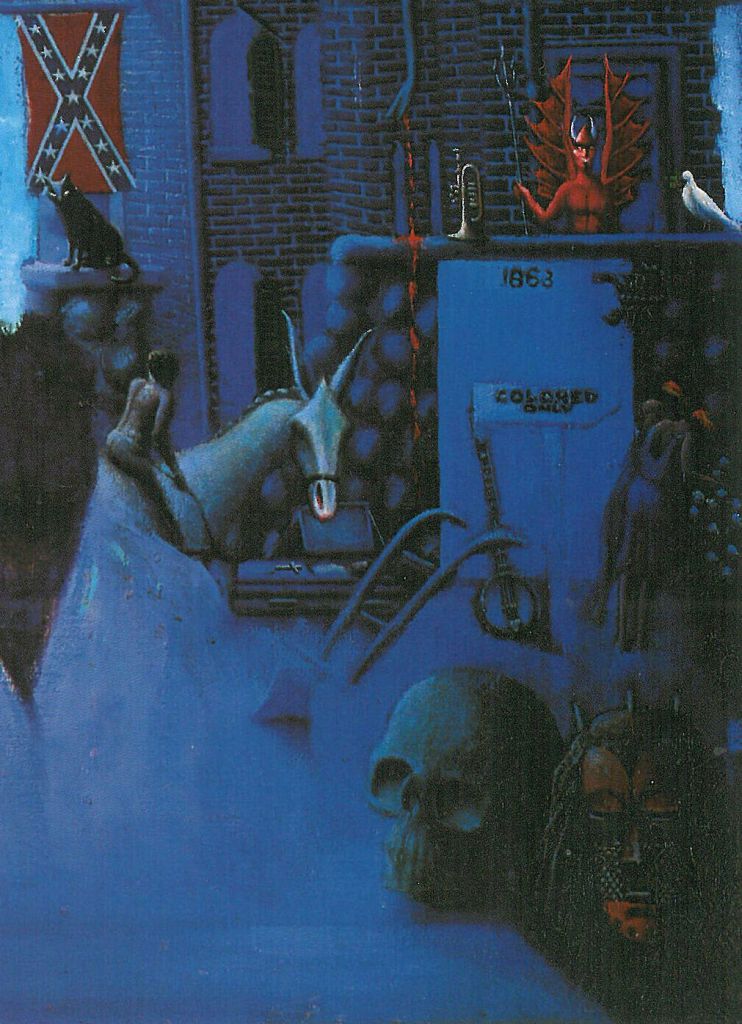
The First One Hundred Years by Archibald Motley: A Racial Lament Painting

Archibald J. Motley Jr. (1891–1981) was one of the most important artists of the Harlem Renaissance. He’s best known for his paintings of urban Black culture, especially the Chicago jazz scene and other nightlife, and he was also a wonderful portraitist.

His final painting, however, shows none of the carefree conviviality that was characteristic of much of his work. On the contrary, it’s nightmarish. Begun in 1963 and reworked over the course of a decade, The First One Hundred Years: He Amongst You Who is Without Sin Shall Cast the First Stone: Forgive Them Father For They Know Not What They Do chronicles race relations in the United States from the Civil War to the civil rights era. It’s the most overtly political painting in Motley’s oeuvre, and once completed, he didn’t paint for the remaining nine years of his life.

Motley Jr., Archibald_The First One Hundred Years
Archibald J. Motley Jr. (American, 1891–1981), The First One Hundred Years: He Amongst You Who is Without Sin Shall Cast the First Stone: Forgive Them Father For They Know Not What They Do, 1963–72. Oil on canvas, 48 7/8 × 40 3/4 in. (124 × 103.5 cm). Collection of Mara Motley and Valerie Gerrard Browne. Image courtesy the Chicago History Museum, © Valerie Gerrard Browne (artist’s daughter-in-law).

The “one hundred years” in the title refers to the period since the Emancipation Proclamation took effect in 1863, changing the legal status of more than 3.5 million enslaved African Americans to “free.” The Civil War ended May 9, 1865, and slavery was officially abolished with the Thirteenth Amendment on December 18 of that year. But the legacy of that institution was still felt throughout the next century, in which Black people suffered disenfranchisement, segregation, lynchings, and a number of other injustices and terrors.

Motley visualizes the Black struggle for freedom and equality through symbols and vignettes.

At the top of the painting are the death masks of John F. Kennedy, Martin Luther King Jr., and Abraham Lincoln, all of whom were assassinated as they sought to advance the rights of African Americans.

Below King’s visage is a Confederate flag, hanging from the front porch of a crumbling Southern manse. The red is replicated in the blood running out the house’s downspout, a horned devil (who surveys the domain he’s claimed), the blood-drop cross insignia of a Ku Klux Klansman, and the tongue of a snarling police dog.

(Related posts: “Book Review: Beholding Christ and Christianity in African American Art; “MLK, Pippin, and the Holy Mountain”; Philip Evergood’s The New Lazarus)

At the bottom right a traditional African mask lies beside a human skull, alluding not only to physical death but also to the fragmentation or loss of cultural identity experienced by those who were abducted from their homeland and brought across the Atlantic to live in captivity, separated from their families and communities and ways of life and even given new names by their oppressors. This wound is also felt by the enslaved persons’ descendants, who are unable to trace their lineage.

Motley Jr., Archibald_The First One Hundred Years (detail)

Above this still life is a Black person on horseback, operating a plow right next to a coffin. Besides the obvious reference to plantation labor, the vignette also evokes the African American spiritual that goes, “Keep your hand on the plow, hold on”—a song of endurance through hardship.

In the center of the painting the Statue of Liberty stands in ironic contrast to a lynched man, the color of her freedom torch echoed in the burning cross of the KKK. Just behind this dead Black man who hangs from a tree is another dead man hanging from another tree: Jesus on the cross. (For more on how these two symbols mutually interpret each other, see theologian James H. Cone’s The Cross and the Lynching Tree.) The hill of Calvary is the brightest part of the entire composition, which I imagine Motley, a practicing Catholic, intended to signify hope, enlightenment, and a call to repentance. The cross illuminates our sin and the love of God that compels us to love our neighbors. I will address this further, in relation to an MLK sermon, below.

Motley Jr., Archibald_The First One Hundred Years (detail)

In the shadow of the cross is a sea of protest and counterprotest signs. Alongside slogans like “We Want to Vote,” “Black Power,” and “We Shall Overcome” are swastikas, “America for Whites, Africa for Blacks,” and “Go home, niggers, and get your relief check.” To the left of this activity, a white police officer beats a Black man with a baton, and a fireman turns a high-pressure hose on Lady Justice. This vignette evokes the chilling news footage from May 1963, when Birmingham Public Safety Commissioner Bull Connor ordered the use of fire hoses and attack dogs on peaceful Black protesters, including children. The force of the jet streams ripped off boys’ shirts and pushed girls over the tops of cars. It was an assault on Black bodies and on justice itself.

Birmingham, Alabama, was, and still is, one of the most racially divided cities in the US, and in the 1960s it became a center of civil rights activism. From 1947 to 1965 it was the site of fifty racially motivated dynamite explosions, earning it the nickname “Bombingham.” The bombing that caught the most international attention was of Sixteenth Street Baptist Church on September 15, 1963. The blast killed four girls who were leaving Sunday school: Addie Mae Collins, Cynthia Wesley, Carole Robertson, and Carol Denise McNair. Motley alludes to this terrorist act with the stained glass window wherein the face of a white Jesus is blown out, as that’s actually what happened at Sixteenth Street Baptist. (“The absence of the face,” said James Baldwin, “is something of an achievement since we have been victimized so long by an alabaster Christ.”)

Motley Jr., Archibald_The First One Hundred Years (detail)

In the center foreground, emerging from the phantasmagoria, is another faceless figure, his form and features undefined. He’s a specter, really, walking toward us—or is it someone in a dream state? Motley mixes historical scenes of violence and terror with contemporary ones, showing how the ghosts of our nation’s past are still haunting us.

Scattered throughout the painting are animals that represent ill omens or evil: a bat, a vulture (who feeds on death), a black cat, a serpent, a scorpion (on the right, crawling across the door marked “1863”). The latter two call to mind Luke 10:19, where Jesus tells his disciples, “Behold, I give unto you power to tread on serpents and scorpions, and over all the power of the enemy . . .” A dove of peace, the only nonsinister animal presence, perches on the margins.

Church, listen up: we have the call and the power, in Christ(!), to tread on racism and every other evil that erects itself against the kingdom of God. Don’t let the Enemy have a stranglehold. Let us be active in confronting the evil of white supremacy and dismantling it—in our own hearts, our congregations, our government, and in all the other systems it operates in—so that the supremacy of Christ and his gospel of freedom and reconciliation can be made known.

Where Are We Today?

I encountered The First One Hundred Years through the 2015 retrospective Archibald Motley: Jazz Age Modernist and have been sitting with the image ever since, thinking: What progress have we made? Do I recognize this scene? What will “The Next One Hundred Years” look like in America?

It’s been almost fifty years since Motley completed the painting, and blood still flows. Black people are still being lynched (Ahmaud Arbery, killed by white vigilantes while out on a jog, is one example). Some people and businesses are still flying their Confederate flags. And racist hate groups are as active as ever. Last October the Department of Homeland Security named white supremacist extremists the country’s number one domestic terrorism threat, a threat that came to fruition January 6 when a mob of radical Trump supporters, catalyzed by the president himself, stormed the Capitol equipped with climbing gear, riot helmets, shields, gas masks, bear spray, flex cuffs, lead pipes, and baseball bats, attempting to overturn the 2020 presidential election results by force. The insurrectionists erected a functional gallows and noose on the lawn and shouted and graffitied death threats. A Confederate battle flag was marched through the halls of Congress, as were other neo-Confederate, neo-Nazi, and nationalist symbols, along with crosses, the Christian flag, a “Jesus 2020” banner, “Make America Godly Again,” etc. (Christian nationalism, on flagrant display at the Capitol, has been publicly denounced by several prominent American Christians these past four years, so I won’t get into it here.) The mob was a mishmash of different groups and individuals united around Trump’s claims of election fraud and trying to hold on to (white) power.

Law enforcement’s completely deficient planning for the white-led protest (and thus inability to properly respond when the protest turned into a siege) stood in stark contrast to the way Black Lives Matter protests in DC were handled last summer, with militarized officers at the ready, low-flying helicopters, and eight-foot-tall fences. Peaceful Black protesters in the streets were met with tear gas and rubber bullets, whereas January 6’s white protesters were able to invade the Capitol with little resistance.

Why the woeful lapse in security, despite clear intelligence that right-wing extremists would be gathering there the day Congress was convening to ratify Biden’s democratically won victory? Because despite the DHS’s recent Homeland Threat Assessment, white people are, in general, not perceived as dangerous; Black (and brown) people are. And because white people know the system works for them, those who stormed the Capitol felt empowered to do so with impunity. They weren’t scared of the police. They didn’t even try masking their identities; on the contrary, several posted photos and videos of their crimes online. After trespassing, assaulting police officers (one of whom died), and vandalizing and looting while federal legislators ran and hid in fear for their lives, the insurrectionists were gently told by President Trump to “Go home. We love you.” Only a few were detained. Investigations have since been launched and more and more arrests are being made. But I bring this all up to show just one recent instance of racial disparities in policing as well as the rise of white nationalist fervor, which are just two of the many symptoms that prove that America does indeed still have a race problem.

The Trump presidency has really brought white supremacy to the fore, forcing us to confront a national sin that perhaps we thought was mostly behind us. “Reckoning” is a word I’ve been seeing a lot. Activist and author Ibram X. Kendi says that if we can be thankful to Trump for anything, it’s this: “He has held up a mirror to American society, and it has reflected back a grotesque image that many people had until now refused to see: an image not just of the racism still coursing through the country, but also of the reflex to deny that reality.”

The Need for Enlightenment

The two subtitles of Motley’s painting are both quotations of Jesus, which together indict sin and ask God for mercy. “He amongst you who is without sin shall cast the first stone” (John 8:7) was spoken to pierce the consciences of a mob of religious elites who sought to stone a woman for adultery; it exposed their two-facedness, their eagerness to punish another’s sin but not to examine their own. Motley is thus urging viewers to confront the ways in which they themselves have violated God’s law, how they have said, by their words or actions (or inaction), that Black lives do not matter. Admit. Admitting sin, admitting that there’s a problem, is the first step in rooting it out.  

“Forgive them, Father, for they know not what they do” (Luke 23:34) was spoken by Jesus on the cross. As he hung dying, he prayed to God on behalf of his killers, recognizing in them a spiritual blindness. Forgiveness is a nuanced concept whose complexities I won’t discuss here, but Jesus’s prayer expresses his goodwill toward his enemies, a spirit of wanting to see them reconciled to God. Jesus recognized that even as sinners hurt people, they themselves are also hurting. They don’t even realize how their sin binds them and blinds them.

In a ca. 1962 sermon on this text, Martin Luther King describes his oppressors (and Jesus’s) as suffering from an “intellectual and moral blindness . . . an ill which man inflicts upon himself by his tragic misuse of freedom and his failure to use his mind to its fullest capacity. There is plenty information available if we consider it as serious a moral obligation to be intelligent as to be sincere. One day we will learn that the heart can never be totally right if the head is totally wrong.” King describes how enslavers sought to rationalize their beliefs, drawing from “science,” history, and biblical interpretation, and segregationists were doing the same, ignoring all evidence that contradicted what they sincerely believed to be true. These days we’ve seen how those who benefit from white privilege seek to explain away racial inequalities or even simply refuse to believe they exist, because who wants to give up power? And of course they find online communities or curate social media feeds that bolster their view that everyone is treated equally in America, that skin color does not grant any unfair advantages, and so when another unarmed Black person is killed by police, they interpret it through the white lens of “Well, he must have been doing something wrong . . .”

Maybe as you read this very article you’re tensing up and want to tell me X, Y, and Z regarding why white privilege is a fallacy or how I’ve been taken in by a “liberal agenda,” or how my narrative of the recent event at the Capitol is completely off—it wasn’t an insurrection, and it had nothing to do with white supremacy, and those weren’t really Trump supporters (yes, I’ve actually heard people say that). Maybe you think it’s me who’s blind.

King talks about the need for enlightenment.

Light has come into the world. There is a voice crying through the vista of time calling men to walk in the light. Man’s earthly life will be reduced to a tragic cosmic elegy if he fails to heed this call. “This is the condemnation,” says John, “that light is come into the world, and men loved darkness rather than light.”

John’s saying, King says, is demonstrated vividly at the cross, which shows God at his best and humanity at its worst.

We must continue to see the Cross as a magnificent symbol of love conquering hate, and light overcoming darkness. But in the midst of this glowing affirmation, let us never forget that our Lord and Master was nailed to that Cross because of human blindness. Those who crucified him knew not what they did.

In what ways are we nailing Christ to the cross afresh, so to speak, unaware of what we’re doing? In what ways are we resisting the work of the Holy Spirit to expose sin, both personal and collective? In what ways are we closing our ears to the cries of our hurting Black brothers and sisters, and to the calls to action from those who are continuing King’s legacy of nonviolent resistance? I’m speaking to white American Christians in particular here. We all want America to heal. But the sin of racism must be acknowledged and confessed, and repentance undertaken, before healing can proceed.

Repenting of sin is a foundational Christian practice; it’s in the church’s DNA. And yet with this particular issue, there’s been a lot of unwillingness among Christians to see and to act. These past four years have been for me a time of self-examination and also critical examination of the evangelical tradition I grew up in and which you might say I’m still a part of. In addition, I’ve spent a lot of time relearning history, locating my privilege, unlearning biases, rereading the Psalms and the Prophets, repenting, exploring more deeply the witness of the Black church and all-around diversifying the voices I listen to, and slowly (admittedly, hesitantly!) wading into the waters of civic engagement. I have a long way to go, to be sure, but I’m on the journey.

I see Motley’s painting as a lament for all the racial injustices perpetrated in the US but also a statement of hope, as the cross beckons us to persist in (or join) the freedom struggle. It’s a prayer that the scales would fall off the eyes of white America—that we would shed willful ignorance—and that people of all races would walk together not only in the light of “liberty and justice for all” but, as King preached, in the light and Spirit of Christ.