Advent, Day 6: Tears

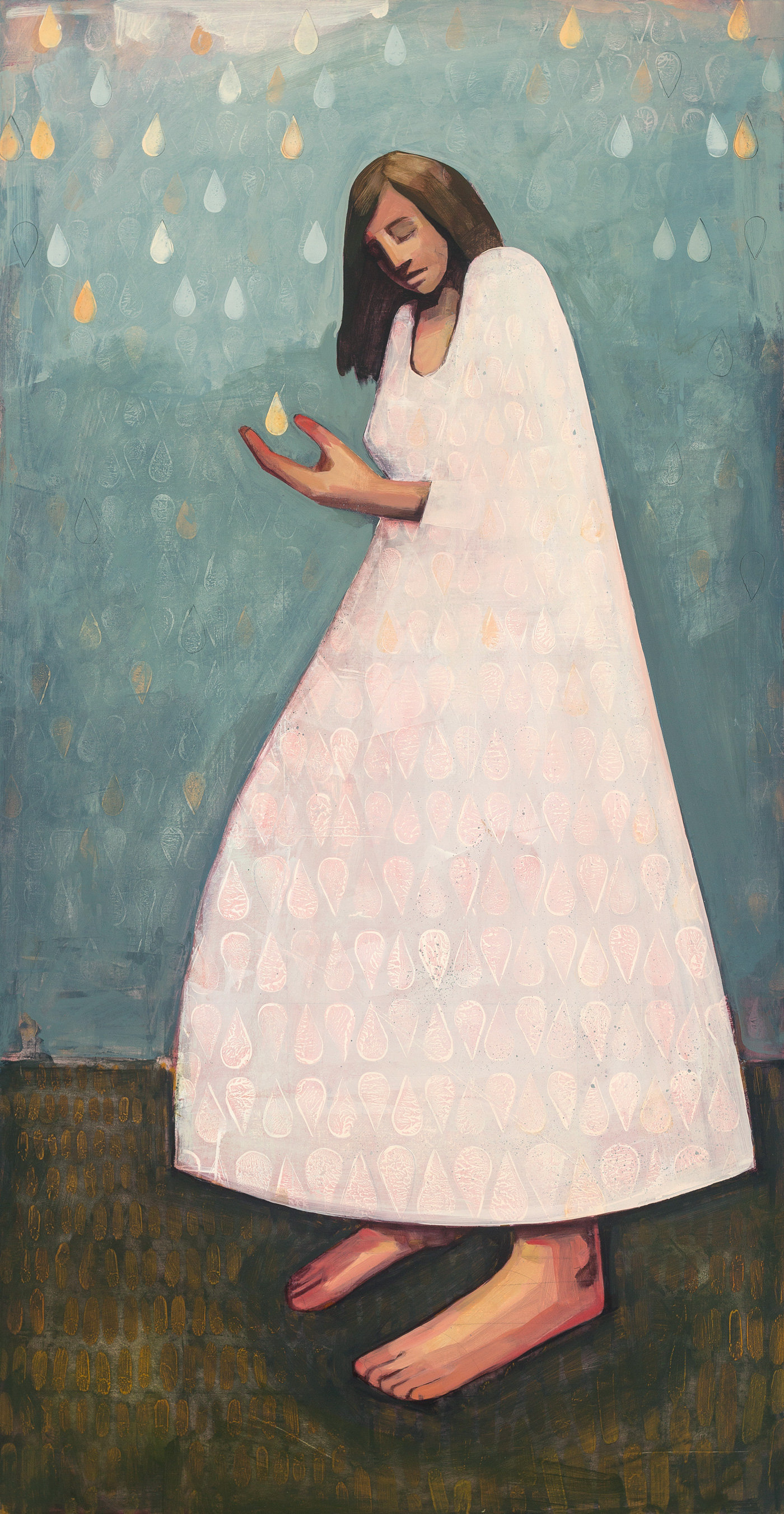
LOOK: the heavens wept with me by Caitlin Connolly
Connolly, Caitlin_the heavens wept with me
Caitlin Connolly (American, 1986–), the heavens wept with me, 2018. Oil on canvas.

LISTEN: “A Dream / On Another’s Sorrow” | Words by William Blake, from Songs of Innocence, 1789, adapt. | Music by David Benjamin Blower, on Innocence & Experience, 2022

Once a dream did weave a shade
O’er my Angel-guarded bed,
That an Emmet lost its way
Where on grass methought I lay.

Troubled, ’wildered, and forlorn,
Dark, benighted, travel-worn,
Over many a tangled spray,
All heart-broke I heard her say:

“O my children! do they cry?
Do they hear their father sigh?
Now they look abroad to see:
Now return and weep for me.”

Pitying, I dropped a tear;
But I saw a glow-worm near,
Who replied: “What wailing wight
Calls the watchman of the night?

“I am set to light the ground,
While the beetle goes his round:
Follow now the beetle’s hum;
Little wanderer, hie thee home.”

*

Can I see another’s woe,
And not be in sorrow too?
Can I see another’s grief,
And not seek for kind relief?

Can I see a falling tear,
And not feel my sorrow’s share?
Can a father see his child
Weep, nor be with sorrow filled?

Can a mother sit and hear
An infant groan, an infant fear?
No, no! never can it be!
Never, never can it be!

And can They who smile on all
Hear the wren with sorrows small,
Hear the small bird’s grief and care,
Hear the woes that infants bear,

And not sit beside the nest,
Pouring pity in their breast;
And not sit the cradle near,
Weeping tear on infant’s tear;

And not sit both night and day,
Wiping all our tears away?
O no! never can it be!
Never, never can it be!

They do give Their joy to all;
They become an infant small;
They become a one of woe;
They do feel the sorrow too.

Think not thou canst sigh a sigh,
And thy Maker is not by;
Think not thou canst weep a tear,
And thy Maker is not near.

The lyrics of this song comprise two poems from William Blake’s Songs of Innocence: “A Dream” and “On Another’s Sorrow.”

In “A Dream,” the poetic speaker dreams about a lost ant (an emmet) who is trying to find her way back to her children and husband. The speaker is moved by the ant’s distress and weeps for her. But then a glowworm (“the watchman of the night,” as he’s lit like a lantern) graciously intervenes, telling the ant to listen to the sound of the beetle walking and to follow that sound home while he lights the way.

“Told from a trusting, childlike perspective, the poem”—a fable—“suggests that those who ask for help will get it: the world is a naturally compassionate place, and guidance and protection are always at hand, even in difficult times.” (LitCharts)

Aren’t we all “little wanderers”? Many of us troubled, bewildered, lonely, and worn by our seeking and striving?

There is empathy for us not only from fellow travelers but also from the Divine.

“On Another’s Sorrow” is about how God lovingly enters into our woes through the Incarnation. He becomes a participant in the project of being human, experiencing firsthand the many trials, hurts, and vulnerabilities that come with the territory.  

In the first three stanzas, the speaker expresses how keenly he feels the sorrows of others. In the fourth stanza, he reflects on how God does the same—only God is perfectly present to all, weeping with those who weep, sighing with those who sigh. Having “become an infant small,” the Creator has demonstrated solidarity with his creation. It is a comfort to know that God is so intimately acquainted with the griefs that afflict us and is keen to companion us through them.

In his creative visioning, British singer-songwriter David Benjamin Blower brought together Blake’s “A Dream” and “On Another’s Sorrow” with a single, spare musical setting, linking the two poems with an instrumental interlude but keeping the same tune throughout. The first poem is about the feeling of weariness or lostness; the second, grief. Both have to do with compassion—we owe it to one another and often receive it from others, and it is always available to us in Christ, who is God brought near.

In “On Another’s Sorrow,” Blower changed the pronouns for God in the fourth and seventh stanzas from “He/His” to “They/Their,” since God is neither male nor female. He also omitted the final stanza in Blake’s original:

O! He gives to us His joy
That our grief He may destroy:
Till our grief is fled and gone,
He doth sit by us and moan.


This post is part of a daily Advent series from December 2 to 24, 2023 (with Christmas to follow through January 6, 2024). View all the posts here, and the accompanying Spotify playlist here.

Roundup: “The Loving Look,” Keiskamma retrospective, and more

ONLINE EVENT: “Theodicy of Beauty” by Sarah Clarkson, March 6, 2:30 p.m. ET: “The question of suffering is one of the central, aching questions of faith. Too often, we meet suffering with an argument for God’s goodness, rather than an invitation to find and discover his goodness anew. Join me for an exploration of what it means to encounter and trust the beauty of God in our times of darkness, suffering, and pain. Drawing on my own story of mental illness and depression, I’ll explore what it means to engage with God’s goodness in a radically healing way, one that restores our capacity to imagine, hope, and create. We’ll use literature, art, and poetry to discern the ways that God arrives in our darkness to heal us, and also to restore us as agents of his loveliness in the midst of a broken world.”

This Crowdcast talk by Sarah Clarkson is based on her book This Beautiful Truth: How God’s Goodness Breaks into Our Darkness. Registration is $7 and includes a complimentary downloadable copy of “Encountering Beauty,” an arts-based reader’s guide to Clarkson’s book. I have appreciated her From the Vicarage: Books, Beauty, Theology newsletter and her wise, gentle reflections on spirituality, literature, and motherhood on Instagram @sarahwanders, so I’m looking forward to hearing from her on this topic!

+++

LECTURES (available on podcast platforms):

>> “The Loving Look” by Dr. Elissa Yukiko Weichbrodt: In this keynote address for the 2018 Beautiful Orthodoxy conference, art historian Elissa Yukiko Weichbrodt [previously], author of Redeeming Vision: A Christian Guide to Looking at and Learning from Art, discusses how contemporary art—which can sometimes be confounding or otherwise challenging—can drive us to confession, empathy, and love. Sharing her encounters with three contemporary artworks, she talks about art as a place where we can experience sanctification and common grace; how the Incarnation further vested our material world with significance; art as an invitation to embodied knowledge; art as part of how we order and understand our physical world; artworks as mirrors and shapers of culture; and how viewers, not just artists, are called to faithfulness.

Yamamoto, Lynne_Wrung
Lynne Yamamoto (American, 1961–), Wrung, 1992. Wringer, synthetic hair, nails, string, 42 × 13 × 5 in.

She cites Esther Lightcap Meek’s Loving to Know: Covenant Epistemology, in which Meek says that all acts of coming to know are integrative; they become part of us. Knowledge is an act of covenantal care, Meek says. We don’t know in order to love; we love in order to know. Weichbrodt says, “For me, contemporary art—particularly art made by artists grappling with histories and experiences that have remained largely unseen, unknown, and unloved by the dominant culture—has served as a catalyst for faithful knowing.”

Besides Wrung, the two other works she spotlights are Outline by Lorna Simpson and From Here I Saw What Happened and I Cried by Carrie Mae Weems.

>> “The Arts as a Means to Love” by Dr. Mary McCampbell: In this lecture given for English L’Abri, Mary McCampbell [previously], an associate professor of humanities at Lee University, discusses some of the ideas from her book Imagining Our Neighbors as Ourselves: How Art Shapes Empathy. I appreciate how her writing and teaching embraces the arts of film and television alongside literature, such that not only are works like The Power and the Glory by Graham Greene, “A Good Man Is Hard to Find” by Flannery O’Connor, and Beloved by Toni Morrison explored, but so are, for example, the comedy-drama Lars and the Real Girl and the drama series Better Call Saul. Discrediting the recent odd assertion from a prominent evangelical corner that empathy is a sin, McCampbell affirms that empathy is, on the contrary, an essential Christian virtue, and one that the narrative arts are adept at forming in us, exposing us to people and stories outside our realms of experience and helping us recognize the image of God in unlikely places.

+++

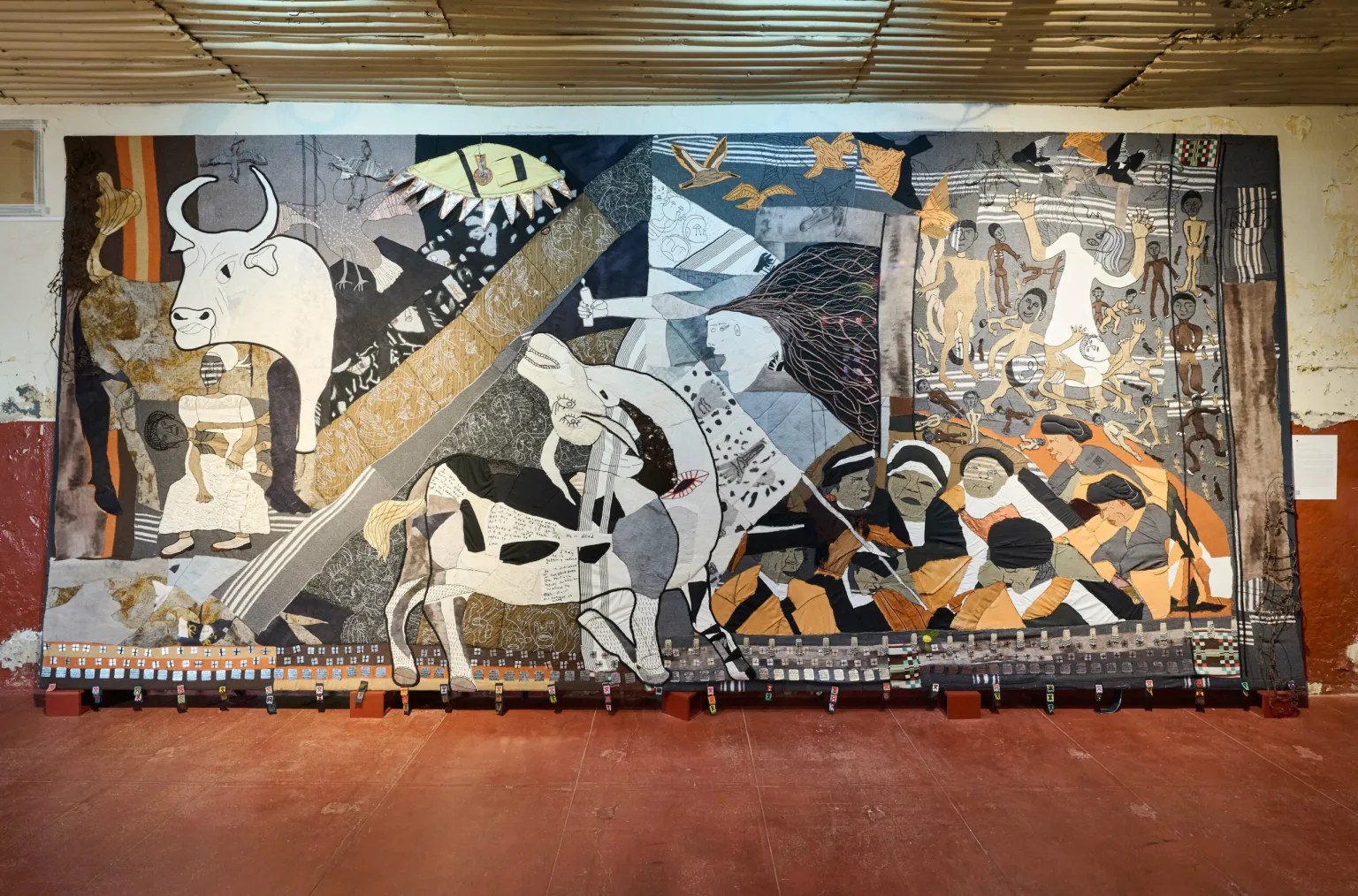
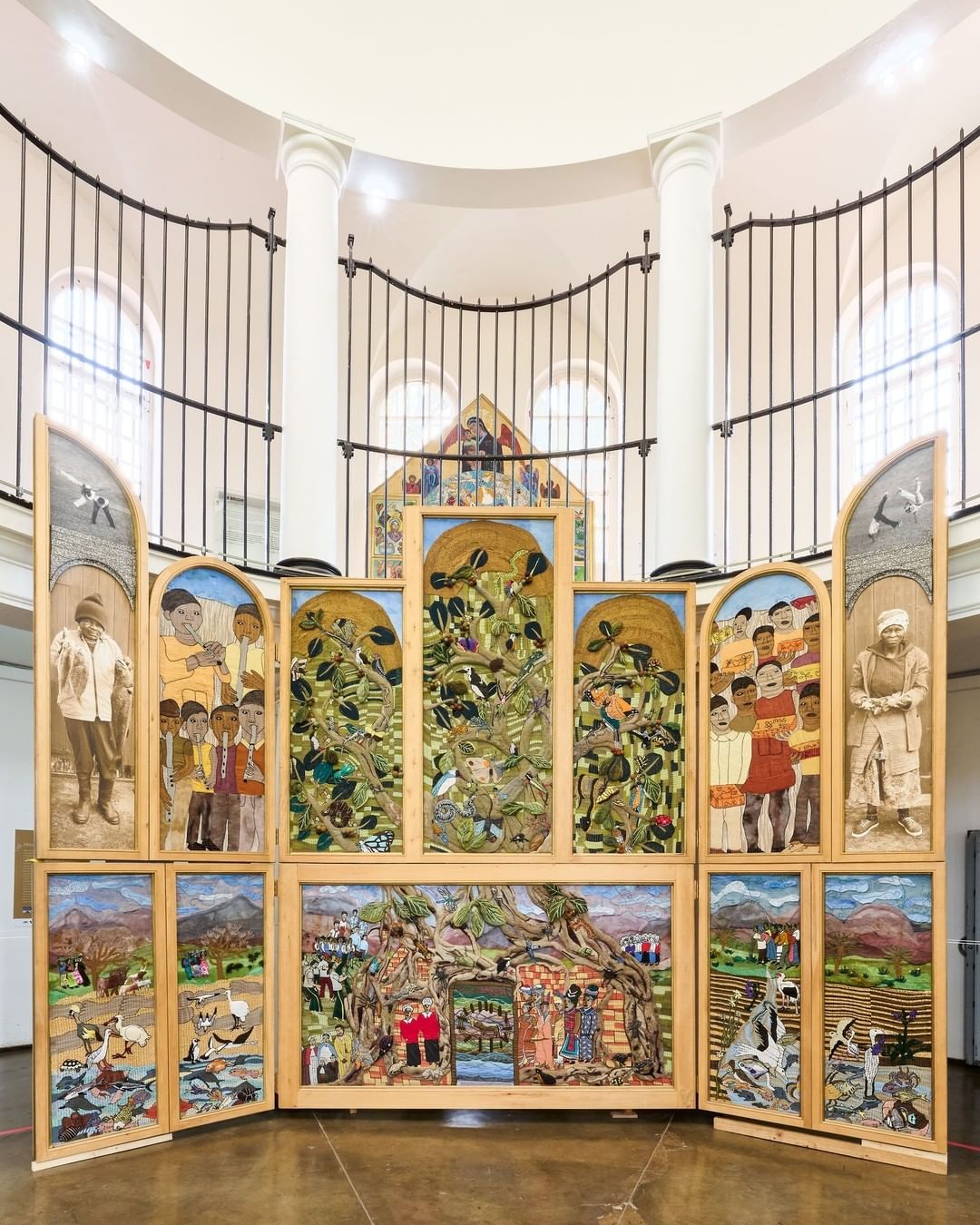
EXHIBITION REVIEW: “Mourning and Perseverance Stitched into South African Tapestries” by Alexandra M. Thomas: Through March 24 at Constitution Hill in Johannesburg, you can see Umaf’evuka, nje ngenyanga, dying and rising, as the moon does, a major retrospective of the work of the Keiskamma Art Project. Founded in 2000, the project archives the collective memory and oral histories of the rural Eastern Cape of South Africa through textile artworks, mainly by Xhosa women. Monumental and small-scale works tell stories of trauma, grief, hope, faith, resilience, and celebration. One of my favorite art research projects has been the one I did on the Isenheim-inspired Keiskamma Altarpiece in 2015, which resulted in the article “Sewing seeds of hope in South Africa”; this altarpiece is one of the many works on display. Let me call out just two others. The photos are from the current exhibition.

Keiskamma Guernica
Keiskamma Guernica, 2010. Mixed media, including appliqué, felt, embroidery, rusted wire, metal tags, beaded AIDS ribbons, used blankets, and old clothes, 3.5 × 7.8 m. Collection of Javett Art Centre at the University of Pretoria, Tshwane, South Africa. Photo: Anthea Pokroy / Keiskamma Trust.

Creation Altarpiece (Keiskamma)
Creation Altarpiece, 2007. Mixed media, including felt, embroidery, photographs, beadwork, wirework, and appliqué, 3.8 × 5.2 m (open). Collection of Unisa Art Gallery, Tshwane, South Africa.

Keiskamma Guernica, after Picasso’s famous antiwar painting, laments the limited access to HIV treatment in rural South Africa in the 2000s and the negligence of government hospitals, which resulted in many HIV/AIDS deaths. The piece repurposes the blankets and clothes of the deceased and serves as an expression of outrage as well as a form of commemoration. Creation Altarpiece, modeled loosely after the Ghent Altarpiece, exults in the region’s abundant wildlife and natural resources and in life-giving initiatives like Hamburg’s music education program, its capoeira group (a dance-like martial art), and the memory boxes made by orphaned children to remember their parents. The three top central panels depict a fig tree eating up an old hotel built by colonialists (a real-life scene observed in the nearby village of Bell!), and the bottom three show villagers of all kinds gathering around Christ, represented as a bull (whereas lambs were commonly sacrificed in ancient Israelite religion, traditional Xhosa religion calls for bull sacrifices).

View the beautiful exhibition catalog here.

+++

SONG: “Kyrie” by Ngwa Roland: Ngwa Roland is a composer and the director of De Angelis Capella [previously], a Catholic choir from Yaoundé, Cameroon. Here is his choral setting of the Kyrie eleison (Greek for “Lord, have mercy”), an important Christian prayer used in liturgies around the world.

+++

ARTICLES:

>> “To One Kneeling Down No Word Came” by Jonathan Chan, Yale Logos: Jonathan Chan is a Singapore-based poet and essayist who graduated with a master’s degree in East Asian Studies from Yale in 2022. In this personal essay he reflects on the poetry of R. S. Thomas, a twentieth-century Anglican priest from Wales, particularly as it relates to the toil of prayer—prayer as a discipline requiring persistence and solitude. Thomas’s poems often express a sense of alienation from God, which is not what we might expect from a pastor, but, as Chan remarks, “God’s absence cultivates a desire for God’s presence.”

>> “Stabat Mater: How a 13th Century Lament Resonates Today” by Josh Rodriguez, Forefront: Back in July 2020, composer Josh Rodriguez [previously here and here] published this article on four modern settings of one of the most celebrated Latin hymns of all time, the twenty-stanza Stabat Mater Dolorosa (lit. “The sorrowful mother was standing”), about Mary mourning the death of her son Jesus. Written in the Middle Ages, it continues to inspire composers today, and it remains “a powerful vehicle for ‘grieving with those who grieve,’” Rodriguez writes. He spotlights the settings by James Macmillan, Julia Perry, Hawar Tawfiq, and Paul Mealor, analyzing some of the musical elements of each and quoting the composers in regards to the piece’s meaning to them.

“The Greatest of These” by Tania Runyan

          1 Cor 13

Embraces the woman whose child screams
on the floor of the cereal aisle.
Enters the friend’s new mansion,
lifts eyes to the skylights, gives thanks.
Yields the last word on the Facebook fight.
Looks the frowning barista in the eye.
Takes a breath and thanks God
there is even a zipper to get stuck.
Sends a gift to the wall-punching uncle.
Glances away from the handcuffed boys
on the side of the road and prays.
Smiles and listens to the grandmother complain
about her knees, rubs the knees,
ladles another bowl of soup.
Believes there is a reason that slumped man
in the alley was born. Trusts he’ll believe it.
Endures the quiet, thankless song of work.
Echoes long after the cymbals have died.

This poem is from Second Sky by Tania Runyan (Cascade/Wipf & Stock, 2013), a collection that “intertwines the life and writings of the Apostle Paul with the spiritual journey of a modern suburban woman confronting the broken world.” Used with permission.