Holy Week: Jesus Takes Up His Cross

. . . carrying the cross by himself he went out to what is called the Place of the Skull, which in Hebrew is called Golgotha. There they crucified him . . .

—John 19:17–18

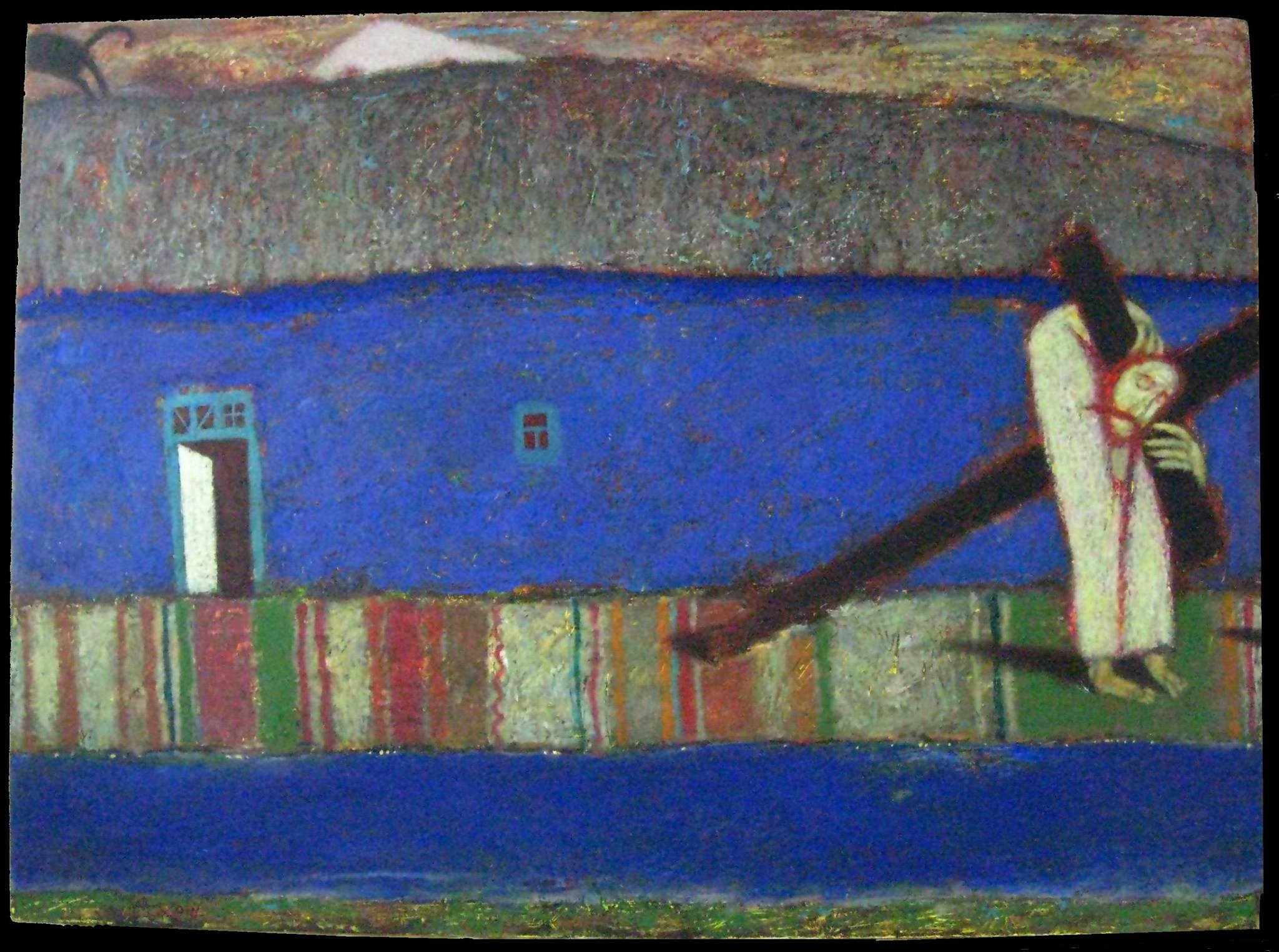
LOOK: White Mountain by Ihor Paneyko
Paneyko, Ihor_White Mountain
Ihor Paneyko (Игоря Панейка) (Ukrainian, 1957–), White Mountain, 2011. Egg tempera on gessoed board.

LISTEN: “Solus ad victimam” (Alone to Sacrifice Thou Goest, Lord) | Original Latin words by Peter Abelard, second quarter of 12th century; English translation by Helen Waddell, 1929 | Music by Kenneth Leighton, 1973 | Performed by St. Olaf Cantorei, dir. John Ferguson, on Hidden in Humbleness: Meditations for Holy Week and Easter, 2010

Alone to sacrifice thou goest, Lord,
Giving thyself to Death, whom thou hast slain.
For us, thy wretched folk, is [there] any word,
Who know that for our sins this is thy pain?

For they are ours, O Lord, our deeds, our deeds.
Why must thou suffer torture for our sin?
Let our hearts suffer for thy passion, Lord,
That very suffering may thy mercy win.

This is that night of tears, the three days’ space,
Sorrow abiding of the eventide,
Until the day break with the risen Christ,
And hearts that sorrowed shall be satisfied.

So may our hearts share in thine anguish, Lord,
That they may sharers of thy glory be.
Heavy with weeping may the three days pass,
To win the laughter of thine Easter Day.

“In Parasceve Domini: III. Nocturno,” whose first line is “Solus ad victimam procedis, Domine,” is a Latin hymn by the French scholastic philosopher, theologian, and poet Peter Abelard (1079–1142). It appears in his collection Hymnarius Paraclitensis—a major contribution to medieval Latin hymnody—and was sung in the night office (Nocturns) of prayers on Good Friday.

Today it is best known through its modern choral setting of the English by British composer and pianist Kenneth Leighton (1929–1988). Dr. David Ouzts, the minister of music and liturgy at Church of the Holy Communion in Memphis, says this is “one of the most effective musical settings of any anthem of the 1,000-plus octavos in our parish music library.” He continues:

This anthem is one of those with harmonies and sonorities that may not sound correct when they are. Worshipers will hear the sparseness of the choir singing in simple same-note octaves, and in the next moment, dissonances between the choral voices will appear.

Though this 12th century text is most certainly a Passiontide text, my favorite aspect is that it foreshadows Easter and the Resurrection.

The wordplay of the music that accompanies “laughter” in the text is notable. The choral voices are high in their tessituras, and the full choir ends literally on a high note, after which the organ accompaniment steals the show with great dissonant chords, only to land on a huge, bright E Major chord.

The hymn invites us to follow Christ to Golgotha, beholding his suffering so that we might be moved to contrition and, clinging to God’s mercy, rise to newness of life—or, as the wonderful last line puts it, “win the laughter of [Christ’s] Easter Day.” The fourth stanza alludes to Romans 8:17, where the apostle Paul writes that we are “heirs of God and joint heirs with Christ, if we in fact suffer with him so that we may also be glorified with him.” Paul speaks elsewhere of believers being “crucified with Christ” (Gal. 2:20)—see my visual commentaries on this passage—and “baptized into his death” (Rom. 6:3) as well as being raised with him.

Jesus may have gone “alone to sacrifice”—but the fruits of that sacrifice abound to all who would eat. Praise be to God.

As we enter the Paschal Triduum, let us weep for our sins and for the innocent Lamb who was slain to atone for them. Let us also look with hope toward daybreak.
Roundup: Too much religion; the single story; fore-edge paintings; choral evensong; and more

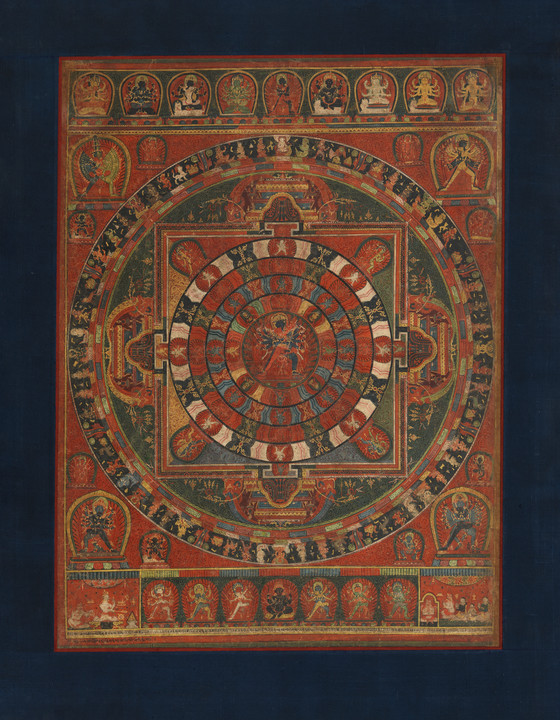
EXHIBITION REVIEW: “Overstating the religious?” by Christopher Knight, Los Angeles Times: Michael Wright brought to my attention an old review of the 2003 LACMA exhibition “The Circle of Bliss: Buddhist Meditational Art,” in which art critic Christopher Knight harshly faults the curators for using religion as the organizing principle . . . of an exhibition of religious art. He says it’s “bizarre” and “inappropriate” that

traditional artistic concerns of art museum exhibitions – style, historical context, connoisseurship, artist biography, etc. – play no part in [the objects’] presentation. Instead, LACMA’s galleries unfold as the articulation and embodiment of a religious philosophy. . . . You will leave this exhibition having not a clue who these artists were . . . and how (or if) their imagery evolved. Instead, the reason for the art’s inclusion is to instruct us in various aspects of the embodiment of perfect compassion – that is, to provide experience with critical theological nuances of “the Middle Way.”

Mandala of the Buddhist Deity Chakrasamvara
Mandala of the Buddhist deity Chakrasamvara, Nepal, 1490. Mineral pigments on cotton cloth, 46 × 34 5/8 in. Los Angeles County Museum of Art, California.

The review itself struck me as bizarre—that Knight decries the exhibition’s focus on the religious meaning of these Tantric paintings, which he considers secondary to their aesthetic qualities and altogether outside the purview of an art institution to comment on. I was glad to see that several readers responded in letters, such as Andy Serrano, who wrote that “up until recent centuries, people did not make art for art’s sake. People who made religious art made it in order to enhance the religious experience in one way or another. Separating religious art without the context of religion is like trying to swim without getting wet.” Phil Cooke chimed in, “The fact that Knight sees no legitimate connection between art and the religious faith that inspired it is at once outrageous and yet sadly typical of current critical assumptions.” [HT: Still Life]

A decade and a half after this exhibition closed, I’ve observed that curators, critics, and art historians oftentimes still struggle to discern or articulate (or else they simply neglect) the theological content and/or devotional purposes of religious art, as they preoccupy themselves instead with the “traditional artistic concerns” Knight mentions. But I do feel that the situation is improving overall, with wider-spread recognition that evaluating certain works of art through the primary lens of religion—if that’s the context in and for which they were created—is not only permissible but essential.

+++

TED TALK: “The Danger of a Single Story” by Chimamanda Ngozi Adichie: The single story, says Nigerian novelist Chimamanda Ngozi Adichie, is when one story (about a person, place, or ethnicity) becomes the only story, creating stereotypes, or a flattened perspective. Adichie admits to having had a single story of her household servant growing up (“poverty”), and later on, of Mexicans (“the abject immigrant”). Many Americans have a single story of Africa. But the problem is, we are all formed by many stories, no single one more definitive than another—and we need to talk about them all. [HT: Sarah Quezada]

+++

ESSAY: “And God Said to Pastors: Use More Sermon Puns and Plan More Parties” by W. David O. Taylor, Christianity Today: Taylor gives three reasons to practice levity and humor in public worship, quoting Augustine, Chesterton, Lewis, Barth, Capon, Buechner, Ratzinger, and Eugene Peterson along the way. I especially like his first point about grace and hyper-abundance.

+++

ESSAY: “In Defense of Owning Too Many Books” by Daniel Melvill Jones, The Curator: I relate to this author’s tottering stacks of books throughout his house—having exhausted my shelf space, I also have them in closets, hutches, and chests. I’m a bibliophile, what can I say. Probably about a third of the books in my personal library I haven’t read yet, which, I affirm with Daniel M. Jones, is both humbling and tantalizing, a “promise of ideas to explore.”

Potential is not in the books you’ve read but in those that remain unread. Therefore, you ought to expand the rows of what you do not know as much as your resources allow, and expect them to keep growing as you get older and accumulate more knowledge.

The books you surround yourself with “will feed [your] life and output in unseen ways.” So stock up!

+++

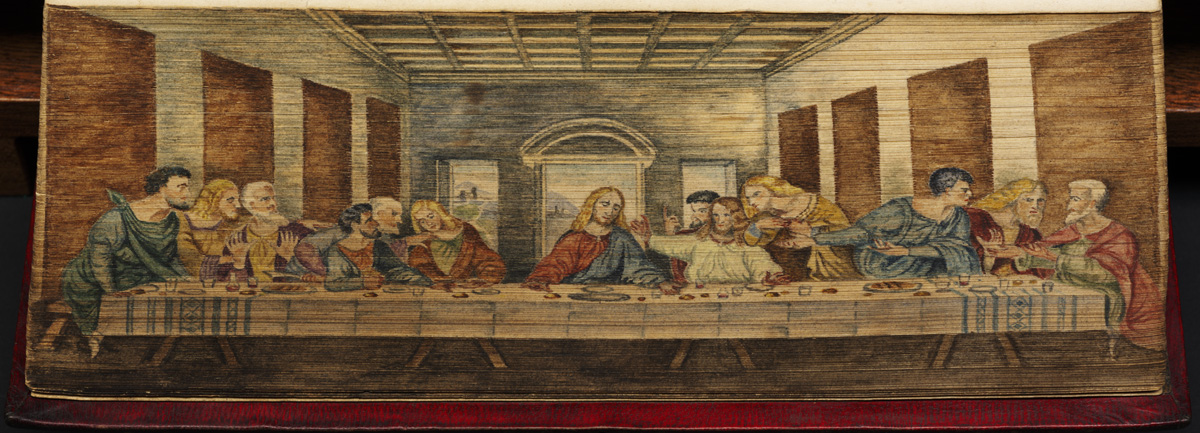
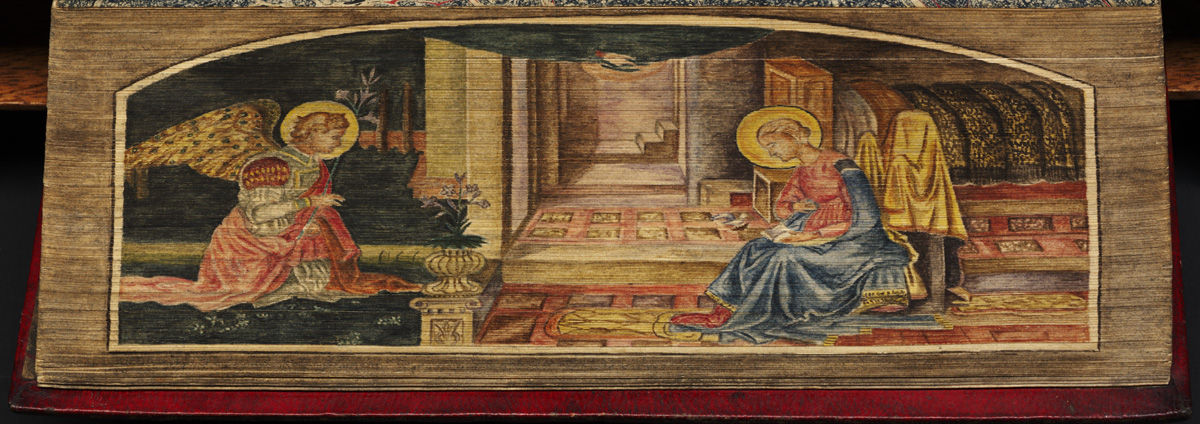
FORE-EDGE PAINTINGS: The Boston Public Library has one of the world’s finest collections of fore-edge paintings, an art form originating around the tenth century but popularized in the eighteenth, utilizing as a surface the edge of a book opposite its spine. Over time, the content of these paintings evolved from decorative or heraldic designs to landscapes and narrative scenes, like these two from volumes 1 and 2 of a Bible printed in Edinburgh in 1803. [HT: Public Domain Review]

Annunciation (fore-edge painting)
The Annunciation after Fra Lippo Lippi, painted on the fore-edge of a Bible (vol. 1 of 2) printed in Edinburgh in 1803. Collection of Boston Public Library.

Last Supper (fore-edge painting)
The Last Supper after Leonardo da Vinci, painted on the fore-edge of a Bible (vol. 2 of 2) printed in Edinburgh in 1803. Collection of Boston Public Library.

Great Big Story recently featured contemporary fore-edge painter Martin Frost, who specializes in the vanishing variety. Cool!

+++

MUSIC DOCUMENTARY: “Elizabeth I’s Battle for God’s Music,” presented by Lucy Worsley: Aired in October 2017 on BBC Four, this hourlong program presents a history of choral evensong, the Protestant church service of music and prayer born out of the English Reformation and still performed today. Worsley moves through the Tudor monarchs, discussing their relationship to sacred music—from Henry VIII, who broke away from the Catholic Church but didn’t want to abandon the Latin mass, and who thus hired Thomas Tallis to compose in a more austere style in which the words of the liturgy could be more easily understood; to his son Edward VI, who, in his dislike of elaborate music, ordered the disbanding of choirs and the destruction of organs, but also supported the creation of the first complete English prayer-book (Thomas Cranmer’s Book of Common Prayer) and John Marbeck’s musical guide to it; to Mary I, who returned England to Catholicism, with its high-church music, all in Latin; and finally Elizabeth I, a moderate Protestant whose compromising spirit led to the reinstatement of English evensong but with much leeway given as to how it is set, whether in monophony, homophony, or polyphony. Elizabeth’s patronage and legal protections of church music made possible the glorious compositions of, among others, William Byrd, and ensured the survival of choral evensong. [HT: Global Christian Worship]

Choral evensong is a continuing tradition, and Worsley concludes by highlighting its new possibilities, such as the Oxford Blues Service by Roderick Williams. Listen to an excerpt on the SoundCloud player below.