25 Poems for Christmas, vol. 3

This is the third installment of my annual “25 Poems for Christmas” series. Included too, on the front end, are poems for Advent, the four-week season of preparation, hope, and expectation leading up to Christmas.

[Read volume 1] [Read volume 2]

1. “Advent (III)” by W. H. Auden, from For the Time Being: Voiced by the Chorus, who cry out from “a dreadful wood / Of conscious evil,” this is the third section of part 1 of Auden’s book-length Christmas poem in nine parts, For the Time Being—“the only direct treatment of sacred subjects I shall ever attempt,” he said. He wrote the poem in 1941–42. He had originally conceived it as the libretto of an oratorio that Benjamin Britten would write the music for, but the text turned out to be too complex, and Britten abandoned the project. The final two lines of this section set us up for the seemingly impossible feat of divine incarnation: “Nothing can save us that is possible: / We who must die demand a miracle.”

Source: For the Time Being: A Christmas Oratorio (Princeton University Press, 2013)

2. “Advent” by R. A. (Robert Alan) Rife: Ten sensory metaphors for Advent, conveying its mood of anticipation.

Source: https://innerwoven.me/ (author’s website)

3. “O Orient Light” by James Ryman: Loosely influenced by the O Antiphons (a set of short chants used in medieval Advent liturgies), this Middle English lyric is by the fifteenth-century Franciscan friar James Ryman of Canterbury; it’s one of 166 sacred poems he published in a 1492 collection. Each stanza consists of one rhyme repeated six times, and the Latin refrain translates to “O Christ, king of the nations, / O life of the living.” The fourth stanza is a standout, connecting the salvation wrought by Christ to the healing properties of plants: “O Jesse root, most sweet and sote, / In rind and root most full of bote, / To us be bote, bound hand and foot, / O vita viventium.”

Source: Cambridge University Library, MS Ee. 1.12; compiled in The Early English Carols, ed. Richard Leighton Greene, 2nd ed., revised and enlarged (The Clarendon Press, 1977). Public Domain.
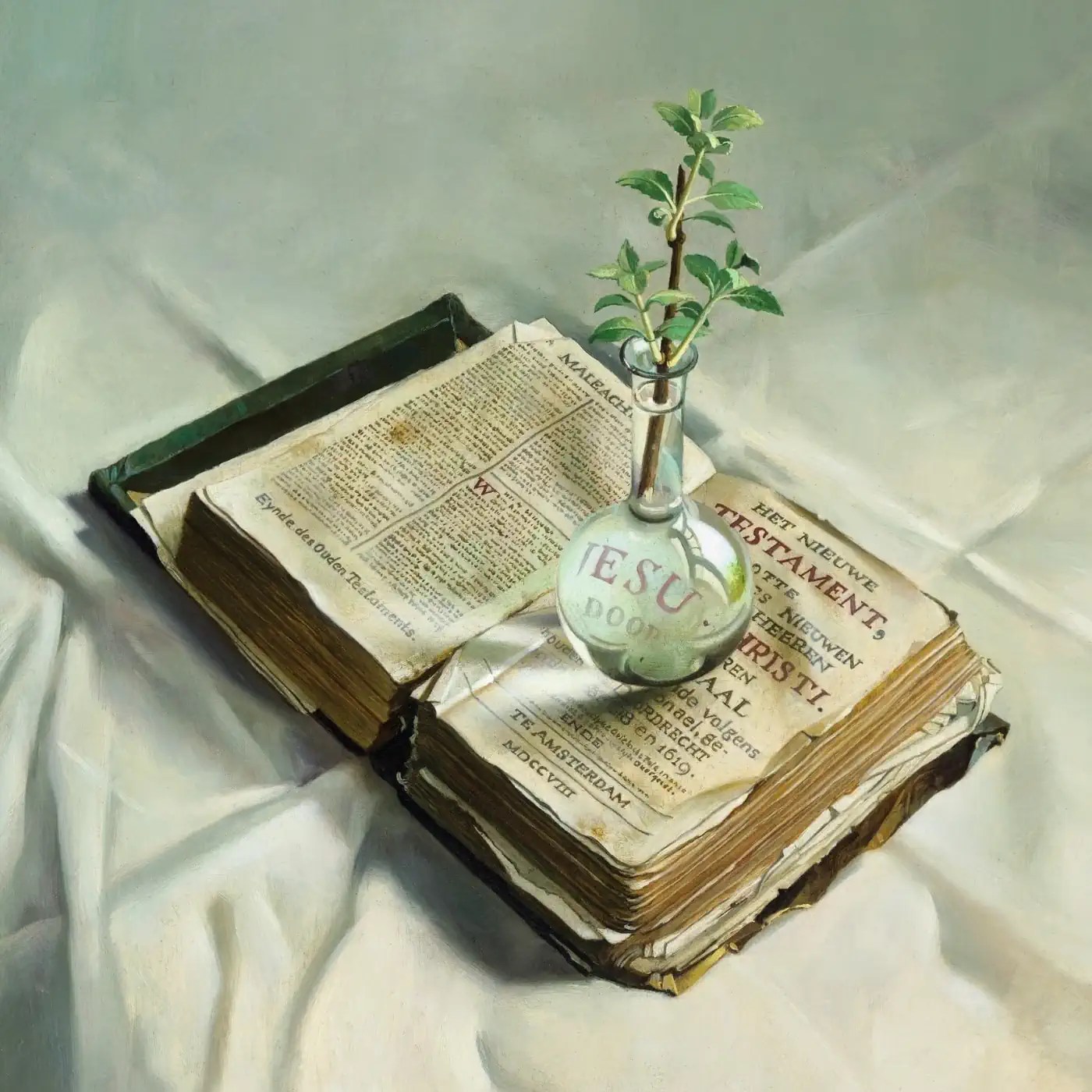
Helmantel, Henk_New Life II
Henk Helmantel (Dutch, 1945–), Nieuw Leven II (New Life II), 1999 (after the 1972 original that was stolen). Oil on canvas, 27 × 24 cm.

4. “Merger Poem” by Judy Chicago: “Merger Poem” is an aspiration that artist Judy Chicago wrote to accompany her 1979 monumental artwork The Dinner Party, a celebration of the richness of women’s heritage, expressed as place settings around a table, that is housed at the Brooklyn Museum. Her vision in the poem is not theistic, at least not explicitly so, but she uses the language of “Eden,” and her descriptions evoke passages from Isaiah about a future harmony, a merging of heaven and earth, in which justice and equity are achieved at last—not to mention the strong eschatological tones that feasting has in Christianity. Each line begins with “And then,” cumulatively generating a longing in the reader for “then” to arrive.

Source: The Dinner Party, exh. cat. (San Francisco Museum of Modern Art, 1979) | https://judychicago.com/

5. “truth” by Gwendolyn Brooks: “And if sun comes / How shall we greet him?” the speaker asks at the opening of this poem. The sun here represents truth, revelation, illumination, which we may seek with weeping and prayer but which can be dreadful when it actually comes. It’s often more comfortable to stay asleep in the dark than to confront the stark brightness of day. But oh, what we miss when we do! Gwendolyn Brooks uses the pronoun “him” for the sun, and it’s easy to read the poem Christologically: you can read it in the sense of any of Christ’s three comings—as a baby in Bethlehem, in personal, inner ways (he reveals himself, and seeks entrance, to human hearts), or as a king and judge at the end of time. Did you catch the reference to Revelation 3:20?

Source: Annie Allen (Harper & Row, 1949); compiled in Blacks (Third World Press, 1987)
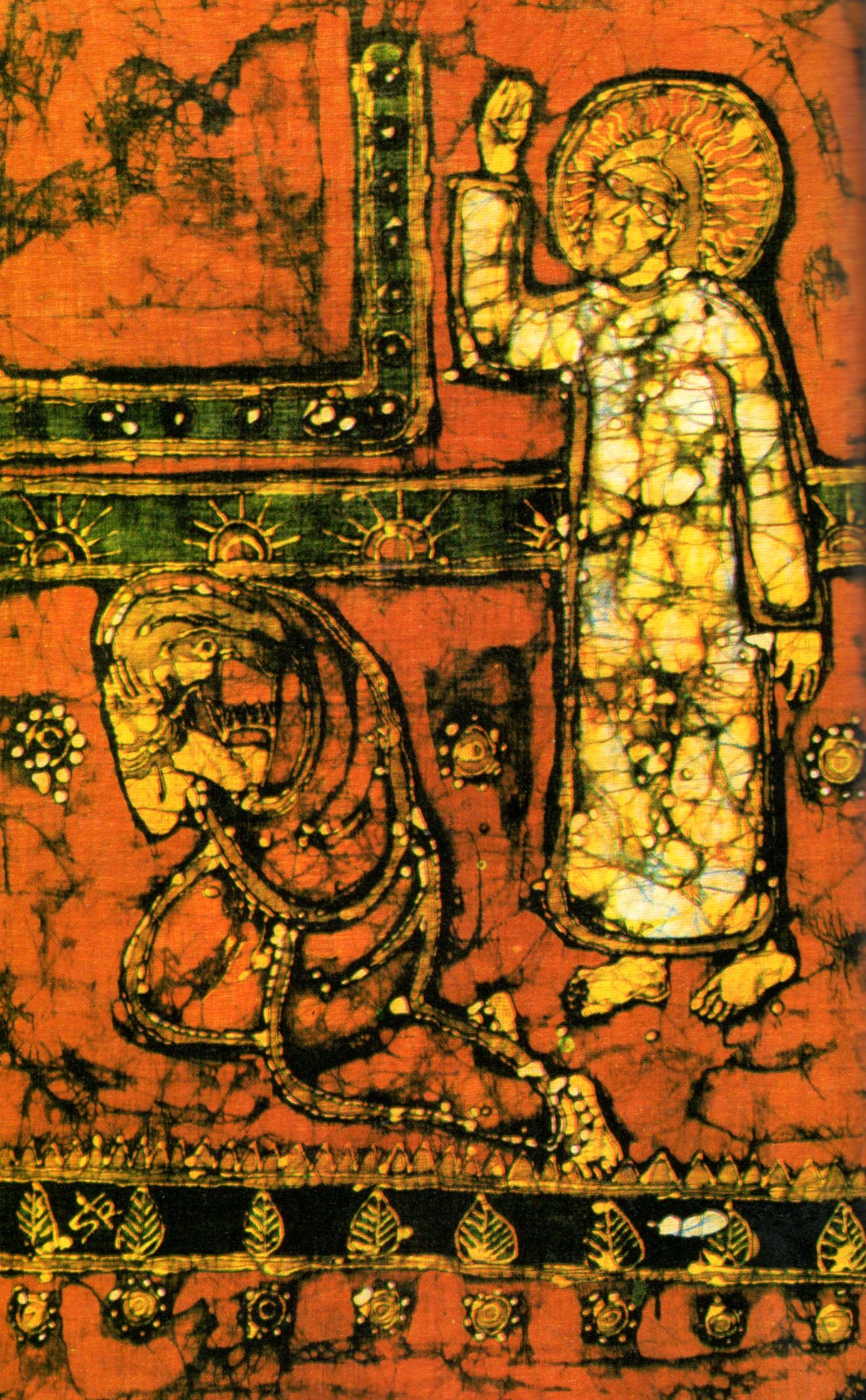
Raj, Solomon_Waiting for My Lord
P. Solomon Raj (Indian, 1921–2019), Waiting for My Lord, batik, published in Living Flame and Springing Fountain (ISPCK, 1993)

6. “Advent” by Mary Jo Salter: In this poem a mother and daughter are building a gingerbread house when a wintry gust tears a shutter on their actual house off its hinges, the shock of the thud causing, inside, a gingerbread wall to split. I think “house,” here, could be a metaphor for a faith structure; a house of belief. Shutters are doing a lot of work in the text: one falls off in a storm, and the daughter’s Advent calendar consists of twenty-five shutters, one opened each day until Christmas to reveal a Bible verse or narrative scene.

I’m not quite sure how to interpret the poem overall, but it seems to be addressing themes of (in)stability, brokenness and repair, the desire to believe versus the impulse to shut out belief, openness (“The house cannot be closed”), (dis)enchantment, the mother-child bond, and safety and danger (the Christmas story, like faith itself, characterized by both). I can’t decide if the “blank” in the final tercet sounds hopeful or bleak: does it connote possibility or lack? And is the mother suggesting in the final line (a repurposing of the final line from stanza 15) that what’s most real to her is not Mary and the baby Jesus but herself and her own child, right there in that moment?—or is she finding a point of kinship with Mother Mary in the love she feels for her offspring?

Source: Open Shutters (Knopf, 2003)

7. “Nativity” by Li-Young Lee: “What is the world?” asks a little boy in the darkness; and again as an adult. A poem of spiritual questing, Li-Young Lee’s “Nativity” deals with existential questions, ending with a tercet that evokes Isaac Watts’s famous carol line “Let every heart prepare him room.” Within us we must make a manger, a “safe place,” to receive the wild God.

Source: Book of My Nights (BOA Editions, 2001)

8. “Nazareth” by Drew Jackson: Ancient Nazareth, where Jesus grew up, was an insignificant village that many believed no good could come out of (see John 1:46). This poem by public theologian Drew Jackson accentuates Jesus’s origins there, his identity as a “southsider” (Nazareth is in southern Galilee). Today some urban neighborhoods on the “South Side” are disparaged, their residents dismissed as poor and lacking education and potential. God chose to incarnate in a rural neighborhood with a similar reputation, not simply dropping in and then leaving but, as the second person of the Trinity, being formed and nurtured in that environment. “Nazareth” is from Jackson’s debut poetry collection, in which he works his way through the first eight chapters of Luke’s Gospel, drawing out the theme of liberation and making contemporary connections.

Source: God Speaks Through Wombs: Poems on God’s Unexpected Coming (InterVarsity, 2021) | https://drewejackson.com/

9. “The Visitation” by Calvin B. LeCompte Jr.: The poet imagines the fields that Mary passes on her way to her cousin Elizabeth’s house joining in the Magnificat, praising the Savior in her womb.

Source: I Sing of a Maiden: The Mary Book of Verse, ed. Sister M. Thérèse (Macmillan, 1947)

10. “My Darling” by Alexandra Barylski: Mary and Joseph are cuddling in bed as she reflects on the divine interventions that brought and kept them together. The poem references the legend, originating in the second-century Protoevangelium of James and repeated in the seventh-century Gospel of Pseudo-Matthew, that Joseph was chosen to wed Mary when from his staff, submitted to the high priest along with those of other single men, there miraculously emerged a dove. Mary expresses appreciation for Joseph’s “visionary love,” patience, and courage in their relationship, his spiritual leadership and support.

Source: Reformed Journal, May 11, 2021
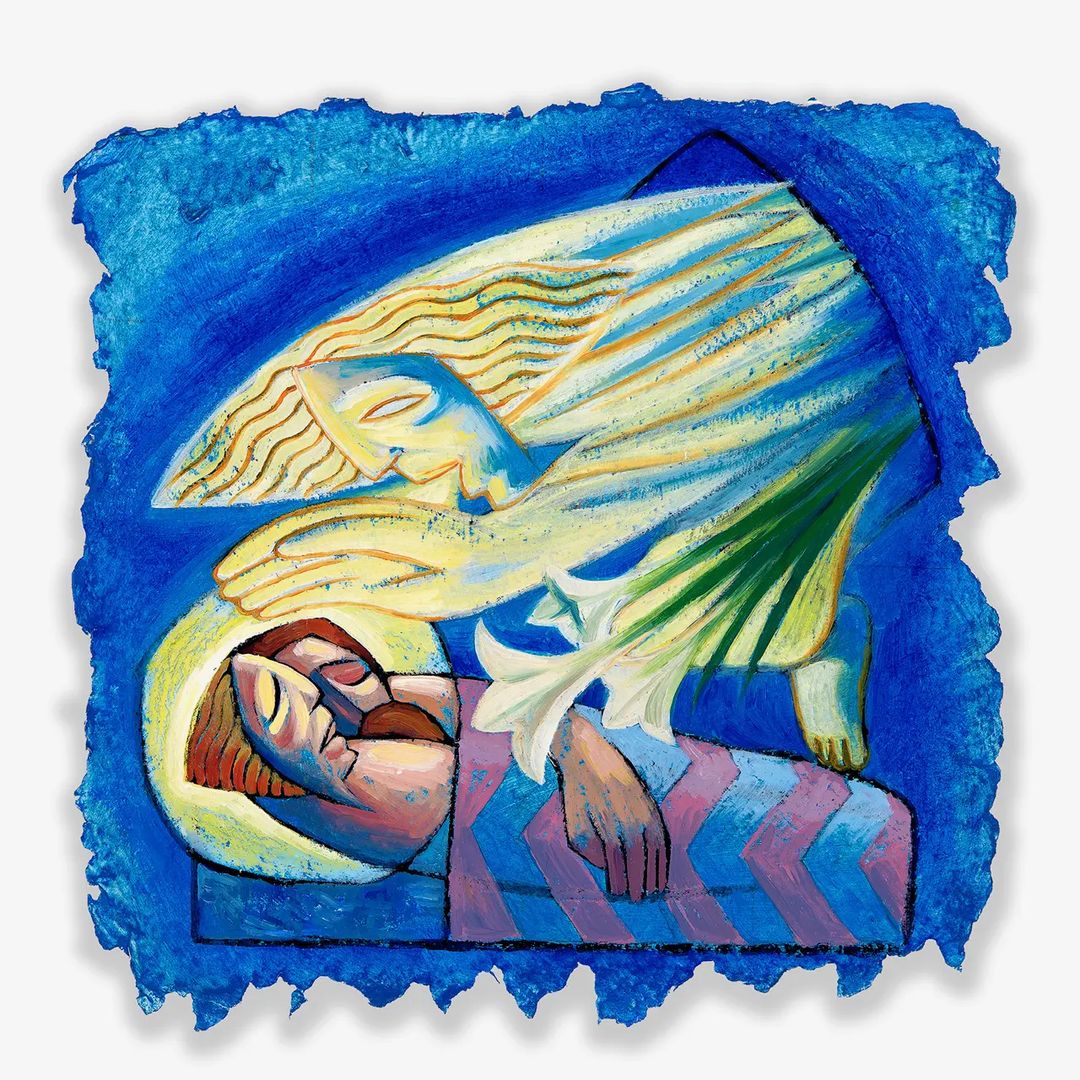
Mynheer, Nicholas_Annunciation
Nicholas Mynheer (British, 1958–), Annunciation, 2017. Oil on handmade paper, 20 × 20 cm.

11. “A Blessing for the New Baby” by Luci Shaw: The speakers of this poem give a lovely benediction over Christ—preincarnate and then embryonic in the first stanza, then out of the womb in the second and third.

Source: Accompanied by Angels: Poems of the Incarnation (Eerdmans, 2006) | https://lucishaw.com/

12. “Love’s Delights” by Meister Eckhart, rendered by Jon M. Sweeney and Mark S. Burrows: The medieval German mystic Meister Eckhart didn’t write poetry, but many of his sermons have a poetic quality to them, so contemporary poet Mark S. Burrows and writer Jon M. Sweeney, working from an English translation of the Middle High German by Frank Tobin, reworked select excerpts into verse. Adapted from a sermon Meister Eckhart preached on Isaiah 60:1, this poem meditates on the downward movement of love that raises up.

Source: Jon M. Sweeney and Mark S. Burrows, Meister Eckhart’s Book of the Heart: Meditations for the Restless Soul (Hampton Roads, 2017)

13. “Word Become Flesh” by Seth Wieck: Pregnancy, childbirth, and nursing take a toll on the body. Voiced by Mary, this poem highlights the bodily realities of Jesus’s first coming—Mary swollen, bruised, cracked, and bleeding. She was wounded for our transgressions, in the sense that she endured kicks to the ribs, postpartum hemorrhoids, etc., in order to bring forth our Savior, and by these wounds, because they gave life to Jesus, our healing was made possible. The last sentence is a zinger. Mary gives (physical) birth to Jesus, and he gives (spiritual) birth to her.

Source: Fathom, December 21, 2017 | https://www.sethwieck.com/

14. “Prince of Peace” by Brian Volck: The poet provides his own introduction to this poem on his website: “Octavian Augustus, first emperor of Rome, was known by many titles, including Divi Filius (Son of God) and Princeps Pacis (Prince of Peace). An inscription in Asia Minor states that Augustus’s birth ‘has been for the whole world the beginning of the gospel (εύαγγέλιον) concerning him.’ How strange, then, to use the same names for a contemporaneous but obscure Palestinian Jew, whose understanding of peace, politics, and power was so radically different. How strange to have so long diluted the scandal of the gospel (good news) with accommodations to an Augustan vision of a peace built on the use or threat of lethal violence. Here’s a Christmas poem calling attention to that contrast in a conscious act against forgetting.”

Source: Flesh Becomes Word (Dos Madres, 2013) | https://brianvolck.com/

15. “The Burning Babe” by Robert Southwell: Consisting of sixteen lines in iambic heptameter, this poem by the Jesuit martyr-saint Robert Southwell [previously] relates a mystical vision of the Christ child, who appears to the narrator on a cold winter’s night, enflamed and hovering in midair. The poem develops the metaphor of the love of Christ as a fiery furnace that both warms and purifies.

Source: St Peter’s Complaint, and Other Poems (London, 1595). Public Domain.
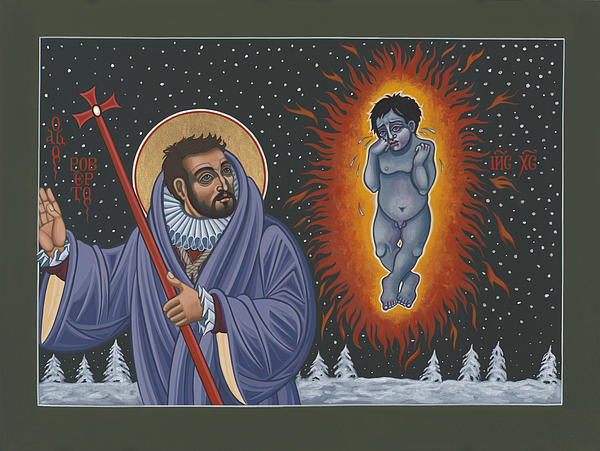
McNichols, William Hart_Robert Southwell and the Burning Babe
William Hart McNichols (American, 1949–), Holy Poet-Martyr St. Robert Southwell and the Burning Babe, 2015. Acrylic on wood. [purchase reproduction]

16. “Advent 1966” by Denise Levertov: This poem is shocking in its horror. Written in 1966, it picks up Southwell’s image of the Burning Babe and transposes it to the napalmed villages of Vietnam, where children were being physically (not symbolically or ethereally, as in Southwell’s poem) set on fire by chemical weapons deployed by the US military. Denise Levertov [previously], who was an antiwar activist as well as a poet, uses repetition to strong effect, conveying a sense of the seemingly relentless carnage (the war produced an estimated two million civilian casualties, more than half the total number). Though addressing a specific historical event, this elegy for the innocent provokes us to consider where similar atrocities are happening today.

Source: To Stay Alive (New Directions, 1971); compiled in Making Peace, ed. Peggy Rosenthal (New Directions, 2006)

17. “Christmas Eve” by Christina Rossetti: The Victorian poet Christina Rossetti [previously] opens this lyric with two paradoxes that characterize Christmas—bright darkness and chilly warmth—referencing the general mood of cheer and comfort that coexists with the bleak English midwinter. Why this mirth? Because “Christmas bringeth Jesus, / Brought for us so low.” Jesus was brought down from heaven in the Incarnation, but he would be brought lower still: his spirits sunken in Gethsemane, his body buried in a grave. The second stanza evokes a wedding: dressed in a bridal gown of gauzy snow, earth receives her heavenly Bridegroom.

Source: Time Flies: A Reading Diary (London, 1885); compiled in The Complete Poems (Penguin, 2001). Public Domain.

18. “Hill Christmas” by R. S. Thomas: In a poor rural Welsh village, parishioners make their way across snowy fields, weather-beaten, on Christmas to feed their bodies and souls with a snow-white bread loaf and crimson wine. In the celebration of the Eucharist, they hear love cry “in their heart’s manger.” Then they return to the day’s chores. I think the last line refers to a wayside crucifix.

Source: Laboratories of the Spirit (Macmillan, 1975); compiled in Collected Poems, 1945–1990 (Dent, 1993)

19. “back in the day” by Carl Winderl: In a practice known as “setting lambs on,” when a baby lamb dies in birth, sheep farmers will often take a live lamb (an orphan, or a twin or triplet from another ewe) and cover it in the skin of the deceased one so that, when the grieving mother smells the familiar scent of her deceased offspring, she accepts the lamb as her own. In Carl Winderl’s poem, Mother Mary reflects on that practice and has a premonition of a dead lamb.

Source: Christian Century, December 27, 2023

20. “Hymn 4 on the Nativity of Christ” by Ephrem the Syrian: St. Ephrem, a church father from the fourth century, wrote his theology in verse and is one of the most significant Early Christian hymnists. His Nativity hymns are my favorite; I’m particularly struck in Hymn IV by his meditation on how the Christ who suckles at Mary’s breast also gives suck to the whole world. “He is the Living Breast of living breath,” as Kathleen E. McVey translates the Syriac.

Source: Ephrem the Syrian: Hymns, trans. Kathleen E. McVey (Classics of Western Spirituality) (Paulist Press, 1989)
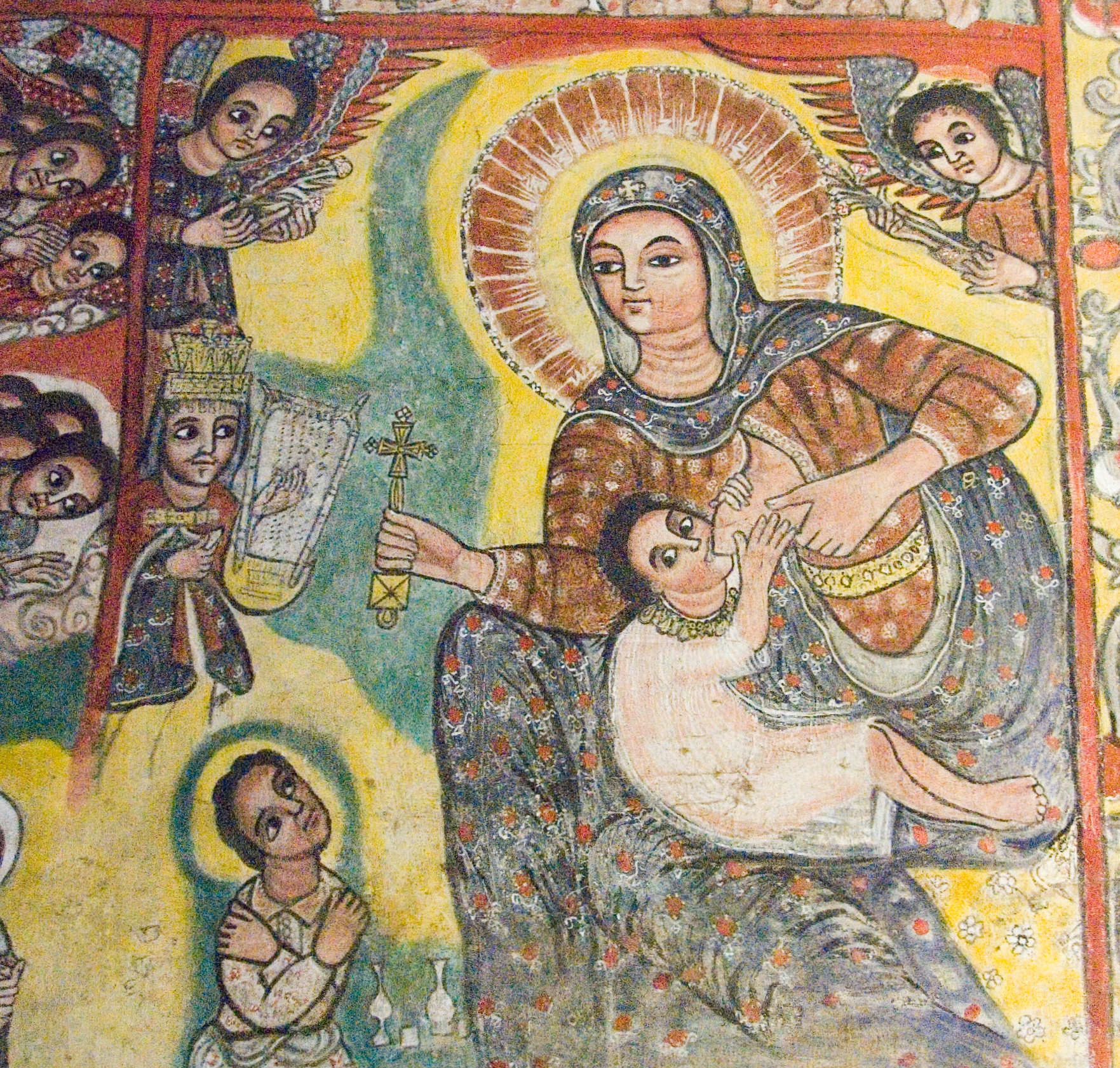
Maria lactans (Ethiopian)
Maria lactans, late 18th century. Fresco, Church of Narga Selassie, Dek Island, Lake Tana, Ethiopia. Photo: Alan Davey.

21. “Nativity” by Scott Cairns: This is the first in a pair of ekphrastic poems called “Two Icons,” in which the poet, who is Greek Orthodox, describes an icon from his home prayer corner. The first three stanzas engage in constructive wordplay: Jesus is wrapped in swaddling bands by his mother, and she is rapt—enraptured, wholly absorbed—by him. She holds him in her gaze and in her hands, and is beholden to him. Icons are about just that: beholding Christ and the sacred mysteries and deepening our affection for the One who holds us in affection. In Nativity icons our gaze is directed to “the core / where all the journeys meet, appalling crux and hallowed cave and womb,” where we are beckoned, like the magi, to bow before the incarnate God.

Source: Compass of Affection: Poems New and Selected (Paraclete, 2006)

22. “Star of the Nativity” by Joseph Brodsky: The Nobel Prize–winning Russian poet Joseph Brodsky was born into a Jewish family, but he was captivated by the story of Jesus’s birth and wrote many poems about it. The final stanza of this one gives us the unique perspective of the Star of Bethlehem, looking down—the Father’s beaming pride.

Source: Nativity Poems (Farrar, Straus and Giroux, 2001)

23. “Wise Women Also Came” by Jan Richardson: The Gospel of Matthew tells us that when Jesus was born, wise men came from the east to worship him. But wise women came too, Jan Richardson surmises. They came during Mary’s labor—midwives assisting with the birth. They came with lamps, fresh water, and blankets.

Source: Night Visions (Wanton Gospeller, 2010)
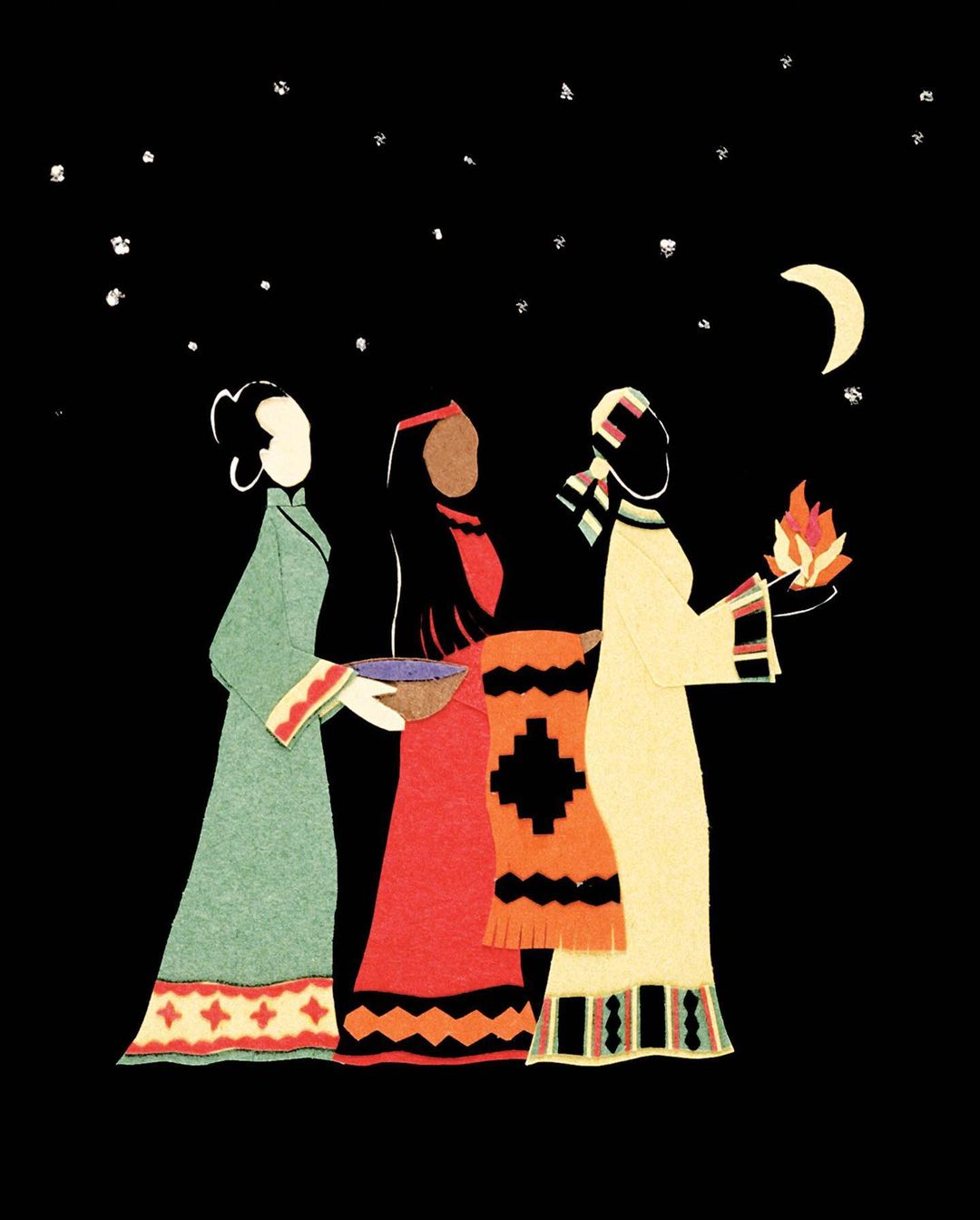
Richardson, Jan_Wise Women Also Came
Jan Richardson (American, 1967–), Wise Women Also Came, 1995. Collage. [purchase reproduction]

24. “Green River Christmas” by John Shea: Theologian and storyteller John Shea reflects on how, after experiencing something scary or unpleasant (like getting a shot or a teeth cleaning), mothers often give their child a treat. Christmas is a kind of supreme treat after the penitential season of Advent, during which we confronted the state of our spiritual health and remedied any shortfalls. Think, too, of the liturgy of (somber) confession and (sweet) pardon every Sunday at church, a prelude to the feast of bread and wine. At the Lord’s Table, we are fed—the gifts of God for the people of God. The Eucharist is the subtext of the final stanza, where Shea describes the presentation of Jesus in the temple forty days after his birth. There he is received by “the long-starved arms / of Simeon and Anna.” They had hungered for salvation, endured a long period of waiting; now they are filled.

Source: Seeing Haloes: Christmas Poems to Open the Heart (Liturgical Press, 2017)

25. “Taking Down the Tree” by Jane Kenyon: “Tick, tick, the desiccated needles drop.” This poem is about the passing of time—the death of another year—and the glumness that often sets in after the holidays are over, but it’s also about the storage of memories. In many households, Christmas ornaments are a multigenerational collection of memories. As with hanging them on the tree, taking them off and packing them away is a ritual that may prompt us to revisit certain past experiences or periods in our life. After we unplug the stringed lights and wrap up the baubles for safekeeping, then what? How will we inhabit the twelve months until next Christmas?

Source: Collected Poems (Graywolf, 2005)

Easter sermon by Saint Ephrem (excerpt) + triptych by Jyoti Sahi

Sahi, Jyoti_Triptych of Salvation
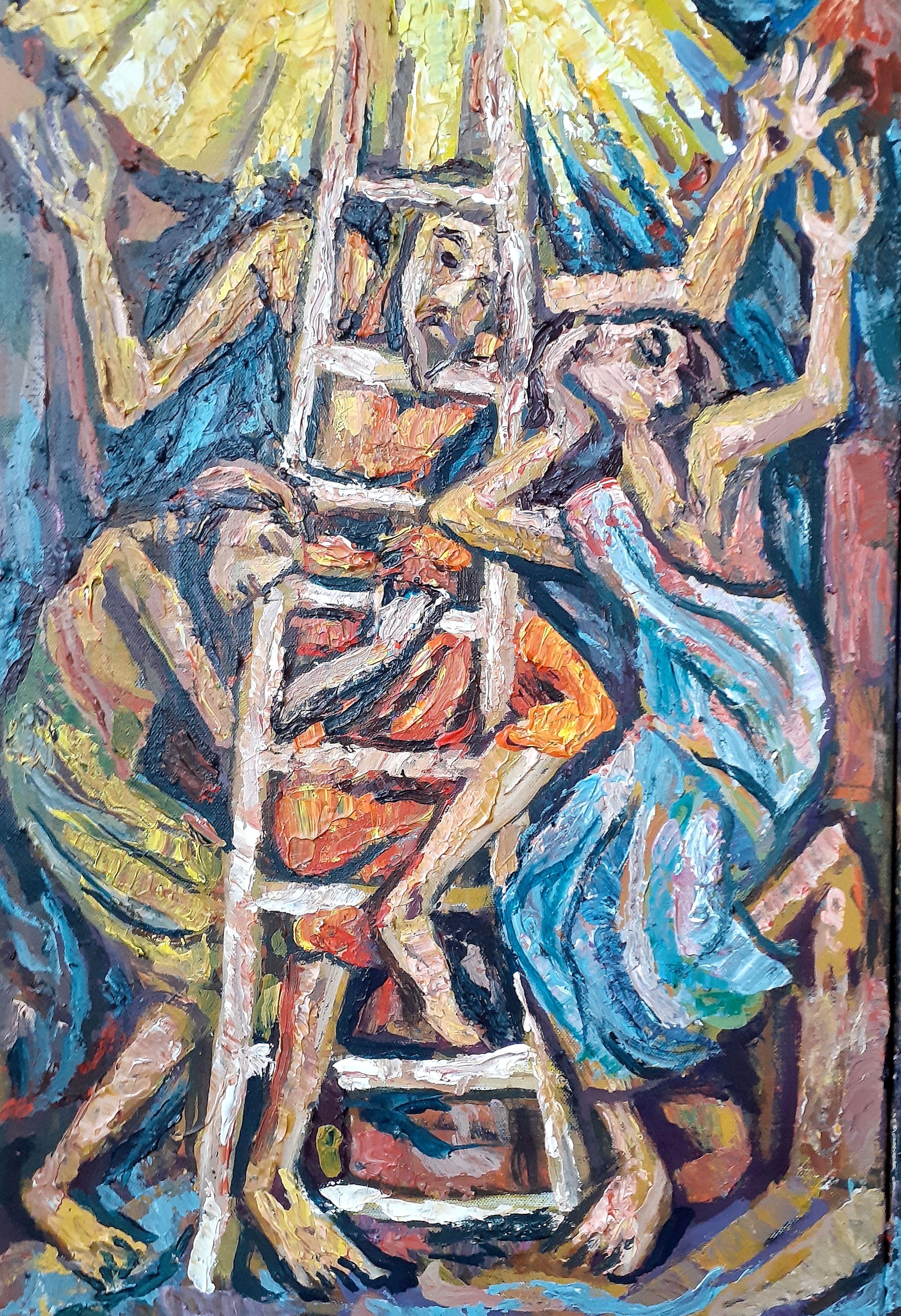
Jyoti Sahi (Indian, 1944–), Triptych of Salvation, 2021. Acrylic, oil, and ocher on canvas, 24 × 48 in. All photos courtesy of the artist.

Death trampled our Lord underfoot, but he in his turn treated death as a highroad for his own feet. He submitted to it, enduring it willingly, because by this means he would be able to destroy death in spite of itself. Death had its own way when our Lord went out from Jerusalem carrying his cross, but when by a loud cry from that cross he summoned the dead from the underworld, death was powerless to prevent it.

Death slew him by means of the body which he had assumed, but that same body proved to be the weapon with which he conquered death. In slaying our Lord, death itself was slain. It was able to kill natural human life, but was itself killed by the life that is above the nature of mortals.

Death could not devour our Lord unless he possessed a body, neither could hell swallow him up unless he bore our flesh; and so he came in search of a chariot in which to ride to the underworld. This chariot was the body which he received from the Virgin; in it he invaded death’s fortress, broke open its strong room, and scattered all its treasure.

At length he came upon Eve, the mother of all the living. She was that vineyard whose enclosure her own hands had enabled death to violate, so that she could taste its fruit; thus the mother of all the living became the source of death for every living creature. But in her stead Mary grew up, a new vine in place of the old. Christ, the new life, dwelt within her. When death, with its customary impudence, came foraging for her mortal fruit, it encountered its own destruction in the hidden life that fruit contained. All unsuspecting, it swallowed him up, and in doing so released life itself and set free a multitude.

He who was also the carpenter’s glorious son set up his cross above death’s all-consuming jaws, and led the human race into the dwelling place of life. Since a tree had brought about the downfall of humankind, it was upon a tree that humankind crossed over to the realm of life. Bitter was the branch that had once been grafted upon that ancient tree, but sweet the young shoot that has now been grafted in, the shoot in which we are meant to recognize the Lord whom no creature can resist.

We give glory to you, Lord, who raised up your cross to span the jaws of death like a bridge by which souls might pass from the region of the dead to the land of the living. . . .

We give glory to you who put on the body of a single mortal and made it the source of life for every other mortal.

You are incontestably alive! Your murderers sowed your living body in the earth as farmers sow grain, but it sprang up and yielded an abundant harvest of people raised from the dead.

Come then, my brothers and sisters, let us offer our Lord the great and all-embracing sacrifice of our love, pouring out our treasury of hymns and prayers before him who offered his cross in sacrifice to God for the enrichment of all.

—Ephrem the Syrian, sections 3–4 and 9 of the Eastertide sermon “On Our Lord,” trans. the International Commission on English in the Liturgy in The Liturgy of the Hours, vol. 2 (New York: Catholic Book Publishing Co., 1976), 735–36

Ephrem the Syrian (ca. 306–373) was a prominent Christian theologian, hymnist, and teacher who is venerated as a saint and a doctor of the church. Born in Nisibis (in modern-day Turkey), he served as a deacon and later lived in Edessa, a center of Greek and Syriac theological and philosophical thought in Upper Mesopotamia. He spoke and wrote in Syriac, a dialect of Aramaic, and is the most significant of all the Syriac Christian fathers.

This sermon excerpt appears in the Roman Catholic Office of Readings for Friday of the Third Week of Easter. In translating the passage, the committee referenced the parallel text in Thomas Joseph Lamy’s Latin translation, “Sermo de Domino nostro,” columns 152–58, 166–68, in Sancti Ephraemi Syri Hymni et Sermones, vol. 1 (1882). Read Ephrem’s full sermon, in an English translation by A. Edward Johnston, at New Advent.

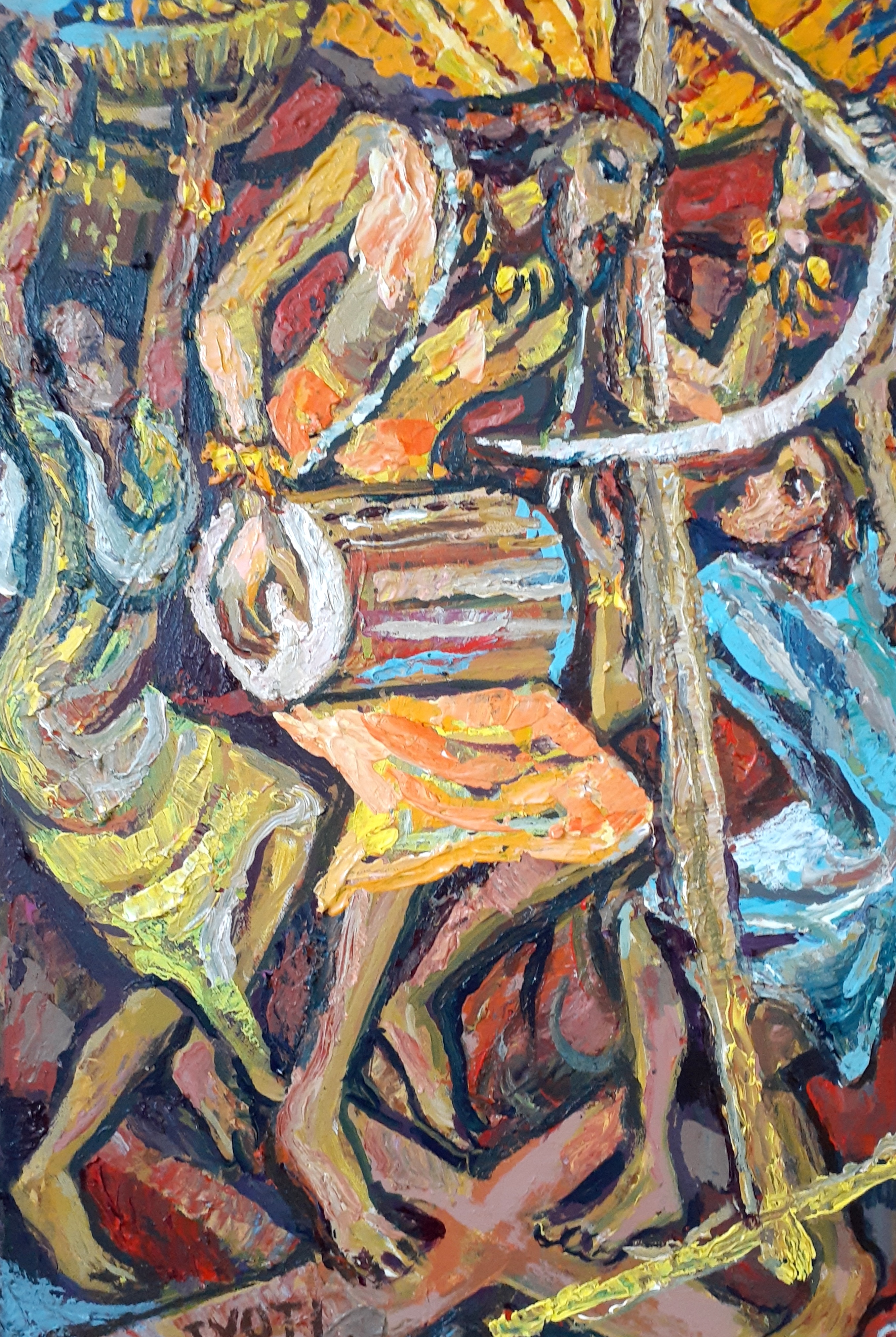
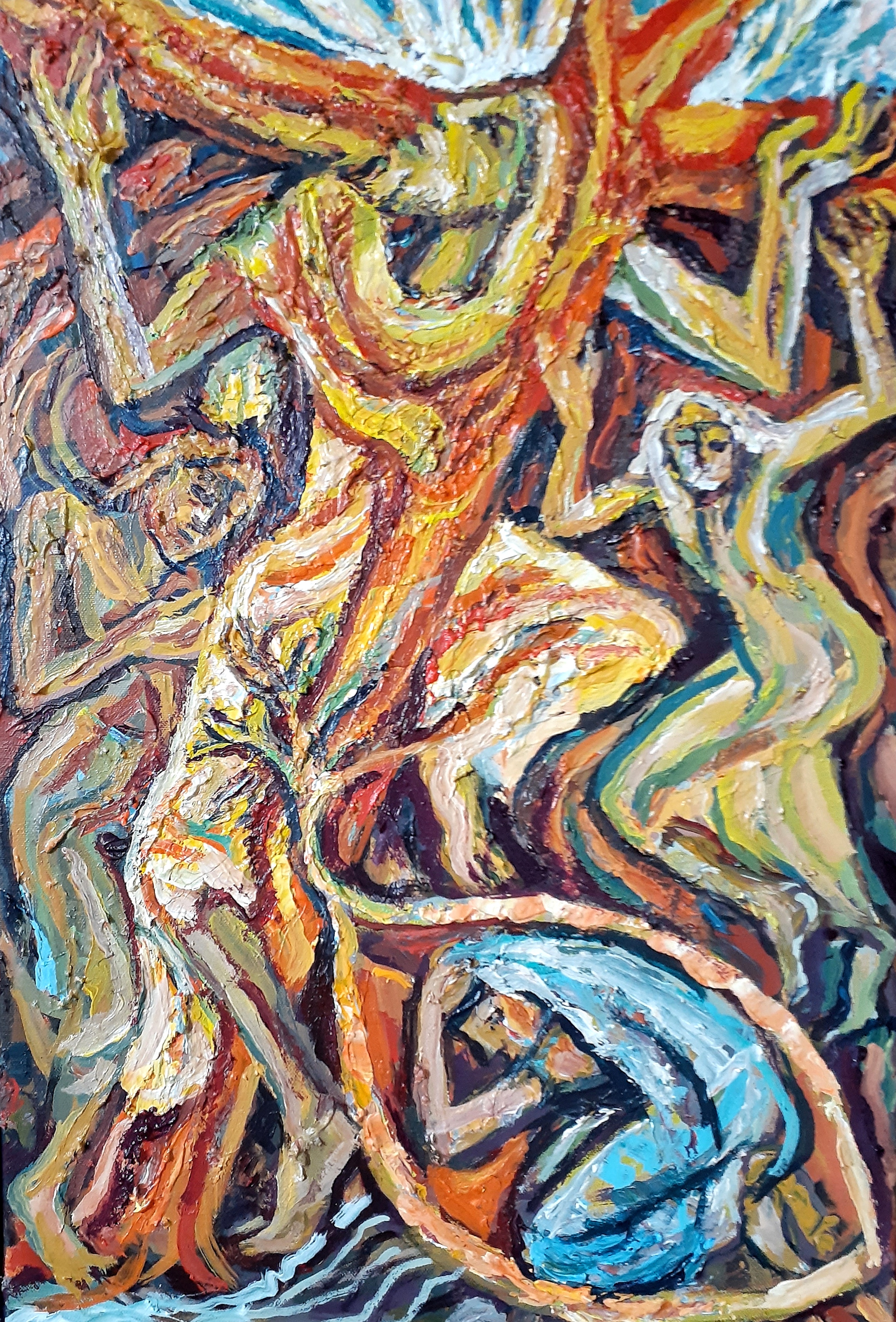
The three-paneled painting at the top of this post is by my friend Jyoti Sahi, one of the most theologically exploratory artists working today. I saw this triptych at an earlier stage of development when I visited his home in Silvepura Village, India, in 2019 and am so pleased by how it turned out. “It represents Christ ascending the cross (left), harrowing the underworld as the drummer (center), and rising like the sprout from the seed that is Mary, from whose womb he sprang forth (right),” Jyoti told me.

Sahi, Jyoti_Triptych of Salvation (left)
Sahi, Jyoti_Triptych of Salvation (central)

The central panel is based on iconography of the Anastasis, in which Jesus descends into Hades following his crucifixion to liberate those who have died. In such icons, Adam and Eve, who represent all of humanity, are “drawn up from the earth,” as Jyoti puts it. Jyoti portrays this rescue as a dance, with Jesus beating out the rhythms of redemption, as well as a time of planting and harvest (he wields a plow and a scythe). Jesus’s death tilled the soil, making conditions right for the dead to be raised to new life.

Jyoti has long been interested in the symbolism of the ladder and the seed, and both symbols are employed here. The ladder is an instrument of both descent and ascent, and the seed, as Christ himself taught, must “die”—be buried in the ground—before it yields life. In the right panel of the Triptych of Salvation, Jesus, having gone down into the earth, bursts forth from his casing, emerging as the tree of life, whose roots are watered by the river of life, which flows across all three panels. This tree is the cross transformed.

Sahi, Jyoti_Triptych of Salvation (right)

His arms raised again as they were on the cross but no longer pinned down, Jesus leads the dance of resurrection, and Adam and Eve and the others who have been delivered join in. They are the fruitful crop of Christ the Gardener.

For two similar paintings by Jyoti, see my blog posts “Jesus as Dancer” and “Jesus as Ladder.”

Hymn 4 on the Nativity of Christ (excerpt) by Ephrem the Syrian

Maria lactans (Ethiopian)
Maria lactans, late 18th century. Fresco, Church of Narga Selassie, Dek Island, Lake Tana, Ethiopia. Photo: Alan Davey.

Glory to that Voice that became a body,
and to the lofty Word that became flesh.
Ears even heard Him, eyes saw Him,
hands even touched Him, the mouth ate Him.
Limbs and senses gave thanks to
the One Who came and revived all that is corporeal.
Mary bore a mute Babe
though in Him were hidden all our tongues.
Joseph carried Him, yet hidden in Him was
a silent nature older than everything.
The Lofty One became like a little child,
yet hidden in Him was a treasure of Wisdom that suffices for all.
He was lofty but he sucked Mary’s milk,
and from His blessings all creation drinks.
He is the Living Breast of living breath;
by His life the dead were suckled, and they revived.
Without the breath of air no one can live;
without the power of the Son no one can rise.
Upon the living breath of the One Who vivifies all
depend the living beings above and below.
As indeed He sucked Mary’s milk,
He has given suck—life to the universe.
As again He dwelt in His mother’s womb,
in His womb dwells all creation.
Mute He was as a babe, yet He gave
to all creation all His commands.
For without the First-born no one is able
to approach Being, for He alone is capable of it.

Translated from the Syriac by Kathleen E. McVey in Ephrem the Syrian: Hymns (Classics of Western Spirituality) (Mahwah, NJ: Paulist Press, 1989), 100–101

Advent, Day 23: Holy One, Jesus Come

LOOK: Nativity, Netherlands, 16th century

Bosch, Hieronymus (after)_Nativity
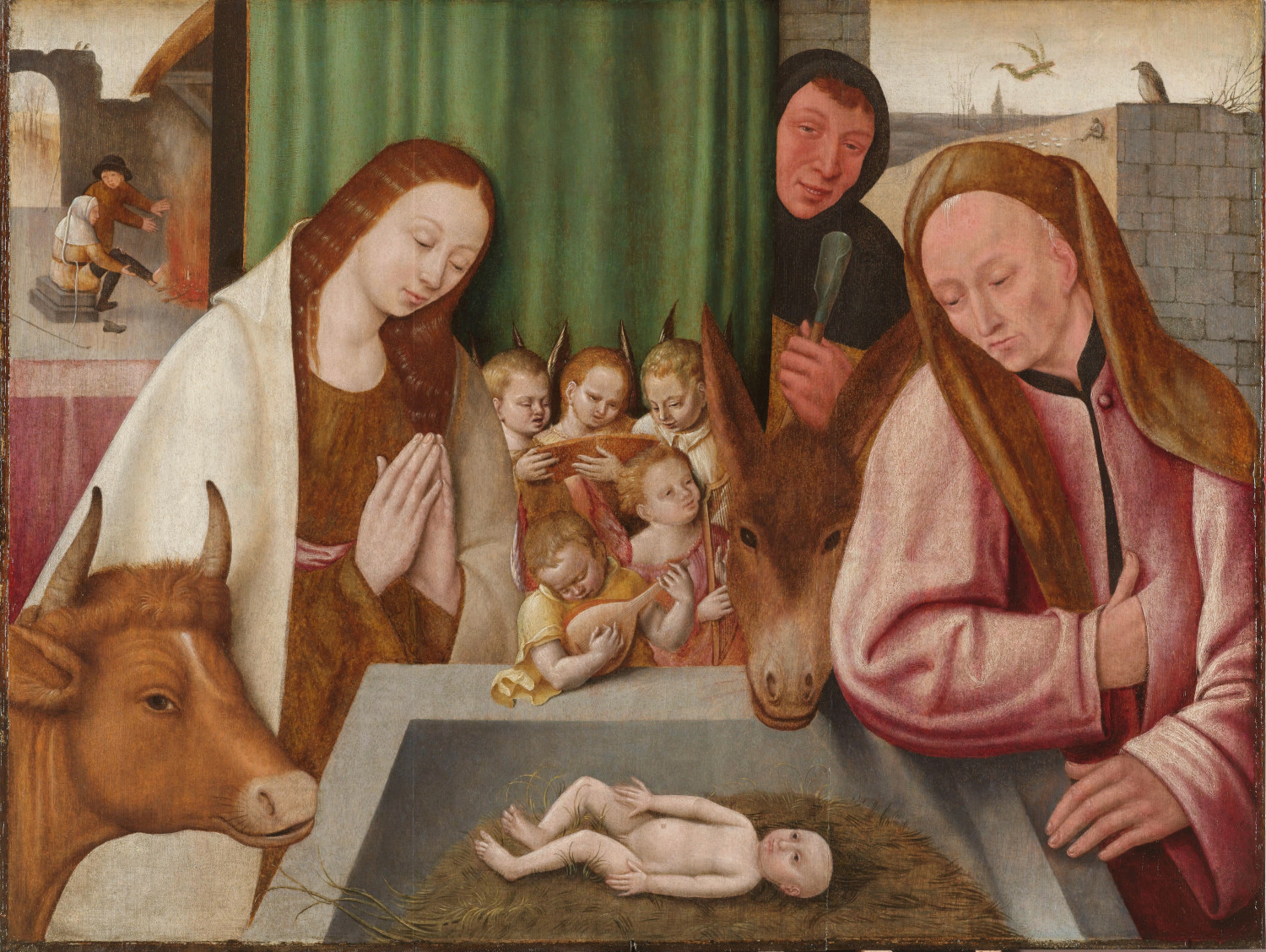
Unidentified artist (in the style of Hieronymus Bosch), Nativity, southern Netherlands, ca. 1550–1600. Oil on panel, 58 × 76 cm. Rijksmuseum, Amsterdam.

This painting in the style of Bosch shows Mary and Joseph adoring their newborn son, Jesus, who’s naked and bedded down in straw. A small angelic ensemble stands at the head of the manger with lute, harp, and songbook, softly serenading the family, while a shepherd sneaks a peek from behind a green curtain. It is as if we, the viewer, are standing opposite the shepherd on the other side of the manger, also looking down at the Christ child. Are we similarly rapt with wonder?

I love how the ox and the ass meet our gaze, acknowledge our presence!

I’m not sure of the significance of Joseph’s hand-in-jacket gesture (its association with stateliness wasn’t established until some two centuries later, from what I can tell), but it’s likely supposed to connote reverence or humility, as do Mary’s prayerful hands.

In the left background, two men warm their hands and feet outside by a fire, while at the right, an angel appears to another shepherd on a hillside, announcing the Messiah’s birth.

LISTEN: “Holy One, Jesus Come” by Andy Bast, on The Hymns of St. Ephrem for Advent by Pillar Church (2014)

The lyrics of this song are loosely based on Ephrem the Syrian’s Nativity Hymn #2 from the fourth century. (All nineteen Nativity hymns by this early Christian poet-theologian are a treasure!)

Blessed is he
Both hidden and seen
Blessed is he
Who left the height of majesty

You magnify all, come magnify me
That I may tell about
The glory of your birth
Proclaim your grace to all the earth
Holy One, Jesus, come!

Blessed is he
Who gave us all
Blessed is he
Who gave us all that he has gained

O Father of all, your glorious day
You gave not seraphim
Nor sent the cherubim
You gave your only Son instead
Holy One, Jesus, come!

All glory to thee, entirely
Glory to thee, from every tongue, entirely
Your birth is enough
For all of us

Great one became a child
Pure one became defiled
O Living One, laid in the tomb
In you we are renewed
Your washing washed us through
Let us obtain life by your death
Holy One, Jesus, come!

The Incarnation, the enfleshment of God in the person of Jesus, encompasses the God-man’s birth and death, as does this song. Salvation was wrought not through Jesus’s birth alone, or life alone, or death alone, or resurrection alone, but through all of it together.

At first I got tripped up on the line “Pure one became defiled,” because Jesus did not become defiled in the sense of succumbing to sin or moral corruption. However, in his ministry, he did touch lepers, bleeding women, and corpses, which, according to the Jewish purity laws at the time, would have made him ritually unclean. Looking back on these healings and raisings, Christians would say that rather than these people’s uncleanness transferring to him, his cleanness transferred to them. But the public perception was that he was defiling himself.

And then, of course, there’s 2 Corinthians 5:21: “For our sake God made the one who knew no sin to be sin, so that in him we might become the righteousness of God.” And Galatians 3:13: “Christ redeemed us from the curse of the law by becoming a curse for us—for it is written, ‘Cursed is everyone who hangs on a tree.’” What it means that Jesus “became sin” or “became a curse” has been the subject of much theological discussion! But suffice it to say that Jesus’s death on the cross involved not only physical debasement but also his bearing, in a metaphysical sense, the full weight of humanity’s transgressions.

Andy Bast is a singer-songwriter from Holland, Michigan. He is a musician and writer for the Christian collective Bellwether Arts and a regular contributor to Cardiphonia projects.

Roundup: Hope installation, new musical setting of Saint Ephrem’s Prayer, Global Stations of the Cross, and more

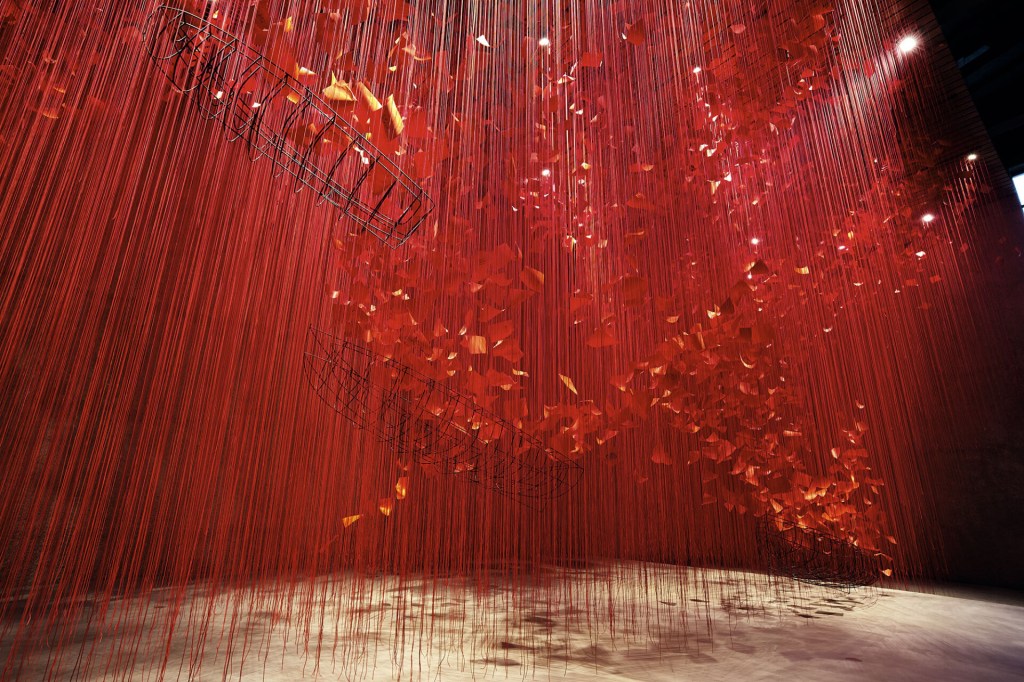
EXHIBITION: “I hope . . .” by Chiharu Shiota, January 12–March 21, 2021, König Galerie, Berlin: Grace Ebert of Colossal writes, “A towering expanse of red thread, a new installation by Chiharu Shiota suspends 10,000 letters within the nave of Berlin’s König Galerie, a Brutalist-style space located in the former St. Agnes church. The immersive construction runs floor to ceiling and is awash with notes from people around the world who share their dreams following a particularly devastating year. Aptly named ‘I hope…,’ the large-scale project hangs two wire boats that appear to float upward at its center, evoking travel into an unknown future.” On view for a few more days!  

Shiota, Chiharu_I hope
Chiharu Shiota (Japanese, 1972–), “I hope . . . ,” 2021. Rope, paper, steel, installation view at König Galerie, Berlin. Photo: Sunhi Mang, VG Bild-Kunst, Bonn.

+++

SONGS:

>> “Saint Ephrem” by Prairie House Hymns: Sam(antha) Connour, whom you might know as Lo Sy Lo, has a new home for her church music: she will now be releasing it under the name Prairie House Hymns, which harkens to her roots in small-town churches and Midwestern culture. (“Seriously melodic theology from the Great Plains”!) Her first single since this rebrand is a prayer attributed to the fourth-century Syrian theologian Ephrem. “In the Byzantine tradition, this prayer is considered to be the most succinct summation of the spirit of Great Lent and is hence the Lenten prayer par excellence, prayed during all Lenten weekday services” (source). The video below is a demo that Connour recorded in November 2020, followed by the official recording released March 15, which includes backup vocals by Alec Watson. I’ve added the song to the Art & Theology Lent Playlist on Spotify.

O Lord and Master of my life
Keep me from indifference
Keep me from discouragement
Lust of power and idle chatter

Will you grant to me your servant
The spirit of wholeness of being
Humblemindedness
Patience and love

O Lord and King of my life
Grant me grace to be aware
Of my sins and not to judge
My brother and my sister

For you are blessed
Now and forever
For you are blessed
Now and forever

>> “Your Blood” by Matt Redman, arr. Sam JC Lee: This video recording is from the “Jazz Hymns and Liturgy” concert at The Lilypad in Cambridge, Massachusetts, on February 16, 2020. Composer, bassist, and bandleader Sam JC Lee [previously] leads his group in an original jazz arrangement of this contemporary hymn. The musicians are Gabriela Martina on vocals, Gregory Groover Jr. on sax, Jiri Nedmoa on piano, Tyson D. Jackson on drums, and Lee himself on bass.

+++

VIRTUAL EXHIBITION/PILGRIMAGE: Global Stations of the Cross 2021: These fifteen contemporary artworks, organized around the Stations of the Cross but with a multifaith approach, were curated by Dr. Aaron Rosen, director of the Henry Luce III Center for the Arts and Religion at Wesley Theological Seminary in Washington, DC. In 2019 I participated, as pilgrim, in the Amsterdam iteration of the annual Stations of the Cross project that Rosen cofounded (which I chronicled in detail here), and his project inspired the Stations of the Cross experience I designed, independently, at the Smithsonian American Art Museum—which, I know from people having reached out to me, has been utilized by several churches, families, and neighborhoods over the years.

McAfee, Antonio_Roger's Station (Ninth Station)
Antonio McAfee (American, 1983–), Roger’s Station (Ninth Station), 2021

Though “in previous years, the central experience of Stations of the Cross involved walking through host cities, inviting visitors to experience the incidental insights and revelations that come from navigating urban spaces in search of sacred experiences,” COVID has required adaptation. So Rosen took the opportunity to make this year’s exhibition multicity and global, and entirely online. Audio commentary is provided by the artists, as are photos of each work. The theme is “monuments and memorials,” and many of the artists have a personal connection to the topics they address, which include the execution of Catholics under the Joseon dynasty in nineteenth-century Korea, political imprisonment under Stalin, the bombing of Coventry during World War II, displacements caused by the British Partition of India in 1947, rising Sinophobia (anti-Chinese sentiment) this past year, California wildfires, gun violence, police brutality, and the ongoing refugee crisis. Here is an excerpt from Rosen’s curatorial statement:

Each station in this journey responds to a monument or memorial, reflecting a tumultuous year in which fresh memorials sprung up to grieve the dead and historic monuments to prejudice were toppled and dismantled. We invited artists to keep these connotations in mind, but ultimately we left the terms ‘monument’ and ‘memorial’ open to interpretation, for artists to construct as they saw fit. Some, like Todd Forsgren, turned familiar images, like the Washington Monument, on their head—evoking the disorienting, disturbing politics of the past four years, and especially the recent insurrection at the nation’s capital. G. Roland Biermann photographed the Millennium Wheel in London, a tourist attraction that now sits sedentary as a stone, lit by an eerie blue light in honor of National Health Service workers. Others chose sites which are legible as memorials only to an intimate circle, who know the tragedy which transpired there. This is the case for Antonio McAfee’s work, which honors his cousin, murdered at a Baltimore metro stop. Another artist, S. Billie Mandle, reminds us that the natural world can, within moments, turn into a graveyard, as she reveals in a photograph taken in the aftermath of devastating wildfires in her home state of California.

There is no single memorial which can effectively capture the myriad traumas of the past year, from the staggering toll of the pandemic to bleak examples of systemic racism and climate crises of biblical proportion. While these challenges have intersected this past year, often with devasting effect, Stations of the Cross does not attempt to summarize them, or generalize the agonizing impact they have had on specific communities, families, and individuals. Instead, this project invites viewers to bear witness to this troubling season through the intimate reflections of individual artists, who find in the Passion a lens to interpret the present.

. . .

While the celebration of resurrection is unabashedly Christian, as it should be, the via dolorosa offers a path that can be instructive across multiple faiths, and none. Christians may travel its route in anticipation of salvation, but that is not the only possible destination. The Stations of the Cross invite an empathy that knows no theological copyright and requires no passport. It demands, quite simply, the capacity to behold—to truly see—the suffering of the Other in our midst. And, at least for the moment, that may be miracle enough.

+++

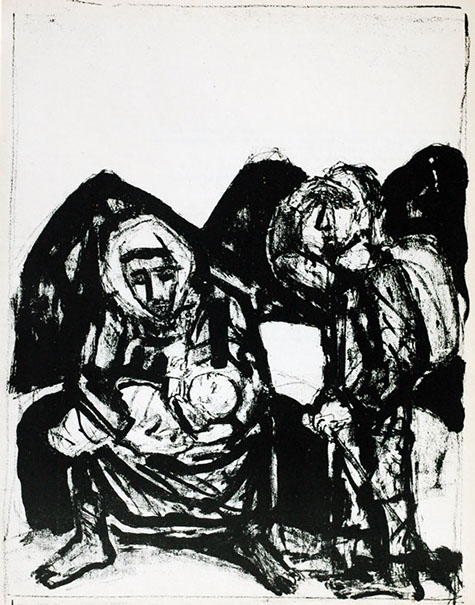
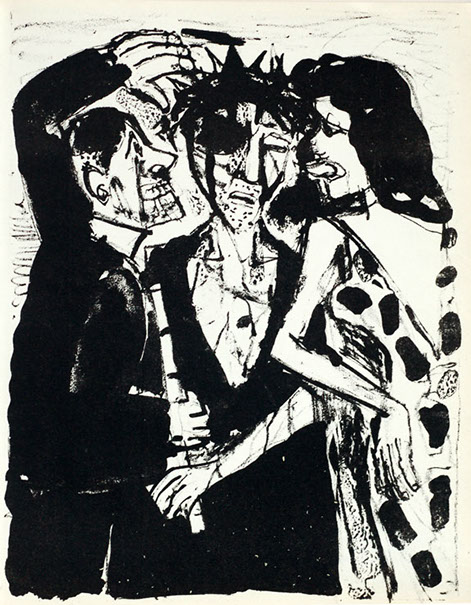
LECTURE: “Otto Dix and the Gospel of Matthew: An Exercise in Wirkungsgeschichte by Dr. Jonathan T. Pennington: In 1960 the German expressionist artist Otto Dix [previously] published Matthäus Evangelium, a cycle of thirty-three lithographs based on the Gospel of Matthew, recounting Jesus’s birth, healing ministry and other miracles, passion, and resurrection. Last year Sojourn Arts, a ministry of Sojourn Church in Louisville, Kentucky, hosted an exhibition of this body of work as well as a contextualizing talk by New Testament scholar and Sojourn East staff preacher Jonathan T. Pennington, given February 21, 2020. Pennington shows how Dix uses Matthew to say something about his own time and culture, and how Dix helps us see certain things about Matthew because of his own situatedness. Starting at 13:25, Pennington walks through the images one by one, interpreting them with a facility I don’t often see in preachers without an art specialization! (He says he spent several weeks studying and reflecting on the lithographs, which goes to show how an image’s meaning reveals itself to those who are willing to sit with it; a bit of biographical research helps too.)

The exhibition Otto Dix: Matthäus Evangelium is available for rental for just $250/month plus shipping—a killer deal! The loaner is Sandra Bowden, a collector of twentieth- and twenty-first-century biblical art who is also an artist herself. She’s such a generous person, and I had the pleasure of meeting her once at her home in Cape Cod, not far from the Community of Jesus, of which she is an oblate.

Dix, Otto_Flight to Egypt
Otto Dix (German, 1891–1969), Die Flucht nach Ägypten (The Flight to Egypt), lithograph from Das Evangelium nach Matthäus (The Gospel according to Matthew), 1960

Dix, Otto_Christ Mocked
Otto Dix (German, 1891–1969), Die Verspottung (Christ Mocked), lithograph from Das Evangelium nach Matthäus (The Gospel according to Matthew), 1960