Magnificat roundup: Visio divina with Mary Gardner, “For Ages Women Hoped and Prayed,” and more

QUOTES:

Mary’s response to this announcement [of Jesus’s forthcoming birth]—her Magnificat—is even more overtly revolutionary. Her song in Luke’s Gospel is not a lullaby; it is a manifesto. She declares that the mighty will be cast down from their thrones, the lowly lifted, the hungry filled with good things, and the rich sent away empty. This is the language of redistribution, the language of a world reordered by justice rather than domination. It is no surprise that tyrants have feared this text; throughout modern history, the Magnificat has been prohibited and/or discouraged in public worship in places like Guatemala, Argentina, and India because oppressed communities used it as a rallying cry for liberation. Mary’s theology is insurgent.

—Kat Armas, “The Politics of Birthing God,” Some Things Abuelita (Substack), December 2, 2025

What I love about Hannah and Mary is they step into God’s eternal streams of justice and of righteousness and of what it means to live as a faithful follower of Yahweh. They step into this expansive world of what God is going to do and has promised to do in the world, instead of the smaller space of their own need—which again, is OK and understandable. But they take us to places where, if we’re honest, most of our prayers don’t regularly go.

—Rev. Dr. Tracey Bianchi, “Waiting with Women (Advent Series Part 2): Hannah’s Story and the Gift of Peace (Shalom),” The Alabaster Jar (podcast), December 8, 2025

+++

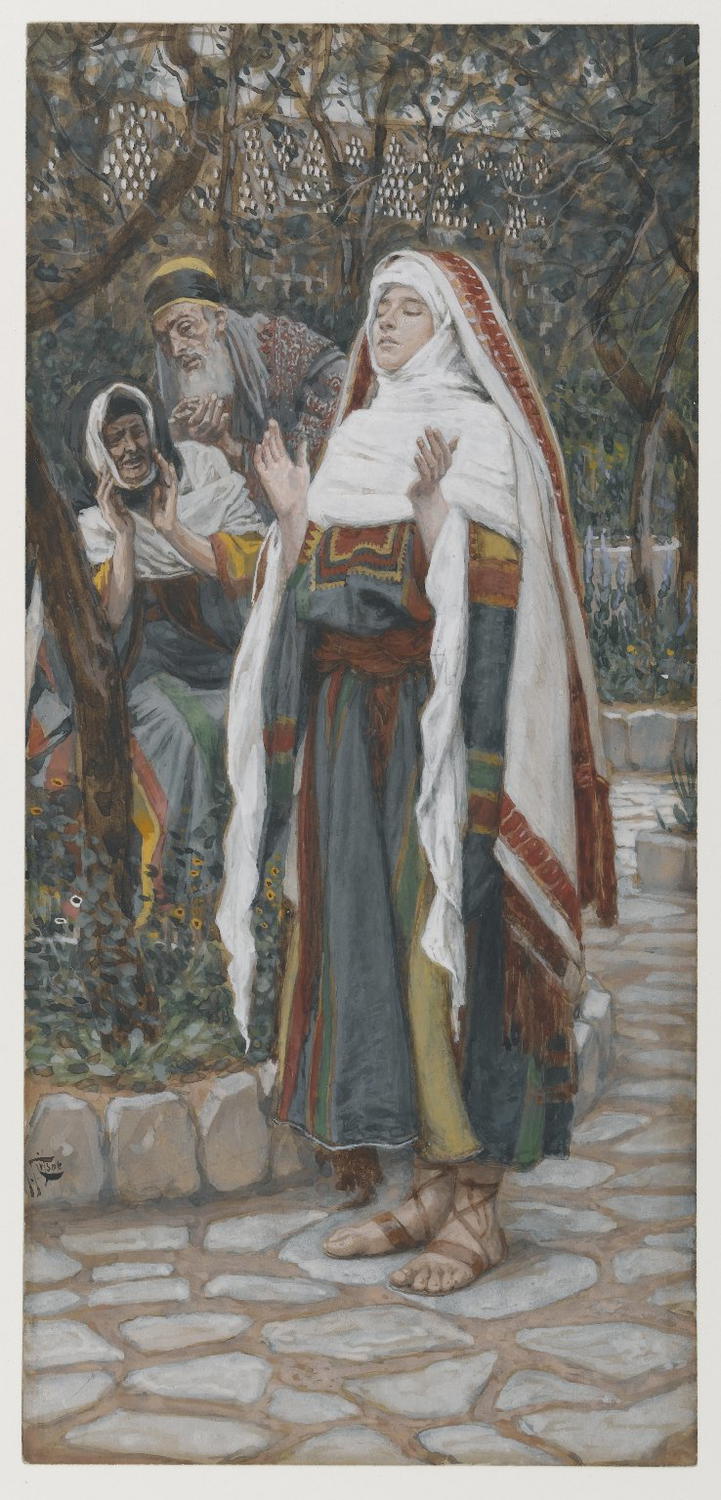
VIDEO DEVOTION: “Beholding the Magnificat with Mary Gardner”: In this “Space for God” video devotion from Coracle, Rev. Mary Amendolia Gardner, an Anglican priest with a bachelor’s degree in art history and a master’s in Christian spirituality, guides us in lectio divina (sacred reading) with Luke 1:46–55 and visio divina (sacred seeing) with James Tissot’s Magnificat.
Tissot, James_The Magnificat
James Tissot (French, 1836–1902), The Magnificat, 1886–94. Opaque watercolor over graphite on gray wove paper, 9 15/16 × 4 5/8 in. (25.2 × 11.7 cm). Brooklyn Museum, New York.

I typically don’t care for Tissot’s biblical watercolors, because of their illustrative quality—they remind me of pictures from the Sunday school curriculum I followed as a child. But I do like this one, which shows Mary in a position of wisdom and authority, absorbed in prayer, preparing to preach and prophesy. Elizabeth and Zechariah stand in attentive awe on the sidelines, their eyes directed toward the divine child she carries in her body while they await her words. The priest’s tongue had been tied, but Mary’s has been loosed. The Cuban American theologian Kat Armas, in the post quoted above, calls Mary “the first theologian of the Gospel,” as she boldly proclaims the messianic deliverance God has set in motion.

+++

SONGS:

>> “For Ages Women Hoped and Prayed” by Jane Parker Huber: “We join the song that Mary sings, an earthly, heavenly theme.” Performed at Wheaton Bible Church in Illinois.

>> “Mary, Did You Know” with alternative lyrics by Jennifer Henry: The original lyrics of this Gaither Vocal Band song were written by Mark Lowry in 1985, and they were set to music by Buddy Greene in 1991; the song became a popular hit. However, some Christians take issue with the rhetorical device that implies Mary did not know her son was God, that he would deliver Israel, and that he would reign forever, when that’s precisely what Gabriel told her from the beginning and what she alludes to in her Magnificat. (Defenders say these questions are most likely voiced by people in Mary’s life who didn’t know all that God had conveyed to her; or that it’s legitimate to wonder whether Mary knew the specifics that would unfold, and to suppose that even if she knew theoretically who Jesus was, she may have struggled to grasp the full scope and significance of his messiahship.)

In 2017, the Canadian theologian and activist Jennifer Henry rewrote the lyrics to center on the Magnificat and its mobilizing influence on justice movements across the globe. That song is sung here by Eric Lige, who is accompanied by Vahagn Stepanyan on piano.

>> “Magnificat” by Simon de Voil, feat. Alexa Sunshine Rose: This adaptation of the Magnificat is by Simon de Voil, a sacred musician, “interspiritual minister,” and retreat leader originally from Scotland now living in Vermont. The imagery in the video is not what I would have expected: It’s footage of bears in the woods. Perhaps it alludes to how all of creation will be redeemed in “the world that is to come”? The bears here, though, seem at peace, so maybe it’s a picture of blessedness, or of creation’s praise alongside Mary’s.

+++

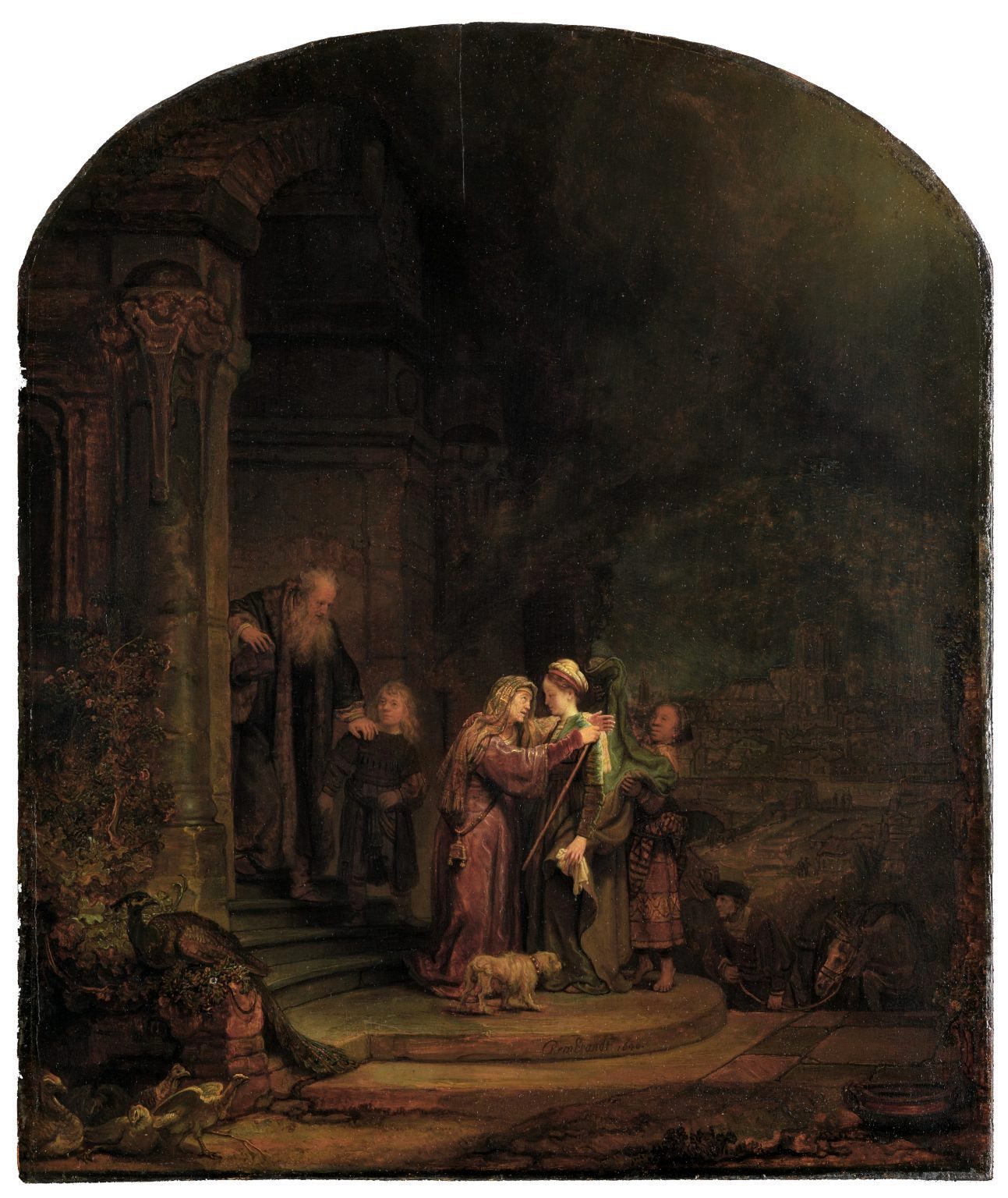
SERMON: Liberated to See by the God Who Sees” by Wes Vander Lugt, Trinity Forest Church, Concord, North Carolina, December 7, 2025: I’m always pleased when preachers, as part of their biblical exegesis, skillfully integrate art into their sermons—not as mere illustration or decoration but as itself interpreting scripture and/or doing theological work. In the sermon he gave for the Second Sunday of Advent this year, Rev. Dr. Wes Vander Lugt [previously], an ordained Presbyterian minister and director of the Leighton Ford Initiative in Theology, the Arts, and Gospel Witness at Gordon-Conwell Theological Seminary, preached on Luke 1:5–25, 39–45, about how God sees us and liberates us to see him and others. He discusses Rembrandt’s Visitation painting, especially the artist’s use of light and shadow—Mary and Elizabeth step out of the shadows, out of a place of feeling unseen, into the light of God’s grace, says Vander Lugt, where they are known and knowing.
Rembrandt_Visitation
Rembrandt Harmensz van Rijn (Dutch, 1606–1669), The Visitation, 1640. Oil on cedar panel, 22 1/4 × 18 7/8 in. (56.5 × 47.9 cm). Detroit Institute of Arts, Michigan. [object record]

He also touches on, very briefly, James B. Janknegt’s 2008 Visitation, which shows how John the Baptist has been liberated to see Jesus, even as the two are still in utero. See 17:49–20:05.

+++

FROM THE ARCHIVE: The Magnificat is a topic I’ve covered on the blog several times over the past ten years. Here are some examples:

“Love is patient…”: Ten songs based on 1 Corinthians 13

This Sunday’s lectionary reading from the Epistles is 1 Corinthians 13:1–13, the famous “love” passage. Here are ten songs that set that text or are based on it. And there are many more besides!

1. “1 Corinthians 13:1–8,” chanted in Romanian by Maria Coman, 2023:

2. “Love Will Never Fail” by Leslie Jordan, Orlando Palmer, Isaac Wardell, and Paul Zach of The Porter’s Gate, from Neighbor Songs, 2019:

For a cover by the Good Shepherd Collective, featuring Jayne Sugg and Son of Cloud (Jonathan Seale) (his is one of my favorite male singing voices), see here. They add as an outro the refrain of Martin Smith’s “I Could Sing of Your Love Forever.”

3. “Tell Him” by Lauryn Hill, 1998, performed by Esperanza Spalding, 2009:

The neo-soul/R&B album The Miseducation of Lauryn Hill (1998), Hill’s solo debut, is one of the most widely acclaimed albums of the nineties. At an evening of jazz and spoken word hosted at the White House on May 19, 2009, by then president Barack Obama, upright bass player, singer, and composer Esperanza Spalding performed her gorgeous arrangement of Hill’s “Tell Him.” The object pronoun “him” used throughout has been interpreted by listening publics as either a romantic partner or God, and the ambiguity is probably intentional. As for me, I hear the song as religious, especially given the line “the love that was shown when our lives were spared,” which I take to be a reference to Christ’s saving sacrifice. [HT]

4. “1 Corinthians 13:8–11” (excerpt) from Uganda, 2021:

This video was uploaded by Bwire Isaac, the founder of Alpha Worship Connection, a registered nonprofit that trains and equips worship leaders in Uganda. It was filmed at one of his Discipleship Training Weeks, and features a pastor named Muwanguzi playing the adungu (bow harp). I believe the language is Luganda. [HT]

5. “Love (1 Corinthians 13)” by Joni Mitchell, from Wild Things Run Fast, 1982:

The song also appears, re-recorded and in new arrangement, on Mitchell’s Travelogue (2002). Hear her speak about how the apostle Paul’s words inspired her in this two-minute video.

(Related post: “The Greatest of These,” a poem by Tania Runyan)

6. “Faith, Hope and Love” by Joanna Forbes L’Estrange, performed by London Voices, dir. Ben Parry, from Heaven to Earth, 2024:

7. “El Amor (1 Corintios 13)” by Michelle Matius, 2023:

Matius is a Christian singer-songwriter and recording artist from the Dominican Republic. Like all her songs, this one is in Spanish.

8. “Live for Love” by Eric Lige, 2022:

9. “The Gift of Love” by Hal Hopson, 1972, performed by Koiné on Gesanbuch, 2008:

The music of this one is adapted from a traditional English folk tune.

10. “Kanoo” (Love) by Elfi Bohl, aka Mariyama Suso, from Suukuu Kutoo / A New Song, 1999:

Bohl’s “Kanoo” is an original setting of 1 Corinthians 13:4–7 in the Mandinka language of West Africa, which she sings to a kora self-accompaniment. She wrote and recorded it while living in The Gambia. To learn more about Bohl and her kora songs, see my previous blog post from December.

Online highlights from the 2023 Calvin Symposium on Worship

On February 8–10, 2023, I had the pleasure of attending in person my first Calvin Symposium on Worship, an annual ecumenical gathering of Christian worship leaders from throughout North America (and some from overseas) organized by the Calvin Institute of Christian Worship at Calvin University and the Center for Excellence in Preaching at Calvin Theological Seminary in Grand Rapids, Michigan. The half-week is full of diverse worship services, lectures, breakout sessions, and opportunities to meet and mingle with folks who serve the church as pastors, liturgists, musicians, publishers, scholars, etc. It was an invigorating time!

The CICW is generous in providing recordings of much of its symposium content for free on their YouTube channel several months after the event, and they’ve just released a big batch. Below are some of my highlights that are shareable.  

Though music is not the exclusive focus of the symposium, it is a major component, and my ministry background is in that area, so I want to share with you some of the new songs I learned.

The worship service on February 9, titled “Rooted in Christ,” was excellent and worth watching in full (the sermon, on Colossians 2:6–15, was preached by Rev. Dr. Marshall E. Hatch, pastor of New Mount Pilgrim Missionary Baptist Church in Chicago), but here are three standout songs. The first two are led by the Calvin University Gospel Choir, directed by Nate Glasper Jr., and feature guest soloist Eric Lige.

“On Christ the Solid Rock,” adapt. and arr. Gerald Perry, 2022:

This song is a new gospel adaptation and arrangement by Gerald Perry of the classic Edward Mote–William Bradbury hymn “The Solid Rock.” It appears on the 2022 album Legacy by the James Family Singers (which is on Spotify), a West Michigan gospel group founded by Oscar and Erma James in 1981 and to which Perry belongs, along with more than two dozen members of his extended family.

“God Is Good” by Morris Chapman, 1992:

A call-and-response song written by Lige’s late mentor, Morris Chapman (1938–2020), a Grammy- and Dove Award–nominated composer and recording artist. The song appears on the 2010 compilation album Incredible Gospel, vol. 2.

“If God” by Casey Hobbs, John Webb Jr., and Natalie Sims, 2019:

This song of lament was sung by Samantha Caasi Tica, then a senior in Calvin’s speech-language pathology department, and Calvin alum Emma Gordon as the “Prayer of Intercession” portion of the service. The congregation (is that what you’d call the group of worshippers at a symposium?) was asked to come in on the chorus and the “Nothing but the Blood of Jesus” bridge. For the official live video of the song as performed by its writer, Casey J, see here.

And now from other worship services at the symposium:

“Los que sembraron con lágrimas” (Those Who with Tears Went Out Sowing) (Psalm 126) by Carlos Colón, 2019:

The Bifrost Arts setting of Psalm 126 by Isaac Wardell is one of my favorite congregational songs—it leans into the “weeping” aspect of the psalm. But this new setting by Carlos Colón leans into the psalm’s “joy” aspect, which gives it a different tone that works equally well, I think. It was led by Colón at the piano, with the help of Calvin University students and guest Wendell Kimbrough. (Watch full worship service.) It is #333 in the bilingual hymnal Santo, Santo, Santo: Cantos para el pueblo de Dios (Holy, Holy, Holy: Songs for the People of God).

“His Love Is My Resting Place (Psalm 23)” by Wendell Kimbrough, 2020:

There’s no standalone video for this song from the symposium, but I cued up the service video to where the song starts at 13:42; you can also listen to the solo recording released by songwriter Wendell Kimbrough in 2020. Director of music and songwriter at Church of the Incarnation in Dallas, Kimbrough is one of today’s foremost composers of biblical psalm settings for contemporary worship. Despite the dozens of settings that already exist of this most famous psalm, which begins “The Lord is my shepherd . . . ,” Kimbrough’s take is not a redundancy but rather a vibrant new and easily singable addition to this catalog of options. I brought it back with me to the local congregation I’m a member of, and the people took to it really well.

“Anta Atheemon” (You Are a Great God) by Ziad Samuel Srouji, 1990:

“Anta Atheemon” is sung by Christians throughout the Middle East and the Arabic-speaking world. It was written by Ziad Samuel Srouji, who was born in Haifa, Israel, and raised in Lebanon but then displaced by civil war to the United States. He is pastor of the Gate International Church in San Mateo, California.

“Soul, Adorn Yourself with Gladness / Vengo a ti, Jesús amado” (cued to 59:00):

What a wonderful song for the celebration of the Eucharist! “Bless the one whose grace unbounded this amazing banquet founded! The high and exalted and holy deigns to dwell with you most lowly. Be thankful! Soul, adorn yourself with gladness and rejoice!” I love the exuberant Puerto Rican melody.

The source of this hymn is the German communion chorale “Schmücke dich, O liebe seele” by Johann Franck (1618–1677). After being translated into Spanish by Albert Lehenbauer (1891–1955) for Lutherans in South America, the chorale traveled up to Puerto Rico, where it was reset to the tune CANTO AL BORINQUEN by Evy Lucío Cordova (b. 1934), now with an added refrain by Esther Eugenia Bertieaux (b. 1944). The English in the bilingual version here, published in Evangelical Lutheran Worship‎ #489, is a composite translation, borrowing from Catherine Winkworth (1827–1878) and others.

+++

The worship services, several a day, are only one component of the Calvin Symposium on Worship. There are also wonderful talks, panel discussions, and workshops—such as “Hardwired to Sing: Entrainment, Interactional Synchrony, and the Spirit-ed Magic of Corporate Song” by Dr. W. David O. Taylor. In this talk Taylor, a liturgical theologian teaching at Fuller Theological Seminary, expands on what I think is the most fascinating chapter of his latest book, A Body of Praise: Understanding the Role of Our Physical Bodies in Worship, which is “The Nature of the Body: Scientific Perspectives on the Body in Worship.”

“First, I wish to suggest that it is the Holy Spirit’s pleasure to work in and through our physical bodies, not just in our heads and hearts, in order to form us wholly into Christ’s body,” Taylor says. “And second, I would like to show how the sciences offer empirical insights into the metaphysical work of the Spirit to form our embodied communal singing.”

Citing Hebbian theory—namely, that “neurons that fire together wire together”—he says that singing together in corporate worship bonds us in ways that nothing else can, strengthening our kinship with one another through our bodies. “People who sing together experience a wiring together of their neural networks. They become tethered to one another in neurological and physiological ways, not just affective or relational ways.” He demonstrates this principle with the help of some audience volunteers.

The last twenty-five minutes of the video are Q&A. Unfortunately, the questioners aren’t miked, and not all the questions are repeated for the recording, so that part is a little hard to follow.

My favorite session that I attended was “The Practice of Lament,” a panel discussion with Drs. Wilson de Angelo Cunha, Cory B. Willson, and Danjuma Gibson, moderated by David Rylaarsdam—all Calvin faculty. “What are the different faces of lament? What is the goal of lament? How can pastoral leaders facilitate lament? What does lament reveal about the nature of God and what it means to be human?” It’s an excellent introduction to this important Christian discipline.

“Lament is a central part of our mission as God’s people, and I will say, we have largely failed,” says Willson. And later: “You cannot be a hopeful people or community if you don’t lament. And we need each other to hold out hope for us when we can’t find the strength to swing our feet from the bed to take another step toward a future.”

Asked to define lament, Gibson, a professor of pastoral care and a practicing psychotherapist, said, “Lamentation, or griefwork, is the process you engage in to come to terms with what has been lost, the rupture, the unattaching to what you have loved—that may be a way of life, that may be a person, that may be an image of how you thought things should have been—when there is a tragedy.”

Later in the discussion, in response to a question about how lament coheres with the apostle Paul’s call to rejoice always, Gibson clarifies: “Lamentation is not the opposite of joy. Lamentation is a particular manifestation of joy. And how I understand joy in my own work is this: joy is the inner assurance that you cultivate over time that you belong to God no matter what. . . . Lamentation is a declaration of that joy.”

Again, the questions from the audience are inaudible. But from memory, I can tell you that one was about divine impassibility (Greek apatheia), an attribute ascribed to God in classical theology that means that God does not feel pain or have emotions. This is an ascription that has always puzzled me and that I reject (it makes a virtue out of Stoicism), and indeed many Christian theologians have problems with it as well, because the picture of God that we have in both Testaments is of a God who is passionate, who grieves and gets angry and exults, and who is responsive to his people, empathetic.

Another question mentions the beating to death of Tyre Nichols by police officers in Memphis. Another asks how we know when we’re done lamenting a particular tragedy.

There’s so much that’s helpful and illuminating in this conversation; please give it a listen.

Another great panel discussion at the symposium was “Worship Music from Africa and the African Diaspora,” between Drs. James Abbington, Stephanie Boddie, Brandon A. Boyd, Pauline Muir, and Jean Kidula:

“What treasures and insights from the rich history of Christian worship music on the continent of Africa as well as from African diaspora communities in the United States and England should be more celebrated and cherished? What misunderstandings should be corrected? How can we learn from this rich history without misappropriating it? What signature examples of congregational song should we all learn more about and from? How can we all continue to learn more and explore more deeply connections across continents and Christian traditions?”

At 57:35, Abbington asks each panelist if they could teach the church one congregational song, one that’s important for the church to know, what would it be?

At the symposium, I also really enjoyed the lecture “More Than We Can Ask or Imagine: Music and the Uncontainability of Hope” by Dr. Jeremy Begbie, a theologian and pianist—but it is not and will not be available online. However, it draws on the themes of his new book from Baker Academic, Abundantly More: The Theological Promise of the Arts in a Reductionist World, which just released this week.


There were lots of other sessions offered as well—on creating a sense of belonging with youth in worship, intergenerational worship in global contexts, worshipping God with our public witness, sacred architecture and space design, cultural intelligence, singing the Psalms, wisdom from Indigenous Christians in Australia, how to shape a compelling sermon, lessons for leading congregational singing, refugia faith, and more. Several of these were recorded and are now hosted online in the Calvin Institute of Christian Worship Resource Library, which has content going back more than a decade (see also their YouTube channel @worshiprenewal).

Registration for next year’s Calvin Symposium on Worship has not yet opened, but the dates have been announced: February 7–9, 2024. The theme is Ezekiel. Find out more at https://worship.calvin.edu/symposium/index.html.

Roundup: West African praise medley, reading poetry and fiction, and more

SPOTIFY PLAYLIST: August 2022 by Victoria Emily Jones: Most months I compile thirty songs and other musical selections into a nonthematic playlist as a way to share good music, mostly from the Christian tradition but otherwise Christian-adjacent. This month’s list includes a traditional Black gospel song performed by Chris Rodrigues and professional spoon player Abby Roach (featured here); a Zulu song from South Africa about holding on to Jesus (bambelela = “hold on”); a song in the voice of Christ Our Mother by Irish singer-songwriter Sinéad O’Connor, from her album Gospel Oak; a portion of Barbados-born Judy Bailey’s Caribbean-style setting of the Anglican liturgy; a brass arrangement of a Golden Gate Quartet classic; Palestrina’s beautiful multivoiced setting of a Latin hymn by Bernard of Clairvaux; a future-looking song of celebration by country artist Naomi Judd, who passed away in April; a condensation of “In Christ Alone” by Texas soul artist Micah Edwards; and more.

The two videos below are from the list: a medley of the Twi praise chorus “Ayeyi Wura” (King of Our Praise) from Ghana and “Most High God” from Nigeria, led by Eric Lige at the 2018 Urbana missions conference, and a new arrangement by Marcus & Marketo of “I’ve Got a River of Life,” a song that I have fond memories of singing in children’s church as a kid (with hand motions!) (you can hear a more standard rendition here). The first line is derived from Jesus’s saying in John 7:38 (“Out of the believer’s heart shall flow rivers of living water”), and the refrain “Spring up, O well!” comes from Numbers 21:17, where the Israelites praise God for providing them water in the desert.

+++

Reading books is a key way that I grow intellectually and spiritually, and books are often where I find content to highlight on the blog, be it poems, visual art, people, or ideas. Because I’m not affiliated with an academic institution, I don’t have easy access to a lot of the books I need for my research, and I rely heavily on my personal library (as well as the Marina interlibrary loan system). If you’d like to support the work of Art & Theology, buying me a book from my wish list is a great way to do that! I’ll consider it a birthday gift, as my birthday is Saturday. 😊

+++

ESSAYS:

>> “Poetry’s Mad Instead” by Abram Van Engen, Reformed Journal: “I believe that poetry has a particular place in the church. I think it responds directly to the call and the invitation of God to ‘sing a new song,’” says Abram Van Engen, chair and professor of English at Washington University in St. Louis and cohost of the podcast Poetry for All. “And in the singing of poetry, the faithful can begin to understand and experience and engage God’s world afresh.” He adds, “Poets often invite us to practice thinking and noticing at a different pace. It is only at a slower speed of processing that we can begin to observe what we have too often missed or ignored.”

In this essay, Van Engen walks readers through the sonnet “Praise in Summer” by Richard Wilbur, which is what he begins with whenever he teaches poetry at church. He teaches you some of the poet’s tools so that you can feel more confident in approaching poems on your own.

>> “In Defense of Fiction: Christian Love for Great Literature” by Leland Ryken: An excellent article, by a professor emeritus of English at Wheaton College and author of The Christian Imagination: The Practice of Faith in Literature and Writing, A Complete Handbook of Literary Forms in the Bible, and more. “With so many valuable nonfiction books available to Christians, many wonder if reading fiction is worth the time. Others view fiction as a form of escapism, a flight from reality and the world of responsibility. But rightly understood, reading fiction clarifies rather than obscures reality. The subject of literature is life, and the best writers offer a portrait of human experience that awakens us to the real world. Fiction tells the truth in ways nonfiction never could, even as it delights our aesthetic sensibilities in the process. Reading fiction may be a form of recreation, but it is the kind that expands the soul and prepares us to reenter reality.”

+++

VISUAL MEDITATION: On Christ and the Samaritan Woman by Jacek Malczewski, by William Collen: William Collen introduced me to this unusual painting on the subject of Christ’s meeting with the woman at the well from John 4—a subject the artist painted several times (e.g., here, here, and here). Whereas Christ is traditionally shown pontificating to the woman with an air of formality, here there is an appealing casualness to their interaction, and the woman dominates the composition.

Malczewski, Jacek_Christ and the Samaritan Woman
Jacek Malczewski (Polish, 1854–1929), Christ and the Samaritan Woman, 1912. Oil on plywood, 92 × 72.5 cm. Borys Voznytskyi Lviv National Art Gallery, Ukraine.

Collen is an art writer and researcher from Omaha, Nebraska, who is a Christian and who blogs at Ruins. I’ve enjoyed following his posts, which include “The proper response to an art of sorrow”; “Dikla Laor’s photographs of the women of the Bible”; how household chores are approached differently by Koons, Picasso, Degas, and Vermeer; “Good art / bad art / non-art”; and “Artists and agency: assumptions and limits.” He writes in a conversational manner that’s really refreshing.

Roundup: Global Christian music; Christologies from the margins; race, gender, and photography

Today’s roundup brings together a theologian (Anderson Jeremiah), an art historian (Elissa Yukiko Weichbrodt), and a musician (Eric Lige and friends) who I think complement one another really well!

SONGS:

Eric Lige [previously] is “a music-maker who promotes Jesus, Justice, Faith, and Community.” He is the worship director at Ethnos Community Church in San Diego and the co-executive producer of The Ethnos Project, which creates a platform for new and emerging global voices in musical worship to be heard worldwide. Especially since COVID hit in 2019, he has been assembling multinational teams of musicians to produce YouTube videos, many of which are livestreamed as part of Ethnos worship services. Here are three examples (view more on Lige’s YouTube channel):

>> “Ξεδιψασμένος (No Longer Thirsty)” by Kostas Nikolaou: A contemporary Christian worship song in Greek, about how Christ, the living water, quenches our thirst for love and purpose. The lead vocalist is Nefeli Papanagi—and wow, do I love her voice!

>> “Ua Mau (Hosanna)” by Moses W. Kaaneikawahaale Keale (aka Keale Ta Kaula): Reyn and Joy Nishii perform this nineteenth-century Hawaiian hymn by Keale “the Prophet,” who converted to Christianity after calling on God during a hunting accident and finding rescue. The first verse translates to “Perpetual is the righteousness / That comes from the Father above / Let us gather together / In his goodness and grace.”

>> “Love’s in Need of Love Today” by Stevie Wonder: Edward Chen and friends—from Canada, the United States, Armenia, Venezuela, and Mexico—perform the opening track from Stevie Wonder’s Grammy-winning album Songs in the Key of Life. “God gave me this gift, and this particular song was a message I was supposed to deliver,” Wonder has said. “The concept I had in mind was that for love to be effective, it has to be fed.” See the full list of credits in the description on the video page. Eric Lige is the one in the maroon shirt.

+++

LECTURES:

>> “Many Faces of Jesus: Christologies from the Margins” by the Revd. Canon Dr. Anderson H. M. Jeremiah, October 12, 2021: Anderson Jeremiah is a senior lecturer in the politics, philosophy, and religion department at Lancaster University in the UK, whose areas of expertise include Christian theology in Asia, postcolonial approaches to theology, Dalit studies, liberation theology, modern missionary movements, and inculturation and faith. Ordained in the Church of South India (part of the Anglican Communion), he was installed as Canon Theologian of Blackburn Cathedral in September 2021, making him the first Dalit to be appointed to that role in any English cathedral.

In this half-hour online talk given last fall for the Diocese of Manchester, Jeremiah discusses the Incarnation as a continuous event—Christ being born into human cultures—as expressed through a selection of visual artworks from Ghana, Bolivia, China, Japan, and India. These images subvert the predominant Western image of Christ and sometimes provide critique. New to me was the black marble crucifix from the Anglican chapel inside Cape Coast Castle, a former trading post (now a museum) where enslaved Africans were held before being loaded onto ships and sold in the Americas. I’m not sure who commissioned the sculpture or when it was placed at this site, but it definitely looks modern.

The Q&A that followed on the original Zoom event is not included in the video, but here’s one of Jeremiah’s comments from it that I transcribed: “Jesus is not foreign to my own experience; this Jesus is part and parcel of my own existential reality. It [the image] enables people who are seeking peace and emancipation; [they are] emboldened in that process of seeing themselves reflected in the image of Jesus. The normative image the church has been holding on to has not created that space.” When one attendee asked if images of white Jesus are always “wrong” or to be discouraged, Jeremiah replied that there’s nothing wrong with such an image in itself, but the problem is when it is imposed on the entire world as the only way of looking at Jesus. “When we hold up one image as normative, we lose the diverse ways God intends to manifest himself in diverse contexts,” he said. (I couldn’t agree more!)

Bolivian crucifix
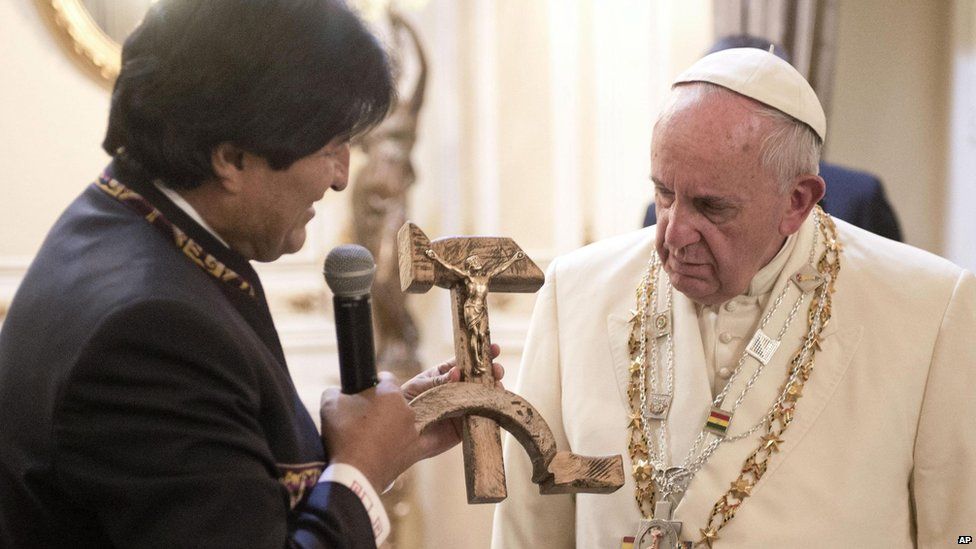
In July 2015 Bolivian president Evo Morales (who is Aymara) presented to Pope Francis a crucifix sculpted in the shape of a hammer and sickle. The crucifix is based on a design by Luís Espinal (1932–1980), a Jesuit priest assassinated in 1980 by right-wing militia. Bolivia’s communications minister, Marianela Paco, told Bolivian radio that “the sickle evokes the peasant, the hammer the carpenter, representing humble workers, God’s people.” Photo: AP.

Raj, Solomon_The Lord Remembers the Hungry
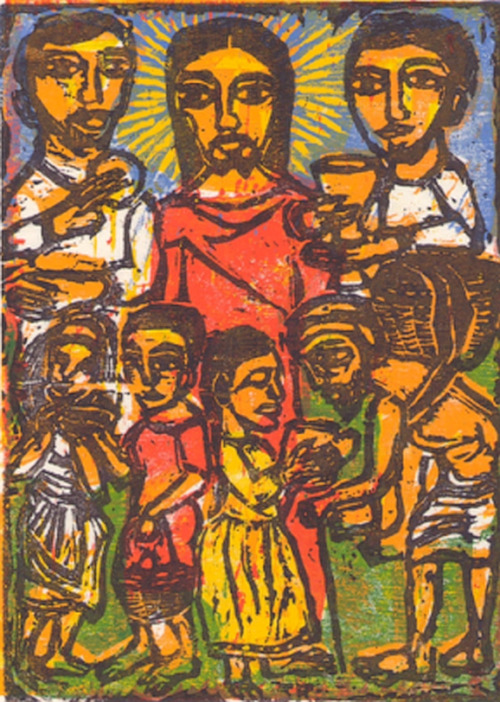
Solomon Raj (Indian, 1921–2019), The Lord Remembers the Hungry: Liberation from Hunger, 2006 (based on the 1988 original). Woodcut, from the series “Liberation in Luke’s Gospel.”

To hear more from the Rev. Dr. Anderson Jeremiah, see “Dalit Theology in the Context of World Christianity: Subversion and Transgression,” another excellent online talk that he gave in June 2021 at the invitation of the Oxford Centre for Religion and Culture. And this Grace Podcast episode from October, where he briefly discusses the From Lament to Action report of the Church of England’s Archbishops’ Anti-Racism Taskforce (published April 22, 2021), the contextual nature of all theology (contra the view that white Euro-American theology is somehow universal, whereas theologies that come from Africa, for example, need to be qualified), and cultural appreciation versus appropriation. “I’m trying to capture the experiences of communities through the stories they tell about Jesus,” Jeremiah says. Follow him on Twitter @TheOutsider40.

>> “The Loving Look: Or, How Art History Taught Me About the Difference Between Structure and Direction When Looking at Images of Race and Gender” by Dr. Elissa Yukiko Weichbrodt, October 12, 2017: Art historian Elissa Yukiko Weichbrodt, a professor at Covenant College who researches representations of race and gender in art and visual culture from the nineteenth century to the present, is one of my favorite people to follow on Instagram (@elissabrodt). I love how she helps people understand and use the tools of the discipline of art history. She teaches us how images work and how to interrogate them.

In this undergraduate lecture (starts at 4:06), Weichbrodt discusses how photography has been used to shape racial bias and even construct race, as well as gender, focusing on a famous 1957 photograph of school desegregation in Little Rock, Arkansas. She shows how this single photo is part of a larger web of meaning that contemporary news photos also play into. We’re always interpreting and categorizing images in relationship to things we’ve already seen, Weichbrodt says, creating a mental archive—for example, a file for “blackness,” a file for “womanhood.” And “as Christians called to recognize the dignity of God’s image in all people, we have to do actual work to acknowledge how our own archives may have hampered or distorted our love for our neighbors.” To look more faithfully, we need to look more; we need to build a broader archive.

For related content from Weichbrodt, see her 2018 series of articles for The Witness BCC: “Representing Race: Why Do Images Matter?,” “Representing Race: Lenses for Interpretation,” and “Restorative Looking.” You can also view a longer and more recent version of this lecture, “Looking Justly,” given October 30, 2019, at Christ Community Church in Franklin, Tennessee, which includes a Q&A.

+++

NEW PLAYLIST: February 2021 (Art & Theology): Continuing my initiative to share good music from the Judeo-Christian tradition . . . here’s a new (nonthematic) playlist I put together, which includes a fifteenth-century Jewish hymn (with a contemporary melody by Ugandan rabbi Gershom Sizomu), a country one-hit wonder from the sixties (thanks to my dad, a regular ’60s Gold listener, for introducing me to this one!), a virtuoso guitar composition by Bruce Cockburn inspired by Jesus’s first miracle, an original gospel song by Freedom Singer Bernice Johnson Reagon, the opening theme song of an antebellum television drama, and more.

Roundup: Art and the Psalms, “We Americans,” the Walking Roots Band, and more

“Psalms in Dialogue: Psalms 22, 23, and 24,” presented by Duke University Chapel: This multidisciplinary video presentation brings together dancers, musicians, a theologian, a painter, and (other) members of the Duke community to draw out the meaning of, or respond to, these three sequential psalms through art, prayer, and conversation. The livestreamed event aired October 17 and will be available for viewing for a limited time. Several of the segments, which I’ve time-stamped below, are intercut with photos from the streets in 2020 (showing the impact of the pandemic and racial unrest), of artist Makoto Fujimura in his studio and of his three finished paintings, and of Ekklesia Contemporary Ballet dancers in training. I wish more university chapels and well-resourced churches would offer experiences like this! Thank you to my friend Peggy for telling me about it. Read more about Duke Chapel’s multiyear Psalms project here.

1:51: “How do we name the impossible mystery?,” a theological reflection by Morley Van Yperen

6:02: Organ: “Jésus accepte la souffrance,” from La Nativité du Seigneur [previously] by Olivier Messiaen, performed by Christopher Jacobson

10:58: Psalm 22 by Makoto Fujimura, 2020, oyster shell on Belgium canvas, 48 × 48 in.

11:09: Reading of Psalm 22:1–22 by Luke A. Powery, with balletic responses by Paiter van Yperen, Elijah Ryan, Heather Bachman, and Sasha Biagiarelli

15:40: Lament, ballet solo danced by Paiter van Yperen (music by Max Richter, choreo by Elisa Schroth)

18:10: Psalm 22:22–32 chant by Zebulon Highben

21:09: Conversation on the Psalms with Makoto Fujimura and Ellen F. Davis, moderated by Amanda Millay Hughes

29:32: Organ: “Christus, der uns selig macht,” BWV 620, by Johann Sebastian Bach, performed by Christopher Jacobson

32:00: Prayer by Nathan Liang

34:11: Recitation of Psalm 23 by Julia Hendrickson

35:22: 6IX, a tap dance by Andrew Nemr

37:10: “The 23rd Psalm,” text adaptation and music by Bobby McFerrin, performed by the Duke Chapel Staff Singers (*this was my favorite!)

40:42: Prayer by Jonathan Avendano

42:39: “The Lord Is My Shepherd,” music by Howard Goodall, performed by the Royal School of Church Music in America Choristers

46:13: Psalm 24 remix produced by Andrew Nemr

48:21: Prayer by Jordyn Blake

49:45: Recitation of Psalm 24 by Julia Hendrickson

51:32: Conversation continued

1:11:49: “He’s Got the Whole World in His Hands,” African American spiritual arranged by Mark A. Miller, performed by the Duke Chapel Choir

+++

POEMS: This week’s edition of ImageUpdate includes two poems that I really appreciated. The first, which was new to me, is “America” by Claude McKay, a key figure in the Harlem Renaissance. Originally published in The Liberator in 1921, it expresses the pain of living in a country where you’re hated for your race and yet remains optimistic, beginning, “Although she feeds me bread of bitterness, / And sinks into my throat her tiger’s tooth, / Stealing my breath of life, I will confess / I love this cultured hell . . .” The second poem is “Making Peace” by Denise Levertov, one of the best-known Christian poets of the twentieth century. “The poets must give us / imagination of peace, to oust the intense, familiar / imagination of disaster,” she writes. Poets can help us feel our way toward shalom—give us a vision of its permeating the world that inspires us to live out its rhythms, its metaphors, its structure, its grammar, our lives like poems.

+++

MUSIC VIDEO: “We Americans” by the Avett Brothers: I’m so moved by this song from the Avett Brothers’ 2019 album Closer Than Together—its grappling with the historical legacy of the US, its greatness and its guilt, with a mixture of heartache, empathy, and hope. It’s one of the healthiest expressions of patriotism I’ve ever come across in a song. We need to see America as the complex entity that she is, which means in part not ignoring her flaws but with love exposing them so that they can be remediated and we can move forward together more faithful to her celebrated ideals. “We Americans” is both confession and supplication, an “I’m sorry, God” and “God, help us to do better.” The final chorus:

I am a son of God and man
And I may never understand
The good and evil
But I dearly love this land
Because of and in spite of We the People
We are more than the sum of our parts
All these broken bones and broken hearts
God, will you keep us wherever we go?
Can you forgive us for where we’ve been?
We Americans

I was reminded of this song in the September 17 episode of the RTN Theology podcast, “You Shall Know the Truth and the Truth Shall Unsettle You.” Chris Breslin interviews Mark Charles, a Native American activist, public speaker, Christian leader, and independent candidate in this year’s US presidential election. He is the coauthor, with Soong-Chan Rah, of Unsettling Truths: The Ongoing, Dehumanizing Legacy of the Doctrine of Discovery. Charles enters at 12:40 with a discussion of the lack of common memory.

+++

SONGS:

>> “Whatever Comes Next” by Drew Miller: This song came out of “Hutchmoot: Homebound,” a virtual arts gathering organized by the Rabbit Room that took place earlier this month. In writing the song, Drew Miller [previously] was inspired in part by Shigé Clark’s new poem “Grateful” (see her perform the poem here).

>> “Bring Your Peace” by the Walking Roots Band: This song was written this year by Seth Thomas Crissman and Greg J. Yoder of the Walking Roots Band as part of a collection of fifteen songs for Shine, a children’s Sunday school curriculum published by MennoMedia and Brethren Press. It appears on Everybody Sing: Worship Songs for Children, released in June as a double album with Everybody Sing: Songs for the Seasons (which comprises ten original songs by The Many). The song asks God to bring his peace into our fears and into the storms we face, and to make us instruments of that peace to others.

>> “Rest Assured,” sung by the Walking Roots Band: TWRB learned this song from a bandmate’s parent (original authorship unknown) and recorded it a cappella in their separate locations at the start of quarantine in March. The chorus goes,

Rest assured, He’s not forgotten
Rest assured, He’ll take care of you
Look at the times He’s been there before
He’ll be there again, rest assured

>> “Let Justice Roll Like a River,” sung by Eric Lige: Bobby Gilles and Rebecca Elliott of Sojourn Music wrote this song in 2017, inspired by Amos 5. In this lyric video from July 5, it’s performed by Eric Lige and Paul Lee of Ethnos Community Church. The singing starts at 1:33. [HT: Global Christian Worship]