The Trial by Bitter Water: An Apocryphal Tale of the Virgin Mary Being Tested for Adultery

As important as she is in the Christian tradition, the Bible doesn’t give us a whole lot of details about the life of Mary, especially prior to her conception of Jesus. To give her a backstory and fill in some gaps, the Protoevangelium of James (aka the Gospel of James) was written in the second century, probably in Syria. The author purports to be the apostle James, the brother of Jesus (by an earlier marriage of Joseph’s, according to the text), but the actual author is unknown. While parts of it are based on the canonical Gospels of Matthew and Luke, most of the material is legendary, developed to satisfy people’s curiosity about Jesus’s parentage and some of the events of his infancy.

The Protoevangelium of James was, and remains, immensely popular in Eastern Christianity, having been translated early on from its original Greek into Syriac, Ethiopic, Coptic, Armenian, and Arabic. On how the Orthodox Church views the text today, I found this Reddit thread interesting.

A later version of it, with additions and modifications, emerged in Latin by the seventh century under the name the Gospel of Pseudo-Matthew (aka the Infancy Gospel of Matthew), popularizing its stories in the West.

None of the three branches of Christianity regards these gospels as scripture—the Gelasian Decree of circa 495 officially classified the Protoevangelium as apocryphal, meaning not inspired or authoritative—but nonetheless, they have heavily influenced (in Catholicism and Eastern Orthodoxy) Christian art and Mariology.

Trying to interpret Christian artworks depicting unfamiliar scenes or details is how I first brushed up against the Protoevangelium of James and the Gospel of Pseudo-Matthew.

One such scene, which is rare but sometimes appears between images of the Visitation (or the Annunciation to Mary, or the First Dream of Joseph) and the Journey to Bethlehem, is of Mary standing before a priest, holding a cup. This, I learned, depicts the so-called trial by bitter water, or sotah ritual, an ancient Hebrew method for dealing judicially with women who were suspected of adultery. Outlined in Numbers 5:11–31, in this ritual, a suspicious husband was to bring his wife to the tabernacle to subject her to a trial by ordeal. After receiving a grain offering from the husband, the priest would mix a concoction of holy water, dust from the tabernacle floor, and curses scraped off from the parchment they were written on. The wife would be compelled to swear her innocence and then drink the cup. If she was guilty of marital unfaithfulness, she would suffer painful reproductive affliction;1 but if not, she would be unharmed and thus exonerated.

Trial by ordeal was a common legal recourse in patriarchal cultures across the ancient Near East, reflecting distrust of women’s sexuality and reinforcing husbands’ domination over their wives. That it was a sanctioned practice in the Old Testament is troubling, to say the least—but let’s sidestep that discussion for now. Let me simply commend to you the Numbers 5 visual commentary by Maryanne Saunders (Master of Studies, History of Art, Oxford), which examines three artworks based on this passage, including a feminist Jewish one.
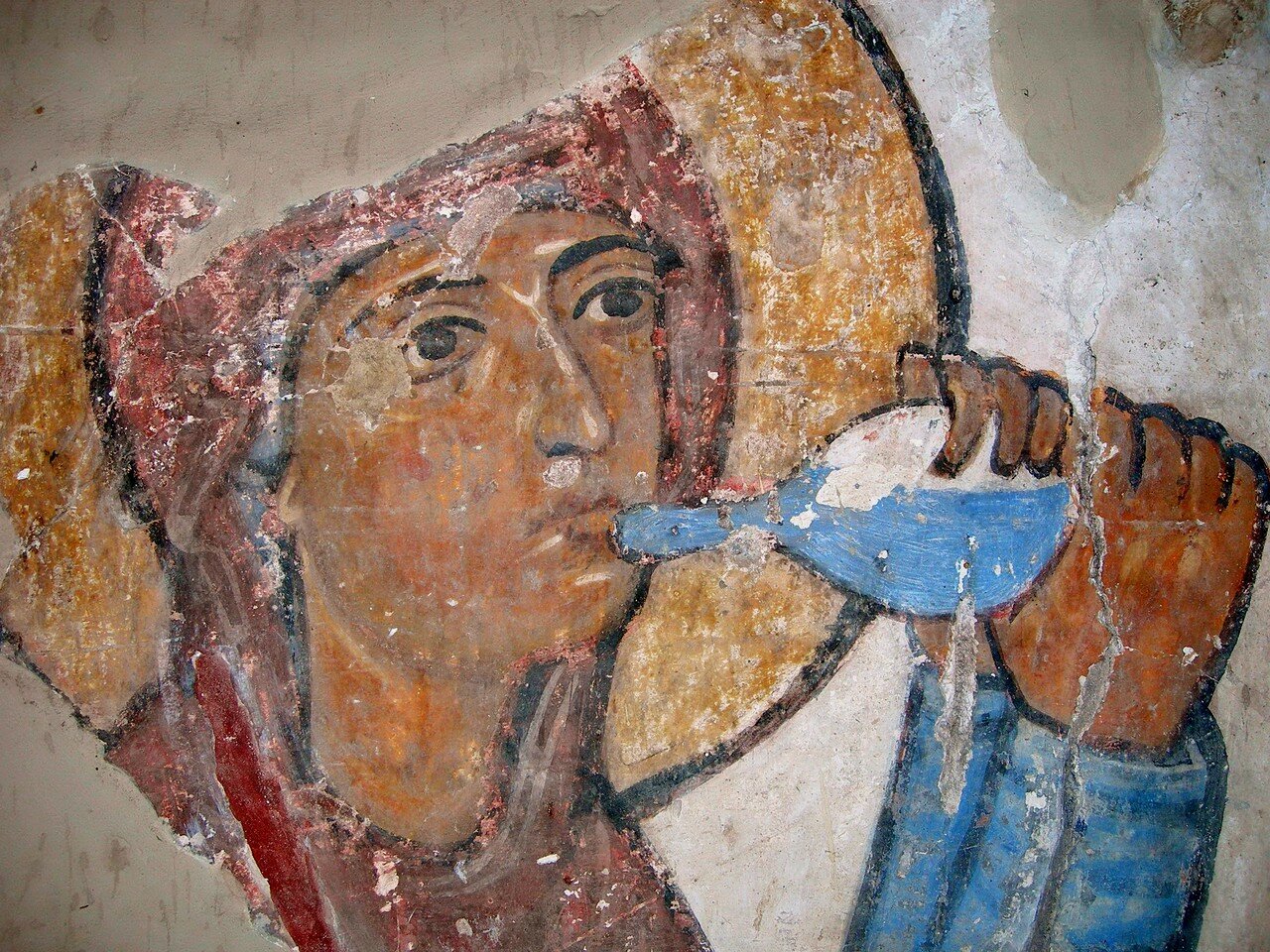
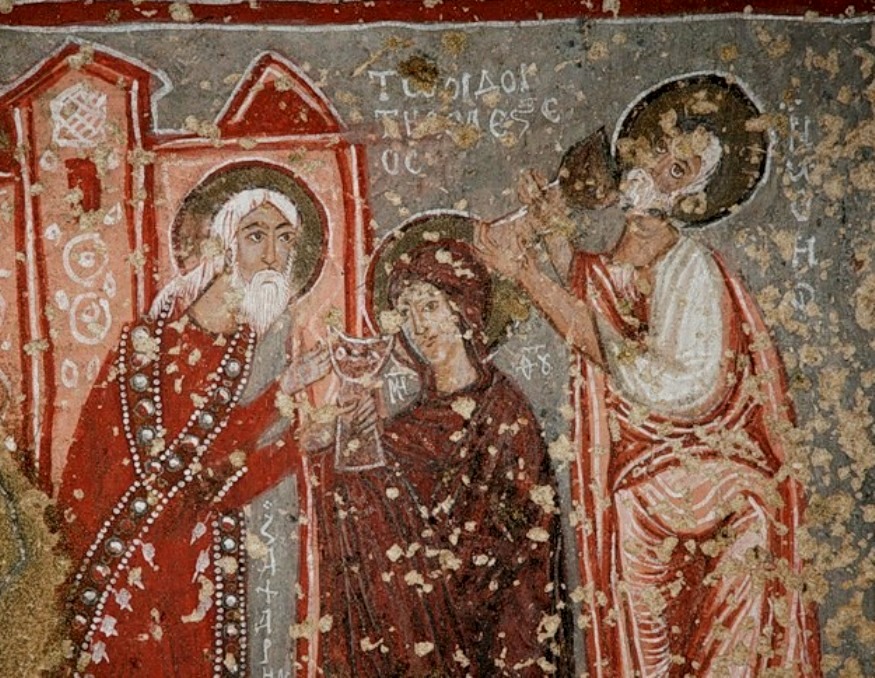
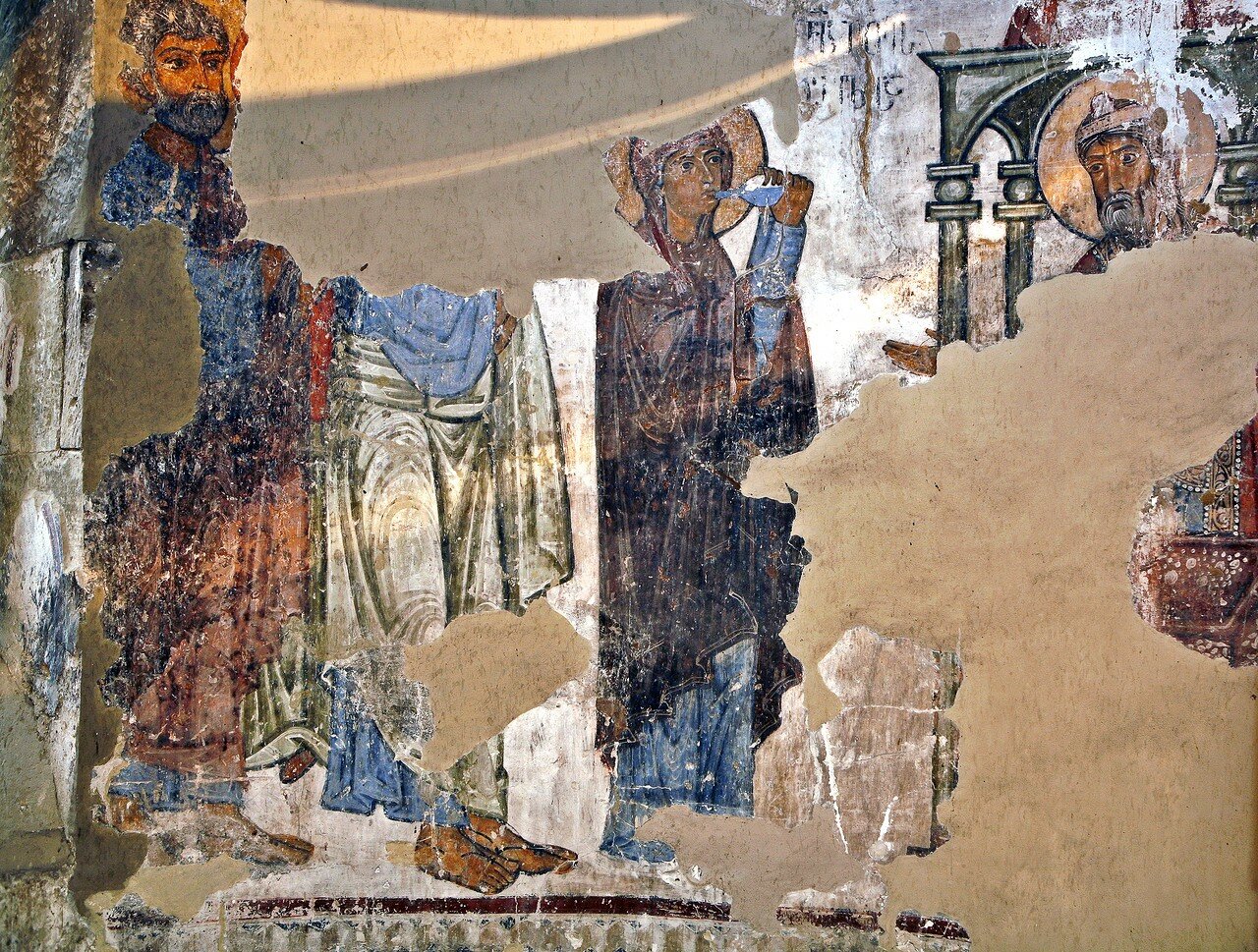
Trial by Bitter Water (Ateni, Georgia) (detail)
Fresco, 11th century, Church of the Dormition of the Virgin Mary, Ateni, Georgia. (See a wider shot below.)

According to the Protoevangelium of James, sometime after the angel had appeared to Joseph convincing him of Mary’s fidelity, a Jewish scribe named Annas saw Mary’s pregnant belly and reported both her and Joseph to the priest for sexual sin, for they were not yet married. They maintained their innocence and were made to drink a potion that would have no effect if they were telling the truth but that would make them ill if they were indeed guilty. Of course, they came out scot-free. Their chastity was divinely confirmed.

(Related post: https://artandtheology.org/2022/12/10/advent-day-14-joseph/)

This account of the Jewish ritual of sotah is unique in that (1) it is initiated by a third party, and (2) the male partner is also accused and made to drink the potential curse. Traditionally, the ritual could be initiated only by a husband. Scholars cite the Protoevangelium author’s apparent unfamiliarity with Jewish practices—this and others—as evidence that he was not Jewish (as the historical James was).

The Protoevangelium was written at a time when opponents of Christianity were decrying the virgin birth. The pagan philosopher Celsus, for example, insisted that while pledged to Joseph, Mary had an affair with the Roman soldier Panthera, and that Jesus was the illegitimate fruit of that union. The story of the trial by bitter water was an attempt to defend Mary against the charge of adultery and Jesus against the charge of ignoble origins. It also—if one believes God was indeed the moral adjudicator in the trial—corroborates the message Mary and Joseph claimed to have received separately from an angel, that Jesus was the Son of God.

I’m sharing this episode from the Protoevangelium not because I think it actually happened but so that you have more context for an image that occasionally crops up in cycles on the life of Mary. Also, perhaps its elaboration on the scandal and consequences of alleged adultery in ancient Jewish culture helps better situate us in Mary’s time and place.

Before I quote the relevant excerpt, a little further background is in order, to explain some of what’s mentioned in the dialogues. Earlier in the Protoevangelium, we read that as an expression of gratitude, Mary’s parents dedicated her to the service of God, and that she lived in the temple in Jerusalem from age three until puberty, where she was fed by angels. When her first menstruation loomed, the priests consulted on what to do with her, lest she defile the temple with her blood. They decided to give her over to the care of Joseph, an elderly widower with grown children.

OK, so now, here are chapters 15 and 16 of the Protoevangelium of James, as translated by Alexander Walker, courtesy of New Advent (I’ve added paragraph breaks):

15. And Annas the scribe came to him [Joseph], and said: “Why have you not appeared in our assembly?”

And Joseph said to him: “Because I was weary from my journey, and rested the first day.”

And he [Annas] turned, and saw that Mary was with child. And he ran away to the priest, and said to him: “Joseph, whom you vouched for, has committed a grievous crime.”

And the priest said: “How so?”

And he said: “He has defiled the virgin whom he received out of the temple of the Lord, and has married her by stealth, and has not revealed it to the sons of Israel.”

And the priest answering, said: “Has Joseph done this?”

Then said Annas the scribe: “Send officers, and you will find the virgin with child.” And the officers went away, and found it as he had said; and they brought her along with Joseph to the tribunal.

And the priest said: “Mary, why have you done this? And why have you brought your soul low, and forgotten the Lord your God? You that wast reared in the holy of holies, and that received food from the hand of an angel, and heard the hymns, and danced before Him, why have you done this?”

And she wept bitterly, saying: “As the Lord my God lives, I am pure before Him, and know not a man.”

And the priest said to Joseph: “Why have you done this?”

And Joseph said: “As the Lord lives, I am pure concerning her.”

Then said the priest: “Bear not false witness, but speak the truth. You have married her by stealth, and hast not revealed it to the sons of Israel, and hast not bowed your head under the strong hand, that your seed might be blessed.” And Joseph was silent.

16. And the priest said: “Give up the virgin whom you received out of the temple of the Lord.” And Joseph burst into tears. And the priest said: “I will give you to drink of the water of the ordeal of the Lord, and He shall make manifest your sins in your eyes.”

And the priest took the water, and gave Joseph to drink and sent him away to the hill-country; and he returned unhurt. And he gave to Mary also to drink, and sent her away to the hill-country; and she returned unhurt. And all the people wondered that sin did not appear in them.

And the priest said: “If the Lord God has not made manifest your sins, neither do I judge you.” And he sent them away.

And Joseph took Mary, and went away to his own house, rejoicing and glorifying the God of Israel.

Here’s how that episode is adapted in chapter 12 of the Gospel of Pseudo-Matthew—again, translated by Walker, and in the public domain:

After these things [the angelic announcements to Mary and Joseph] there arose a great report that Mary was with child. And Joseph was seized by the officers of the temple, and brought along with Mary to the high priest. And he with the priests began to reproach him, and to say: “Why have you beguiled so great and so glorious a virgin, who was fed like a dove in the temple by the angels of God, who never wished either to see or to have a man, who had the most excellent knowledge of the law of God? If you had not done violence to her, she would still have remained in her virginity.”

And Joseph vowed, and swore that he had never touched her at all.

And Abiathar the high priest answered him: “As the Lord lives, I will give you to drink of the water of drinking of the Lord, and immediately your sin will appear.”

Then was assembled a multitude of people which could not be numbered, and Mary was brought to the temple. And the priests, and her relatives, and her parents wept, and said to Mary: “Confess to the priests your sin, you that wast like a dove in the temple of God, and received food from the hands of an angel.”

And again Joseph was summoned to the altar, and the water of drinking of the Lord was given him to drink. And when anyone that had lied drank this water, and walked seven times round the altar, God used to show some sign in his face. When, therefore, Joseph had drunk in safety, and had walked round the altar seven times, no sign of sin appeared in him. Then all the priests, and the officers, and the people justified him, saying: “Blessed are you, seeing that no charge has been found good against you.”

And they summoned Mary, and said: “And what excuse can you have? Or what greater sign can appear in you than the conception of your womb, which betrays you? This only we require of you, that since Joseph is pure regarding you, you confess who it is that has beguiled you. For it is better that your confession should betray you, than that the wrath of God should set a mark on your face, and expose you in the midst of the people.”

Then Mary said, steadfastly and without trembling: “O Lord God, King over all, who know all secrets, if there be any pollution in me, or any sin, or any evil desires, or unchastity, expose me in the sight of all the people, and make me an example of punishment to all.” Thus saying, she went up to the altar of the Lord boldly, and drank the water of drinking, and walked round the altar seven times, and no spot was found in her.

And when all the people were in the utmost astonishment, seeing that she was with child, and that no sign had appeared in her face, they began to be disturbed among themselves by conflicting statements: some said that she was holy and unspotted, others that she was wicked and defiled.

Then Mary, seeing that she was still suspected by the people, and that on that account she did not seem to them to be wholly cleared, said in the hearing of all, with a loud voice, “As the Lord Adonai lives, the Lord of Hosts before whom I stand, I have not known man; but I am known by Him to whom from my earliest years I have devoted myself. And this vow I made to my God from my infancy, that I should remain unspotted in Him who created me, and I trust that I shall so live to Him alone, and serve Him alone; and in Him, as long as I shall live, will I remain unpolluted.”

Then they all began to kiss her feet and to embrace her knees, asking her to pardon them for their wicked suspicions. And she was led down to her house with exultation and joy by the people, and the priests, and all the virgins. And they cried out, and said: “Blessed be the name of the Lord forever, because He has manifested your holiness to all His people Israel.”

Some of the differences from the Protoevangelium of James are:

  1. Mary and Joseph’s accusers are a group of unnamed religious officials rather than the scribe Annas.
  2. It’s specified that Mary and Joseph are brought before the high priest, and he’s named Abiathar. (In the Protoevangelium, the high priest, from the time of Mary’s presentation in the temple as a child to just after the birth of Christ, is Zechariah, Elizabeth’s husband.)
  3. The sotah ritual involves the accused circling the altar seven times rather than going away to the hill country and returning.
  4. Most notably, Mary vows to remain celibate for life. This passage lent power to (or derived power from?) the developing doctrine of Mary’s perpetual virginity—considered dogma by the Roman Catholic Church, as formally declared at the Lateran Council of 649, and taught, too, by the Eastern Orthodox Church, who accept the title “ever-virgin” for Mary, as recognized at the Second Council of Constantinople in 553.

One of the earliest known appearances of the trial by bitter water in visual art is on one of the twenty-seven surviving ivory plaques set into the cathedra (episcopal throne) of Archbishop Maximian of Ravenna.
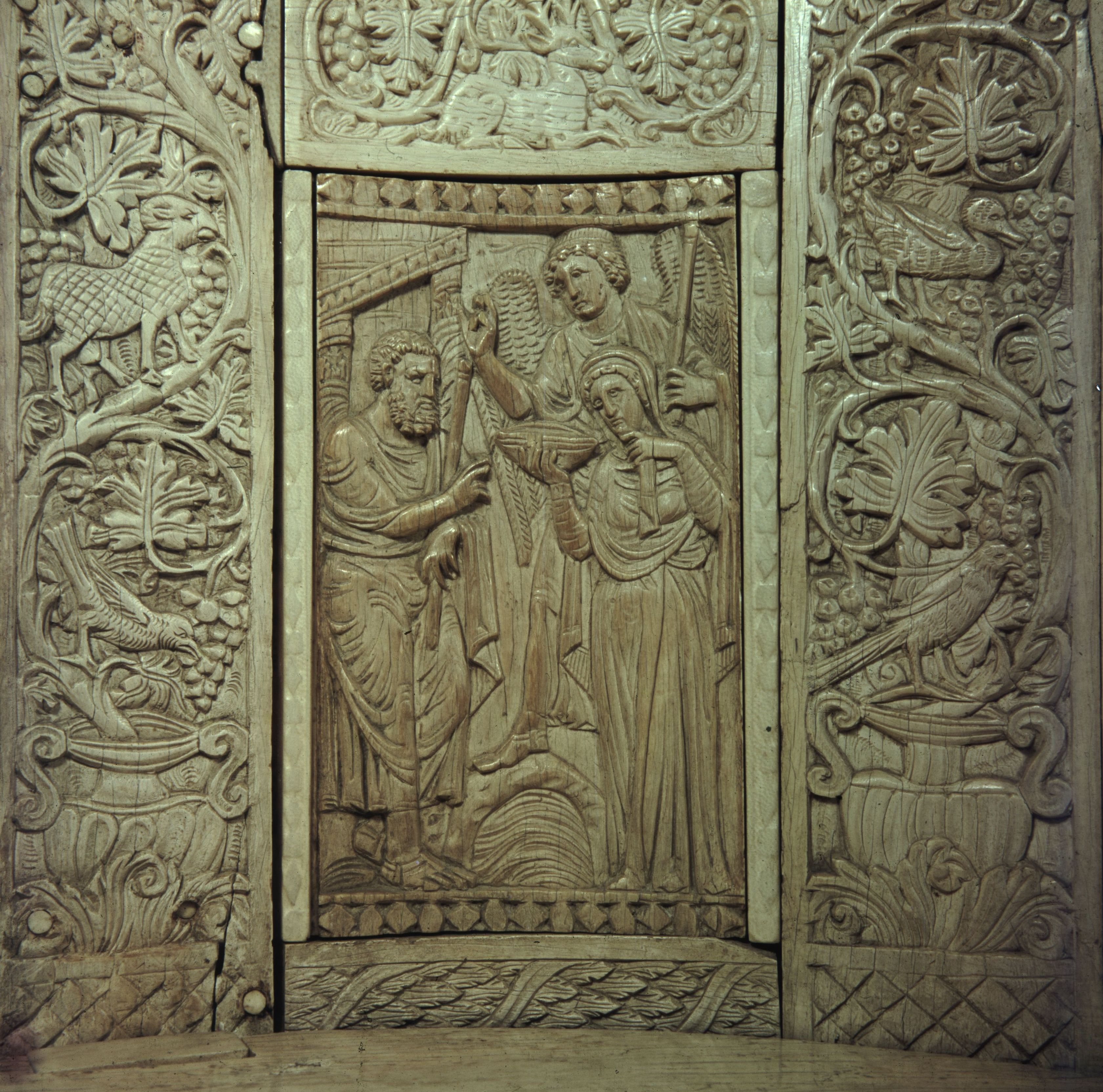
Trial by Bitter Water (Throne of Maximian)
Throne of Maximian (detail), Constantinople or Alexandria, ca. 545–53. Ivory. Archiepiscopal Museum, Ravenna, Italy. [view full throne]

Standing at the right, Mary holds a vessel in one hand and a skein of wool in the other. (The Protoevangelium says she was among the young women who wove a new veil for the holy of holies.) Joseph stands across from her with a staff in hand, and behind her stands an angel, indicating divine intervention to determine guilt or innocence.  

Around the same time, the trial by bitter water appeared in another ivory made in the Eastern Mediterranean—possibly Syria.
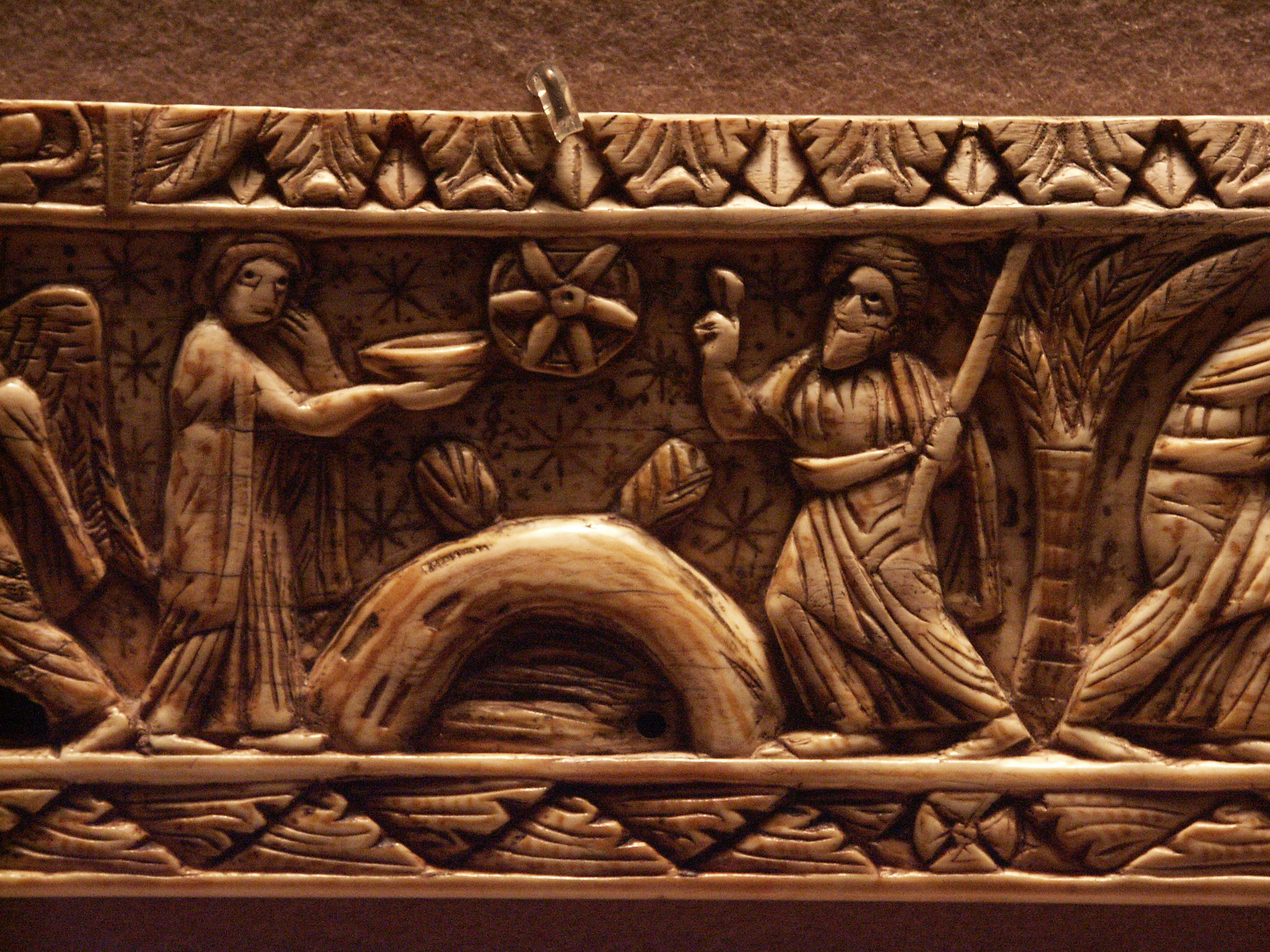
Trial by Bitter Water (Louvre)
Detail of an ivory band depicting the Trial by Bitter Water, Eastern Mediterranean (Syria?), 550–600. Musée du Louvre, OA 11149. [view full artwork]

And in a sequence of Marian scenes on a carved ivory Gospel-book cover from France.
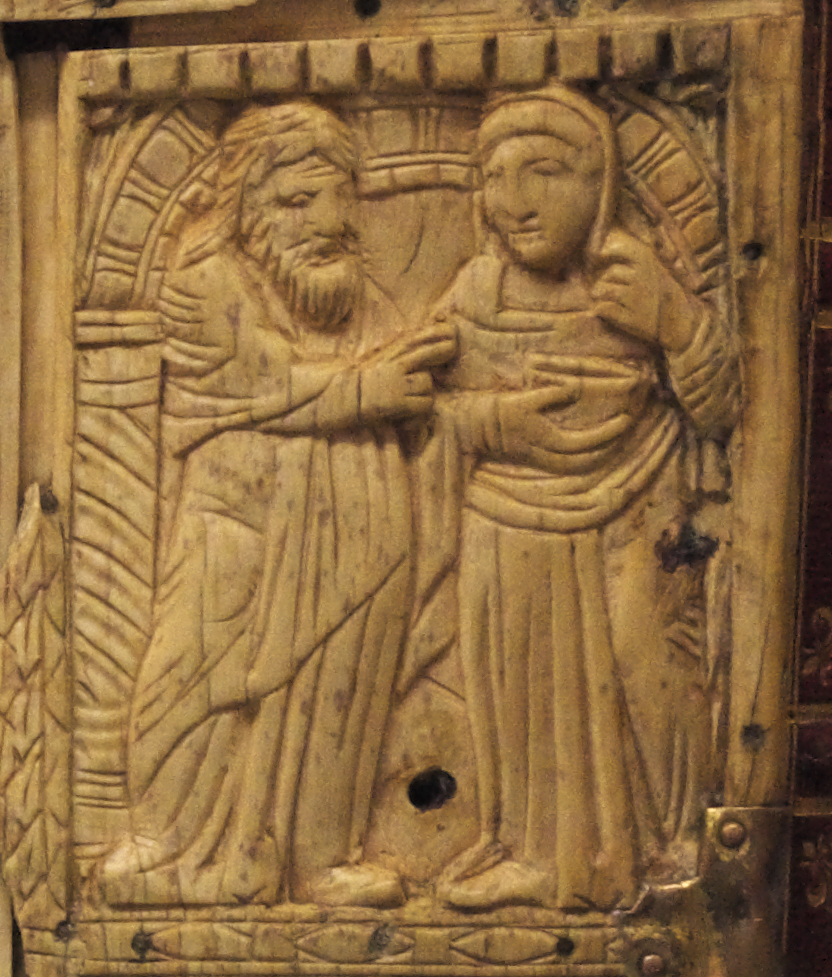
Trial by Bitter Water (Lupicin Gospels)
Ivory panel from the back cover of the Lupicin Gospels, France, 6th century. Bibliothèque nationale de France, Paris. [view full cover]

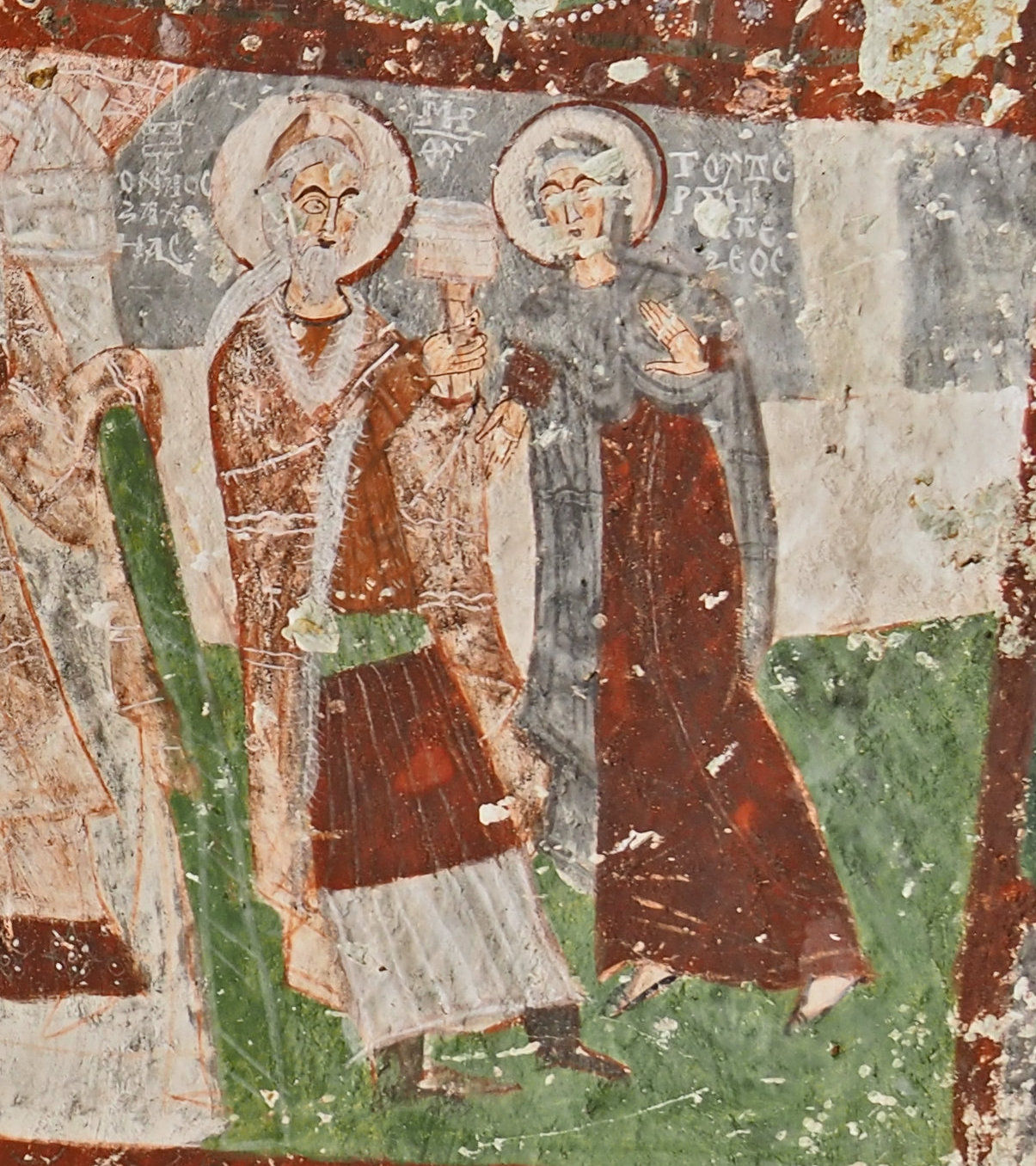
The scene is found painted inside several of the cave churches of Cappadocia from the ninth through eleventh centuries, including St. Eustathios, Tokalı (see below), Kılıçlar, Bahattin Samanlığı, Aynalı, Eğritaş, and Pürenli Seki, as the art historian Yıldız Ötüken has pointed out.

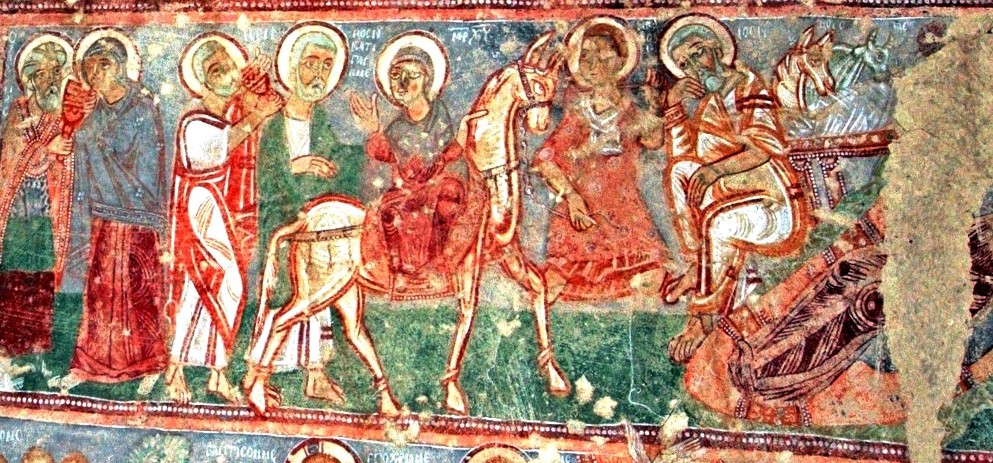
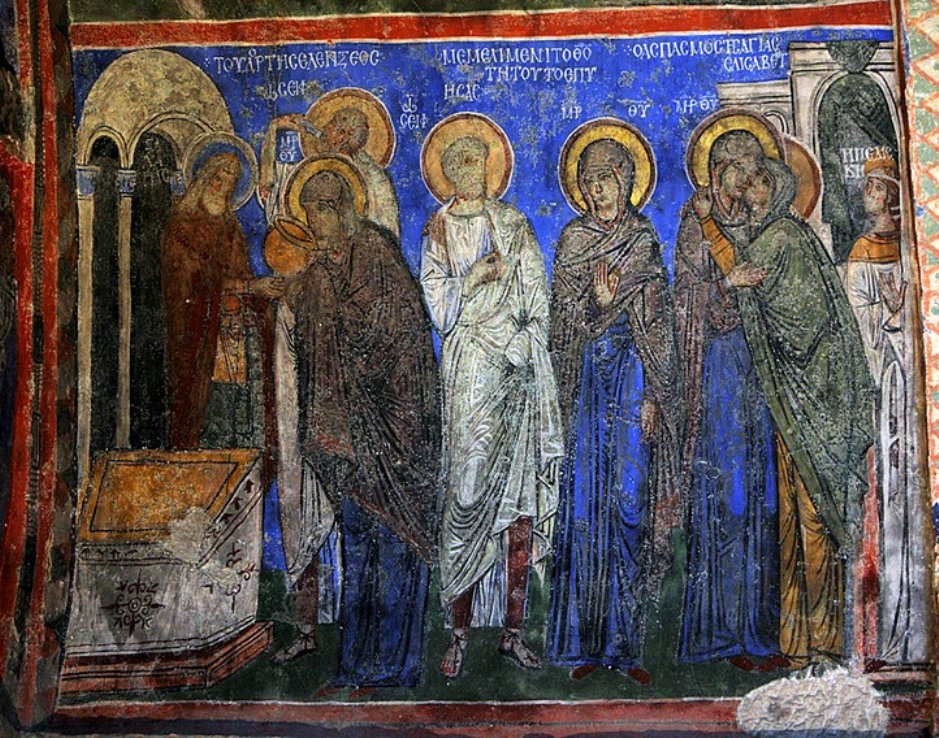
In Old and “New” Tokalı Kilise (Buckle Church), the latter built as an extension forty years after the original, Joseph drinks the bitter water as well as Mary, as the apocryphal gospels state but which is rarely shown.
Trial by Bitter Water (Old Tokali)
Fresco, ca. 920, south wall, Old Tokalı Kilise (Buckle Church), Göreme Open Air Museum, Cappadocia, Turkey [view wider shot]

Trial by Bitter Water (New Tokali)
Fresco, ca. 960, New Tokalı Kilise (Buckle Church), Göreme Open Air Museum, Cappadocia, Turkey

So, too, at Çavuşin Church:

Trial by Bitter Water (Çavuşin)
Fresco, mid-10th century, Çavuşin Church, Göreme National Park, Cappadocia, Turkey [view wider shot]

But not at Pancarlik Church:

Trial by Bitter Water (Pancarlik Church)
Fresco, 11th century, Pancarlik Church, Cappadocia, Turkey [view wider shot]

The trial by bitter water also appears elsewhere in the Balkans, such as in Georgia and North Macedonia.
Trial by Bitter Water (Ateni, Georgia)
Fresco, 11th century, Church of the Dormition of the Virgin Mary, Ateni, Georgia

Trial by Bitter Water (Balkans)
I’m not able to confirm, but blogger Marina Golubina says this is a 13th-century fresco from Sušica (near Skopje) in North Macedonia.

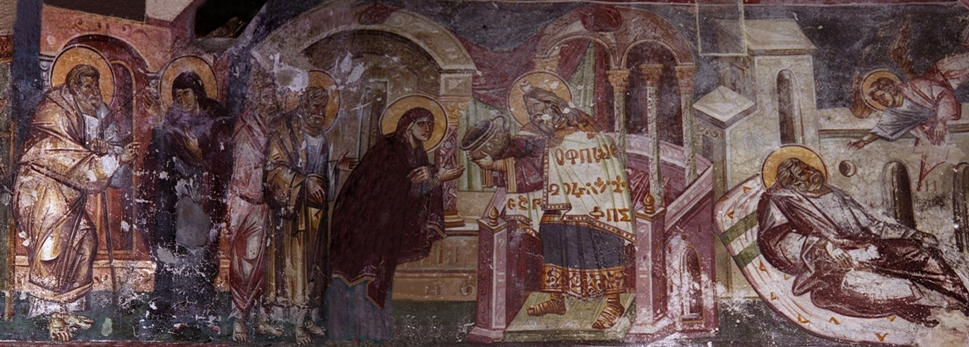
Joseph's Reproach, Trial by Bitter Water, Joseph's Dream
Michael Astrapa and Eutychius, Joseph’s Reproach, the Trial by Bitter Water, and Joseph’s Dream, 1295. Fresco, north wall, Church of the Virgin Mary Peribleptos, Ohrid, North Macedonia.

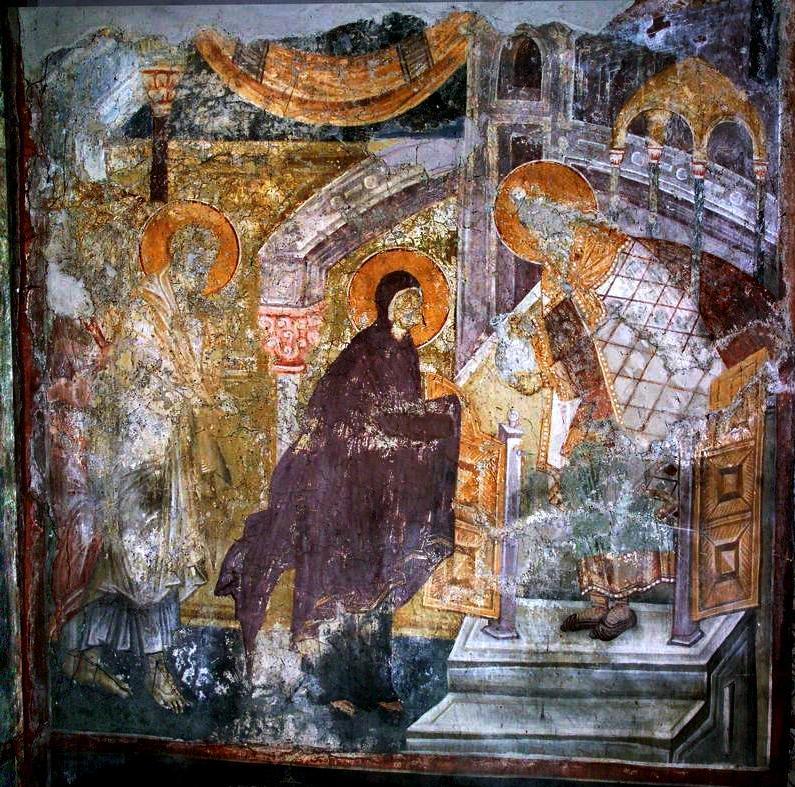
Trial by Bitter Water (Macedonia)
Fresco, 1330, Church of the Presentation of the Virgin in the Temple, Kucevište, North Macedonia

In that second image in the above grouping, Mary is accompanied to the temple by her five (four?) virgin companions, named in the Gospel of Pseudo-Matthew as Rebecca, Sephora, Susanna, Abigea, and Cael.

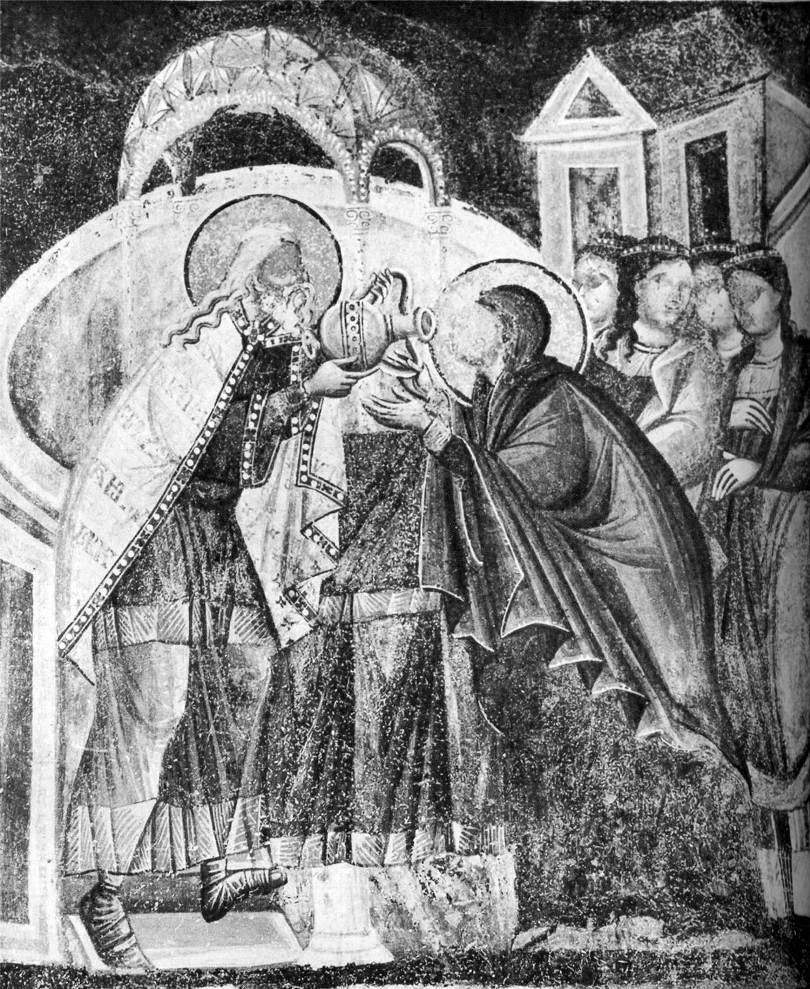
Due to overlapping content, the Protoevangelium of James is illustrated in detail in the twelfth-century manuscript Six Homilies on the Life of the Virgin by James of Kokkinobaphos, which was made by a prominent atelier in Constantinople and is held at the Vatican Library. The trial by bitter water is divided into two separate scenes: one of Joseph drinking the cup and being escorted up the mountain, and one of Mary doing the same.
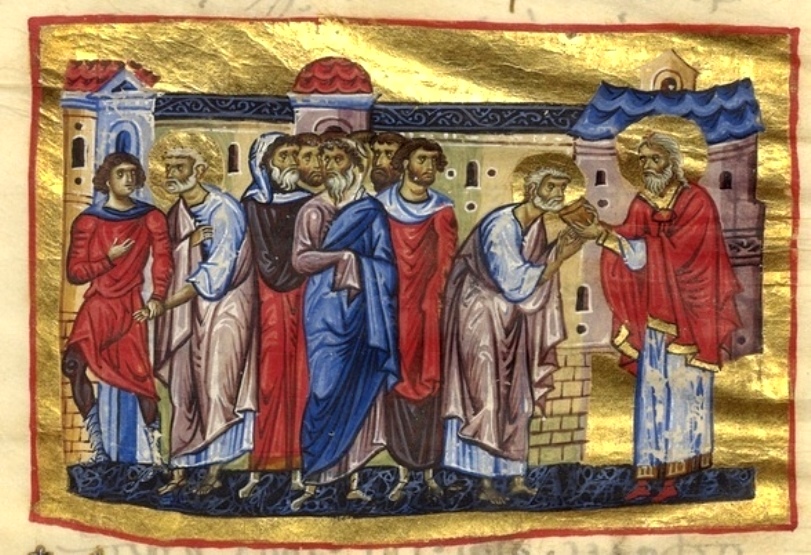
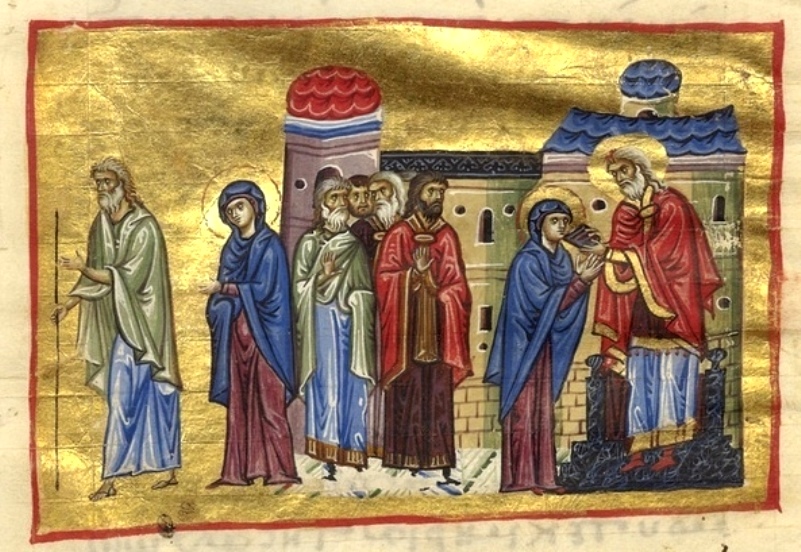
Trial by Bitter Water (Joseph) (Vatican)
Joseph drinks the cup from Zechariah, Constantinople, first half of 12th century. From a manuscript of the Six Homilies on the Life of the Virgin by James of Kokkinobaphos. Rome, Biblioteca Apostolica Vaticana, Vat. gr. 1162, fol. 184r. [object record]

Trial by Bitter Water (Mary) (Vatican)
Mary drinks the cup from Zechariah, Constantinople, first half of 12th century. From a manuscript of the Six Homilies on the Life of the Virgin by James of Kokkinobaphos. Rome, Biblioteca Apostolica Vaticana, Vat. gr. 1162, fol. 188r. [object record]

Other scenes in the sequence portray Joseph’s dream, Joseph consulting with his sons, Joseph apologizing to Mary, Annas the scribe confronting Joseph and the pregnant Mary, Annas reporting the couple to the high priest Zechariah, Mary and Joseph being brought to the temple, Zechariah talking with Joseph, Zechariah talking with Mary, and after the drink, Mary returning unharmed and Zechariah proclaiming her innocence, and then Mary, Joseph, and Joseph’s sons leaving Jerusalem.

On occasion, the trial by bitter water appears in Russian icons, such as on the walls of St. Sophia Cathedral in Vologda.
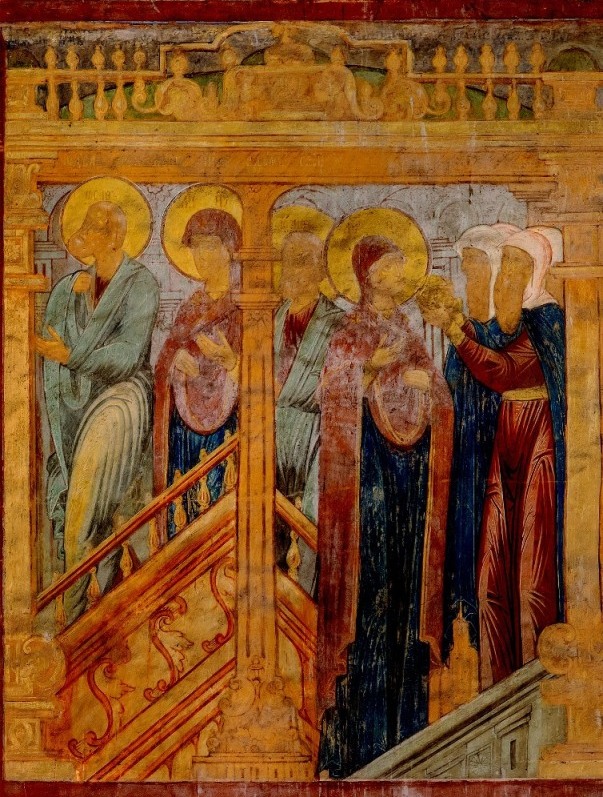
Trial by Bitter Water (Russia)
Fresco, 1685–87, St. Sophia Cathedral, Vologda, Russia

I first encountered it, though, in my studies of Ethiopian art, where it appears in a handful of illuminated manuscripts.
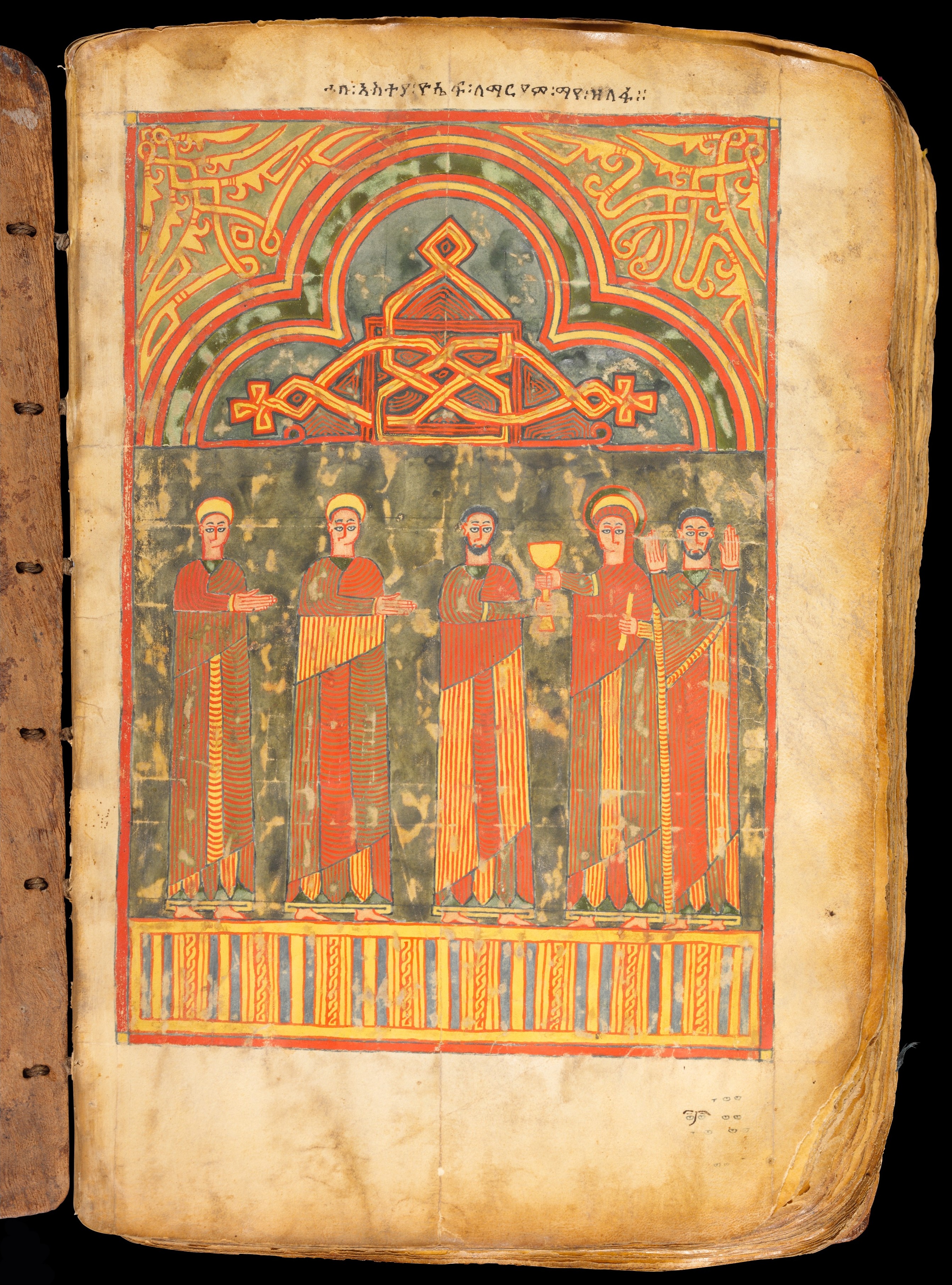
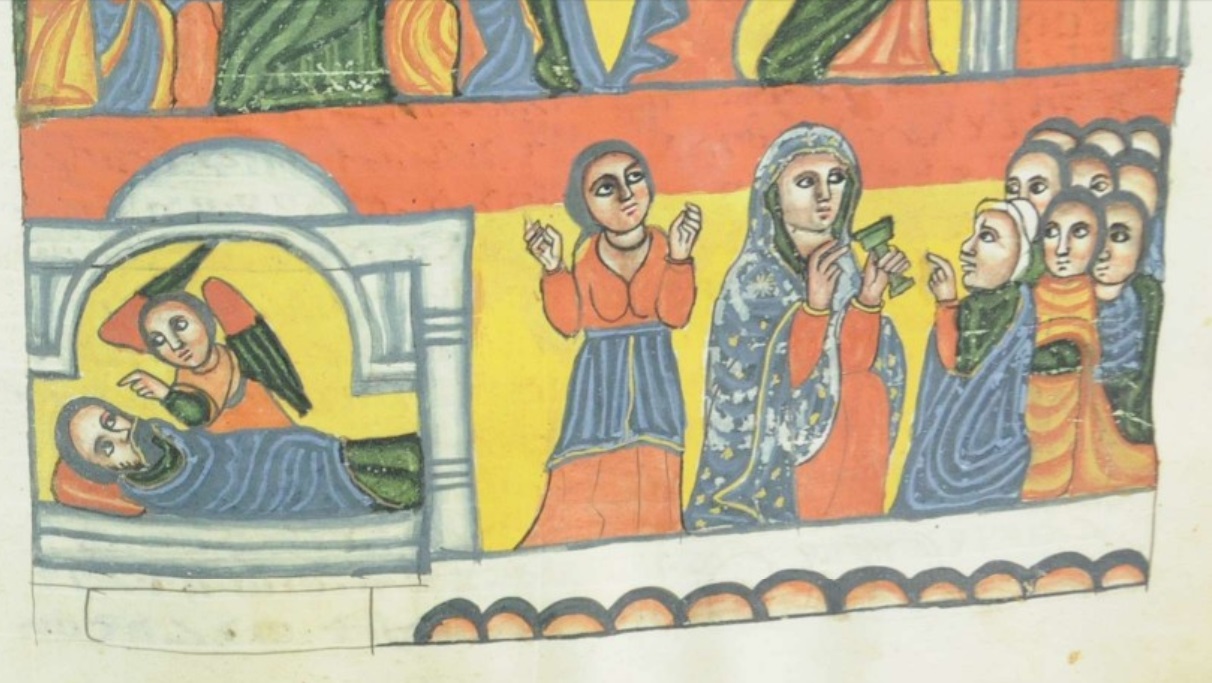
Trial by Bitter Water (Ethiopia)
The Trial by Bitter Water, from an Ethiopian Gospel-book, late 14th–early 15th century. Metropolitan Museum of Art, New York.

Trial by Bitter Water (Ethiopia)
Painting from a Miracles of Mary manuscript, Ethiopia, probably 18th century. Dimā Giyorgis Monastery, Goğğām Province, Ethiopia. Shelfmark: G2-IV-2.

The trial by bitter water is almost nonexistent in Western art. One exception is a fresco inside the Church of Santa Maria foris portas (Church of St. Mary Outside the Gates) in Castelseprio, Italy. All the frescoes there, which are some of the most sophisticated and expressive to have survived from the early medieval period, exhibit a strong Byzantine influence.

Trial by Bitter Water (Castelseprio)
Fresco, first half of 9th century, Church of Santa Maria foris portas (Church of St. Mary Outside the Gates), Castelseprio, Italy. Photo: Francesco Bini.

A mosaic at the Basilica of San Marco (Saint Mark’s) in Venice could easily be mistaken for the trial by bitter water, as Mary appears to be taking in hand the same pitcher with which she draws water from the well in the adjacent Annunciation scene.
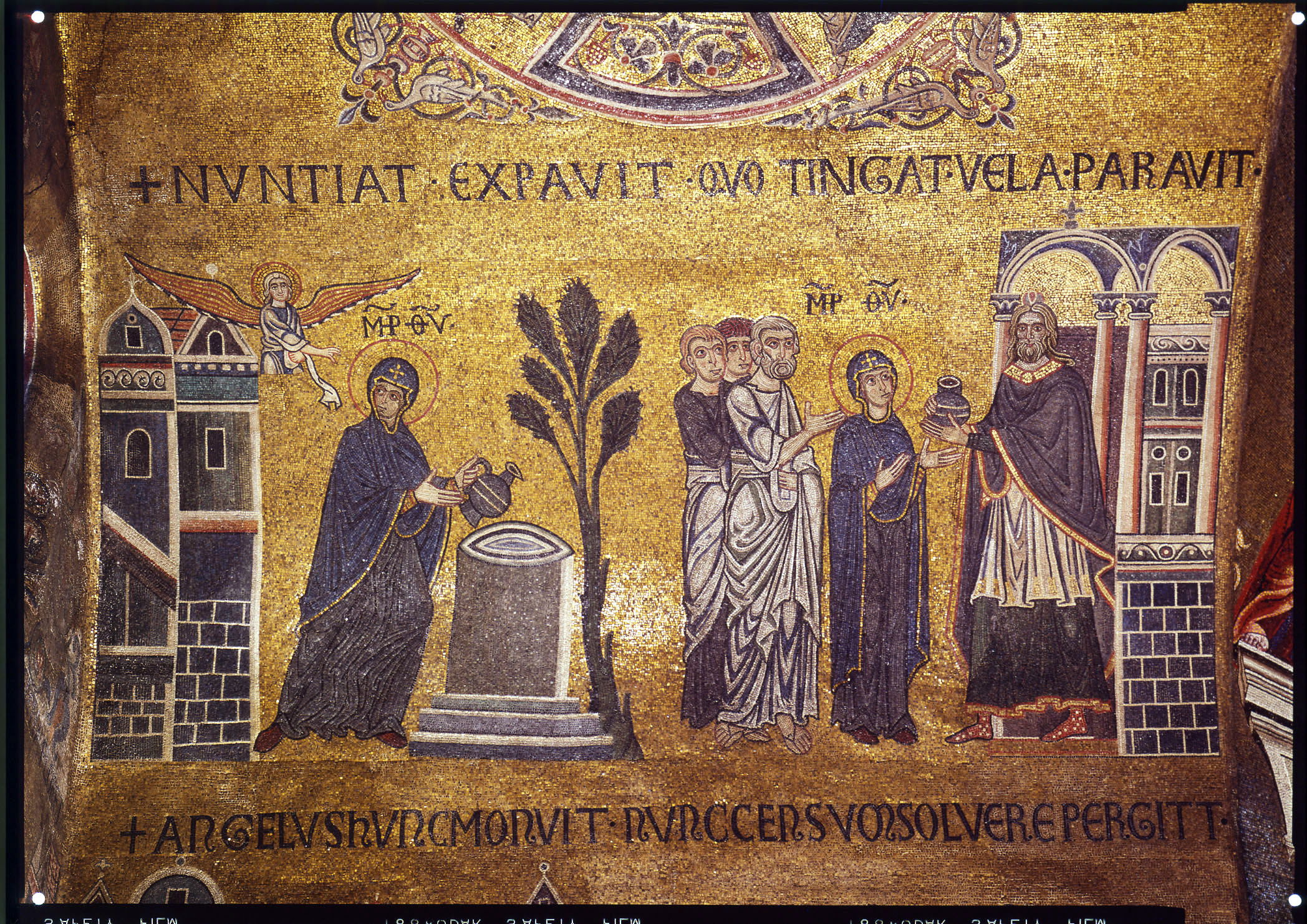
Annunciation at the Spring (San Marco, Venice)
The Annunciation at the Spring and the Handing Over of Purple to Mary, detail of transept mosaic in the Basilica of San Marco, Venice, 12th century

But the Latin inscription, Quo tingat vela paravit, indicates that the priest is handing Mary a vase of dye. This is another reference to the Protoevangelium: Chapter 10 says that after her betrothal to Joseph but before their marriage, Mary was one of seven virgins from the house of David selected by a council of priests to remake the temple veil (presumably to replace the old worn one). By lot, she was chosen to spin and weave the scarlet and purple.

Other comparable images, such as the mosaic at the former Chora Church (now Kariye Mosque) in Istanbul, show the priest handing Mary a skein of wool instead.

According to the Protoevangelium, Mary was spinning wool for this project when she was interrupted by the angel Gabriel with news of an even greater task she had been chosen for.

Those who disbelieved her about how her pregnancy came to be insisted she be brought to the temple for a trial by bitter water. Sometimes in image cycles on the life of Mary, such as the one on the Carolingian-era Werden Casket, she is shown on her way to the trial rather than at it, being led to the temple by an angel, priest, or moral police to verify her account before God.

Credit goes to Marina Golubina for compiling the vast majority of these images in a blog series (in Russian): Part 1, Part 2, Part 3, Part 4, Part 5, Part 6, Part 7, Part 8, Part 9, Part 10, Part 11, Part 12, Part 13, Part 14, Part 15, Part 16. As always, I have linked each image to its online source and have done my best to provide captioning info.


NOTES

  1. When Christians claim that the Bible opposes abortion, some people point to Numbers 5:11–31 as a counterexample, since, for the woman who has conceived a child out of wedlock, the “bitter water” is essentially an abortifacient; “if you have gone astray while under your husband’s authority, if you have defiled yourself and some man other than your husband has had intercourse with you, . . . now may this water that brings the curse enter your bowels and make your womb discharge, your uterus drop!” the priest pronounces (Num. 5:20, 22 NRSV). There’s ambiguity in the Hebrew text as to whether this curse involves loss of a fetus or only infertility. ↩︎

Landmark exhibition “Ethiopia at the Crossroads” explores cross-cultural influences on Ethiopian art

All photos in this post, except for the last one (of the processional icon), are my own.

(Note: WordPress seems to have disabled the feature that allows you to expand an image upon clicking, but if you’re reading on a computer, you can right-click an image and open it in a new tab to view it in full resolution; if you’re reading on a phone, you can pinch to zoom.)

Located in the Horn of Africa and with access to the Red Sea, Nile River, Mediterranean Sea, and Indian Ocean, Ethiopia stands at the nexus of historical travel, trade, and pilgrimage routes that brought it into contact with surrounding cultures and influenced its artistic development. Coptic Egypt, Nubia, South Arabia, Byzantium, Armenia, Italy, India, and the greater African continent were among those influencers. But Ethiopia not only absorbed influences; it transmitted them too.

A major art exhibition is centering Ethiopia’s artistic traditions in a global context. For Ethiopia at the Crossroads at the Walters Art Museum in Baltimore (running through March 3), curator Christine Sciacca has brought together more than 220 objects from the Walters’ own extraordinary Ethiopian art collection and private and institutional lenders both domestic and international. Icons, wall paintings, processional crosses and hand crosses, illuminated Gospel books and psalters, sensuls (chain manuscripts), healing scrolls, and more are on display throughout the galleries, whose walls have been painted bright green, yellow, and red—the colors of the Ethiopian flag. To round off the exhibition, guest curator Tsedaye Makonnen, an Ethiopian American multidisciplinary artist, was tasked with curating a few works from contemporary artists of the Ethiopian diaspora.

Ethiopia at the Crossroads exhibition view

The majority of objects are Christian, made for liturgical or private devotional use. Ethiopia is one of the world’s oldest Christian nations: in the early fourth century, persuaded by a missionary from Syria, King Ezana of Aksum embraced Christianity, and it has been the dominant religion of Ethiopia ever since. But the exhibition does also include some Islamic and Jewish objects.

One of the first works you’ll encounter is a mural that would have originally been mounted on the outer wall of an Ethiopian Orthodox church sanctuary (mäqdäs), portraying the Nativity, the Presentation of Christ in the Temple, and the Adoration of the Magi.

Nativity, Presentation of Christ in the Temple, and Adoration of the Magi, Ethiopia, 18th century. Glue tempera on overlapping canvas pieces mounted to a new stretched canvas, 49 3/16 × 66 15/16 in. (124.9 × 170 cm). Walters Art Museum, Baltimore. [object record]

Remarkably, at the Nativity, there is a feast taking place, and Jesus is feeding his mother with what looks like a Communion wafer! As the theologian Lester Ruth has said, “The sound from most baby beds is a cry to be fed. But the cry from the manger is an offer to feed on his body born into this world.”

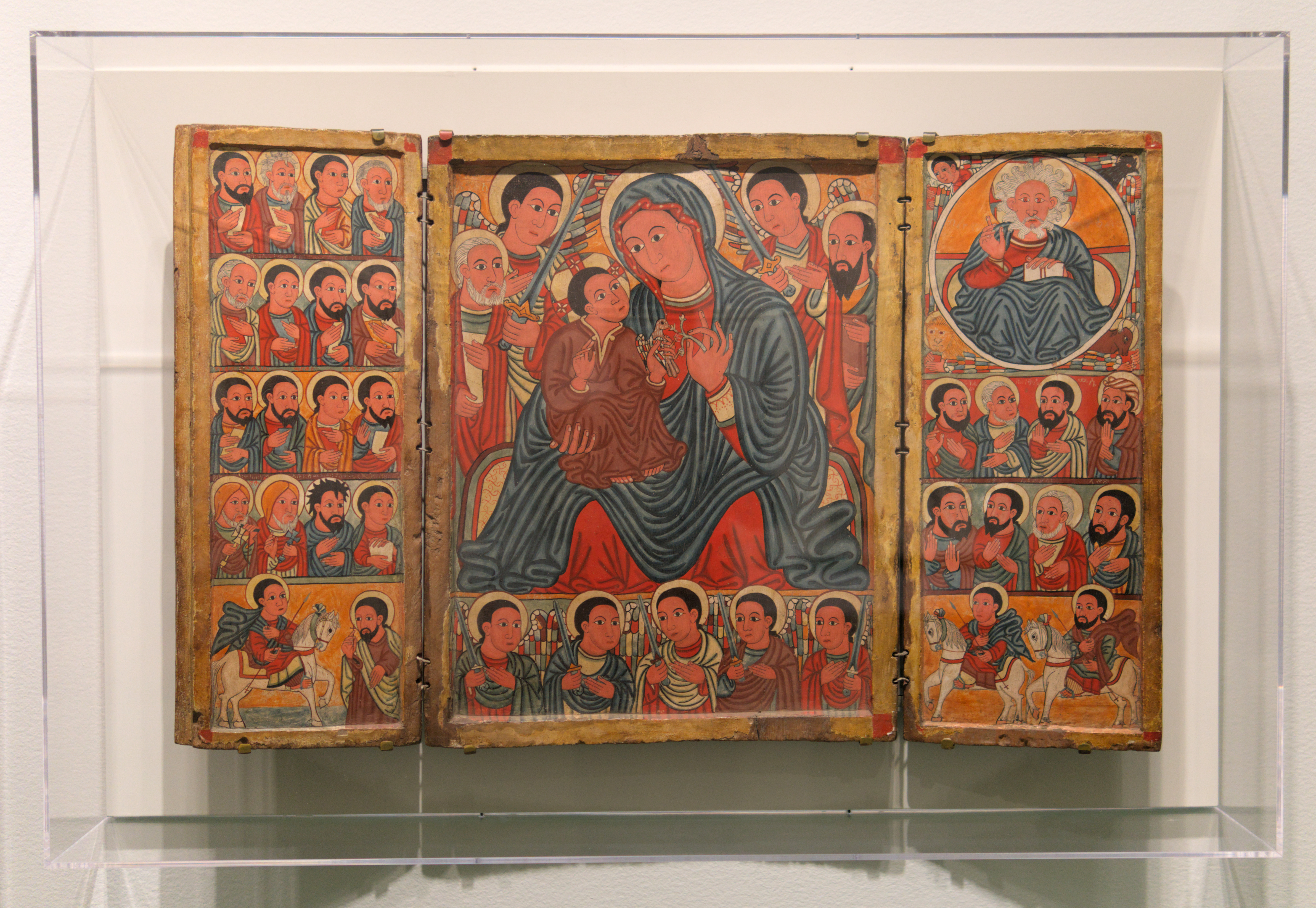
One of history’s most famous Ethiopian painters is Fre Seyon, who worked at the court of Emperor Zara Yaqob (r. 1434–1468) and was of the first generation of Ethiopian artists who painted icons on wood panels. He was also a monk. He likely introduced one of the characteristic features of Ethiopian icons of the Virgin and Child: the archangels Michael and Gabriel flanking them with drawn swords, acting as a kind of honor guard.

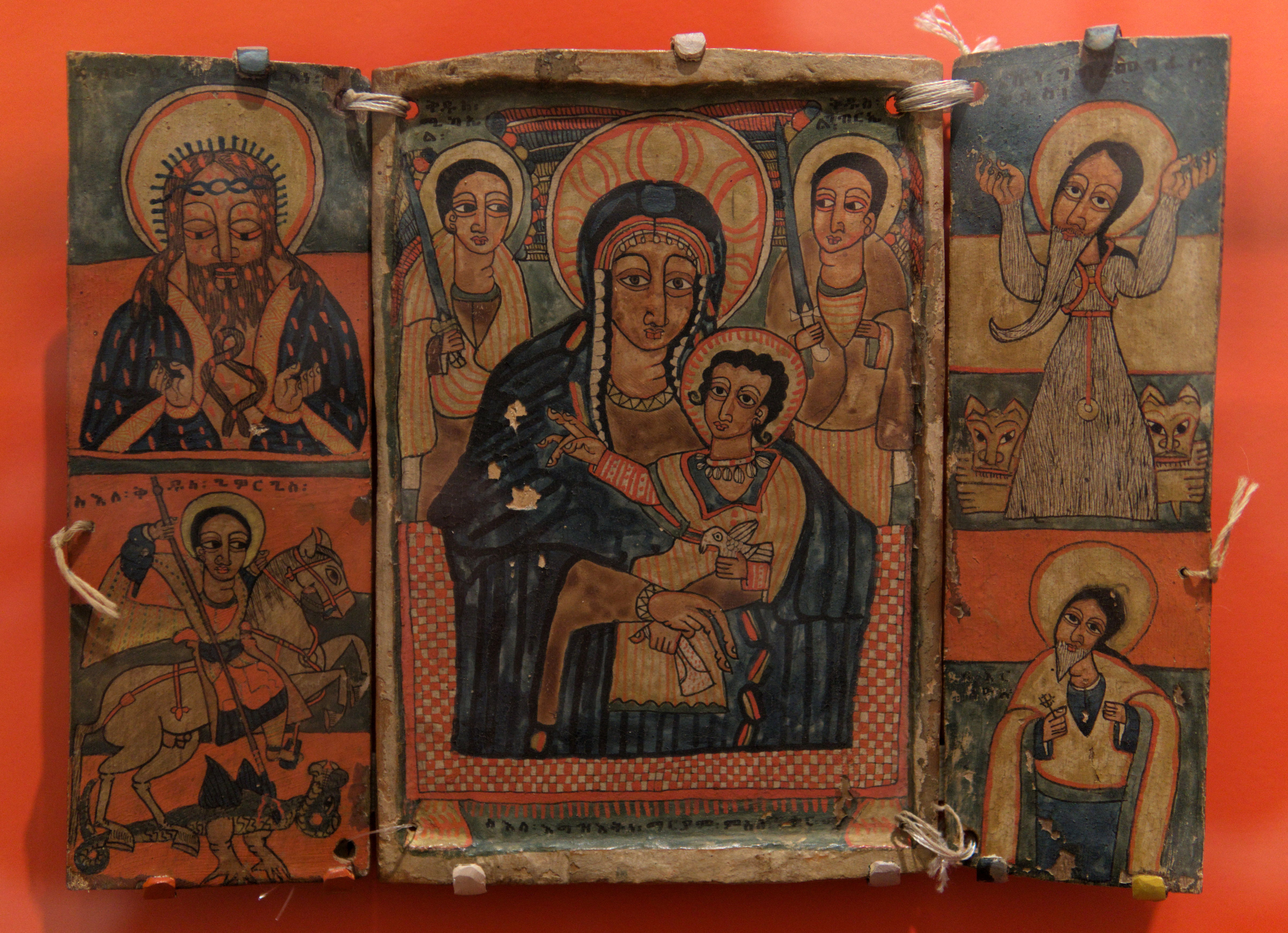
Fre Seyon triptych
Fre Seyon (Ethiopian, active 1445–1480), Triptych Icon with the Virgin Mary and Christ Child Flanked by Archangels and Saints (center), Twelve Apostles and Saints (left), and Prophets and Saints (right), mid- to late 15th century. Tempera on gesso-primed wood. Institute of Ethiopian Studies, Addis Ababa University, acc. no. IESMus4186.

My two favorite details of this triptych by Fre Seyon are (on the right wing) the image of the Ancient of Days surrounded by the tetramorph, his wild gray locks being blown about, and in the center, the bird that Christ holds, its feet grasping at a three-branched twig. On a literal level, the bird is a plaything for the boy that charmingly emphasizes his humanity (in the late Middle Ages, at least in Europe—I’m not sure about in Ethiopia—it was common for young children to keep tame birds as pets). On another level, the bird may be symbolic. In traditional Western art, Jesus sometimes holds a goldfinch, a bird with distinctive red markings that’s fond of eating thistle seeds and gathering thistle down and thus came to be read as a prefiguration of Christ’s thorny, blood-spilt passion. I’m not sure whether Fre Seyon intended a symbolic significance for this bird.

The Ancient of Days, enthroned in the tetramorph

Here’s another triptych from the exhibition, this one from a century and a half later:

Virgin and Child triptych
Triptych Icon with the Virgin Mary and Christ Child Flanked by Archangels, Scenes from the Life of Christ, Saint George, and Saints Honorius, Täklä Haymanot, and Ewostatewos, Ethiopia (Tigray), early 17th century. Glue tempera on panel, 16 3/4 × 22 5/16 in. (42.5 × 56.7 cm). Walters Art Museum, Baltimore. [object record]

The composition of the Virgin and Child is based on prints of a painted icon from Santa Maria Maggiore in Rome brought to Ethiopia by Portuguese Jesuit missionaries—but it innovates. As the wall text notes, “Mary’s cloak stretch[es] out in either direction to embrace the scene of Christ Teaching the Apostles below. Umbrella-like, Mary appears as both the protector and personification of the church.”

Harrowing of Hell

On the right wing, angels hold up chalices to collect the blood that flows from Jesus’s wounds on the cross, while below that, Joseph of Arimathea and Nicodemus carry Jesus’s wrapped corpse to the tomb. On the left wing is one of my favorite traditional religious scenes: the Harrowing of Hell, or Christ’s Descent into Limbo, in which, on Holy Saturday, Jesus enters the realm of his dead to take back those whom Death has held captive, first of which are our foreparents Adam and Eve. Below that scene is an image of the dragon-slaying Saint George, a late third-century figure from the Levant or Cappadocia who is the patron saint of Ethiopia.

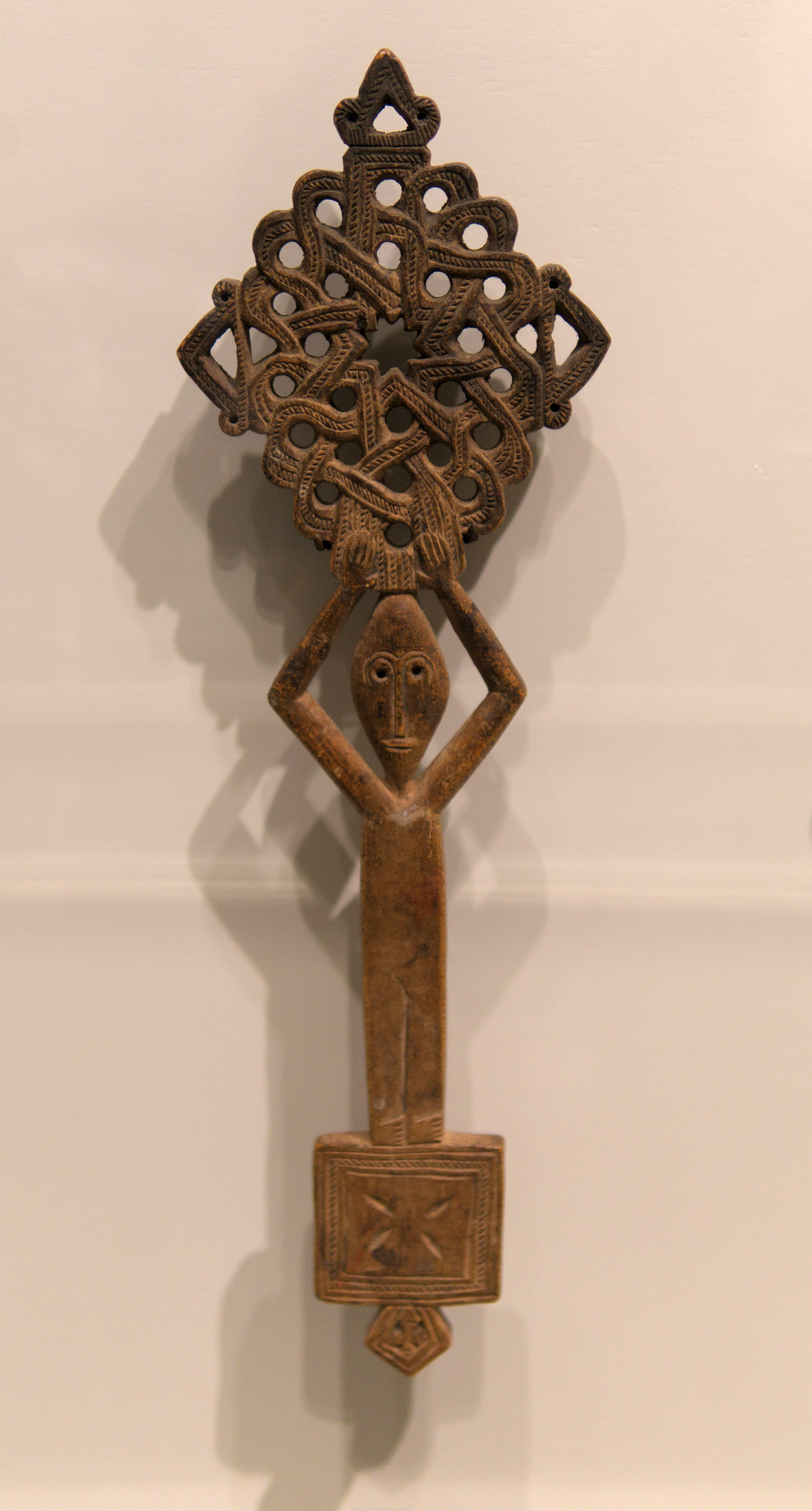
At the bottom center is a scene of Christ teaching the twelve apostles, plus two Ethiopian saints. They all hold hand crosses, like those carried by Ethiopian priests and monks.

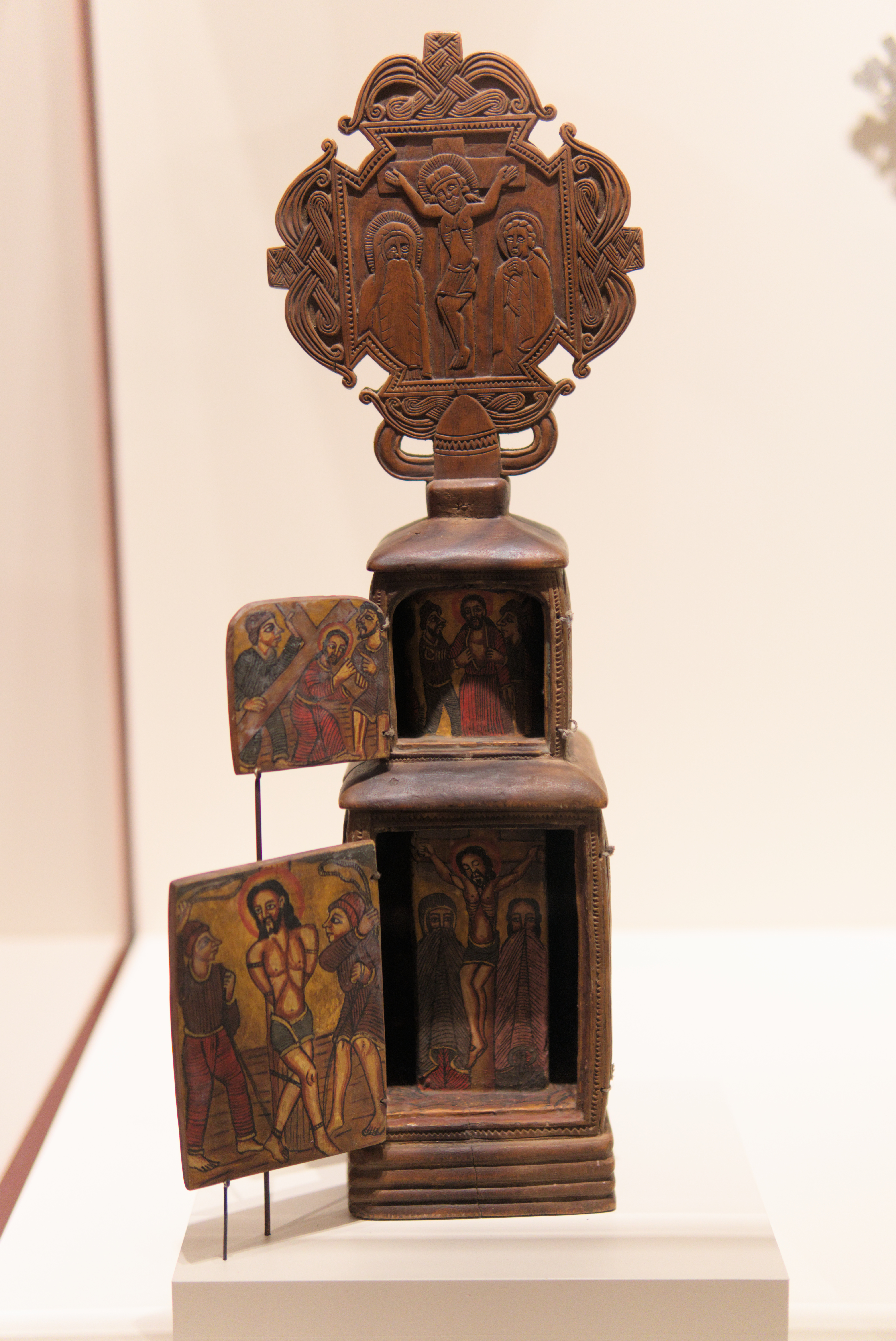
Hand Cross with Figure
Hand Cross with Figure, Ethiopia, probably 18th–19th century. Wood, 13 3/8 × 4 3/16 × 9/16 in. (34 x 10.7 × 1.4 cm). Walters Art Museum, Baltimore. [object record]

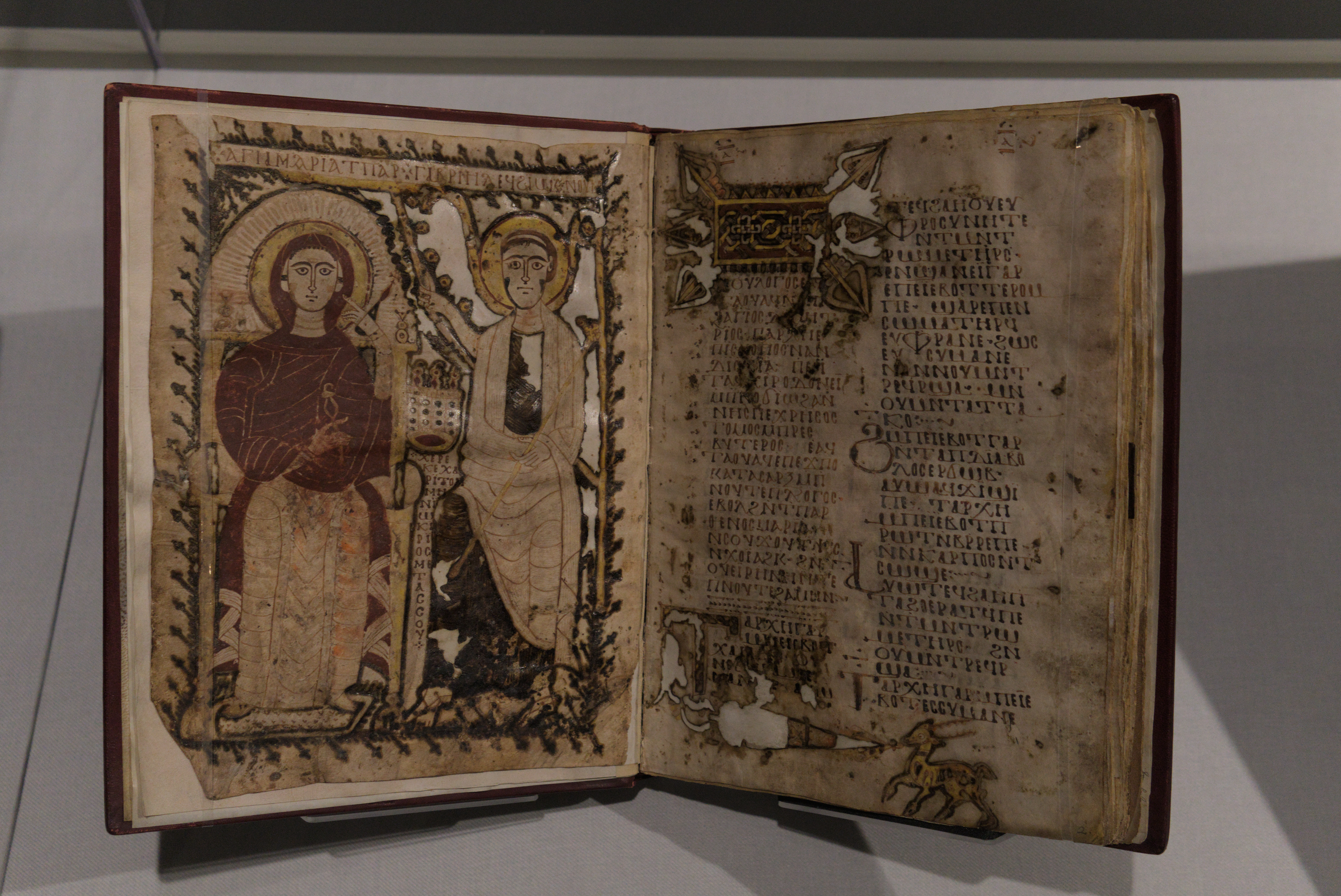
Coptic-Arabic Book of Prayer
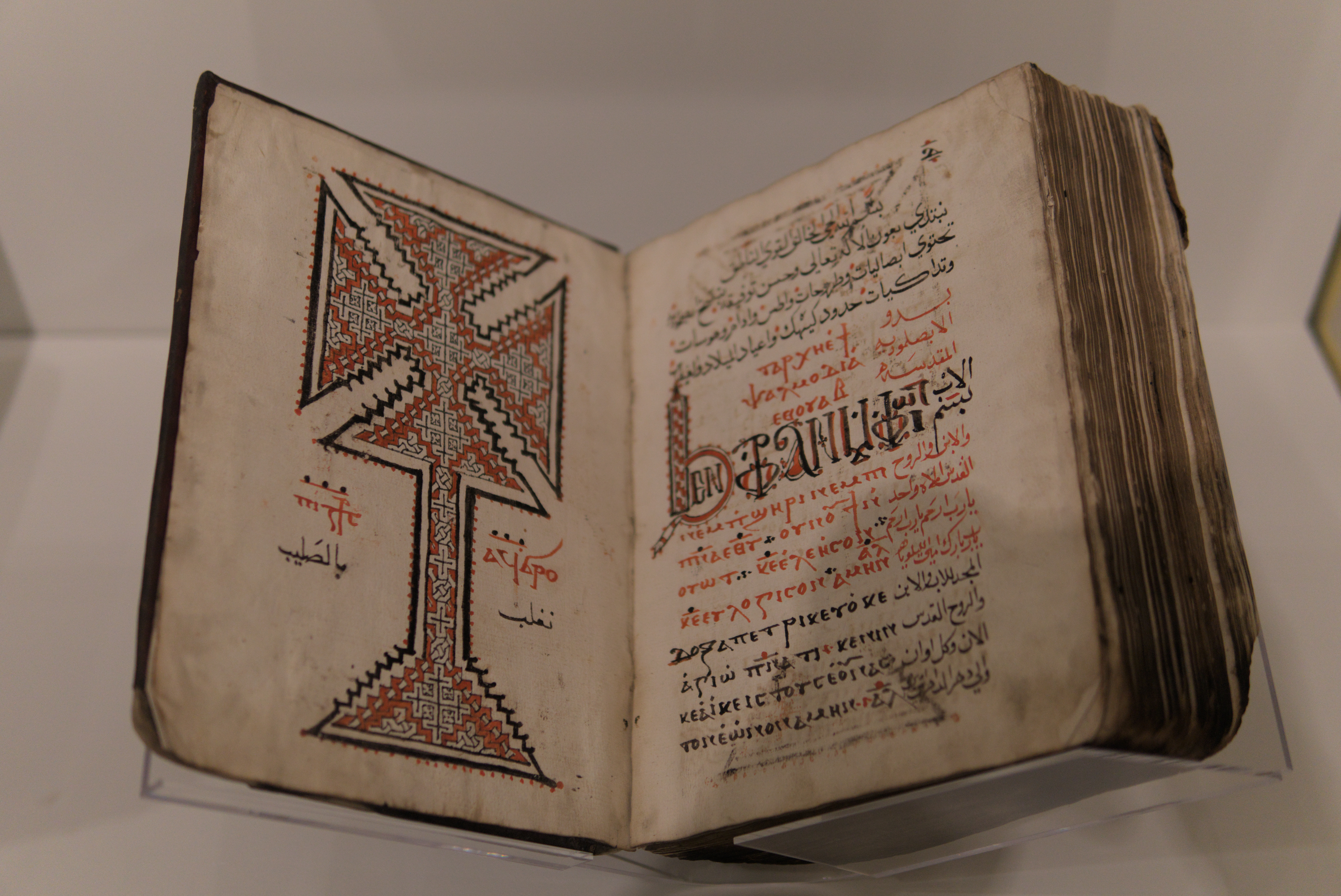
Coptic-Arabic Book of Prayer, Egypt, 18th century. Tempera and ink on parchment, 11 3/4 × 9 in. (29.8 × 22.8 cm). Melikian Collection. [object record]

One of the hallmarks of the exhibition is its multisensory nature: attendees are immersed not only in the sights of Ethiopia but also in the sounds and smells. Scratch-and-sniff cards invite people to take a whiff of frankincense, which would have filled the censer on display. Or to smell berbere, a hot spice blend that would have been stored in the woven baskets nearby.

Frankincense

This olfactory element was produced by the Institute for Digital Archaeology, which, as part of its efforts to record and preserve ephemeral culture, has launched an ambitious program to preserve the heritage of smells. “The aim is to provide the technical means for documenting the aromas of today for the benefit of future generations – and to find new methods and opportunities for experiencing the odors of the past.”

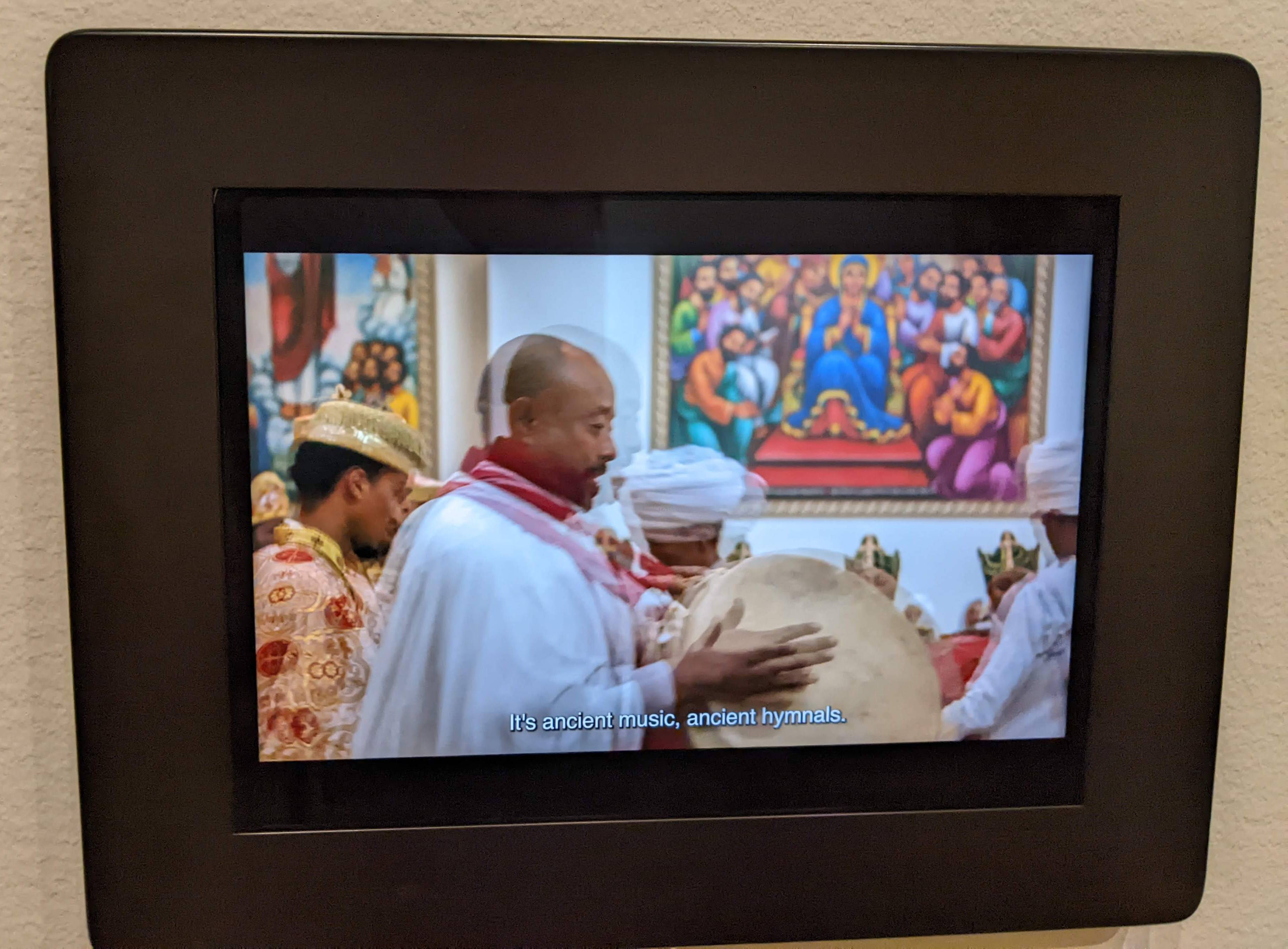
Also in the exhibition there are screens where you can watch videos of Ethiopian Orthodox worship, including music and liturgies, where you will see some of the objects in use. You can also listen to interviews with members of the local Ethiopian diaspora community. (The Washington metropolitan area has the largest Ethiopian population outside Ethiopia.)

Further contextualizing the objects and enhancing the sense of place, pasted onto the wall is a blow-up photograph of a Christian holy-day celebration wending through the streets. This serves as a backdrop to two physical artifacts present in the room: a qämis (dress) and a debab (umbrella).

Dress and umbrella
Left: Dress (qämis), Ethiopia, 20th century(?), cotton, Peabody Essex Museum, E72559. Right: Umbrella (debab), Ethiopia, 20th century, silk and velvet, Peabody Essex Museum, E68713.

The inscriptions on many of the Ethiopian icons and manuscript illuminations, which identify the figures and scenes, are in Ge‘ez (aka classical Ethiopic), an ancient South Semitic language that originated over two thousand years ago in what is now northern Ethiopia and Eritrea. It’s no longer spoken in daily life, but it is still used as the language of the Ethiopian Orthodox Church and taught to boys in Sunday school. I really wish I could read it, as it would be a great help in interpreting the Ethiopian images I come across in my studies!

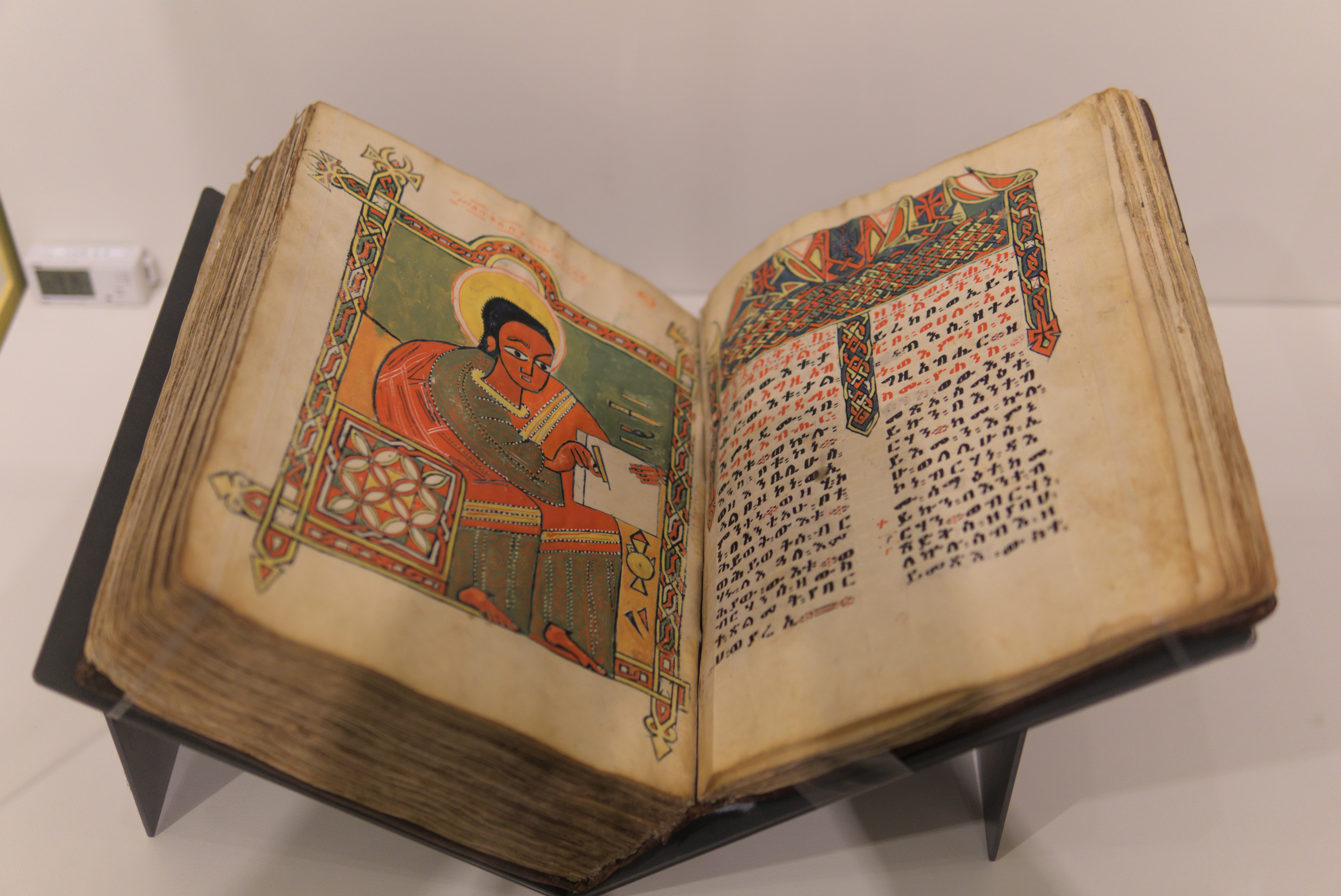
Contrary to what some may assume, Ethiopians in the medieval era were not an isolated people. They traveled—to Rome, to Jerusalem, and so forth. Evidence of Holy Land pilgrimage is suggested by an early fourteenth-century Gospel book that includes the domed Church of the Holy Sepulcher as the backdrop for Christ’s resurrection:

Crucifixion and Resurrection
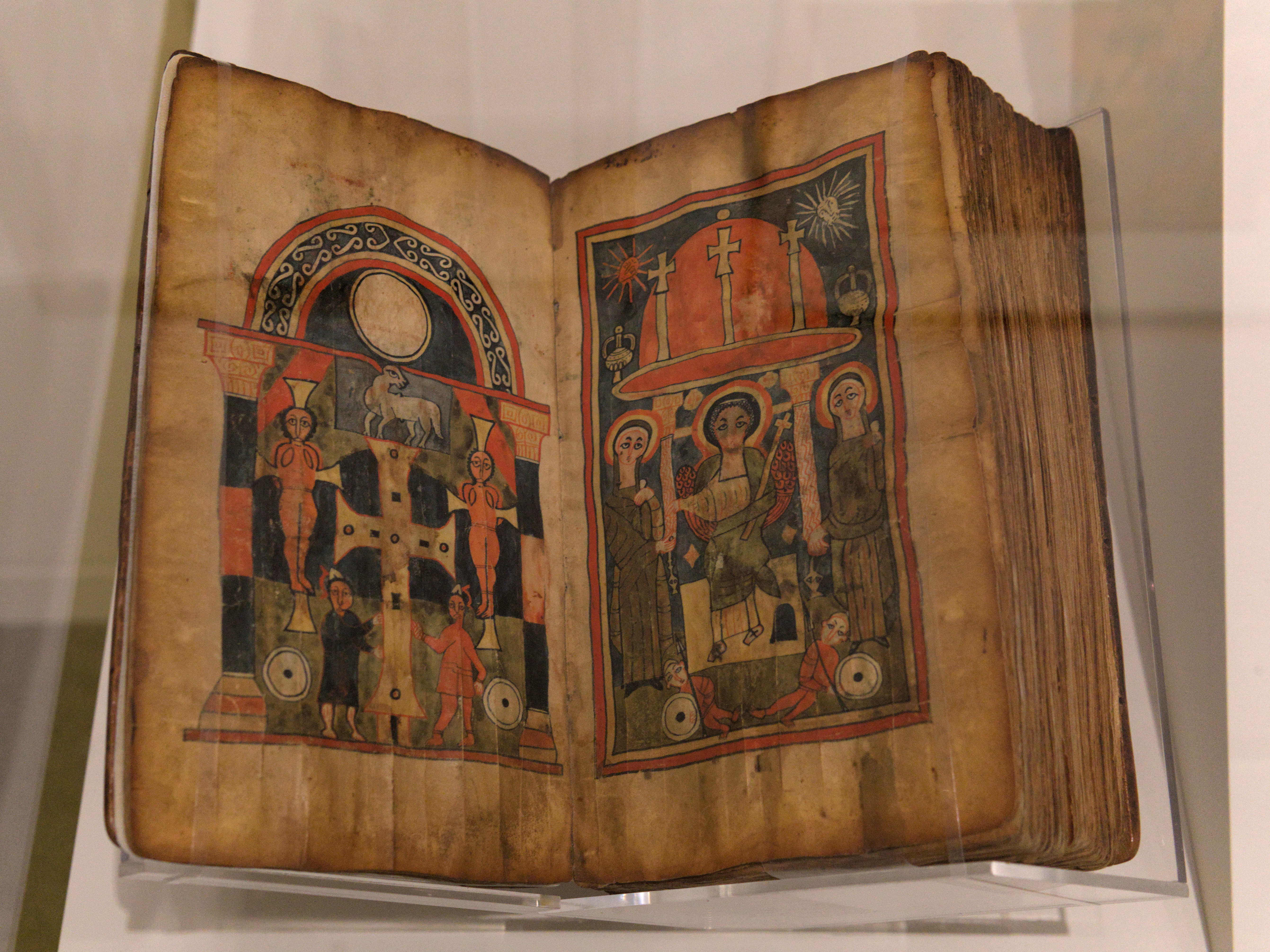
Gospel Book with the Crucifixion and Christ’s Resurrection, Ethiopia (Tigray), early 14th century. Ink and paint on parchment, 10 1/2 × 6 11/16 in. (26.7 × 17 cm). Walters Art Museum, Baltimore, W.8.36, fols. 6v–7r. [object record]

This is an extraordinary book, one of the oldest surviving Ethiopian manuscripts and the oldest in North America. Ethiopian artists weren’t yet depicting Jesus on the cross, so to represent the Crucifixion, this artist has painted a living lamb surmounting a bejeweled cross, with the two thieves crucified on either side.

Also from the fourteenth century, a manuscript opened to a page spread of Christ’s Entry into Jerusalem:

Triumphal Entry
Christ’s Entry into Jerusalem, folios added from an earlier Gospel book to a Ta’ammera Maryam manuscript, Ethiopia, 14th century. Tempera and ink on parchment. Private collection.

I like how the scene extends across both pages, creating a sense of forward progression, and the two onlookers above the city gate.

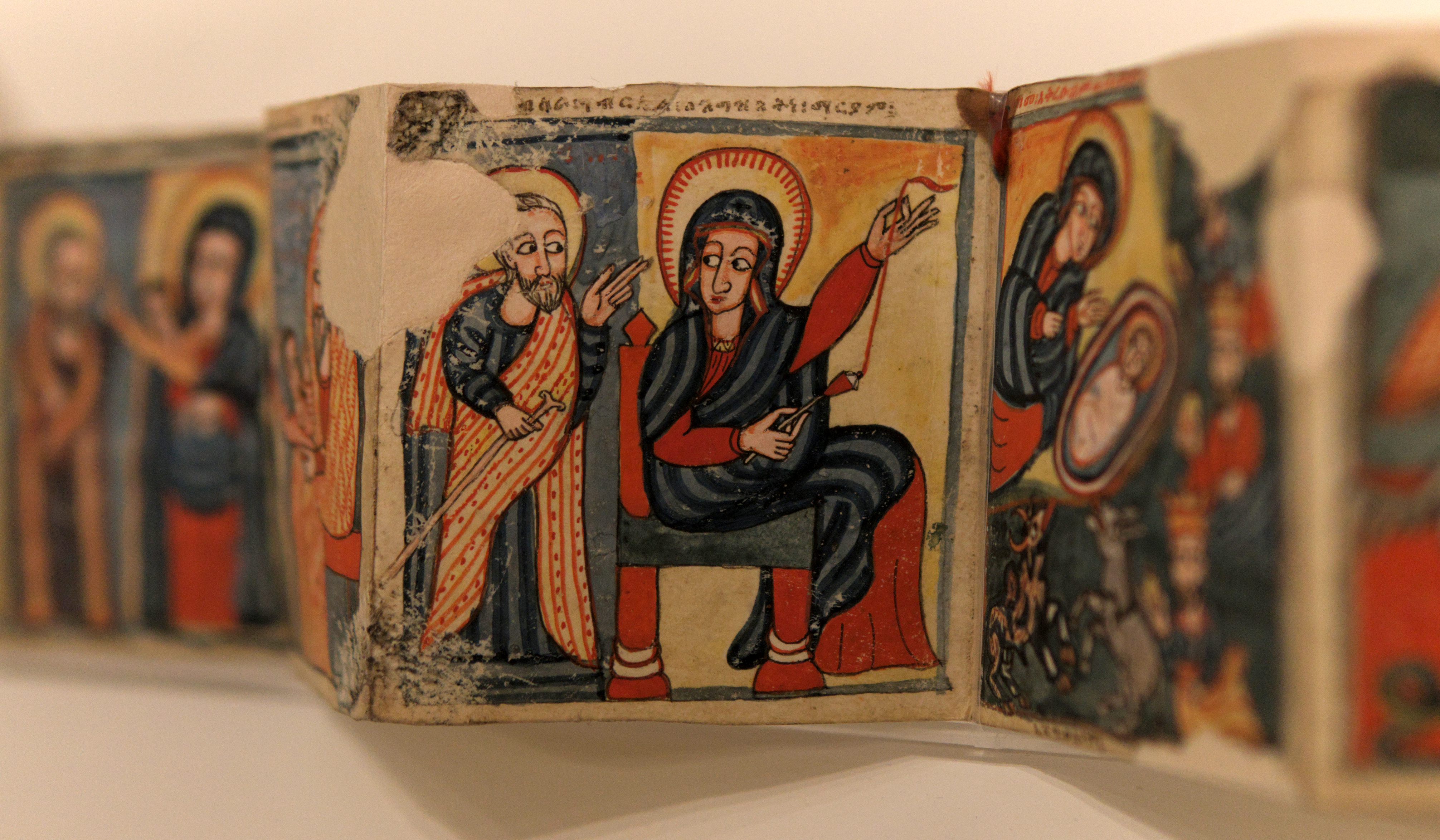
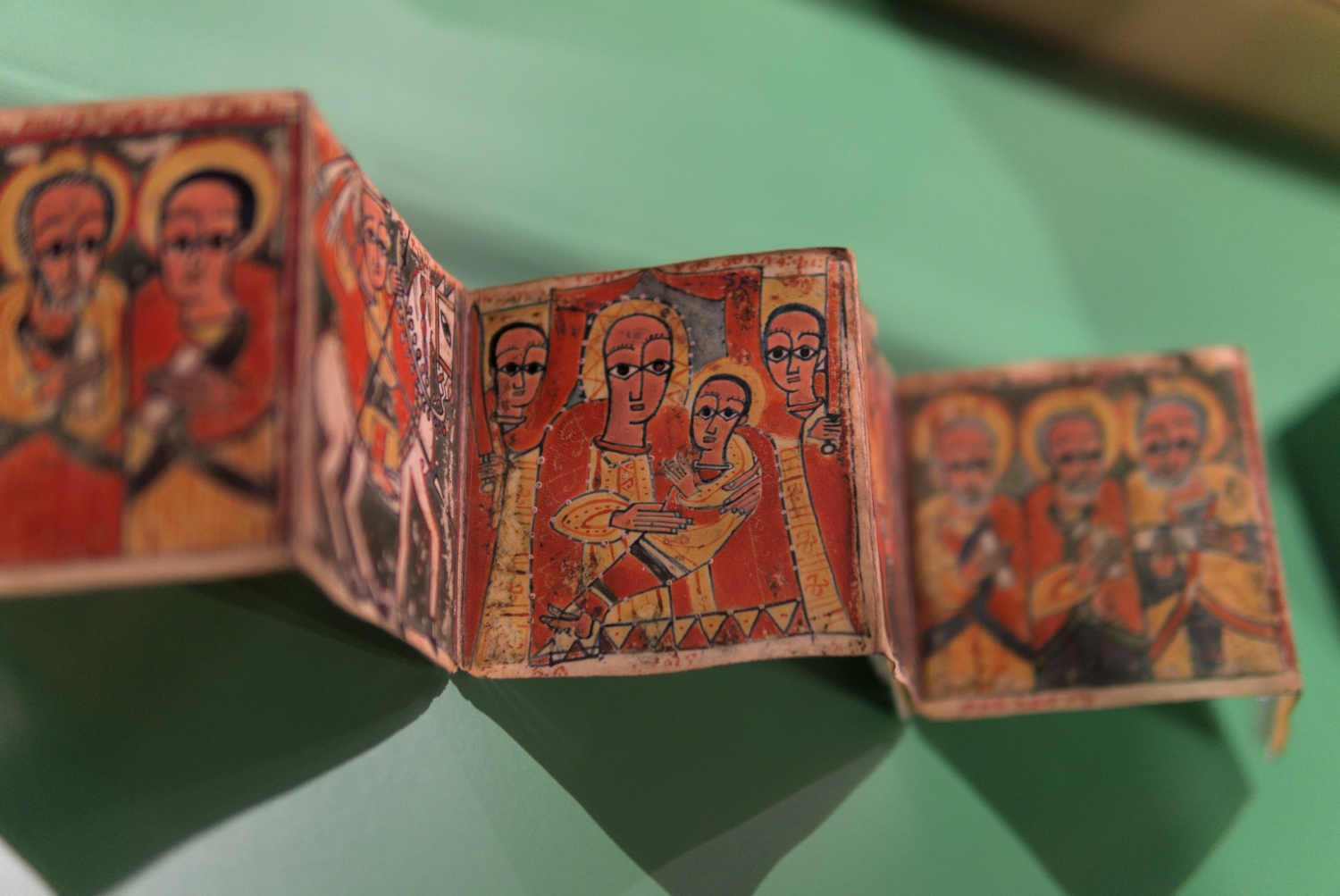
One of my favorite objects from the exhibition is a sensul from Gondar depicting ten scenes from the life of Mary. A sensul is an Ethiopian chain manuscript, in this case pocket-size, created out of a single folded strip of parchment attached to heavy hide boards at each end, which creates a small book when folded shut. Here’s a detail showing the Annunciation:

Annunciation (from a sensul)
Annunciation, from a Gondarine sensul (chained manuscript), Ethiopia (Gondar), late 17th century. Ink and paint on parchment, each panel 3 5/8 × 3 1/8 in. (9.2 × 9 cm). Walters Art Museum, Baltimore. [object record] [GIF]

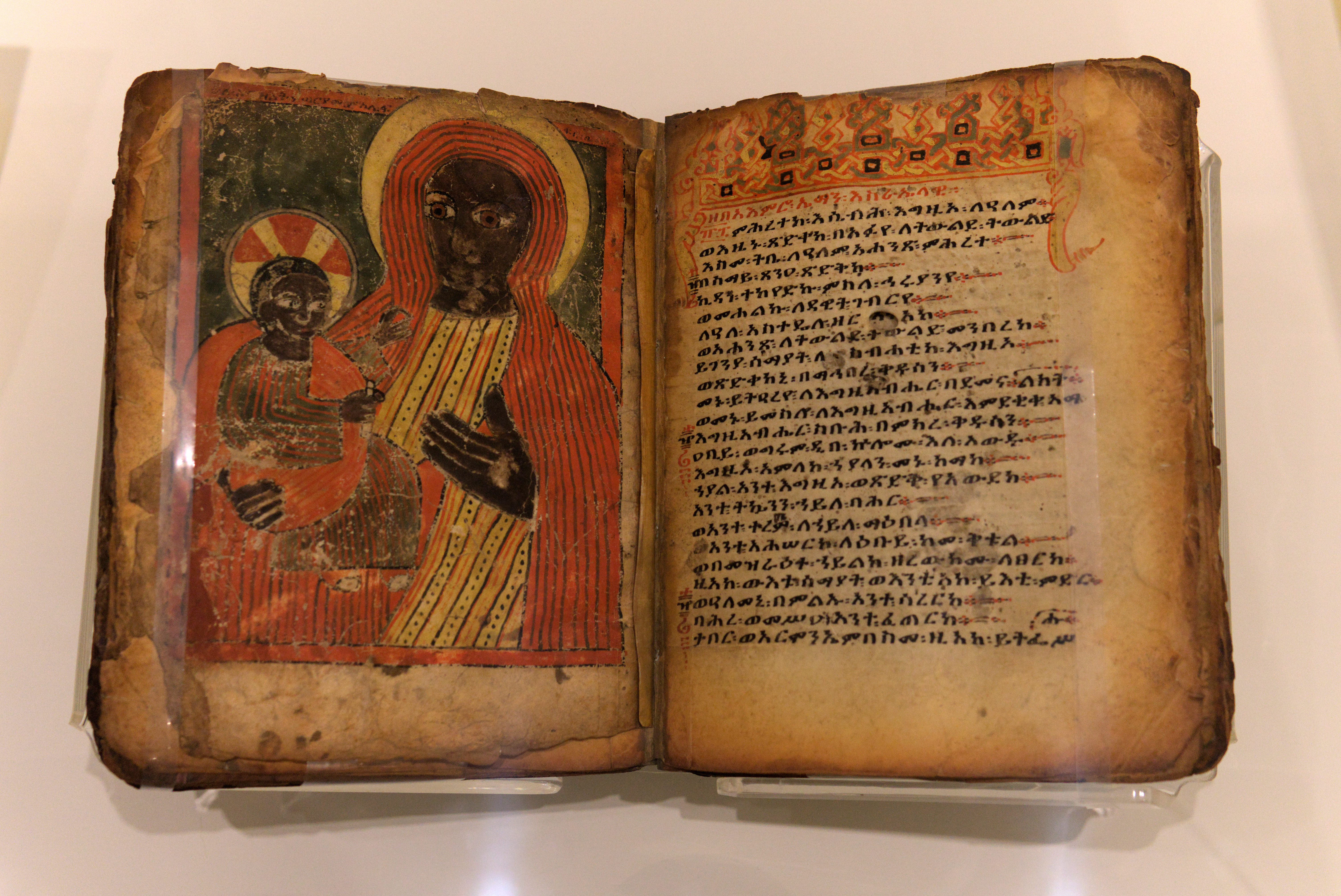
It’s a common misconception that Ethiopians have always depicted biblical figures as dark-skinned to reflect the local population. Such treatment didn’t become normative until the eighteenth century, although some earlier artists did choose black complexions for holy persons:

Virgin and Child
Virgin and Child, from a Psalter with the Wəddase Maryam (Praise of Mary) and Mähalǝyä Näbiyyat (Canticles of the Prophets), Ethiopia, 15th century. Ink and pigments on parchment with wooden boards, open: 8 7/8 × 6 11/16 × 3 15/16 in. (22.5 × 17 × 10 cm). Toledo Museum of Art, Ohio. [object record]

Portrait of John the Evangelist
The Opening of the Gospel of John, from a Gospel book, Ethiopia, ca. 1504–5. Tempera on parchment, 13 9/16 × 10 7/16 in. (34.5 × 26.5 cm). J. Paul Getty Museum, Los Angeles, Ms. 102, fols. 215v–216r. [object record]

Virgin and Child triptych
Triptych Icon with the Virgin Mary and Christ Child Flanked by Archangels (center), the Kwer‘atä re’esu (Man of Sorrows) and Saint George (left), and Saint Gäbrä Mänfäs Qeddus and Abba Arsanyos (right), Ethiopia (Gondar), late 17th–early 18th century. Tempera on gesso-primed wood. Institute of Ethiopian Studies, Addis Ababa University, acc. no. IESMus3492.

In the triptych shown above, not only is the infant Jesus depicted as Black, but he also wears a necklace made of cowrie shells, which are traditionally given to Ethiopian children for protection!

My favorite artwork from the exhibition is probably this triptych:

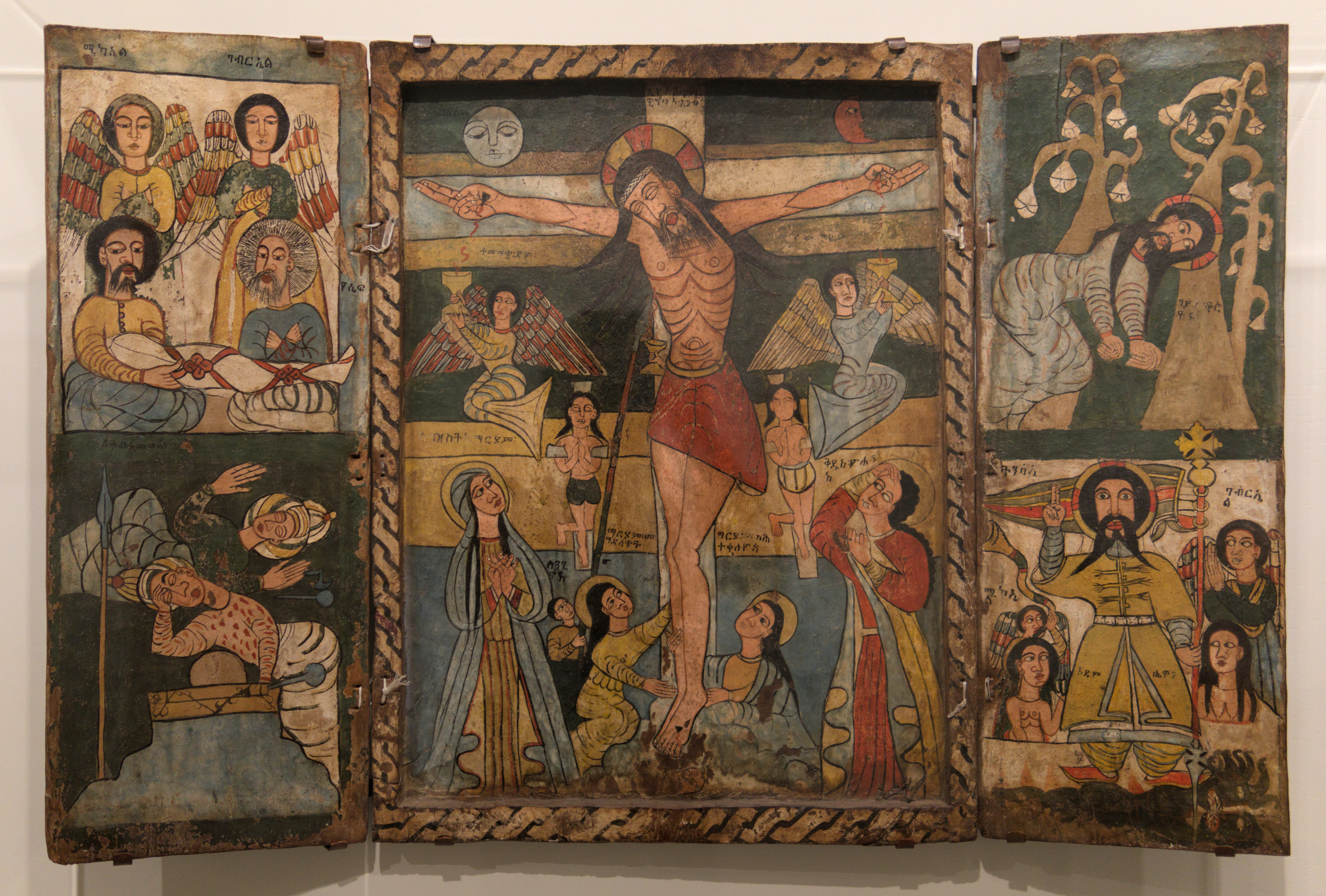
Crucifixion triptych
Triptych Icon with the Crucifixion (center), Entombment and Guards at the Tomb (left), and Temptation in the Wilderness and the Resurrection of Christ (right), Ethiopia, late 16th century. Tempera on gesso-primed wood. Institute of Ethiopian Studies, Addis Ababa University, acc. no. IESMus4126.

Its central panel depicts the Crucifixion, Christ’s head bowed in death and his fingers gesturing blessing, even as his palms are nailed. At the top, the sun and the moon mourn his passing. As we saw before, angels catch the blood that drips from his body (notice the cute little hand sticking out from behind his torso!). At the base, the two larger-scale figures are the Virgin Mary and St. John, while next to Mary on a smaller scale is Longinus, the centurion who pierces Christ’s side with a spear.

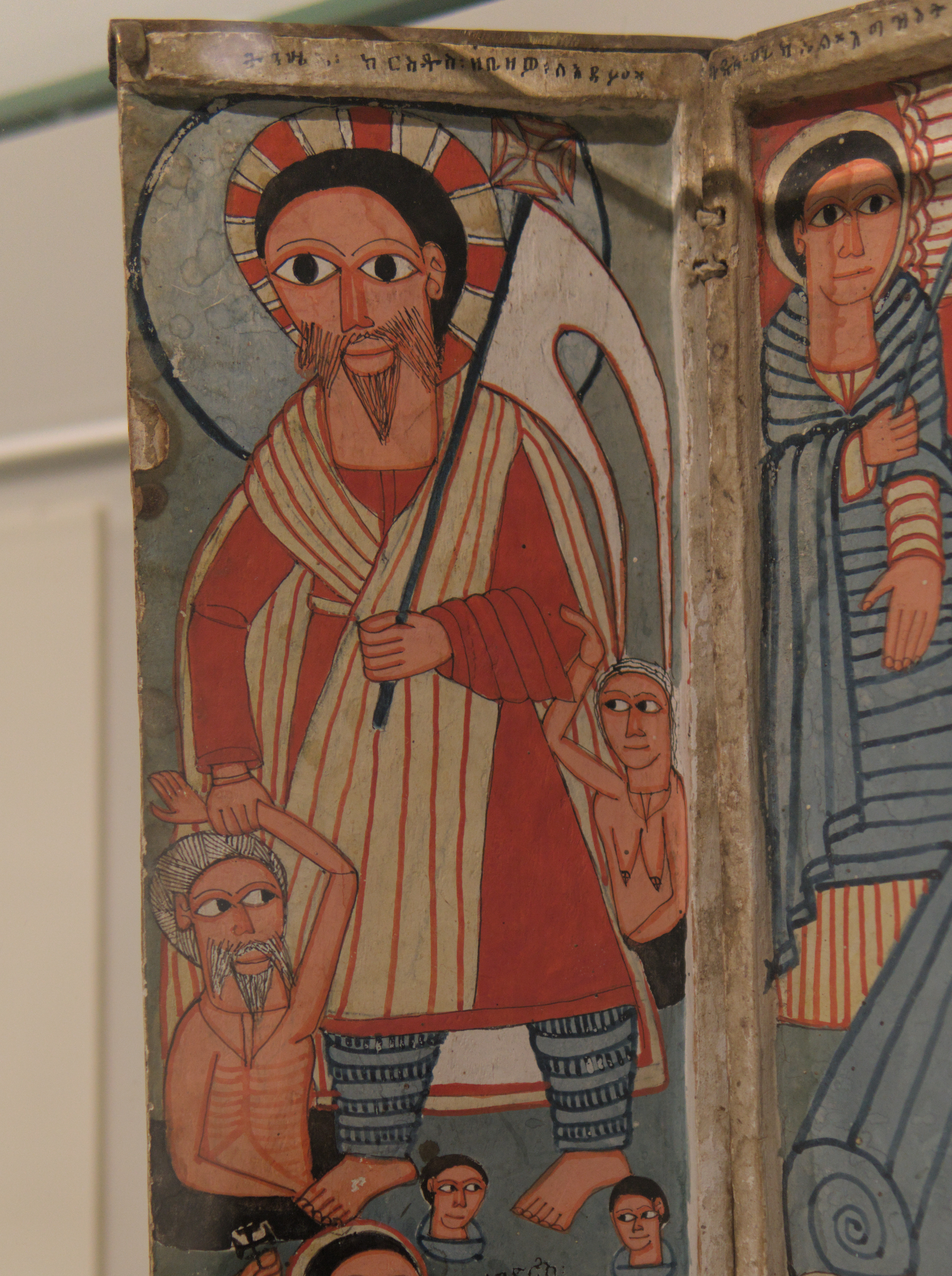
The left wing shows the Entombment of Christ, with two guards, wearing pointed turbans, sleeping at their post. The right wing shows a scene that the label identifies as “Temptation in the Wilderness” (presumably a translation of the inscription on the tree) but that looks to me more like an Agony in the Garden. Below that is the Resurrection, with Christ holding a victory banner, standing atop Hades. An angel blows a shofar and the dead rise up out of their graves, following Christ, the firstfruits of the resurrection (1 Cor. 15:20–22). Christ wears a short-sleeved, knee-length jacket with frog closures, and bunched sleeves and trousers, both of which reflect clothing from regions east of Africa.

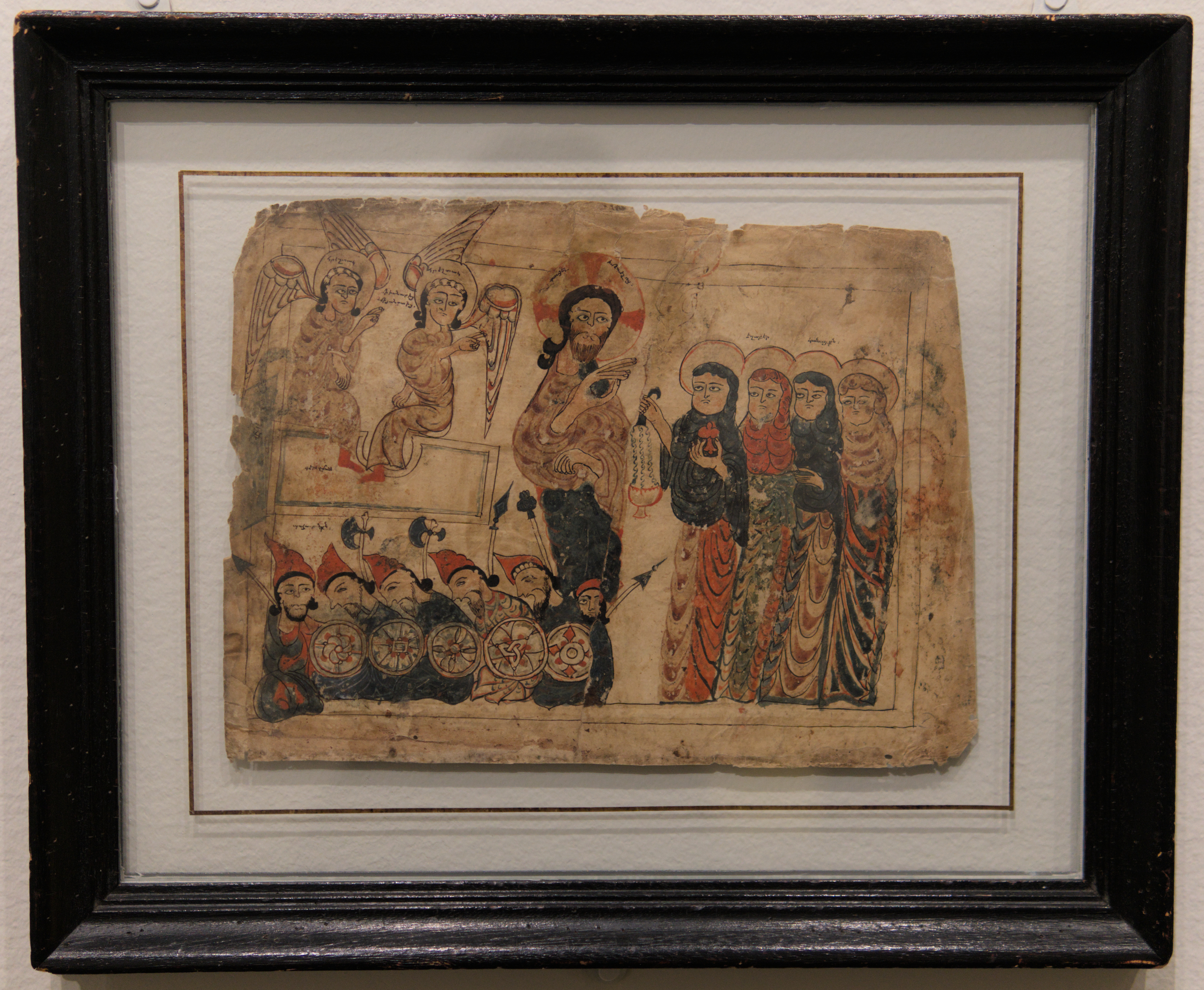
The wall text notes the fine, wavy lines used to render the figures’ draperies, perhaps influenced by Armenian artists from the Lake Van region.

Armenian Resurrection
Yovsian of Vaspurakan (Armenian), Leaf from a Gospel book with the Resurrection of Christ and Visit of the Women to the Tomb of Christ, ca. 1350. Tempera on cotton paper. Private collection.

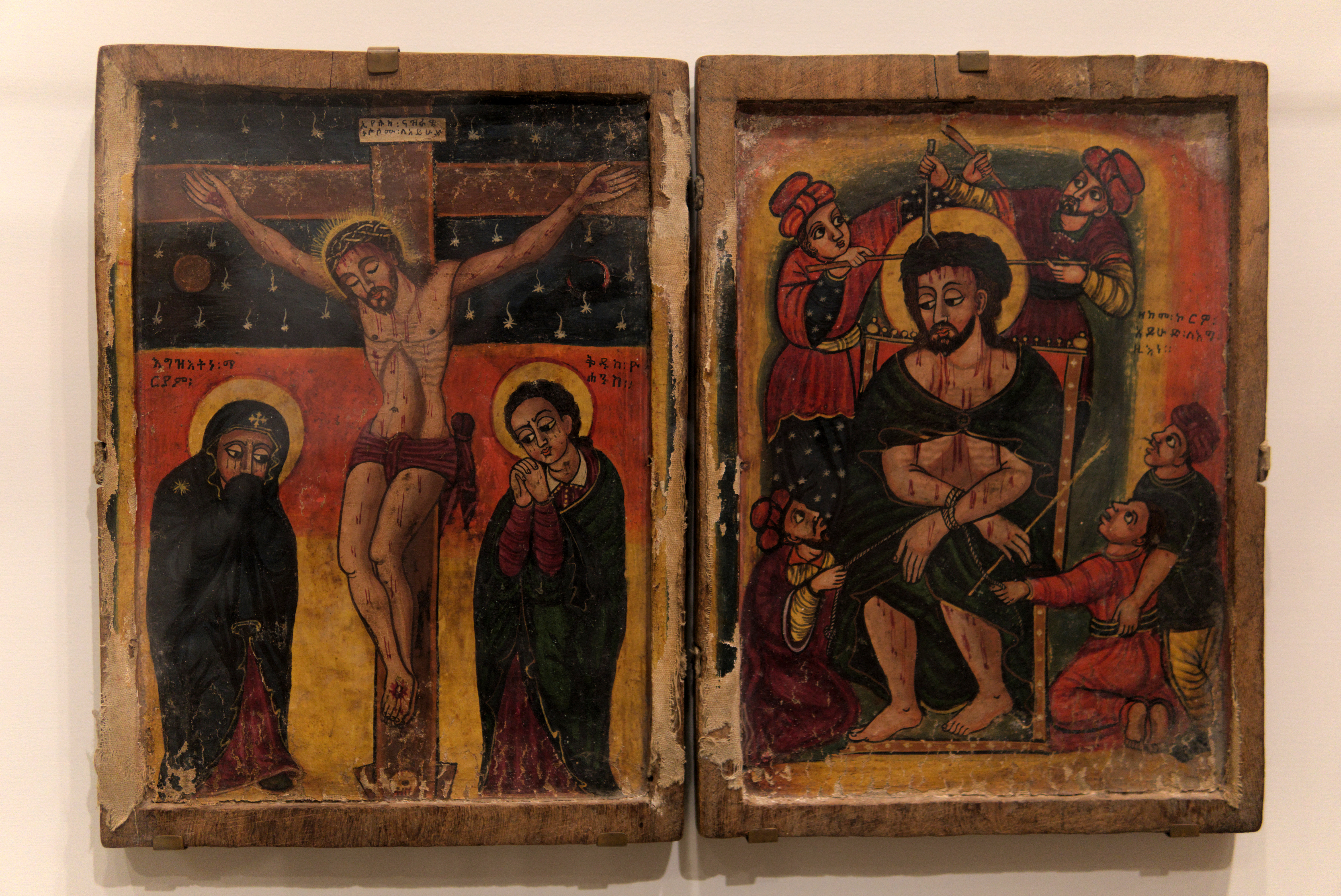
Here’s another Crucifixion, this one painted in what’s called the Second Gondarine style, characterized by smoothly modeled figures, often with darker skin tones, and wide horizontal bands of red, yellow, and green filling the background:

Crucifixion-Mocking diptych
Diptych Icon with the Crucifixion (left) and the Mocking of Christ (right), Ethiopia, late 17th–early 18th century. Wood, polychrome, 13 1/2 × 9 7/8 in. (34.3 × 25.1 cm). Virginia Museum of Fine Arts, Richmond. [object record]

The squiggles behind Christ at the top left may simply be a decorative motif, but to me they look like falling stars, an apocalyptic sign, and as if the sky is weeping.

The right panel of the diptych shows Christ being cruelly fitted with a crown of thorns.

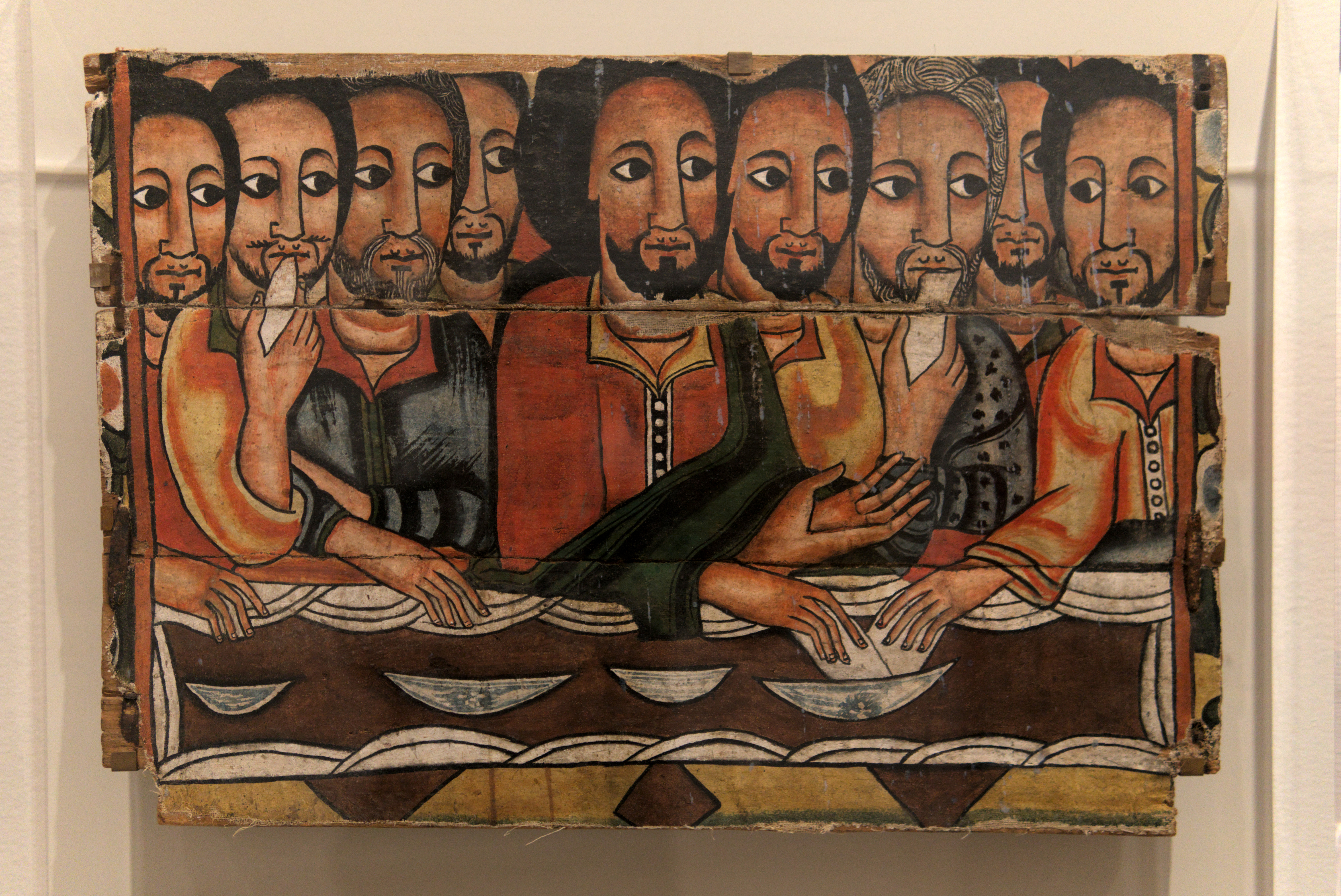
Two other passion images I want to share are a Last Supper wall painting and an Entombment from a disbound album.

Last Supper
Last Supper, Ethiopia, 18th century. Tempera on linen, mounted on panel, 16 3/4 × 24 in. (42.6 × 61 cm). Virginia Museum of Fine Arts, Richmond. [object record]

Entombment
Album Leaf with the Entombment of Christ, Ethiopia (Sawa?), late 17th century. Pigments on vellum. Minneapolis Institute of Art, 2009.39.3y. [object record]

In the Last Supper, Jesus and Judas both dip their bread (injera!) into the same bowl and exchange a knowing glance.

In the Entombment, Jesus, wrapped in white linen, is lowered into the ground, mourned by several of his women followers. The portrayal of his mother Mary’s weeping, her hands covering her eyes and her face stained with tears, is particularly poignant. This leaf is from a set of forty-four, now matted separately but originally arranged in series and likely painted on several long sheets of parchment that were sewn together and folded accordion-style to form a sensul.

One of the most extraordinary objects on display is a rare folding processional icon that adopts the form of a fan, from the late fifteenth century:

Processional icon (Ethiopia)
Folding Processional Icon in the Shape of a Fan, Ethiopia, late 15th century (Stephanite). Ink and paint on parchment, thread, extended: 24 1/4 × 154 1/8 × 4 3/4 in. (61.6 × 391.4 × 12 cm). Walters Art Museum, Baltimore. Photo courtesy of the museum. [object record]

Thirty-eight identically sized figures span the surface of this elongated parchment: the early Christian martyrs Julitta (Juliet) and Cyricus, St. George, St. John the Baptist, the archangel Michael, the Virgin Mary, the archangel Raphael, St. Paul, the Ethiopian artist-priest Afnin, and unidentified Old Testament patriarchs and prophets. There would have been a wooden handle attached to either end that, when pulled together, created a double handle for a giant wheel to be displayed during liturgical processions and church services (see here). As the museum website notes, “The Virgin Mary, whose hands are raised in a gesture of prayer, is then at the top of the wheel. By depicting Mary in the company of saints and angels, the icon powerfully evokes the celestial community of the church.”

This is just a sampling of all the wonderful art objects that are a part of the Ethiopia at the Crossroads exhibition. I’ll share more photos on Instagram (@art_and_theology) in the coming weeks.

I strongly encourage you to go see this! I think it would be enjoyable for children as well, especially Christian children, who will be able to identify many of the painted stories. For Christians, it’s an opportunity to connect with our artistic heritage and with African church history. If you can’t catch the exhibition at the Walters in Baltimore before it closes March 3, it will be traveling to the Peabody Essex Museum in Salem, Massachusetts (April 13–July 7, 2024), and the Toledo Museum of Art in Ohio (August 17–November 10, 2024).

Also, a catalog is coming out in April, where you will find photos of all the artworks in addition to illuminating essays.

Roundup: “Africa & Byzantium,” “Ethiopia at the Crossroads,” and more

ART EXHIBITIONS:

Two major exhibitions of African art are currently running in Manhattan and Baltimore, containing many Christian objects, some of them never before seen in the US. I attended both, and they’re excellent. I want to write a full-on review for each, but because I don’t know that I’ll have time to do so before they close, I wanted to at least make you aware of them in this abbreviated form in the hopes that you’ll have a chance to go see them. I will share more photos soon.

>> Africa & Byzantium, Metropolitan Museum of Art, New York City, November 19, 2023–March 3, 2024: Curated by Dr. Andrea Myers Achi. “Art history has long emphasized the glories of the Byzantine Empire (circa 330–1453), but less known are the profound artistic contributions of North Africa, Egypt, Nubia, Ethiopia, and other powerful African kingdoms whose pivotal interactions with Byzantium had a lasting impact on the Mediterranean world. Bringing together a range of masterworks—from mosaic, sculpture, pottery, and metalwork to luxury objects, paintings, and religious manuscripts—this exhibition recounts Africa’s central role in international networks of trade and cultural exchange. With artworks rarely or never before seen in public, Africa & Byzantium sheds new light on the staggering artistic achievements of medieval Africa. This long-overdue exhibition highlights how the continent contributed to the development of the premodern world and offers a more complete history of the vibrant multiethnic societies of north and east Africa that shaped the artistic, economic, and cultural life of Byzantium and beyond.”

Annunciation (Egypt)
The Annunciation, from a miscellany, Egypt, Fayyum Oasis, 913–14. Ink on parchment, 10 9/16 × 13 13/16 in. (26.8 × 35.1 cm). Collection of the Morgan Library and Museum, New York. Photo: Victoria Emily Jones.

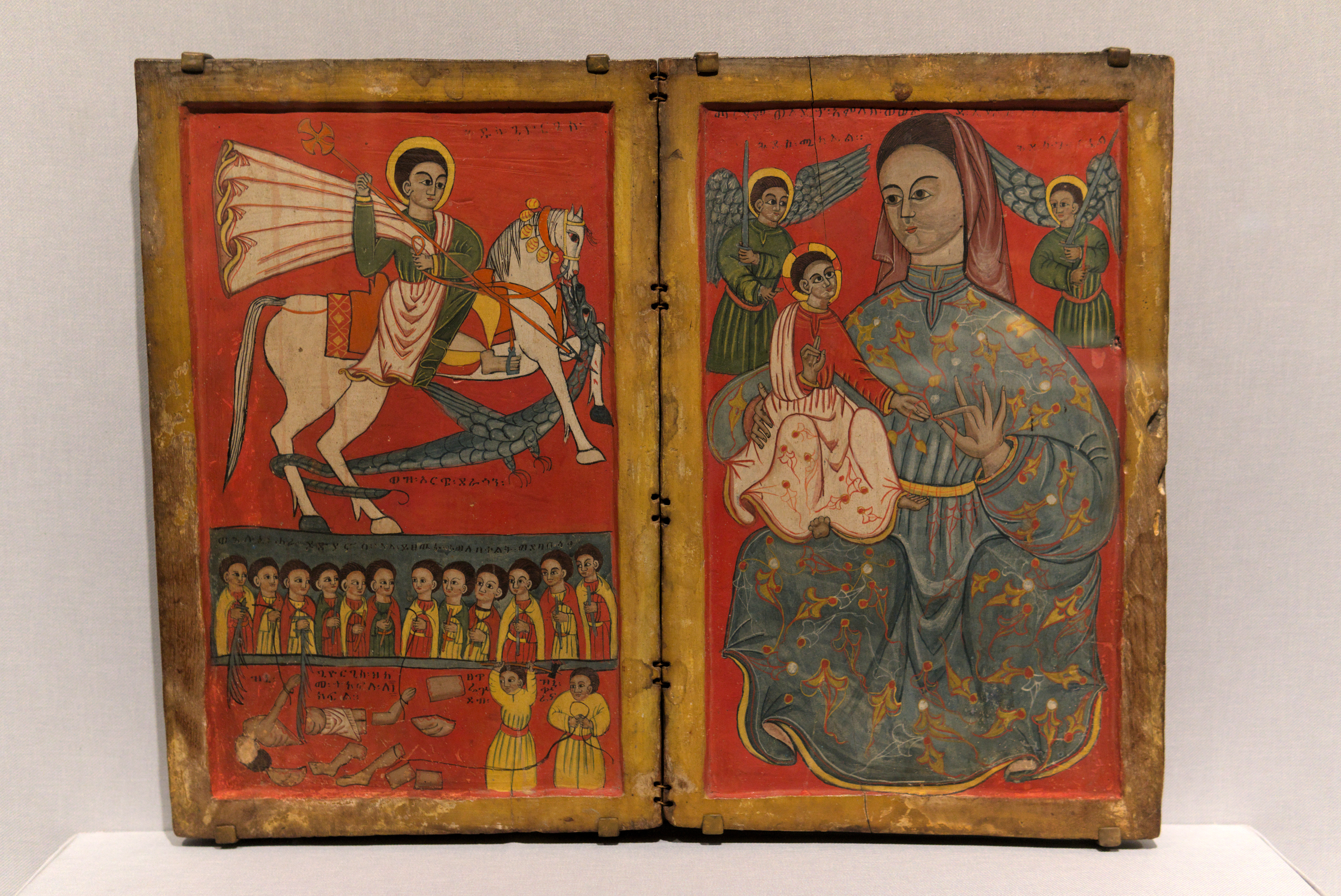
_DSC8288
Diptych with Saint George and the Virgin and Child, Ethiopia, late 15th–early 16th century. Paint on wood, 20 1/2 × 26 5/16 × 1 3/16 in. (52 × 66.8 × 3 cm). Collection of the National Museum of African Art, Smithsonian Institution, Washington, DC. Photo: Victoria Emily Jones.

Exhibition tour:

Smarthistory video of one of the extraordinary early icons on display, borrowed from St. Catherine’s Monastery in Mount Sinai, Egypt:

>> Ethiopia at the Crossroads, Walters Art Museum, Baltimore, December 3, 2023–March 3, 2024: Curated by Dr. Christine Sciacca. “Ethiopia at the Crossroads is the first major art exhibition in America to examine an array of Ethiopian cultural and artistic traditions from their origins to the present day and to chart the ways in which engaging with surrounding cultures manifested in Ethiopian artistic practices. Featuring more than 220 objects drawn from the Walters’ world-renowned collection of Ethiopian art and augmented with loans from American, European, and Ethiopian lenders, the exhibition spans 1,750 years of Ethiopia’s proud artistic, cultural, and religious history.

“Seated in the Horn of Africa between Europe and the Middle East, Ethiopia is an intersection of diverse climates, religions, and cultures. Home to over 80 different ethnicities and religious groups, a large portion of the historic artistic production in Ethiopia supported one of the three Abrahamic faiths (Judaism, Christianity, and Islam), all of which have early roots in Ethiopia. As one of the oldest Christian kingdoms, Ethiopian artists produced icons, wall paintings, crosses of various scales, and illuminated manuscripts to support this religious tradition and its liturgy. . . .”

The exhibition will travel to the Peabody Essex Museum in Salem, Massachusetts, April 13–July 7, 2024, and to the Toledo Museum of Art in Ohio August 17–November 10, 2024.

Ethiopian sensul
Detail of a sensul (chained manuscript), Ethiopia, 15th–early 16th century. Parchment, ink, paint, and leather. Collection of the Peabody Essex Museum, Salem, Massachusetts. Photo: Victoria Emily Jones.

Mänbärä Tabot Icon
Mänbärä Tabot Icon with Eight Panels and Painted Scenes, Ethiopia, ca. 1850. Carved wood and glue tempera. Private collection, United States. Photo: Victoria Emily Jones.

+++

SPOTIFY PLAYLIST: February 2024 (Art & Theology): An assortment of psalms, hymns, and spiritual songs, old and new.

Also, as Lent starts on February 14, don’t forget about my Lent playlist! Since its original publication in 2021, I’ve added songs to the bottom.

+++

BLOG POST: “The True Purpose of Theology” by W. David O. Taylor: Professor Taylor shares seven things about theology that he opens his first theology class lecture with each term at Fuller. So important. I hope I reflect these on my blog.

+++

HYMN: “O Love That Wilt Not Let Me Go” by George Matheson: I first shared this hymn at Art & Theology back in 2019; it’s one of my favorites. Here are two more videos of the song that are worth checking out.

>> Sung by Kristyn Getty and Dana Masters: Keith and Kristyn Getty, a powerhouse couple in the Christian music industry, have chosen “O Love That Wilt Not Let Me Go” as their Family Hymn of the Month for February, providing some background on the writer, a free sheet music download of their arrangement, and a video performance from 2021 with guest vocalist Dana Masters. The Gettys’ large platform among evangelicals is sure to get this lesser-known hymn into many homes!

>> Sung by Westminster Chorus: Here Westminster Chorus (from Westminster, California) performs David Phelps’s a cappella arrangement of the hymn in Petrikirche in Dortmund, Germany. I previously shared a video of Phelps singing this version with three of his fellow Gaither Vocal Band members, which is itself moving, but with a thirty-four-person choir, the effect is tremendous.

+++

VIDEO: The Greeter’s Guild Goes to Times Square: Ryan Pemberton, director of community cultivation for Image journal, introduced me to “the moustachioed motivator of the high street,” Troy Hawke, in the January 18 installment of ImageUpdate. His videos are so delightful! Pemberton writes,

Call me quaint, but at the start of a presidential election year, what I’m most looking for in books, film, and certainly in public life is kindness. Under the circumstances, I can’t stop recommending Troy Hawke to friends. A character created by British comedian Milo McCabe, Hawke is a 1930s throwback, eloquent in speech and dapper in dress. His go-to wardrobe includes a smoking jacket worn over loose-fitting linen pants and Oxford dress shoes. As founder (and only member) of the Greeters Guild, he offers hyper-specific and articulate compliments to strangers—guests entering a Waitrose, commuters at a public transit hub, or those stopping at an EV charging station. After being invited to “try that in New York,” Hawke has been spotted offering compliments to passersby in Central Park. His intentional and attentive praise is a refreshing contrast to so much vitriol pouring its way through my screens and speakers. These public encounters call to mind Kierkegaard’s Works of Love, in which he notes that the work of love is to see and name the love already present in others, and, in so doing, to catalyze that love’s growth into its fullest expression (all while refusing to take credit—it was there the whole time). In this way, Hawke is both prophetic and timely. Fred Rogers, in an interview offered toward the end of his life (captured in the 2018 documentary Won’t You Be My Neighbor), shared that the most pressing work facing our species in this millennium is “making goodness attractive.” To that end: Thank you, Mr. Hawke; I can’t look away.

Christmas, Day 1: Rejoice!

Merry Christmas!

LOOK: Ethiopian Nativity tapestry

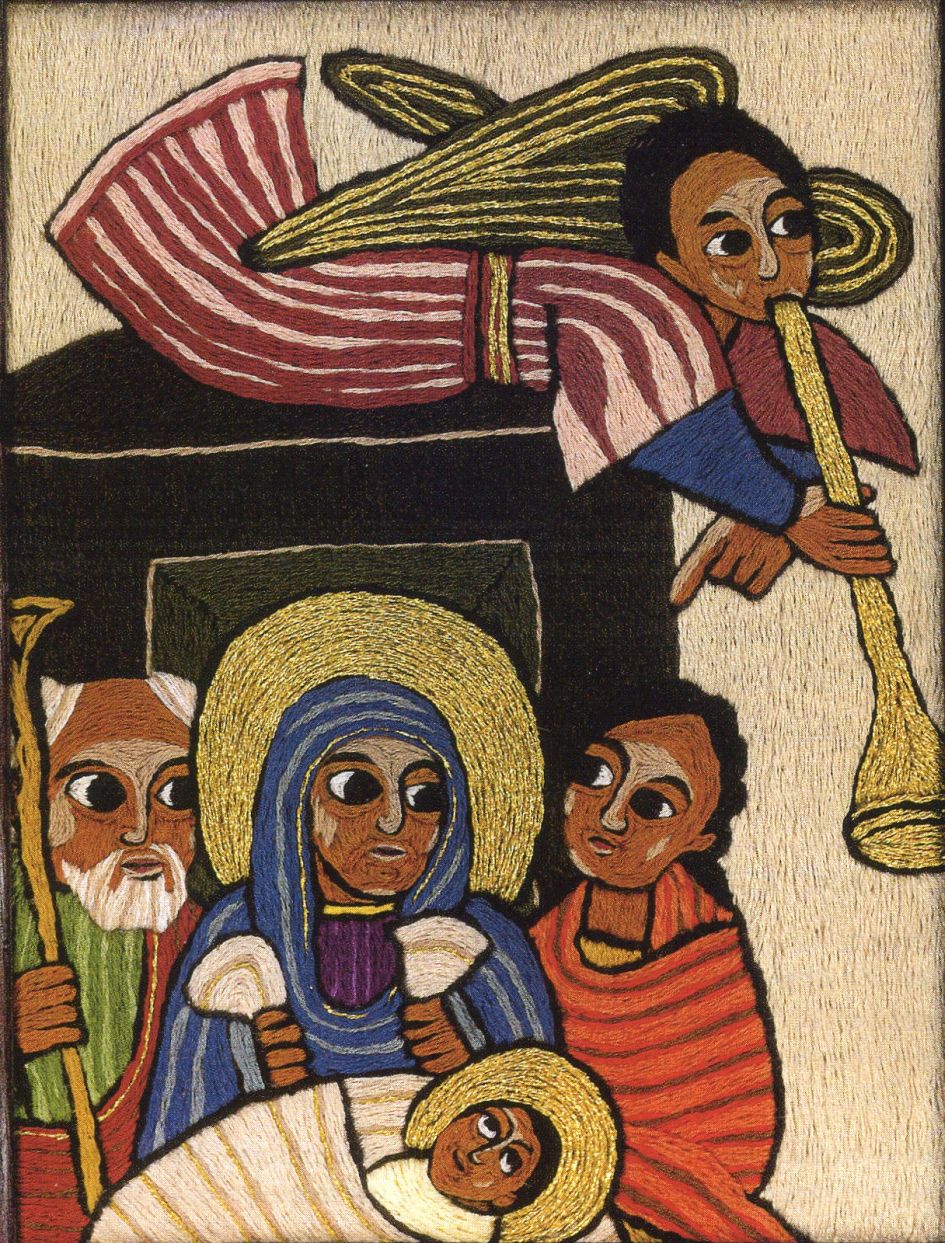
Ethiopian Nativity
Tapestry after: Tadesse Wolde Aregay (Ethiopian, 1953–), Joy in Heaven: Glory Be to God, 1985, painting on goatskin. Copyright of the original image belongs to Berliner Missionswerk and the Raad voor de Zending der NHK (Mission Council of the Dutch Reformed Church in the Netherlands).

I don’t know the maker or whereabouts of this charming tapestry, but I did find that it is based on a painting made by the Ethiopian artist Tadesse Wolde Aregay, which you can view here, along with three of Aregay’s other Christmas paintings. In it, a trumpeting angel points to the newborn Christ, whose mother, Mary, wraps him warmly in a blanket. Joseph stands on the left with a staff. On the right is Salome, a midwife and disciple of Jesus who appears in the Nagara Maryam (History of Mary), an apocryphal book of Marian legends from Ethiopia, and who is often portrayed in Ethiopian paintings of the Nativity and the Flight to Egypt.

LISTEN: “Christ Is Born Today” | Original German and Latin words attributed to Heinrich Suso (ca. 1295–1366); English translation by John Mason Neale, 1853 | Music: German dance tune, 14th century | Arranged by Elbertina “Twinkie” Clark and performed by the Clark Sisters on New Dimensions of Christmas Carols, 1978

Good Christian men, rejoice
With heart, and soul, and voice;
Give ye heed to what we say:
Good news!
Jesus Christ is born today!
Ox and ass before him bow;
He is in the manger now.
Christ is born today!

(Joy to the world)
Christ is born today!
(He’s in the manger now)
Christ is born today!
(Peace on earth, goodwill to men)
Christ is born today!
(Unto us)

And man is blessèd evermore.
Christ is born today!
(Christ is born today)
Christ is born today!
(Peace on earth, goodwill to men)
Christ is born today!
(Unto us a child is given)
Christ is born today!

This Christmas carol has its origins in late medieval Germany. It’s attributed to the Dominican friar Henry Suso—a legend says he had a vision of angels singing and dancing with joy about the birth of Christ, and, caught up in the mystic celebration, he penned the song.

I love the quick-tempoed, 6/8 version I grew up singing in church—but I also love what the Clark Sisters have done with it!

Officially formed in 1973 and active ever since, the Grammy-winning Clark Sisters are Jacky Clark Chisholm, Elbernita “Twinkie” Clark, Dorinda Clark-Cole, and Karen Clark Sheard. They were born in Detroit to gospel musician and choral director Dr. Mattie Moss Clark, who got them started in their singing careers. The group is a pioneer of contemporary gospel music, and last year they were inducted into the Black Music & Entertainment Walk of Fame in Atlanta.

The soloist on “Christ Is Born Today” is Denise “Niecy” Clark-Bradford, who left the group in 1986. In the first verse she mistakenly sings “groan” instead of “bow.”

Note that in hymnals today it is common to replace the first line with “Good Christian friends, rejoice” or “Good Christian folk, rejoice” to avoid the gendered “men,” and likewise in a later verse to change “And man is blessèd evermore” to “And we are blessed forevermore.” I get that “men” is being used in the broad sense of “humankind,” but where small lyrical changes for gender inclusivity are nondisruptive, as they are here, I am in favor of them.

The carol is written in the voice of the angels who excitedly proclaimed Christ’s birth to the shepherds, and their proclamation is taken up by Christians around the globe who sing this song, spurring one another to rejoice in the good news.


This post is part of a daily Christmas series that goes through January 6. View all the posts here, and the accompanying Spotify playlist here.

Roundup: Nativity art from Asia, the Christ Hymn in Thai, and more

ARTICLES:

>> “How Asian Artists Picture Jesus’ Birth from 1240 to Today” by Victoria Emily Jones, December 18, 2023, Christianity Today: My first CT article was published this week! I was asked to curate and introduce a sampling of Nativity art from across Asia. By representing Jesus as Japanese, Indonesian, or what have you, these artists convey a sense of God’s immanence, his “with-us–ness,” for their own communities—and for everyone else, the universality of Christ’s birth.

Turun, I Wayan_In Bethlehem
I Wayan Turun (Indonesian, 1935–1986), In Bethlehem, 1958. Acrylic on canvas, 46 × 64 cm. Collection of Stichting Zendingserfgoed (Missionary Heritage Foundation), Zuidland, Netherlands.

>> “The Story of Christ in Chinese Art: Scholars at Peking University Make a Christmas Portfolio for LIFE,” Life, December 22, 1941, pp. 40–49: In doing research for my Christianity Today article, I found this old article from Life magazine that features eight Chinese watercolors on silk from the collection of Dr. William Bacon Pettus (1880–1959), an American educator and president of the California College of Chinese Studies in Peking (Beijing) in the 1920s and ’30s, which were being exhibited at New York’s American Bible Society at the time. With the ordination of six Chinese bishops by Pope Pius XI in 1926, the Chinese Catholic Church was transitioning from a mission church to an indigenous local church, and Chinese-style religious art—much of it coming out of the art department of the new Catholic University of Peking (Beiping Furen Daxue)—was part of that localization. Productivity seems to have continued at Furen during the Japanese occupation, as this article attests. Many of the students and faculty were recent converts to Christianity, though the article reports that non-Christians also enrolled and taught in the art program.

Lu Hongnian_Nativity
Lu Hongnian (Lu Hung-nien) ( 陸鴻年) (Chinese, 1914–1989), The Birth of Jesus, ca. 1941. Chinese watercolor on silk.

Here is one of the paintings by Lu Hongnian, who sometime after this article was published, in part through his having engaged the New Testament as inspiration for his paintings, became a Christian and took the name John. It shows the Holy Family in a mountainside cave, Mary gazing adoringly at her newborn son as Joseph brings more straw to cushion him. Beside them, an angel holds up a lantern for light, while two shepherd children approach from the entrance, eager to meet their Savior.

+++

SONGS:

>> “Philippians 2:511” by HARK Music: This song takes a traditional Thai melody, arranged by Tirasip Kraitirangul, and puts it to a Thai translation of the famous Christ Hymn from Philippians 2. It’s performed by the HARK Duriya Tasana Singers (feat. Somchairak Sriket and Damrongsak Monprasit) and Dancers, filmed on location at Chaloem Kanchanaphisek Park in Bangkok. The song is from HARK’s Thai Hymns Album (2014), which can be downloaded for free at https://harkpublications.com/?product=thai-hymns-album-2. The two-stringed bowed instrument you see at 3:21 is a saw u.

The Duriya Tasana (“Curators of the Arts”) ensemble was formed in 2012 under the commission of the Thai-Psalms Project, an endeavor to create Thai traditional and classical music settings for the psalms of the Bible. Many of the members are affiliated with the Bunditpatanasilpa Institute of Fine Arts in Bangkok. Thanks to my friend Janet, whose sister is preparing a move to Thailand, for alerting me to this group!

>> “Jesus You Come” by Tenielle Neda, performed with Jon Guerra: This song by the Australian singer-songwriter Tenielle Neda [previously], which she sings with Jon Guerra, makes a nice complement to the Thai song above. The performance is from “Songs for Hope: A TGC Advent Concert” on December 6, 2020.

+++

MIDDLE ENGLISH LULLABY: “As I lay upon a night”: Medievalist Eleanor Parker introduces a charming Christmas lullaby from fourteenth-century England, a dialogue between Mary and the Christ child, and provides a modern English translation of its thirty-seven stanzas. In the Middle Ages, says Rosemary Woolf, the subject matter of lullabies was often a prophecy of the baby’s future—presumably a romantic promise of great and happy achievements. But here it is the child who relates the future to his mother, thus providing the material for his own lullaby.

+++

ART VIDEO: “Third Sunday of Advent: Ethiopian Art: Gospel Book” by James Romaine: Every December, my friend James Romaine, an art historian who teaches at Lander University, publishes four videos on his Seeing Art History YouTube channel related to the themes of the season, part of his annual Art for Advent series. This year he’s chosen to focus on Ethiopian art, covering illuminations from two different manuscripts, a diptych icon, and a rock-hewn church.

In this video Romaine discusses the formal qualities of two paintings from a sixteenth-century Ethiopian Gospel-book, the identity of the figures, and the liturgical context of the book, including the use of the red veil that’s attached at the top, which, Romaine says, “both protects and sanctifies the icon,” creating a sense of anticipation for the Orthodox believer who, in faith, lifts the veil to see what is revealed.

Roundup: Ambai praise medley, ArtStories, Visually Sacred, and more

Each item in a roundup represents hours of combing through and evaluating other possibilities to feature, to find that one I deem will be of most value to readers of Art & Theology. None of these spots are ever bought or coerced, but rather represent sincere recommendations on my part. If you appreciate the resources I curate, would you consider making a donation to make this continued work possible? Or buying me a book from my Amazon wish list (to support my research)? Regardless, I really appreciate you being here!

+++

SONGS:

>> Ambai Praise Medley: This summer Palmer Keen, an American ethnomusicologist based in Yogyakarta who runs the online repository Aural Archipelago, visited the Christian village of Kawipi in the Ambai Islands of Papua, Indonesia, to learn more about songgeri, a worship music tradition indigenous to that area. When he arrived, the villagers formed a welcome party to greet him at the church steps with much music making! That is what this clip is from:

Palmer writes,

Songgeri is a gospel string band tradition from the Ambai archipelago of Papua. The Ambai people, fervent Pentecostals since mass conversion in the mid-20th century, have taken the string band format popular across Melanesia . . . and embraced it as a vehicle for a unique gospel sound unlike anything else in Indonesia.

The name songgeri itself means “joy” in the Ambai language, and every bit of the music is designed to channel a particularly Pentecostal religious ecstasy: handmade lutes (four-string “ukulele” and five string “gitar”) stick to just three easy chords, while giant double bass-like stembas are turned towards the players and plucked with both hands and hand-carved wooden picks to get a thunderous sound. Musicians play a non-stop medley of “praise and worship” verses sung in Ambai and Indonesian—in one piece, “Nemunu Doana Kamia Wowong,” for example, they sing: “His house is built on coral / The gates of heaven are open / He awaits us!”

For more on the history, form, and instruments of songgeri, including additional videos, see Palmer’s recent blog post. (Shout-out to Sam Connour for alerting me to this fantastic music!)

>> “Campfire Coritos,” performed by Israel and New Breed: This corito [previously] medley features the songs “Con mis manos y mi vida” (With My Hands and My Life), “Alabaré” (Oh, Come and Sing), “Te alabarán oh Jehová” (They Will Praise You, O Jehovah), “Quién como tú” (Who Is Like You?), “Hay poder” (There Is Power), and “Ven, ven, ven, Espíritu Divino” (Come, Come, Come, Holy Spirit). The first female soloist is Israel Houghton’s wife, Adrienne Bailon-Houghton, and the second female soloist (with dark hair) is Adrienne’s sister, Claudette Bailon.

And here’s another corito medley sung by the same group:

+++

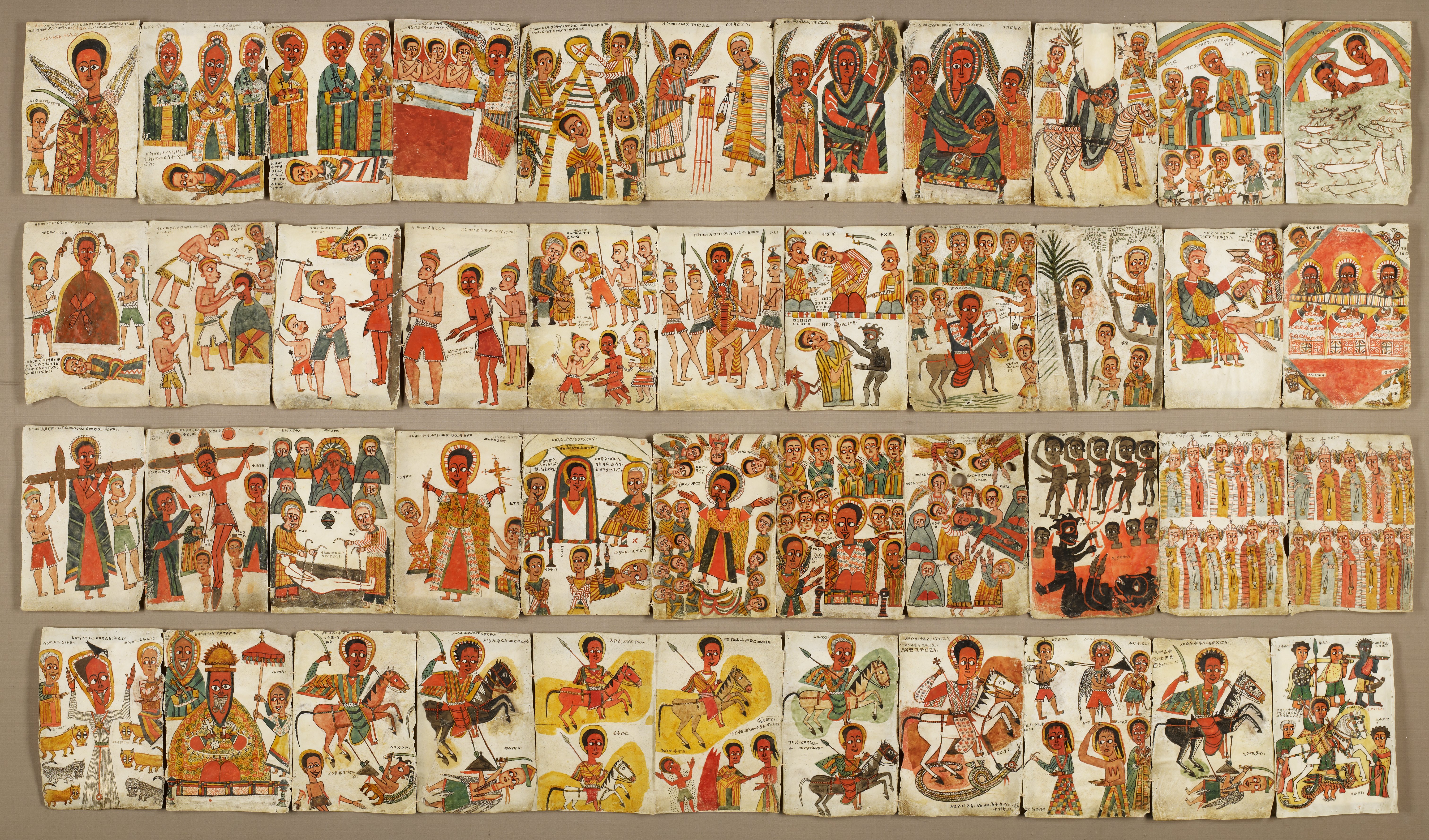
ART: 44 Plates from a Christian illuminated album, Ethiopia: When I was at the Minneapolis Institute of Art a few years ago, I saw on display three paintings on vellum from seventeenth-century Ethiopia, in the First Gondarene style, featuring Ethiopian saints and Bible stories. They are from a set of forty-four pages that were at one time sewn together and used as a prayerbook. The inscriptions are in Ge‘ez, an ancient language that originated in northern Ethiopia and is now only used in religious ceremonies.

Ethiopian album
Ethiopian saints and scenes from the Hebrew scriptures and the Christian Bible, from a disbound album, Ethiopia, late 17th century. Collection of the Minneapolis Institute of Art, Minneapolis, Minnesota.

Learn more about this illuminated album through ArtStories, an interactive multimedia feature on MIA’s website that allows for in-depth exploration of select objects from the museum’s collection. On the “More” tab is a video on “Connecting with World Religions,” a photo of each individual page with accompanying descriptions, and a behind-the-scenes video with Ethiopian manuscript cataloger Getatchew Haile.

I encourage you to further peruse ArtStories, which spotlights art objects from around the world in all sorts of media, including an ancient Egyptian instrument, an Islamic prayer mat, a Somali wedding basket, an Osage friendship blanket, a snake jug that pokes fun of the Confederacy, a brass leopard-shaped water pitcher from Nigeria, a pair of folding screens from Japan, an illusionistic marble sculpture, El Greco’s Expulsion of the Money-Changers, Rembrandt’s Lucretia, one of Monet’s grain stacks, and more. The interface directs you to specific details of the work and teaches about content, context, technique, and influences.

+++

PODCAST EPISODES: The first season of the podcast Visually Sacred: Conversations on the Power of Images, hosted by Arthur Aghajanian, wrapped this summer, altogether featuring conversations with thirteen luminaries in the field of religion and the arts. These were two of my favorite episodes:

>> “William Dyrness: Protestant Aesthetics, Modernism, and Theopoetics”: Theologian William Dyrness from Fuller Theological Seminary discusses the importance of art to spirituality, and the history and theology of images in Protestantism versus Catholicism. He also shares how Christianity influenced many canonical modern artists, and introduces theopoetics, a Christian movement that seeks to broaden our understanding of orthodoxy by bridging art forms and connecting art to daily life.

>> “Natalie Carnes: Iconoclasm, Beauty, and Aesthetics”: Theologian Natalie Carnes [previously], a professor at Baylor University, discusses iconoclasm, particularly the controversy around public monuments; the ambivalence of images as mediators of the Divine (giving us access and blocking access); suffering and beauty; feminist theology; and Christian asceticism as a form of abundance.

Roundup: “El Shaddai” (new song), everyday Black life in pictures, and more

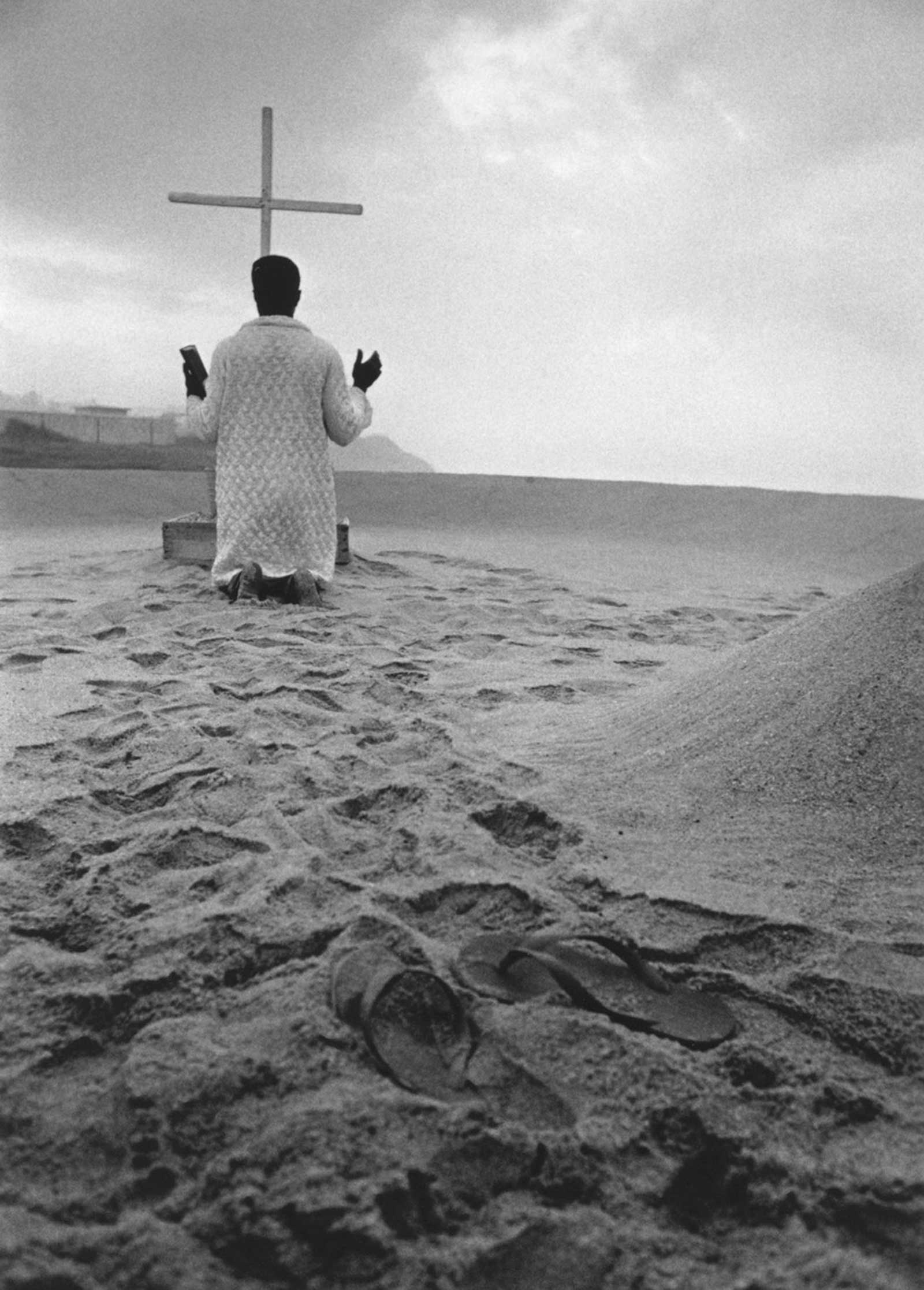
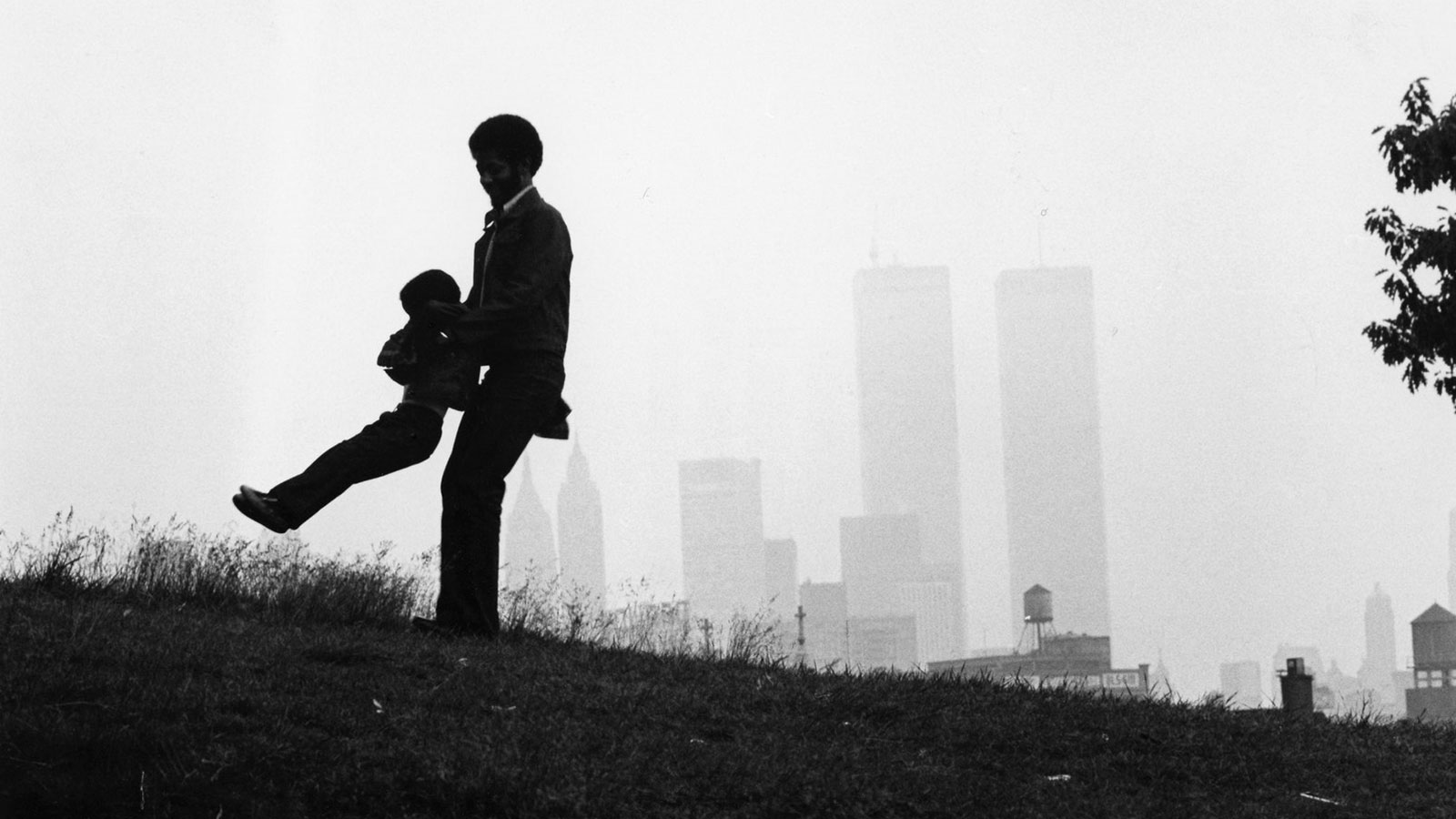
PHOTO COMPILATION: “Chester Higgins’s Life in Pictures”: Chester Higgins Jr. (b. 1946) is an American photographer whose work focuses on everyday Black life; “it is inside simple moments where I look for windows into larger meaning,” he says. He was a staff photographer for the New York Times for more than four decades, and his work is in the permanent collection of the Museum of Modern Art. This heavily illustrated New Yorker article is a good introduction to his oeuvre, in which religious belief and practice feature prominently. I found out about him through the photography compilation book Standing in the Need of Prayer: A Celebration of Black Prayer.

Higgins, Chester_Sunrise Prayer
Chester Higgins (American, 1946–), Sunrise Prayer on Osu Beach, Accra, Ghana, 1973

Higgins, Chester_Father Swinging Son, Brooklyn
Chester Higgins (American, 1946–), Father Swinging Son, Brooklyn, 1972

+++

SONGS:

>> “El Shaddai” by Victory: On January 27 singer-songwriter Victory Boyd, who goes professionally by the mononym Victory, released her latest single, “El Shaddai.” El Shaddai is an ancient Hebrew name for God whose original meaning is unclear but which is often translated into English as “God Almighty”—although “God of the Mountains,” “the Full-Breasted God” (referring to God’s nourishment of God’s children), or “the All-Sufficient One” have also been posited. Its first appearance in the Bible is in Genesis 17:1, where God tells Abram, “’I am El Shaddai; walk before me, and be blameless.”

Read the lyrics in the YouTube video description.

>> “Come Unto Me” by Take 6: A friend recently introduced me to the American a cappella gospel sextet Take 6. Formed in 1980 on the campus of Oakwood College in Huntsville, Alabama, and still active, they incorporate sophisticated jazz harmonies into the tradition of Black gospel “quartet” singing. They are featured on Spike Lee’s Do the Right Thing soundtrack and have won ten Grammys.

This 1988 performance for a Heritage USA TV spot features the group’s six original vocalists: Claude V. McKnight III, Mark Kibble, Mervyn Warren, David Thomas, Cedric Dent, and Alvin Chea.

>> “He’s Got the Whole World in His Hands” by Peter Collins: I love what Peter Collins does with this African American spiritual! This video was his submission to Tyler Perry’s #HesGotTheWholeWorldChallenge from 2020 (which I featured here). It didn’t make the final cut, but I’m so glad it’s out there.

+++

LITERARY EXCERPT from The Color Purple by Alice Walker: This short passage from Alice Walker’s 1982 Pulitzer Prize–winning novel is taken from a conversation between the protagonist, Celie, and her friend Shug, about pleasure, gratitude, and grace. Shug refers to God as “it” (“God ain’t a he or a she”), and her statement about the necessity of enjoying God’s good creation and being open to surprise provides the source of the title.

I’m embarrassed to say that although I saw and really liked the 1985 Steven Spielberg film adaptation of The Color Purple, I’ve never read the book! I plan to rectify that before December, when another film adaptation—of the 2005 stage musical based on Walker’s novel—is coming out, directed by Blitz Bazawule. It stars Fantasia, H.E.R., Colman Domingo (Euphoria), Taraji P. Henson (Hidden Figures), Danielle Brooks (Orange Is the New Black), Jon Batiste, and more.

+++

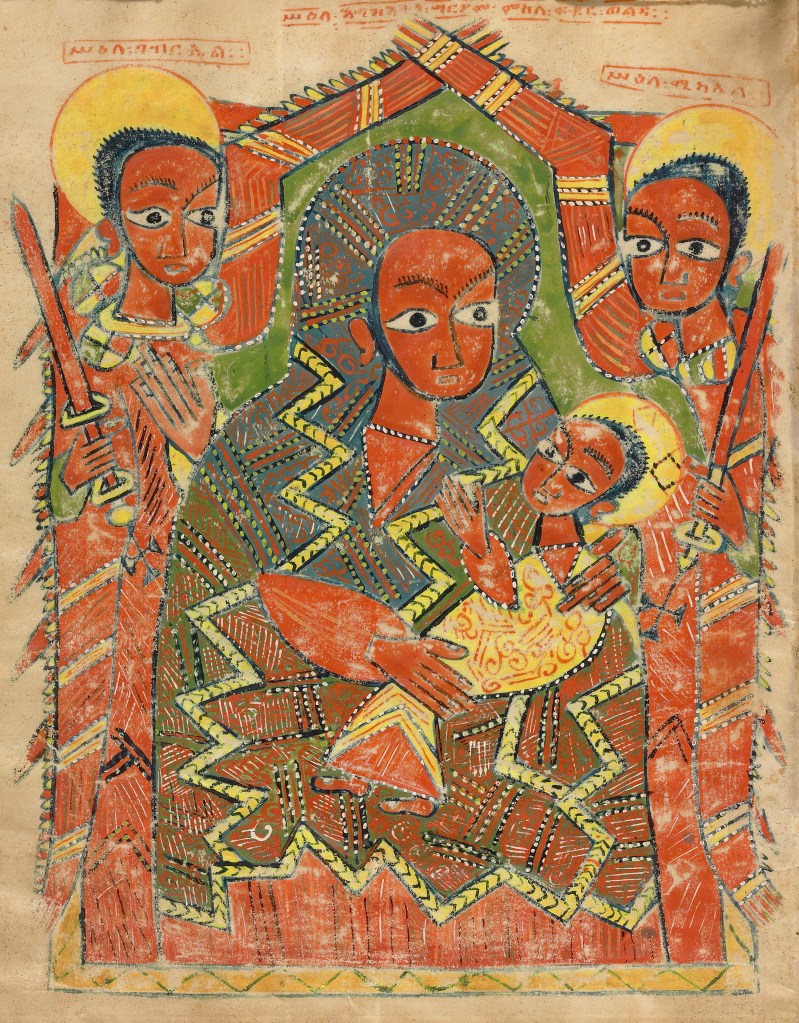
VIDEO: “Ethiopian Gospel Book”: In this six-minute instructional video, Dr. Beth Harris, executive director of Smarthistory, and Kelin Michael, a graduate curatorial intern of manuscripts at the Getty Museum, explore an early sixteenth-century Gospel book from Ethiopia. They discuss the book’s historical context and the formal qualities of its paintings, including the flatness of the figures and the colorful interlacing. They focus on a full-page illumination at the front of the Virgin and Child enthroned between two archangels, but they also touch on the book’s canon tables and its portrait of Saint John the Evangelist.

Virgin and Child (Ethiopian MS, Getty)
The Virgin and Child with the Archangels Michael and Gabriel, Ethiopia, ca. 1504–5. Tempera on parchment, 13 9/16 × 10 7/16 in. (34.5 × 26.5 cm). J. Paul Getty Museum, Los Angeles, Ms. 102, fol. 19v.

Hymn 4 on the Nativity of Christ (excerpt) by Ephrem the Syrian

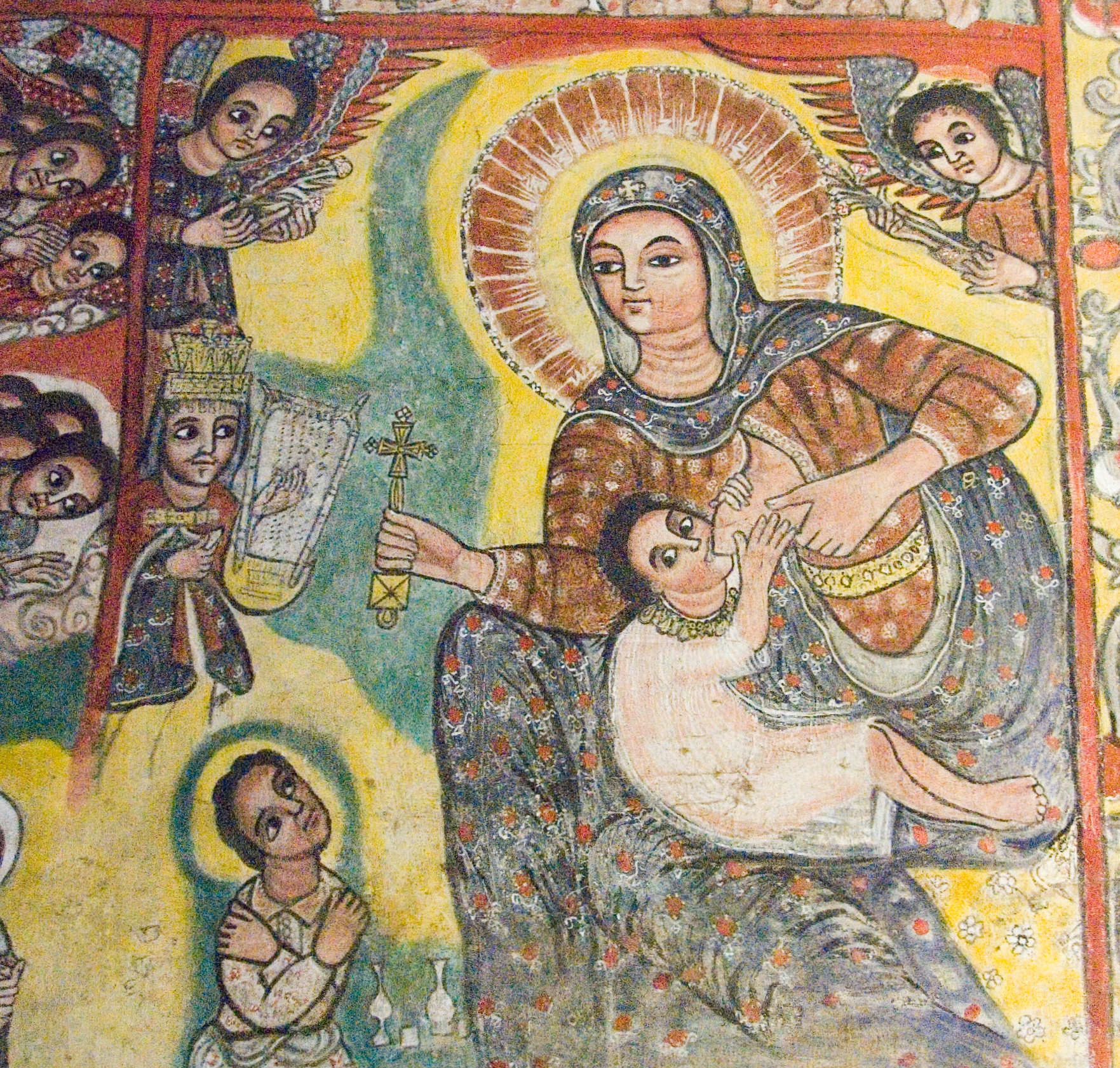
Maria lactans (Ethiopian)
Maria lactans, late 18th century. Fresco, Church of Narga Selassie, Dek Island, Lake Tana, Ethiopia. Photo: Alan Davey.

Glory to that Voice that became a body,
and to the lofty Word that became flesh.
Ears even heard Him, eyes saw Him,
hands even touched Him, the mouth ate Him.
Limbs and senses gave thanks to
the One Who came and revived all that is corporeal.
Mary bore a mute Babe
though in Him were hidden all our tongues.
Joseph carried Him, yet hidden in Him was
a silent nature older than everything.
The Lofty One became like a little child,
yet hidden in Him was a treasure of Wisdom that suffices for all.
He was lofty but he sucked Mary’s milk,
and from His blessings all creation drinks.
He is the Living Breast of living breath;
by His life the dead were suckled, and they revived.
Without the breath of air no one can live;
without the power of the Son no one can rise.
Upon the living breath of the One Who vivifies all
depend the living beings above and below.
As indeed He sucked Mary’s milk,
He has given suck—life to the universe.
As again He dwelt in His mother’s womb,
in His womb dwells all creation.
Mute He was as a babe, yet He gave
to all creation all His commands.
For without the First-born no one is able
to approach Being, for He alone is capable of it.

Translated from the Syriac by Kathleen E. McVey in Ephrem the Syrian: Hymns (Classics of Western Spirituality) (Mahwah, NJ: Paulist Press, 1989), 100–101

Lent, Day 19

I am my beloved’s, and my beloved’s is mine . . .

—Song of Solomon 6:3a (cf. 2:16)

He brought me to the banqueting house, and his banner over me was love.

—Song of Solomon 2:4

I will extol thee, O LORD; for thou hast lifted me up . . .

—Psalm 30:1a

Blessed be the God and Father of our Lord Jesus Christ, who hath blessed us with all spiritual blessings in heavenly places in Christ . . .

—Ephesians 1:3

LOOK: Ethiopian Angels, Debre Birhan Selassie Church

Ethiopian church ceiling
Painted wood ceiling, early 19th century, Debre Birhan Selassie Church, Gondar, Ethiopia. Photo: A. Savin.

Debre Birhan Selassie (Trinity and Mountain of Light) Church in Gondar, the imperial capital of Ethiopia from 1636 to 1855, is famous for the colorful paintings that cover every inch of the interior walls and ceiling. The south wall concentrates on the Life of Christ, while the north wall depicts various saints. The focal point—on the east wall, in front of the holy of holies—is a Crucifixion scene and an icon of the Trinity. But the most celebrated visuals inside the church are the hundred-plus winged heads painted in rows between the wooden beams of the ceiling, representing the cherubim and God’s omnipresence.

The original church, which was round, was consecrated in 1693 by Emperor Iyasu I, but lightning destroyed it in 1707. The rectangular stone church that stands on the site now likely dates to the late eighteenth century, and it is the only one of the forty-four Orthodox Tewahedo churches in Gondar to survive the 1888 sack of the city by Mahdist soldiers from Sudan. (Locals say the marauders were miraculously rerouted by a swarm of bees.)

According to Ethiopia (Bradt Travel Guide) writer Philip Briggs, “The paintings are traditionally held to be the work of the 17th-century artist Haile Meskel, but it is more likely that several artists were involved and that the majority were painted during the rule of Egwala Seyon (1801–17), who is depicted prostrating himself before the Cross on one of the murals.”

Debre Birhan Selassie is still an active church, but priests also offer tours. Here’s some video footage of the inside (you’ll see it’s very dark, and flash photography is not allowed), and some drone footage of the exterior.

The church is part of a larger imperial compound, known as Fasil Ghebbi, that has been a UNESCO World Heritage Site since 1979 and that includes palaces, monasteries, and public and private buildings.

Angels (Debra Berhan Selassie Church)
Photo: Alan Davey

LISTEN: “His Banner Over Me Is Love” by B. C. Laurelton (pseudonym of Alfred B. Smith), 1965 | Performed by Christy Nockels on Be Held: Lullabies for the Beloved, 2017 | CCLI #28579

I am my Beloved’s and He is mine—
His banner over me is love.
I am my Beloved’s and He is mine—
His banner over me is love.
I am my Beloved’s and He is mine—
His banner over me is love,
His banner over me is love.

He brought me to His banqueting table—
His banner over me is love.
He brought me to His banqueting table—
His banner over me is love.
He brought me to His banqueting table—
His banner over me is love,
His banner over me is love.

He lifted me up to the heavenly places—
His banner over me is love.
He lifted me up to the heavenly places—
His banner over me is love.
He lifted me up to the heavenly places—
His banner over me is love,
His banner over me is love.

I sang a version of this song in children’s church regularly when I was little (with hand motions!) and have carried it with me all these years, a gentle assurance that I am divinely loved and protected. I’ve quoted the scriptures it’s drawn from above. Its refrain comes from Song of Solomon 2:4: “his banner over me was love.”

The Song of Solomon, aka the Canticle of Canticles, has traditionally been read, at least on one level, as an allegory of the love between God and the human soul—or, more specifically in the Christian tradition, Christ and his church.

From the root “to cover,” the Hebrew word for “banner” in this verse refers to a military standard. It is being used figuratively here to indicate that we enlist ourselves under Love’s banner, which goes forth in triumph and protects those under its billows. We belong to love, commit ourselves to love, overcome through love. The verse is perhaps an allusion to the names of generals being inscribed on the banners of their armies. God’s name is Love (1 John 4:8).

The image is at once vigorous and gentle. The NRSV translates the phrase as “his intention toward me was love.”

The song “His Banner Over Me Is Love” was written by Alfred B. Smith (1916–2001), an itinerant song leader, songwriter, and Christian music publisher. Smith compiled and published his first songbook, Singspiration One: Gospel Songs and Choruses, while he was a student at Wheaton College in 1941, to support the evangelistic meetings he was running with his roommate, Billy Graham (yes, that Billy Graham!). Two years later he founded Singspiration Publishing Company, which published several popular series of songbooks. In 1963 he sold Singspiration to Zondervan, but he ran other publishing ventures (i.e., Better Music Publications and Encore Publications) for the remainder of his ministerial career.

According to Music in the Air: The Golden Age of Gospel Radio by Mark Ward Sr., Smith composed “His Banner Over Me Is Love” in 1965 as an impromptu offertory while serving as a visiting song leader at First Baptist Church–Laurelton in Brick, New Jersey. Afterward he received requests from the congregation for the music. His original notation read “B. C. Laurelton” (for “Baptist Church Laurelton”) to designate where he wrote the song, and it was copied as such as people shared the music with others—so when the song was later published in 1972, Smith decided to adopt “B. C. Laurelton” as a pen name.

Singer-songwriter Christy Nockels [previously] sings “His Banner over Me” on an album of lullabies to a twinkling piano accompaniment.

May this truth—that God’s banner over you is love—soothe you and give you confidence.