Standing at the threshold of another Advent, we hear the invitation of Christ: ‘Come away to a deserted place and rest a while.’ And so we begin our season of growth and expectation—a time to secret ourselves with Mary, to join our hearts with hers, and to grow pregnant with God together. God invites us to a quiet place of reflection and bounty. This Advent, choose some time for silence. Make space within yourself to grow large with the abundance of God’s favor. Make this a time to fill your lungs deeply with God so that you can breathe Christ into the world.
Waiting does not diminish us, any more than waiting diminishes a pregnant mother. We are enlarged in the waiting. We, of course, don’t see what is enlarging us. But the longer we wait, the larger we become, and the more joyful our expectancy.
I’m one of the artistic directors of the Eliot Society, a faith-based arts nonprofit in Annapolis. I’m really looking forward to our next two events this fall! If you’re in the area, I’d love for you to come out to these talks by a musician and a medievalist. They’re both free and include a time of Q&A and a small dessert reception afterward.
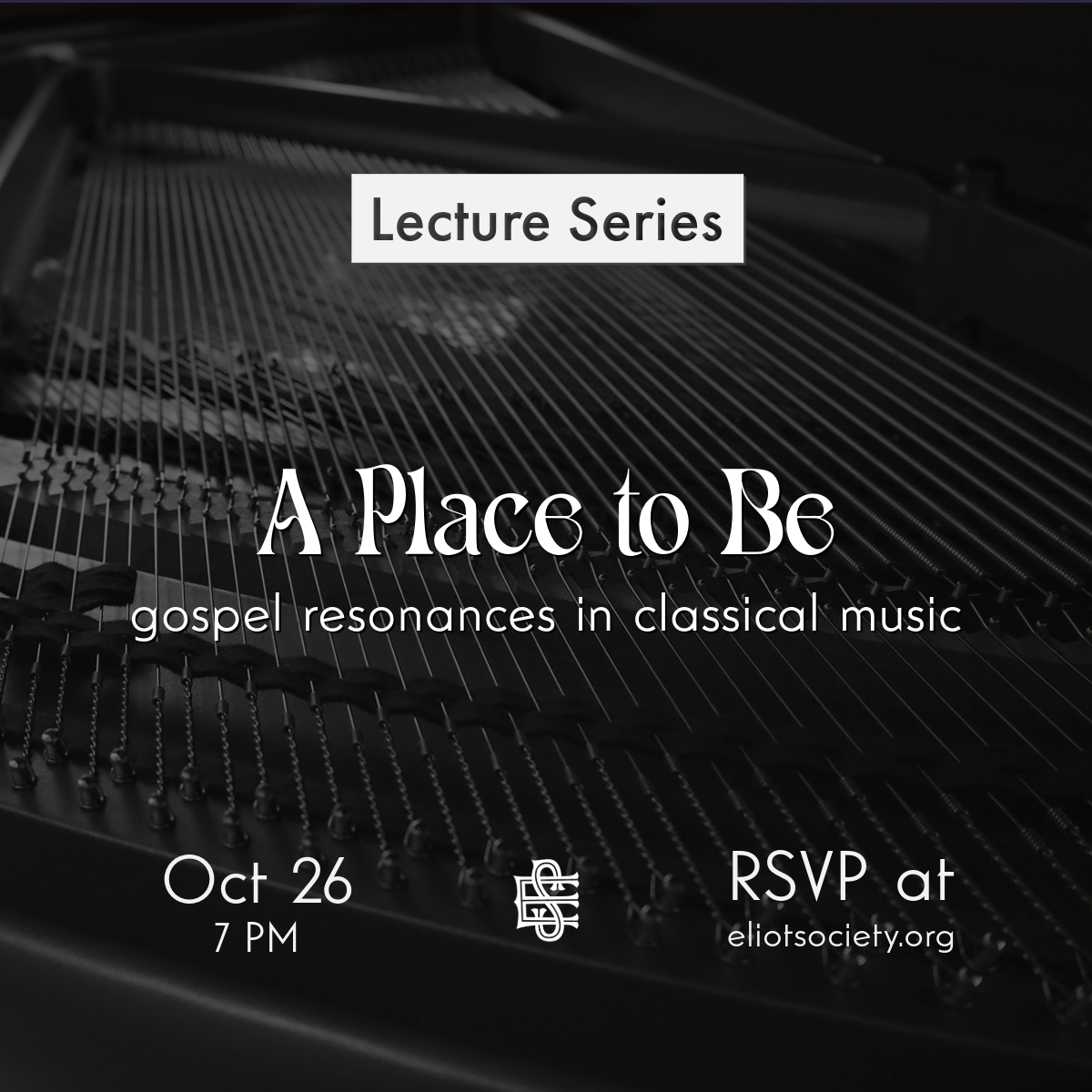
>> “A Place to Be: Gospel Resonances in Classical Music” by Roger Lowther, October 26, 2024, Redeemer Anglican Church, Annapolis, MD: “At its most basic, music is a collection of sounds. How those sounds are organized varies by country and culture and reflects their values, history, and heart-longings. Join Tokyo-based American musician Roger W. Lowther on a journey through the landscapes of Western and Japanese classical music and explore their unique and fascinating differences. Roger will lead from the piano as he demonstrates the musical languages of each tradition and show how they contain hidden pointers to gospel hope in a world full of suffering and pain.”
I’ve heard Roger speak before, and he’s very Jeremy Begbie-esque in that he does theology through instrumental music. As a bicultural person, a New Englander having lived in Japan for almost twenty years (ministering to and through artists of all disciplines), he brings a unique perspective. In addition to discussing the defining features of the Western versus Japanese classical traditions, he’ll be performing a few piano pieces from each.
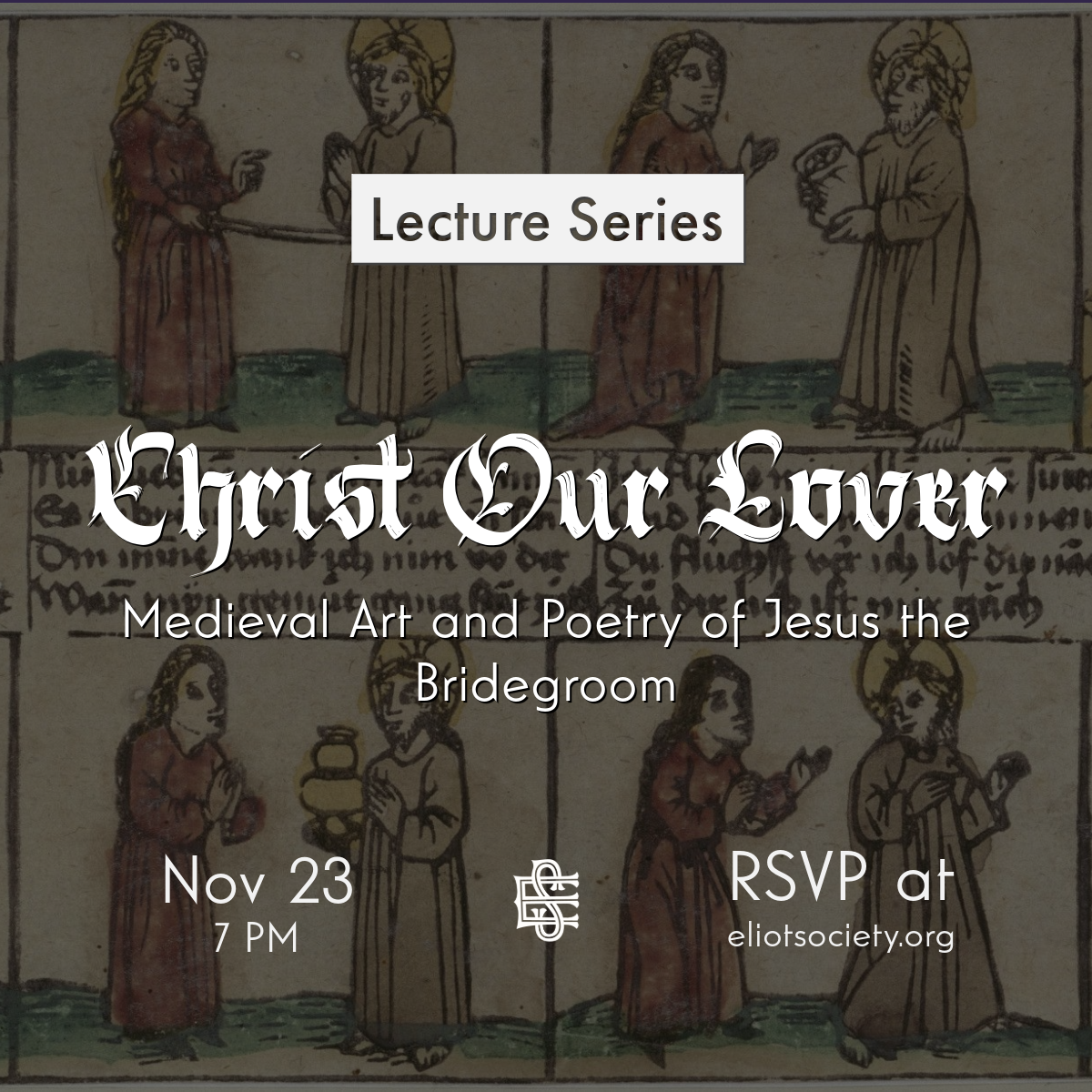
>> “Christ Our Lover: Medieval Art and Poetry of Jesus the Bridegroom” by Dr. Grace Hamman, November 23, 2024, St. Paul’s Anglican Church, Crownsville, MD: “If there was a ‘bestseller’ book of the Bible in the European Middle Ages, it would be the Song of Songs. When read allegorically, in the manner of medieval theologians like St. Bernard of Clairvaux, the book tells the story of the romance between Christ and the soul that culminates in Christ’s love shown on the cross. This is a story of mutual pursuit, the pain of desire and sacrifice, sensual delight, and true union. The idea of Jesus as a longing lover of each individual soul appeared everywhere by the later medieval period, in art, poetry, sermons, and the devotional writings of men and women alike.
“These themes and images can strike us as strange, even uncomfortable. An illustrated poem for nuns depicted the Song of Songs like a cartoon strip. Prayer books of wealthy nobles portrayed Christ’s wounds intimately. Poets wrote Christ in the role of a chivalric, wounded knight weeping and waiting for his lady. And yet, examining this ancient imagery of Jesus our Lover together can challenge us to greater vulnerability with our Savior, to refreshed understandings of God’s hospitality, and, in the words of Pope Gregory the Great, can set our hearts ‘on fire with a holy love.’”
Grace is a fabulous teacher of medieval poetry and devotional writing, one whom I’ve mentioned many times on the blog before. Her Jesus through Medieval Eyes was my favorite book of 2023; read my review here. She has encouraged me to move in toward the strange and imaginative in medieval theology and biblical interpretation, because there’s often beauty and wisdom to be found there if we give it a chance. She has a keen awareness of the body of Christ across time and an appreciation for the gifts they’ve bequeathed the church of today, be they words, art, or whatever else.
+++
VIDEO: “Poet and Pastor: Christian Wiman and Eugene Peterson”: In this four-minute video from Laity Lodge, poet and essayist Christian Wiman and pastor and spiritual writer Eugene Peterson (best known for his Bible translation The Message) talk about prayer and spirituality. They each share a poem they’ve written: Wiman’s “Every Riven Thing” and Peterson’s “Prayer Time.” “People who pray need to learn poetry,” Peterson says. “It’s a way of noticing, attending.”
ARTICLE + PLAYLIST: “Latin American Fiesta!” by Mark Meynell: I always appreciate the selections and knowledge Mark Meynell [previously] brings to his 5&1 blog series for the Rabbit Room, each post exploring five short pieces and one long piece of classical music. This Latin American installment features Kyries from Peru and Argentina, a candombe air, a four-part Christmas anthem in Spanish creole from Mexico (I found an English translation!), an Argentine tango, and a dance chôro (Portuguese for “weeping” or “cry”) from Brazil. What diverse riches!
“Classical music, as conventionally understood, is not often associated with Latin America,” Meynell writes, “though, as we will see, this is a situation that needs rectifying. Some extraordinary soundworlds were being created long before the Conquistadores arrived from European shores, and together with the cultural impact of the transatlantic slave trade from Africa, the musical mix that resulted is unique. To put it at its most simplistic, we could say that the two key musical influences were the Catholic Church and the complex rhythms of percussion and dance; and often, it’s hard to tell where one ends and the other begins.”
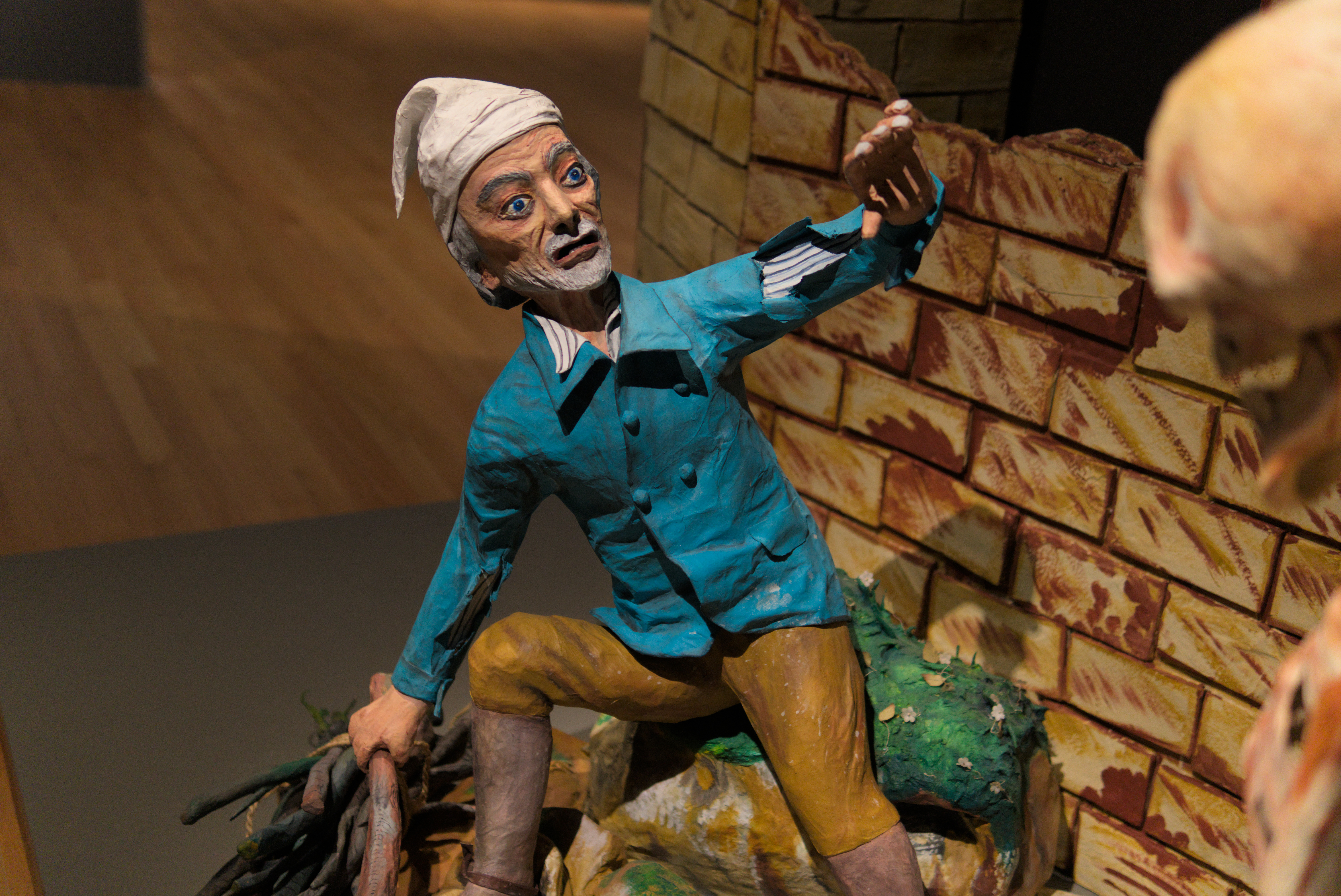
ARTWORK: The Old Man and Death by Pedro Linares: Last month I visited the Wadsworth Atheneum Museum of Art in Hartford, Connecticut, for the first time and was delighted to stumble upon an exhibition that had just been put up, Entre Mundos: Art of Abiayala. On view through December 15, it highlights collection works made by artists with personal or ancestral ties to Mexico, the Caribbean, and Central and South America. The title translates to “Between Worlds,” and “Abiayala,” I learned, is a Guna (Kuna) word that means “land in its full maturity” or “land of vital blood”; it’s used by the Guna and some other Indigenous peoples to refer to the Americas.
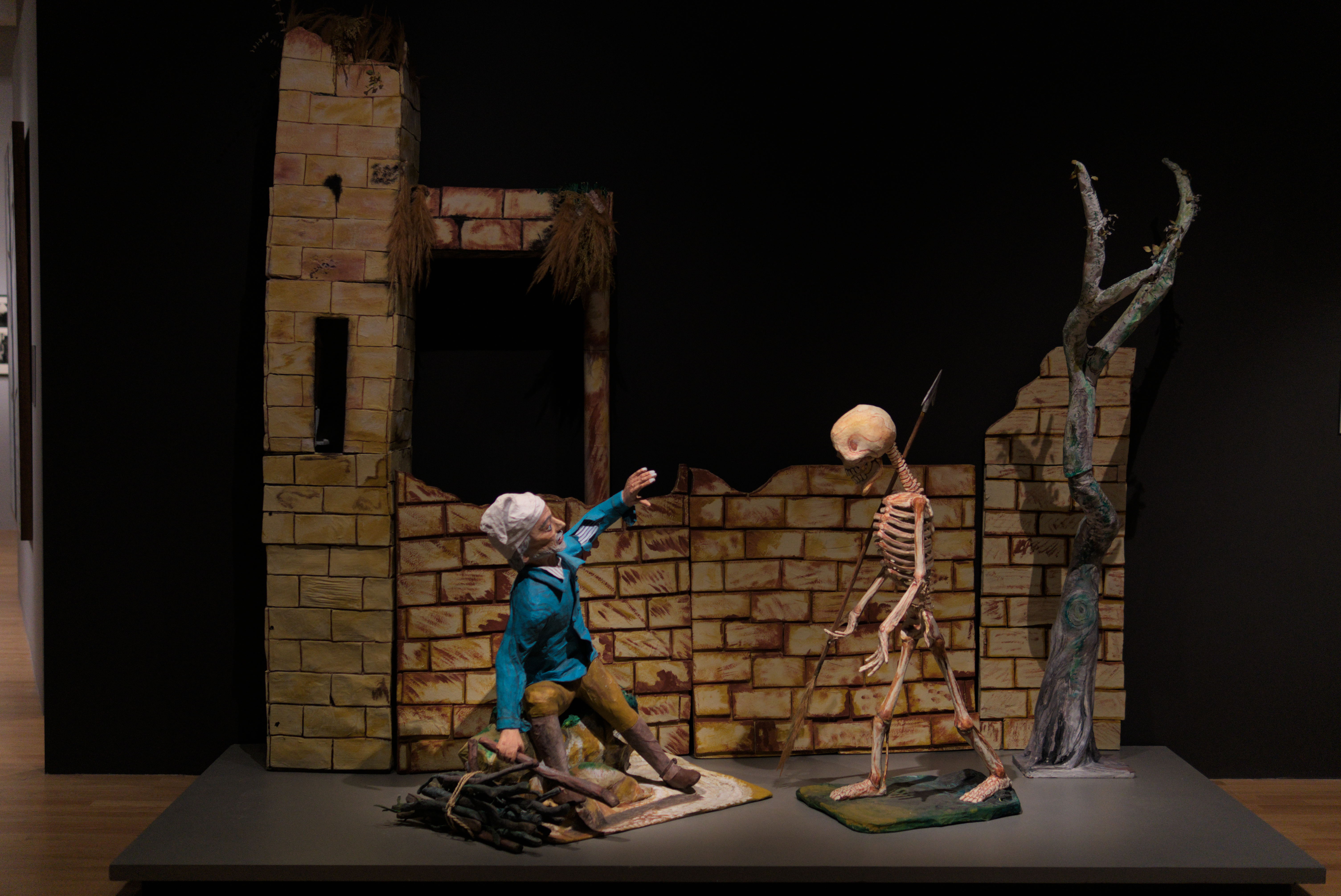
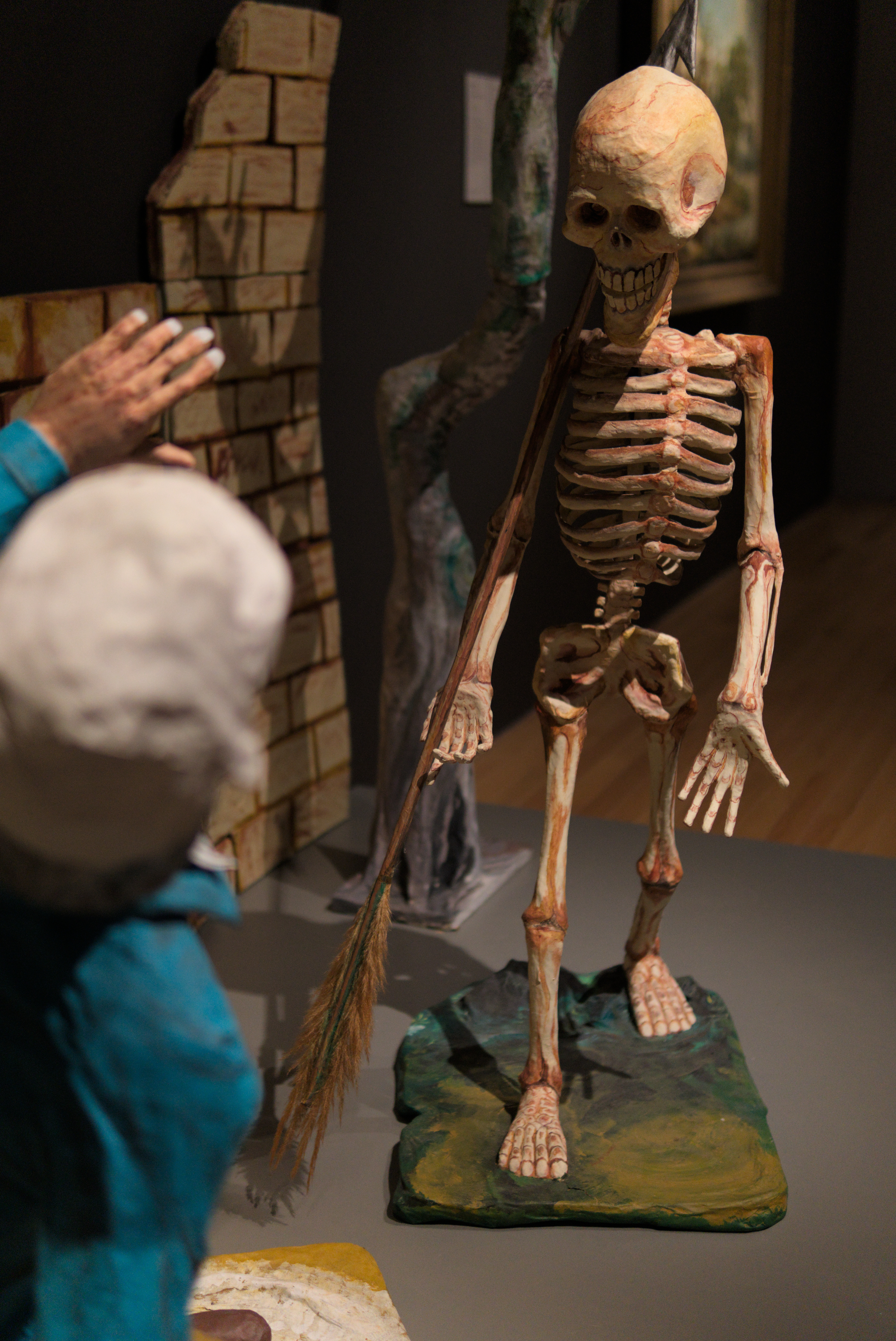
Pedro Linares (Mexican, 1906–1992), El viejo y la muerte (The Old Man and Death), 1986. Papier-mâché and mixed media. Wadsworth Atheneum Museum of Art, Hartford, Connecticut. Photo: Victoria Emily Jones.
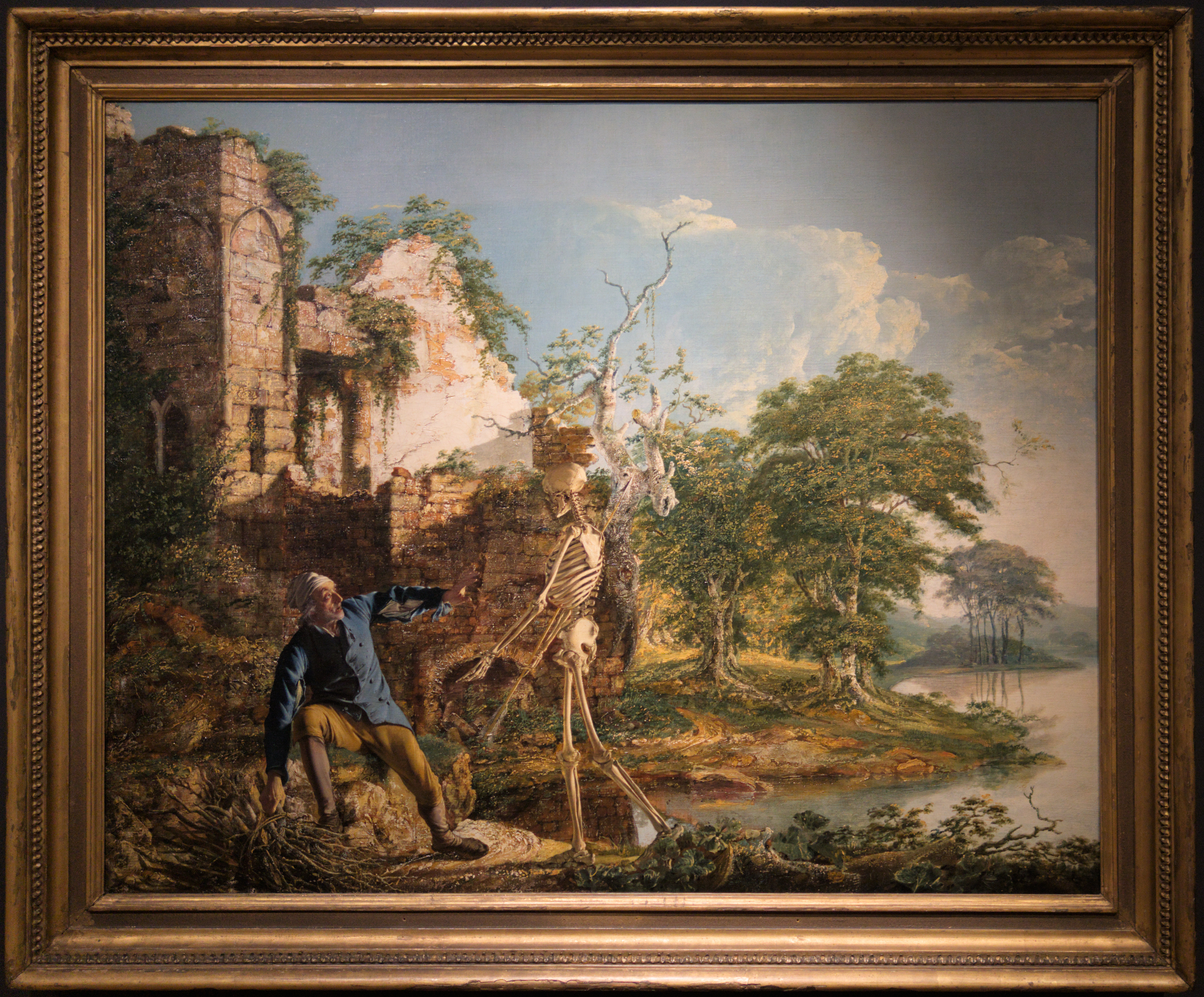
For me the standout piece from the exhibition is The Old Man and Death by Pedro Linares, a dramatic tableau in the medium of cartonería (papier-mâché sculpture), a traditional handcraft of Mexico. Commissioned by the Wadsworth in 1986 for the artist’s MATRIX exhibition, it reinterprets Joseph Wright of Derby’s 1773 painting of the same name, one of the most popular works in the museum’s collection.
Joseph Wright of Derby (English, 1734–1797), The Old Man and Death, 1773. Oil on canvas, 40 × 50 1/16 in. (101 × 127 cm). Wadsworth Atheneum Museum of Art, Hartford, Connecticut. Photo: Victoria Emily Jones.
masterfully combines Wright’s ability to depict a literary narrative with his skill in rendering a natural setting with accuracy and keenly observed detail. The subject of this painting is based on one of Aesop’s Fables or possibly a later retelling by Jean de la Fontaine. . . . According to the tale, an old man, weary of the cares of life, lays down his bundle of sticks and seats himself in exhaustion on a bank and calls on Death to release him from his toil. Appearing in response to this invocation, Death arrives. Personified here as a skeleton, Death carries an arrow, the instrument of death. Illustrating the moral of the tale that it is “better to suffer than to die,” the startled old man recoils in horror and instinctively waves him off, reaching for the bundle as he clings to life.
The Linares piece and its inspiration are placed side-by-side in the gallery, which also displays an alebrije by the same artist, papel picado, painted skulls, an ofrenda, and Diego Rivera’s Young Girl with a Mask.
HYMN FOR THE FEAST OF THE VISITATION: “Somewhere I hear the church bells ringing” by Gracia Grindal: There are many church songs on the Magnificat, the canticle Mary sings in Luke 1:46–55 when she greets her cousin Elizabeth at Elizabeth’s home in the hills of Judea, but very few hymns, at least in Protestantism, that narrate the Visitation event that occasions it, including Elizabeth’s glad affirmations. Gracia Grindal’s “Somewhere I hear the church bells ringing” is one example of the latter—a four-stanza hymn she wrote in 2010 for the Feast of the Visitation, celebrated every year on May 31, with Elizabeth as the poetic speaker. The hymn captures the excitement of the Messiah coming into the world, and references an Alfred Lord Tennyson poem along the way.
On her blog Hymn for the Day, Grindal provides the lyrics and a reflection on this hymn, as well as sheet music that uses a melody Daniel Charles Damon wrote specifically for the text, which is also available in Damon’s collection Garden of Joy (Hope Publishing, 2011). For public-domain tune alternatives, Grindal suggests DISTRESS or KEDRON from William Walker’s Southern Harmony (1835), or the Renaissance tune by Thomas Tallis known as TALLIS’ CANON—all three of which are commonly used with Fred Pratt Green’s twentieth-century hymn “O Christ, the Healer, We Have Come.”
A professor emerita at Luther Seminary in St. Paul, Minnesota, Gracia Grindal is a prolific writer and translator with expertise in Scandinavian hymns. She has served on several hymn committees and boards and is the author of A Treasury of Faith, a three-volume series of over seven hundred hymn texts on the lessons of the Revised Common Lectionary (Wayne Leupold Editions, 2006–9); Preaching from Home: The Stories of Seven Lutheran Women Hymn Writers (Eerdmans, 2011); an English translation of Hallgrímur Pétursson’s Icelandic Passíusálmar (Hymns of the Passion) (Hallgrím Church, 2020); and Jesus the Harmony: Gospel Sonnets for 366 Days (Fortress, 2021), among many other books.
+++
SUBSTACK POSTS:
>> “The Slow Way: On Being ‘at Peace and in Place’” by Micha Boyett, The Slow Way: When her third child was born with Down syndrome, Micha Boyett, an emerging writer, knew she needed to release herself from the anxiety of producing and focus on parenting; she decided to slow down in order to be faithful to her son. Drawing on themes in her new book, Blessed Are the Rest of Us: How Limits and Longing Make Us Whole, Boyett reflects in this post on the slow, remarkable, intricate work God does when we “allow all that we are to nourish the place we find ourselves”; when we let go of plans and rest in the goodness of what God has for us at this moment. “Rest is something that nourishes our long-term lives. And rarely, if ever, does rest improve our influence, our finances, or our platforms,” she writes. “Rest is an invisible gift to ourselves that results in invisible growth, invisible peace, invisible relational wholeness.”
>> “Word Games with George Herbert” by Grace Hamman, Medievalish: This Herbert poem was new to me, and what a delight it is! It consists of five tercets, each with an end word that gradually diminishes through loss of a letter with each subsequent line—e.g., CHARM, HARM, ARM. Playing this word game, Herbert develops the conceit of himself as a tree in God’s enclosed garden-orchard.
“The Nuingetonn Peeche” from the Tradescants’ Orchard, 1620–29. Oxford, Bodleian Library MS. Ashmole 1461, fol. 105r.
I always enjoy the literary works, which are mostly medieval or early modern, that Dr. Grace Hamman explores through her newsletter and podcast—and the “Prayer from the Past” she curates for each newsletter sign-off, like the one in this edition, by Richard Brathwait (1588–1673).
+++
SONG: “Te Atua” (Dear Lord): I heard this popular New Zealand hīmene (hymn) in the Taika Waititi–directed movieBoy (2010) (such a great movie!). It’s a traditional Māori Christian text, set to the Appalachian folk tune NEW BRITAIN (best known for its pairing with “Amazing Grace”) and performed in 1997 by the St. Joseph’s Māori Girls’ College Choir, featuring soloist Maisey Rika. The arrangement is by the college’s principal, Georgina Kingi. Bearing echoes of Jesus’s parable of the sower, this song is particularly appropriate for the season of Ordinary Time that we’re now in, during which the seeds that were planted in us in the first half of the Christian year germinate, grow, and bear fruit.
E te Atua kua ruia nei
Ö purapura pai
Hömai e koe he ngákau hou
Kia tupu ake ai

E lhu kaua e tukua
Kia whakangaromia
Me whakatupu ake ia
Kia kitea ai ngá hua

A má te Wairua Tapu rá
Mátou e tiaki
Kei hoki ki te mahi hé
Ö mátou ngákau höu
Dear Lord, you have spread Your seeds of goodness Give us new hearts So that these seeds may grow
Dear Lord, do not allow These seeds to be lost But rather let them grow So that the results may be seen
May the Holy Spirit Guide us Lest our hearts should Return to our evil ways
>> Message Songs by the Porter’s Gate: For this album, the Porter’s Gate Worship Project partnered with the Eugene Peterson Center for Christian Imagination at Western Theological Seminary to set to music excerpts from Peterson’s best-selling translation of the Bible, The Message. Included are adaptations of Psalms 5, 16, 27, and 121, Matthew 11:28–30, Luke 15, and John 1—by a range of songwriters. The album release this month coincided with the publication of The Message Anniversary Edition, available from NavPress.
>> Volume 10 (Ordinary Time) of The Soil and The Seed Project: This double album—which is completely free!—features twenty-four songs by musicians of faith under the direction of Seth Thomas Crissman, a Mennonite pastor, educator, songwriter, and multi-instrumentalist from Harrisonburg, Virginia. Here’s one of the songs, “The Way Your Kingdom Comes” by Lindsey FitzGerald Stine, sung by her and her sister Rachel FitzGerald:
The music is one element of a larger project that also includes liturgies and newly commissioned artworks. Learn about the project’s free summer concert series on their Events page, which will feature contributors to the most recent album and other friends.
NEW ALBUM: Lent Hymns by Paul Zach: Released this month, Lent Hymns by Paul Zach comprises twelve songs, a mix of originals and classics, with contributions by IAMSON, Jessica Fox, Sara Groves, Jon Guerra, and Kate Bluett. The LP is available wherever music is streamed or sold. Here’s an Instagram video that excerpts “Draw Me In”:
KICKSTARTER: New Porter’s Gate album: This summer The Porter’s Gate, an interdenominational Christian music collective, is gathering songwriters to write and record musical settings of passages from The Message, a translation of the Bible by the late Eugene Peterson [previously] that uses contemporary idioms and phrases. The project is in partnership with the Eugene Peterson Center for Christian Imagination at Western Theological Seminary in Holland, Michigan. I’m so looking forward to this!
+++
SONGS:
>> “Вечірня молитва” (Vechirnya molytva) (Evening Prayer): A choral setting of a text from the Divine Service of the Eastern Orthodox Church, by contemporary Ukrainian composer Iryna Aleksiychuk. Performed in 2012 by the Female Choir of Kiev Glier Institute of Music, conducted by G. Gorbatenko. [HT: Global Christian Worship]
English translation:
Heavenly King, Comforter, Spirit of Truth, Who art everywhere present and fillest all things, Treasury of good things, and Giver of life: Come and abide in us, and cleanse us from every sin, And save our souls, O Good One! Holy God, holy Mighty, holy Immortal, Have mercy on us.
>> “Bare and Bones” by Candace Coker: Trinidad-born, Vancouver-based singer-songwriter Candace Coker sings the title track from her new album, Bare and Bones, with her boyfriend, Josiah Charleau. The video is shot at Bamboo Cathedral, a thousand-foot stretch of roadway in Tucker Valley in Chaguaramas, Trinidad and Tobago, where bamboo stalks bend toward each other across the road, creating a canopy.
>> “HigherHoly” by IAMSON:IAMSON is the artist name of singer-songwriter and music producer Orlando Palmer, based in Richmond, Virginia. He released this song as a single in 2020. The rap is performed by guest artist Marv (Marvin Hudgins II) of Chattanooga, Tennessee, and the animation in the video is by Kenya Foster.
>> “I Could Sing of Your Love Forever” (cover) by Mary Yang and Ger Vang: Mary Yang and Ger Vang are Hmong Christian musicians living in Milwaukee, Wisconsin. (The Hmong are an Indigenous people group from East and Southeast Asia.) Here they perform their bossa nova arrangement of this modern worship classic by Martin Smith of the English band Delirious?. Yang and Vang are part of the Fishermen’s Project, a band that releases mainly classic hymns translated into the Hmong language. [HT: Global Christian Worship]
American pastor, professor, author, and poet Eugene H. Peterson passed away on October 22 at age eighty-five. He’s best known for his idiomatic translation of the Bible, The Message, which has sold twenty million copies worldwide since its publication in 2002. He developed this translation over his nearly three decades as a Presbyterian pastor in Bel Air, Maryland, as a way to reinvigorate his congregation’s engagement with scripture. Its most quoted verse is John 1:14, describing the incarnation: “The Word became flesh and blood, and moved into the neighborhood.”
The church culture I grew up in regarded The Message with disdain, as they thought it plays fast and loose with the words of scripture and lacks reverence. Nurtured on a KJV-only diet, I felt rebellious purchasing an NIV Study Bible in middle school, and although I no longer subscribed to the fundamentalism of my youth by the time I had finished college, adding a used copy of The Message to my checkout basket at the Montague Bookmill a few years later still set the “Unsanctioned!” bells ringing in my head. But I was finally ready to engage this translation (or as some would say, paraphrase) of which I had heard so much but read so little.
What I found was that Peterson’s scripture translation, while no doubt sounding very different than the translations arrived at by committee, is full of reverence—and joy, and play, and wonder. It takes the familiar words of the Bible and re-presents them in a new way so as to really bring out their tone and meaning. Take, for example, Psalm 96:4–7. The King James Version reads,
For great is the Lord, and greatly to be praised;
he is to be feared above all gods.
For all the gods of the peoples are worthless idols,
but the Lord made the heavens.
Splendor and majesty are before him;
strength and beauty are in his sanctuary.
Ascribe to the Lord, O families of the peoples,
ascribe to the Lord glory and strength!
The Message has
For God is great, and worth a thousand Hallelujahs.
His terrible beauty makes the gods look cheap;
Pagan gods are mere tatters and rags.
God made the heavens—
Royal splendor radiates from him,
A powerful beauty sets him apart.
Bravo, God, Bravo!
Everyone join in the great shout: Encore!
In awe before the beauty, in awe before the might.
Now, I love the poetry of the King James Version. But I also love Peterson’s renderings. They enliven the texts. That’s not to say God’s word isn’t already living and active, but that sometimes it can grow stale in the ears of those who have been reading it for a lifetime. The jubilance of Psalm 96 in The Message is amplified by the use of contemporary expressions—Bravo! Encore!—to denote enjoyment and praise. As I read this, I am enticed to “join in the great shout.”
While I wouldn’t advise using The Message as your sole or even primary Bible (Peterson himself says as much in the preface), I do uplift it as a wise, fun, and spiritually nourishing supplement. You’ll see that I occasionally feature Peterson’s verse translations in Artful Devotions because they communicate God’s truth with such color and force (see, e.g., Ps. 19, Ps. 51, Rom. 8:6, 2 Cor. 4: 1–6, Eph. 2:1–10). His motivation all along was to expose a new generation to the beauty of the gospel. “Getting the words of the Bible into [people’s] heads and hearts, getting the message lived,” is what he characterized as the primary work of his life (preface, The Message).
When I think of Eugene Peterson, I think imagination. He exemplified that Christian duty not only in his Bible translation but also in his various other professional ministries: as pastor, professor, and author. In each role, he sought to awaken Christians to the goodness of imagination. Listen to him speak on the topic with On Being’s Krista Tippett, in a podcast episode recorded in 2016.
My pursuit of the arts has been indirectly influenced by Peterson, because he was a critical influence on and mentor to W. David O. Taylor, whom I have followed for some time and greatly look up to. An assistant professor of theology and culture at Fuller Theological Seminary, Taylor wrote a beautiful personal tribute to Peterson the other week. “It’s one thing to be given permission to do a thing,” Taylor writes. “It’s quite another to be encouraged, and supported, and patronized, and inspired, and resourced to do a thing. Eugene’s one of those key people in my life who encouraged me to pursue the arts.”
Peterson was Taylor’s professor of spiritual theology at Regent College in Vancouver. “He used the poetry of Gerard Manley Hopkins and the literature of George Eliot, Karl Barth’s theology and Frederick Buechner’s novels, Greek mythology and stories from his Pentecostal childhood as a way to help his students understand who God was and what God was on about it in this expansive vision of Holy Scripture,” Taylor says. “All of it felt immensely exhilarating to me; it still does.” I’ve come to Peterson’s other writings mainly through Taylor, who cites them with deep respect.
Peterson was an especial lover of poetry. He discussed the topic on film with former Poetry editor Christian Wiman and with U2 star Bono (in an interview by Taylor on the Psalms, above), and he has written about it in numerous books of spiritual theology. He’s even written a volume of original poetry called Holy Luck, from which I featured the poem “Aaron’s Beard” last year, and has contributed to some of Luci Shaw’s poetry anthologies, like A Widening Light: Poems of the Incarnation (see “Tempted”). Here is some of what Peterson had to say about poetry:
“Poets are caretakers of language, shepherds of words, protecting them from desecration, exploitation, misuse. Words not only mean something, they are something, each with a sound and rhythm all its own. Poets are not primarily trying to tell us or get us to do something. . . . I do not have more information after reading a poem; I have more experience.” (Holy Luck, xiv)
“People who pray need to learn poetry, even if they’re not adept at it.” (source)
“Poets tell us what our eyes, blurred with too much gawking, and our ears, dulled with too much chatter, miss around and within us. Poets use words to drag us into the depth of reality itself. Poetry grabs us by the jugular. Far from being cosmetic language, it is intestinal.” (Answering God, 11)
“We cannot speed-read a poem. A poem requires rereading. Unlike prose which fills the page with print, poems leave a lot of white space. . . . There is a lot to see, to feel, to sense. We sit before the poem like we sit before a flower and attend to form, relationship, color. We let it begin to work on us. When we are reading prose we are often in control, but in a poem we feel like we are out of control. . . . In prose we are after something, getting information, acquiring knowledge. . . . But in poetry we take a different stance. We are prepared to be puzzled, to go back, to wait, to ponder, to listen. This attending, this waiting, this reverential posture, is at the core of the life of faith, the life of prayer, the life of worship, the life of witness. . . . Read it again, read it again, read it again.” (Subversive Spirituality, 180)
“It takes a while to get the poets. . . . It takes a while to get the gospel. . . . We have to quit getting in a hurry. . . . I think the besetting sin of Americans is impatience.” (source)
Though I never met Eugene Peterson, I am so grateful for his witness, and for the many ways he has blessed the church over the years. His words have tutored, and continue to tutor, my imagination and, yes, deepen my love for Jesus and his gospel.
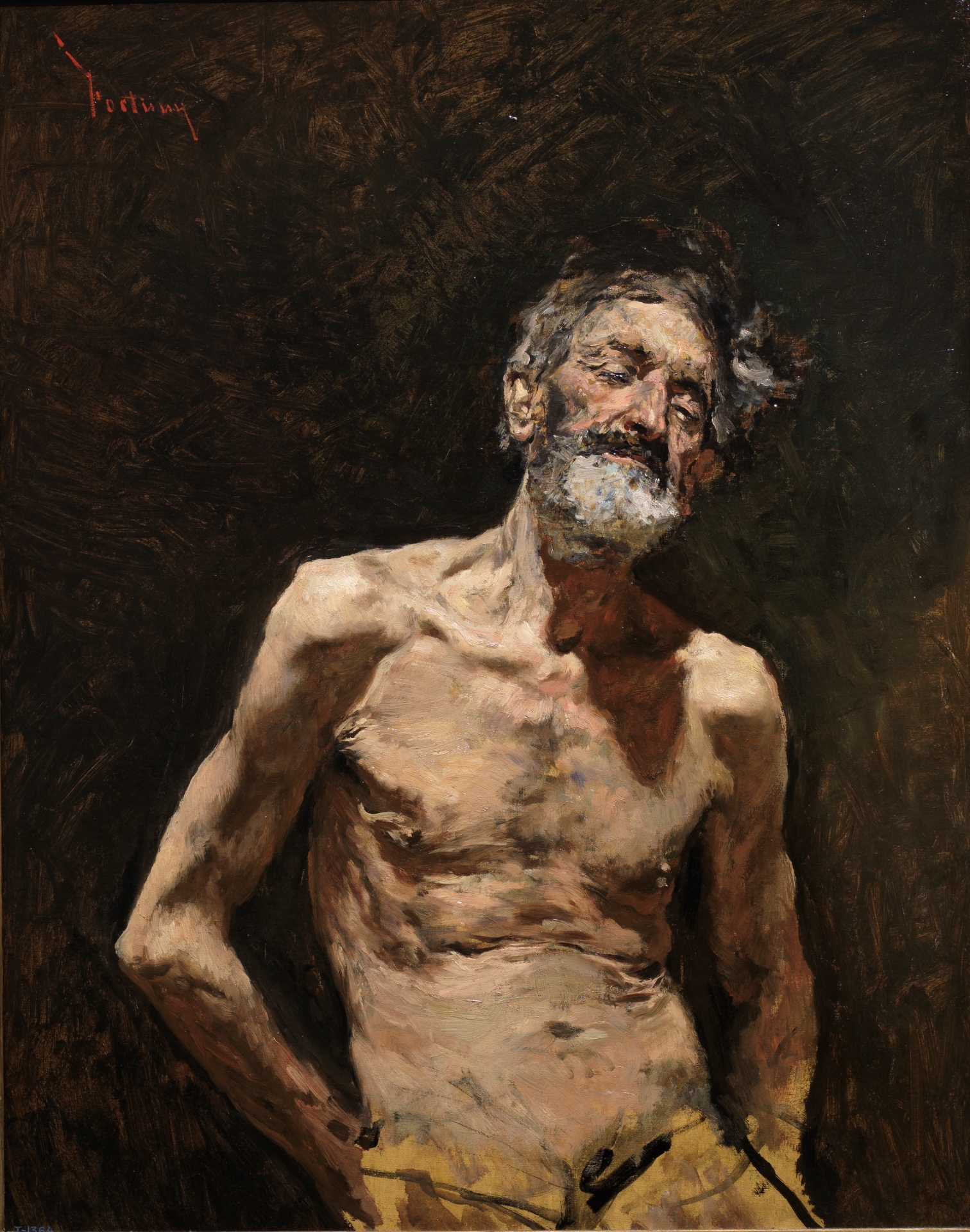
A song of ascents comprising just three verses, Psalm 133 is assigned as this upcoming Sunday’s lectionary reading from the book of Psalms. It contains two colorful similes that liken brotherly unity to (1) oil running down the beard and (2) a heavy dewfall. The first one offers an especially sensuous picture of consecration, of divine blessedness, referencing the anointing ritual for priests practiced in ancient Israel (see Exodus 30:22–33). Attracted to the poetic quality of this image, Eugene H. Peterson wrote his own nine lines around it, imagining God’s blessings, like oil, dissolving the rust that had accumulated over his belief.
Mariano Fortuny y Marsal (Spanish, 1838–1874), Nude Old Man in the Sun, ca. 1871. Oil on canvas, 76 × 60 cm. Museo del Prado, Madrid.
“Aaron’s Beard” by Eugene H. Peterson
. . . running down the beard,
Upon the beard of Aaron . . .
—Psalm 133:2
Aaronic blessings
Run down my red beard
Refracting sun warmth
In oil ooze
loosening
Ironic curses
Flecks of stubborn rust
Corrosive unbelief
Cynic stuff.
“Aaron’s Beard” is published in Holy Luck by Eugene H. Peterson (Eerdmans, 2013) and is used here by permission of the publisher. Reproduction of the poem without express permission from Wm. B. Eerdmans Publishing Company is a violation of copyright.
Gulap K. Hajarathbai (Indian), Temptation, 20th century. Oil on canvas, 18 × 20 in. Source: Herbert E. Hoefer, Christian Art in India (Chennai, India: Gurukul Lutheran Theological College and Research Institute, 1982)
“Tempted”by Eugene H. Peterson
Mark 1:12–13
Still wet behind the ears, he’s Spirit-pushed
up Jordan’s banks into the wilderness.
Angels hover praying ’round his head.
Animals couch against his knees and ankles
intuiting a better master. The Man
in the middle—new Adam in old Eden—
is up against it, matched with the ancient
Adversary. For forty days and nights
he tests the baptismal blessing and proves to his dismay
the Man is made of sterner stuff than Adam:
the Man will choose to be the Son God made him.
Mark dedicates a spare two verses to this initiatory event in the life of Christ: the forty days of temptation he endured immediately following his baptism: “The Spirit immediately drove him out into the wilderness. And he was in the wilderness forty days, being tempted by Satan. And he was with the wild animals, and the angels were ministering to him” (Mark 1:12–13, ESV; cf. Matthew 4:1–11, Luke 4:1–13).
I’m intrigued by Mark’s use of the word driven (ekballō) to describe the manner in which the Spirit imparts motion to Christ. Whereas Matthew and Luke use the gentler led (anagō), Mark implies something more forceful: ejected, cast forth, hurled. In his idiomatic translation of the Bible, The Message, Eugene H. Peterson uses push: “At once, this same Spirit pushed Jesus out into the wild” (emphasis mine).
So the same Spirit who had just alighted on Jesus in the waters of the Jordan, presiding over God’s pronouncement that “You are my beloved Son; with you I am well pleased” (Mark 1:11), now pushes Jesus into the Judean desert, away from civilization. Why? So that in the quiet, he could get to better know himself and the Father, to better discern the task to which he had been called. This process necessarily involved doing battle with the prospects of other paths, other identities.
“Turn these stones into bread.” “Jump; let’s see if God saves you.” “Worship me; I’ll give you the kingdom of earth.”
Satan tries to draw Jesus from a messiahship of self-sacrifice to a messiahship of power. Performing miracles for his own benefit, to avoid any discomfort or pain in life; performing miracles for show, like a magician, to impress the masses; becoming an earthly king, with political control and dominion—these are all temptations Jesus would face again. Here he has the opportunity to confront them head-on in preparation for his imminent ministry to the Israelites. Over this period of forty days, Jesus solidifies his mission, rejecting the vision of himself and his life that Satan lays out for him. Instead of gratification, pride, and riches, Jesus chooses purity, humility, and poverty. Continue reading “Voices in the desert—whose blessing will we heed?”→
Entire Bifrost Arts catalog available for free download: For a limited time, the Christian music collective Bifrost Arts is offering all forty-eight of their songs for free download from NoiseTrade. Donations are welcome—100 percent of them will go to the Salt and Light Artist fund, which funds residencies for Christian artists in Arab countries, providing a platform for interaction with the local arts community.
Interview with Bono and Eugene Peterson on the Psalms: This short film, released in April, documents the friendship between Bono (of the band U2) and Eugene Peterson (author of contemporary-language Bible translation The Message) revolving around their common interest in the Psalms. Inspired by their conversation, interviewer David Taylor compiled a list of resources for exploring the Psalms.
Transforming a Protestant worship space into a Catholic one: The largest glass building in the world, the Crystal Cathedral in Orange County, California, has been undergoing renovations since having been sold in 2013 by the Reformed Church in America to the Roman Catholic Diocese of Orange. “Our charge is to convert an open, all-glass Evangelical church into a great Catholic cathedral to serve its centuries-old sacraments and ritual processions, and to reinforce the centrality of the Eucharist,” write architects Scott Johnson and Frank Clementi. This article published in Faith and Form describes some of the symbolic, aesthetic, environmental, and technical challenges of this project and includes renderings of the new space, which is scheduled to reopen next year.
Top 25 films on mercy: I’ve been enjoying these top 25 film lists put together by the Arts & Faith online community—especially how they reach beyond the obvious choices, dipping into the silent era as well as non-American cinema. Here’s their latest, a list of films that “show us visions of a world so often lacking in mercy, as well as worlds in which one merciful act alters the landscape of human experience forever.” Click here to view their other lists: road films, horror films, divine comedies, films on marriage, and films on memory.





 Art & Theology