Advent, Day 17: Come, My Beloved

What is that coming up from the wilderness like columns of smoke, perfumed with myrrh and frankincense, with all the fragrant powders of a merchant?

—Song of Solomon 3:6 (KJV)

Arise, shine; for thy light is come, and the glory of the LORD is risen upon thee.

—Isaiah 60:1 (KJV)

Awake, awake; put on thy strength, O Zion; put on thy beautiful garments, O Jerusalem, the holy city. . . . Shake thyself from the dust; arise, and sit down, O Jerusalem: loose thyself from the bands of thy neck, O captive daughter of Zion. For thus saith the LORD, Ye have sold yourselves for nought; and ye shall be redeemed without money.

—Isaiah 52:1–3 (KJV)

LOOK: Eve by Kiki Smith
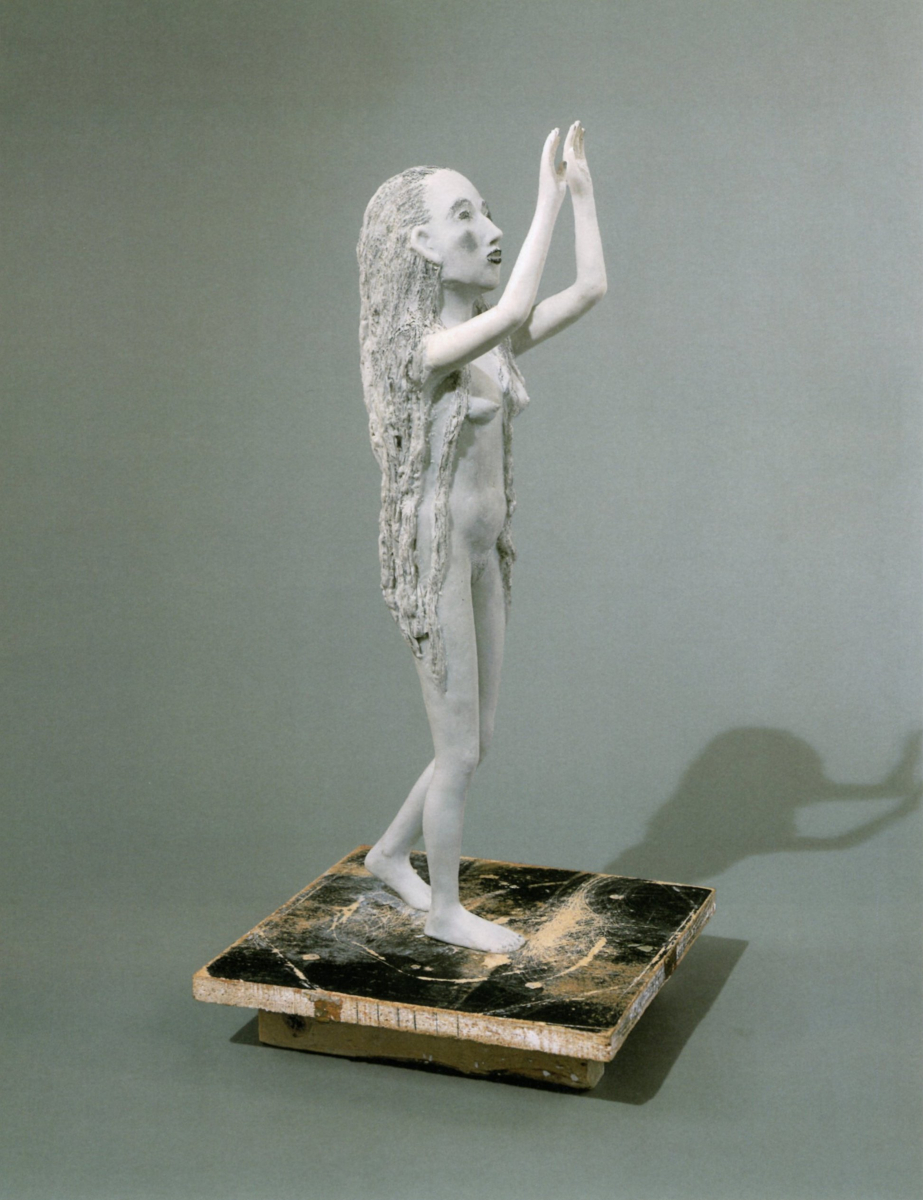
Smith, Kiki_Eve
Kiki Smith (American, 1954–), Eve, 2001. Manzini (resin and marble dust) and graphite, 20 3/8 × 5 × 6 3/4 in. (51.8 × 12.7 × 17.1 cm). Source: Kiki Smith: A Gathering, 1980–2005, p. 247

Eve, the mother of all living, a representative of humanity. The crown of God’s creation, and yet she distrusted God’s word, transgressed his command, breaking what was intended to be an eternal communion. In this small sculpture, she looks up, raising her hands in front of her face—in a gesture of prayer or praise? Shielding her eyes from brightness? Could it be she sees redemption on the horizon?

LISTEN: “Lecha Dodi” (Come, My Beloved), traditional Jewish hymn | Words by Shlomo ha-Levi Alkabetz, based on verses from the Hebrew Bible, 16th century | Music by Maayan Tzafrir, 2021 | Sung by Maayan Tzafrir, 2021

(Turn on CC on the video to read the Hebrew lyrics alongside the English.)

ENGLISH TRANSLATION (supplied by 12 Tribes Music):

Rouse yourselves! Rouse yourselves! [Isa. 51:17]
Your light is coming; rise up and shine. [Isa. 60:1]
Awake! Awake! Utter a song.
The glory of God is revealed upon you.

Who is this that cometh up out of the wilderness,
Perfumed with myrrh and frankincense,
With all the fragrant powders of a merchant? [Song of Sol. 3:6]

Shake off the ashes! Rise up from the dust!
Put on your garments of splendor, my people. [Isa. 52:1]
Through the son of Yishai [Jesse] of Bethlehem,
Redemption draws near to my soul.

Awake! Awake! Utter a song,
Let me see thy countenance.
Awake! Awake! Utter a song,
Let me hear thy voice.

When I was a student at UNC–Chapel Hill, I was curious to learn more about the Jewish roots of my Christian faith. I reached out to the Jewish campus organization Hillel, and they invited me to attend their Shabbat dinner, hosted every Friday at sundown at a large house on Cameron Ave.

Most markedly, I remember, before eating, the communal singing of the piyyut (Jewish liturgical poem) “Lecha Dodi” as everyone turned to face the door. I had no idea what the words meant—they were in Hebrew—or what the orientation of bodies was communicating. The song was part of the group’s regular liturgy, familiar to the Jewish students who were gathered, so no introduction or explanation was given, no lyric sheet that I recall. Afterward I asked the rabbi what just happened. “We welcomed in the Shabbat bride,” she said. “The Shekinah.” (The Shekinah is a dwelling or settling of the divine presence. The word is a feminine noun in Hebrew.)

I was puzzled by this statement. It sounded so mystical, challenging my very literalistic sensibilities at the time. The words of the song, by the rabbi and Kabbalist Shlomo ha-Levi Alkabetz (1500–1576), are mostly a composite of scripture texts from the Song of Songs, Isaiah, and elsewhere. Rabbi Shlomo personifies Shabbat (the Sabbath) as a bride, and Israel as her mate. The song anticipates the everlasting Shabbat, ultimate redemption, as the people of Israel ask God to bring about messianic deliverance.

(Related posts: https://artandtheology.org/2024/12/10/advent-day-10-bridegroom-of-the-soul/; https://artandtheology.org/2019/11/26/salvation-is-him-artful-devotion/)

I was taken back to this experience from almost twenty years ago when recently, I came across a version of the “Lecha Dodi” distributed by 12 Tribes Music [previously]. There are hundreds of different tunes for Rabbi Shlomo’s text, from medieval Moorish to northern European folk; but 12 Tribes features a newer setting by the Israeli musician Maayan Tzafrir.

The YouTube video description provides some biographical background:

Maayan Tzafrir is a singer and musician who weaves Balkan and Middle Eastern musical traditions with her Jewish roots. In her music she combines ancient piyutim (chants) with folk melodies. Maayan’s original compositions are inspired by Greek, Bulgarian, Georgian, and Turkish traditions. Maayan is the founder and vocal leader of the Yearot Ensemble, a singer in the Greek band Tavernikos, founder of The Hebrew Balkan Choir, and conductor of various workshops, meetings, and tours focusing on Balkan traditional singing with a Hebrew and feminine spirit.

The lyrics provided for Tzafrir’s version differ slightly from the traditional lyrics. It appears that she uses verses 5 and 4, with complementary material in between.

As a Christian, I can’t help but hear these words in light of Jesus. Several of the Hebrew scripture texts for Jewish Shabbat overlap with the Hebrew scripture texts for the Christian season of Advent, which is itself a dedicated time of looking forward to the arrival of the Messiah, beseeching his coming to dwell.

The phrase “son of Jesse” is a reference to the royal Davidic line from which the Messiah will come—and, in Christian belief, did come, in Jesus of Nazareth, son of Mary, who has since ascended into heaven but has promised to return to bring about the fullness of God’s kingdom.

Awake! Sing! Redemption draweth nigh!
Roundup of religious art exhibitions

Religion is heavily present in every medieval and Renaissance art museum collection, and curators are constantly organizing exhibitions that highlight this fact. To a smaller extent, religion is also present in contemporary art, and my appreciation goes out to those institutions that have picked up on this and have chosen to mount shows with religion up front and center. Here’s a list of just some such exhibitions currently running that have crossed my radar. (Follow the links to view more images.)

+++

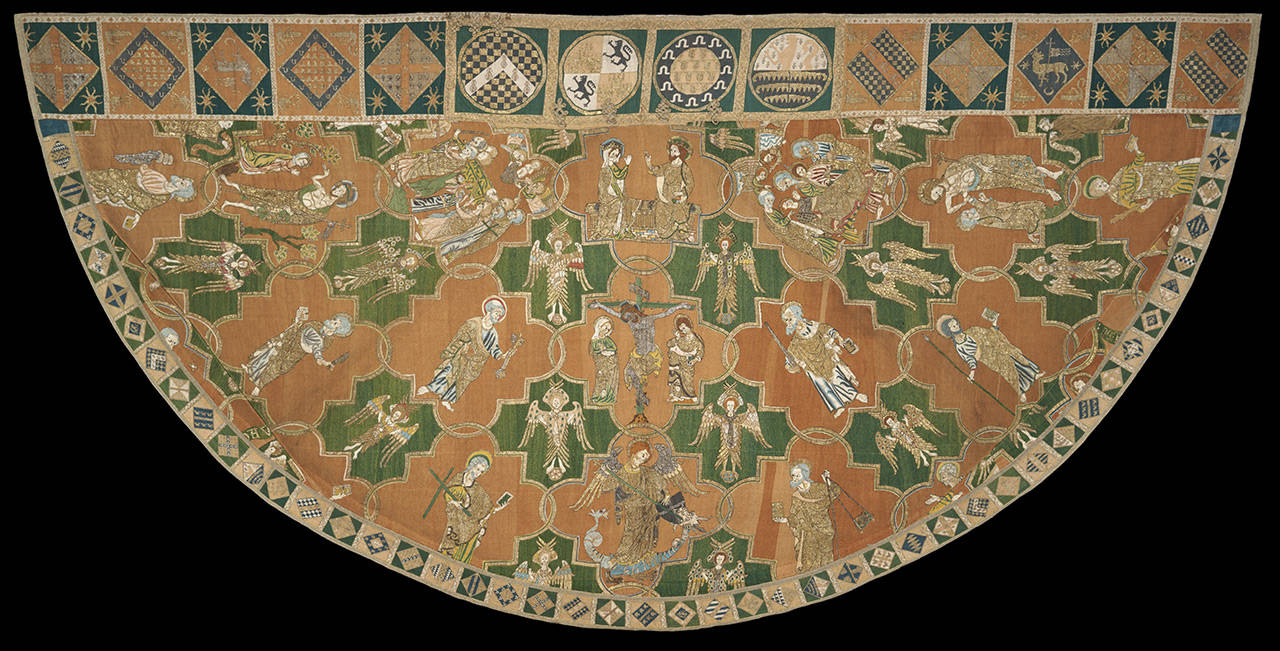
“Opus Anglicanum: Masterpieces of English Embroidery,” Victoria and Albert Museum, London, October 1, 2016–February 5, 2017: In medieval Europe, embroidered textiles were indispensable symbols of wealth and power. Owing to their quality, complexity, and magnificence, English embroideries (referred to as opus Anglicanum, “English work”) enjoyed international demand among kings, queens, popes, and cardinals, and here one hundred of them are brought together. Treasures include the Butler-Bowdon Cope, the Syon Cope, and the Tree of Jesse Cope—ceremonial cloaks made for use in church services and processions, featuring images from the lives of Christ, the Virgin, and the saints. (I love the interactive zoom function on these! To help you navigate the densely packed imagery, details of interest are tagged and can be clicked on to magnify and to reveal a textbox of information.) Hear contemporary embroiderer James Merry discuss some of the aspects of their technique and design that blow him away:

Syon Cope
The Syon Cope, 1310–20, England. Collection of the Victoria and Albert Museum, London.

+++

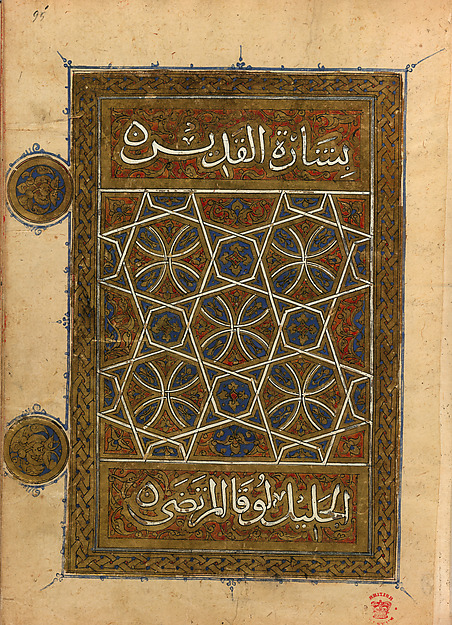
“Jerusalem 1000–1400: Every People Under Heaven,” Metropolitan Museum of Art, New York City, September 26, 2016–January 8, 2017: “This landmark exhibition demonstrates the key role that the Holy City played in shaping the art of the period from 1000 to 1400. In these centuries, Jerusalem was home to more cultures, religions, and languages than ever before. Through times of peace as well as war, Jerusalem remained a constant source of inspiration that resulted in art of great beauty and fascinating complexity. This exhibition is the first to unravel the various cultural traditions and aesthetic strands that enriched and enlivened the medieval city. It features some 200 works of art from 60 lenders worldwide.” I especially love the four Gospels in Arabic borrowed from the British Library, whose geometric illuminations bear an obvious Islamic influence.

Arabic Gospels
Folio from an Arabic Gospel-book, 1335, Jerusalem. Opaque watercolor, gold, and ink on paper, 10 5/8 × 7 7/8 in. (27 × 20 cm). Collection of the British Library (Add. MS 11856).

+++

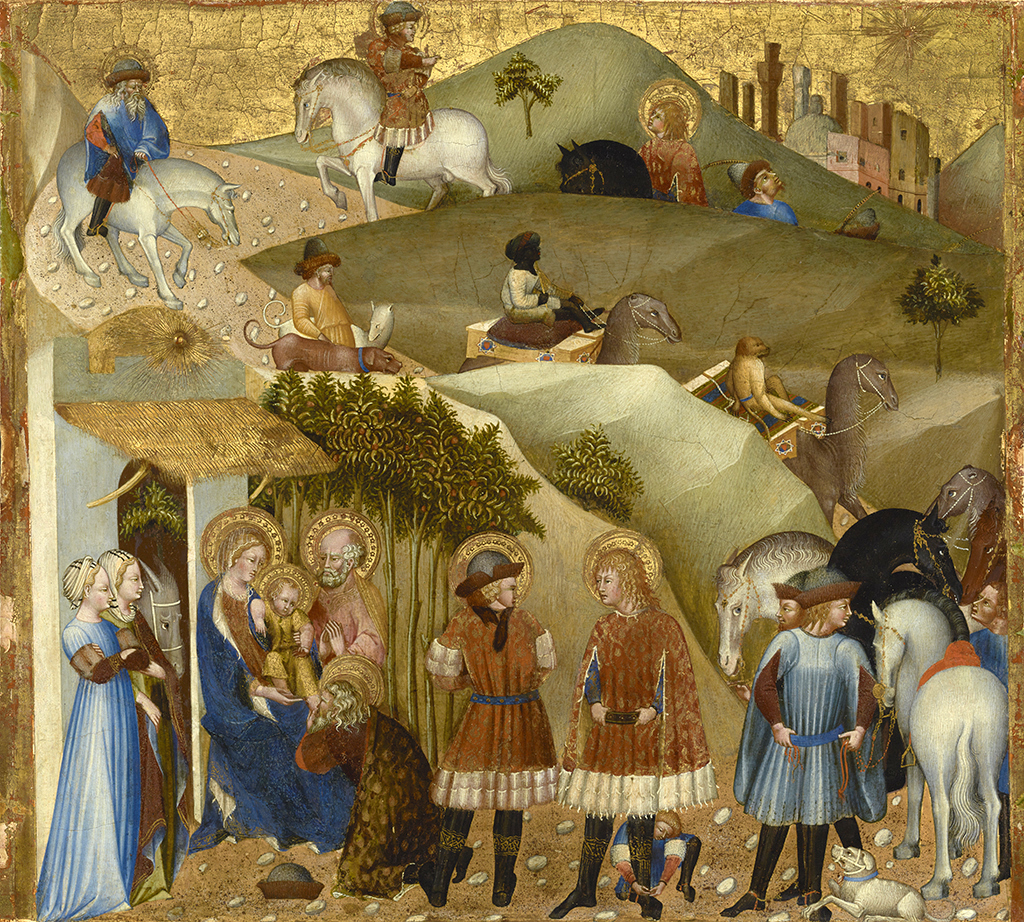
“The Shimmer of Gold: Giovanni di Paolo in Renaissance Siena,” Getty Center, Los Angeles, October 11, 2016–January 8, 2017: “Manuscript illuminator and panel painter Giovanni di Paolo was one of the most distinctive and imaginative artists working in Siena, Italy, during the Renaissance. This exhibition reunites several panels from one of his most important commissions—an altarpiece for the Branchini family chapel in the church of San Domenico in Siena—for the first time since its dispersal, and presents illuminated manuscripts and paintings by Giovanni and his close collaborators and contemporaries. Through recent technical findings, the exhibition reveals his creative use of gold and paint to achieve remarkable luminous effects in both media.”

Adoration of the Magi by Giovanni di Paolo
Giovanni di Paolo (Italian, ca. 1403–1482), The Adoration of the Magi, 1427. Tempera and gold leaf on panel. Kröller-Müller Museum, Otterlo, the Netherlands.

+++

“The Key” (organized by Caravan), Riverside Church, New York City, September 21–November 6, 2016: Founded by US Episcopal priest Paul-Gordon Chandler, Caravan develops initiatives that use art as a bridge for intercultural and interreligious dialogue. The organization’s 2016 exhibition is in the last leg of its Cairo-London-New York journey. It showcases the work of forty Middle Eastern and Western artists from different monotheistic faith backgrounds, each of whom was given a four-foot-tall fiberglass ankh to develop into a work of art. Known as the “Key of Life,” the ankh is an ancient hieroglyph originating in Egypt but spreading throughout Asia Minor; today it is used as a symbol of pluralism, tolerance, and harmony. I especially like the ones by Sergio Gomez, Arabella Dorman, Fatma Abdel Rahman, and Isaac Daniel.

The Key exhibition (Caravan)

+++

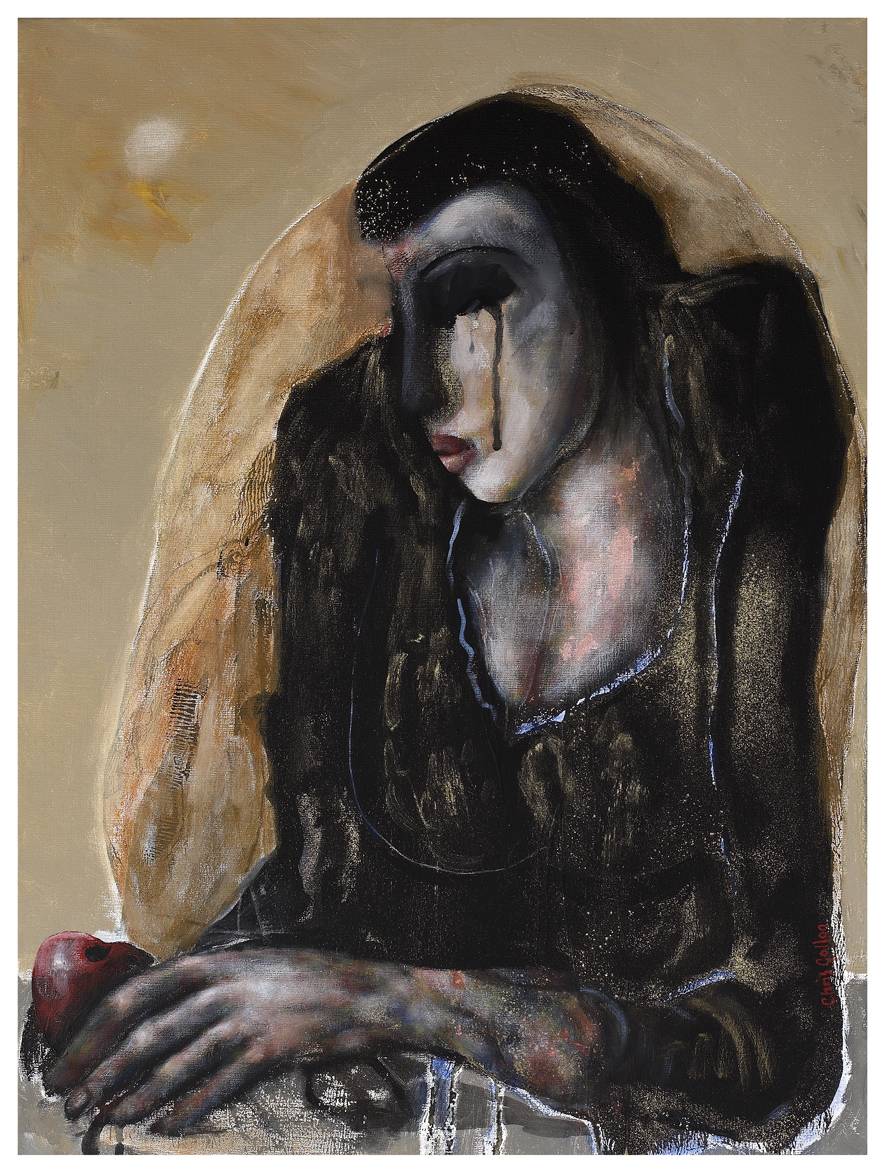
“Incarnation, Mary & Women from the Bible,” Romsey Abbey, Hampshire, England, October 12–November 6, 2016: Having already stopped at Guildford, Norwich, Chichester, Durham, and Hereford Cathedrals, Chris Gollon’s latest series of paintings on women of the Bible is now at Romsey Abbey. It includes the standards, like Eve, Rachel, Hannah, Delilah, Bathsheba, the two Marys (the Virgin, and Magdalene), and Salome, as well as some unnamed and even implied women, like Judas’s wife. It also includes some extrabiblical female saints, like Lucy, Cecilia, Julian of Norwich, and Ethelflaeda. I’m really attracted to the sad quality of many of Gollon’s women, and to the emphasis on hands (much like Eduardo Kingman!).

Contemplation of Eve by Chris Gollon
Chris Gollon (British, 1953–), The Contemplation of Eve, 2011. Acrylic on canvas, 24 × 18 in. (61 × 46 cm).

+++

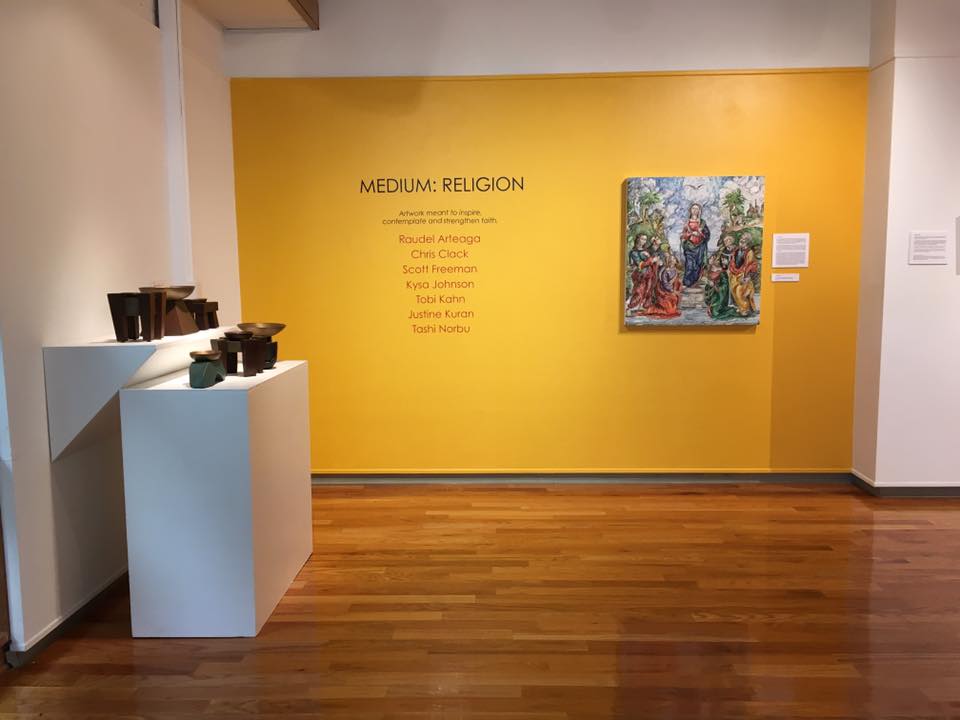
“Medium: Religion,” Gallery of Art and Design, University of Central Missouri, Warrensburg, Missouri, September 22–October 28, 2016: This exhibition—“meant to inspire, contemplate, and strengthen faith”—features seven contemporary artists whose work engages religion: Tobi Kahn, who creates Jewish ceremonial art like etrog containers, shalom bat chairs, and omer counters; Chris Clack, whose work explores the relationship between Christianity and science; Kysa Johnson, whose Immaculate Conception series links images of the Virgin with asexually reproducing yeast and bacteria; Justine Kuran, known for her quilled hamsas (palm-shaped amulets); Scott Freeman, whose The Wall Remaining laments the long-suffered disunity between Jews and Christians; Tashi Norbu, trained in the art of traditional Tibetan Buddhist thangka painting; and Raudel Arteaga, who deconstructs famous religious paintings into their geometric basics.

medium-religion-exhibition

+++

“Illuminations: Works by Vanessa German, Peter Oresick, and Christopher Ruane,” Carlow University Art Gallery, Pittsburgh, Pennsylvania, September 8–December 9, 2016: “‘Illuminations’ features the work of three local artists who evoke the traditions of icon painting or biblical parables to bring out focus on the overlooked and to cast light into the shadows of our present day,” says gallery director Sylvia Rhor. Works include responses to last year’s Charleston church shootings, literary figures painted in the style of Russian icons, and sacred stories updated through the use of photography and digital technology.

illuminations-exhibition-poster