
Bidding Christmas Goodbye: Two Carols (One Sung, One Recited) for Candlemas Eve

Whereas in our present age it’s common for families to take down their Christmas decorations on Twelfth Night (January 5) or Epiphany (January 6)—and many American Christians do so even sooner—in medieval Europe they typically stayed up through Candlemas on February 2, or were removed the evening before. Yes, Christmas was celebrated for forty days in the Middle Ages! Why that span? Because forty days after his birth, the infant Christ was presented in the temple according to Jewish custom and inspired the famous song of Simeon about finally getting to see God’s salvation and glory. The feast of Candlemas commemorates this event each year, which many medieval worshipping communities regarded as the bookend of the Christmas season.

In her book Winters in the World: A Journey through the Anglo-Saxon Year, Eleanor Parker notes that Candlemas is the last feast of winter and the first feast of spring—a transitional festival that looks back to Christmas and forward to Easter (86). The date coincides with a significant point in the solar year: midway between the winter solstice and the spring equinox. Read more in an UnHerd article by Parker, “Light a candle; spring is coming.”

So as we celebrate Candlemas this Friday, we bid farewell to Christmas and prepare to welcome Lent. The Chorus of Westerly models a respectful send-off in a video they released in January 2021, combining a choral performance of the “Candlemas Eve Carol” with a recitation by James Lawson of “Now Have Good Day”—both texts from early modern England.

The text of the first carol, originally published with the title “Ceremonies for Candlemasse Eve,” is by the poet-priest Robert Herrick (1591–1674), and the tune is traditional, collected from an old church gallery book; the two appear together in The English Carol Book (Second Series) (1923), edited by Martin Shaw and Percy Dearmer. The Chorus of Westerly sings the first two stanzas and refrain:

Down with the rosemary and bays,
Down with the mistletoe;
Instead of holly, now upraise
The greener box (for show).

The holly hitherto did sway;
Let box now domineer
Until the dancing Easter day,
Or Easter’s eve appear.

Thus times do shift; each thing his turn does hold;
New things succeed, as former things grow old.

Herrick describes the English family tradition of taking down the Christmas greens—rosemary, bay, mistletoe, holly—on Candlemas Eve, replacing them with boxwood, which would stay up for the duration of Lent.

Burning the Christmas Greens
“Burning the Christmas Greens,” uncredited illustration from the January 29, 1876, edition of Harper’s Weekly

The remaining three stanzas move through the rest of the church year, associating yew with Easter, birch with Pentecost, and rushes and oak with Ordinary Time. The changing of seasonal decorations becomes for Herrick an emblem of the transience of life.

As the choir hums wistfully on, Father Christmas appears, giving this speech (the bracketed annotations are by Eleanor Parker):

Now have good day, now have good day!
I am Christmas, but now I go my way.

Here have I dwelt with more and less [i.e., everyone]
From Hallowtide till Candlemas,
And now I must from you hence pass;
Now have good day!

I take my leave of king and knight,
Earl and baron, and lady bright;
To wilderness I must me dight; [I must prepare myself to go into the wilderness]
Now have good day!

And of the good lord of this hall
I take my leave, and of guests all;
Methinks I hear that Lent doth call;
Now have good day!

. . . . . . . . . . . . . . . . . . .

Another year I trust I shall
Make merry in this hall,
If rest and peace in our fair land may fall;
Now have good day!

. . . . . . . . . . . . . . . . . . .

Now fare ye well, all in fere; [together]
Now fare ye well for all this year;
Yet for my sake make ye good cheer;
Now have good day!

This sixteenth-century carol is compiled in the commonplace book of the London merchant Richard Hill (Oxford, Balliol College MS 354).
Advent, Day 5

LOOK: Christmas Tree by Shirazeh Houshiary

Houshiary, Shirazeh_Christmas Tree
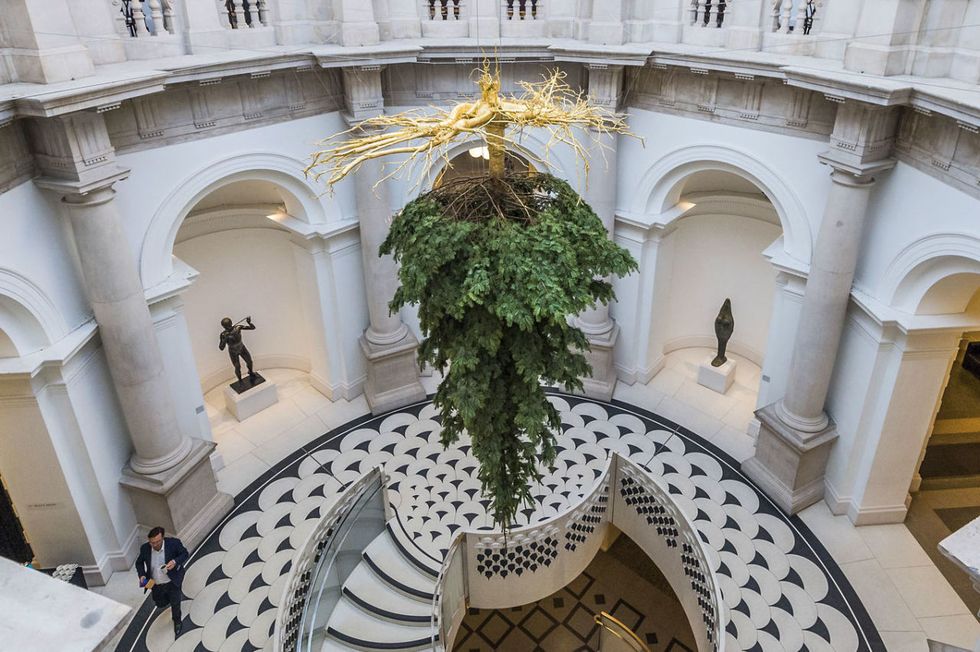
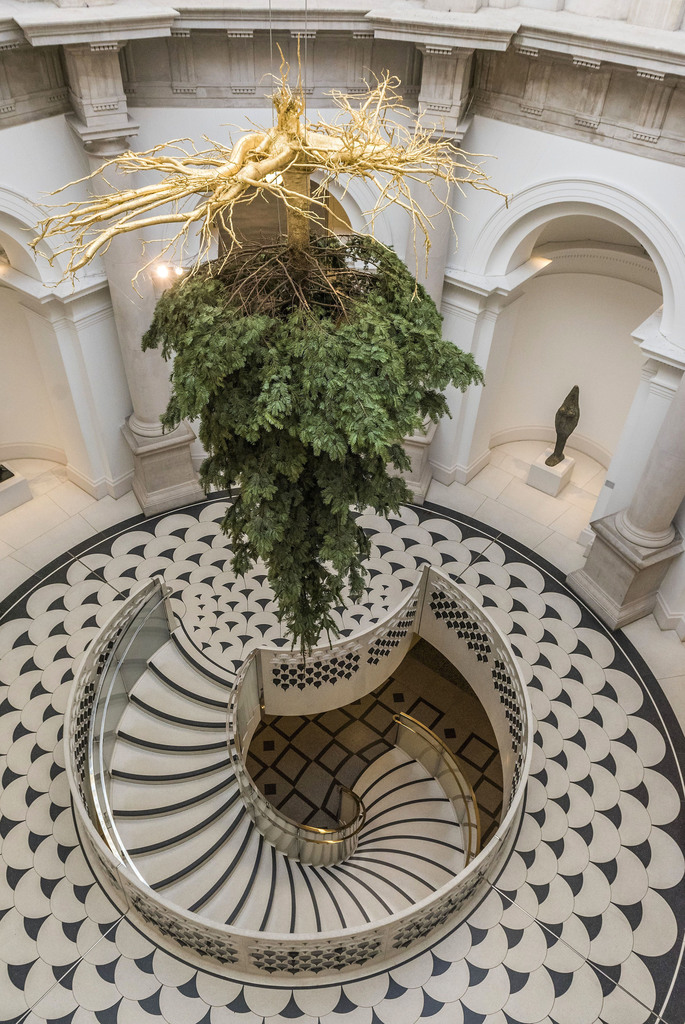
Shirazeh Houshiary (Iranian British, 1955–), Christmas Tree, 2016/1993. Temporary installation at Tate Britain, London.

Every year from 1988 to 2012, and again in 2016 after the completion of a massive three-year renovation, Tate Britain commissioned a leading contemporary artist to create a Christmas tree installation inside the galleries. (In 2017 this tradition was replaced with the annual Winter Commission, where an artist is invited instead to decorate the museum’s Millbank facade with lights.)

The Tate awarded Shirazeh Houshiary the Christmas Commission in 1993, and she came up with a novel interpretation of the theme: a live pine tree suspended upside down, its exposed roots coated in gold leaf. She described the piece as “taking earth back to heaven,” and the Tate says it reflects the artist’s interest “in astronomy, mysticism and the interplay between light and dark.”

As Houshiary’s Christmas Tree was so memorable, Tate Britain asked her to reprise it in 2016 down the center of the museum’s new spiral staircase designed by the architecture firm Caruso St John. So in December of that year it could be seen under the glass dome of the rotunda of the museum’s Thames-facing entrance, viewable from three different levels.

Though I didn’t get to see the installation in person, the photos instantly reminded me of the inverted tree that appears in some of the woodcuts and batiks of Indian Christian artist Solomon Raj (see, e.g., here and here). For him this symbol represents the Christian’s being rooted in God and bearing fruit in the world.

Neither Raj nor Houshiary, however, were the first to develop this symbol. The Katha Upanishad, an ancient sacred Hindu text, references something similar: “There is an eternal tree called the Ashvattha, which has its roots above and its branches below. Its luminous root is called Brahman, the Supreme Reality, and it alone is beyond death. Everything that exists is rooted in that point. There is nothing else beyond it” (2.3.1). The inverted tree is also mentioned in the Bhagavad Gita 15.1 and the Rig Veda 1.24.7. Furthermore, in his Timaeus Plato describes man as a “heavenly plant” with its branches on earth and its roots in heaven—and I wouldn’t be surprised to find the arbor inversa present in other religious and philosophical traditions as well.  

Houshiary was not working from an intentionally Christian framework (nor a Hindu or Platonic one), but her installation’s linkage with the season of Christmas welcomes, I’d say, a Christological reading. As already mentioned, she acknowledged in her 1993 statement an interplay between heaven and earth—heaven being evoked through the tree’s gilded root system that towers above the viewer, catching the natural light from above. Our realm, earth, is where the ever-green life enters and expands.

I think of how Jesus Christ, the New Adam, human being par excellence and yet Eternal One who is from the beginning, came down from on high, bringing lushness, grafting humanity into the Divine.

Houshiary, Shirazeh_Christmas Tree
Photo: Guy Bell

LISTEN: “Love Divine” | Words by Charles Wesley, 1747 | Music by Thomas Waller, first published 1869; arr. Wilder Adkins, 2015 | Performed by Justin Cross and Wilder Adkins on Hollow Square Hymnal, 2016; reissued as a single, 2018

Love divine, all loves excelling,
joy of heav’n, to earth come down!
Fix in us thy humble dwelling,
all thy faithful mercies crown.
Jesus, thou art all compassion;
pure, unbounded love thou art.
Visit us with thy salvation;
enter ev’ry trembling heart.

Breathe, O breathe thy loving Spirit
into ev’ry troubled breast.
Let us all in thee inherit,
let us find that second rest.
Take away our bent to sinning;
Alpha and Omega be.
End of faith, as its beginning,
set our hearts at liberty.

Come, Almighty, to deliver,
let us all thy life receive.
Suddenly return, and never,
nevermore thy temples leave.
Thee we would be always blessing,
serve thee as thy hosts above,
pray, and praise thee without ceasing,
glory in thy perfect love.

Finish, then, thy new creation;
pure and spotless let us be.
Let us see thy great salvation,
perfectly restored in thee.
Changed from glory into glory,
till in heav’n we take our place,
till we cast our crowns before thee,
lost in wonder, love, and praise.

“Love Divine, All Loves Excelling” is one of my absolute favorite hymns. It’s grand and passionate, tender and communal, and its many invocations have an Advent ring to them: Come down, Love! Make your home in us. Bring all your faithful mercies to a climax. Visit us with your salvation. Enter our trembling hearts. Breathe your spirit into us. Give us yourself. Lead us to ultimate rest. Be Alpha and Omega to us. Liberate. Deliver. Let us receive your life. “Suddenly return” . . . and never, never leave! Finish your new creation. Restore us in you.

Note that the second line appears in some hymnals without the comma following “joy of heav’n” and with a comma for the end punctuation, which, instead of acting as a petition, would indicate that the joy of heaven has already come down. The ambiguity, which different hymnal editors have resolved differently, is a perfectly comfortable one, as Jesus did come to earth once, and we beseech his return.

I know the hymn best from its pairing with the 1870 tune BEECHER by John Zundel, but Wilder Adkins uses a slightly earlier tune from the shape-note tradition that I quite like. It was composed by Thomas Waller (ca. 1832–1862) of Upson County, Georgia, who taught at Sacred Harp singing schools in the mid-nineteenth century.