Roundup: Advent poetry discussion, graffiti at Canterbury Cathedral, “Dios con Nosotros” print series, and more

ONLINE DISCUSSION: “Poems of Advent, Christmas, and Epiphany” led by Brian Volck, December 13, 2025, 12–1:30 p.m. ET: Poet Brian Volck (whose work I’ve shared here and here) is leading a free online discussion on Advent, Christmas, and Epiphany poetry next Saturday. Sponsored by the Ekklesia Project, it will bring together diverse poetic styles and voices. “Each poem is read by a volunteer and then the group discusses what stood out, what struck them, and what questions the poem raises,” Volck says. “My goal is to encourage a diversity of responses rather than impose mine. No preparation is required.” Register here to receive the Zoom link and the poems in advance.

+++

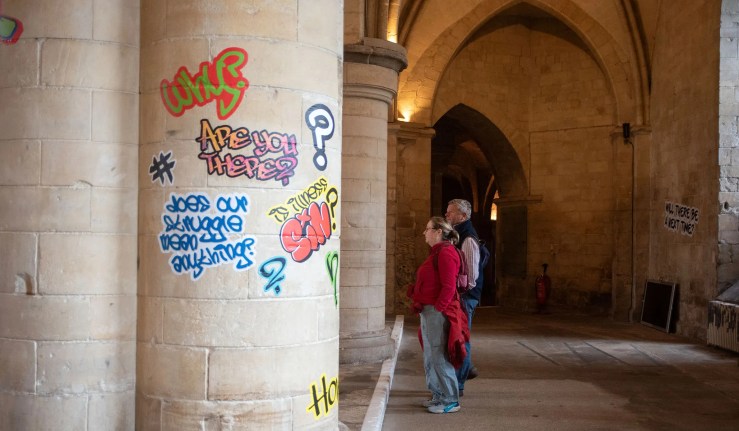
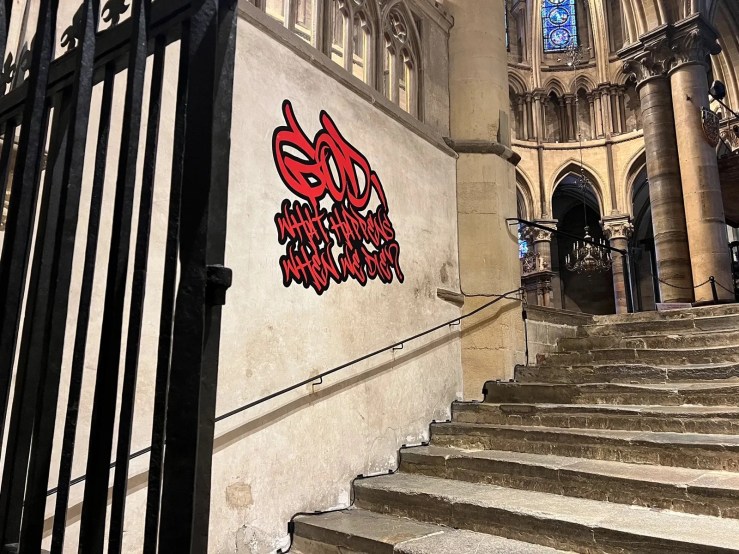
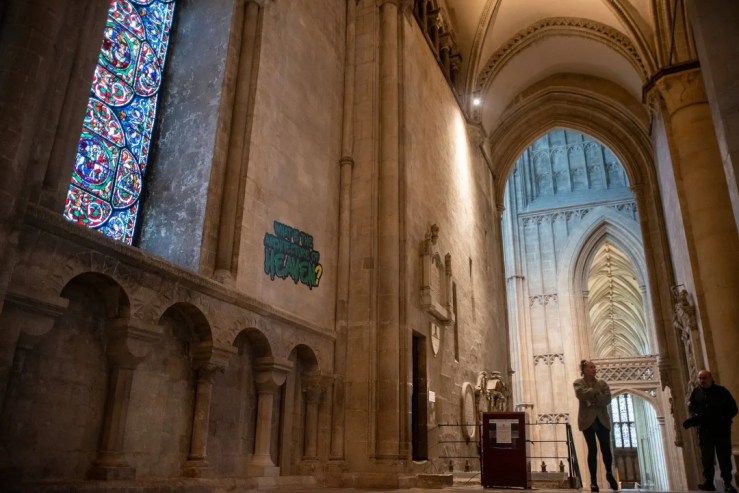
INSTALLATION: Hear Us, Canterbury Cathedral, October 17, 2025–January 18, 2026: Graffiti-style stickers are affixed to the medieval walls, floors, and pillars of England’s Canterbury Cathedral in the temporary installation Hear Us, voicing questions to God collected from local marginalized individuals, such as:

  • Why is there so much pain and destruction?
  • Is this all there is?
  • Are you there?
  • Does everything have a soul?
  • Do you ever regret your creations?
  • How do I break the cycle?
  • Does our struggle mean anything?
  • How is my dog Bear doing?
  • God, do you know me?
  • Hear Us
  • Hear Us
  • Hear Us

Curator Jacquiline Creswell [previously], collaborating with poet Alex Vellis, organized a series of workshops led by artists Sven Stears, Henry Madd, Jasbir Dhillon, Adam Littlefield, Alice Gretton, and Callum Farley, which invited people who felt the cathedral was not for them to gather together and delve into discussions about their lives, experiences, and aspirations. Among the participants were members of the Black and Brown diasporas, LGBTQIA+ people, neurodivergent people, people in addiction recovery, and people with mental health disorders. They were asked to respond to the prompt “If you could ask God a question, what would it be?”

Many of the responses were then translated into big, colorful word graphics that cannot be overlooked. “All of the questions are prayers. All of the questions are already sacred,” Vellis says. “So by putting the questions into an already existent sacred space, we are saying you are valid, your words are valid, your prayers are in a place in which they can be heard and they can be seen and they can be supported.”

I learned about this installation from the Exhibiting Faith podcast’s interview with Creswell and Vellis—an episode I heartily commend. They explain how the exhibition was developed, how they persuaded the cathedral to agree to it, and how they have dealt with the storm of criticism it has generated. Many have called it an act of vandalism (even though the stickers were authorized by the dean and will leave no trace when they’re removed next month) and irreverence, desecration. US Vice President JD Vance said the exhibition “mak[es] a beautiful historical building really ugly,” and Elon Musk called it a “suiciding” of Western culture.

I have not seen the exhibition in person, and I am neither British nor Anglican, so I don’t possess the same sense of my identity or heritage being threatened that many Church of Englanders have expressed. But I personally like the confrontational clash of aesthetics: traditional juxtaposed with modern; majestic Gothic architecture, staid limestone, garishly “spray-painted” in a street style, bringing contemporary spiritual and theological questions into a nearly millennium-old church building. I also like the concept of amplifying rather than diminishing the voices of those who feel marginalized by the church but who still want to engage, who are curious—bringing their questions into the space where we gather as a community of Christ followers and using them as a portal into further faith conversations, as Creswell put it in a media interview.

+++

BLOCKPRINT SERIES: Dios con Nosotros (God with Us) by Kreg Yingst: Kreg Yingst [previously] is my favorite contemporary printmaker working on religious themes. Last December he shared a series of hand-colored linocut prints that he started in 2019 and that is ongoing, collectively titled Dios con Nosotros (God with Us)—“a modern-day American Christmas story which takes place somewhere south of the U.S. border,” he writes.
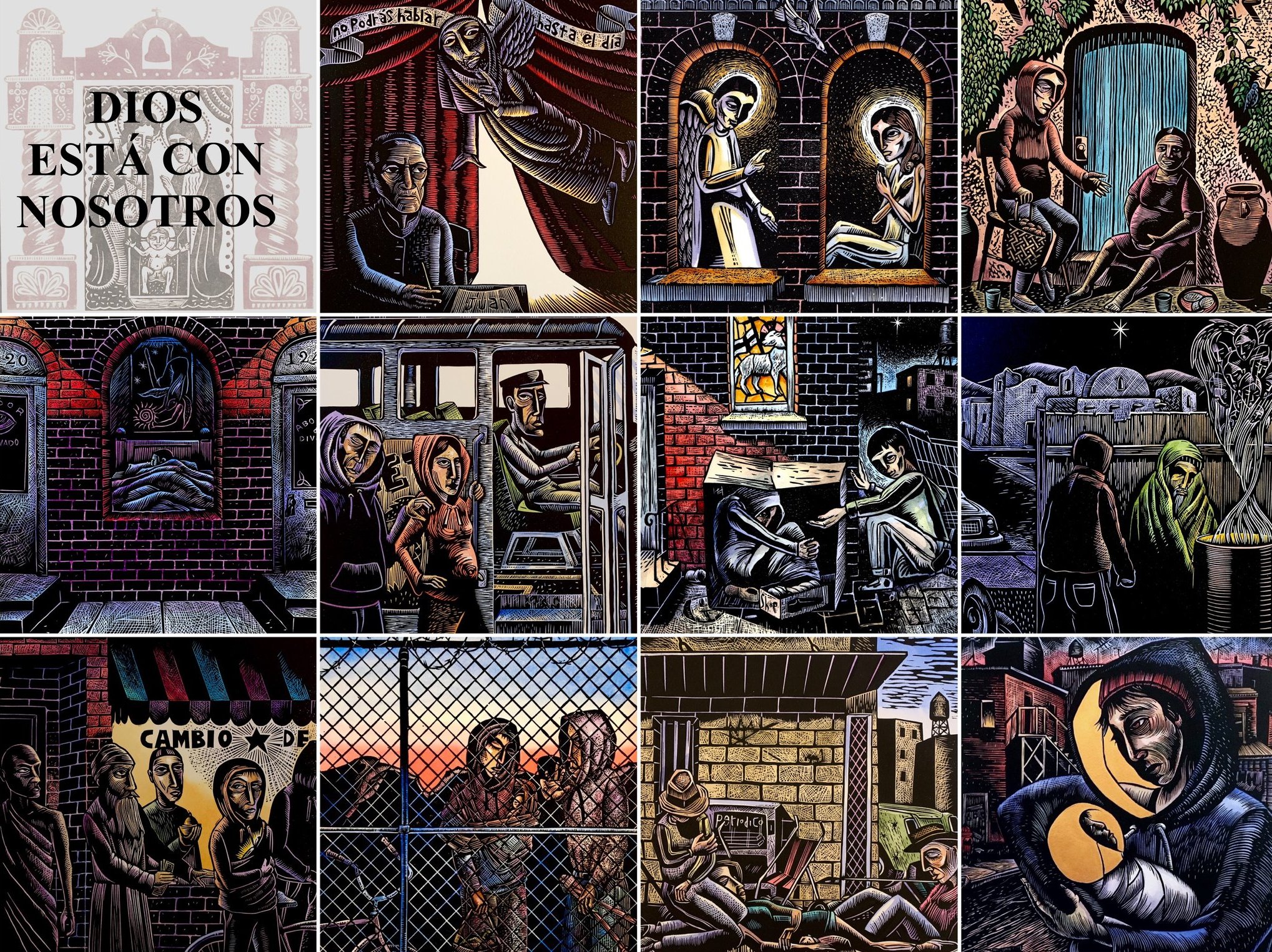
Yingst, Kreg_God with Us series

Several of the linocuts are for sale at Yingst’s Etsy shop, as is a set of twelve identical Christmas cards featuring Madona y Niño as the primary image. You can browse the rest of the series as it currently stands on his PsalmPrayers Facebook page; I’ve linked to the individual images below:

  1. El Encuentro: Zacarías y el Ángel Gabriel (The Encounter: Zechariah and the Angel Gabriel)
  2. La Anunciación (The Annunciation)
  3. La Visitación (The Visitation)
  4. El Dilema de José (Joseph’s Dilemma)
  5. Viaje a la Ciudad Natal (Journey to the Hometown)
  6. La Natividad (The Nativity)
  7. Una Multitud de Ángeles del Cielo (A Multitude of Angels from Heaven)
  8. Unos Sabios Procedentes del Oriente (Some Magi from the East)
  9. Los Refugiados (The Refugees)
  10. Matanza de los Inocentes (Massacre of the Innocents)
  11. Madona y Niño (Madonna and Child)

+++

SONGS:

>> “Un Cuento de Navidad” (A Song of Christmas): This original song by Adrian Roberto and Melissa Romero is about a town that had lost its wonder—until a child discovered a Bible, and his reading aloud its story of a Savior sparked revival.

>> “What Child Is This / Child of the Poor”: The Hound + The Fox are Reilly and McKenzie Zamber, a husband-wife musical duo from Oregon. This song of theirs interleaves the classic Christmas carol “What Child Is This” by William Chatterton Dix with a new song that emphasizes Christ’s solidarity with the poor.

Here are the Zambers’ new lyrics:

Helpless and hungry, lowly, afraid,
Wrapped in the chill of midwinter;
Comes now, among us, born into poverty’s embrace,
New life for the world.

Who is this who lives with the lowly,
Sharing their sorrows,
Knowing their hunger?
This is Christ revealed to the world
In the eyes of a child, a child of the poor.

Who is the stranger here in our midst,
Looking for shelter among us?
Who is the outcast? Who do we see amidst the poor,
The children of God?

So bring all the thirsty, all who seek peace;
Bring those with nothing to offer.
Strengthen the feeble;
Say to the frightened heart,
“Fear not: here is your God!”

(Related posts: https://artandtheology.org/2023/12/29/christmas-day-5-poor-little-jesus/; https://artandtheology.org/2021/12/17/advent-day-20/)

>> “Everybody Ought to Treat a Stranger Right”: Arranged and expanded by Dan Damon [previously], this traditional blues song is performed here by the Dan Damon Quartet, featuring guest vocalist Sheilani Alix, at a concert at Community Church of Mill Valley in California on December 10, 2023. “Blind Willie Johnson recorded this song in 1930 with two Christmas verses mixed in. I separated them out, added two verses to tell a fuller Christmas story, and recorded the Christmas version with my band on the album No Obvious Angels,” Damon explains. “According to the writer of Hebrews, some have entertained angels unawares.”
Roundup: Religion and Contemporary Art

WEBSITE LAUNCH: The Foundation for Spirituality and the Arts: From a September 20 press release: “The Foundation for Spirituality and the Arts is pleased to announce the debut of our new website, fsa.art. Complementing in-person programming in Charleston and New York City, fsa.art functions as FSA’s online curatorial wing. It hosts both commissioned and curated content as well as a selection of features spotlighting significant artists, scholars, exhibitions, and publications from recent decades. We hope this site will be a valuable and inspiring resource that fosters dialogue, community, and innovation in the field of spirituality and the arts.”

FSA is “devoted to nurturing connections between spirituality and contemporary art. . . . By encouraging a mutual flow of creativity and faith from both artists and scholars, we hope to initiate fresh channels of spiritual enrichment from new depths of artistic expression. Nurturing innovative and experimental collaborations between a wide range of communities, we aspire to integrate estranged voices together in a spirit of harmony, openness, and inquisitiveness.”

At the heart of their programming is their annual series of residencies, open to visual artists, performers, composers, choreographers, curators, writers, and theologians. Visit their website to find out more, and follow them on Instagram @foundation.spirituality.arts. Below are four artworks I’ve encountered through their social media postings.

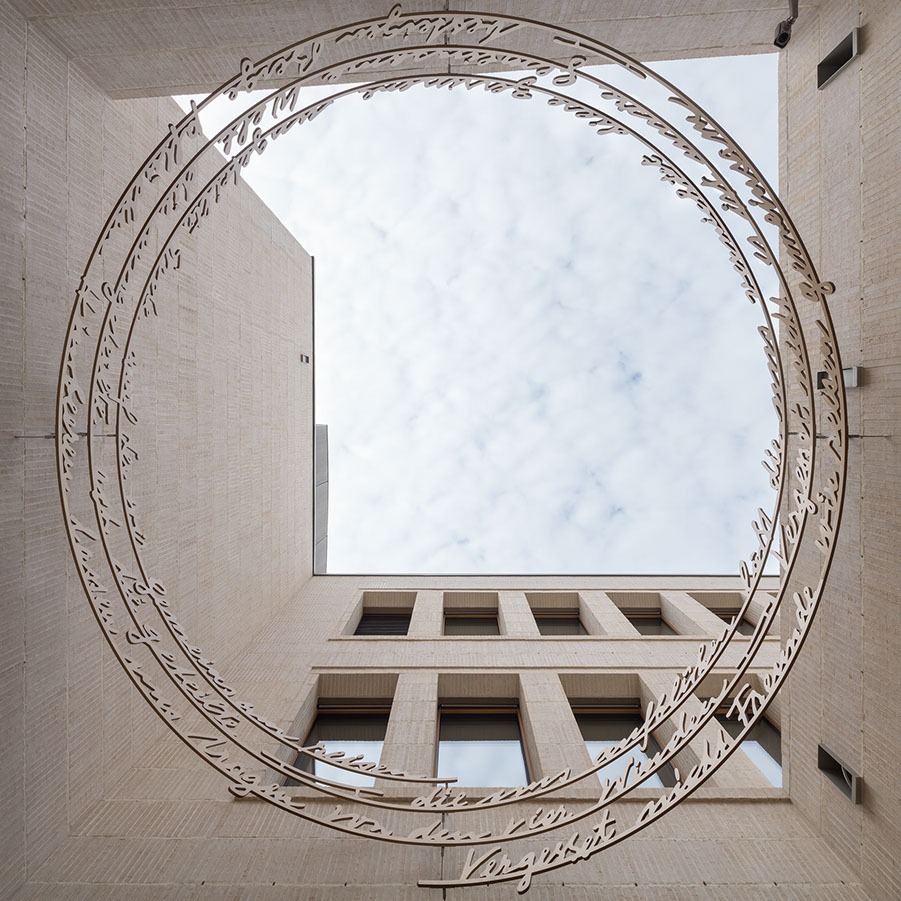
Kristen, Tom_Gemeinsam
Tom Kristen (German, 1968–), Gemeinsam (Together), 2019. Jewish Synagogue and Community Center, Regensburg, Bavaria. Photo: Marcus Eben. Floating above the center’s atrium, this gilded bronze spiral text is taken from Rose Ausländer’s poem “Gemeinsam”: “Vergesst nicht, Freunde, wir reisen gemeinsam. . . . Es ist unsre gemeinsame Welt.” (“Don’t forget, friends: we travel together. . . . It is our common world.”)

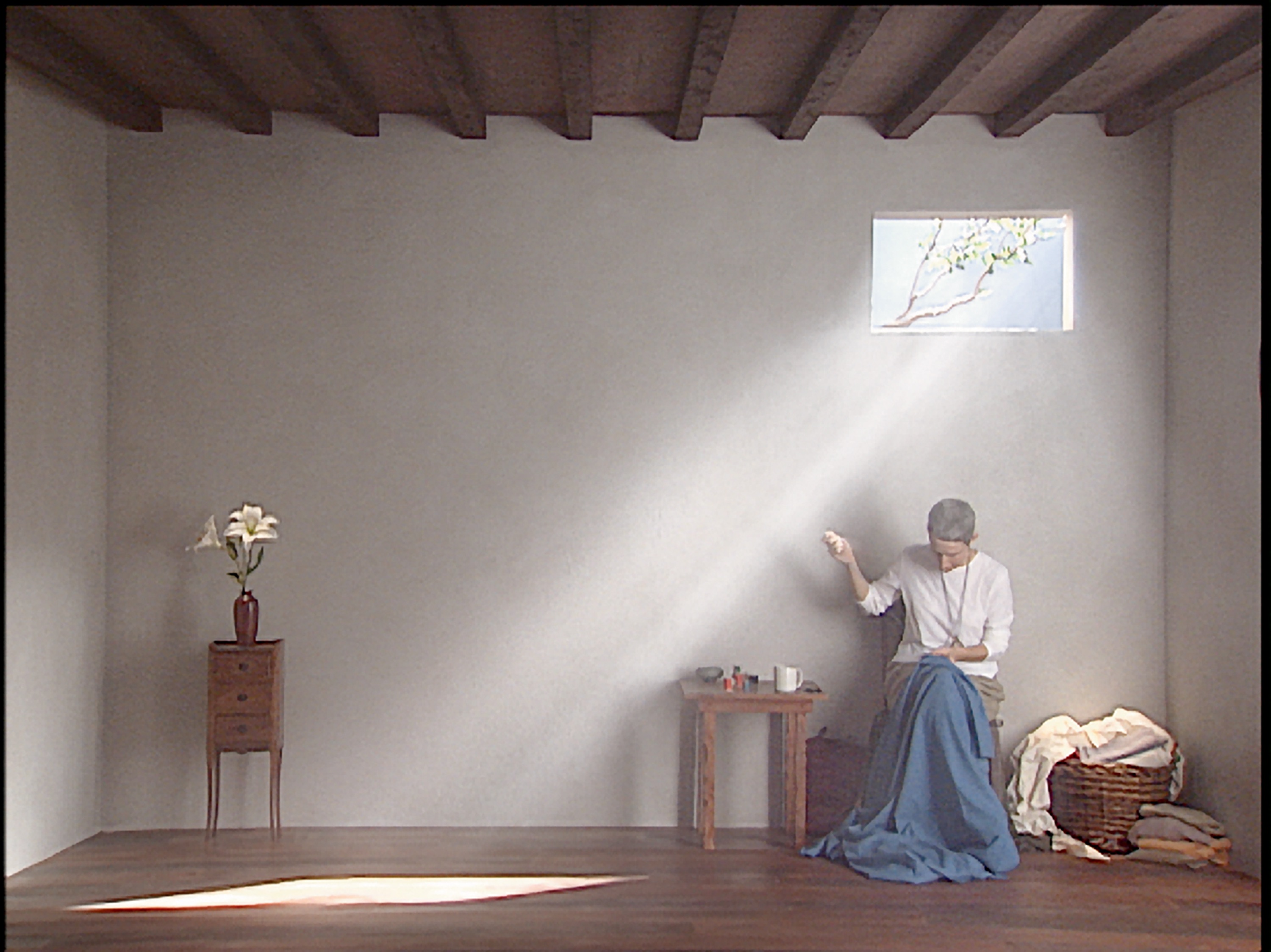
Viola, Bill_Catherine's Room (still)
Bill Viola (American, 1951–), Still from Catherine’s Room, 2001. Color video polyptych on five flat panel displays, 18:39 minutes, performer: Weba Garretson. Photo: Kira Perov, courtesy Bill Viola Studio.

Agha, Anila Quayyum_Intersections
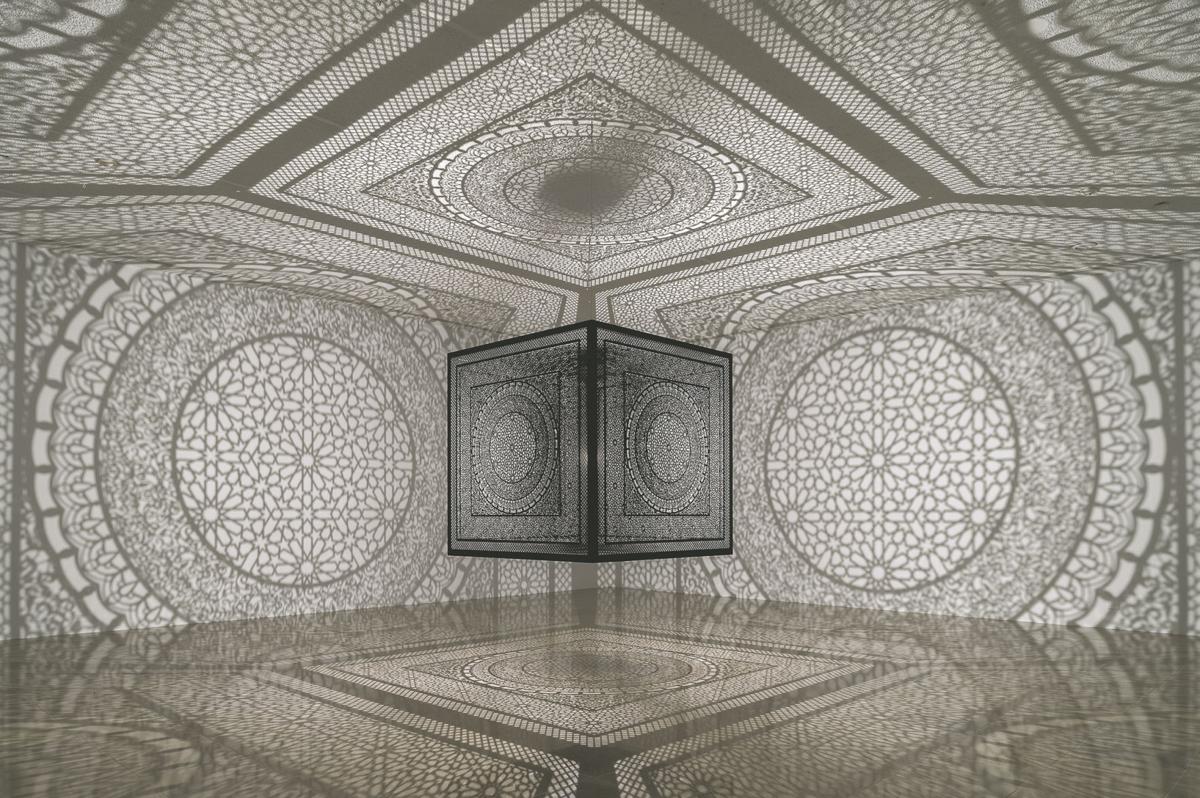
Anila Quayyum Agha (Pakistani American, 1965–), Intersections, 2013. Lacquered wood and halogen bulb, 78 × 78 × 78 in. (cast shadows: 43.5 × 43.5 × 16 ft.). Installation view at Rice Gallery, Houston, Texas, 2015.

Mingwei, Lee_Our Labyrinth
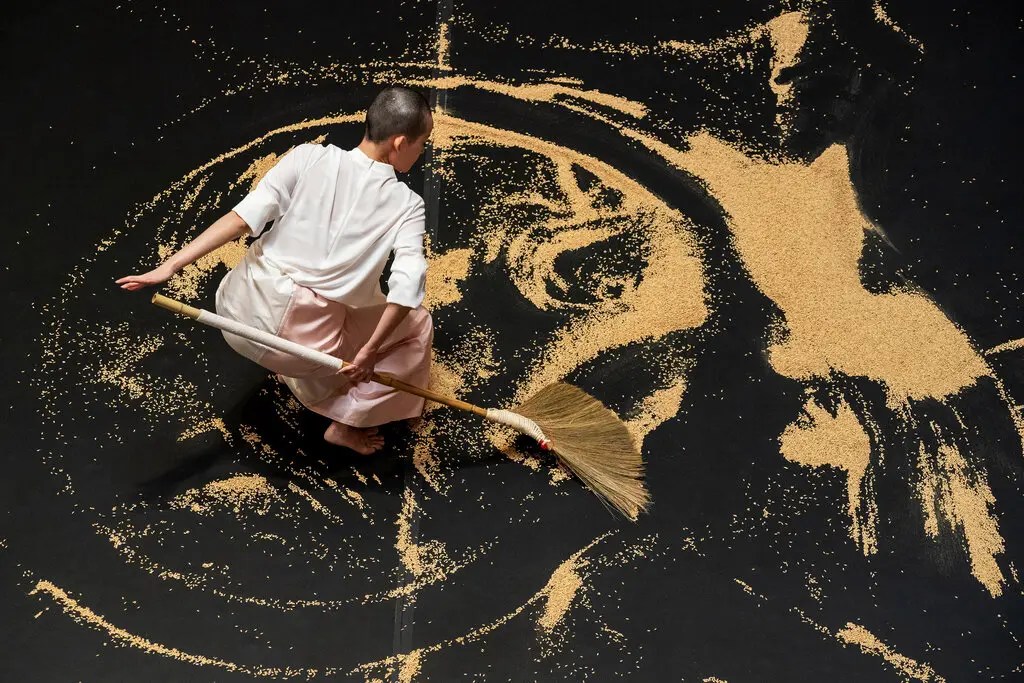
Lee Mingwei (Taiwanese American, 1964–), Our Labyrinth, 2015–present. Photo: Stephanie Berger. In this performance work, single dancers, dressed in floor-length sarongs and wearing ankle bells, take turns sweeping a mound of rice in patterns on the floor in a designated gallery space. This iteration from 2020 at the Metropolitan Museum of Art was a collaboration with choreographer Bill T. Jones, and the performer in the photo is I-Ling Liu. [Watch on YouTube]

+++

LECTURE: “The New Visibility of Religion in Contemporary Art” by Jonathan A. Anderson: Religion is becoming more visible in contemporary art and more discussable, says artist, art critic, and theologian Jonathan Anderson in his September 17 talk sponsored by Bridge Projects in Los Angeles. Danh Vo, Kris Martin, Andrea Büttner, Deana Lawson, Arthur Jafa, Genesis Tramaine, Hossein Valamanesh, Theaster Gates, Zarah Hussain, Francis Alÿs, Louise Bourgeois, Sol LeWitt, Sean Kelly, Gerhard Richter, James Turrell—these are just some of the many contemporary artists who have engaged substantively with religion in their work, either through form or content or through the ways in which they frame the work’s central questions. Curators and art historians are recognizing this more and more, and it’s being reflected in exhibitions and scholarship. Anderson highlights several such instances from the past two decades, celebrating religion’s increased visibility but also pointing out where there’s room for improvement. The talk starts at 6:36:

At 28:58, Anderson outlines four interpretive horizons, or fundamental hermeneutics, within which religion is becoming visible, intelligible, and meaningful in contemporary art: anthropological (31:00), political (37:43), spiritual (42:51), and theological (48:42). He discusses the problems and possibilities of each—ways in which it has been productive or insightful, and ways in which it’s limiting. The fourth horizon, the theological, is the least developed in the art world and the most contested, he says.

He concludes,

A more concentrated and well-developed mode of theological inquiry has much to contribute to the history, theory, and criticism of contemporary art without being reductive, but instead opening much of what’s going on in contemporary art. And so going forward, I do envision a mode of study that keeps all these horizons in view, and a mode of discourse that keeps all these horizons in view, while especially developing the potential for the modes of critical writing capable of addressing theological conceptualities, genealogies, and implications that are in play in so much of the art being made today. And that involves thinking better from both directions, developing concepts and capacities—skills, really—where art criticism might operate with a more agile, historically sensitive understanding of religion and theology (a richer theological intelligence), and theology might operate with a more agile, historically sensitive understanding of art and criticism (a richer art historical intelligence, or visual intelligence).

The last half hour is Q&A. What he says at 1:03:59 is fascinating! If you enjoyed this talk, check out, too, the one he gave ten years ago, “The (In)visibility of Theology in Contemporary Art Criticism,” which I published detailed notes on and which became a chapter in the book Christian Scholarship in the Twenty-First Century: Prospects and Perils, edited by Thomas M. Crisp, Steve L. Porter, and Gregg A. Ten Elshof.

As a side note, Anderson teaches two courses at Duke Divinity School, where he is a postdoctoral associate in the DITA program: “Contemporary Art and Theology” and “Visual Art as Theology.” The latter looks at the history of primarily Christian art as a domain of primary theological reasoning and biblical commentary, done in visual-spatial terms rather than in verbal-written terms. His hope is that divinity students—future biblical scholars, theologians, pastors, etc.—will become more literate in the visual-spatial forms of theology. I mention this because it’s what I’m about too!

+++

PODCAST EPISODE: “Jacquiline Creswell: Curating in Sacred Spaces,” Exhibiting Faith: Hosted by critic and art historian David Trigg, this is the first episode of a brand-new podcast about the intersection of art and faith, featuring a range of guests for whom those two elements have played a significant role. First up is Jacquiline Creswell, a visual arts adviser and curator who has, since 2009, organized more than forty-five exhibitions in sacred spaces. She has been central to the development of the visual arts programs at Salisbury, Ely, and Chichester Cathedrals. She discusses some of the projects she has worked on and how they’ve been received by the congregation and the wider public, how the setting of an artwork can alter its meaning and the way people engage with it, the logistical challenges of placing art in historic churches, and more.

I was interested to learn that she is from a Jewish background, even though most of her jobs have been with Christian institutions. Check out the eight objectives she lists on her website, which have guided her curatorial work and which I find exciting; the first is “To present artwork which is engaging, that encourages a spiritual response and may at times challenge conventional perceptions.”

Pope, Nicholas_Apostles Speaking in Tongues
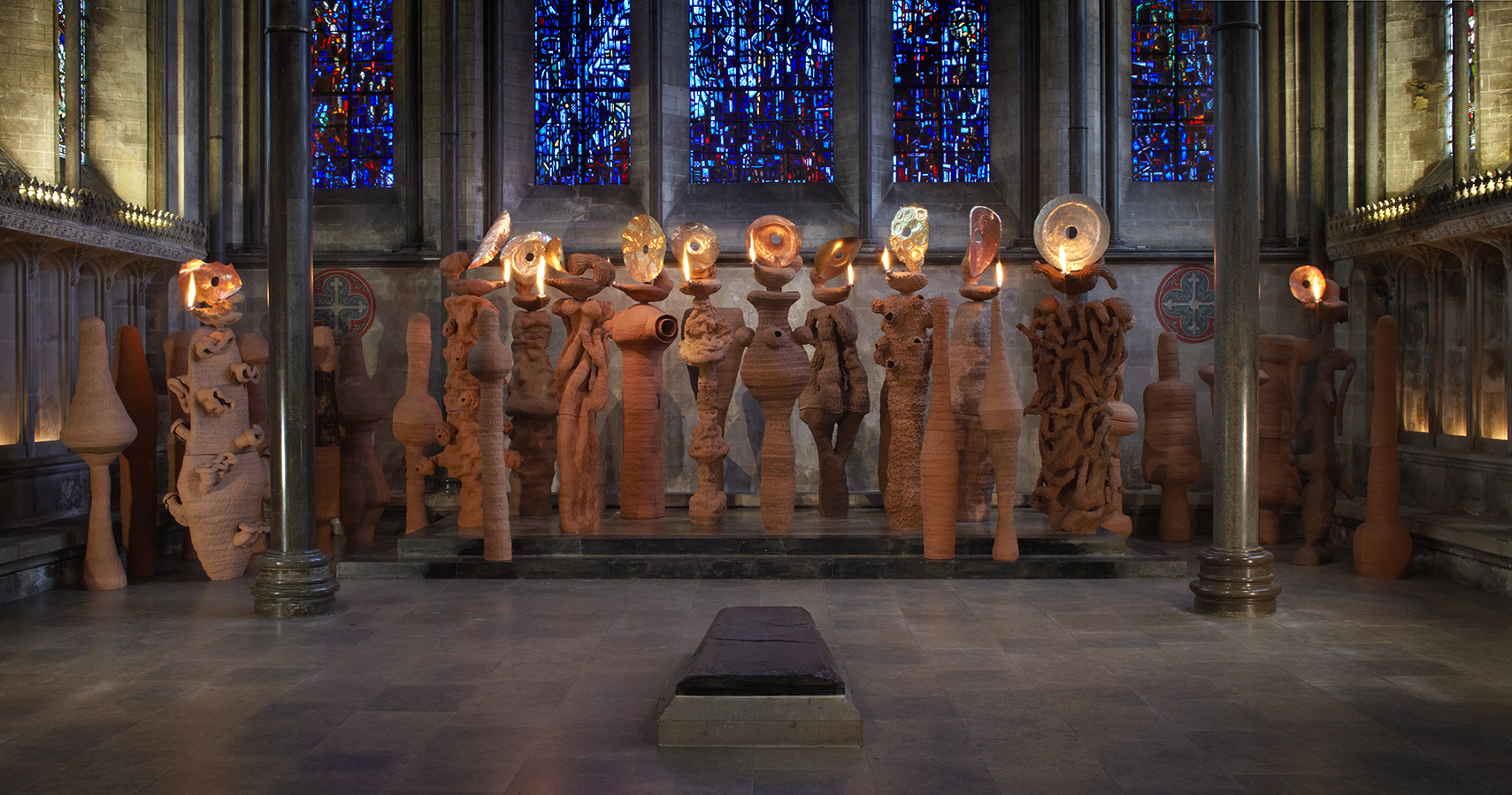
Nicholas Pope (British, 1949–), The Apostles Speaking in Tongues Lit By Their Own Lamps, 1996, installed 2014. Thirty-three figures in terracotta, metal, wick, paraffin, and flame. Trinity Chapel, Salisbury Cathedral. Photo: FXP, London.

Haebich, Jayson_Star of Bethlehem
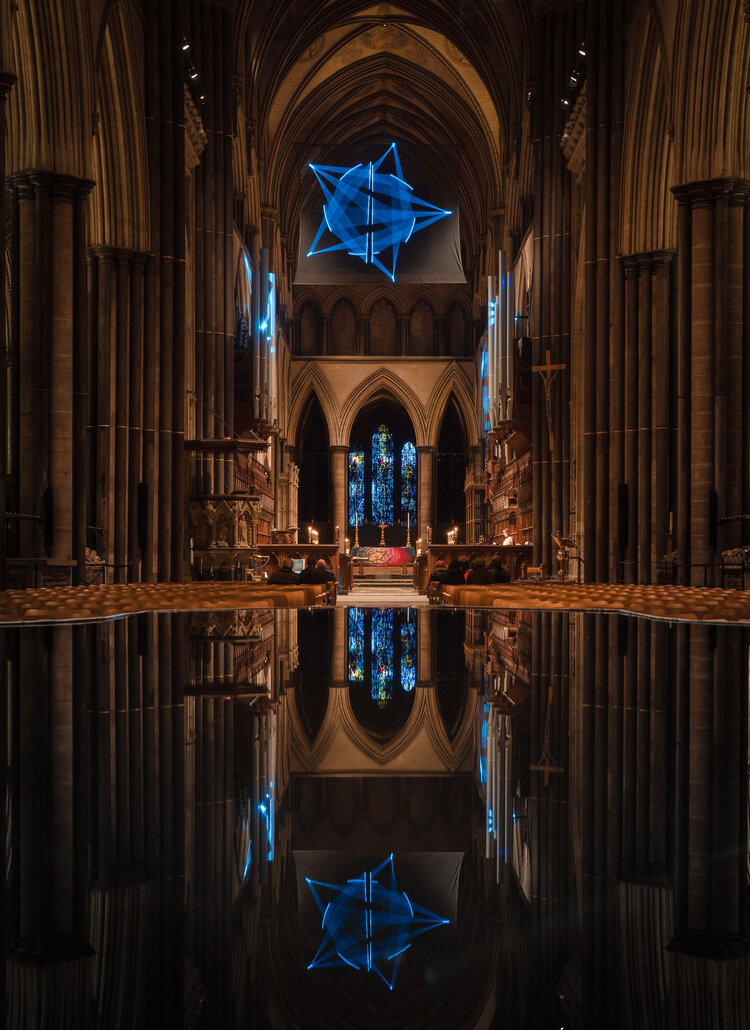
Jayson Haebich (born in Australia, living in Hong Kong and London), Star of Bethlehem, 2016. Interactive laser installation at Salisbury Cathedral, England.

New episodes of Exhibiting Faith are released once a month. The second (and latest) episode is an interview with Dubai-born, Birmingham-based textile artist Farwa Moledina, whose Women of Paradise (2022) scrutinizes the portrayal of Muslim women in the canon of Western art. Moledina also discusses her experience of Ramadan during lockdown and how it resulted in By Your Coming We Are Healed (2020), two sufras (floor mats for communal dining) made up of photographs of plated dishes submitted to her by participants in the virtual iftars she hosted, arranged according to Islamic design principles of symmetry, abstraction, and recurrence.

+++

SHORT FILM SERIES: At the Threshold: Theology on Film, dir. Sean Dimond: At the Threshold is the latest project from UNTAMED, a documentary film studio in Seattle that “pursue[s] stories of spiritual and narrative depth, with a bias for hope, risk, and redemption.” Filmed in Belgium, Germany, and the UK, it profiles six Christian theologians from Europe, each one humble, open-hearted, and reflective.

  1. “The Open Narrative of Love” with Lieven Boeve, Leuven, Belgium: Boeve reflects on how God interrupts people’s self-enclosed stories. Christianity, he says, is itself an open narrative, not a closed one, and it leads us not away from the world but right into it. One of the filming locations in this short is a rural landscape in Borgloon where Pieterjan Gijs and Arnout van Vaerenbergh built Reading between the Lines, an open-air chapel created to imagine a church inseparable from the world around it.
  2. “The Greater Part” with David Brown, St Andrews, Scotland: Brown talks about prayer, the Bible as part of a living tradition, the church’s call to be creatively other, and the only time he ever saw his father cry. He also cites some of the poets, novelists, and composers/singer-songwriters he admires.
  3. “The Radiance” with Perry Schmidt-Leukel, Muenster, Germany: “The fractcal structure of religious diversity” is of deep interest to Schmidt-Leukel, a Christian who draws insights from Buddhism and who was criticized by Cardinal Joseph Ratzinger for doing so.
  4. “Danseuse” with Ann Loades, Durham, England: A feminist theologian, Loades is one of only two people ever to be awarded a CBE for services to theology. The Christian tradition is responsible for the devaluation of women, she says, but that tradition also contains resources for its own transformation. She also discusses dance as prefiguring the resurrection body.
  5. “To Imagine That” with Garrick Allen, Glasgow, Scotland: Allen sees the book of Revelation as being about how to live in a system that is unjust. “This is John’s response to an oppressive system, and it gives us space to rethink what a just system would look like in our world—to begin to imagine that.”
  6. “Begin with the End” with Judith Wolfe, St Andrews, Scotland: “We have to take seriously the claim that we do not yet live in the world as it will be, and as we will be, and that we have to live towards an eschaton, a presence of God in the world, which is not only not yet apparent, but is not even comprehensible to us. So how do we live authentically in this life?”

From the studio: “Theology offers a home for the vast and the intimate. No question is foreclosed. Visually immersive, poetic, and global in scale, these narrative and theological short films invite viewers into a conversation about life and its limits which is as vibrant as it is challenging. This series isn’t about promoting theological ideas we necessarily agree with, but rather we are exploring the connections between vulnerable life, big questions, and the diversity of theological work being done today. It’s not that we are on the threshold of discovering God, but that perhaps God is already on the threshold of our lives, knocking to enter through our wounds, deepest desires, and questions.”