Roundup: Korean-English worship, “God Breathed” by Ruth Naomi Floyd, John Witvliet on liturgical sincerity, and more

WORSHIP SERVICES:

In February I shared a few of the Vespers services offered at this year’s Calvin Symposium on Worship at Calvin University in Grand Rapids, Michigan, which I was privileged to attend. Here are two of the full-fledged services that give you a sense of what the larger corporate gatherings are like. (The theme was Ezekiel.) I love the cross-cultural sharing that goes on, learning new songs alongside others, getting refreshed by prayer and formed by liturgy, sitting under the teaching of wise ministers of God from various backgrounds, and taking Communion with friends new and old.

>> “God’s Glory Departs from Israel,” February 8, 2024 (with bilingual Korean-English music and liturgy): This worship service was led in Korean and English by the Woodlawn Christian Reformed Church Choir, directed by Chan Gyu Jang; the Living Water Church Worship Team, directed by Yohan Lee; and members of the Calvin University and Calvin Theological Seminary Korean communities. Rev. Dr. Anne Zaki from Evangelical Presbyterian Seminary in Cairo, Egypt, preached on Ezekiel 10–11.

This is an example of bilingual worship done really well! (I’ve seen it done poorly: with lack of communication of intention, one-sided involvement in the design or execution, inadequate pronunciation coaching for non-native speakers at the mic, unclear instructions that create confusion as to who is supposed to say or sing what, unintelligibility, etc.) I’m so grateful for all the creativity and thoughtfulness that went into creating this service—with a special shout-out to the bulletin designers and livestream technicians.

The bulletin provides this note on bilingual worship:

Two languages are intertwined together in this bilingual service. At times, words are spoken in one language, and their translation—unspoken—is provided on the righthand column; at times, the leaders demonstrate to the congregation how to sing or speak the words through transliteration; and at other times, the leaders and congregation converse in both languages, providing meaning to each other, so that no word sung or spoken is left unintelligible. We seek understanding and order in the sharing of our gifts.

In our pursuit, however, we practice patience and hospitality. In this service, we are called not only to speak and sing, but also to listen, to take turns. By listening, we create a room—a shelter—for travelers and strangers in this land, since language and music have power to transport one’s soul homeward. By taking turns, we practice the pace and posture of dialogue, even monolingual dialogue.

Beautiful! Here are three songs I’ll call out for special attention:

  • 9:14: “Joo-yeo, Come, O Lord” by Sunlac Noh: This song, which is particularly well suited for Advent, originated in the Anglican Church of Korea and was translated into English last year by Martin Tel (see podcast interview below). The version we sang at the symposium preserves two of the Korean titles for Jesus.
  • 23:36: 우리에게 향하신 (Woo-ri-e-ge Hyang-ha-shin) (Never-Ending Is God’s Love) by Jin-ho Kim, based on Psalm 117:2: Sung entirely in Korean, this was used as a refrain during the Assurance of Pardon and the Prayers of the People. A simple, repeated line, either sung or spoken, is a good way to involve non-native speakers of a given language.
  • 1:14:37: 주님 다시 오실 때까지 / Rise, My Soul, Till Jesus Comes Again” by Hyeong-won Koh: The closing song is a charge to continue in the way of Jesus, all the way Home. The vocalists on stage sang the song themselves in its original Korean the first time through, and then we all joined in in English for the second time.

All the song credits are provided in full in the YouTube video description.

>> “The Valley of Dry Bones,” February 8, 2024: Rev. Dr. Brianna K. Parker from Dallas, founder of Black Millennial Café, preached on the famous Ezekiel 37 passage, and the Calvin University Gospel Choir, directed by Nate Glasper, led music, along with guest artist Ruth Naomi Floyd.

I want to especially draw your attention to 23:31, where Floyd premieres an extraordinary new song of hers, “God Breathed.” It opens and closes with a flute, and in between are her powerful jazz vocals, singing an original poetic text based on Ezekiel 37, accompanied by James Weidman on piano. (Update: Here’s a standalone video of the song.)

+++

PODCAST EPISODE: “Fighting Back Against the Storms of Life with Martin Tel,” Psalms for the Spirit: Host Kiran Young Wimberly interviews Martin Tel, director of music at Princeton Theological Seminary and senior editor of Psalms for All Seasons: A Complete Psalter for Worship (2012), about the Psalms—the importance of psalm singing in his Dutch Reformed upbringing; the Psalms as a form of resistance and protest; the Psalms as a means of praying our own prayers and those of others; our need to overhear some psalms as being prayed against us (that is, have you considered that you might be someone else’s oppressor?); and ideas for framing a psalm with a refrain, such as these:

  • Combine the Charles Albert Tindley gospel song “The Storm Is Passing Over” with Psalm 57 (“In the shadow of your wings I will take refuge, until the destroying storms pass by . . .”). Sing into the storm.
  • Choose a Gospel passage of someone in deep lament (e.g., the ten lepers in Luke 17:11–19), surround it with Psalm 88, and have the congregation sing “Kum Ba Yah” (Gullah for “Come by Here”) in minor mode as a refrain (“Someone’s crying, Lord . . .”). A choir can hum the spiritual while the reader(s) read the scriptures.
  • Intersperse the verses of Psalm 14 (“Fools say in their heart, ‘There is no God.’ . . . They have all gone astray . . .”) with the refrain “Prone to wander, Lord, I feel it . . .” to help the congregation members see their own foolishness instead of assuming it’s someone else who’s the fool.

+++

ARTICLE: “The Mysteries of Liturgical Sincerity” by John Witvliet, Worship (reprinted Pray Tell), May 2018: Some Protestants accuse the more liturgically inclined Christians, like me, of not valuing sincerity in worship because we value prewritten prayers and other set forms. But just because something is scripted or done habitually does not make it “rote” or “empty.”

“Among my mostly Protestant students, no theme is more contested, misunderstood, or cherished” than sincerity, writes John D. Witvliet, director of the Calvin Institute of Christian Worship and professor of worship, theology, and congregational and ministry studies at Calvin University and Calvin Theological Seminary. In this article he explores several different definitions of sincerity, which vary widely across cultures, centuries, philosophical frameworks, and Christian traditions, and then offers six “corrective lenses” to common astigmatisms in the free-church Protestant way of viewing the world: outside-in sincerity, vicarious sincerity, trait sincerity, symbiotic sincerity, sincerity as gift, and aspirational sincerity.

This article is SO GOOD. I have been greatly influenced over the years by Dr. Witvliet’s teachings on liturgical formation, and I strongly encourage you all to read this piece.

+++

EKPHRASTIC POEMS:

An ekphrastic poem is a poem written in response to a work of visual art. Here are two examples I like from the past two years:

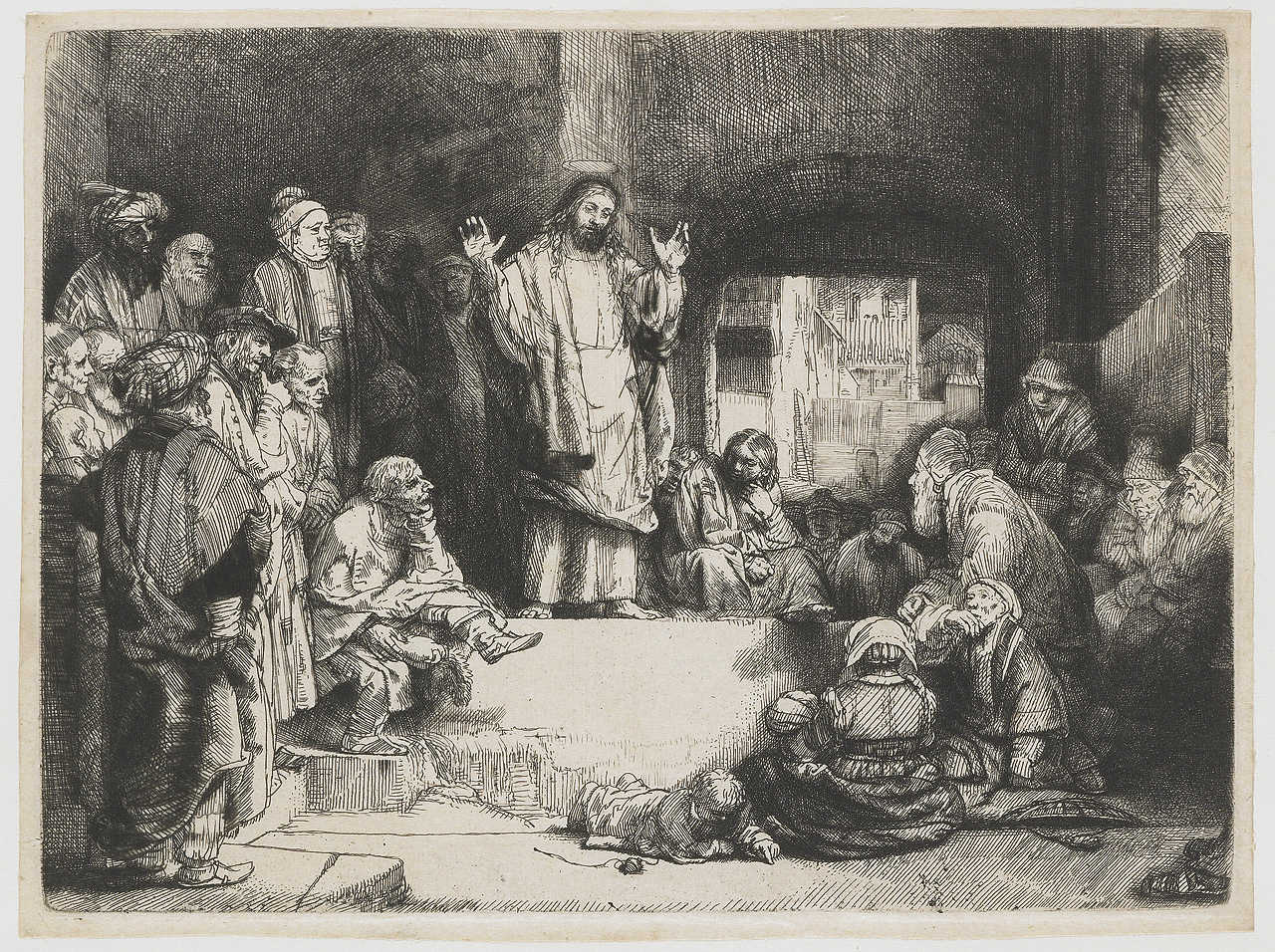
>> “Christ Preaching” by Keene Carter, Image: “I forgive the absent boy,” begins this poem based on a Rembrandt etching, directing our attention to the young child in the foreground who has turned away, disinterested, from Jesus’s sermon, drawing on the ground instead. Jesus gives grace to those in the crowd with averted gazes or who are distracted, simply continuing to preach on on the virtue of empathy—of seeing yourself in others—and on true life.

Rembrandt_Christ Preaching (1652)
Rembrandt van Rijn (Dutch, 1606–1669), Christ Preaching (La Petite Tombe), ca. 1652. Etching, engraving, and drypoint on paper, 6 1/4 x 8 5/16 in. (15.9 × 21.1 cm). National Gallery of Art, Washington, DC.

>> “L’Angélus” by Seth Wieck, Grand Little Things: The Angelus is a traditional Christian prayer whose name comes from its opening words in Latin, “Angelus Domini” (The angel of the Lord). For centuries it was prayed by the faithful three times a day—at 6 a.m., noon, and 6 p.m.—the times announced by the ringing of bells from church towers. In the nineteenth century Millet famously painted two peasant farmers at dusk pausing from their labor in the fields to bow their heads and pray the Angelus. Seth Wieck interprets the painting through poetry, homing in on the part of the prayer that says, “Let it be done to me according to thy word,” expressing an attitude of surrender to God’s will. Wieck imagines the hard life of the man and woman shown pulling up potatoes from the earth—the same earth in which, shortly hence, they’ll bury a child, lost to sickness. The poem becomes a meditation on death, harvest, and acceptance.

Millet, Jean-Francois_The Angelus
Jean-Franҫois Millet (French, 1814–1875), The Angelus, 1857–59. Oil on canvas, 55.5 × 66 cm. Musée d’Orsay, Paris.


DONATE

I am committed to keeping all Art & Theology posts freely available to all; no paywalls here. To help me make a part-time living developing content for the site, would you consider donating to the work, or supporting my research by buying me a book from my Amazon wish list? I appreciate it!

“River” by Eugene McDaniels (song)

There’s a river somewhere
That flows through the lives of everyone
I know it flows through the valleys
And the mountains and the meadows of time
Yes, it do

There’s a star in the sky
That shines in the lives of everyone
You know it shines in the valleys
And the mountains and the meadows of time
Yes, it do

There’s a voice from the past
That speaks through the lives of everyone
You know it speaks through the valleys
And the mountains and the meadows of time
Yes, it do

There’s a smile in your eyes
That brightens the lives of everyone
It brightens the valleys
And the mountains and the meadows of time
Yes, it do

There is a short song of love
That sings through the lives of everyone
You know it sings through the valleys
And the mountains and the meadows of time
Yes, it do

There’s a river somewhere
That flows through the lives of everyone
I know it flows through the valleys
And the mountains and the meadows of time
Yes, it do

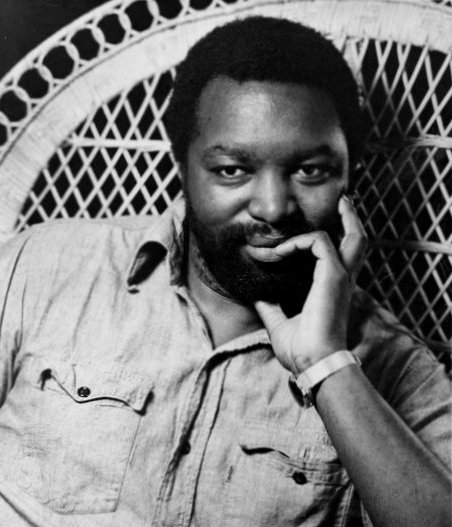
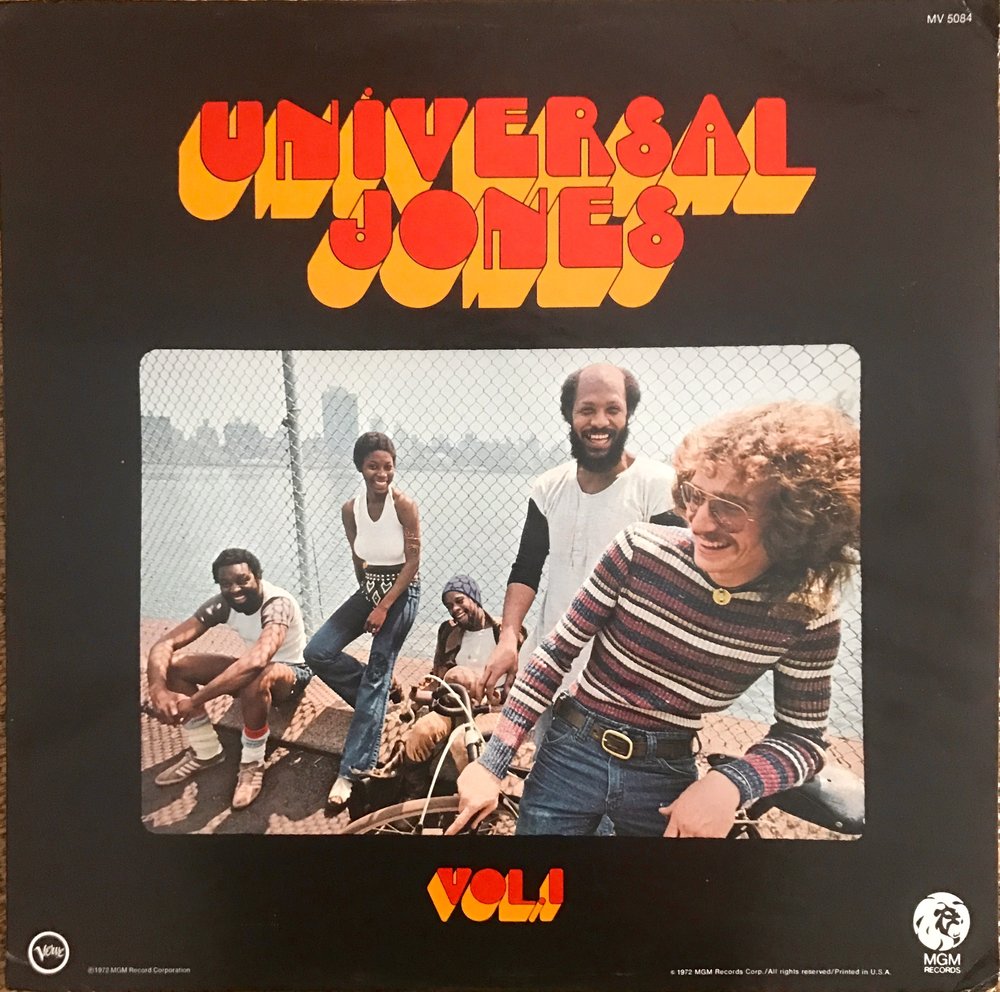
The folk-funk song “River” is by the American singer-songwriter and music producer Eugene McDaniels (1935–2011). He first recorded it with his band Universal Jones on a self-titled album (the group’s only output) in 1972, and he recorded it again, with a synth, on his solo album Natural Juices in 1975.

McDaniels grew up in Omaha, Nebraska, singing gospel music in church. He gained fame in the early 1960s as a clean-cut soul singer—he went by “Gene” at the time—and then surprised everyone in 1970 and 1971 with Outlaw and Headless Heroes of the Apocalypse, containing antiwar, antiestablishment songs performed in a much more experimental style. Universal Jones (1972) is innocuous by comparison, though it still embraces the counterculture. The genres of folk, rock, jazz, gospel, soul, funk, and even proto-rap—often creatively mixed—are all represented in McDaniels’s oeuvre.

Universal Jones cover
From left to right: Eugene McDaniels, Sister Charlotte, Leon Pendarvis, Maurice McKinley, Bob Woos

In the Bible, water connotes blessing, refreshment, life, hope, and abundance. “Flowing streams,” writes the Rev. J. Stafford Wright, “are parables of the flowing life of God.” Wright was referring in particular to one of Ezekiel’s visions, where an unnamed guide leads the prophet through a river that issues forth from the temple in Jerusalem (Ezek. 47:1–12). The guide says,

This water flows toward the eastern region and goes down into the Arabah, and when it enters the sea, the sea of stagnant waters, the water will become fresh. Wherever the river goes, every living creature that swarms will live, and there will be very many fish once these waters reach there. It will become fresh, and everything will live where the river goes.

He then goes on to describe the verdant trees on either side of the riverbank:

Their leaves will not wither nor their fruit fail, but they will bear fresh fruit every month, because the water for them flows from the sanctuary. Their fruit will be for food and their leaves for healing.

Sounds a lot like John’s eschatological vision in Revelation 22, where a river flows down from God’s throne, watering the tree of life, which is for the healing of nations. There are also similar passages in the Minor Prophets: “A fountain shall flow from the house of the LORD” (Joel 3:18); “And in that day it shall be that living waters shall flow from Jerusalem” (Zech. 14:8). God is understood as the source of these waters, which signify an invisible, spiritual reality.

(Related posts: https://artandtheology.org/2022/04/02/lent-28/; https://artandtheology.org/2022/12/11/advent-day-15-great-joy-river/)

When Jesus comes onto the scene, he talks about “rivers of living water” flowing out of the hearts of believers (John 7:38–39), “spring[s] of water welling up to eternal life” (John 4:13–14). God dwells in humanity, and thus the life God gives springs up from within us and vitalizes the wider world.

I don’t know whether McDaniels had any of these biblical texts in mind when he wrote “River.” But a river, a star, a voice, a song of love—these signal to me the Divine moving, shining, speaking, singing into the lives of humanity. Through the ups and downs of history, the ancient will has worked and is continuing to work, revealing itself to those who look, listen, and follow. Ecclesiastes 3:11 says that God has “set eternity in the human heart.” We possess a moral consciousness and spiritual yearning.

To me, “River” is about recognizing the blessing poured out on the world from the heart of God, about tuning in to the unseen truths embedded in the fabric of the universe. It speaks of God’s all-brightening smile (God’s pleasure in his creation), his whispers of our belovedness, and the river-flow of his goodness.

The song has been covered a handful of times over the years and across the globe, including by:

Further, in 1975 the California bluesman J. C. Burris adapted it both lyrically and musically and recorded it under the title “River of Life” on his album Blues Professor:

Bernice Johnson Reagon, a song leader and civil rights activist, uses Burris’s lyrics in her cover on River of Life: Harmony One (1986), overdubbing her voice singing multiple parts in an a cappella tour de force:

There’s a river somewhere
That flows through the life
Of everyone
And it flows through the mountains
And down through the meadow
Under the sun

There’s a star in the sky
That brightens up the life
Of everyone
They can see the life of happiness
Along with the future
Of the lonely one

Yes, it is

There’s a voice from the valley
That speaks to the mind
Of everyone
And it talks about the future
Along with the joy
Of the sorrowed one

Put a smile on your face
And brighten up the day
For everyone
And live your life of happiness
Along with the sick and lonely
And sorrowed one

Yes, it is

There’s a river somewhere
That flows through the life
Of everyone
And it flows from the mountain
Down through the meadow
Under the sun

There’s a sky full of diamonds
That brightens up the life
Of everyone
Then they can see the life of happiness
Along with the future
Of the lonely one

Yes, it is

The main revision by Burris comes at the end of each verse, where he mentions the lonely, the sick, and the sorrowful. They have a special place of belonging in God’s heart and plans. Jesus’s ministry was to such as these. Blessed are the poor and those who mourn, he said, for theirs is the kingdom of heaven.

Burris encourages us to come alongside those who are hurting with love and inclusion, and to look with them into God’s promised future, where the oppressed are liberated, the sick are healed, the silenced go out singing, and mourning is turned to dancing. Contra the cynicism of “the Preacher” who penned Ecclesiastes, there is something new under the sun! For those with eyes to see it, God is in the process of making all things new (Rev. 21:5).

Roundup: Black church–inspired art exhibition; new albums; visual Easter Vigil liturgy; and more

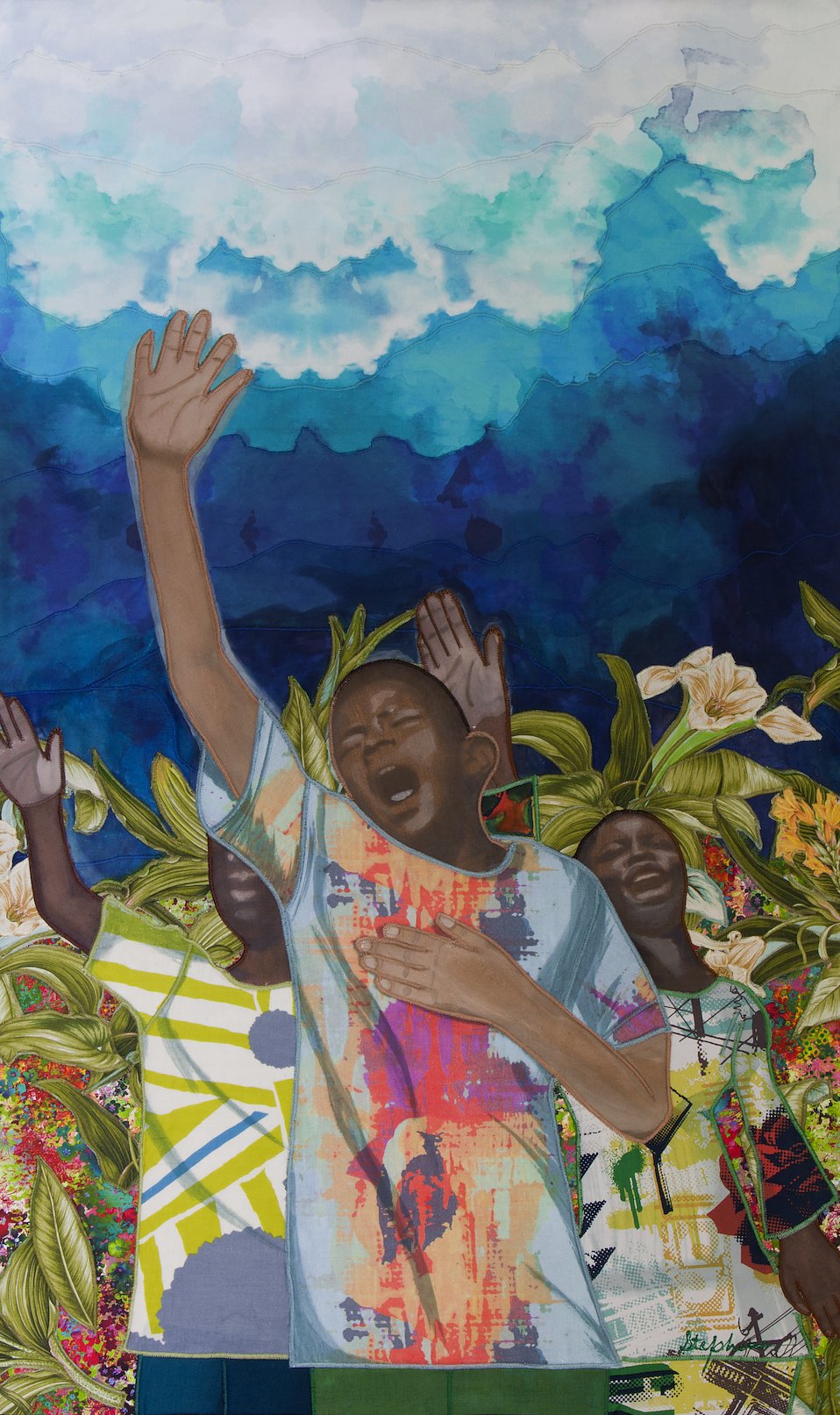
EXHIBITION: Otherwise/Revival, Bridge Projects, Los Angeles, April 9–June 26, 2021: Curated by Jasmine McNeal and Cara Megan Lewis, this group exhibition visualizes the impact of the historic Black church—specifically the Black Pentecostal movement—on contemporary artists. Included are several artists I’ve featured on the blog before—Lava Thomas [here], Kehinde Wiley [here], Clementine Hunter [here], Letitia and Sedrick Huckaby [here]—plus twenty-six others.

Phyllis Stephens (American, 1955–), High and Lifted Up, 2020. Cotton fabric, 57 × 33 in. Private collection. Courtesy of the artist and Richard Beavers Gallery, New York.

Davis, Kenturah_Namesake I
Kenturah Davis (American, 1984–), Namesake I, 2014. Incense ink on rice paper, applied with rubber stamp letters, 39 × 36 in. Courtesy of the artist and the Petrucci Family Foundation, New Jersey.

I regret that I won’t be able to see the exhibition in person, but there’s a wealth of relevant content available on the gallery’s website, including photos, artist bios and statements, and commentaries. I haven’t fully delved in yet, but some of the artist names are new to me, and I look forward to jumping over to their websites to learn more. There’s also a series of free events that have been scheduled. The premiere of the virtual music performance yes! lord by Ashton T. Crawley and a symposium on the Azusa Street Revival have already passed (both are archived online for on-demand viewing), but here are some upcoming opportunities you can reserve a spot for:

+++

ARTICLE: “5 Films About the Beauty of Resurrection” by Brett McCracken: “Resurrection’ tropes are so familiar in certain genres that they can numb us to the jarring beauty and bracing surprise of resurrection. But other films capture the magic and shock of resurrection by situating it within more mundane realities and contexts. Here are five of my favorite examples of this kind—movies that capture resurrection in all of its miraculous, unsettling, hope-giving glory.” One of his selections is Happy as Lazzaro, which I saw last year and enjoyed:

+++

NEW ALBUMS:

>> Hymns I by Lovkn: Steven Lufkin is a singer-songwriter from Phoenix, Arizona, recording under the name Lovkn. His latest EP, a collection of eight acoustic hymn covers, was released April 2. (Also, he’s currently raising funds to record an album of original songs, to be released later this year: kickstarter.com/projects/lovkn/new-album-2021.)

>> Prayers for the Time of Trial by Joel Clarkson: Released April 7, this EP comprises five original SATB choral compositions by Joel Clarkson, which he recorded with his sister Joy Clarkson. My favorite is the first, “Lighten Our Darkness,” a setting of the Book of Common Prayer’s Collect for Aid Against Perils: “Lighten our darkness, we beseech thee, O Lord; and by thy great mercy defend us from all perils and dangers of this night; for the love of thy only Son, our Savior, Jesus Christ. Amen.”

The other four are “Sub Tuum Praesidium” (Beneath Thy Protection), a third-century hymn to the Virgin Mary as Theotokos; “Hail King,” a poem by Joel’s other sister, Sarah Clarkson, that marvels at how rocky cliffs and sea waves and herring gulls sing God’s praises in their own way; “Ubi Caritas,” an ancient hymn centered on the theme of Christian charity; and the simple benediction “May the peace of the Lord be with you now and always.”

In addition to composing music, Joel is also a professional audiobook narrator and the author of Sensing God: Experiencing the Divine in Nature, Food, Music, and Beauty.

+++

ORTHODOX CHANT: Russian Kontakion of the Departed: At Prince Philip’s funeral service at St. George’s Chapel at Windsor Castle on April 17, a choir of four sang, among other pieces, the Russian Kontakion of the Departed, translated into English by William John Birkbeck and arranged by Sir Walter Parratt. “The Russian Kontakion of the Departed is an ancient Kiev chant with its origins in the Russian Orthodox liturgy. This moving chant expresses the sorrow of grief but reminds us of the Christian hope of everlasting life; in the face of sadness, we sing Hallelujahs.” [HT: Global Christian Worship]

Give rest, O Christ, to thy servant with thy saints:
where sorrow and pain are no more;
neither sighing but life everlasting.
Thou only art immortal, the creator and maker of man:
and we are mortal formed from the dust of the earth,
and unto earth shall we return:
for so thou didst ordain,
when thou created me saying:
Dust thou art und unto dust shalt thou return.
All we go down to the dust;
and weeping o’er the grave we make our song:
Alleluia, alleluia, alleluia.

+++

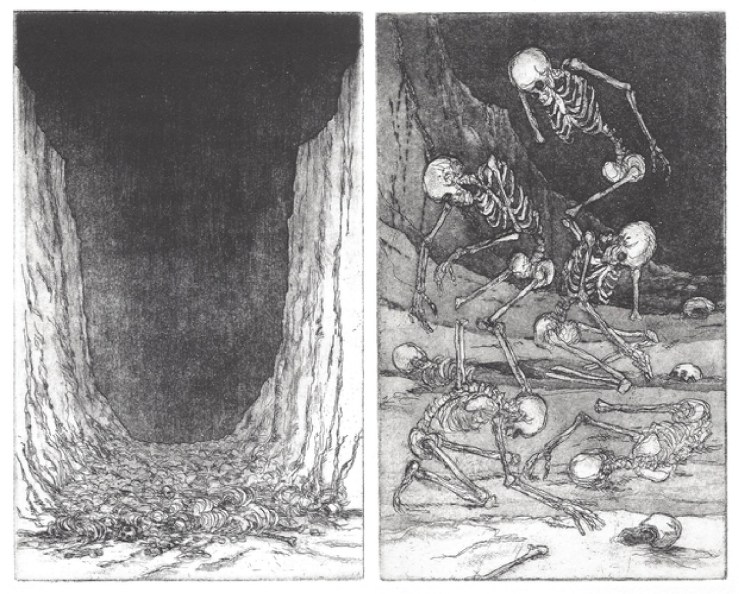
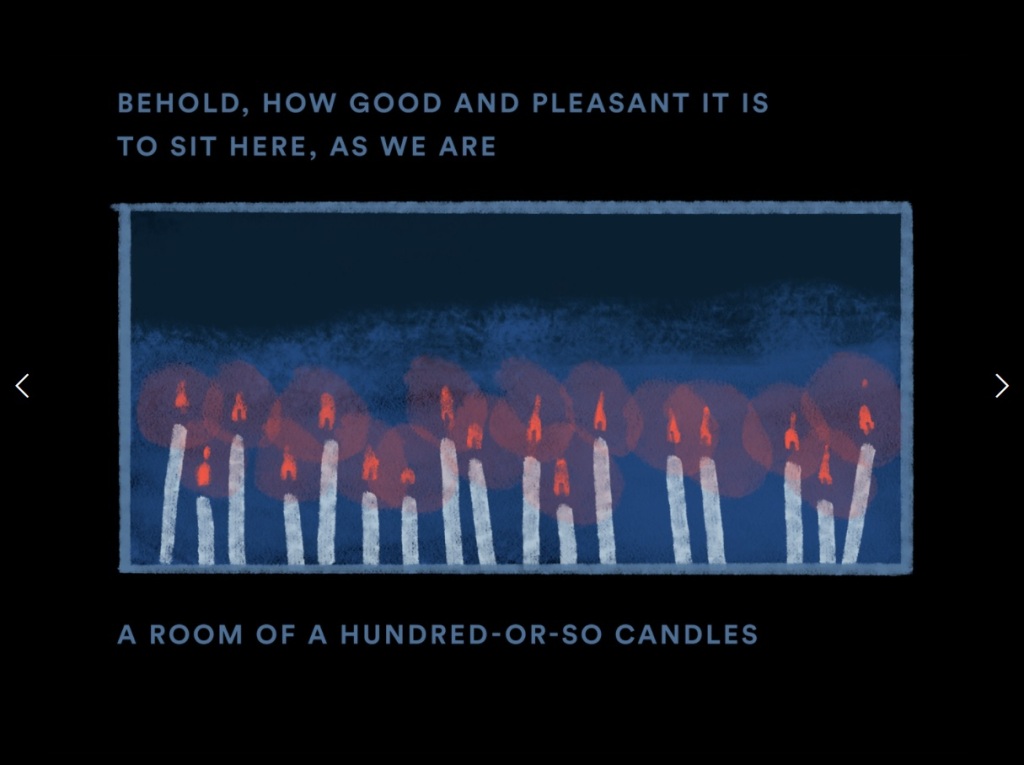
VISUAL LITURGY: “After Ezekiel” by Madeleine Jubilee Saito: Remember those flip books you probably encountered as a kid—the ones with a series of images that gradually change from one page to the next, giving the illusion of animation when viewed in quick succession? Well, this is a digital version of that. In 2019 cartoonist and illustrator Madeleine Jubilee Saito created an image sequence intended to be swiftly clicked through as part of the Easter Vigil at a church in Boston. It was inspired by the story of Ezekiel in the valley of dry bones (Ezek. 37). Very compelling!

“Turn Back, O Man” as motet and showtune

Early this week I was searching the Hymnary database for hymns based on or referent to Sunday’s lectionary reading from Ezekiel 18, where God calls on his people to “repent and turn from all your transgressions, lest iniquity be your ruin” (v. 30b), and the very similar passage later in the book: “As I live, declares the Lord GOD, I have no pleasure in the death of the wicked, but that the wicked turn from his way and live; turn back, turn back from your evil ways, for why will you die, O house of Israel?” (Ezek. 33:11).

One of the search results was “Turn Back, O Man” by the English poet and playwright Clifford Bax. Written in 1916, it doesn’t explicitly reference World War I, but it’s likely that that was the intended subtext.

Turn back, O man, forswear thy foolish ways.
Old now is earth, and none may count her days,
Yet thou, its child, whose head is crowned with flame,
Still wilt not hear thine inner God proclaim,
“Turn back, O man, forswear thy foolish ways.”
 
Earth might be fair, and people glad and wise.
Age after age their tragic empires rise,
Built while they dream, and in that dreaming weep.
Would they but wake from out their haunted sleep,
Earth shall be fair, and people glad and wise.
 
Earth shall be fair, and all its people one,
Nor till that hour shall God’s whole will be done!
Now, even now, once more from earth to sky
Peals forth in joy the old, undaunted cry,
“Earth shall be fair, and all its people one.”

The tune it’s set to in hymnals, OLD 124TH, is by Louis Bourgeois and is from the 1551 edition of the Genevan Psalter. Gustav Holst arranged the tune as a motet (a polyphonic, unaccompanied choral composition) in 1916 and in fact is the one who approached Bax with the request for a new text.

Here is a performance by the University of Texas Chamber Singers, from their 2008 album Great Hymns of Faith:

When I read the first line, it sounded familiar, and I was reminded that the song (with a much different tune and style!) opens the second act of Godspell. This 1971 musical created by John-Michael Tebelak and composed by Stephen Schwartz is based on Jesus’s teaching ministry as told in the Gospels, especially Matthew’s. (The show’s title is the archaic English spelling for “gospel.”) In addition to Jesus and John the Baptist/Judas, the cast consists of eight nonbiblical, “holy fool” characters who use their own names and sing and act out the parables and other sayings.

Tebelak, who wrote the play as his master’s thesis at Carnegie Mellon, was studying Greek and Roman mythology when, in his last year at school, he started reading the Christian Gospels in earnest and was enraptured by the joy they exuded and compelled by their emphasis on community. He tells the story of how on March 29, 1970, in pursuit of knowing more, he attended an Easter Vigil service at a church in Pittsburgh, wearing his usual overalls and a T-shirt—and he was frisked for drugs. “I left with the feeling that, rather than rolling the rock away from the Tomb, they were piling more on,” he said. That experience motivated him to write Godspell.

Tebelak’s Godspell was produced at Carnegie Mellon in late fall 1970, featuring an original song by cast member Jay Hamburger (“By My Side”) and a handful of old Episcopal hymns played by a rock band.

After leaving university, Tebelak took the show to New York City, where prospective producers suggested a new score and brought in Stephen Schwartz for the job. The rescored show, which retained Hamburger’s single song contribution, opened May 17, 1971, at the off-Broadway Cherry Lane Theatre and became a hit.

Six of Godspell’s eighteen song texts, including the chart-topping “Day by Day,” are actually taken straight from the Episcopal Hymnal. Schwartz liked the idea of dusting the cobwebs off some of these stodgy hymns and giving them new melodies with a catchy seventies pop vibe that would leave audiences singing them as they exited the theater.

“Turn Back, O Man” is one of those. It’s sung by Sonia, the sassy character with a put-on sensuality, a role originated by Sonia Manzano (of Sesame Street fame). Here’s the scene from the 1973 film adaptation directed by David Greene, with “Sonia” played by Joanne Jonas:

Isolated from the rest of the musical, this song seems completely irreverent and unbefitting the serious nature of God’s call to repentance. Its zaniness and sense of play, punctuated by Jesus’s pensive delivery of the third verse, is on a par with the tone of the whole—and that unique approach to telling the gospel works, I think, really well overall in Godspell, bringing to mind how “the foolishness of God is wiser than men, and the weakness of God is stronger than men” (1 Cor. 1:25). The characters embody the countercultural aspect of Jesus’s teachings, which appear ridiculous, clownish, to the rest of the world.

“The characters in Godspell were never supposed to be hippies,” Stephen Schwartz clarifies.

They were supposed to be putting on “clown” garb to follow the example of the Jesus character as was conceived by Godspell’s originator, John-Michael Tebelak, according to the “Christ as clown” theory propounded by Harvey Cox of the Harvard Divinity School (among others). . . . Because the show was originally produced in the hippie era, and because the director of the Godspell movie somewhat misinterpreted the characters as hippie-esque, that misunderstanding has come to haunt the show a bit.

In this particular song, performed by a hammy character in a feather boa, the lyrics entreat hearers to give up their “foolish ways,” going on to suggest that what is truly foolish is living as if asleep—building “tragic empires,” chasing empty dreams. Though endowed with the flame of reason and conscience, humanity at large, generation after generation, keeps rejecting God’s will, hence the lack of global unity and gladness.

“Dry Bones” by Rebekah Osborn

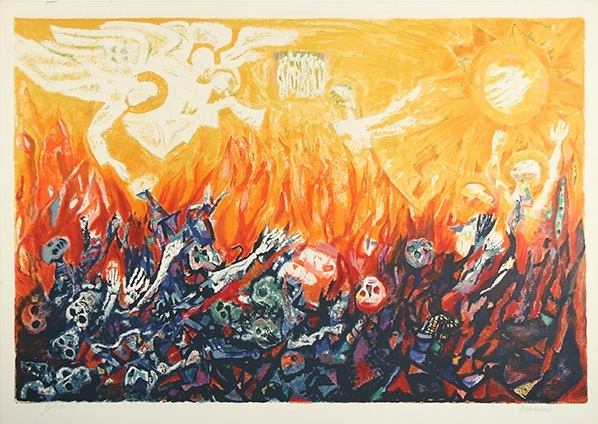
Valley of Dried Bones by Abraham Rattner
Abraham Rattner (American, 1895–1978), Valley of Dried Bones. Lithograph, 59.7 × 89.5 cm.

The macabre vision that God gives Ezekiel in 37:1–14 is to me one of the most compelling in all of scripture. In it God brings Ezekiel to a valley filled with dried-up human bones (the aftermath of a battle) and commands him to prophesy life to the bones. As he does, they start to reassemble into human shapes, then they grow tissue, then flesh. But they have no breath. So Ezekiel invokes the Spirit of God to come fill the corpses, and when the Spirit does, the corpses transform into live beings.

The dry bones in the vision represent the hopelessness of divided, dispersed Israel. She was “dead” as a nation, deprived of her land, her king, and her temple. But God promises to restore Israel physically and spiritually. The reanimation of the dry bones is a sign of that promise.

Christian theologians interpret this vision as being fulfilled by the descent of the Holy Spirit at Pentecost in Acts 2, to permanently indwell believers and so give them new life. Jesus Christ came as both king and temple for Israel, and founder of the New Jerusalem, and when he ascended to heaven he left his Spirit (pneuma, breath) on earth to continue his resurrection work.

Rebekah Osborn, singer, songwriter, and worship assistant at Redeemer Presbyterian Church in Indianapolis, wrote a song in 2012 inspired by Ezekiel’s vision of the valley of dry bones. I’ve embedded it here with her permission. (For more information see https://rebekahkayosborn.wordpress.com/2012/07/13/dry-bones/; access the chords here.)

I am standing in a valley filled with dead, dry bones
I don’t know if they could ever live again
He says, “I am calling you from your grave.
You will know I am Lord when I bring you from the dead.”

Rise up, dry bones
Breathe the air, live again
Rise up, dry bones
Death shall be master over you no more

I am standing in the valley when the Lord God says,
“Prophesy, son of man, over the dead,
For their bones dried up, and their hope is lost,
But they will know I am God when I bring them from their graves.”

(Chorus)

Oh Breath, breathe on these slain
That they may live
Oh Breath, breathe on these slain
That they may live

(Chorus)

All God’s people have their own personal resurrection narratives, and Osborn’s “Dry Bones” speaks to those. Before Christ, we were dead in sin, unwhole. But Christ breathed life into us, just like God did at Creation (Genesis 2:7), bringing us up out of the valley of death. In this mighty act of re-creation, Christ’s power is made known.

Still, even after receiving the gift of Christ’s Spirit, we sometimes experience periods of deadness. Things happen that obscure for us the reality of love and life that is at the center of the universe. This song can be used to sing through those valleys. We can ask God to bring us back to life, to revive us just as he did all those skeleton heaps before Ezekiel’s wonder-filled eyes.