
Roundup: Childbirth photography, “Talj, Talj,” and more

SUBSTACK POST: “Advent and Love” by Micha Boyett, The Slow Way: “There was a mother and man who loved her. There was a baby. The baby was the story God was telling, and that story became a seven-pound human and wailed. His mother cleaned his body with cloth and water, and fed him at her breast. She hoped he would latch on. It took a while. She bled and napped. He napped and cried again. He was God’s story and human. This is how he made a home with us. His making a home with us was love, and that love created a way for peace, hope, and joy.” Micha Boyett is an excellent spiritual writer, and I’m thrilled to learn that she has an Advent book coming out next year!

+++

CHILDBIRTH PHOTOGRAPHY: “2019 Birth Becomes Her Image Contest Winners” and “2020 IAPBP Competition Winners”: I’ve never birthed a baby or witnessed a live birth, but whenever I see photographs of the process and its outcome, it makes me emotional with joy. Seriously, I tear up as I smile. I don’t know these people, and yet I’m awed and overwhelmed.

Photo by Belle Verdiglione
Photograph by Belle Verdiglione, 2019

Since Christmas is about the BIRTH of Jesus, I find it meaningful to spend some time with childbirth photographs to remind myself how God chose to come to us—through a woman’s birth canal. It’s a wonder that never ceases to amaze me. Although there are a few exceptions, it’s a picture of birth that artists interpreting the Nativity typically don’t want to touch (in part because women’s bodies are still largely taboo, in part because the Catholic Church teaches the birth was quick, painless, and bloodless), and so in the artistic canon, we get mostly clean, calm images of postpartum bliss, not the laborious and messy before. But isn’t that, too, part of the miracle and the glory of Christmas?

The boldface links above are to past Birth Becomes Her and International Association of Professional Birth Photographers competitions. If you have any other recommended compilation sources or favorite childbirth photographers, I’d love to know!

+++

SONGS:

>> “Love Came Down” by Joanna Forbes L’Estrange: For her 2024 album Winter Light, the British choral composer Joanna Forbes L’Estrange wrote a new setting of this beloved Christmas poem by Christina Rossetti.

>> “Yeshu Thungea Ningla” (On the Day Jesus Was Born) by James Lhomi: Released by Lareso Music, this song was written by James Lhomi, a significant Lhomi Christian musician in Nepal. The Lhomi are a Tibetan people living in India, China, and Nepal. Lhomi is also the name of their language. The song opens, “Let us a sing a sweet song on the day of Christ’s birth, let us rejoice with a joyful heart, for Emmanuel has been born unto us.” [HT: Global Christian Worship]

>> “What a Day It Is” by Evan Thomas Way: Singer-songwriter Evan Thomas Way, cofounder (with Josh White) of the Deeper Well record label, released this song on his 2014 debut album, Only Light. At the time, he was the worship pastor at Door of Hope Church in Portland, Oregon; now he’s an executive pastor there.

>> “Talj, Talj” (Snow, Snow) by Fairuz: The Lebanese singer Fairuz (فيروز‎‎,) is one of the most celebrated singers in the Arab world. Born to Christian Maronite and Syriac Orthodox parents, she is now a member of the Greek Orthodox Church. She popularized the Arabic Christmas carol “Talj, Talj” on her 1977 album Christmas Hymns, which you can watch her perform on a television special in the video below (I can’t find the year or name of the show or broadcaster). The lyrics paint a wintry scene of snow falling and hearts flowering, for “there is a baby awake in the cave, and his sweet eyes are full of love.” [HT: Global Christian Worship]
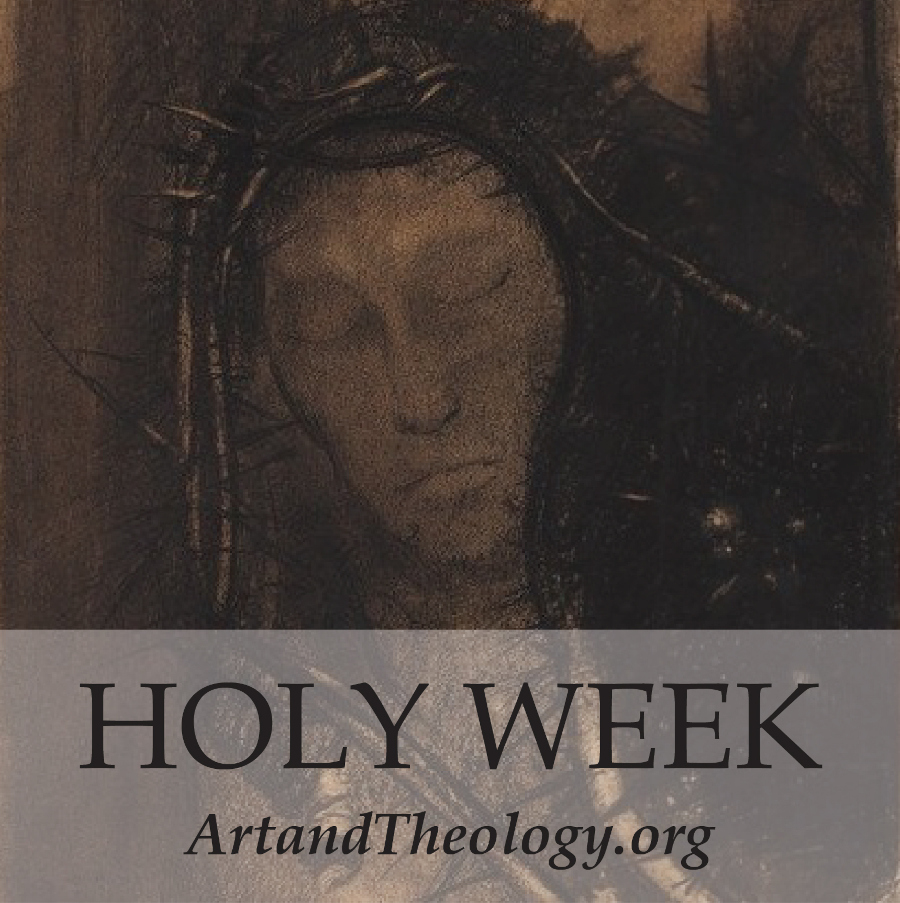
Holy Week Playlist

There are hundreds of thousands of musical works, from a range of genres, inspired by Christ’s passion, especially his death on the cross, which, along with the resurrection, is the centerpiece of the Christian faith. I’ve curated just a sampling of these on Spotify, from across time periods and countries, to serve as an aural guide through the final week of Jesus’s life. The drama begins with Christ’s triumphal entry into Jerusalem on a donkey, where he’s hailed with hosannas, and then continues with a last supper shared with his disciples, an agonized prayer in Gethsemane followed by betrayal and arrest, then, all in one day, multiple trials (religious and civil), conviction by mob, a public execution, and burial. Many of the playlist selections are narrative in character, while some have a more theological bent. My hope is that these pieces aid you in observing this most holy of weeks, walking with Christ through the shadows, taking in how “he himself bore our sins in his body on the tree, that we might die to sin and live to righteousness. By his wounds [we] have been healed” (1 Pet. 2:24).

To add the playlist to your account, open the Art & Theology Holy Week Playlist link, then click on the More (…) icon and select “Save to Library.”

Art & Theology Holy Week playlist (art by Odilon Redon)

[Playlist cover art: Odilon Redon, Christ, ca. 1895, charcoal, chalk, pastel, and pencil on paper, Museum of Modern Art, New York]

The playlist is a mixture of classical and popular (indie-folk, gospel) music. In this post I want to provide a little context for some of the pieces, by which I mainly mean translations of all the non-English lyrics. Because of what you see here, you might get the wrong impression that the list is almost entirely classical; actually, it’s only about half.

The opening track, “Herr, unser Herrscher” (Lord, Our Ruler), is a unique arrangement of the opening chorus from Johann Sebastian Bach’s St. John Passion, a Good Friday oratorio in German.

Herr, unser Herrscher, dessen Ruhm
In allen Landen herrlich ist!
  Zeig uns durch deine Passion,
  Daß du, der wahre Gottessohn,
  Zu aller Zeit,
  Auch in der größten Niedrigkeit,
  Verherrlicht worden bist!
Lord, our ruler, whose fame
In every land is glorious!
  Show us, through your passion,
  That you, the true Son of God,
  Through all time,
  Even in the greatest humiliation,
  Have become transfigured! [source]

Unique, because the Baroque choir and orchestra are accompanied by an ensemble of Gabonese musicians who contribute their own rhythmic profile, along with solo percussionists Sami Ateba from Cameroon and Naná Vasconcelos from Brazil. The recording, rereleased on the compilation album Babel (2008), is originally from Lambarena: Bach to Africa (1995), a collaboration between French composer and producer Hughes de Courson and Gabonese composer and guitarist Pierre Akendengué, synthesizing two disparate sound worlds. (“Bombé / Ruht wohl, ruht wohl, ihr heiligen Gebeine” is another highlight from the album. For weeks I debated whether to include it on this playlist—adding it, taking it off, adding it back again—ultimately deciding to leave it off, the reason being that it overlays Bach’s choral rondo with music and invocations to the dead from a Bwiti religious ritual. Though sonically compelling and worth listening to, I felt that it might impede some Christians’ ability to engage this list in a devotional way; so I opted for a traditional Western classical recording instead.)

Other selections from Bach’s St. John Passion are:

>> “Christus, der uns selig macht”

Christus, der uns selig macht,
Kein Bös’ hat begangen,
Der ward für uns in der Nacht
Als ein Dieb gefangen,
Geführt für gottlose Leut
Und fälschlich verklaget,
Verlacht, verhöhnt und verspeit,
Wie denn die Schrift saget.
Christ, who makes us blessed,
committed no evil deed,
for us he was taken in the night
like a thief,
led before godless people
and falsely accused,
scorned, shamed, and spat upon,
as the scripture says. [source]

>> “Petrus, der nicht denkt zurück”

Petrus, der nicht denkt zurück,
Seinen Gott verneinet,
Der doch auf ein' ernsten Blick
Bitterlichen weinet.
Jesu, blicke mich auch an,
Wenn ich nicht will büßen;
Wenn ich Böses hab getan,
Rühre mein Gewissen!
Peter, who did not recollect,
denied his God,
who yet after a serious glance
wept bitterly.
Jesus, look upon me also,
when I will not repent;
when I have done evil,
stir my conscience! [source]

>> “O große Lieb”

O große Lieb, O Lieb ohn alle Maße,
Die dich gebracht auf diese Marterstraße!
Ich lebte mit der Welt in Lust und Freuden,
Und du mußt leiden.
O great love, O love beyond measure,
that brought you to this path of martyrdom!
I lived with the world in delight and joy,
and you had to suffer. [source]

>> “Ruht wohl, ihr heiligen Gebeine”

Ruht wohl, ihr heiligen Gebeine,
Die ich nun weiter nicht beweine,
Ruht wohl und bringt auch mich zur Ruh!
Das Grab, so euch bestimmet ist
Und ferner keine Not umschließt,
Macht mir den Himmel auf und schließt die Hölle zu.
Rest well, you blessed limbs;
now I will no longer mourn you.
Rest well and bring me also to peace!
The grave that is allotted to you
and encloses no further suffering
opens heaven for me and closes off hell. [source]

For Bach’s St. Matthew Passion—one of the most celebrated works of classical sacred music ever written, right up there with Handel’s Messiah—I’ve drawn from the abridged English version (rather than the original German), translated by the Rev. Dr. John Troutbeck and performed in 1962 by the New York Philharmonic and Collegiate Chorale under the direction of Leonard Bernstein. I chose just a few pieces from it, not wishing to replicate the whole thing; as you can see, I tend to favor chorales over arias.

Continue reading “Holy Week Playlist”