Favorite Films of 2025, Part 1

This is my sixth consecutive year of sharing my top twenty newly released films—see my favorites from 2024, 2023, 2022, 2021, and 2020. My criterion for qualifying as a 2025 release is the film had to have shown in commercial screenings in the US in that year; or if there was no theatrical release, it had to have become available through video on demand. I’ve seen over a hundred such films and will share with you the ones I like best, split across two posts.
Favorite Films of 2025

The first Shaker settlement in colonial New York, the forests of early twentieth-century Idaho, a juke joint in Jim Crow Mississippi, the political prisons of 1970s Brazil, a crumbling ranch during the Rhodesian Bush War, a night market in Taipei, the beaches of a remote Welsh island—these are some of the places where the stories unfold. They explore parent-child relational fracture; the grief of losing a child or a spouse; the experience of spiritual ecstasy; the beauty of building a life and a family; the pressures of unemployment; the struggles of settling into a new city, country, or living arrangement; the horrors of adolescence; the consuming urge for revenge against an oppressor, and what to do when you’re confronted with their humanity; art making in (virtual) community; and the complicated process of healing from the trauma of sexual assault; among other themes.

Viewer discretion advised: Please beware that about half of these films have R ratings and may contain content that some find offensive. I do not flag such content because I don’t keep track of it and I evaluate movies based on their merit as a whole, recognizing that “mature” content is often necessary to tell a particular story; my descriptions should give you a good sense of whether that story is one you’d like to engage. But of course, if your conscience proscribes you from viewing certain content, please consult a content guide beforehand to determine if the film will be safe for you.

1. Sentimental Value, dir. Joachim Trier. Nora (Renate Reinsve), a stage actress, and her father Gustav (Stellan Skarsgård), a filmmaker, have a broken relationship. When she was a child her dad drank a lot, cheated on her mom, and left Norway for long periods of time to focus on his career. Now in his old age, Gustav wants to reconcile, and the only way he knows how to affirm the hurt his daughter feels and apologize for it is to write a role for her in a movie inspired by his own childhood, in which she would play a version of his mother. Nora has no interest in the project. She thinks it’s only a publicity stunt, not realizing it’s her dad’s way of saying, “I see you.”

Sentimental Value is about the emotional communication we lack, but also art as a way of translating pain into something we can share. (Film has the power to say things without saying them, fostering understanding.) It’s about the wounds family members inflict on each other, about love and rage and regret.

We come to learn that depression has afflicted three generations of this family: Nora, her mother, and her paternal grandmother. One of the most poignant scenes is where, when Nora is incapacitated again from her mental illness, her sister Agnes (Inga Ibsdotter Lilleaas) comes to clean her apartment while she lies awake on the couch—a simple act of care. The sisters’ bond is, I think, the sweetest aspect of the film.

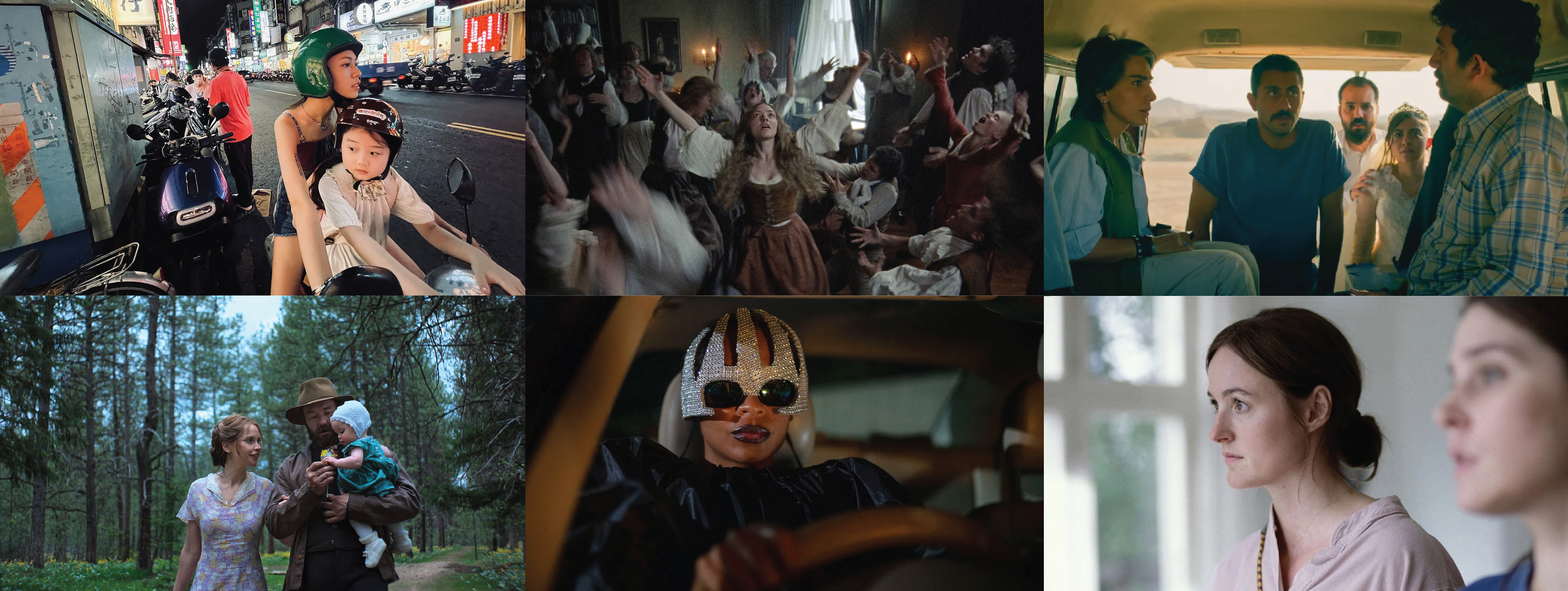
2. The Testament of Ann Lee, dir. Mona Fastvold. The Testament of Ann Lee is a musical biopic of the primary founder of the Shakers, a Christian sect that emerged in mid-eighteenth-century England and that was known for its ecstatic worship (“shaking”); under the visionary Ann Lee’s leadership, it would also come to be distinguished by its practice of communal living, celibacy, gender and racial equality, pacifism, and meticulous craftsmanship. Fleeing religious persecution, Lee (played by Amanda Seyfried) emigrated to America in 1774 with a small group of followers, building a community in upstate New York—but their loud, night-long worship services (which sparked rumors of witchcraft), their refusal to fight in the Revolutionary War (due to their commitment to nonviolence), and many men’s disapproval of sexual abstinence (women, including wives, flocked to the new movement) led to attacks in their new home country too.

Visceral and rousing and built largely on the rhythm of breaths and body slaps, Daniel Blumberg’s soundtrack is phenomenal; much of it consists of new arrangements of old Shaker hymns, including “Hunger and Thirst,” “All Is Summer,” and “Pretty Mother’s Home,” but he also composed a few original songs as well. Using historical documentation of Shaker dancing as fodder for the imagination, choreographer Celia Rowlson-Hall designed the ways in which the characters commune with God together through movement, bringing all their emotions to bear in their bodies.

As someone deeply interested in Christian history (even unorthodox offshoots) and early American hymnody, I was already inclined to like this movie. But I did not expect to be as transported as I was. The story, the acting, the music and dancing, the costumes, the set design, the cinematography—all contribute to an electric, devotional film that illuminates the life and legacy of a radical woman preacher from centuries past. I did not know that Lee had had four children and lost them all in infancy; this repeated trauma likely prompted her teaching, which she claimed to have received in a revelation from God, about the sinfulness of sex. In many ways, the film is about moving through grief.

3. Hamnet, dir. Chloé Zhao. We don’t know much about William Shakespeare, and still less about his wife Anne (aka Agnes, pronounced AHN-yes). One thing we do know is that the couple had three children, and their only son Hamnet—a name interchangeable with “Hamlet” in the loose orthography of the time—died at age eleven, likely of the bubonic plague. Based on a novel by Maggie O’Farrell, Chloé Zhao’s Hamnet traces Will (Paul Mescal) and Agnes’s (Jessie Buckley) relationship from courtship to marriage to childbearing and -rearing and then, in the second half, through the waves of grief that hit them in different ways after the sudden death of Hamnet (Jacobi Jupe). The film focuses especially on Agnes’s perspective, opening with her nestled in the exposed roots of a giant tree (establishing her deep connection to nature), developing her as a feral yet tender character at first radiant with the joys of motherhood and then ripped apart by loss, and climaxing with a transcendent moment she experiences in community at the premiere performance of Hamlet at the Globe Theatre in London.

Several Shakespeare biographers have speculated that his writing Hamlet was a means by which he processed his grief over the loss of his son, reconfiguring that grief into a work of art. Even though it’s about the death of a father, the play contains ghosts, mourning, madness, guilt, and contemplations of suicide that may have been at least partially colored by Will’s own personal tragedy. O’Farrell and Zhao, who cowrote the Hamnet screenplay, have given this theory a compelling narrative framework, a story of marital love that’s strained by grief but that survives it.

4. No Other Choice, dir. Park Chan-wook. Man-su (Lee Byung-Hun) is a hardworking, upper middle-class South Korean family man with a wife (Son Ye-jin) and two kids. He takes pride in his work as a manager at a paper mill, producing beautiful products. Then suddenly, after twenty-five years at the same company, he’s laid off due to an American buyout. After more than a year of unemployment, he grows desperate and decides to eliminate the three highest-qualified men in competition with him for a job in the paper industry.

Often in dark comedy thrillers, murder is treated lightly. Not so here. We see the humanity of Man-su’s targets, the shocking and unjust nature of his determined course of action, and the soul-hollowing cost of moral compromise. Despite the film’s premise, there’s actually no graphic violence, other than when Man-su extracts from his mouth a rotting tooth, symbolic of his pained conscience, with pliers (plus a disturbing image having to do with bonsai wiring). A satire of capitalism and the male ego, the film explores the lengths to which a man is willing to go to maintain an affluent lifestyle for himself and his family. And oh, what wonderfully composed shots! (Props to cinematographer Woo-hyung Kim.)

5. I’m Still Here, dir. Walter Salles. This Brazilian biographical drama is about the real-life Eunice Paiva (played by Fernanda Torres), a mother of five who fought for the truth after her politically dissident husband, Rubens Paiva (Selton Mello), was forcibly disappeared by the country’s military dictatorship in 1971. Suddenly thrown into the role of sole head of family, Eunice must hold everyone together and reinvent herself. She moves her family to São Paulo, earns a law degree, and becomes an activist at the center of campaigns to open archives on the victims of the military regime. She is indefatigable in demanding answers and pursuing justice. Her endurance is a form of resistance.

The director of I’m Still Here, Walter Salles, spent time with the Paivas during his adolescence—he was friends with one of Eunice’s boys and frequented their teeming, music-filled oceanfront home in Rio de Janeiro before Rubens went missing. The first half hour of the film activates those memories, while the film as a whole is based on a book by Eunice’s son Marcelo Rubens Paiva.

Streaming on Netflix.

6. On Becoming a Guinea Fowl, dir. Rungano Nyoni. Made and set in Zambia, this comedy-drama is in Bemba and English. Its title is a metaphor referring to how guinea fowl use their voice—a screech—to warn the flock of predators or other impending dangers. The film opens with Shula (Susan Chardy) driving home from a party one night—wearing a glittering helmet and a puffy black jumpsuit inspired by Missy Elliott’s “The Rain” video—when she finds her uncle Fred lying dead in the road. She doesn’t seem upset, and later, when gathered with her relatives, they press her. Where are your tears? She observes her family’s performative grief for a man she knew to be immoral and their mistreatment of Fred’s widow, and she wants no part of it.

It’s hard to talk about this film without giving away a key reveal. But I can say that it’s about the silence families keep to maintain the myth of a happy and well-functioning unit, the behavior of elders that families pretend not to notice for the sake of cohesion. Consider who gets mourned and who/what does not. A critique of patriarchal culture in Zambia, the film confronts generational differences, especially as relates to traditionalist versus progressive notions of accountability, agency, respect, and respectability.

Streaming on HBO.

7. Train Dreams, dir. Clint Bentley. Adapted from Denis Johnson’s 2011 novella of the same name, Train Dreams spans the 1890s through 1960s in and around Bonners Ferry, Idaho. Both grand and quiet, transcendent and personal, it chronicles the small, simple frontier life of Robert Grainier (Joel Edgerton)—all the beauty and pain it holds. Orphaned at age six, Robert meets Gladys (Felicity Jones) sometime in his twenties, and the two marry. They build a cabin together near a river, and have a daughter. The family enjoys ordinary pleasures, like supper by candlelight, naps on the front porch, chasing chickens in the yard.

Robert works first as a railroad bridge builder, then as a logger—which takes him away from home for months at a time—then as a hauler. He suffers incredible loss, but he keeps moving on, into old age, as the wild country all around him modernizes and marvels like airplanes, television, and space travel are introduced. The film is about dreams realized and unrealized, about grief and change, about the fleetingness and yet (paradoxically) substantiality of human life.

Streaming on Netflix.

8. It Was Just an Accident, dir. Jafar Panahi. Working one day in an auto shop in Tehran, Vahid (Vahid Mobasseri) is traumatized by the voice and gait of a first-time customer, whom he swears is Eghbal (Ebrahim Azizi), an Iranian government security officer who, years earlier, had blindfolded and tortured him when he was imprisoned for speaking out for workers’ rights. In a thirst for vengeance, Vahid kidnaps the man and is in the process of burying him alive in the desert when he starts to have doubts as to whether he’s the right person. He tracks down a few of his fellow ex-prisoners, including a wedding photographer (Mariam Afshari) and a young bride-to-be (Hadis Pakbaten), to provide identity confirmation—but they, too, have mixed degrees of certainty.

Equal parts retribution drama, moral thriller, and screwball road comedy, this film explores what happens when four victimized men and women turn the tables on their victimizer. It wrestles with justice and mercy—what they look like, which is more virtuous or more prudent in this situation, and what would distinguish the civilians’ act of killing from the murders committed by the regime they resist.

Writer-director Jafar Panahi has spent time in Iranian prisons under the charge of “propaganda against the Islamic Republic of Iran” and has been banned from filmmaking in that country, so he had to shoot It Was Just an Accident furtively. I was surprised by how effective the comedic elements are against the backdrop of brutality. (My description makes the film sound only harrowing, but it’s also funny; there were quite a few laughs in the audience during the screening I attended.) It’s a difficult tonal balance to pull off, but Panahi does.

9. Left-Handed Girl, Shih-Ching Tsou. Single mom Shu-Fen (Janel Tsai) and her daughters, college-age I-Ann (Shih-Yuan Ma) and five-year-old I-Jing (Nina Ye), have just moved from rural Taiwan back to the city of Taipei. Shu-Fen opens a noodle stand at a night market, I-Ann takes a job as a “betel nut beauty” (dressing seductively to sell a fruit chewed for its stimulant and mild narcotic effects), and I-Jing attends school and takes care of her pet meerkat. This family drama is about these three female protagonists adapting to their new environment, each navigating their own challenges, whether that be paying the rent and dealing with old-fashioned parents; finding a new social scene and a place to belong; or overcoming the shameful “curse” (as I-Jing’s grandpa keeps reminding her) of being left-handed. There’s a clichéd plot device used to amp up the drama that irks me, but other than that, I enjoyed this story of acclimation and survival.

Director Shih-Ching Tsou wrote the screenplay with Sean Baker—whose Florida Project, which Tsou co-produced, is one of my favorite all-time films. She shot Left-Handed Girl entirely on an iPhone 13.

Streaming on Netflix.

10. Sorry, Baby, dir. Eva Victor. Writer-director and lead actor Eva Victor’s feature film debut is a tragicomedy about healing after sexual assault. Her character, Agnes, is a literature professor at a college in small-town New England—the same college where, three years earlier, her graduate thesis adviser raped her. She works through her trauma with the support of her friend Lydie (Naomi Ackie); her adopted cat Olga, her neighbor Gavin (Lucas Hedges), and a stranger with a sandwich shop (John Carroll Lynch) also offer her their presence. Wit and empathy combine in this nonlinear, life-affirming story of a woman in the process of recovering her sense of self and security that were wrenched from her by a trusted other.

Streaming on HBO.

Read part 2.

Favorite Films of 2022, Part 1

Since 2020, I have been publishing an annual list of my top twenty films of the year, with trailers and microreviews. (See my lists for 2020 and 2021.) I love the collaborative nature of filmmaking, the coming together of so many talents—writing, acting, directing, shooting, editing, set design, costume design, etc.—to tell a story through moving images. Movies are actually my favorite mode of storytelling. It’s a shame that in some circles they’re denigrated as inferior to novels, less worthy of our time. That’s absolutely not true!

Moviegoing can be transformative. Like other art forms, movies reflect back to us the many aspects of the human (and in the case of my #5, animal!) experience, and can demand something of us.

Here are the first ten of my twenty recommendations for films to see that were released in the United States (though several were made internationally) in 2022, ranked in order of preference. Please be aware that many of these have R ratings and that you can consult content advisories if that concerns you.

1. Everything Everywhere All at Once, dir. Daniel Kwan and Daniel Scheinert. Bighearted and bizarre, this comedy sci-fi action adventure is about a first-generation Chinese American woman, Evelyn (Michelle Yeoh), who’s trying to hold it all together as her laundromat business is failing and her relationships are fraying, especially with her twenty-something daughter, Joy (Stephanie Hsu), whom she just doesn’t “get.” Then one day, out of nowhere, Evelyn is enlisted by a version of her husband, Waymond (Ke Huy Quan), to stop the evil Jobu Tupaki, a version of Joy, from destroying the multiverse. As Evelyn travels to alternate universes, she’s able to access skills and emotions her alt-selves possess and bring them back with her to help her fight.

Absurdity ensues. In one universe, Evelyn has hotdogs for fingers, and so becomes adept at using her feet; in one she’s a rock overlooking a canyon; in another, a teppanyaki chef whose colleague is controlled by a raccoon under his hat; in yet another, she’s a martial arts–trained movie star who never left China. She “verse jumps” from one to the other seeking to save her daughter from the vortex of despair into which she’s trying to suck everyone and everything, and all the while Joy is trying to find a version of her mother whom she can connect with, who can understand the emptiness in her.

The directors said the film is about a family trying to find each other through the chaos. At its core, it’s a family drama—one that explodes across the multiverse. It’s also about choosing kindness and joy (symbolized by a googly eye) and moving toward one another in empathy. It’s much louder and more outrageous than all my other picks, and I could have done without the scatological humor, but I found myself enthralled by the wild, disorienting ride that lands at a really tender place. Michelle Yeoh proves her versatility as an actor, and Jamie Lee Curtis, who plays IRS inspector Deirdre Beaubeirdra, is hilarious.

Streaming on Showtime.

2. The Banshees of Inisherin, dir. Martin McDonagh. Set in 1923 during the Irish Civil War on a fictional island off Ireland’s west coast, this dark comedy begins when Colm (Brendan Gleeson) tells his lifelong bestie, Pádraic (Colin Farrell), that he no longer wants to be friends. Colm is a fiddler and composer who wants to establish a legacy, a musical output that will live on—a goal that Pádraic is impeding by distracting him with daily hours of dull conversation, he says—whereas Pádraic says he merely wants to be known for “being nice.” Baffled by his friend’s abrupt severing of their relationship, Pádraic repeatedly pursues understanding and restoration, escalating the tension toward acts of violence. Male friendship and loneliness, melancholy, and mortality are key themes in this artful buddy-breakup movie that had me laughing out loud as well as tearing up.

Streaming on HBO Max.

3. Guillermo del Toro’s Pinocchio, dir. Guillermo del Toro and Mark Gustafson. Light overcomes the darkness in this stop-motion animated musical adaptation of the classic Italian children’s novel from 1883. It was written and codirected by Guillermo del Toro, a master of magical realism, and has been in development since 2008. When his young son dies, the carpenter Geppetto (David Bradley) carves a boy puppet, Pinocchio (Gregory Mann), to fill the hole left by this profound loss. In an act of compassion, the Wood Sprite (Tilda Swinton) brings Pinocchio to life and commissions Sebastian J. Cricket (Ewan MacGregor), an itinerant writer, to look out for him. Curious and unruly, Pinocchio ends up trapped in a circus by an abusive showman. He and his father spend much of the film trying to reunite, to be family to each other.  

These story points will sound familiar to most, but del Toro cleverly adapts them and adds new ones, setting the story in a Tuscan village during the rise of Mussolini in the 1930s, with one of the main villains being a Fascist podestà who’s trying to recruit Pinocchio into the army. It turns out it is the villagers who blindly subscribe to Il Duce’s propaganda who are the puppets, whereas Pinocchio, with his irrepressibility, is decidedly unpuppetlike. Thus the film explores contexts in which disobedience can be a virtue. Del Toro also places more emphasis on Geppetto’s growth than Pinocchio’s, making the story about Geppetto becoming a real father—learning to accept Pinocchio with all his quirks and difference, not making his love contingent on Pinocchio fulfilling his image of the perfect son—rather than Pinocchio becoming a real boy.

The artistry of this film is dazzling! I was blown away by the production design by Guy Davis and Curt Enderle (they designed the locations and characters and established the whole visual style), especially the evocation of interwar Italian life and culture, with the centrality of the church. I’m also dazzled by the puppets—shout-out to Georgina Haynes, the director of character fabrication—because remember, with stop-motion animation, all the characters are handmade, physical creations existing in three-dimensional space, not computer-made or drawn on a page; all but the “wooden” Pinocchio (made from 3D-printed hard plastic) consist of a manipulable silicone skin sitting over a mechanized system.

Streaming on Netflix.

4. Aftersun, dir. Charlotte Wells. Eleven-year-old Sophie (Frankie Corio) is on vacation with her single dad, Calum (Paul Mescal), in Turkey. He doesn’t have a lot of money, but he’s trying to create a memorable holiday for her. And despite its mundanity, it is memorable—the frame story is adult Sophie replaying its moments on tape and in her mind. Aftersun is a very personal project for first-time writer-director Charlotte Wells, who draws on her own history and relationship with her father; she says she wants people to be able to feel the warmth of these memories, even though they’re tinged with sadness. Though it’s never spelled out, it appears that Calum suffers from depression, and we gradually see more and more of his pain. The lack of exposition enables us to make our own inferences about it and about the ending. The “Under Pressure” dance sequence, which intercuts a frantic, stroboscopic nightclub scene where adult Sophie searches the floor for Calum with one of young Sophie and Calum dancing lovingly outside the hotel, safe in each other’s arms, is a contender for scene of the year—a metaphoric conveyance of mental health decline, of holding on and letting go.

5. EO, dir. Jerzy Skolimowski. Who would have thought a donkey’s inner life could be so captivating to watch onscreen? His memories, his imagination, his hopes, his fears, the affection he feels and longs for, his joys and sorrows. EO follows the life journey of the titular donkey as he passes from owner to owner, some of them kind, others cruel. He starts out at a circus in Poland, where he’s tenderly cared for by the young performer Magda (Sandra Drzymalska). But he’s seized by animal rights activists and ends up at a horse sanctuary, and from there he moves to a petting farm for children with disabilities. He escapes, looking for Magda, and spends a harrowing night alone in the forest. Chancing upon a soccer game the next day, he becomes a mascot for a time, a figure of great adulation but also vitriol by the opposing team. His next job is as a beast of burden at a fur farm, where he’s made to carry fox pelts, and then he’s acquired by an Italian priest.

There’s very little dialogue in the film, and there are no voiceovers to convey EO’s thoughts or emotions, which we infer by context. The cinematography, from close-up shots of EO’s dark, expressive eyes to wide shots of varied landscapes, is gorgeous—visual poetry. EO is an indictment of human violence and a call to empathy for animals. Dare I say I liked it better than the Bresson classic (Au hasard Balthazar) that inspired it? Unlike its predecessor, it stays entirely focused on the donkey’s perspective, with humans relegated to the periphery.

6. Hit the Road, dir. Panah Panahi. A road-trip dramedy from Iran, this debut feature by Panah Panahi follows a family of four as they drive across the Iranian countryside under the pretext of a wedding. Dad (Mohammad Hassan Madjooni), who wears a leg cast, sits in the back with the young ball-of-fire son (Rayan Sarlak) and sick dog, while Mom (Pantea Panahiha) and the quiet older son (Amin Simiar) take turns at the wheel, sometimes evincing their worry. There’s something clandestine about this journey, and over the course of the film we learn more but not much. But even with the imminent separation hanging like a cloud, there’s a lightness and a sweetness that’s so endearing as we watch the characters bicker and goof around and connect with one another. Films that can hold together the weighty and the comical, like this one, tend to be the ones I enjoy most.

Streaming on Showtime.

7. TÁR, dir. Todd Field. Set in the classical music world, this drama explores the corrupting nature of power through the (fictional) character of Lydia Tár (Cate Blanchett), an award-winning conductor, composer, educator, and author. It’s an intense and brilliant performance of a complex character who is amazing at her craft but who also uses her status to manipulate others, including the young female cellist who has just joined her orchestra, the prestigious Berlin Philharmonic. The tension rachets up as they prepare to perform Mahler’s Fifth Symphony and rumors about Lydia’s connection to the death of one of her former protégés threaten to undo her.

8. Broker, dir. Kore-eda Hirokazu. Found families is a key theme in the oeuvre of the Japanese director Kore-eda Hirokazu, whose Shoplifters (2019) is one of my all-time favorite films. His latest, Broker, is set in South Korea. Seeking to place her newborn son, Woo-sung, in the care of a family better equipped to raise him, the young single mom So-young (Ji-eun Lee) leaves him outside a church, where he is intercepted by Sang-hyeon (Song Kang-ho) and Dong-soo (Dong-won Gang), who attempt to sell him on the adoption black market. The next day she returns with doubts and demands to be included in the process of finding a home for Woo-sung. So she follows the two brokers in responding to the calls of prospective buyers, and along the way they pick up a stowaway from an orphanage, the ebullient Hae-jin (Seung-soo Im), the character that really brought it all together for me.

As they drive from city to city, the five travelers bond with one another, each of them carrying their own forms of rejection trauma and seeking love and belonging. The last night they spend together . . . wow! Kore-eda is a deft handler of sentiment, never maudlin but rather inserting understated emotional moments in all the right places (another example: the flower on the wet car window scene). He tackles heavy subject matter and complex social issues with heart, always keeping his characters at the center and allowing for reprieves of warmth and brightness. He avoids simplistic endings but also unnecessarily bleak ones, taking a vantage point of hope.

9. The Fabelmans, dir. Steven Spielberg. This coming-of-age drama is a fictionalized telling of Steven Spielberg’s upbringing in a midcentury Jewish American household and, since seeing his first movie in a theater at age six, his developing passion for cinema. Spielberg’s stand-in is Sammy Fabelman (Gabriel LaBelle). In many ways The Fabelmans is Spielberg’s love letter to his artistic and free-spirited mother, named Mitzi in the movie and played by Michelle Williams, who from the get-go fully supports Sammy’s dream to become a filmmaker, unlike his much more practical father, Burt (Paul Dano), a computer engineer, who doesn’t initially see filmmaking as a worthy pursuit.

I wondered if The Fabelmans was going to be a self-indulgent homage to Spielberg’s successful career, full of Easter eggs to his other films, but it wasn’t that at all. The story stands on its own apart from its basis in the particularities of Spielberg’s life. It’s about vocation and family and the power of films to help us see the truth. That it’s also a semiautobiographical portrait of a director whose films I grew up on (E.T., Jaws, Jurassic Park) and continue to admire is an added bonus!

10. Nanny, dir. Nikyatu Jusu. Marked by menace and mystery, this psychological horror-drama centers on Aisha (Anna Diop), a Senegalese immigrant to New York City hired by an affluent couple to care for their daughter. Aisha is haunted by the absence of her six-year-old son, whom she left under the care of a cousin in Senegal so that she could earn money to bring him to the US. But that goal becomes difficult when her employers start withholding her wages. As she navigates the oppressive situation she finds herself in, she is visited by figures from West African folklore: Mami Wata (a mermaid-like water spirit) and Anansi (a trickster spider). They seem like malevolent forces, but her boyfriend’s grandmother encourages her to reframe her thinking and to ask what the spirits want not from her but for her. Could they be haunting her to help guide her toward a new and better life?

The film deals with class, race, exploitation, resistance, survival, motherhood, and guilt—all parts of Aisha’s immigrant experience. Despite the too-quick resolution that follows, the scene at the end of Aisha being reborn out of chaos is visually and emotionally compelling. I appreciate how writer-director Nikyatu Jusu, born in the US to Sierra Leonean parents, uses supernatural horror tropes in unique and subversive ways.

Streaming on Amazon Prime.

Read part 2.

Favorite Films of 2021, Part 1

I know, I know. My top 20 list of films from 2021 is very late. Several that I wanted to see before compiling the list didn’t come to a theater near me until after the Oscar nominees were announced . . . But better late than never, right?

I’m breaking up the list into two separate posts.

I am counting films as from 2021 if they were released in the US in that year. If the film is available for free through a streaming service to subscribers, I will mention that at the end of the description; most of the others can be rented online for a fee, or you might also try checking your local library for a DVD.

Note: Several of these films are rated R, and for a variety of reasons. If you want to avoid specific types of mature content, I suggest you consult the Parents’ Guide on the IMDB page of whatever movie you’re considering watching.

If you’d like to see my top 20 films of 2020, click here.

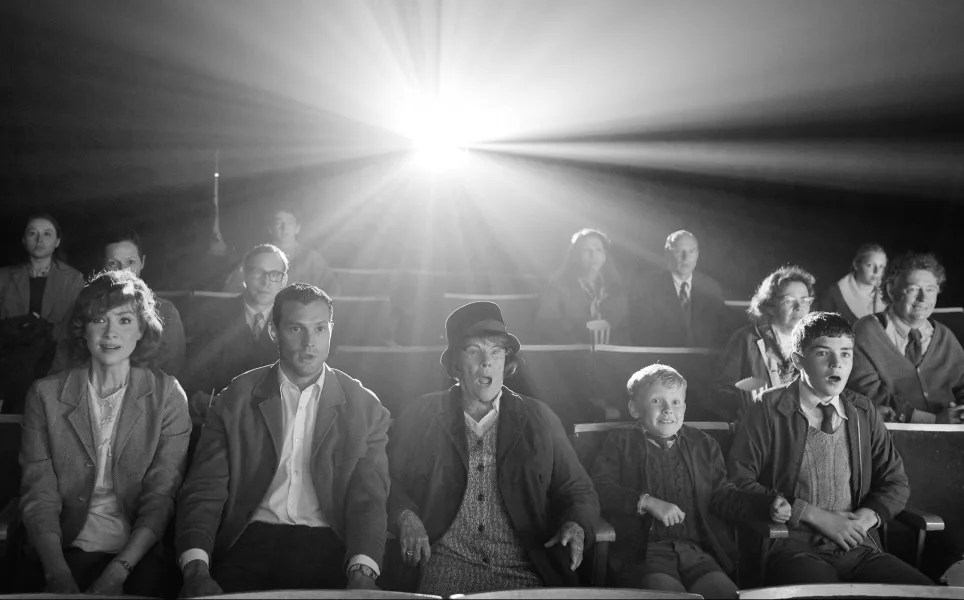
Belfast film still
The joy of cinema is one of the themes in Kenneth Branagh’s semiautobiographical film Belfast, as all three generations of Buddy’s family enjoy going to the movies together. In this still, they react to the flying car riding off the cliff in Chitty Chitty Bang Bang.

1. Belfast, dir. Kenneth Branagh. Drawn from writer-director Kenneth Branagh’s own childhood, Belfast takes place in 1969–70 in a working-class neighborhood in the Northern Ireland capital, at the beginning of the thirty-year period of political violence known as the Troubles. This conflict was between (mostly Catholic) nationalists seeking independence from Britain, and (mostly Protestant) loyalists who saw themselves as British and thus sought to preserve Northern Ireland’s union with Britain. The focus of the film, however, is on family, not politics, as all the events of the year are filtered through the perspective of nine-year-old Buddy (Jude Hill). He sees his dad, for example, who refuses to participate in the riots, as a hero in the vein of his favorite western film characters.

Belfast is poignant and nostalgic and not at all the worse for being so. The “Everlasting Love” scene near the end is euphoric—and well earned!—and made me cry. In the wake of a death and amid financial debt, impending displacement from what has been their family’s hometown for generations, and other marital strains, Pa (Jamie Dornan) sings a pop song to Ma (Caitriona Balfe) from a lounge stage and pulls her into a dance, creating a moment of pure celebration, love, and defiant survival. The film’s highlight for me is how it holds together life’s joys and struggles, sorrows and laughter. Branagh, who moved with his parents and brother from Belfast to Reading, England, at age nine to escape the violence, dedicated the film to “those who stayed, those who left, and those who were lost” in Belfast.

2. The Power of the Dog, dir. Jane Campion. An adaptation of a Thomas Savage novel, this film subverts the traditional image of the western cowboy, exploring male virility, vulnerability, and agency. What is required to protect those you love? Is it muscles and bluster and a “gloves off” sort of grit, or a courage rooted someplace else?

Set in Montana in 1925, the film centers on the macho-posturing Phil Burbank (Benedict Cumberbatch), who runs a cattle ranch with his brother George (Jesse Plemons). When George marries the widowed Rose (Kirsten Dunst), she and her impressionable teenage son Peter (Kodi Smit-McPhee) settle at the Burbank estate. Phil is set off by Peter’s “sissiness”—his willowy frame, his slight lisp, his delight in crafting paper flowers for his mother—and he reacts with incessant bullying. He is cruel, mocking, and emotionally abusive not only to Peter but also to Rose, whom he resents for layered reasons.

The ending makes us see one of the characters in a completely different light and therefore prompts us to reread some of the emotional dynamics we have witnessed. The title comes from Psalm 22:20: “Deliver my soul from the sword; my darling from the power of the dog” (KJV).

Streaming on Netflix.

3. The Lost Daughter, dir. Maggie Gyllenhaal. Ambivalence toward motherhood is rarely explored onscreen. We see mother characters overwhelmed and exhausted, even stifled, but the sacrifices they make in those roles are almost always portrayed as ultimately worth it for the profound love and joy they experience as a result of being a mom. Because we’re conditioned, culturally and religiously, to view children as an unmitigated blessing, to express any kind of regret about having children is taboo (we’re only allowed to regret not having children). Women are expected to relish their role as mothers and to find their deepest fulfillment in that role, and if they don’t, they’re branded as “bad” or selfish.

I can already hear the alarm bells going off with my readers right now. “Children are a gift from God! How dare we be anything less than grateful for them! Women are designed to bear and nurture life! What could possibly be more fulfilling than living out that design?” One of the great things about films is that they often help us to enter into other experiences and perspectives, to access the feelings of another and, through that, our own. That doesn’t mean we forsake our beliefs and convictions, but we open ourselves up to a story that could challenge our sometimes overly simplistic thinking. One doesn’t have to reject the Bible to acknowledge that motherhood is messy and that for many women it requires them to confront (or else bury) darker pulls and emotions. Contrary to what we’re often told, motherliness does not come naturally to all women! There’s much more I could say about this, but let’s get to The Lost Daughter:

First-time writer-director Maggie Gyllenhaal, who herself has two daughters, wanted to make a film that explores all the complicated, unresolved emotions surrounding motherhood, which can include terror, anxiety, doubt, annoyance, and despair. An adaptation of Elena Ferrante’s novel of the same title, it follows Leda (Olivia Colman), a middle-age literature professor on holiday in Greece. One day on the beach she encounters a young mother named Nina (Dakota Johnson), who triggers Leda’s memories of her own two daughters, now in their twenties. We see flashbacks to Leda’s life as a struggling twenty-something mom (played by Jessie Buckley). She loves her children but feels plundered by them. And so she does something “aberrant,” as Gyllenhaal put it in an interview, which we find out about halfway through the film.

The film neither punishes nor condones its protagonist’s behavior. To what degree Leda feels guilt, regret, or satisfaction, and about what specifically, is largely left to the viewer to interpret, as she’s a hard one to read. (Colman gives us a very interior performance, which I think is to her and the film’s credit.) She is obviously troubled by past decisions, as her dizzy spells and thievery would suggest. There is also quite a bit of open-ended symbolism at play throughout.

Streaming on Netflix.

4. Drive My Car, dir. Ryûsuke Hamaguchi. The forty-minute prologue of this three-hour film establishes the relationship between theater actor-director Yusuke Kafuku (Hidetoshi Nishijima) and his screenwriter wife, Oto (Reika Kirishima). Within this pocket of time, Oto dies of a cerebral hemorrhage—after Yusuke finds out about her having an affair but before he confronts her about it. Roll opening credits.

Based loosely on a short story by Haruki Murakami, Drive My Car is about grief, intimacy, betrayal, forgiveness, self-knowledge, and communication across barriers. Two years after his wife’s death, Yusuke participates in a residency in Hiroshima, where he has been invited to direct a multilingual stage production of Chekhov’s Uncle Vanya, about a forty-seven-year-old man who is so world-weary that he wants to die. Yusuke’s concept is for the actors to act in their native language—Mandarin, Japanese, Korean, Korean Sign Language—feeding off their dialogue partner’s tones, speech rhythms, body language, and facial expressions, while subtitles are projected on a screen for the play’s audience.

Yusuke’s emotional healing comes through his work on this play (“Chekhov is terrifying because his lines drag the real out of you,” he says) and through the friendship he develops with his assigned driver, Misaki Watari (Toko Miura), a young woman who also carries a private grief. The two help each other come to terms with loss and regret and learn how to live again.

Streaming on HBO Max.

5. Flee, dir. Jonas Poher Rasmussen. This animated documentary chronicles the refugee experience of Amin Nawabi (not his real name), who fled from Afghanistan to Russia with his family in 1992 when he was eleven to escape the Mujahedeen attacks that became more frequent in Kabul after the Soviet withdrawal. He sought asylum in Europe for the next few years as an unaccompanied minor and eventually settled in Denmark, where he attended high school in Copenhagen and became friends with classmate Jonas Poher Rasmussen, now a filmmaker. More than twenty years later, he is telling his story for the first time, and it is Rasmussen he has entrusted it to.

The use of animation, a rare but not unheard-of choice for a documentary, has several advantages. It enables the subject to remain anonymous for his own safety. It allows for the re-creation of scenes from Amin’s childhood that were not, and could not have been, captured on film. And it enhances the expressiveness, tone, and meaning of certain scenes. The animation is supplemented, sparingly, with archival newsreel footage that gives historical veracity to some of Amin’s memories. And an important link to “the real” is forged by the use of Amin’s own voice in the animated interview sessions, conducted over several years, and sometimes in voiceover in the flashbacks. (His younger self is voiced by actors who capture him at two different ages—nine to eleven, and fifteen to eighteen.)

Throughout the film, Amin works to integrate his past and present and to make a home (“someplace safe, somewhere you know you can stay, and you don’t have to move on”) with his fiancé, Kasper, whom he has not yet spoken his traumas to.

Streaming on Hulu.

6. CODA, dir. Sian Heder. Sure, this film follows a predictable narrative arc and hits all the notes you would expect. But it’s so good! Seventeen-year-old Ruby (Emilia Jones) is the only hearing member of her family (CODA = child of deaf adults). Before school each day she works on the family’s fishing boat with her dad (Troy Kotsur) and older brother (Daniel Durant), while her mom (Marlee Matlin) runs the business side of things. But she finds herself increasingly drawn toward singing as a career path, and she starts to consider applying to Berklee College of Music in Boston.

The conflict is a familiar one: follow the plans your parents have laid out for you, or chase your own dreams, your own calling. Ruby needs to find her identity apart from being her family’s interpreter. But how can she honor the talents she’s been gifted with and her family obligations? Ruby’s parents slowly learn to accept and support her ambitions, even though they revolve around an auditory art form that is not accessible to them, and even though it means she’ll have to leave home. A turning point comes when they see her sing a duet at a school concert. In what is the most moving scene in the film, they experience the performance through watching the reactions of others in the audience.

Streaming on Apple TV+.

7. The Killing of Two Lovers, dir. Robert Machoian. A stylish arthouse drama set in rural Utah, this film follows David (Clayne Crawford), who’s desperately trying to keep his family of six together during a separation from his wife, Niki (Sepideh Moafi). He refuses to accept that the marriage is over. Shot in a 4:3 aspect ratio and with lots of long takes, the film is raw, potent, unflinching. And I love where it ends up.

Streaming on Hulu.

8. The Truffle Hunters, dir. Michael Dweck and Gregory Kershaw. This documentary made me smile more than any other film I saw last year. It’s so tender, and so gorgeously shot. And it’s got to be my favorite dog movie!

Truffle hunters are typically a secretive bunch, but the filmmakers got access to several of these elderly men from northern Italy who forage the forests with their trusty dogs, seeking out the edible fungus, a gourmet delicacy, to sell at high-priced auctions or on the black market. There are no interviews, no voiceovers—just a quietly observant camera. Despite the high prices truffles fetch, the hunters live simple lives in their Piedmont villages. And each has his own personality.

There’s a heavy focus on the relationship between the men and their dogs. They share meals with them, take baths with them, sing “Happy Birthday” to them, bring them to church. Aurelio, who is single and has no children, looks for someone to take care of his dog Birba when he dies; his chatter with Birba, and his expressions of love (like baking her a cake for her birthday), is the most endearing part of the film. It was also precious to see Titina, Carlo’s dog, being blessed by a priest—to use her gift of scent to serve others, to bring joy, as her finds will end up being used to make delicious dishes.

9. The Father, dir. Florian Zeller. Because of the COVID-19 extended eligibility period for Oscar submissions last year, this film was technically part of the 2021 Academy Awards, even though it was released in February 2021. Anthony Hopkins, who won Best Actor for this role, plays Anthony, an elderly man with dementia. As he loses his grip on the things and people around him, he becomes easily agitated and resists the care of his daughter Anne (Olivia Colman).

Zeller said he wanted the audience to feel as though, like Anthony, they’re “groping their way through a labyrinth,” so he wove a complex narrative that mixes reality with Anthony’s memories. We are made to feel his confusion, terror, frustration, and disorientation, in part by the use of multiple actors to portray a single character, such that we’re also not sure who’s who and what’s going on. Kudos to editor Yorgos Lamprinos and production designer Peter Francis for their work, as both those skills are key in pulling off this kind of storytelling.

The film is heartbreaking—the biggest downer on my list, for sure, especially with its climactic scene where Anthony breaks down and cries for his mommy. But by inviting us into Anthony’s suffering, The Father develops our empathy for those whose brains stop functioning properly in old age, for whom the world no longer makes any sense—an incredibly fearful thing.

10. C’mon C’mon, dir. Mike Mills. Johnny (Joaquin Phoenix) is a radio journalist who travels the US asking kids big questions about life. When his sister (Gaby Hoffmann) is forced to deal with a mental health crisis her ex-husband is experiencing, Johnny becomes the caretaker of her son (Woody Norman) for an extended period. The uncle-nephew bonding that follows constitutes the core of the film. Unlike The Lost Daughter, C’mon C’mon paints a bright and affirmative portrait of parenthood. It acknowledges the challenges of raising children while also celebrating the many small, beautiful moments of connection that are possible between adult and child.

Read part 2.