
ONLINE COURSE: The Christian Imagination with Dr. Mary McCampbell, July 9–August 22, 2026: Mary McCampbell is an independent scholar of the humanities with over twenty years’ teaching experience in higher education. Starting next month, she’s offering an online course on the Christian imagination for $100 (fee paid through Venmo). Classes will take place Thursdays from 7 to 8:30 p.m. ET and will be recorded for those who can’t attend live.
“In this interdisciplinary class, we will read fiction and poetry, listen to music, and look at visual art that encourages us to recognize the mystery of God and the paradoxical nature of the human condition. We will also read essays from artists and scholars to discuss what it means for the artist of faith to create meaningful things for which faith is, as O’Connor notes, ‘the light by which I see.’ Last of all, we will address why every Christian needs to value the imagination and what this might look like in practice.” Graham Greene, Flannery O’Connor, T. S. Eliot, Leif Enger, Sho Baraka, C. S. Lewis, Christian Wiman, and Frederick Douglass are among the artists and thinkers whom participants will engage.
+++
ARTICLE: “Male Statues Are Transformed into Fathers Carrying Their Babies,” My Modern Met: On November 19, 2024, International Men’s Day, fathers around Sweden went out and adorned male statues with baby slings, carriers, and dolls as part of the #Kvantitetstidspappan (Quantity Time Dad) campaign conceived by the think tank Arena Idé. Its purpose was to challenge societal assumptions that women ought to be the primary caregivers to their children rather than sharing that responsibility equally with their male partner.
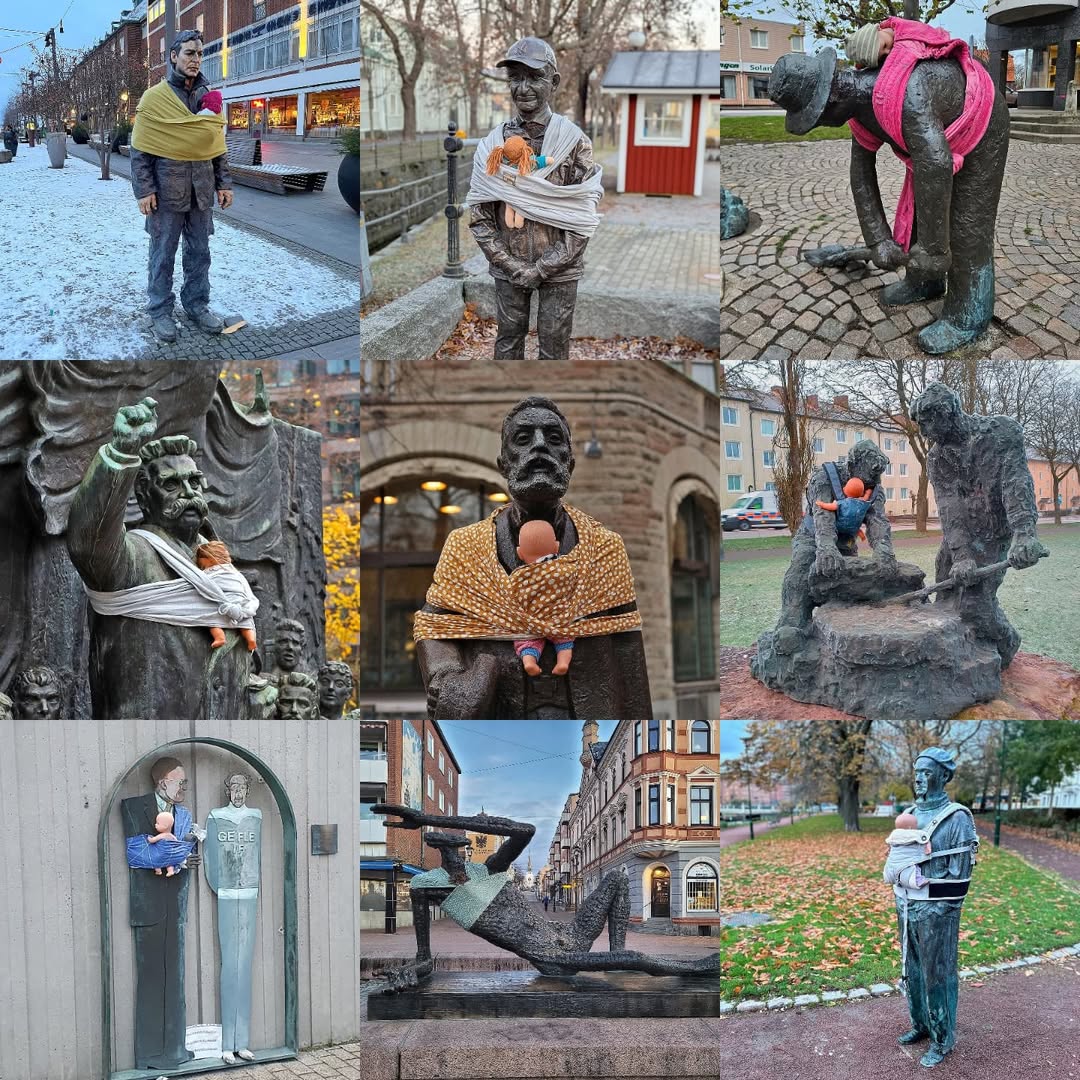
I believe that when it comes to work and childcare, families should do whatever works best for them but that both parents should be actively involved in their child’s upbringing and that fathers ought not to neglect the importance of bonding with their child beginning in early infancy.
Think of how many sculptures you’ve seen of a woman holding a baby. Now think of how many you’ve seen of a man holding a baby. That disparity shapes our imaginations and expectations.
That’s why the #Kvantitetstidspappan campaign was, in my estimation, a great success. By projecting images of men as active parents—models of fatherly engagement—it makes fatherhood more visible, normalizes paternal involvement in infant care and development, and hopefully encourages dads to spend more time at home with their kids.
+++
SONGS: Happy first day of summer!
>> “Sumer is icumen in” (Summer Is Come): “Sumer is icumen in,” also known as the Cuckoo Song or the Summer Song, is a medieval vocal composition written, most likely, by a monk in or around Reading, England, in the mid-thirteenth century, its (Middle English) lyrics and musical notation preserved in a manuscript at the British Library. The song celebrates the arrival of summer, with all its fecundity and animal movement. It’s the oldest known composition featuring six-part polyphony and, according to the Oxford English Dictionary, the earliest recorded instance of the impolite verb “to fart”: “Bulluc sterteth, / Bucke verteth” (Bull leaps, buck farts)! (The translation of the latter line is, however, debated, with some scholars favoring “cavorts.”)
Here’s a wonderful solo rendition by the Burundian British musician Muco (IG @bookofvoices), with self-accompaniment on the inanga, a traditional zither from Burundi and Rwanda. Muco’s work “combine[s] lyrics and influences from Old, Middle, and Modern English, as well as French, Swahili, and Kirundi, reflecting his deep interest in the interconnection of folk traditions across cultures.” (Thanks, Instagram algorithm, for introducing me to Muco!)
See also Elizabeth Mitchell’s rendition, sung in modern English, from her 2012 album Blue Clouds. But for the full effect, performing the six-part round, here’s the Exeter University Madrigals:
>> “Geh aus mein Herz und suche Freud” (Go Forth, My Heart, This Summer Day): “Go forth, my heart, this summer day / Go forth and seek your joyful way / With thanks for all these pleasures!” So opens this seventeenth-century German hymn by Paul Gerhardt (1607–1676), set to music by August Harder (1775–1813) and translated into English by Gracia Grindal (1943–). (See also an earlier translation by Catherine Winkworth.)
+++
PRINTABLE: Chasing Wonder: Photo Bingo Challenge: New from SALT: “Chasing Wonder: Photo Bingo Challenge is a simple, engaging way for families or congregations to slow down, notice the world around them, and reflect on God’s beauty, joy, justice, hope, humor, and inspiration all around. Participants take original photos inspired by the bingo prompts”—such as “something broken,” “something blue,” “water,” “something that makes you laugh”—“and mark off squares as they go.”
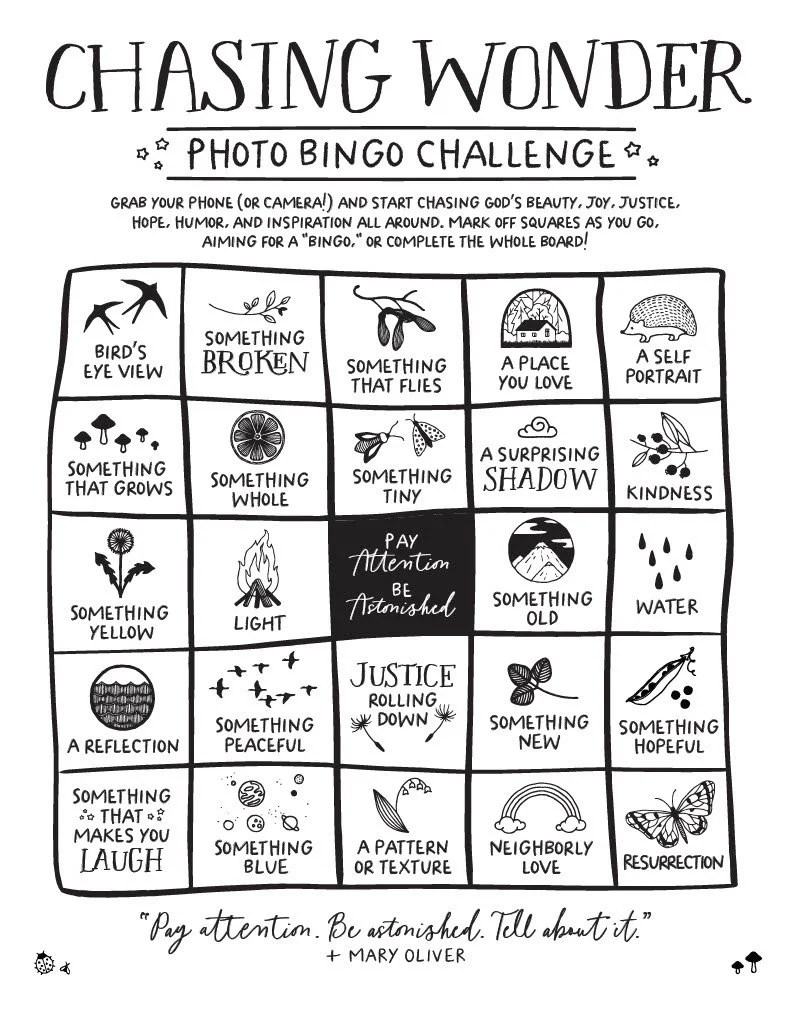
It’s $15 to print the bingo board for individuals, families, or congregations. I love this idea!


_(mid_13th_C),_f.11v_-_BL_Harley_MS_978.jpg)