
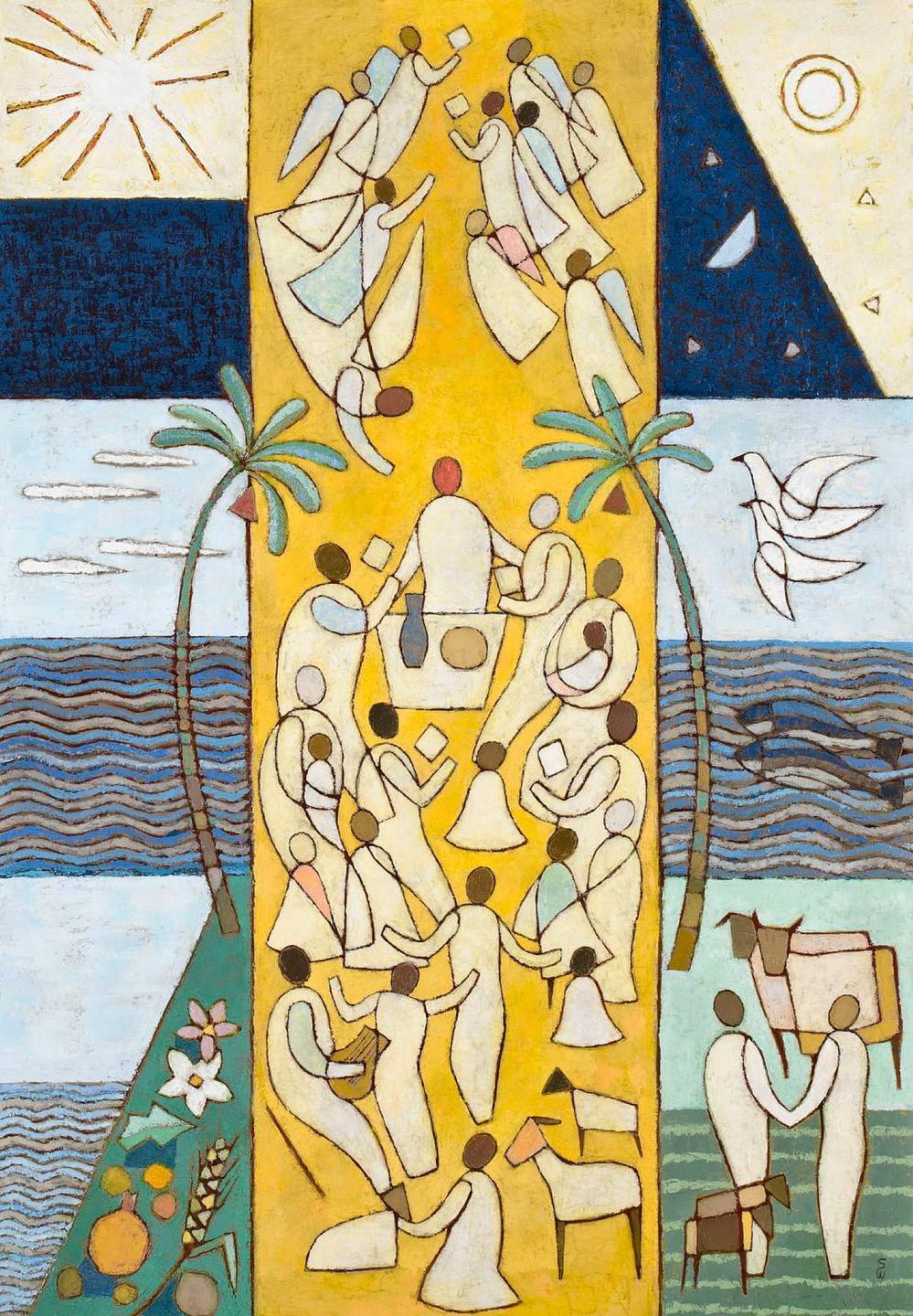
Easter Hymn from the Early Church

Watanabe, Soichi_To God Be the Glory
Soichi Watanabe (Japanese, 1949–), To God Be the Glory, 2009. Acrylic on canvas, 52 × 39 in. Collection of the Overseas Ministries Study Center at Princeton Theological Seminary.

This is the paschal feast,
the Lord’s passing from death to life:
so cries the Spirit.
No type or telling, this, no shadow.
Pasch of the Lord it is, and truly.

You have protected us, Jesus,
from endless disaster.
You spread your hands like a mother
and, motherlike, gave cover with your wings.
Your blood, God’s blood, you poured over the earth,
giving life, because you loved us.

The heavens may have your spirit, paradise your soul,
but oh, may the earth have your blood!

This feast of the Spirit
leads the mystic dance through the year.
New is this feast and all-embracing;
all creation assembles at it.

Joy to all creatures, honor, feasting, delight!
Dark death is destroyed
and life is restored everywhere.
The gates of heaven are open.
God has shown himself human,
humanity has gone up to God.
The gates of hell are shattered,
the bars of Adam’s prison broken.
The people of the world below have risen from the dead,
bringing good news:
what was promised is fulfilled.
From the earth has come singing and dancing.

This is God’s passing!
Heaven’s God, showing no stinginess,
has joined us together with God in the Spirit.
The great marriage hall is full of guests,
all dressed for the wedding,
no guest rejected for want of a wedding garment.
The paschal light is the bright new lamplight,
light that shines from the virgins’ lamps.
The light in the soul will never go out.
The fire of grace burns in us all,
spirit, divine, in our bodies and in our souls,
fed with the oil of Christ.

. . . . . . . . . . . . . . . . . . . . .

Join, then, all of you, join in this great rejoicing.
You who’ve been working the vineyard from the early hour
and you who came later,
come now and collect your wages.
Rich and poor, sing and dance together.
You who are hard on yourselves, you who are easy,
honor this day.
You who have fasted and you who have not,
make merry today.

The meal is ready: come and enjoy it.
The calf is a fat one: you will not go away hungry.
There’s kindness for all to partake of and kindness to spare.

Away with pleading of poverty:
the kingdom belongs to us all.
Away with bewailing of failings:
forgiveness has come from the grave.
Away with your fears of dying:
the death of our Savior has freed us from fear.
Death played the master: he has mastered death.
The world below had scarcely known him in the flesh
when he rose and left it plunged in bitter mourning.

Isaiah knew it would be so. [Isa. 14:9]
The world of shadows mourned, he cried, when it met you,
mourned at its being brought low, wept at its being deluded.
The shadows seized a body and found it was God;
they reached for earth and what they held was heaven;
they took what they could see: it was what no one sees.
Where is death’s goad? Where is the shadows’ victory?

Christ is risen: the world below [hell] is in ruins.
Christ is risen: the spirits of evil are fallen.
Christ is risen: the angels of God are rejoicing.
Christ is risen: the tombs are void of their dead.
Christ has indeed arisen from the dead,
the first of the sleepers.

Glory and power are his for ever and ever. Amen.

This text is a composite of excerpts from two Easter sermons spuriously attributed to John Chrysostom (ca. 347–407) and drawing inspiration from Hippolytus of Rome (ca. 170–ca. 235), which I adapted from Walter Mitchell’s English translation from the original Greek that appears in Adalbert Hamman, OFM, ed., Early Christian Prayers (Chicago: Regnery Gateway, 1961), 31–35. The source texts can be found in the Patrologia Graeca 59:741–46 and 59:721–24. They probably date to the fourth century.

Advent, Day 19: Behold

“They will hunger no more and thirst no more;
    the sun will not strike them,
    nor any scorching heat,
for the Lamb at the center of the throne will be their shepherd,
    and he will guide them to springs of the water of life,
and God will wipe away every tear from their eyes.”

—Revelation 7:16–17

Then the angel showed me the river of the water of life, bright as crystal, flowing from the throne of God and of the Lamb through the middle of the street of the city. On either side of the river is the tree of life with its twelve kinds of fruit, producing its fruit each month, and the leaves of the tree are for the healing of the nations. Nothing accursed will be found there any more. But the throne of God and of the Lamb will be in it, and his servants will worship him; they will see his face, and his name will be on their foreheads. And there will be no more night; they need no light of lamp or sun, for the Lord God will be their light, and they will reign forever and ever.

And he said to me, “These words are trustworthy and true, for the Lord, the God of the spirits of the prophets, has sent his angel to show his servants what must soon take place.”

 “See, I am coming soon! Blessed is the one who keeps the words of the prophecy of this book.”

—Revelation 22:1–7

LOOK: The Supper of the Lamb by Wayne Forte

Forte, Wayne_The Supper of the Lamb
Wayne Forte (Filipino American, 1950–), The Supper of the Lamb, 2004. Oil on canvas, 60 × 48 in.

In this eschatological painting by Wayne Forte, the slain and risen Lamb reopens Eden, welcoming us all to the feast. He holds a palm branch, symbol of the martyr’s victory, and stands atop a table set with bread, wine, and the fruits of the tree of life. A river issues forth, further underscoring that this is a place of refreshment.

In the foreground, the iron grillwork of the gate depicts key events from salvation history: the Fall and Expulsion, Noah’s Ark, the Sacrifice of Isaac, the Exodus, the Nativity, the Crucifixion, and the Resurrection. Originating in the early Christian era, the IHS monogram at the top denotes the first three letters of the Greek name of Jesus, ΙΗΣΟΥΣ: iota, eta, sigma. Later it came to be mistakenly (but appropriately!) interpreted as an acronym for the Latin Jesus Hominum Salvator, “Jesus, Savior of Humanity.”

LISTEN: “Behold, Behold” by Caroline Cobb, performed with Sean Carter on A Home and a Hunger: Songs of Kingdom Hope (2017)

I see a city coming down
Like a bride in whitest gown
Purely dressed
I see the pilgrims coming home
All creation finds shalom
The promised rest
The Lamb of God will be her light
The sun will have no need to shine

Refrain:
Behold, behold
God makes his home with us
He’ll take his throne, forever glorious
Behold, behold
God makes his home with us
He’ll take his throne, forever glorious
The curse will be undone
O come, Lord Jesus, come

The Lord will banish every sin
All that’s broken he will mend
And make new
And we will see him face to face
As he wipes our tears away
And death is through
And all the ransomed and redeemed
From every tongue and tribe will sing

[Refrain]

At last the darkness will surrender to the light
But we, unveiled in glory, will forever shine
At last the powers of hell will drown in lakes of fire
But we will freely drink the crystal streams of life

Come, thirsty, taste and see
Come, hungry, to the feast
Come, weary, find your peace
The Bride and Spirit sing
Come!
Come!

[Refrain]

Based on Revelation 21–22, “Behold, Behold” is the last song on Caroline Cobb’s album A Home and a Hunger, which traces kingdom hope from Genesis to Revelation, each song focusing on a different biblical book.


This post is part of a daily Advent series from December 2 to 24, 2023 (with Christmas to follow through January 6, 2024). View all the posts here, and the accompanying Spotify playlist here.

Grief and Loss Will Be Undone (Artful Devotion)

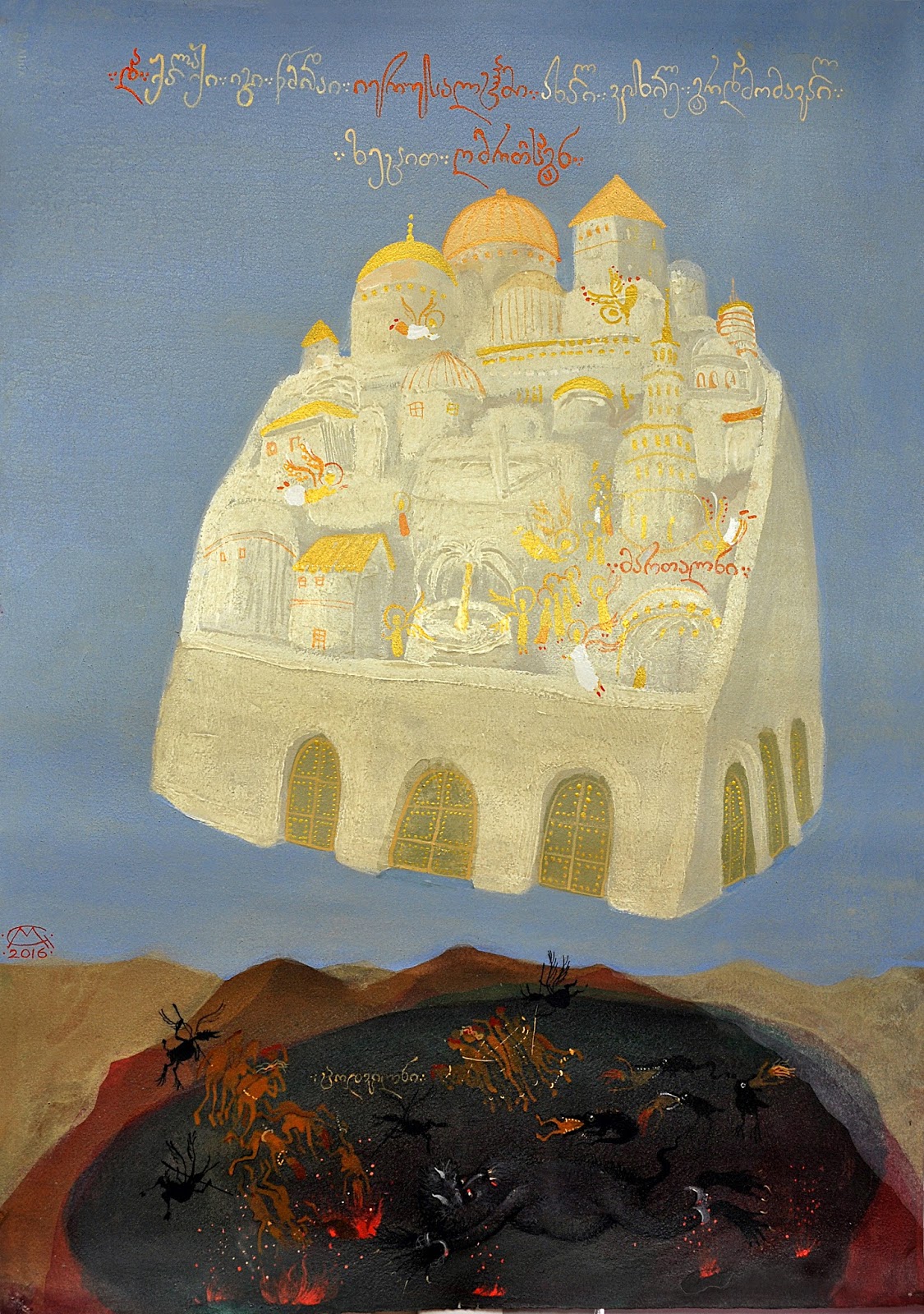
Descent of the New Jerusalem (Georgian icon)
Gocha Kakabadze (Georgian, 1966–), Descent of the New Jerusalem, 2016. Gouache on paper.

On this mountain the LORD of hosts will make for all peoples
a feast of rich food, a feast of well-aged wines,
of rich food filled with marrow, of well-aged wines strained clear.
And he will destroy on this mountain
the shroud that is cast over all peoples,
the sheet that is spread over all nations;
he will swallow up death forever.
Then the Lord GOD will wipe away the tears from all faces,
and the disgrace of his people he will take away from all the earth,
for the LORD has spoken.
It will be said on that day,
Lo, this is our God; we have waited for him, so that he might save us.
This is the LORD for whom we have waited;
let us be glad and rejoice in his salvation.

—Isaiah 25:6–9 (NRSV)

+++

SONG: “When Your Kingdom Comes” by the Silver Pages, feat. Mona Reeves, on The Silver Pages: Part II (2015)

Christians are called to be “aching visionaries,” writes Nicholas Wolterstorff in the classic Lament for a Son—much like the Hebrew prophets, who by the Spirit’s enlightening were able to see through the pain of this present era into a future where all things are made new, where sorrow is undone and Love reigns. Blessed are those who cling to this vision, and who actively live into it here and now, not ignoring hurt but acknowledging its wrongness (that’s what lament is: to say, “This is not right”) and co-laboring with God to heal it. For this task we are equipped with God’s Spirit.

(Related posts: “A sweeping vision of all things made new”; “‘Jis’ Blue’ by Etta Baldwin Oldham”)

The Christian fixation on heaven is sometimes perceived by outsiders as escapist, as opioid. Claiming its promise does console, it’s true. It does give us power to push through pain and guards us against despair. But what it absolutely does not allow is retreat from reality. On the contrary, it helps us to inhabit reality more fully. Talk of heaven doesn’t numb us to the world—or at least it shouldn’t. It makes us hyperaware, especially of history’s path. History is going somewhere! It has a telos, and it has manifestly not arrived there yet. Until then, we ache. We labor. We hope. Rather than having an idling effect, seeing the goal actually motivates us to live presently in tighter line with God’s values, because we see how beautiful a world they usher in. We know that we cannot ourselves create the final fullness that Christ will institute when he returns, nor can we remove the pall of evil (again, that’s only within Christ’s power), but we can certainly live as citizens of God’s kingdom and thus practitioners of the gospel in all its transformative goodness.

Brothers Philip and Paul Zach (The Silver Pages) are aching visionaries who write songs and sing. “When Your Kingdom Comes,” performed with Mona Reeves, helps us to see with greater clarity the glorious future that’s in store for this earth. One day when we come home to it, it will be heaven. The New Jerusalem will descend, and we’ll be wed eternally to its king.

To download the album version of the song (which has more pronounced percussion) along with five other Silver Pages tracks, go to NoiseTrade. It’s free in exchange for your email address.

Update, 9/21/20: Paul Zach posted a solo acoustic version of the song on his Instagram today.

And here he is singing the song with his friend Patrick Bagaza from Rwanda, who translated the song into Swahili:

+++

[After the Ring is destroyed]

“Gandalf! I thought you were dead! But then I thought I was dead myself. Is everything sad going to come untrue? What’s happened to the world?”

“A great Shadow has departed,” said Gandalf, and then he laughed and the sound was like music, or like water in a parched land; and as he listened the thought came to Sam that he had not heard laughter, the pure sound of merriment, for days upon days without count.

—J. R. R. Tolkien, from The Return of the King


This post belongs to the weekly series Artful Devotion. If you can’t view the music player in your email or RSS reader, try opening the post in your browser.

To view all the Revised Common Lectionary scripture readings for Proper 23, cycle A, click here.