
Christmas, Day 3: Stupendous Stranger

LOOK: The Nativity by Gerard David
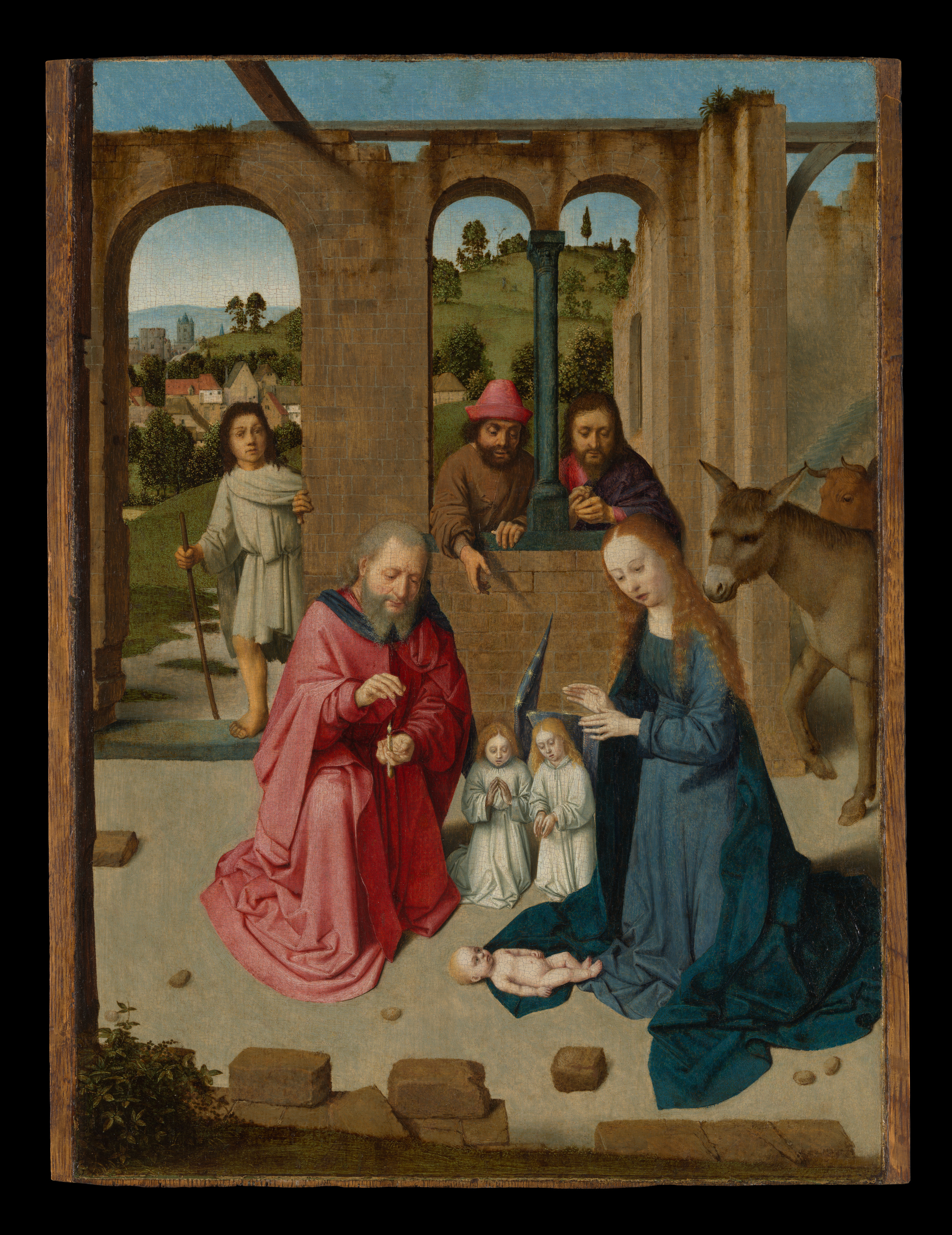
David, Gerard_Nativity
Gerard David (Netherlandish, ca. 1455–1523), The Nativity, early 1480s. Oil on wood, 18 3/4 × 13 1/2 in. (47.6 × 34.3 cm). Metropolitan Museum of Art, New York.

LISTEN: “Where Is This Stupendous Stranger” | Words by Christopher Smart, 1765 | Music by Linda L. Hanson, 2012 | Performed by Fire (women’s a cappella chamber ensemble), 2020

Where is this stupendous Stranger?
Prophets, shepherds, kings, advise!
Lead me to my Master’s manger,
Show me where my Savior lies.

O most mighty, O most holy,
Far beyond the seraph’s thought,
Are you then so mean and lowly
As unheeded prophets taught?

O the magnitude of meekness,
Worth from worth immortal sprung!
O the strength of infant weakness,
If eternal is so young!

God all-bounteous, all-creative,
Whom no ills from good dissuade,
You have come to be a native
Of the very world you made.

The four verses of this Christmas hymn are excerpted from a nine-stanza poem by Christopher Smart [previously] published in Hymns and Spiritual Songs for the Fasts and Festivals of the Church of England (London, 1765). The poem was recovered in the twentieth century and since then has received multiple new musical settings—by composers such as I-to Loh, Charles Heaton, Conrad Susa, Joan A. Fyock, Leo Nestor, Alec Wyton, Thomas Gibbs Jr., Scott M. Hyslop, and Jacques Cohen—as well as pairings with older tunes.

My favorite setting of the text is by Linda L. Hanson, the founding director of Fire, a women’s a cappella chamber ensemble in Charlottesville, Virginia. The group performs the hymn in the video above, which Fire member Mary Welby von Thelen spliced together from thirteen solitary recordings during the COVID-19 pandemic. Hanson is in the top row, the third from the left.

The alliterative opening line of the hymn asks where the “stupendous Stranger” can be found—the divine one sent from heaven. Stupendous isn’t an adjective we use often. It means “causing astonishment or wonder: awesome, marvelous.” The poetic speaker begs the prophets, shepherds, and magi to divulge the location of the Christ child so that he can go and worship him.

The next two stanzas marvel at the paradoxes of the Incarnation—how Christ is “mighty” and “holy,” beyond the comprehension of even the angels, and yet “mean” (humble) and “lowly,” lying here in the dirt before us, visible, tangible, vulnerable, no longer far above us but in our very midst. What “magnitude of meekness,” what “strength of infant weakness.” The eternal one is born in time.

The omnibenevolent Creator has deigned to become part of his creation. No potential ill that he will suffer as a result—and he will suffer many and grievous ills, culminating in death by crucifixion—can deter him from making his beloved earth his home.

Hanson has generously allowed me to share the sheet music of “Where Is This Stupendous Stranger,” and says the hymn can be freely used by local church congregations. Anything outside that context will require her permission.
“Spiritus” by Steve Turner (poem)

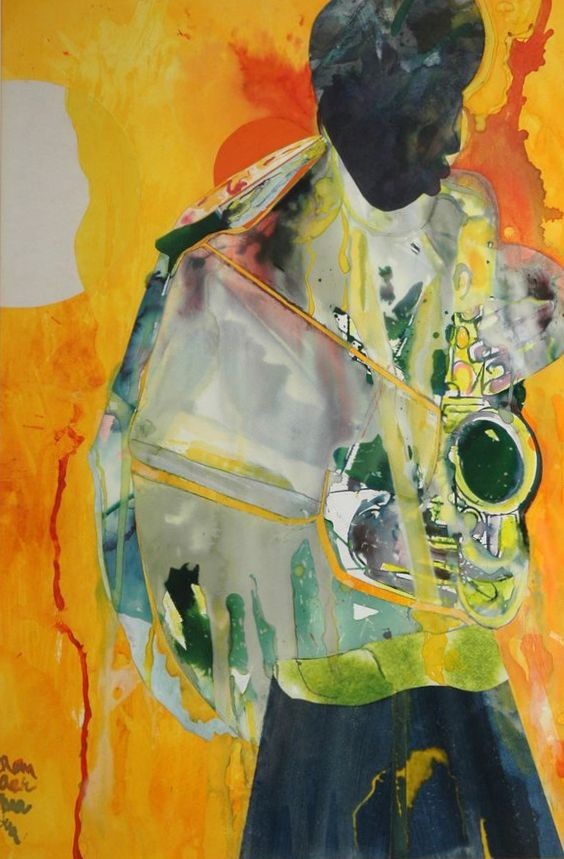
Bearden, Romare_All the Things You Are
Romare Bearden (American, 1912–1988), All the Things You Are, 1987. Collage, color dyes, and watercolor on board, 36 × 24 in. (91.4 × 61 cm).

I used to think of you
as a symphony
neatly structured,
full of no surprises.
Now I see you as
a saxophone solo
blowing wildly
into the night,
a tongue of fire,
flicking in unrepeated
	patterns.

From Poems by Steve Turner, compiled by Rebecca Winter (Oxford: Lion Publishing, 2002)

Steve Turner is a music journalist, biographer, and poet from the UK who has spent his career chronicling and interviewing people from the worlds of music, film, television, fashion, art, and literature. He has contributed to newspapers such as The Mail on Sunday and The Times, and among his many books is the influential Imagine: A Vision for Christians in the Arts. He lives in London.

Catching fire

As Luke records in Acts 2, ten days after Jesus ascended to heaven, during the feast of Shavuot, the Holy Spirit manifested as “tongues of fire” and descended on Jesus’s apostles, filling them with power before the multitudes that had gathered. Peter preaches this as a fulfillment of the prophet Joel: “In the last days it will be, God declares, that I will pour out my Spirit upon all flesh, and your sons and your daughters shall prophesy, and your young men shall see visions, and your old men shall dream dreams . . .” (Acts 2:17; cf. Joel 2:28).

As geographically and linguistically diverse pilgrims embraced the good news of Christ that day and carried it back to their homes, God’s Spirit spread throughout the ancient Near East and from there to other parts of the world, such that Christianity is the most global and multicultural religion. The fire that fell that one Sunday in Jerusalem has spread exponentially! First it caught the Twelve, and then some three thousand witnesses, and it’s been burning ever since.

Consider this untitled poem by Theodore Roszak*:

Unless the eye catch fire
The God will not be seen
Unless the ear catch fire
The God will not be heard
Unless the tongue catch fire
The God will not be named
Unless the heart catch fire
The God will not be loved
Unless the mind catch fire
The God will not be known

In it the physical senses are ignited, as are the emotions and the intellect. The whole person—body, spirit, and soul—is set on fire. Sounds Pentecostal, no? With echoes of Moses’s meeting God in a burning bush on Mount Horeb (Exod. 2), as revelation is key.

Slowly read each of the five couplets, one at a time, considering how God makes himself known through that faculty. Ponder what it means for the eye to “catch fire,” the ear to catch fire, and so on. What does that image evoke?

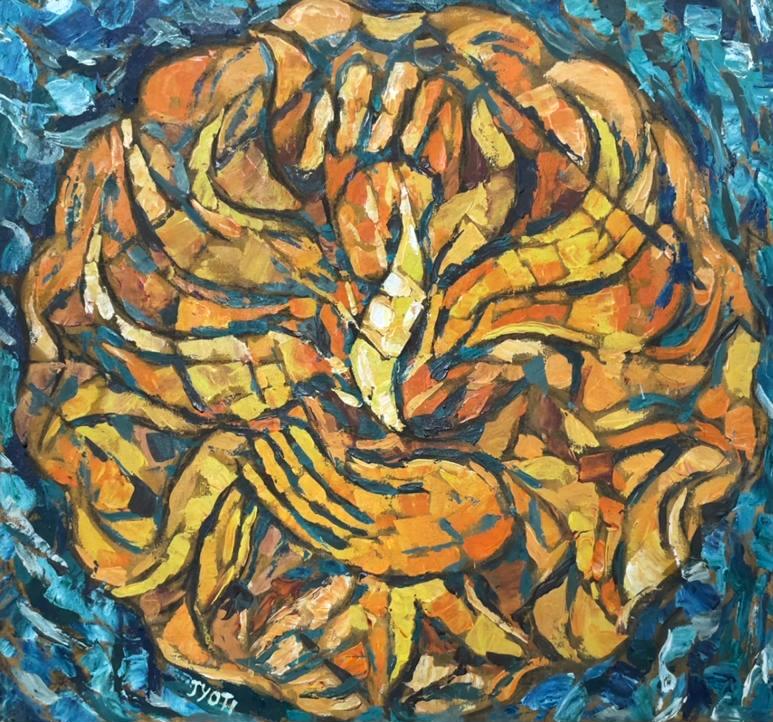
Sahi, Jyoti_Holding the Flame of Fire
Jyoti Sahi (Indian, 1944–), Holding the Flame of Fire, 2005. Oil on canvas, 36 × 36 in. Painted as a design for a stained glass window for the entrance of Paripurnata Halfway Home in Kolkata, India.

Fire shows up a lot in the work of Indian Christian artist Jyoti Sahi, as in his painting Holding the Flame of Fire, which shows a pair of hands cradling a flame that fans out in bright oranges and yellows, forming a mandala (Sanskrit “circle”). Perhaps you see licking tongues, or dove’s wings, or I AM calling out from a blazing shrub.

This painting was inspired by aarti, a ritual expression of love and gratitude to a deity that originated and is widely practiced in Hinduism but that has been adapted by some Christians in South India. (Sahi demonstrated it to me in a Christian chapel in Bengaluru when I visited him a few years ago.) A lit oil or ghee lamp is placed on a tray, Sahi explains, “where different offerings are arranged representing the senses, such as flowers related to sight, incense sticks in relation to smell, water and fruit in a bowl in relation to taste, and earth and ash in relation to touch.” The priest or householder waves the tray in a clockwise motion, then brings it around from person to person, each of whom cups the flame with their hands and then touches their forehead, seeking divine blessing. Aarti is often accompanied by singing and can be performed at home or in public places of worship.

(Related post: https://artandtheology.org/2020/11/30/advent-day-2-fire/)

How awesome is it that the Spirit of God, the living flame, moves among us—even abides within us! The Spirit stirs, illuminates, regenerates, sanctifies, guides, comforts, intercedes, and empowers. What a gift.

* Note on authorship: This poem appears in Where the Wasteland Ends: Politics and Transcendence in Postindustrial Society by Theodore Roszak (Doubleday, 1972) as the epigraph to chapter 9, “Mind on Fire: Notes on Three Old Poets.” While Roszak provides attributions for all the other epigraphs in the book, he does not for this one, leading me to believe that the verse either originated with him or is from an unknown source. It is often misattributed to William Blake—probably because Roszak’s chapter focuses on Blake, in addition to Wordsworth and Goethe—but I confirmed with multiple Blake scholars that these lines are not Blake’s. P. K. Page wrote a short story in 1979 titled “Unless the Eye Catch Fire,” citing Roszak as the title’s source.