
“The Soul’s Garment” by Margaret Cavendish (poem)

Pelton, Agnes_Translation
Agnes Pelton (American, 1881–1961), Translation, 1931. Oil on canvas, 26 × 21 in. (framed). Collection of Fairfax Dorn and Marc Glimcher. Source: Agnes Pelton: Desert Transcendentalist, p. 105.

Great Nature clothes the soul, which is but thin,
With fleshly garments, which the Fates do spin;
And when these garments are grown old and bare,
With sickness torn, Death takes them off with care,
And folds them up in peace and quiet rest,
And lays them safe within an earthly chest:
Then scours them well and makes them sweet and clean,
Fit for the soul to wear those clothes again.

This poem was published in its earliest form under the title “Soule, and Body” in Poems and Fancies by the Right Honourable Lady Margaret, Countess of Newcastle (1653), and appears as above in the book’s second edition (1664). It is in the public domain.

Margaret Lucas Cavendish (1623–1673), duchess of Newcastle-upon-Tyne, was a prolific English writer across the genres of poetry, science fiction, drama, letters, biography, and natural philosophy. A pioneering feminist, she wrote in her own name in a period when most women writers remained anonymous. She spent three years as a lady-in-waiting to Queen Henrietta Maria (wife of King Charles I) at the royal court in Oxford and then in exile in France; it’s there that she met her soon-to-be husband, William Cavendish, then marquis of Newcastle, who remained a great influence throughout her life, encouraging her intellectual pursuits. Cavendish moved in circles that included Thomas Hobbes and René Descartes and, in 1667, was the first woman to be formally invited to visit the Royal Society. She is buried in Westminster Abbey.
“Deliverance” by Evelyn Bence (poem)

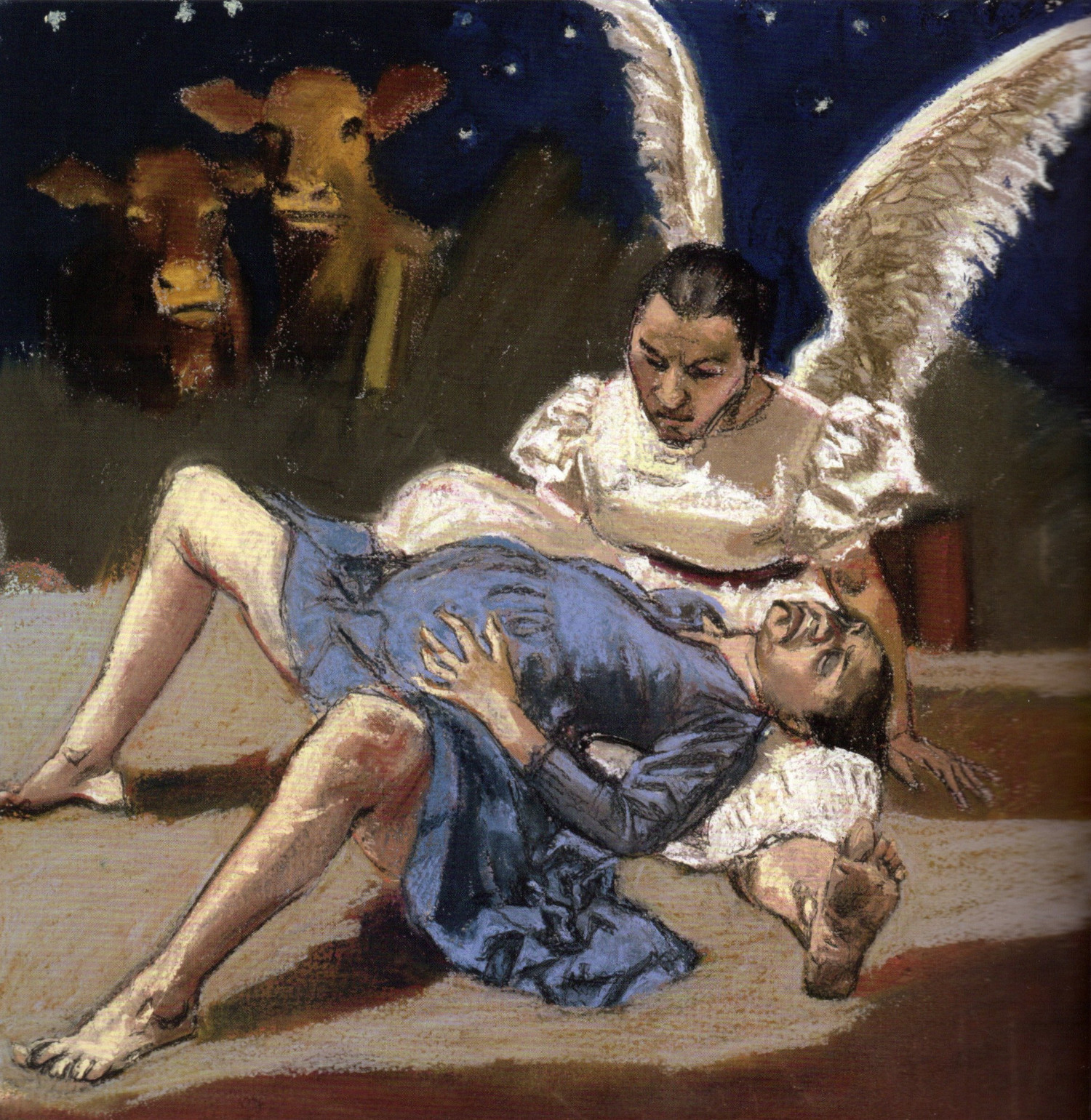
Rego, Paula_The Nativity
Paula Rego (Portuguese British, 1935–2022), The Nativity, 2002. Pastel on paper mounted on aluminum, 21 3/8 × 20 1/2 in. (54 × 52 cm). Palácio de Belém, Lisbon, Portugal. Source: Paula Rego: The Art of Story, p. 226.

It is time.
My body’s clock gongs
your salvation’s hour.
The water has left the pasture
and flowed toward the river’s mouth.
Follow or you will wither
in the desert that remains.
I will bleed for you
on this your first dark journey,
but in time, when life pushes you
headlong through black canyons,
the wounds will be your own.
May you learn early:
at the end light always shines.
It is here, child.
The time is come.
Breathe.

This poem was originally published in the Winter 1982/83 issue of Today’s Christian Woman and appears in the book Mary’s Journal: A Mother’s Story by Evelyn Bence (Grand Rapids, MI: Zondervan, 1992). Used by permission of the author. (Thanks to Maureen E. Doallas, curator of the exhibition Mary, Mary, for introducing me to it!)

Evelyn Bence (born 1952) is a writer and editor living in Arlington, Virginia. She is the author of Room at My Table; Prayers for Girlfriends and Sisters and Me; Spiritual Moments with the Great Hymns; and the award-winning Mary’s Journal, a novel written in the voice of Jesus’s mother. She has served as religion editor at Doubleday, managing editor for Today’s Christian Woman, and senior editor at Prison Fellowship Ministries. Her personal essays, poems, and devotional reflections have appeared in various publications.