Twelve Advent Stations by Mark Cazalet

Mark Cazalet (b. 1964) is a contemporary artist based in London whose work centers on color and balances empiricism and lyricism. He works across media—painting, drawing, printmaking, and (in collaboration with fabricators) stained glass, etched and engraved glass, printed enamel on glass, tapestries, and mosaics. A major part of his career has been fulfilling ecclesiastical commissions and making sacred art. But all of his work, regardless of subject matter, is shot through with a sacramental impulse.

Last year Cazalet made a series of twelve “Advent Stations” that move circuitously through the story of Jesus’s first coming, marked as it was by mystery, vulnerability, risk, and glory. These include modernized versions of scenes you’d find in traditional Infancy of Christ cycles, such as the Annunciation to Mary, the Annunciation to the Shepherds, the Dream of the Magi, and the Flight to Egypt, but also new ones, drawing us into the grand sweep—sometimes rushing, sometimes quiet—of gospel hope. “The overarching theme,” he told me, “is pregnancy, birth, nurturing, waiting, escape, migration, and finally, in the mistle thrush’s morning song, the greeting of the new day’s limitless potential.”

The artist’s choice of substrate is unique: He painted his stations in oil on domestic wooden objects, such as bread boards, meat and cheese boards, children’s lunch trays, washboards, chapati rolling boards, and a baker’s peel. By using these ordinary boards mainly from home kitchens, Cazalet further situates the biblical Advent story in the everyday. That many of the boards are used for preparing or serving bread underscores Jesus’s self-declaration as “the living bread that came down from heaven,” whose flesh Christians eat ritually as a means of interabiding (John 6).

Cazalet’s Advent Stations debuted last December at his home church, St Martin’s in Kensal Rise, London, where they were installed one per week from Advent through Candlemas. The project was a collaboration with fellow parishioners Richard Leaf, who wrote a poem for each station, and Pansy Cambell, who calligraphed the poems.

That exhibition spawned interest from Chelmsford Cathedral in Essex, where all the artworks and poems are on display from December 1, 2025, through February 2, 2026. The cathedral is already home to two commissioned works of Cazalet’s: the monumental multipanel painting The Tree of Life and an engraved and etched glass window depicting St. Cedd.

The word “station” in the title of Cazalet’s recent series refers to a stopping place along a route. In the Middle Ages, the Roman Catholic Church developed a devotional practice known as the Stations of the Cross, which breaks down the passion of Christ into fourteen distinct episodes fit for contemplation. The idea was that those who could not travel physically to Jerusalem for Lent to walk the Via Dolorosa (the processional route Jesus took to Golgotha) could at least walk the path in spirit, using a series of images as prompts to pause, pray, and reflect.

(Cazalet also made a set of twenty Stations of the Cross in 2024.)

Used by Christians in various denominations, this practice has been adapted for other seasons of the church year. While there are no official Advent Stations or Stations of the Nativity, Cazalet has come up with twelve.

All photos in this article are by the artist and are used with his permission.

Advent Station 1: The Breath of God
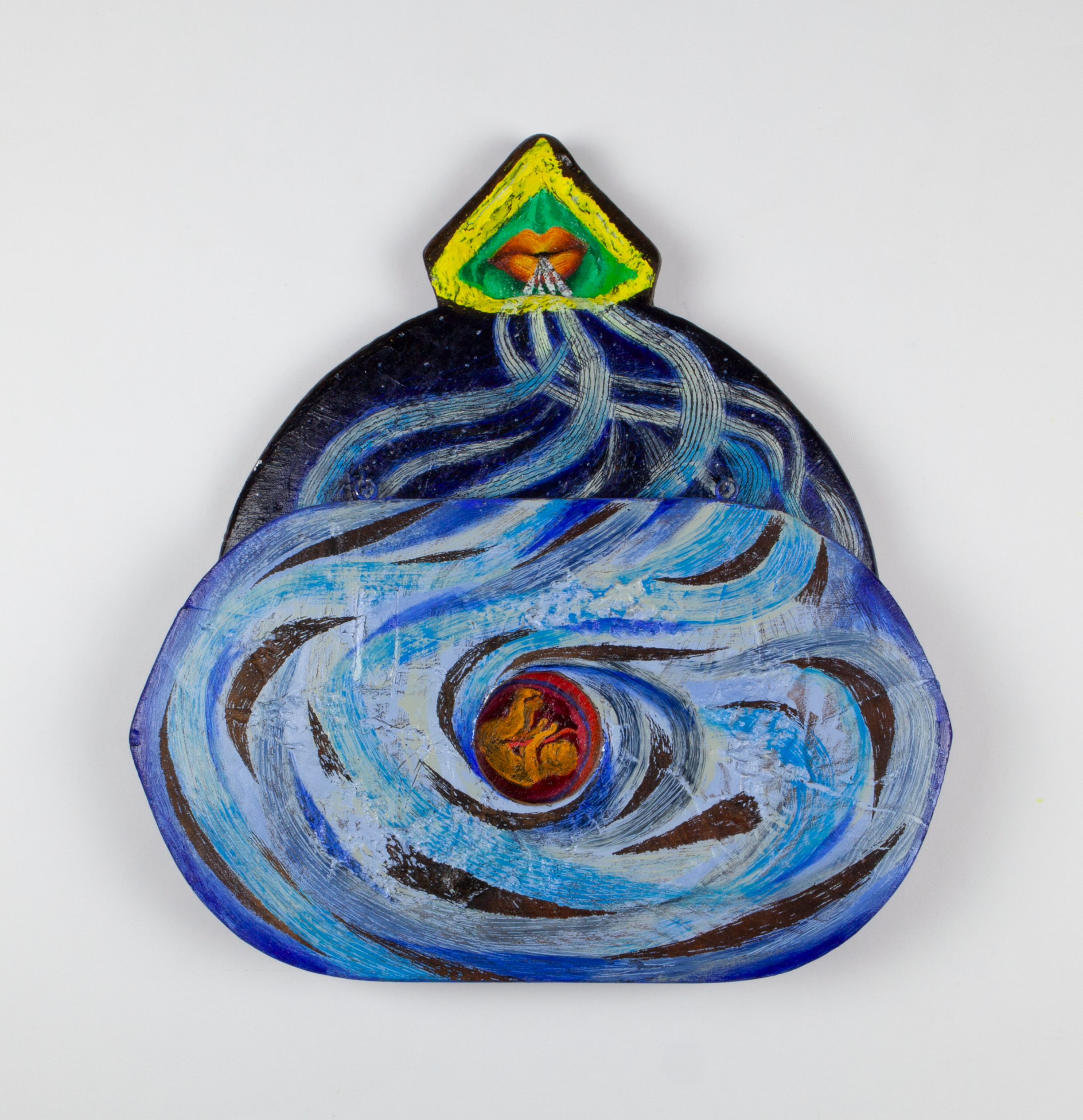
Advent Station 1. The Breath of God (closed)
Mark Cazalet, Advent Station 1: The Breath of God (closed), 2024

A mystical visualization of the Word becoming flesh, the first station has two configurations. In its closed form, it shows the mouth of God blowing through space, the divine breath coalescing around a woman’s uterus to form an embryo, the child who will be called Jesus. Wisps of blue swirl dynamically around this firstborn of new creation.

The triangular shape evokes the Trinity, as the Incarnation was an act involving Father (initiator), Son (enfleshed one), and Holy Spirit (overshadower / inseminating agent).
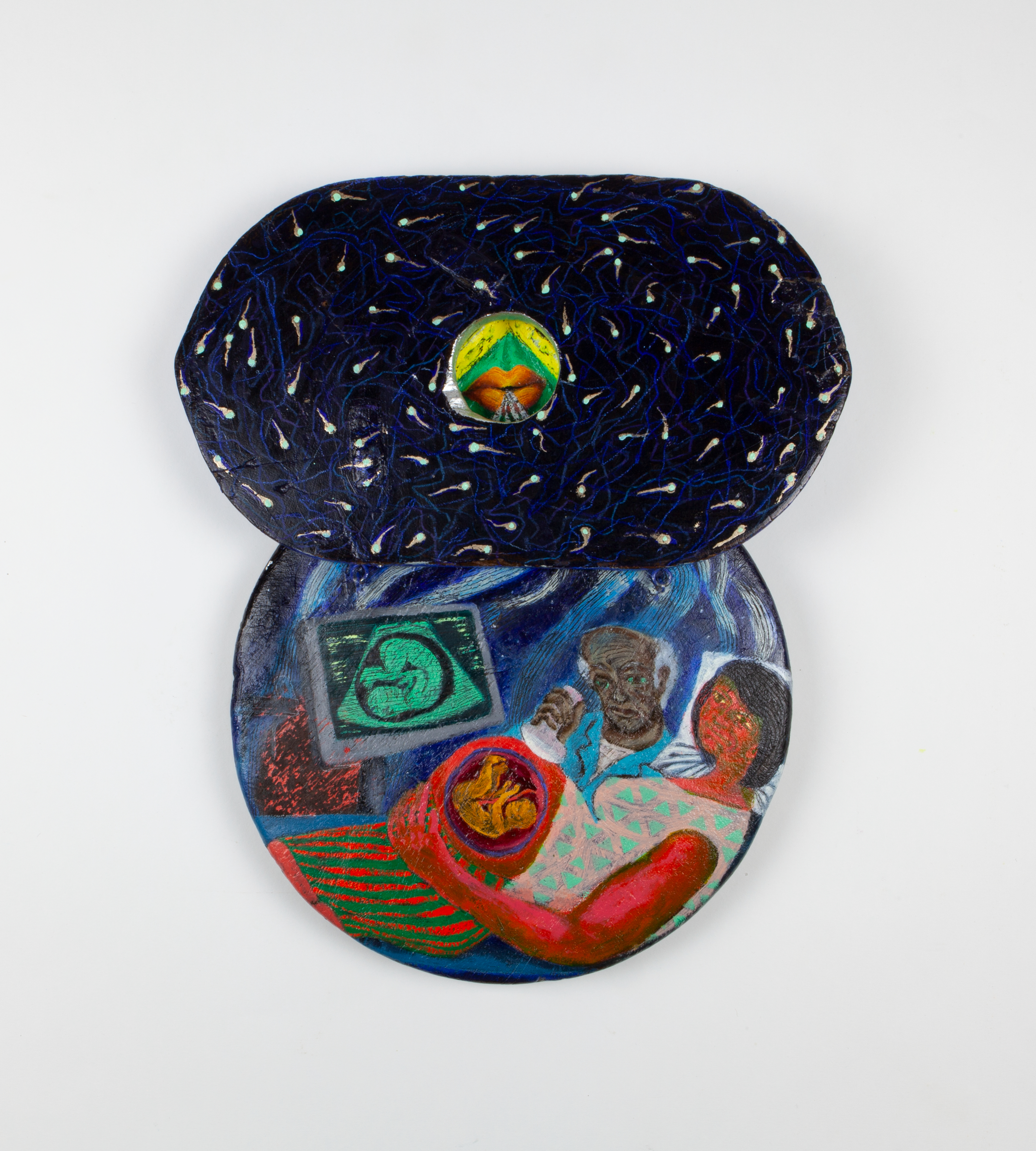
Advent Station 1. The Breath of God (open)
Mark Cazalet, Advent Station 1: The Breath of God (open), 2024

In the exhibition, an attached ribbon instructs viewers, “Lift me.” When you do, the bottom board flips up to reveal a pool of swimming sperm cells, as God created the male gamete needed to make a male child and supernaturally (nonsexually) deposited it into Mary, where it fertilized one of her eggs.

The virginal conception of Christ is a mystery beyond knowing; no amount of scientific head-scratching will bring us closer to understanding the mechanics, nor do we need to. But I like the reminder from this unusual artistic interpretation that all the necessary human genetic material was present—Mary supplying hers, and God supplying the rest. Jesus was not some kind of alien transplanted into a human womb, but rather was made up of all the human stuff we are, and grew by stages inside his mother over a period of nine months. And yet, while fully human, he’s also—marvel of marvels—fully God.

On the round board below, we see that the isolated uterus from the first view belongs to Mary, who lies in bed while Joseph serves as ultrasound technician, shining a light that discloses the still-developing Christ child on a video monitor.

Advent Station 2: John the Baptist on the Beach
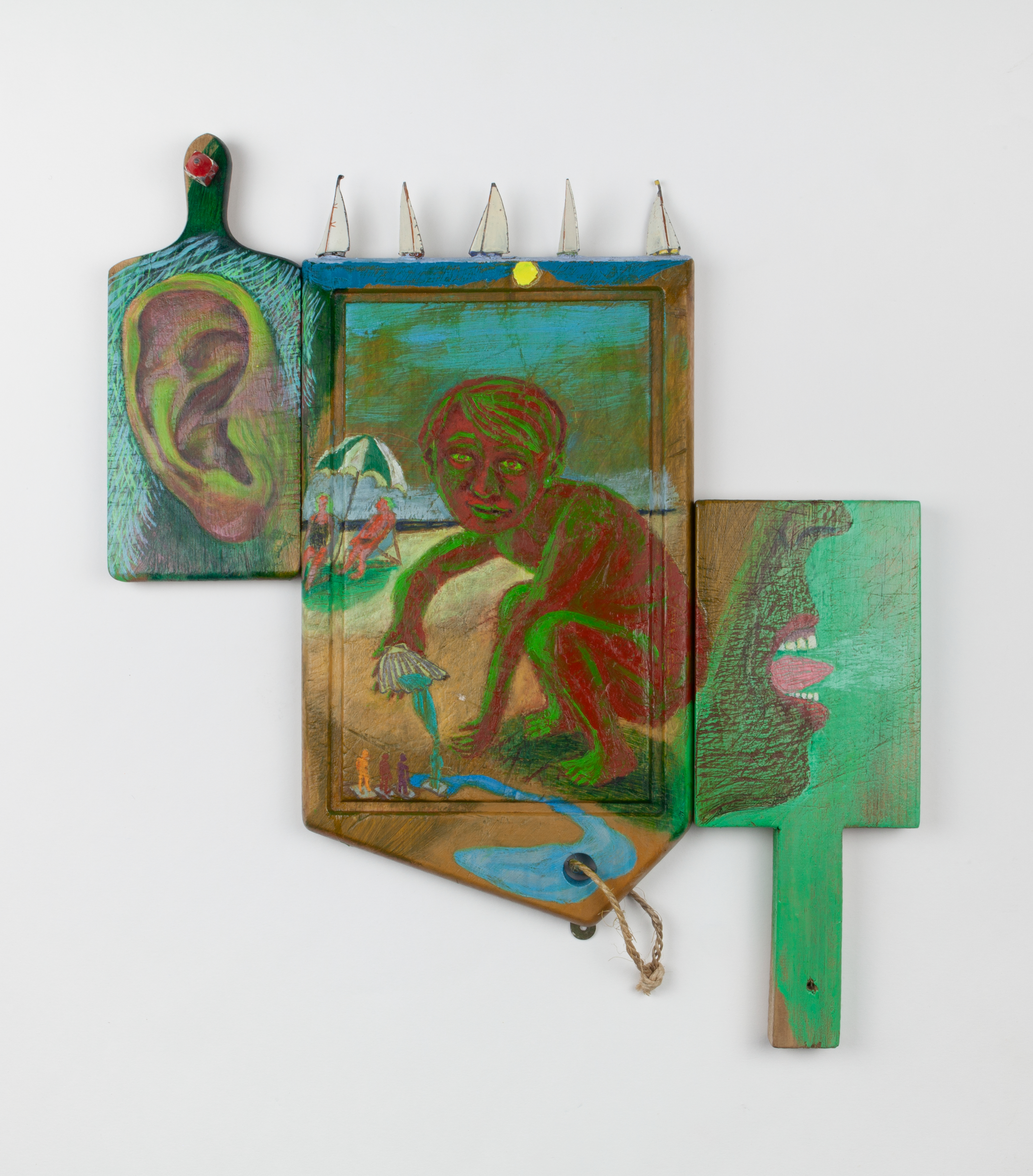
Advent Station 2. John the Baptist on the Beach
Mark Cazalet, Advent Station 2: John the Baptist on the Beach, 2024

The breath/wind motif is subtly carried over into this second Advent station, with sailboats lining the top of the center board.

This scene shows a young John the Baptist playing on the beach, with his parents, Zechariah and Elizabeth, lounging in swimsuits under a nearby umbrella. John crouches in the sand, pouring water from a seashell (the implement he uses to baptize Jesus in many traditional paintings, most famously Piero della Francesca’s) onto toy figurines who have queued up for the affusion. The water cuts a mini river through the sand, alluding to the Jordan.

The two side panels, which show a close-up of an open ear and an open mouth, likely refer to, in his prophetic ministry as an adult, John’s hearing the word of God and proclaiming it. His is “the voice of one crying out in the wilderness: ‘Prepare the way of the Lord; make his paths straight’” (Mark 1:3). John is regarded as an Advent figure because, by preaching repentance from sin, he prepared the people for the coming of the Messiah.

Advent Station 3: The Annunciation
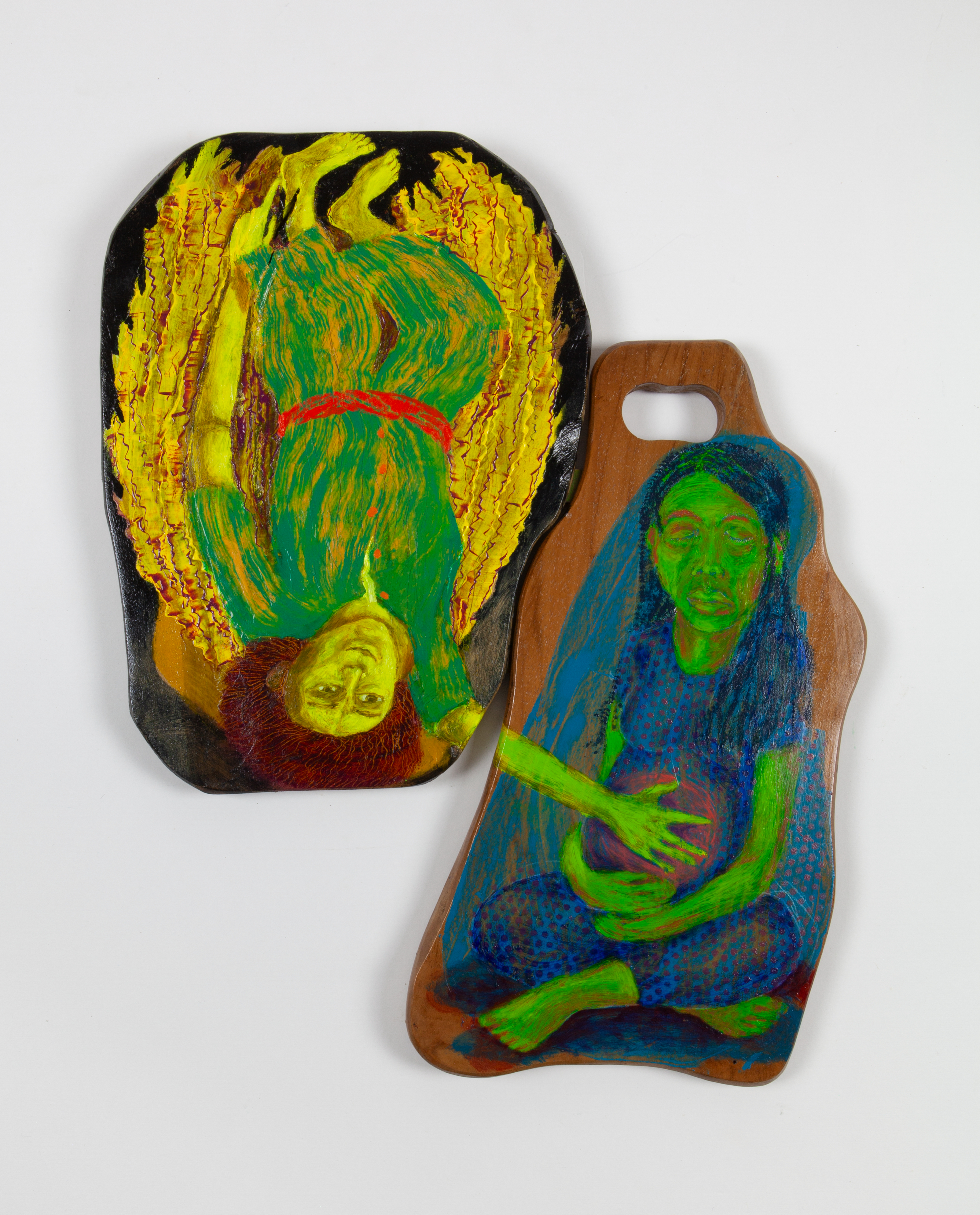
Advent Station 3. The Annunciation
Mark Cazalet, Advent Station 3: The Annunciation, 2024

The Annunciation, portraying the angel Gabriel’s message to Mary that she has been chosen to bear God’s Son, is one of the most frequently depicted biblical scenes of all time. How could any artist possibly make it new?

Cazalet refreshes the encounter by showing Gabriel dipping down headfirst from the heavens, the unconventional orientation perhaps a playful allusion to the topsy-turvy nature of Christ’s kingdom. He reaches across the gap to touch the belly of Mary, a young Black woman in a polka-dot dress who is seated on the floor with her eyes closed, rapt in prayer. This consensual touch is what effects the Incarnation.

Mary wears blue and even exudes a blue aura, blue being her traditional color, associated with heaven (the sky realm) and hope. Gabriel’s skin has a golden sheen—the color of divinity, purity, holiness. The coming together of blue and yellow creates green, symbolizing life, growth, and renewal.

Advent Station 4: Bethlehem Motel
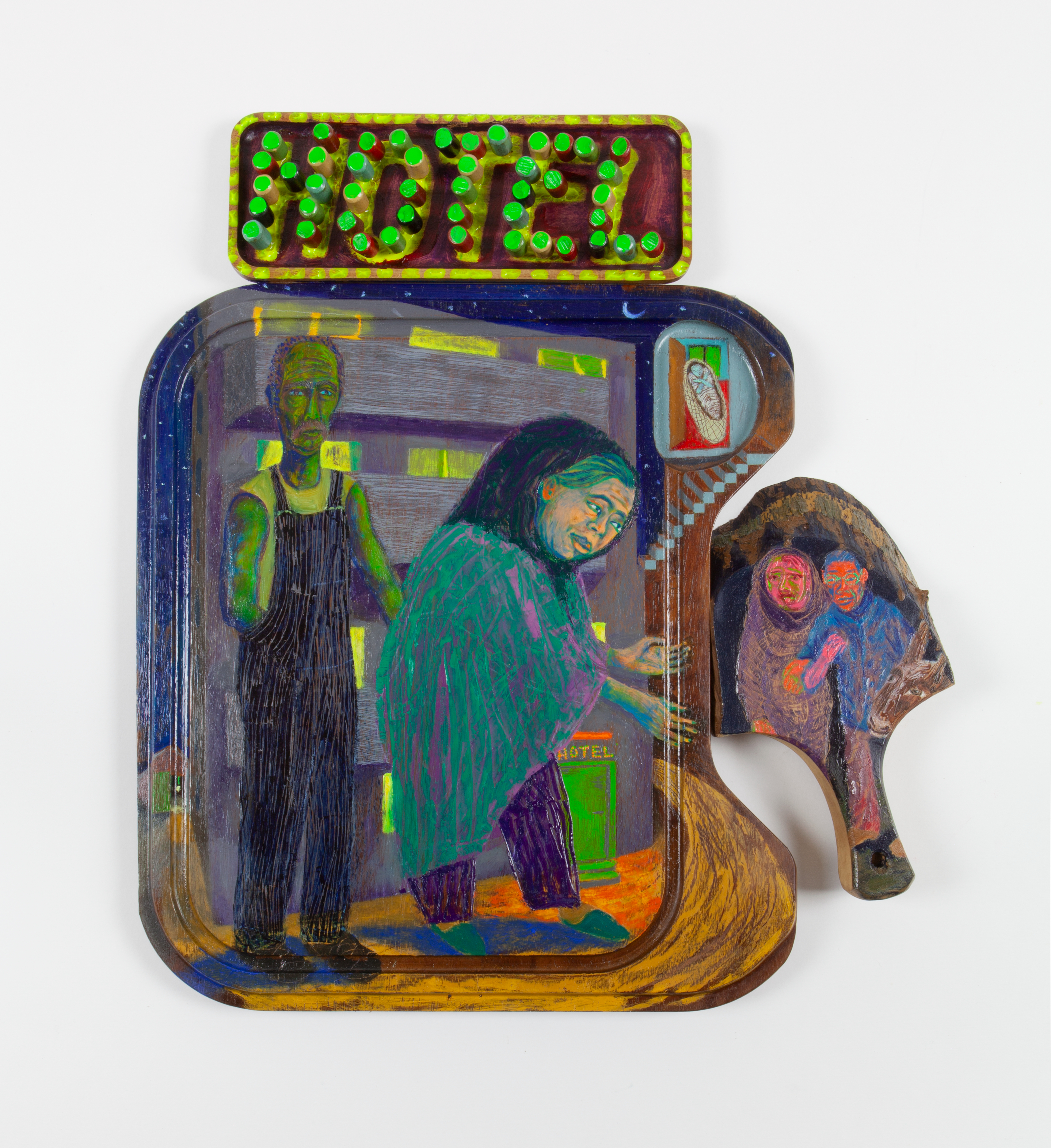
Advent Station 4. Bethlehem Motel
Mark Cazalet, Advent Station 4: Bethlehem Motel, 2024

The innkeeper couple in Bethlehem are a cultural invention, biblical scholars tell us, spawned by a misleading English translation of Luke 2:7, which says “there was no room for them [Mary and Joseph] in the inn” (KJV). The Greek word translated “inn,” kataluma, more properly means “guest room”: Because the census had brought many out-of-towners to the area, the guest rooms of Joseph’s relatives were full, but they made space for the pregnant couple in the lower room of the house where animals were kept for the night.

Despite the lack of an innkeeper character in scripture, it has become a popular element in storytelling about the Nativity in art, song, and sermons, as it prompts us to consider whether we are making room for Christ in our busy, overcrowded lives. And not just Christ, but anyone in need—of shelter or other forms of care.

Cazalet shows Mary and Joseph approaching a motel door as the female owner, sympathetic, comes out to greet them. A niche above their heads, hovering like a thought bubble, shows what the couple desires: a place to give birth and to lay their son.

Advent Station 5: The Incarnation (A Blessing Conferred)
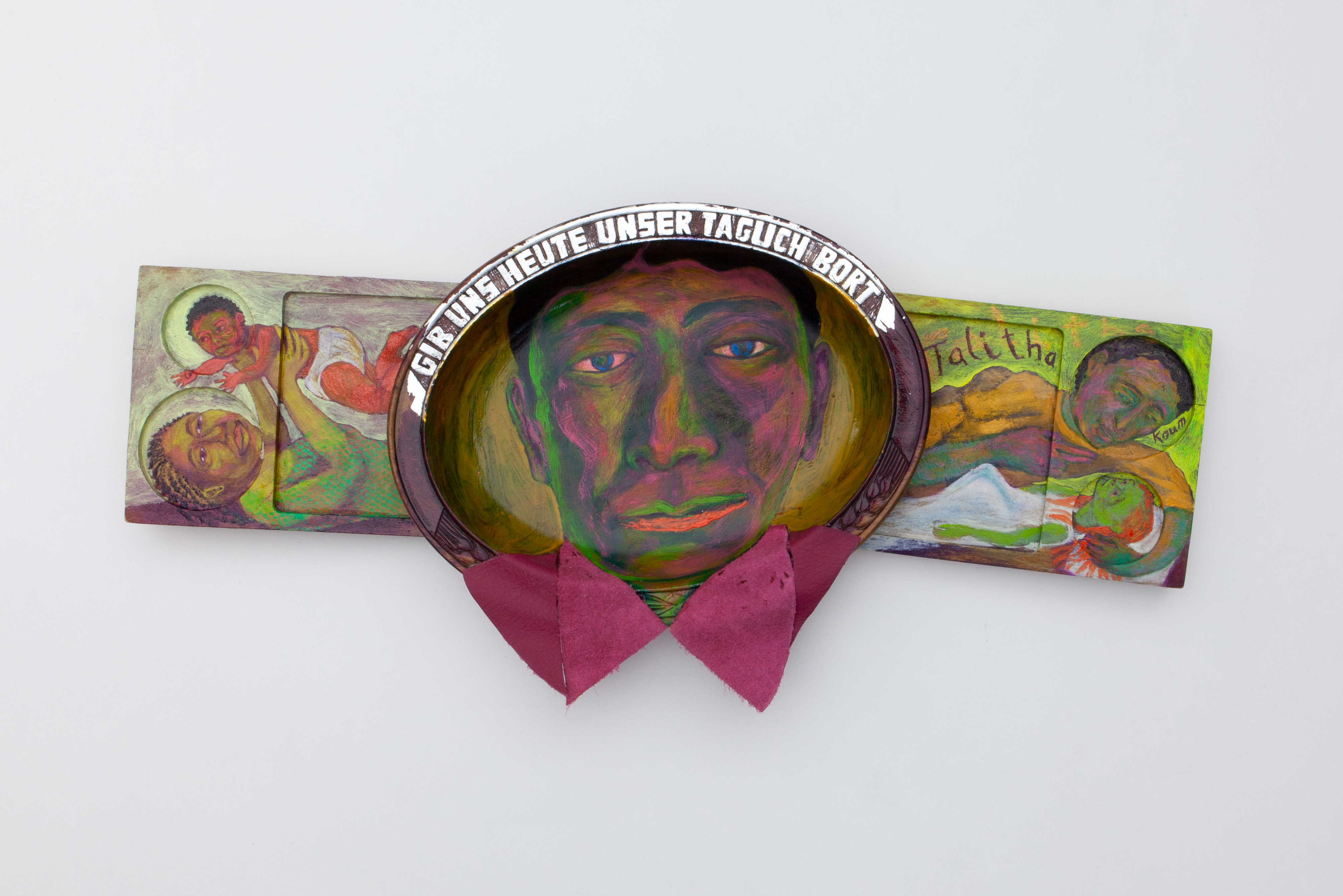
Advent Station 5. The Incarnation (A Blessing Conferred)
Mark Cazalet, Advent Station 5: The Incarnation (A Blessing Conferred), 2024

The fifth station features an unconventional combination of images. The left board shows Mary lying on her back, holding the wiggly infant Christ above her. She beams with maternal love.

On the right board, an adult Christ, similarly positioned, leans over the dead daughter of the synagogue leader Jairus. “Talitha koum,” Jesus gently instructs, cradling the girl’s head—Aramaic for “Little girl, get up” (Mark 5:41). With his words, she rises back to life.

The central image, a Head of Christ, is painted on a wooden bread plate from Germany—these plates were sometimes also used as church collection plates—whose rim reads, “Gib uns heute unser täglich brot” (Give us this day our daily bread). Carved sheaves of wheat poke out from under Jesus’s pink cloth collar.

“My intention is that Mary’s love for her son as she raised him taught him the care and compassion to want to help a child in extremis,” Cazalet told me. “The man is formed by the mother’s love, and our childhoods set the pattern of our response to others.”

Notice how, from behind the Christ head, the two adjoining boards emerge like wings, suggesting freedom.

Advent Station 6: The Shepherds See the Star
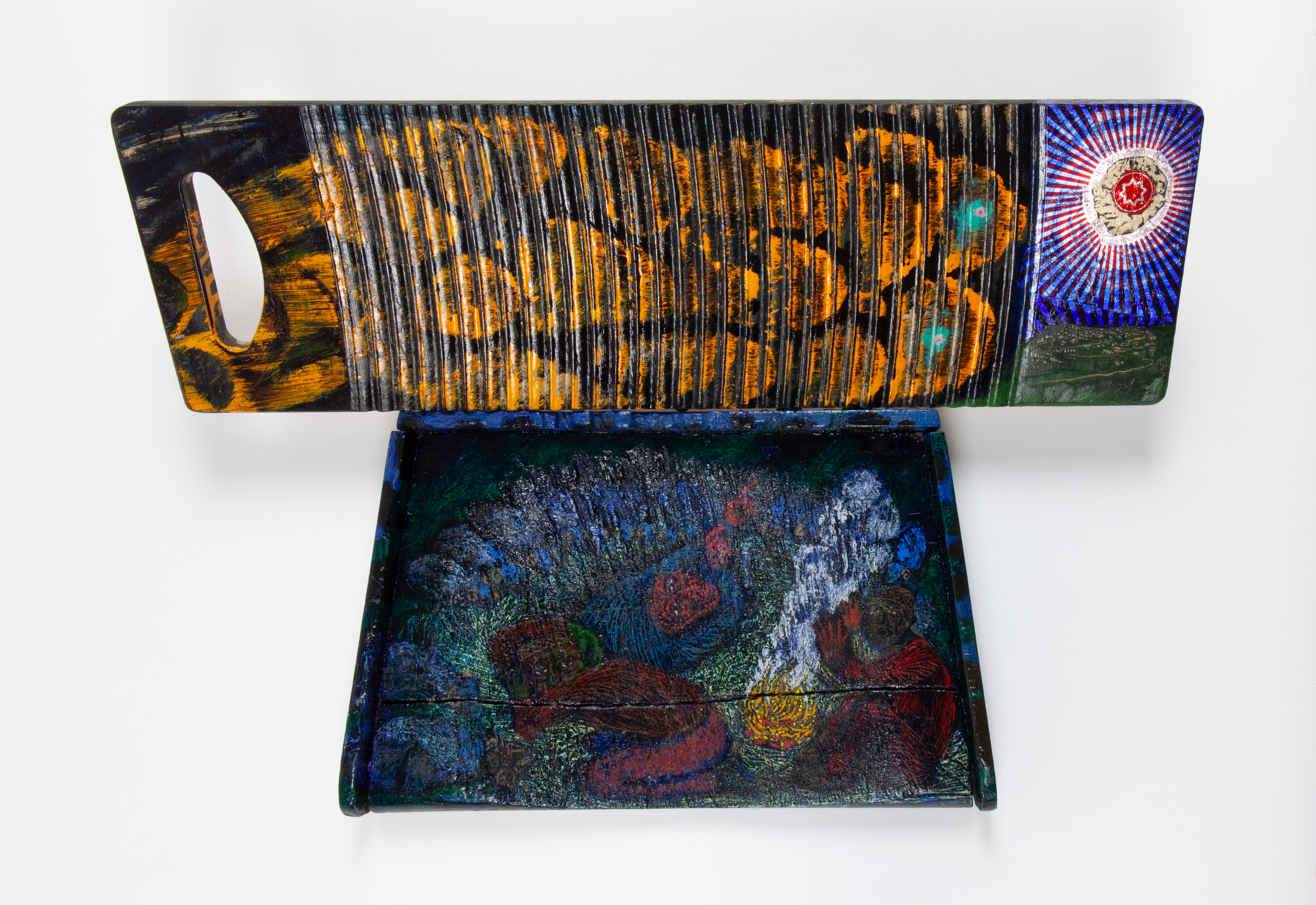
Advent Station 6. The Shepherds See the Star
Mark Cazalet, Advent Station 6: The Shepherds See the Star, 2024

The sixth station portrays the glory of the Lord rippling across the night sky above three shepherds tending their flocks. Content and unassuming, they are gathered round a warm fire when suddenly, an angel appears to announce to them the birth of Christ. One of the shepherds cowers in fear while another gesticulates toward a brightly beaming star in the near distance—rendered with a Tunnock’s milk chocolate tea cake wrapper.

Advent Station 7: The Magi Dreaming
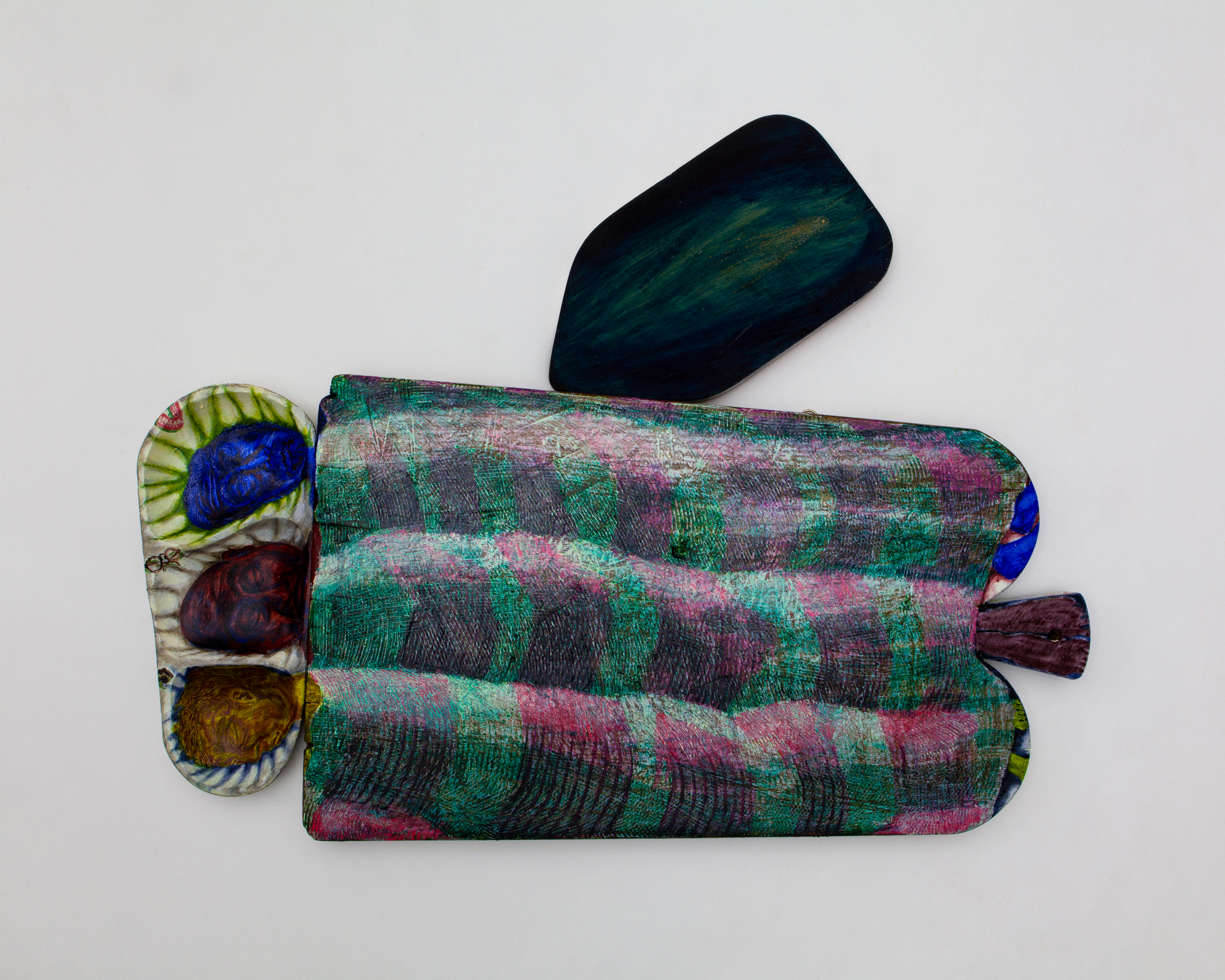
Advent Station 7. The Magi Dreaming
Mark Cazalet, Advent Station 7: The Magi Dreaming, 2024

Having followed a star to Jerusalem from their home back east, the magi enter the court of Herod to inquire where they can find the newborn king of the Jews whom the star heralds, to pay him homage. Herod hadn’t heard of such a king, but immediately he feels threatened—“king of the Jews” is his title—and, unbeknown to the visiting dignitaries, decides to crush this young rival. After consulting with Jewish scholars, he discerns Bethlehem as the birthplace. He divulges this information to the magi and asks them to report back once they’ve found the child so that he, too, can honor him. He hides his true motive under a lie.

The magi have a transformative encounter with Jesus in Bethlehem. Falling asleep after that momentous day, they receive a warning from God not to return to Herod. So they avoid him on their way back home.

As in medieval visual treatments of the Dream of the Magi, Cazalet has the magi sharing a bed. (There’s nothing salacious about it—it’s just a compositional practicality, to show the three men in one space, having the same dream at the same time.) Their toes peep out from under the covers. That surface, by the way, is flat—Cazalet skillfully creates the illusion of convexity through painting, suggesting bodies underneath.

Beside the magi’s heads are three small personal objects: earbuds, glasses, and dentures, which allude to the proverbial principle “See no evil, hear no evil, speak no evil.” “I was musing if this trinity of pilgrim searchers were perhaps aspects of the one true pilgrim, parts of a single whole disciple,” the artist told me.

Advent Station 8: Herod Syndrome
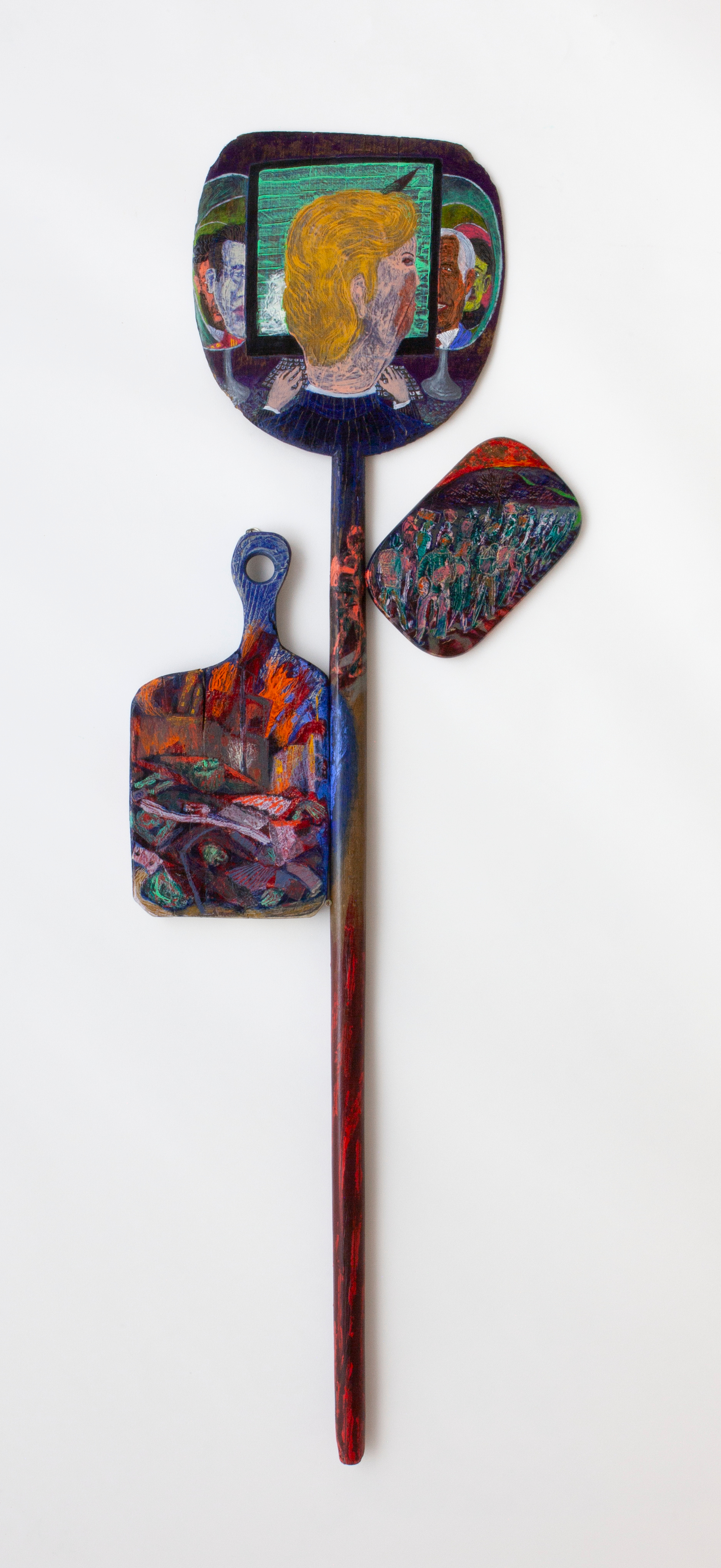
Advent Station 8. Herod Syndrome
Mark Cazalet, Advent Station 8: Herod Syndrome, 2024

Thwarted by the magi, Herod fumes with rage. He will not be dethroned by this so-called messiah. So he orders his soldiers to kill all the boys in Bethlehem aged two and under, thinking that Jesus will be among them. In his self-obsession, he cares nothing for the good of the people; he cares only for the consolidation of his own power.

Station 8 is Cazalet’s modern take on the Massacre of the Innocents. At the helm of a computer keyboard is a presidential figure launching a missile on whomever he has deemed the enemy, while other likeminded autocrats—I believe that’s Saddam Hussein, Kim Jong Un, Vladimir Putin, and Adolf Hitler—look over his shoulder approvingly, their faces reflected endlessly in mirrors using a technique called mis en abyme (“put in the abyss”). This panel, the transferring surface of a baker’s peel, sits at a height to emphasize the pompousness of rulers like Herod, who see themselves as above others and above the law.

Such an attitude can have dire consequences. “Below we see the devastation of a civilian population, defenceless against the technological onslaught,” Cazalet describes, “and the perpetual streams of migrants fleeing who knows where to be vilified as more foreign mouths to feed.”

The power mania that gripped Herod, that led to his lashing out in violence, is still alive and well today in national and global politics.

Advent Station 9: The Flight to Egypt (Forced Migration)
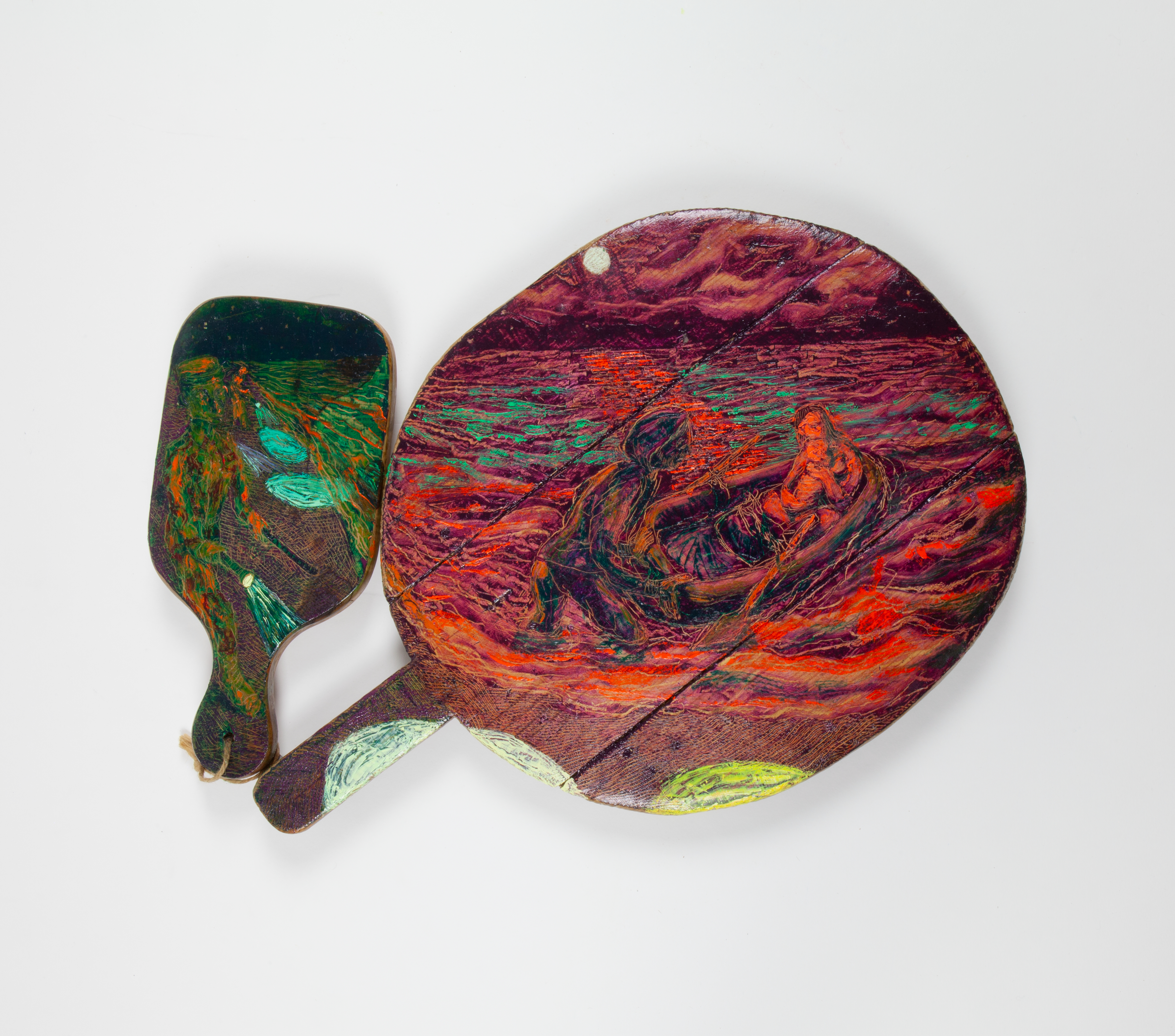
Advent Station 9. The Flight to Egypt (Forced Migration)
Mark Cazalet, Advent Station 9: The Flight to Egypt (Forced Migration), 2024

To protect their son from Herod’s murder decree, Mary and Joseph flee with him across the border to Egypt. Cazalet reimagines their flight through the lens of today’s refugee crisis. In station 9, the Holy Family boards an inflatable raft, braving choppy seawaters in search of asylum. They’re bathed in a menacing red.

On the adjoining panel, border patrol officers, with flashlights and batons, stand on the shore, seeking to bar the entry of strangers into their land.

Advent Station 10: The Exiles Return
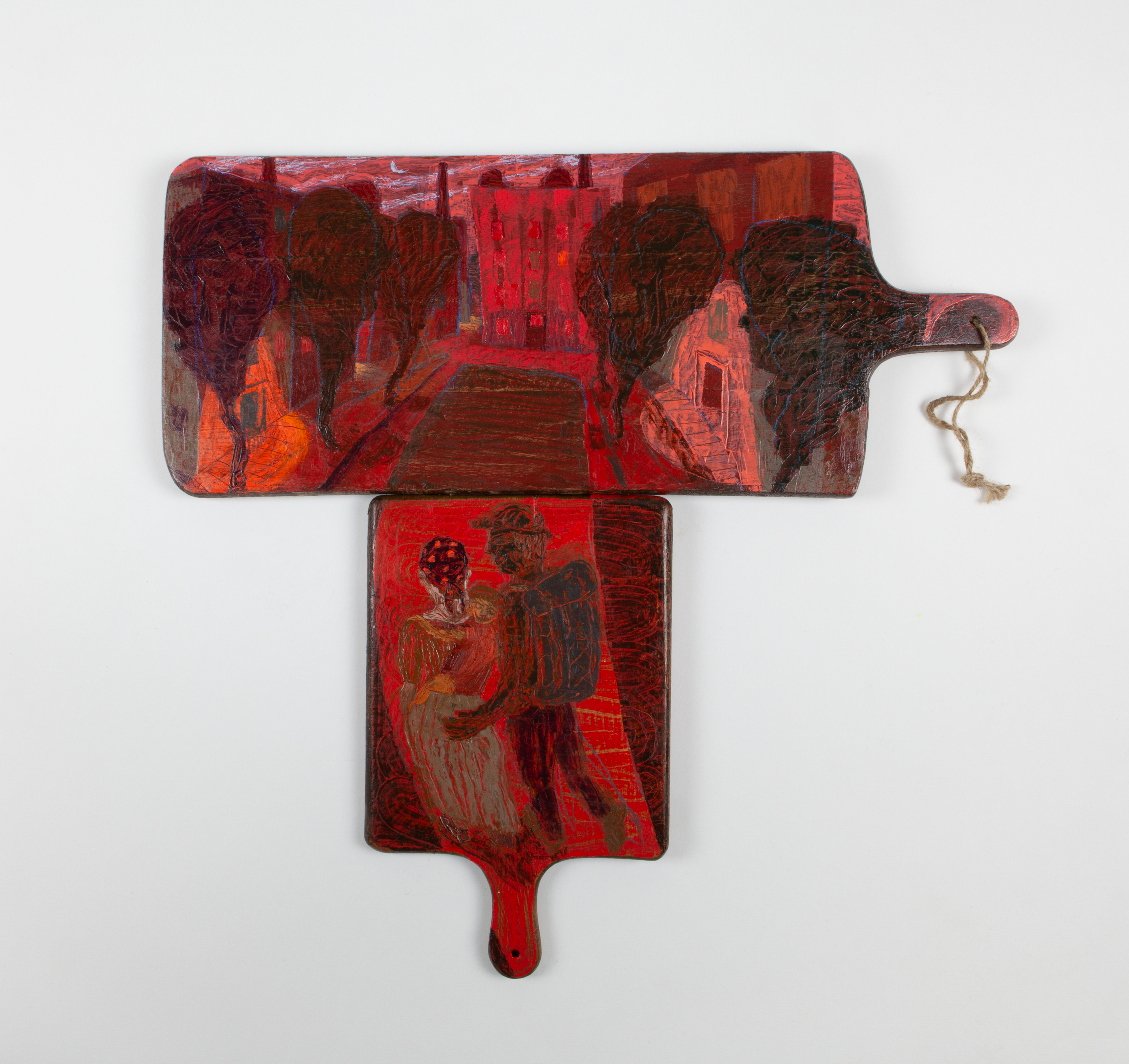
Advent Station 10. The Exiles Return
Mark Cazalet, Advent Station 10: The Exiles Return, 2024

Egypt grants refuge to the Holy Family, and they settle there for an undisclosed period of time—until Joseph receives word from an angel that it’s safe to return to their homeland.

Station 10 shows the family arriving at sunset in their beloved Nazareth, all their belongings reduced to what could fit in a single backpack. As they approach a tree-lined boulevard, Jesus clings to his mother’s back, looking behind at where they’ve come from. He has not yet known this town but will come to love it. He will call it home until his ministry beckons him beyond it more than two decades later.

Advent Station 11: Faithful Waiting and Watching (Anna and Simeon)
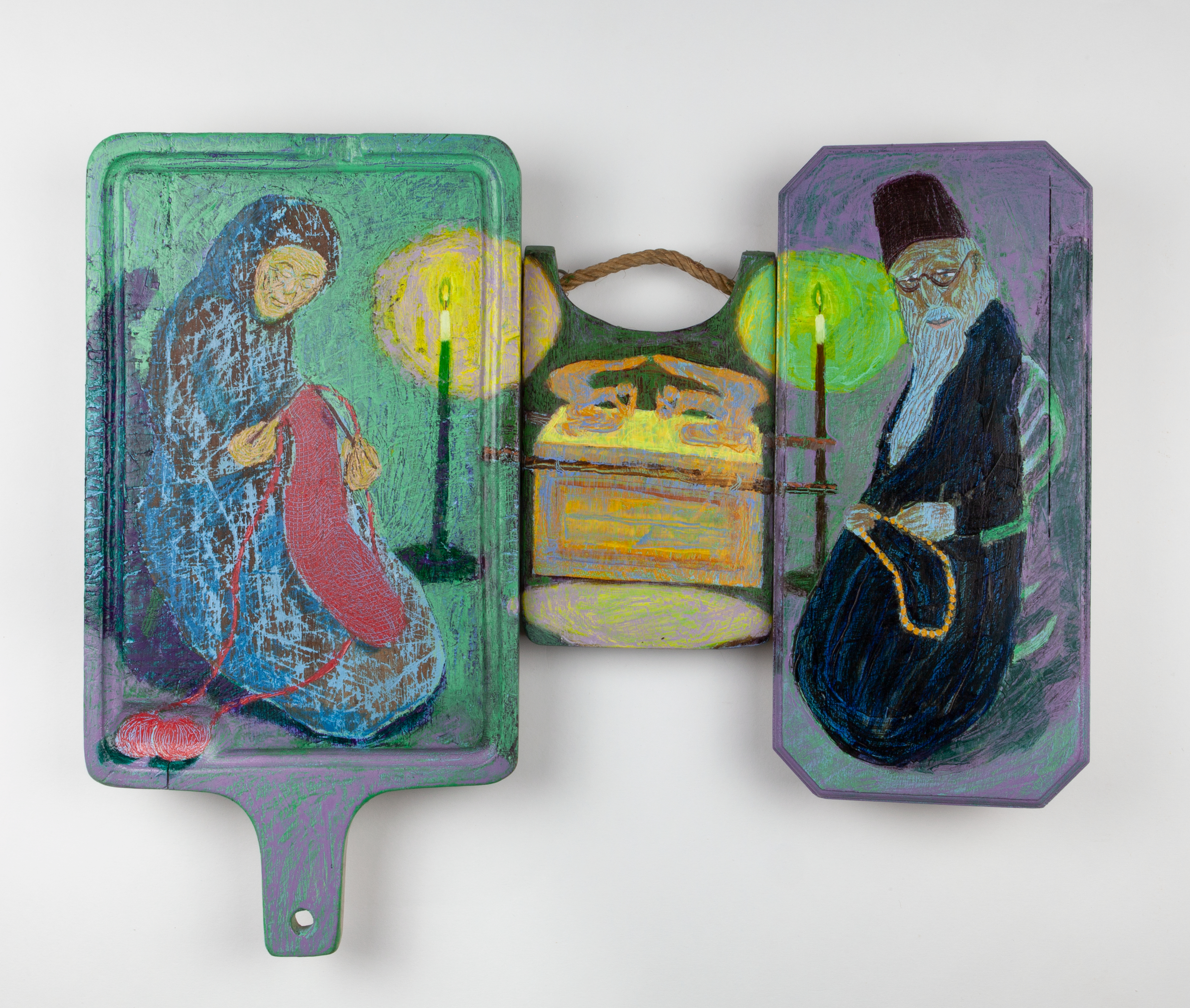
Advent Station 11. Faithful Waiting and Watching (Anna and Simeon)
Mark Cazalet, Advent Station 11: Faithful Waiting and Watching (Anna and Simeon), 2024

This is my favorite of all the stations. While the Presentation of Christ in the Temple is standard fare in Christian art—showing Mary handing Jesus to Simeon, a devout Jew interpreted by most artists as a priest, forty days after Jesus’s birth, with Joseph and the prophet Anna standing off to the side—Cazalet isolates the elderly Anna and Simeon, zeroing in on their faithful act of waiting for the Messiah.

Illuminated by candlelight, Anna knits a scarf, communing with God in the solitude, while Simeon fingers a string of prayer beads. Their eyes are weary and downcast, and yet they possess a steadfast hope that their Savior is on his way.

Linking their two spaces is the ark of the covenant, a sacred wooden storage chest plated in gold and topped by two hammered-gold cherubim. Containing the tablets of the law, Aaron’s rod, and a pot of manna, the ark was kept in the holy of holies, the innermost sanctum of the temple, where it signified God’s presence.

Waiting can often feel useless—like nothing’s happening or will ever happen. But Anna and Simeon continued to wait on the Lord, to count on his promise. And finally, before they died, they were granted the grace to see and to hold the One they had so fervently longed for: the Christ, Emmanuel, “God with us.”

Advent Station 12: The Mistle Thrush Greets the New Day
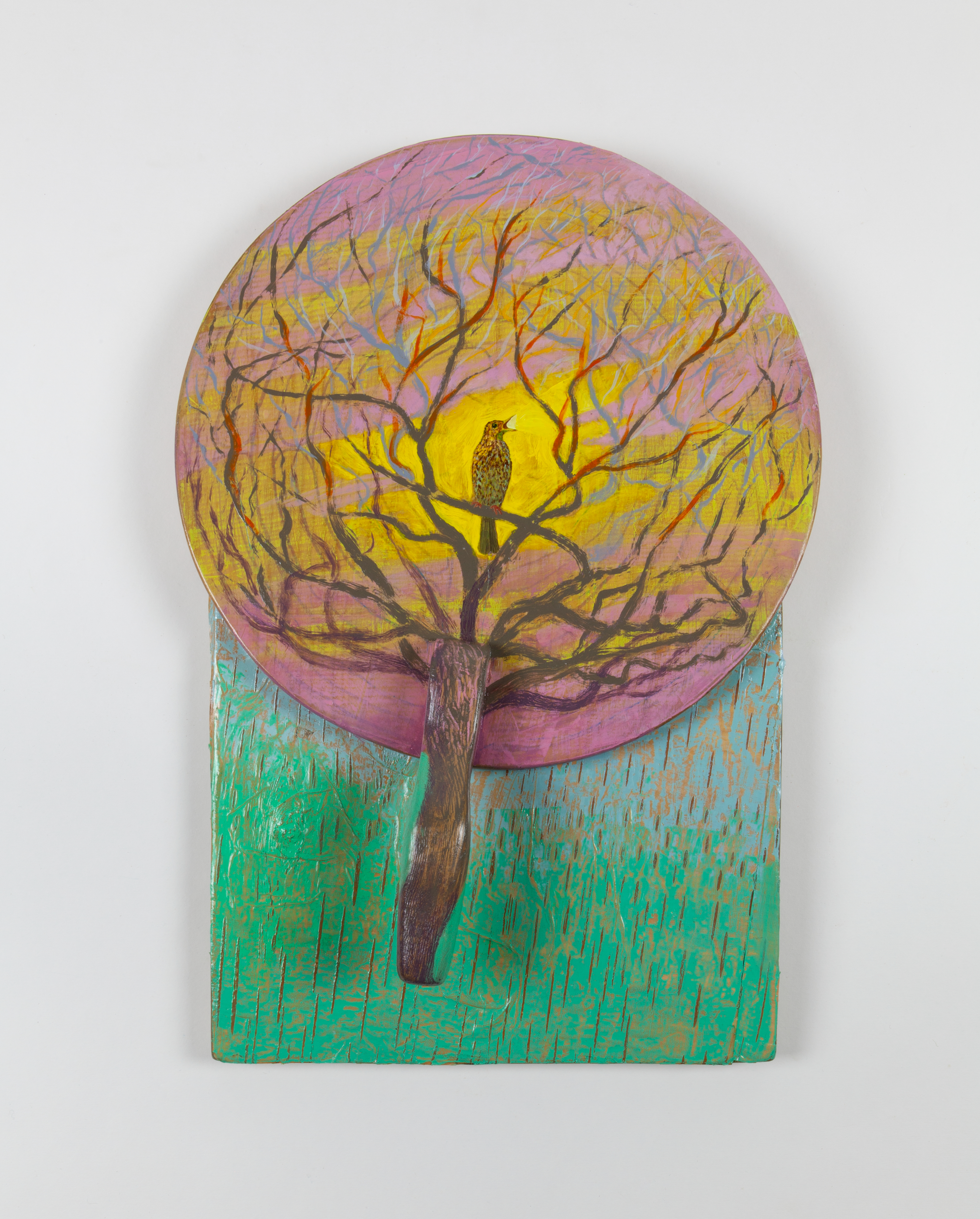
Advent Station 12. The Mistle Thrush Greets the New Day
Mark Cazalet, Advent Station 12: The Mistle Thrush Greets the New Day, 2024

The Advent path we’ve just walked has included an unplanned pregnancy, persecution, and displacement but also miracles, play, and surprise.

Cazalet’s Advent Stations end with a bird in a tree, singing its heart out as a pink and yellow dawn spreads across the sky. The twisted branches become streamers, blowing as if in celebration. (There’s that breath of God again!) Out of the bird’s beak shoots light.

The board that forms the grassy ground is incised with knife marks, perhaps suggesting woundedness—although maybe it’s a turning over of the soil to promote new growth.

The flame-like hues in and around the tree evoke the burning bush of Exodus 3, from which God spoke his name: I AM THAT I AM.

This Advent tree, bare yet lively, calls us to embrace each new day as a gift from the One who is and was and is to come, remembering how Christ came to show us who God is and to feel and heal our brokenness, and he will come again to make all things new.


The Advent Stations by Mark Cazalet, with accompanying poems by Richard Leaf rendered in calligraphy by Pansy Cambell, are on display at Chelmsford Cathedral in eastern England through February 2, 2026. They are available for sale, but until they’re purchased, Cazalet wants to show them in other churches and cathedrals. They’re tentatively scheduled for exhibition in Southwark Cathedral in London during Advent 2026.
Roundup: Advent poetry discussion, graffiti at Canterbury Cathedral, “Dios con Nosotros” print series, and more

ONLINE DISCUSSION: “Poems of Advent, Christmas, and Epiphany” led by Brian Volck, December 13, 2025, 12–1:30 p.m. ET: Poet Brian Volck (whose work I’ve shared here and here) is leading a free online discussion on Advent, Christmas, and Epiphany poetry next Saturday. Sponsored by the Ekklesia Project, it will bring together diverse poetic styles and voices. “Each poem is read by a volunteer and then the group discusses what stood out, what struck them, and what questions the poem raises,” Volck says. “My goal is to encourage a diversity of responses rather than impose mine. No preparation is required.” Register here to receive the Zoom link and the poems in advance.

+++

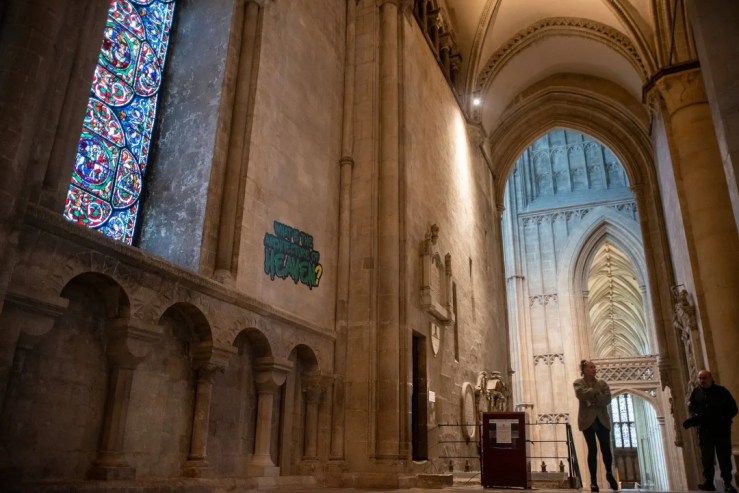
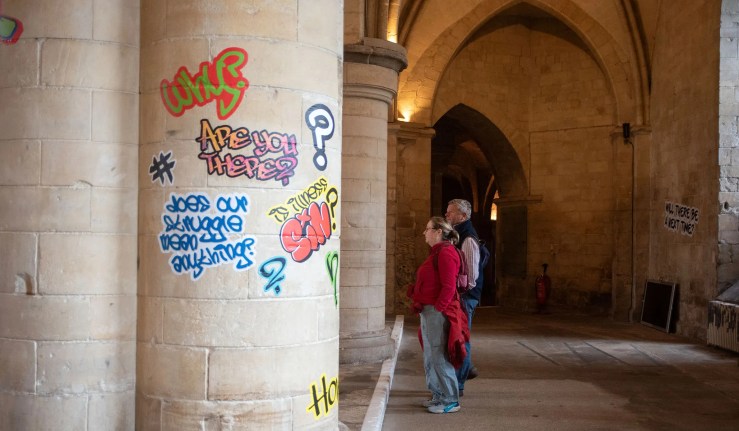
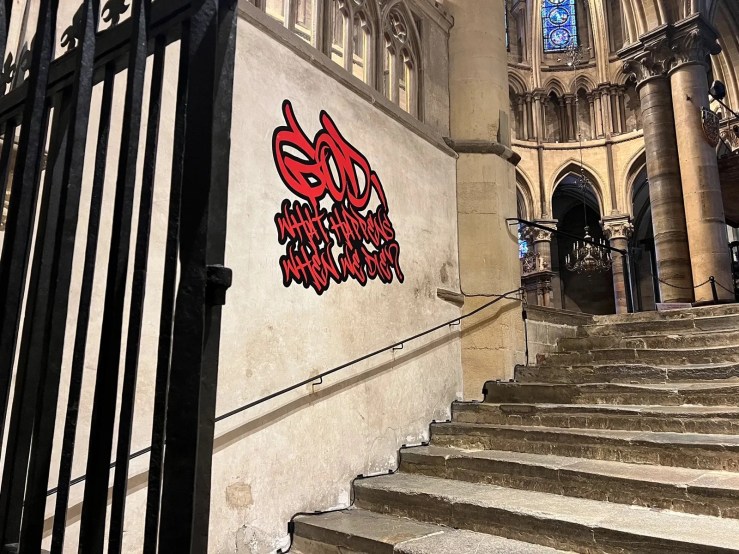
INSTALLATION: Hear Us, Canterbury Cathedral, October 17, 2025–January 18, 2026: Graffiti-style stickers are affixed to the medieval walls, floors, and pillars of England’s Canterbury Cathedral in the temporary installation Hear Us, voicing questions to God collected from local marginalized individuals, such as:

  • Why is there so much pain and destruction?
  • Is this all there is?
  • Are you there?
  • Does everything have a soul?
  • Do you ever regret your creations?
  • How do I break the cycle?
  • Does our struggle mean anything?
  • How is my dog Bear doing?
  • God, do you know me?
  • Hear Us
  • Hear Us
  • Hear Us

Curator Jacquiline Creswell [previously], collaborating with poet Alex Vellis, organized a series of workshops led by artists Sven Stears, Henry Madd, Jasbir Dhillon, Adam Littlefield, Alice Gretton, and Callum Farley, which invited people who felt the cathedral was not for them to gather together and delve into discussions about their lives, experiences, and aspirations. Among the participants were members of the Black and Brown diasporas, LGBTQIA+ people, neurodivergent people, people in addiction recovery, and people with mental health disorders. They were asked to respond to the prompt “If you could ask God a question, what would it be?”

Many of the responses were then translated into big, colorful word graphics that cannot be overlooked. “All of the questions are prayers. All of the questions are already sacred,” Vellis says. “So by putting the questions into an already existent sacred space, we are saying you are valid, your words are valid, your prayers are in a place in which they can be heard and they can be seen and they can be supported.”

I learned about this installation from the Exhibiting Faith podcast’s interview with Creswell and Vellis—an episode I heartily commend. They explain how the exhibition was developed, how they persuaded the cathedral to agree to it, and how they have dealt with the storm of criticism it has generated. Many have called it an act of vandalism (even though the stickers were authorized by the dean and will leave no trace when they’re removed next month) and irreverence, desecration. US Vice President JD Vance said the exhibition “mak[es] a beautiful historical building really ugly,” and Elon Musk called it a “suiciding” of Western culture.

I have not seen the exhibition in person, and I am neither British nor Anglican, so I don’t possess the same sense of my identity or heritage being threatened that many Church of Englanders have expressed. But I personally like the confrontational clash of aesthetics: traditional juxtaposed with modern; majestic Gothic architecture, staid limestone, garishly “spray-painted” in a street style, bringing contemporary spiritual and theological questions into a nearly millennium-old church building. I also like the concept of amplifying rather than diminishing the voices of those who feel marginalized by the church but who still want to engage, who are curious—bringing their questions into the space where we gather as a community of Christ followers and using them as a portal into further faith conversations, as Creswell put it in a media interview.

+++

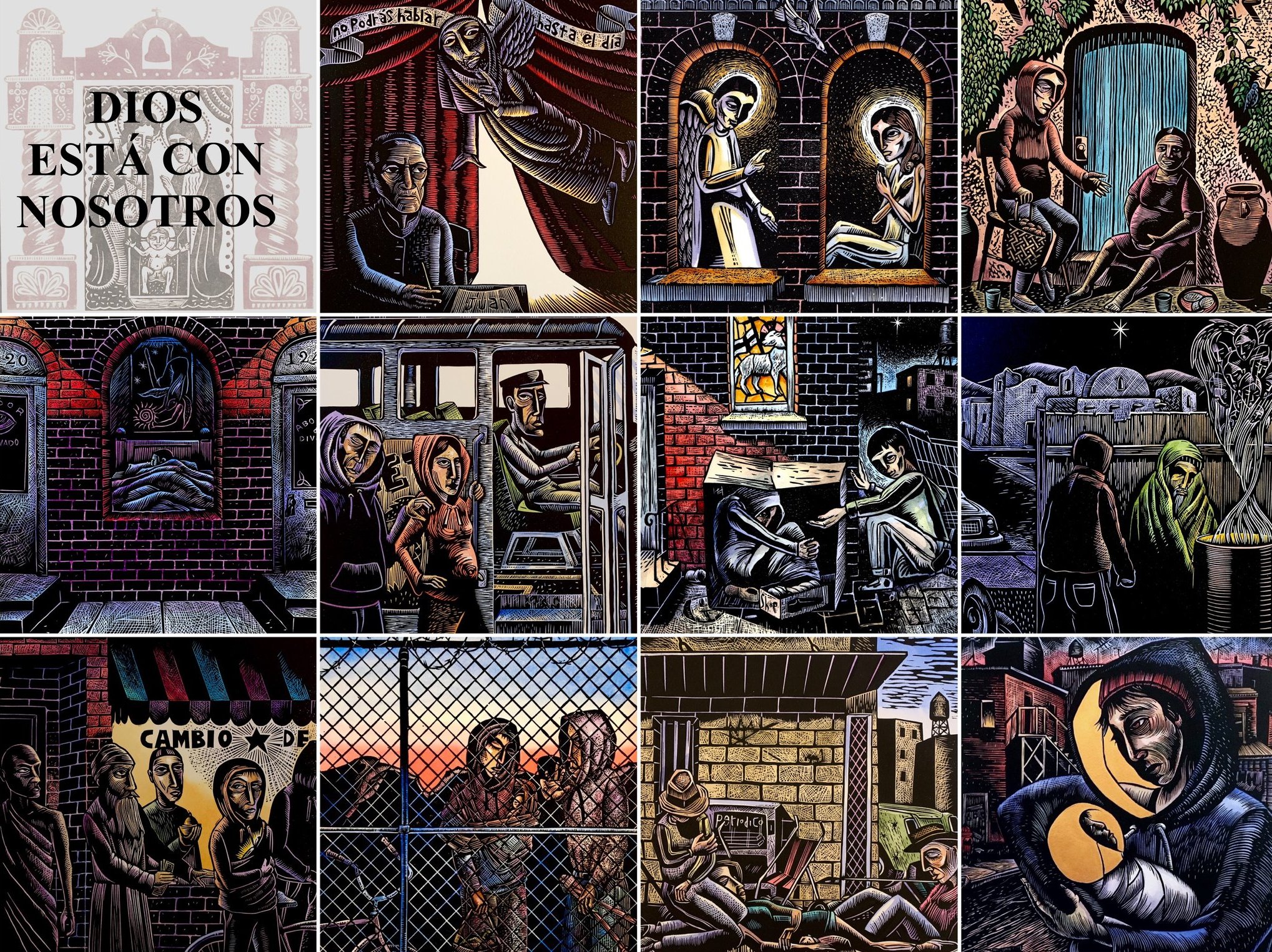
BLOCKPRINT SERIES: Dios con Nosotros (God with Us) by Kreg Yingst: Kreg Yingst [previously] is my favorite contemporary printmaker working on religious themes. Last December he shared a series of hand-colored linocut prints that he started in 2019 and that is ongoing, collectively titled Dios con Nosotros (God with Us)—“a modern-day American Christmas story which takes place somewhere south of the U.S. border,” he writes.

Yingst, Kreg_God with Us series

Several of the linocuts are for sale at Yingst’s Etsy shop, as is a set of twelve identical Christmas cards featuring Madona y Niño as the primary image. You can browse the rest of the series as it currently stands on his PsalmPrayers Facebook page; I’ve linked to the individual images below:

  1. El Encuentro: Zacarías y el Ángel Gabriel (The Encounter: Zechariah and the Angel Gabriel)
  2. La Anunciación (The Annunciation)
  3. La Visitación (The Visitation)
  4. El Dilema de José (Joseph’s Dilemma)
  5. Viaje a la Ciudad Natal (Journey to the Hometown)
  6. La Natividad (The Nativity)
  7. Una Multitud de Ángeles del Cielo (A Multitude of Angels from Heaven)
  8. Unos Sabios Procedentes del Oriente (Some Magi from the East)
  9. Los Refugiados (The Refugees)
  10. Matanza de los Inocentes (Massacre of the Innocents)
  11. Madona y Niño (Madonna and Child)

+++

SONGS:

>> “Un Cuento de Navidad” (A Song of Christmas): This original song by Adrian Roberto and Melissa Romero is about a town that had lost its wonder—until a child discovered a Bible, and his reading aloud its story of a Savior sparked revival.

>> “What Child Is This / Child of the Poor”: The Hound + The Fox are Reilly and McKenzie Zamber, a husband-wife musical duo from Oregon. This song of theirs interleaves the classic Christmas carol “What Child Is This” by William Chatterton Dix with a new song that emphasizes Christ’s solidarity with the poor.

Here are the Zambers’ new lyrics:

Helpless and hungry, lowly, afraid,
Wrapped in the chill of midwinter;
Comes now, among us, born into poverty’s embrace,
New life for the world.

Who is this who lives with the lowly,
Sharing their sorrows,
Knowing their hunger?
This is Christ revealed to the world
In the eyes of a child, a child of the poor.

Who is the stranger here in our midst,
Looking for shelter among us?
Who is the outcast? Who do we see amidst the poor,
The children of God?

So bring all the thirsty, all who seek peace;
Bring those with nothing to offer.
Strengthen the feeble;
Say to the frightened heart,
“Fear not: here is your God!”

(Related posts: https://artandtheology.org/2023/12/29/christmas-day-5-poor-little-jesus/; https://artandtheology.org/2021/12/17/advent-day-20/)

>> “Everybody Ought to Treat a Stranger Right”: Arranged and expanded by Dan Damon [previously], this traditional blues song is performed here by the Dan Damon Quartet, featuring guest vocalist Sheilani Alix, at a concert at Community Church of Mill Valley in California on December 10, 2023. “Blind Willie Johnson recorded this song in 1930 with two Christmas verses mixed in. I separated them out, added two verses to tell a fuller Christmas story, and recorded the Christmas version with my band on the album No Obvious Angels,” Damon explains. “According to the writer of Hebrews, some have entertained angels unawares.”

Christmas, Day 4: The Innocents

We remember today, O God, the slaughter of the holy innocents of Bethlehem by King Herod. Receive, we pray, into the arms of your mercy all innocent victims; and by your great might frustrate the designs of evil tyrants and establish your rule of justice, love, and peace; through Jesus Christ our Lord, who lives and reigns with you, in the unity of the Holy Spirit, one God, for ever and ever. Amen.

—Collect from the Book of Common Prayer

Western church calendars mark December 28 as the Feast of the Holy Innocents, or Childermas, a day set aside to remember the slaughter of male Bethlehemites aged two and under by Herod the Great, king of Judea, as recounted in Matthew 2:16–18. Historians estimate there were probably ten to twenty children of that age in Bethlehem at the time.

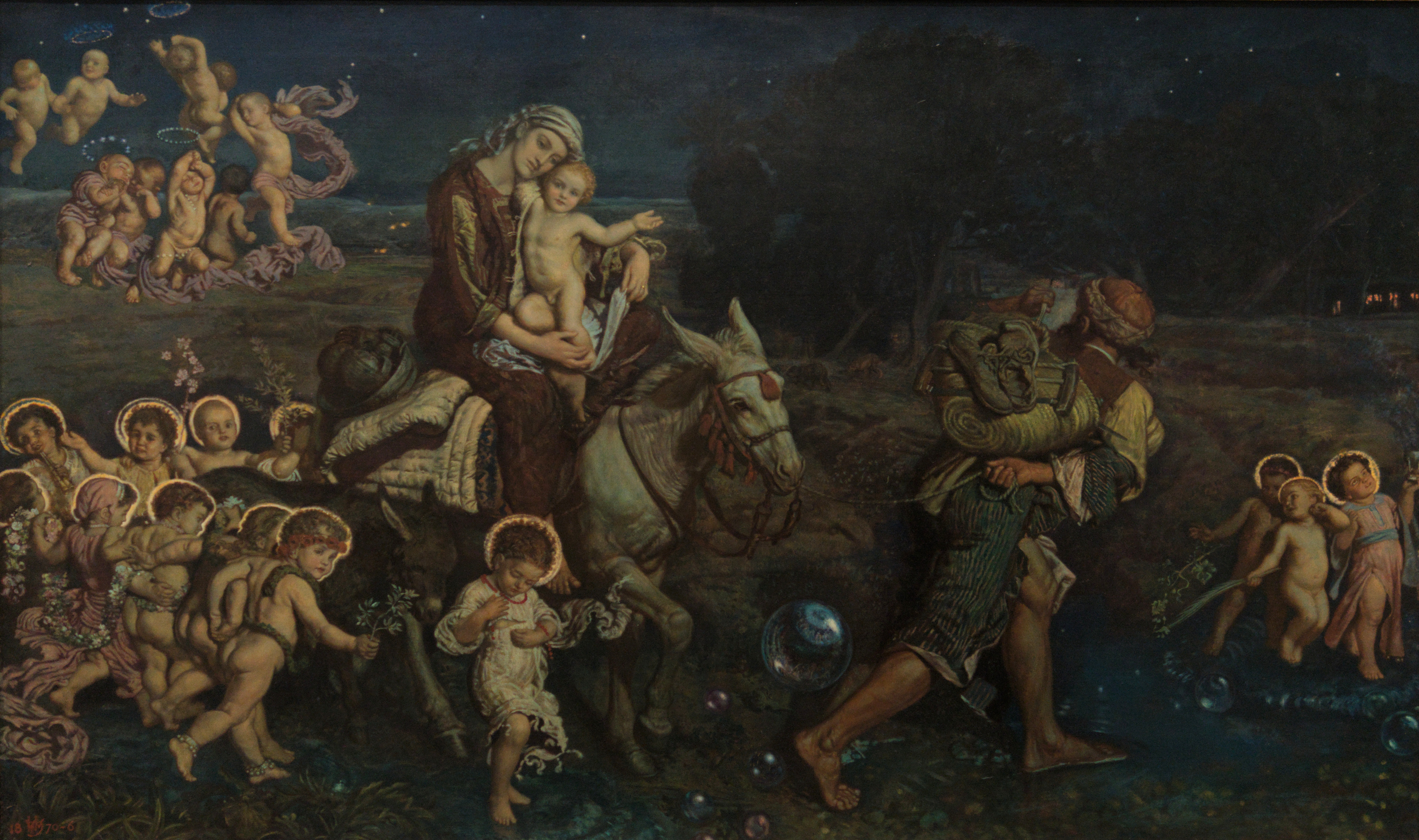
LOOK: The Triumph of the Innocents by William Holman Hunt

Hunt, William Holman_The Triumph of the Innocents
William Holman Hunt (British, 1827–1910), The Triumph of the Innocents, 1870–1903. Oil on canvas, 75.3 × 126 cm. Harvard Art Museums, Cambridge, Massachusetts. Photo: Victoria Emily Jones. [object record]

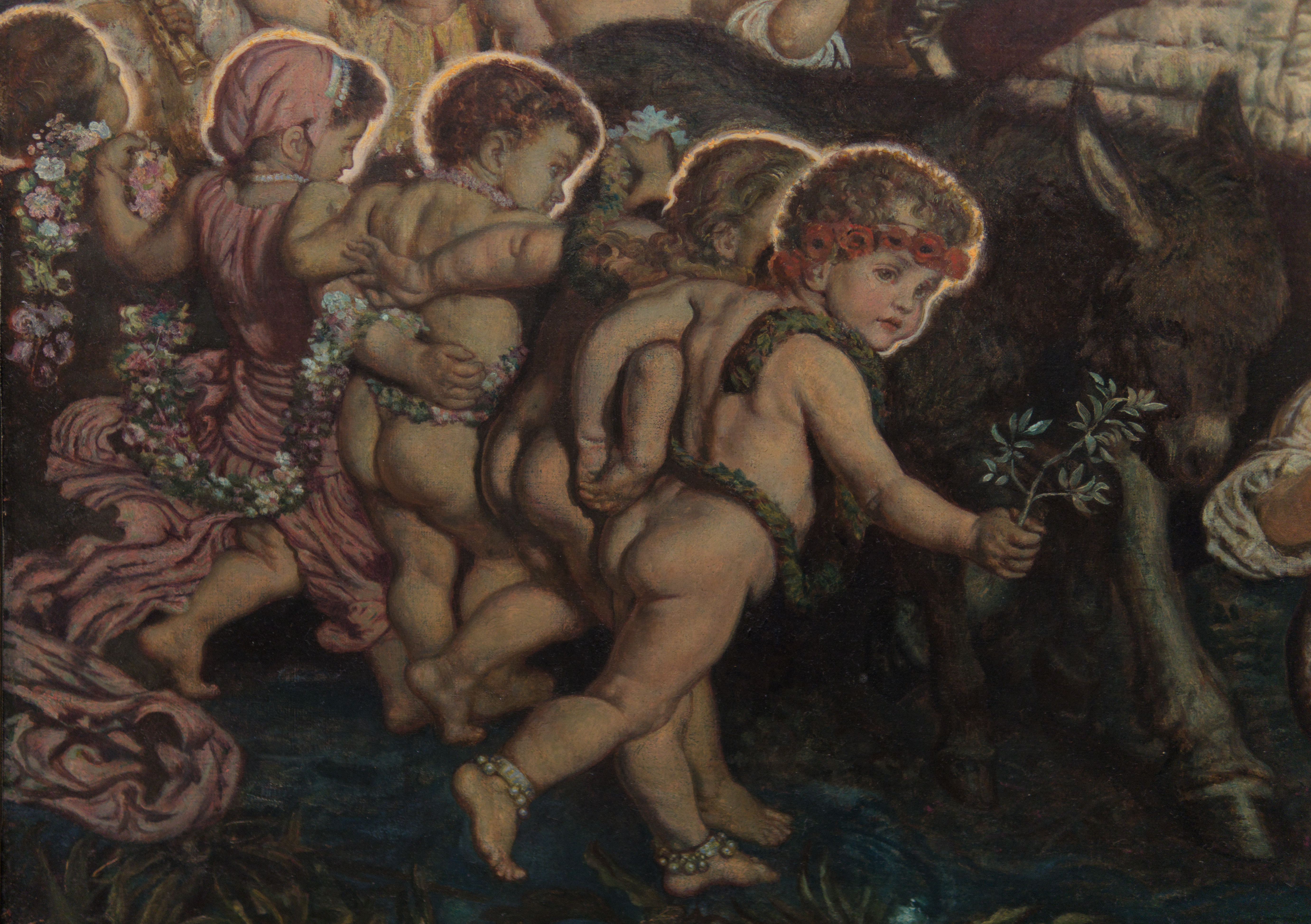
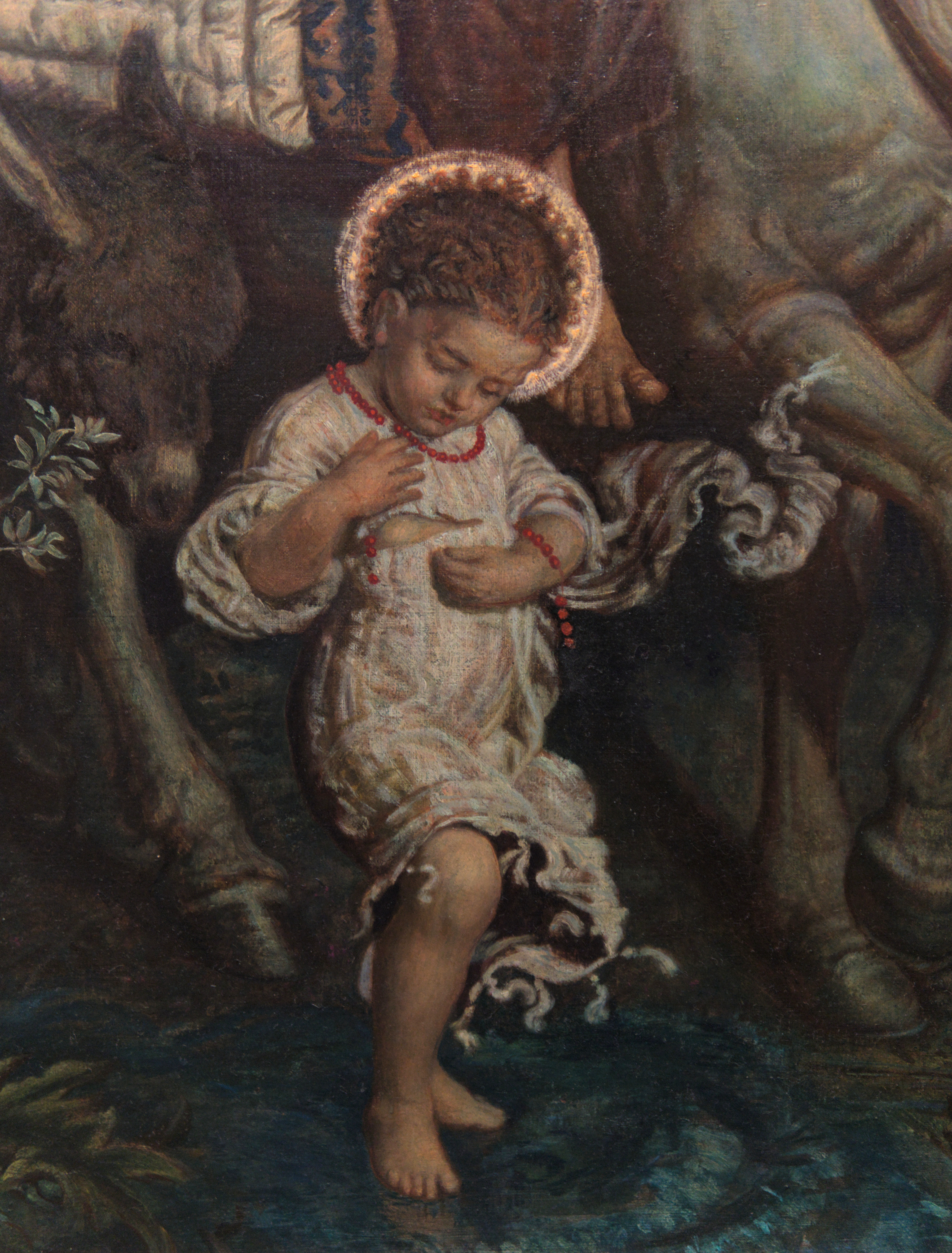
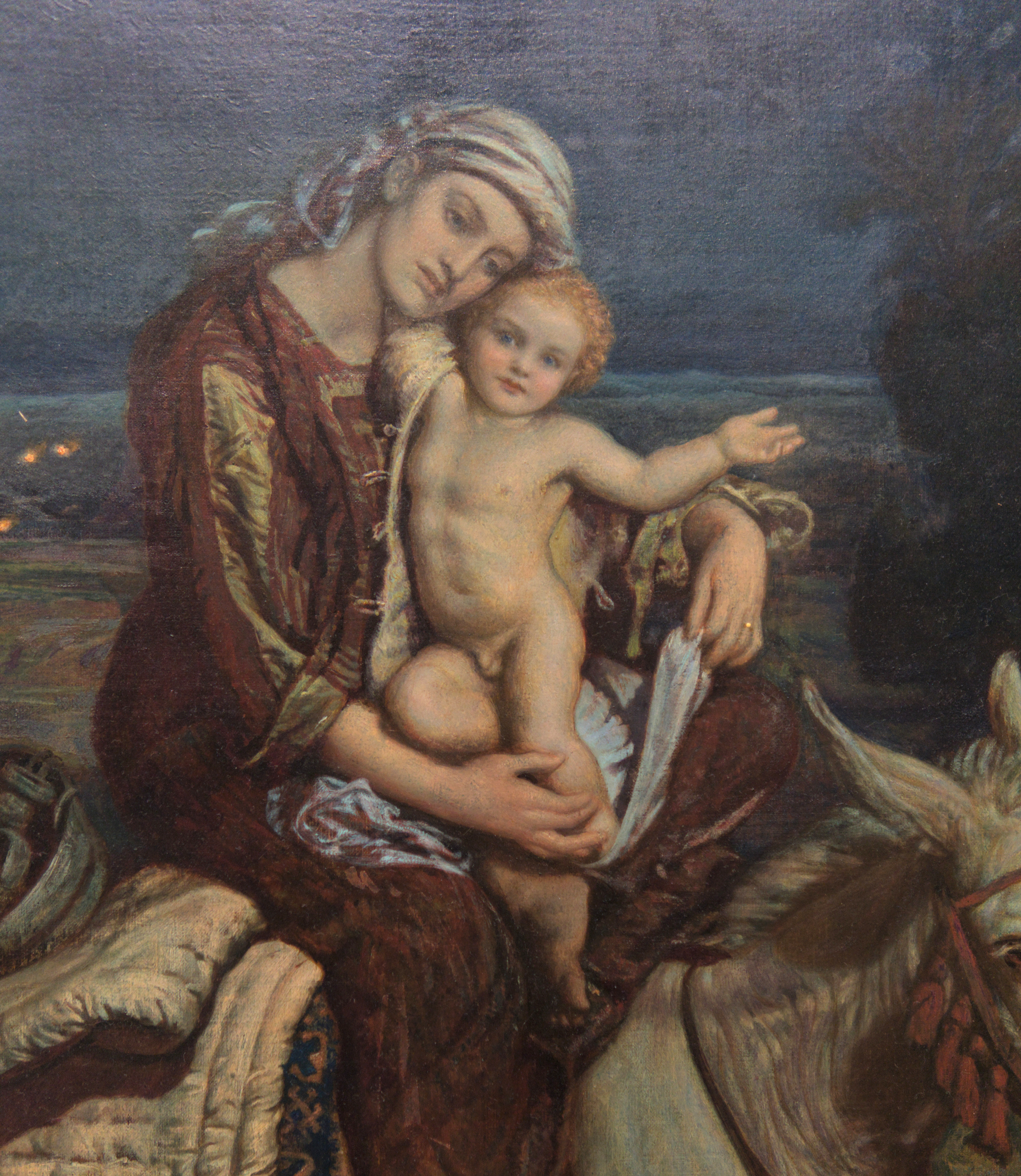
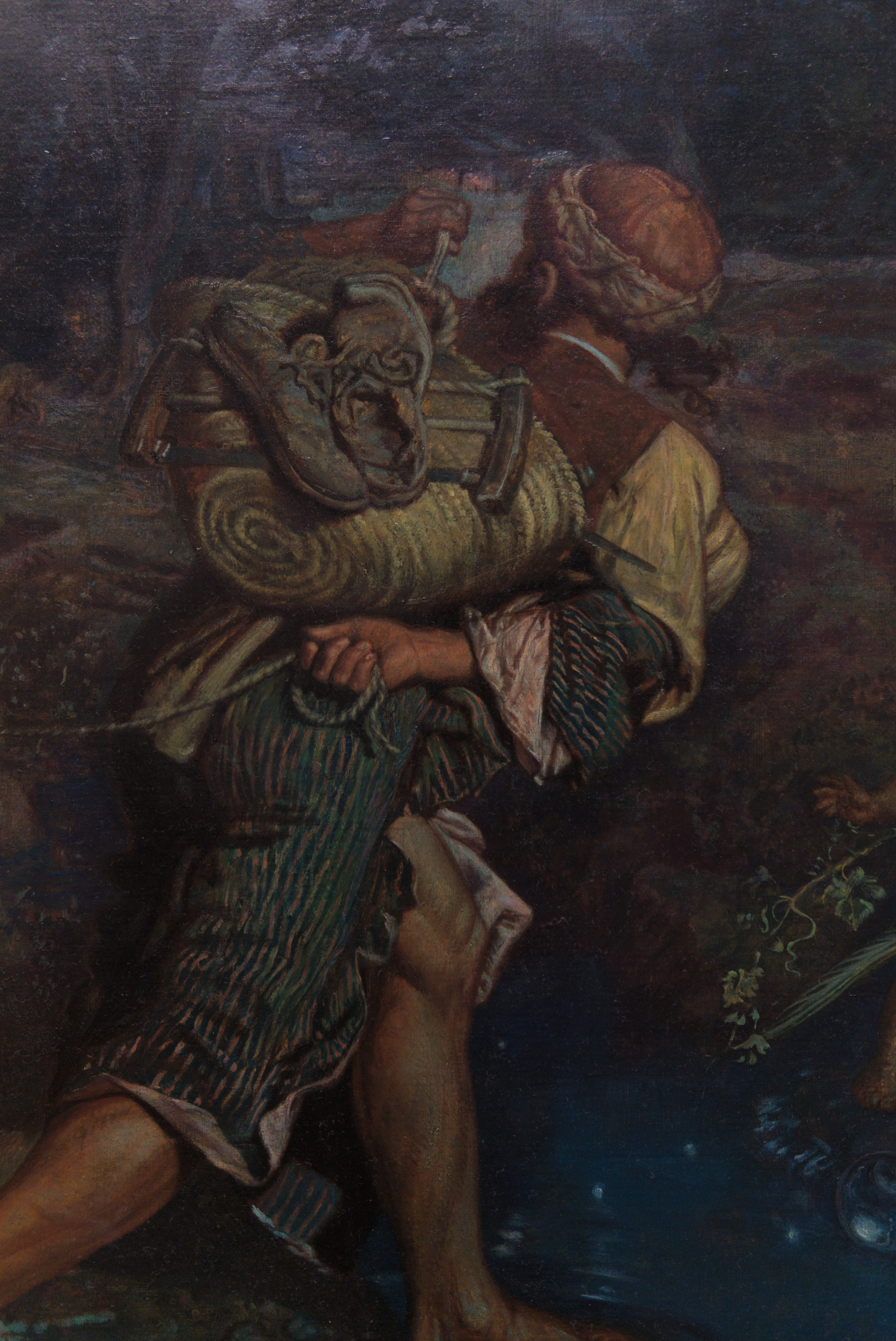
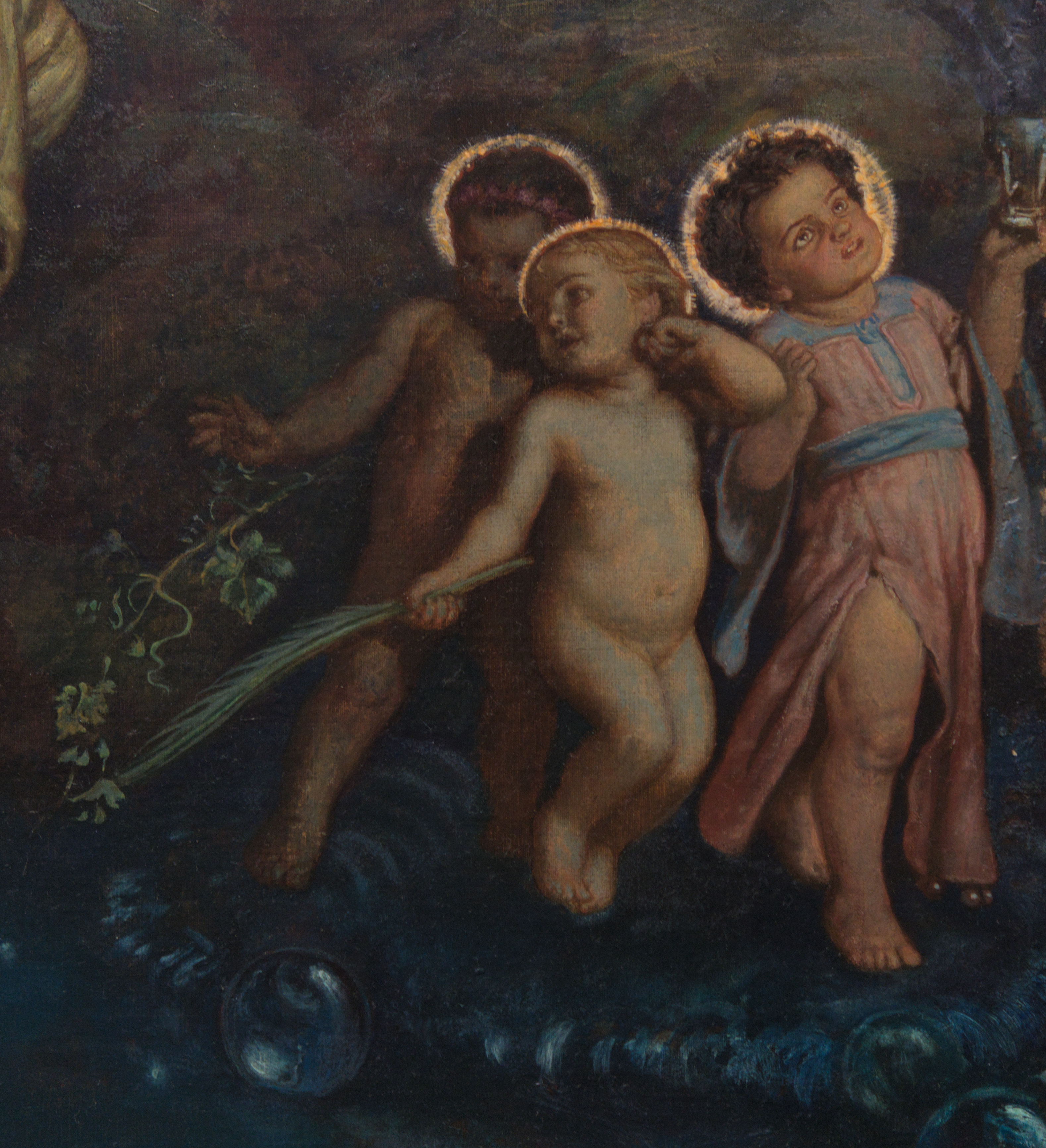
This visionary realist painting by the Pre-Raphaelite artist William Holman Hunt is a unique interpretation of the Flight to Egypt. It shows, surrounding the Holy Family on the run, the embodied spirits of all the little boys in Bethlehem—the “innocents”—who were slain at Herod’s behest. It’s the first of three versions Hunt painted of the subject, mostly completed by 1876, but with some of the background left unfinished until 1903. The other two versions are in the Tate Britain in London and the Walker Art Gallery in Liverpool.

The early church understood these boys as the first Christian martyrs. Though they were not conscious witnesses for Christ, they were killed because of him, casualties of a persecuting tyrant’s brooking no rival. Their death prefigures that of future Christian martyrs, starting with Stephen, as well as Christ’s own death.

Despite the solemnity of this episode, Hunt casts it in a triumphant light. Instead of showing the infants dismembered or impaled in a bloodbath with their mothers wailing in helpless grief, as artists have historically done, Hunt shows them in the light of glory, carrying palms and other branches and wearing floral crowns and garlands. They are, in the words of John Powell Lenox, the “first of that glorious company whose shining ranks are nearest the throne of the Slain One.”

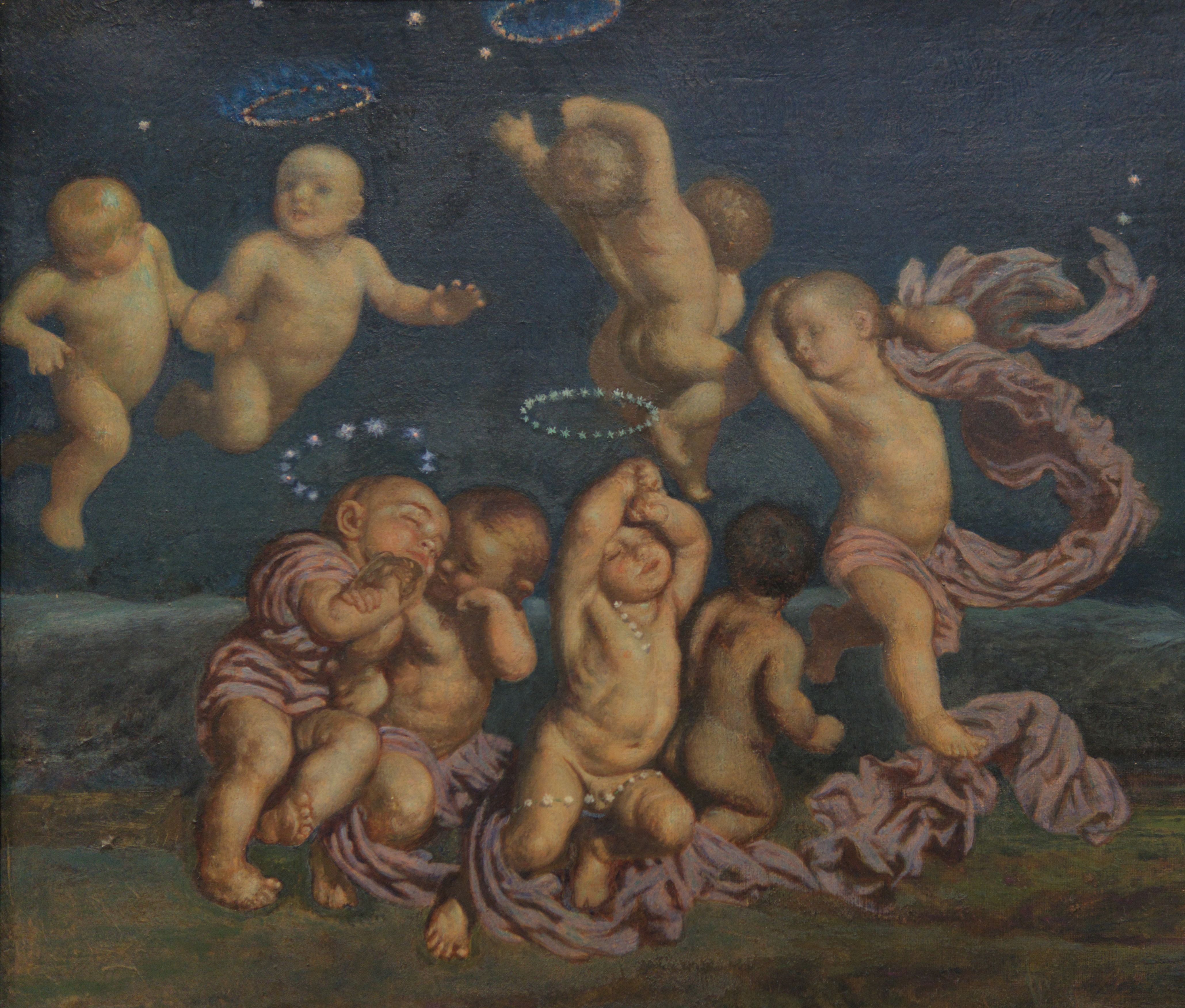
Floating in air, those at the upper left are just waking up to their new spiritual life—they open their eyes and stretch.

Triumph of the Innocents (detail)

Those on the ground lock arms in solidarity and play, surrounding a little foal. One curly-locked lad wears a red necklace, the beads spilling from the chain reminiscent of blood drops. But the fatal chest wound that one of Herod’s soldiers had inflicted by sword is no more, as he looks down with wonder to discover through a tear in his tunic. Healed flesh!

Triumph of the Innocents (detail)

In the center Mary rides a mule, holding Jesus, who greets his playmates with a wave and a smile. He’s the only one who’s aware of them, these mystic brothers accompanying him into exile. Joseph leads the way forward, staying alert to potential threats. His tool basket is slung over his shoulder, which he’ll use to make a living for his family in Egypt.

Triumph of the Innocents (detail)

At the far right one of the child-martyrs, “in priestly office” and holding a censer, leads the celestial band, while his two companions “cast down their tokens of martyrdom in the path of their recognised Lord,” as Hunt wrote in the catalog for the 1885 exhibition of the Tate version by the Fine Art Society in London.

Triumph of the Innocents (detail)

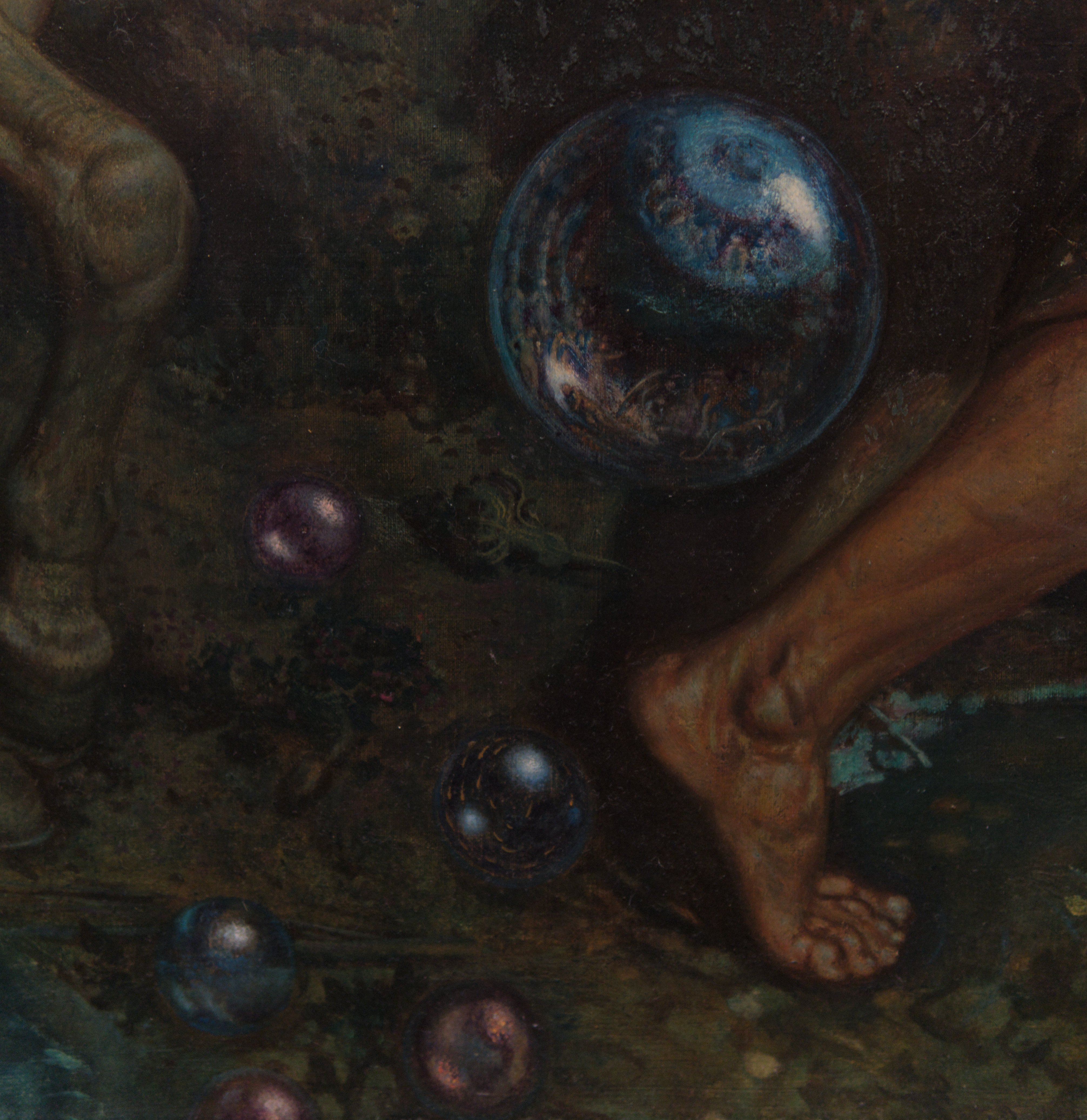
The children tread through “the living fountains of water, the streams of eternal life . . . ever rolling onward and breaking—where it might if real water be dissipated in vapour—into magnified globes which image the thoughts rife in that age in the minds of pious Jews . . . of the millennium which was to be the mature outcome of the advent of the Messiah.” The large bubble above Joseph’s right calf reveals Jacob’s dream at Bethel, which “first clearly speaks of the union of Earth and Heaven” that Christ will one day make total and permanent.

Triumph of the Innocents (detail)

To read the artist’s thirteen-page statement about the painting, see here.

LISTEN: “Salvete Flores Martyrum” (Hail, Martyr Flowers) | Words by Aurelius C. Prudentius, early fifth century | Music by Claudio Dall’Albero, 2022 | Performed by the Choir of Sidney Sussex College, Cambridge, dir. David Skinner, on Vespertina Hymnodia: Sacred Music by Claudio Dall’Albero, 2022

Salvete flores Martyrum
Quo lucis ipso in limine
Christi in secutur sustulit
Ceu turbo nascentes rosas.

Vos prima Christi victima
Grex immolatorum tener
Aram ante ipsam simplices
Palma et coronatis luditis.

Jesu tibi sit Gloria
Qui natus es de Virgine
Cum Patre et almo Spiritu
In sempiterna saecula
All hail, ye little Martyr flowers,
Sweet rosebuds cut in dawning hours!
When Herod sought the Christ to find,
Ye fell as bloom before the wind.

First victims of the Martyr bands,
With crowns and palms in tender hands,
Around the very altar, gay
And innocent, ye seem to play.

All honor, laud, and glory be,
O Jesu, Virgin-born, to Thee;
All glory, as is ever meet,
To Father and to Paraclete.

Trans. Athelstan Riley

“Salvete flores martyrum” is the office hymn for Lauds on the Feast of the Holy Innocents. It is a cento from the 208-line Epiphany poem in the Cathemerinon by the ancient Latin Christian poet Prudentius, first assembled in the 1568 Breviary of Pope Pius V.

This text has been set to music by many composers ever since the Renaissance. My favorite setting is probably by the contemporary Italian composer Claudio Dall’Albero, from his cycle Five Hymns for Vespers, shared above.

Other notable settings include those by Tomás Luis de Victoria and Michael Haydn (Joseph Hadyn’s brother).

Athelstan Riley’s is one of several metrical English translations, but here’s a prose translation provided by John Carden in his compilation A Procession of Prayers:

God keep you, O finest flowers of martyrs, who, at the dawn of life, were crushed by the persecutor of Christ and flung like petals before a furious wind.

You, the first to die for Christ, tender flocks of martyrs, now dance before the altar, now laugh candidly with your palms and gardens.

Five new Advent/Christmas albums

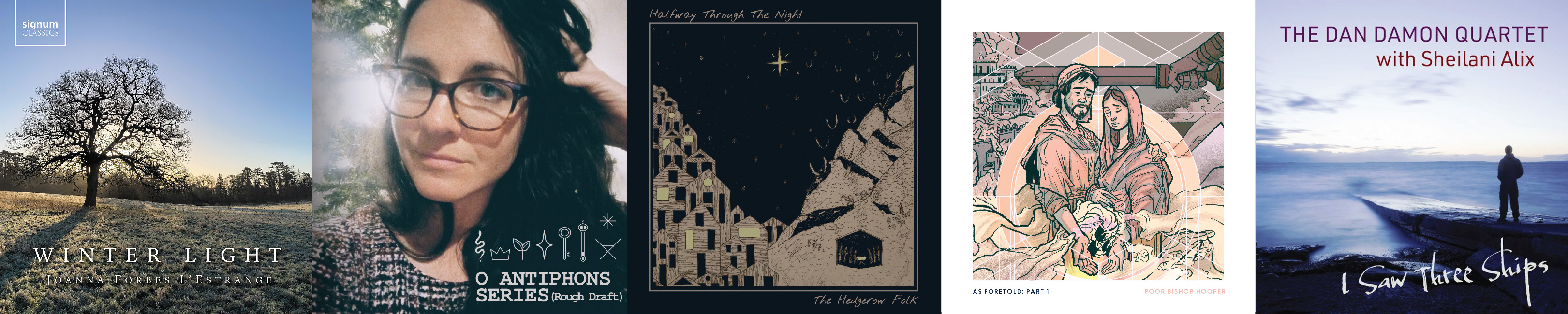
Every fall a number of new holiday albums hit the market. Here are five from this year that I’ve been enjoying. I’ve included one or two sample tracks from each.

2024 Holiday Albums

Winter Light by Joanna Forbes L’Estrange

A smorgasbord of choral works by the British composer Joanna Forbes L’Estrange, plus a few written or cowritten by her husband, Alexander, and one by her son Harry, all performed by Ben Parry’s London Voices. I learned about this album from Angier Brock, who wrote the anthem text for the title track. One of my favorite pieces is the “Advent ‘O’ Carol,” which I’ll be featuring in a devotional post on December 17. Below is a retune of “In the Bleak Midwinter” (risky, since Holst’s beautiful tune is so iconic, but I love what L’Estrange does with Rossetti’s poem), followed by an original jazzy carol about “The Three Wise Women” of Christmas—Mary, Elizabeth, and Anna.

O Antiphons Series by Elise Massa

Elise Massa is a singer-songwriter and music minister currently living in Durham, England, where she works for United Adoration, a global nonprofit that seeks to empower local artists to create music and art rooted in Christ and meaningful to their particular context, culture, and language. This quiet, understated album consists of seven original songs based on the O Antiphons, refrains sung during evening prayer on the seven last days of Advent preceding Christmas Eve. Here’s the first one, “O Wisdom (O Sapientia)”:

Halfway Through the Night by the Hedgerow Folk

Named after a phrase from a C. S. Lewis poem, The Hedgerow Folk is an Alabama-based acoustic Americana trio: Jon Myles, Amanda Hammett, and Bryant Hains. “Halfway through the night” is a through line that weaves through this their first Christmas album as a declaration of hope. My two favorite tracks: their reharmonized rendition of “Lo, How a Rose E’er Blooming,” and their bluegrass arrangement of “Oh Come, Divine Messiah” (which I knew previously only from an a cappella choir of nuns). Also available on vinyl.

As Foretold: Part 1 by Poor Bishop Hooper

As Foretold is a trilogy of albums that takes its subject matter from the prophetic fulfillment passages in Matthew’s Gospel. Part 1, released this week, covers the first two chapters of the book—Jesus’s birth, his flight to Egypt, Herod’s slaughter of innocents, and Jesus’s return to Nazareth. Three of the tracks deal with Joseph’s three dreams—a rarity in music! In his first dream, an angel appears to tell him that Mary is telling the truth, that the son inside her was indeed conceived by the Holy Spirit. In the second dream, treated in the “Out of Egypt” song below, the angel tells Joseph to take his family and flee Bethlehem to Egypt to escape Herod’s wrath, and in the third, the angel informs him it’s safe to return to their homeland.

Poor Bishop Hooper is offering the album for free download from their website! Parts 2 and 3 will release in early 2025.

I Saw Three Ships by Dan Damon

Daniel Charles Damon is a jazz pianist, hymn writer, and retired Methodist pastor from San Francisco, who also works as associate editor of hymnody at Hope Publishing Company. His latest jazz Christmas album features a combination of classics and originals, including two hymns he wrote both the words and music for (“Like a Child” and “Winter’s Child”); “Hunger Carol” by Shirley Erena Murray (words) and Saya Ojiri (tune), which Damon has freshly arranged; and “Peace Child,” another Murray hymn, for which Damon wrote a tune.

It’s difficult to choose a favorite track, as I love this album through and through! I’ll highlight first the nineties hymn “Peace Child,” a pensive reflection on how Christ comes to us “in the silence of stars, in the violence of wars,” “through the hate and the hurt, through the hunger and dirt.” Second, a lively medieval carol whose Latin refrain, “Id-e-o-o-o, id-e-o-o-o, id-e-o, gloria in excelsis Deo!,” translates to “Therefore, glory to God in the highest!”

The vocalist on the album is the award-winning Sheilani Alix. She is accompanied by Damon on piano, Kurt Ribak on acoustic bass, Carrie Jahde on drums, and Lincoln Adler on tenor saxophone and soprano sax.

If you like this album, be sure to also check out Damon’s 2022 Christmas album, No Obvious Angels.


What 2024 holiday albums have you been enjoying?

Roundup: Paula Rego’s Life of the Virgin; corito medleys; more

EXHIBITION: Paula Rego: Secrets of Faith, Victoria Miro Venice, April 23–June 18, 2022: Portuguese-born British artist Paula Rego died last Wednesday, June 8, after a seven-decade career, and in the midst of four solo exhibitions of her work—including this one at Victoria Miro’s gallery in Venice, which explores her small but significant body of religious art. [HT: Jonathan Evens]

In 2002 Jorge Sampaio, then president of Portugal, commissioned Paula Rego to create eight pastel drawings based on episodes from the life of the Virgin Mary, to be installed permanently in the chapel of the presidential palace (Palácio de Belém) in Lisbon. Titled Nossa Senhora (Our Lady), the cycle comprises Annunciation; Nativity; Adoration; Purification at the Temple; Flight into Egypt; Lamentation; Pietà; and Assumption. Rego had such fun with the commission that she produced additional works on the subject, which she decided to keep for herself. It is these, along with her watercolor studies, that are currently on display in Venice. (The original eight pastels are not allowed to leave the chapel for which they were made.)

Rego, Paula_The Flight to Egypt
Paula Rego (Portuguese British, 1935–2022), The Flight to Egypt, 2002. Watercolor and ink on paper, 8 1/4 × 11 3/4 in. (21 × 29 cm).

Rego, Paula_Descent from the Cross
Paula Rego (Portuguese British, 1935–2022), Descent from the Cross, 2002. Pastel on paper mounted on aluminum, 29 1/2 × 28 3/8 in. (75 × 72 cm).

I learned about Rego’s Marian cycle a few years ago and became enthralled by it, though I’ve never seen it in person, and most of these supplemental works are new to me. It’s unique, in part because of Mary’s corporeality. In a 2003 interview with Richard Zimler, Rego said, “If there is anything new about these representations of the Virgin, it is the fact that they were done by a woman, which is very rare. . . . It always used to be men who painted the life of the Virgin, and now it is a woman. It offers a different point of view, because we identify more easily with her.”

While the president praised the cycle and Rego insisted that “these pictures were created with admiration and respect,” an open letter to Sampaio referred to it as an “outrage done to the vast majority of the Portuguese people,” an “outrage against their religious beliefs and an offence to the Virgin Mary.” In brief: “blasphemous and scandalous.” I can see why Rego’s larger oeuvre, with its often menacing and/or transgressive imagery (not least of which is her Abortion Series), would scandalize conservative viewers, but I am a bit confused by the outrage at Nossa Senhora, which to me seems very honoring. The objectors, it sounds like, are those who prefer Mary to be more ethereal and sedate; they don’t want to see her, for example, slouching or wincing or expressing astonishment, or awkwardly struggling to hold the weight of her son’s corpse. There will always be those who resist any kind of updating of religious art. If the scenes are restaged in an unfamiliar way or rendered in an unfamiliar style or introduce a new element or the figures don’t look like how we have always pictured them, then some will oppose them outright—which is a shame, because such art often invites us more deeply into the story, helping us to see it afresh.

Definitely check out the boldface link above to view more pieces from the exhibition, as well as a video that shows Nossa Senhora in situ. For further reading, see “Paula and the Madonna: Who’s That Girl?” by Maria Manuel Lisboa and the transcript from Zimler’s interview with Rego.

+++

PODCAST EPISODE: “Past Hymns for the Present Moment,” Tokens, May 26, 2022: “Hymns are often sentimentalized in the American church, cast aside as merely retired songs with dated language, bearing no real appeal or relevance. But of course it may be that our old hymnals have some crucial things to say to us in our current cultural moment. This is the challenge I [Lee C. Camp] posed to Odessa Settles, Phil Madeira, and Leslie Jordan: find and perform some old hymns which might be both indicting and encouraging to the modern church, and to the world at large. Beautiful conversation and moving performances, taped at Nashville’s Sound Emporium.”

+++

POETRY UNBOUND EPISODES:

In each episode of this podcast from On Being Studio, host Pádraig Ó Tuama unpacks a contemporary poem in fifteen minutes. Here are two from season 5 (which just came to an end) that I particularly liked.

>> “Looking for The Gulf Motel” by Richard Blanco: “What happens when we remember?” Ó Tuama asks. “Why do we remember? Is it sweet or sad? Is it both? If you particularly associate warm memories, romantic memories, nostalgic memories with a place, and then that place is changed, does that mean that all those memories are gone?” In this poem from a collection of the same title (which I checked out from my local library at Ó Tuama’s recommendation, and it’s excellent!), Cuban American poet Richard Blanco, at age thirty-eight, reminisces about a family beach vacation from his childhood. Read the poem here.

If I were writing this poem, it would be called “Looking for The Blockade Runner,” as that’s the name of the Wrightsville Beach hotel in North Carolina that my family and I used to stay at for four days or so each summer. My little brother and I should still be running around on the waterfront lawn as our parents watch us from inside the giant window of the dining room, finishing up their breakfast. My dad should still be riding in a wave on a boogie board, teaching me technique. My mom should still be lounging at the pool in her black one-piece with sunglasses and a Vanity Fair, I feeling so grown up beside her sipping my virgin piña colada. My brother should still be exhilarated by the live hermit crabs at Wings, and I by the dried starfish and sand dollars. We should all still be walking back from the Oceanic, our bellies filled with she-crab soup and hush puppies and catch-of-the-day, down the shore at dusk.

>> “The change room” by Andy Jackson: A poet who’s interested in difference and embodiment, here Andy Jackson, who has severe spinal curvature due to Marfan syndrome, “is looking at the attention that he gets in his body and is refocusing it, extending it wider, looking at the deeper question of, what does it mean for any of us to be in a body, and how do we in bodies relate to others in bodies?” Read the poem here, from the collection Human Looking.

+++

CORITO VIDEOS: A corito (literally “short song”) is a type of Latino Christian worship song. Coritos have “fairly simple tunes, often with repetitive words, that the people sing by heart,” writes Justo L. González in ¡Alabádle!: Hispanic Christian Worship. “Most of them are anonymous, and pass by word of mouth from one congregation to another. For that reason, the tune or the words of a particular corito may vary significantly from one place to another. They are often sung to the accompaniment of clapping hands, tambourines, and other instruments.” To learn more about this genre, see the Calvin Institute of Christian Worship interview with Rosa Cándida Ramírez and Analisse Reyes and the entry in the Encyclopedia of Christianity in the Global South, vol. 2.

>> Joseph Espinoza sings a corito medley consisting of “Cuando el pueblo del Señor” (When the People of the Lord), “No puede estar triste” (The Heart That Worships Christ Cannot Be Sad), “Ven, ven, Espiritu divino” (Come, Come, Holy Spirit), “Cantaré al Señor por siempre” (I Will Sing to the Lord Forever), and “El Poderoso de Israel” (The Mighty One of Israel). Aaron Barbosa is on keyboard, Fabian Chavez is on percussion, and Yosmel Montejo is on bass.

>> The video below was shared March 25, 2020, in the Multicultural Worship Leaders Network Facebook group that I belong to, and it’s pure joy! The performers string together three coritos: “Le canto aleluya” (I Sing Alleluia), “Hay victoria” (There’s Victory), and “Los que esperan en Jesus” (Those Who Wait in Jesus).

Federico Apecena provides the following translation. (The slashes indicate the number of times that line or passage is sung.)

//The heart that worships Jesus cannot be sad
The heart that worships God cannot be sad//

//That’s why I sing, I sing hallelujah
The heart that worships God cannot be sad//

//There’s victory, there’s victory, there’s victory in the blood of Jesus//
The enemy will not be able to defeat our souls
//Because there is victory, because there is victory, because there is victory in the blood of Jesus//

//That’s why I sing, I sing hallelujah
The heart that worships God cannot be sad//

///Those that wait, that wait in Jesus///
//Like eagles, like eagles, their wings will open//

They will walk and will not get tired, they will run and will not stop
//New life they will have, new life they will have, those that wait, that wait in Jesus//

//That’s why I sing, I sing hallelujah
The heart that worships God cannot be sad//

Roundup: Ethiopian illuminations, convent cradles, Women’s Christmas, and more

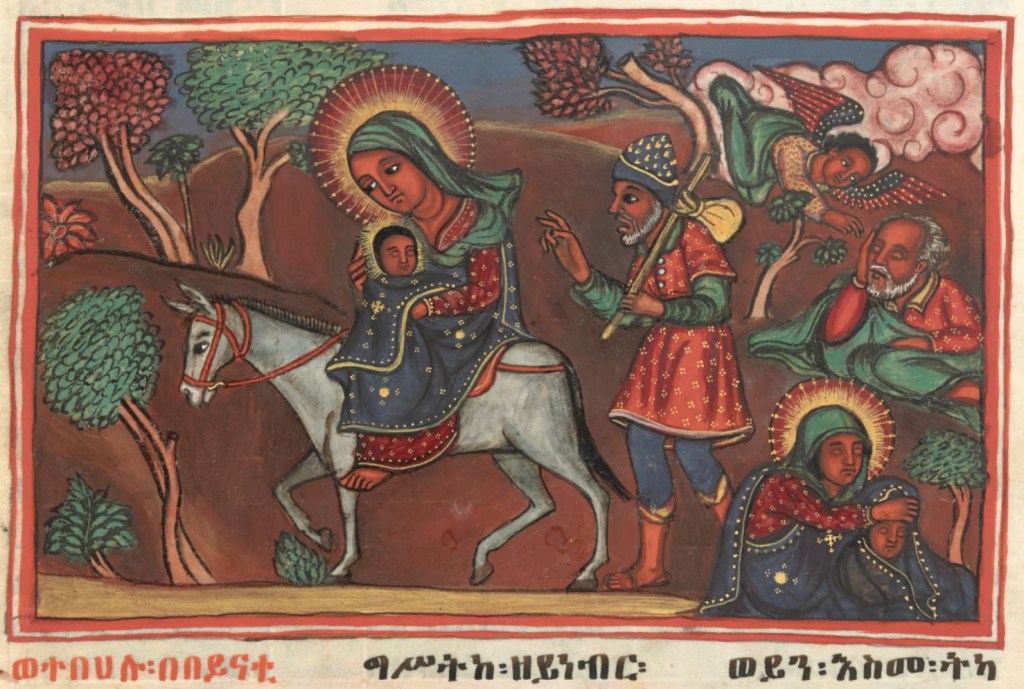
“The Christmas Story: Images from Ethiopic Manuscripts” by Eyob Derillo: The British Library has a fantastic collection of Christian manuscripts from seventeenth- and eighteenth-century Ethiopia. This blog post by curator Eyob Derillo shows Christmas-related illuminations from four different ones. Follow the links in the captions to explore each manuscript further.

Flight to Egypt (Ethiopian)
“Flight into Egypt,” from the Nagara Māryām (History and Miracles of the Blessed Virgin Mary), Ethiopia, ca. 1730–55. British Library Or. 607, fol. 17r.

You can follow Derillo on Twitter @DerilloEyob. He’s always posting fascinating things about Ethiopian art and its intersection with the country’s history, culture, politics, and Christianity, including lots of Ethiopian saints’ stories!

If you enjoyed the blog post, I recommend the highly accessible book The Road to Bethlehem: An Ethiopian Nativity, an interweaving of ancient (apocryphal) tales surrounding Jesus’s birth that flourished in Ethiopia, compiled and told by Elizabeth Laird, with the biblical narrative. It’s illustrated in full color with images from the British Library’s collection and is perfectly appropriate for children (and adults!). I’ve perused the Ethiopian manuscripts on the BL website but am not able to decode several of the images because I’m unfamiliar with the tales and cannot read Ge’ez, and Laird’s book helped me out in that respect, at least in part. For a deeper dive into Ethiopian art—which is inextricable from its patrons’ and makers’ Christian spirituality—see the informative and beautifully produced Ethiopian Art: The Walters Art Museum, a catalog from another museum that houses a fine collection of Ethiopian art.

+++

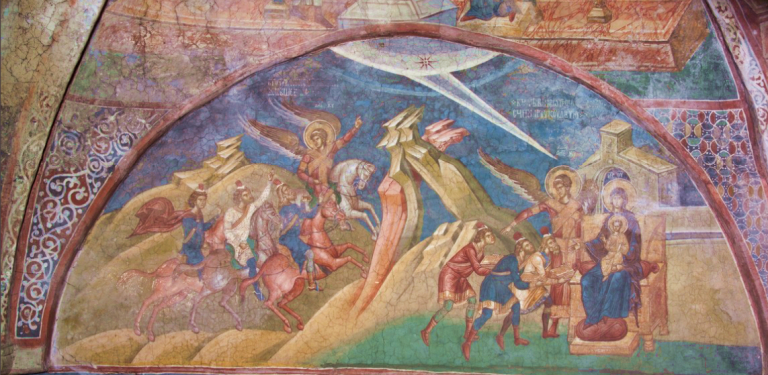
The Angel of the Lord in icons of the Magi: In this recent post from Icons and Their Interpretation [previously], icons consultant David Coomler spotlights a fresco from Decani Monastery in Serbia that shows an angel on horseback leading the magi to the Christ child, emphasizing supernatural direction. He identifies the same, idiosyncratic figure in a 1548 painting by Frangos Katelanos at Varlaam Monastery in Meteora, Greece, comparing it to two more common appearances of an angel with the magi in Eastern iconography: on foot beside the newborn king’s “throne,” presenting the magi to him.

Journey and Adoration of the Magi (icon)
Journey of the Magi and Adoration of the Magi, 14th century. Fresco, Decani Monastery, Serbia. View a modern copy here.

+++

SONG MEDLEY: “Christmas Around the World” by Acapals: Acapals is a collaboration of four friends and a penguin who share a love for making a cappella music (despite not sharing much in the way of geography, culture or language).” They are Nick Hogben, tenor, from England; Leif Tse, baritone, from Hong Kong; Jacky Höger, alto, from Germany; and Prayer Weerakitti, soprano, from Thailand. In this video each of them arranged a holiday song in their native language, which they sing together: “Hark! The Herald Angels Sing” (English), “Silent Night” (Cantonese), “Es ist ein Ros’ entsprungen” (German), and “New Year Greeting” (Thai). [HT: Global Christian Worship]

+++

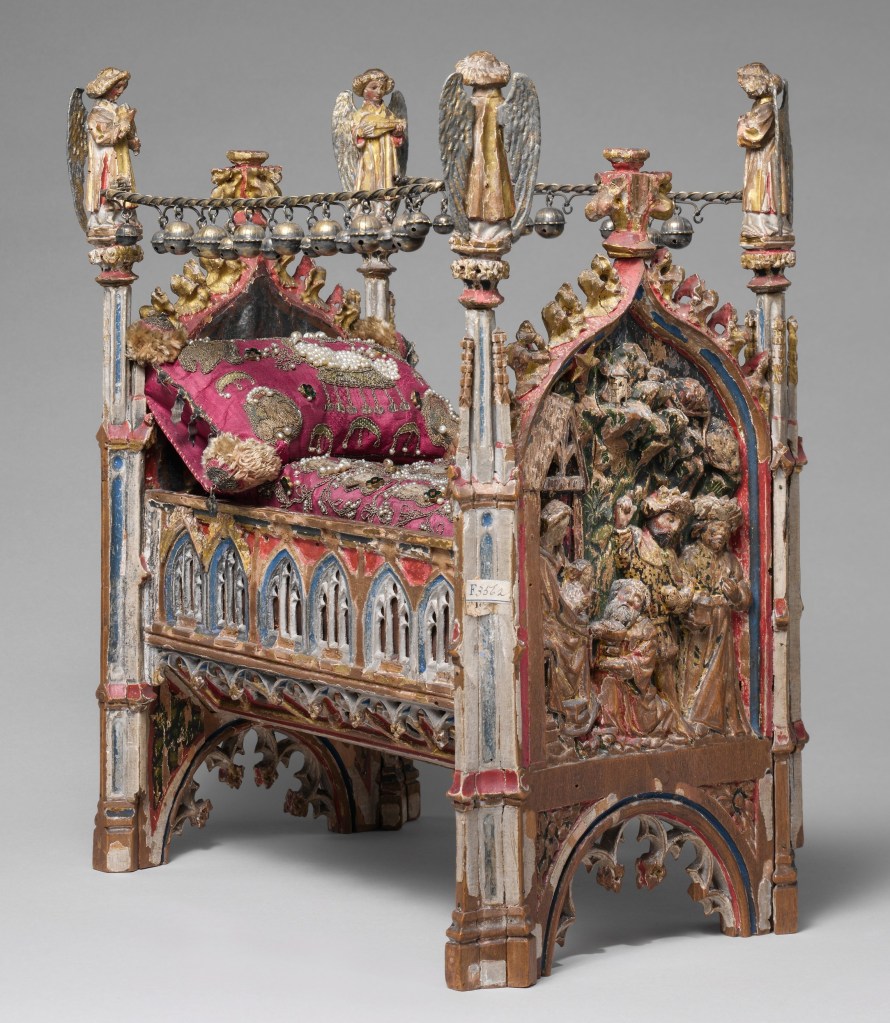
“The Cloister and the Cradle” by Shannon Reed: Some medieval nuns and lay religious women cared for baby Jesus dolls (ceramic or wooden) as a devotional practice—dressing them, playing with them, “feeding” them, singing to them, rocking them in cradles. Full of wit and tenderness, this Vela magazine essay by Shannon Reed explores that practice. “It is difficult to separate my modern reaction to the sight of a grown woman (in a habit!) acting in such bizarre ways, carrying a doll around and pretending it’s real,” Reed writes. “But I try to remember that for these women, this was an empowering opportunity to be Mary, most holy, most blessed.”

Reed considers women’s agency in the Middle Ages, mystical visions made tangible, and the desire for maternal intimacy, incorporating personal stories and reflections, as a single woman without children, about attending baby showers, nannying through grad school, shopping for godchildren, and teetering between enjoyment of her non-mom status and an inclination to mother. As a thirty-two-year-old woman who also does not have kids (though I am married) and is content but constantly surrounded by reminders of what I’m missing, I can relate to a lot of the feelings and experiences Reed articulates here. I chanced upon this essay when trying to find more information about a Beguine cradle I saw at the Met, pictured below (spurred, too, by the description of a Virgin and Child ivory). I found myself unexpectedly moved by the author’s vulnerability and by the connections she draws between modern-day longings for and expressions of motherhood and those played out in medieval Christian convents.

Beguine cradle (The Met)
Crib of the Infant Jesus, 15th century, from the Grand Béguinage in Louvain (now at the Metropolitan Museum of Art). Click to view details of the carved Nativity and Adoration of the Magi at the head and foot and, on the embroidered coverlet, Jesus’s family tree.

To learn more about how some medieval women mediated their relationship with Christ in part through dolls and cradles, see “Crib of the Infant Jesus” from Feminae: Medieval Women and Gender Index, “Cradling Power: Female Devotions and Early Netherlandish Jésueaux” by Annette LeZotte, “Female Spirituality and the Infant Jesus in Late Medieval Dominican Convents” by Ulinka Rublack, and “Encounter: Holy Beds” by Caroline Walker Bynum.

+++

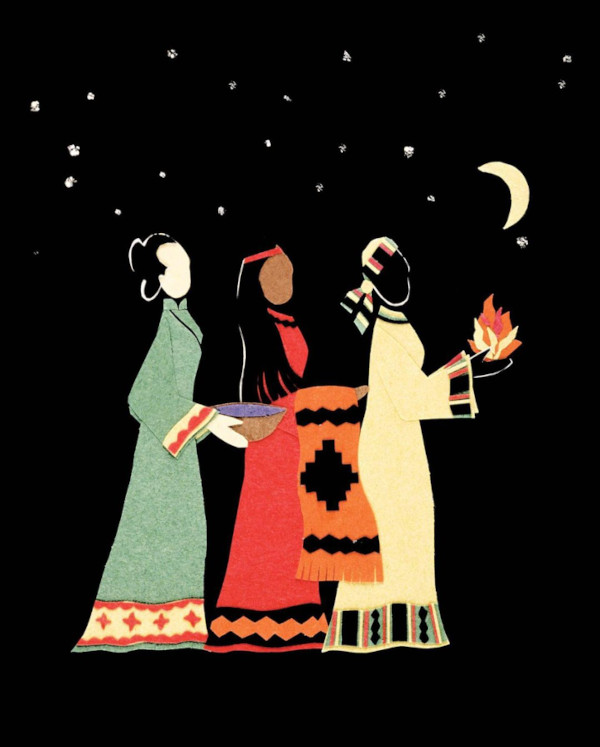
The Sanctuary Between Us: A Retreat for Women’s Christmas by Jan Richardson: Every year artist, writer, and Methodist minister Jan Richardson provides a new compilation of her art, blessings, and spiritual reflections as a free PDF download. The subtitle references the Irish custom of Nollaig na mBan, or Women’s Christmas, observed particularly in County Cork and County Kerry. “Women’s Christmas originated as a day when the women, who often carried the domestic responsibilities all year, took Epiphany [January 6] as an occasion to celebrate together at the end of the holidays, leaving hearth and home to the men for a few hours.” In this spirit Richardson offers an opportunity “to pause and step back from whatever has kept you busy and hurried in the past weeks or months, . . .  spend[ing] time in reflection before diving into what this new year will hold.”

“Blessing to Summon Rejoicing,” “Blessing of Memory,” “Blessing the Body,” and “Blessed Are You Who Bear the Light” are among the several benedictions, thoughtfully introduced and many accompanied by collages, paintings, or encaustics. Some sections also include questions for personal reflection. For example: “How do you experience—or desire to experience—remembering in community? Who are the people who hold your memories with you? Are there ways you experience memory as a sacrament, a space where you know the presence and grace of God at work in your life? For whom might you be (or become) a sanctuary of memory as you help them hold their stories and their lives?”

Wise Women Also Came by Jan Richardson
Wise Women Also Came © Jan L. Richardson [purchase]

The poem “Wise Women Also Came,” printed as an interlude, is especially compelling, describing how, in addition to the wise men mentioned in the biblical narrative, wise women also came to Jesus’s birth bearing gifts—“water for labor’s washing, / fire for warm illumination, / a blanket for swaddling.”

Cold Dark Night (Artful Devotion)

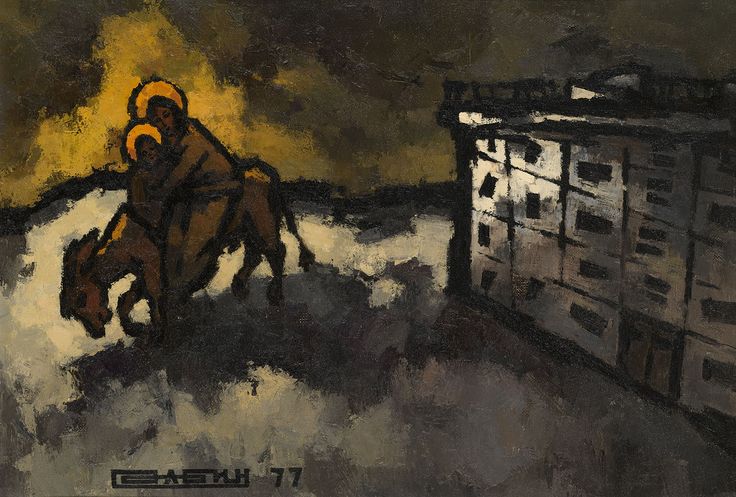
Flight to Egypt by Oscar Rabin
Oscar Rabin (Russian, 1928–2018), Flight into Egypt, 1977. Oil on canvas, 49 × 70 cm.

Now when they had departed, behold, an angel of the Lord appeared to Joseph in a dream and said, “Rise, take the child and his mother, and flee to Egypt, and remain there until I tell you, for Herod is about to search for the child, to destroy him.” And he rose and took the child and his mother by night and departed to Egypt and remained there until the death of Herod. This was to fulfill what the Lord had spoken by the prophet, “Out of Egypt I called my son.”

Then Herod, when he saw that he had been tricked by the wise men, became furious, and he sent and killed all the male children in Bethlehem and in all that region who were two years old or under, according to the time that he had ascertained from the wise men. Then was fulfilled what was spoken by the prophet Jeremiah:

“A voice was heard in Ramah,
weeping and loud lamentation,
Rachel weeping for her children;
she refused to be comforted, because they are no more.”

—Matthew 2:13–18

+++

SONG: “Cold Dark Night” by Sam Phillips, originally released on her Cold Dark Night EP (2009) and re-released on the new full-length album Cold Dark Nights (2019)

When was he born? When was he born?
When was he born? On a cold dark night.

The king said, “Kill every baby boy that you can find.
There’s been too much talk about a new king born,
And this throne is mine.”

When was he born? When was he born?
When was he born? On a cold dark night.

He wasn’t born to be a king. He wasn’t born to fight.
He knew this world can get so dark that when you can
You’ve got to turn on the light.

When was he born? When was he born?
When was he born? On a cold dark night.

+++

A Russian painter and activist, Oscar Rabin was one of the founders of the Soviet Nonconformist Art movement. After being stripped of his citizenship in 1978 for political dissidence, he emigrated to Paris, where he lived until his death last year at age ninety. He is the subject of the feature-length documentaries Oscar (2018) and, with his wife and fellow artist Valentina Kropivnitskaya, In Search of a Lost Paradise (2015).


This post belongs to the weekly series Artful Devotion. If you can’t view the music player in your email or RSS reader, try opening the post in your browser.

To view all the Revised Common Lectionary scripture readings for the First Sunday after Christmas Day, cycle A, click here.

The Christmas Songwriters Project

This week Christianity Today published an article by theology and culture professor W. David O. Taylor, titled “Why Putting Christ Back in Christmas Is Not Enough.” I highly recommend it. In it Taylor discusses four fundamental influences on the way Christmas is celebrated in America, beginning with its illegalization by Puritans in the seventeenth century. One public notice warned citizens:

The observation of Christmas having been deemed a Sacrilege, the exchanging of Gifts and Greetings, dressing in Fine Clothing, Feasting and similar Satanical Practices are hereby FORBIDDEN, with the Offender liable to a Fine of Five Shillings.

“So what happens,” muses Taylor,

when the Protestant church in the 17th century evacuates its worship of the celebration of Christ’s birth? A liturgical vacuum is created that non-ecclesial entities willingly fill. The government determines the legal shape of Christmas, the market shapes a society’s emotional desires and financial expectations about the holy day, the ideal family replaces the holy family, and the work of visual artists shape its imagination, while musicians and writers fill the empty space with their own stories about the “magic” of Christmas.

Taylor is not saying we can’t enjoy any of the secular trappings of Christmas (“the grace and goodness of God are not absent from these things”), only that we should recognize that the Christmas story told in the Gospels of Matthew and Luke is far more fantastical, more difficult and dangerous, more multicultural and multigenerational, and more relevant than the Christmas story America tells—including American civil religion.

This article was adapted from a lecture Taylor gave, as part of the Fuller Texas Lecture Series, to a gathering of scholars and artists at Christ the King Presbyterian Church in Houston on October 20, which can be streamed via Facebook. (Starts at about 22:40.) The focus is on the critical role songwriters can play in reorienting our imaginations back toward the scriptural accounts of Christ’s birth, going beyond the sentimental and nostalgic into a more thorough habitation of the story in all its shades.

What if the narrative of Matthew and Luke were more determinative of our Christmas holidays than the narrative of Wall Street and primetime television? What if our Christmas songs gave our congregations a chance to sing to God from the depths of their hearts—of their heart’s longings and wonderings, hopes and fears, certainties and doubtings, joys and melancholy yearnings? What if our Christmas songs gave our congregations a chance to encounter the good news afresh—in a way that exceeded their sense of how deeply good, richly mysterious, and wonderfully paradoxical that news could in fact be? What if our Christmas songs offered an opportunity for our congregations to be attuned to each other—across the aisle as well as across denominational and cultural and geographic and linguistic lines—in a way that we never imagined possible?

This lecture was the capstone of the second workshop of the Christmas Songwriters Project, a new initiative sponsored by the Brehm Center for Worship, Theology, and the Arts, the Calvin Institute of Christian Worship (CICW), and Duke Divinity School. Co-directing the project along with Taylor are Noel Snyder, a program manager at the CICW with a background in musicology, and Lester Ruth, a historian of Christian worship at Duke. The first workshop, held in March in Grand Rapids, Michigan, brought together twenty-four Christian songwriters from across the US who were specially invited to participate. Following its success, a second one took place October 18–19 in Houston with a new set of eighteen select songwriters, all local. The hope is to conduct future workshops, as soon as next fall, in Nashville, and later in New York City and Los Angeles. A website for the Christmas Songwriters Project is under development and is likely to launch this coming spring.

Christmas Songwriters Project
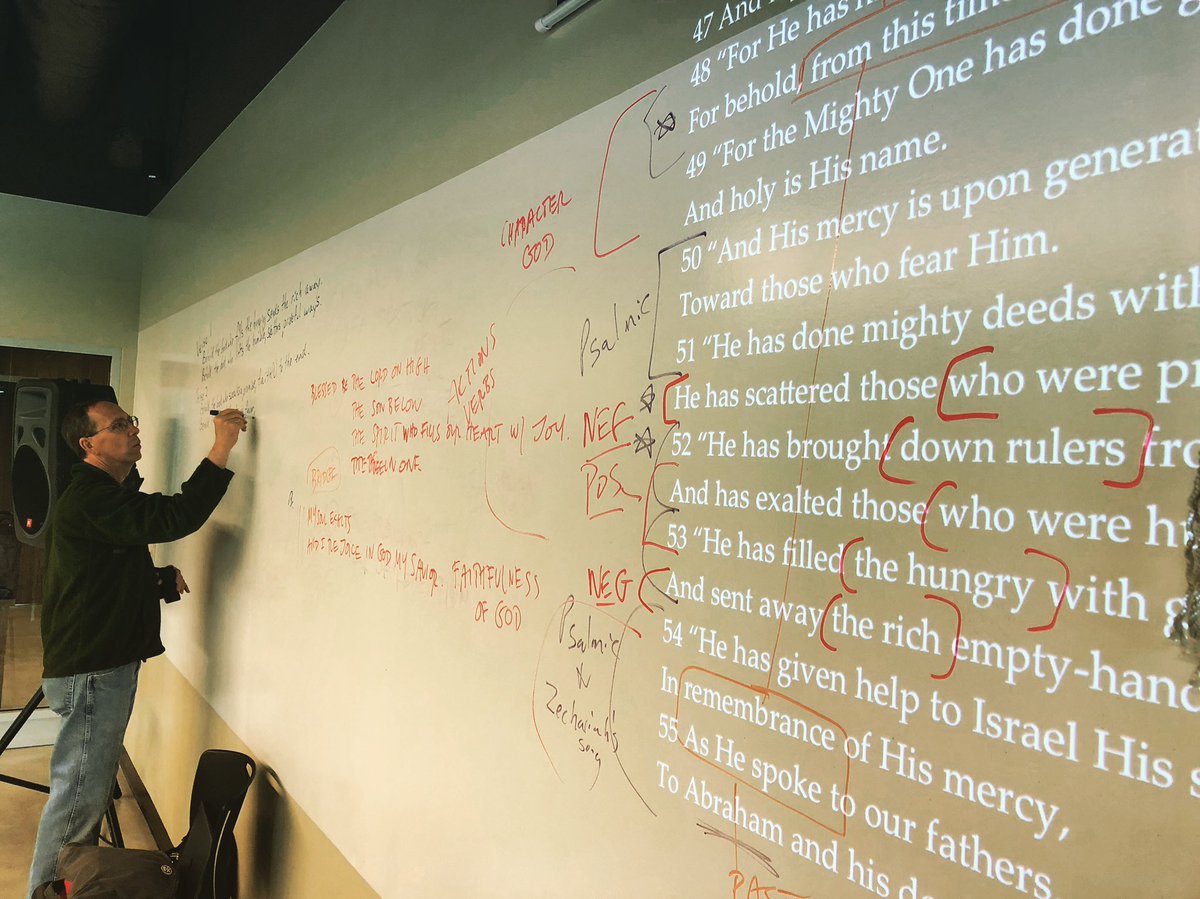
Professor Lester Ruth leads a Christmas Songwriters Project session on October 18 in which participants are tasked with reworking Mary’s Magnificat into a congregational hymn that highlights the upside-down kingdom of God.

Over the course of two days, the Houston songwriters performed a close reading of the infancy narratives in the Gospels of Matthew and Luke; studied Charles Wesley’s Hymns for the Nativity of Our Lord, a collection of eighteen of his hymns, published in 1745; and sought to get a sense of the musical aesthetics of today’s top fifteen Christmas carols. They asked themselves a double question: What does Christmas sound like? And what should Christmas sound like? (What new sounds are needed to re-sound the stories in Matthew and Luke?)

During these workshops, there was a heavy emphasis on collaboration. Several fine songs have resulted, which are in various phases of production. Six premiered in their earliest forms in the above video, interspersed with Taylor’s lecture.

One of the highlights is a reprise of the saccharine “Away in a Manger” that takes into account the Massacre of the Innocents and the resultant flight to Egypt of the Holy Family, thereby giving a broader view of the Christmas story, one that coheres better with the Matthean narrative, which ends with Rachel weeping. The clever twists on the original lyrics and the grayer tonality give a sense of the darkness into which Jesus came and also resonate with the experiences, hopes, and fears of many contemporary refugees.

“Away from the Manger: The Refugee King” – Words and music by Liz Vice, Wen Reagan, Bruce Benedict, Greg Scheer, and Lester Ruth | Performed by Liz Vice (lead vocals) and Hannah Glavor (guitar and backing vocals)

[Update, November 8, 2019: Liz Vice has just released “Refugee King” as a single!]

Away from the manger they ran for their lives
The tiny boy Jesus a son they must hide
A dream came to Joseph, they fled in the night
And they ran and they ran and they ran

No stars in the sky but the Spirit of God
Led down into Egypt from Herod to hide
No place for his parents, no country or tribe
And they ran and they ran and they ran

Stay near me, Lord Jesus, when danger is nigh
And keep us from Herods and all of their lies
I love thee, Lord Jesus, the Refugee King
And we sing and we sing and we sing

Alleluia (×5)

(Related post: “Songs about the Flight to Egypt”)

Another highlight is the song “Savior of Mankind,” an original setting of a hymn text by Charles Wesley, performed at around 51:00 in the lecture video. It captures a sense of the cosmic import of the Nativity, and of the overlap of heaven and earth that is the Christ. The line “’Tis all your heav’n on him to gaze”—wow.

“Savior of Mankind”Words by Charles Wesley, 1745 | Music by Luke Brawner, Joe Deegan, Rebekah Maddux El-Hakam, and Paul Yoon, 2018

Let angels and archangels sing
The Son of God, Immanuel’s Name
Adore with us our newborn king
And still the joyful news proclaim

All heav’n and earth be ever joined
To praise the Savior of mankind (
×2)

The everlasting God comes down
To walk with the sons of men
Without his majesty or crown
The great Invisible is seen

Of all his dazzling glories shorn
The everlasting God is born (×2)

Angels, see the infant’s face
With rapt’rous awe the Godhead own
’Tis all your heav’n on him to gaze
And cast your crowns before his throne

Now he on his footstool lies
For he built both earth and skies (×2)

By him into existence brought
You sang the all-creating Word
You heard him call our world from naught
Again, in honor of your Lord

You morning stars, your hymns employ
And shout, you sons of God, for joy (×2)

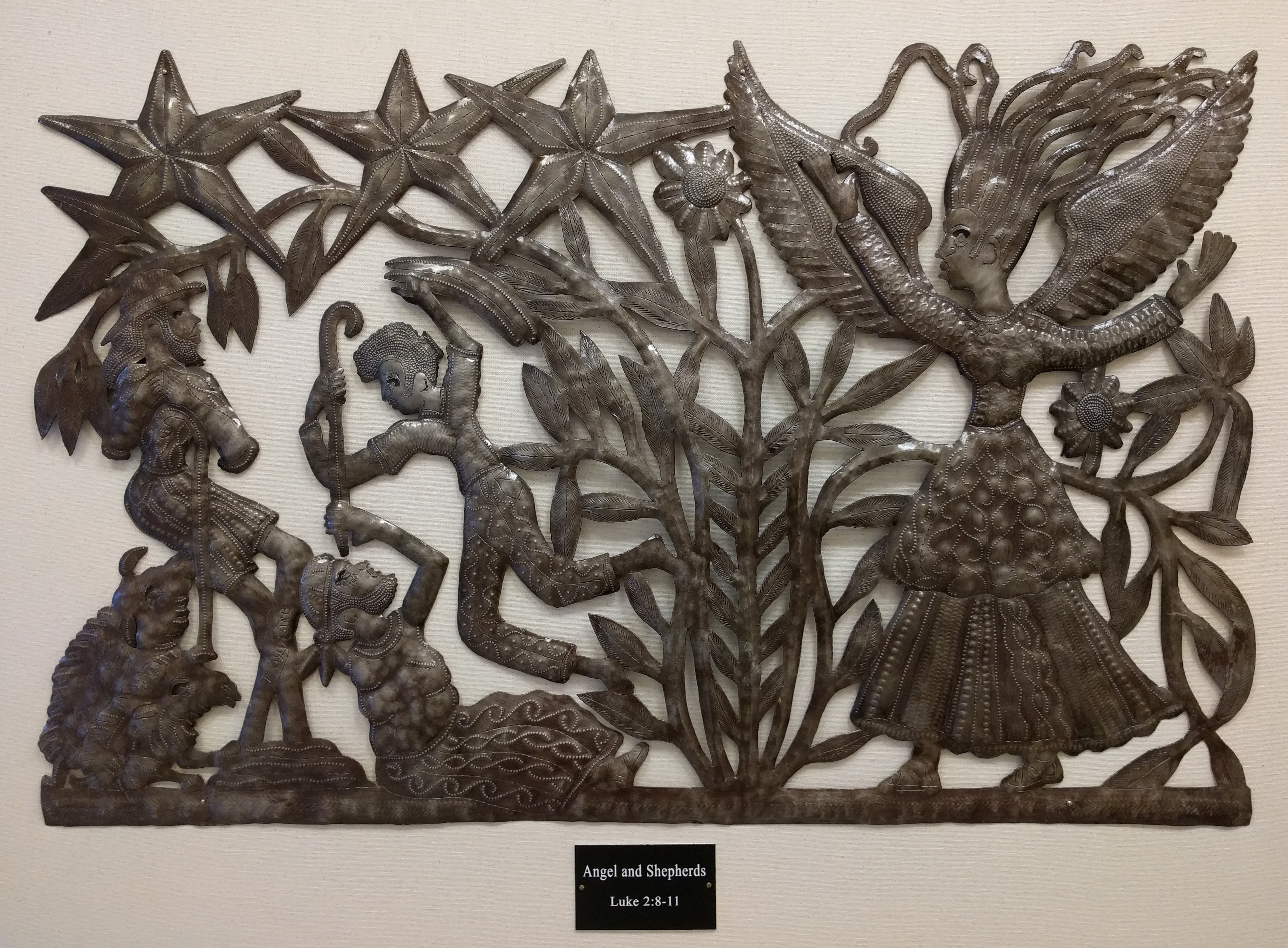
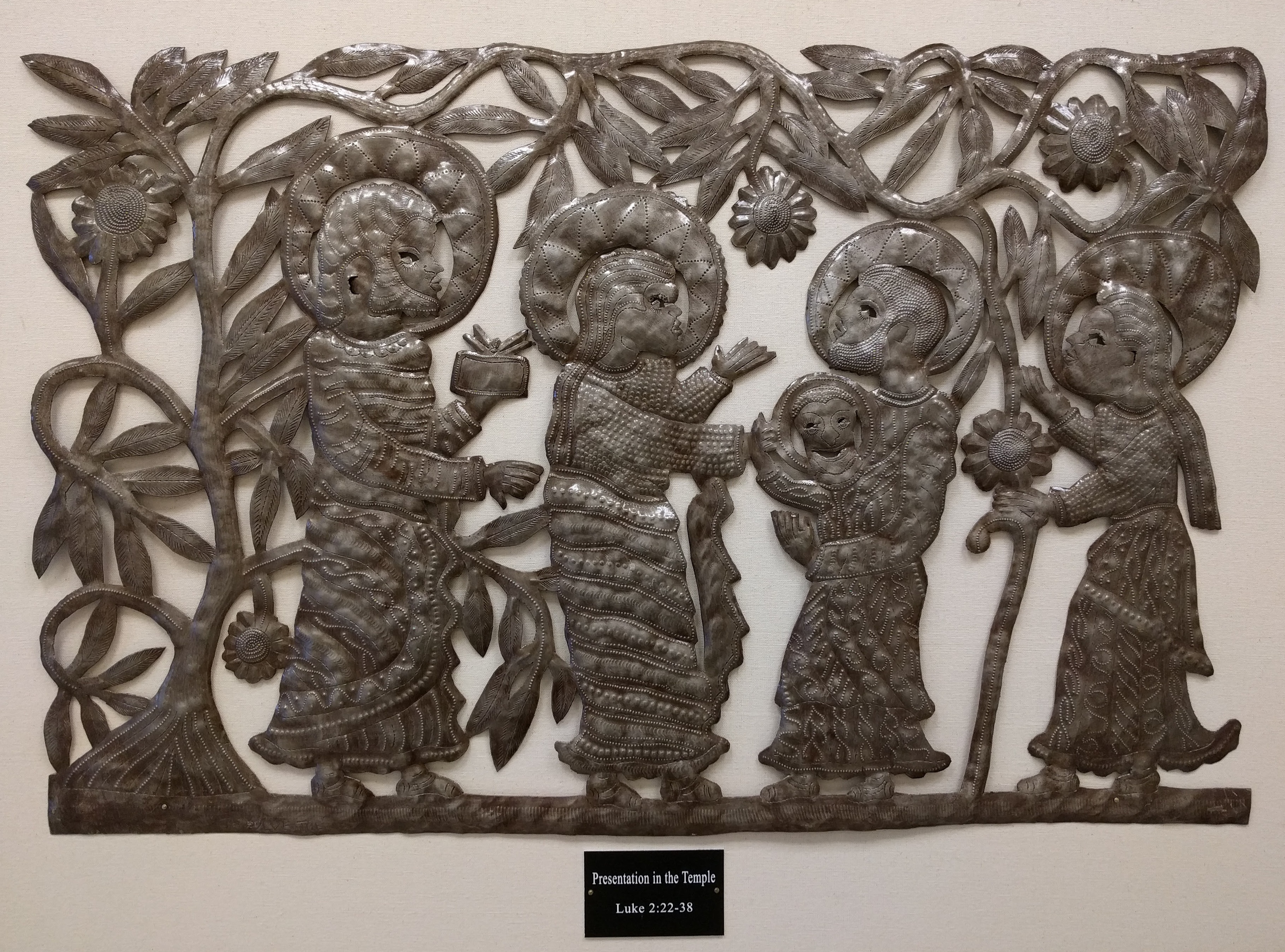
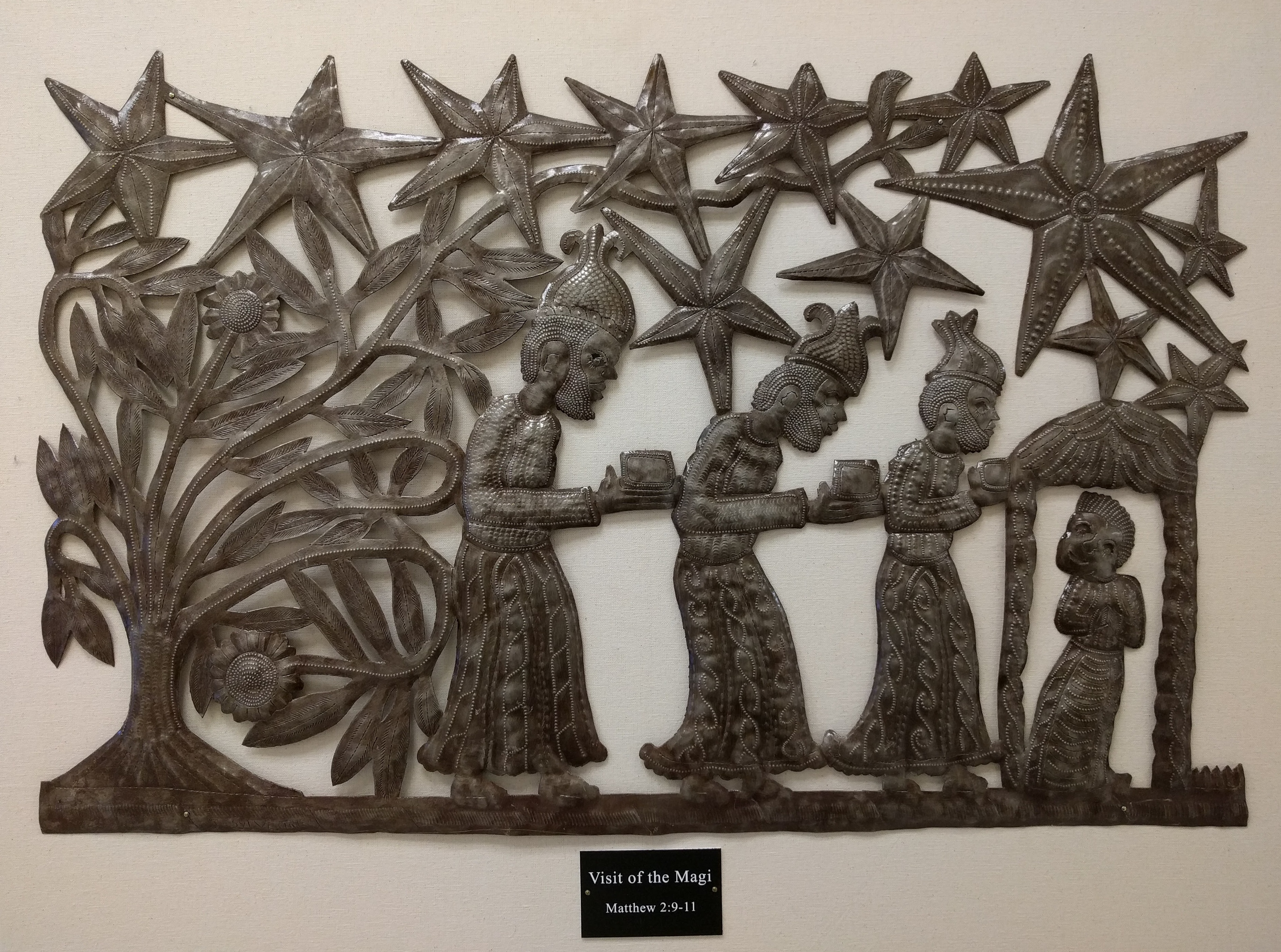
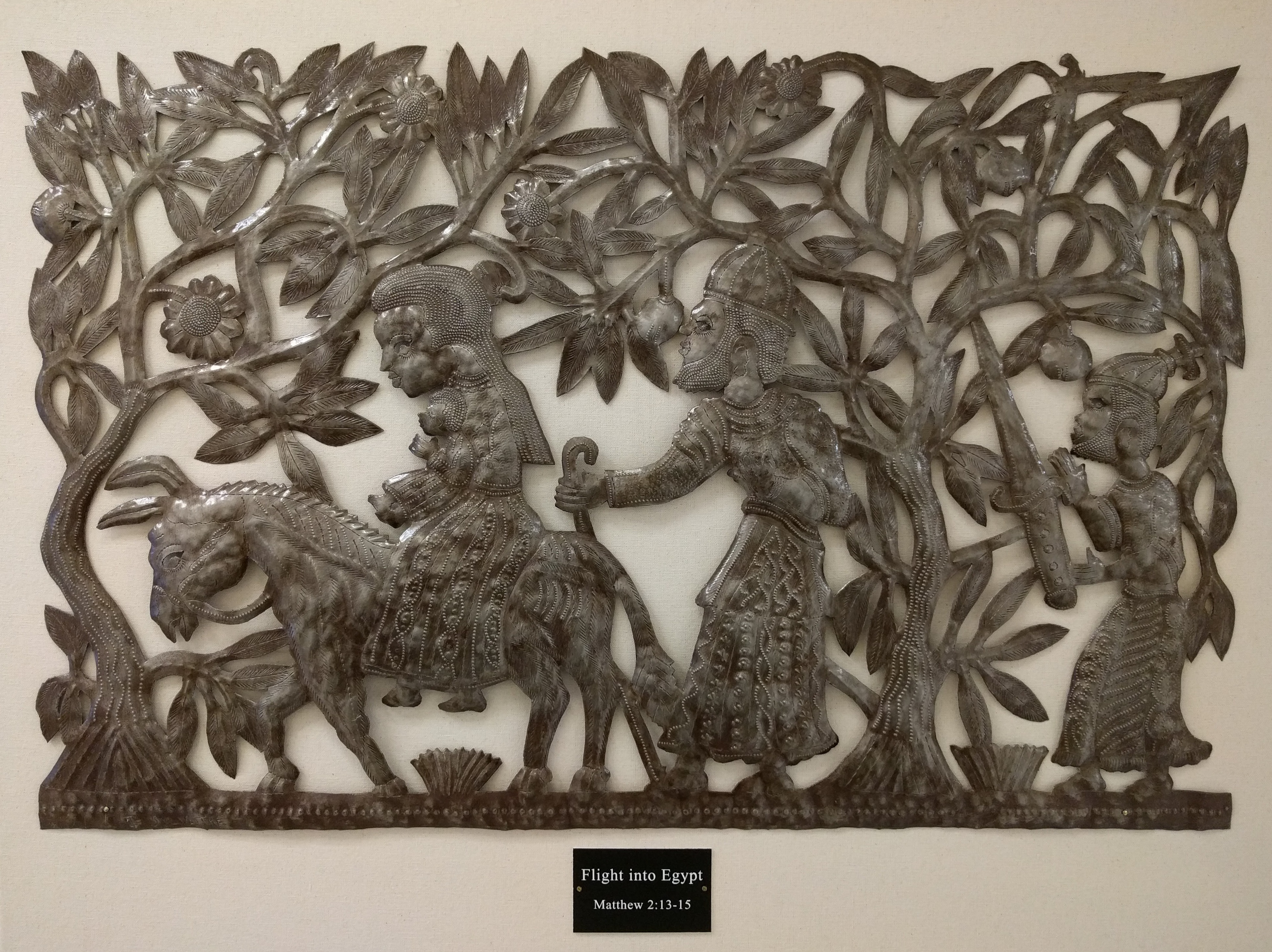
Infancy of Christ metalworks by Haitian artist Jean Sylvestre

When wandering around the Duke Divinity School campus this summer, waiting for a conference talk to start, I inadvertently encountered a stunning seven-work cycle of metal panels depicting scenes from the biblical narratives of Christ’s birth. They were designed and hand-carved from discarded steel oil drums by Haitian artist Jean Sylvestre, who lives in the village of Croix-des-Bouquets, ten miles outside Port-au-Prince.

Steel drum sculpting is an art form unique to Haiti, and Croix-des-Bouquets is the center of production, home to dozens of workshops. Once acquiring a drum, the artist first removes the round ends and places them inside the cylinder along with dried banana or sugar cane leaves, then sets the leaves on fire to burn off any paint or residue. When the drum cools, the artist makes a cut from top to bottom, then climbs inside and pushes with his legs and arms to open up the metal, which he then pounds into a flat sheet. Next he draws a design onto the metal using chalk, then uses a hammer, chisel, and ice picks to actualize it. To see photos of this process and learn more about it, visit www.haitimetalart.com.

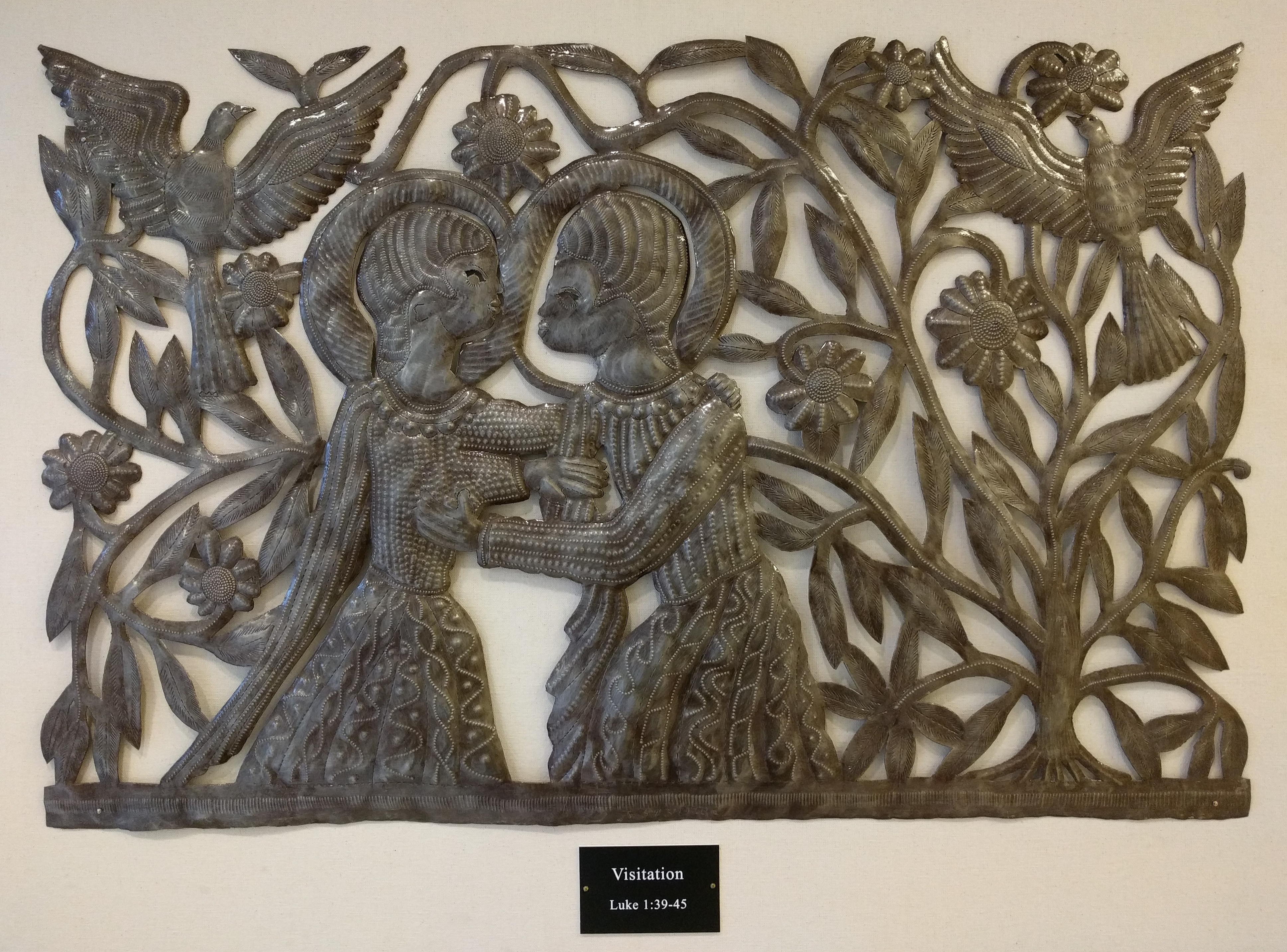
In Sylvestre’s nativity cycle at Duke—a gift from Drs. Richard and Judith Hays—the characters are depicted as native Haitians. Each scene unfolds against a backdrop of curvilinear greenery that is typical of Haitian metalwork.

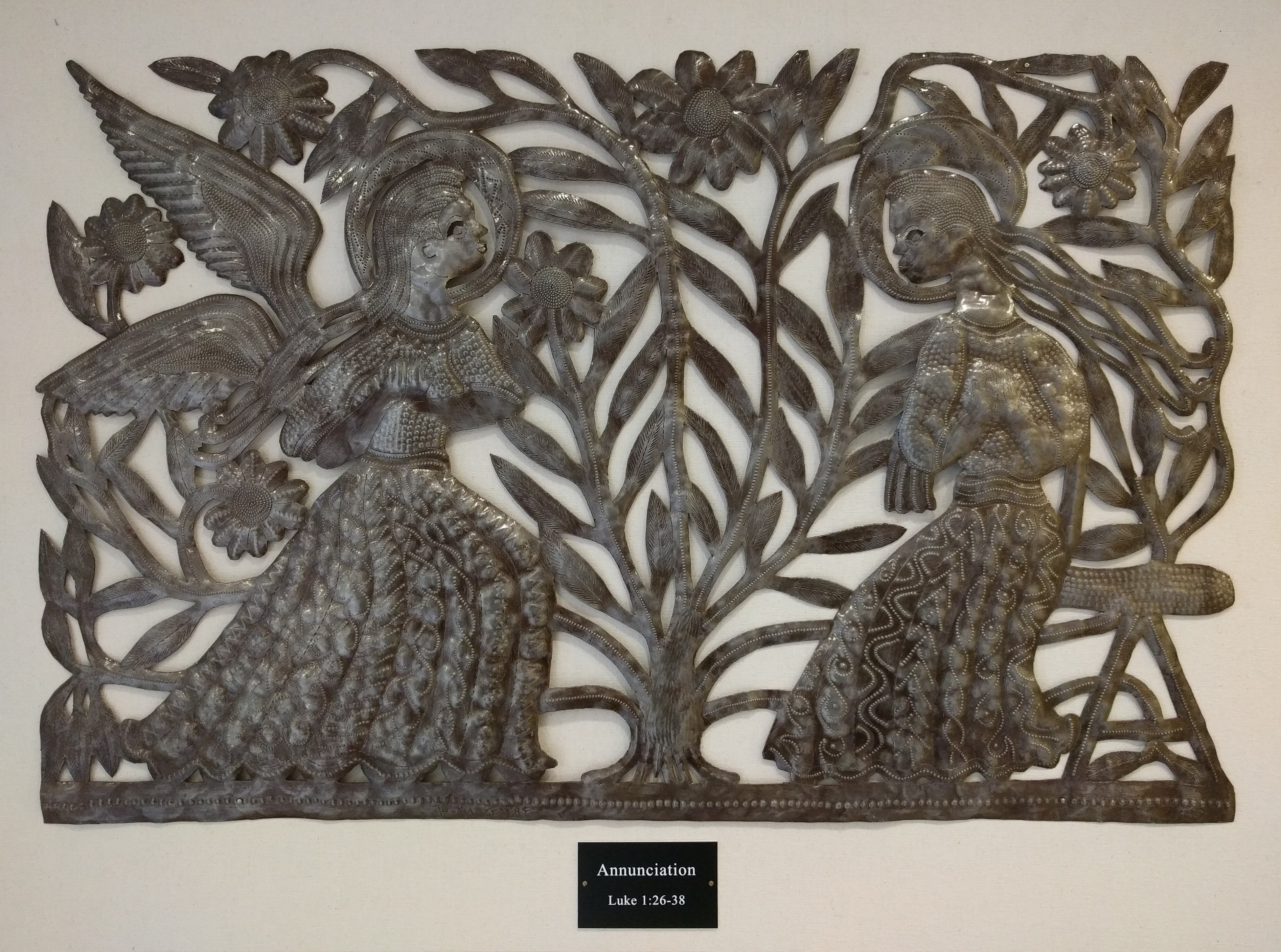
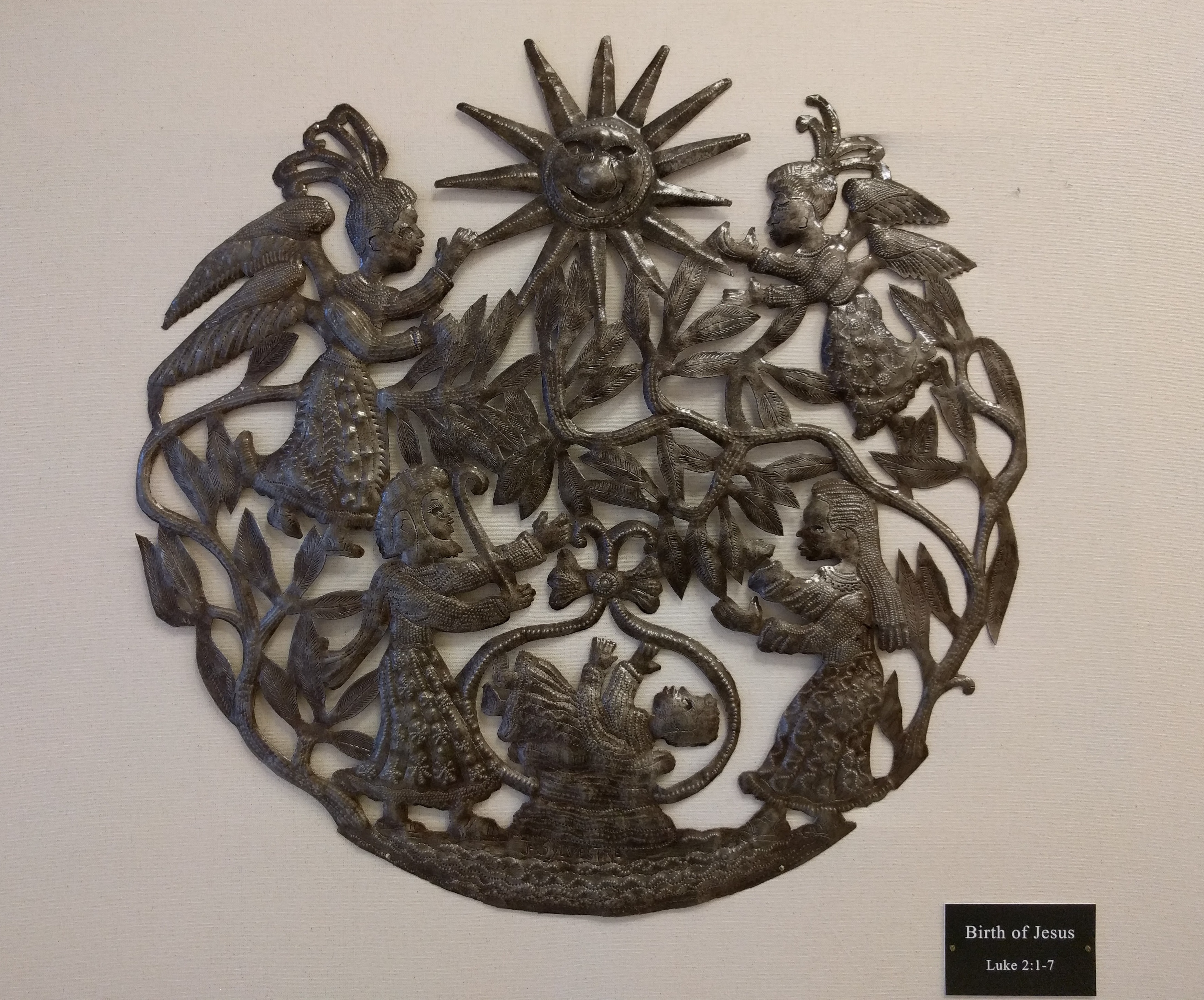
My favorite of the seven has got to be the Annunciation to the Shepherds; I love the angel’s wild hair and the one shepherd who jumps backward in fear and surprise. I’m also tickled by the smiling sun in the Nativity panel!

Annunciation by Jean Sylvestre
Jean Sylvestre (Haitian, 1957–), Annunciation, 2013. Recycled steel. No. 1 from a cycle of seven in the Westbrook Building, Duke Divinity School, Durham, North Carolina. Photo: Victoria Emily Jones.

Visitation by Jean Sylvestre
Jean Sylvestre (Haitian, 1957–), Visitation, 2013. Recycled steel. No. 2 from a cycle of seven in the Westbrook Building, Duke Divinity School, Durham, North Carolina. Photo: Victoria Emily Jones.

Nativity by Jean Sylvestre
Jean Sylvestre (Haitian, 1957–), Birth of Jesus, 2013. Recycled steel. No. 3 from a cycle of seven in the Westbrook Building, Duke Divinity School, Durham, North Carolina. Photo: Victoria Emily Jones.

Annunciation to the Shepherds by Jean Sylvestre
Jean Sylvestre (Haitian, 1957–), Angel and Shepherds, 2013. Recycled steel. No. 4 from a cycle of seven in the Westbrook Building, Duke Divinity School, Durham, North Carolina. Photo: Victoria Emily Jones.

Presentation in the Temple by Jean Sylvestre
Jean Sylvestre (Haitian, 1957–), Presentation in the Temple, 2013. Recycled steel. No. 5 from a cycle of seven in the Westbrook Building, Duke Divinity School, Durham, North Carolina. Photo: Victoria Emily Jones.

Adoration of the Magi by Jean Sylvestre
Jean Sylvestre (Haitian, 1957–), Visit of the Magi, 2013. Recycled steel. No. 6 from a cycle of seven in the Westbrook Building, Duke Divinity School, Durham, North Carolina. Photo: Victoria Emily Jones.

Flight into Egypt by Jean Sylvestre
Jean Sylvestre (Haitian, 1957–), Flight into Egypt, 2013. Recycled steel. No. 7 from a cycle of seven in the Westbrook Building, Duke Divinity School, Durham, North Carolina. Photo: Victoria Emily Jones.

Duke Divinity School also owns a fourteen-piece Stations of the Cross cycle by Jean Sylvestre, which is often displayed in the nave of Duke University Chapel during Lent.

Songs about the Flight to Egypt

On the heels of Jesus’s birth came his frantic flight, with parents Mary and Joseph, from the sword of an egomaniacal politician who swore death to all the male children of Bethlehem under the age of two. To secure his own power and advantage, Herod had to squash all potential threats.

Thus the birthday festivities were cut short as the Holy Family packed up what little they had and hit the road running, seeking asylum in another country.

Flight to Egypt by Jean-Francois Millet
Jean-François Millet (French, 1814–1875), The Flight into Egypt, ca. 1864. Conté crayon, pen, ink, and pastel over gray washes on paper, 31.1 × 39.4 cm. Art Institute of Chicago.

Many families are still making this difficult journey today: fleeing home in order to escape persecution and/or death.

Even though the Flight to Egypt is a part of the Christmas story, it’s often omitted from present-day nativity pageants and carol services because we prefer to bask in that which is quaint and cozy and cute and joyful, and we want that happy ending. We don’t want the darkness to rain on all the Christmas light. This is a real shame. By leaving out this event from our retellings of Jesus’s birth narrative, not only do we do a disservice to his memory, we neglect an opportunity to see Christ in our refugee neighbors.

(Related post: “Maria von Trapp, plus seven artists, on Jesus the refugee”)

To help remedy this omission, I’ve compiled a list of songs based on the Flight to Egypt so that churches can consider using them (or be inspired to write their own!) as part of their Christmas observances. I’ve purposely excluded “The Cherry-Tree Carol,” a centuries-old ballad derived from an apocryphal story about the Flight to Egypt from the Gospel of Pseudo-Matthew (chapter 20); I did so not only because the anonymous lyricist reset the episode during the Journey to Bethlehem, when Jesus was still in the womb, but because, though charming, there’s nothing historic, spiritually valuable, or socially conscious about it, and it perpetuates a popular stereotype of Joseph as stubborn and unkind that I believe scripture itself does not bear.

Also excluded are the several carols about the Massacre of the Innocents—the episode that prompted the Flight to Egypt. The two episodes are obviously related, but I want to focus here on the Flight.

CONGREGATIONAL HYMNS

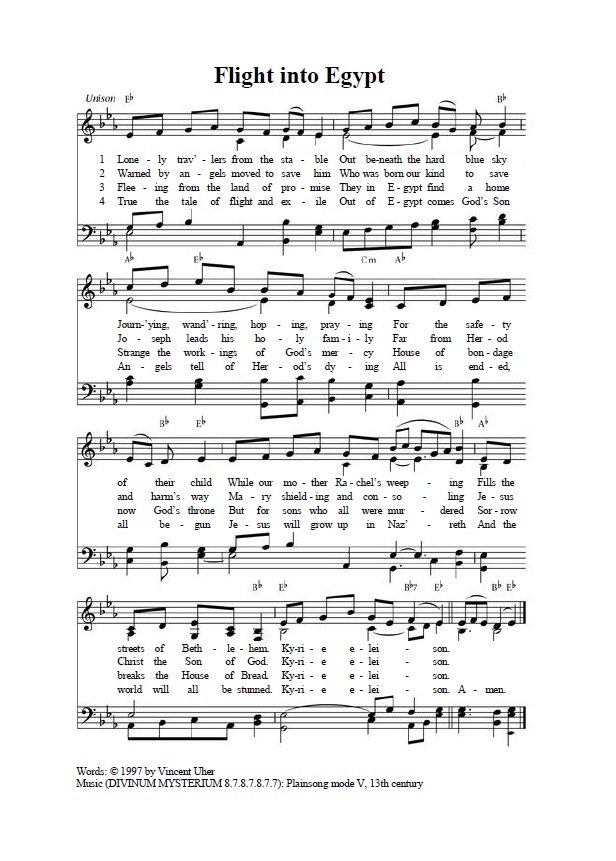
I could find only one song on the topic that was written with congregational singing in mind, and that is “Flight into Egypt” by the Rev. Vincent William Uher III (1963–). It’s made up of four verses and the refrain “Kyrie eleison” (Lord, have mercy), a common prayer in Christian liturgies. Because the hymn uses a plainchant tune, it has an irregular meter and may therefore be a little tricky for congregations to pick up right away. But the words are so beautifully crafted and set, and Rev. Uher gives his permission for noncommercial use, as long as credit is given. I put together a printable hymn sheet, reproduced below the lyrics. (Click on the image to open up the sheet as a PDF in a new tab.)

“Flight into Egypt” (1997) – Words: Vincent Uher | Music: Plainchant mode V, 13th century

Lonely travelers from the stable
Out beneath the hard blue sky
Journeying, wandering, hoping, praying
For the safety of their child
While our mother Rachel’s weeping
Fills the streets of Bethlehem.
Kyrie eleison.

Warned by angels moved to save him
Who was born our kind to save
Joseph leads his holy family
Far from Herod and harm’s way
Mary shielding and consoling
Jesus Christ the Son of God.
Kyrie eleison.

Fleeing from the land of promise
They in Egypt find a home
Strange the workings of God’s mercy
House of bondage now God’s throne
But for sons who all were murdered
Sorrow breaks the House of Bread.
Kyrie eleison.

True the tale of flight and exile
Out of Egypt comes God’s Son
Angels tell of Herod’s dying
All is ended, all begun
Jesus will grow up in Nazareth
And the world will all be stunned.
Kyrie eleison.

flight-into-egypt-by-vincent-uher

Because of the scarcity of carols referencing the Flight to Egypt, I took to writing some verses of my own, using already-popular hymn tunes. Each of these verses is intended not as an additional stanza to the carol whose tune it shares (that would render the narrative structure incoherent) but as a standalone reprise of sorts. I envisioned any one of them being sung as part of a Christmas Eve service following the reading, as part of the total Christmas story, of Matthew 2:13–14.   Continue reading “Songs about the Flight to Egypt”