Moveable Garden, a community art project organized by Sojourn Arts, 2021. Mixed media on panel.
Sojourn Arts is a ministry of Sojourn Midtown in Louisville, Kentucky. As one way for their community to engage the springtime theme of Easter, on Easter Sunday 2021, Tim Robertson led a riso printing project in the church’s art gallery between services, open to all. Participants selected and arranged live flowers on the glass copier of a risograph (a type of digital printing machine that uses a process similar to screen printing to create vibrant, textured prints), printed their designs onto colorful paper, cut them out, and collaboratively collaged them into a floral arrangement on a wood panel—a “moveable garden”! View more photos here.
LISTEN: “Christ Is Your Spring”|Words by Edward A. Washburn, 1863 | Music by Andy Bast, 2024 | Performed by Bellwether Arts, feat. Emily Hanrahan, 2024
Christ has arisen, And Death is no more! Lo! the white-robed ones Sit by the door. Dawn, golden morning, Scatter the night. Haste, you disciples glad, First with the light!
Break forth in singing, O the world newborn! Sing the great Eastertide, Christ’s holy morn. Sing him, young sunbeams Dancing in mirth; Sing, all you winds of God Coursing the earth!
Sing him, you laughing flow’rs Fresh from the sod; Sing him, wild, leaping streams, Praising your God! Break from your winter, Sad heart, and sing! Bud with your blossoms fair; Christ is your spring.
Sing alleluia!
Christ is your spring.
What a beautiful hymn text! Andy Bast found it in Jane Eliza (Coolidge) Chapman’sEaster Hymnscompilation, published in Boston in 1876. In the introduction to the hymnal, Chapman’s uncle J. I. T. (James Ivers Trecothick) Coolidge, an Episcopalian minister, delights in how
[Easter’s] sun shines with fuller radiance each year upon the world, whose night of darkness it broke on the Resurrection Morning. The anthems which greet its rising are caught and repeated by increasing millions of grateful hearts of every tongue, kindred, and people, until the wide earth is filled with their sounding praise. How sacred a privilege to have part in this mighty and triumphant symphony, how sad to be out of harmony with its sublime strains!
Written by Rev. Dr. Edward A. Washburn (and given a new tune by Bast), “Christ Is Your Spring” apostrophizes the whole newborn world, enjoining it to praise God. Sunbeams, winds, flowers, streams, the human heart—all are encompassed in God’s project of renewal and invited to sing each in their own way.
Taken near Mars Desert Research Station in Hanksville, Utah, in 2019, this photograph shows yellow and purple flowers peeping up through the dry cracks of a desert floor. It’s a superbloom, “a rare desert botanical phenomenon in which an unusually high proportion of wildflowers whose seeds have lain dormant in desert soil germinate and blossom at roughly the same time. The phenomenon is associated with an unusually wet rainy season” [source]. View more photos here.
Even the wilderness and desert will be glad in those days The wasteland will rejoice and blossom with spring crocuses Yes, there will be an abundance of flowers and singing for joy The deserts will become as green as the mountains of Lebanon As lovely as Mount Carmel or the plain of Sharon There the Lord will display his glory The splendor of God With this news, strengthen those who have tired hands And encourage those who have weak knees Say to those with fearful hearts: Be strong and do not fear Your God is coming He is coming to save you
This electronica chant sets to music a popular Advent scripture: Isaiah 35:1–4. Sung by Tara Ward [previously] of the Opiate Mass, it was recorded live on December 4, 2010, at Immanuel Lutheran Church in Seattle.
The name [The Opiate Mass] is a nod both to the Christian liturgical form and to Karl Marx’s assessment that religion is the opiate for the masses. Perhaps it is. Or perhaps the common desire for comfort, rest, escape, or relief are more complicated and mysterious than we know.
In our pursuit of creating spaces of beauty and awe, we find ourselves partial to cathedrals, antiquity, ambience, pipe organs, samplers, synthesizers, incense, tongues, silence, joy, meditation, ambiguity, the abstract. We strive to avoid pretense, hype, cliché, certainty, celebrity, egotism, greed, noise.
Last summer my husband and I drove up to Chadds Ford, Pennsylvania, to see the Joseph Stella: Visionary Nature exhibition at the Brandywine Museum of Art, which ran June 17–September 24, 2023. (Before that it was shown at the Norton Museum of Art in West Palm Beach, Florida, and the High Museum of Art in Atlanta.) It was lovely! There’s an accompanying catalog still available.
Joseph Stella (1877–1946) was born in the mountain village of Muro Locano in southern Italy, near Naples, and immigrated to New York at age eighteen, becoming a US citizen in 1923. He traveled much throughout his life—between his native country and his adopted country, but also for extended stays in Morocco, Chad, Algeria, France, and Barbados. In Paris in 1911–12 he met many of the leading artists of the European avant-garde, including Matisse, Picasso, and Modigliani, and was exposed to the full range of developments in modern art—postimpressionism, Symbolism, fauvism, cubism, surrealism, futurism, dadaism.
Though Stella absorbed some of these influences, he never aligned with a single group or movement. Art historian Abram Lerner says Stella is difficult to pin down, describing him as “a multiple stylist of unusual scope and energy,” both a modernist and a traditionalist. [1] In terms of content, his oeuvre is divided fairly evenly between urban industrial subjects—his most famous paintings are probably those from his series on the Brooklyn Bridge—and joyful and abundant nature.
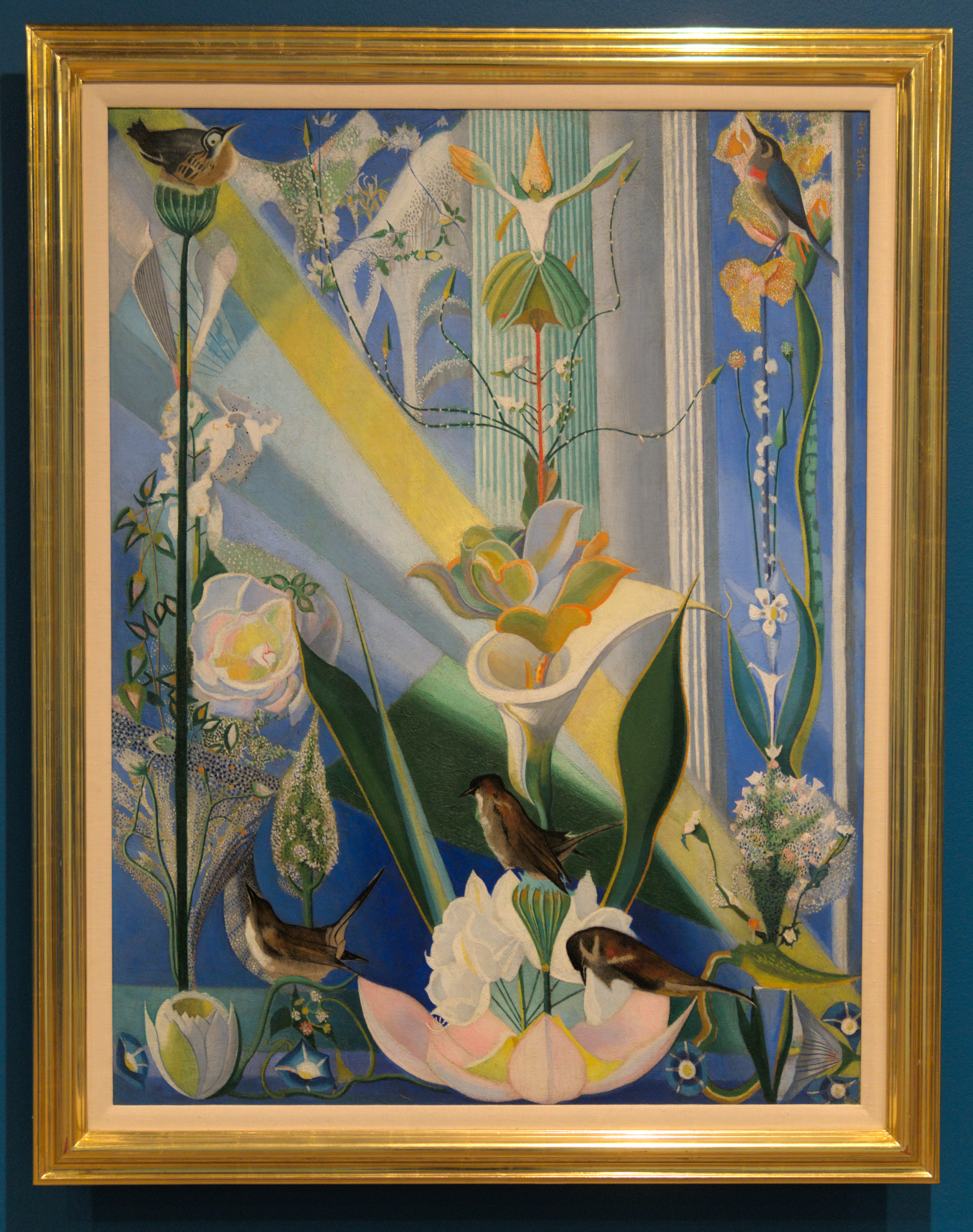
Joseph Stella: Visionary Nature, curated by Stephanie Heydt and Audrey Lewis, spotlights the latter. Many of Stella’s paintings feature birds and foliage hieratically positioned around a central axis, such as Dance of Spring (Song of the Birds).
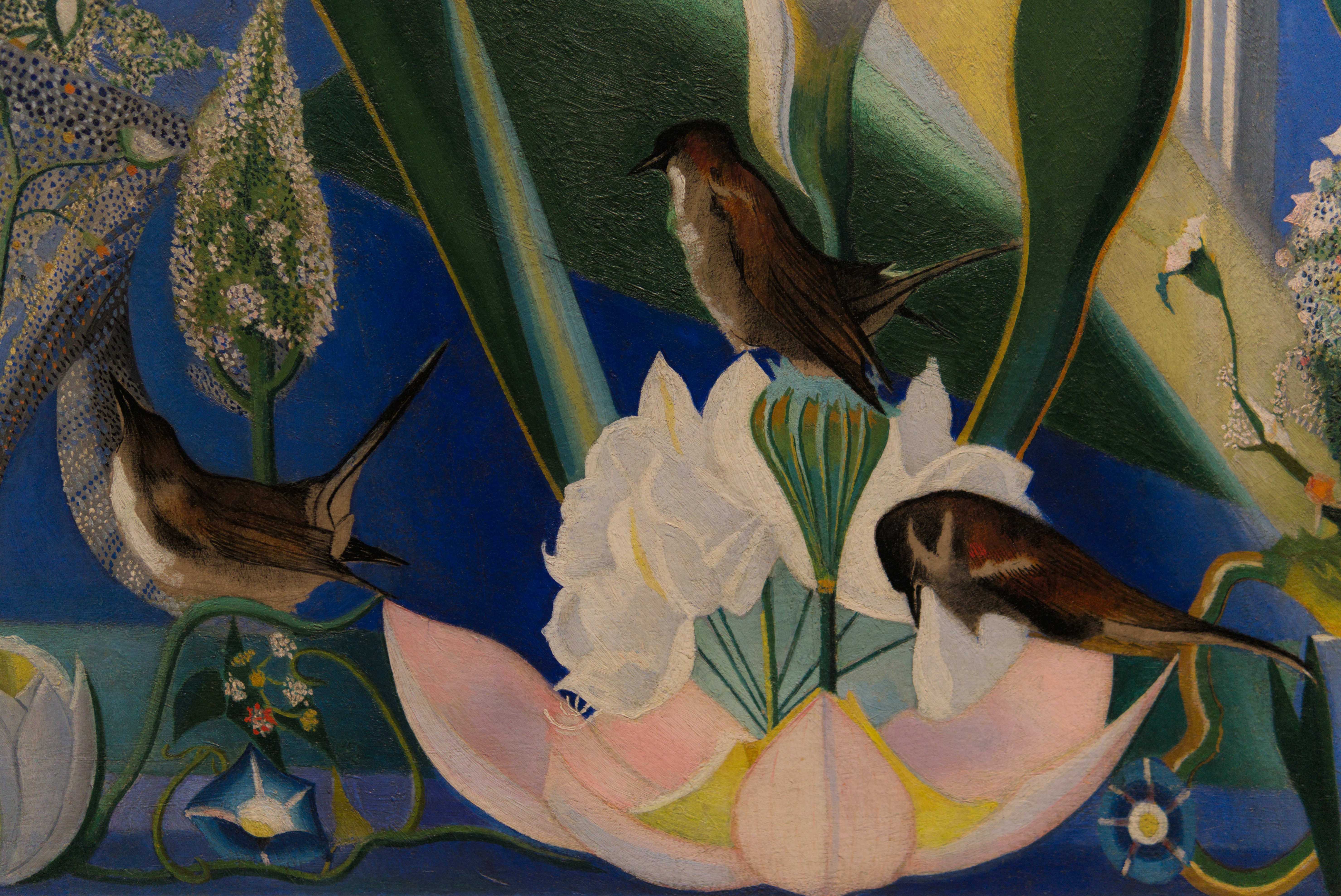
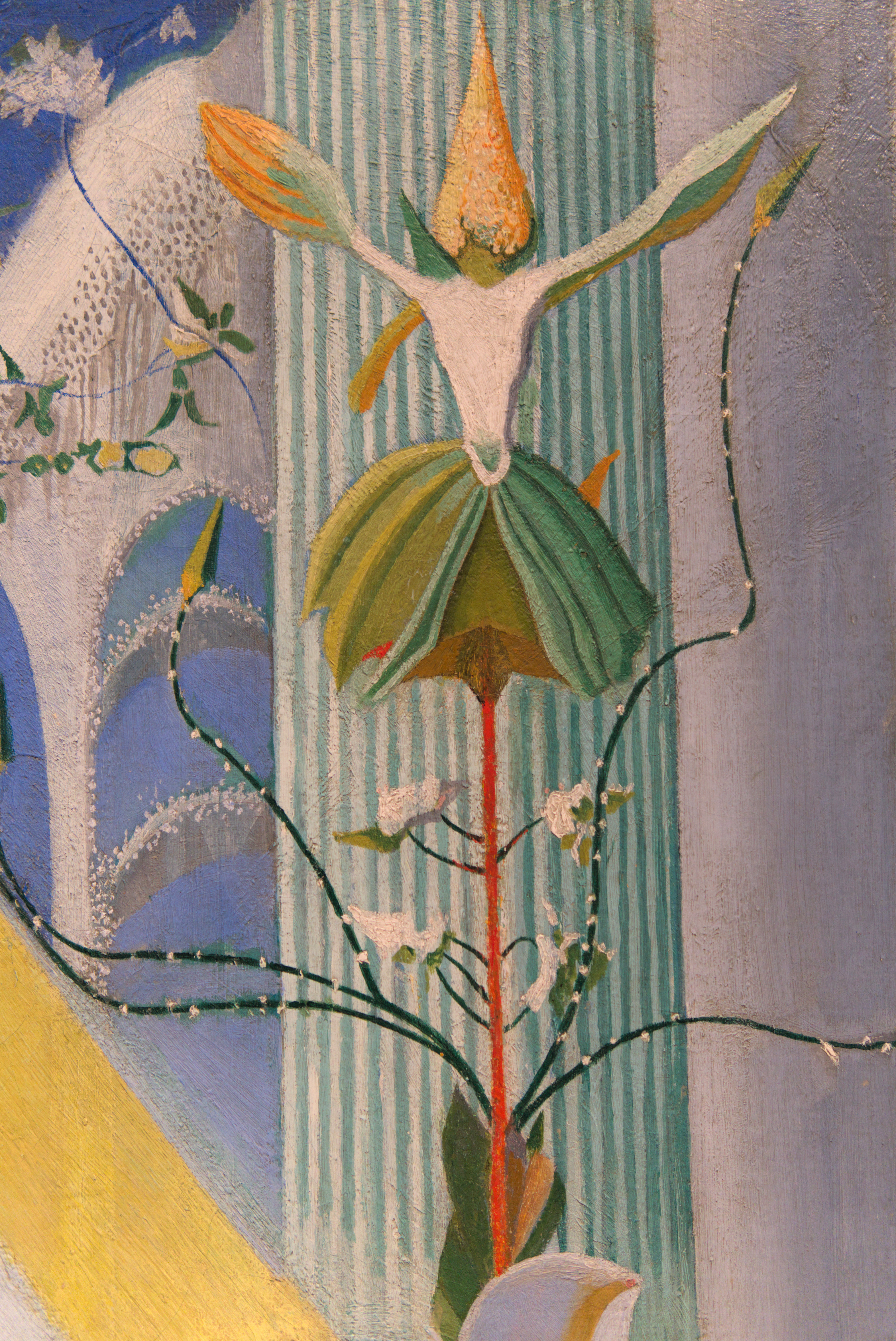
Joseph Stella (Italian American, 1877–1946), Dance of Spring (Song of the Birds), 1924. Oil on canvas, 42 3/8 × 32 3/8 in. (107.6 × 82.2 cm). Kemper Museum of Contemporary Art, Kansas City, Missouri. Photo: Victoria Emily Jones. [object record]Dance of Spring (Song of the Birds) (detail)Dance of Spring (Song of the Birds) (detail)
“Here,” reads the wall text,
Stella assembles a classical temple of flora and fauna—in his own words, culled “from the elysian lyricism of the Italian spring.” Flowers rise from a pink lotus at the base of a central column, culminating in the curious combination of lupine and a longhorn steer’s head flower, a floral form that resembles a bull’s skull. Below perch three sparrows, the national bird of Italy and a favorite of Stella’s.
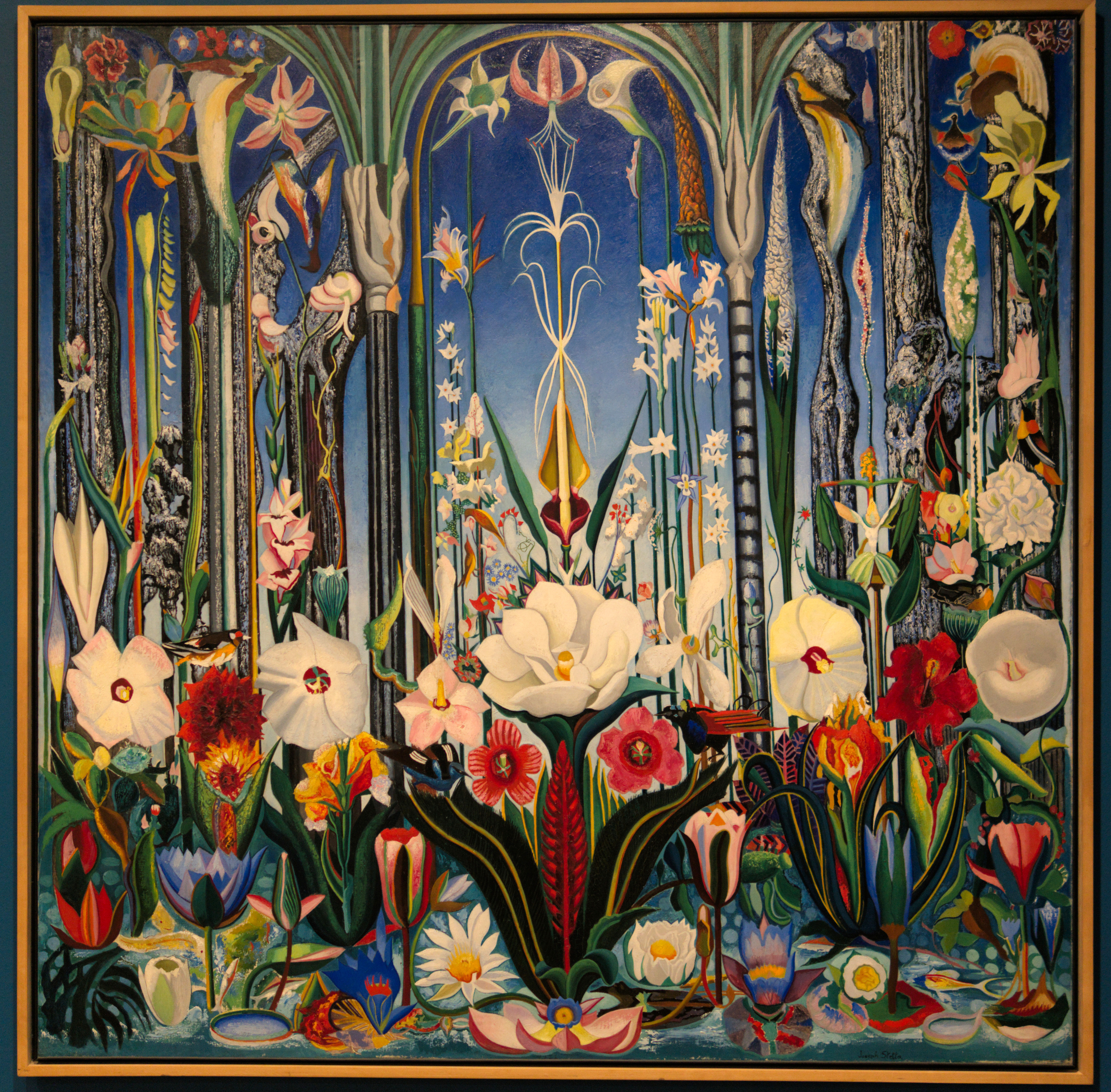
At over six square feet, Stella’s Flowers, Italy is an even more epic floral composition, a symphony of vitality and color.
Joseph Stella (Italian American, 1877–1946), Flowers, Italy, 1931. Oil on canvas, 74 3/4 × 74 3/4 in. (189.9 × 189.9 cm). Phoenix Art Museum, Arizona. Photo: Victoria Emily Jones.
From the wall text:
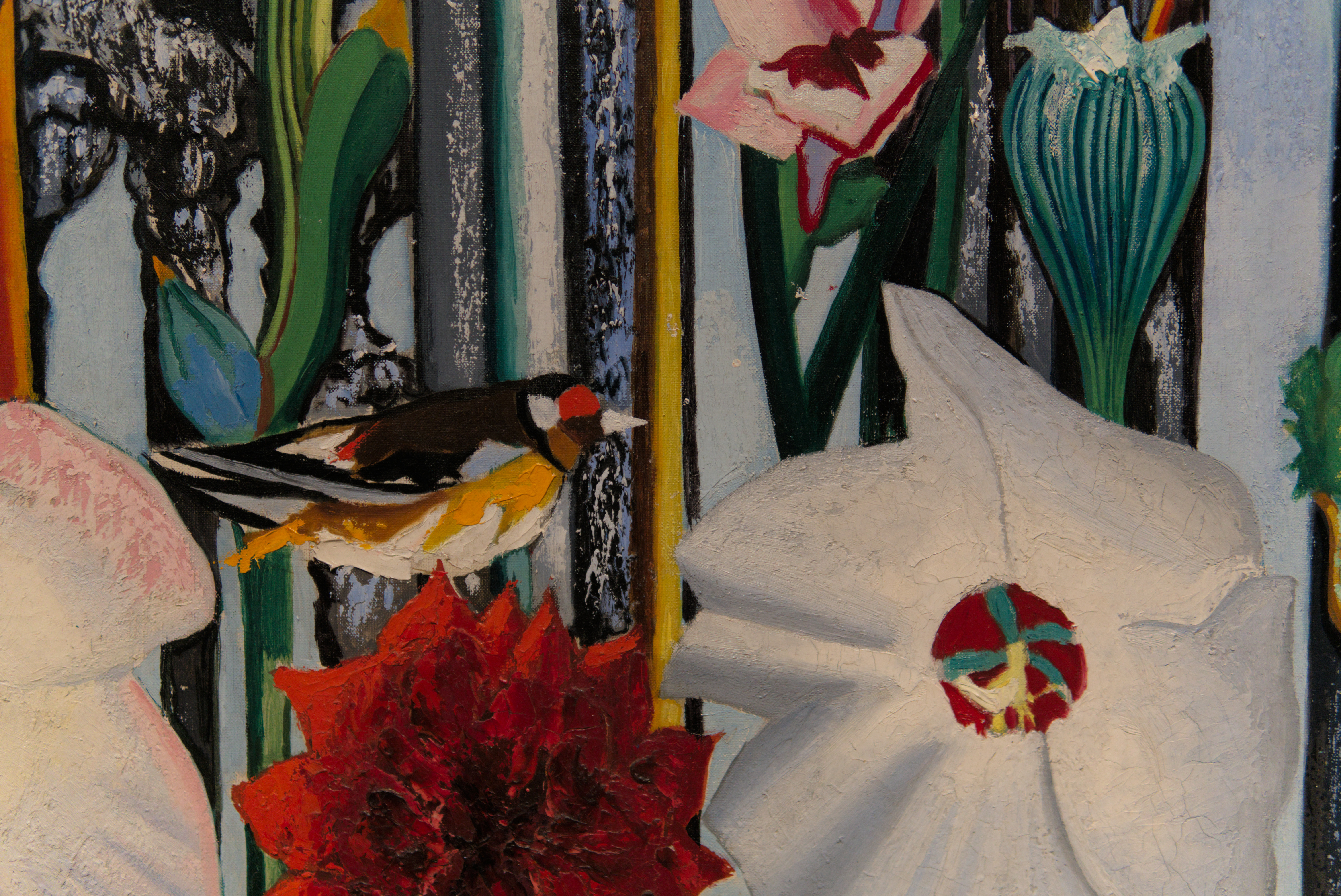
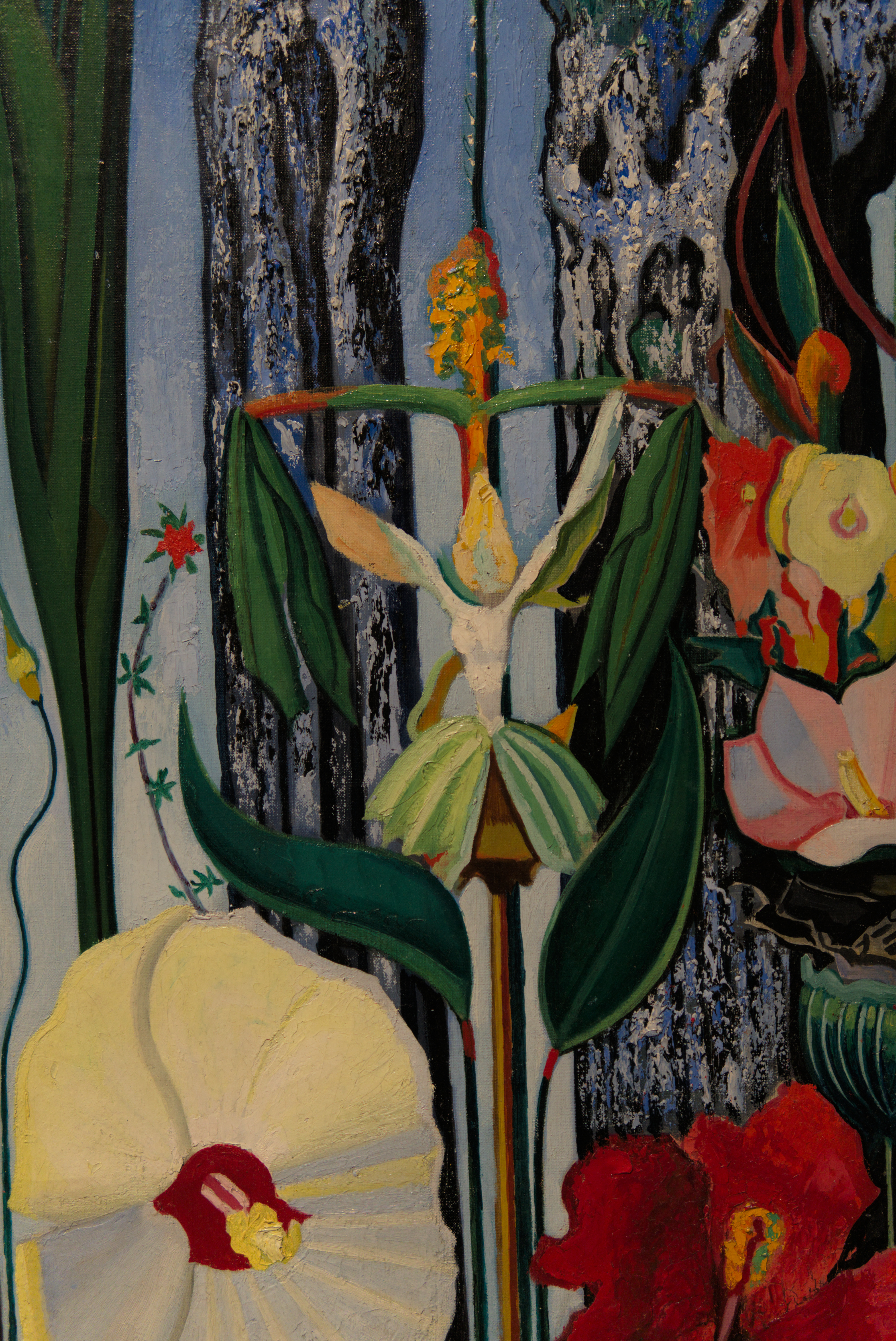
Order and symmetry are in constant tension with the spontaneity of organic ornamentation. The canvas overflows with colorful depictions of flowers and birds within a setting evoking Gothic architecture: pillars of gnarled tree trunks extend outward from the center, as if aisles of a cathedral. Lupine, gladiolas, and birds-of-paradise fill the vertical spaces with a spectrum of colors simulating stained glass windows. Like a congregation in the pews, a host of smaller flowers and plants are gathered below.
Flowers, Italy (detail)Flowers, Italy (detail)
Despite the title, the flowers depicted are not all native to Italy; Stella culled them from his world travels, and some are his own mystical inventions.
Stella sought to portray the voluptuousness and spirituality of his Italian homeland. He was raised in the Catholic faith, and although he didn’t practice as an adult, he remained proud of that heritage. Devotion to the Virgin Mary was a prominent aspect of his religious experience growing up, and in the 1920s he began painting a series of Madonnas, three of which were part of this exhibition.
Art historian Barbara Haskell identifies some of the artistic influences on these paintings:
The garlands of fruits and flowers that surrounded his Madonnas and their embroidered garments of lacy floral patterns recalled the work of the fifteenth-century Venetian Carlo Crivelli, while their impassive countenances, downcast eyes, and long, slim hands folded under translucent cloaks owed a debt to the Dugento masters Cimabue and Duccio. Yet Stella’s paintings were equally influenced by the flat, naive, and colorful images of the Madonna that proliferated in the popular devotional images and folk art of Southern Italy . . . in prayer sheets and books, scapulars, and ex-votos as well as in the profusion of silk and plastic flowers on altars and religious images. [2]
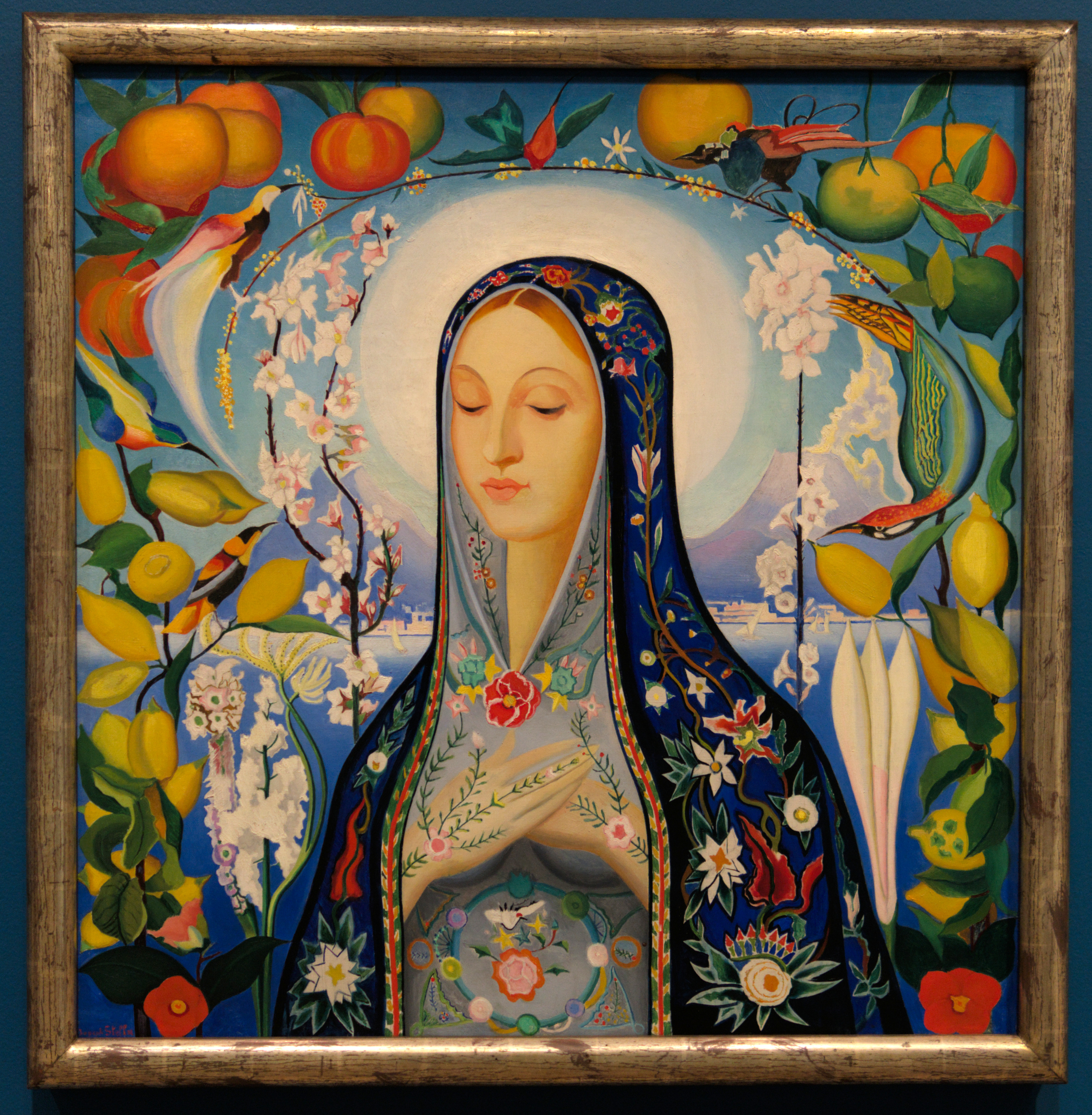
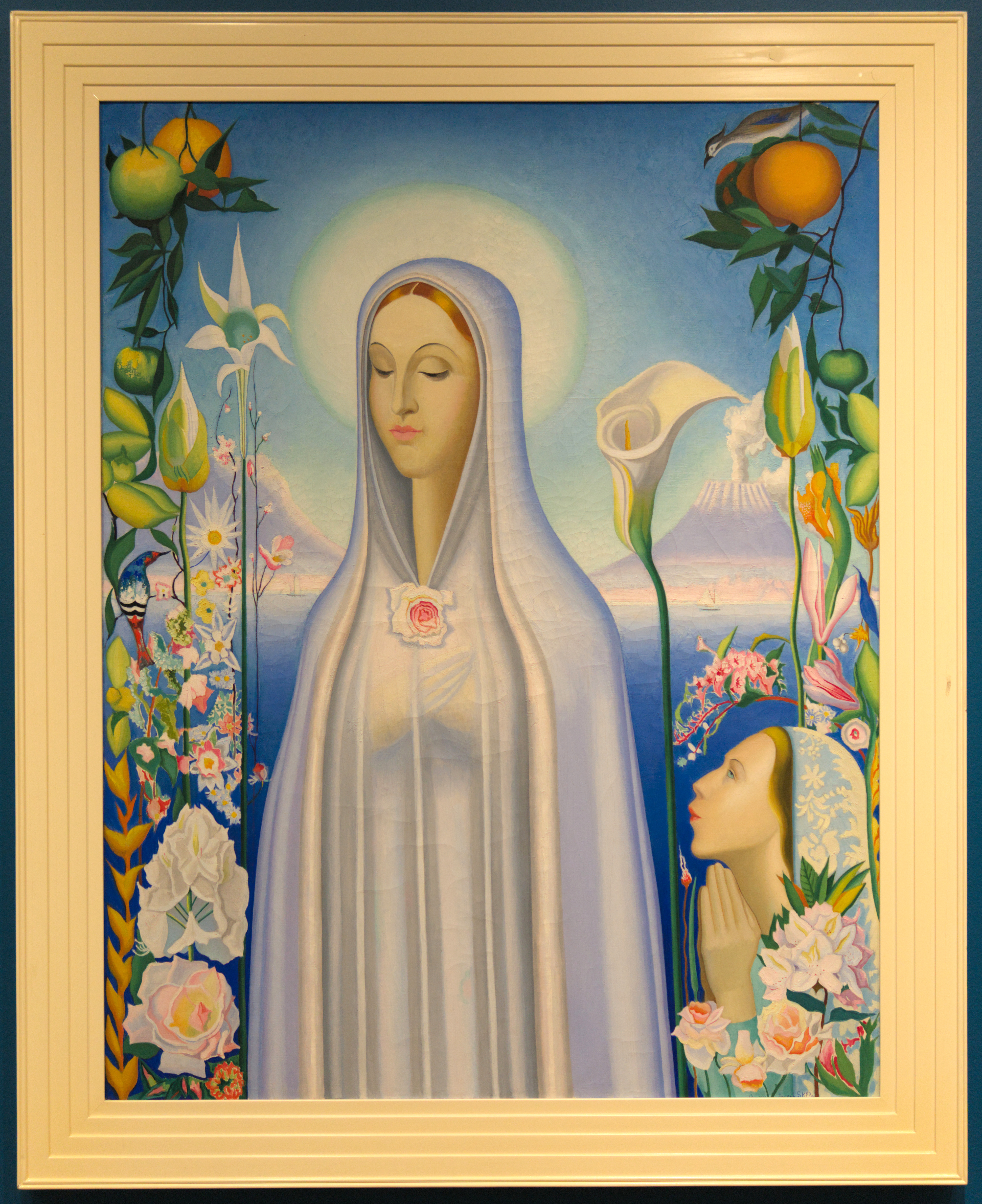
Joseph Stella (Italian American, 1877–1946), The Virgin, 1926. Oil on canvas, 39 11/16 × 38 3/4 in. (100.8 × 98.4 cm). Brooklyn Museum, New York. Photo: Victoria Emily Jones. [object record]
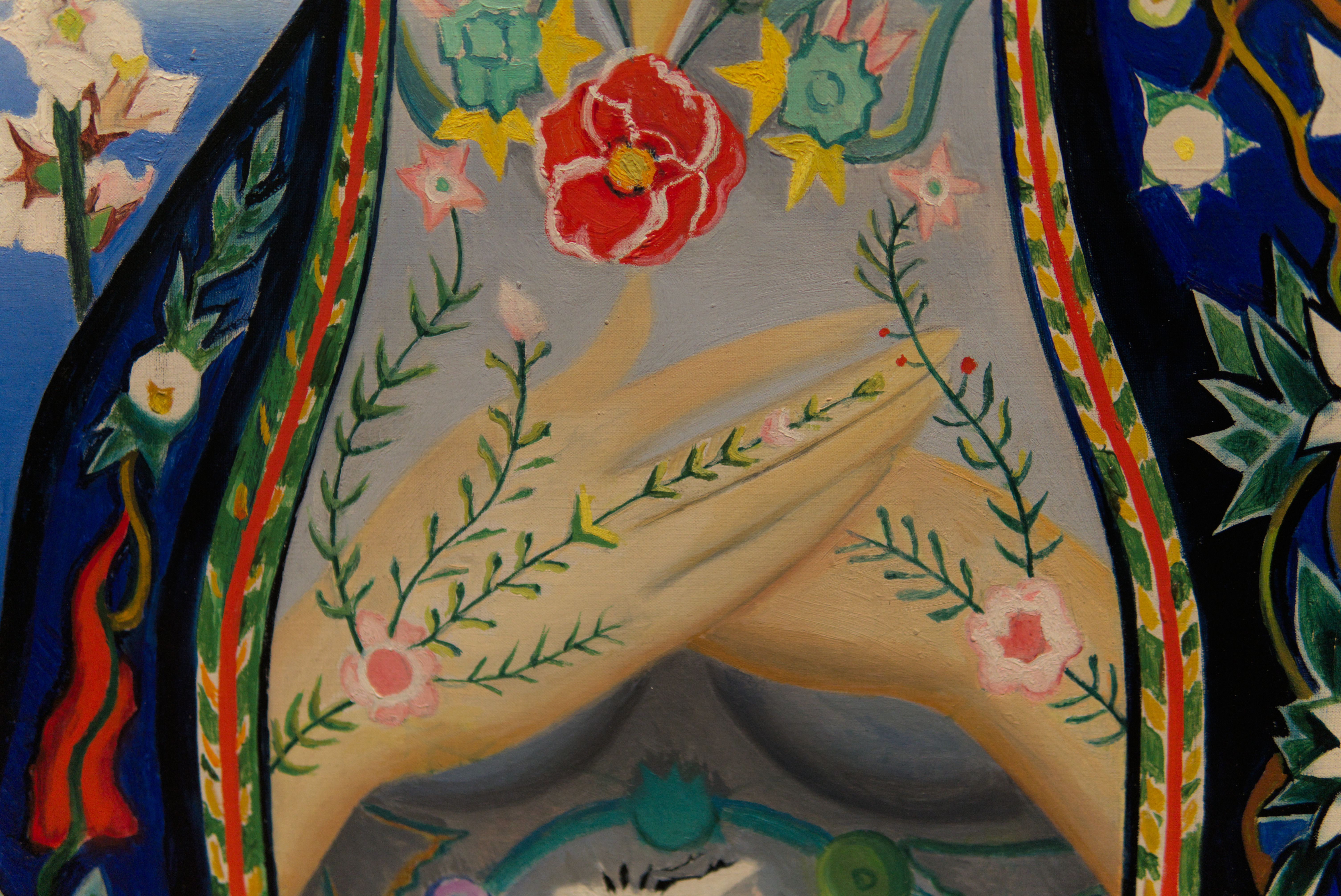
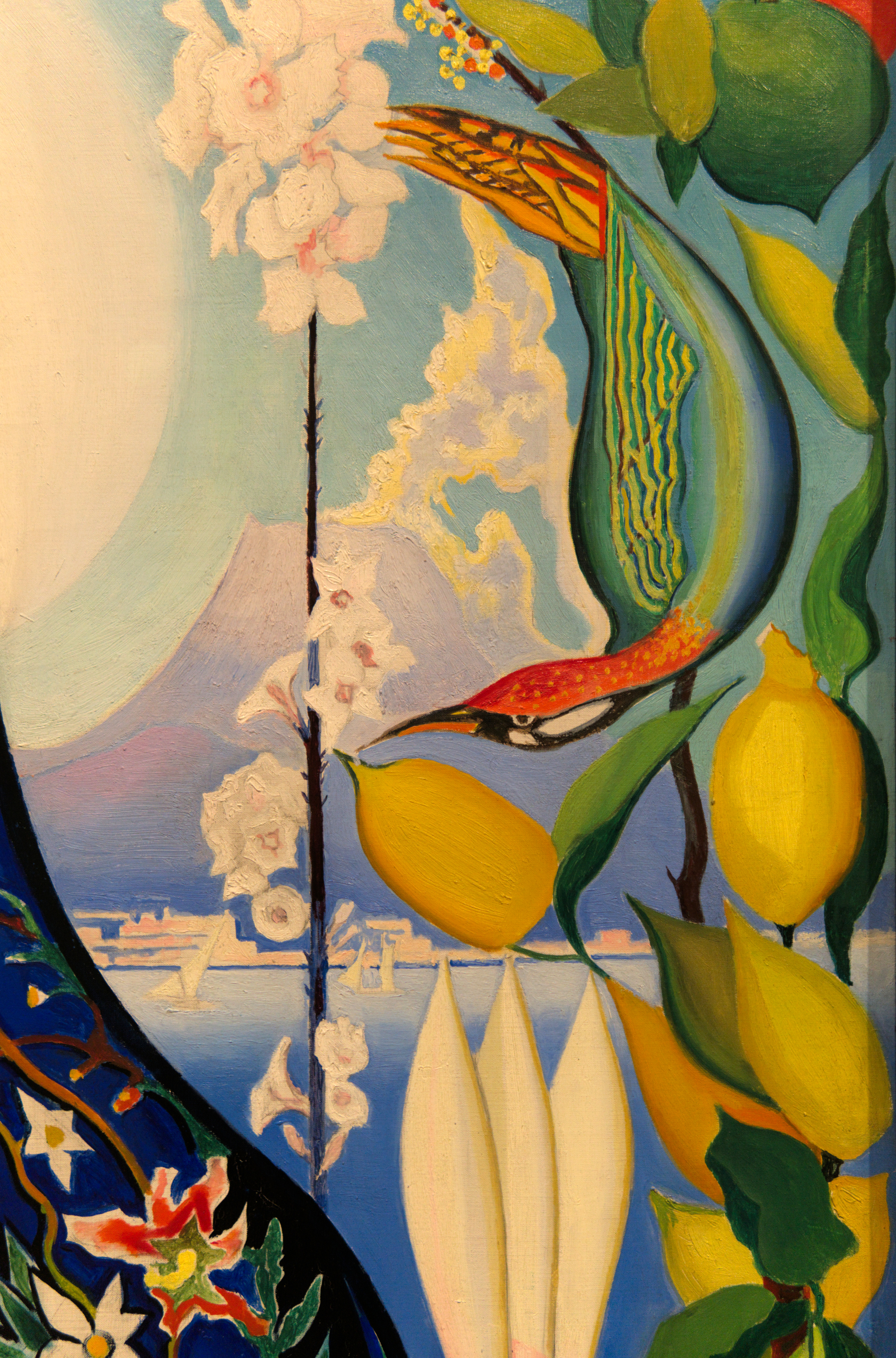
His 1926 Virgin from Brooklyn Museum is my favorite. It shows Mary enshrined among the fruits and flowers of the Mediterranean, with tendrils sweeping up and down her mantle and robe, adorning her neck like a necklace, sprouting out of her prayerful hands, and encircling the womb where she gestated Jesus. The Joseph Stella: Visionary Nature curators provided the following commentary in the wall text:
Eyes downcast and hands folded in a traditional Christian gesture of spiritual humility, Stella’s Madonna is set against the distinctive topography of Naples. Visible in the background is Mount Vesuvius, the smoldering volcano that erupted in AD 79 and a landmark of Southern Italy. The halo-like orb surrounding the Virgin’s head, seemingly nestled into the profiles of the mountains, transforms the modern Naples into a site of religiosity. Stella described “the Virgin praying [. . .] protected, on both sides, by almond blossoms, crowned above by the wreath of the deep and clear gold of the orange and lemon trees.”
Stella captures the wild beauty, the fecundity, the blossoming of Mary when the Holy Spirit plants his seed in her and she conceives God’s Word. Her acceptance of the divine call that the angel Gabriel relays to her produces life that redounds to all of humanity and indeed to the whole world. It’s why Mary’s cousin Elizabeth exclaims to her, “Blessed are you among women, and blessed is the fruit of your womb!” (Luke 1:42).
The Virgin (detail)The Virgin (detail)
There’s a long tradition in Christianity of describing Mary’s conception of Jesus as a flowering and of honoring her with flowers. I’m reminded especially of the twelfth-century mystic Hildegard of Bingen’s many hymns and antiphons that celebrate Mary in such terms.
Yes your flesh held joy like the grass when the dew falls, when heaven freshens its green: O mother of gladness, verdure of spring. [3]
Pierced by the light of God, Mary Virgin, drenched in the speech of God, your body bloomed, swelling with the breath of God. [4]
You glowing, most green, verdant sprout,
in the movement of the spirit, in the midst of wise and holy seekers, you bud forth into light.
Your time to blossom has come.
Balsam scented, in you the beautiful flower blossomed. [5]
The Brooklyn Virgin could be read as an Annunciation image, the Incarnation taking place inside this young woman who said yes to God. The sailboats on the sea, their movement reliant on the wind, may allude to the Holy Spirit who blew onto the scene in a major way in Luke 1 to move salvation history forward.
Joseph Stella (Italian American, 1877–1946), The Virgin (Virgin of the Rose and Lily), 1926. Oil on canvas, 57 1/2 × 44 3/4 in. (146.1 × 113.7 cm). Private collection, courtesy of Collisart, LLC, New York. Photo: Victoria Emily Jones. [object record]
The reference to outdoor religious processions with painted wooden Madonnas in southern Italy is more pronounced in Stella’s Purissima, in which the Mary figure, nearly life-size, is very stiff, statuesque. Co-curator Stephanie Heydt from the High Museum of Art introduces the work in this three-and-a-half-minute video:
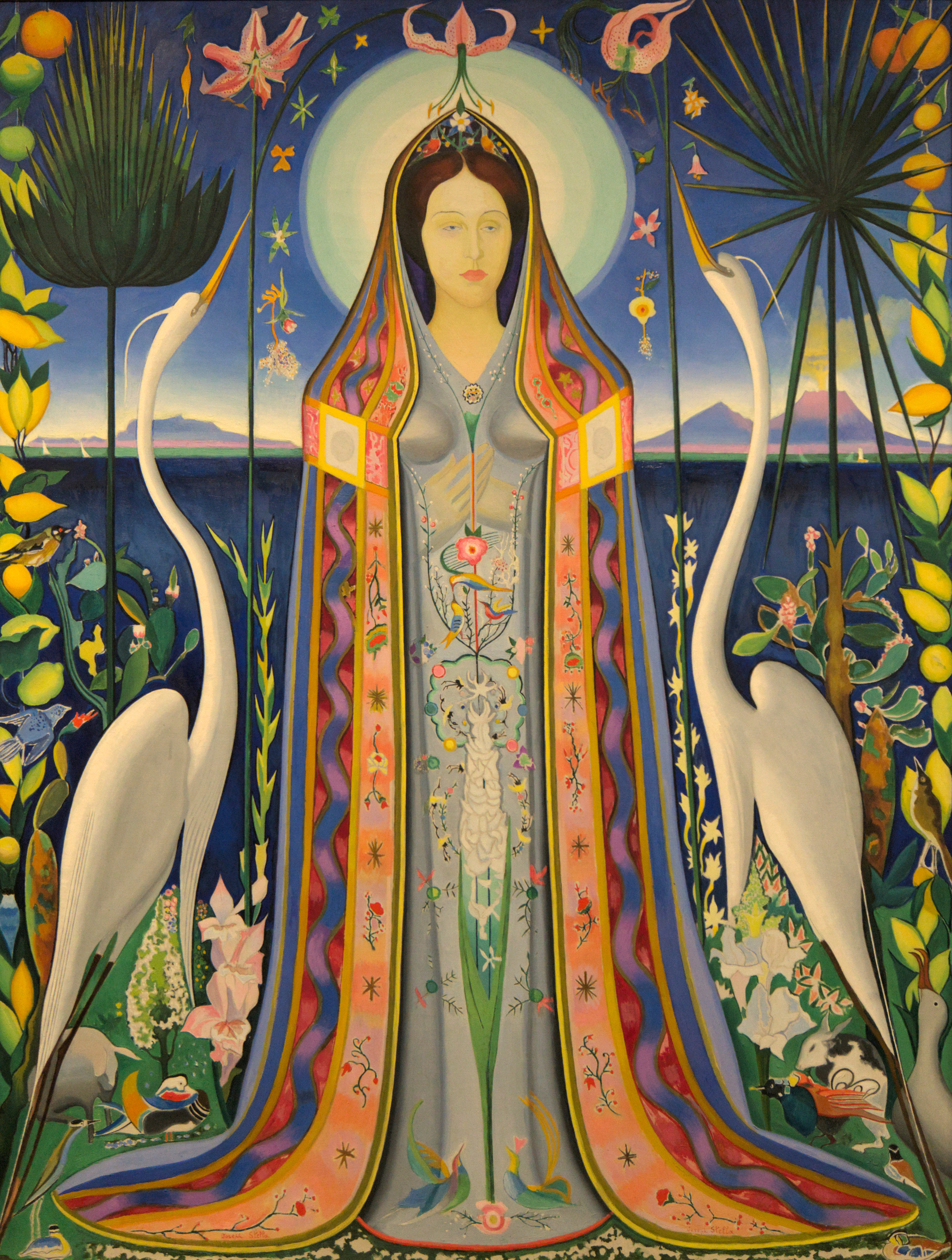
Joseph Stella (Italian American, 1877–1946), Purissima, 1927. Oil on canvas, 76 × 57 in. (193 × 144.8 cm). High Museum of Art, Atlanta, Georgia. Photo: Victoria Emily Jones. [object record]
“Mater Purissima” (Purest Mother), or “Virgo Purissima” (Purest Virgin), is one of Mary’s titles in Catholicism. The artist gave the following description of the painting:
Clear morning chanting of Spring.
BLUE intense cobalt of the sky—deep ultramarine of the Neapolitan sea, calm and clear as crystal—and alternating with zones of lighter blue, the mantle multicolored (an enormous lily blossom turned upside down).
SILVER quicksilver of spring water, quilted with the rose, green, and yellow of the gown—greenish silver, very bright—mystic DAWN-white—of the Halo.
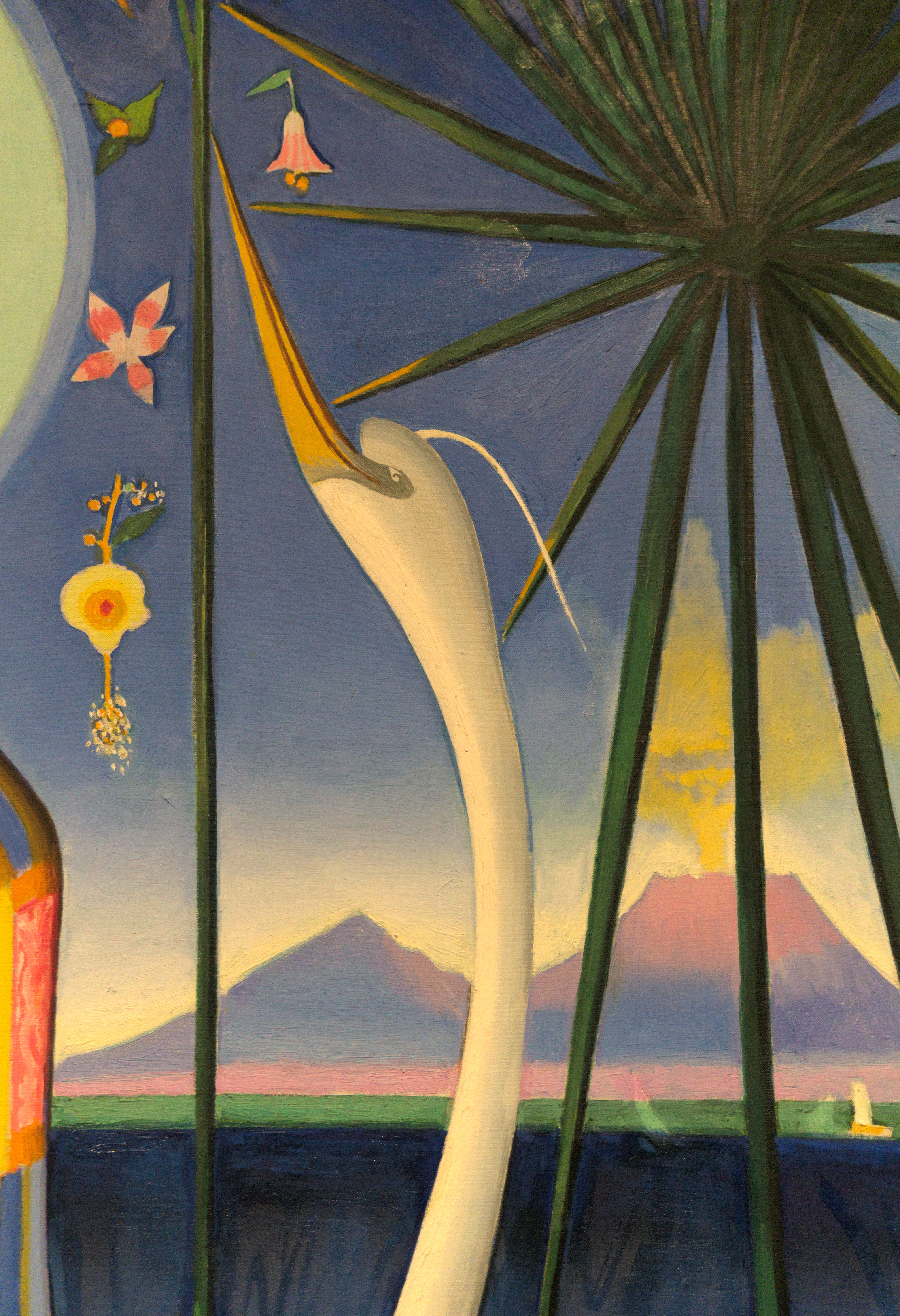
WHITE as snow for the two herons, whose gleaming white necks enclose, like a sacred shrine, the prayer of the VIRGIN.
YELLOW very light—for the edges of the mantle—to bring it out clearly with diamond purity, and reveal the hard firm modeling of the virginal breast. The lines of the mantle fall straight over the long hieratic folds of the gown, forming a frame—and the full, resonant yellow of unpeeled lemons at both sides of the painting like echoing notes of the propitious shrill laughter of SPRING.
VIOLET mixed with ultramarine for the zigzag motif in the panel along the edge of the mantle, and bright, fiery violet at the top of Vesuvius, near the white fountainhead of incense—light violet tinged with rose, for the distant Smile of Divine Capri.
GREEN soft, tender, like the new grass—intense green for the short pointed leaves that enclose the lemons—and a dark green, both sour and sweet, for the palms that fan out at the sides like mystic garlands.
PINK strong—rising to the flaming, pure vermilion borders—of the Rose, brilliant as a jewel, in contrast to the waxy pallor of the hands clasped in prayer—and infinitely subtle, delicately modulated rose for the small flowers that with the others of various colors weave of dreams and promises and splendid bridal gown of the “Purissima.” [6]
Like his Brooklyn Virgin, this painting is also set in the Bay of Naples, with Mount Vesuvius gently erupting in the right background, and the island of Capri rising up out of the sea on the left.
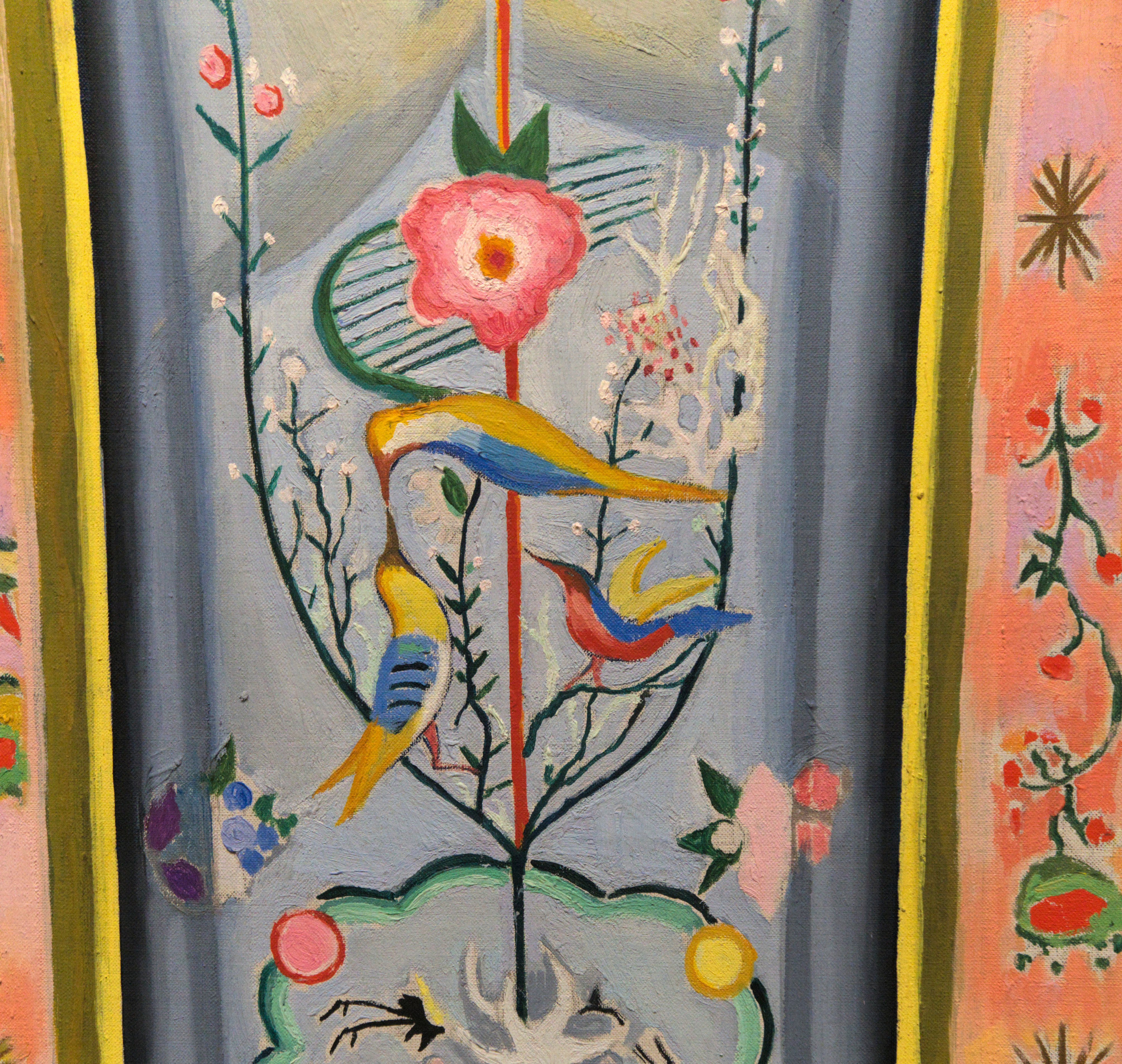
Purissima (detail)Purissima (detail)
Three pink lilies create a frame around the Purissima, their long stalks rising up on either side of her, with one flower bending down to crown her head with its filaments and anthers. She is attended not by angels but by herons, along with other critters at her feet. This is a Madonna both earthy and supernal.
Here are a few more photos from the exhibition:
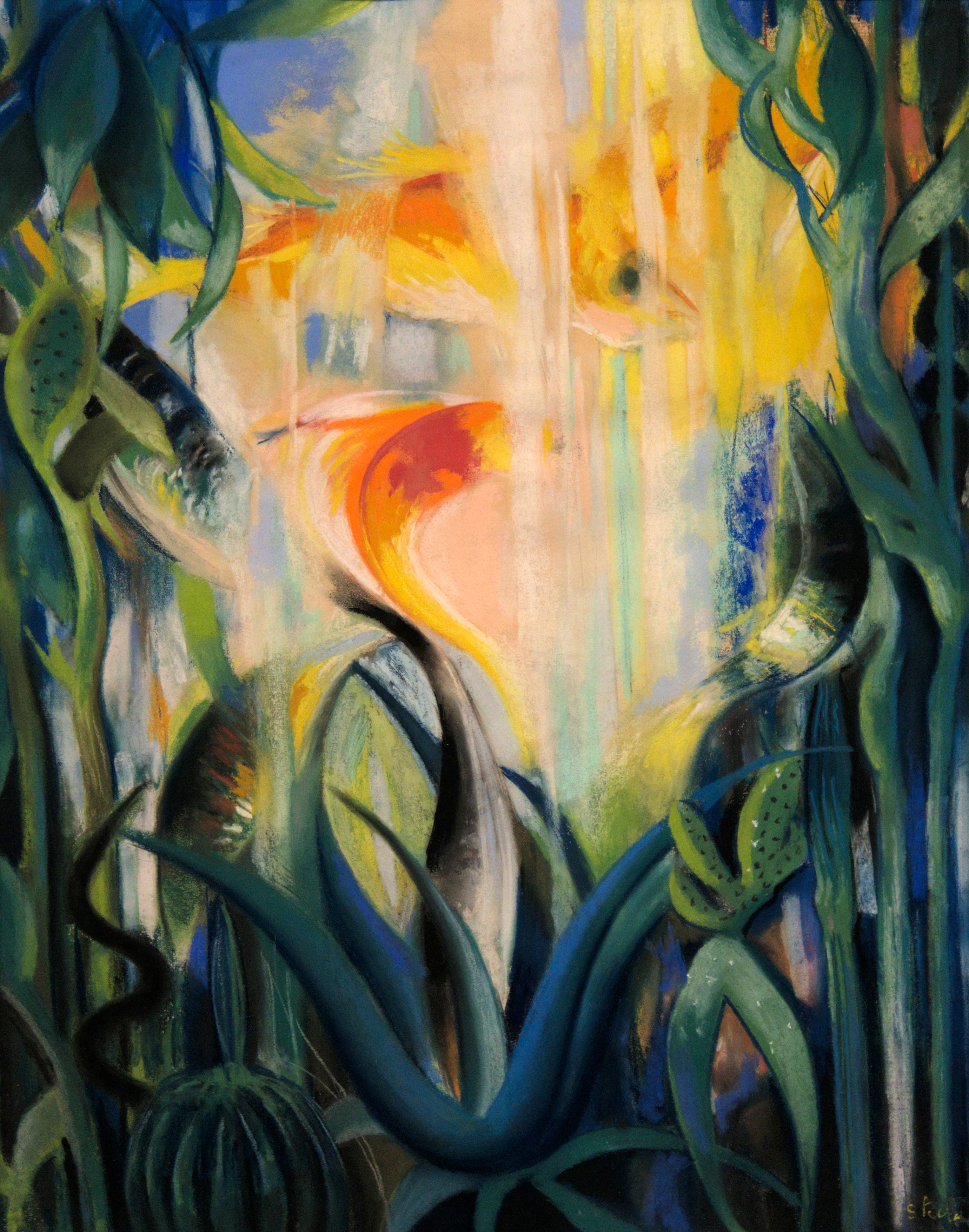
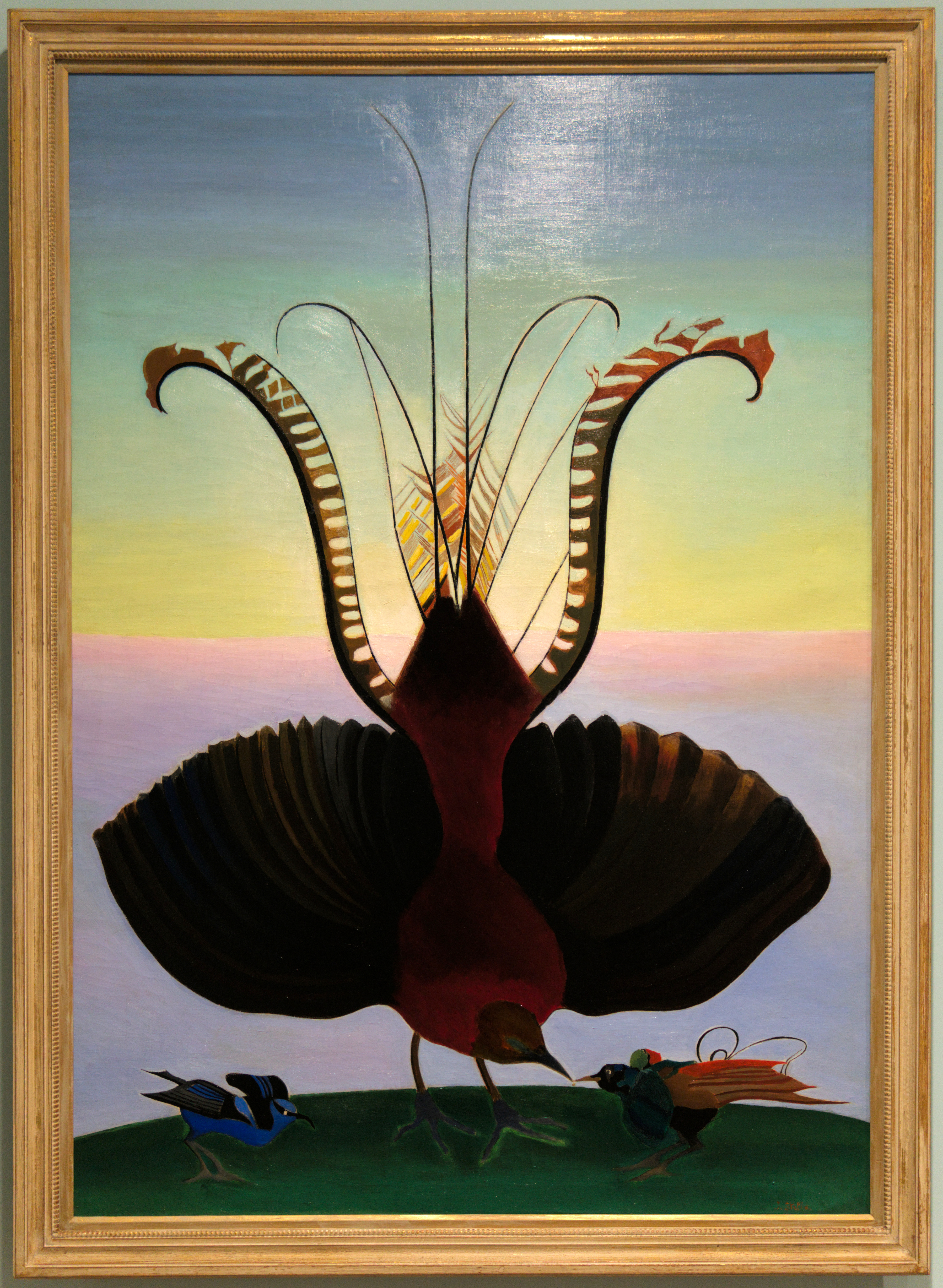
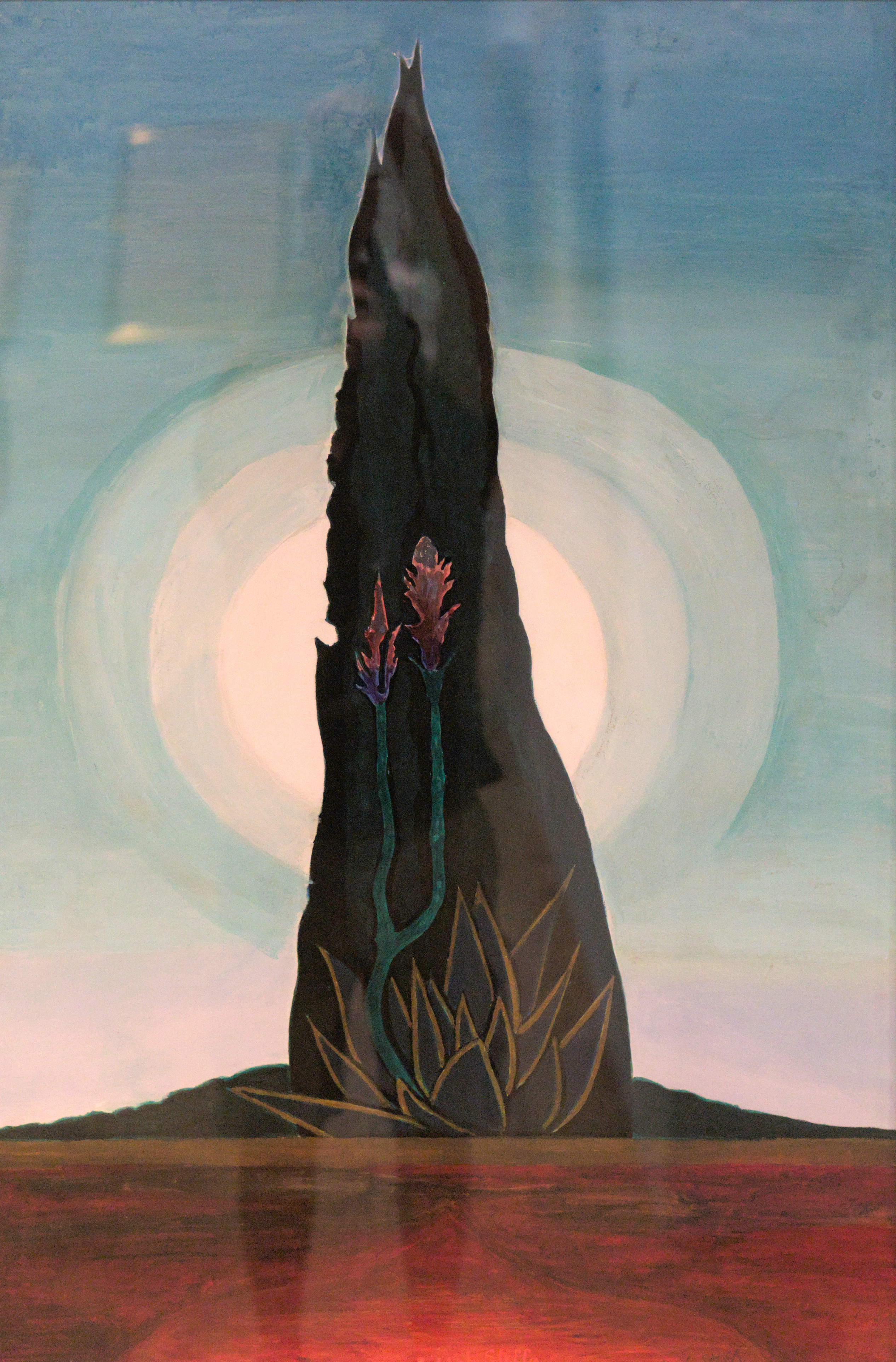
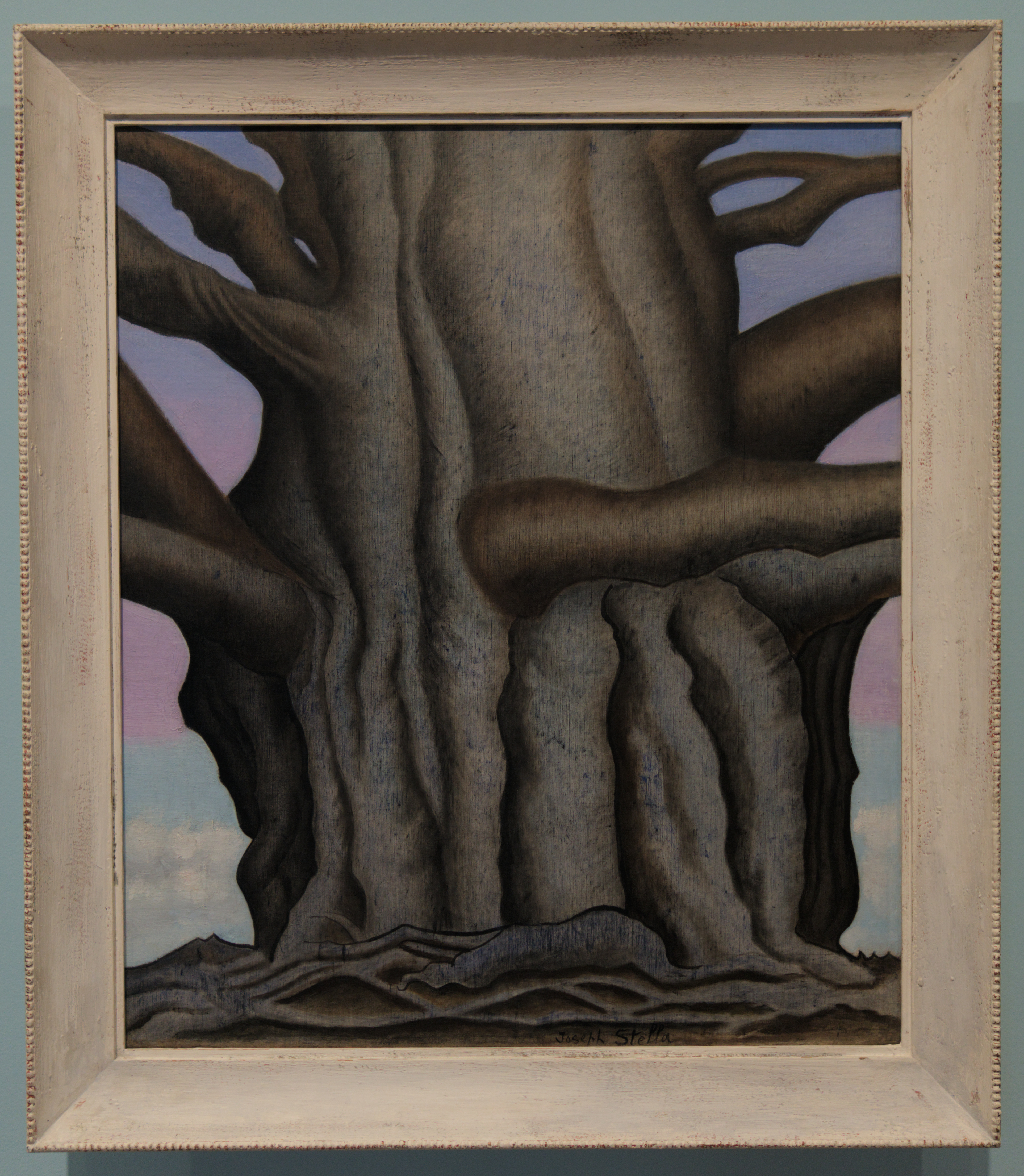
Joseph Stella (Italian American, 1877–1946), Aquatic Life (Goldfish), ca. 1919–22. Pastel on paper. American University Museum, Washington, DC. Photo: Victoria Emily Jones.Joseph Stella (Italian American, 1877–1946), Lyre Bird, ca. 1925. Oil on canvas, 54 × 30 1/8 in. (137.2 × 76.5 cm). Addison Gallery of American Art, Phillips Academy, Andover, Massachusetts. Photo: Victoria Emily Jones.Joseph Stella (Italian American, 1877–1946), Tree, Cactus, Moon, ca. 1928. Gouache on paper, 41 × 27 in. (104.1 × 68.6 cm). Reynolda House Museum of American Art, Winston Salem, North Carolina. Photo: Eric James Jones. [object record]Joseph Stella (Italian American, 1877–1946), Banyan Tree, ca. 1938. Oil on canvas, 36 1/2 × 31 1/2 in. (92.7 × 78.7 cm). Myron Kunin Collection of American Art, Minneapolis, Minnesota. Photo: Victoria Emily Jones.
1. Abram Lerner, foreword to Judith Zilczer, Joseph Stella: The Hirshhorn Museum and Sculpture Garden Collection (Washington, DC: Smithsonian Institution Press, 1983), 6.
2. Barbara Haskell, Joseph Stella (New York: Whitney Museum of American Art / Harry N. Abrams, 1994), 151.
3. From Hildegard of Bingen, “Hymn to the Virgin,” trans. Barbara Newman, in Symphonia: A Critical Edition of the “Symphonia armonie celestium revelationum” (Ithaca, NY: Cornell University Press, 1988, 1998), 123.
4. From Hildegard of Bingen, “Antiphon for the Virgin,” in Symphonia, 137.
5. FromHildegard of Bingen,“A Song to Mary,”rendered by Gabriele Uhlein, in Meditations with Hildegard of Bingen (Rochester, VT: Bear & Co., 1983), 119.
6. English translation from Irma B. Jaffe, Joseph Stella (Cambridge: Harvard University Press, 1970), 99–100. For the original Italian, see appendix 1, #29.
Woman gathering flowers, first century CE. Detached fresco, 38 × 32 cm, from the Villa Arianna in Stabiae, Campania, Italy, now in the Collection of the Museo Archeologico Nazionale di Napoli, Naples, Italy. The woman may be Primavera (a personification of spring) or Flora (the Roman goddess of flowers, fertility, and abundance), or simply a generic maiden at leisure.
Spring bursts today,
For Christ is risen and all the earth’s at play.

Flash forth, thou Sun,
The rain is over and gone, its work is done.

Winter is past,
Sweet Spring is come at last, is come at last.

Bud, Fig and Vine,
Bud, Olive, fat with fruit and oil and wine.

Break forth this morn
In roses, thou but yesterday a Thorn.

Uplift thy head,
O pure white Lily through the Winter dead.

Beside your dams
Leap and rejoice, you merry-making Lambs.

All Herds and Flocks
Rejoice, all Beasts of thickets and of rocks.

Sing, Creatures, sing,
Angels and Men and Birds and everything.

All notes of Doves
Fill all our world: this is the time of loves.
This poem was originally published in A Pageant, and Other Poems(London, 1881) and is in the public domain.
One of the most celebrated poets of the Victorian era, Christina Georgina Rossetti (1830–1894) was an English writer of Romantic, devotional, and children’s poems. She was the youngest of four siblings, among them the Pre-Raphaelite artist Dante Gabriel Rossetti, several of whose paintings she sat for, famously modeling for the Virgin Mary. A devout Anglican whose verse gives vivid expression to the life of faith and to spiritual longing, she is recognized as a saint by the Church of England and the Episcopal Church, who celebrate April 27 as her feast day.
Advent is a season of waiting with deep longing and hope for that long-looked-for day when fear and pain will be no more because Christ will reign and set this world free. These songs tap into that.
>> “Redemption Draweth Nigh”by Gordon Jensen (1970), performed by Rumbi Lee (2018): The title and refrain of this contemporary hymn are drawn from Luke 21:28: “And when these things begin to come to pass, then look up, and lift up your heads; for your redemption draweth nigh” (KJV).
+++
STREET ART SERIES: Medicinal Flowers of Lebanon by Faith XLVII: In September 2021, South African artist Faith XLVII (Liberty Du) traveled to Beirut to paint curative flowers across the rubble of the Lebanese city in the wake of the August 4, 2020, port explosion that caused at least 218 deaths, 7,000 injuries, and $15 billion in property damage, as well as leaving an estimated 300,000 people homeless. Rosehips, horned poppies, chicory, African carline thistle—all these botanicals are used in remedies for common ailments. “Each flower urges us, in a sense, towards healing as they grow out of the concrete,” the artist said.
Faith XLVII (South African, 1979–), Glaucium flavum, from the Medicinal Flowers of Lebanon series, Beirut, Lebanon, 2021. Photo courtesy of the artist.
+++
NEW ALBUMS:
>> The Soil and The Seed Project, vol. 8: Advent-Christmas-Epiphany: For the Advent-Christmas-Epiphany triad of the church year comes this new album from The Soil and The Seed Project, a ministry of Virginia Mennonite Missions—and recently Lilly-Endowed! All their music is free—for download, and even as physical CDs while supplies last. Below are two of my favorite tracks, both written by new contributors to the project. The first verse of Philip Fisher Rhodes’s “Bethlehem One” is in the voice of the in utero Christ; the second, the shepherds; the third, the wise men. The song is sung by Ben Luna. And “Peace Prayer” by Susan Gascho-Cooke is a plea that God would hold his arms around “this tilting planet,” the world’s wounds, and all people.
Each TSATP album is part of a larger project that also includes “Little Liturgies” booklets perfect for families with small kids (but that can also be used by individuals and small groups). Each booklet includes litanies, prayers, reflection questions, suggested activities, and visual art—and again, they’re free! Request a digital or physical copy here.
>> Kindness Is Solid Stone, Violence Is a Heavy Loan to Pay by David Benjamin Blower: Released November 3 and available on Bandcamp only, this album features nine original songs by writer, poet, theologian, and podcaster David Benjamin Blower of Birmingham, UK. I appreciate the minimalist sound and the stark lyricism. My favorite track is probably “Meet Me Where I Sing and Stamp My Feet”:
BANJO DUET: “Foggy Morning Breaking” by Alison Brown and Steve Martin: Did you know the actor Steve Martin also has a music career? He’s been playing the banjo since he was a teenager, and he writes, records, and tours, both solo and as part of bluegrass bands. He’s even won three Grammys for his banjo music!
Fellow banjoist Alison Brown invited him to contribute to one of the tunes on her forthcoming album, On Banjo, which releases May 5. It’s called “Foggy Morning Breaking.” She wrote and plays the A section; he wrote and plays the B. The piece was released last month as a single, along with this music video.
>> April 22: “The Ekstasis Café: An Evening of Poetry, Music, Testimony, and Gallery,” Goldberry Books, Concord, North Carolina: Ekstasis is a beautiful quarterly magazine “exhibit[ing] arts and letters that reflect the depths of Christian life.” Next Saturday they are hosting their first-ever public gathering! Their hope with it is to foster meaningful connections, conversation, deep aesthetic encounters, and inspiration.
Stephen Procopio, Ascension, 2020. A full-color version of an illustration for Come See a Man (an illustrated Gospel of John) by Fish Coin Press.
From April 9 to May 28, the gallery at Sojourn Church Midtown in Louisville is exhibiting a selection of art from Fish Coin projects (open Sundays from 9 a.m. to 12:30 p.m., or by appointment); here are a few exhibition views. And two Friday evenings from today, Fish Coin Press creative director Jared Boggess and development lead Stephen Procopio, who are illustrators themselves, will be visiting the gallery to discuss “visual theology” and its role in the local church. There will be a Q&A and a sneak preview of upcoming publications.
+++
POEM: “Psalm” by Dorianne Laux: This poem sings the glories of “the hidden and small,” of the plants and creatures beneath our feet. Read more of Laux’s poems at https://www.doriannelaux.net/poems.
+++
LECTURE: “Resurrection and the Renewal of Creation” by N. T. Wright: In this 2018 lecture sponsored by Lanier Theological Library and Baylor University’s Truett Seminary, ancient historian and New Testament scholar N. T. Wright discusses the meaning of Jesus’s resurrection, a topic he explores thoroughly in the influential academic tome The Resurrection of the Son of God and its more accessible corollary, Surprised by Hope: Rethinking Heaven, the Resurrection, and the Mission of the Church. “Easter is the start of something; it isn’t the ending,” he says. With the resurrection of Christ, the new creation has been launched and put to work in the world. It’s not about securing our souls a place in some nonspatiotemporal heaven when we die but about heaven colonizing earth here and now. We humans, he says, are meant to stand at the place where heaven and earth interlock. We who have received life are to be ourselves life-bringers, to participate in God’s massive renewal project. We are resurrection people!
Wright addresses common Christian misconceptions about death, judgment, and the fate of this world, seeking to root out the corrupting influence of Platonism and other pagan Greek philosophies on Christian eschatology. (For example, the new creation won’t be a creatio ex nihilo, creation out of nothing; it will be a creatio ex vetere, a creation out of the old. The implications of that are huge.) He also affirms the absolute importance of belief in Jesus’s bodily resurrection—his rising is no mere metaphor!—and calls on Christians to recover a centralizing hope in the general resurrection (what he calls “life after life after death”; fully embodied life in the new heavens and the new earth that comes after the not-yet-fully-realized life experienced in the interim between one’s death and the future cosmic coming of Christ) rather than regarding what happens immediately after one’s death as the ultimate beatitude.
Wright always makes me excited about what God’s doing and excited to be a disciple of Jesus. What more could a preacher ask for?
The final half hour of the video is Q&A.
+++
DIGITAL COMIC: 30 Days of Comics (2022) by Madeleine Jubilee Saito:Madeleine Jubilee Saito [previously] is a Seattle-based cartoonist who is interested, as she says on her website, in “friendship, formal experimentation, medieval sacred comics, the built environment, solidarity, climate justice, the psalms, the material world, and the sacred.” Last year she was one of five artists in the inaugural cohort of On Being Project’s Artist Residency; during that time she created “For living, in climate crisis.” Her work is poetic, spiritual, and earthy, and I love it.
Comic by Madeleine Jubilee Saito, 2022, the ninth of thirty from “30 Days of Comics.”
In November 2022 Saito made a one-page, four-panel comic (almost) every day for the duration of the month. The series is resurrection-themed and, she told me, inspired by one of my blog posts: the one about Fra Angelico’s Noli me tangere at San Marco, a painting in which Christ the Gardener sows his stigmata across the lawn, as art historian Georges Didi-Huberman so beautifully interprets in his monograph on the artist. Click on the image and scroll down (then, at the bottom, click “←older”) to view all twenty-seven comics from the series. Each can stand alone, but they also have a cumulative effect. It’s stunning! You can follow Saito on Instagram @madeleine_jubilee_saito.
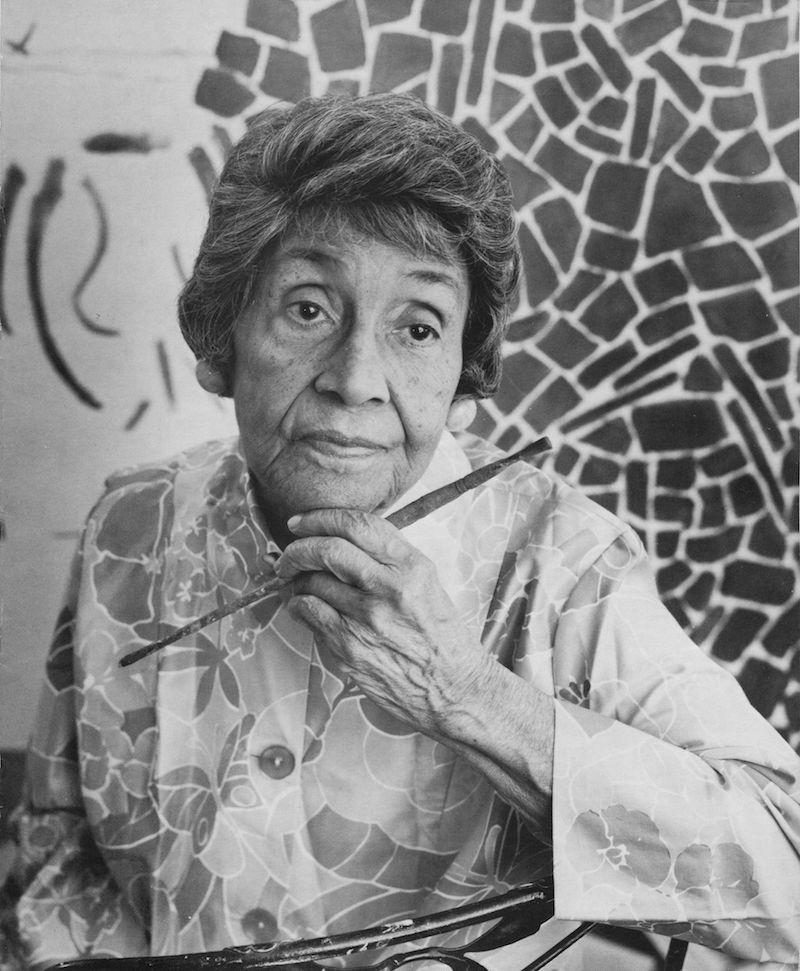
Last October I saw the wonderful retrospective exhibition Alma W. Thomas: Everything Is Beautiful at the Phillips Collection in Washington, DC, co-organized by the Chrysler Museum of Art in Norfolk, Virginia, and the Columbus Museum in Columbus, Georgia. Taking its title from the 1970 hit song by Ray Stevens (which was on the mixtape Thomas listened to while she painted), the exhibition shows that Thomas’s creativity extended beyond the studio to encompass interior design, costume design, fashion, puppetry, teaching, service, gardening, and more.
Alma Thomas (1891–1978) was an African American artist best known for her exuberant abstract paintings inspired by the hues, patterns, and movement of trees and flowers in and around her neighborhood in Northwest Washington, DC. Seeking relief from the racial violence in her native Georgia and better educational opportunities, she moved to Washington with her family at age fifteen and remained there for the rest of her life. In 1924 she became Howard University’s first fine arts graduate, and after that taught art for thirty-five years at Shaw Junior High School, leaving behind a celebrated legacy as an educator and a champion for Black youth. She was also an active member of St. Luke’s Episcopal Church, through which she founded the Sunday Afternoon Beauty Club, organizing field trips, lectures, and other activities to promote arts appreciation.
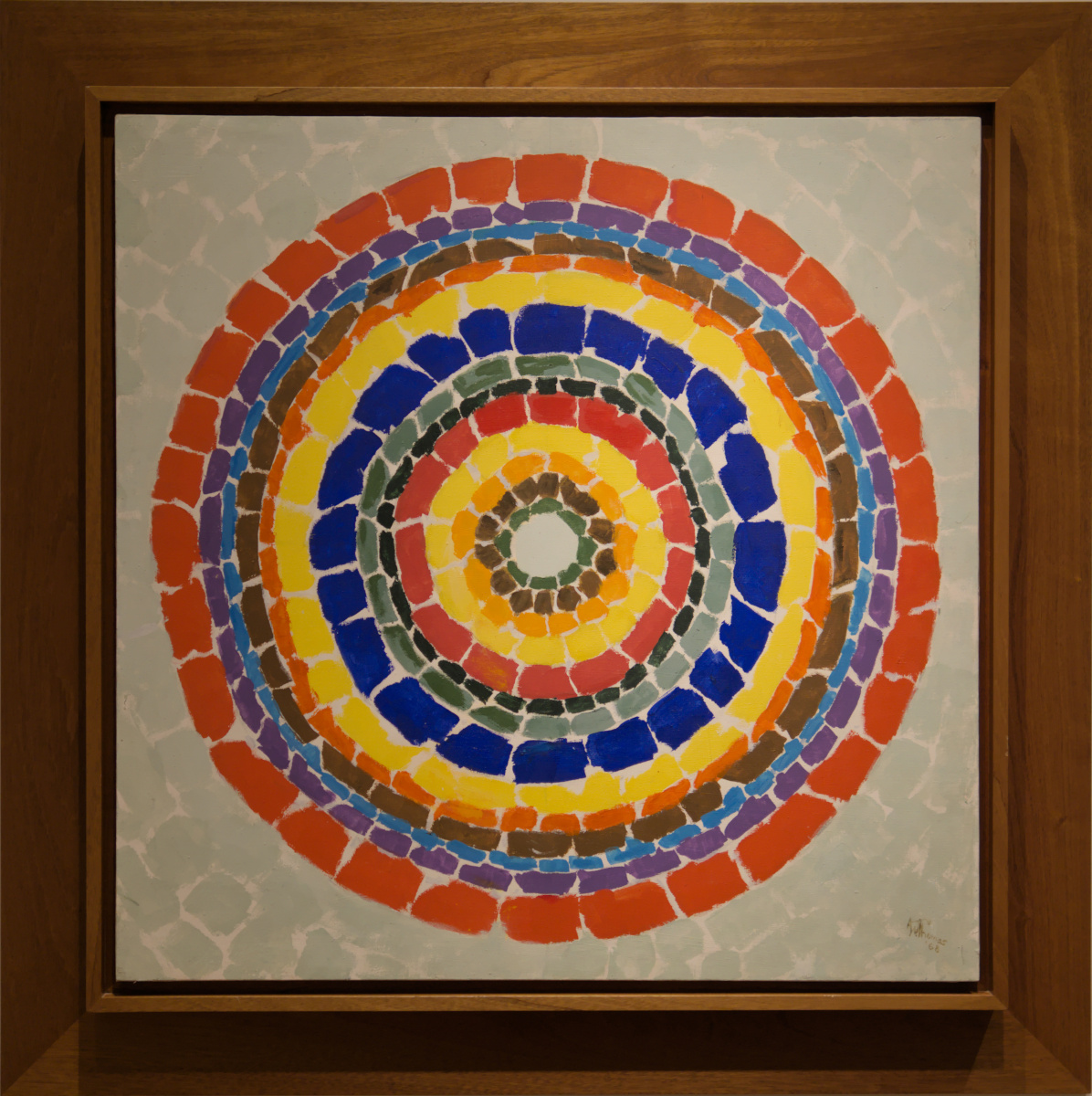
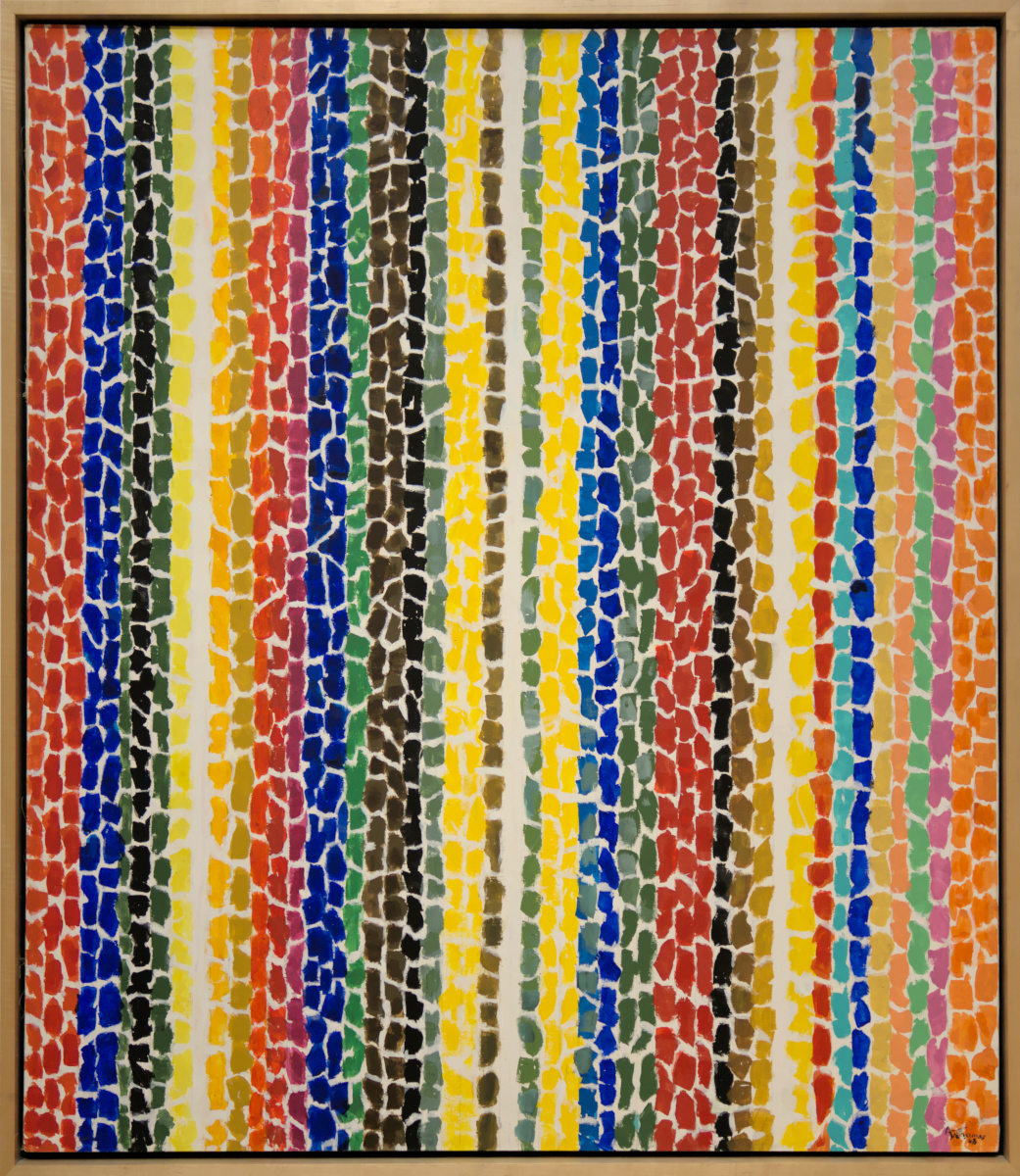
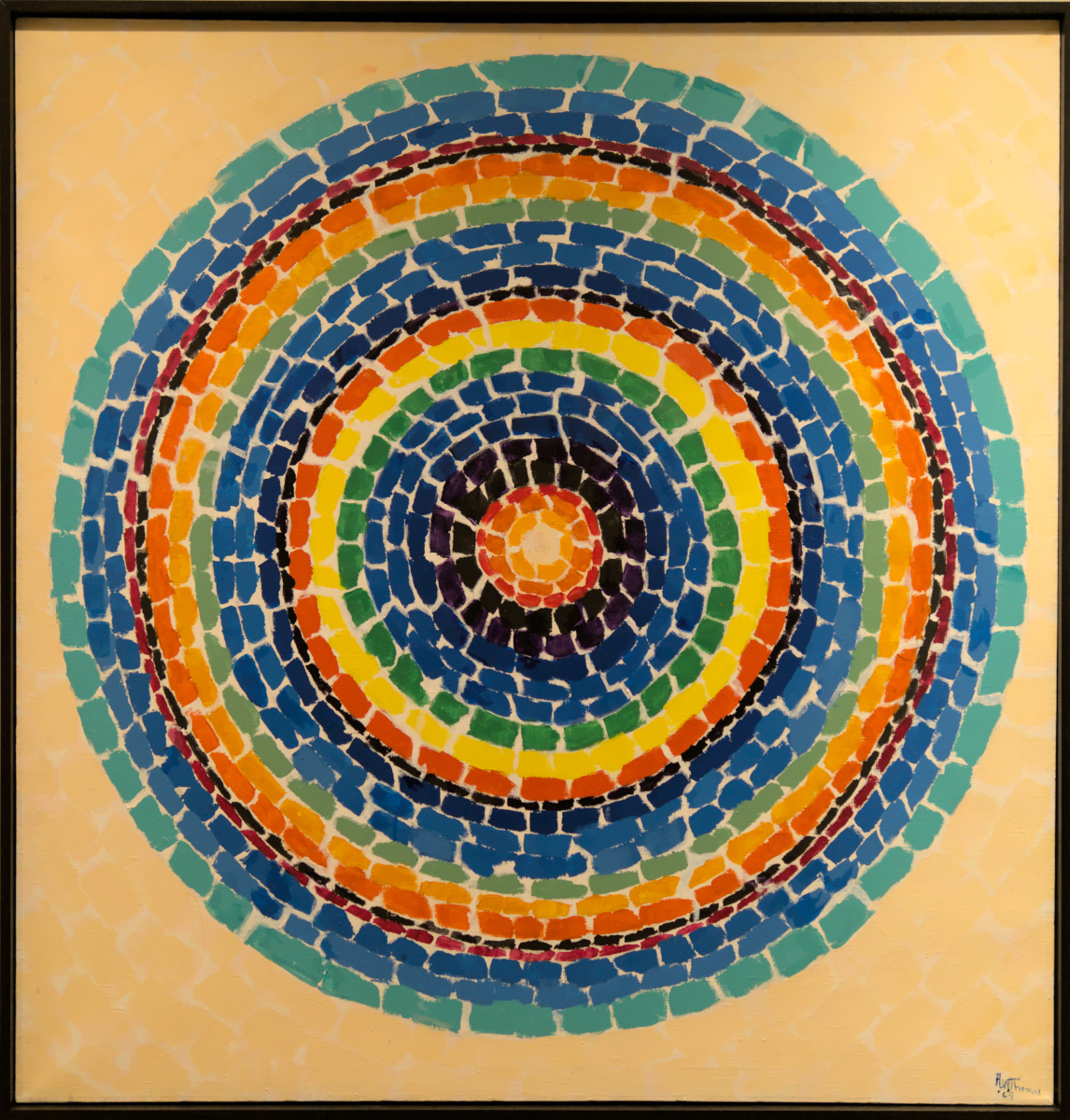
Though Thomas had been painting for decades, she didn’t develop her signature style—consisting of vibrant paint pats arranged in columns or concentric circles—until about 1965, after retiring from teaching; she called these irregular free blocks “Alma’s Stripes.” Her exploration of the power of simplified color and form in luminous, contemplative, nonobjective paintings means she is often classified as a Color Field painter, and she is particularly associated with the Washington Color School. At age eighty she had her first major exhibition, at the Whitney Museum of American Art in New York in 1972. She was the first Black woman to receive a solo show at this prestigious museum, and the show won her instant acclaim.
Alma W. Thomas (American, 1891–1978), A Joyful Scene of Spring, 1968. Acrylic on canvas, 36 1/4 × 36 1/4 in. Collection of the Love, Luck & Faith Foundation. Photo: Victoria Emily Jones. “Spring delivers her dynamic sermons to the world each year, drenching one’s soul with its extravaganza,” Thomas said (catalog, p. 167).
The natural world was an enduring source of inspiration for Thomas. She kept a flower garden in her backyard and frequented the green spaces of the nation’s capital. She described the holly tree visible through the bay window of her living room with great relish:
That tree, I love it. It’s the one who inspired me to do this sort of thing. The composition in the bay window reached me each morning—the colors, the wind who is their creative designer, the sunshine filtering through the leaves to add joy. The white comes through those leaves and gives me the white of the canvas. I’m fascinated by the way the white canvas dots around, and above, and through the color format. My strokes are free and irregular, some close together, others far apart, thus creating interesting patterns of canvas peeking around the strokes. [3]
Thomas saw nature as having a musicality, an idea underscored by many of the titles she gave her paintings, which pair terms from classical music especially—such as “symphony,” “sonata,” “concerto,” “rhapsody,” “étude”—with the names of trees or flowers. Nature sounds forth an array of notes, all in resplendent harmony with one another. And its compositions are new every morning!
Thomas’s rhythmic dabs of prismatic color express joy, celebration, and wonder at God’s creation and are reminiscent of those biblical psalms in which nature is said to praise God (e.g., Psalm 19:1–3; Psalm 65:12–13; Psalm 96:11–12; Psalm 98:4–8). Not only is nature animate; it sings and dances and claps its hands.
Many of Thomas’s paintings, whether of outwardly radiating rings or parallel rows, are meant to suggest an aerial view of flower beds or nurseries. “I began to think about what I would see if I were in an air-plane,” she said. “You streak through the clouds so fast you don’t know whether the flower below is a violet or what. You see only streaks of color.” [4]
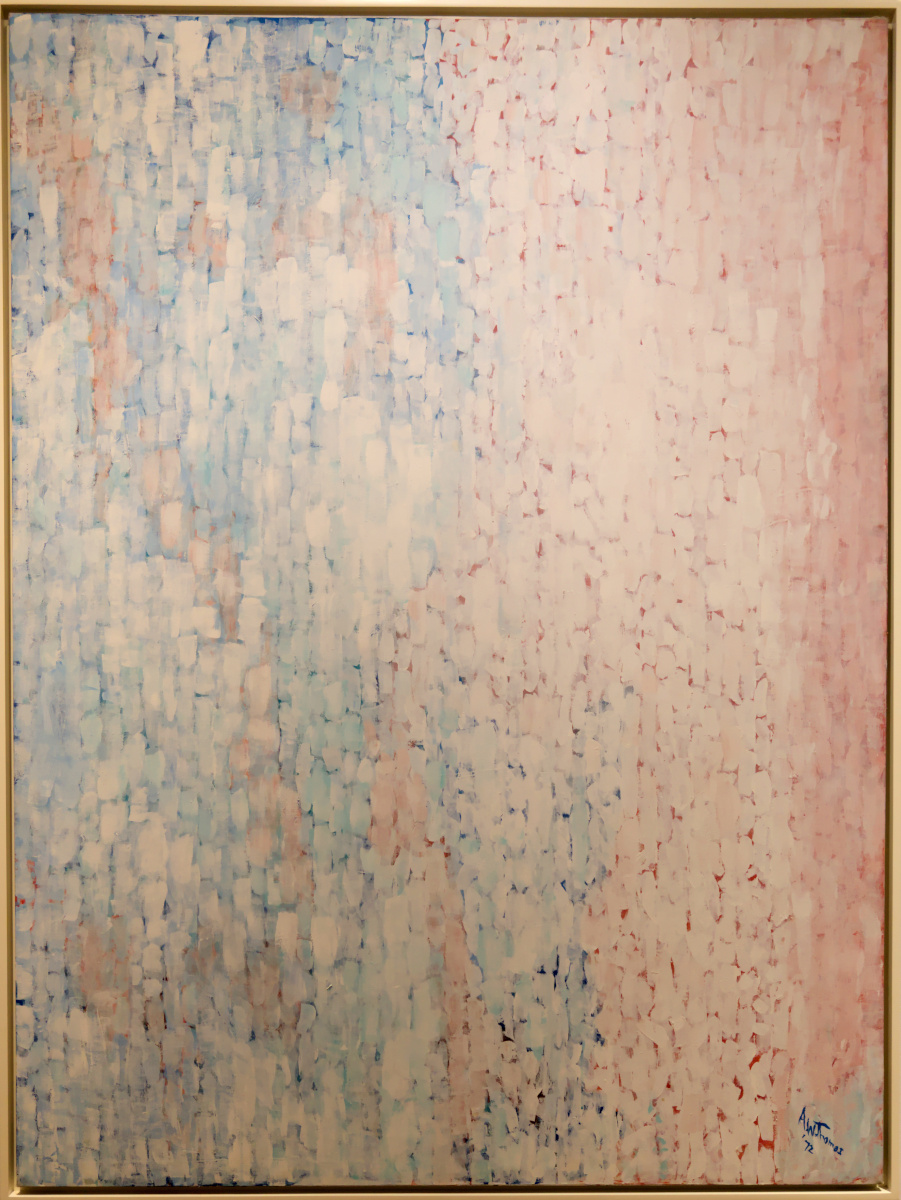
Alma W. Thomas (American, 1891–1978), Breeze Rustling Through Fall Flowers, 1968. Acrylic on canvas, 57 7/8 × 50 in. The Phillips Collection, Washington, DC. Photo: Victoria Emily Jones.Alma W. Thomas (American, 1891–1978), Wind Dancing with Spring Flowers, 1969. Acrylic on canvas, 50 3/16 × 48 1/16 in. Hood Museum of Art, Dartmouth College, Hanover, New Hampshire. Photo: Victoria Emily Jones.Alma W. Thomas (American, 1891–1978), Red Roses Sonata, 1972. Acrylic on canvas, 60 × 54 in. Metropolitan Museum of Art, New York. Photo: Victoria Emily Jones.Alma W. Thomas (American, 1891–1978), Cumulus, 1972. Acrylic on canvas, 71 × 53 in. San Francisco Museum of Modern Art. Photo: Victoria Emily Jones.
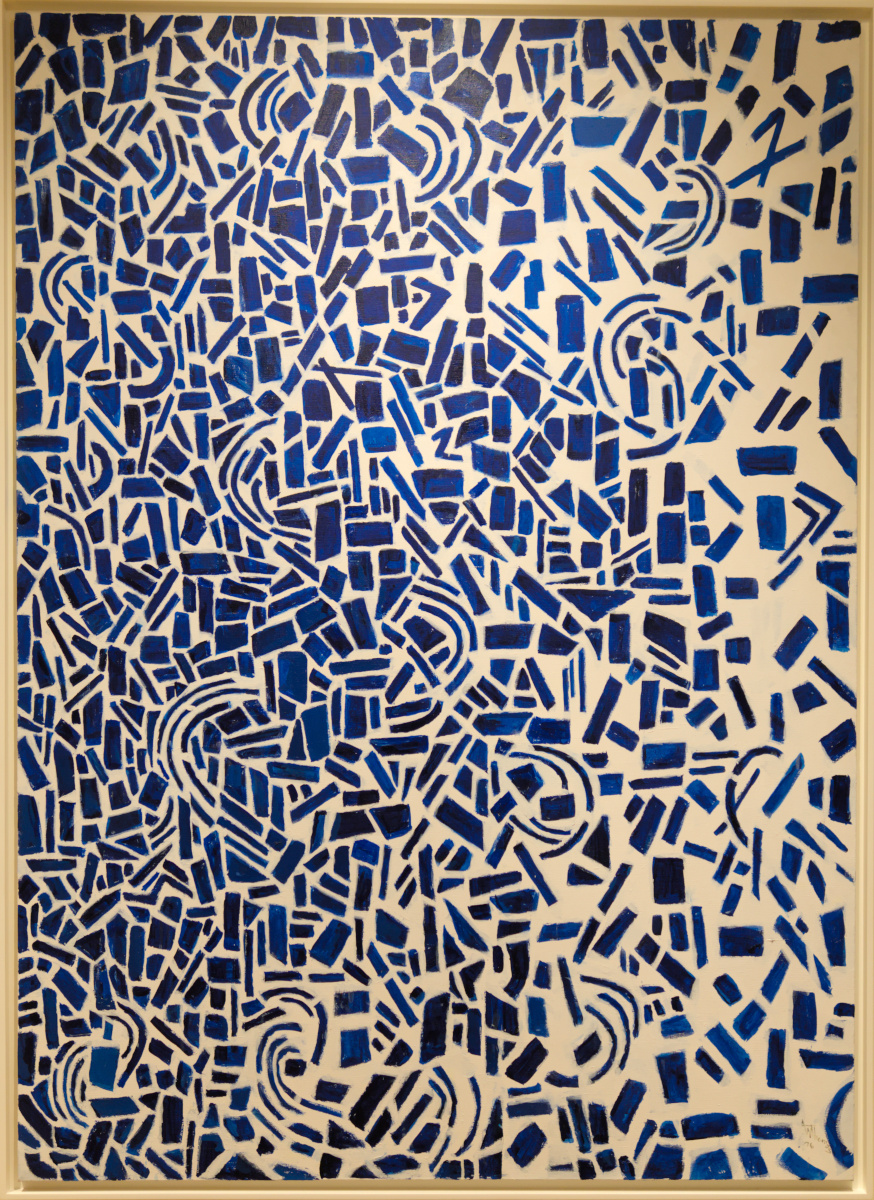
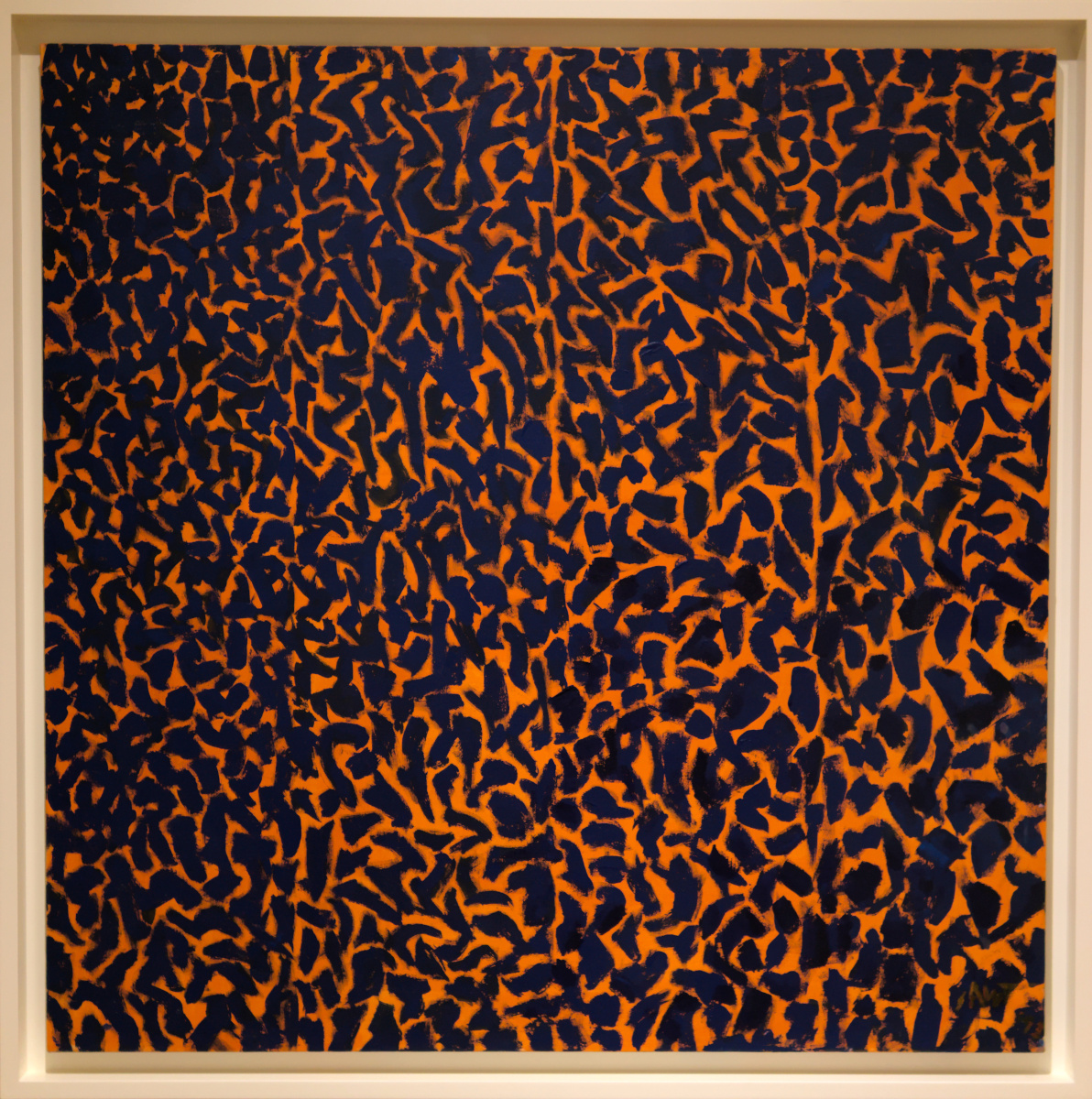
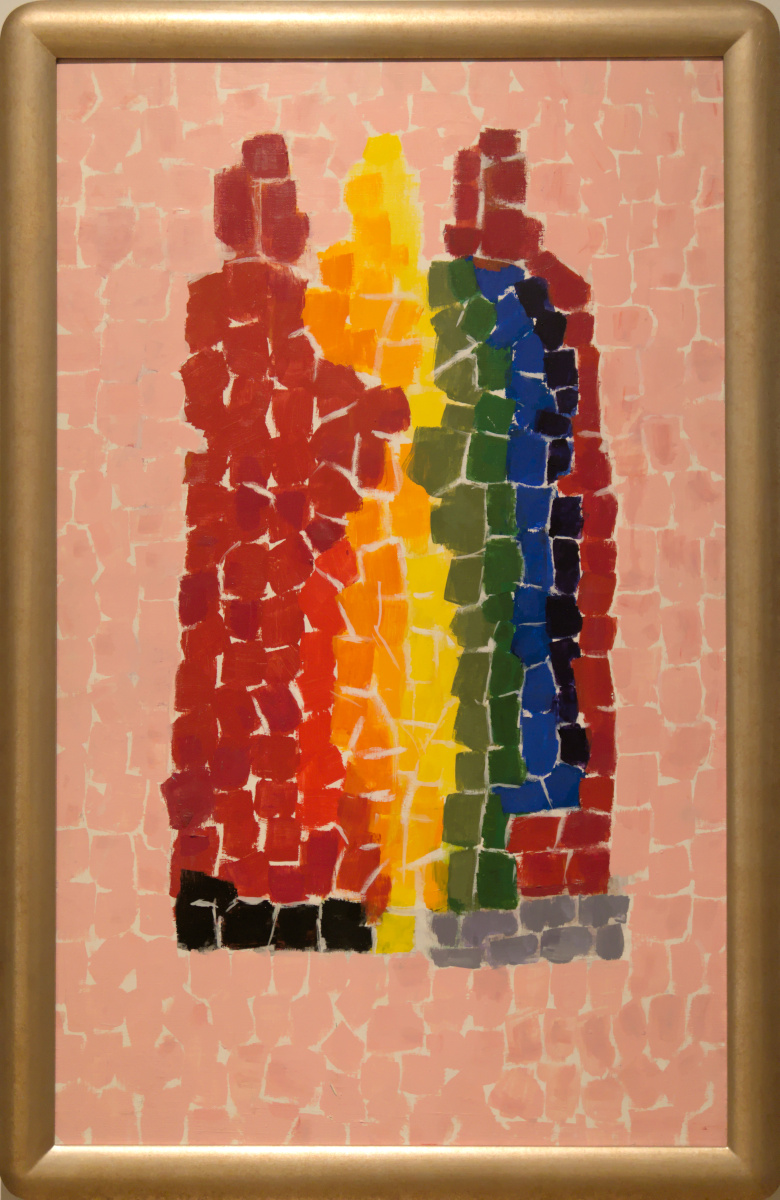
Eventually, Thomas’s vocabulary of vertically or circularly organized paint pats expanded to include “wedges, commas, and other glyphic shapes formed entirely by her brush and arranged in tessellated patterns” [5], which have the same vibratile quality. Grassy Melodic Chant visually references the path to her garden, which featured dark flagstones with off-white mortar borders.
Alma W. Thomas (American, 1891–1978), Grassy Melodic Chant, 1976. Acrylic on canvas, 46 × 36 in. Smithsonian American Art Museum, Washington, DC. Photo: Victoria Emily Jones.Alma W. Thomas (American, 1891–1978), Babbling Brook and Whistling Poplar Trees Symphony, 1976. Acrylic on canvas, 72 × 52 in. Michael Rosenfeld Gallery LLC, New York. Photo: Victoria Emily Jones. Thomas recalled in reference to this painting, “I would wade in the brook [near my childhood home] and when it rained you could hear music. I would fall on the grass and look at the poplar trees and the lovely yellow leaves would whistle” (catalog, p. 33).Alma W. Thomas (American, 1891–1978), Fiery Sunset, 1973. Acrylic on canvas, 41 1/4 × 41 1/4 in. Museum of Modern Art, New York. Photo: Victoria Emily Jones.Alma W. Thomas (American, 1891–1978), Falling Leaves, Love Wind Orchestra, 1977. Acrylic on canvas, 21 1/2 × 27 1/2 in. Private collection. Photo: Victoria Emily Jones.
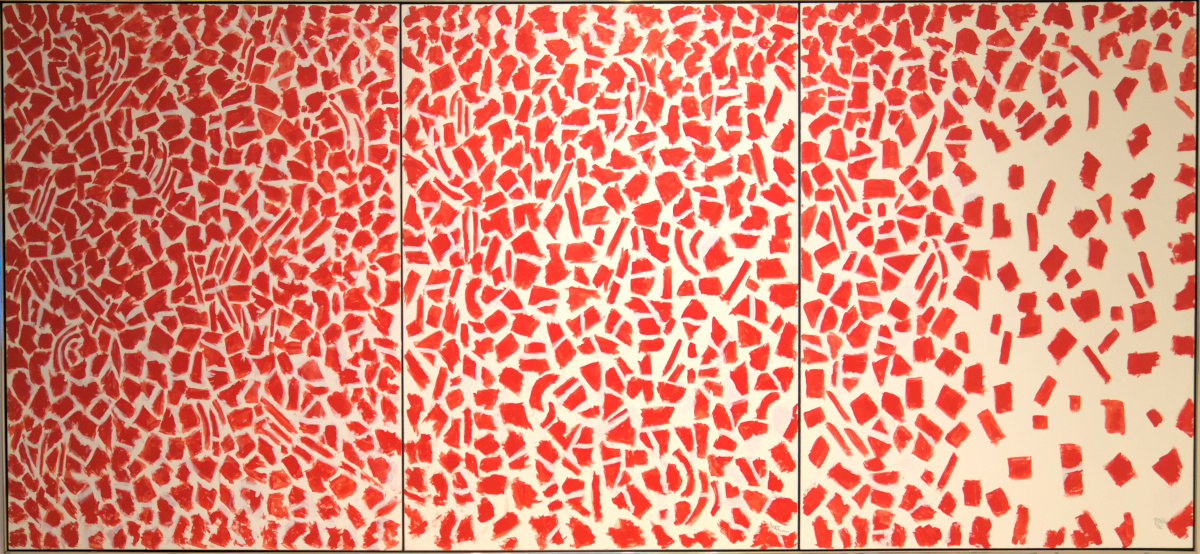
At over thirteen feet long, the monumental three-paneled Red Azaleas Singing and Dancing Rock and Roll Music (1976) is Thomas’s most ambitious painting and the touchstone of the exhibition. She painted it two years before her death, when she was suffering from painful arthritis, deteriorating vision, and the lasting repercussions of a broken hip. Though she had to adapt her technique to accommodate these ailments, her aesthetic vision is masterfully executed, and most people regard this as her magnum opus.
Alma W. Thomas (American, 1891–1978), Red Azaleas Singing and Dancing Rock and Roll Music, 1976. Acrylic on three canvases, 73 3/4 × 158 1/2 in. Smithsonian American Art Museum, Washington, DC. Photo: Victoria Emily Jones.
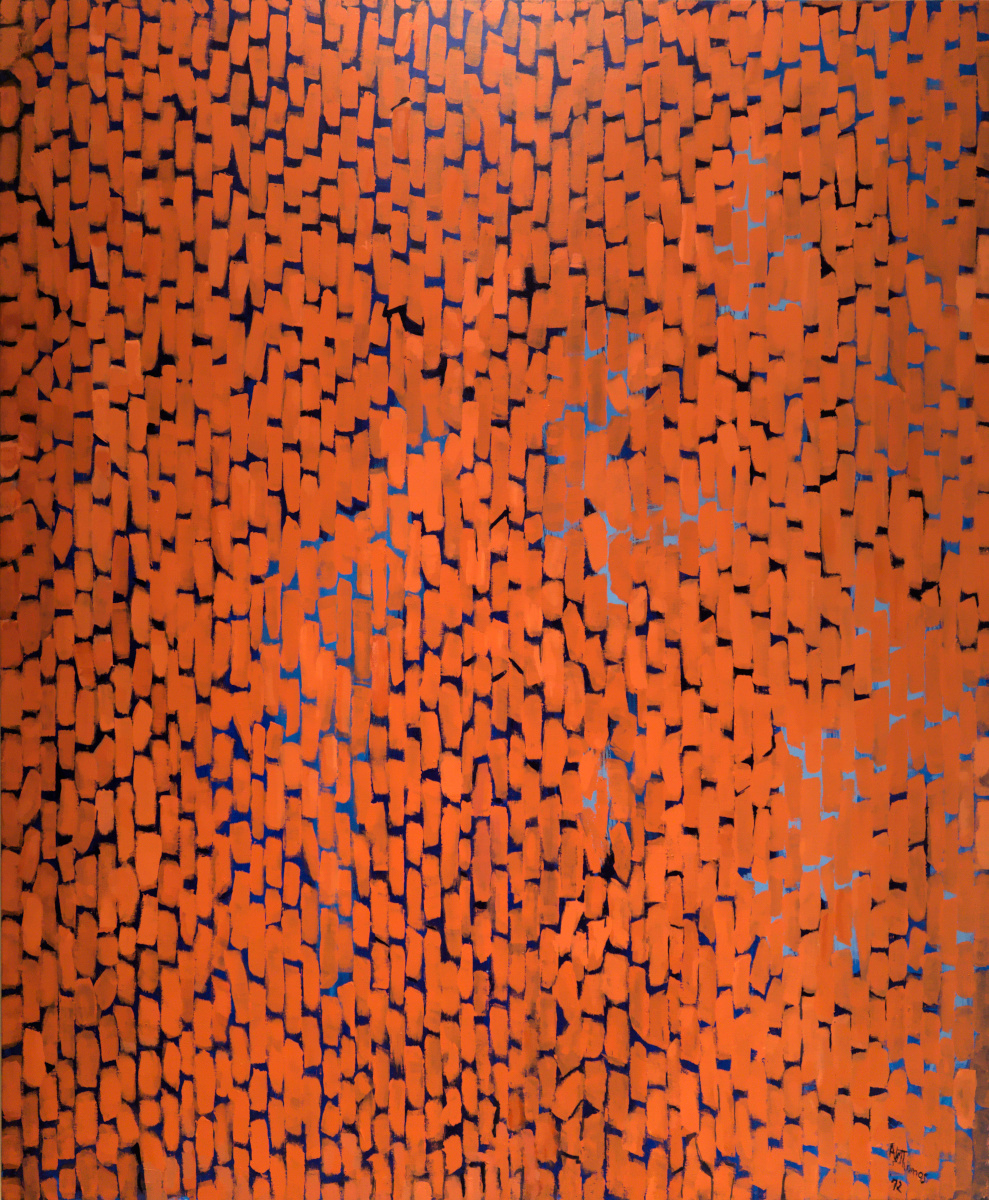
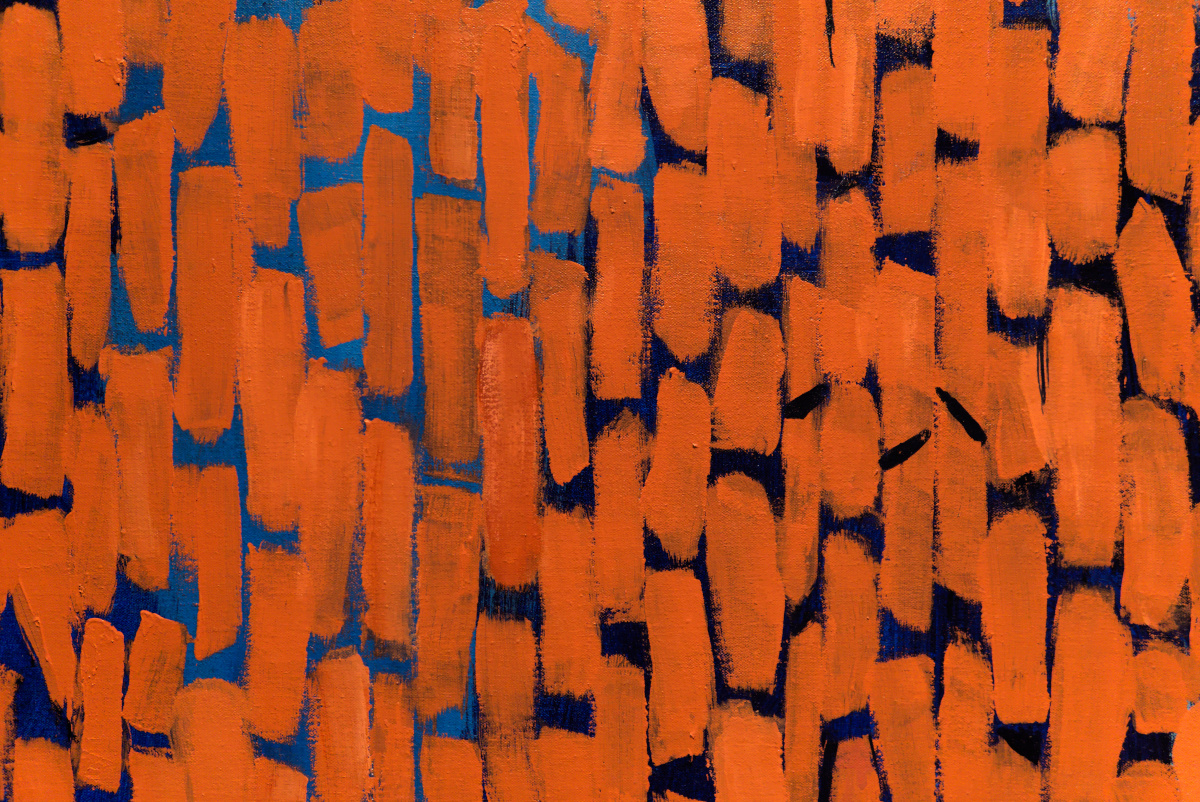
In addition to her enthusiasm for local, seasonal flora, Thomas was also really interested in space exploration. Like many Americans, she followed NASA’s lunar and Mars missions on the radio and television. She painted Mars Dust in 1971 as Mariner 9 circled the Red Planet, attempting to map its surface but being held up by a massive dust storm.
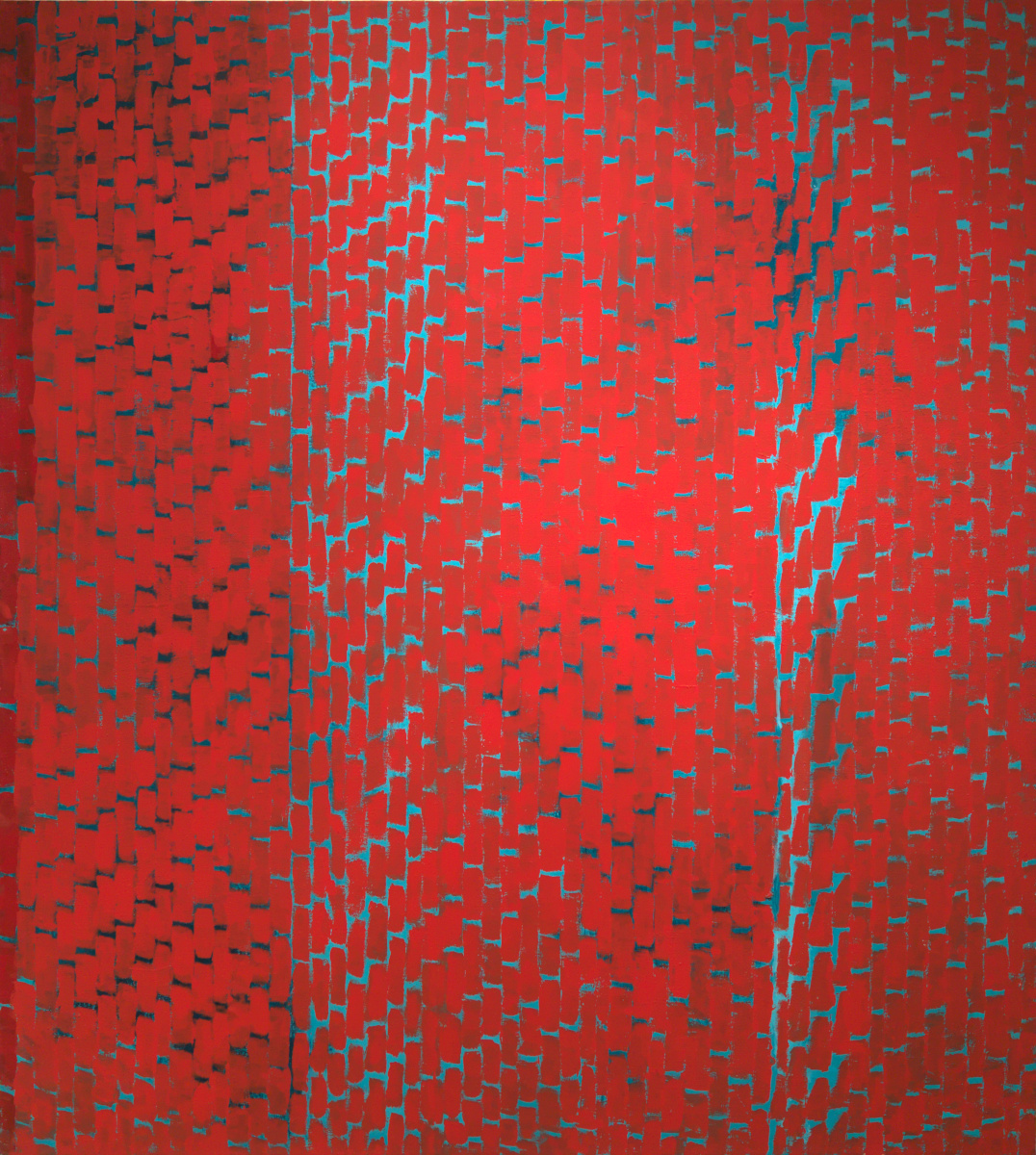
Alma W. Thomas (American, 1891–1978), Mars Dust, 1972. Acrylic on canvas, 69 1/4 × 57 1/8 in. Whitney Museum of American Art, New York. Photo: Victoria Emily Jones.Mars Dust, detail
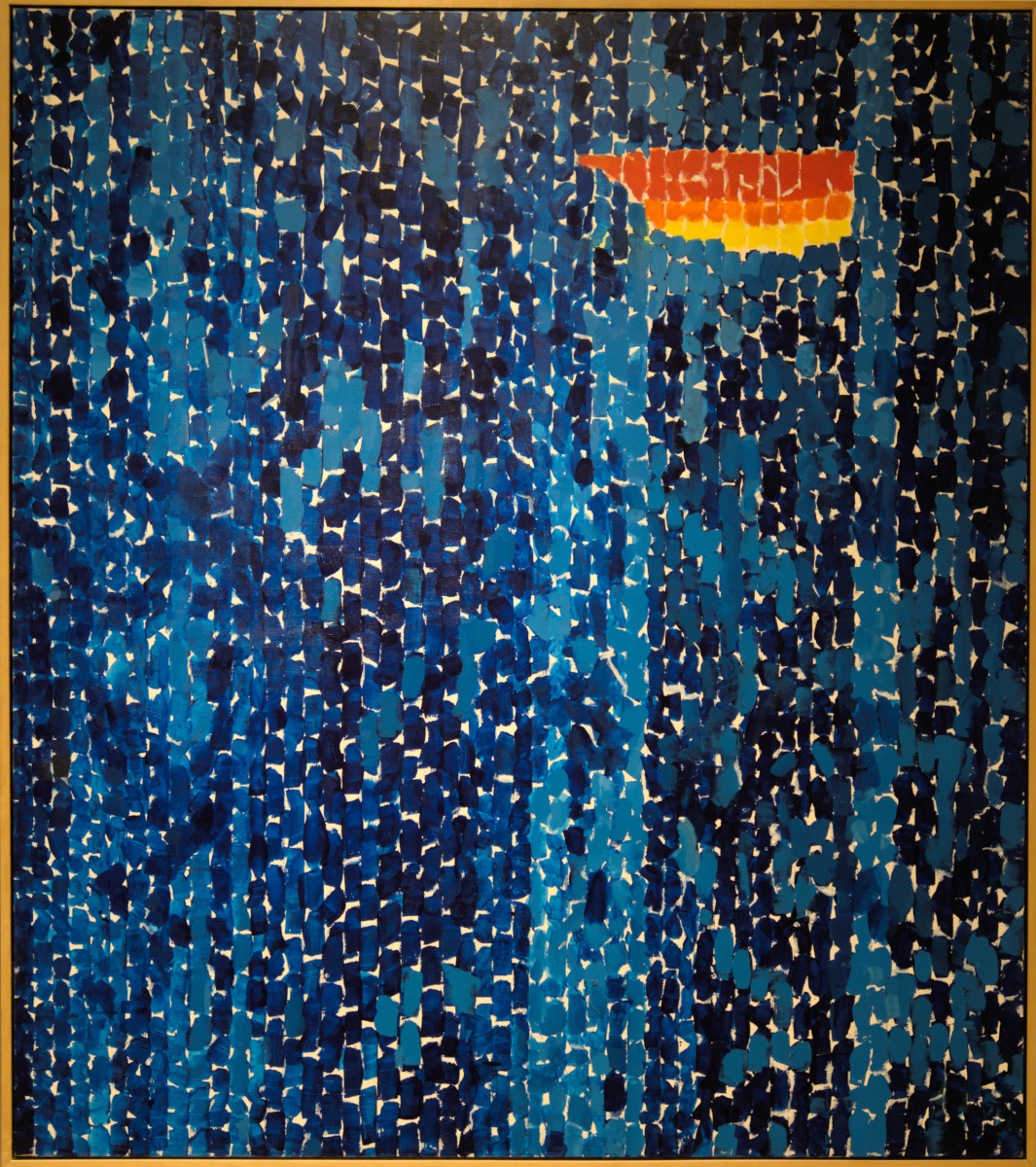
She also painted several works inspired by images taken of Earth during the Apollo 10 and 11 spaceflights, such as Snoopy Sees Earth Wrapped in Sunset (not pictured)—Snoopy being the name of the lunar module. Starry Night with Astronauts is the final work in her Space series.
Alma W. Thomas (American, 1891–1978), Starry Night and the Astronauts, 1972. Acrylic on canvas, 60 × 53 in. Art Institute of Chicago. Photo: Victoria Emily Jones.
Thomas’s choice to paint apolitical abstractions rather than taking the Black human figure as her subject was somewhat controversial. Members of the Black Arts Movement rigidly insisted that “Black artists should be making work that furthered the goals of Black liberation by speaking directly to their own communities rather than trying to fit into white aesthetic frameworks or addressing non-Black audiences. . . . In the process, they largely rejected visual abstraction because it was rooted in a European modernist tradition, one that had very little to do, they believed, with the lives and urgencies of Black folks.” [6]
Thomas disliked being pigeonholed as a “Black artist” and resisted the idea that responsible art must be oriented toward social activism. “We artists are put on God’s good earth to create,” she said. “Some of us may be black, but that’s not the important thing. The important thing is for us to create, to give form to what we have inside us. We can’t accept any barriers, any limitations of any kind, on what we create or how we do it.” [7] And elsewhere: “Through color, I have sought to concentrate on beauty and happiness, rather than on man’s inhumanity to man.” [8] In finding success as an abstractionist focused on beauty in nature and in technological innovation, she broke down barriers of what were considered (by both whites and Blacks) acceptable styles and subject matter for African American art.
This doesn’t mean Thomas was indifferent to Black progress. On the contrary, she was deeply involved in advancing racial uplift in her own community.
Thomas, far from retreating from the world, had always flung herself headlong into it. She devoted her life to advancing the lives of her Black students, peers, and neighbors—from her commitment to education (“Education is the strongest weapon we [African Americans] have,” she insisted); to her work to establish an art gallery that would collect the creations of Black people so as to begin to build an art historical archive; to her collaborations with civil rights organizations and publications; to her backyard garden, which she treated as a small offering of beauty in the midst of her gritty surroundings. [9]
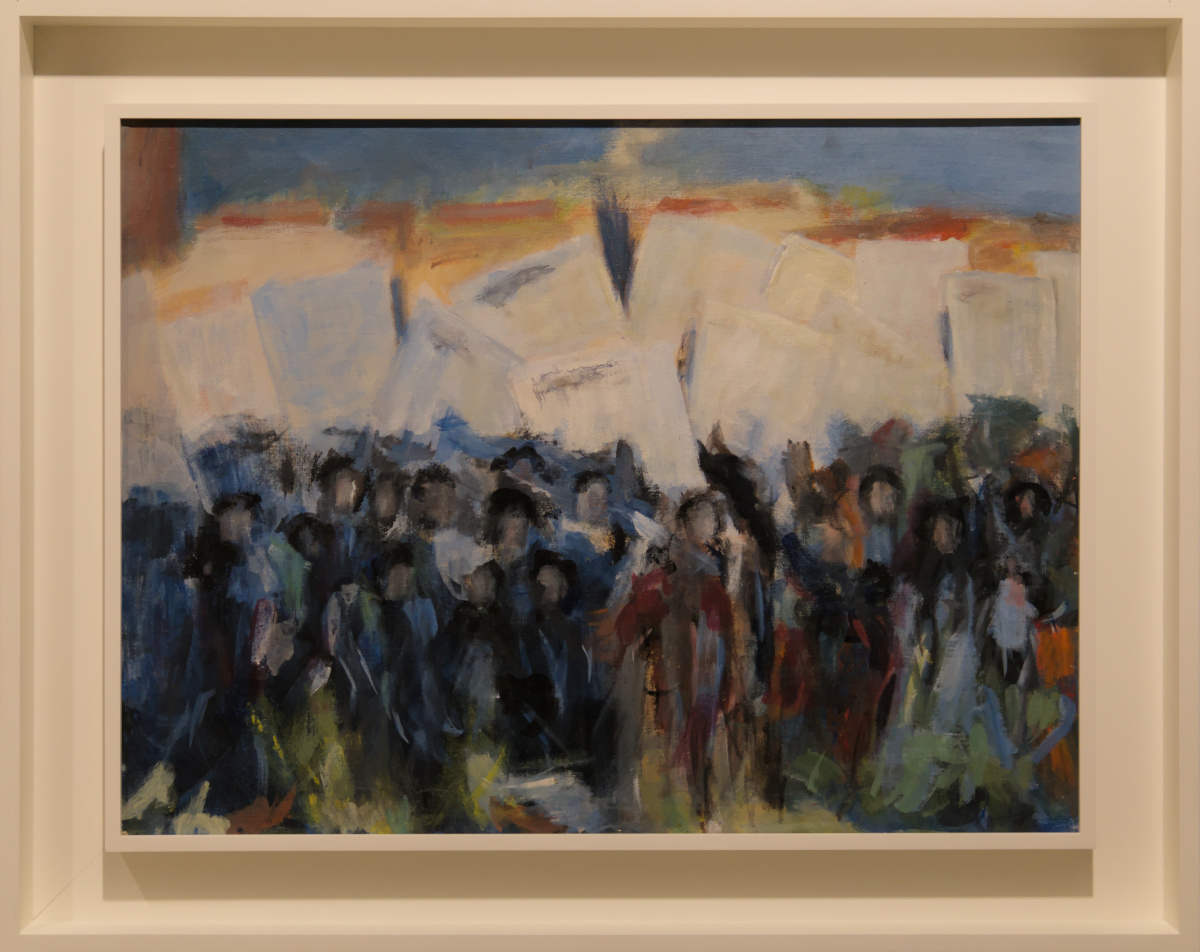
Her one political painting, for which she painted two preparatory sketches, is on the August 28, 1963, March on Washington for Jobs and Freedom, which she participated in.
Alma Thomas (American, 1891–1978), Sketch for March on Washington, ca. 1963. Acrylic on canvasboard, 20 × 24 in. The Columbus Museum, Columbus, Georgia. Photo: Victoria Emily Jones.
She also painted a few explicitly religious subjects, among them the Journey of the Magi and the Entombment of Christ.
Alma W. Thomas (American, 1891–1978), Three Wise Men, 1966. Acrylic on canvas, 36 1/2 × 23 1/2 in. Collection of the Harmon and Harriet Kelley Foundation for the Arts. Photo: Victoria Emily Jones.Alma W. Thomas (American, 1891–1978), They Laid Him in the Tomb, ca. 1958. Oil on canvas, 32 1/4 × 40 1/4 in. Collection of Paola Luptak. Photo: Victoria Emily Jones.
Alma W. Thomas: Everything Is Beautiful has left the Phillips but will be at the Frist Art Museum in Nashville from February 25 to June 5, 2022. From there it will visit the Columbus Museum in Columbus, Georgia (Thomas’s birthplace), from July 1 to September 25, 2022.
At the archived Phillips exhibition page, you can find video lectures and conversations and audio commentaries, plus you can take a 360-degree virtual tour of the exhibition. Washington-area readers: if you missed Everything Is Beautiful and want the chance to see Thomas’s work in person, mark your calendars for October 2023, when the Smithsonian American Art Museum will be exhibiting the more than two dozen Thomas paintings in its collection; the show is called Composing Color: Paintings by Alma Thomas.
There is plenty of material out there about Alma Thomas. A few other resources I’ll point you to are the Alma W. Thomas: Everything Is Beautiful catalog, of which the following video gives you a look inside:
The National Women’s History Museum also curated an interactive online exhibition about Thomas through Google Arts & Culture.
NOTES
1. Alma Thomas, quoted in Eleanor Munro, Originals: American Women Artists (New York: Simon and Schuster, 1979), 194.
2. This rhetorical question of Thomas’s is printed beneath her 1924 senior class photograph in The Bison, Howard University’s annual. Seth Feman and Jonathan Frederick Walz, eds., Alma W. Thomas: Everything Is Beautiful (New Haven, CT: Yale University Press, 2021), 78 (fig. 3).
3. Quoted in Andrea O. Cohen, “Alma Thomas,” DC Gazette, October 26–November 8, 1970.
4. Alma Thomas Papers, untitled statement, Biographical Accounts and Notes, c. 1950s–c . 1970s, box 1, folder 2, page 10.
5. Sydney Nikolaus, et al., “Composing Color: The Materials and Techniques of Alma Woodsey Thomas,” in Feman and Walz, 105.
6. Aruna D’Souza, “What Filters Through the Spaces Between,” in Feman and Walz, 61.
7. Quoted in Adolphus Ealey, “Remembering Alma,” in Merry A. Foresta, A Life in Art: Alma Thomas, 1891–1978 (Washington, DC: Smithsonian Institution Press for the National Museum of American Art, 1981), 12.
8. Quoted in David L. Shirey, “At 77, She’s Made It to the Whitney,” New York Times, May 4, 1972, 52.



_-_Napoli_MAN_8834.jpg)



 Art & Theology