LOOK: The Wise and Foolish Virgins, Norwegian tapestry
The Wise and Foolish Virgins, Norway, 17th century. Wool, bast fiber, 83 1/2 × 61 in. (212.1 × 154.9 cm). Minneapolis Institute of Art, Minneapolis, Minnesota.
The golden age of Norwegian tapestry (billedvev) spans roughly 1550 to 1800. Of all the woven subjects during this period, the Wise and Foolish Virgins was the most popular. The art historian Thor B. Kielland registered a total of seventy-five such tapestries from the seventeenth century alone. Draped over a bed, they would have provided warmth, decoration, and moral instruction. I love their aesthetic!
Jesus’s parable of the wise and foolish virgins comes from Matthew 25. Ten young women are members of a bridal party, and they’re awaiting the arrival of the bridegroom so that the celebration can start. In the tapestry pictured here, the top figures represent the wise virgins, whose oil-filled lamps indicate their readiness to accompany the bridegroom to the wedding feast. Those in the lower register, however, foolishly allowed their lamps to burn out; they weep into their handkerchiefs because the feasting started when they were out replenishing their oil supply, and now they’re too late.
That’s Christ the bridegroom in the upper right.
If I’m honest, this parable is uncomfortable for me. I don’t like that the neglectful women are locked out of the party. I don’t want anyone who wants in to be turned away. I want the bridegroom to show them grace, as the landowner did the day laborers who worked the vineyard for only one hour, giving them the same wage as those who worked for nine. But the parable of the virgins, with its stark sense of finality, is one of Christ’s teachings, so I want to grapple with it, not simply ignore it to suit my own proclivities.
I learned much about the existing body of Ten Virgins tapestries from rural Norway from Laura Berlage’s webinar “Dressing the Wise and Foolish Virgins: What Tapestry Can Teach Us About Women, Dress, and Culture in 16th and 17th Century Norway,” presented on July 17, 2023. She says the tapestries were made by women (unlike those produced by the guilds in Flanders and Paris), for women (they were used as bridal coverlets and included in dowries). They preached preparedness for young wives. “Good comes to those who are prepared,” Berlage elaborates; “you can’t get to heaven by borrowing someone else’s spiritual work.”
Regarding the headwear, Berlage clarifies: “The crowns the virgins wear are not because they’re princesses. There is a special tradition in Norway of wearing a crown at your wedding, which is an ancient nod to the Norse goddess Freja (later said to be an emblem of the Virgin Mary).”
Over time, Berlage says, the original meaning of the parable got lost, such that weavers no longer differentiated between the two sets of virgins, for example. She calls this phenomenon “image decay” and compares it to the telephone game.
For a shorter, less academic lesson on the ten virgins in Norwegian tapestry, see the six-minute video “Woven Wise and Foolish Virgins” by Robbie LaFleur:
LISTEN: “Himmelriket Liknas Vid Tio Jungfrur” (The Kingdom of Heaven Is Like Unto Ten Virgins) | Words from Then Swenska Psalmboken (The Swedish Hymnbook), 1697 | Traditional melody from Mockfjärd, collected by Nils Andersson in 1907 from Anders Frisell | Performed by Margareta Jonth on the album Religious Folk-Songs from Dalecarlia, 1977, reissued 1994
Himnelriket liknas vid tio jungfrur
som voro av olika kynne.
Fem månde oss visa vår tröga natur
Vårt sömnig och syndiga sinne.
Gud nåde oss syndare arma.

Vår brudgum drog bort uti främmande land
Och månde de jungfrur befalla
Sig möta med ljus och lampor i hand
Enär som han ville dem kalla.
De fävitske dröjde för länge.

De ropa: O Herre, o Herre låt opp,
Låt oss icke bliva utslutna!
Men ute var nåden, all väntan, allt hopp
Ty bliva de arma förskjutna
Till helvetets jämmer och pina.

Så låter oss vaka och hava det nit
Att tron och vår kärlek må brinna.
Vi måge här följa vår brudgum med flit
Och eviga salighet finna.
Det himmelska bröllopet. Amen.
The kingdom of heaven is like unto ten virgins Who were of different character. Five showed us our slothful nature, Our sleepy and sinful selves. God have mercy on us poor sinners.
Our bridegroom traveled in foreign lands And ordered the virgins To meet him with lighted lamp in hand Whenever he called them. The foolish ones waited too long.
They cry, “O Lord, O Lord, open up, Let us not be locked out!” But it was too late for mercy, for waiting, for hope, For the poor souls were cast Into hell’s wailing and torment.
So let us watch and show zeal That faith and our love may burn. Let us follow our bridegroom diligently And find eternal bliss, The heavenly wedding. Amen.
For all flesh is as grass, and all the glory of man as the flower of grass. The grass withereth, and the flower thereof falleth away: but the word of the Lord endureth for ever. And this is the word which by the gospel is preached unto you.
—1 Peter 1:24–25 (KJV) (cf. Isaiah 40:7–8)
Man is like a breath; his days are like a passing shadow.
—Psalm 144:4 (ESV)
LOOK: Fraktur attributed to David Kriebel
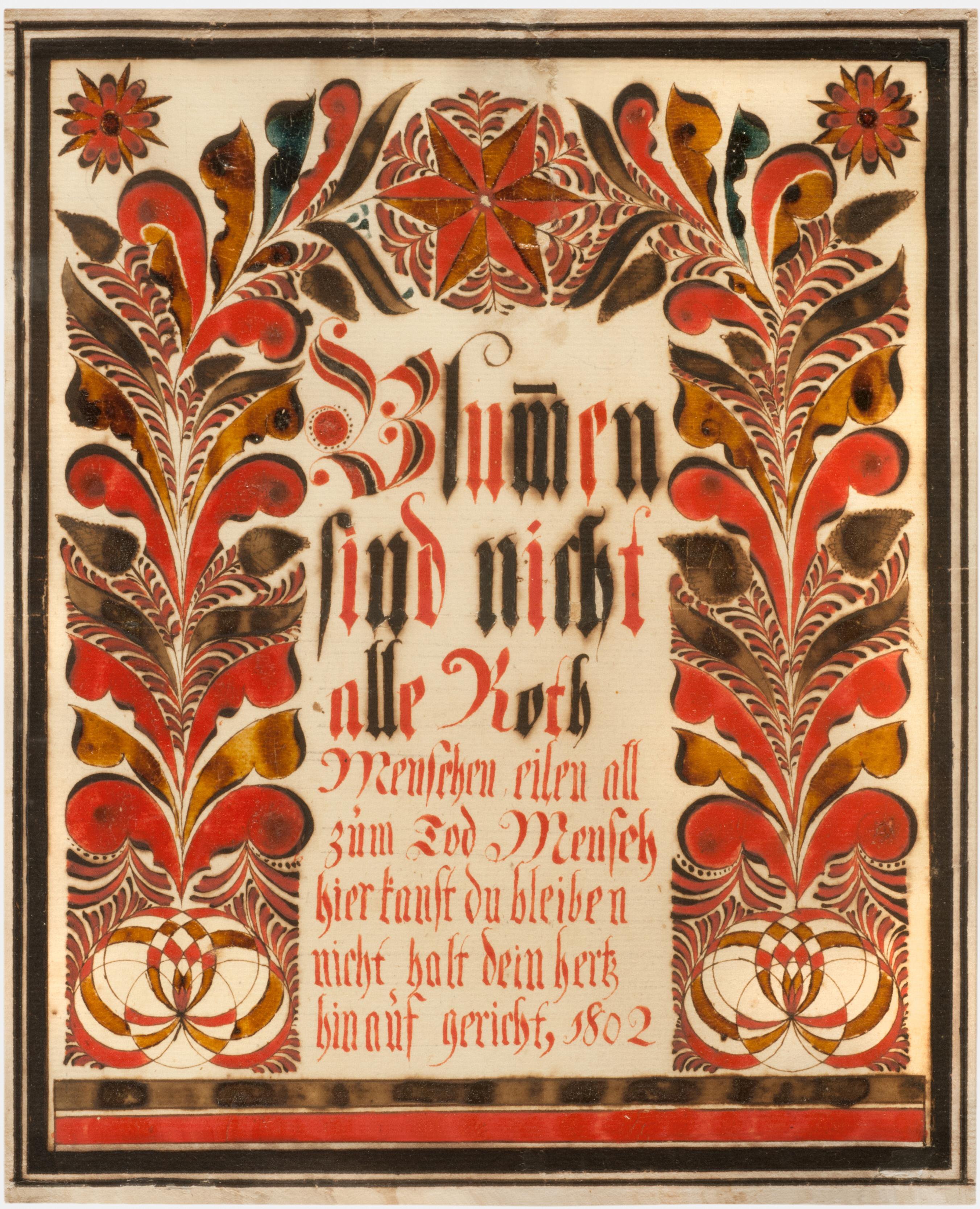
Fraktur attributed to David Kriebel (1787–1848), Gwynedd Township, Montgomery County, Pennsylvania, 1802. Watercolor and ink on laid paper, 9 1/2 × 7 1/2 in. (24.1 × 19.1 cm). Philadelphia Museum of Art.
Referring to exuberantly decorated pages made by Pennsylvania Germans, fraktur is a type of folk art that flourished in the eighteenth and nineteenth centuries. Traditionally handwritten in ink and hand-painted with letter embellishments and design motifs like birds, hearts, and tulips, these works on paper often contain religious texts and/or commemorate important life events like births, deaths, and baptisms. They were made primarily by pastors and schoolmasters, who gifted them to parishioners or students. The recipients did not frame or hang them, but rather kept them in Bibles, drawers, or chests.
The German text of this fraktur translates to “Flowers are not all red. All men hasten toward death. Man cannot remain here, so direct your heart upward.” The piece features a foliate border and a color palette of reds and browns that captures both the bloom of youth and life’s inevitable withering. It was made by David Kriebel, a farmer from Gwynedd Township in Montgomery County, Pennsylvania, who would later move to nearby Worcester Township and become a minister in the Schwenkfelder Church, a small Christian denomination rooted in the Protestant Reformation teachings of Caspar Schwenkfeld von Ossig (1489–1561), which emphasize inner spirituality over outward form.
LISTEN: “As the Life of a Flower” by Laura E. Newell (words) and George H. Ramsey (music), 1904 | Performed by the Chuck Wagon Gang, 1953 [HT]
As the life of a flow’r, as a breath or a sigh So the years that we live as a dream hasten by True, today we are here, but tomorrow may see Just a grave in the vale and a mem’ry of me
Refrain: As the life of a flow’r, as a breath or a sigh So the years glide away, and alas, we must die
As the life of a flow’r, be our lives pure and sweet May we brighten the way for the friends that we greet And sweet incense arise from our hearts as we live Close to him who doth teach us to love and forgive [Refrain]
While we tarry below, let us trust and adore Him who leads us each day toward the radiant shore Where the sun never sets and the flow’rs never fade Where no sorrow or death may its borders invade [Refrain]
This early twentieth-century gospel hymn is performed here by D. P. Carter (tenor) and three of his nine children: Rose Carter Karnes (soprano), Anna Carter Gordon (alto), and Ernest (Jim) Carter (bass, guitar). The quartet formed in 1935 and started appearing on WBAP radio in the family’s hometown of Fort Worth, Texas, the following year, billing themselves as the Chuck Wagon Gang.
“As the Life of a Flower” draws on biblical passages that compare human life to a flower for its ephemerality (e.g., Job 14:2; Psalm 103:15–16; Isa. 40:6–8; 1 Pet. 1:24–25). But flowers are also fragrant, and the song makes that comparison too, echoing verses like 2 Corinthians 2:14–15, where Paul writes, “Thanks be to God, who . . . through us spreads in every place the fragrance that comes from knowing him. For we are the aroma of Christ to God among those who are being saved and among those who are perishing.”
Though we are fading, we are glorious creations of God with joyous and sweet-smelling potential. While we live on this earth, may we exude the beauty and aroma of Christ in all we say and do.
Ivan Večenaj (Croatian, 1920–2013), Nativity, 1970. Oil on glass. Galerija Ivan Večenaj, Gola, Croatia.
Ivan Večenaj (1920–2013) was a self-taught artist from Croatia, a representative of the Hlebine school of naive painting. He loved nature and folk culture—many of his paintings depict local village life or biblical scenes set in Croatia’s rural countryside. His works are in the collections of the Croatian Museum of Naïve Art in Zagreb and the Vatican Museums, among others. There is also a museum dedicated to his work: the Galerija Ivan Večenaj (Ivan Večenaj Gallery) in his home village of Gola in the Prekodravlje region.
Večenaj’s 1970 Nativity sets Jesus’s birth in Gola. Mary bounces the boy Jesus on her knee under a makeshift shelter roofed with a purple blanket that resembles a mountain. Emerging from the snowy ground behind them is a red cross, a crown of thorns hanging from the center and blood dripping from a wedged nail on both terminals onto a barren tree and Mary’s cloak. But this sign of death is counterbalanced with signs of life—flowers, wheat, and a grapevine sprouting up around the two, references to the Eucharist and to the blossoming of salvation.
The scene emphasizes Jesus’s humble birth into a peasant family—the artist, too, had a peasant background—and foreshadows his atoning death.
LISTEN:“Ar gyfer heddiw’r bore”(For the sake of this very morning), aka “Faban Bach” (A Little Baby) | Words by David Hughes, early nineteenth century | Tune: MENTRA GWEN, traditional Welsh | Performed by Parti Fronheulog, 1967
Ar gyfer heddiw’r bore’n faban bach, faban bach, y ganwyd gwreiddyn Iesse’n faban bach; y Cadarn ddaeth o Bosra, y Deddfwr gynt ar Seina, yr Iawn gaed ar Galfaria’n faban bach, faban bach, yn sugno bron Maria’n faban bach.
Caed bywiol ddŵfr Eseciel ar lin Mair, ar lin Mair, a gwir Feseia Daniel ar lin Mair; Caed bachgen doeth Eseia, ’r addewid roed i Adda, yr Alffa a’r Omega ar lin Mair, ar lin Mair; mewn côr ym Meth’lem Jiwda, ar lin Mair.
Diosgodd Crist o’i goron, o’i wirfodd, o’i wirfodd, er mwyn coroni Seion, o’i wirfodd; i blygu’i ben dihalog o dan y goron ddreiniog i ddioddef dirmyg llidiog, o’i wirfodd, o’i wirfodd, er codi pen yr euog, o’i wirfodd.
Am hyn, bechadur, brysia, fel yr wyt, fel yr wyt, i ’mofyn am dy Noddfa, fel yr wyt i ti’r agorwyd ffynnon a ylch dy glwyfau duon fel eira gwyn yn Salmon, fel yr wyt, fel yr wyt, gan hynny, tyrd yn brydlon, fel yr wyt.
For the sake of this very morning, as a little baby, a little baby Was born the root of Jesse, as a little baby; The Strong one who came from Bosra, The Lawmaker of old on Sinai, The Redemption to be had on Calvary, as a little baby, a little baby, Suckling the breast of Mary, as a little baby.
The life-giving water of Ezekiel is found on Mary’s knee, on Mary’s knee, And the true Messiah of Daniel on Mary’s knee; Here is the wise boy-child of Isaiah, The promise made to Adam, The Alpha and Omega on Mary’s knee, on Mary’s knee; In the stall in Bethlehem of Judah, on Mary’s knee.
Christ took off his crown, of his freewill, of his freewill, In order to crown Zion, of his freewill; To bow his undefiled head Under the thorny crown, To suffer enraged derision, of his freewill, of his freewill, To raise the head of the guilty, of his freewill.
Therefore, sinner, hurry, as thou art, as thou art, To ask for his sanctuary, as thou art; For thee the well was opened Which washes thy wounds Like the snow on Salmon, as thou art, as thou art. For that, come promptly, as thou art.
With roots dating back to the pre-Reformation era, theplygain service is a Welsh Christmas tradition in which Christians gather at church from 3 a.m. to 6 a.m. on Christmas morning for community-led carol singing. One of the popular carols that’s sung is “Ar gyfer heddiw’r bore,” its text by the Welsh poet David Hughes (ca. 1794–1862), known by his bardic name of Eos Iâl. It’s twelve stanzas in all, which start with the Nativity and then move through various stages of Christ’s passion, from Gethsemane to Pilate’s hall to Golgotha to the garden of the tomb, commemorating the incarnation, the atonement, and Christ’s ascension and intercession for sinners.
The recording here is by Parti Fronheulog, a folk trio of brothers from southeast Denbighshire, Wales—Tom Williams (lead), Osmond Williams (tenor), and Ted Williams (bass)—who were active in the 1960s. They sing stanzas 1, 2, 5 and 12.
Purvis Young (American, 1943–2010), Untitled, 1990s. Paint on fiberboard, 65 1/16 × 47 5/8 in. (165.3 × 121 cm). Smithsonian National Museum of African American History and Culture, Washington, DC. Photo: Victoria Emily Jones. [object record]
From the gallery label at the Smithsonian National Museum of African American History and Culture, where I first encountered this painting in 2019:
Purvis Young was a long-time resident of Overtown, a Black neighborhood in Miami, Florida. He began drawing while in jail, after a vision led him to embrace the idea of becoming an artist. He educated himself about the history of art, and focused on a daily routine of making art, much of it on public surfaces and walls. In Untitled, as in much of Young’s work, angels and horses are prominently featured; angels represent goodness and horses represent freedom. Just as he had found salvation through art, he hoped his own art would bring harmony to his neighborhood, and to the world.
In the foreground of the painting, four angels look onto a scene of what appears to be celebration. Myriad figures hold aloft circular items—tambourines? halos? Is this the gathering of saints in heaven, where goodness and freedom abound?
Kama simcha yesh bevetcha, kshe’kulam sharim beyachad Al shehaya al sheyieh ve’al kol she’Ata oseh Hayu yamim tovim yoter, ach le’olam lo nevater Al hasimcha ha’arucha, she’od tavo ken hi tavo
Im lo nashir unehalel ha’avanim lo ishteku Kol habria lecha koret, baruch haba Maran Ata Bein im od shana o od me’ah, lecha namtin betsipia Hu she’ala, gam od yered ve’az tatchil hachagiga [Refrain]
Outro: Hineh ma tov uma naim, kshe’kulanu mehalelim Sharim beyachad le’Elohim, kol echad hu chelek, kulam bifnim
ENGLISH TRANSLATION:
There’s so much joy in Your home, when everyone is singing About what was, and what will be, and about everything You’re doing There were better days, but we’ll never give up On the joy that has been prepared, that will come, yes, joy will come
Refrain: Lift up your hands; we’re celebrating before Yeshua [Jesus] We’ll see Your goodness in heaven, but also in the land of the living We’ll lift our voices to the heavens, filling them with song We’ll celebrate as a family, when we come again into Your home
If we won’t sing and worship, the stones will not remain silent All of creation is calling for You, “Blessed are You! Come, Lord. Maranatha.” Whether it takes a year or a hundred, we’ll wait for You with expectancy He who ascended will descend again, and then our celebration will start [Refrain]
Outro: How good and pleasant it is, when all of us worship Singing together to God, everyone takes part, everybody is in
Shilo Ben Hod is a Messianic Jewish worship leader from Israel. He sings this song of his in Hebrew with his wife, Sarah, and other family and friends.
Then I saw a new heaven and a new earth, for the first heaven and the first earth had passed away, and the sea was no more. And I saw the holy city, the new Jerusalem, coming down out of heaven from God . . .
It has a great, high wall with twelve gates, and at the gates twelve angels, . . . and the twelve gates are twelve pearls. . . .
I saw no temple in the city, for its temple is the Lord God the Almighty and the Lamb. And the city has no need of sun or moon to shine on it, for the glory of God is its light, and its lamp is the Lamb. The nations will walk by its light, and the kings of the earth will bring their glory into it. Its gates will never be shut by day—and there will be no night there. . . .
Then the angel showed me the river of the water of life, bright as crystal, flowing from the throne of God and of the Lamb through the middle of the street of the city. On either side of the river is the tree of life with its twelve kinds of fruit, producing its fruit each month, and the leaves of the tree are for the healing of the nations. Nothing accursed will be found there any more. But the throne of God and of the Lamb will be in it, and his servants will worship him; they will see his face, and his name will be on their foreheads. And there will be no more night; they need no light of lamp or sun, for the Lord God will be their light, and they will reign forever and ever.
—Revelation 21:1–2, 12, 21–25; 22:1–5
LOOK: The New Heaven by Leroy Almon
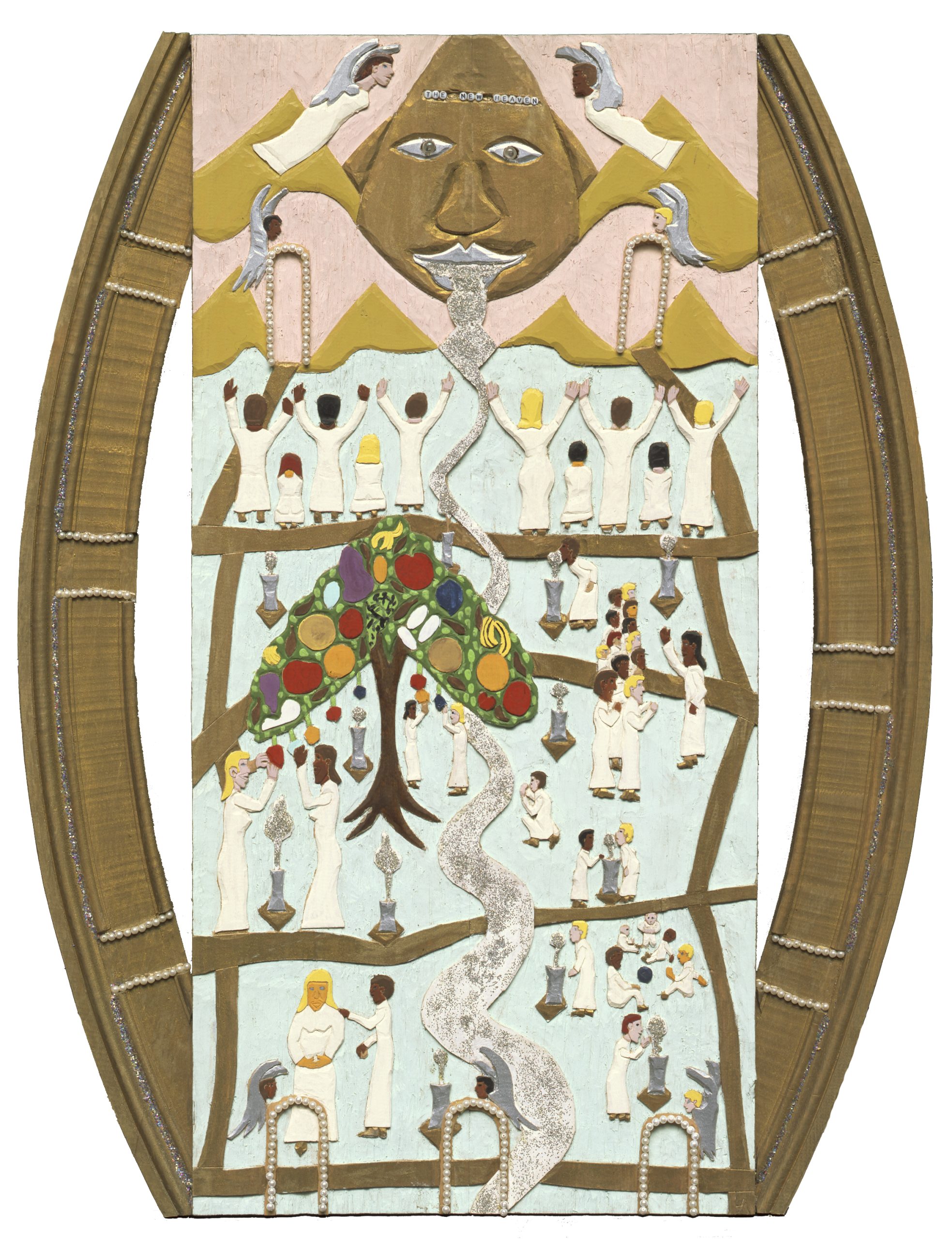
Leroy Almon (American, 1938–1997), The New Heaven, 1984. Carved wood, light bulbs, artificial pearls, glue, glitter, plastic letters, paint, 36 × 28 in. (91.4 × 71.1 cm). Toledo Museum of Art, Ohio. [object record]
This mixed-media depiction of heaven by African American folk artist Leroy Almon draws on imagery from the book of Revelation, showing centrally a crystal-bright river, the water of life, flowing forth from the mouth of God (Rev. 22:1–2). It courses through the paradisal scene, past the tree with its twelve fruits and healing leaves, and is pumped into twelve fountains, from which Black and white people drink together. Across lines of race, the new-city dwellers unite in worship, fellowship, and play. Notice the group of children with the ball in the bottom register!
For a framing device, Almon has used two wooden doors that bow out, as if the scene in all its fullness cannot be contained; as if the borders of the new city must bend to embrace the multitudes and their joy. The shape communicates an expansiveness that is the heart of God.
God is shown as majestic, mountain-like, and yet bearing a tender expression. The plastic beads on his forehead are printed with letters that read, “THE NEW HEAVEN,” and his eyes (not lit in this photo) are battery-powered light bulbs! He is, as John the Revelator tells us, the unending light dispelling all darkness.
Almon was born in 1938, so for about the first three decades of his life, he lived in a country where racial segregation was enforced legally in many states and socially in others. By and large, Blacks and whites were made to live in separate neighborhoods, attend separate schools, swim in separate pools, eat at separate restaurants, drink from separate water fountains, pass through separate public building entrances, wait in separate waiting rooms, sit in separate sections of the bus and the theater and even (woe is us) the church, and so on. Even after the passage of the Civil Rights Act in 1964, mandating desegregation, racial prejudices and hostilities continued to persist, as they do today. And because sinful human beings create and run systems (criminal legal, economic, educational, medical, etc.), it’s no surprise that the sin of racism can be found there as well.
Almon longed to see racial justice and (re)conciliation, and he knew Jesus has the power to make it happen. Almon’s preaching ministry went hand-in-hand with his art making. Through both, he shared the good news that Jesus, through his life, death, and resurrection, calls us to a new way of being in the world, which involves repentance of sin and turning to the divine light of love that knows no bounds. His New Heaven envisions a world saved and transformed by Christ’s love, where power is shared equally, forgiveness sought and granted, and friendship is the order of the day, as is a shared rejoicing in the greatness of God. In The New Heaven, Black and white praise Jesus side-by-side, eat at the tree of life together, and put their lips to the same bubbling fount of living water.
And not only are relationships healed and humanity restored to its original harmony in the new heaven, but also personal sorrows and hardships are no more. Physically, mentally, emotionally, spiritually, socially, we flourish in the light of God that never dims.
LISTEN: “Great Rejoicing” by Thad Cockrell, on To Be Loved (2009) | Performed by Rain for Roots, feat. Sandra McCracken and Skye Peterson, on Waiting Songs (2015)
There’s gonna be a great rejoicing (2×)
The troubles of this world Will wither up and die That river of tears made by the lonely Someday will be dry There’s gonna be a great rejoicing
There’s gonna be a great joy river (2×)
Questions of this world Someday will be known Who’s robbing you of peace And who’s the giver
There’s gonna be a great joy river
Someday you will find me Guarded in His fortress Open heart and wings That never touch the ground Someday we will gather In a grand reunion Debts of this old world Are nowhere to be found Nowhere to be found
There’s gonna be a great rejoicing (5×)
We are now halfway through Advent! Many of the songs featured in this Advent series, including today’s, appear on my Advent Playlist. I also have a companion Christmastide Playlist, which has been revised and expanded since last year to include some choral selections.
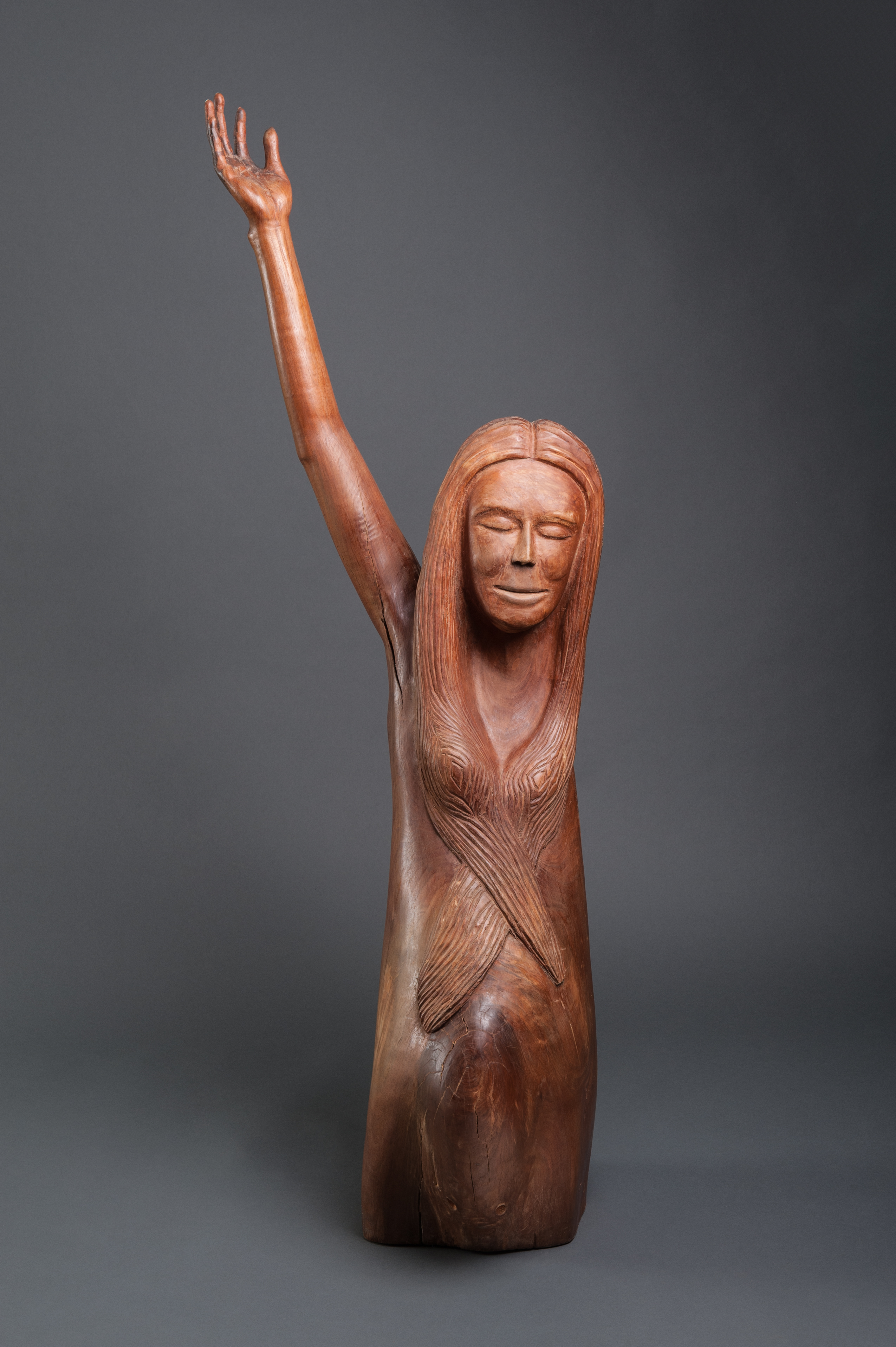
Fred J. Carter (American, 1911–1992), Behold My Miracle, 1980. Walnut, 55 × 20 in. Collection of Mary Carter Owens and Vel-Holly Fleming. Photo: Dan Meyers, courtesy of the American Visionary Art Museum.
Born in 1911 in the mountains of southwestern Virginia, Fred Jerome Carter spent the first few decades of his adulthood as a hardware merchant. In 1938 he married Eloise Davis, and in 1950 they adopted their first and only son, Ross.
In his late forties, Carter began to pursue art making, taking a beginner’s painting class, his only formal artistic training. But wood sculpting is the medium for which he became best known. Writer and documentary filmmaker Jack Wright classifies Carter’s art as “Appalachian art brut,”art brut (“raw art”) being a French term coined by modern artist Jean Dubuffet to describe art made outside the academic tradition.
In 1970 Carter was devastated when his son, having returned as a Marine from Vietnam, hanged himself. He and Eloise divorced shortly after, and Carter opened the Ross Carter Gallery, named in his son’s honor, where he started showing his own work. Below the gallery he established the Cumberland Museum to exhibit a large collection of pioneer tools and artifacts (having to do, for example, with farming, mining, spinning, and moonshining) that provided a window into Appalachian culture and history. It’s there that he met Vickie Hill, whom he later married. Vickie gave birth to Carter’s first biological child, Holly, in 1983, when Carter was seventy-two. Their daughter Mary was born two years later.
Carter created Behold My Miracle two years before Vickie’s first pregnancy, but he retroactively identified the figure with her. In a 1980 interview with Wright for Headwaters Television, he describes how the sculpture came about:
I was back, at Easter [1980], in the mountains, and a fellow was sawing up firewood. Now this was part of a walnut log . . . cut down forty or fifty years ago. . . . There was a limb going up through here about ten feet long. I said, “Don’t cut that up for wood. . . . I see something in this that I want to make. . . . I see a pregnant woman.” . . . So I brought it home and began to look at it. . . . The wood began to talk to me and tell me what it is. . . .
So, I will probably call this Behold My Miracle. That’s what the mother is saying and I am trying to get her to say, in the position of her hand and the look on her face, that this is truly the great miracle. . . . As though she is saying, “Behold me, in my greatest moment of the miracle!”
LISTEN: “The Glory of Jah” by Sinéad O’Connor and Ronald Tomlinson, on Theology (2007) – The acoustic version in the video below, which appears on disc 1 of the album, was recorded live at The Sugar Club in Dublin.
There is no Holy One like you You install kings and take them down Truly there is no one beside you You made all of creation with wisdom
Refrain: May the glory of Jah endure forever The boughs of the mighty are broken And the weak are clothed with strength
There is the sea, vast and wide With all its creatures beyond number There go the ships, they all look to you You lift up the poor into a place of honor [Refrain]
Jah makes poor or he makes rich The pillars of the earth belong to him And he has set his world upon them To raise us up from the dunghill [Refrain]
The eighth full-length album by Irish singer-songwriter Sinéad O’Connor, Theology is a collection of mostly original spiritual songs in the Judeo-Christian tradition. It’s saturated with scripture. It contains:
The opening (and my favorite) “Something Beautiful,” which starts out in O’Connor’s own voice and ends with quotations of Jeremiah 6:14 and 2:32, where God expresses compassion and longing for his people
“Out of the Depths,” a lament for the ways in which organized religion binds God and makes him hard to access, bookended by verses from Psalm 130
O’Connor grew up Catholic and, until converting to Islam in 2018, identified as such, though she has always been unorthodox. Frustrated by the spiritual vapidness of the pop music industry in which she had found fame, in the early 2000s she studied theology at a college in Dublin, looking to connect more deeply with her religious heritage. Her favorite instructor, the Irish Dominican priest Wilfred Harrington, taught a course on the Prophets, reviving her interest in the biblical material that had so fascinated her as a youth. During this time, she was considering leaving her music career, but Fr. Harrington suggested that she set some scripture texts to music and see what happens. She took his advice, and the result is Theology, which she dedicated to Fr. Harrington. Listen to a ten-minute interview with O’Connor about the album, from the limited-edition Theology DVD released in 2008.
When I first heard “The Glory of Jah,” I thought it was a condensation of Mary’s Magnificat, which she voiced upon visiting her cousin Elizabeth following their mutual unexpected pregnancies—Elizabeth with John the Baptist, and Mary with the Christ:
My soul magnifies the Lord, and my spirit rejoices in God my Savior, for he has looked with favor on the lowly state of his servant. Surely from now on all generations will call me blessed, for the Mighty One has done great things for me, and holy is his name; indeed, his mercy is for those who fear him from generation to generation. He has shown strength with his arm; he has scattered the proud in the imagination of their hearts. He has brought down the powerful from their thrones and lifted up the lowly; he has filled the hungry with good things and sent the rich away empty. He has come to the aid of his child Israel, in remembrance of his mercy, according to the promise he made to our ancestors, to Abraham and to his descendants forever. (Luke 1:46–55)
But as I listened more closely and flipped through my Bible to match phrases, I realized that O’Connor’s song is actually a pastiche of Old Testament verses from 1 Samuel, Daniel, and the Psalms, the primary source text being Hannah’s song of thanksgiving:
My heart exults in the LORD; my strength is exalted in my God. My mouth derides my enemies because I rejoice in your victory.
There is no Holy One like the Lord, no one besides you; there is no Rock like our God. Talk no more so very proudly; let not arrogance come from your mouth, for the LORD is a God of knowledge, and by him actions are weighed. The bows of the mighty are broken, but the feeble gird on strength. Those who were full have hired themselves out for bread, but those who were hungry are fat with spoil. The barren has borne seven, but she who has many children is forlorn. The LORD kills and brings to life; he brings down to Sheol and raises up. The LORD makes poor and makes rich; he brings low; he also exalts. He raises up the poor from the dust; he lifts the needy from the ash heap to make them sit with princes and inherit a seat of honor. For the pillars of the earth are the LORD’s, and on them he has set the world.
He will guard the feet of his faithful ones, but the wicked will perish in darkness, for not by might does one prevail. The LORD! His adversaries will be shattered; the Most High will thunder in heaven. The LORD will judge the ends of the earth; he will give strength to his king and exalt the power of his anointed. (1 Sam. 2:1–10)
Hannah, an ancient Jew, prayed these words at the tabernacle at Shiloh upon dedicating her firstborn son, Samuel, to God’s service, as he was conceived after many hard years of infertility and anguished prayer. Mary’s song, which came some ten centuries later, picks up themes from Hannah’s, so it’s no wonder I originally misidentified O’Connor’s source. Mary would have known Hannah’s song from having heard it read in synagogue, and, as Mary’s son would also be set apart for divine service, perhaps she found a special kinship with this ancestral sister. Mary was also spiritually formed by the Psalms, another influence on her Magnificat composition; their words were deep in her bones, naturally coming out in effusions of praise.
Both Hannah and Mary praise God’s kindness, authority, and eternal plan, emphasizing his mercy toward the poor and the humble. Both songs are thematically linked to Psalm 113:5–8:
Who is like the LORD our God, who is seated on high, who looks far down on the heavens and the earth? He raises the poor from the dust and lifts the needy from the ash heap, to make them sit with princes, with the princes of his people.
Now returning to O’Connor’s song: Line 2 has a corollary in Daniel 2:21, “he . . . deposes kings and sets up kings.” And the second verse seems inspired by Psalm 104:24–26, 31:
O LORD, how manifold are your works! In wisdom you have made them all; the earth is full of your creatures. There is the sea, great and wide; creeping things innumerable are there, living things both small and great. There go the ships and Leviathan that you formed to sport in it.
May the glory of the LORD endure forever; may the LORD rejoice in his works . . .
When referring to God, O’Connor uses the Rastafari name for him, “Jah,” a shortened form of “Jehovah.” She had recorded her previous album, Throw Down Your Arms, in Jamaica, a collection of roots reggae song covers, and her spirituality was impacted by her encounters with the Rastafari there. “They use music to reassure people that God is actually with them and watches them, can be called upon,” she said.
So “The Glory of Jah” is a highly intertextual song, rooted in Hannah’s song but weaving in strands from other biblical books—and the result sounds an awful lot like something Mother Mary would sing!
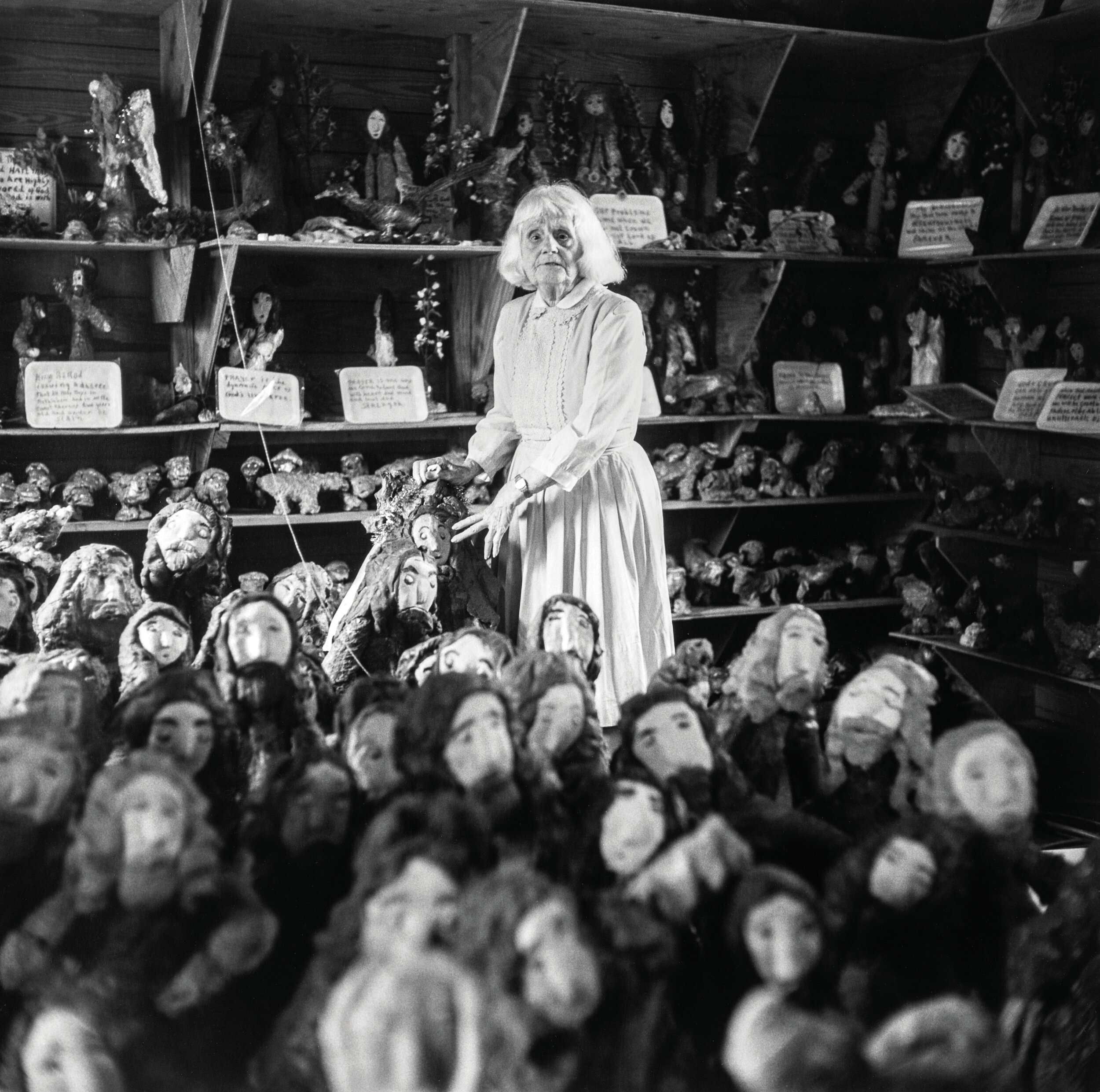
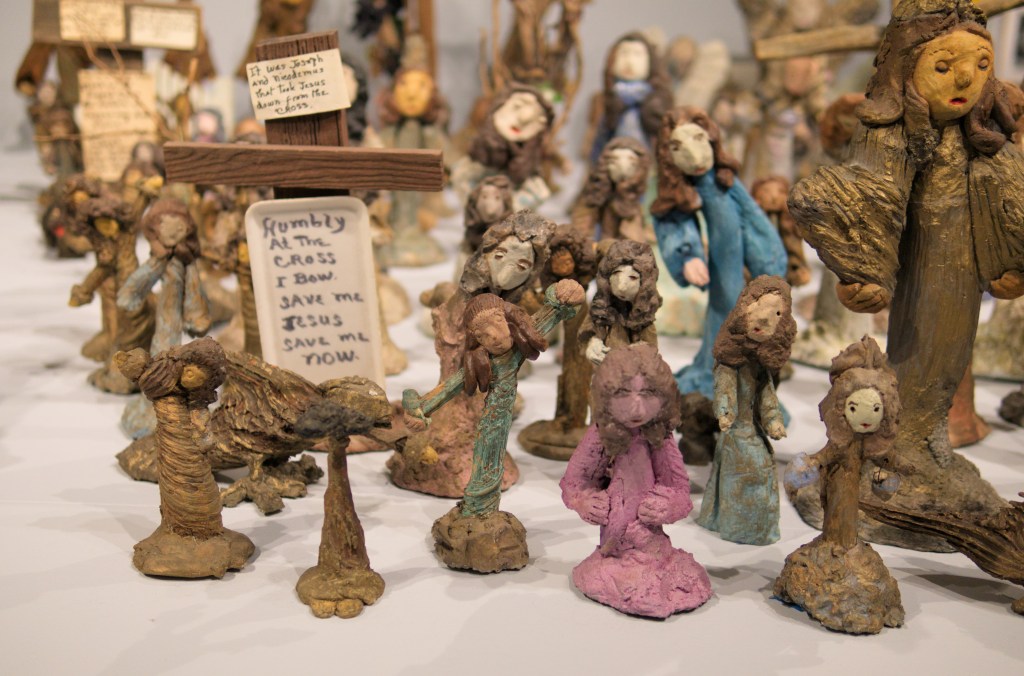
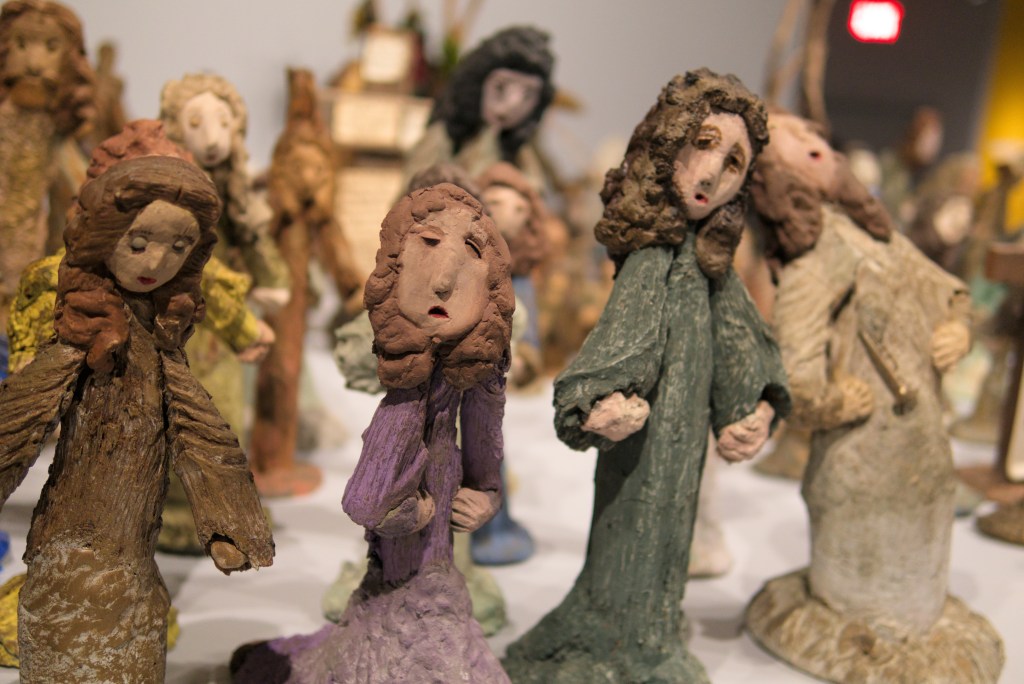
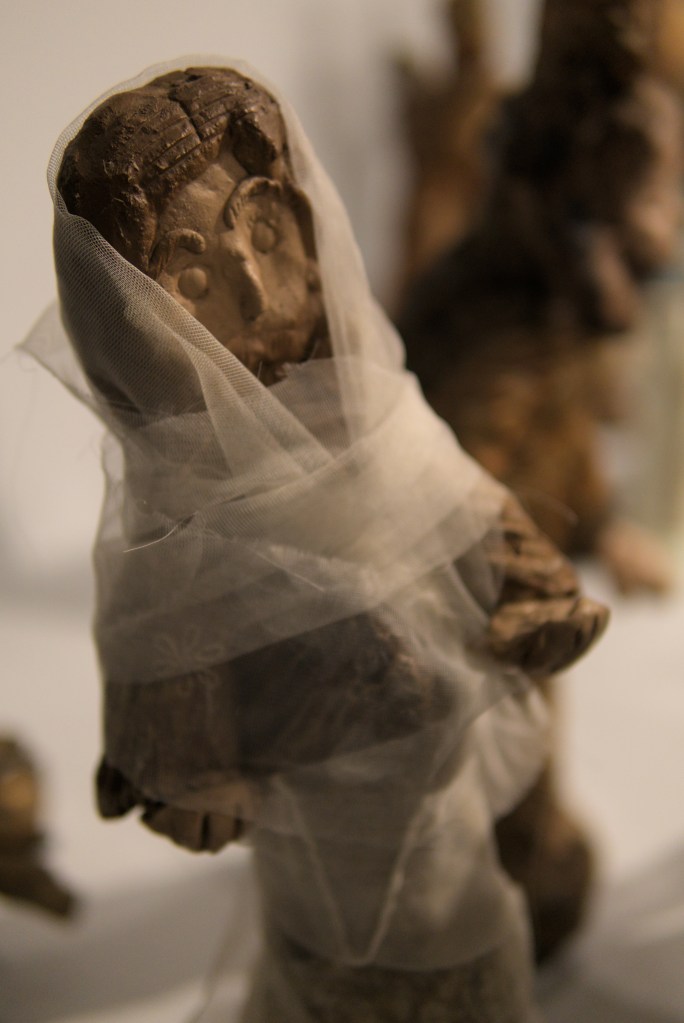
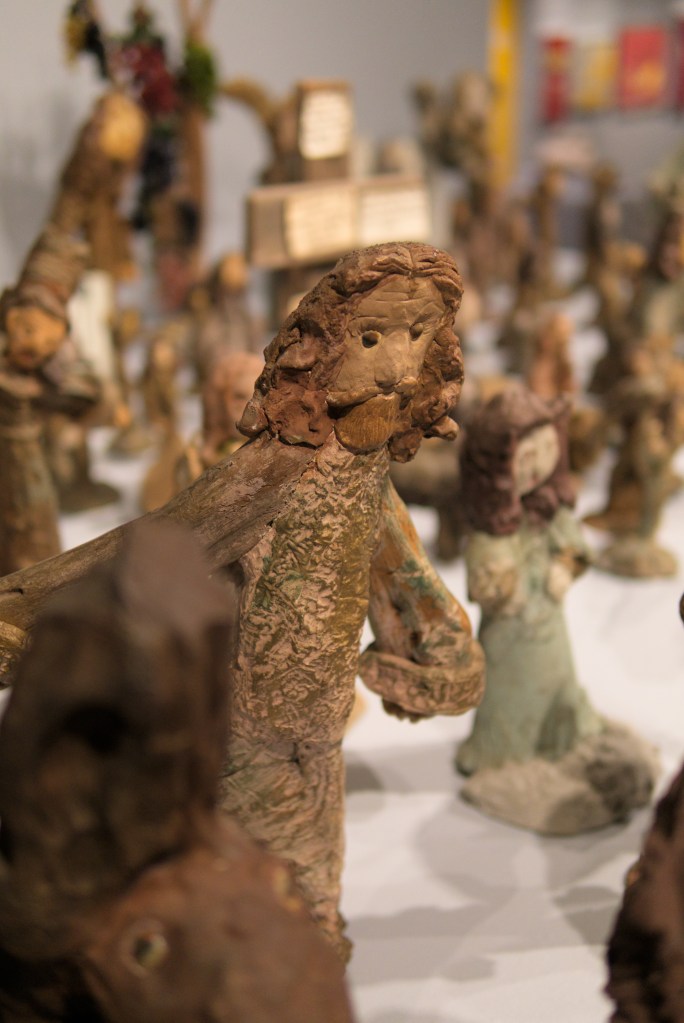
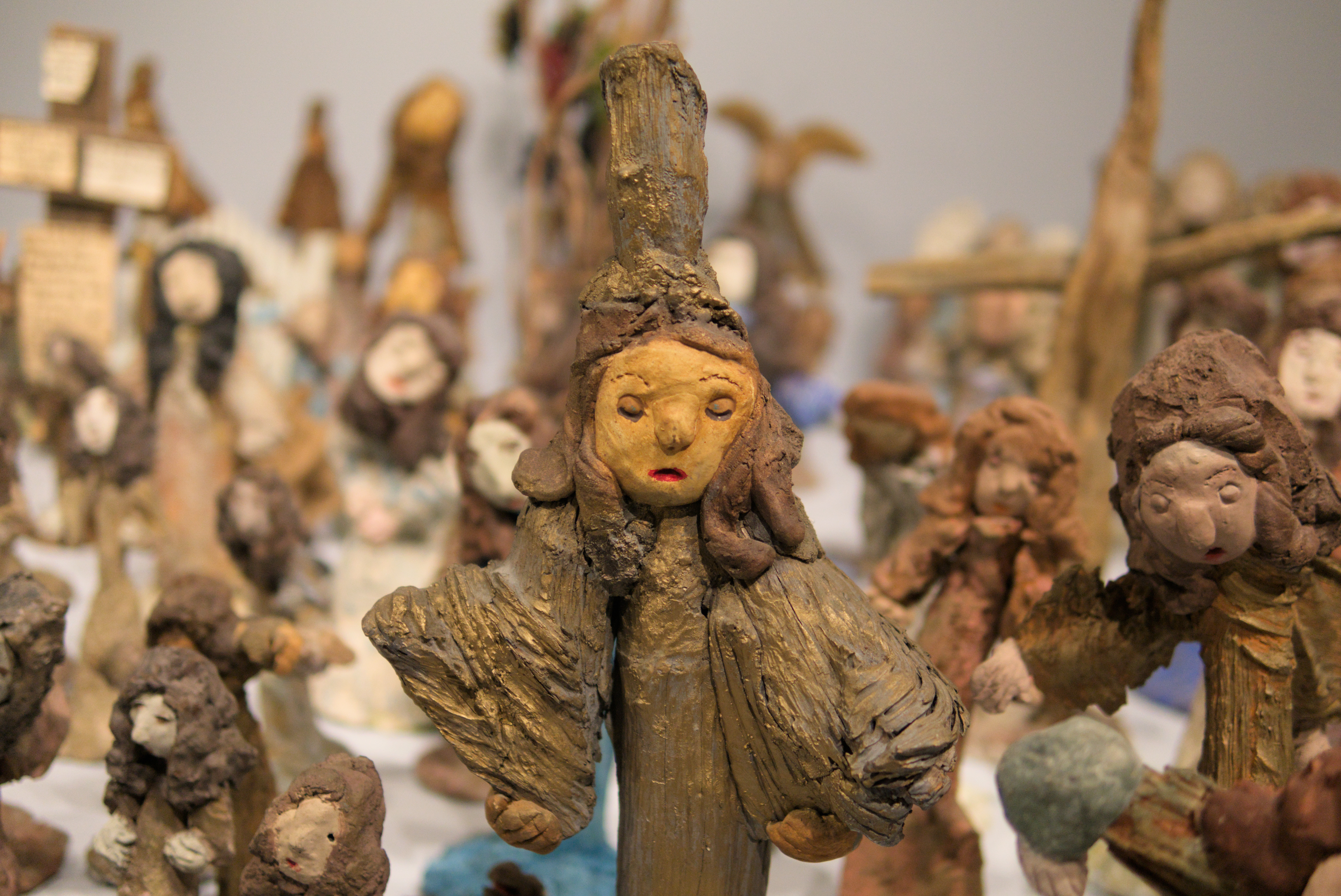
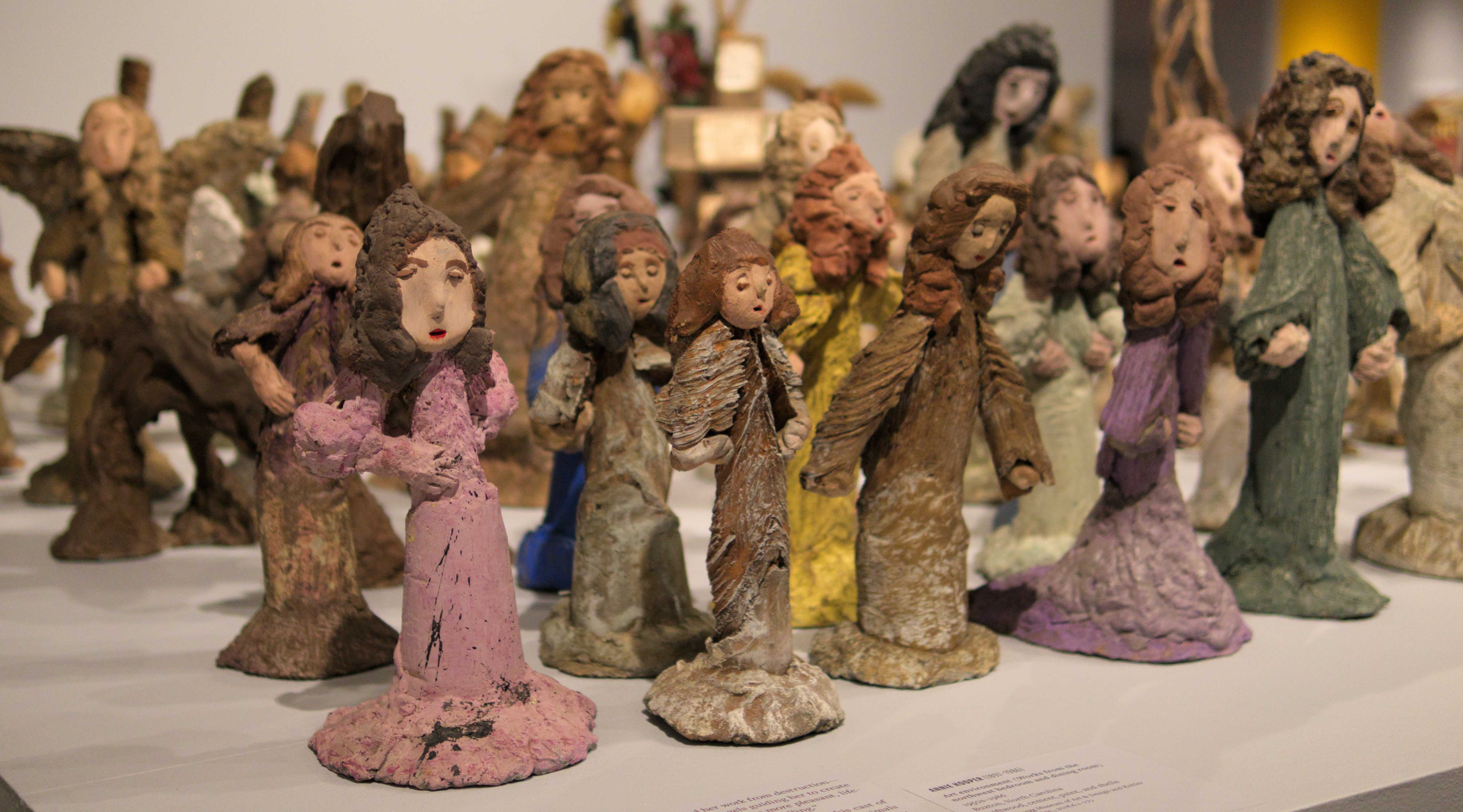
Earlier this month I visited the American Folk Art Museum in New York City and was struck by a large ensemble of painted driftwood sculptures by “outsider” artist Annie Hooper (1897–1986). Arranged on a broad platform in the main gallery, the figures are a mixture of apostles, prophets, patriarchs and matriarchs, pilgrims, pray-ers, angels, dancers, and mourners. They are but a small fraction of the thousands such figures that filled Annie’s remote coastal North Carolina home, where they beckoned friends and strangers alike to come in, take a look around, and hear God’s good word. Annie loved to tell stories through these her “symbols,” as she called them, interweaving her own life experiences with the narrative of scripture to communicate the hope of the gospel.
Annie Hooper (American, 1897–1986), Art environment (works from the northwest bedroom and dining room), Buxton, North Carolina, 1950s–1986. Driftwood, cement, paint, and shells, dimensions variable (average figure height 17 in.). American Folk Art Museum, New York, 2018.6.1–170. Photo: Victoria Emily Jones.
Annie (Miller) Hooper was born in 1897 in Buxton, North Carolina, on Hatteras Island in the Outer Banks. She was raised in a devout Methodist household that included her twelve siblings—one of them her twin sister, Mamie—and fourteen foster children.
After taking a few courses at Blackstone College for Girls in Virginia, she married John Hooper and moved across Pamlico Sound to Stumpy Point, North Carolina, where John was a commercial fisherman. Their son, Edgar, was born a year later, when Annie was nineteen.[1]
Annie was very involved in her church community—playing the organ for services, preaching sermons when called upon, teaching Sunday school for children and adults, writing poems for the church newsletter, composing songs.
During World War II, when Edgar was deployed to the South Pacific and John left to work in the naval shipyards in Norfolk, Annie experienced her first bout of depression, which was accompanied by blackouts. Her second bout came when Edgar, after returning safely home from overseas, developed lung problems that required him to convalesce for a year in the mountains. Overcome with the fear of losing him, she suffered a nervous breakdown that led her to seek treatment in Raleigh (likely electroconvulsive therapy).
Shortly before her four months of psychiatric care, Annie and John had moved back to her hometown of Buxton and opened a motel. She returned to Buxton in need of recuperation, and she turned often to a large illustrated Bible for diversion and comfort, filling her mind with images of the Divine at work.
Annie Hooper with her Sermon on the Mount, Buxton, NC, ca. 1983. Photo: Roger Manley.
Then one day in her fifties, Annie “heard voices and angels guiding her to create figures” that “were to reveal the more pleasant, life-affirming aspects of Christian storytelling,” as she later reported to folklorist Roger Manley.[2] She went out to the beach, picked up a suggestive piece of driftwood, fashioned a face on it with English putty, and colored it with leftover house paint. It was Moses on Mount Nebo, at the end of his life, looking over the river Jordan into the promised land (Deut. 32:48–52; 34:1–5).
Moses on Mount Nebo
Pleased with the result, she crafted more biblical figures using those same simple materials. She would often add seashells for eyes and cement limbs.
This art practice seemed to have a healing effect on her.
As her number of sculptures grew, Annie arranged them into tableaux around her house, starting in the dining room and a bedroom and expanding over a thirty-five-year period into every square inch of empty space—hallways, stairs, closets, tables, piano tops, stove burners, etc. “She had a kind of Cecil B. DeMille vision of the sweep of multitudes with casts of thousands,” Manley told me, “while her house was all but uninhabitable from the sheer volume of work packed into it. She used yardsticks to reach the light switches, and could barely get to the kitchen sink. The overall effect was dazzling, if a bit claustrophobically breathtaking.”[3]
Annie made use of preexisting furniture to raise elements of certain scenes, creating a spatial dynamic. “In Annie’s house,” Manley said, “angels gazed down on the shepherds with their flocks from atop dressers and chairs, the golden calf was elevated on a stool, the ‘mount’ in the Sermon on the Mount was the dining room table, and so on.” She separated the scenes with garlands of tinsel and bouquets of plastic flowers and strung Christmas lights through them. “Changing colored light played over the groupings to impart movement and dazzle.”[4]
By the time Annie died in 1986 she had made about 2,500 figurative sculptures[5] inspired by the Old and New Testaments, on subjects like Jacob’s Ladder, the Exodus, Daniel in the Lions’ Den, Belshazzar’s Feast, the Visitation, the Flight to Egypt, the Sermon on the Mount, the Holy Women at the Tomb, Paul and Silas in Jail, and many more. Notably, there’s no Crucifixion scene; Annie said she couldn’t bear to put nails in the hands and feet of Christ.[6] And so we get empty crosses instead.
The final group she worked on, left unfinished when she died, was forty-seven grieving Hebrew mothers who had lost their sons to Pharaoh’s death edict (Exod. 1:22). This story of infant male genocide, along with its correlative in Matthew 2:16–18, is one she returned to frequently throughout her four decades of art making, as it held strong resonances for her. She likened her son’s being sent away to war to his being thrown to crocodiles.
Mournful moms are everywhere in Annie’s work, Manley said—“surrounding Lazarus, overlooking scores of dead babies, at the foot of the cross(es). She identified with all women experiencing loss. In WWII dead sailors (mostly American and British) occasionally washed up on the beaches near her house after their ships had been sunk by U-boats, and she pitied their mothers as well. It was a major thread running through the whole display.”[7]
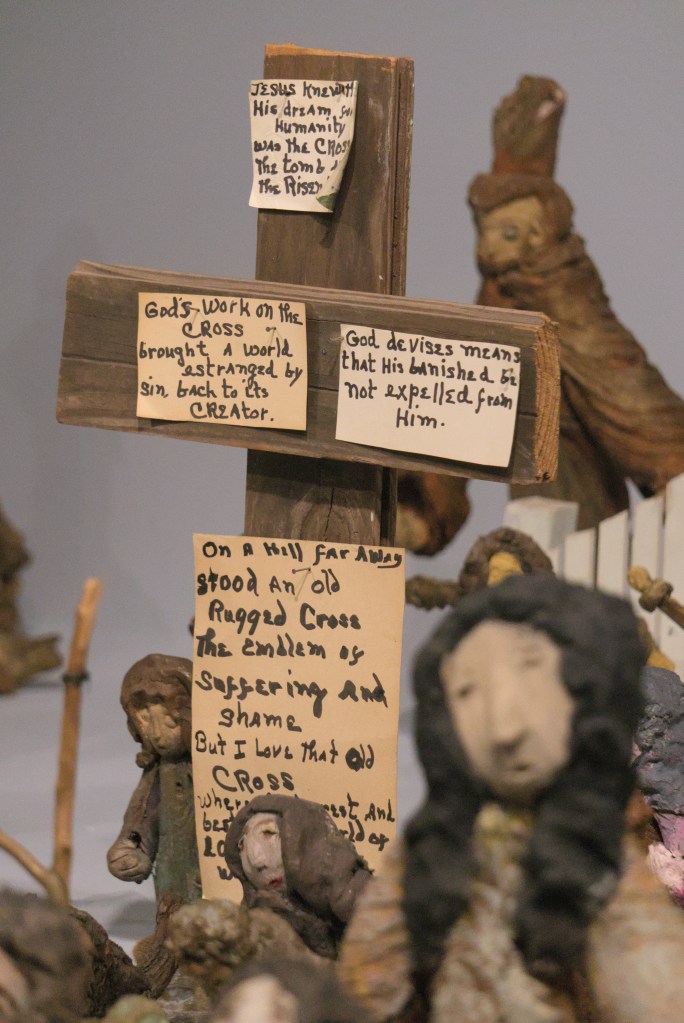
Not all the figures correspond to characters in the Bible. Some are simply “bringing the message,” Annie said.[8] They may illustrate a hymn, such as “Will There Be Any Stars in My Crown?,” “It Is Well with My Soul,” “All Hail the Power of Jesus’ Name,” or “The Old Rugged Cross.”
Wanting to share these visual stories, Annie frequently welcomed visitors into her home, giving performative tours that involved narration and interactivity. For example, she would lean the Jesus figure over the prone Lazarus figure and bid him rise, or she would roll the stone away from Christ’s tomb while saying, “This is what God wants each of us to do—to roll away the stone of unbelief from our hearts.”[9]
Lazarus
In 1978 Annie’s husband became paralyzed from a stroke, and she stopped creating until John’s death in 1982 so that she could take care of him. She was devastated by the gradual loss of her best friend to whom she had been married for sixty-plus years and who had always supported her (some would say eccentric) calling. But even as John lay ill and as she grieved, she still welcomed people in to experience the mixed-media spectacle she had built in their living quarters, as she wanted it to continue fulfilling its main purpose of edification.
She set up hundreds of signs with messages—handwritten in marker on pieces of paper and foam meat trays—to accompany the figures so that people could take their own self-guided tours. Some of these consist of Bible quotations or hymn lyrics, but most are distillations of her own spiritual wisdom, in her own words, or else personal prayers. Examples include:
“God’s intent is that man should come to Him and enjoy Him forever.”
“Through the ages, heaven will never cease to resound with the glad hallelujahs from the grateful hearts of the redeemed.”
“The cry of the heart for God is the cry that brings down blessings from that high source.”
“There is a place where the tears of the forgiver and the forgiven mingle together (at the foot of the cross).”
“God’s work on the cross brought a world estranged by sin back to its Creator.”
“Whatever honors God, help me to take delight in.”
“Lord, bring me to the place where mine eye seeth Thee.”
(And the occasionally humorous) “Keep out of the manger, Santa Clause [sic]. That belongs to the Baby Jesus.”
Jesus (with donkey in foreground, from another scene)
Reflecting back on her life’s work, Annie said,
I feel like I’ve been dedicated and set apart for God’s work. I believe that, but I haven’t gotten to the point that I’m perfect. I’m not an angel, I’m an aged imp. I can only live in hope, fully believing that God will bless me by making me a blessing to others, and I think I have been. When people come, they come seeking something of the supernatural, and they get it when they get God’s word. Here they get not only God’s word but they get a symbol resembling the thought that they have.
My work is all the work of love, working out the biblical scenes that will last through the ages long after I’m gone. That is my motive, that is my purpose, making figures with some spiritual thought to go along. When I look back over the work I’ve done it amazes me—but still it is not something to be worshipped. It is something that will tell a story.[10]
In a different interview, at age eighty-seven, Annie described how she works in collaboration with God, in a sense, who has uniquely equipped her for the work:
I feel like I’ve had help. I feel like the Lord’s given me the desire to do, and the talent to do, and the material to work with, and the time to do. So I really feel like I’ve been a coworker, not only in making the material that I have, but also explaining it to those who come.[11]
Brimming with faith and battling emotional and mental distress, Annie created a world, channeling her pain and anxieties as well as her hopes and joys into the making of hundreds upon hundreds of sculptures inspired by sacred scripture. Some of the figures look lost or forlorn, whereas others look peaceful, even beatific; still others appear playful. She felt she could identify with many of the people represented—e.g., Job in his affliction, the Virgin Mary in her surrender.
Annie saw in these biblical stories a reflection of the human experience and assurances of how God meets us in our brokenness (in our doubts, fears, failures, sickness, grief, or what have you), bringing salvation. Lament and praise are joined together in her oeuvre.
Unfortunately, the AFAM exhibition does not preserve the narrative groupings of the figures, instead arranging them roughly by size and placing them all on the same level facing forward, rather than having them interact with one another. There are no visual dividers or spotlights to help viewers navigate the bunches. As such, and lacking much of Annie’s interpretive signage, it’s nearly impossible to precisely identify any of the characters or to discern a plot—though Manley was able to confirm a few of my hunches (labeled in my captions) and to guide me in identifying a few other figures.
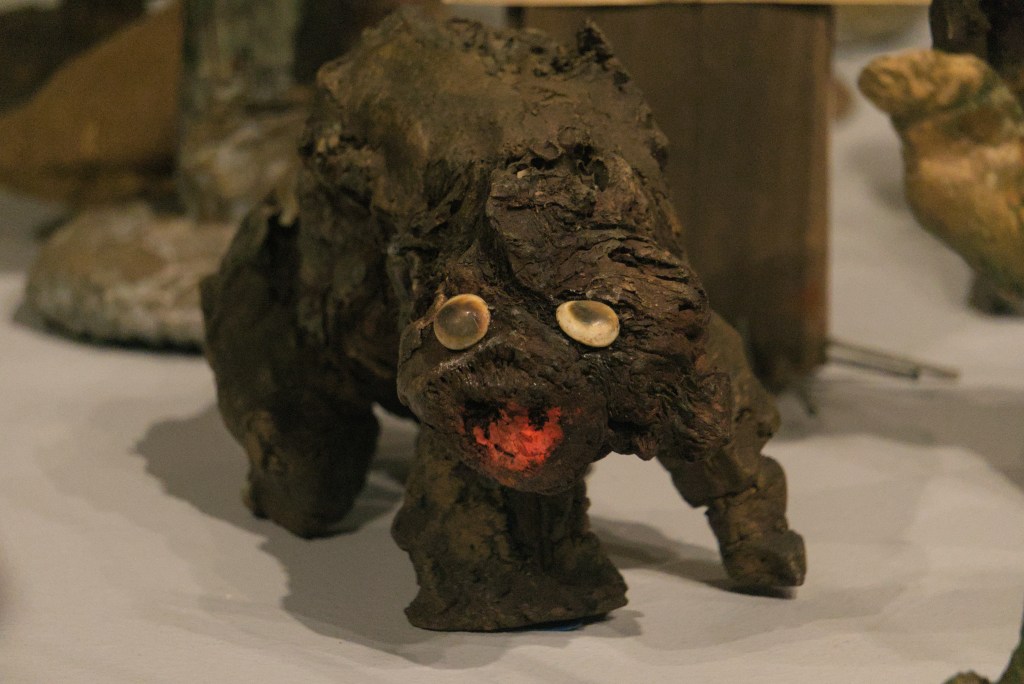
I was puzzled by the presence of what I thought might be a bear.
Manley suggested that it is probably a Gadarene swine from the story of Jesus healing a demoniac (Mark 5:1–20) but that it could also be from Annie’s “Valley of the Shadow of Death” scene, which featured a large human figure lying down on a piece of green shag carpet (a green pasture) surrounded by scary black and purple creatures.
Even in her lifetime, Manley informed me, Annie’s scenes were unfixed, constantly shifting and evolving. “Many of Annie’s figures played multiple roles,” he said. “If she had to move a scene to a different part of the house to make way for more, and the new location was too small to accommodate the entire scene, she would repurpose the ‘extras’ and make them part of some other scene. Her environment was not static—every time I went (perhaps 20 times?) a majority of the scenes would have been relocated and rearranged. Only a few ‘stayed put.’”[12]
Roger Manley, whose friendship with and research on Annie I’ve relied on extensively for this article, became the caretaker of Annie’s work after her death. He first encountered it in 1970 when, on Christmas break after his first semester at Davidson College, he was hitchhiking and happened to be picked up by one of Annie’s grandsons. Thinking Manley would be amused by his grandma’s sculptures, he brought him to the house. Manley was enthralled by what he saw. He took photos and returned many times since, each time developing a keener sense of responsibility to preserve the work for posterity.
At Manley’s behest, Catherine Peck, a graduate student in the folklore program at the University of North Carolina at Chapel Hill, spent August 1984 at Annie’s house in Buxton, labeling and photographing her work and interviewing her. When Annie died in 1986, she bequeathed all her sculptures to the Jargon Society in Highlands, North Carolina, which Manley helped arrange.
Ownership was transferred to North Carolina State University around 1988, when Manley curated the first solo exhibition of Annie’s work, A Blessing from the Source, at the university’s Visual Arts Center (now the Gregg Museum of Art & Design), showcasing six of her scenes and twenty-five photographs. The exhibition opened with an international symposium, the United States’ very first on visionary/self-taught/outsider art, which included participants from the Collection de l’Art Brut in Lausanne (Geneviéve Roulin), the Musgrave Kinley Outsider Art Collection (Monika Kinley), the Adolf Wölfli Foundation (Elka Spoerri), the Prinzhorn Collection (Inge Jádi), Rebecca Puharich (later to become Rebecca Hoffberger, founder of the American Visionary Art Museum in Baltimore), Roger Cardinal (author of Outsider Art, which named the “field”), John MacGregor (author of The Discovery of the Art of the Insane), Sam Farber (one of AFAM’s great champions, who largely funded their previous building next to MoMA), and others.
In 1995 Manley organized a much larger exhibition at NC State, A Multitude of Memory: The Life Work of Annie Hooper, that displayed the whole lot they had inherited.
In 2017 the Gregg Museum (of which Manley is the director) transferred the Annie Hooper Bequest to the Kohler Foundation for conservation treatment and stewardship. While many of the sculptures remain in the permanent collection of the Gregg and the John Michael Kohler Arts Center kept 233, the rest have been donated to nine other museums across the country—including the American Folk Art Museum, where I had the pleasure of being introduced to Annie’s work!
If you’d like to find out more about Annie Hooper, check out the freely accessible Digital Southern Folklife Collection at UNC, which houses four audio interviews and three on-site video tours with Annie, and the nineteen-page exhibition catalog from 1988, A Blessing from the Source.
All photos in this article, except the one of Annie Hooper, were taken by me (Victoria Emily Jones) at the multi-artistMultitudesexhibitionat the American Folk Art Museum in Manhattan in August 2022. The exhibition runs through September 5.
NOTES:
1. ^“The Life Summary of Edgar Ormond,”FamilySearch. Cf. Annie Hooper, interview by Catherine Peck, 1984, tape 1: Side 1, Catherine Peck Collection, 1981–1988, in the Southern Folklife Collection, Louis Round Wilson Special Collections Library, University of North Carolina at Chapel Hill, NC.
3. ^ Roger Manley, email to the author, August 23, 2022.
4. ^ Roger Manley, email to the author, August 21, 2022.
5. ^ “As for numbers of objects, there are about 2500 human and angel figures, dead babies, birds, crocodiles, sheep, lions, etc., and some 500 more ‘accessories’: bases for inserting artificial flowers, driftwood stumps that provided landscaping, gold-painted miniature furniture (all crudely made by Annie), textiles (shrouds, swaddling cloths, etc.), concrete food items (for various suppers and feasts, loaves and fishes). The original inventory included everything—bunches of plastic flowers, rotating color-wheel lights, garlands of tinsel—hence the 5000 number. The materials these were made of did not survive long-term storage, however; over time, low-grade plastics begin to turn gooey or brittle, tinsel sheds, etc., so the object count shrank.” Roger Manley, email to the author, August 21, 2022.
6. ^ Annie Hooper, interview by Catherine Peck, 1984, tape 6: Side 1.
Leroy Almon (American, 1938–1997), Mr. & Mrs. Satan Fishing, 1991. Polychrome bas-relief wood carving, 22 1/2 × 24 in. Gordon Gallery, Nashville.
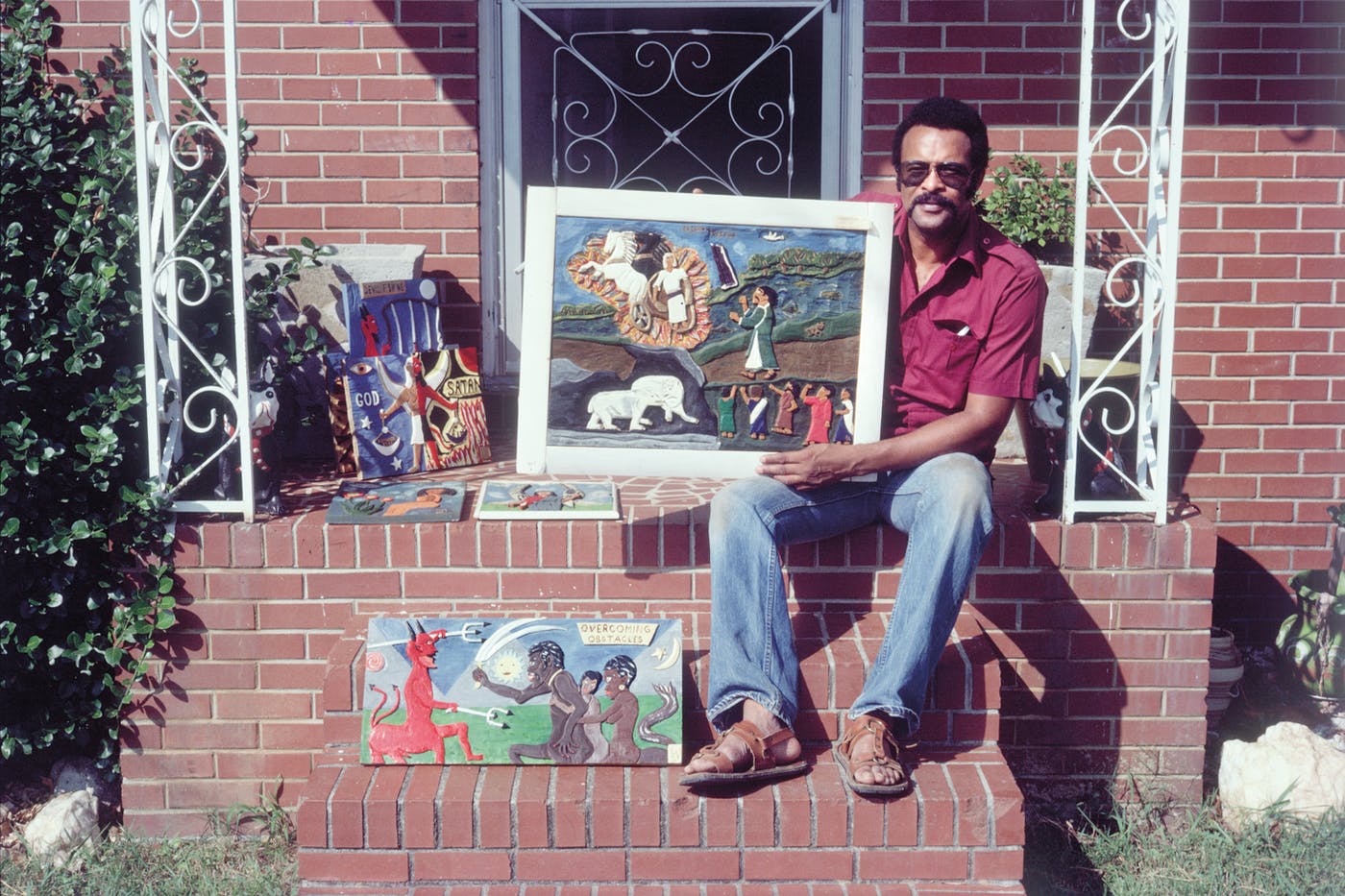
Leroy Almon (1938–1997) was born in Tallapoosa, Georgia, but grew up in Ohio. While working for Coca-Cola in Columbus, he met the self-taught woodcarver Elijah Pierce [previously] at Gay Tabernacle Baptist Church, where Pierce served as lay preacher, and in 1979 became apprenticed to him. Pierce taught Almon how to make low-relief carvings in wood using pocketknives and hand chisels, and then to paint them. Initially the two collaborated on pieces, until 1982, when Almon returned to Tallapoosa. There he restored his childhood home, converting the basement into an art studio. Like his mentor, he too combined the vocations of art making and evangelical preaching.
Almon is well known for his didactic carvings on the subjects of religion, politics, and African American history. The battle between good and evil is at the forefront of his art. Satan fishing for souls is a theme he developed and returned to many times in variation; see, for example, here, here, here, and here. Such carvings show a caricatured Satan (red, horned, spiky-tailed, and goateed) dangling various vices—gambling, promiscuity, sex, drugs, greed, hypocrisy, etc.—as bait before humans who appear ready to bite. Sometimes he’s joined by his wife, Mrs. Satan!
In the version at the Gordon Gallery in Nashville, cards, cash, a romantic couple (presumably unwed), alcohol, cigarettes, a bomb, hard drugs, and a church building are on the line. The latter symbolizes the false piety of many churchgoers and the corruption inside institutionalized Christianity.
In The New Encyclopedia of Southern Culture, Vol. 23: Folk Art, Jenifer P. Borum praises Almon’s ability to “mix fire-and-brimstone warnings about the world’s evils with a playful sense of humor”; she refers to the “comic moralism” of his work. My first reaction upon seeing Mr. & Mrs. Satan Fishing was to laugh out loud. But then I wondered whether the humor was intentional. Does the artist want us to chuckle? I haven’t been able to find any statements from Almon. The image likely represents very real temptations that afflicted his community and maybe, some of them, him personally. I suppose the humor could be self-conscious, but if so, it’s a dark humor—gravitas masked in levity. Almon knew that “like a roaring lion [our] adversary the devil prowls around, looking for someone to devour” (1 Pet. 5:8).
Leroy Almon on his front stoop in Tallapoosa, Georgia, 1987. Photo: Roger Manley.
LISTEN: “The Devil Ain’t Lazy” by Fred Rose; originally recorded by Bob Wills & His Texas Playboys, 1947 | Performed by Pokey LaFarge on Pokey LaFarge, 2013
The devil ain’t lazy (No siree) The devil ain’t lazy (No siree)
He roams around with sticks and stones Passing out his moans and groans The devil ain’t no lazy bones He works 24 hours a day
The devil ain’t lazy (No siree) The devil ain’t lazy (No siree)
He likes to see us fight and fuss Makes us mean enough to cuss Then he blames it all on us He works 24 hours a day
He travels like a lightning streak And he strikes from town to town Then he gets you when you’re weak He’ll tear your playhouse down
The devil ain’t lazy (No siree) The devil ain’t lazy (No siree)
He tells us he won’t hurt a fly Then he makes us steal and lie Keeps us sinning until we die He works 24 hours a day
The devil ain’t lazy (No siree) The devil ain’t lazy (No siree)
Gets his pitchfork out each night Gives the folks an awful fright I know he does it just for spite He works 24 hours a day
The devil ain’t lazy (No siree) The devil ain’t lazy (No siree)
Tells us how to find success I know he’ll wind up in distress I’ll tell ya why: the devil is an awful mess He works 24 hours a day
He likes to see things scorch and burn He don’t make no excuse If he catches you, he’ll turn you Every way but loose
The devil ain’t lazy (No siree) The devil ain’t lazy (No siree)
So if you think you’re strong and brave Smart enough to not behave You got one foot in the grave He works 24 hours a day 24 hours a day (Yes, he does!) He works 24 hours a day He works 24 hours a day
Jesus began his public teaching ministry by reading the following passage from an Isaiah scroll at his local synagogue:
The Spirit of the Lord is upon me, because he has anointed me to bring good news to the poor. He has sent me to proclaim release to the captives and recovery of sight to the blind, to let the oppressed go free, to proclaim the year of the Lord’s favor. (Luke 4:18–19)
Some theologians call this the Nazareth Manifesto. It’s Jesus’s inauguration speech, if you will, where he lays out his platform, his values, his mission.
The freedom that Jesus came to bring is not just spiritual, although it is at least that. It is also physical. He came to liberate us body and soul—from sin and its many ugly manifestations, both personal and systemic, that prevent us and others from thriving.
As we await Christ’s second advent, we can look forward to this promise: freedom is coming.
Jessie B. Telfair (American, 1913–1986), Freedom Quilt, Parrott, Georgia, United States, 1983. Cotton, with pencil, 74 × 68 in. American Folk Art Museum, New York.
When Jessie Telfair invoked the power of a single word repeated over and over in this quilt, she knew the word would reverberate through the history of the United States, back to the “peculiar institution” of slavery and the freedom that she was still struggling to attain in the 1960s at the beginning of the Civil Rights movement. The making of the quilt was incited by an incident she suffered in those years, when registering to vote was enough to cost this African American woman her job in a school kitchen. The bitterness of that experience still burned years later, and fellow quiltmakers urged her to express the pain through her art. Worked in the colors of the American flag, the quilt cries freedom. In a subtle metaphor, Telfair has set each repeated letter in its own block; all are visually related, but no two are alike.
LISTEN: “Freedom Is Coming” from South Africa, third quarter of 20th century | Performed by Kate Marks and friends on Circle of Song: Chants and Songs for Ritual and Celebration, 1999
Freedom is coming Freedom is coming Freedom is coming Oh yes, I know!
Jesus is coming Jesus is coming Jesus is coming Oh yes, I know!
This South African freedom song originated during the apartheid era (1948–1994). It’s one of the many songs collected by Swedish musician Anders Nyberg when he traveled with his choir Fjedur to South Africa in 1978 at the invitation of the South African Lutheran Church. Upon his return, “Freedom Is Coming” and other South African freedom songs and hymns were published in Sweden and soon after in the United States in the collection Freedom Is Coming: Songs of Protest and Praise from South Africa (Utryck, 1984), which is still in print. Fjedur’s performance of “Freedom Is Coming” at the Budapest Assembly of the Lutheran World Federation in 1984 was instrumental in disseminating the song around the world, and afterward it started appearing in more hymnals.
In September 2019 I visited Atlanta, Georgia, and one of the two art stops I made was the Clark Atlanta University Art Museum, whose purpose is “to collect, preserve, research, and exhibit fine art works that document the role of African Americans in American history and culture.” When I got there I was bummed to see that the museum was closed in preparation for three exhibitions that were to open that Sunday. But graciously, even though the signage and lighting hadn’t been installed and some of the objects were still being moved around, the curator allowed me in for a little glimpse.
I was stopped in my tracks by a mixed media sculpture in the gallery of recent acquisitions: Float by Alfred Conteh.
Alfred Conteh (American, 1975–), Float, 2014. Steel, epoxy dough, thermoadhesive plastic, atomized steel dust, atomized bronze dust, urethane plastic, steel chain, 93 × 46 × 35 in. Clark Atlanta University Art Museum, Atlanta, Georgia. Photo: Victoria Emily Jones.
It shows a Black female Christ figure rising up in a whirl of energy, her hat blown aloft. Wounds are visible on her hands and feet, but these are taken up into new, greening life. At the bottom is a broken chain, indicating that she has been set free. The piece expresses the exhilaration of emancipation, of being shackled no more.
I would classify Float as a resurrection image, which its staging reinforces. To its far left is a wooden crucifix by Dilmus Hall, followed by The Mourners by Frederick C. Flemister, from 1942. (Note that the two crucifix photos in this post are courtesy of the Souls Grown Deep Foundation, who donated the pieces to the museum.)
Dilmus Hall (American, 1896–1987), Untitled, n.d. Wood, wood putty, plastic beads, and paint, 12 × 9 in. Clark Atlanta University Art Museum, Atlanta, Georgia. Photo: Stephen Pitkin / Pitkin Studio.Frederick C. Flemister (American, 1916–1976), The Mourners, 1942. Oil on canvas, 39 3/4 × 31 1/4 in. Clark Atlanta University Art Museum, Atlanta, Georgia. Photo: Victoria Emily Jones.
Drawing on iconography of the Lamentation over the Dead Christ, Flemister’s The Mourners shows a mother holding the corpse of her grown son, who has just been deposed from a lynching tree. Behind her a woman in a pink dress throws up her arms in grief, and a preteen boy runs into his own mother’s arms for comfort. Like many artists before and after him, Flemister connects the killings of innocent Black men to the killing of Jesus—not because their deaths are salvific but because both they and Jesus were unjustly “crucified,” and because Black men bear God’s image, which the visual conflation reminds us of. As Jesus told his disciples, “Truly, I say to you, as you did it to one of the least of these my brothers, you did it to me” (Matt. 25:40).
Death and resurrection, suffering and hope, are the theme of this temporary exhibition. A second wooden crucifix, by Thornton Dial Jr., adorns the opposite wall. It’s titled I’ll Be Back, which, as the sculpture was made a few years after The Terminator came out, may be a playful reference to Arnold Schwarzenegger’s famous line, but it is first and foremost an affirmation that Jesus will return to earth, as promised, to fully set things right. (By the way, I wonder if Conteh, in making Float, was inspired by the hubcap component of another of Dial’s crucifixes . . .)
Thornton Dial Jr. (American, 1953–), I’ll Be Back, 1988. Wood, metal, barbed wire, string, fabric, industrial sealing compound, enamel, nails, 35 × 32 × 6 3/4 in. Clark Atlanta University Art Museum, Atlanta, Georgia. Photo: Stephen Pitkin / Pitkin Studio.
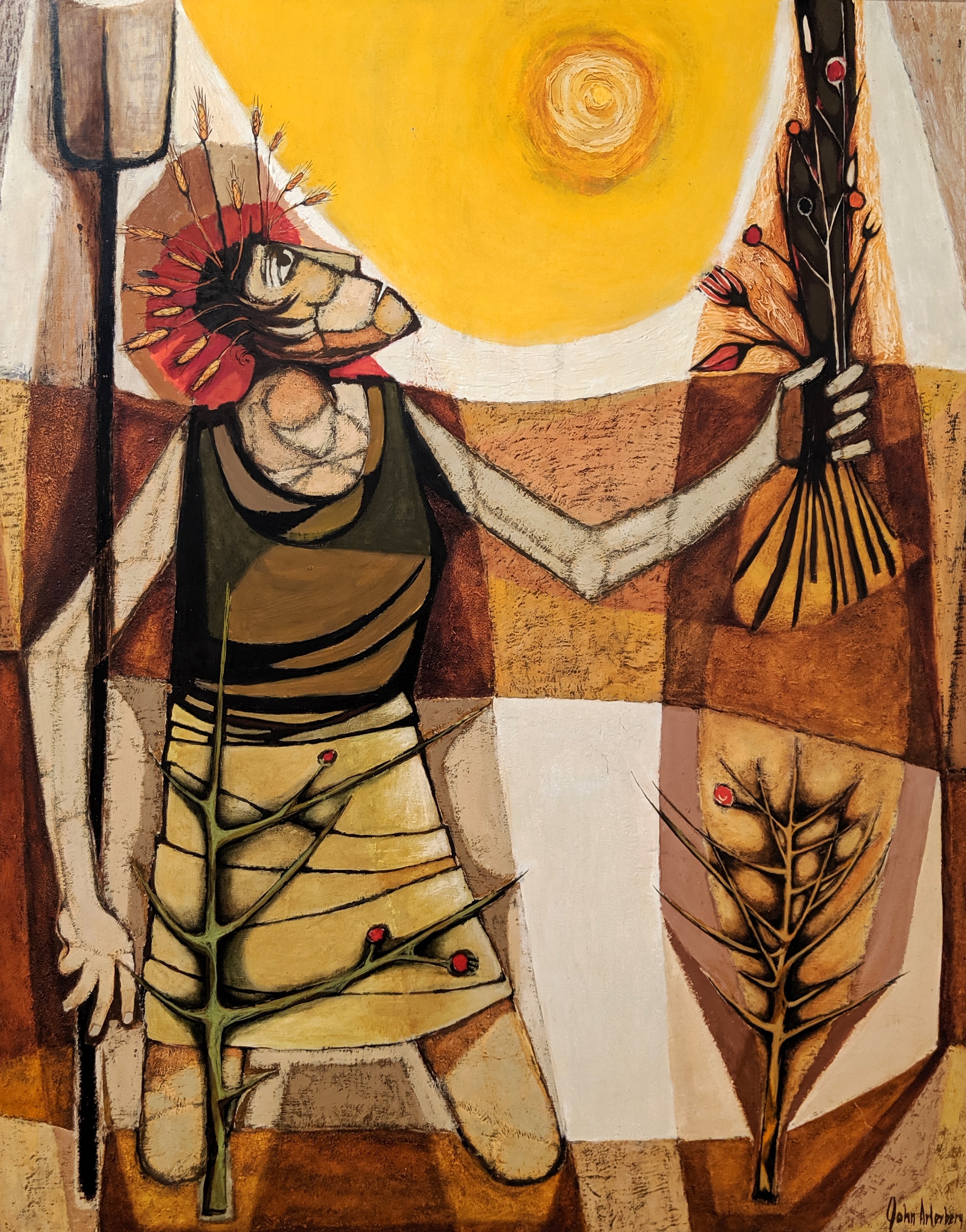
The last piece in the room is Ceres by John W. Arterbery. Ceres was the Roman goddess of agriculture, grain crops, and fertility, the equivalent of the Greek mother-goddess Demeter. In Arterbery’s painting she wears a crown of sprouting wheat stalks and holds a pitchfork in one hand and a leafless plant with buds and berries in the other. I think the flowers may be poppies, as Ceres is associated with those.
John W. Arterbery (American, 1928–1977), Ceres, 1963. Oil on Masonite, 60 × 47 1/2 in. Clark Atlanta University Art Museum, Atlanta, Georgia. Photo: Victoria Emily Jones.
It appears as though Arterbery is depicting the imminence of spring, when Ceres will be reunited with her daughter Proserpine (Persephone) and life will grow and flourish. It shows Ceres looking toward the sun in anticipation of such a time. Read in conjunction with the other pieces in the room, Ceres could be interpreted as an Advent image—a waiting for the final fulfillment of God’s good purposes for his creation, which includes a definitive end to suffering and oppression and a universal thriving.
The Clark Atlanta University Art Museum is typically open Tuesday through Friday from 11 a.m. to 4 p.m., as well as by appointment, but you may want to email ahead of time (cauArtMuseum@gmail.com) to confirm. It’s definitely worth a visit, though I can’t guarantee that the works featured here will be on display. If you wish to browse photos of pieces from the museum’s collection, see In the Eye of the Muses: Selections from the Clark Atlanta University Art Collection (2012).














 Art & Theology