Contemporary art roundup: Golden Madonna intervention, digitally printed glass, artists discuss sacred commissions, and more

EXHIBITION: Living by the Rule: Contemporary Meets Medieval, Sainsbury Centre, Norwich, May 16–October 4, 2026: Curated by Jessica Barker and Ed Krčma, Living by the Rule puts objects from medieval Benedictine monastic contexts into dialogue with contemporary artworks, creating a reciprocity and generating reflection on the rules we live by today—how we structure our everyday lives. For example, a set of mazers (drinking vessels used by monks) from Canterbury is juxtaposed with Andrea Büttner’s Table woodcut and an apartheid-era drawing of a Seder by the Jewish South African artist Vivienne Koorland. Three tapestries from Susan Morris’s SunDial:NightWatch series, recording the amount of ambient light the artist was exposed to during the years 2010, 2011, and 2012, are displayed alongside the San Zeno Wheel, a rare manuscript volvelle (a timekeeping device with movable, rotating discs) from ca. 1455 Verona, Italy (view photos here).

Danh Vo_Untitled (Crucifix)
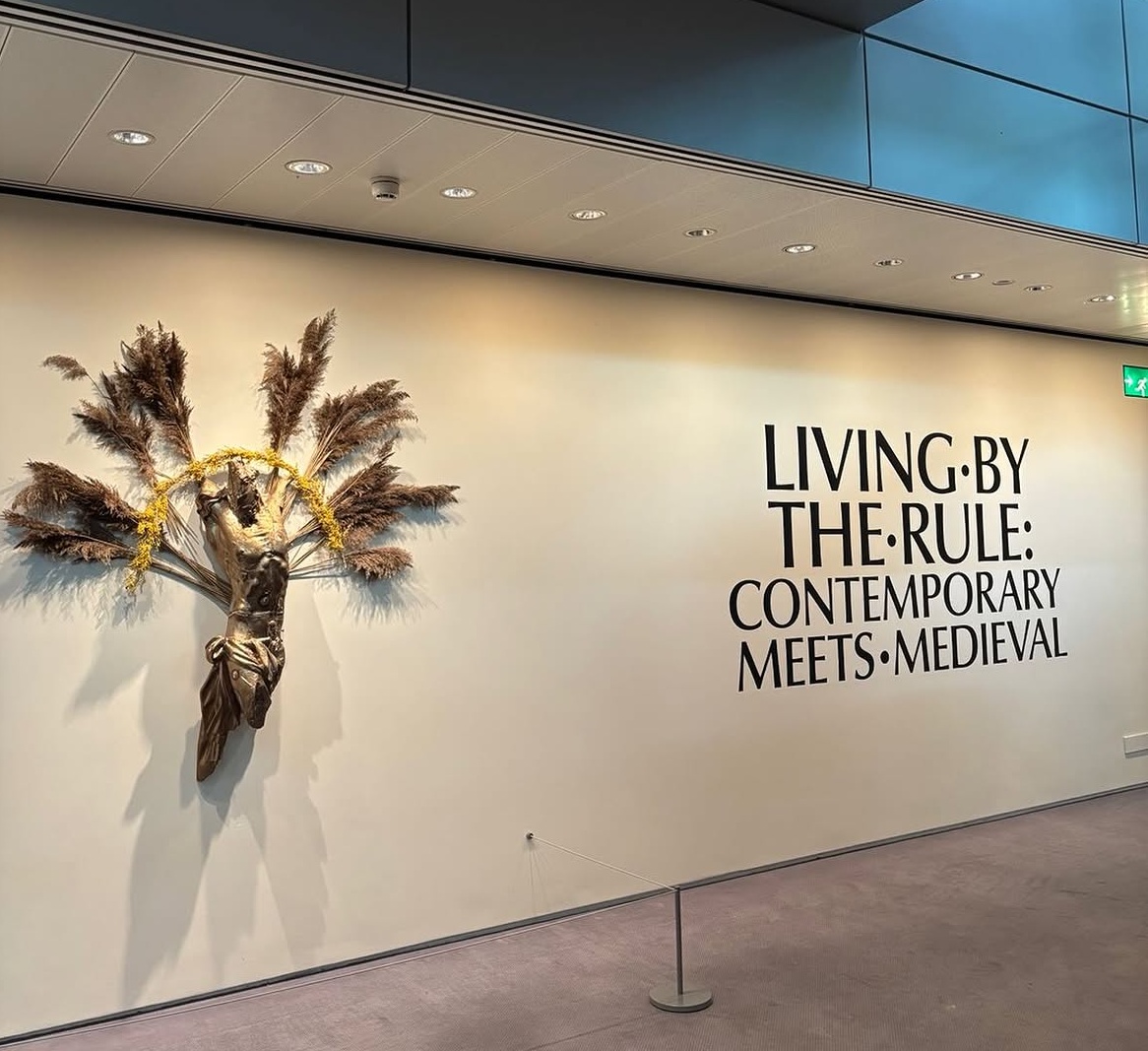
An untitled 2020 crucifix by Danh Vo—a bronze cast of a sixteenth-century Spanish corpus of Christ, decorated with pampas grass—hangs at the entrance to the exhibition Living by the Rule: Contemporary Meets Medieval at the Sainsbury Centre in Norwich, England.

The accompanying catalog will be published in the US in September. Here’s the press release.

+++

ARTWORKS:

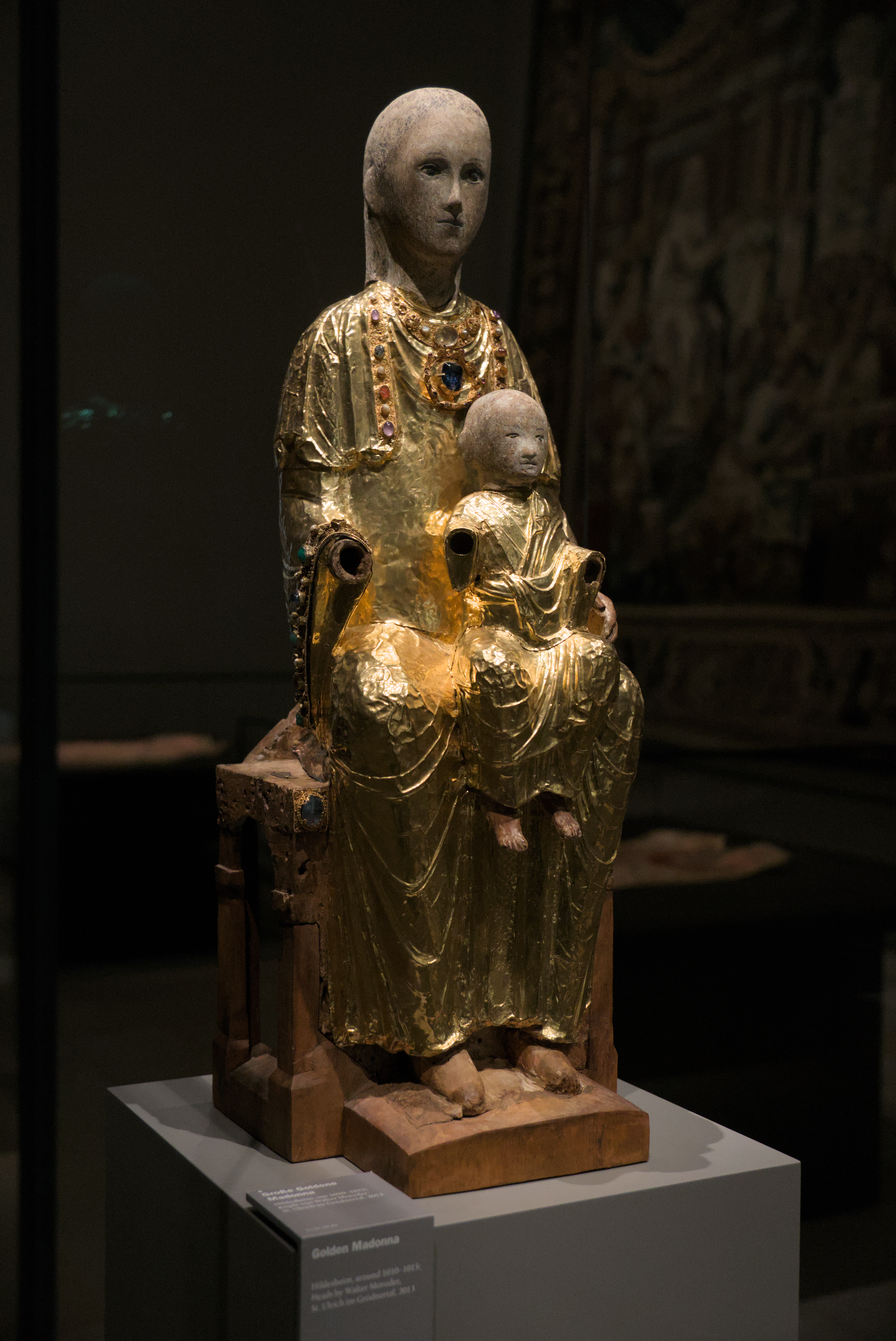
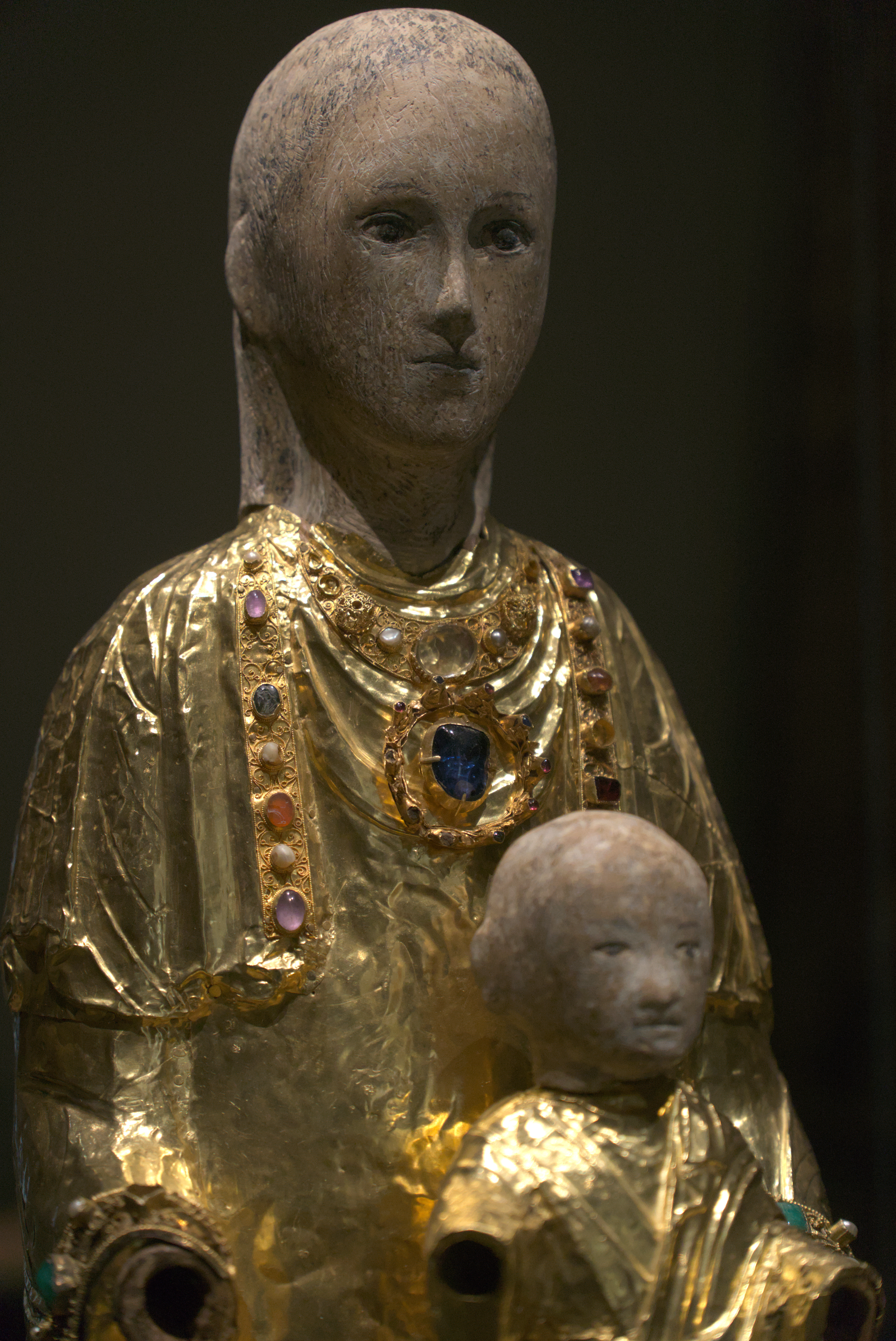
>> Golden Madonna, with heads by Walter Moroder: Last fall when I was in Germany, I took a day trip from Hanover to the city of Hildesheim (just a half hour south by train)—I wanted to see the fabulously painted ceiling of St. Michael’s Church, as well as the bronze Bernward Doors at St. Mary’s Cathedral. Well, the cathedral was closed for a funeral when I arrived, so while I waited for it to reopen, I spent time in the adjacent Dommuseum (Cathedral Museum) Hildesheim. There I saw this unusual-looking Virgin and Child sculpture, whose gold-plated limewood core looked medieval to me, but whose heads, also wooden, looked contemporary. The plaque underneath confirmed my suspicions, giving a date of 1010–15, “with heads by Walter Moroder, 2013.”

Golden Madonna
Golden Madonna, Hildesheim, ca. 1010–15, with heads by Walter Moroder, 2013. Gold sheet on linden wood core, filigree, precious stones, 56.6 × 25.5 × 25.2 cm. Cathedral Museum, Hildesheim, Germany, Inv. DS 82. Photo: Victoria Emily Jones.

Golden Madonna

Showing Mary enthroned with her son Jesus, the Golden Madonna of Hildesheim is one of the most important works of Ottonian art and, at over a thousand years old, is among the oldest three-dimensional sculptures in the medieval Latin West. It was probably commissioned by St. Bernward, bishop of Hildesheim from 993 to 1022. It stood on the high altar of Hildesheim Cathedral from at least the thirteenth century onward and was often carried in procession.

Its heavy liturgical usage led to the original heads, Mary’s left hand, and both the Christ child’s hands breaking off and becoming lost. The twentieth century saw a succession of restored heads, but the sculpture was exhibited more often without them, until recently. To commemorate a major interior redesign, the Dommuseum commissioned the contemporary South Tyrolean artist Walter Moroder to make new heads; he completed them in 2013, and they were attached in 2014. Moroder’s additions are not restoration-style but markedly contemporary, creating a compelling fusion of old and new while still honoring the sacred and historical significance of the object.

To learn more about this and other works in the cathedral museum, see the free e-book Medieval Treasures from Hildesheim.

>> Vitrail des cent visages (Stained Glass Window of 100 Faces) by Véronique Ellena and Pierre-Alain Parot: To commemorate the millennium of the 1015 founding of Strasbourg Cathedral, the French state commissioned a contemporary stained glass window to be installed in two unadorned bays in the cathedral’s Saint Catherine Chapel. The commission was awarded to the artist Véronique Ellena, who works mainly in photography, and the master glassmaker Pierre Alain Parot; the two worked together on a design, which was executed by GLASSOLUTIONS Saint-Gobain, who used their advanced Dip-Tech digital ceramic in-glass printer to reproduce Ellena’s photographs on glass—a groundbreaking technique. Parot then applied a blown glass second skin over the printed imagery.

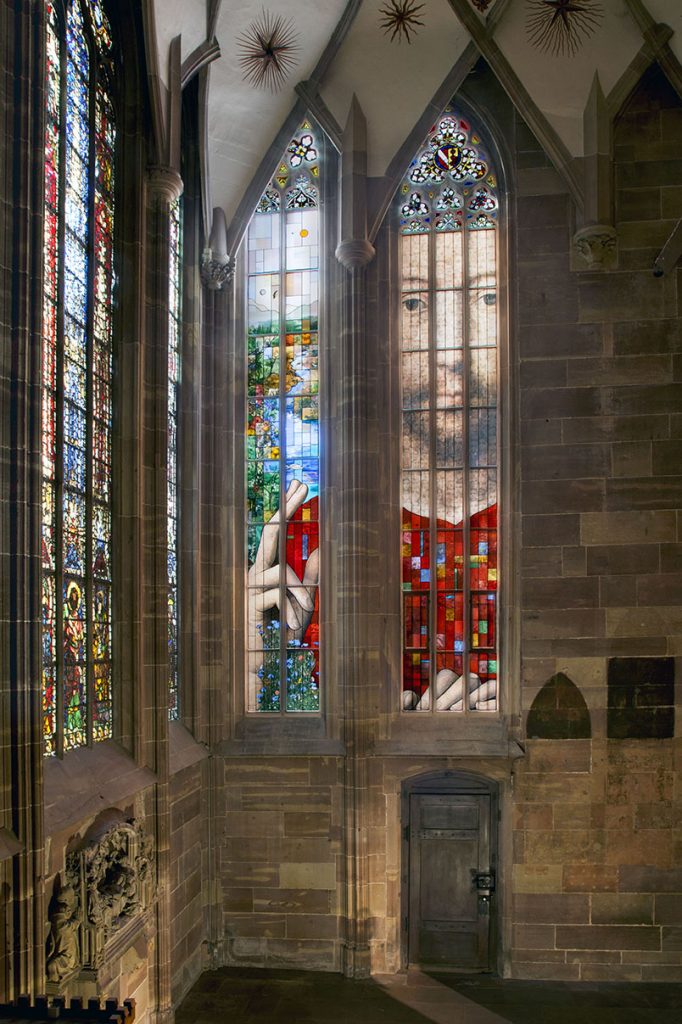
Installed in September 2015, the window features a half-length image of Christ, based on the early Netherlandish painting Christ Blessing by Hans Memling, but with the face made up of 150-some faces of everyday people who have come to the cathedral. This photomontage approach to imaging Christ—constituting his visage with those of diverse others—is profound, inviting connections to theological anthropology (humans being created in the imago Dei), the incarnation (God assuming ourflesh), and ecclesiology (the church as the “body of Christ”).

Strasbourg Cathedral stained glass
Véronique Ellena and Pierre-Alain Parot, Stained Glass Window of 100 Faces, 2015. Digitally printed glass, manufactured by GLASSOLUTIONS Saint-Gobain, height 7.8 m. Saint Catherine Chapel, Strasbourg Cathedral, Alsace, France.

Strasbourg Cathedral stained glass
Details

Ellena also uses photomontage to depict the natural world in the left bay—rivers, fields, forests, mountains, and sky, along with various flora and fauna. She may have drawn inspiration from an address St. Catherine of Alexandria (the chapel’s namesake) gave before Emperor Maxentius in the early fourth century, shortly before being martyred:

You admire this temple wrought by the hands of artisans; you admire its precious adornments which will be as dust before the face of the wind. You ought rather to wonder at the heavens and the earth, the land and the sea, and all the things that are in them; to wonder at the ornaments of the heavens, namely the sun and the moon and the stars, and at their servitude, whereby from the beginning of the world to the end thereof they run to the west and return to the east, night and day, and are not ever wearied. And when you have taken notice of these things, ask and learn who is more powerful than they! And when, by His own gift, you shall have come to know Him, . . . adore Him and glorify Him, for He is the God of gods and Lord of lords!

Ellena’s goal with the window, she said, was to convey “the beauty and diversity of the world.” View additional photos on her website, and on the blog of Jean-Yves Cordier. For making-of photos, see the website of the Fondation Bettencourt Schueller, who awarded the window a prize in 2016.

+++

VIDEO SERIES: Contemporary Artists and the Sacred Space: Conversations in London, presented by the Foundation for Spirituality and the Arts and Art + Christianity: I really enjoyed this four-part series of in-depth, on-site video interviews with artists Shirazeh Houshiary (her East Window at St Martin-in-the-Fields is phenomenal!), Christopher Le Brun, Graeme Mortimer Evelyn, and Victoria Rance, each focused on a single work of art commissioned from the artist for a place of worship in London. “The series explores the conception, process, and realization of each artwork, attending to the distinctive challenges and possibilities of creating art for sacred spaces. The interviews offer rare insight into this collaborative endeavor, revealing the artists’ practices alongside their reflections on the spiritual and religious dimensions of their work.” Here’s the trailer:

+++

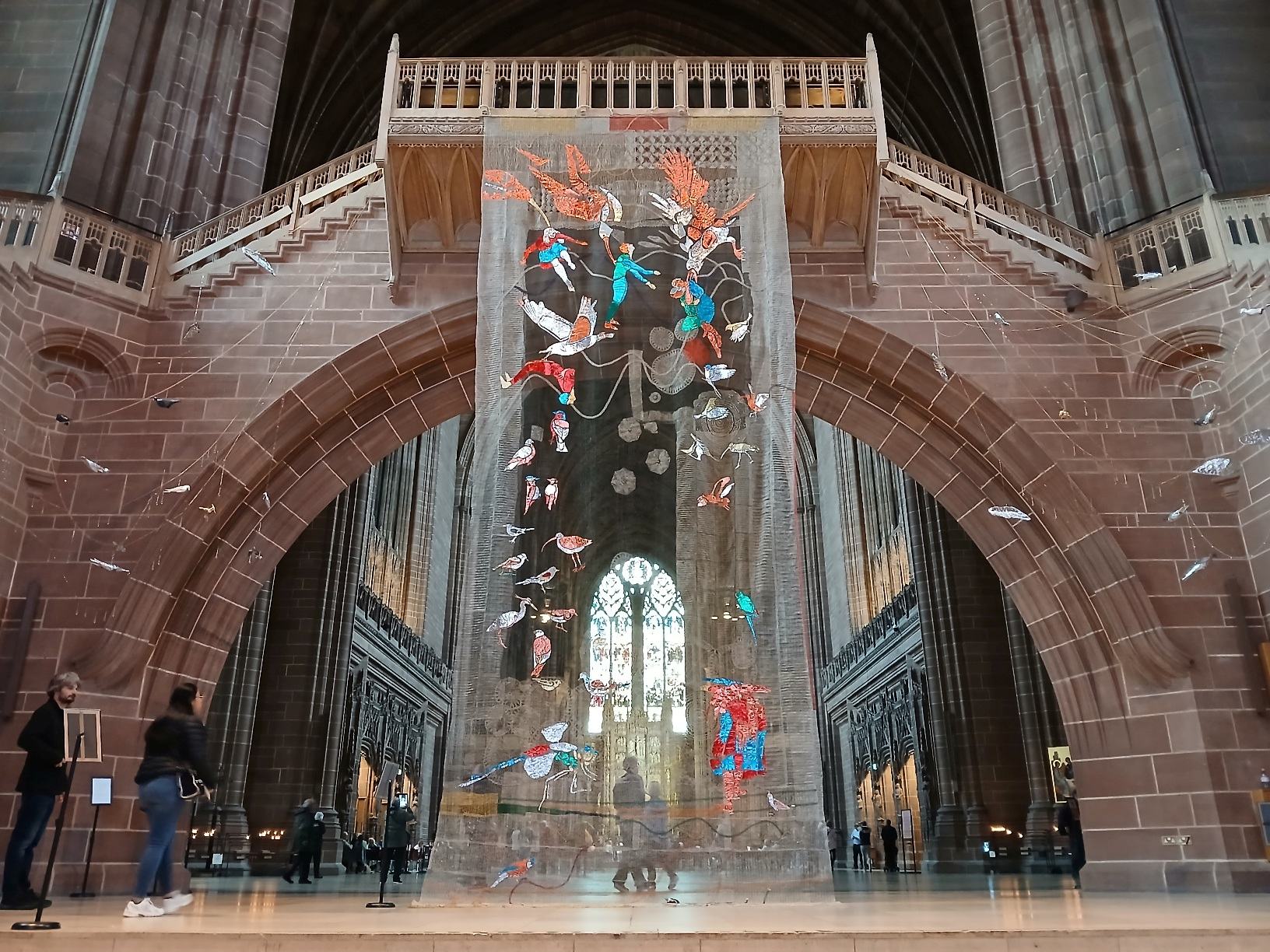
PODCAST EPISODE: “The Art of Liverpool’s Anglican Cathedral,” Exhibiting Faith: Host David Trigg and guest Laura Moffatt, director of Art + Christianity, explore a selection of modern and contemporary artworks displayed in Liverpool’s Anglican cathedral. (Links to the works discussed are at the bottom of the show notes.) Besides its several wonderful permanent installations, since 1999, Liverpool Cathedral has partnered with the Liverpool Biennial—the UK’s largest free festival of contemporary art—to host temporary installations, which last year comprised a monumental crocheted hanging by Maria Loizidou featuring migratory birds native to the Merseyside area, and a series of “glass collages” in the Lady Chapel by Ana Navas.

Frink, Elisabeth_The Welcoming Christ
Elisabeth Frink (British, 1930–1993), The Welcoming Christ, 1993. Bronze, height 5 m. Above the west doors of Liverpool Cathedral.

  • Loizidou, Maria_Where Am I Now (full)
  • Loizidou, Maria_Where Am I Now (detail)
  • Loizidou, Maria_Where Am I Now (detail)

+++

Because we’ve entered a new month, that means a new playlist! Here’s my thirty-song compilation for July:

Roundup: Religion and Contemporary Art

WEBSITE LAUNCH: The Foundation for Spirituality and the Arts: From a September 20 press release: “The Foundation for Spirituality and the Arts is pleased to announce the debut of our new website, fsa.art. Complementing in-person programming in Charleston and New York City, fsa.art functions as FSA’s online curatorial wing. It hosts both commissioned and curated content as well as a selection of features spotlighting significant artists, scholars, exhibitions, and publications from recent decades. We hope this site will be a valuable and inspiring resource that fosters dialogue, community, and innovation in the field of spirituality and the arts.”

FSA is “devoted to nurturing connections between spirituality and contemporary art. . . . By encouraging a mutual flow of creativity and faith from both artists and scholars, we hope to initiate fresh channels of spiritual enrichment from new depths of artistic expression. Nurturing innovative and experimental collaborations between a wide range of communities, we aspire to integrate estranged voices together in a spirit of harmony, openness, and inquisitiveness.”

At the heart of their programming is their annual series of residencies, open to visual artists, performers, composers, choreographers, curators, writers, and theologians. Visit their website to find out more, and follow them on Instagram @foundation.spirituality.arts. Below are four artworks I’ve encountered through their social media postings.

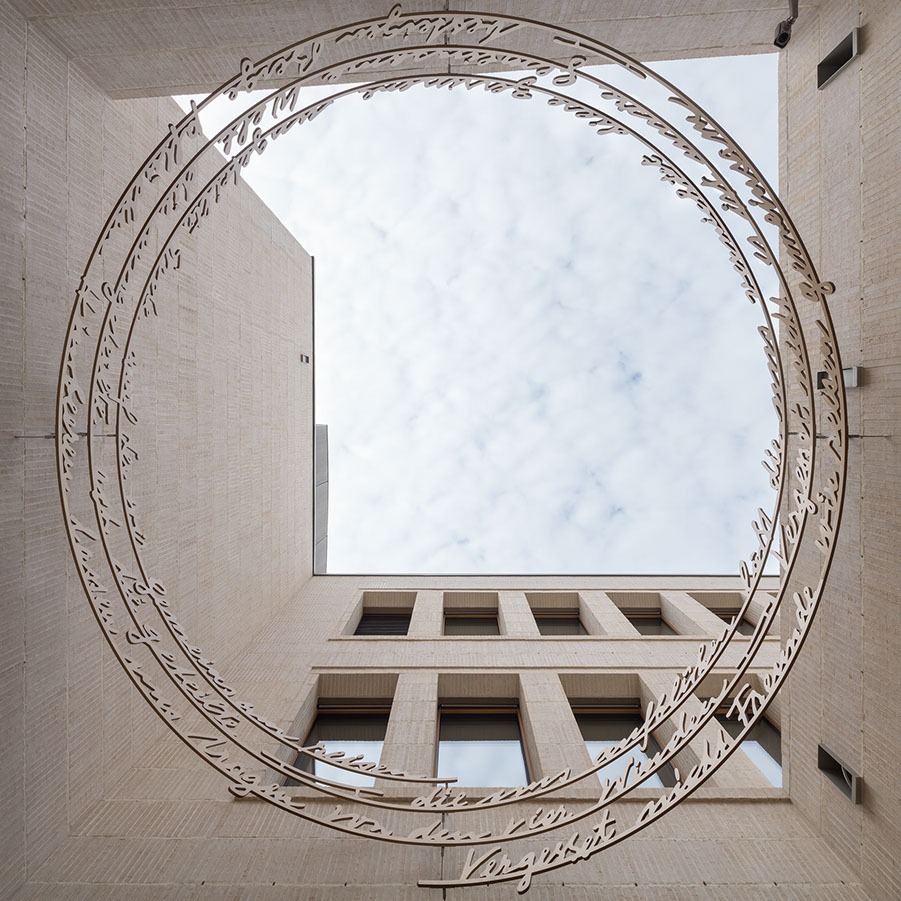
Kristen, Tom_Gemeinsam
Tom Kristen (German, 1968–), Gemeinsam (Together), 2019. Jewish Synagogue and Community Center, Regensburg, Bavaria. Photo: Marcus Eben. Floating above the center’s atrium, this gilded bronze spiral text is taken from Rose Ausländer’s poem “Gemeinsam”: “Vergesst nicht, Freunde, wir reisen gemeinsam. . . . Es ist unsre gemeinsame Welt.” (“Don’t forget, friends: we travel together. . . . It is our common world.”)

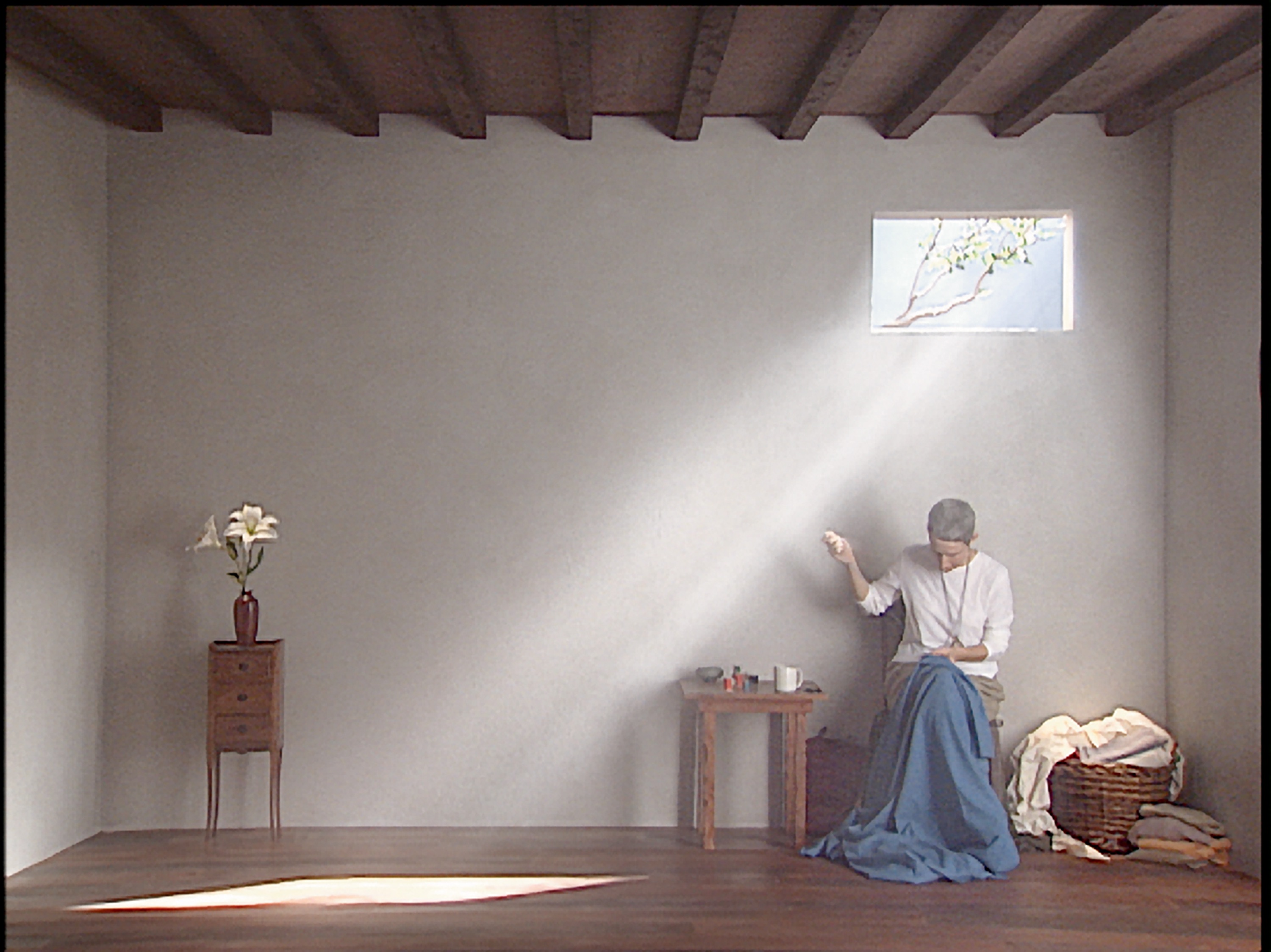
Viola, Bill_Catherine's Room (still)
Bill Viola (American, 1951–), Still from Catherine’s Room, 2001. Color video polyptych on five flat panel displays, 18:39 minutes, performer: Weba Garretson. Photo: Kira Perov, courtesy Bill Viola Studio.

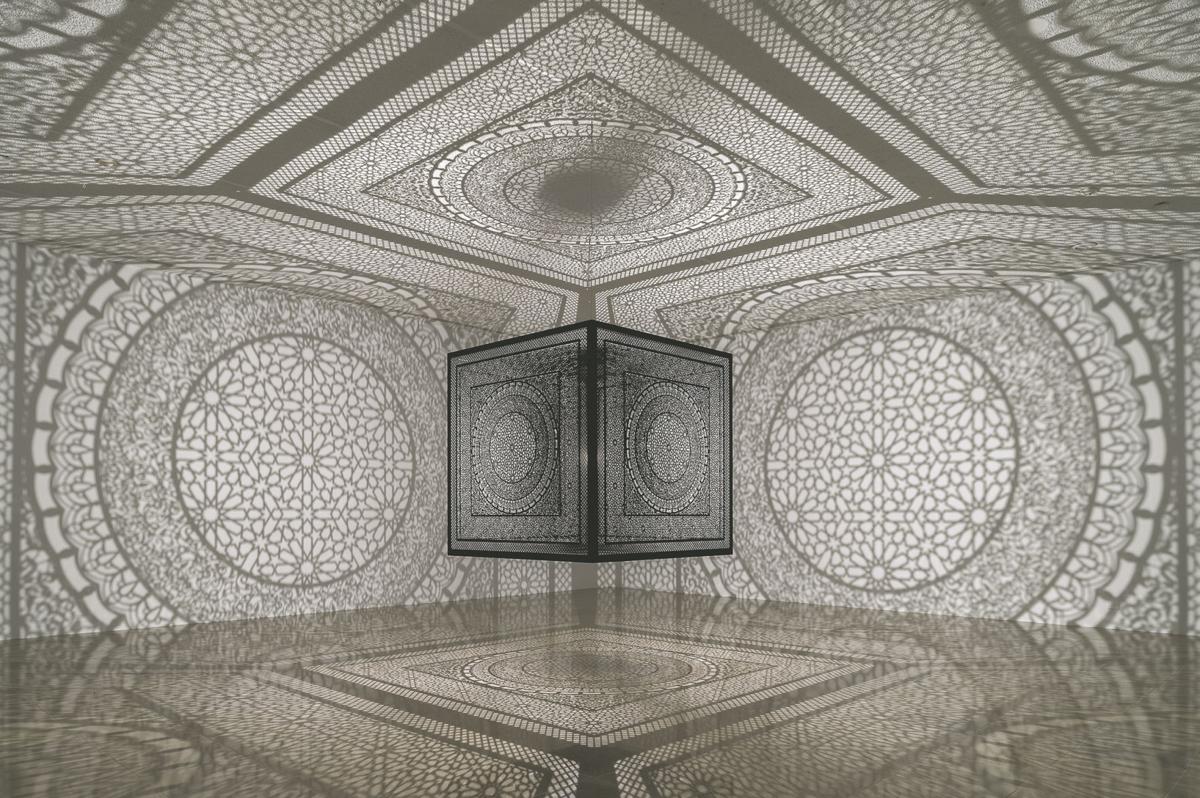
Agha, Anila Quayyum_Intersections
Anila Quayyum Agha (Pakistani American, 1965–), Intersections, 2013. Lacquered wood and halogen bulb, 78 × 78 × 78 in. (cast shadows: 43.5 × 43.5 × 16 ft.). Installation view at Rice Gallery, Houston, Texas, 2015.

Mingwei, Lee_Our Labyrinth
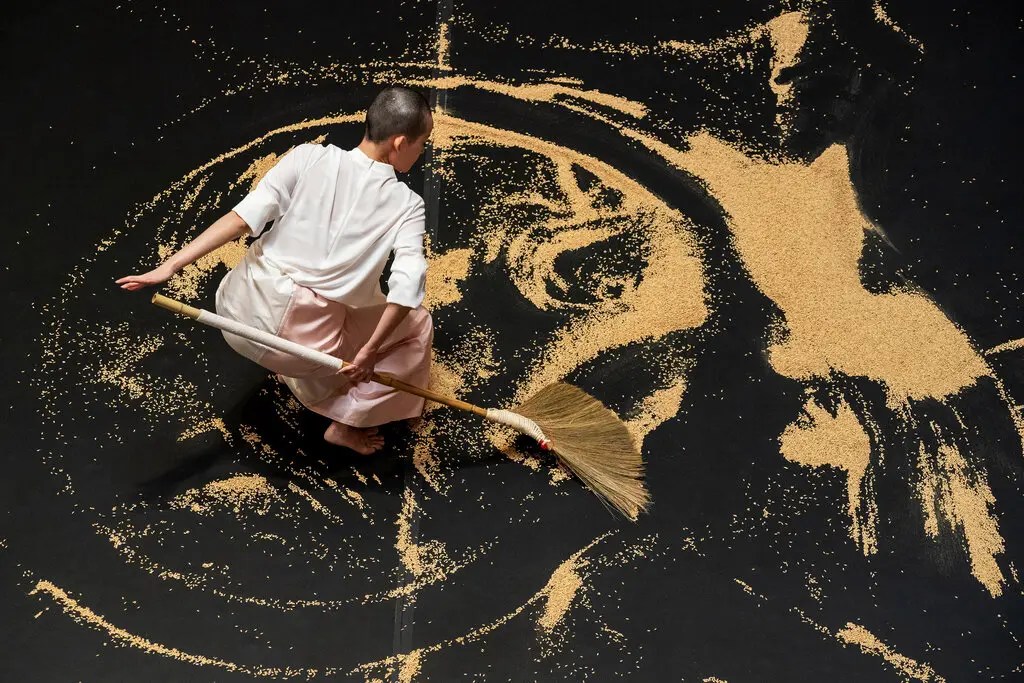
Lee Mingwei (Taiwanese American, 1964–), Our Labyrinth, 2015–present. Photo: Stephanie Berger. In this performance work, single dancers, dressed in floor-length sarongs and wearing ankle bells, take turns sweeping a mound of rice in patterns on the floor in a designated gallery space. This iteration from 2020 at the Metropolitan Museum of Art was a collaboration with choreographer Bill T. Jones, and the performer in the photo is I-Ling Liu. [Watch on YouTube]

+++

LECTURE: “The New Visibility of Religion in Contemporary Art” by Jonathan A. Anderson: Religion is becoming more visible in contemporary art and more discussable, says artist, art critic, and theologian Jonathan Anderson in his September 17 talk sponsored by Bridge Projects in Los Angeles. Danh Vo, Kris Martin, Andrea Büttner, Deana Lawson, Arthur Jafa, Genesis Tramaine, Hossein Valamanesh, Theaster Gates, Zarah Hussain, Francis Alÿs, Louise Bourgeois, Sol LeWitt, Sean Kelly, Gerhard Richter, James Turrell—these are just some of the many contemporary artists who have engaged substantively with religion in their work, either through form or content or through the ways in which they frame the work’s central questions. Curators and art historians are recognizing this more and more, and it’s being reflected in exhibitions and scholarship. Anderson highlights several such instances from the past two decades, celebrating religion’s increased visibility but also pointing out where there’s room for improvement. The talk starts at 6:36:

At 28:58, Anderson outlines four interpretive horizons, or fundamental hermeneutics, within which religion is becoming visible, intelligible, and meaningful in contemporary art: anthropological (31:00), political (37:43), spiritual (42:51), and theological (48:42). He discusses the problems and possibilities of each—ways in which it has been productive or insightful, and ways in which it’s limiting. The fourth horizon, the theological, is the least developed in the art world and the most contested, he says.

He concludes,

A more concentrated and well-developed mode of theological inquiry has much to contribute to the history, theory, and criticism of contemporary art without being reductive, but instead opening much of what’s going on in contemporary art. And so going forward, I do envision a mode of study that keeps all these horizons in view, and a mode of discourse that keeps all these horizons in view, while especially developing the potential for the modes of critical writing capable of addressing theological conceptualities, genealogies, and implications that are in play in so much of the art being made today. And that involves thinking better from both directions, developing concepts and capacities—skills, really—where art criticism might operate with a more agile, historically sensitive understanding of religion and theology (a richer theological intelligence), and theology might operate with a more agile, historically sensitive understanding of art and criticism (a richer art historical intelligence, or visual intelligence).

The last half hour is Q&A. What he says at 1:03:59 is fascinating! If you enjoyed this talk, check out, too, the one he gave ten years ago, “The (In)visibility of Theology in Contemporary Art Criticism,” which I published detailed notes on and which became a chapter in the book Christian Scholarship in the Twenty-First Century: Prospects and Perils, edited by Thomas M. Crisp, Steve L. Porter, and Gregg A. Ten Elshof.

As a side note, Anderson teaches two courses at Duke Divinity School, where he is a postdoctoral associate in the DITA program: “Contemporary Art and Theology” and “Visual Art as Theology.” The latter looks at the history of primarily Christian art as a domain of primary theological reasoning and biblical commentary, done in visual-spatial terms rather than in verbal-written terms. His hope is that divinity students—future biblical scholars, theologians, pastors, etc.—will become more literate in the visual-spatial forms of theology. I mention this because it’s what I’m about too!

+++

PODCAST EPISODE: “Jacquiline Creswell: Curating in Sacred Spaces,” Exhibiting Faith: Hosted by critic and art historian David Trigg, this is the first episode of a brand-new podcast about the intersection of art and faith, featuring a range of guests for whom those two elements have played a significant role. First up is Jacquiline Creswell, a visual arts adviser and curator who has, since 2009, organized more than forty-five exhibitions in sacred spaces. She has been central to the development of the visual arts programs at Salisbury, Ely, and Chichester Cathedrals. She discusses some of the projects she has worked on and how they’ve been received by the congregation and the wider public, how the setting of an artwork can alter its meaning and the way people engage with it, the logistical challenges of placing art in historic churches, and more.

I was interested to learn that she is from a Jewish background, even though most of her jobs have been with Christian institutions. Check out the eight objectives she lists on her website, which have guided her curatorial work and which I find exciting; the first is “To present artwork which is engaging, that encourages a spiritual response and may at times challenge conventional perceptions.”

Pope, Nicholas_Apostles Speaking in Tongues
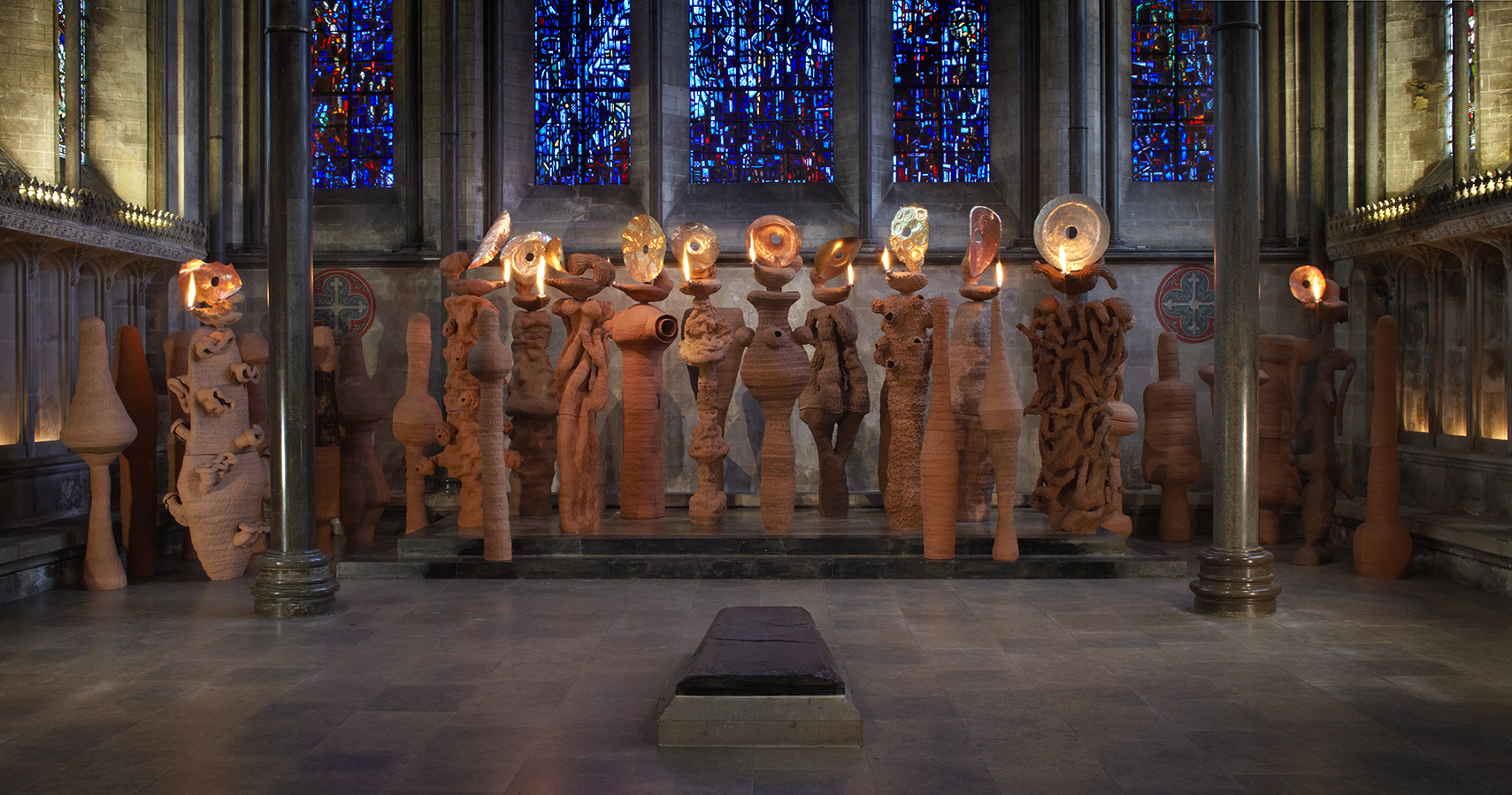
Nicholas Pope (British, 1949–), The Apostles Speaking in Tongues Lit By Their Own Lamps, 1996, installed 2014. Thirty-three figures in terracotta, metal, wick, paraffin, and flame. Trinity Chapel, Salisbury Cathedral. Photo: FXP, London.

Haebich, Jayson_Star of Bethlehem
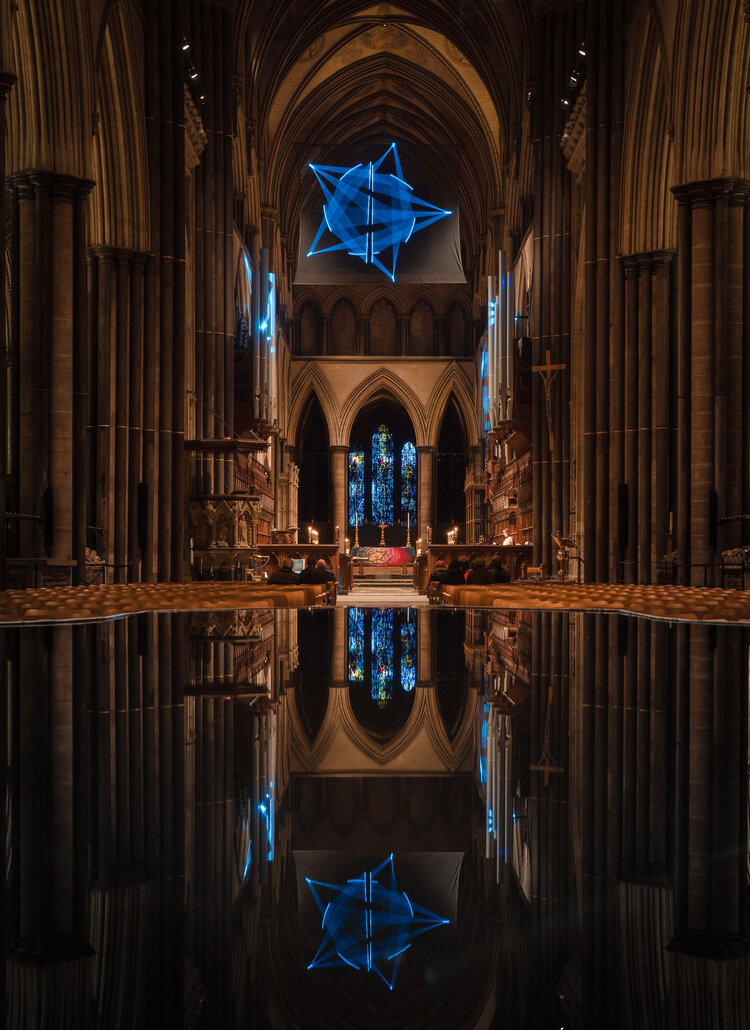
Jayson Haebich (born in Australia, living in Hong Kong and London), Star of Bethlehem, 2016. Interactive laser installation at Salisbury Cathedral, England.

New episodes of Exhibiting Faith are released once a month. The second (and latest) episode is an interview with Dubai-born, Birmingham-based textile artist Farwa Moledina, whose Women of Paradise (2022) scrutinizes the portrayal of Muslim women in the canon of Western art. Moledina also discusses her experience of Ramadan during lockdown and how it resulted in By Your Coming We Are Healed (2020), two sufras (floor mats for communal dining) made up of photographs of plated dishes submitted to her by participants in the virtual iftars she hosted, arranged according to Islamic design principles of symmetry, abstraction, and recurrence.

+++

SHORT FILM SERIES: At the Threshold: Theology on Film, dir. Sean Dimond: At the Threshold is the latest project from UNTAMED, a documentary film studio in Seattle that “pursue[s] stories of spiritual and narrative depth, with a bias for hope, risk, and redemption.” Filmed in Belgium, Germany, and the UK, it profiles six Christian theologians from Europe, each one humble, open-hearted, and reflective.

  1. “The Open Narrative of Love” with Lieven Boeve, Leuven, Belgium: Boeve reflects on how God interrupts people’s self-enclosed stories. Christianity, he says, is itself an open narrative, not a closed one, and it leads us not away from the world but right into it. One of the filming locations in this short is a rural landscape in Borgloon where Pieterjan Gijs and Arnout van Vaerenbergh built Reading between the Lines, an open-air chapel created to imagine a church inseparable from the world around it.
  2. “The Greater Part” with David Brown, St Andrews, Scotland: Brown talks about prayer, the Bible as part of a living tradition, the church’s call to be creatively other, and the only time he ever saw his father cry. He also cites some of the poets, novelists, and composers/singer-songwriters he admires.
  3. “The Radiance” with Perry Schmidt-Leukel, Muenster, Germany: “The fractcal structure of religious diversity” is of deep interest to Schmidt-Leukel, a Christian who draws insights from Buddhism and who was criticized by Cardinal Joseph Ratzinger for doing so.
  4. “Danseuse” with Ann Loades, Durham, England: A feminist theologian, Loades is one of only two people ever to be awarded a CBE for services to theology. The Christian tradition is responsible for the devaluation of women, she says, but that tradition also contains resources for its own transformation. She also discusses dance as prefiguring the resurrection body.
  5. “To Imagine That” with Garrick Allen, Glasgow, Scotland: Allen sees the book of Revelation as being about how to live in a system that is unjust. “This is John’s response to an oppressive system, and it gives us space to rethink what a just system would look like in our world—to begin to imagine that.”
  6. “Begin with the End” with Judith Wolfe, St Andrews, Scotland: “We have to take seriously the claim that we do not yet live in the world as it will be, and as we will be, and that we have to live towards an eschaton, a presence of God in the world, which is not only not yet apparent, but is not even comprehensible to us. So how do we live authentically in this life?”

From the studio: “Theology offers a home for the vast and the intimate. No question is foreclosed. Visually immersive, poetic, and global in scale, these narrative and theological short films invite viewers into a conversation about life and its limits which is as vibrant as it is challenging. This series isn’t about promoting theological ideas we necessarily agree with, but rather we are exploring the connections between vulnerable life, big questions, and the diversity of theological work being done today. It’s not that we are on the threshold of discovering God, but that perhaps God is already on the threshold of our lives, knocking to enter through our wounds, deepest desires, and questions.”