Advent, Day 3: Kingdom Come

LOOK: The Promise of Peace by Frank Wesley
Wesley, Frank_Promise of Peace
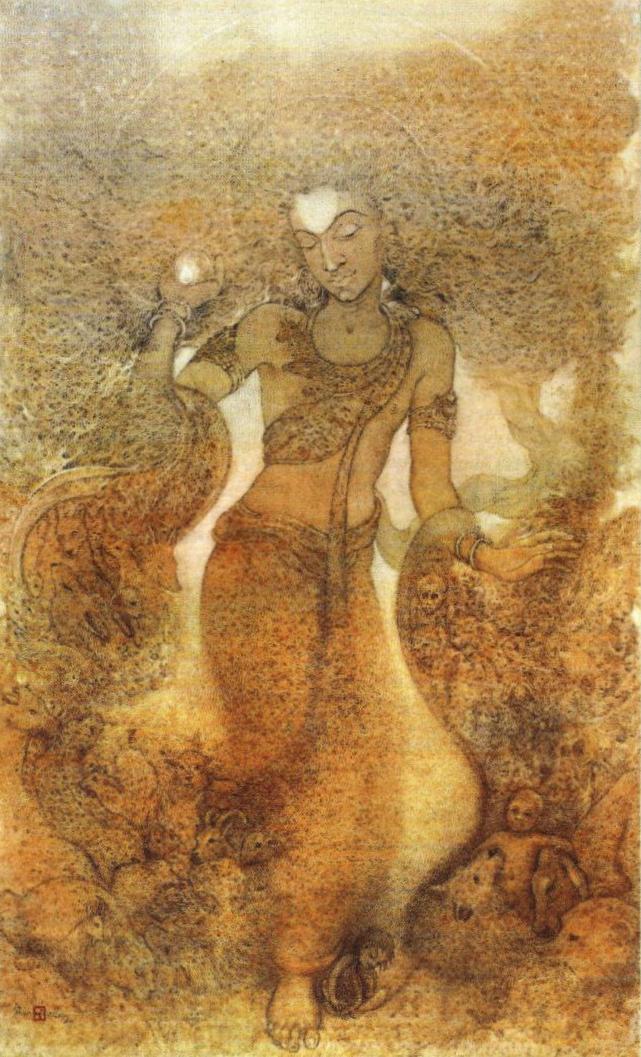
Frank Wesley (Indian, 1923–2002), The Promise of Peace, 1994. Watercolor, 50 × 30 cm.

Frank Wesley (1923–2002) [previously] is one of the twentieth century’s most celebrated Indian Christian artists. His watercolor The Promise of Peace appears on the cover of the March 1996 issue of Image: Christ and Art in Asia, the monthly magazine of the Asian Christian Art Association, which is where I sourced it from. Painted in warm brown earth tones and based on Isaiah 11:1–9, it shows an Indianized Jesus ushering in the peaceable kingdom of God. The ACAA provides the following commentary:

Christ is the shoot rising from the stump, and the Spirit of the Lord’s presence is shown in the white egg/flame/pearl in the upraised right hand and in the white heart shape centred on Jesus’ brow. A faint halo encircles his head, while a second halo sweeps from the right hand down to the left hand, under which the needy of the land shelter. The little child living at peace with many different animals is visible in the bottom right-hand corner, and the child playing unharmed with the viper is seated at the foot of Jesus. On the left-hand side of the painting a wide variety of creatures are playing happily together. The bracelet on Jesus’s left upper arm carries the symbol for Peter while that on the right upper arm signifies Paul. The symbols of the four gospel writers can be seen in the necklet.

(Related post: https://artandtheology.org/2020/12/03/advent-day-5-peace/)

LISTEN: “O Lord, May Your Kingdom Come” | Words by Greg Scheer, based on Isaiah 11:6–9, 2014 | Music by Eric Sarwar, based on the Raga Mishra Shivranjani, 2014 | Led by Eric Sarwar at the Calvin Symposium on Worship, 2019

Refrain:
اے خدا تیری بادشاہی آئ
(Transliteration: Aey Khuda, teri badshahi, aey)
O Lord, may your kingdom come

Where the wolf and lamb
Shall lie down as kin
And a child shall lead them [Refrain]

Where the cow shall graze
And its calves will play
With the cubs of the lion [Refrain]

Where the babe in arms
Shall fear no harm
From the snake or the adder [Refrain]

May your kingdom come
May your will be done
On earth as in heaven [Refrain]

Born and raised in Pakistan, Rev. Dr. Eric Sarwar is a musician, global missiologist, and the pastor of Artesia City Church in Southern California, made up of Indian and Pakistani immigrants. He is also the founding president of the Tehillim School of Church Music and Worship in Karachi, which fosters the academic study of the ethnomusicology, missiology, and tradition of Christian worship in communities across Pakistan and the overseas diaspora. He plays the harmonium and is fluent in English, Hindi, Punjabi, and Urdu. He is the author of Psalms, Islam, and Shalom: A Common Heritage of Divine Songs for Muslim-Christian Friendship (Fortress Press, 2023) and is a frequent organizer of zabur (psalm) festivals.

In the video above, extracted from a Vespers service, Sarwar leads attendees of the 2019 Calvin Symposium on Worship in Grand Rapids, Michigan, in an anthem he wrote with Greg Scheer, joined on stage by other musicians from the symposium. The refrain is in Urdu and English.

Purchase sheet music here.


This post is part of a daily Advent series from December 2 to 24, 2023 (with Christmas to follow through January 6, 2024). View all the posts here, and the accompanying Spotify playlist here. “O Lord, May Your Kingdom Come” is not on Spotify.

“The Visitation” by Calvin B. LeCompte Jr. (poem)

Wesley, Frank_Visitation
Frank Wesley (Indian, 1923–2002), Mary Going to Visit Elizabeth, n.d. Egg tempera, 20 × 25 cm. Source: Frank Wesley: Exploring Faith with a Brush, p. 173

To Elizabeth she came,
over the hills,
bearing the Lord flowering in her womb—

sacrament of her flesh,
bud richly taut—

the warmth of her
containing His infinity,
the sun His fire.

The dark earth of her body
seemed to encompass all things.
The terraced fields of Juda
pregnant with seed
called out to her
as she passed,
praising the Child
she was yet to bear,
invoking His blessing
on their expectancy.

These must call out,
full in their fullness,
barren beside hers,
then how should a child
six months conceived
adore with stillness
in his mother’s womb?

“The Visitation” by Calvin B. LeCompte Jr., based on Luke 1:39–45, appears in I Sing of a Maiden: The Mary Book of Verse, ed. Sister M. Thérèse (New York: Macmillan, 1947).


In this poem Calvin B. LeCompte Jr. compares the embryonic Christ to a flower bud about to bloom from the warm, dark seedbed of Mary. The glorious abundance of the spring hills, he writes, is nothing—“barren beside hers”—compared to the abundance and glory Mary holds within her, soon to be revealed. LeCompte personifies the Judean countryside that Mary passes through, in her first trimester, on her way to her cousin Elizabeth’s house, who is herself six months pregnant. Like these women, the fields are “pregnant with seed.” And they recognize with reverence the Christ who travels past them, borne in the womb of his mother. They (the grasses) wave, they bow; they call out to him, seeking blessing. If even nonhuman nature is moved by the as-yet-latent Jesus and can’t help but react with praise, then how much more ought the unborn John, kinsman and appointed forerunner, to leap and rejoice when, momentarily, his mom and Jesus’s embrace belly to belly and sing Magnificat.


Calvin Byrd LeCompte Jr. (1922–2001) was a Black Catholic educator, musician, literary critic, and occasional poet from Washington, DC, the son of a prominent medical doctor. He earned a BA in English in 1943 and an MA in linguistics in 1948, both from the Catholic University of America, and he attended a number of the “literary salons” Ezra Pound held at St. Elizabeths Hospital in DC while Pound was a psychiatric patient there. LeCompte also studied piano under Cecil Cohen, giving lecture-recitals at colleges around the country in the late forties, and taught voice at the Frederick Wilkerson Studio for some twenty years. He then went on to serve for twenty-three years as music director at Epiphany Catholic Church in Georgetown, as well as music director at the classical radio station WGMS, where he created and hosted the program Music in Our Time as a showcase and teaching forum for contemporary classical music. A professor of English and music at the University of the District of Columbia, he also lectured at Howard University, Temple University, the University of Pennsylvania, the Kennedy Center, the Opera Guild, and the Folger Library. In addition, he translated in eight languages for the National Catholic News Service.

Christmas, Day 9

LOOK: Holy Family in Saffron by Frank Wesley

Wesley, Frank_Holy Family
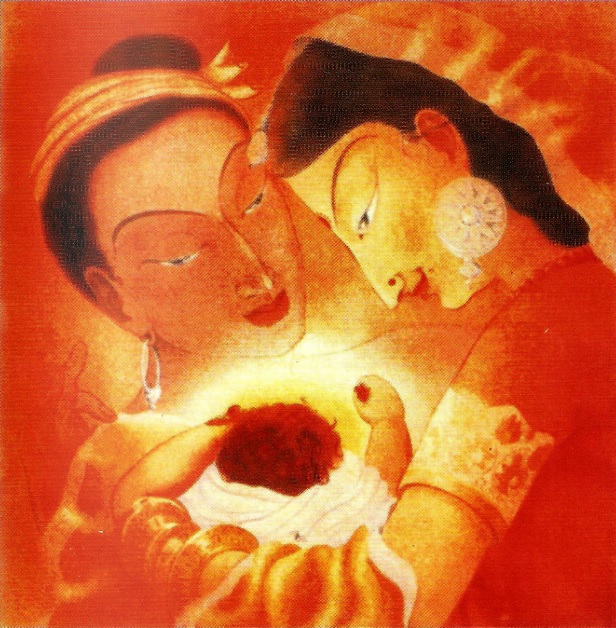
Frank Wesley (Indian, 1923–2002), Holy Family in Saffron, ca. 1950. Watercolor, 21 × 16 cm. Gould Collection. Photo courtesy of the Asian Christian Art Association.

Frank Wesley [previously] was a fifth-generation Christian from North India who began painting biblical subjects in 1947 when the Christian Home Committee of the National Christian Council of India began licensing original images from him for their magazine, a relationship that lasted for decades. His initial training had been in commercial art, but from 1950 to 1952 he studied as a postgraduate at the School of Art in Lucknow under the Hindu artist Bireshwar Sen, kickstarting his fine-art career. The Lucknow school of watercolor painting, developed during the Bengal Renaissance in the first half of the twentieth century, is the style with which he is most associated, and which the above painting is representative of, with its graceful, calligraphic lines.

With the aid of an American patron, Wesley continued his art education at Kyoto Art University from 1954 to 1958, where he learned traditional and modern Japanese painting techniques, lacquer work, textile design, woodblock printing, and ink drawing, and in Chicago from 1958 to 1960, which included coursework at the Art Institute, where he learned about modern abstraction and how to work with oil paint.

Wesley returned to India in 1960 and, after a four-year courtship, married Athalie Brown, an Australian nurse working in a mission hospital in Azamgarh. They had two children. Seeking better opportunities, he emigrated to Australia with his family in 1973 and lived there until his death in 2002. Even in his new adopted country, he continued painting biblical scenes in an Indian style.

You can view thumbnails of other paintings by Frank Wesley at www.frankwesleyart.com. For better-quality reproductions along with more detailed biographical information, there’s the book Frank Wesley: Exploring Faith with a Brush by Naomi Wray (Auckland: Pace Publishing, 1993), but it’s out of print and difficult to find.

LISTEN: “Joseph Dearest, Joseph Mine” (original: “Josef lieber, Josef mein”) | Traditional German carol, 14th century (tune: RESONET IN LAUDIBUS) | English translation of verses by Percy Dearmer,* 1928; refrain translated by Edward T. Horn III, 1958 (from the carol “Long Ago and Far Away”) | Arranged and performed by Blue Water Highway on Christmastide, 2014

“Joseph dearest, Joseph mine,
Help me cradle the Child divine.
God reward thee and all that’s thine,
In paradise,” so prays the mother Mary.

He came among us at Christmastide,
At Christmastide, in Bethlehem;
Men shall bring him from far and wide
Love’s diadem: Jesus, Jesus,
Lo, he comes, and loves, and saves, and frees us!

“Gladly, dear one, Lady mine,
Help I cradle this Child of thine.”
“God’s own light on us both shall shine,
In paradise,” as prays the mother Mary.

All shall come and bow the knee;
Wise and happy their souls shall be,
Loving such a divinity as all may see
In Jesus, son of Mary.

Sweet and lovely, little one,
Princely, beautiful, God’s own Son,
Without thee all of us were undone;
Our love is won by thine, O son of Mary.

* Some sources cite Neville S. Talbot as the translator; I’m going with The Oxford Book of Carols, whose original 1928 edition, and subsequent ones, name Dearmer.

RESONET IN LAUDIBUS (Let the voice of praise resound) is a fourteenth-century German carol tune associated with a carol text of the same name as well as with “Josef lieber, Joseph mein.” The latter carol is from a medieval mystery play from Leipzig that survives in multiple manuscripts. It spotlights Joseph’s faithful presence and loving support during Christ’s infancy.

The original carol did not have a refrain; an unknown editor spliced that in from a different fourteenth-century German carol at some point, but it still often circulated with the verses only, including in the earliest English translations. In 1958, however, the American pastor Edward Traill Horn III (1909–1994) translated the refrain from German into English for incorporation into a new Christmas carol he wrote, “Long Ago and Far Away.” Blue Water Highway uses verses and refrain for their recording “Joseph Dearest, Joseph Mine.”

Find free sheet music here.

If you prefer choral music, I really like Kirke Mechem’s arrangement of the carol, from his Seven Joys of Christmas suite, as performed by the Stanford University Chamber Chorale and Orchestra under the direction of Stephen M. Sano.

See also the recording on Vaughan Williams: An Oxford Christmas (2021), where it appears under the title “Song of the Crib.”

“The Recompense” by John Banister Tabb

Wesley, Frank_Mary at the Tomb
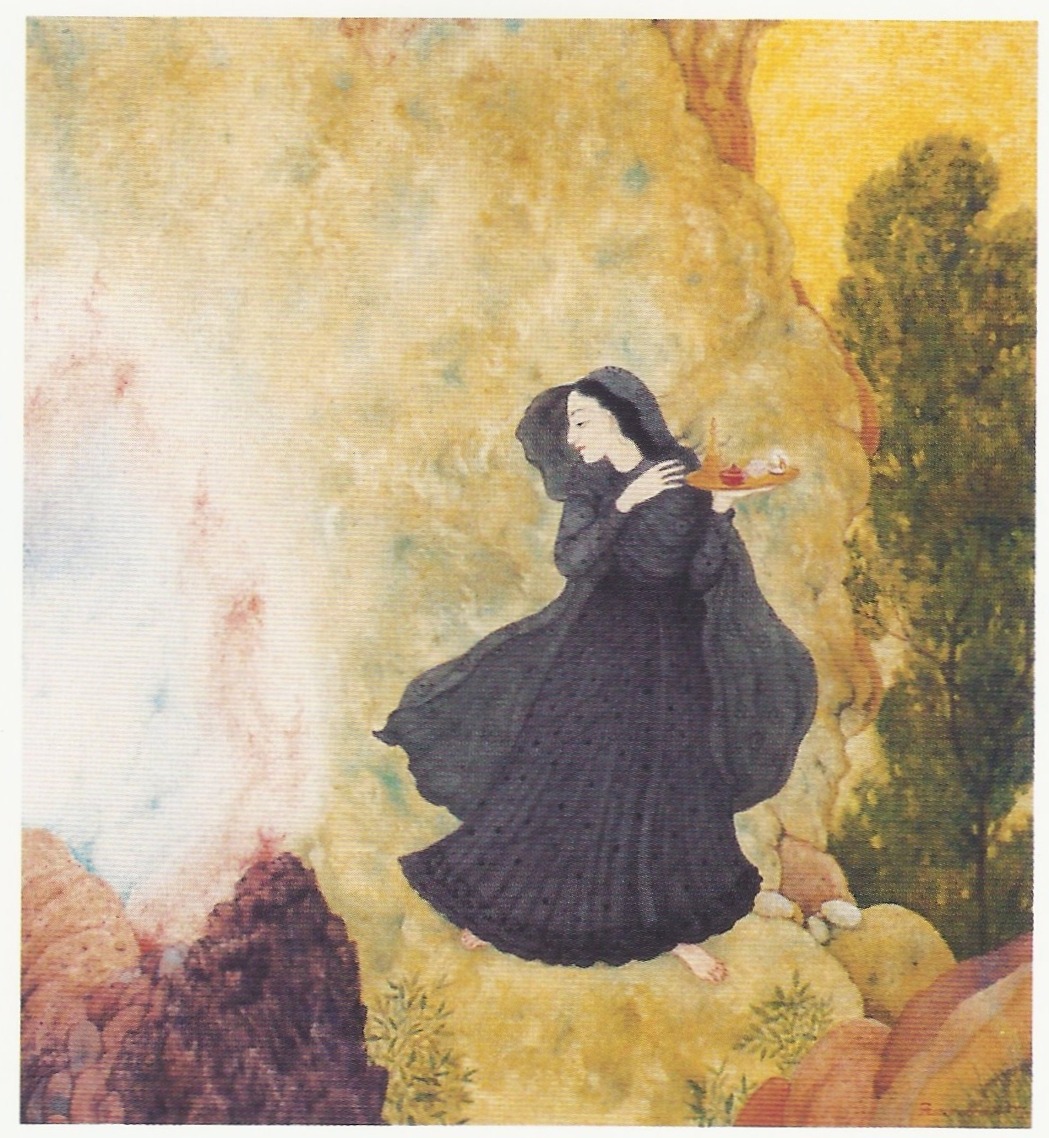
Frank Wesley (Indian, 1923–2002), Mary at the Tomb, ca. 1991. Watercolor, 25 × 20 cm. Published in “Frank Wesley: Exploring Faith with a Brush” (Auckland: Pace, 1993).

She brake the box, and all the house was filled
With waftures from the fragrant store thereof,
While at His feet a costlier rose distilled
The bruisèd balm of penitential love.

And lo, as if in recompense of her,
Bewildered in the lingering shades of night,
He breaks anon the sealèd sepulcher,
And fills the world with rapture and with light.

“The Recompense” by John Banister Tabb was originally published in Poems by John Banister Tabb (Boston: Copeland and Day, 1894) and is now in the public domain.

This short poem—just two quatrains with an abab cdcd rhyme scheme—draws on Luke 7:36–50. In this Gospel episode, Jesus is dining at the house of Simon the Pharisee when an unnamed “sinful woman” enters with an alabaster jar of precious ointment, which she pours lavishly onto Jesus’s feet in an act of love and gratitude, and in recognition of his messianic identity. So humbled is she by Jesus’s forgiveness of her sin that she is in tears. (Note: Tradition says this woman was Mary Magdalene—based in part on a conflation with the similar account in John 12:1–8, which names the woman Mary.)

Of even more value to Christ than the essential oils, Tabb suggests, is the woman’s “penitential love,” a balm before his wounds. Her beautiful, bruised soul, like a rose, releases such an aroma, though the Pharisees can’t smell it, and they try to shame her. Not long hence Jesus returns her tenderhearted gesture, opening another stone container (his tomb) and spilling forth life and light and bliss, priceless treasures, onto his beloved world. He meets Mary in her bewilderment on that first Easter morning, lavishing on her all his resurrection riches.