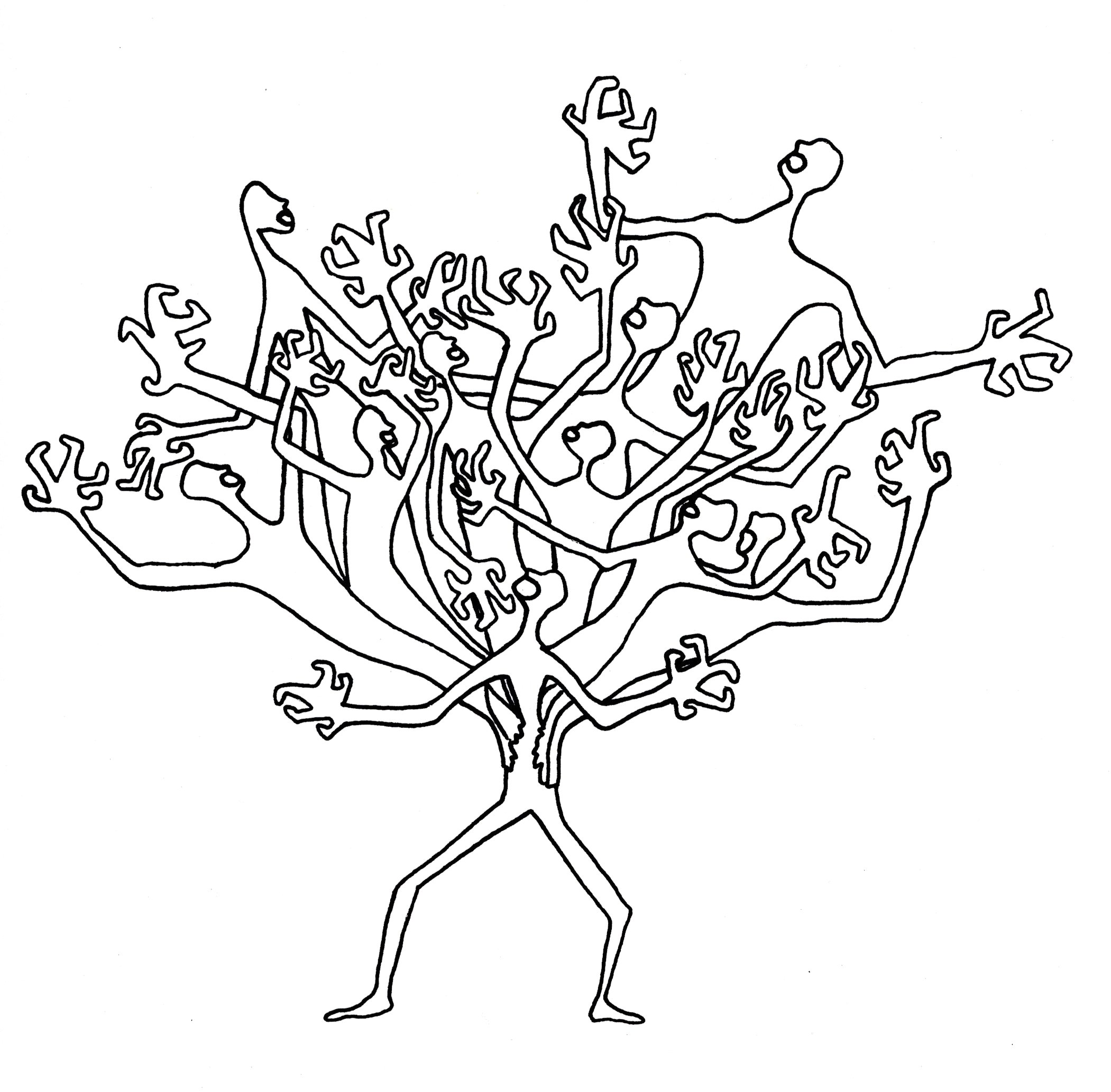
“Our Grandmothers” by Maya Angelou (poem)

White, Charles_Mother Courage II
Charles White (American, 1918–1979), Mother Courage II, 1974. Oil on canvas, 49 3/4 × 39 7/8 in. National Academy of Design, New York.

She lay, skin down in the moist dirt,
the canebrake rustling
with the whispers of leaves, and
loud longing of hounds and
the ransack of hunters crackling the near branches.

She muttered, lifting her head a nod toward freedom,
I shall not, I shall not be moved.

She gathered her babies,
their tears slick as oil on black faces,
their young eyes canvassing mornings of madness.
Momma, is Master going to sell you
from us tomorrow?

Yes.
Unless you keep walking more
and talking less.
Yes.
Unless the keeper of our lives
releases me from all commandments.
Yes.
And your lives,
never mine to live,
will be executed upon the killing floor of innocents.
Unless you match my heart and words,
saying with me,

I shall not be moved.

In Virginia tobacco fields,
leaning into the curve
of Steinway
pianos, along Arkansas roads,
in the red hills of Georgia,
into the palms of her chained hands, she
cried against calamity,
You have tried to destroy me
and though I perish daily,

I shall not be moved.

Her universe, often
summarized into one black body
falling finally from the tree to her feet,
made her cry each time into a new voice.
All my past hastens to defeat,
and strangers claim the glory of my love,
Iniquity has bound me to his bed,

yet, I must not be moved.

She heard the names,
swirling ribbons in the wind of history:
nigger, nigger bitch, heifer,
mammy, property, creature, ape, baboon,
whore, hot tail, thing, it.
She said, But my description cannot
fit your tongue, for
I have a certain way of being in this world,

and I shall not, I shall not be moved.

No angel stretched protecting wings
above the heads of her children,
fluttering and urging the winds of reason
into the confusions of their lives.
They sprouted like young weeds,
but she could not shield their growth
from the grinding blades of ignorance, nor
shape them into symbolic topiaries.
She sent them away,
underground, overland, in coaches and
shoeless.
When you learn, teach.
When you get, give.
As for me,

I shall not be moved.

She stood in midocean, seeking dry land.
She searched God’s face.
Assured,
she placed her fire of service
on the altar, and though
clothed in the finery of faith,
when she appeared at the temple door,
no sign welcomed
Black Grandmother. Enter here.

Into the crashing sound,
into wickedness, she cried,
No one, no, nor no one million
ones dare deny me God, I go forth
along, and stand as ten thousand.
The Divine upon my right
impels me to pull forever
at the latch on Freedom’s gate.

The Holy Spirit upon my left leads my
feet without ceasing into the camp of the
righteous and into the tents of the free.

These momma faces, lemon-yellow, plum-purple,
honey-brown, have grimaced and twisted
down a pyramid of years.
She is Sheba and Sojourner,
Harriet and Zora,
Mary Bethune and Angela,
Annie to Zenobia.

She stands
before the abortion clinic,
confounded by the lack of choices.
In the Welfare line,
reduced to the pity of handouts.
Ordained in the pulpit, shielded
by the mysteries.
In the operating room,
husbanding life.
In the choir loft,
holding God in her throat.
On lonely street corners,
hawking her body.
In the classroom, loving the
children to understanding.

Centered on the world’s stage,
she sings to her loves and beloveds,
to her foes and detractors:
However I am perceived and deceived,
however my ignorance and conceits,
lay aside your fears that I will be undone,

for I shall not be moved.

from I Shall Not Be Moved (Random House, 1990), copyright © Caged Bird Legacy, admin. CMG Worldwide

Maya Angelou (1928–2014) was an African American poet, storyteller, civil rights activist, and lecturer, most famous for her autobiography I Know Why the Caged Bird Sings (1969). She began her career as a singer, dancer, and actress but started writing in the late 1950s, often combining personal narrative with advocacy for racial and gender equality. In 1960 she worked as the northern coordinator for Martin Luther King Jr.’s Southern Christian Leadership Conference, before moving to Egypt and then Ghana with her son. She returned to the US in 1965 to help Malcolm X build the Organization of Afro-American Unity.

In addition to seven autobiographies and multiple poetry collections, Angelou also wrote children’s books, cookbooks, essays, short stories, stage plays, screenplays, documentaries, and music (including film scores). She was a recipient of three Grammys for her spoken-word albums, an Emmy nomination for her portrayal of Kunta Kinte’s grandmother in the miniseries Roots (1977), the National Medal of Arts (2000), the Presidential Medal of Freedom (2010), the Literarian Award (2013), and many other honors. Recurring themes in her literary works include hardship and loss, love, social justice, Black beauty, the strength of women, and the human spirit.


In her Nancy Hanks Lecture on Arts and Public Policy, given March 20, 1990, for the American Council for the Arts in Washington, DC, Maya Angelou addressed her audience with a question:

I often wonder what would happen if I could come face to face with a grandparent, a great-great-great-grandparent. Suppose you did? Just imagine. What would happen? Not a specter, a real person, 200 years old, who said, “So . . . You’re the reason I took the lash, you’re it, huh? So you’re the reason I took the auction block, and stayed alive . . . you’re it, are you? How is it with you? How are you doing with the gifts I gave you?”

She went on to describe how her grandmother and mother used to sing the African American spiritual “I Shall Not Be Moved” around the house. Its lyrics are based on Jeremiah 17:7–8: “Blessed are those who trust in the LORD, whose trust is the LORD. They shall be like a tree planted by water, sending out its roots by the stream. It shall not fear when heat comes, and its leaves shall stay green; in the year of drought it is not anxious, and it does not cease to bear fruit” (cf. Ps. 1:3; 62:6).

Angelou then talked about the importance of “being flexible so one can bend, resilient so that one can stand erect after being knocked down,” before proceeding to read her poem “Our Grandmothers.”

The poem celebrates the strong Black women who have gone before, that great cloud of witnesses, the ancestors, who stood firm in the face of all kinds of adversity, giving life to succeeding generations. The queen of Sheba (who gifted gold, spices, and jewels to King Solomon of Israel, as 1 Kings 10 relates, and who the ancient historian Josephus said ruled over Ethiopia and Egypt), abolitionist Harriet Tubman, writer Zora Neale Hurston, and educator and philanthropist Mary Bethune are among the women named. Self-assertive, tenacious, filled with holy desire, steadfast in the pursuit of freedom and justice.

Angelou is one of the most banned authors in the United States, particularly in high schools, where some districts deem her books inappropriate for their use of racial epithets and frank depictions of violence, including sexual assault. “Our Grandmothers” is mild by comparison to her first autobiography, but it does allude to lynching and rape and contains a litany of vulgar, demeaning names. She does not want to sugarcoat these realities, this history.

While acknowledging the suffering endured by Angelou’s female forebears, the poem is triumphant in tone. It’s that refusal to despair, that holding on to faith, that Angelou so admires and that impels her to join in that old refrain, composed in chains and having carried her people through countless trials and acts of resistance: “Like a tree planted by the water, I shall not be moved.”
Juneteenth roundup: Songs, poems, two painting series, and Step Afrika! performance

Juneteenth is a federal holiday that commemorates the end of slavery in the United States. It is celebrated annually on June 19, the date on which, in 1865, the Union army finally arrived in the nation’s farthest reaches—Texas—to enforce the proclamation Lincoln had signed more than two and a half years earlier. While the holiday is marked predominantly by joy, it also calls on celebrants to reflect on the complicated meaning of freedom—“freedom that came at the end of the bloodiest war on the American soil where more than 700,000 lives were lost, freedom that came at the death of many enslaved people who never lived to see it, and freedom that people still fight for today,” historian Daina Ramey Berry told Life & Letters. In the words of another historian, Mitch Kachun, Juneteenth is a time “to celebrate, to educate, and to agitate.”

Yesterday I published a long-form article on the three twenty-first-century stained glass windows at New Mount Pilgrim Missionary Baptist Church in Chicago, which explore America’s stained past, Black communities’ resilience, present-day gang violence, and “the values of the village.” The article provides ample fodder for possible ways to honor Juneteenth, such as these:

  • Donate to the MAAFA Redemption Project to support the promise and genius of Chicago’s Black and Brown youth. Or choose another Black cause, publication, individual, or business to invest in.
  • Watch the documentary All These Sons to learn about how two Chicago organizations are loving and transforming their neighborhoods, seeking to free residents from cycles of violence and help them reclaim their self-worth.
  • Spend ten minutes looking at and meditating on each of the three rose windows at New Mount Pilgrim. Think of them as visual prayers that you can enter into.
  • “Read” (that is, view, as it’s almost entirely a picture book) The Middle Passage by Tom Feelings, pausing at each illustration to really feel the weight of the atrocities perpetrated during the transatlantic slave trade. Practice lament.
  • Watch the groundbreaking miniseries Roots, based on Alex Haley’s novel, which traces the saga of a Mandinka family for three generations, before, during, and after slavery. It originally aired on ABC over eight consecutive nights in 1977, and later that year on BBC One; it’s streaming for free on Tubi (no account needed) in the form of six ninety-minute episodes.
  • For a firsthand account of slavery written by someone who was himself enslaved, read Olaudah Equiano’s autobiography, or passages from it.
  • Read the poet Lucille Clifton, who writes about Black womanhood, history, family, and religion. A good place to start would be her National Book Award–winning Blessing the Boats.
  • Peruse the Adinkra Symbol Index, put together by web designer Jean MacDonald, to learn more about this West African writing system and some of the concepts and proverbs represented in it.

+++

YOUTUBE PLAYLIST: Juneteenth 2024, compiled by Victoria Emily Jones: As a follow-up to the Juneteenth Playlist I published on YouTube in 2022, I’ve put together a brand-new one of nineteen songs, including a ring shout from South Carolina, a Sam Cooke cover, a virtuosic performance by the Trinidadian pianist Hazel Scott, a song-turned-children’s-book by Rhiannon Giddens, some seventies funk, and more. Here are two selections from the list:

>> “Feelin’ Good”: Written in 1964 by English composers Anthony Newley and Leslie Bricusse for the musical The Roar of the Greasepaint – The Smell of the Crowd, this song became a classic when Nina Simone recorded it the following year for her album I Put a Spell on You. In 2021, Dove, Verve Records, UMe, and the Nina Simone Charitable Trust teamed up to create the first-ever music video for Simone’s version of the song. Directed by Sarah Lacombe and featuring dancer Raianna Brown, the new music video “aims to continue Simone’s important legacy by telling a story of Black female empowerment . . . follow[ing] four generations of Black women living their truths, loving each other, celebrating their hair, and feeling good,” according to the press release.

>> Soul Force by Jessie Montgomery:Soul Force is a one-movement symphonic work which attempts to portray the notion of a voice that struggles to be heard beyond the shackles of oppression,” writes composer Jessie Montgomery. “The music takes on the form of a march which begins with a single voice and gains mass as it rises to a triumphant goal. Drawing on elements of popular African-American musical styles such as big-band jazz, funk, hip-hop and R+B, the piece pays homage to the cultural contributions, the many voices, which have risen against aggressive forces to create an indispensable cultural place.” It’s performed here by the national youth ensembles NYO-USA, NYO2, and NYO Jazz, established by Carnegie Hall.

The title of the work comes from Rev. Dr. Martin Luther King’s “I Have a Dream” speech, in which he states, “We must not allow our creative protest to degenerate into physical violence. Again and again, we must rise to the majestic heights of meeting physical force with soul force.”

Click here to access all nineteen songs on Art & Theology’s YouTube playlist for Juneteenth 2024. (See also my Juneteenth playlist on Spotify.)

+++

WASHINGTON, DC, EVENTS:

I live about an hour north of DC in Central Maryland, so I try to take advantage of some of the many cultural offerings of that city. If you, too, live nearby and don’t already have plans for Juneteenth, here are two ideas of things to do outside the house.

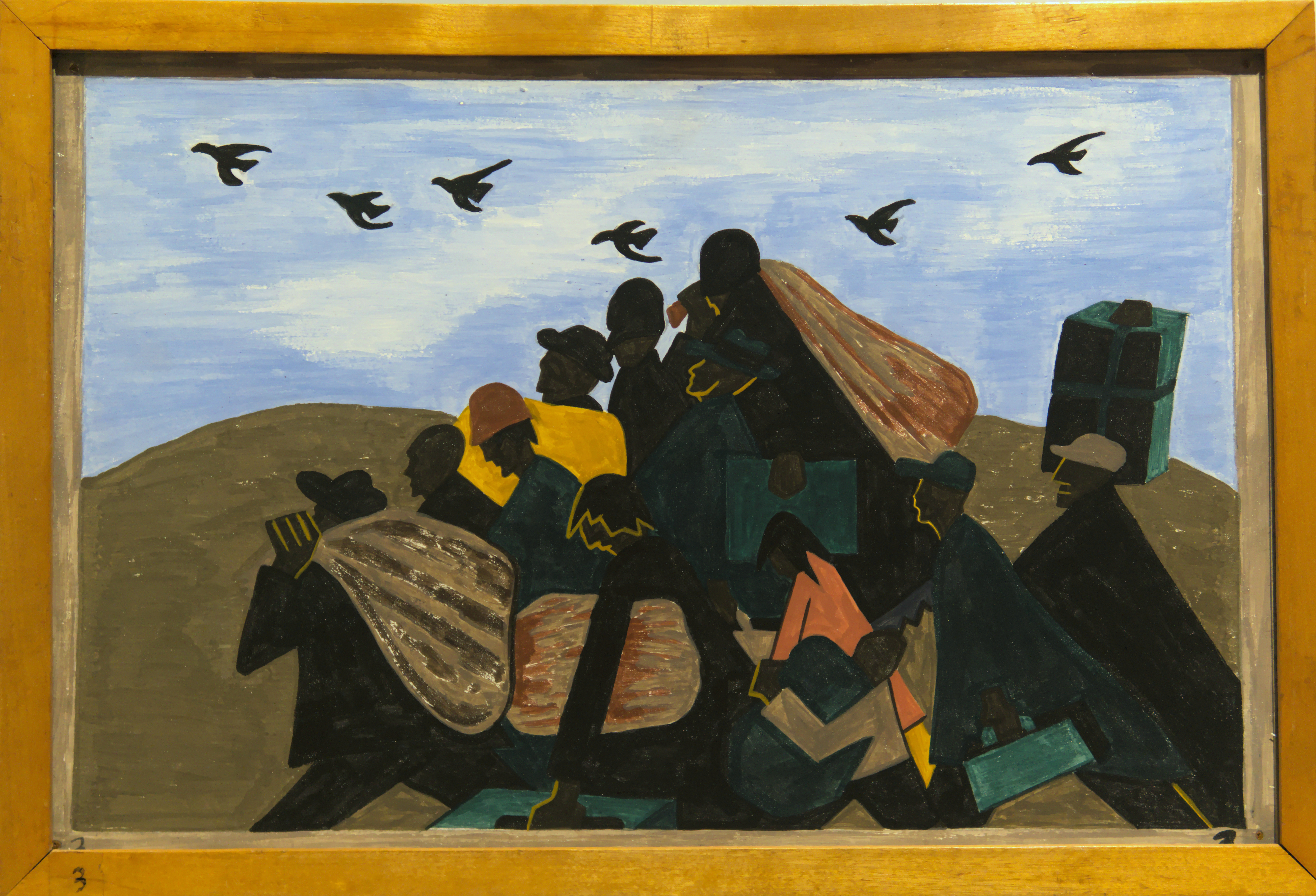
>> STEPPING PERFORMANCE: “Step Afrika! The Migration: Reflections on Jacob Lawrence,” Arena Stage, running through July 14: I’ll be going tomorrow, thanks to an invite from a friend! “Using its hallmark style of percussive dance-theater, Step Afrika!’s The Migration: Reflections on Jacob Lawrence tells the story of one of the largest movements of people in United States history, when millions of African American migrants moved from the rural South to the industrial North in the 1900s to escape Jim Crow, racial oppression, and lynchings. Inspired by Jacob Lawrence’s iconic 60-panel The Migration Series (1940-41), this signature work from the award-winning dance company uses the images, color palette, and motifs in the painting series to tell this astonishing story through pulsating rhythms and visually stunning movement.” The performance fuses body percussion, tap, and contemporary dance with live gospel, jazz, and blues.

Here’s a video promo made by New Victory Theater when the show toured there a few years ago:

Lawrence, Jacob_Migration Series 3
Jacob Lawrence (American, 1914–2000), “From every southern town migrants left by the hundreds to travel north,” panel 3 from The Migration Series, 1940–41. Casein tempera on hardboard, 12 × 18 in. Phillips Collection, Washington, DC. Photo: Victoria Emily Jones. [object record]

Browse all sixty panels from The Migration Series at https://lawrencemigration.phillipscollection.org/. Lawrence pictures different aspects of the northern migration story, such as crowded train stations, rotting crops, lynchings, urban housing, educational opportunity, and church life.

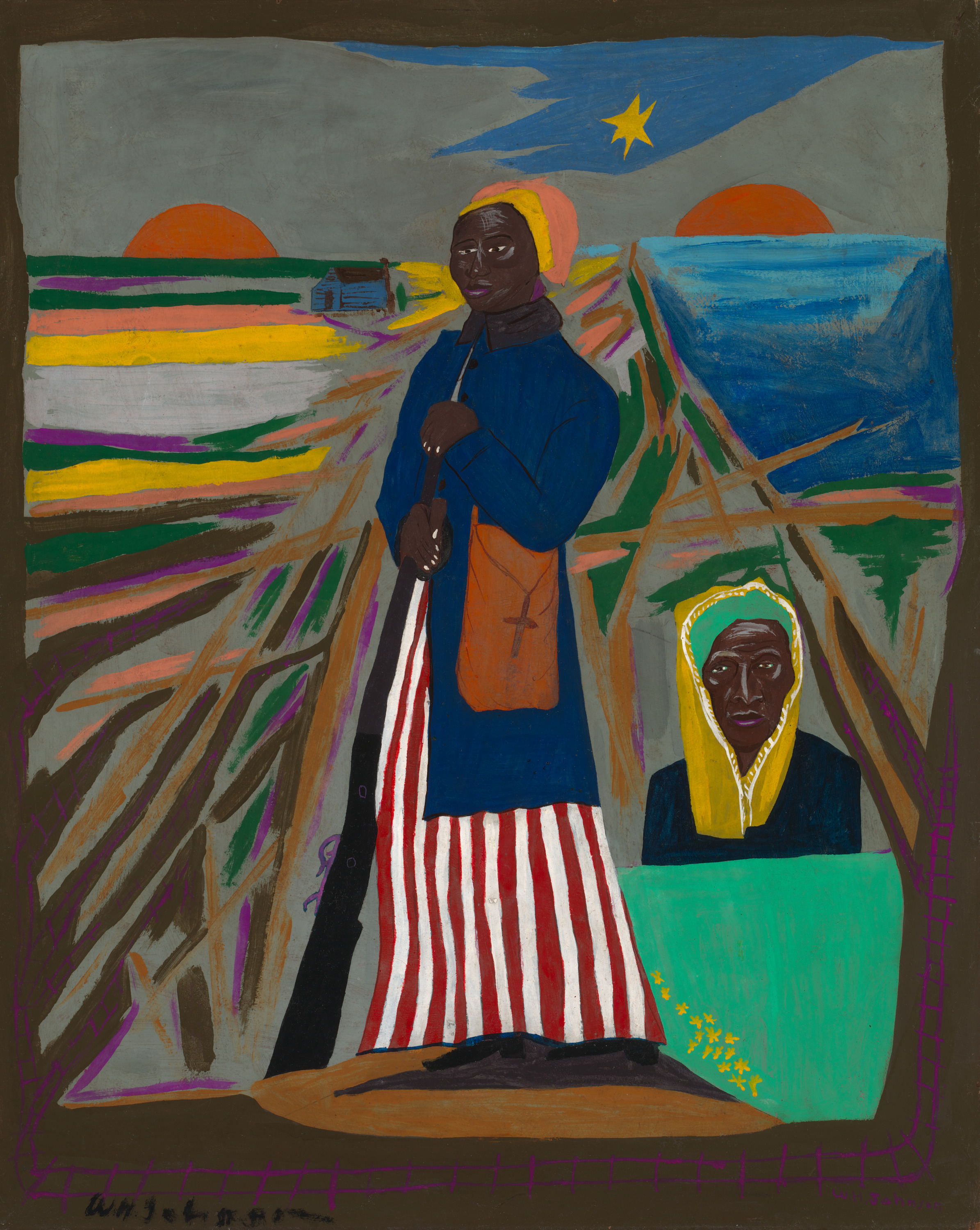
>> ART EXHIBITION: Fighters for Freedom: William H. Johnson Picturing Justice, Smithsonian American Art Museum, March 8–September 10, 2024: Another African American artist who was working around the same time as Jacob Lawrence is William H. Johnson (1901–1970). Last weekend I saw his Fighters for Freedom series of paintings at the SAAM—the first time the works have been shown together since 1946. He painted the series in the mid-1940s as a tribute to African American activists, scientists, teachers, and performers as well as international leaders working to bring peace to the world. Interactive kiosks identify the many historical figures. I learned so much! I can picture this exhibition being a good teaching tool for children as well. Spending time with every painting would be overwhelming for them, but choosing a few select artworks as entry points into talking about the freedom fighters depicted and the larger freedom story they’re a part of should work well.

Johnson, William H._Harriet Tubman
William H. Johnson (American, 1901–1970), Harriet Tubman, ca. 1945. Oil on paperboard, 28 7/8 × 23 3/8 in. (73.5 × 59.3 cm). Smithsonian American Art Museum, Washington, DC.

At the exhibition there are also signs and photos that inform viewers of related artifacts at other Smithsonian museums in the city, including:

(Click on the links for short video features about these objects, made specially for this exhibition.)

+++

POEMS:

>> “Paul Robeson” by Gwendolyn Brooks: Though in popular culture he is best remembered as an international star of stage and screen, the bass-baritone singer and actor Paul Robeson was also a prominent activist who graduated from law school and fought for civil rights. In this poem, Gwendolyn Brooks celebrates that latter legacy of his, his commitment to seeing the Black community in America, as well as other oppressed people groups around the world, flourish. The powerful final lines—“we are each other’s / harvest: / we are each other’s / business: / we are each other’s / magnitude and bond”—communicate the wisdom that we reap the good fruit that grows from seeds sown by others. She references Robeson’s most famous song, “Ol’ Man River,” sung by the character Joe in the musical Show Boat; the song laments the hardships faced by African Americans and expresses envy of the carefree Mississippi River, which just keeps rolling along, free from toil. But Brooks was happy to see Robeson move beyond the despondency embodied by Joe the deck hand, to take a much more empowered stance in public life.

>> “Juneteenth” by Marilyn Nelson: Here Nelson reflects on the childhood of her mother, Johnnie, who grew up in the all-Black pioneer town of Boley, Oklahoma. In Boley, then as now, June 19 is a “second Easter,” a time of food, family, games, and celebration. After several stanzas spent recounting the lighthearted festivities, the last line lands with a thud, a brutal reminder of the terror these community members fled to establish a place of their own. The poem is ultimately about overcoming, but even as the Black residents of Boley have built a new life for themselves and their families, racism is still a wound they bear. “Juneteenth” can be found in the excellent collection The Fields of Praise: New and Selected Poems by Marilyn Nelson (Louisiana State University Press, 1997).

“Fisk Jubilee Proclamation” by Tyehimba Jess (poem)

Jessica Lynne Brown

mother emanuel ame church, charleston, sc, 1822: cross-ankle church, palmetto, ga, 1899: green leaf presbyterian church, keeling, tn, 1900: red top church, hopkinsville, ky, 1915: first baptist church, carteret, nj, 1926

Fisk Jubilee Proclamation

(choral)

  O sing unto the Lord a new song . . . (Psalm 96)

O, sing . . . undo the world with blued song
born from newly freed throats. Sprung loose from lungs
once bound within bonded skin. Scored from dawn
to dusk with coffle and lash. Every tongue
unfurled as the body’s flag. Every breath
conjured despite loss we’ve had. Bear witness
to the birthing of our hymn from storied depths
of America’s sin. Soul-worn psalms, blessed
in our blood through dark lessons of the past
struggling to be heard. Behold—the bold sound
we’ve found in ourselves that was hidden, cast
out of the garden of freedom. It’s loud
and unbeaten, then soft as a newborn’s face—
each note bursting loose from human bondage.

Fulton Street M.E. Church, Chicago, IL, 1927: Second Baptist Church, Detroit, MI, 1930: Macedonia Baptist Church, Egg Harbor City, NJ, 1935: Mount Methodist Church, Henderson, NC, 1940: Negro Methodist Church, Loganville, GA, 1947

Source: Olio by Tyehimba Jess (Seattle and New York: Wave Books, 2016). Illustration by Jessica Lynne Brown, from Olio, p. 5. Used with permission. View the book page.

+++

Hear Tyehimba Jess introduce and read his poem at the New York State Writers Institute in this video from 2017:

+++

“Fisk Jubilee Proclamation” by Tyehimba Jess is the first in a heroic crown of sonnets from Jess’s second poetry collection, the Pulitzer Prize–winning Olio. A crown of sonnets is a circular sequence in which the last line of the first sonnet becomes the first line of the second sonnet, the last line of the second sonnet becomes the first line of the third sonnet, and so forth, until eventually the last line of the last sonnet becomes the first line of the first sonnet. What makes Jess’s crown “heroic” (part of the form’s technical name) is that it comprises fifteen sonnets, and the final one is made up of all the first or last lines of the preceding fourteen, in order. Quite the feat!

With this heroic crown, Jess honors the Fisk Jubilee Singers from the historically Black Fisk University in Nashville, Tennessee, a choral ensemble established in 1871 and still active today. Fisk was founded after the Civil War to educate freed men and women and other young African Americans. To raise money for the new school, music professor and treasurer George L. White formed a small choir of nine students to tour the United States. Their repertoire was the spirituals they and their parents sang on the plantations, songs that were rarely known at the time among northern white audiences—such as “Go Down, Moses,” “Steal Away to Jesus,” “Ezekiel Saw the Wheel,” “Joshua Fit the Battle of Jericho,” and “Roll, Jordan, Roll,” to name a few. The Fisk Jubilee Singers are credited with spreading and popularizing this uniquely Black American art form over the country and world.

Fisk Jubilee Singers (original)
The nine original Jubilee Singers, Fisk University, Nashville, Tennessee, ca. 1871. From left to right: Minnie Tate, Greene Evans, Isaac Dickerson, Jennie Jackson, Maggie Porter, Ella Sheppard, Thomas Rutling, Benjamin Holmes, Eliza Walker.

Their first eighteen-month stint took them to Ohio, Pennsylvania, New York, Connecticut, Rhode Island, New Jersey, Massachusetts, Maryland, and Washington, DC. Then in 1873, they toured Great Britain and continental Europe, performing for Queen Victoria and other prominent figures.

The name of the group comes from Leviticus 25, where God mandates that every fifty years, the enslaved are to be set free: “And you shall hallow the fiftieth year, and you shall proclaim liberty throughout the land to all its inhabitants. It shall be a Jubilee for you: you shall return, every one of you, to your property and every one of you to your family” (v. 10).

The Fisk Jubilee Singers took up God’s call to proclaim liberty far and wide, and they did so through their song. Written in the singers’ collective voice (hence the “choral” headnote), “Fisk Jubilee Proclamation” opens with an epigraph taken from Psalm 96:1: “O sing unto the Lord a new song . . .” (emphasis mine). The first line plays upon this biblical line by substituting three words that rhyme with the ones displaced: “O, sing . . . undo the world with blued song.”

Their song is blued because it was born out of deep suffering. And with it they undo the world—they open up those who were formerly closed off against them. They unravel racist stereotypes, asserting their sacred humanity.

They sing as an act of defiance. Whereas their enslavers had demanded them and their parents to be quiet and would often beat them into submission, now they are unapologetically loud, unbeaten—their words, like them, set free. They own their voices, which embody a range of nuance, from strong, vigorous, and sharp to soft and smooth. Tongue-tied no more, they burst loose from bondage with their new song of freedom. An unfurling of their body’s flag.

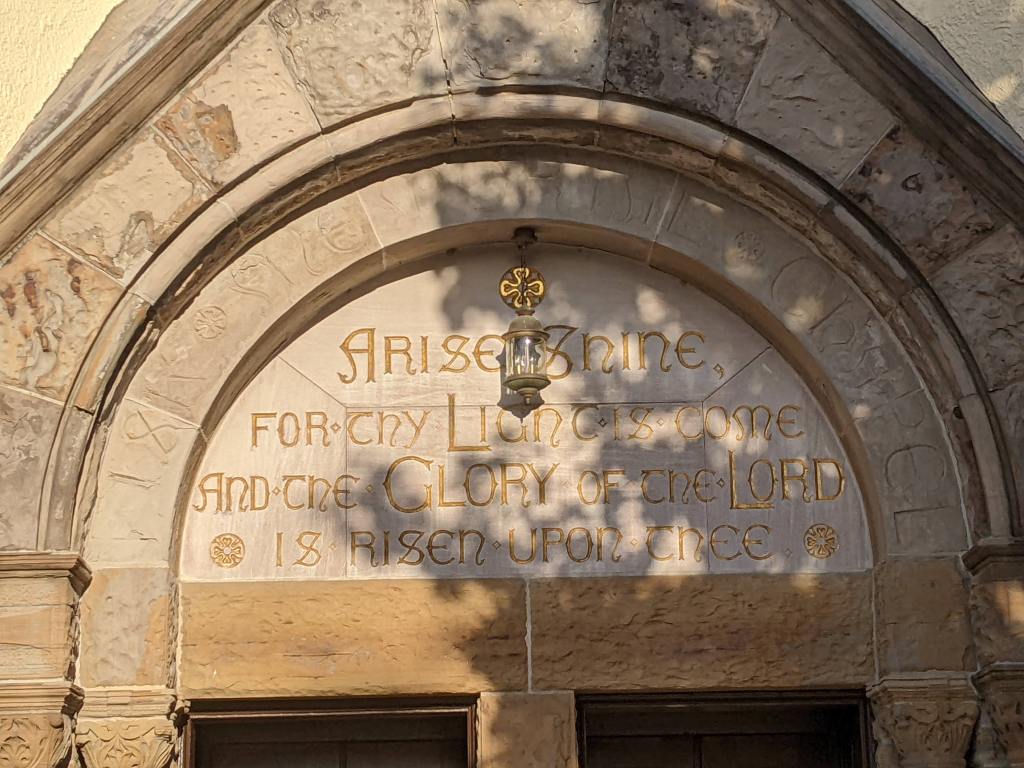
Fisk Memorial Chapel tympanum
“Arise, shine, for thy light is come, and the glory of the Lord is risen upon thee” (Isa. 60:1). Tympanum, Fisk Memorial Chapel (built 1892), Fisk University, Nashville, Tennessee. Photo: Victoria Emily Jones. This chapel is the home performance site for the Fisk Jubilee Singers.

The poem is full of b alliteration: blued, born, bound, bonded, body’s, breath, bear, birthing, blessed, blood, behold, bold, (un)beaten, bursting, bondage. This letter is what’s known as a plosive consonant, because it makes a small explosive sound as you say it. Such an effect reinforces the idea of eruption.

Jess describes the choir’s singing as an act of childbirth, the hymn that has lain within them finally emerging, through painful labor, for all to hear. That hymn is “scored”—in the sense of its music being written on the page, but also bearing the marks of the slaver’s lash, that trauma, that story of violence and oppression, passed down to new generations. The “worn” in “soul-worn psalms” also has a double meaning, in that the singers wear their souls on the sleeves of their songs (or, the songs are dressed in soul) but also they are soul-weary.

Concurrent with the rise and ongoing performances of the Fisk Jubilee Singers were frequent attacks on Black places of worship. As the singers were spreading beauty and hope through the spirituals, white terrorists were spreading ugliness and hate. To remind readers of this context, Jess provides a litany of church names and dates across the top and bottom of the page of each Fisk Jubilee sonnet, indicating Black churches that were burned down, bombed, or sites of other kinds of racially motivated violence. In the back of the book Jess includes this note “On the Fisk Jubilee Choir testifying through fire . . .”:

The names of our burned and bombed black churches enfold the spirituals sung by our Jubilee choir. Inside each flame burns hum, prayer, and holy book. Each hymn inhabits heat and smolder; each biblical spark is kindled with story. There is no complete record of all such attacks upon the black congregational body, no complete accounting of all the pulpits, pews, and psalm books rendered into fire—these 148 stand in testimony to all the unnamed churches lost to arson and TNT, the slats and nails and sweat that doubled as schoolhouse and underground passageway, the pyres of pine and oak and cedar steeples that sheltered baptisms and home-goings, the silent crucifixions curled into ash. The AMEs and the Graces, the Tabernacles and all the many Firsts; the hand fans, tambourines, mourner’s benches, and collection plates; they rise in smoke like the songs that soaked through them and up to heaven’s blued, eternal door. (221)

The litany traces an unbroken line of violence from 1822 to 2015 and, true to the sonnet corona form, highlights a tragic circularity: Mother Emanuel AME Church in Charleston, South Carolina, is the earliest African American church to suffer arson that Jess found record of in his research, and that same church was the target of a mass shooting on June 17, 2015, which claimed nine victims. (Tomorrow is the eighth anniversary.) This murder occurred while Olio was in production with the publisher, and Jess knew he had to add it to the end of the poem sequence.

Despite such assaults on their dignity and personhood, the Fisk Jubilee Singers have always continued to praise, and that is their glorious legacy. They’ve carried forward the joys, sorrows, and faith of their community in song. The final, extraordinary poem in Jess’s Fisk Jubilee sequence is titled “We’ve sung each free day like it’s salvation.” It ends like this: “We’ve smuggled faith from slave shack to palace, / boiling the air with hallelujah’s balm— / each note bursting loose from bondage / to sing unto the world a new song.”

I wholly commend Olio to you, which is the most inventive volume of poetry I’ve ever read. It took Jess nearly eight years to write, and given its irregular nature, I imagine it also took a while for the designer and production team at Wave Books to work out! An olio is a miscellaneous mixture of heterogenous elements, a hodgepodge, but also, as an early page of the book notes, “the second part of a minstrel show which featured a variety of performance acts and later evolved into vaudeville.”

Part fact, part fiction, the book examines the lives of mostly unrecorded African American performers directly before and after the Civil War up to World War I, in “an effort to understand how they met, resisted, complicated, co-opted, and sometimes defeated attempts to minstrelize them,” as the publisher writes. It includes, for example, transcripts of interviews conducted by the fictitious Julius Monroe Trotter with an array of people who knew the ragtime composer Scott Joplin. It also includes syncopated sonnets (a form of contrapuntal poetry), which can be read up, down, diagonally, or interstitially—listen to Jess read and explain, for example, the sequence he wrote on the conjoined twins Millie and Christine McKoy, where the form stands in for the corpus of the sisters to represent their interconnected but independent narratives. But even for just the fifteen Fisk Jubilee sonnets alone, ten of which are in the voice of each of the original nine singers and their (white) conductor, the book is worth the price.

[Purchase Olio on Amazon] [Purchase Olio from Wave Books]

To learn more about what went into writing the Fisk Jubilee sonnets, read Jess’s blog post for the Poetry Foundation, “Flames of History / Rhythms of Song.” Also check out the interview with Jess published in the Interlochen Review, “Music, Literature, and the Struggle of Consciousness.” One thing that particularly stood out to me from the interview was, when asked about how he intertwines language and music in Olio, he said,

You have to remember in African American literature that we were deprived of the right of reading and writing for most of our history in this country. So, the song and the music became the literature. So, after emancipation, it’s impossible to really completely extract one from the other, because one was so instrumentally carrying so many stories for so long, for so many generations.

Tyehimba Jess (b. 1965) is a major poet whose work bridges slam and academic poetry and is imbued with deep archival research, often fusing music, history, and fiction. His first collection, leadbelly (2005), an exploration of the blues musician Huddie “Lead Belly” Ledbetter’s life, was chosen for the National Poetry Series by Brigit Pegeen Kelly. His second collection, Olio (2016), which celebrates the mostly unrecorded Black musicians, orators, and other performers of the nineteenth and early twentieth centuries, won the 2017 Pulitzer Prize. He teaches English at the College of Staten Island.

Juneteenth Playlist: Songs of Black joy, liberation, and faith

Juneteenth (June 19) is a federal holiday in the United States celebrating the liberation of enslaved African Americans in Texas in 1865. Abraham Lincoln had issued the Emancipation Proclamation on January 1, 1863, but it was not implemented in places still under Confederate control, and because Texas, being on the westernmost edge of the Confederacy, was farthest from the military action of the Civil War, Texans could conveniently continue to enslave, as there were no soldiers there to enforce the executive decree. But when Union troops, both white and Black, arrived in Galveston Bay on June 19, 1865, two months after the official end of the war, they saw to it by threat of force that the 250,000-plus enslaved Black people in the state were freed.

Also known as Emancipation Day or Jubilee Day (after the year of release mandated by ancient Israelite law), Juneteenth has been celebrated by African American communities in Texas ever since the first anniversary of the freeing event. Historically, the church has been at the center of these celebrations, as the formerly enslaved attributed their liberation to God, to whom they gave effusive thanks and praise. In the twentieth century, Juneteenth expanded into other states but still remained very niche, until 2021, when, after decades of lobbying by Black activists, President Joe Biden signed into law the Juneteenth National Independence Day Act, moving the holiday into the mainstream.

Juneteenth marks not only that one historic day but also, more broadly, freedom as an ongoing struggle. It’s not as if the illegalizing of chattel slavery, or even the passage of the Civil Rights Act of 1964, ended racial oppression or prejudices, which manifest today in, for example, the racial wealth gap, voter suppression, and disparities in policing. We have made important progress as a country, for sure, but there’s still a ways to go until everyone breathes free.

Bishop T. D. Jakes of The Potter’s House in Dallas says that Juneteenth must involve a reckoning with our nation’s sordid past and a commitment to identifying and rooting out whatever sordidness persists. “It’s vital we all must remember when liberty and justice is delayed or denied, it causes traumatic ripples throughout future generations. . . . As we collectively stop to acknowledge and learn from the delayed liberties of our nation’s ancestors, we must not allow those same systems to repeat injustices.”

In recognition of Juneteenth, I’ve compiled on Spotify 118 songs of Black joy, liberation, and faith. From Beyoncé to Duke Ellington, Adolphus Hailstork to Rhiannon Giddens, Mary Lou Williams to Richard Smallwood, these artists jubilate, extol, lament, protest, revel, testify, and hope.

I acknowledge the complications of me, a white person, offering this playlist. I have grappled with how to appropriately celebrate Juneteenth and how to balance its predominant tone of joy (am I allowed to feel joy?) with an honest accounting of past and present evils that mark the Black experience in America, especially slavery and its legacy. One basic piece of advice I’ve heard is to center Black voices. Listen to and lift up Black historians, Black theologians, Black novelists, Black songwriters, etc.  

The Art & Theology Juneteenth Playlist combines sacred and so-called secular music written and/or performed by Black artists and exhibiting a spirit of defiant joy. It emphasizes the beauty, power, creativity, and divine belovedness of Black people.

Honoring the religious roots of Juneteenth and the faithful ongoing witness of the Black church, I have incorporated many Christian songs, especially those that speak to the imago Dei and to God’s faithfulness, guidance, and deliverance. The Bible is full of divine deliverance tales: the Israelites from slavery in Egypt; Daniel from the lions’ den; the three Hebrew boys from the fiery furnace; Jonah from the belly of the whale; Paul and Silas from prison. “Didn’t my Lord deliver Daniel? Then why not every man?” sings one spiritual. Another, “Go Down, Moses,” confronts Pharaoh, a stand-in for white Southern enslavers, with the demand “Let my people go,” while yet another exults in the toppling of Pharaoh’s power—“Pharaoh’s army got drownded.” The spiritual “Satan, We’re Gonna Tear Your Kingdom Down” addresses the Enemy directly, expressing resolve to overthrow demonic systems and ideologies, such as white supremacy.

There are also plenty of feel-good vibes on the playlist, lighter songs like Lee Dorsey’s “Occapella,” Count Basie’s “Jumpin’ at the Woodside,” and Jon Batiste’s “Freedom” (with its stylish, smile-inducing music video that I can’t get enough of!):

There’s also the gospel song “This Joy” by Shirley Caesar, sung by the Resistance Revival Chorus:

Its first verse is: “This joy that I have—the world didn’t give it to me. . . . The world didn’t give it, and the world can’t take it away.” “This strength,” “this love,” and “this peace” follow in subsequent verses—otherworldly qualities given to us by God, as Caesar makes explicit in the original, and which no one can ever steal from us. No matter what harm people may do to us, we still possess these inner gifts, which help us face whatever comes.

Composed in the antebellum South, “No More Slavery Chains for Me” (aka “Many Thousands Gone” or “No More Auction Block”) holds together proclamation and grief. The speaker boldly asserts her freedom: “No more slavery chains,” “no more auction block,” “no more peck of corn,” “no more driver’s lash,” “no more mistress’ call,” “no more children stole from me.” It could be spoken by someone who is still enslaved but who refuses to tolerate that condition any longer, or it could be spoken by someone recently freed, rejoicing in what she has escaped. But the solemn refrain, “Many thousands gone,” remembers the multitudes whom slavery has killed. Here’s a performance by mezzo-soprano Shirley Verrett, an international opera star active from the late 1950s through 1990s:

Often words fail to capture the emotional intensity one might feel. “Triptych: Prayer / Protest / Peace” by Max Roach, from his 1960 avant-garde jazz album We Insist!: Freedom Now Suite, featuring Abbey Lincoln, consists almost entirely of wordless vocal expressions, screaming, and sighing, along with drumming by Roach. It’s mournful and alarming. The only words are at the beginning of part 3: “I need peace.” Cued up here (starting at 5:50) is Lincoln and Roach’s performance of the first two parts of “Triptych” for a Belgian TV station that aired January 10, 1964. (The earlier song in the video is “Tears for Johannesburg,” from the same suite.)

In the liner notes for We Insist!, Nat Hentoff writes that “Triptych” is a “final, uncontrollable unleashing of rage and anger that have been compressed in fear for so long that the only catharsis can be the extremely painful tearing out of all the accumulating fury.”

From the same era and genre is “They Say I Look Like God” from The Real Ambassadors, a jazz musical by Dave Brubeck and Iola Brubeck that never made it to the stage but that was recorded in the studio in 1961 and released a year later. Sung by Louis Armstrong, the song opens with these humorous lines, which Armstrong delivers with chilling earnestness:

They say I look like God
Could God be black? My God
If all are made in the image of Thee
Could Thou perchance a zebra be?

This is one-half of the first of four verses, all of which are interspersed with lines of scripture from Genesis 1 and 1 John 4 intoned, like a liturgical chant, by the trio Lambert, Hendricks & Ross, affirming the inherent goodness of Black folks, bearers of the divine breath. Verses 2 and 3 are addressed to God, pleading that he would show “that our creation was meant to be.” The final verse expresses longing for the day

When God tells man he’s really free
Really free
Really free
Really free

The creation narrative of Genesis 1 is also where Sho Baraka’s “Black as Heaven” opens—with beautiful Blackness, sacred humanity. Historically the color white has been used to symbolize goodness, purity, and heaven, but Baraka turns that symbol inside out and declares that he is “black as heaven.” If God created all humans in his image and many of those humans have black skin, then Blackness is a reflection of God. The Creator loves what he created, and we should too.

Heaven is full of Black saints and will continue to fill with such. The song lists many from across the fields of politics, music, history, education, theology and homiletics, agricultural science, and the culinary arts: Dr. Martin Luther King Jr., King Ezana of Aksum, King Lalibela of the Zagwe dynasty, Mahalia Jackson, Athanasius, Mary McLeod Bethune, George Washington Carver, David Walker, Edna Lewis, Carter G. Woodson, Bishop G. E. Patterson, Sister Rosetta Tharpe. These men and women are all “black as gold,” not in the sense that they are commodities or currencies, but rather are holy, luminous; and black as life-giving soil.

This is one of the songs commissioned for the 2022 documentary Juneteenth: Faith and Freedom [previously], and it includes a rap by Mag44 of Zambia. There’s so much richness in it, and I encourage you to follow along and sit with the lyrics, investigating any unfamiliar references and, depending on your background, humbly receiving the critiques or gladly receiving the affirmations.

In addition to hip-hop and jazz, the playlist is full of songs from the civil rights movement, such as “Woke Up This Morning with My Mind.” This old gospel song was recorded by Roosevelt and Uaroy Graves in 1936 and adapted in 1961 by the Rev. Robert Wesby, a Baptist minister from Aurora, Illinois. Wesby first sang it while spending time in jail in Hinds County, Mississippi, as a Freedom Rider, replacing the repeated word “Jesus” with one of Jesus’s key platform goals, “freedom”: “Woke up this morning with my mind stayed on freedom.”

This song became an important one in civil rights marches, and is led in the above recording by the famous activist Fannie Lou Hamer. For subsequent verses, she sings “Walkin’ and talkin’ with my mind . . . ,” “Singin’ and prayin’ with my mind . . . ,” “Ain’t no harm to keep your mind . . .” Stayed on freedom.

“Ain’t No Grave” is another traditional gospel song, first recorded by Bozie Sturdivant in 1942 and then by Sister Rosetta Tharpe in 1946–47. It’s about the general resurrection, when the saints will be called up out of their graves, but it’s also about indestructibility, the refusal to be or stay buried. I chose a more recent arrangement performed by jazz vocalist Tiffany Austin [previously], from her 2018 album Unbroken:

Hers starts off with the percussive sounds of a ring shout, a style borrowed from the Gullah Geeche of South Carolina’s Sea Bird Islands, and then goes on to incorporate scat singing. It’s full of enthusiastic energy!

One of the most powerful songs on the playlist is “Make It Home” by Tobe Nwigwe, written after the murder of George Floyd in May 2020. The song is “for the nappy heads in heaven, with a nappy-head Christ by they side”—for Blacks who have died.

It’s also a prayer and a blessing for Blacks who are living. “I pray you catch a wave that doesn’t subside. . . . May your streets be paved with gold. Hope my whole hood make it home.” He prays that his friends, family, and neighbors are able to make it safely back to their homes each night and are not killed in the streets. But “home” operates on other levels as well. To be at home with yourself, for example, is to feel whole, confident, secure in your body. Home also implies belonging. And of course “home” can also mean heaven, that place of ultimate freedom and rest. Are we creating the necessary conditions for freedom and rest here on earth as it is in heaven?

I learned about this song from Dr. Mary McCampbell (see the February 17, 2022, installment of her newsletter, The Empathetic Imagination), who teaches the music video in her humanities class at a Christian university.

Collectively, the songs on this playlist reflect the multifaceted spirit of Juneteenth, which encapsulates exultation, passion, power, praise, irrepressibility, resistance, sorrow, anger, and hope and trust. Like Juneteenth itself, the playlist is a looking back and a looking forward. We Americans are a people “on our way.” The work of emancipation is unfinished. These Black artists invite us to join the work.

I invite you, as a way of commemorating the holiday, to:

1. Choose one of the songs and pray from it.

2. Choose one of the artists and explore more of their oeuvre.

3. Choose one of the older songs and explore its origin and history, learning more about the context from which it arose and how it has been received over the decades. Listen to other renditions to see the different ways it’s been interpreted.

The image on the playlist cover is cropped from a photo I took a few years ago at Duke University Chapel of the linocut Ain’t No Grave by Steve A. Prince (2019), which shows a dancing winged figure emerging from the head of Carlotta Walls LaNier, the youngest of the Little Rock Nine, as she integrates the city’s high school in 1957. It is an embodiment of LaNier’s mighty spirit, and that of other Black “agents of God,” to use Prince’s term, who pursue freedom for themselves and others.

Advent, Day 15

Jesus began his public teaching ministry by reading the following passage from an Isaiah scroll at his local synagogue:

The Spirit of the Lord is upon me,
    because he has anointed me
        to bring good news to the poor.
He has sent me to proclaim release to the captives
    and recovery of sight to the blind,
        to let the oppressed go free,
to proclaim the year of the Lord’s favor. (Luke 4:18–19)

Some theologians call this the Nazareth Manifesto. It’s Jesus’s inauguration speech, if you will, where he lays out his platform, his values, his mission.

The freedom that Jesus came to bring is not just spiritual, although it is at least that. It is also physical. He came to liberate us body and soul—from sin and its many ugly manifestations, both personal and systemic, that prevent us and others from thriving. 

As we await Christ’s second advent, we can look forward to this promise: freedom is coming.

[Related post: “Jubilee (Artful Devotion)”]

LOOK: Freedom Quilt by Jessie B. Telfair

Telfair, Jessie B._Freedom Quilt
Jessie B. Telfair (American, 1913–1986), Freedom Quilt, Parrott, Georgia, United States, 1983. Cotton, with pencil, 74 × 68 in. American Folk Art Museum, New York.

Curator Stacy C. Hollander writes,

When Jessie Telfair invoked the power of a single word repeated over and over in this quilt, she knew the word would reverberate through the history of the United States, back to the “peculiar institution” of slavery and the freedom that she was still struggling to attain in the 1960s at the beginning of the Civil Rights movement. The making of the quilt was incited by an incident she suffered in those years, when registering to vote was enough to cost this African American woman her job in a school kitchen. The bitterness of that experience still burned years later, and fellow quiltmakers urged her to express the pain through her art. Worked in the colors of the American flag, the quilt cries freedom. In a subtle metaphor, Telfair has set each repeated letter in its own block; all are visually related, but no two are alike.

LISTEN: “Freedom Is Coming” from South Africa, third quarter of 20th century | Performed by Kate Marks and friends on Circle of Song: Chants and Songs for Ritual and Celebration, 1999

Freedom is coming
Freedom is coming
Freedom is coming
Oh yes, I know!

Jesus is coming
Jesus is coming
Jesus is coming
Oh yes, I know!

This South African freedom song originated during the apartheid era (1948–1994). It’s one of the many songs collected by Swedish musician Anders Nyberg when he traveled with his choir Fjedur to South Africa in 1978 at the invitation of the South African Lutheran Church. Upon his return, “Freedom Is Coming” and other South African freedom songs and hymns were published in Sweden and soon after in the United States in the collection Freedom Is Coming: Songs of Protest and Praise from South Africa (Utryck, 1984), which is still in print. Fjedur’s performance of “Freedom Is Coming” at the Budapest Assembly of the Lutheran World Federation in 1984 was instrumental in disseminating the song around the world, and afterward it started appearing in more hymnals.