
Roundup: Christmas music, old poems with Grace, and more

ADVENT MEDITATION: “Love is . . .” by the Rev. Jonathan Evens: Evens shared this brief written meditation last week at Advent Night Prayer at St Catherine’s Wickford in England, pondering the love Mary demonstrated at various points along the way from the announcement of Jesus’s conception to her and her family’s resettlement in Egypt.

+++

SONGS:

>> “I Pray on Christmas” (cover) by the Good Shepherd Collective: This song was written by Harry Connick Jr. and is performed here by Benjamin Kilgore with Terence Clark, Liz Vice, and Charles Jones of the Good Shepherd Collective, an interdenominational group of musicians collaborating across the US. The video is directed by Jeremy Stanley.

>> “Mary Was the First One to Carry the Gospel” by the Gaither Vocal Band: I grew up in a Baptist church in North Carolina, so southern gospel music is a very familiar genre for me! But I hadn’t heard this song before, until my mom sent me a link last week. It was written by Mark Lowry and Bill Gaither (they took the title from a 1978 song by Dottie Rambo), who sing it here with David Phelps and Guy Penrod at the Alabama Theatre in Birmingham in 2000 as part of the Gaithers’ Christmas in the Country concert. It’s about how Mary was the first person to carry the good news enfleshed—first in her womb, and then in her arms.

>> “Late Upon a Starry Night” by David Benjamin Blower: David Benjamin Blower is an “apocalyptic folk musician, poet, writer, theologian, podcaster, and sound artist” from the UK whose work emphasizes the liberative strains of the gospel. He just released this original Christmas song yesterday, and it will be available only through January 5, 2023, on Bandcamp, with 50 percent of proceeds going to Safe Passage UK, an organization working toward safe routes for refugees. Blower said he wrote the song after hearing a friend talk about her experience of Moria refugee camp in Greece.

The stanzas tell the story of the Annunciation to Mary, Mary and Joseph’s Journey to Bethlehem, the Annunciation to the Shepherds, the Journey of the Magi, and the Flight to Egypt. The refrain draws a line from the first book of the Bible to the last, referencing God’s prophecy in Eden about the serpent’s head being crushed by a descendant of Adam and Eve (Gen. 3:15) (the serpent being representative of sin and death) as well as, implicitly, the image in Revelation 12 of the woman in labor and the dragon. Read the lyrics on the song’s Bandcamp page.

+++

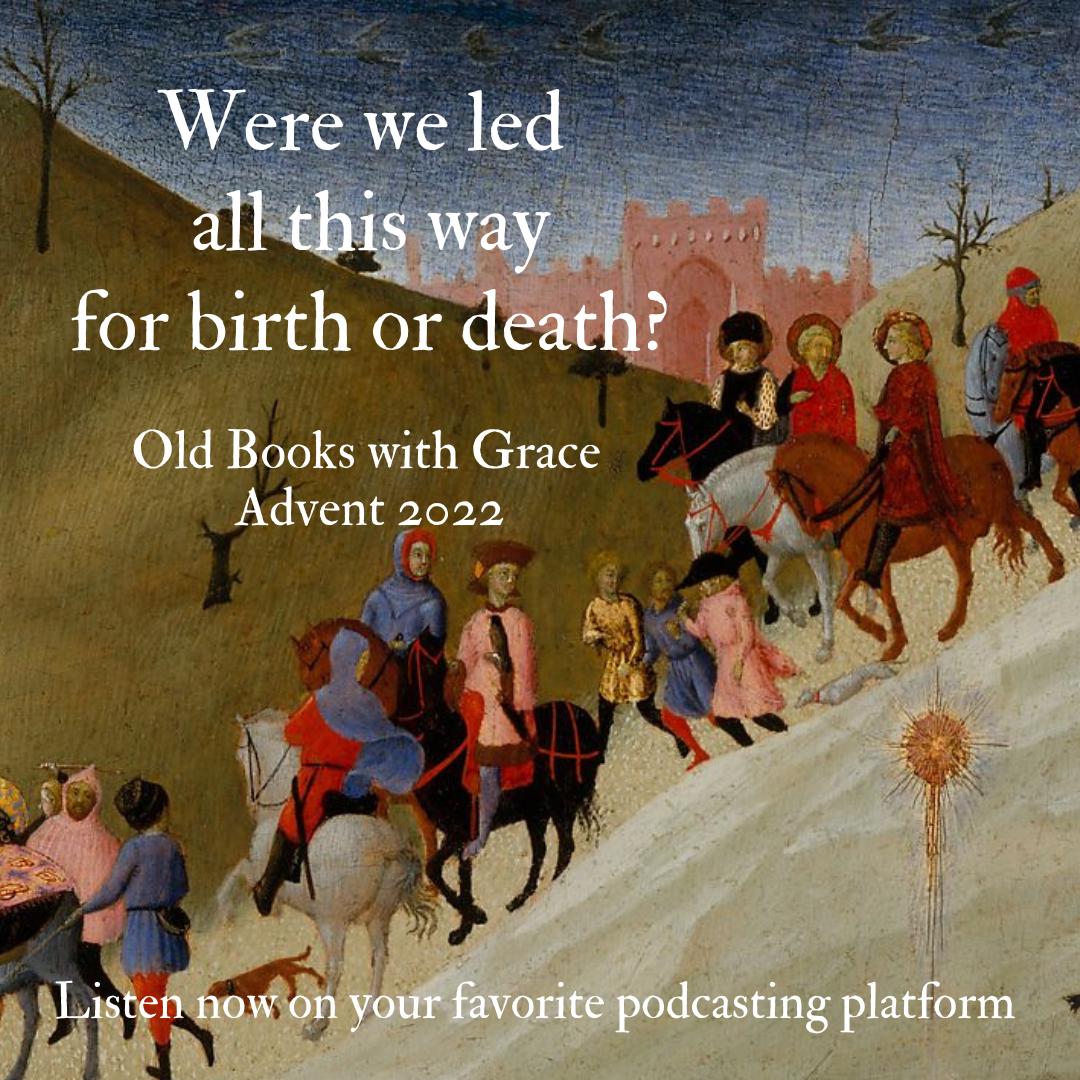
PODCAST SERIES: Advent 2022, Old Books with Grace: I’ve been loving Dr. Grace Hamman’s four-part Advent podcast series, consisting of roughly twenty-minute episodes that discuss seasonal poems. Hamman is a specialist in medieval literature and theology and has the rare gift of being able to translate her extensive knowledge to nonspecialists in engaging and personal ways. She can speak with facility on lit and theology from other eras too. In this series she talks about our status as pilgrims in this world, how Christ carries our prayers in his body, nature-inspired images of the Incarnation, and more. I frequently come away from her podcast with new insight, and always having been spiritually nourished. If you’re traveling for Christmas, queue these up for the car, plane, train, or bus ride! Or work them into your week some other way, perhaps over breakfast, or while you’re doing dishes. Old Books with Grace is available wherever you listen to podcasts. (I use Google Podcasts, but Apple Podcasts or PodBean are the most popular providers.)

  • Episode 1: Were we led all this way for birth or death? (“Journey of the Magi” by T. S. Eliot)
  • Episode 2: Harke! Despair Away (“The Bag” by George Herbert)
  • Episode 3: Heaven Cannot Hold Him (“A Christmas Carol” by Christina Rossetti and excerpt from Piers Plowman by William Langland)
  • Episode 4: Dayspring (releases December 21; will cover an Old English version and Middle English version of one of the O Antiphons)
+++

DANCING ANGEL: This video from a church Christmas pageant in Porter, Indiana, went viral in 2019, but I’m just now seeing it (thanks to @upworthy!). It shows then-four-year-old Isabella Grace Webb dancing it up freestyle in her angel costume to “O Come, All Ye Faithful.” So adorable!

Love That Holds On Tight (Artful Devotion)

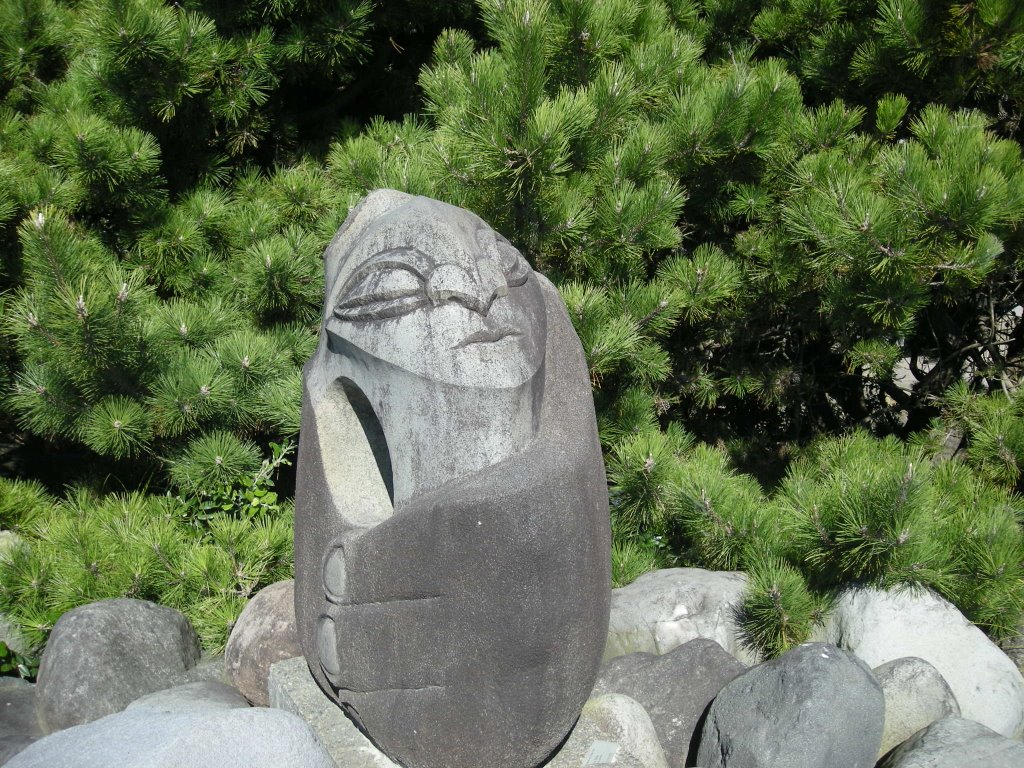
Fakaukau by Filipe Tohi
Filipe Tohi (Tongan, resident in New Zealand, 1959–), Fakaukau, 1996. Stone carving. Photo: Museum of New Zealand Te Papa Tongarewa, via Christ for All People, p. 87

I give them eternal life, and they will never perish, and no one will snatch them out of my hand. My Father, who has given them to me, is greater than all, and no one is able to snatch them out of the Father’s hand.

—John 10:28–29

+++

SONG: “O Love That Wilt Not Let Me Go” | Words by George Matheson, 1882 | Music by Albert L. Peace, 1884 | Performed by Madison Cunningham, on Monuments by Calvary Creative (2015)

+++

Fakaukau (“Thought”) is the title ascribed to this Tongan sculpture in the excellent book Christ for All People: Celebrating a World of Christian Art, published in 2001, which also places it in a private collection. However, photographs of a very similar—if not the same—sculpture by the same artist can be found online under the name Anchor Stone (see photos here and here), and it’s publicly accessible. Its shape is based on the anchor stone through which Tongan fishermen tie the rope of their boats. You can see the hand of God holding the fisher tenderly yet securely as the fisher rests in that grasp.

Anchor Stone by Filipe Tohi
Anchor Stone by Filipe Tohi, located along the Coastal Walkway in New Plymouth, Taranaki, North Island, New Zealand. Photo courtesy of New Plymouth District Council.

Anchor Stone is located along the New Plymouth Coastal Walkway, an eight-mile path that forms an expansive sea-edge promenade stretching from Pioneer Park at Port Taranaki all the way to the eastern side of Bell Block Beach in the Taranaki region of North Island, New Zealand. More precisely, the sculpture sits at the eastern end of a bridge that crosses the Huatoki Stream, near the Wind Wand. The walkway features several other sculptures by Filipe Tohi, as well as artworks by other Pacific Islanders.

Filipe Tohi was born in Nuku’alofa, Tonga, in 1959 and moved to Taranaki, New Zealand, in 1979, where he trained as a carver with a Maori cooperative. His early sculptures were mainly in stone and wood, but more recently he has achieved recognition for large contemporary sculptures in aluminum and steel that are inspired by lalava, traditional Tongan coconut sennit lashing (used to build roofs and canoes). Tohi studied and learned this ancient art form during a return visit to his homeland in 1987 and has been responsible for revitalizing and popularizing it. See more of his work at http://www.lalava.net/index.php/ct-menu-item-17#6.

Christianity took root in Tonga in the first half of the nineteenth century when the country’s king, George Tupou I, converted and the people followed suit. It has been Tonga’s main religion ever since.

+++

I first encountered the hymn “O Love That Wilt Not Let Me Go” a few years ago through a Calvary Collective album—I was extremely moved by Madison Cunningham’s understated arrangement and vocal performance, which captures so well the weary tone of the old text and tune. Cunningham adds a four-line chorus: “You will not let me go, so I will trust in thee. You won’t let go, so I will rest. You won’t let go, so I will trust in thee. O I will rest in thee.” Here is the full original text:

O Love that wilt not let me go,
I rest my weary soul in thee;
I give thee back the life I owe,
that in thine ocean depths its flow
may richer, fuller be.

O Light that follow’st all my way,
I yield my flick’ring torch to thee;
my heart restores its borrowed ray,
that in thy sunshine’s blaze its day
may brighter, fairer be.

O Joy that seekest me through pain,
I cannot close my heart to thee;
I trace the rainbow through the rain,
and feel the promise is not vain
that morn shall tearless be.

O Cross that liftest up my head,
I dare not ask to fly from thee;
I lay in dust life’s glory dead,
and from the ground there blossoms red,
life that shall endless be.

Upon hearing this, I immediately set about looking for a piano score—come to find that the hymn is in the hymnal I grew up with! And yet I don’t recall my congregation ever singing it.

In my estimation, “O Love” is one of the most sublime hymns ever written. It taps deeply into that feeling of “I’m tired, burnt out, spent,” meeting us there with gentle hope and joy. The first verse opens with a reminder of the tenacious hold God has on us and with a soul-invitation into the “ocean depths” of God’s being. What a contrast the hymn builds between our weakness and God’s strength. We flicker; God blazes. We bow our heads in exhaustion and lie down to die; God lifts us up and brings us into his full-flowering life. I know some churches have revived “O Love” using new tunes, but those, I feel, don’t hold a candle to Albert Peace’s original. The hymn often crops up in funeral programs and works beautifully in that context, but its relevance is by no means restricted to those at the end of life or those observing a recent passing.

For a brighter, more vigorous version of the hymn that utilizes the original tune, see Chelsea Moon’s Hymn Project, Volume 2, a collaboration with the Franz Brothers:

And here’s a great a cappella quartet arrangement by the Gaither Vocal Band:

Update, 10/19/20: Since I published this post, a video by 20schemes has been released, of Pete and Cara Bell from Hope Community Church Barlanark in Glasgow performing “O Love That Wilt Not Let Me Go” with the Peace tune I so admire. It’s a straightforward rendition with acoustic guitar, clear and beautiful singing, and lyrics onscreen, so if you’re looking to introduce the hymn to your church music team, this video would be a helpful start.


This post belongs to the weekly series Artful Devotion. If you can’t view the music player in your email or RSS reader, try opening the post in your browser.

To view all the Revised Common Lectionary scripture readings for the Fourth Sunday of Easter, cycle C, click here.