
Roundup: Holocaust survival embroideries, transforming brokenness into beauty, and more

SPOTIFY PLAYLIST: August 2026 (Art & Theology)

+++

POEM: “Last Words (Death Row, Texas)” by Eileen Talone: This poem from Image journal’s Winter 2020 issue made me cry. “Formally, it is a villanelle composed of found language from the transcripts of executions in Texas,” writes James K. A. Smith. “It is a poem of last words that the poet has braided together as an elegy, a song of both lament and yearning.”

+++

PODCAST EPISODE: “Pádraig Ó Tuama: Poetry, and Making Peace, Bearing Witness and Being Human – Poetry Against the Dark,” No Small Endeavor with Lee C. Camp, November 3, 2025: “‘Legitimate target has sixteen letters—and one long abominable space between two dehumanizing words.’ In this episode, poet and peacebuilder Pádraig Ó Tuama offers a sobering yet luminous reflection on language, theology, and the long road of reconciliation. From exorcisms and conversion therapy to moments of silence, soup, and starlight, his stories remind us that even in a burning world, there is still room for awe, for courage, and for a better kind of human flourishing.”

+++

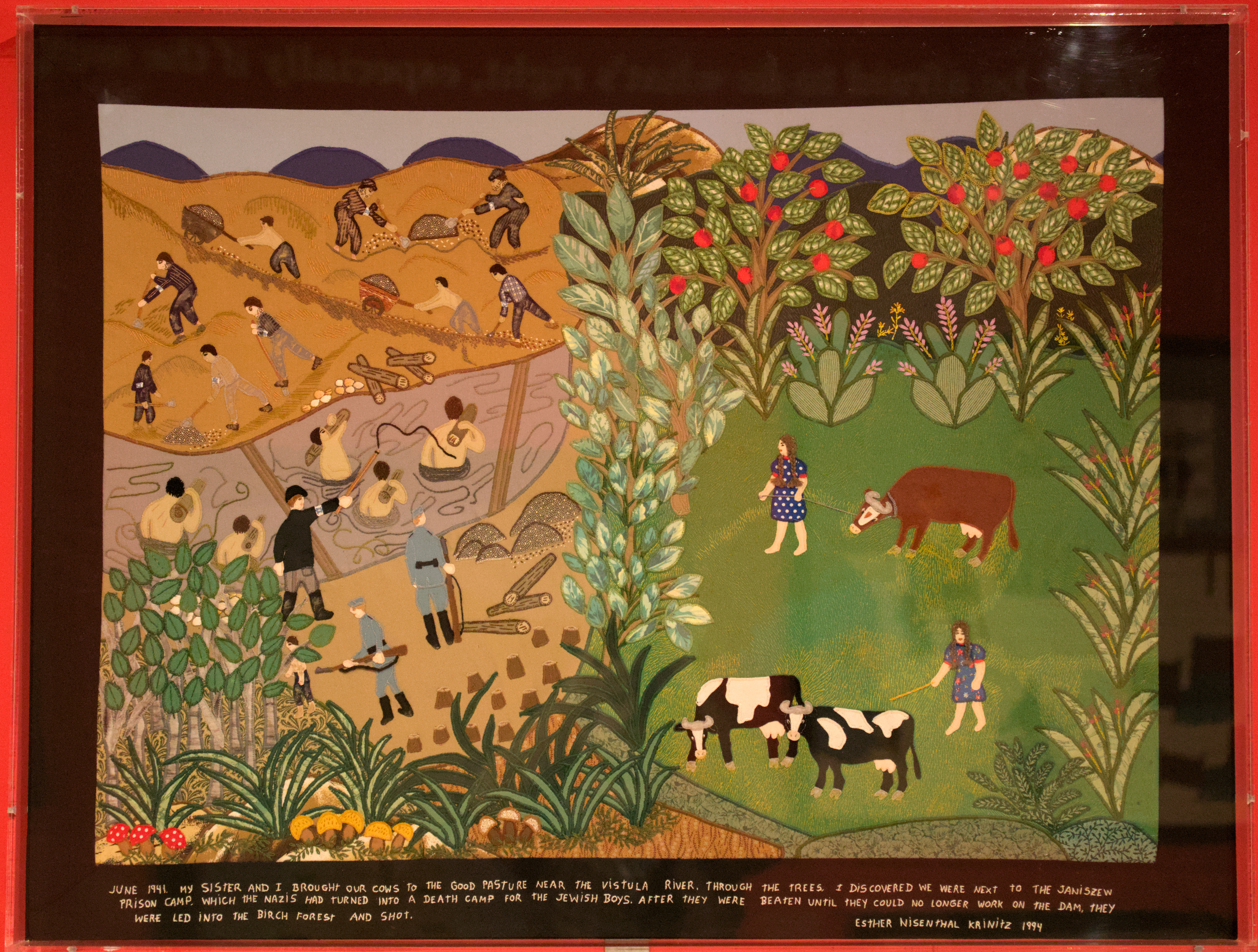
EXHIBITION (+ BOOK + VIDEO TOUR): Esther and the Dream of One Loving Human Family, American Visionary Art Museum, Baltimore, February 23, 2019–December 2030: I recently saw this affecting exhibition at AVAM (the same museum that’s currently showing Mary Proctor), spending a whole afternoon taking in the visual and textual testimony of Esther Nisenthal Krinitz (1927–2001) regarding her survival of the Holocaust. Krinitz was twelve when the Nazis occupied the Polish hamlet of Mniszek, where she lived on a farm with her family. She was able to flee three years later, in 1942, with one of her younger sisters, but she never saw her parents, brother, or other sister again. She emigrated to the United States in 1949, working as a seamstress in Brooklyn and then in Frederick, Maryland, where she spent the remainder of her life.
Krinitz, Esther Nisenthal_Janiszew Prison Camp
Esther Nisenthal Krinitz (Polish American, 1927–2001), Janiszew Prison Camp, 1994. Embroidery and fabric collage, 30 1/2 × 40 1/8 in. Photo: Victoria Emily Jones. © Bernice Steinhardt and Helene McQuade.

In 1977, at age fifty, Krinitz embroidered an approximately four-by-four-foot panel of her childhood home, her carrying pails of water up the footpath. She wanted to share her memories with her two daughters, Bernice Steinhardt and Helene McQuade. This became the first piece in a series of thirty-six, covering her bucolic childhood—tending geese, swimming in the river, walking through wheat fields on stilts, watching her mom make Passover matzos—and then its sudden disruption by German forces during the war. Her embroidered pictures show such cruelties as a soldier ripping off her father’s prayer shawl and cutting off her grandfather’s beard, and her whole family being pulled out of their beds at dawn and taunted with guns. They show children forced to dig trenches, a family friend’s betrayal, Krinitz hiding out in the woods, death marches, shootings, cabbages growing on human ashes at Maidanek concentration camp, and Nazi corpses hanging from trees after the liberation. Krinitz didn’t finish embroidering her whole life story, but the final image she completed shows her arriving, after living for several years in a refugee camp in Germany, in New York Harbor with her husband and newborn.

To view all the images, visit the Art and Remembrance website, which includes image files as well as a video tour narrated by Steinhardt. I also heartily recommend the beautifully produced book Memories of Survival, which reproduces the full series and provides an introduction, transcriptions of Krinitz’s hand-stitched descriptions, and commentary by Steinhardt.

Krinitz’s art is the primary component and anchor point of the current exhibition in Baltimore—but the exhibition also includes a dozen or so works by other artists that lament atrocities and advocate for an end to violence. “The show pays tribute to humanity’s unjust persecution of innocents and the dream of a world at peace.”

+++

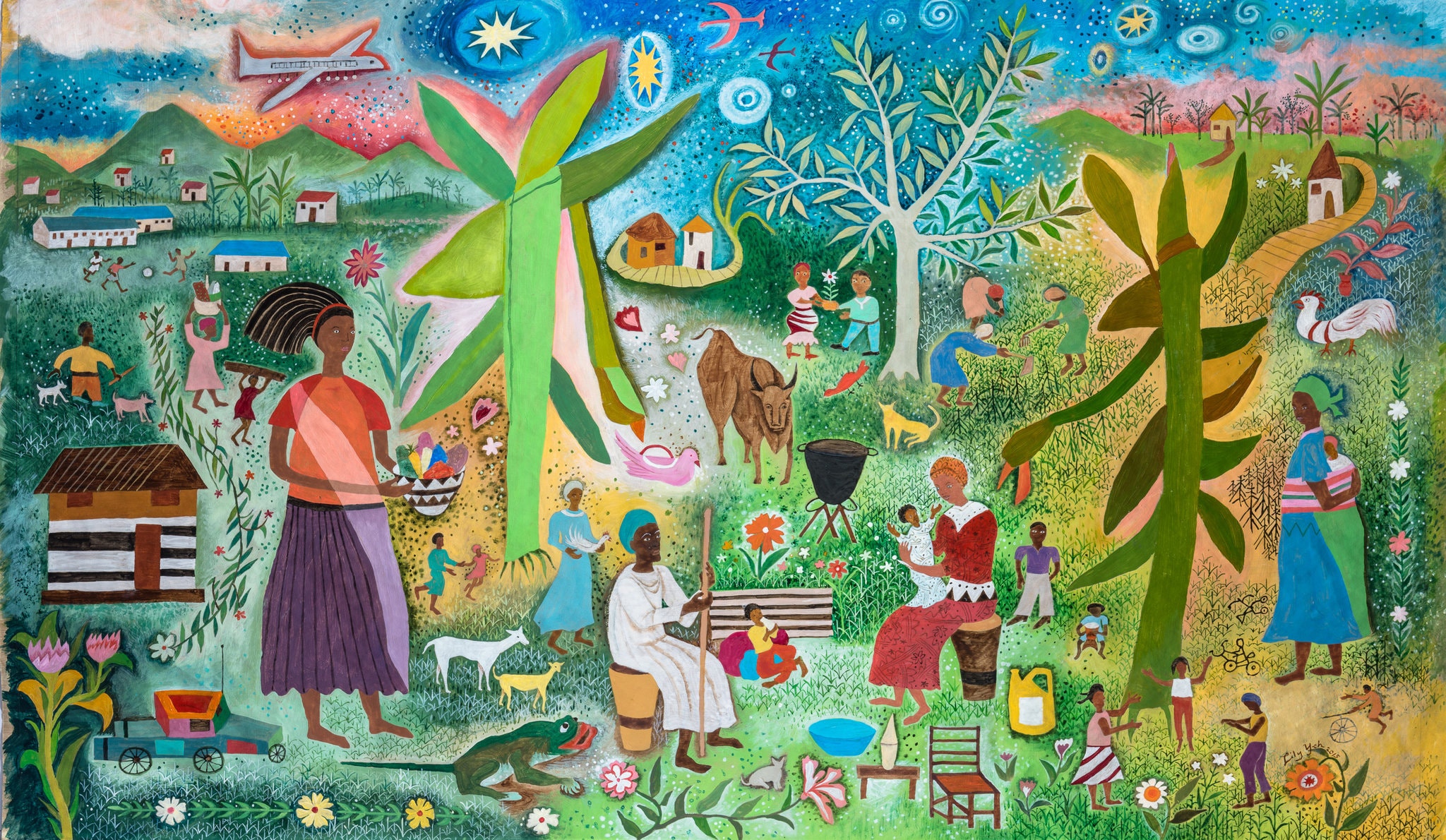
TED TALK: “How Art Transforms Brokenness into Beauty” by Lily Yeh, April 19, 2024: Chinese American artist Lily Yeh travels the world, building community through the arts and bringing beauty to public spaces often seen as “broken.” In this TED Talk, she describes three of her collaborative projects: establishing an art park in North Philadelphia, which involved the making of murals, sculptures, and mosaics with neighborhood children and adults (a project that evolved into the nonprofit The Village of Arts and Humanities); working with survivors of the Rwandan genocide to create a memorial in Rugerero atop a mass grave (“Where there’s beauty, we see hope,” one survivor told her); and “turning dilapidation into color and abundance” at a middle school for migrant children in rural China.

Yeh is the subject of the 2014 documentary The Barefoot Artist: Healing Communities Through Art, streaming for free on Kanopy and available for rental through other platforms.

I learned about her through the Esther and the Dream of One Loving Human Family exhibition at AVAM (see previous roundup item), where three of her paintingsVillage Life in Rwanda Before the 1994 Genocide, Escaping into the Forest, and The 1994 Rwandan Genocide—are on display.
Yeh, Lily_Village Life in Rwanda Before the 1994 Genocide
Lily Yeh (Chinese American, 1941–), Village Life in Rwanda Before the 1994 Genocide, 2015. Acrylic on brown paper. Courtesy of the artist.

+++

SONGS:

>> “The Law of God Is Love” by Kester Limner: Kester Limner wrote this song in June 2020 for a virtual contemplative worship service at St. Andrew’s Episcopal Church in Seattle, influenced by the simple, slow, repetitive style of Taizé chant. She shares it under a Creative Commons Attribution (CC BY) license, which enables reusers to distribute, remix, adapt, and build on the material in any medium or format, even commercially, as long as attribution is given to the creator.

Love, love, the law of God is love
And to break every chain of oppression
So we work, and we pray, O God, Your kingdom come
May we see the dawn of Your justice

>> “Prayers for Freedom” by MaMuse: “Wholeheartedly fed by the folk and gospel traditions, MaMuse (Sarah Nutting and Karisha Longaker) create uplifting music to inspire the world into thriving.” “This video,” they write, “was inspired by our love and reverence for water, for friendship cherished and laughter forever praised.” I’ve previously featured the duo here and here.

“Miriam” by Alison Leonard (poem)

Zwerger, Lisbeth_Miriam relinquishes Moses
Watercolor illustration by Lisbeth Zwerger, from Stories from the Bible (NorthSouth Books, 2016)

Hush my mother’s infant lusty
hush my fear-born brother nigh
rock you still in paper’s cradle
cry you not, or you will die

Rushes taller than your manhood
hide you now from club and sword
neighbours’ howls forget, and slumber
on the swaying water-sward

Rose a king who knew not Joseph
feared our numbers, feared our poise
feared our strength within his nation
spoke the killing of our boys

Cunning she who bore you quietly
cunning midwife I must be
cunning now to rock you, rock you
on the river tenderly

Hush, and hear not my heart beating
for the story that’s to come
mist-enfolded seeps toward me
in a howl that must be dumb

Silent children, silent women
silent men and silent bones
silent shoes in piles unnumbered
silent dust among the stones –

Here’s the woman with her women
with her barren sorrow bowed
jewels, gold and slaves unnumbered
cannot soothe her field unploughed

Cunning I, my mother’s daughter
cannot hush you, but can save
but can lift you from the water
king’s son make from son of slave

Running now to fetch my mother
running now to lose the sight
of the silent dust unslumbered
mist-encroaching through my flight

Mother, Mother, run and feed him –
of his origins be dumb –
close your ears against the howling
of the mothers still to come

This poem, inspired by Exodus 1–2, is published in The Poetic Bible, ed. Colin Duriez (Hendrickson, 2001).

Alison Leonard (born 1944) is a writer from the UK whose works include children’s and adult fiction, stage and (BBC) radio plays, poetry, and spiritual nonfiction. She is a Quaker and is deeply committed to interfaith dialogue and learning.

(Related posts: “Bithiah’s defiance: Kelley Nikondeha and poet Eleanor Wilner imagine Pharaoh’s daughter”; “Miriam,” a poem by Rachel Barenblat)

ESSAY: “Where Sorrow and Pain Are No More” by Margaret Adams Parker

Last summer when participating in a two-week Calvin College seminar, I was providentially assigned to room with Margaret (Peggy) Adams Parker, a sculptor and printmaker who lives, as it so happens, just an hour south of me! Peggy’s enthusiasm—for God, for life, for art—is infectious. She possesses such deep joy, and yet she feels so deeply the hurts of the world. She is attentive, as all good artists must be. “I feel called as an artist to bear witness to the world I see around me and also to the ways I understand that world,” Peggy wrote in an ArtWay feature. “This yields not only images of beauty and tenderness, but also images of suffering and terror.” She regards her art as a means of prayer.

The recipient of numerous church and seminary commissions, Peggy majors on religious and social justice themes. Her sculpture Mary as Prophet won a 2016 honor award from the Interfaith Forum on Religion, Art, and Architecture. In addition to maintaining a studio practice and doing shows, Peggy serves as an adjunct instructor at Virginia Theological Seminary, teaching such courses as “Encountering Scripture through the Visual Arts” and “The Artist as Theologian.” She also writes for various publications, including ARTS: The Arts in Religious and Theological Studies and the Anglican Theological Review, and collaborated on the book project Who Are You, My Daughter? Reading Ruth through Image and Text. She is currently working on a Saint Andrew sculpture group. To learn more about Peggy and view more of her work, visit her website, www.margaretadamsparker.com.

By way of further introduction, here is an essay Peggy wrote ten years ago for the book Heaven, ed. Roger Ferlo (New York: Seabury Books, 2007), pp. 158–66. It is reproduced by kind permission of the publisher.

“Where Sorrow and Pain Are No More”

by Margaret Adams Parker

To be honest, I’ve never thought much about heaven, at least in any systematic fashion. I was interested enough to pick up, at some point, The Great Divorce, C. S. Lewis’s allegory of heaven and hell. And I’ve been known to joke about my expectations that heaven had better have a comprehensively stocked art studio, as well as a fabulous bookstore.

But in looking back though many years of making art and also teaching about art at a Christian seminary, I’ve unearthed a great deal about heaven, although not in the expected places. I haven’t glimpsed heaven among the many imagined depictions, ranging from medieval woodcuts to the visual speculations of twentieth-century outsider artists. I’m simply not drawn to “visionary” images. These are not the kinds of images I make. Instead, my image of heaven is distinctly negative (theologians would call it apophatic). I have no vision of what heaven is like. But I have seen, and I have also made, pictures of what heaven is not.

I am a concrete thinker, and so my art is earthbound, far from visionary. I’ve always understood the incarnational nature of Christianity as a charge to take seriously life in this world. What’s more, my two great artistic mentors—Rembrandt and Käthe Kollwitz—were rarely given to visions. Rather, their work was grounded in the physical, spiritual, and social realities of life. Such symbols as they used (most notably Kollwitz’s use of the skeleton to represent death) served to underscore their understanding of human existence as it is. They recorded moments as small as a child learning to walk and as momentous as war or revolution. Even when picturing the incarnation, that most heavenly of earthly events, both artists showed the miracle taking place in a tangible human setting.

Consider some of these two artists’ characteristic images. Rembrandt’s drawings testify powerfully to his all-encompassing interest in the life around him. He depicted everyone he saw—beggars and merchants, rabbis and serving girls—with the same probing yet sympathetic scrutiny. His drawings of his wife Saskia constitute a particularly poignant record: we watch as she endures four pregnancies, suffers the deaths of three infants, and finally dies at thirty, a short nine years after their betrothal. We glimpse her first in a silverpoint drawing (1633), made the week of their engagement. In this love poem in line, Rembrandt shows us a winsome young woman, resting her cheek lightly against her hand, dangling in her other hand one of the flowers that also adorn her straw hat. In a pen and ink drawing made four years later (1637), Saskia lies in bed, supporting her head heavily on her hand, staring out with a weary and resigned expression. And in the image that Rembrandt sketched on a tiny etching plate the year Saskia died (1642), she has become an old woman, worn, gaunt, and desperately ill.

Portrait of Saskia as a Bride
Rembrandt van Rijn (Dutch, 1606–1669), Portrait of Saskia as a Bride, 1633. Silverpoint on parchment, 18.5 × 10.7 cm (7 3/10 × 4 1/5 in.). Staatliche Museen Preussischer Kulturbesitz, Kupferstichkabinett, Berlin. Inscription (trans.): “This was portrayed after my wife when she was 21 years old, the third day after we were married. June 8, 1633.”

Saskia in Bed
Rembrandt van Rijn (Dutch, 1606–1669), Saskia in Bed, ca. 1637. Pen and brown ink, 8.4 × 10.4 cm (8 3/10 × 10 1/10). British Museum, London.

Sick Woman with a Large White Headdress by Rembrandt
Rembrandt van Rijn (Dutch, 1606–1669), Sick Woman with a Large White Headdress (Saskia), ca. 1642. Etching with touches of drypoint, 6 × 5.1 cm (2 3/8 × 2 in.).

Käthe Kollwitz’s imagery is more politically engaged. The daughter of a trained lawyer who chose to work as a builder rather than practice within the Prussian legal system, she spent her life depicting the plight of the poor and protesting the ravages of war. In her first great print series, A Weavers’ Rebellion (1897–98), she chronicled the causes, progression, and bloody aftermath of the 1844 revolt of Silesian home weavers against their employers. The series begins with Poverty (1894), where a family of weavers gathers around the deathbed of an infant, and concludes with The End (1897), where the bodies of slain revolutionaries are being laid out on the floor of a weaver’s cabin. In both of these dimly lit interiors, the looms and other apparatus of the weavers’ trade stand as ominous reminders of the weavers’ plight.   Continue reading “ESSAY: “Where Sorrow and Pain Are No More” by Margaret Adams Parker”