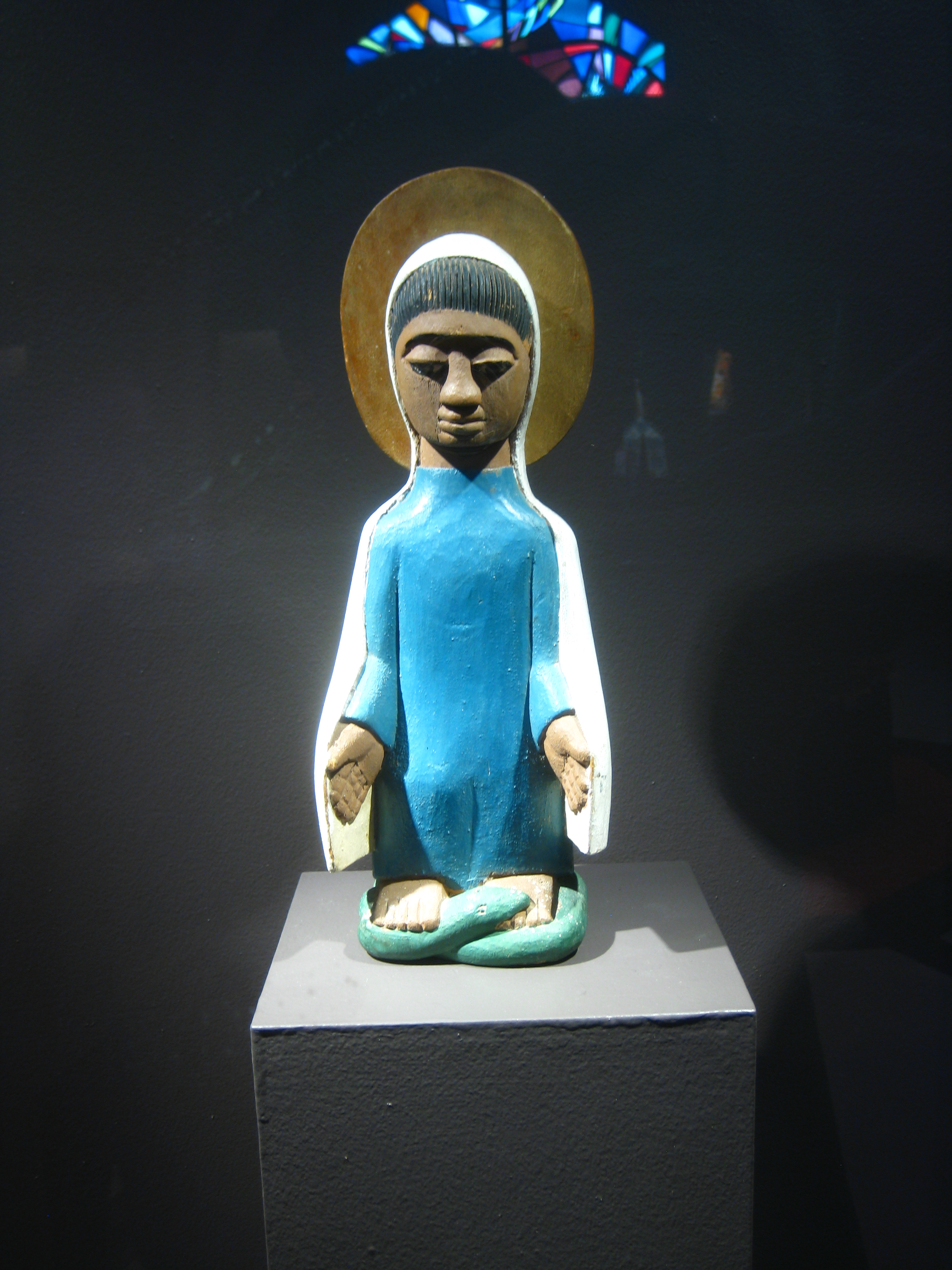
George Bandele (Nigerian, 1910–1995), Virgin Mary, 1960s, wood and pigment. Collection of the SMA African Art Museum, Tenafly, New Jersey. Photo: Victoria Emily Jones.
With the feast of the Visitation coming up on May 31, I’ve been thinking about the song Mary sings in Luke 1:46–55 upon meeting up with her cousin Elizabeth in the hill country of Judea following their miraculous conceptions. It’s bold, exultant, and worshipful, oriented around the liberative power of God. As we continue to reel from the string of mass shootings in the US (Tuesday’s shooting at Robb Elementary School in Uvalde, Texas, was the 212th this year alone), I wonder how Mary’s song might speak to us in this moment—how we, too, might exclaim it with her same fervor and hope, truly believing that God is at work in the world, bringing about justice and healing, even though it is injustice and hurt that so often sound the loudest.
Here is a modern interpretation of the Magnificat by Rev. M Barclay, cofounder and director of enfleshed, an organization that creates prayers, liturgies, art, meditations, teachings, and other spiritual resources for collective liberation. Written in 2019, it captures the verve of Mary’s words while also drawing out shades of sorrow and adding a petitionary element. Barclay uses the gender-neutral pronoun “They” for the Triune God.
My soul is alive with thoughts of God. What a wonder, Their liberating works. Though the world has been harsh to me, God has shown me kindness, seen my worth, and called me to courage. Surely, those who come after me will call me blessed. Even when my heart weighs heavy with grief, still, so does hope abide with me. Holy is the One who makes it so. From generation to generation, Love’s Mercy is freely handed out; none are beyond the borders of God’s transforming compassion. The power of God is revealed among those who labor for justice. They humble the arrogant. They turn unjust thrones into dust. Their Wisdom is revealed in the lives and truths of those on the margins. God is a feast for the hungry. God is the great redistributor of wealth and resources. God is the ceasing of excessive and destructive production that all the earth might rest. Through exiles and enslavement, famines and wars, hurricanes and gun violence, God is a companion in loss, a deliverer from evil, a lover whose touch restores. This is the promise They made to my ancestors, to me, to all the creatures and creations, now and yet coming, and in this promise, I find my strength. Come, Great Healer, and be with us.
A popular song in choir repertoires, “Betelehemu” is a Yoruba Christmas carol by the Grammy-nominated drummer Babatunde Olatunji, arranged for men’s choir by Wendell P. Whalum. It came into being while Olatunji was a student on scholarship at Morehouse College in the 1950s: he shared it with Whalum, director of the school’s glee club, and that spawned a collaboration.
There have been numerous recordings of “Betelehemu” over the years, and each one has its own distinct flavor, especially in the percussion sections. I really like the one by The Young People’s Choir of New York City from the 2003 album It Is Possible. But here’s a version from Brazil, arranged for SATB by Jonathan Crutchfield:
Here are the Yoruba lyrics and English translation to follow along with, provided courtesy of my friends Ezekiel Olagoke and Temidayo Akinsanya. For a pronunciation guide, click here.
Betelehemu Awa yio ri Baba gbojule Awa yio ri Baba fehinti Nibo labi Jesu Nibo labe bi i Betelehemu, ilu ara Nibe labi Baba o daju Iyin, iyin, iyin nifun o Adupe fun o, adupe fun o, adupe fun ojo oni Baba oloreo Iyin, iyin, iyin fun o Baba anu Baba toda wasi Betelehemu
Bethlehem
We shall see that we have a Father to trust
We shall see that we have a Father to rely on
Where was Jesus born?
Where was he born?
Bethlehem, the city of wonder
That is where the Father was born for sure
Praise, praise, praise be to Him
We thank You, we thank You, we thank You for this day
Blessed Father
Praise, praise, praise be to You, merciful Father
Father who delivered us
Bethlehem
The lyrics are simple, rejoicing in the Father’s glory and grace in giving his Son over to be born in Bethlehem. I asked my Yoruba friends about the line “That is where the Father was born for sure,” which seems problematic from a Trinitarian perspective, because it was the Son, Jesus—not the Father—who was born in Bethlehem. The Yoruba word Baba has more nuance than the English “Father”; it is used to signify a biological relationship but also as an honorific for wise men or elders. But still I wondered whether it is theologically appropriate.
Ezekiel told me that Yoruba Christians understand the distinctions between the three persons of the Trinity and that Baba is not commonly used to refer to Jesus, but in defense of it, he pointed me to scripture passages like Daniel 7:9–14 (cf. the book of Revelation), which describes Jesus as “the Ancient of Days”; John 8:58, in which Jesus tells his disciples, “Before Abraham was, I am,” ascribing to himself a status greater than that of the greatest Jewish patriarch; and Colossians 1:15–17: “He [Jesus] is the image of the invisible God, the firstborn of all creation. For by him all things were created, in heaven and on earth, visible and invisible, whether thrones or dominions or rulers or authorities—all things were created through him and for him. And he is before all things, and in him all things hold together.” In Yoruba culture and other African cultures as well, says Ezekiel, Jesus is sometimes called “Chief” or “Ancestor,” a similar notion that emphasizes his being before all things, the eternal Source in whom all things consist.
Temi said that to avoid confusion, he would probably recommend a revision from Nibe labi Baba o daju to Nibe labi Jesu o daju (or else he’d drop the name so that the indefinite pronoun “he” is implied instead).
Both friends felt that the phrase Awa yio ri (“We shall see”) in the second and third lines is awkward in this context. All the other lyric translations I’ve found translate the phrase as “We are glad,” but that would be Awa ni, Ezekiel said—and that doesn’t quite fit the musical meter. It’s possible that the song is merging Advent with Christmas: it starts with looking forward to the birth, then it acknowledges the birth as having happened, eliciting appellations of praise.
Wooden door detail by George Bandele, 1962, showing the Adoration of the Magi. Collection of the SMA Fathers, Cadier en Keer, Netherlands. Source: Christliche Kunst in Afrika, p. 144
It seems that “Betelehemu” is more popular outside Nigeria than in. Ezekiel and Temi and one other Yoruba friend (from different generations) said that despite growing up in Christian homes in Nigeria, they’ve never heard it before, but they’ve heard ones similar to it. So while some sources credit “Betelehemu” as a “Yoruba folk text” and “Yoruba folk tune,” leaving Olatunji out entirely, I think it’s more likely that Olatunji drew on the song traditions of his people to create a new composition. At the very least, Olatunji introduced the song to the United States—and our Christmas concerts are all the richer for it! Continue reading “Yoruba Christmas carol and art (Nigeria)”→


 Art & Theology