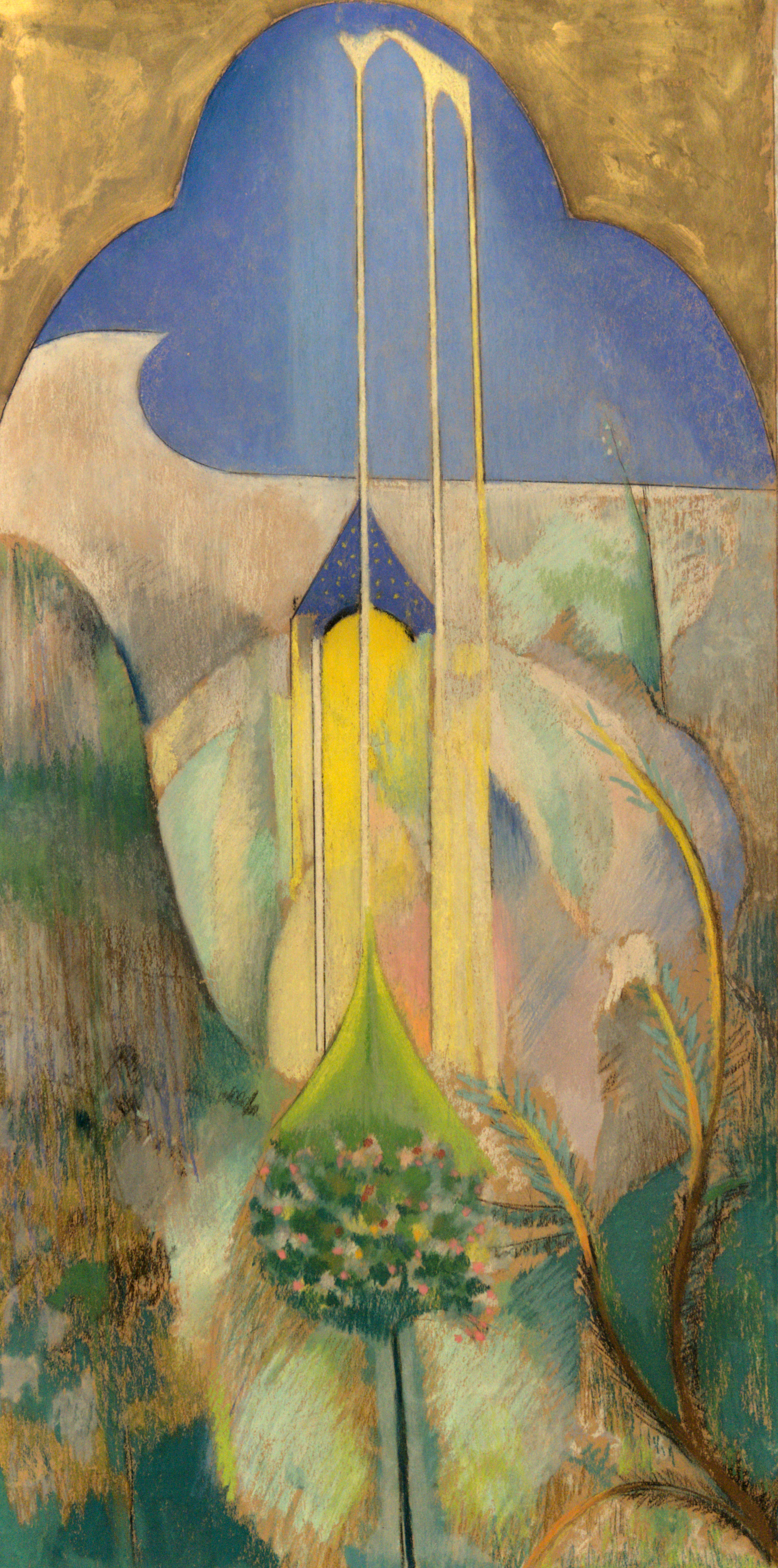
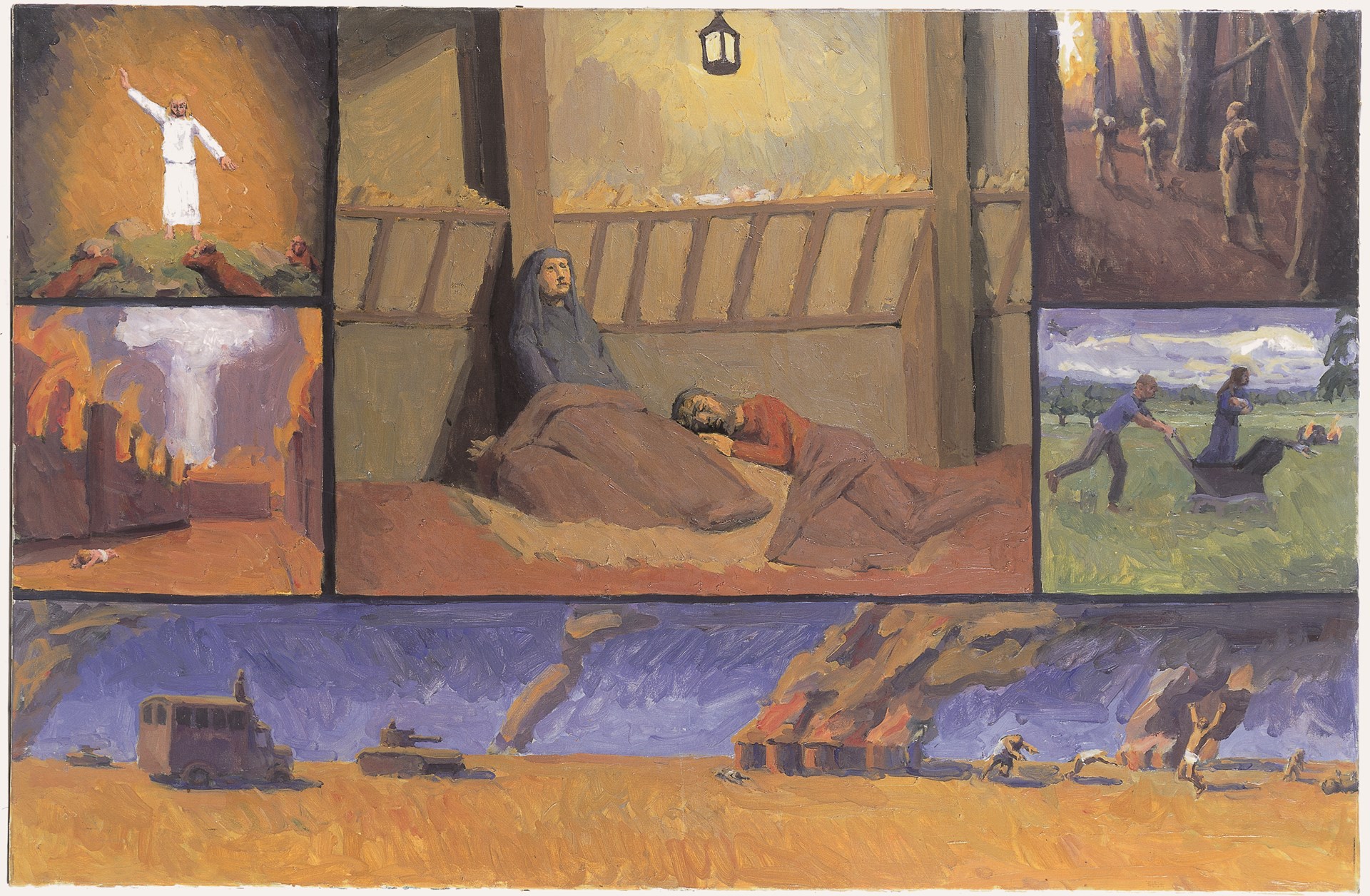
Joseph Stella (American, 1877–1946), Nativity, 1919–20. Oil pastel and oil on paper, 37 × 19 5/16 in. (94 × 49.1 cm). Whitney Museum of American Art, New York. Photo: Victoria Emily Jones. [object record]
Julian’s room. Christmas Day; early morn.

JULIAN. The light comes feebly, slowly, to the world
On this one day that blesses all the year,
Just as it comes on any other day:
A feeble child He came, yet not the less
Brought godlike childhood to the aged earth,
Where nothing now is common anymore.
All things hitherto proclaimed God:
The wide-spread air; the luminous mist that hid
The far horizon of the fading sea;
The low persistent music evermore
Flung down upon the sands, and at the base
Of the great rocks that hold it as a cup . . .
. . . . . . . . . . . . . . . . . . . . . . . . . . . . . . . . . . . . . .
But men heard not, they knew not God in these[.]
. . . . . . . . . . . . . . . . . . . . . . . . . . . . . . . . . . . . . . . . . . . . .
But when He came in poverty, and low,
A real man to half-unreal men,
A man whose human thoughts were all divine,
The head and upturned face of humankind—
Then God shone forth from all the lowly earth,
And men began to read their Maker there.
Now the Divine descends, pervading all.
Earth is no more a banishment from heaven,
But a lone field among the distant hills,
Well ploughed and sown, whence corn is gathered home.
Now, now we feel the holy mystery
That permeates all being: all is God’s;
And my poor life is terribly sublime.
Where’er I look, I am alone in God,
As this round world is wrapt in folding space;
Behind, before, begin and end in Him:
So all beginnings and all ends are hid;
And He is hid in me, and I in Him.
. . . . . . . . . . . . . . . . . . . . . . . . . . . . . . . .
O centre of all forms! O concord’s home!
O world alive in one condensèd world!
O face of Him, in whose heart lay concealed
The fountain thought of all this kingdom of heaven!
Lord, Thou art infinite, and I am Thine!
        I sought my God; I pressed importunate;
I spoke to Him, I cried, and in my heart
It seemed He answered me. I said, “O, take
Me nigh to Thee, Thou mighty life of life!
I faint, I die; I am a child alone
’Mid the wild storm, the brooding desert night.”
        “Go thou, poor child, to Him who once, like thee,
Trod the highways and deserts of the world.”
        “Thou sendest me then, wretched, from Thy sight!
Thou wilt not have me—I am not worth Thy care!”
        “I send thee not away; child, think not so;
From the cloud resting on the mountain peak,
I call to guide thee in the path by which
Thou mayst come soonest home unto my heart.
I, I am leading thee. Think not of Him
As He were one and I were one; in Him
Thou wilt find me, for He and I are one.
Learn thou to worship at his lowly shrine,
And see that God dwelleth in lowliness.”
This passage is excerpted from part 3, scene 10 of Within and Without: A Dramatic Poem by George MacDonald, a verse play that, in 1855, was the author’s first published work.
George MacDonald (1824–1905) was a prolific Scottish writer across the genres of adult and children’s fantasy, realistic fiction, theology, poetry, and literary essay. He was the founding father of modern fantasy literature (Phantastes, The Princess and the Goblin, At the Back of the North Wind, and Lilith and his best-known works), a mentor to fellow writer Lewis Carroll (he was a catalyst to Carroll’s publishing Alice’s Adventures in Wonderland), and a great influence on C. S. Lewis (who cites his writings as instrumental in his conversion to Christianity). MacDonald served for a few years as a Congregational minister, but his preaching about God’s universal love and the ultimate salvation of all (apokatastasis) rubbed against the staunchly Calvinist grain of his time and place; after resigning his pastoral post in Arundel, England, he continued preaching without pay as a layman, as well as weaving his theological views into his fiction.
SPOTIFY PLAYLIST: July 2024 (Art & Theology): This month’s “mixtape” includes a worship song by Daniel P. Cariño from Baguio, the Philippines; a 1954 recording from the streets of New Orleans of the itinerant preacher, singer, and guitarist Elder David Ross; a piano-violin arrangement of “Amazing Grace” by Carlos Simon; a nineteenth-century American folk hymn; an excerpt from Mendelssohn’s oratorio Elijah; a Jesus bhajan in Hindi from Toronto; a one-word song by choral-pop composer Michael Engelhardt; a brand-new Porter’s Gate single; and more.
+++
NEW BOOKS:
>> Diary of an Old Soul: Annotated Edition by George MacDonald, with introduction and notes by Timothy Larsen: At last, a keepsake edition of George MacDonald’s devotional poetry collection Diary of an Old Soul! Last week InterVarsity Press released a cloth-bound hardcover with ribbon bookmark, an introduction and sparing notes by the modern British religious history scholar Timothy Larsen, and, as MacDonald stipulated in the book’s first printing in 1880, a blank page facing each page of verse for readers to continue the conversation. C. S. Lewis gave a copy of Diary of an Old Soul to his future wife, Joy Davidman, as a Christmas gift in 1952, and it would make a wonderful Christmas gift still. For each day of the year MacDonald offers a seven-line poem that voices his spiritual longings, struggles, or joys; the Victorian tastemaker John Ruskin extolled the collection as proof that worthy religious poetry could still be written in the modern age. I highlighted my favorite selections from the book in a blog post last year, but on reading this new edition, new lines are standing out to me.
>> Word Made Fresh: An Invitation to Poetry for the Church by Abram Van Engen: Several Christians have told me they want to read more poetry and learn to better appreciate it but don’t know where to start. I usually recommend starting with an anthology, to get a taste of a wide range of styles and eras, and see if there are particular kinds they gravitate to. But now I’m thrilled I can recommend Abram Van Engen’s Word Made Fresh: An Invitation to Poetry for the Church, with a foreword by Shane McCrae. (Full disclosure: I was the copyeditor!) Endorsed by such luminaries as Christian Wiman and James K. A. Smith, the book is an excellent introduction to how and why to read poetry. Van Engen discusses sixty-two distinct poems, almost all of them reproduced in full, ranging from John Donne, Ben Jonson, and Frances Ellen Watkins Harper to Gwendolyn Brooks, Richard Wilbur, and Li-Young Lee and including, too, church hymns and biblical psalms, two forms of poetry with which Christian readers are likely already familiar. In part 1 he demonstrates six ways to read poetry: personally, for pleasure, inquisitively, like it’s a friend, considering form, and through erasure. In part 2 he answers the question “Why read poetry?”: to name creation, to tell the truth, to rejoice with those who rejoice, and to weep with those who weep. Van Engen insists that poetry is for everyone, and Word Made Fresh substantiates the claim.
PRINT INTERVIEW: “Through the Rent, Eternity Enters: A Conversation with Marilyn Nelson and Christian Wiman,” moderated by Abram Van Engen, Hedgehog Review: In December 2023, The Carver Project at Washington University in St. Louis brought together award-winning poets Marilyn Nelson and Christian Wiman for a discussion of poetry, faith, love, perception, ambition, humility, prayer, and grace, moderated by Abram Van Engen. Poets, I’ve noticed from attending conferences and reading or listening to interviews with them, tend to have an immense storehouse of wise quotes from other poets and thinkers at the ready, as this interview corroborates. There’s so much here to chew on!
+++
ESSAY: “Christianity and Poetry” by Dana Gioia, First Things: “This brief and inadequate historical survey,” writes poet and literary critic Dana Gioia, “is offered to demonstrate the powerful continuity of Christian poetry in English. Our literary canon is suffused with religious consciousness, which has expressed itself in ways beyond the imagination of theology and apologetics. Milton boasted that his Paradise Lost would ‘justify the ways of God to men,’ but his masterpiece was only one of countless poems that engaged, enlarged, and refined the spirituality of the English-speaking world. Christianity went so deeply into the collective soul of the culture that its impact continues even in our secular age.”
He proposes, “All that is necessary to revive Christian poetry is a change in attitude—a conviction that perfunctory and platitudinous language will not suffice, an awareness that the goal of liturgy, homily, and education is not to condescend but to enliven and elevate. We need to recognize the power of language and use it in ways that engage both the sense and the senses of believers.”
+++
CANTATA: Rejoice in the Lamb by Benjamin Britten, performed by VOCES8 and the VOCES8 Foundation Choir & Orchestra, dir. Barnaby Smith: “Rejoice in the Lamb (Op. 30) is a cantata for four soloists, SATB choir and organ composed by Benjamin Britten in 1943 and uses text from the poem Jubilate Agno by Christopher Smart (1722–1771). The poem, written while Smart was in an asylum, depicts idiosyncratic praise and worship of God by different things including animals, letters of the alphabet and musical instruments. Britten was introduced to the poem by W. H. Auden whilst visiting the United States, selecting 48 lines of the poem to set to music with the assistance of Edward Sackville-West. The cantata was commissioned by the Reverend Walter Hussey for the celebration of the 50th anniversary of the consecration of St Matthew’s Church, Northampton. Critics praised the work for its uniqueness and creative handling of the text.” (Wikipedia)
I know this poem from its famous passage about Jeoffry the cat, in which Smart celebrates his cat’s relationship with God: “For I will consider my Cat Jeoffry. / For he is the servant of the Living God duly and daily serving him. / For at the first glance of the glory of God in the East he worships in his Way. / For this is done by wreathing his body seven times round with elegant quickness. / For then he leaps up to catch the musk, which is the blessing of God upon his prayer. . . .” See 3:52 of the video.
SONG: “Wild Strawberries” by Nick Chambers: This song from 2020 expresses yearning to know the God whose beauty is revealed in nature and who is mysterious, “divinely robed in dark and radiant haze.” It’s based on a 1819 Swedish hymn by Johan Olaf Wallin that was quoted by the aging professor Isak Borg in Ingmar Bergman’s multi-award-winning film Wild Strawberries.
“In the gospel narratives,” Chambers writes, “the risen Jesus is always one step ahead, beckoning us further. We follow after tangible touches and traces he leaves behind—folded grave clothes and broken bread. He travels with us but isn’t always recognizable, still teaching his friends how to fish, readying breakfast on the beach. Wherever he appears and withdraws, the background becomes the foreground, inviting us to see and seek him everywhere. Resurrection cannot be confined; all creation is drawn into its trajectory.” Read more from Chambers in the YouTube video description.
Following the popularity of last year’s “25 Poems for Christmas,” I’ve decided to publish a brand-new installment, and will perhaps make this a yearly tradition! All the selections can be read online—just follow the links.
Despite the pithy title of this post, not all the poems are “Christmas” poems, strictly speaking, but rather they encompass the season of Advent too, as well as Epiphany. Advent is a four-week season leading up to Christmas that is characterized by a mood of longing and expectation; it is oriented not only toward Jesus’s first coming but also toward his second. Christmas, of course, celebrates the birth of Jesus, the Word of God made flesh. And Epiphany, on January 6, commemorates the visit of the magi to the crib, representing God’s self-revelation to the wider world.
Each poem is accompanied by a micro-commentary or short descriptive blurb, which I suggest you read after reading the poem itself. There’s a benefit to first entering a poem without having any context—then after registering your initial impressions and questions, to consider another person’s framing or analysis or highlights, and reread. And then a third time! Each reading can potentially reveal new meaning.
Stone Nativity by Juan Manuel Cisneros, Ventura, California, December 2016 [learn more]
1.“Haiku for an Advent Calendar” by Richard Bauckham: Church services during Advent tend to focus on messianic prophecies from the Hebrew Bible, rumblings of a coming savior. In this sequence of twenty-four haiku, Richard Bauckham pulls a detail from each book of the Jewish scriptures, finding anticipations of Christ. For example, Isaiah: “In the wilderness / a voice cries for centuries / seeking an echo.” Or Job: “God answered Job but / not his question. Maybe he / will do that again.”
2. “How Christ Shall Come” (anonymous): The cosmological Christ blew in from the four cardinal directions, coming as lover, knight, merchant, and pilgrim. So says this fourteenth-century Middle English lyric, rich in metaphor, compiled in a book of preaching aids and sermons by John Sheppey (d. 1360), bishop of Rochester. (It is unclear whether he is the author of the poem.) The great medieval literature scholar Carleton Brown gave it the title “How Christ Shall Come” in his landmark Religious Lyrics of the XIVth Century (1924), and Grace Hamman brought it to my attention recently in her wonderful monthly Substack, Medievalish, providing a modern English translation and commentary.
3.“Hawk Lies Down with Rabbit” by Seth Wieck: What would it look like for death to no longer have dominion in the animal world? Grappling with Isaiah’s end-time vision of a peaceable kingdom void of predation, this poem describes in graphic terms a bird of prey making its kill, feeding on flesh, and wonders how a hawk could still be itself with rewired impulses. Hear the author read and provide context for the poem on the Reformed Journal Podcast.
4.“john” by Lucille Clifton: Written in the voice of John the Baptist, this poem is part of an extraordinary sixteen-poem sequence titled “some jesus,” which features a range of biblical characters. In her retelling of his ministry as forerunner to the Messiah, Lucille Clifton casts John as a Black Baptist preacher, preparing his listeners to receive the one who “com[es] in blackness / like a star.” Clifton’s larger body of work would suggest that “blackness” here is multivalent, describing what Jesus comes into and as: the word suggests the darkness of the world that Christ entered, on the one hand, but also functions as a positive racial identifier. In Clifton’s revisioning, Christ comes as a Black man, wearing “a great bush / on his head”—which, again, could be read as an Afro, and/or as a mystical reference to the site at which God revealed himself to Moses in the Sinai desert. Luminous with truth, Christ comes, “calling the people brother.”
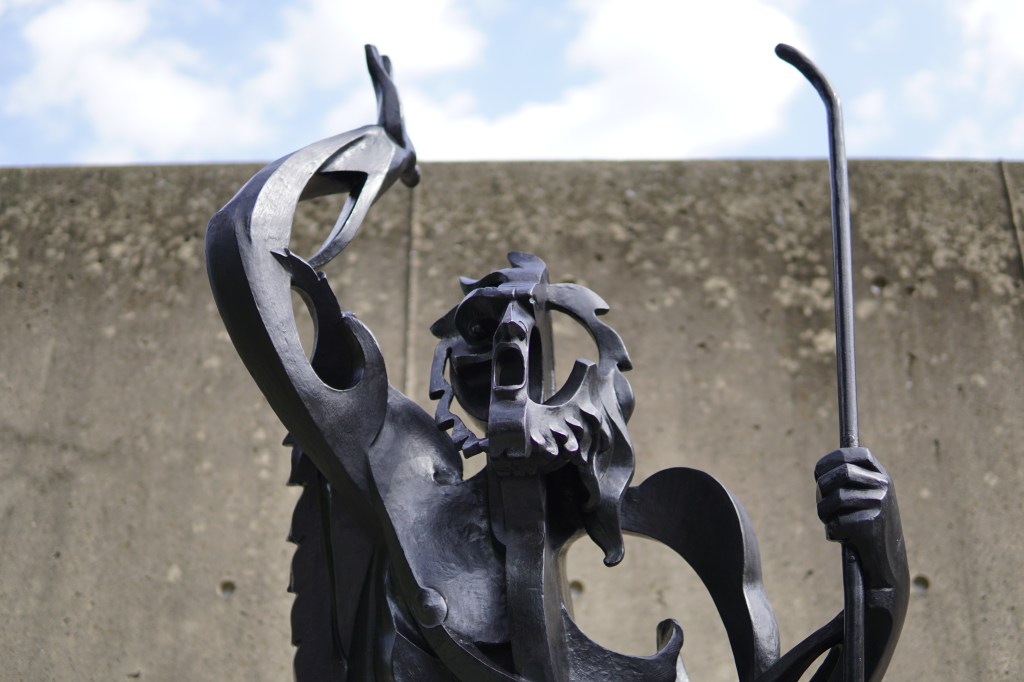
Pablo Gargallo (Spanish, 1881–1934), The Prophet (St. John the Baptist) (detail), 1933. Bronze, 91 3/4 × 29 1/2 × 19 in. Wurtzburger Sculpture Garden, Baltimore Museum of Art. Photo: Victoria Emily Jones.
5. “Christmas Mail” by Ted Kooser: Every December the story of an ancient birth comes alive again in couriers’ mailbags, in tin boxes at the ends of driveways, on mantels and fridges. This poem honors those postal workers who deliver good tidings in the form of Christmas cards, the magic spilling out the envelopes to make even the most tiresome routes sparkle a bit.
6. “December 25” by George MacDonald: Through the mid-nineteenth century, denominations influenced by the Reformed tradition, including the Church of Scotland in which George MacDonald was raised, typically did not observe Christmas, the rationale being that no one day should be thought of as holier than any other. But in his book-length dramatic poem Within and Without, MacDonald refers to December 25 as “this one day that blesses all the year”—and in this seven-liner from his Diary of an Old Soul, he describes Christmas as a gleaming blue sapphire, a structural center around which all the other jewels of the church calendar are oriented.
7. “On a Cardinal Climbing Down a Manhole to Restore Power to 400 Homeless People” by Michael Stalcup: On May 11, 2019, Cardinal Konrad Krajewski, the papal almoner (Pope Francis’s special appointee to distribute charity), crawled into a manhole and broke a police seal to personally restore power to a homeless shelter in Rome whose electricity had been shut off due to its failure to pay its bills. The shelter was occupied by some 450 people at the time, 100 of them children, who had been without electric light, hot water, and refrigeration for nearly a week. In this poem, which can be read Christologically, Michael Stalcup celebrates this defiant humanitarian act that brought light to a people living in darkness.
8. “Incarnation” by Amit Majmudar: “Inheart yourself, immensity. Immarrow, / Embone, enrib yourself.” So begins the five-poem sequence “Seventeens.” Musical and witty, this first poem is a plea to the great I AM to take on a body and “be all we are, and all we aren’t.”
9.“The Lord Is with Thee” by Micha Boyett: Written in 2010 as the third in a five-poem sequence commissioned by John Knox Presbyterian Church in Seattle, this poem centers on the Visitation episode described in Luke 1:39–58. It’s about Mary finding belonging in God’s story, especially through the companionship of her elder cousin Elizabeth, who has nurtured Mary’s faith since infancy and continues to do so in this her moment of crisis. “How easily she spoke of God, / as if he were a neighbor, a fish vendor on the street,” Mary admires. Elizabeth supports Mary physically, emotionally, and spiritually, holding her hair back as she vomits, protecting her from vicious rumors, affirming the work of God in her life, and accompanying her at the start of this wild path God has set them both on.
Odilon Redon (French, 1840–1916), Mystical Conversation, ca. 1896. Oil on canvas, 65 × 46 cm. Museum of Fine Arts, Gifu, Japan.
10.“Our Lady” by Mary Elizabeth Coleridge: The great-grandniece of the Romantic poet Samuel Taylor Coleridge, Mary Elizabeth Coleridge (1861–1907) grew up in a home visited by family friends Alfred Lord Tennyson, Anthony Trollope, John Ruskin, and Robert Browning, among others. In this poem she marvels at how God chose the common-born Mary for such a task as mothering the Christ, singing along with Mary’s Magnificat about how God raises up the lowly.
Source: Fancy’s Following (privately published, 1896). Public Domain.
11. “Traveling Man”by Marjorie Maddox: With his pregnant wife alongside, Joseph plods down south to Bethlehem, “convinced of the predestined / roll of dice chrismated with Miracle.” An epigraph from a Leonard Cohen song sets the tone.
12.“Sonnet in the Shape of a Potted Christmas Tree” by George Starbuck: This charming shape poem contrasts the extravagance of our popular celebrations of Christmas with the poverty of the first-century event it marks. The first half describes the furious wind of decorative activity that uproots evergreens from their natural habitats to bring them indoors and deck them with baubles and ribbon. I don’t know how to interpret “no scapegrace of a sect,” but “Daughter-in-Law Elect” refers to a duet from the Gilbert and Sullivan opera The Mikado. The turn comes with “a son born / now / now,” the latter two lines styled as the visible trunk of the tree; here the scene shifts to the simple stable of old, where Mary lies “spent” next to her newborn along with a cow and donkey, a sole “firework” guiding the magi and us all to the spot.
13.“Christmas (I and II)” by George Herbert: George Herbert (1593–1633) is one of the most celebrated poets of the English language. In part 1, a sonnet, of this two-part poem, he imagines himself a weary traveler who chances upon a humble inn where he unexpectedly finds his Lord, the infant Christ. It’s the inn of Bethlehem. Having then received rest from Christ his host, in the closing couplet he expresses his desire to reciprocate—to offer his own soul, lowly though it is, as a residence for Christ, praying that God first adorn it to make it hospitable. In the second part of the poem, Herbert uses a metaphysical conceit (extended metaphor) comparing his soul to a shepherd whose flock of thoughts, words, and deeds pastures on God’s word and who, like the shepherds of Bethlehem, sings glory to God. His shepherd-soul seeks eternal daylight, which he finds in the Son/sun, whose beams so intertwine with his song that the beams sing and his song shines.
14. “Descending Theology: The Nativity” by Mary Karr: The physicality of childbirth, from the contractions (which pierce the Virgin like a star, Karr writes) to the bodily fluids, is heavily featured in this poem. Jesus emerges from his mother “a sticky grub” with a “lolling head” and “sloppy mouth” that seeks out her breast for food. And as she feeds him physically, he feeds her spiritually. Then he falls asleep. His first nap, Karr writes, is a foretaste of the sleep of death he will eventually come to taste. But for now, he wakes up crying—as all babies do.
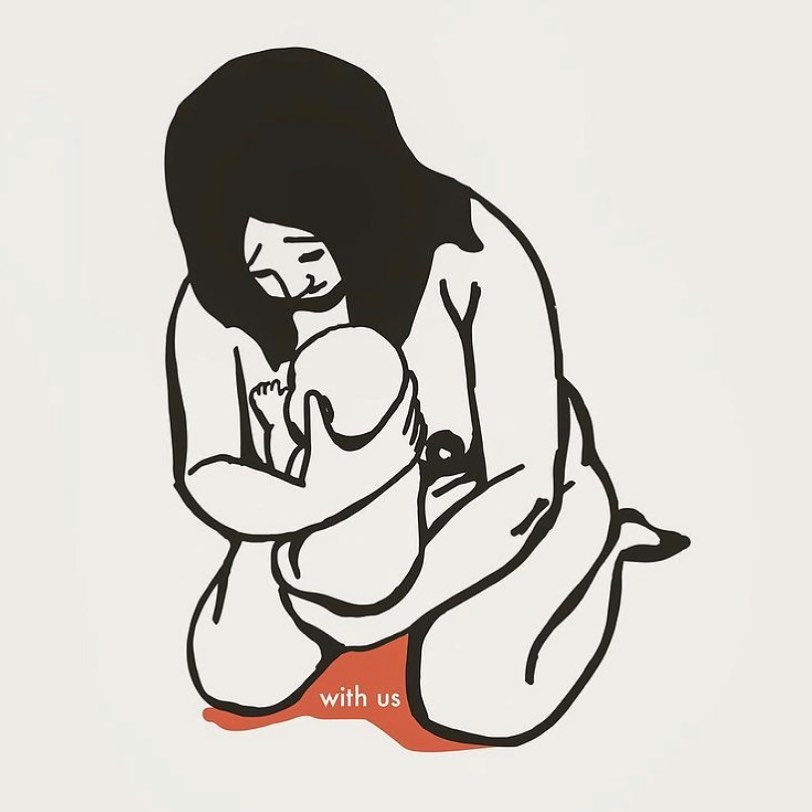
Scott Erickson (American, 1977–), With Us, Face to Face, 2016. Digital art. [available for purchase]
15.“from spiralling ecstatically this”by E. E. Cummings: What a fantastic opening line! The heavenly spheres whirling, twirling, down into the “proud nowhere”—Bethlehem—“of earth’s most prodigious night.” Heretofore living in mundanity, the domestic animals, hungry for miracle, for newness, are vouchsafed to be witnesses of this supernatural event, before which they kneel “humbly in their imagined bodies.” Overhead floats the “perhapsless mystery of paradise,” a phrase suggesting that heaven is beyond human understanding but not without certainty; it’s a declarative reality, not subjunctive, even if it can’t quite be put into words. Mary herself has no words—she silently, knowingly smiles, while the created world erupts in song around her. The “mind without soul” is a reference to Herod, who seeks to snuff out this new life, but to no avail.
The omission of spaces after punctuation marks (e.g., “a newborn babe:around him,eyes”) is not a mistake; that’s how E. E. Cummings liked it. Scholars say it’s to create a faster rhythm, but in this poem I don’t think that choice is as effective, as pauses and slow savoring seem more appropriate to its contemplative mood.
16.“How the Natal Star Was Born”by Violet Nesdoly: Narrated by the angel Gabriel, this poem imaginatively describes heaven’s nervously awaiting the birth of Jesus during the nine months following Gabriel’s dispatch to Mary, and then busting out in celebration when at last they hear his infant-cry. When his Son is born, instead of cigars, the Father passes out trumpets to his company of friends, who sound them all the way to Bethlehem’s fields, and pops open a bottle of champagne whose bubbles spray far and wide.
17. Sections 9–10 of “The Child” by Rabindranath Tagore: Hinduism was the religion of Rabindranath Tagore’s birth and upbringing, but he also held deep respect for Jesus Christ. (For more on the influence of Christianity on Tagore’s thought and writing, see chapter 4 of Rabindranath Tagore and Interfaith Dialogue by Manas Kumar Ghosh [DMin thesis, Charles Sturt University, 2010].) “The Child” is a free-verse poem that Tagore wrote in English in 1930 after seeing a passion play in Germany and then translated into Bengali in 1932 with the title “Sishutirtha” (Pilgrimage to Childhood). In it a “Man of faith” gathers people from all walks of life to join him on a “pilgrimage of fulfilment,” to “struggle [through the dark] into the Kingdom of living light.” Initially met with enthusiasm, the Man later becomes a target of the people’s anger and distrust, and they kill him. Disorientation ensues. But a man in the crowd is able to rally the others to repent and resume their quest, following the spirit of “the Victim.”
The final two sections, 9 and 10, are the selection I’ve chosen. (Scroll right to read the last.) At “the first flush of dawn,” when the time is ripe, the pilgrims arrive at a thatched hut in a palm grove, where they finally meet the eternal Light they’ve been seeking: “the mother . . . seated on a straw bed with the babe on her lap, / . . . the morning star.” Here is the Child of the title, humanity’s redeemer.
Source: The Child (London: George Allen and Unwin, 1931)
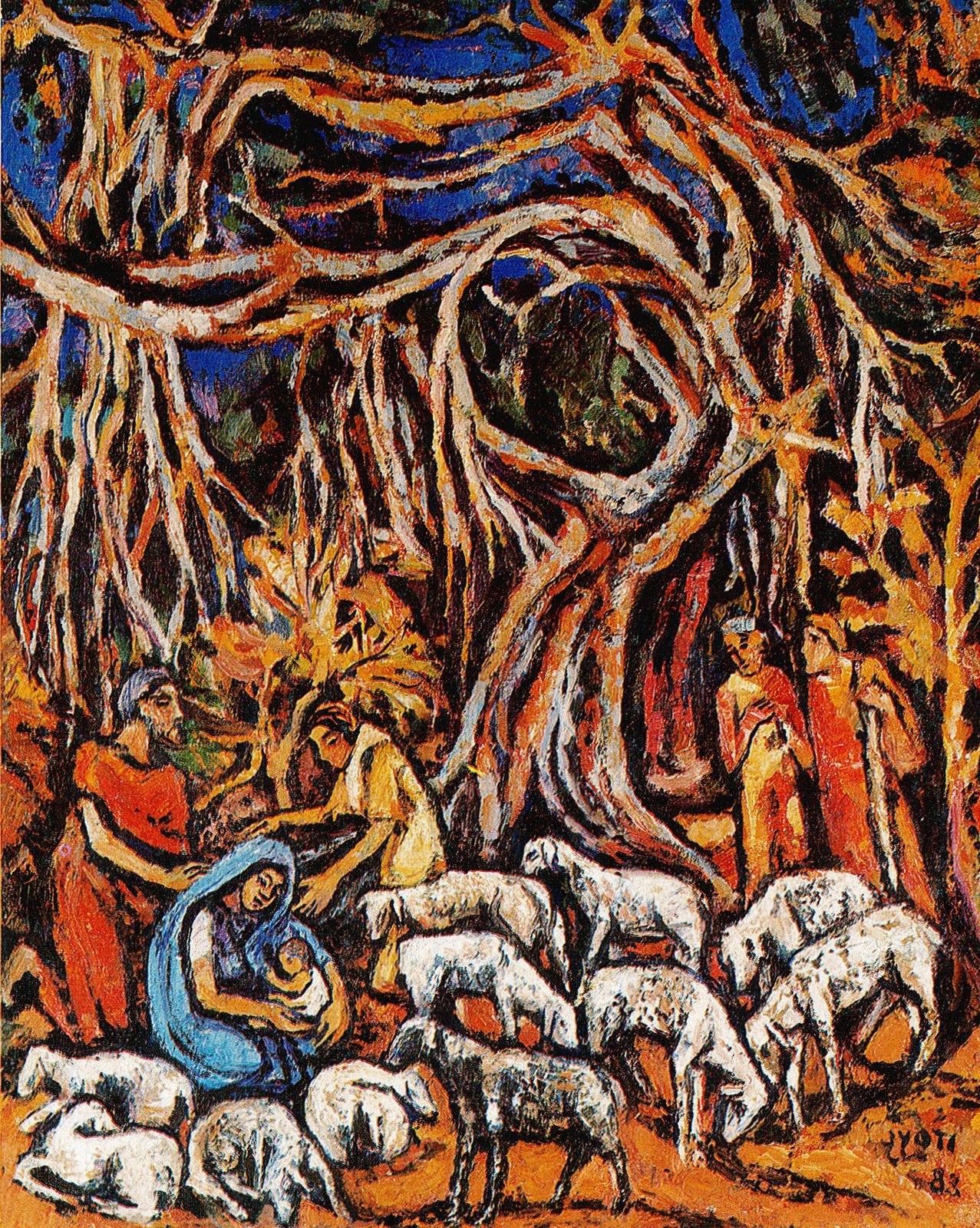
Jyoti Sahi (Indian, 1944–), Adoration of the Shepherds, 1983. Oil and acrylic on canvas.
18. “Love’s Bitten Tongue (11)”by Vassar Miller: This poem, “You, my God, lonesome man, Love’s bitten tongue,” is from a crown of twenty-two sonnets, a type of sequence in which the last line of each sonnet is repeated as the first line of the next, but each time with a new twist of syntax and sense. The crown as a whole expresses the poet-speaker’s struggle against her ego, and her desire for Christ (whom she gives such an evocative name in the title!). In this particular sonnet she describes waiting at the edge of her bed every Christmas Eve as a child in anticipation of both Santa’s arrival with gifts and the holy mystery of Christ’s birth, an admixture of sacred and profane longings that fill her still as an adult.
19. “Gloria in Profundis” by G. K. Chesterton: G. K. Chesterton’s poems are of variable quality, but this one is brilliant, emphasizing God’s descent from the rich heights of heaven into an obscure cave in a simple town. “Glory to God in the lowest!” it exclaims, a clever inversion of the angels’ song to the shepherds in Luke 2:14. The poem was originally published in a 1927 Christmas pamphlet with wood engravings by Eric Gill. The Latin title translates to “Glory in the Depths.”
Source: Gloria in Profundis by G. K. Chesterton (Ariel series pamphlet) (London: Faber and Gwyer, 1927); compiled in The Spirit of Christmas (New York: Dodd, Mead, 1985)
20.“Silent Night” by Bonnie Bowman Thurston: Rev. Dr. Bonnie Thurston invokes a tradition that says the night of Christ’s birth, there was a whole hour in which time stood still and all was silent. What a fascinating legend! Thurston told me its origin is northern European, said she remembers reading it in some scholarly Celtic studies; I wasn’t able to locate any such mentions, but the second-century Protoevangelium of James, chapter 18, probably written in Egypt or Syria, does describe everything momentarily freezing in place around Joseph as he steps out to find a midwife for Mary. Anyway, the poem ends with a striking metaphor! Word, flesh: fire. (Reminds me of this digital artwork by Scott Erickson.)
21. “After Luke 2:19” by Michelle Ortega: When the shepherds recounted to Mary what the angels had told them in the fields about Jesus being the promised Messiah, “Mary treasured all these words and pondered them in her heart,” Luke narrates in his Gospel. Poet Michelle Ortega expounds on this verse, emphasizing the relationship of Mary’s body to her son’s from conception to birth and now postpartum—an intimacy known well by mothers across the centuries. As wondrous as it was to be part of a cosmic story writ large in the skies, Ortega suggests that Mary treasured just as much as the grand pronouncements those small moments of being just an ordinary mama.
22. “Christmas: 1924”by Thomas Hardy: “We the civilized world have given Christianity a fair trial for nearly 2000 years, & it has not yet taught countries the rudimentary virtue of keeping peace,” lamented the British novelist and poet Thomas Hardy (1840–1928) in a letter to Florence Henniker dated February 25, 1900, during the Boer War. World War I only increased his cynicism, which is on display in this sour little epigram that opens with an ironic quotation of the angels’ proclamation to the shepherds the night of Jesus’s birth.
Francis Hoyland (British, 1930–), Nativity, 1961. Oil on canvas, 90 × 120 cm. Methodist Modern Art Collection, HOY/1963/1.
23. “Eating Baklava on New Year’s Eve” by Anya Krugovoy Silver: Poet Anya Silver (1968–2018) reads a spiritual benediction in her piece of baklava, layered and sweet and consumed on the eve of a new year.
Source: Second Bloom (Eugene, OR: Cascade Books, 2017)
24. “A Ballad of Wise Men”by George M. P. Baird: Jesus so often confounds the wisdom of the wise, starting with his birth. With gentle humor and in iambic rhythm and rhyme, this poem celebrates the simple access we all have to Christ.
Source: Rune and Rann (Pittsburgh: Aldine Press, 1916). Public Domain.
25. “Excrucielsis”by Hannah Main-van der Kamp: Originally published at ArtWay.eu as a response to the contemporary Romanian sculpture The Spring by Liviu Mocan, this poem alternates between the weary journeying toward truth of one of the biblical magi and that of a modern-day seeker similarly “longing for / the something more.” It can be a trudge, finding the Light—it involves risk, a willingness to follow the signs, and the tenacity to hold on to your “vision burden,” “clutch[ing] the weight” of it all the way over rough and varied terrain. But the epiphanic moment awaits, to sound like a trumpet blast. The title of the poem is a neologism combining the words “excruciating” and “excelsis” (Latin for “the heights”); “every excelsis contains something excruciating, that’s how we get to genuine excelsis,” the poet told me in an email. Read a related prose reflection by Main-van der Kamp here.
Source: The Slough at Albion (Victoria, BC: Ekstasis Editions, forthcoming)
Disclosure: This post contains Amazon affiliate links, meaning I earn a small commission from qualifying Amazon purchases originating from clicks on this site.
George MacDonald (1824–1905) was a Scottish preacher, poet, essayist, and writer of both realist and fantasy fiction. He was a great influence on J. R. R. Tolkien and C. S. Lewis, the latter of whom published, in 1946, a compilation of MacDonald’s theological writings excerpted from his sermons, novels, and other sources. “I know of hardly any other writer who seems to be closer, or more continually close, to the Spirit of Christ Himself,” Lewis wrote in the preface to George MacDonald: An Anthology.
MacDonald is best known for his fairy tales, such as The Princess and the Goblin (my entrée to the author as a child, via a 1991 animated film adaptation from Wales) and Phantastes. But more recently I have been appreciating his devotional poetry.
George MacDonald, as photographed by his friend and fellow writer Lewis Carroll, 1863
While in his fifties, MacDonald published A Book of Strife in the Form of the Diary of an Old Soul (1880), a collection of 366 short, original, untitled devotional poems, one for each day of the year. (Read it for free online.) Addressed to God, these poems voice discouragement, weariness, restlessness, desire, doubt, and trust. MacDonald asks God for healing and refreshment; for a vulnerable, stripped-down soul, clothed anew in Christ; for salvation from his stubbornness and folly; for guidance through his dark night of the soul; for rightly ordered loves; for Christian growth. He searches for God, confesses his sinful tendencies, praises God for God’s love and faithfulness, and prays for words when words fail him.
Below are my favorite selections—some full poems, some just single lines or excerpts—from MacDonald’s Diary of an Old Soul, which is in the public domain. The headings are my own, to aid in navigating more easily to different topics, and the trifold dividers mark separate entries.
When the book was printed privately in 1880, all the left-hand pages were left blank to encourage thoughtful reader responses; “Let your white page be ground, my print be seed,” MacDonald wrote in the dedication. I’d encourage you, too, to grab a journal and record your own prayers and reflections prompted by any of these verses, or simply to copy out the lines that resonate. And songwriters and composers: I can see potential for musical settings here!
A New Song
Barb thou my words with light, make my song new.
Seeing with the Inner Eye
That thou art nowhere to be found, agree
Wise men, whose eyes are but for surfaces;
Men with eyes opened by the second birth,
To whom the seen, husk of the unseen is,
Descry thee soul of everything on earth.
Who know thy ends, thy means and motions see:
Eyes made for glory soon discover thee.
+++
Lord, in the land of things that swell and seem,
Help me to walk by the other light supreme,
Which shows thy facts behind man’s vaguely hinting dream.
God Transcends All Imagining
What the heart’s dear imagination dares,
Thou dost transcend in measureless majesty
All prayers in one—my God, be unto me
Thy own eternal self, absolutely.
+++
Oh, let me live in thy realities,
Nor substitute my notions for thy facts,
Notion with notion making leagues and pacts;
They are to truth but as dream-deeds to acts,
And questioned, make me doubt of everything.—
“O Lord, my God,” my heart gets up and cries,
“Come thy own self, and with thee my faith bring.”
Be My All
Be thou the well by which I lie and rest;
Be thou my tree of life, my garden ground;
Be thou my home, my fire, my chamber blest,
My book of wisdom, loved of all the best;
Oh, be my friend, each day still newer found,
As the eternal days and nights go round!
Nay, nay—thou art my God, in whom all loves are bound!
In Him and by Him All Things Consist
Thy fishes breathe but where thy waters roll;
Thy birds fly but within thy airy sea;
My soul breathes only in thy infinite soul;
I breathe, I think, I love, I live but thee.
Oh breathe, oh think,—O Love, live into me;
Unworthy is my life till all divine,
Till thou see in me only what is thine.
Practicing the Presence of God at Work
Two things at once, thou know’st I cannot think.
When busy with the work thou givest me,
I cannot consciously think then of thee.
. . . . . . . . . . . . . . . . . . . . . . . . . . . . . . . . . .

Therefore I make provision, ere I begin
To do the thing thou givest me to do,
Praying,—Lord, wake me oftener, lest I sin.
Amidst my work, open thine eyes on me,
That I may wake and laugh, and know and see,
Then with healed heart afresh catch up the clue,
And singing drop into my work anew.
“The life is more than meat, the body more than raiment”
Thy will be done. I yield up everything.
“The life is more than meat”—then more than health;
“The body more than raiment”—then than wealth;
The hairs I made not, thou art numbering.
Thou art my life—I the brook, thou the spring.
Because thine eyes are open, I can see;
Because thou art thyself, ’tis therefore I am me.
On Prayer
Sometimes, hard-trying, it seems I cannot pray—
For doubt, and pain, and anger, and all strife.
Yet some poor half-fledged prayer-bird from the nest
May fall, flit, fly, perch—crouch in the bowery breast
Of the large, nation-healing tree of life;—
Moveless there sit through all the burning day,
And on my heart at night a fresh leaf cooling lay.
+++
In my dead moments, master, stir the prayers.
+++
My prayer-bird was cold—would not away,
Although I set it on the edge of the nest.
Then I bethought me of the story old—
Love-fact or loving fable, thou know’st best—
How, when the children had made sparrows of clay,
Thou mad’st them birds, with wings to flutter and fold:
Take, Lord, my prayer in thy hand, and make it pray.
Prayers in Times of Spiritual Destitution
When I no more can stir my soul to move,
And life is but the ashes of a fire;
When I can but remember that my heart
Once used to live and love, long and aspire,—
Oh, be thou then the first, the one thou art;
Be thou the calling, before all answering love,
And in me wake hope, fear, boundless desire.
+++
There is a misty twilight of the soul,
A sickly eclipse, low brooding o’er a man,
When the poor brain is as an empty bowl,
And the thought-spirit, weariful and wan,
Turning from that which yet it loves the best,
Sinks moveless, with life-poverty opprest:—
Watch then, O Lord, thy feebly glimmering coal.
A Prayer for Joy in All Circumstances
Do thou, my God, my spirit’s weather control;
And as I do not gloom though the day be dun,
Let me not gloom when earth-born vapours roll
Across the infinite zenith of my soul.
Should sudden brain-frost through the heart’s summer run,
Cold, weary, joyless, waste of air and sun,
Thou art my south, my summer-wind, my all, my one.
A Prayer for Victory over Temptation
Haste to me, Lord, when this fool-heart of mine
Begins to gnaw itself with selfish craving;
Or, like a foul thing scarcely worth the saving,
Swoln up with wrath, desireth vengeance fine.
Haste, Lord, to help, when reason favours wrong;
Haste when thy soul, the high-born thing divine,
Is torn by passion’s raving, maniac throng.

Fair freshness of the God-breathed spirit air,
Pass through my soul, and make it strong to love;
Wither with gracious cold what demons dare
Shoot from my hell into my world above;
Let them drop down, like leaves the sun doth sear,
And flutter far into the inane and bare,
Leaving my middle-earth calm, wise, and clear.
A Prayer for Endurance through Trials
Thou wouldst not have thy man crushed back to clay;
It must be, God, thou hast a strength to give
To him that fain would do what thou dost say;
Else how shall any soul repentant live,
Old griefs and new fears hurrying on dismay?
Let pain be what thou wilt, kind and degree,
Only in pain calm thou my heart with thee.
A Prayer for Sanctification
Lord, in my silver is much metal base,
Else should my being by this time have shown
Thee thy own self therein. Therefore do I
Wake in the furnace. I know thou sittest by,
Refining—look, keep looking in to try
Thy silver; master, look and see thy face,
Else here I lie for ever, blank as any stone.

But when in the dim silver thou dost look,
I do behold thy face, though blurred and faint.
Oh joy! no flaw in me thy grace will brook,
But still refine: slow shall the silver pass
From bright to brighter, till, sans spot or taint,
Love, well content, shall see no speck of brass,
And I his perfect face shall hold as in a glass.
A Prayer against Workaholism
Help me to yield my will, in labour even,
Nor toil on toil, greedy of doing, heap.
“My yoke is easy, and my burden is light”
I cannot see, my God, a reason why
From morn to night I go not gladsome, free;
For, if thou art what my soul thinketh thee,
There is no burden but should lightly lie,
No duty but a joy at heart must be:
Love’s perfect will can be nor sore nor small,
For God is light—in him no darkness is at all.
God Our Mother
. . . Weary and worn,
Why not to thee run straight, and be at rest?
Motherward, with toy new, or garment torn,
The child that late forsook her changeless breast,
Runs to home’s heart, the heaven that’s heavenliest . . .
Faith and Doubt
Doubt swells and surges, with swelling doubt behind!
My soul in storm is but a tattered sail,
Streaming its ribbons on the torrent gale;
In calm, ’tis but a limp and flapping thing:
Oh! swell it with thy breath; make it a wing,—
To sweep through thee the ocean, with thee the wind
Nor rest until in thee its haven it shall find.
+++
Ever above my coldness and my doubt
Rises up something, reaching forth a hand:
This thing I know, but cannot understand.
Is it the God in me that rises out
Beyond my self, trailing it up with him,
Towards the spirit-home, the freedom-land,
Beyond my conscious ken, my near horizon’s brim?
New Life
If thou hadst closed my life in seed and husk,
And cast me into soft, warm, damp, dark mould,
All unaware of light come through the dusk,
I yet should feel the split of each shelly fold,
Should feel the growing of my prisoned heart,
And dully dream of being slow unrolled,
And in some other vagueness taking part.

And little as the world I should foreknow
Up into which I was about to rise—
Its rains, its radiance, airs, and warmth, and skies,
How it would greet me, how its wind would blow—
As little, it may be, I do know the good
Which I for years half darkling have pursued—
The second birth for which my nature cries.
+++
“Wake, thou that sleepest; rise up from the dead,
And Christ will give thee light.” I do not know
What sleep is, what is death, or what is light;
But I am waked enough to feel a woe,
To rise and leave death. Stumbling through the night,
To my dim lattice, O calling Christ! I go,
And out into the dark look for thy star-crowned head.
+++
Lord, wake me up; rend swift my coffin-planks;
I pray thee, let me live—alive and free.
Rooted in Christ
Thou in my heart hast planted, gardener divine,
A scion of the tree of life: it grows;
But not in every wind or weather it blows;
The leaves fall sometimes from the baby tree,
And the life-power seems melting into pine;
Yet still the sap keeps struggling to the shine,
And the unseen root clings cramplike unto thee.
Dying to Self
Lord, I have fallen again—a human clod!
Selfish I was, and heedless to offend;
Stood on my rights. Thy own child would not send
Away his shreds of nothing for the whole God!
Wretched, to thee who savest, low I bend:
Give me the power to let my rag-rights go
In the great wind that from thy gulf doth blow.
+++
Lord of essential life, help me to die.
To will to die is one with highest life,
The mightiest act that to Will’s hand doth lie—
Born of God’s essence, and of man’s hard strife:
God, give me strength my evil self to kill,
And die into the heaven of thy pure will.—
Then shall this body’s death be very tolerable.
+++
With every morn my life afresh must break
The crust of self, gathered about me fresh;
That thy wind-spirit may rush in and shake
The darkness out of me, and rend the mesh
The spider-devils spin out of the flesh—
Eager to net the soul before it wake,
That it may slumberous lie, and listen to the snake.
Lost Sheep
Things go not wrong when sudden I fall prone,
But when I snatch my upheld hand from thine,
And, proud or careless, think to walk alone.
Then things go wrong, when I, poor, silly sheep,
To shelves and pits from the good pasture creep;
Not when the shepherd leaves the ninety and nine,
And to the mountains goes, after the foolish one.
“Forgive us our debts, as we forgive our debtors”
Keep me from wrath, let it seem ever so right:
My wrath will never work thy righteousness.
Up, up the hill, to the whiter than snow-shine,
Help me to climb, and dwell in pardon’s light.
I must be pure as thou, or ever less
Than thy design of me—therefore incline
My heart to take men’s wrongs as thou tak’st mine.
Spiritual Riches
Lord, in thy spirit’s hurricane, I pray,
Strip my soul naked—dress it then thy way.
Change for me all my rags to cloth of gold.
Who would not poverty for riches yield?
A hovel sell to buy a treasure-field?
Who would a mess of porridge careful hold
Against the universe’s birthright old?
The Prodigal God
Gloriously wasteful, O my Lord, art thou!
Sunset faints after sunset into the night,
Splendorously dying from thy window-sill—
For ever. Sad our poverty doth bow
Before the riches of thy making might:
Sweep from thy space thy systems at thy will—
In thee the sun sets every sunset still.
God’s Stability
Father of me, thou art my bliss secure.
Make of me, maker, whatsoe’er thou wilt.
Let fancy’s wings hang moulting, hope grow poor,
And doubt steam up from where a joy was spilt—
I lose no time to reason it plain and clear,
But fly to thee, my life’s perfection dear:—
Not what I think, but what thou art, makes sure.
God’s Universality
Where should the unknown treasures of the truth
Lie, but there whence the truth comes out the most—
In the Son of man, folded in love and ruth?
Fair shore we see, fair ocean; but behind
Lie infinite reaches bathing many a coast—
The human thought of the eternal mind,
Pulsed by a living tide, blown by a living wind.
Searching for Pleasure
Ah, me, my God! in thee lies every bliss
Whose shadow men go hunting wearily amiss.
+++
I see a little child whose eager hands
Search the thick stream that drains the crowded street
For possible things hid in its current slow.
Near by, behind him, a great palace stands,
Where kings might welcome nobles to their feet.
Soft sounds, sweet scents, fair sights there only go—
There the child’s father lives, but the child does not know.
Perfect Love
Thou dost demand our love, holy Lord Christ,
And batest nothing of thy modesty;—
Thou know’st no other way to bliss the highest
Than loving thee, the loving, perfectly.
Thou lovest perfectly—that is thy bliss:
We must love like thee, or our being miss—
So, to love perfectly, love perfect Love, love thee.
+++
Lord, with thy breath blow on my being’s fires,
Until, even to the soul with self-love wan,
I yield the primal love, that no return desires.
Surrender
O Christ, my life, possess me utterly.
Take me and make a little Christ of me.
+++
O Master, my desires to work, to know,
To be aware that I do live and grow—
All restless wish for anything not thee
I yield, and on thy altar offer me.
Let me no more from out thy presence go,
But keep me waiting watchful for thy will—
Even while I do it, waiting watchful still.
+++
My Lord, I have no clothes to come to thee;
My shoes are pierced and broken with the road;
I am torn and weathered, wounded with the goad,
And soiled with tugging at my weary load:
The more I need thee! A very prodigal
I stagger into thy presence, Lord of me:
One look, my Christ, and at thy feet I fall!
Freedom
So bound in selfishness am I, so chained,
I know it must be glorious to be free
But know not what, full-fraught, the word doth mean.
By loss on loss I have severely gained
Wisdom enough my slavery to see;
But liberty, pure, absolute, serene,
No freest-visioned slave has ever seen.
+++
So shall abundant entrance me be given
Into the truth, my life’s inheritance.
Lo! as the sun shoots straight from out his tomb,
God-floated, casting round a lordly glance
Into the corners of his endless room,
So, through the rent which thou, O Christ, hast riven,
I enter liberty’s divine expanse.
Receptivity to the Spirit
Faith opens all the windows to God’s wind.
Aging
O Life, why dost thou close me up in death?
O Health, why make me inhabit heaviness?—
I ask, yet know: the sum of this distress,
Pang-haunted body, sore-dismayed mind,
Is but the egg that rounds the winged faith;
When that its path into the air shall find,
My heart will follow, high above cold, rain, and wind.
+++
Thou, healthful Father, art the Ancient of Days,
And Jesus is the eternal youth of thee.
Our old age is the scorching of the bush
By life’s indwelling, incorruptible blaze.
O Life, burn at this feeble shell of me,
Till I the sore singed garment off shall push,
Flap out my Psyche wings, and to thee rush.
+++
My harvest withers. Health, my means to live—
All things seem rushing straight into the dark.
But the dark still is God. I would not give
The smallest silver-piece to turn the rush
Backward or sideways. Am I not a spark
Of him who is the light?—Fair hope doth flush
My east.—Divine success—Oh, hush and hark!
Death
God, thou from death dost lift me. As I rise,
Its Lethe from my garment drips and flows.
Ere long I shall be safe in upper air,
With thee, my life—with thee, my answered prayer,
Where thou art God in every wind that blows,
And self alone, and ever, softly dies,
There shall my being blossom, and I know it fair.
+++
I was like Peter when he began to sink.
To thee a new prayer therefore I have got—
That, when Death comes in earnest to my door,
Thou wouldst thyself go, when the latch doth clink,
And lead him to my room, up to my cot;
Then hold thy child’s hand, hold and leave him not,
Till Death has done with him for evermore.
The Diary of an Old Soul represents only a fraction of the poetry George MacDonald wrote. To explore more, see The Poetical Works of George MacDonald, vols. 1 and 2 (1893). Seeing as next year is the bicentenary of his birth, I expect to be hearing his name a lot more!
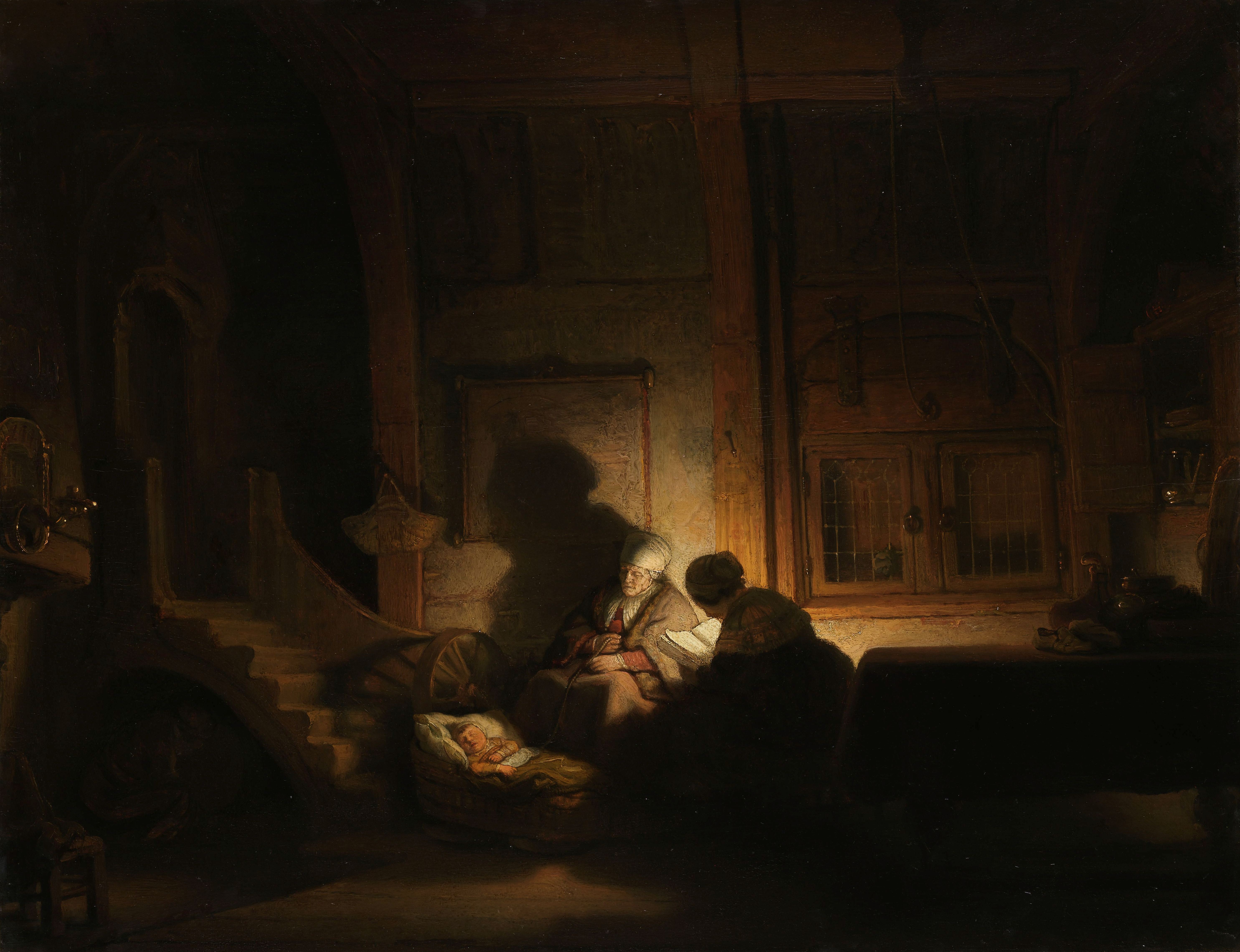
Workshop of Rembrandt van Rijn, Holy Family at Night, ca. 1642–48. Oil on panel, 66.5 × 78 cm. Rijksmuseum, Amsterdam.
During the Dutch Golden Age, the master artist Rembrandt van Rijn (1606–1669) ran a flourishing workshop in Amsterdam, overseeing the production of students’ paintings that continued the deep chiaroscuro and distinctive application of paint seen in his own work.
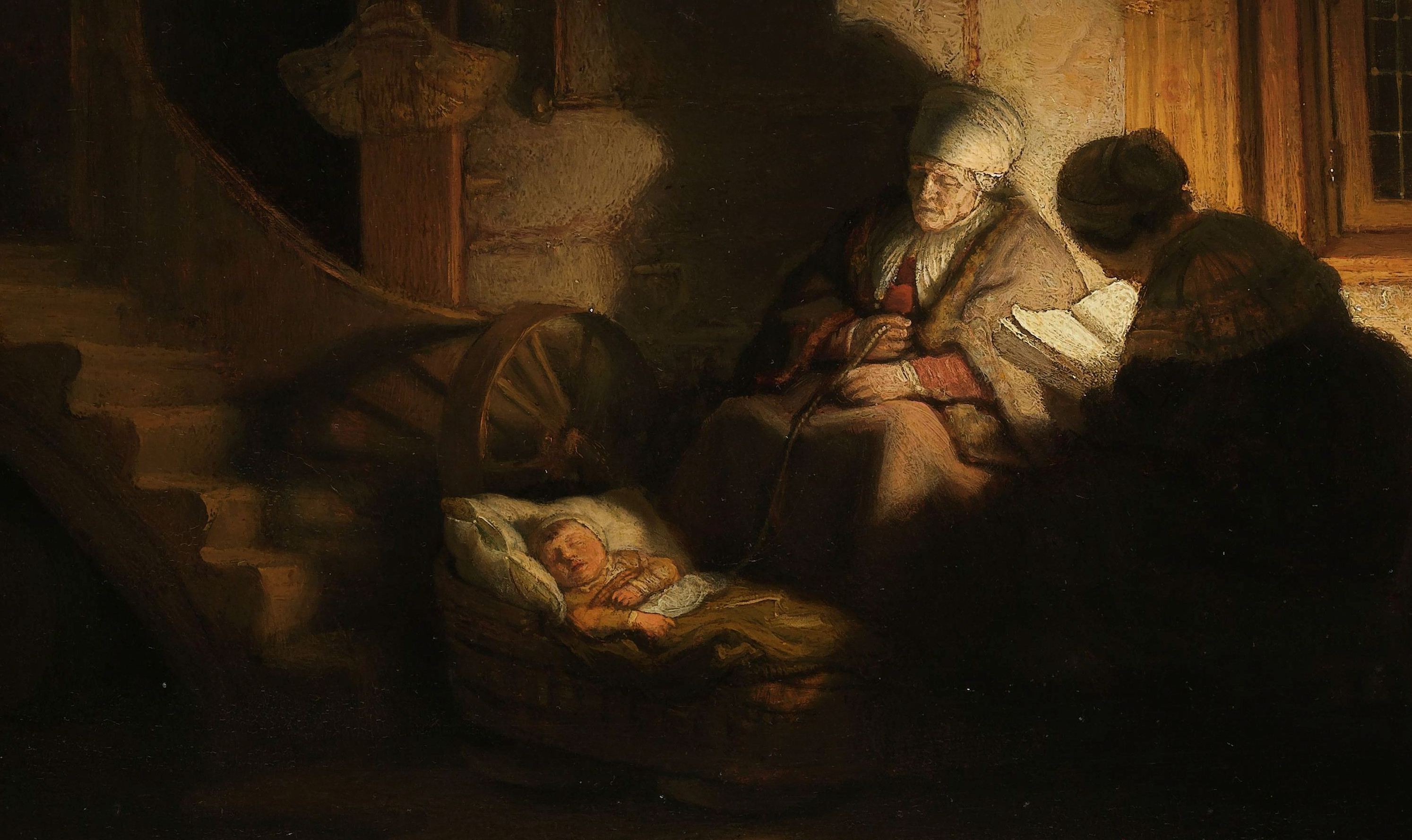
This painting from his workshop shows the Holy Family in a sparsely lit domestic interior at night. The Christ child lies asleep in a wicker cradle at the foot of a half staircase, his grandma Anne likewise nodding off as she rocks him gently with the cradle rope. Relieved by the quiet, Jesus’s mom, Mary, catches up on some reading, and Joseph taps liquid from a barrel on the left under the stairs (he’s very difficult to make out through the shadows).
This lived-in room is full of everyday objects from seventeenth-century Holland. Over the hearth on the left a copper candlestick holder is affixed to the wall. Behind Anne is a map, and beside her a spinning wheel, and a wicker basket hangs from the nail of a curved wooden beam. On the table to the right are a pair of old shoes, a flask attached to a leather belt, and a mortar and pestle, and a Jan Steen jug and other kitchenware are stored in the cupboard above. The shutters are drawn closed over the window. How utterly ordinary!
Although scholarly opinion since 1900 has identified the figures as biblical ones (the title is not the artist’s, as artists did not title their paintings at the time), for much of the painting’s history viewers interpreted it as simply a genre scene—that is, a scene showing regular people going about their daily lives. It lacks the “distinction, nobility, and loftiness” owed to biblical subject matter, it was believed, especially the Holy Family. There are no angels, no haloes. The only hint of sacredness is the pouring of light from a mysterious unknown source.
But the ordinariness of the scene depicted is precisely what makes it so glorious. Jesus was born into a working-class family. For most of his life he labored as a carpenter, adopting Joseph’s trade. He wasn’t surrounded by lavish things. His upbringing looked much like that of all the other Jewish boys in Nazareth. That he was God incarnate would be revealed in time, to those who had eyes to see. But in the meantime, he cooed and pooed and cried and slept and fed and spit up like any other baby! And his mom was exhausted like any other mom, forced to sneak in some time for herself (including private devotional time, as she’s probably reading her Bible here) wherever she could, between childcare, chores, and other obligations.
That God chose to come to us as an ordinary human being born to an ordinary family (albeit conceived in an extraordinary way!) surprised everyone. The song that follows extends the surprise of the Incarnation into God’s other interventions in our lives, on a more personal scale. Just as he defied expectations in his first coming, so he often continues to surprise us in the ways he comes to us now—that is, not according to our own prescriptions, but down his “own secret stair,” when and where we’re least expecting it.
LISTEN: “That Holy Thing” | Words by George MacDonald, 1877 | Music by Katy Wehr, on In Others’ Words, 2008
They all were looking for a king, To slay their foes, and lift them high: Thou cam’st a little baby thing That made a woman cry.
O Son of Man, to right my lot Naught but thy presence can avail; Yet on the road thy wheels are not, Nor on the sea thy sail.
My how or when thou wilt not heed, But come down thine own secret stair, That thou mayst answer all my need, Yea, every bygone prayer.
This song is a setting of a poem written by George MacDonald (1824–1905) in December 1877 and sent by letter to a handful of friends.* When it was first published in 1893 in the two-volume Poetical Works of George MacDonald, it was with this revised final stanza:
My fancied ways why shouldst thou heed? Thou com’st down thine own secret stair; Com’st down to answer all my need, Yea, every bygone prayer!
The poem appears in the highly influential Oxford Book of English Verse (1900), compiled and edited by Arthur Quiller-Couch, but in its original form.
“That holy thing” is a translation of the Greek word hagios, which appears in Gabriel’s speech to Mary in Luke 1:35: “that holy thing which shall be born of thee shall be called the Son of God.” Educator Missy Andrews unpacks the poem:
In “That Holy Thing,” MacDonald meditates on man’s expectations and God’s will. In the first line of the poem, the poet remembers the first-century Jews who suffered under Roman occupation, waiting for the Messiah who would restore the throne of David to Israel. He acknowledges their plight and their expectation, contrasting it with what they in fact received. The baby Christ represented both a gracious answer to their need, and an immediate disappointment. He satisfied the deepest intentions of their prayer and Yahweh’s ancient prophecies, but frustrated their earthy expectations for geographic kingdoms and vindication. Not only that, but the baby King “made a woman cry.” This references not only the immediate suffering and travail of the Christ Child’s mother, Mary, but ultimately the suffering that would rend her heart when He himself was lifted high upon the cross in answer to their desperate prayer for triumph over their foes.
The poet notes that his own travails and petitions, his own desperate need of God’s intervening help, is denied in its immediacy as well. For, although the Son of Man’s own presence alone can help to “right the lot” of the poet, his coming is not visible by road or sea. In this way, MacDonald acknowledges that his own expectations, like those of his spiritual forebears, eclipse his ability to see the Lord’s coming in his own circumstances. He acknowledges the differences between God’s ways and man’s, in faith acknowledging that the Lord answers man in his own ways and times, keeping secret His approach, but stealthily accomplishing man’s every need, answering his every prayer through the mystery of incarnation. This incarnate Child, the Son of Man, replete with humanity and no stranger to suffering, suggests a remedy for all who wait and suffer.
Andrews is a founding director of CenterForLit, whose goal is “to bring readers face to face with the world’s best books so they can know themselves more fully as God’s creatures.” The center has a special emphasis on equipping parents to teach the classics to their kids.
The commentary above is excerpted, with Andrews’s permission, from the first post of twenty-five published in Advent 2015 for the CenterForLit’s “Literary Advent” blog series (which is excellent!). Andrews provides interpretations of poems by John Donne, Madeleine L’Engle, Gerard Manley Hopkins, T. S. Eliot, W. H. Auden, and more, combining literary analysis and theological reflection. You can enjoy Andrews’s series in print form with the book Wild Bells: A Literary Advent.
Kathryn Wehr, PhD, is a singer-songwriter whose most recent album, which leans folk rock in style, is And All the Marys: Women Encountering Christ in the Gospels (2018).
Besides being a musical artist, Wehr is also a scholar whose interests include theology and the arts, spiritual formation, and church history. Her specialization is the religious drama of Dorothy L. Sayers, and as such, she is the editor of the forthcoming book The Man Born to be King, Wade Annotated Edition(IVP Academic, 2023). In addition, she is the managing editor of Logos: A Journal of Catholic Thought and Culture at the Center for Catholic Studies at the University of St. Thomas in Saint Paul, Minnesota.
* Thank you to the Special Collections & University Archives at Taylor University, through whose British Author Collections I discovered this earlier composition date for the poem, as well as an authoritative version of stanza 3 from MacDonald’s own hand. They provided me with a scan of one of MacDonald’s handwritten copies of “That Holy Thing” (Ref. ID 482), which contains the headnote “Written for my friends—Christmas, 1877.”
The following four poets/pray-ers express awe and gratitude for God’s bountiful heart as conveyed through nature, a gift given freely to everyone—new every morning. Each attributes to God an exceeding liberality, even prodigality (wastefulness), in such daily bestowals, which, as the Brazilian Catholic archbishopHélder Pessoa Câmara (1909–1999) suggests below, ought to inform our own giving.
Jan Sluijters (Dutch, 1881–1957), October Sun, Laren, 1910. Oil on canvas, 48.3 × 52.7 cm. Frans Hals Museum, Haarlem, Netherlands. Photo: Victoria Emily Jones.
Untitled poem by Emily Dickinson
As if I asked a common Alms—
And in my wondering hand
A Stranger pressed a Kingdom,
And I, bewildered, stand—
As if I asked the Orient
Had it for me a Morn—
And it should lift its purple Dikes,
And shatter Me with Dawn!
Written in 1858; source: The Complete Poems of Emily Dickinson, ed. Thomas H. Johnson (Cambridge, MA: The Belknap Press of Harvard University Press, 1955)
+++
Untitled poem by George MacDonald
Gloriously wasteful, O my Lord, art thou!
Sunset faints after sunset into the night,
Splendorously dying from thy window-sill—
For ever. Sad our poverty doth bow
Before the riches of thy making might:
Sweep from thy space thy systems at thy will—
In thee the sun sets every sunset still.
Source: A Book of Strife in the Form of the Diary of an Old Soul (self-pub., 1880)
+++
“The Excesses of God”by Robinson Jeffers
Is it not by his high superfluousness we know
Our God? For to equal a need
Is natural, animal, mineral: but to fling
Rainbows over the rain
And beauty above the moon, and secret rainbows
On the domes of deep sea-shells,
And make the necessary embrace of breeding
Beautiful also as fire,
Not even the weeds to multiply without blossom
Nor the birds without music:
There is the great humaneness at the heart of things,
The extravagant kindness, the fountain
Humanity can understand, and would flow likewise
If power and desire were perch-mates.
Source: Be Angry at the Sun and Other Poems (New York: Random House, 1941)
+++
Untitled prayer by Hélder Pessoa Câmara, OFS
Lord,
isn’t your creation wasteful?
Fruits never equal
the seedlings’ abundance.
Springs scatter water.
The sun gives out
enormous light.
May your bounty teach me
greatness of heart.
May your magnificence
stop me being mean.
Seeing you a prodigal
and open-handed giver,
let me give unstintingly
like a king’s child,
like God’s own.
Source: The Hodder Book of Christian Prayers, compiled by Tony Castle (London: Hodder and Stoughton, 1986)
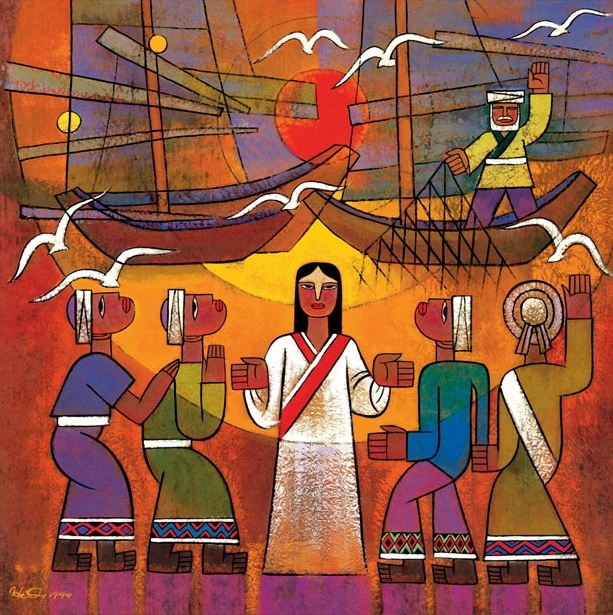
VISIO DIVINA SERIES: “During Asian Pacific American Heritage Month, C4SO [Diocese of Churches for the Sake of Others] celebrates artist He Qi, who reinterprets sacred art within an ancient Chinese art idiom. His work is a blend of Chinese folk art and traditional painting technique with the iconography of the Western Middle Ages and Modern Art. On each Sunday during May, we have licensed one of He’s paintings to illuminate one of the lectionary readings. We will provide prompts for you to do Visio Divina, or ‘sacred seeing,’ an ancient form of Christian prayer in which we allow our hearts and imaginations to enter into a sacred image to see what God might have to show us.” [HT: Global Christian Worship]
He Qi (Chinese, 1950–), Calling the Disciples, 1999. Oil on canvas.
For this past Lent the C4SO brought us the Stations of the Cross by Laura James, a self-taught painter of Antiguan heritage, combined with a liturgy by their scholar in residence, Rev. Dr. W. David O. Taylor. I appreciate their recognition of the value of visual art to the individual and corporate lives of their people.
+++
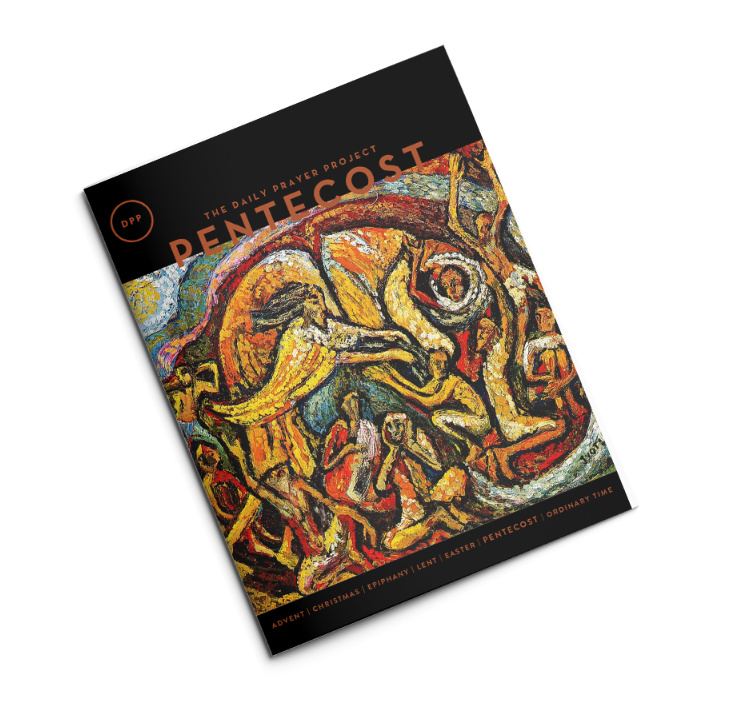
NEW DPP EDITION: Pentecost 2021: Pentecost is May 23, kicking off a new season of the church year—which means a new periodical from The Daily Prayer Project is hot off the presses! This is one of the publications I work for. “We celebrate and join in prayer with a vastly diverse church in this edition of the DPP. The Indian artist Jyoti Sahi’s dynamic painting Receive the Holy Spirit adorns the cover and leads us to a powerful remembrance of and meditation on that great outpouring of Pentecost. The church of the Caribbean gifts us with their song of Pentecost: ‘Fire, fire, fire! Fire fall on me!’ The Christian Council of Nigeria leads us in prayer and asks God to ‘grant us a vision of our land that is as beautiful as it could be . . . [and the] grace to put this vision into practice.’ The Korean songwriter Geon-yong Lee offers up a lament for the fractures of the church and invites us to truly long and work for unity: ‘Come, hope of unity; make us one body. Come, O Lord Jesus; reconcile all nations.’ . . .”
The two other featured artworks in this edition, which will be added to our online gallery May 23, are an abstract ink drawing by Takahiko Hayashi, evocative of the Spirit’s vitality, and a piece by Yuanming Cao that celebrates the steadfastness of the church in China using as its medium the everyday devotional materials of rural Christians in the Suzhou region.
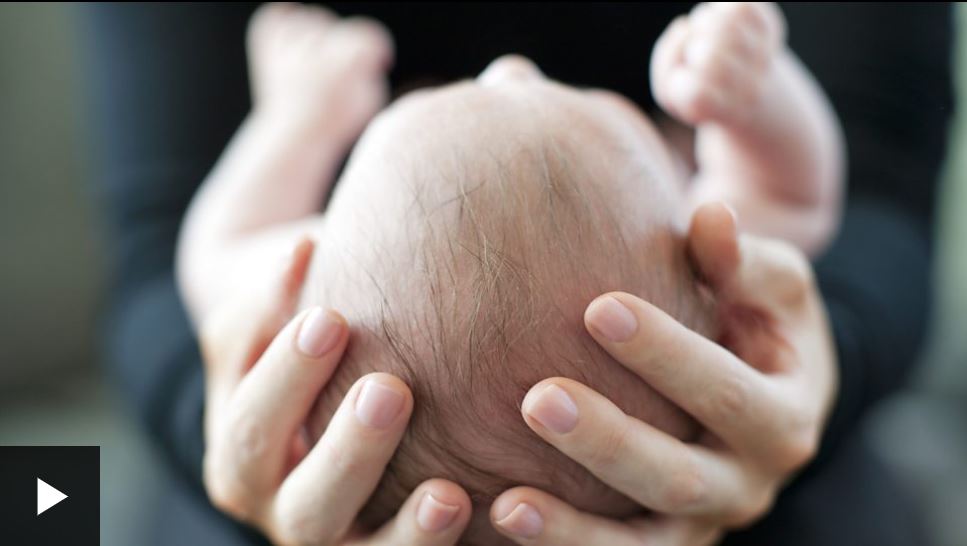
VIDEO: “What happens to humans when we can’t touch?”: “Touch is how we first communicate as babies. And it’s fundamental to human wellbeing. So what happens when we can’t touch?” This recent BBC Radio 4 video by Daniel Nils Roberts discusses the importance of touch to human development, connection, and health. Roberts talks to scientists—and a cuddle therapist!—about why touch makes us feel good, and the skyrocketing of “touch hunger” since the onset of COVID-19. While I have been deprived of physical contact with friends for the past year and I sorely miss it (I hadn’t realized how much hugs, shoulder pats, etc., mean to me), I live with my husband and have been able to receive touch from him; I can’t imagine what it would be like for those who have been completely without touch during this time of restrictiveness. [HT: Joy Clarkson]
+++
NEW BOOK: Enjoying the Bible: Literary Approaches to Loving the Scriptures by Matthew Mullins: Released in January by Baker Academic. “Many Christians view the Bible as an instruction manual. While the Bible does provide instruction, it can also captivate, comfort, delight, shock, and inspire. In short, it elicits emotion—just like poetry. By learning to read and love poetry, says literature professor Matthew Mullins, readers can increase their understanding of the biblical text and learn to love God’s Word more.”
I found out about this book through the interview by Jessica Hooten Wilson in the current issue of Christianity Today, “Reading God’s Word like a Poem, Not an Instruction Manual” [HT: ImageUpdate]. In the interview Mullins says he hopes the book reaches those Christians who tend to privilege information and instruction in their scripture reading above enjoyment—people who go to the Bible only for facts about God or practical guidance, not an encounter. Mullins shows how the Bible wants to shape not only our intellectual understanding but also our desires and emotions, and that many scripture passages are not reducible to a simple message or takeaway. Those who read and enjoy poetry inherently grasp this about the Bible. Here’s a short lecture Mullins gave on the topic in 2018, “You Can’t Understand the Bible If You Don’t Love Poetry”:
+++
ONLINE POETRY RETREAT: Send My Roots Rain, Saturday May 15, 10 a.m.–3 p.m. UK time: Brought to you by the Church Times and Sarum College, this event will feature readings and/or presentations by Pádraig Ó Tuama, Malcolm Guite, Helen Wilcox, Mark Oakley, and others. The cost is £15 (about USD$20). [HT: Arts and the Sacred at King’s (ASK) weekly e-bulletin; email Chloë Reddaway to subscribe]
+++
SUMMER READING GROUP: Phantastes by George MacDonald, led by Kirstin Jeffery Johnson: The Rabbit Room is sponsoring an online book club this summer centered on Phantastes by George MacDonald, a fantasy novel whose young hero Anodos wakes up in Fairy Land one day and is forced to reassess his assumptions about himself and others. Fantasy is not a genre I naturally gravitate to, but I keep hearing about this novel from different sources—how perplexing yet alluring it is—so I’m going to give it a try! I’m especially thrilled that the discussions will be led by MacDonald scholar Kirstin Jeffrey Johnson. Oh, and fun fact: this is the book that C. S. Lewis said most shaped his vocational attitude and philosophy of life.
“The ‘live’ version of this book group, including the online forum, opens May 25 [with chapters 1–4] and will include Zoom chats every Tuesday night at 7:00 p.m. CST for five weeks. However, you are welcome to join at any time, even after the live chats have ended. The discussions will be archived, and the forum will be open indefinitely for new registrants to continue reading and discussing the book.” You can purchase a copy of the book through the Rabbit Room Store, or there’s this annotated edition I bought, edited by John Pennington and Roderick McGillis. (It has a beautiful cover, but the annotations seem geared more toward middle-grade readers.)
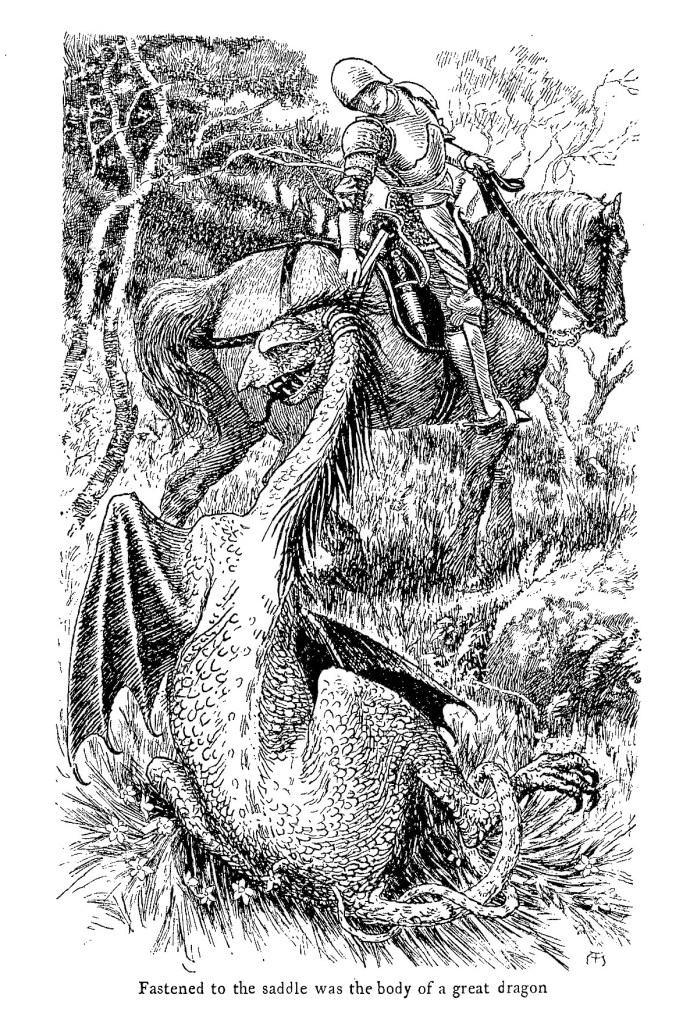
Illustration by Arthur Hughes, from chapter 23 of the third edition of Phantastes by George MacDonald, published by Arthur C. Fifield in 1905
As a bonus, listen to “Giving as the Angels Give,” a two-part session from Hutchmoot 2019 that explores “some of the ways in which, as an author, teacher, and community-builder, MacDonald intentionally manifested hospitality.” Part 1 is a personal on-ramp to the topic by Jennifer Trafton (“I can’t think of any other writer who makes me feel the intimacy of God’s welcome more than MacDonald does,” she says), and part 2, which focuses more on MacDonald’s biography, is by Kirstin Jeffrey Johnson.
Note to reader: “HT” stands for “hat tip”; it’s an acknowledgment of where or from whom I first found mention of the content I link to—that is, if I did not discover it directly from the source itself. I include these tags, along with strategic hyperlinks on the names of people and institutions, because, other than simply being courteous, I want to aid you in building your own “Christianity and the arts” network. One of the primary questions I get from people is “Who should I follow?” or “Where did you find about . . . ?” Soon I will compile a list, on its own tab, of like-minded content curators/providers that inspire me, but regular readers of the blog will, I’m sure, have already picked up on who a lot of those are. And I’m learning of new ones all the time!
ALBUM FUNDRAISER: Love Secrets by John Mark Pantana: I really enjoyed Pantana’s 2017 debut album, Mighty Grace, so I jumped at the opportunity to support his next project on Indiegogo: Love Secrets. His voice is so soothing! So are his original lyrics, all about God’s love and grace. Visit him at https://www.johnmarkpantana.com/, and listen to one of the songs from his upcoming album, “Abba,” below. Fundraising campaign ends February 9.
+++
EXHIBITIONS
I love the curatorial approach of these two current exhibitions, which bring art from the Middle Ages or Renaissance into conversation with contemporary art. Rather than doing this to prove a disjunction sparked by modernity, the curators stress continuity between the artists of yesterday and today.
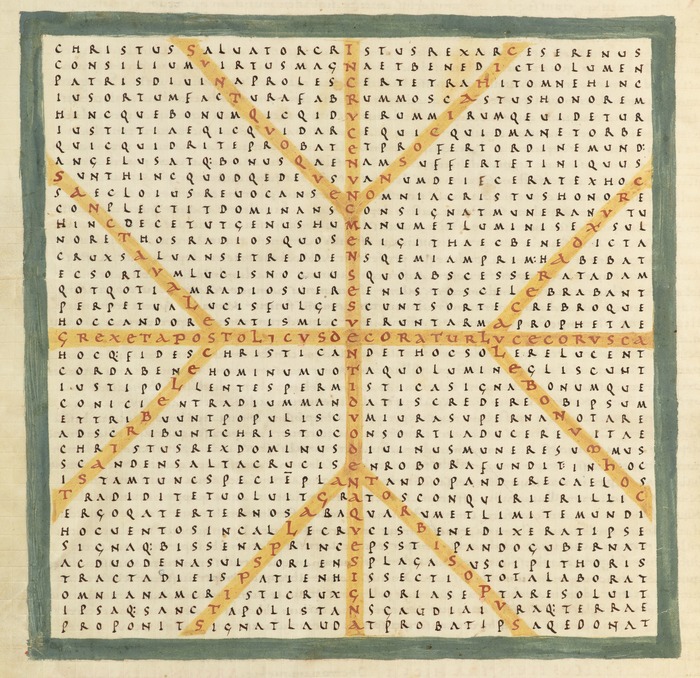
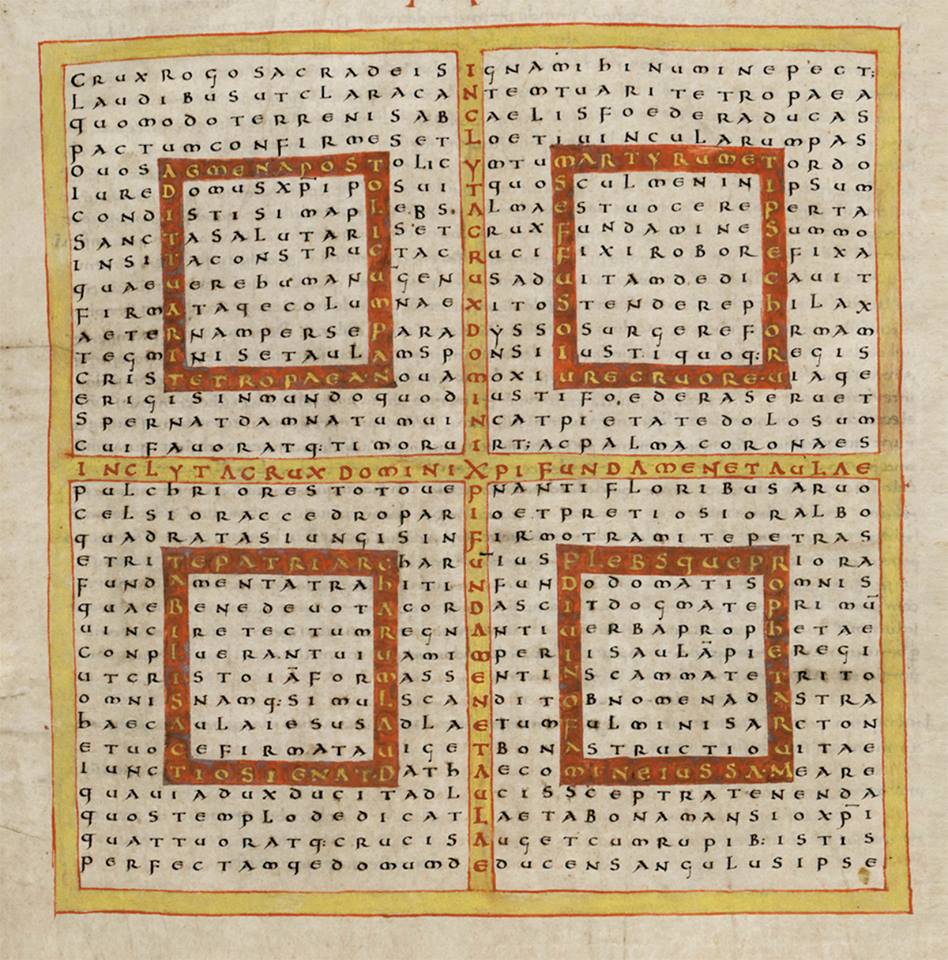
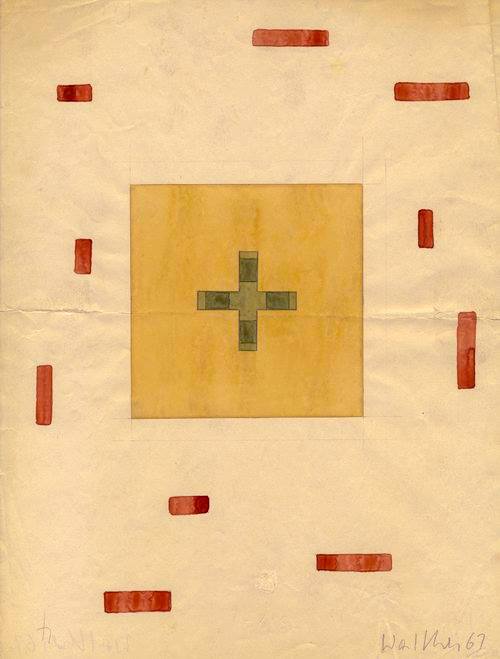
“Make It New: Conversations with Medieval Art,” Bibliothèque nationale de France (National Library of France), Paris, November 5, 2018–February 10, 2019: Curated by Dutch artist Jan Dibbets, “Make It New” explores the relationship between works of contemporary art and the medieval art of Raban Maur (Hrabanus Maurus), a ninth-century monk from Fulda, Germany, and a major figure of the Carolingian renaissance. The centerpiece of the exhibition is Raban Maur’s De laudibus sanctae crucis (In Praise of the Holy Cross), a Latin manuscript comprising twenty-eight highly sophisticated poems whose letters are arranged in simple grids over colorful, geometric cross patterns. At the BnF, these compositions are placed in dialogue with thirty-plus works by some of today’s minimalist, conceptual, and land artists, including Sol LeWitt, Carl Andre, François Morellet, Niele Toroni, and Franz E. Walther, stressing similarities in form, color, proportion, and perspective. [press release (English)] [compilation of Maur images]
The original figure poem cycle was produced around 810 at the scriptorium in Fulda, and Raban Maur had a hand in making at least five other copies during his lifetime (of which France’s National Library owns two: Lat. 2423 and Lat. 2422); seventy-four additional copies from the Middle Ages are extant. The Burgerbibliothek Bern in Switzerland has digitized its early eleventh-century copy (Cod. 9), and it’s really fascinating! Full-resolution downloads are enabled. According to the Benedictine abbot Odilo of Cluny, “no work more precious to see, more pleasing to read, sweeter to remember, or more laborious to write can or could ever be found.” I don’t know Latin, but visually, I can really appreciate these fine pages. I was hoping to find more information about the work but could really only find a single French lecture given back in 2007 by Denis Hüe, a professor of medieval and Renaissance language and literature at the Université Rennes 2 Haute-Bretagne.
Figure poem by Raban Maur, Fulda, Germany, ca. 822–847. BnF Lat. 2422, fol. 10v.
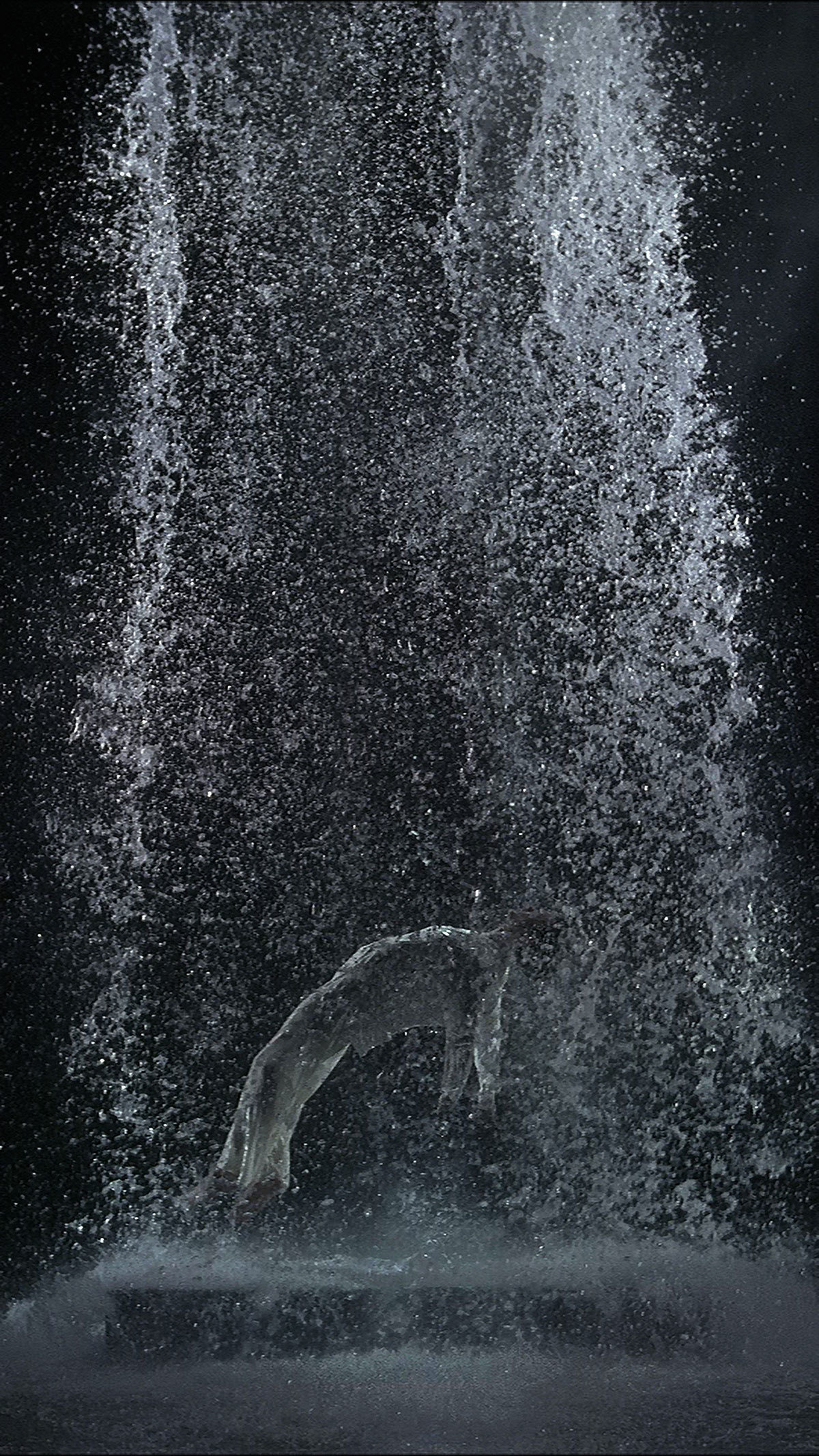
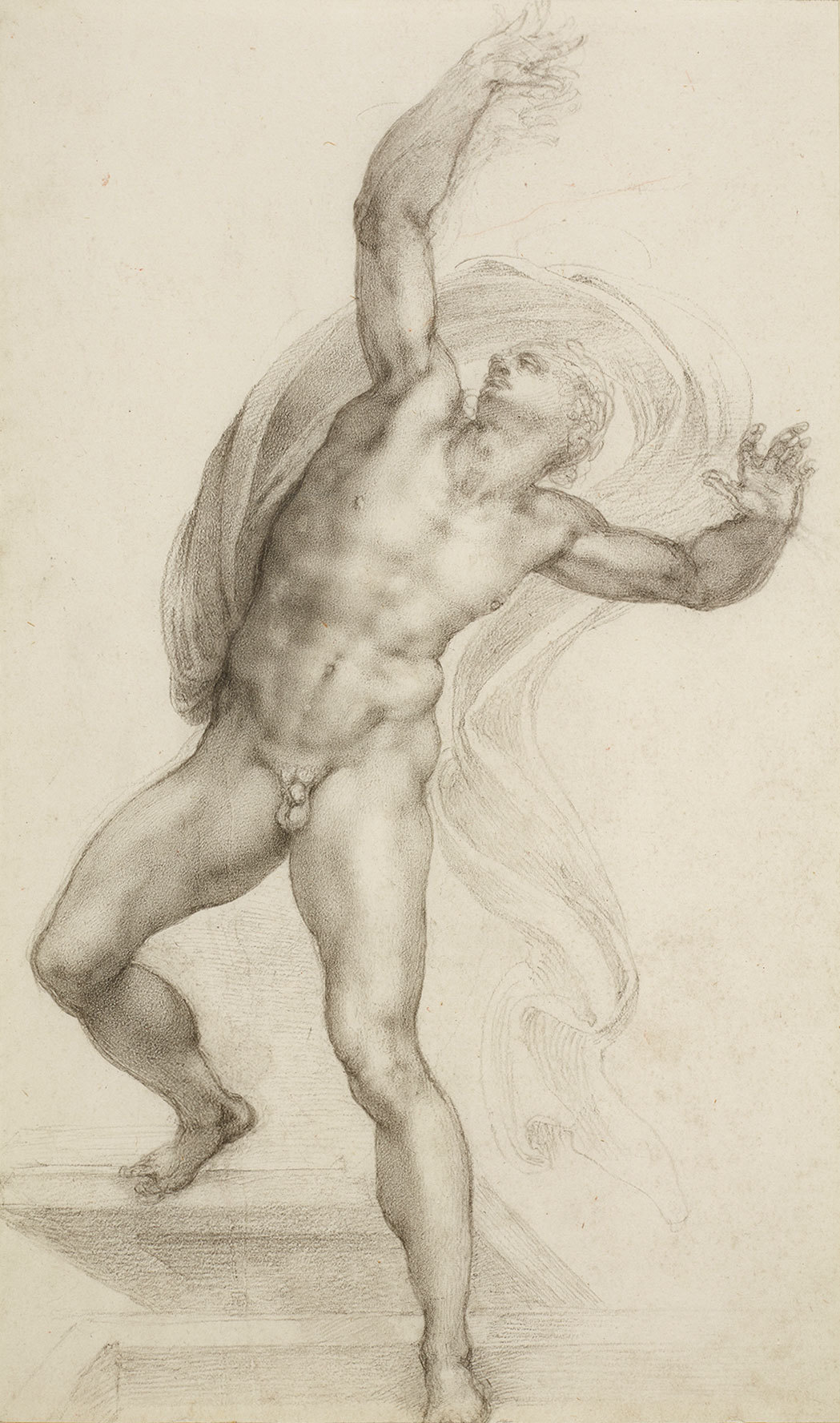
“Bill Viola / Michelangelo: Life, Death, Rebirth,”Royal Academy of Arts, London, January 26–March 31, 2019: When pioneering video artist Bill Viola saw a collection of Michelangelo’s exquisite drawings at Windsor Castle in 2006, he was astonished by the Renaissance master’s expressive use of the body to convey emotional and spiritual states. Here the two artists are exhibited side by side, showing their common grappling with life’s fundamental questions, albeit in vastly different mediums. “Both artists harness the symbolic power of sacred art, and both show us physical extremes and moments of transcendence.” Among the twelve major installations from Viola, spanning his career, is Tristan’s Ascension(The Sound of a Mountain Under a Waterfall), a sixteen-foot-high projection depicting the ascent of the soul after death.
For February 16, the Royal Academy has organized a full day of events keyed to the exhibition, including poetry readings, a documentary screening, and a panel discussion with cultural historian Marina Warner, theologian Ben Quash, and artist Mariko Mori, titled “Art as fulfilment: the use of religion and spirituality in contemporary art.” Questions for the day include: Does art connect us? Can art be transformative or transcendental? Can art influence society—that is, change opinions or human behavior? Other offerings in addition to this program are a curator’s introduction on February 1, a short course on figure drawing, and a talk on the limitations and opportunities of digital art. Plus, the London Art Salon is hosting a talk on the exhibition by art historian Marie-Anne Mancio.
Bill Viola (American, 1951–), Tristan’s Ascension (The Sound of a Mountain Under a Waterfall), 2005. Video/sound installation. Performer: John Hay. Photo: Kira Perov. Courtesy Bill Viola Studio.
Michelangelo Buonarroti (Italian, 1475–1564), The Risen Christ,” ca. 1532–33. Black chalk on paper, 37.2 × 22.1 cm. Royal Collection Trust, UK.
+++
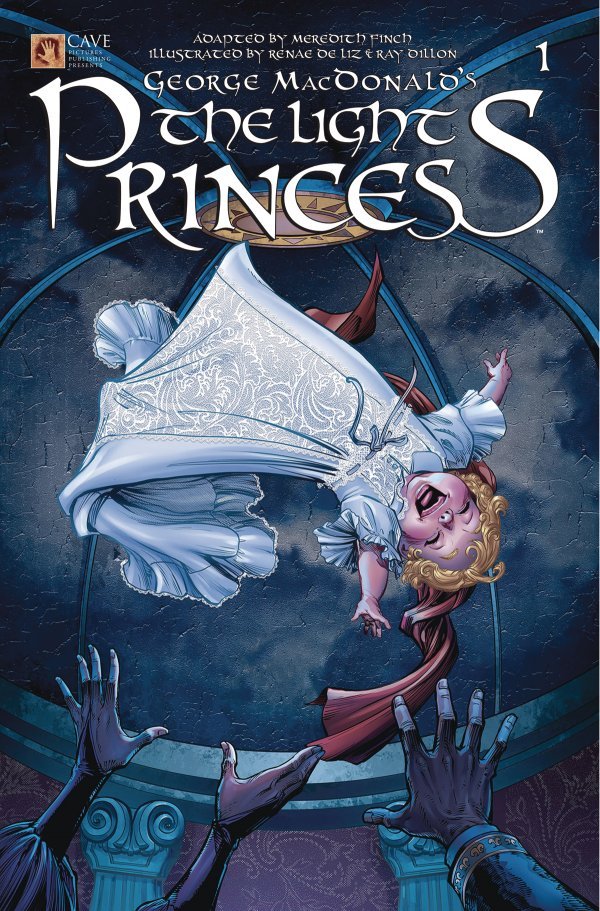
NEW COMIC BOOK PUBLISHER: Cave Pictures Publishing, founded in fall 2018 by Mark Rodgers, is committed to the telling of “modern myths” that “speak to the soul” through comic books in the genres of action-adventure, sci-fi, historical fiction, and fantasy. Pitched for the spiritually inclined, the stories they publish “seek to make sense of our world . . . draw us toward the source of goodness . . . uncover what we worship.” Says Rodgers in a Hollywood Reporter interview: “Just as cave paintings were humanity’s initial attempt to process through the tough ultimate questions of human existence, we look at our stories as ‘sherpas of the soul,’ to contribute to the individual and collective human journey towards meaning and a greater reality,” the One True Myth. Read more about the company’s influences and aspirations in this Convivium essay. See also the interview in Sojourners.
One of their five inaugural series is The Light Princess, an adaptation of one of George MacDonald’s best-loved fairy tales, about a princess who is cursed with weightlessness and is only brought down to earth by a true, sacrificial love. MacDonald was a Scottish author, poet (e.g., here, here, and here), and Christian minister who deeply influenced C. S. Lewis and J R. R. Tolkien. Speaking of Tolkien, I’m really digging this quote of his on Cave Pictures’ website, which affirms the value of story: “Legends and myths are largely made of ‘truth,’ and indeed present aspects of it that can only be received in this mode. . . . Long ago certain truths and modes of this kind were discovered and must always reappear.”
Susanne Mitchell (American, 1973–), Waiting (from the series Silence of the Ordinary), 2015. Oil and mixed media on canvas, 162.6 × 149.9 cm (64 × 59 in.).
I wait for the LORD, my soul waits,
and in his word I hope.
O Master, my desires to work, to know,
To be aware that I do live and grow—
All restless wish for anything not thee
I yield, and on thy altar offer me.
Let me no more from out thy presence go,
But keep me waiting watchful for thy will—
Even while I do it, waiting watchful still.
This post belongs to the weekly series Artful Devotion. If you can’t view the music player in your email or RSS reader, try opening the post in your browser.
To view all the Revised Common Lectionary scripture readings for Proper 14, cycle B, click here.
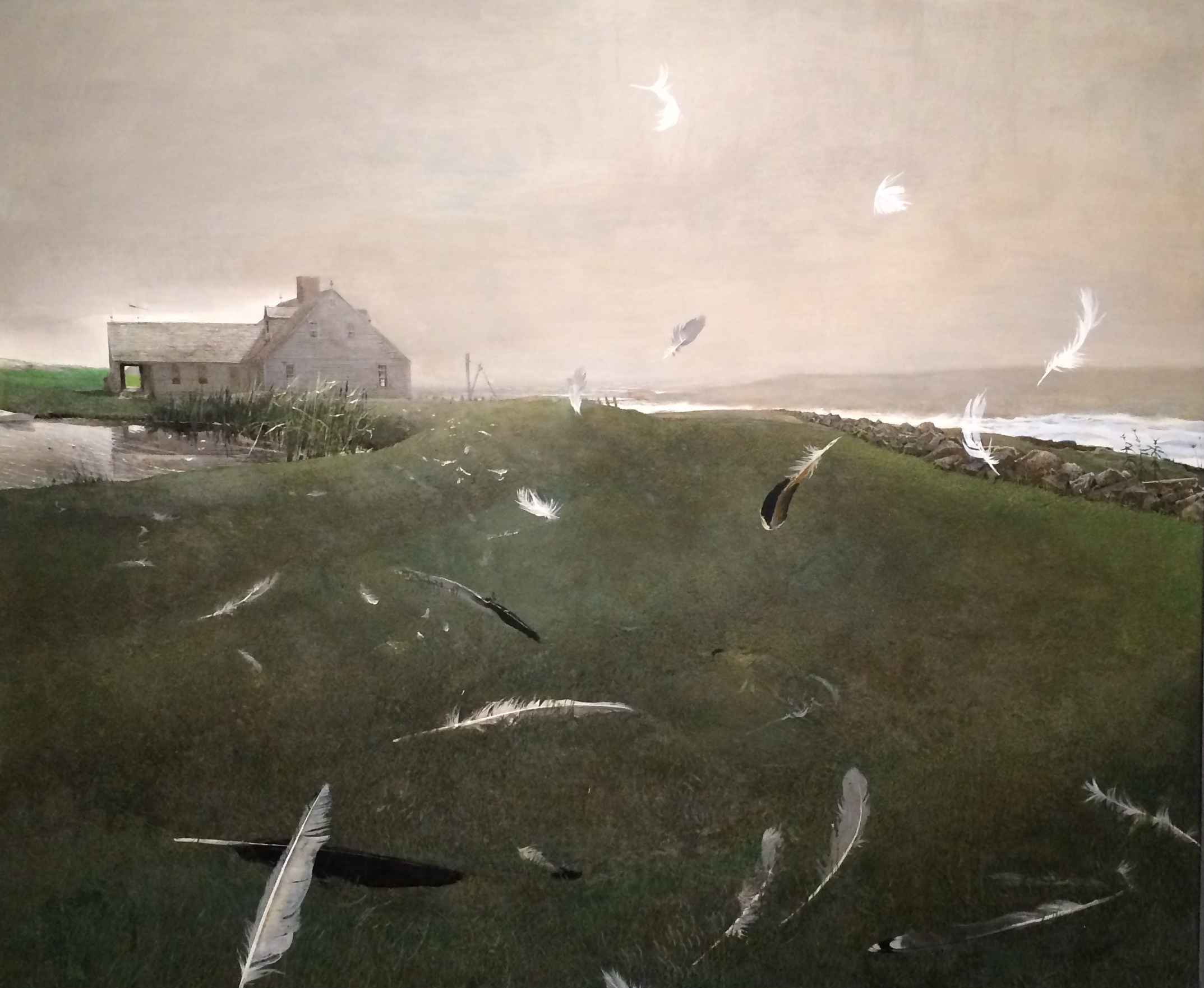
Andrew Wyeth (American, 1917–2009), Airborne, 1996. Tempera on hardboard panel. Crystal Bridges Museum of American Art, Bentonville, Arkansas.
For this is the love of God, that we keep his commandments. And his commandments are not burdensome. For everyone who has been born of God overcomes the world.
—1 John 5:3–4a
+++
SONG: “How Gentle God’s Commands” | Words by Philip Doddridge (1702–1751) | Music by Hans Georg Nägeli (1773–1836) | Performed by Ordinary Time, on At the Table (2009)
How gentle God’s commands!
How kind his precepts are!
Come, cast your burdens on the Lord
And trust his constant care.
Beneath his watchful eye,
His saints securely dwell;
That hand which bears all nature up
Shall guard his children well.
Why should this anxious load
Press down your weary mind?
Haste to your heav’nly Father’s throne
And sweet refreshment find.
His goodness stands approved,
Unchanged from day to day;
I’ll drop my burden at his feet
And bear a song away.
+++
I cannot see, my God, a reason why
From morn to night I go not gladsome, free;
For, if thou art what my soul thinketh thee,
There is no burden but should lightly lie,
No duty but a joy at heart must be:
Love’s perfect will can be nor sore nor small,
For God is light—in him no darkness is at all.
This post belongs to the weekly series Artful Devotion. If you can’t view the music player in your email or RSS reader, try opening the post in your browser.
To view all the Revised Common Lectionary scripture readings for the Sixth Sunday of Easter, cycle B, click here.








 Art & Theology