Advent, Day 5: When?

LOOK: Bethlehem by Carola Faller-Barris
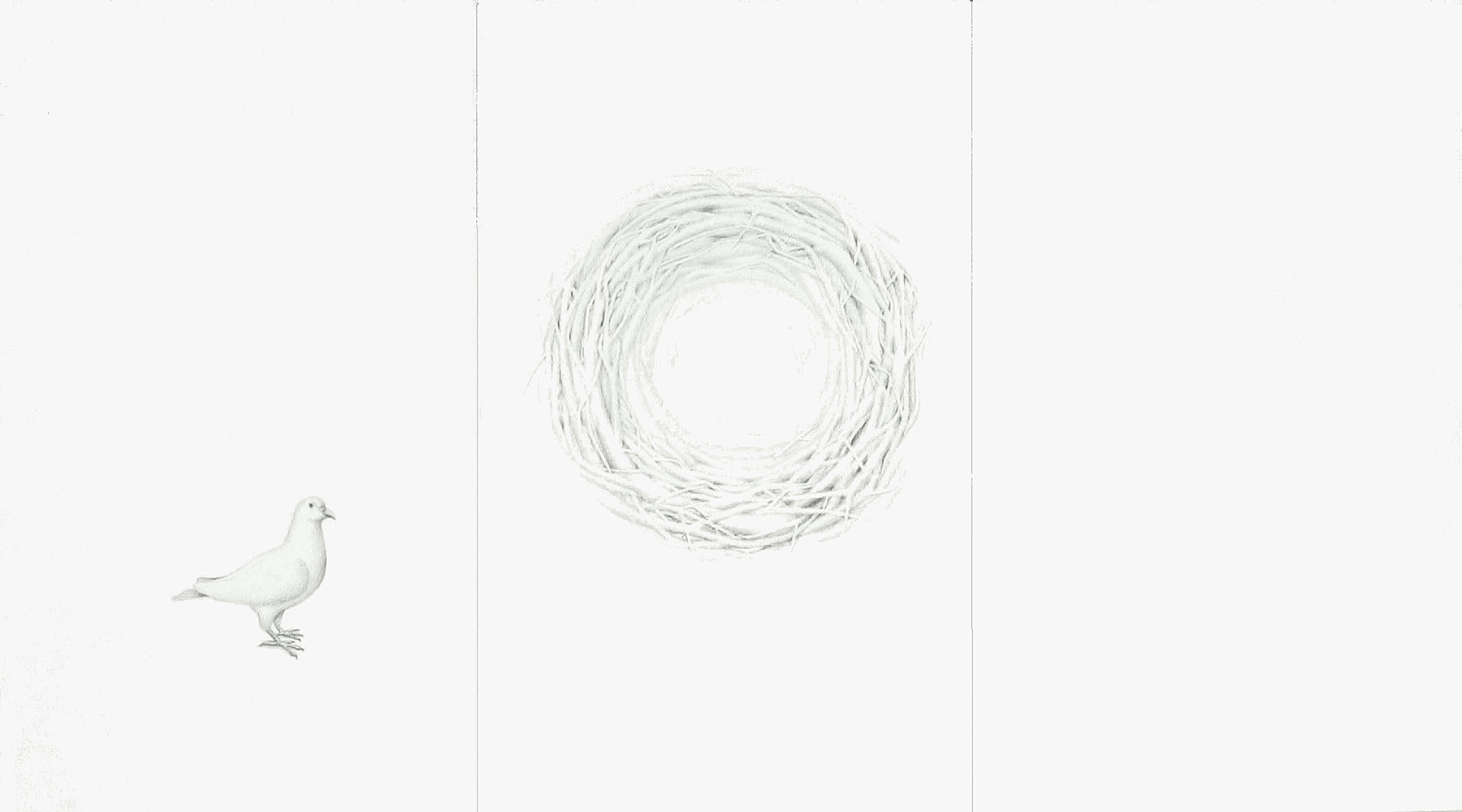
Faller-Barris, Carola_Bethlehem
Carola Faller-Barris (German, 1964–), Bethlehem, 2009. Pencil on paper on MDF board, 100 × 180 cm. [HT]

LISTEN: “Peace” | Words by Gerard Manley Hopkins, 1879, and Wilfred Owen, 1917 | Music by Peter Bruun, 2017 | Performed by the Svanholm Singers, dir. Sofia Söderberg, on Exclusive, 2019

When will you ever, Peace, wild wooddove, shy wings shut,
Your round me roaming end, and under be my boughs?
When, when, Peace, will you, Peace? I’ll not play hypocrite
To own my heart: I yield you do come sometimes; but
That piecemeal peace is poor peace. What pure peace allows
Alarms of wars, the daunting wars, the death of it?

Out there, we’ve walked quite friendly up to Death,—
Sat down and eaten with him, cool and bland,—
Pardoned his spilling mess-tins in our hand.
We’ve sniffed the green thick odour of his breath,—
Our eyes wept, but our courage didn’t writhe.
He’s spat at us with bullets and he’s coughed
Shrapnel. We chorussed when he sang aloft,
We whistled while he shaved us with his scythe.

Oh, Death was never enemy of ours!
We laughed at him, we leagued with him, old chum.
No soldier’s paid to kick against His powers.
We laughed,—knowing that better men would come,
And greater wars: when each proud fighter brags
He wars on Death, for lives; not men, for flags.

O surely, reaving Peace, my Lord should leave in lieu
Some good! And so he does leave Patience exquisite,
That plumes to Peace thereafter. And when Peace here does house
He comes with work to do, he does not come to coo,
He comes to brood and sit.

The text of this choral work by the Danish composer Peter Brunn combines two British poems: “Peace” by Gerard Manley Hopkins and “The Next War” by Wilfred Owen. Let’s look at each one separately, and then together.


“Peace” by Gerard Manley Hopkins

When will you ever, Peace, wild wooddove, shy wings shut,
Your round me roaming end, and under be my boughs?
When, when, Peace, will you, Peace? I’ll not play hypocrite
To own my heart: I yield you do come sometimes; but
That piecemeal peace is poor peace. What pure peace allows
Alarms of wars, the daunting wars, the death of it?

O surely, reaving Peace, my Lord should leave in lieu
Some good! And so he does leave Patience exquisite,
That plumes to Peace thereafter. And when Peace here does house
He comes with work to do, he does not come to coo,
He comes to brood and sit.

The Jesuit poet-priest Gerard Manley Hopkins (1844–1889) wrote this curtal sonnet on October 2, 1879, after finding out he was reassigned from his role as curate at St. Aloysius’s church in Oxford to curate at St. Joseph’s in the industrial town of Bedford Leigh, near Manchester. He was apprehensive about this move to a place he described as “very gloomy” and unclean. The following decade, the last of his life, he would be plagued by melancholic dejection, which his later poems reflect. In addition to the internal disquiet he was experiencing in the fall of 1879, there was also an external lack of peace, as Great Britain was at war on three fronts—in southern Africa (against the Zulu kingdom), Afghanistan, and Ireland.

The speaker of the poem addresses Peace, an elusive dove, begging him to come settle down to nest, to incubate his eggs. “Brooding” here, writes J. Nathan Matias, is not a morose act but a generative, warmly creative one, birthing life.

Though the dove appears in scripture as a symbol of God the Spirit, in the last three lines of this poem he could be God the Son, the Prince of Peace. The people waited for generations upon generations for his arrival. And when he came, he was not all talk. He came with serious work to do; he came to hatch a newborn world.

This poem expresses yearning for peace in our hearts and in our lands—a permanent, holistic peace that only Christ can bring.


“The Next War” by Wilfred Owen

“War’s a joke for me and you,
While we know such dreams are true.”
—Siegfried Sassoon

Out there, we’ve walked quite friendly up to Death,—
Sat down and eaten with him, cool and bland,—
Pardoned his spilling mess-tins in our hand.
We’ve sniffed the green thick odour of his breath,—
Our eyes wept, but our courage didn’t writhe.
He’s spat at us with bullets and he’s coughed
Shrapnel. We chorussed when he sang aloft,
We whistled while he shaved us with his scythe.

Oh, Death was never enemy of ours!
We laughed at him, we leagued with him, old chum.
No soldier’s paid to kick against His powers.
We laughed,—knowing that better men would come,
And greater wars: when each proud fighter brags
He wars on Death, for lives; not men, for flags.

One of the premier poets of World War I, Wilfred Owen (1893–1918) was a British soldier whose poems lament the horrors of trench and gas warfare. His cynicism and transparency about war stood in stark contrast to the confidently patriotic verse written by earlier war poets.

Owen wrote “The Next War” while being treated for “shell shock” (PTSD) at Craiglockhart War Hospital in Edinburgh; he sent it in a letter to his mother dated September 25, 1917, writing the following week that he wanted her to show it to his youngest brother, Colin—for him “to read, mark, learn.” Owen was discharged from the hospital two months later and returned to the front lines of France, where he was killed in action on November 4, 1918, a week before the armistice, at age twenty-five.

He opens his ironic-toned sonnet with an epigraph from “A Letter Home” by Siegfried Sassoon, a fellow war poet he met at Craiglockhart, who became a friend and a mentor to him. (Bruun omits the epigraph in his choral work so that there’s a seamless transition between poems.) “Dreams will triumph, though the dark / Scowls above me,” Sassoon writes earlier in his poem, a poem that acknowledges the bleakness of war but, imagining the rebirth of a friend slain in battle, clings to the hope that it will soon be over and we can laugh it off.

Owen undercuts the optimism and solace in these lines with what follows in his own poem. The speaker of “The Next War”—which it’s pretty clear is the poet himself—personifies Death as a comrade whose intimate presence is normal among soldiers. He spits bullets, coughs shrapnel, and breathes stinking odors, and yet they ally themselves with him, sing Death’s song, go with him into battle.

Soldiers only delude themselves if they think they fight against Death, Owen asserts; they fight with him. Their nations’ governments will say they’re heroes, taking up arms to save lives and secure peace, but Owen rejects the idea that there’s anything noble, glorious, or effective about war. Soldiers kill men “for flags”—merely serving national interests—and their doing so never puts an end to war but only leads to another.


By bringing together these two texts, sandwiching Owen between Hopkins, Bruun gives a more hopeful framing to Owen’s disillusioned reflections on war, ending with the final image of a brooding dove. I like how the two poems play off one another. For example, Hopkins’s rhetorical question of “What pure peace allows / . . . the death of [peace]?” stands in starker relief when read in conjunction with Owen’s criticism of the ostensible rationale for war.

Bruun still honors Owen’s experience of being made far too familiar with death, his endurance of mortar blasts and mustard gas and all-around carnage, to no apparent end. Owen’s text starts at 2:11 of the video, where a menacing, march-like cadence enters. We feel the anxiety and the darkness of battle. The specificity of the poem resists us metaphorizing war—that is, applying the poem to a situation of inner turmoil (battling inner demons) only. This is physical combat between nations, which, of course, has severe psychological repercussions on the participants.

But at 5:33 the hushed tones of Hopkins return. Bruun had been attracted to Hopkins’s poem “Peace” for some time. In 2010 he wrote a setting of it for solo voice and flute, clarinet, horn, percussion, glockenspiel, violin, violoncello, and contrabass, and in 2016 he published a new setting, with Owens now inserted, as the second in a five-song cycle called Wind Walks for mixed choir and accompaniment, all five texts taken from Hopkins. He then adapted the song for the male-voice chamber choir the Svanholm Singers from Sweden, which is what I feature here.

The pointed and repeated “When” at the opening of Bruun’s piece, a word that Hopkins repeats three times in his poem, is powerful, an echo of the familiar biblical refrain, “How long, O Lord?” If we read Peace as Christ, then the poem is a prayer, asking Christ to come home to us, to our world—to spread his wings over it and nurture it back to life.

In Hebrew thought, shalom, “peace,” is not a passive thing, merely the absence of war. It’s the active presence of God and an all-encompassing state of completeness, soundness, health, safety, and prosperity.

Shalom is what we long for, especially during Advent. It’s what scripture promises will come someday—but now, its lack is keenly felt. It may occasionally flit and hover nearby, but then it flies off again.

As the church, may we embrace “Patience exquisite, / That plumes to Peace thereafter,” as we await Christ’s return, in the meantime preparing his way through acts of righteousness and reconciliation.

“Hurrahing in Harvest” by Gerard Manley Hopkins (poem)

Linnell, John_Wheat
John Linnell (British, 1792–1882), Wheat, ca. 1860. Oil on canvas, 94.2 × 140.6 cm. National Gallery of Victoria, Australia.

Summer ends now; now, barbarous in beauty, the stooks arise
Around; up above, what wind-walks! what lovely behaviour
Of silk-sack clouds! has wilder, wilful-wavier
Meal-drift moulded ever and melted across skies?

I walk, I lift up, I lift up heart, eyes,
Down all that glory in the heavens to glean our Saviour;
And, eyes, heart, what looks, what lips yet gave you a
Rapturous love’s greeting of realer, of rounder replies?

And the azurous hung hills are his world-wielding shoulder
Majestic—as a stallion stalwart, very-violet-sweet!—
These things, these things were here and but the beholder
Wanting; which two when they once meet,
The heart rears wings bold and bolder
And hurls for him, O half hurls earth for him off under his feet.

The beauty of Christ suffuses the landscape in “Hurrahing in Harvest” by Gerard Manley Hopkins, written September 1, 1877, while he was studying theology at St Bueno’s College in the Vale of Clwyd, Wales. A hurrah is a jubilant shout, an exclamation of joy, and in this poem the object of that joy is the kingdom of God manifest in a late summer day during the wheat harvest. Hopkins wrote to his friend and fellow poet Robert Bridges—the man who championed his work and is responsible for its being known at all—that “the Hurrahing Sonnet was the outcome of half an hour of extreme enthusiasm as I walked home alone one day from fishing in the Elwy.”

Stooks are bound sheaves of wheat, and Hopkins describes them as savage-looking (“barbarous in beauty”), perhaps suggesting their resemblance to an unkempt head of hair. In their wonderfully wild way, when propped up, they point to the clouds, which glide along moving aerial sidewalks—the wind (“wind-walks”). Through metaphor, Hopkins refers to the clouds as “silk-sack[s]” (they’re bulky yet smooth, substantial yet wispy) and not snowdrift but “meal-drift” (mounds of coarsely ground white grain). The clouds are willful and wavy; they mold together and melt into sky.

Hopkins lifts up his eyes and heart—language reflecting the Sursum corda of the liturgy—to behold the day’s glory. “Down” in line 6 can be read as an adverb or verb: Hopkins looks down across the valley, or he “downs” the scene, takes it all in. And seeing the freshly reaped fields, he “glean[s]” Christ. He likens the rapture he feels to receiving a kiss of greeting from a lover, real and round. Addressing his eyes and heart, he says that no adoring human gaze nor tender human lips have ever imparted such pleasure as Christ imparts through nature.

In the final stanza Hopkins perceives the hills as the majestic shoulders of Christ supporting the sky. He compares Christ to a stallion (wild, strong) and a violet (delicate, humble).

The image of a stallion returns in the second-to-last line, where he says his own heart “rears” (raises upright) wings, which enable him to launch himself upward, his legs pushing off the ground. It’s a leaping of the spirit, an ascent of the soul—an intimate meeting of self and Savior in the goodness of the cloudy-blue afternoon. The Divine is always here, he says, “and but the beholder / Wanting”; that is, lacking awareness.

Throughout the poem there’s a strong sense of propulsion, carried in part by all the alliteration: “barbarous in beauty,” “wind-walks,” “silk-sack,” “wilder, wilful-wavier,” “meal-drift moulded . . . melted . . . ,” “glory . . . glean,” “realer, rounder replies,” “hung hills,” “world-wielding,” “stallion stalwart,” “heart . . . hurls.”

Hopkins’s eyes have been oriented to perceive the spiritual in the material, and the result is ecstasy.


Gerard Manley Hopkins (1844–1889) was a preeminent English poet and a Jesuit priest, whose most famous works include “The Wreck of the Deutschland,” “Pied Beauty,” “God’s Grandeur,” and “The Windhover.” In 1866 he converted from Anglicanism to Roman Catholicism, a decision that estranged him from his family; then he entered the Jesuit novitiate in 1868 and was ordained to the priesthood in 1877. He spent the last five years of his life as a classics professor at University College Dublin, struggling with depression, during which time he wrote the “terrible sonnets,” so-called because of their expression of deep anguish and desolation. Very few of his poems were published during his lifetime, and widespread recognition didn’t come until nearly three decades after his death, in 1918, when his friend Robert Bridges edited the first collection of his poems. Hopkins was the most innovative poet of the Victorian era, his “sprung rhythm” creating new acoustic possibilities and anticipating the modernist movement.

Easter Playlist

Easter Sunday is the most joyful day of the Christian year, kicking off a fifty-day season of feasting and celebration centered on the resurrection of Jesus Christ. While we celebrate the resurrection year-round (every Sunday is a “little Easter”), the liturgical calendar gives us this set-apart time to linger with and savor the mystery with particular focus and renewed fervor. Christ’s rising from the grave has far-reaching implications, which the church unpacks, most especially during Eastertide, through its liturgies, scripture readings, sermons—and music.

I compiled a Spotify playlist of songs and other musical pieces for this festal season—a mix of classical, gospel, choral, folk, and indie-pop, with some jazz and bluegrass. These selections span historical periods and geographic locales, ranging from early medieval hymns and liturgical refrains to newer releases, from Senegal, Tanzania, Chile, Tyendinaga Mohawk Territory (in Ontario), Serbia, Hungary, Germany, Ireland, France, the Middle East, and more.  

You’ll find plenty of classic texts and tunes, some retunes and new arrangements of the classics and other oldies, and some through-and-through originals. And lots of Alleluias!

Sung in Byzantine-rite churches, the Paschal troparion—“Christ is risen from the dead, trampling down death by death, and on those in the tombs bestowing life”—is represented here by a few different settings in a few different languages, including Georgian (“Krist’e Aghsdga”) and Greek (“Hristos Anesti”). Church of the Apostles does a version in English that works well with a contemporary worship band.

The medieval French melody known as NOEL NOUVELET is often paired with two different Easter hymn texts, both of which I’m very fond of: “Welcome, Happy Morning!” by Venantius Fortunatus, a sixth-century hymnographer in the Merovingian court and later bishop of Poitiers, and the early twentieth-century “Now the Green Blade Riseth” by J. M. C. Crum, which has this wonderfully poetic refrain: “Love is come again like wheat that springeth green.” Claire Holley [previously] recorded a subdued, guitar-picked rendition of the latter, and for the former, here’s Redeemer Knoxville’s [previously] super-fun arrangement, which includes mandolins, trumpets, and a raucous energy!

Christ’s death and resurrection initiated a new exodus, so to speak, so some of the songs, like “Carol of the Exodus” [previously] and “Mary, Don’t You Weep” [previously] use the language of Pharaoh’s armies (i.e., agents of death) being overthrown, and liberation.

Also included on the list is a Swahili praise song whose key phrase, “Yesu ni wangu, wa uzima wamilele,” translates to “Jesus is mine, he is (the God of) everlasting life.” Some English versions of the song translate it as “Jesus is mine, he’s alive and he’s eternal.”

Classical selections include the Sinfonia (instrumental opening) of Bach’s Easter Oratorio; “Dum transisset Sabbatum” (When the Sabbath Was Past), a Renaissance motet setting of Mark 16:1–2 by John Taverner; a movement from a piano sonata by modern Finnish composer Einojuhani Rautavaara inspired by the icon of the holy women at the tomb; and a movement from a violin sonata by Austrian Baroque composer Heinrich Ignaz Franz Biber.

The latter two are among the several allusive instrumental pieces on the list, which also include “Viriditas” on jazz guitar by Charlie Rauh (its title references Hildegard of Bingen’s concept of greening, freshness, new life) and “Phoenix” on oud by Egyptian Australian virtuoso Joseph Tawadros (the phoenix is a mythological bird that dies and rises again, which the medieval church embraced as a symbol of Christ).

Two gems I discovered while searching for Easter music are settings of Gerard Manley Hopkins’s poem “Easter”: one a Celtic-influenced choral setting by Steven C. Warner, the other an alt-rock version by Jon Green (JG Hymns):

A popular Easter song in Spanish-speaking churches throughout the world is “Resucitó” (He Is Risen) by Kiko Argüello:

There are a few songs here written for kids, like “Jesus Is Alive” by Rain for Roots and “Risen Today” by John Burland, but which I find enjoyable myself!

And there are a handful of songs by James Ward [previously], a gospel songwriter and pianist from New City Fellowship in Chattanooga, Tennessee—such as “Morning Sun,” which is included in the Trinity Hymnal:

For a closer, I chose “Love Divine, Victorious,” written by Karl Digerness and arranged by Minna Choi, musicians at City Church San Francisco [previously]. I love its blend of classical and folk-rock styles, with an orchestra interacting with a banjo and drum kit. (The album recording has a full orchestra and a choir; the video below is a pared-down version from last year, with string orchestra and two vocalists.) The song looks back in remembrance and forward in anticipation, quoting the traditional memorial acclamation “Christ has died, Christ is risen, Christ will come again.”

To listen to all 130-plus songs on Spotify, open the Art & Theology Eastertide Playlist link, then click on the More (…) icon and select “Save to Library.” Then the list will be easily accessible to you throughout the season and will reflect any new song additions I make.

Easter Playlist Cover

Playlist cover art: Edward Burra, Resurrection, ca. 1948–50

Thanksgiving Playlist

I’ve compiled a playlist of songs of thanks to God for life, beauty, family, salvation, fruitful harvests, and countless other blessings, and for God’s very self. To make a list on this theme is difficult, as every praise song, of which there are millions, is essentially a song of thanksgiving. So many songs and other musical pieces, including those from outside the Judeo-Christian tradition, testify to experiences of goodness. Perhaps I’m being too literal, but I focus (though not exclusively) on songs that explicitly say “Thanks.” I also want to make clear that God deserves thanks not just for what he’s done but for who he is.

To save the playlist to your Spotify account, click the ellipsis and select “Add to Your Library.”

The list is bookended by the seventeenth-century Trinitarian doxology written by Thomas Ken (“Praise God from whom all blessings flow . . .”), which many churches sing weekly to the tune of OLD 100TH. While the first on the list is in English, the last is in Hawaiian.

Several of the songs are settings of the biblical psalms. The Abayudaya community of Jews in eastern Uganda, for example, sings the call-and-response Psalm 136 in Luganda; led by J. J. Keki, the congregation responds after each line with “His steadfast love endures forever!” Banjoist Béla Fleck [previously] and mandolinist Chris Thile use this melody from Abayudaya as the basis of their “Psalm 136” duet, which appears on Fleck’s new album, Bluegrass Heart.

There’s also Psalm 92 (“It is good to give thanks to the Lord . . .”) from Poor Bishop Hooper’s EveryPsalm project, Wendell Kimbrough’s Psalm 107, and a classical guitar rendition of Jewish singer-songwriter Debbie Friedman’s “Hodu” [previously], a setting of Psalm 118:1–4. Rebekah Osborn also sets Psalm 118, in English.

“We Thank You” is by Broken Walls, a musical group comprising followers of the Jesus Way who seek to build bridges between the church and the First Nations people of North America. Founded by Jonathan Maracle, a Mohawk from Tyendinaga Territory in Ontario, Canada, the band uses indigenous instruments and sounds to share the Creator’s love.

Across the Atlantic, the monks of Keur Moussa Abbey [previously] in Senegal sing “Nous Te Louons, Père Invisible” (“We Praise You, Invisible Father”), accompanied by balafon (a gourd-resonated xylophone). The French lyrics translate as follows:

Lord of immortality
We praise you, invisible Father
You are the source of life
We praise you, invisible Father
The source of all light
We praise you, invisible Father
You are the source of grace
We praise you, invisible Father
Friend of mankind, friend of the poor, you draw everything unto yourself through the coming of your beloved Son!
We praise you, invisible Father

I’ve also included a dedicatory instrumental piece played on kora and oboe for the inauguration and consecration of the abbey.

Praise be to God, too, for natural wonders large and small. You’ll want to be sure to check out Alanna Boudreau’s setting of “Pied Beauty” by the poet-priest Gerard Manley Hopkins. (For you Hopkins lovers, Boudreau also set “My own heart let me more have pity on” and “God’s Grandeur,” the latter appearing on Spotify as “Wb / Bw.”) There are also classics like “This Is My Father’s World” and, retuned and retitled by Ben Thomas, “I Sing the Mighty Power of God” [previously].

“For the Beauty of the Earth,” which opens with gratitude for creation and then expands into other areas of thanks, is one of my all-time favorite hymns. Andrew Laparra’s straightforward rendition is so lovely, even though it does omit two of the verses—on the wonders of the human body (“. . . the mystic harmony linking sense and sound to sight”) and “the joy of human love . . .”

For the provision of food, there’s a delightful little song that Kim Gannon and Walter Kent wrote for the 1948 Disney short The Legend of Johnny Appleseed, the American nurseryman, conservationist, and folk hero. The song became popular in primary schools and children’s camps and at grace before meals, and in 2003 Mary Thienes Schünemann included an adaptation in the songbook and accompanying album This Is the Way We Wash-a-Day, which is what I’ve put on the list.

For another prayer appropriate for mealtime, see “Multilingual Grace” by Jaewoo Kim, Grace Funderburgh, Abraham Deng, and Josh Davis of Proskuneo Ministries [previously]. “Here in our community, we eat together a lot . . . and that means Koreans, Latinos, Americans, Burmese, and Sudanese and more coming together around the table,” Davis writes on the Proskuneo blog. “We wanted something we could sing to thank God together. And so we wrote this.” The chorus says “Thank you” in Arabic, Korean, Spanish, and Swahili:

Shukran
Gam-sa-hae
Gracias
Asante

(See the full lyrics.)

Relishing simply being alive is a common theme that comes across especially in songs like “So Glad I’m Here” by Bessie Jones, covered by Dan Zanes [previously] and Elizabeth Mitchell [previously], and “It’s Such a Good Feeling” by the Mister Rogers(!), charmingly jazzified by Holly Yarbrough.

Michael and Lisa Gungor sing of the gift of their second daughter, Lucette, in their song “Light.” Lucie, as they call her, whose name means “light,” was born in 2014 with Down syndrome and heart complications. Seven years and multiple heart surgeries later, she continues to fill the Gungors’ lives, and others’, with brightness.

Gratitude in all circumstances is another theme that comes up, in such songs as “Hallelujah” by the Sons of Rainer, “Sing” by Jon Batiste, and the traditional hymn “How Can I Keep from Singing.” And India Arie’s gorgeous “Give Thanks,” which expresses an attitude of welcome and embrace for all that life brings. In the refrain “Give thanks for all that is,” “Give thanks” is substituted in repeats with the words “Selah” (an untranslatable Hebrew word from the Psalms that probably indicates a reflective pause in the music), “Hallelujah” (Hebrew for “Praise the Lord”), “Namaste” (Sanskrit for “I bow to you”), and “Ashé” (a multivalent concept in Yoruba religion that carries the meaning, in one sense, of “So be it,” similar to “Amen” in Christianity).

Recited daily upon waking up, “Modeh Ani” by Nefesh Mountain is a Jewish prayer of thanks that translates to “I give thanks before you, King living and eternal, for You have returned within me my soul with compassion; abundant is Your faithfulness!” It’s based on the belief that every morning, God renews every person as a new creation.

There are also gospel songs aplenty by artists including Shirley Ann Lee, Mahalia Jackson, Beyoncé [previously], Regina Belle, Roberta Martin, Janice Gaines (covering Andraé Crouch), and others from the Black church tradition.

Bob Marley’s “Thank You, Lord” from 1967 isn’t on Spotify, but an admirable cover by his fellow Jamaican reggae artist Max Romeo is. Sam Cooke’s recording of “I Thank God” by Jack Hoffman, Elliott Lewis, and Bebe Blake is also missing from the streaming service, but I love what the Avett Brothers do with the song, so I’ve featured them instead.

Our gratitude for God’s love and hospitality should overflow into our relationships with other people, animals, and the earth, and our trust in God’s goodness means we should receive with openness what comes from his hand, even if it’s not what we asked for. In the playlist’s penultimate song, “The Welcome,” David Benjamin Blower sings, “Just as Love has welcomed you, my friends / Welcome one another and all things.”

+++

This blog site and the thematic playlists that accompany it take an enormous amount of time to put together. If you have been blessed by either this year, please consider making a financial contribution to support me so that I can continue doing this work. And thank you, all, for engaging with and sharing the content!

“May is Mary’s month”: Hopkins poem meets Glasgow Style

“The May Magnificat” by Gerard Manley Hopkins

May is Mary’s month, and I
Muse at that and wonder why:
    Her feasts follow reason,
    Dated due to season—
 
Candlemas, Lady Day;
But the Lady Month, May,
    Why fasten that upon her,
    With a feasting in her honour?
 
Is it only its being brighter	
Than the most are must delight her?
    Is it opportunest
    And flowers finds soonest?	

Ask of her, the mighty mother:
Her reply puts this other
    Question: What is Spring?—
    Growth in every thing—
 
Flesh and fleece, fur and feather,
Grass and greenworld all together;
    Star-eyed strawberry-breasted
    Throstle above her nested
 
Cluster of bugle* blue eggs thin
Forms and warms the life within;
    And bird and blossom swell
    In sod or sheath or shell.
 
All things rising, all things sizing
Mary sees, sympathising
    With that world of good,
    Nature’s motherhood.
 
Their magnifying of each its kind
With delight calls to mind
    How she did in her stored
    Magnify the Lord.

Well but there was more than this:
Spring’s universal bliss
    Much, had much to say
    To offering Mary May.
 
When drop-of-blood-and-foam-dapple
Bloom lights the orchard-apple
    And thicket and thorp are merry
    With silver-surfèd cherry
 
And azuring-over greybell makes
Wood banks and brakes wash wet like lakes
    And magic cuckoocall
    Caps, clears, and clinches all—
 
This ecstasy all through mothering earth
Tells Mary her mirth till Christ’s birth
    To remember and exultation
    In God who was her salvation.

* Bugle, or bugleherb, is a blue-flowering plant in the mint family.
† A group of houses standing together in the country; a hamlet; a village.
‡ Bracken ferns.

+++

In the Roman Catholic Church, May is dedicated to Mary, the mother of Jesus, and daily devotions to her are encouraged throughout the month. In many parishes, statues of Mary are crowned with flower garlands at this time.   

Though I myself do not practice Marian devotion, I have an immense appreciation for her example of faith and for the role she played in salvation history, and I feel a kinship to her as a spiritual foremother. I also find myself drawn to poems and visual art that reflect on her pregnancy, on the Life growing inside her.

Written in 1878 by the Jesuit poet-priest Gerard Manley Hopkins, “The May Magnificat” muses on the fittingness of May as a designated period of celebration of Mary. In the yearly cycle of the Christian liturgical calendar, Candlemas, which celebrates the presentation of Jesus in the temple as an infant (and Mary’s postpartum purification), is logically dated to February 2, forty days after Christmas, per Leviticus 12:1–4. Lady Day, the feast of the Annunciation (the day on which Jesus was conceived), is celebrated March 25, nine months before Christmas. But why, Hopkins wonders, has the church set apart May in particular for Christians to honor Mary?

He determines it’s because in May, the natural world—at least in the northern hemisphere, where he, an Englishman, lived—is bursting into full bloom, reflecting Mary’s own fecundity, her body a superabundant source of life. In late spring there is a certain joyousness in the air, a “universal bliss,” an “ecstasy.” Mammals are gestating and/or giving birth, birds are incubating and hatching, groves and gardens are flowering, and earth seems to be swelling to a fullness. There is “[g]rowth in every thing.”

Hopkins delights in the wealth of spring, all its flora and fauna. He marvels how the azure of heaven is reflected on earth in the tangled nest of a song thrush, and how sunlight dapples the apple and cherry trees. Perhaps Mary learned gladness from such gladsome surroundings, he suggests. And not only that, but as mother, she shared an affinity with Nature, also a mother.

The month of May culminates, on the 31st, with the feast of the Visitation, which marks the pregnant Mary’s visit to her pregnant cousin Elizabeth. Upon their meeting Mary sang a praise song known as the Magnificat, Latin for “[My Soul] Magnifies [the Lord]” (see Luke 1:46–56). She makes large God’s name, celebrating his mercy, strength, and provision and the impending birth of her son, Israel’s Savior and the world’s.

+++

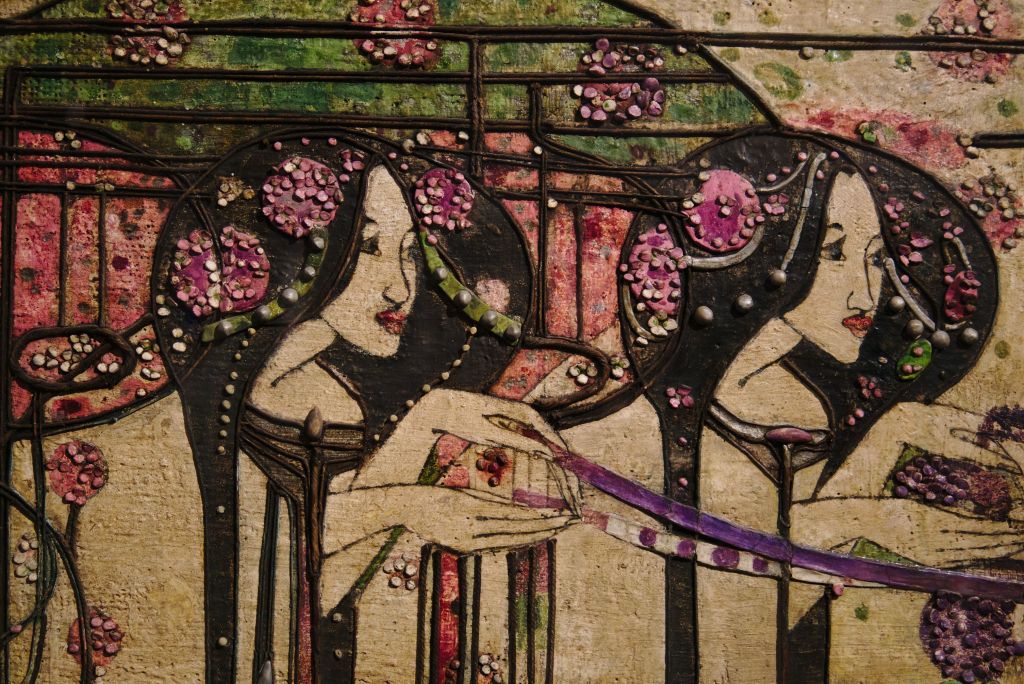
In October 2019 I had the privilege of seeing the internationally touring exhibition Designing the New: Charles Rennie Mackintosh and the Glasgow Style at the Walters Art Museum in Baltimore, whose highlight was a large-scale gesso frieze by Margaret Macdonald Mackintosh, Charles’s artistic collaborator and wife. It was displayed in a narrow hallway behind a plastic screen, so I couldn’t get a shot of the full piece, but here’s a photo provided by the CSG CIC Glasgow Museums Collection:

Macdonald, Margaret_The May Queen
Margaret Macdonald Mackintosh (Scottish, 1864–1933), The May Queen, 1900. Gesso on burlap over wood frame, scrim, twine, glass beads, thread, tin leaf, papier-mâché, steel pins, 158.8 × 457 cm. Kelvingrove Art Gallery and Museum, Glasgow.

All other photos in this post are my own.

Emerging in the 1890s in the industrial heartland of Scotland, the “Glasgow Style” was the only Art Nouveau movement in Great Britain. “When applied to two-dimensional objects, such as book covers, textiles, posters, and stained glass, the Glasgow Style blended elongated and organic lines, personal symbolic languages, and favored motifs to create otherworldly stylized plant and human forms,” writes Alison Brown, curator of Designing the New. It was developed by a small group of young adult friends known as The Four: Charles Rennie Mackintosh, Margaret Macdonald, Frances Macdonald, and James Herbert McNair. (Charles and Margaret married in 1900, and Margaret’s sister Frances married James in 1899.)

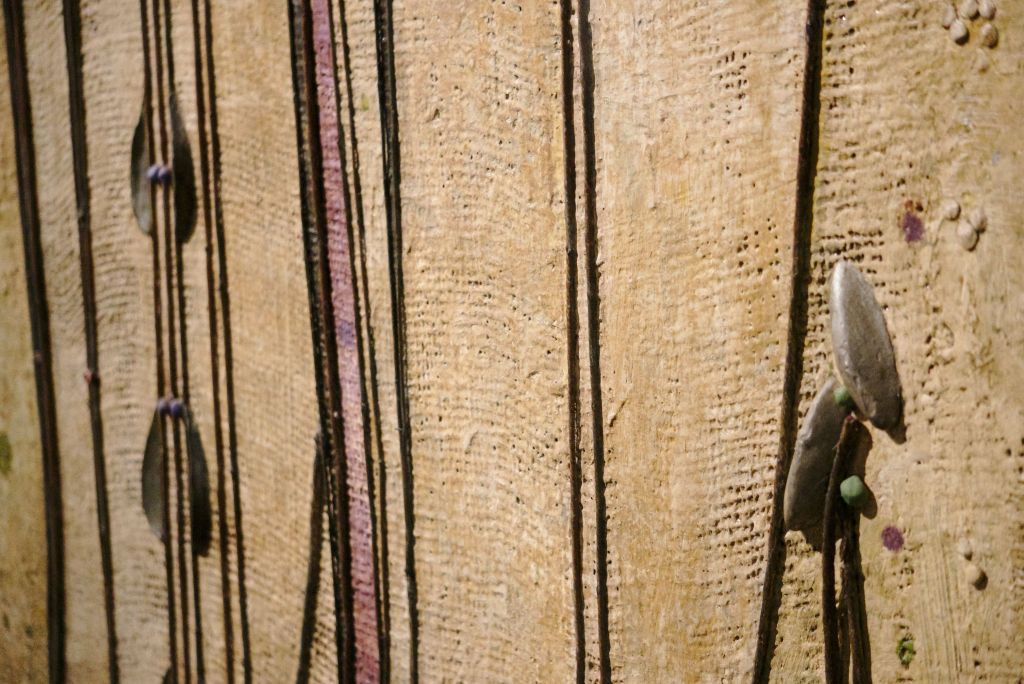
Margaret’s wide-ranging output included watercolors, graphics, metalwork, and textiles, but her specialization was gesso, a plaster-based medium, which she used to make decorative panels for furniture and interiors. The May Queen was commissioned from her at the turn of the century by Miss Catherine Cranston for one of her famous Ingram Street tea rooms in Glasgow, where it hung above a window in the Ladies’ Luncheon Room until 1971. (It is now preserved at the Kelvingrove Art Gallery and Museum.) Gloriously textured, it consists of rough burlap stretched over a wooden frame and covered in gesso, glass beads, metallic leaf, and molded paper. “Some of the modeled plaster shapes bear fingerprints, pinched and pressed into the panel’s surface. The outlines of the figures, trees, and plant forms are ‘drawn’ with brown painted string held fast with long steel pins,” Brown writes.

The crowning of a “May Queen,” a girl chosen to personify May Day and preside over its festivities, is a traditional springtime ritual in western Europe. (If you need a visual, think Florence Pugh’s character in Midsommar . . .) So the title of this artwork is most likely a reference to that. However, I get some serious Marian vibes from the central female figure, which are only reinforced when I view the work in light of the Catholic tradition of the “May crowning” of Mary.

And what a resonant pairing it makes with Hopkins’s “The May Magnificat”! It shows a woman in a strong frontal stance, dressed with flowers, haloed in green, supported by a throne-like backing, and enlarged, perhaps, with child. She’s attended by four maidservants or companions.

This could very well be read as Mary of Nazareth, crowned with beauty, blessed by God to bear his Son into the world.

Shine Like a Star (Artful Devotion)

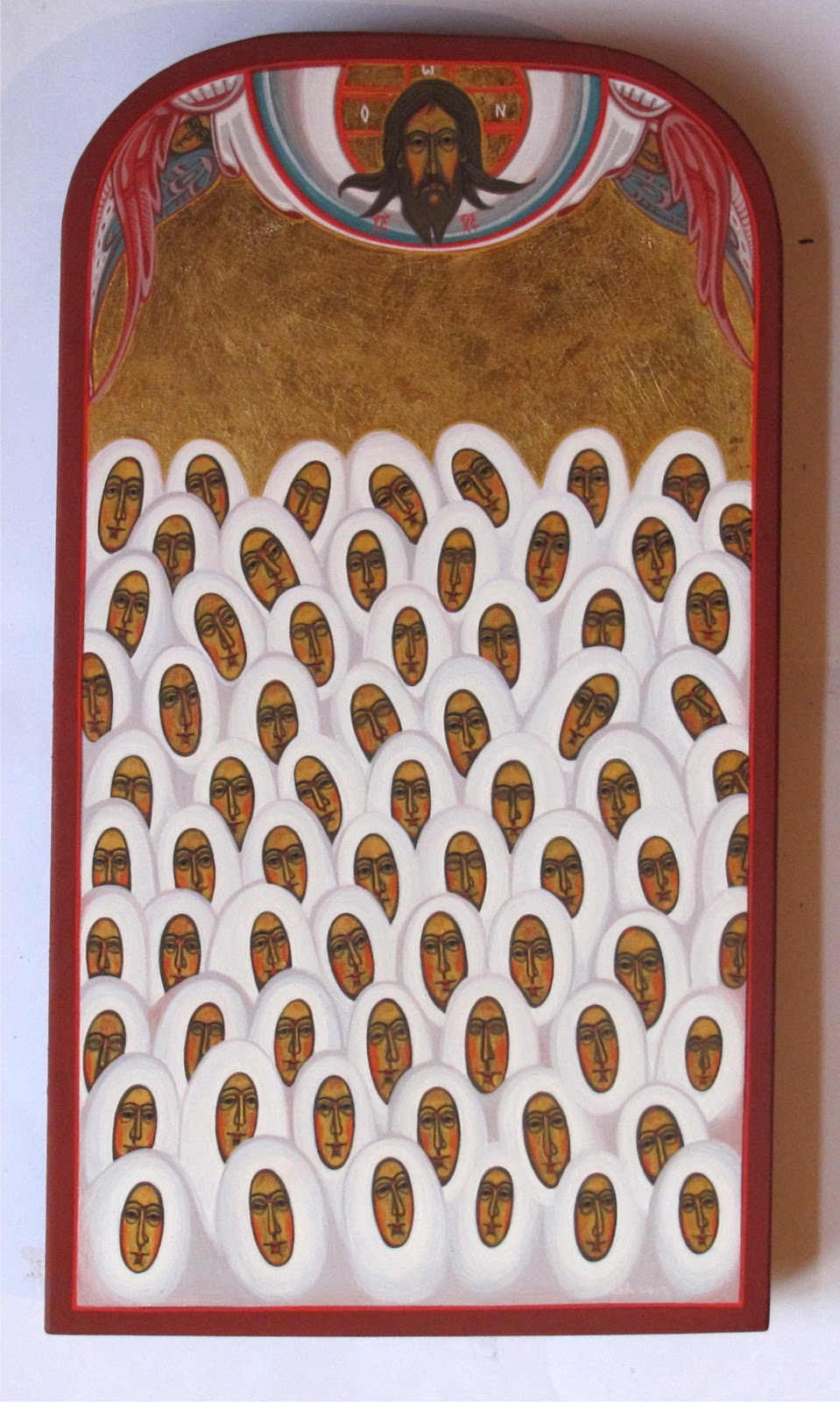
Saints by Olya Kravchenko
Icon by Olya Kravchenko (Ukrainian, 1985–)

“And those who are wise shall shine like the brightness of the sky above; and those who turn many to righteousness, like the stars forever and ever.”
—Daniel 12:3

“On that day the Lord their God will save them,
as the flock of his people;
for like the jewels of a crown
they shall shine on his land.”
—Zechariah 9:16

“Then the righteous will shine like the sun in the kingdom of their Father.”
—Matthew 13:43

+++

SONG: “Shine Like a Star in the Morning” | American folk song, adapted by Elizabeth Mitchell from a string trio arrangement by Ruth Crawford Seeger | Performed by Elizabeth Mitchell, Simi Stone, and friends on The Sounding Joy (2013)

Though passed off as a Christmas song on this Smithsonian Folkways album, “Shine Like a Star in the Morning” seems to me especially fitting for All Saints’ Day (November 1), as it draws on those biblical passages that equate righteousness with heavenly resplendence. “Shine, shine all around the throne of God,” the song goes.

Gerard Manley Hopkins, in his poem “The Starlight Night,” makes the same connection:

Look at the stars! look, look up at the skies!
O look at all the fire-folk sitting in the air!
The bright boroughs, the circle-citadels there!
Down in the dim woods the diamond delves! the elves’-eyes!
. . . . . . . . . . . . . . . . . . . . . . . . . . . . . . . . . . . . . . . . .
. . . Christ and his mother and all his hallows.


This post belongs to the weekly series Artful Devotion. If you can’t view the music player in your email or RSS reader, try opening the post in your browser.

Matthew 13:43 belongs to the Gospel lection for July 23, 2017 (Proper 11, cycle A). To read the passage in full, along with the week’s three other Revised Common Lectionary scripture passages, click here.