Holy Week starts this Sunday. Per usual, I’ll be publishing daily art and music pairings during that period (so, too, during the Easter Octave), but here is some additional art and music, and a theological reflection, for the occasion. You might also consider spending time with the Holy Week Playlist I curated on Spotify.
TENEBRAE SERVICE: Good Friday, April 2, 2021, Good Shepherd New York: Not all churches host a service on Good Friday, but for me, it is one of the most meaningful services of the year and helps make Easter all the more potent and celebratory. It wasn’t until 2011 that I attended my first Good Friday service—of the Tenebrae variety, Latin for “darkness,” meaning we started with multiple lit candles, and they were gradually extinguished throughout the evening, symbolizing the Light of the World dying out. If you’re curious about what such a service might look like, here’s a great example from 2021, from Good Shepherd New York. Filmed during the pandemic, it was a digital-only offering. As is typical, it combines song and scripture readings to tell the story of Christ’s death. Some Tenebrae services include a brief homily, but this one does not. I’ve included a list of time stamps to the songs below.
1:15: “When I Survey the Wondrous Cross” by Isaac Watts and Lowell Mason
6:26: “I Need Thee Every Hour” by Annie Hawks and Robert Lowry
24:28: “How Deep the Father’s Love for Us” by Stuart Townend
31:08: “Remember Me” by Paul Zach
35:50: “Were You There?,” African American spiritual (with a watercolor by Soyoung L Kim, inscribed with Isaiah 53:11a: “Out of the anguish of his soul he shall see and be satisfied”)
+++
INSTRUMENTAL MUSIC FOR GOOD FRIDAY: The one Facebook group I belong to is Liturgy Fellowship; I joined when I was a worship planner and stick around because of the many great resources, especially musical ones and ideas for marking holy days as a congregation, that are shared by Christians across denominations. One post I made note of is from Andrew Kerhoulas, the associate pastor at Grace Mills River in Mills River, North Carolina. As a prelude for their 2023 Good Friday service, he said, Grace Mills River musicians played an excerpt from the fifth movement of Olivier Messiaen’s Quartet for the End of Time. Here’s the full movement, performed by cellist Bingxia Lu and pianist Jackie Tu:
“The piece is avant-garde and not a little abrasive to those with pop music sensibilities,” Kerhoulas wrote to the group. “But once you know that it was written in 1941 by a French prisoner of war while in a German prison and first performed for fellow prisoners, it takes on depths of meaning. So too the cross: It is grotesque and horrific, but it becomes meaningful and even beautiful when you know the occasion—the deeper story—in which Jesus gave up his life.”
The church concluded its Good Friday service with a string quintet postlude, “On the Nature of Daylight” by Max Richter, played to the dimming of lights. Again, the following performance is not from Grace Mills River, but rather by Louisa Fuller, Natalia Bonner, John Metcalfe, Chris Worsey, and Ian Burdge for the fifteenth anniversary edition of The Blue Notebooks album.
Some people think that music used in Christian worship as a focal piece (i.e., not in the background) needs to have words to be worshipful and productive. I strongly disagree. Instrumental music conveys beauty and sets a mood and, yes, even communicates—often that which is difficult to express verbally. I love Grace’s thoughtful inclusion of these two modern and contemporary pieces from the classical tradition in their community’s observance of Good Friday.
+++
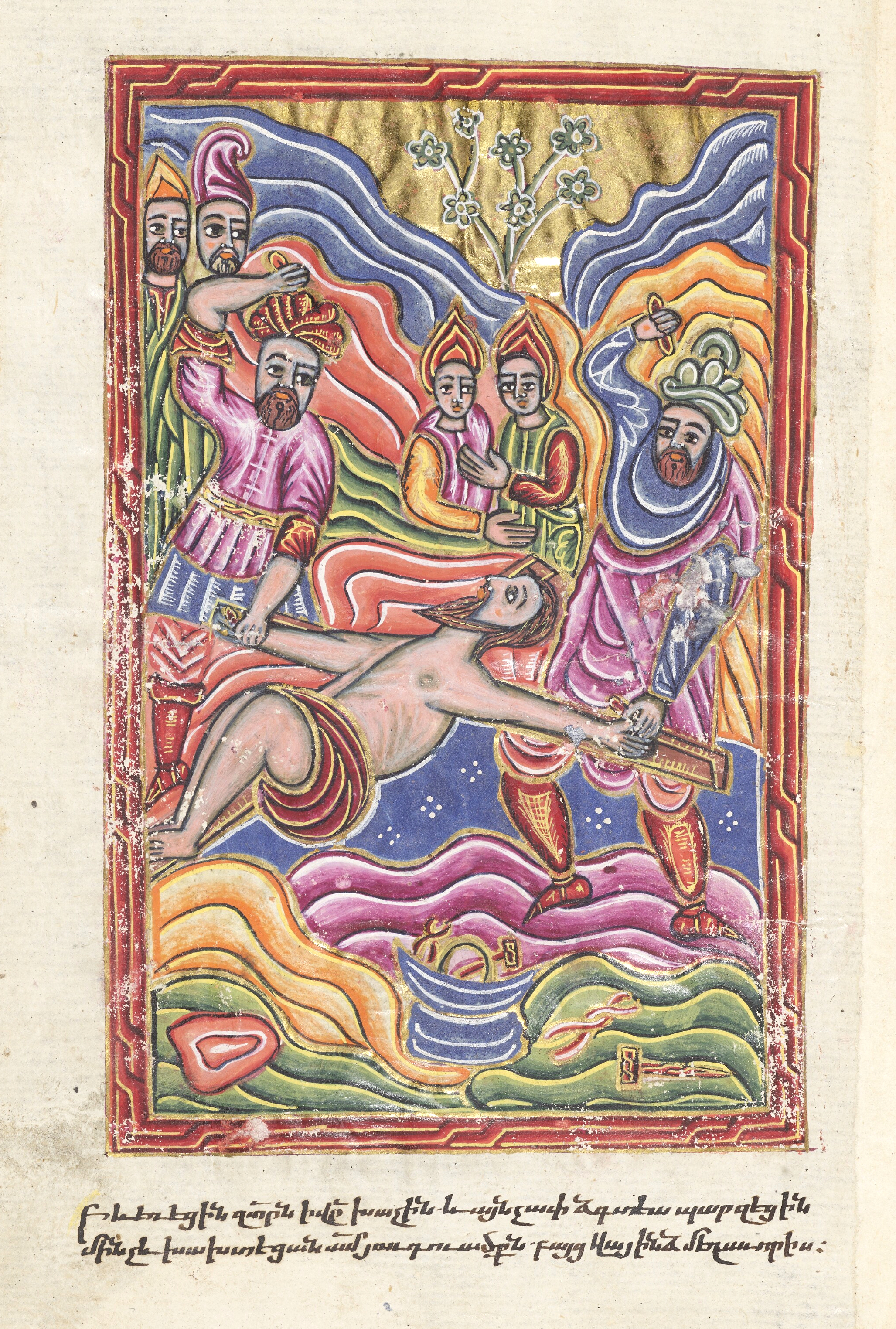
ART COMPILATION: “Crucifixion: Armenian Illuminated Manuscripts” by Levon Ounanian: This compilation brings together thirty-one Armenian miniatures of Christ’s passion. (Miniatures are painted illustrations in a manuscript, so called not because they’re small, though they usually are, but because artists often sketched them using a red lead pigment called minium.) According to the author, of the 31,000 Armenian manuscripts currently listed around the world, about 6,000 of them contain miniatures, not to mention the many more that contain non-narrative decoration.
Mesrop of Khizan (Armenian, active in Persia, ca. 1560–ca. 1652), The Nailing on the Cross, from an Armenian Gospel book, 1609. Oxford, Bodleian Library, MS. Arm. d.13, fol. 13v. Click to view the fully digitized manuscript.
+++
SONG: “Saare Paap” (सारे पाप) (All Sins), performed by James Bovas: In this video, James Bovas [previously] performs a Hindi version of a Malayam song about the Crucifixion. The Hindi lyrics and English translation were supplied to me by the Indian gospel media production company Sarah Creation.
सारे पाप और दाग ममटाकर, मुक्क्त देने के मलए मुक्क्त दाता ने बहाया, खून अपना क्रूस से खून के प्यासे भेडियों ने, आके घेरा यीशु को मारे कोिे टोकी कीले, धारे ननकली ज़ख्मों से मेरे मन तू याद कर ले, क्यों सहे दुुःख यीशु ने तेरा खानतर जान देकर, दी ररहाई यीशु ने श्राप सारे लेके मेरे, दे दी मुझको आमशषे यीशु के पावन लहू से, भाग्य मेरे खुल गए
To remove all the stains and sin, and to give salvation The Redeemer shed his blood on the cross Bloodthirsty wolves surrounded Jesus He was scourged, nailed, and a stream of blood issued forth from his wounds O my soul, never forget why Jesus suffered! He gave his life to set you free He took all my curses and gave me all the blessings By the holy blood of Jesus, my destiny changed forever
+++
ESSAY: “The Path from Death to Life” by Kurt Koch, Plough, March 30, 2024: A Catholic cardinal reflects on the dark side and the bright side of Holy Saturday. “As the day Jesus rested in the grave, Holy Saturday is the day of God’s concealment and silence in history,” Koch writes. “And yet, Holy Saturday also has a hopeful and joyful aspect. . . . [On this day] Jesus traveled to [Hades,] the place of greatest loneliness – a place completely bereft of any human relationships – and stirred the souls and limbs trapped by rigor mortis with the warming love of God. He transformed their grave into a place of new life.” This essay is anthologized in the revised and expanded edition of Bread and Wine: Readings for Lent and Easter (Plough, 2026).
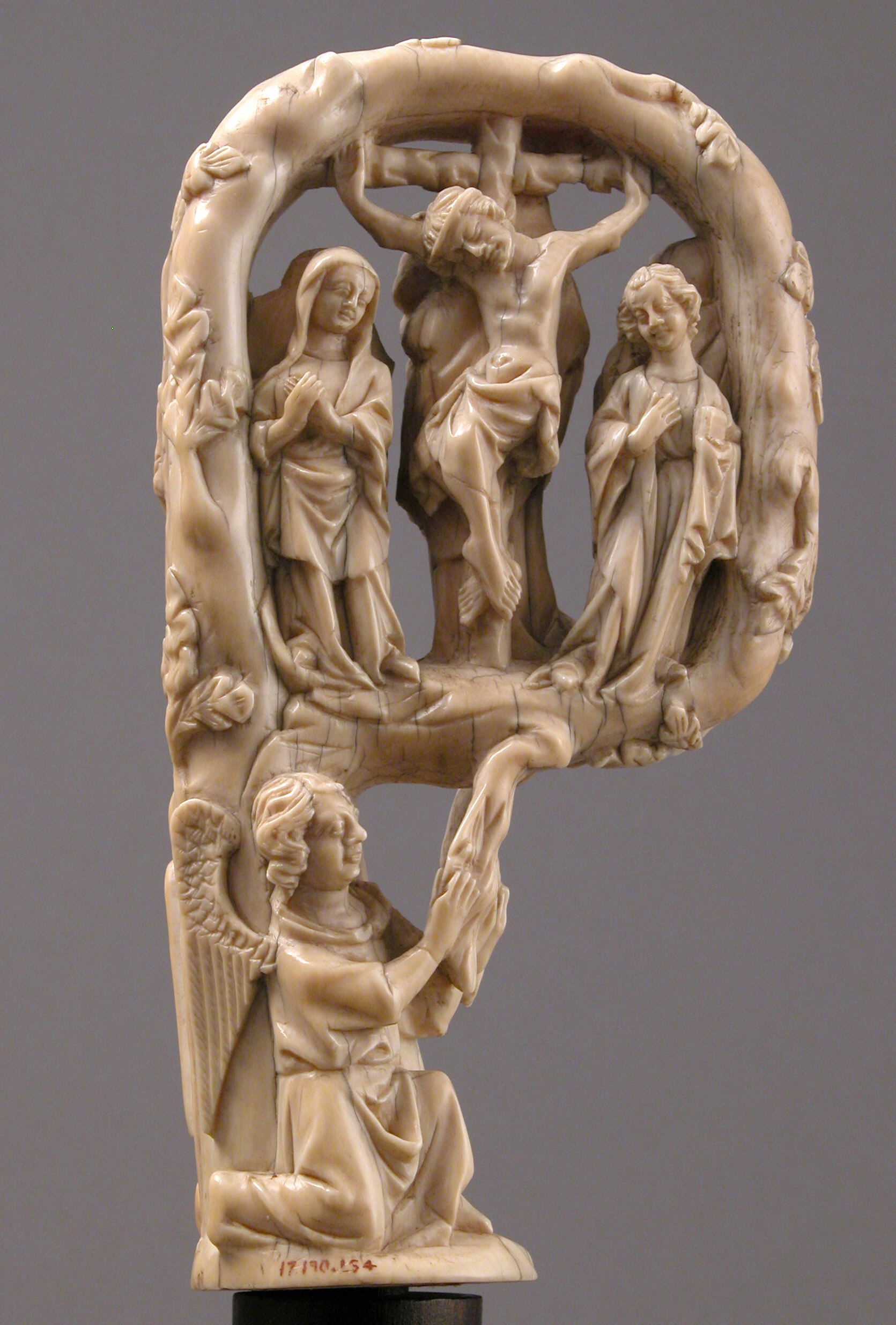
Crozier Head with the Crucifixion, Paris, ca. 1350. Elephant ivory, 5 13/16 × 3 1/8 × 1 1/2 in. (14.8 × 8 × 3.8 cm). Metropolitan Museum of Art, New York. The reverse side depicts the Virgin and Child with Saint Denis.
This carved head of a bishop’s staff from medieval France depicts Christ crucified on the tree of the cross, flanked by his mother Mary and his friend John. From the base of the cross flows a healing stream of blood, which an angel kneels to catch in his hands.
LISTEN: “O Love Divine, What Hast Thou Done” | Words by Charles Wesley, 1742
I can’t decide which of the following two tunes I prefer, so I proffer them both. The first is a traditional four-part hymn tune, sung a cappella, whereas the second is a contemporary guitar-driven tune.
>> Music by Isaac Baker Woodbury, 1850 | Performed by the Choral Arts Society of Washington, dir. Scott Tucker, on Lift Up Your Voice: Hymns of Charles Wesley, 2015:
>> Music by Heaven’s Dave, on Beyond the Starry Skies, 2023:
O Love divine, what hast thou done? Th’ immortal God hath died for me; The Father’s co-eternal Son Bore all my sins upon the tree. Th’ immortal God for me hath died; My Lord, my Love, is crucified.
Behold him, all ye that pass by, The bleeding Prince of Life and Peace; Come, sinners, see your Savior die, And say, “Was ever grief like his?” Come feel with me his blood applied; My Lord, my Love, is crucified.
Is crucified for me and you, To bring us rebels back to God. Believe, believe the record true: We all are bought with Jesus’ blood. Pardon for all flows from his side; My Lord, my Love, is crucified.
Then let us sit beneath his cross, And gladly catch the healing stream; All things for him account but loss, And give up all our hearts to him— Of nothing speak, or think beside, But Jesus and him crucified.
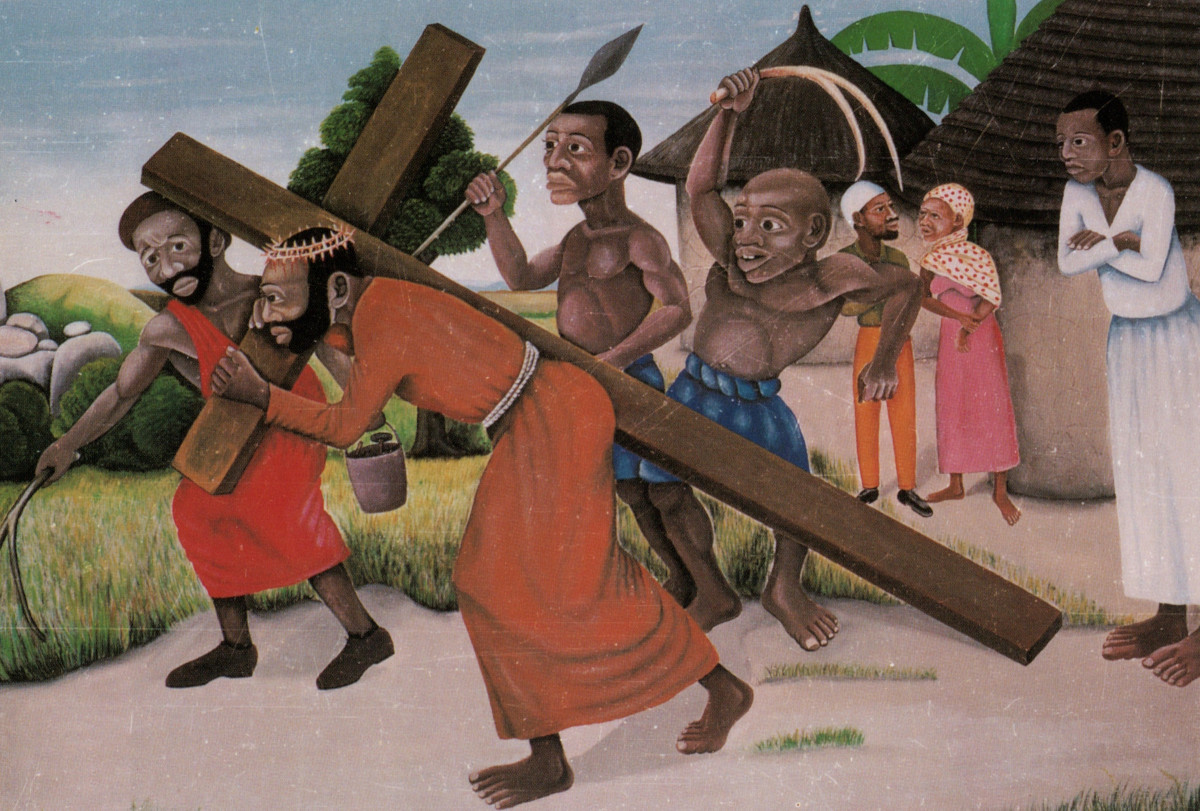
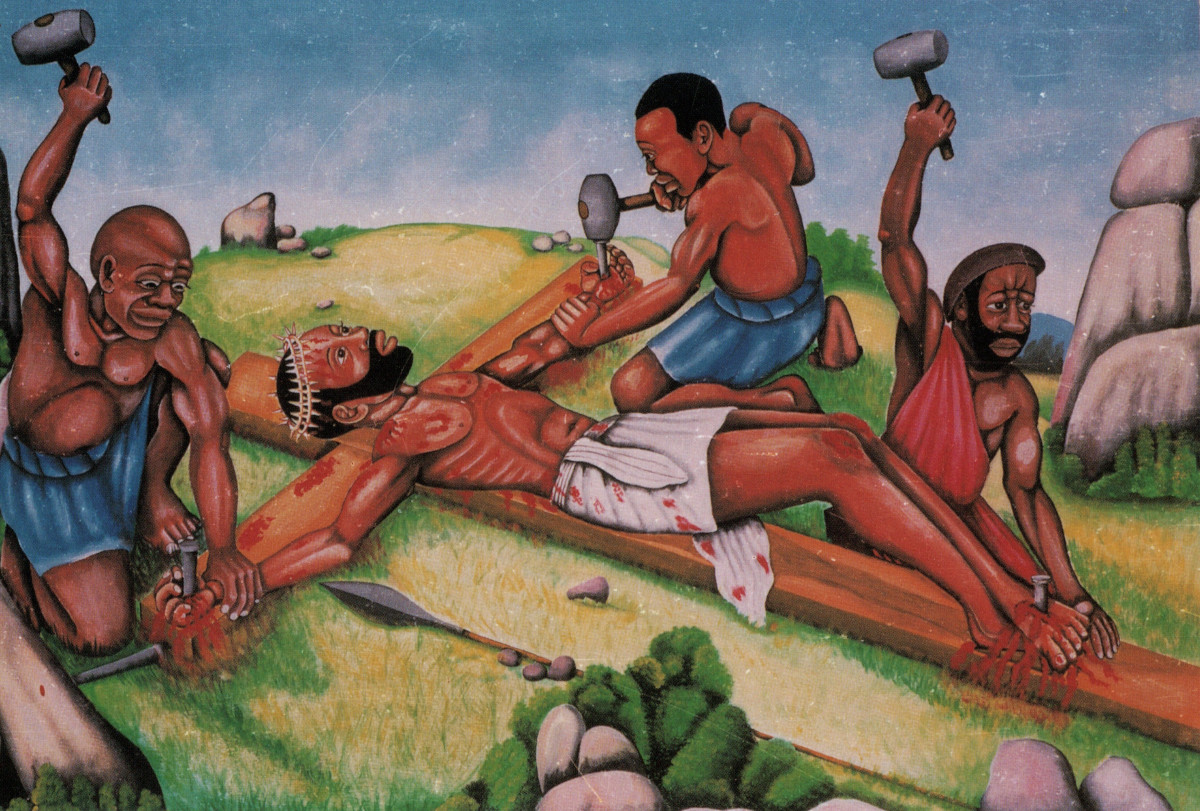
LOOK: Stations of the Cross #2 and #11 by Charles Ndege
Charles S. Ndege (Tanzanian, 1966–), Station II: Jesus Takes Up His Cross. Wall painting from St. Joseph Mukasa Balikuddembe Church, Nyakato (Mwanza region), Tanzania. Source: Were You There? Stations of the Cross by Diana L. HayesCharles S. Ndege, Station XI: Jesus Is Nailed to the Cross
The cement walls of St. Joseph Mukasa Balikuddembe Church in Nyakato, Tanzania, bear a series of murals by the Tanzanian artist Charles Ndege depicting the Stations of the Cross, set around the southern shores of Lake Victoria.
I couldn’t find what year the murals were painted, but the earliest would be 1995, as they are mentioned (and one is reproduced) in the book Towards an African Narrative Theology by the American Maryknoll missionary priests Joseph Healey and Donald Sybertz, which came out in 1996.
I found out about Ndege’s Stations from the book Were You There? Stations of the Cross (Orbis, 2000), a small paperback that reproduces all fourteen scenes in full color and features reflections by the African American Catholic theologian Diana L. Hayes. I recommend it.
See how they done my Lord See how they done my Lord (Can’t you) See how they done my Lord Lord, have mercy on me
Well, they whipped him all night long They whipped him all night long (Tell me) Whipped him all night long Lord, have mercy on me
Well, they whipped him up a hill They whipped him up a hill (Tell me) Whipped him up a hill Lord, have mercy on me
Well, they nailed him to the cross They nailed him to the cross (Tell me) Nailed him to the cross Lord, have mercy on me
Well, two thieves was hanging beside him Two thieves was hanging beside him (Tell me) Two thieves was hanging beside him Lord, have mercy on me
This song is sung by six unidentified men incarcerated at the Louisiana State Penitentiary, known colloquially as Angola Prison, one of the largest maximum-security prisons in the United States. A lament reflecting on Christ’s passion, it’s one of a series of Black gospel songs and spirituals recorded at the prison by the folklorist and musicologist Harry Oster in the late 1950s.
“How they done him” is slang for “how they wronged him” or “how they treated him badly.”
I can’t help but wonder if the singers identified with the abuse Christ suffered and found comfort in knowing that God himself walked the road before them and is with them in their own ways of sorrow. Perhaps (instead or too) they saw themselves in the penitent thief mentioned in the last stanza, who acknowledged the justice of his own sentence and asked Jesus to remember him in God’s kingdom.
The song’s refrain, “Lord, have mercy,” is a common one in liturgical churches, one that invokes God’s mercy in light of personal and corporate sins. It’s a plea for God’s compassion and forgiveness, and for relief.
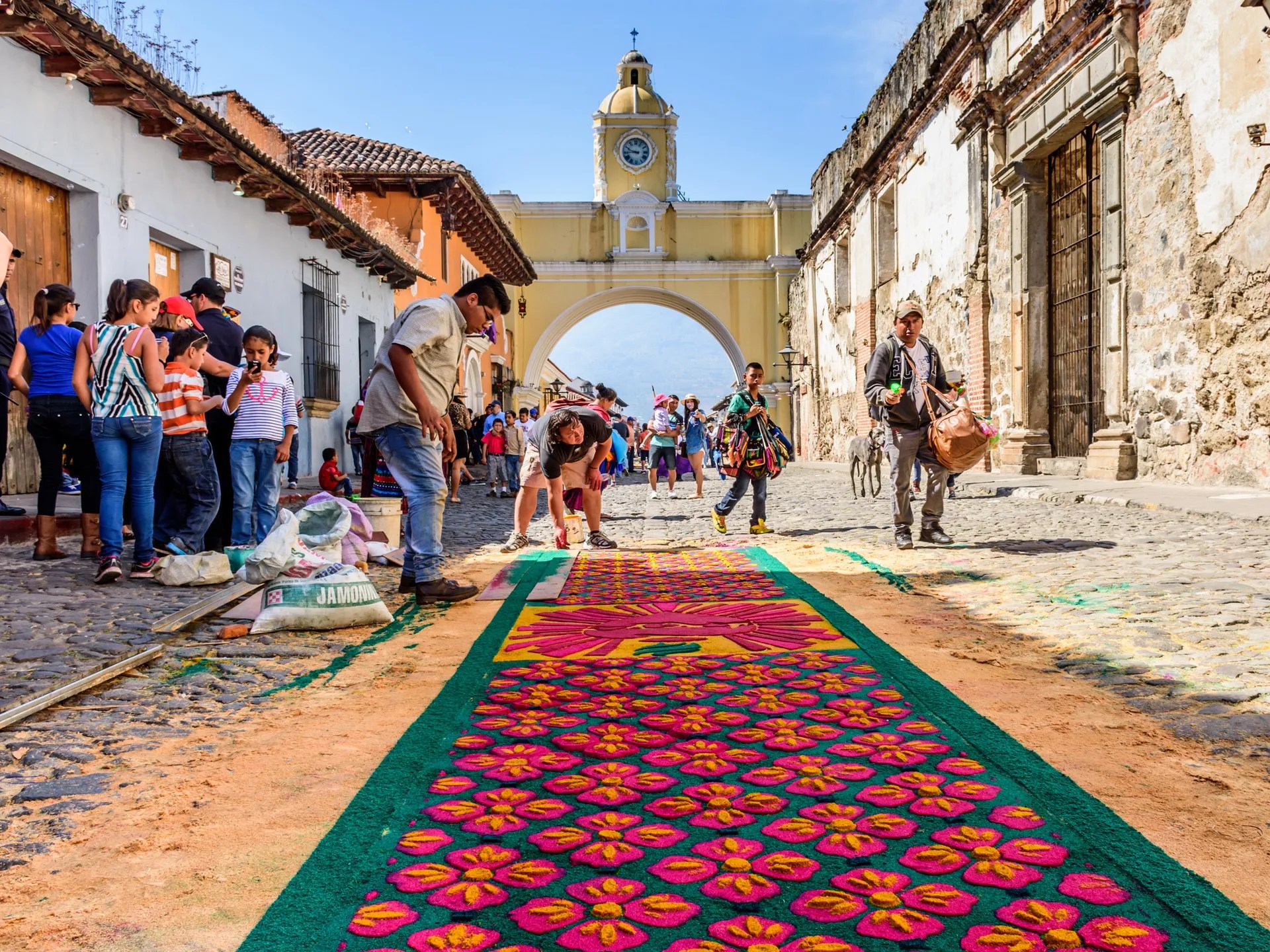
HOLY WEEK TRADITION: Antigua, Guatemala, is renowned for its annual Good Friday observance, which involves the laying out of alfombras (carpets) of multicolored sawdust through the city’s cobblestone streets, hundreds of feet long. On Maundy Thursday, the city closes so that families and businesses can spend the day constructing the carpets, applying the sawdust to planned designs using stencils and strainers and adding pine needles, flowers, fruits, and other natural materials as well.
People watch while locals make an alfombra (carpet) of dyed sawdust for Antigua’s Good Friday processions, the most famous in Latin America. Photo: Lucy Brown, 2016.
At 4 a.m. on Good Friday, the processions begin, with people carrying floats that bear statues of Christ carrying his cross, followed by marching bands playing solemn music. (This is a remembrance of Jesus’s walk to Calvary.) As their feet pass over the alfombras, the dust scatters. Locals and visitors gather along the streets dressed in black for mourning, and at 11 p.m. a figure of Jesus is laid to rest in the church.
Here are two resources for exploring this tradition further:
>> VIDEO: “Alfombras de Semana Santa en Guatemala,” dir.Federica Dominguez: This short film (in Spanish, with English subtitles) interviews Rolando Ortiz, an alfombrero who is also a shoemaker. He explains that the carpets hark back to Jesus’s triumphal entry into Jerusalem, when the crowds strewed his path with palm branches (giving him the red carpet treatment, so to speak). Even though the alfombras last only a brief time, locals spare no expense in bringing them to fruition each year—“for Jesus,” Ortiz says. “It is an act of gratitude above all.” An offering of beauty and praise.
+++
NEW ALBUM: As Foretold, Part 3 by Poor Bishop Hooper: Released today, this is the final album in a trilogy based on the prophetic fulfillment passages in the Gospel of Matthew. It centers on Jesus’s passion and concludes with a resurrection epilogue. As with all their music, the duo graciously offers it for free download from their website.
+++
SONGS performed by Emorja Roberson: Emorja Roberson [previously] is a singer, gospel choir conductor, and assistant professor of music and African American studies at Oxford College of Emory University in Georgia. I enjoy following his YouTube channel. Here are two songs that are especially fitting for Holy Week.
>> “I Know It Was the Blood”: Roberson sings three verses of this beloved African American spiritual: the title verse, “They whipped him all night long,” and “He never said a mumblin’ word.” The song is more typically sung in a major key, and its full lyrics span Christ’s passion, resurrection, ascension, and second coming. But Roberson slows down the tempo and sings in a minor key, homing in on the sorrow of Good Friday.
>> “He Decided to Die” by Margaret Pleasant Douroux: Roberson, on keys, sings a gospel classic with friends Marcus Morton and Cameron Scott, a song that emphasizes Christ’s resoluteness on the cross, his endurance for love.
+++
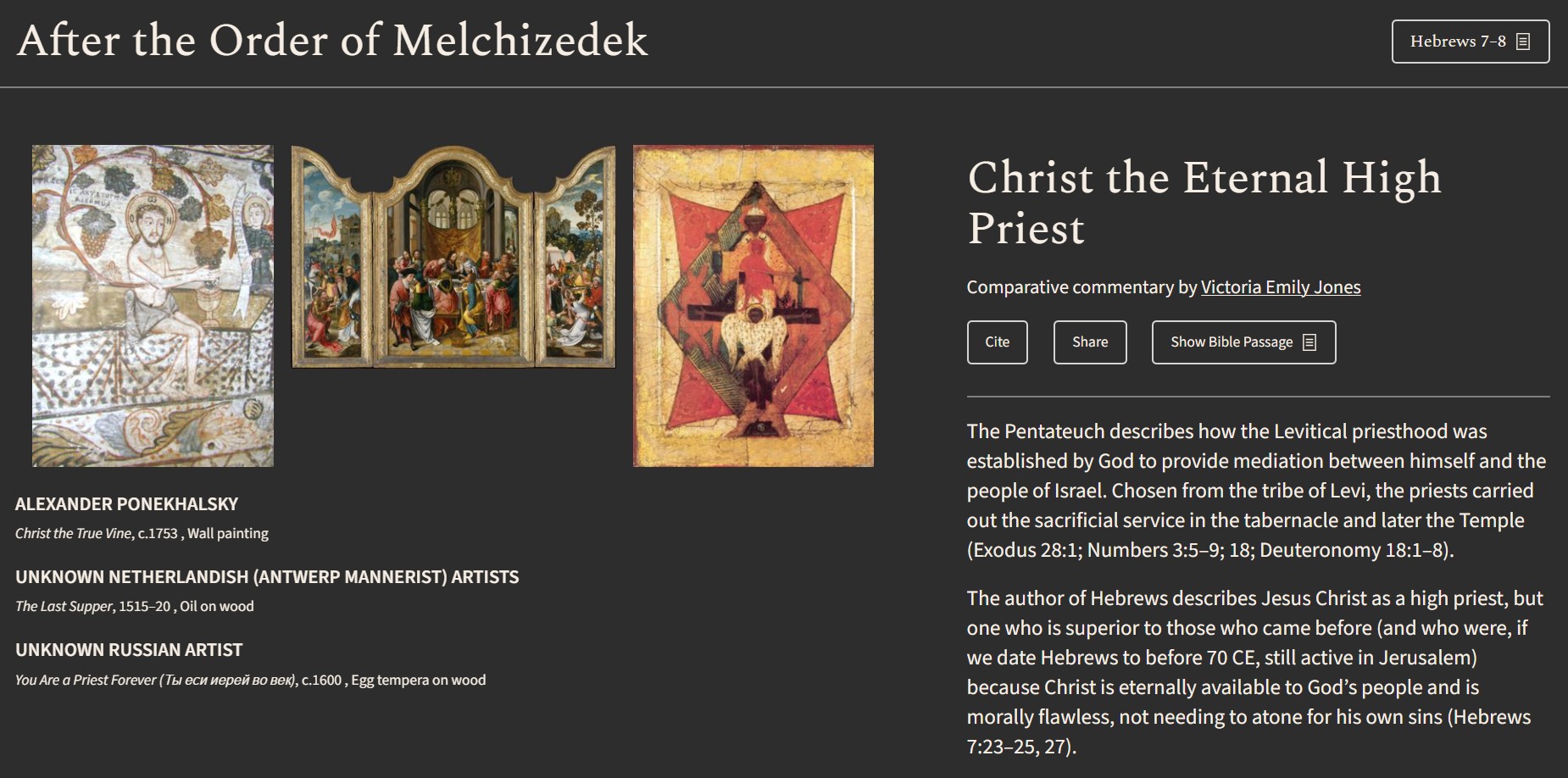
VISUAL COMMENTARIES: “After the Order of Melchizedek” by Victoria Emily Jones: My latest contribution to the Visual Commentary on Scripture, a project based out of King’s College London, was published earlier this month. Tasked with choosing and commenting on three artworks that dialogue with Hebrews 7–8, I landed on a “You Are a Priest Forever” icon from Russia (very strange!), an Antwerp Mannerist triptych that centers the Last Supper, and (my favorite) a wall painting of Christ the Grapevine from a Romanian church. I was interested to explore the idea of how Jesus, in giving his body and blood, is both the offerer and the offered, both priest and sacrifice.
+++
POEM: “The Death of Christ” by Emperor Kangxi: Emperor Kangxi (1654–1722) ruled in China for sixty-one years during the Qing Dynasty. In 1692 he issued the Edict of Toleration, which barred attacks on churches and legalized the practice of Christianity among Chinese people. Curious about and respectful of other faiths, he penned this short poem on the Crucifixion using the classical qi-yen-she form.
+++
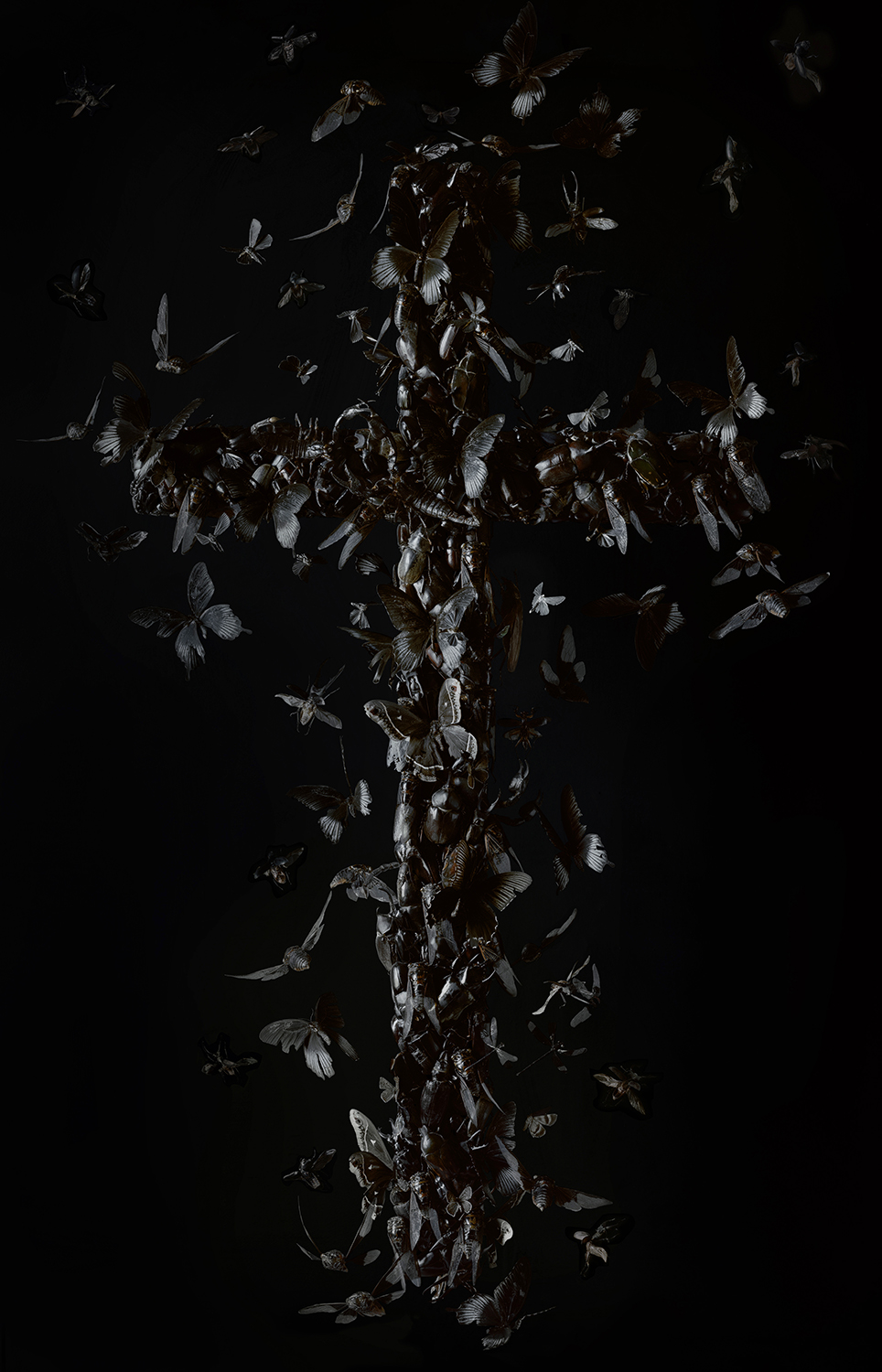
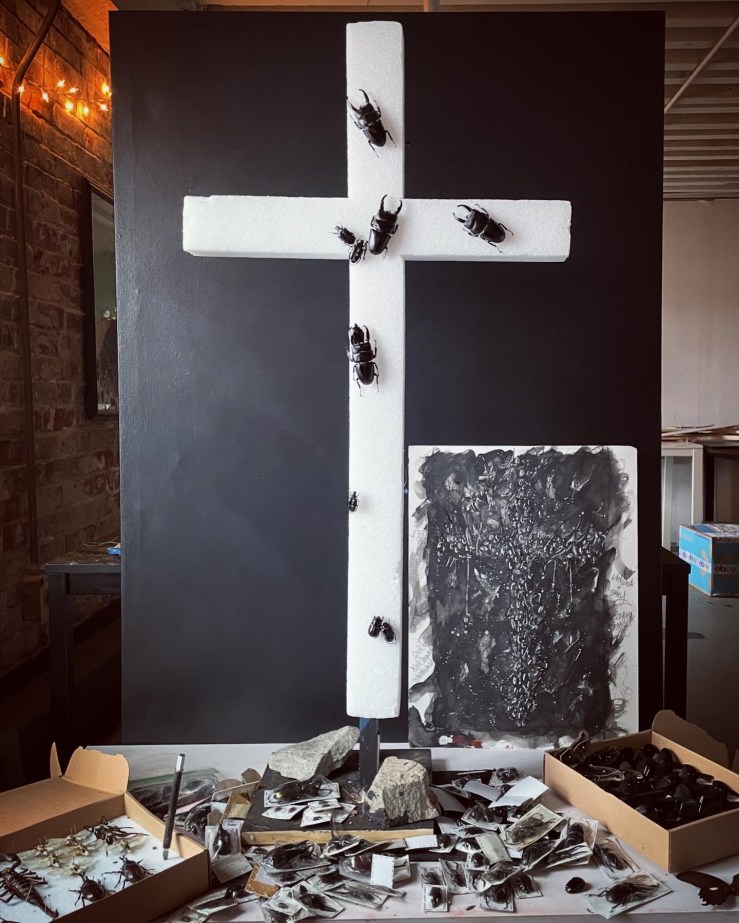
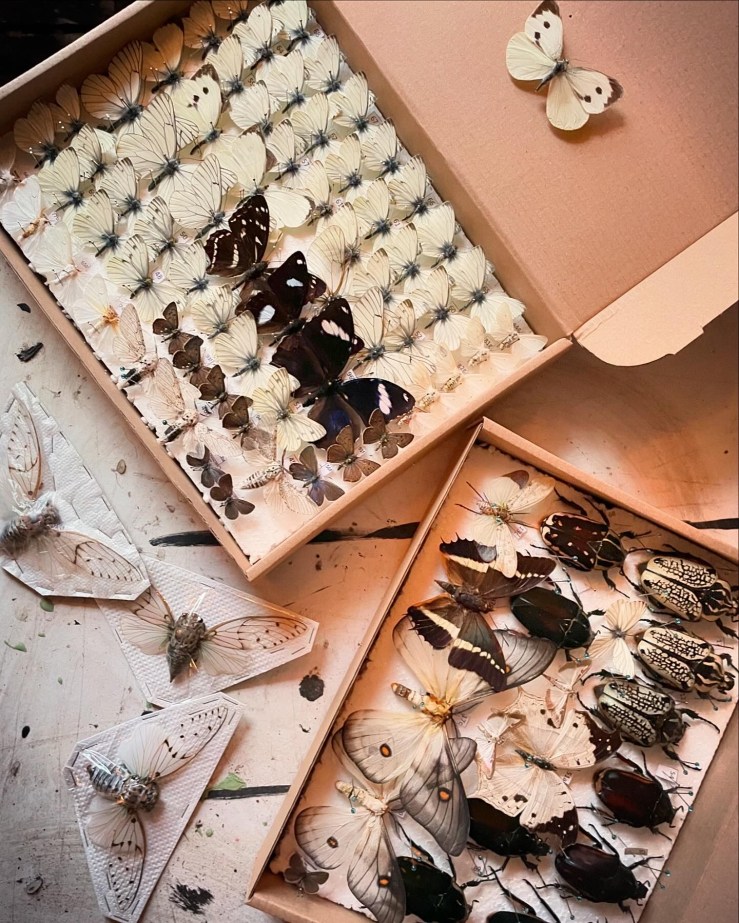
EXHIBITION: Tara Sellios: Ask Now the Beasts, Fitchburg Art Museum, January 18, 2025–January 18, 2026:Tara Sellios is a multidisciplinary artist from South Boston working mainly in large-format photography. Delighting in detail and complex symbolism, she often uses insects, dried fauna, bone, and other organic matter to create elaborate still lifes that she then photographs under dramatic lighting. She is inspired by art historical representations of the end of the world, especially the bizarre paintings of Hieronymus Bosch and Albrecht Dürer’s Apocalypse woodcuts, and by seventeenth-century Dutch vanitas paintings.
The photographs in her current solo show, Ask Now the Beasts at Fitchburg Art Museum in Massachusetts, are “contemporary allegories of suffering and transcendence.” The exhibition’s title comes from Job 12:7.
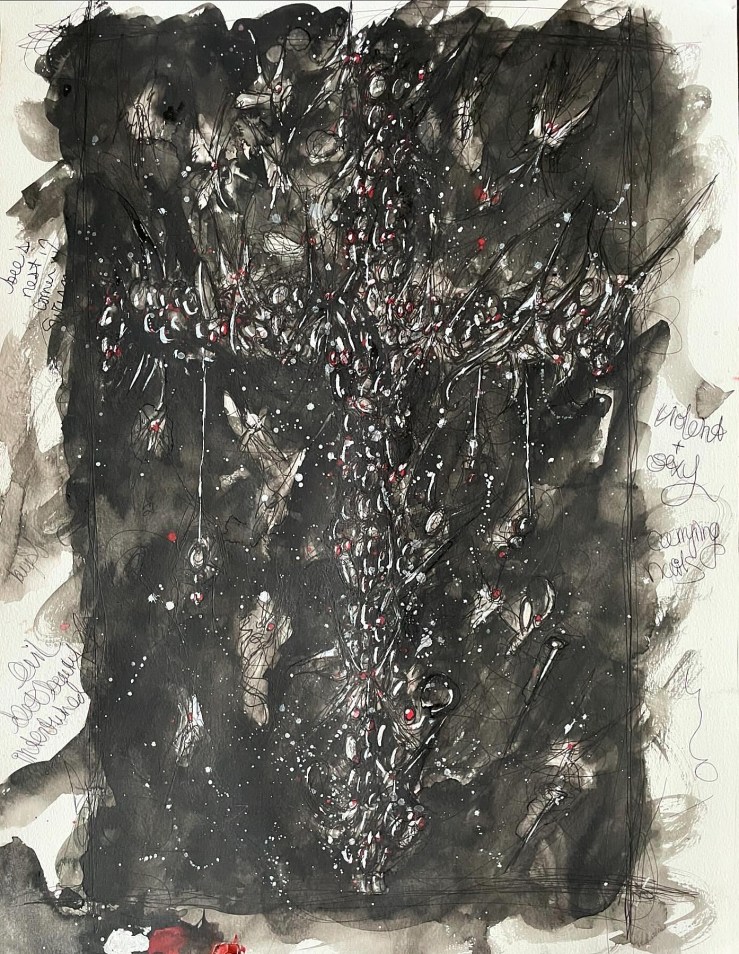
Two of the works on display are a pair of crosses: Umbra (Latin for “darkness” or “shadow”) and Dilucesco (“to begin to grow light, to dawn”), which together suggest a movement from death to resurrection. Constructed with a throng of black beetles and other black insects, the Umbra cross evokes the detail from the Synoptic Gospels’ Crucifixion accounts that at noon, “darkness came over the whole land until three in the afternoon, while the sun’s light failed” (Luke 23:44–45; cf. Matt. 27:45; Mark 15:33). Dilucesco, on the other hand, shows the cross seemingly exploding into light, as white moths and other winged insects break out of their cruciform shape. View these two photographic artworks, plus a few process photos and sketches the artist sent me, below. See, too, www.tarasellios.com.
Tara Sellios (American, 1987–), Umbra, 2024, from the series Ask Now the Beasts. Inkjet print from 8 × 10 negative, 55 × 35 in. Courtesy of the artist.Tara Sellios (American, 1987–), Dilucesco, 2024, from the series Ask Now the Beasts. Inkjet print from 8 × 10 negative, 55 × 35 in. Courtesy of the artist.
The following exhortation is by Kenneth Tanner, pastor of Holy Redeemer church in Rochester Hills, Michigan, and the author of Vulnerable God: Reviving the Wonder of God-with-Us in Our Humanity, forthcoming from Brazos Press. He originally posted it on Facebook on March 26, 2018, and I reprint it here with his permission.
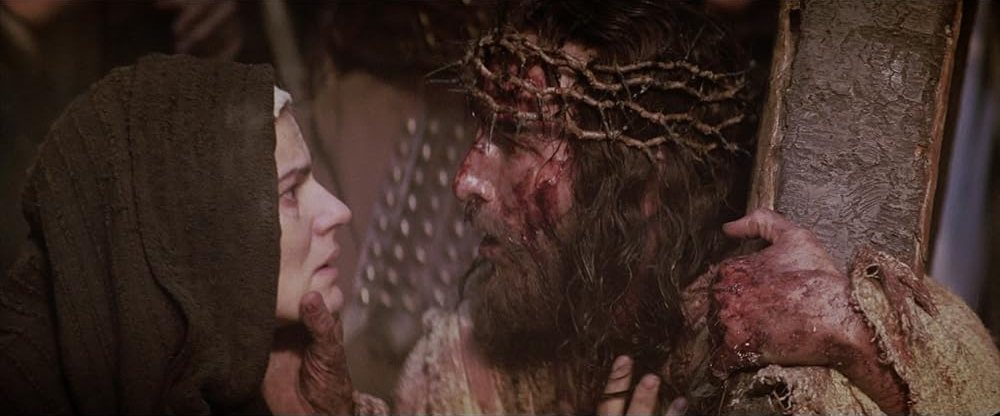
[In 2004] a film premiered during Lent. The film was about this week we are entering, the week that changes the world.
There’s a scene in the film of Jesus falling flat on his face into a dusty road; surrounded by crowds, a crown of thorns on his head, the heavy timber he is carrying comes down hard on his back.
He falls at the intersection of an alleyway where we see his mother Mary huddled in anguish as she waits in horror to glimpse Jesus passing.
When Jesus hits the ground just yards from her, Mary flashes back to a moment when as a child Jesus stumbled and hurt himself. In the memory, Jesus runs to her in pain and she takes him into her arms of comfort.
Startled back from her vision, back to the reality of her son laying prostrate in the dust, Mary springs to life and rushes to the aid of her son. When Jesus sees her, he shoulders his cross, and as he slowly rises back to his feet, he looks at Mary and says, “Behold, mother, I make all things new.”
Film still from The Passion of the Christ (2004), dir. Mel Gibson
Once a year Christians let this story be the priority in their lives. We take children out of music lessons and sporting events. We don’t plan social engagements. We pause. We take a deep breath. We put ordinary busyness on hold. We take a long weekend of sabbaths.
We pray. We sing. We lament. We remember. We find silence and dwell in it. We worship.
We ENTER the story together by the Spirit in gathered liturgies that re-enact the gift of the Last Supper, the command to love as God has loved us, the anxious questions and perspiration of Gethsemane.
We come together again to take a hard look at the cross, at our own violence toward God, at the Love that forgives even as we betray and deny and flee, as we smite and whip and nail and mock.
In the quiet of Holy Saturday we ponder a world without God, where death reigns without the resurrection.
Then we gather once more with great joy to remember that death is not the end of anyone or the end of the world, that the resurrection is the end of all things.
I want to encourage you to disconnect from the grind and walk the way of the cross this week, to stay with Jesus and the women and John in the darkness that has to come before the new dawn.
You will never quite understand our community, ancient practices, or the deeper meanings of this week until you let it take over your life once a year. And with every passing year, as you keep this sacred week sacred, free from other obligations and pursuits, you will see and experience and encounter Jesus Christ anew.
So I invite you to surrender and enter contemplation of the mighty acts whereby God has reconciled the world to himself in Jesus Christ, the things only Jesus can do, for we cannot do them ourselves, where we find genuine rest from our labors in the acts of Love that make the world new.
To assist your contemplations, I’ll be sharing a song and an artwork here on each day of Holy Week, as is my custom. (You can view the archived posts in this annual series, from 2024, 2023, 2022, 2021, and 2020.) Some of the songs can be found on Art & Theology’s Holy Week Playlist:
The English Crucifixion lyric “My Fearful Dream” (also known by the beginning of its first line, “To Calvary he bore his cross”) was written anonymously in the fifteenth century. It is preserved, with music by Gilbert Banastir (sometimes spelled Banaster or Banester) (ca. 1445–1487), on folios 77v–82r of the famous Tudor songbook BL Add. MS. 5465, intended for use at the court of King Henry VII. Compiled around the year 1500, this manuscript is commonly referred to as the Fayrfax Manuscript after Robert Fayrfax, the Tudor composer who was organist of St. Albans and a Gentleman of the Chapel Royal—that is, an adult male singer in the monarch’s household choir. It contains twelve sacred songs and thirty-seven secular songs, all in English—with, “beyond question, the finest music written to vernacular words which survives from pre-Reformation England,” writes John Stevens in Early Tudor Songs and Carols (xvi). It is unknown whether the text or the music was written first.
In 1982 “My Fearful Dream” was performed by Pro Cantione Antiqua under the direction of Mark Brown at the Church of St. John-at-Hackney in London. The recording of this performance was originally released in 1985 in vinyl format on A Gentill Jhesu: Music from the Fayrfax Ms. and Henry VIII’s Book (Hyperion A66152) and was later reissued by Regis Records in 2006 on the CD Tears & Lamentations: English Renaissance Polyphony (RRC 1259). Unfortunately, the CD is out of print, the choral group is inactive, and I can find no performances online. I thus provide the recording of “My Fearful Dream” (or “My Fearfull Dreme,” as the track list spells it) directly below for educational purposes. It is a song for three voices: alto, tenor, bass.
Below is the original text as transcribed by Richard Leighton Greene from the Fayrfax Manuscript in The Early English Carols (Oxford: Clarendon Press, 1935), page 124, followed by a version with modernized spellings and updates of a few antiquated words. The text also appears in John Stevens, Music and Poetry in the Early Tudor Court (London: Methuen, 1961), no. 56, and the music in John Stevens, ed., Early Tudor Songs and Carols (Musica Britannica 36) (London: Stainer and Bell, 1975), page 476.
Pro Cantione Antiqua does not sing the third stanza.
Rogier van der Weyden (Netherlandish, 1399/1400–1464), The Crucifixion, with the Virgin and Saint John the Evangelist Mourning, ca. 1460. Oil on panel, overall 71 × 73 in. (180.3 × 185 cm). Philadelphia Museum of Art.
Most people today use the word “carol” as synonymous with a cheerful Christmas song. But up until about 1550, the term was used for lyrics of a certain form rather than a certain subject or spirit. Greene defines the medieval or Renaissance carol as “a song on any subject, composed of uniform stanzas and provided with a burden . . . [that is,] an invariable line or group of lines which is to be sung before the first stanza and after all stanzas” (Early English Carols, xxxii–xxxiii). He distinguishes a burden from a refrain: “The refrain, as defined in this essay, is a repeated element which forms part of a stanza, in the carols usually the last line. The burden, on the other hand, is a repeated element which does not form any part of a stanza, but stands wholly outside the individual stanza-pattern” (clx).
That’s why “My Fearful Dream” can properly be called a carol. The two lines beginning “My fearful dream” open the song and repeat after each stanza.
My Feerfull Dreme
My feerfull dreme nevyr forgete can I:
Methought a maydynys childe causless shulde dye.

To Calvery he bare his cross with doulfull payne,
And theruppon straynyd he was in every vayne;
A crowne of thorne as nedill sharpe shyfft in his brayne;
His modir dere tendirly wept and cowde not refrayne.
          Myn hart can yerne and mylt
          When I sawe hym so spilt,
          Alas, for all my gilt,
Tho I wept and sore did complayne
     To se the sharpe swerde of sorow smert,
     Hough it thirlyd her thoroughoute the hart,
So ripe and endles was her payne.

My feerfull dreme . . .

His grevous deth and her morenyng grevid me sore;
With pale visage tremlyng she strode her child before,
Beholdyng ther his lymmys all to-rent and tore,
That with dispaire for feer and dred I was nere forlore.
          For myne offence, she said,
          Her Son was so betraide,
          With wondis sore araid,
Me unto grace for to restore:
     ‘Yet thou are unkynd, which sleith myn hert,’
     Wherewith she fell downe with paynys so smert;
Unneth on worde cowde she speke more.

My feerfull dreme . . .

Saynt Jhon than said, ‘Feere not, Mary; his paynys all
He willfully doth suffir for love speciall
He hath to man, to make hym fre that now is thrall.’
‘O frend,’ she said, ‘I am sure he is inmortall.’
          ‘Why than so depe morne ye?’
          ‘Of moderly pete
          I must nedis wofull be,
As a woman terrestriall
     Is by nature constraynyd to smert,
     And yet verely I know in myn hart
From deth to lyff he aryse shall.’

My feerfull dreme . . .

Unto the cross, handes and feete, nailid he was;
Full boistusly in the mortess he was downe cast;
His vaynys all and synowis to-raff and brast;
The erth quakyd, the son was dark, whos lyght was past,
          When he lamentable
          Cried, ‘Hely, hely, hely!’
          His moder rufully
Wepyng and wrang her handes fast.
     Uppon her he cast his dedly loke,
     Wherwith soddenly anon I awoke,
And of my dreme was sore agast.

My feerfull dreme . . .
My Fearful Dream (modernized)
My fearful dream never forget can I:
Methought a maiden’s child causeless should die.

To Calvary he bore his cross with doleful pain,
And thereupon strained he was in every vein;
A crown of thorns, sharp as needles, shoved in his brain.
His mother dear tenderly wept and could not refrain.
          My heart did yearn and melt
          When I saw him so spilt,
          Alas, for all my guilt,
And I wept and did sore complain
     To see the sharp sword of sorrow smart,
     How it pierced her straight through the heart,
So ripe and endless was her pain.

My fearful dream never forget can I:
Methought a maiden’s child causeless should die.

His grievous death and her mourning grieved me sore;
With pale visage, trembling, she strode before her child,
Beholding his limbs all rent and torn,
That with despair for fear and dread I was near forlorn.
          For my offense, she said,
          Her Son was so betrayed,
          With wounds sore arrayed,
Me unto grace for to restore:
     “Yet thou art unkind, which slayeth my heart,”
     Wherewith she fell down with pains so smart;
Hardly one word could she speak more.

My fearful dream never forget can I:
Methought a maiden’s child causeless should die.

Saint John then said, “Fear not, Mary; all his pains
He willfully suffers for the special love
He has to man, to make him free that’s now in thrall.”
“O friend,” she said, “I am sure he is immortal.”
          “Why, then, do you mourn so deeply?”
          “Of motherly pity
          I needs must woeful be,
As a terrestrial woman
     Is by nature constrained to smart,
     And yet verily I know in my heart
From death to life he shall arise.”

My fearful dream never forget can I:
Methought a maiden’s child causeless should die.

Unto the cross, hands and feet, he was nailed;
Violently into the mortise he was cast down;
His veins and sinews were all riven apart and burst;
The earth quaked, the sun was dark, whose light was past,
          When he, lamenting,
          Cried, “Eli, Eli, Eli!”
          His mother was ruefully
Weeping and wrung her hands fast.
     Upon her he cast his deathly look,
     Wherewith suddenly anon I awoke,
And of my dream was sore aghast.

My fearful dream never forget can I:
Methought a maiden’s child causeless should die.
The speaker of this carol has a dream—a nightmare—of Calvary, where he beholds the ignominious death of Jesus and the agonizing grief of Jesus’s mother and realizes that such suffering was undertaken for his sake, to save him from sin and its fatal consequences. The accusation that Mary hurls at the speaker in her hour of torment is biting: “You slay my heart!” My son is dead because of you. It’s such a humanizing passage, this expression of a mother’s anger at a death that didn’t have to be.
This is the Mater Dolorosa (Latin for “Sorrowful Mother”) of Christian tradition, who is sometimes depicted with a sword (or seven!) in her chest, literalizing Simeon’s prophecy to her as a teen and evoking the piercing sensation of losing a child. In Rogier van der Weyden’s Crucifixion diptych that I’ve reproduced here, created in roughly the same period as “My Fearful Dream” but in the Low Countries, there’s no sword, but Mary’s sorrow is evident in her tear-stained face, the wringing of her hands, and her literally collapsing under the unbearable weight of what she’s been asked to endure.
In the carol, the apostle John, present with Mary at the foot of the cross, catches her in her swoon and offers consolation, reassuring her that Jesus suffers willingly out of love. She responds that she knows it in her heart, and that she knows too that he will ultimately rise from death, but that that doesn’t diminish the sharpness of the pain she feels, deep in her body, watching her son shamed and wounded so.
The final image in the dream is of Jesus looking on his mother with a deathly pallor. With that, the speaker is jolted awake and sits with the horror.
On this side of the resurrection, it can be easy to breeze past Good Friday (“He didn’t stay dead!”) or to meditate on the Crucifixion only in a spiritual or theological sense. But this poem, this carol, sticks us in medias res, before the resurrection, into a physical human drama full of emotional intensity, so that we can feel what it might have been like to be present at the execution of the Son of God. Maybe you feel that the graphic details are gratuitous (the thorns shoved in his brain[!], his sinews riven apart, etc.), that sensory engagement with the scene is an exercise that fails to honor the bigger picture, and that it’s fruitless to generate pity for Christ or his mother, as the event is passed and what’s done is done. But centuries of faithful Christians have found otherwise: that meditating on Christ’s pain and that of his mother can help us better appreciate the real-life as opposed to merely mythic dimensions of the story and can cultivate in us a proper horror of sin and a deeper gratitude for Christ’s sacrifice.
The word “causeless” in the burden of the carol—the speaker sees a woman’s child dying without cause—does not imply that Jesus’s death served no purpose, but rather that he was put to death on wrongful charges. The Jewish tribunal charged him with blasphemy for calling himself the Son of God, and the Roman courts charged him with sedition, with inciting insurrection against the empire. But he was telling the truth about his identity and did so in ultimate reverence for God, not lack of it, and while the path he called his followers to would in some ways challenge the values of Rome and reorient ultimate loyalties, he never took up arms or encouraged his followers to do so (quite the contrary), and he never sought political power or overthrow.
Listen once more to Pro Cantione Antiqua’s performance of this carol as it would have been performed for the first Tudor monarch, Henry VII, presumably in private religious services for him and his family. May the depths to which God went to save God’s beloved world be something you never can forget.
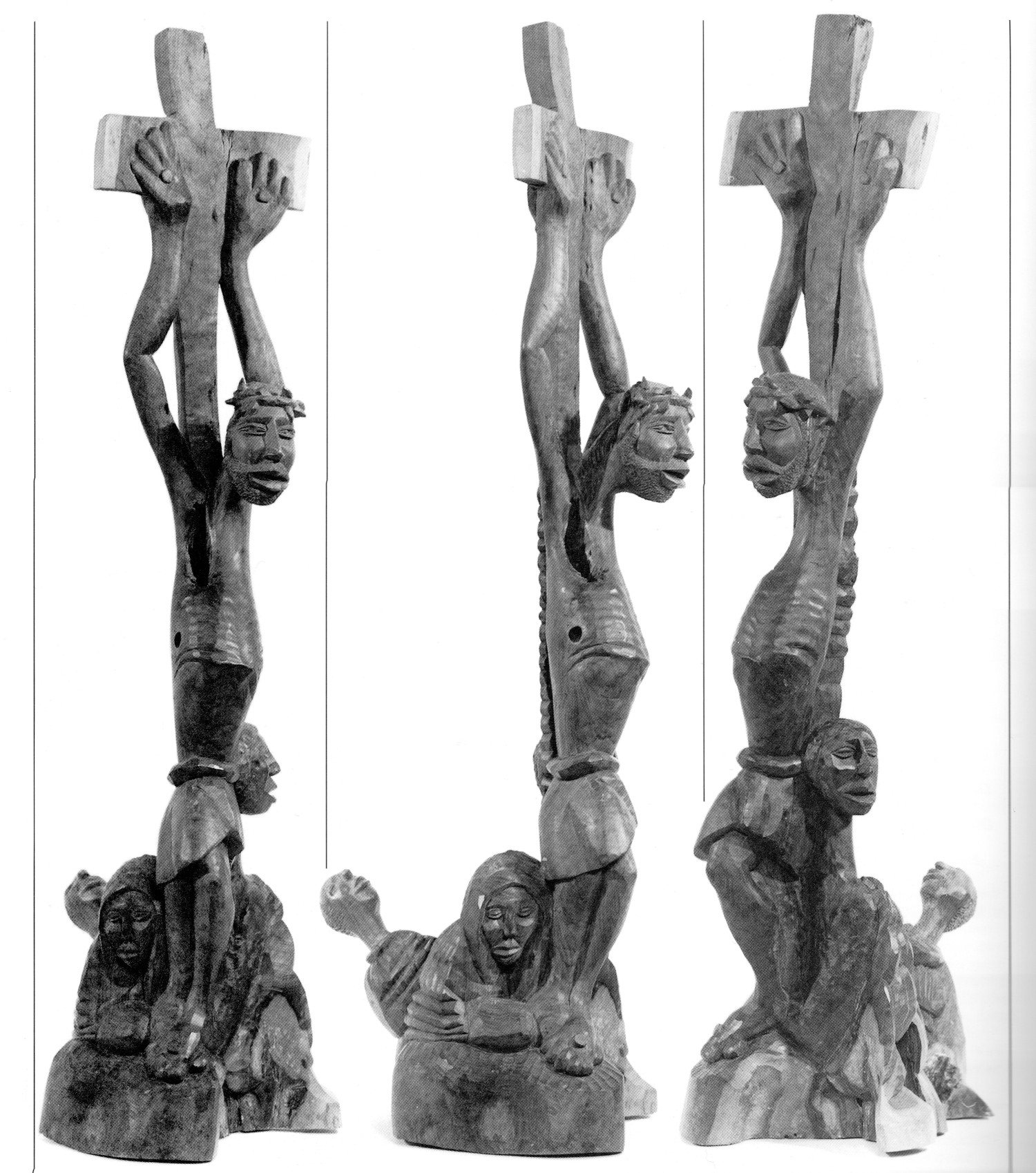
Olivewood crucifix, South Africa, 1978. Source: Christliche Kunst in Afrika, p. 263
LISTEN: “Indodana” (Son), traditional isiXhosa song from South Africa | Arr. Michael Barrett and Ralf Schmitt, adapt. André van der Merwe, 2014 | Performed by the Stellenbosch University Choir, 2014
You took your own son
Who lived among us [wailing]
(Repeat)

The Son of God
Was crucified [wailing]
(Repeat)

Oh Father! Father, Father Jehovah!
Father! [wailing]
(Repeat)

[source]
This song so well captures the mood of mourning that characterizes Good Friday, when the Son of God was slain. “Hololo” and “helele” are wordless expressions of grief. So is the “Zjem zjem zja” sung by the basses, like heaving sobs, on the title word in verse 2. One soprano who performed this piece said that singing the “Oh’s” above the melody felt like singing tears.
Holy Week begins Sunday. I will be publishing short daily devotional posts during that time and through the first eight days of Easter. Also: don’t forget about the Art & TheologyHoly Week Playlist and Eastertide Playlist! I’ve made some new song additions since last year, mixed in to preserve the narrative flow.
+++
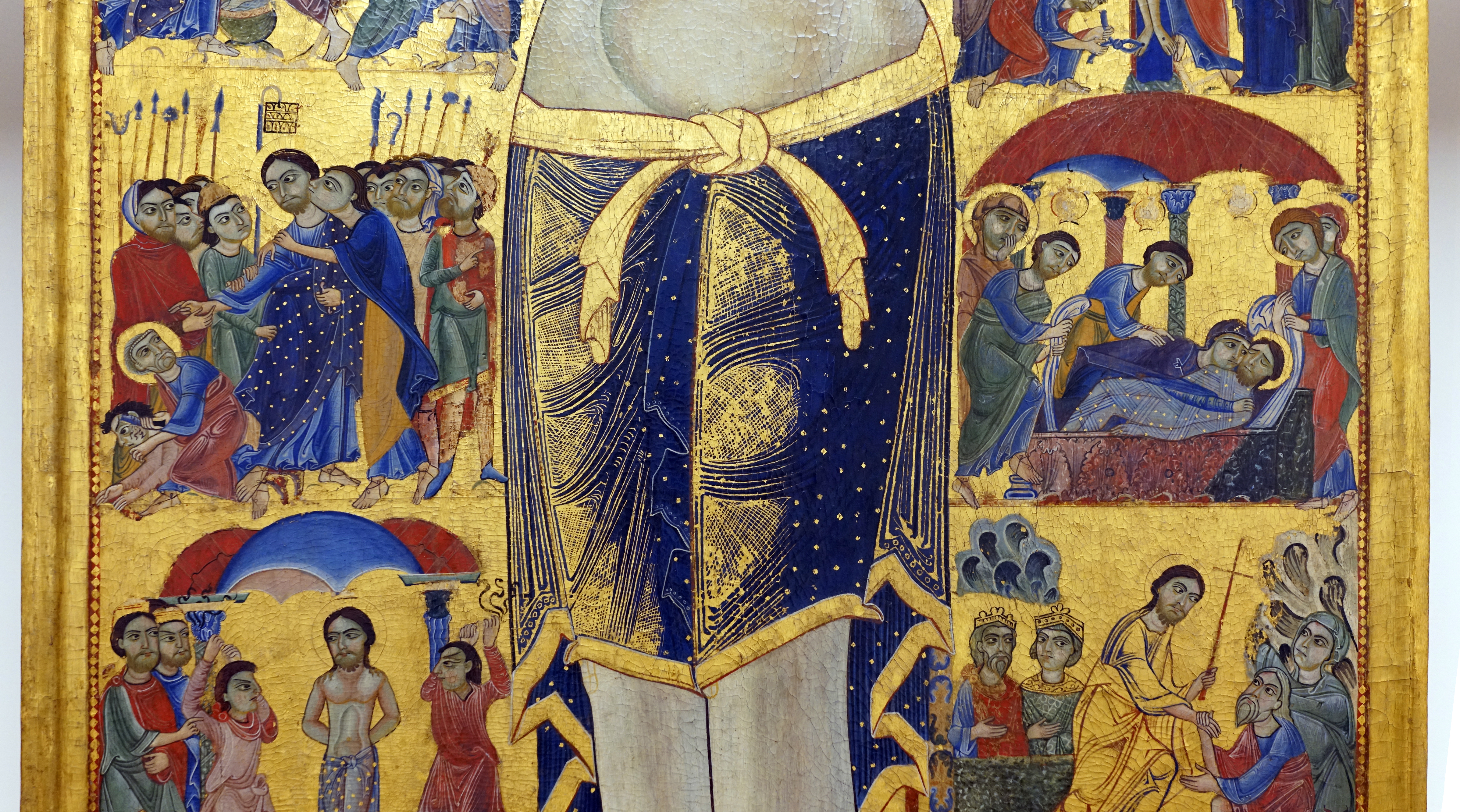
ART VIDEO: “The Crucifixion, c. 1200 (from Christus triumphans to Christus patiens)”: When I was a student in Florence for a semester, my first paper for my Italian history, art, and culture class traced the evolution of the painted wood-panel crucifix in late medieval Italy, from the Christus Triumphans (Triumphant Christ) type to Christus Patiens (Suffering Christ). I lived less than a five-minute walk from the Uffizi, which has in its collection a beautiful example of each—explored by Drs. Steven Zucker and Beth Harris in this short Smarthistory video. Longtime readers of the blog may recognize the latter, which I posted back in 2018.
Painted cross (detail), Pisa, ca. 1180–1200. Tempera and gold leaf on wood, 277 × 231 cm. Galleria degli Uffizi, Florence, Inv. 432. [object record]
Zucker provides wonderful photos of both in high resolution on his Flickr page (start here and scroll right)—the full crosses and details of each apron scene—available for free noncommercial use under a Creative Commons license. And there are many other art historical images there as well!
+++
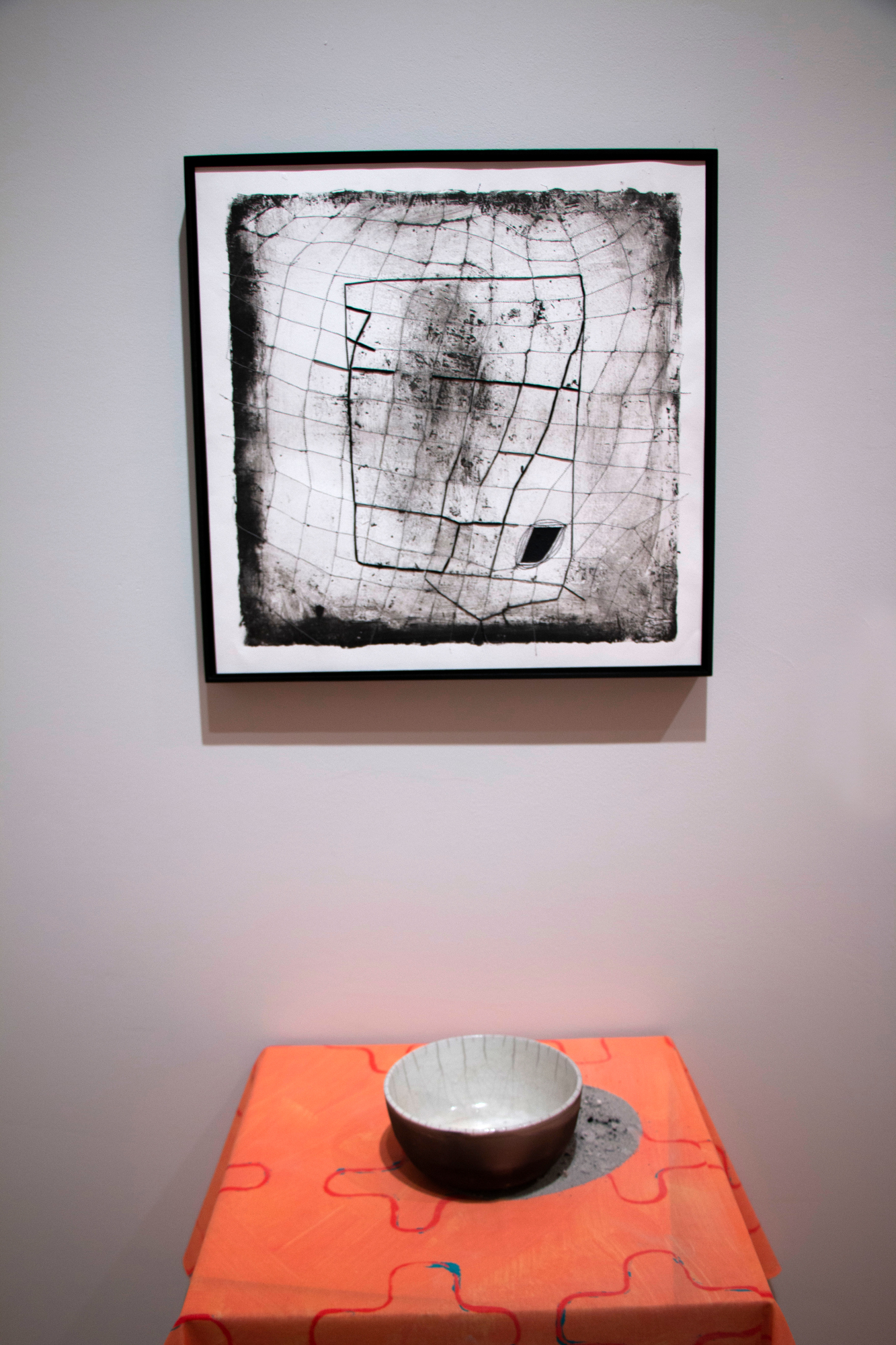
ONLINE EXPERIENCE: “Anamnesis: Journey through the Stations of the Cross”: This year visual artist Daniel Callis and the music and liturgy collective The Many collaborated on a self-guided set of online Stations of the Cross. There are fifteen total, which are being released one at a time every morning and evening from March 30 through April 5. Each station consists of an artwork, a prayer, a song, and a written meditation that help us enter into lament.
Daniel Callis (American, 1955–), Grief Station #1, Prognosis, 2022. Ink, oil, palm ash, fiber, clay, ash, fabric, 60 × 24 × 24 in. (total work). Photo courtesy of the artist.
The artworks are by Callis, and they’re from his Stations: Resurgam series, a body of work that was just exhibited this month at Green Art Gallery at Biola University in La Mirada, California. He began the series in January 2021 in response to the death of his son, Jeremy David Callis (1980–2020). It consists of fifteen mixed-media works on paper (his process involves printing, “wounding,” stitching, etc.) and fifteen raku-fired offering bowls that incorporate, from the cooling process, copies of letters, hospital documents, and drawings from Jeremy. “They are about pain and the absurd insistent pursuit of hope,” Callis says of the series. Resurgam is Latin for “I shall rise again.”
The songs are by The Many.
+++
BOOK EXCERPT from The Unvarnished Jesus: A Lenten Journey by Brian Zahnd: In this post from his blog, Pastor Brian Zahnd excerpts a passage from his book The Unvarnished Jesus (2019). “To interpret the meaning of the cross is more than a life’s work—in fact, it has and will remain the work of the church for millennia,” he writes. “The cross is the ever-unfolding revelation of who God is, and it cannot be summed up in a simple formula. This is the bane of tidy atonement theories that seek to reduce the cross to a single meaning. The cross is many things: It’s the pinnacle of God’s self-disclosure. It’s divine solidarity with all human suffering. It’s the shaming of the principalities and powers. It’s the point from which the satan is driven out of the world. It’s the death by which Christ conquers Death. It’s the abolition of war and violence. It’s the supreme demonstration of the love of God. It’s the re-founding of the world around an axis of love. It’s the enduring model of co-suffering love we are to follow. It’s the eternal moment in which the sin of the world is forgiven . . .” Read more.
+++
SONGS:
>> “The Leaves of Life”: “The Leaves of Life,” alternatively titled “The Seven Virgins,” is a traditional English ballad carol of Christ’s passion, first set down in the nineteenth century. It is narrated by (the apostle?) Thomas, who on a fateful Friday runs into the Virgin Mary and six of her companions, who are looking for Jesus. He directs them to the hill where Jesus is being crucified (“And sit in the gallery” may be a corruption of “The city of Calvary”). The women tearfully fly to the site, and Jesus tries to console his mother from the cross before breathing his last. The song ends with Thomas imbibing a strong scent of rose and fennel as he meditates on Christ’s love. [HT: Global Christian Worship]
Here the song is performed in the chapter house of Wells Cathedral in Somerset by William Parsons, founder of the British Pilgrimage Trust and author of Singing for Our Supper: Walking an English Songline from Kent to Cornwall, a book about the seven months he spent as a wandering minstrel. Parsons refers to it as a gypsy carol because Ralph Vaughan Williams collected one version of it from the Roma singer Esther Smith during his 1908–13 collecting trips that resulted in the publication, with Ella May Leather, of Twelve Traditional Carols from Herefordshire (1920).
>> “Were You There”: This African American spiritual is performed here by Pegasis, a vocal trio of sisters—Marvelis, Rissel, and Yaina Peguero Almonte—originally from the Dominican Republic but now living in Green Bay, Wisconsin. It’s as if they’re the three Marys singing their testimony! The song is on their 2016 album Peace Through Praise, which they released under the name The Peguero Sisters. Their harmonies are gorgeous.
+++
PODCAST EPISODE: “Malcolm Guite: Poems on the Passion”: In this special passion- and resurrection-themed Nomad devotional episode from 2018, Malcolm Guite reads and reflects on three of his poems, and David Benjamin Blower performs an original three-part song that he wrote in response and that has not been released elsewhere (see 4:30, 16:04, and 27:18).
Guite’s “Jesus dies on the cross,” part of his Stations of the Cross sonnet cycle, was inspired by a line from George Herbert’s poem “Prayer”: “God’s breath in man returning to his birth.” And his “Easter Dawn” [previously] is based in part on a sermon by the seventeenth-century Anglican bishop Lancelot Andrewes. Paraphrasing Andrewes, Guite says, “Jesus is the gardener of Mary [Magdalene]’s heart—her heart is all rent and brown and wintery, and with one word, he makes all green again.” Beautiful! For more on the theme of Jesus as gardener, see my 2016 blog post “She mistook him for the gardener.”
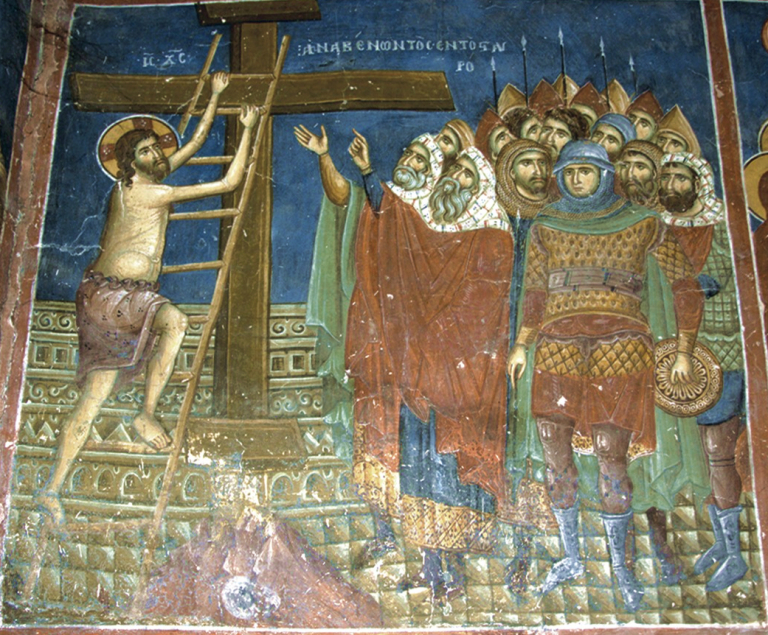
In the thirteenth century, a new subject emerged in painted Passion cycles in both East and West: Christ resolutely climbing a ladder to the cross. He ascends willingly, even enthusiastically, demonstrating a heroic acceptance of death. In taking those steps up onto the instrument of his martyrdom, he exercises agency. As he tells a gathered crowd in John 10:18, “No one takes [my life] from me, but I lay it down of my own accord. I have power to lay it down . . .” Out of love for the world, he gives himself as a sacrifice, bringing about reconciliation between God and humanity.
The iconography of the Ascent of the Cross (alternatively referred to as “Christ Mounts the Cross”) is of Byzantine origin and can be found in Macedonian and Serbian church frescoes.
Michael Astrapas and Eutychios, Ascent of the Cross (at right), 1295. Fresco, Church of the Holy Mother of God Peribleptos (aka Church of Saint Clement), Ohrid, North Macedonia. Photo: Vera Zavaritskaya.Ascent of the Cross, 1298. Fresco, Church of St. Nicholas, Prilep, North Macedonia. Photo: P. S. Pavlinov.Ascent of the Cross, 1317. Fresco, Church of St. George, Staro Nagoričane, North Macedonia.Ascent of the Cross, 1343–45. Fresco, Church of St. George, Pološko, North Macedonia.
In a fresco from the Church of St. George at Staro Nagoričane, a small Roman military detachment has just led Jesus to the site of his execution. A young enslaved Roman fixes the cross into the ground, instructed by an older slave who holds a basket of nails, while a third stands on the suppedaneum and waits to nail Jesus’s hands into place. Caiaphas, the Jewish chief priest, points to the cross, indicating to Christ to ascend it. Christ grabs hold of the rungs and climbs, while at the top left, from behind a rock, the Virgin Mary and John look on in grief.
Byzantine painting greatly influenced the Italian painters of the thirteenth and early fourteenth centuries. Many of them adopted Byzantine models, of which the Ascent of the Cross is one example.
Pacino di Bonaguida (Italian, Florentine, 1280–1340), Ascent of the Cross, from the picture-book Scenes from the Life of Christ and the Life of the Blessed Gerard of Villamagna, ca. 1320. Tempera and gold leaf on parchment, 9 5/8 × 6 7/8 in. (24.5 × 17.6 cm). Pierpont Morgan Library, New York, M. 643, fol. 12r.
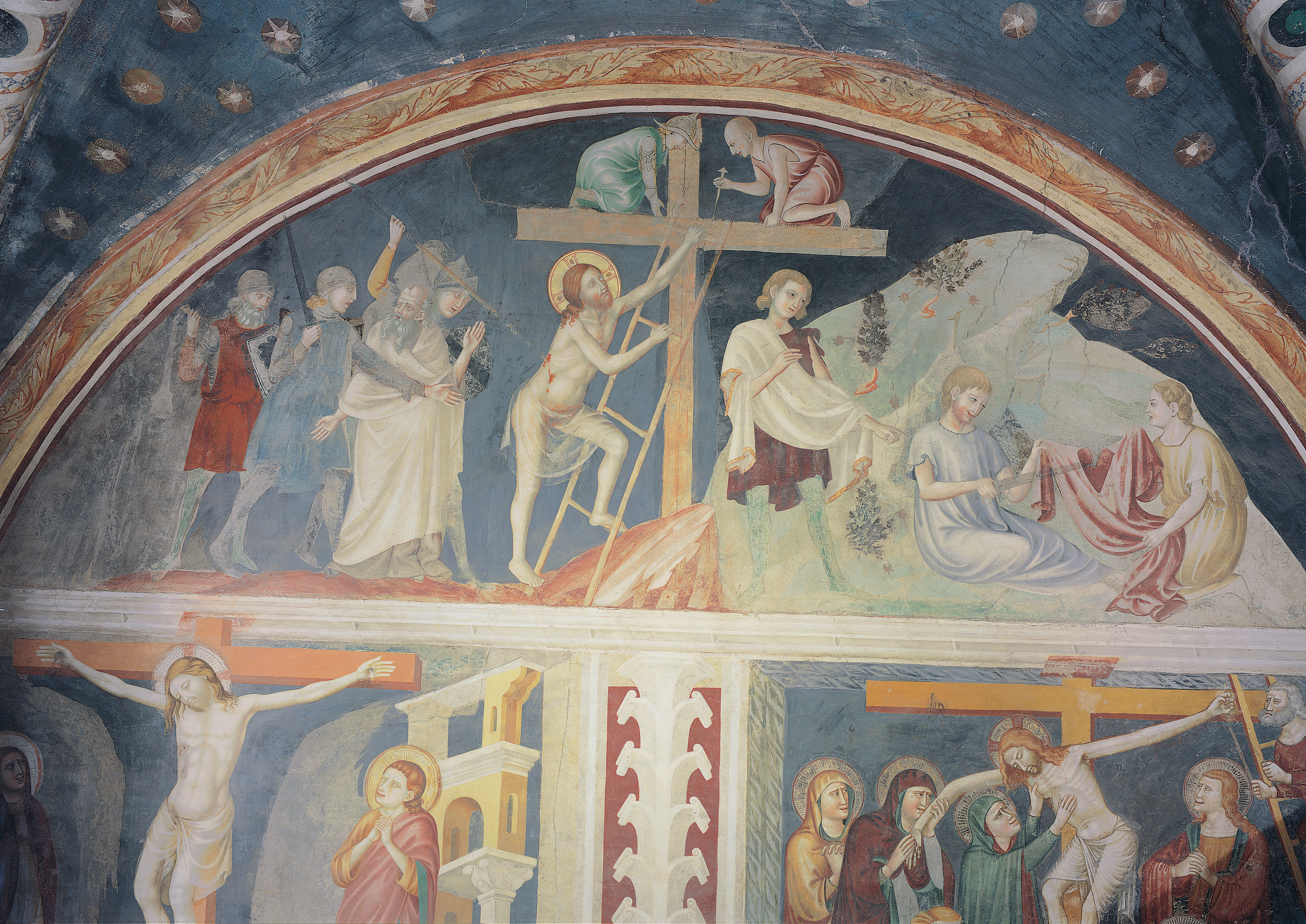
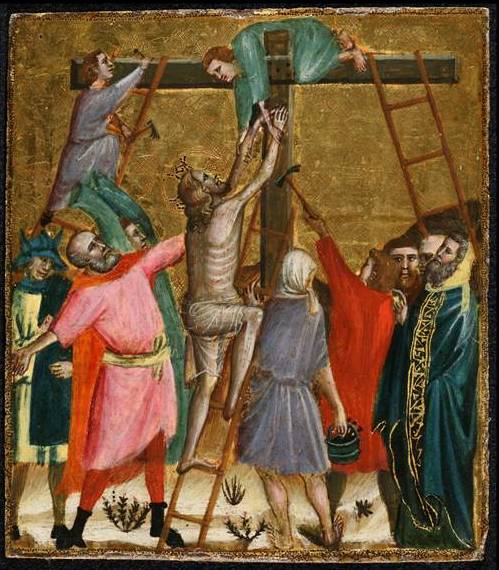
In a Ferrarese church lunette fresco in the Benedictine nuns’ monastic complex of Sant’Antonio in Polesine, two men kneel on the cross’s patibulum as Christ mounts the ladder propped against it. He wears a translucent loincloth, emphasizing his nakedness and humiliation. Knowing Christ’s innocence, an elderly Jewish man tries to intervene to prevent the brutality, but he is restrained by soldiers. On the right, a group of Romans argues over who will get to keep Christ’s cloak, a souvenir from this regional celebrity.
Christ Mounts the Cross on a Ladder, 14th century. Fresco, Monastery of Sant’Antonio in Polesine, Ferrara, Italy.
In some versions of the Ascent of the Cross, Jesus is pushed or pulled into position, or at least aided, by soldiers, with whom he readily cooperates. Such is the case in the earliest identified instance of the subject, from an eleventh-century Armenian Gospel-book. (Armenians were the largest non-Greek ethnicity in the Byzantine Empire.)
Ascent of the Cross, from the Vehapar Gospels, Armenia, early 11th century. Matenadaran, Yerevan, MS 10780, fol. 125v.
Art historian Thomas F. Mathews says that in the Armenian tradition, Golgotha is identified with the place where the Jewish patriarch Jacob had a vision of angels trafficking a ladder connecting heaven and earth. “How awesome is this place! This is none other than the house of God, and this is the gate of heaven,” Jacob exclaimed, dubbing it Bethel, Hebrew for “house of God” (Gen. 28:10–22). In Armenian manuscript illuminations, Mathews argues, the subject of Christ ascending the cross, very often followed by a depiction of Christ’s dead body descending from the cross, was thus interpreted as an extension of Jacob’s vision, as by climbing up and down the ladder of the cross, Christ opened heaven’s gate.[1]
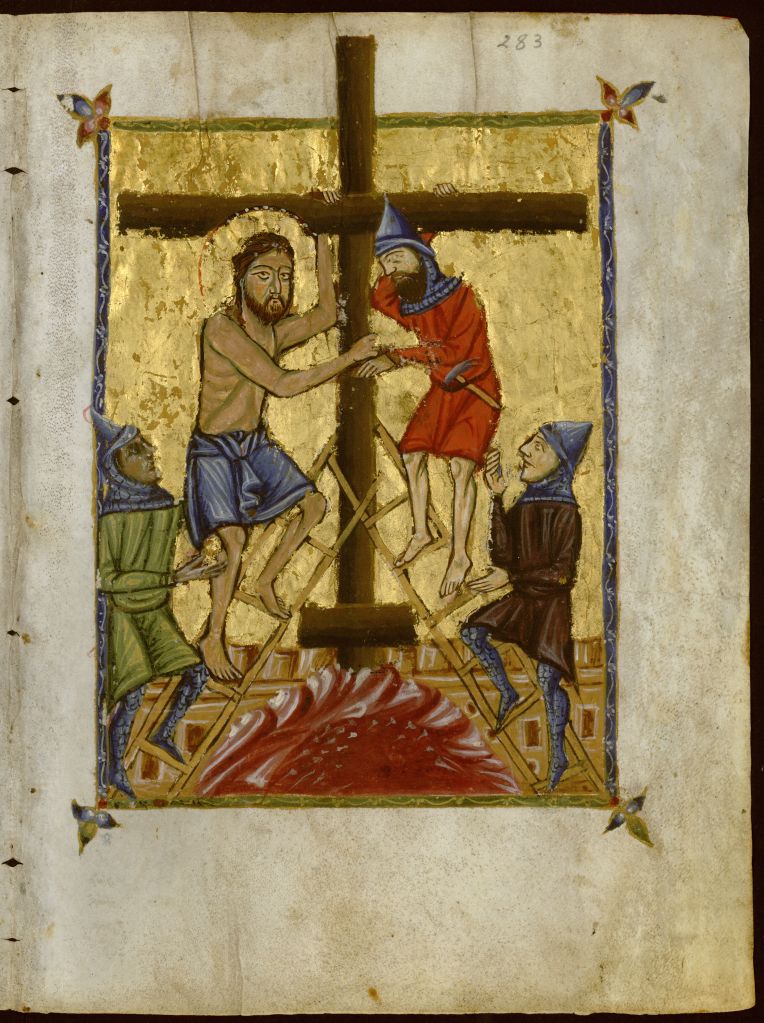
Another Armenian Gospel-book miniature of the subject, from the early fourteenth century, is particularly striking in how it shows Christ turning, mid-climb, toward the viewer, his direct gaze engaging our pity and love.
T‘oros Taronec‘i, Ascent of the Cross, from the Gladzor Gospels, Armenia, 1300–1307. UCLA Library Special Collections, Los Angeles, Armenian MS 1, p. 283.
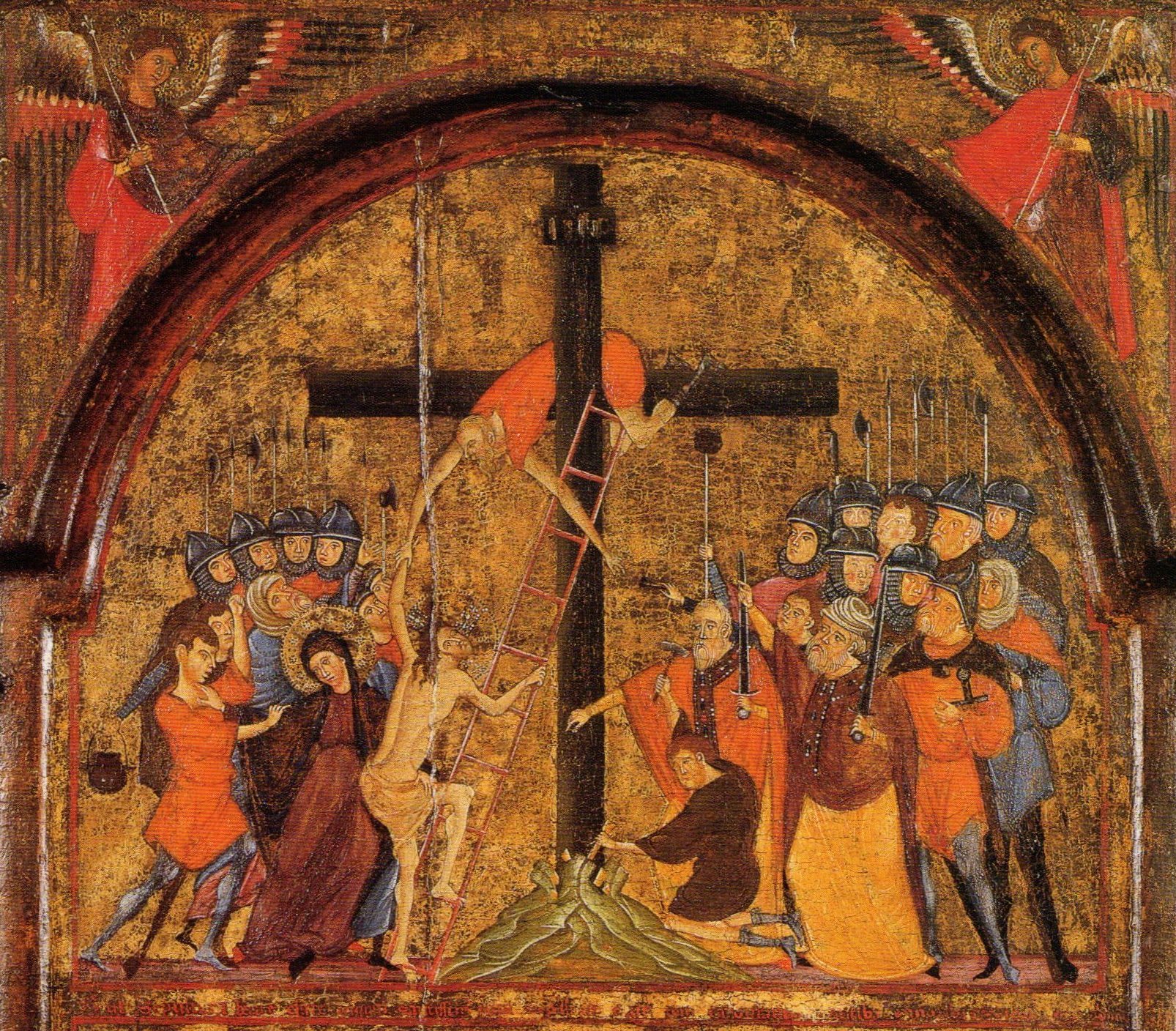
In some versions from Italy, Mary grabs her son around the waist, trying to prevent him from experiencing further torture. Take, for example, the panel painting by Guido da Siena that was originally part of the Madonna del Voto altarpiece in Siena’s cathedral. Her mama-bear instinct kicking in, Mary pushes away one of her son’s tormentors with one arm and with the other protectively encircles her son, unable to let him go.
Guido da Siena (Italian, Sienese, 1230–1290), Ascent of the Cross, ca. 1265–74. Tempera on poplar wood, 34.5 × 46 cm. Museum Catharijneconvent, Utrecht, Netherlands.
Some Christians are wary of suggesting that the Mother of God would seek to deter God’s plan, but let’s remember that, devout as she was, Mary was not superhuman. The death sentence passed against her son and the violence that followed naturally unleashed a flood of emotion in her and an impulse to resist. What mother wouldn’t do everything in her power to save her child from harm? No matter how much she believed in her son’s mission, what mother wouldn’t reach out for one last embrace, if only to delay the inevitable?
That said, Mary’s gesture here may be one of attempting not to impede his ascent but to cover his nakedness. In the widely influential Meditations on the Life of Christ, a text that originated in early fourteenth-century Tuscany and circulated in Latin and all the major European vernaculars,[2] Mary responds in agony to Jesus’s being shamefully stripped for all to see, and she intervenes with a small mercy:
Oh what anguish this was to his mother, to see her most sweet son naked like this, standing like a lamb among these wicked wolves!
Then the mother, full of sorrow, went up close to her most sweet son and took the veil from her head and wrapped it around Lord Jesus Christ with bitter sorrow. And I do not know how she did not fall dead to the earth.[3]
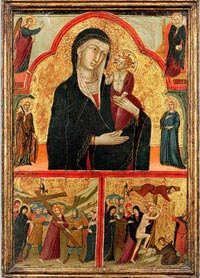
Closely related to the Guido panel is one by an anonymous artist from Umbria or Tuscany that was the central panel of a portable altarpiece with two wings, possibly painted for the Basilica of Santa Chiara in Assisi. It depicts the Ascent of the Cross—again, with the Virgin Mary interceding—above a scene of the Funeral of Saint Clare (d. 1253), a close follower of Saint Francis and the founder of the Poor Clares religious order.
Christ Mounting the Cross and the Funeral of Saint Clare (detail), Umbria or Tuscany, 1290s. Tempera and silver leaf on panel, overall 31 1/4 × 20 3/8 in. (79.4 × 51.8 cm). Davis Museum, Wellesley College, Wellesley, Massachusetts.
For the iconography of the Ascent of the Cross, art historian Anne Derbes identifies a possible literary source as Pseudo-Bede’s De meditatione passionis Christi: “Then, when the cross had been prepared, they [the people] cry: ‘Ascend, Jesus, ascend.’ O how freely He ascends, with what great love for us He bore everything, with what patience, what gentleness!”[4]
Terser references to this episode, Derbes points out, appear in Pseudo-Anselm’s Dialogus, which mentions that Christ “ascends the wood of the cross,”[5] and in Ambrose’s commentary on Luke, in which Ambrose remarks that “it was not his cross that Christ ascended, but ours,” and that Christ ascended the cross “as a victor ascends a triumphal chariot.”[6]
Derbes also notes the possible influence of the adoratio crucis (adoration of the cross) ritual, known in Jerusalem from the fourth century and in the West from the seventh or eighth, which states, “O Lord Jesus Christ, I adore you climbing onto the cross.”[7]
[In the tiled gallery below, click on the image to view the caption and source URL.]
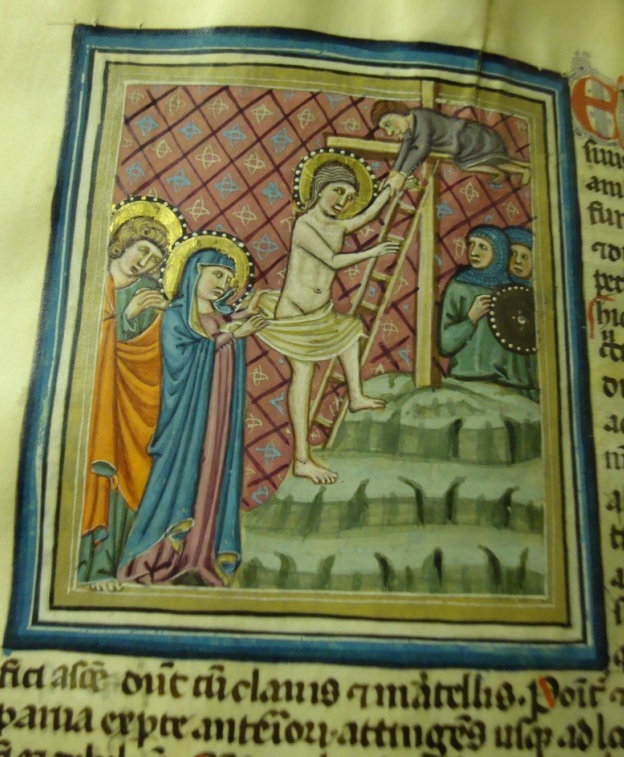
The long Latin version of the Meditations, which, from the mid-fourteenth century, postdates most of the paintings shown here, also mentions the Ascent of the Cross, perhaps itself influenced by trecento visual culture:
Now diligently behold the process of Crucifixion. Two ladders are accustomed to be placed, one on the one side, the other on the other; upon these, wicked men go up, with nails and hammers; while another ladder is placed in front, reaching to that part of the Cross where the feet are to be nailed. Contemplate now each event Our Lord may have been compelled by means of this small ladder to ascend the Cross, for He does whatsoever they bid Him, humbly, without resistance or complaint. Having reached the top of the ladder, He turns Himself round, it may be, opens His arms, and extends His Hands—so royal and beautiful—and yields Himself up to His crucifiers.
. . . Some there are who think that this was not the method of Crucifixion, i.e. by making our Lord ascend a ladder before the nailing of His Body to the Cross; but that they fastened Him to the Cross when it was laid on the ground before it was raised.[8]
Interestingly, the writer, as he does elsewhere in the manuscript, allows for the possibility that the action may have occurred in one of two ways. Actually, probably neither of the two options he describes for how Christ was nailed to the cross is accurate. Ancient historians think it most likely that Jesus was nailed to the horizontal crossbeam while it lay on the ground, which was then lifted up, his body attached, and dropped into a notch in the permanently fixed vertical post.[9]
However, the Ascent of the Cross isn’t so much meant to be a literal portrayal of what happened historically as it is an expression of the theological truth that Christ went to his death voluntarily. He was not forced onto the cross against his will. The Ascent suggests divine initiative and purpose. Even in those images where Christ is being prodded by his executioners, he does not resist. Instead, he bounds onward and upward to his chosen end.
In medieval English literature, the freedom and strength of Christ in his death is often emphasized. In the Old English poem “The Dream of the Rood” from the eighth century, the cross says, “Then I saw mankind’s Lord / hasten with great zeal, as though he wanted to climb on me.”[10] In Middle English religious lyrics, which come down to us mainly through preaching manuscripts, Christ mounts the cross much like a knight does his steed, prepared for battle, but of a spiritual kind.[11]
One anomalous example of the Ascent of the Cross that I found comes from Reformation Germany. A copperplate engraving by Augustin Hirschvogel[12] shows a muscly Christ mounting the cross with three figures slung over his shoulder: a clawed, beaked, horned creature representing the devil; a skeleton representing death; and what looks like a bloated corpse, probably representing sin. The tone is triumphant, as Christ’s death defeats this formidable trio. They are nailed to the cross with him, but unlike him, never to rise.
Augustin Hirschvogel (German, 1503–1553), Christ Ascending the Cross with Sin, Death, and the Devil, 1547. Etching, 11.8 × 14.8 cm (image) / 15.1 × 14.8 cm (sheet). National Gallery of Art, Washington, DC.
Christ Ascending the Cross with Sin, Death, and the Devil is one of a group of over one hundred etchings of biblical scenes commissioned by the Hungarian aristocrat and politician Peter Perényi (1502–1548) for his Concordance of the Old and New Testaments, first published in Vienna by the printer Aegidius Adler in 1550. Perényi selected the scenes and wrote the letterpress captions beneath them. This one reads,
Noch mer Christus am creutz uberwand Desshalben von Gott war selb gesandt Und den teueffel Hell alles band Drumb er unser erlöser ist genannt. Luc. 23e. Corinth.5f.
On the cross, it says, Christ overcame hell and the devil, and that’s why we call him “Redeemer.” The biblical citations are to the Crucifixion account in Luke 23 and to 2 Corinthians 5:14–21, which begins, “For the love of Christ urges us on, because we are convinced that one has died for all; therefore all have died. And he died for all, so that those who live might live no longer for themselves but for the one who for their sake died and was raised” (NRSV).
A follower of Martin Luther and a friend of Philip Melanchthon, Perényi was an influential protector of Protestant preachers in the kingdom of Hungary. But his shifting political allegiances got him into trouble when in 1542 he was imprisoned by Ferdinand I, a Habsburg prince, for disloyalty. It was from a prison in Vienna that he worked on his concordance project.
All these artworks of Christ ascending the cross show his bravery, dignity, and poise in the face of persecution, his heroic self-giving that wins the world’s salvation. Despite his mother’s tearful entreaties, and despite the pain he knows is coming, he remains steadfast, his eyes fixed on the prize that will be attained on Easter morning.
As an independent scholar, I rely on your donations to keep publishing articles like this, as they require a large time investment, and in this case, a photo licensing fee (for the Ferrara fresco). If you appreciate having access to researched, illustrated articles on theological art, would you consider making a donation to support my work, either monetarily (via PayPal or the secure form below) or by buying me a book? Thank you!
1. Thomas F. Mathews and Avedis K. Sanjian, Armenian Gospel Iconography: The Tradition of the Glajor Gospel (Washington, DC: Dumbarton Oaks Research Library and Collection, 1990), 131–32.
2. This text is traditionally attributed to a Franciscan friar known as Pseudo-Bonaventure and believed to have originated in Latin (title: Meditationes de vitae Christi), but Sarah McNamer has persuasively argued that its originator was a woman, a Poor Clare from Pisa, who wrote it in Italian for her fellow nuns sometime between 1300 and 1325. Within the next decade and a half, McNamara proposes, a Franciscan friar expanded and altered it to make it more didactic, creating first another Italian version (the “testo minore”) and then translating this into Latin to “authorize” it and make it more disseminatable. The long Latin text has become canonical but is, McNamara argues, inferior to the base text, compromising its narrative pacing and emotional impact. See Sarah NcNamer, Meditations on the Life of Christ: The Short Italian Text (Notre Dame, IN: University of Notre Dame Press, 2018).
3. Translated by Sarah McNamer from Oxford, Bodeleian Library MS Canonici Italian 174 (the “testo breve”), in Meditations, 141.
4. “Deinde parata cruce dicunt ei, ascende, Jesu, ascende. O quam libenter ascendit, o quanto amore ista omnia pro nobis sustinuit, o quanta patientia, o quanta mansuetudo!”(PL 94:565). Translated by Anne Derbes in Picturing the Passion in Late Medieval Italy: Narrative Painting, Franciscan Ideologies, and the Levant (Cambridge, UK: Cambridge University Press, 1996), 154.
6. “Non enim suam, sed nostram crucem christus ascendit” (PL 15:1923); “currum suum triumphator ascendit” (PL 15:1924). Qtd. Derbes, 242n56.
7. “Domine Ihesu Christi, adoro te in cruce ascendentem,” qtd. Derbes, 242n56, from Karl Young, The Drama of the Medieval Church, vol. 1 (Oxford: Clarendon, 1933), 117–19.
8. S. Bonaventure, The Life of Christ, trans. and ed. Rev. W. H. Hutchings (London: Rivingtons, 1881), 267, xiii–xiv. Sarah McNamer says that while (what she argues is) the original Meditations text describes a crucifixion method known as jacente cruce—Christ nailed to the cross as it lies prone on the ground—the Italian recension and subsequent translations and versions that came soon after privilege the erecta cruce method, in which Christ ascends a ladder to an upright cross and thus is nailed from an elevated position (Meditations, 228n126).
9. Martin Hengel, Crucifixion in the Ancient World and the Folly of the Message of the Cross (Philadelphia: Fortress, 1977), 25; Robin Jensen, The Cross: History, Art, and Controversy (Cambridge, MA: Harvard University Press, 2017), 10.
10. “Geseah ic þā Frēan mancynnes / efstan elne micle, þæt hē mē wolde on gestīgan.”
11. The metaphor of Christ’s cross as a horse that he bravely mounts as if for battle occurs in MS Balliol 149 (cf. MSS Magdalen 93 and Trinity Dublin 277), Nicolas Bozon’s poem “Sa sele fu trop dure, et mout l’ad anguise,” MS Bodley 649, and MS Harley 2316. See Rosemary Woolf, Art and Doctrine: Essays on Medieval Literature (London: The Hambledon Press, 1986), 113–15.
12. Hirschvogel was trained as a stained-glass painter in the workshop of his father, but when his hometown of Nuremberg accepted Luther’s Protestant teachings, the workshop lost its church commissions. Hirschvogel thus pivoted to designing maps and fortification plans and, in his final decade, making landscape etchings as part of the Danube School. Richard Manly Adams Jr., “One Acquisition, Two Great Traditions at Pitts,” Reformation Notes no. 56 (Summer 2021): 5.
VIDEO: “Waiting with Christ: An Artful Meditation for Holy Week”: A collaboration between Duke Initiatives in Theology and the Arts in Durham, North Carolina, and City Church in Cleveland, Ohio, this half-hour video from 2021 presents a small collection of scripture readings, poems, visual art, and music for Holy Week, interspersed with reflections by theologian Jeremy Begbie. The artistic selections are a spoken word performance by Paul Turner, Malcolm Guite’s sonnet “Jesus Meets His Mother,” the Adagio movement of Schubert’s String Quintet in C Major, the painting Riven Tree by Bruce Herman, and Bifrost Arts’ “Our Song in the Night,” performed by Salina Turner, Allison Negus, and Joel Negus [previously].
+++
ARTICLE: “6 Musical ‘Passions’ Beyond Bach” by Josh Rodriguez: Composer, professor, and Deus Ex Musica cofounder Josh Rodriguez is an excellent classical music curator and guide. In this article he introduces us to six modern large-scale musical works about Jesus’s final week: The Passion of Yeshua by Richard Danielpour, La Pasión Según San Marcos by Osvaldo Golijov, The Passion of the Christ Symphony by John Debney, Johannes-Passion by Sofia Gubaidulina, Simeron by Ivan Moody, and the St. John Passion by James MacMillan. He interweaves composer biography, musical analysis, and meaning in concise ways, with nods to music history. Stylistic influences for these diverse selections range from Byzantine chant to salsa! Audio/video excerpts are provided, such as the cued-up “¿Por qué?” from Golijov’s Pasión (see below), a movement centering on the woman who anointed Jesus’s feet with perfume (Mark 14:3–9).
+++
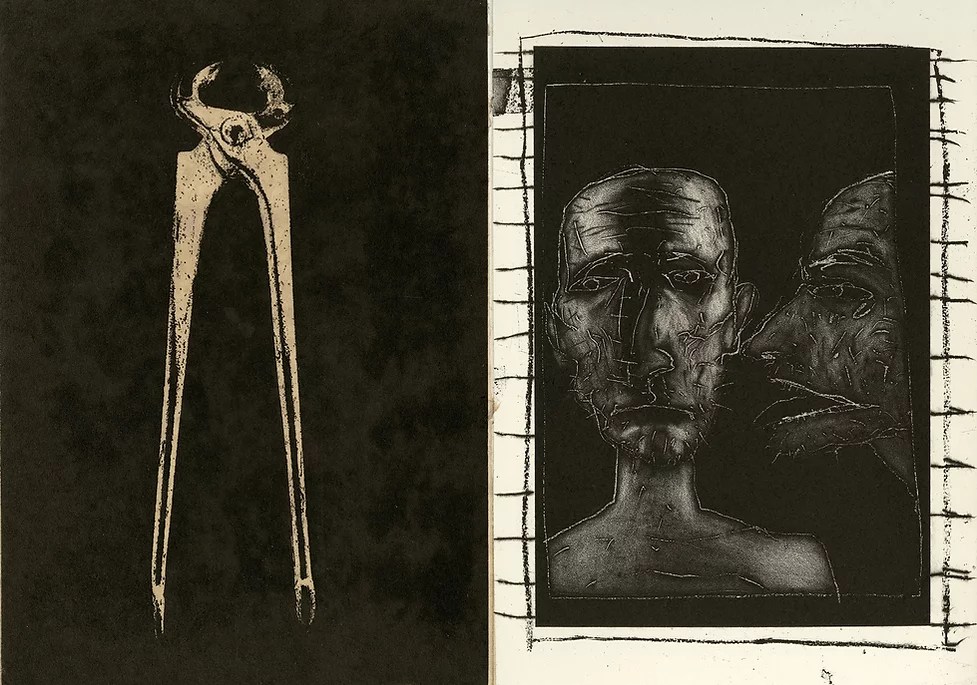
PRINT SERIES: The Passion and Its Objects (after Dürer) by Marcus Rees Roberts: “The Passion and Its Objects (after Dürer) is a series of etchings and monotypes by Marcus Rees Roberts. The images derive from fragments from Albrecht Dürer’s series of woodcuts The Small Passion (1511). Images of the Passion – and of the crucifixion in particular – are so embedded in Western consciousness that we forget that it is a depiction of betrayal, prejudice, and torture. In this version of the Passion by Dürer, one of several he made, small, everyday objects lie scattered within the images – a jug, pliers, a hammer, a coil of rope. Even five hundred years later, we recognise these objects as our own; we can identify with them. But in so doing, we enter the depicted space, and we become complicit in the cruelty. This is one reason why Dürer’s Small Passion is both so powerful and so uncomfortable.”
Marcus Rees Roberts (British, 1951–), The Passion and Its Objects (after Dürer) I, 2019. Diptych etching and aquatint with chine collé printed on Somerset Satin soft white 300gsm, each plate 29.5 × 21 cm (overall 29.5 × 42 cm). Edition of 15.
+++
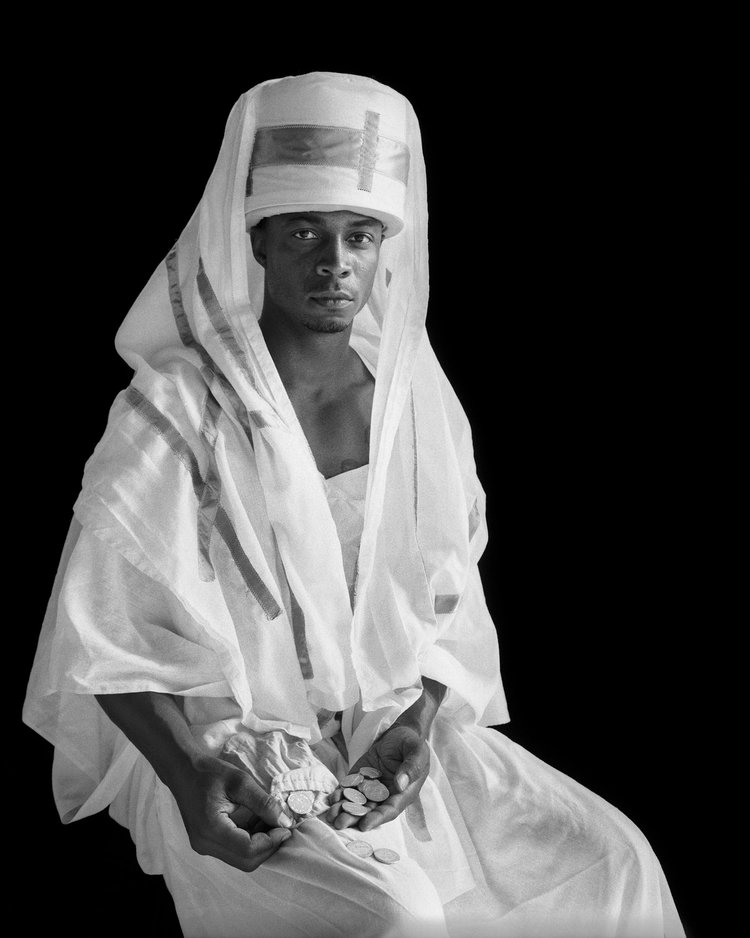
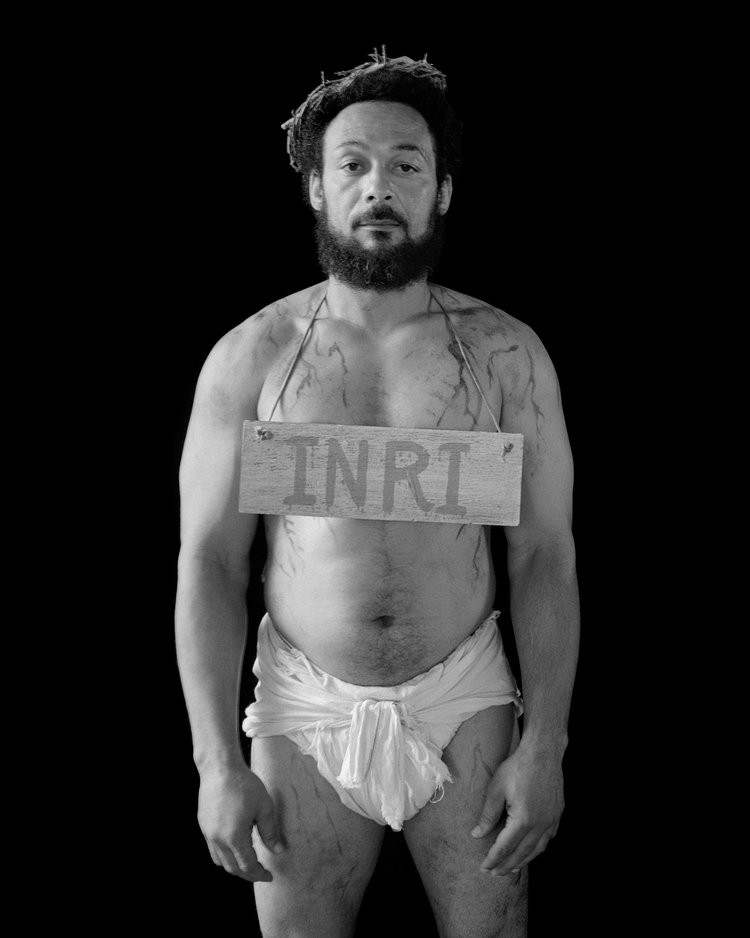
PHOTOGRAPHY SERIES: Passion Play by Deborah Luster: “There are more than 5,300 inmates at the Louisiana State Penitentiary at Angola. Nearly 4,000 of them are serving life without parole. In 2012 and 2013 the Angola Prison Drama Club staged a play unlike any other in the prison’s experience. The Life of Jesus Christ featured 70 inmates, men and women acting together for the first time—in costume, with a real camel, performing for the general public. For the untrained actors, this production held special meaning as they saw pieces of their own lives revealed in the characters they played.”
Layla “Roach” Roberts (Inquisitor), sentenced to LIFE, Angola Prison, Louisiana. Photograph by Deborah Luster, from the Passion Play series, 2013.Bobby Wallace (Jesus), Angola Prison, Louisiana. Photograph by Deborah Luster, from the Passion Play series, 2013.
+++
SONGS:
>>“May I Go with You” by January Lim: This Maundy Thursday song was written in 2020 in the voice of Jesus in Gethsemane, speaking to God the Father. In the first stanza, it seems to me that Jesus is asking to be taken up to heaven, like Elijah—just whisked away back to glory, and spared tomorrow’s cruelties and pain. But in the second stanza that same request seems to shift in meaning as Jesus expresses a desire to go with God’s plan and asks for the strength to follow through. The song was released on the EP Gathered Sighs (2021), put out by Evergreen Baptist Church of Los Angeles, where Lim serves as worship arts pastor. [HT: Global Christian Worship]
















 Art & Theology