Sheep May Safely Graze (Artful Devotion)

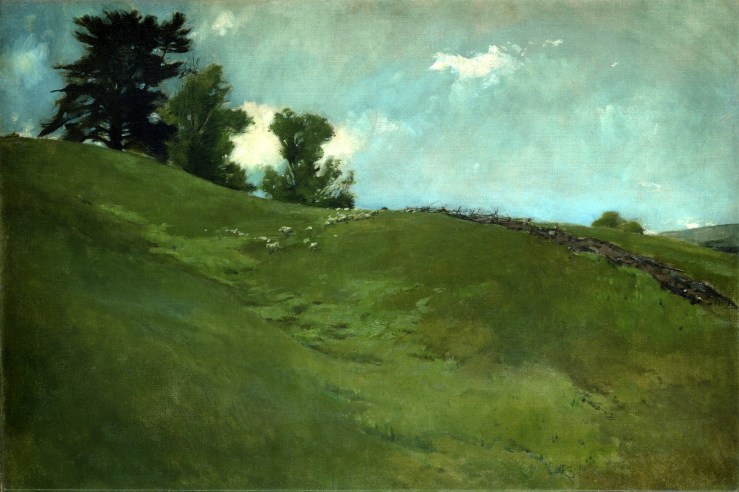
Landscape, Cornish, N.H. by John White Alexander
John White Alexander (American, 1856–1915), Landscape, Cornish, N.H., ca. 1890. Oil on canvas, 30 3/8 × 45 in. (77.2 × 114.2 cm). Smithsonian American Art Museum, Washington, DC.

The LORD is my shepherd; I shall not want.
He maketh me to lie down in green pastures:
he leadeth me beside the still waters.
He restoreth my soul . . .

Yea, though I walk through the valley of the shadow of death,
I will fear no evil:
for thou art with me;
thy rod and thy staff,
they comfort me.

—Psalm 23:1–3a, 4

+++

MUSIC: “Sheep May Safely Graze,” from BWV 208 | Composed by Johann Sebastian Bach (1713) | Performed by London Symphony Orchestra, on Night in Berlin (2001)

The aria “Schafe können sicher weiden” (Sheep May Safely Graze) comprises the ninth movement of Bach’s Was mir behagt, ist nur die muntre Jagd (The Lively Hunt Is All My Heart’s Desire)—known informally as the Hunting Cantata. Written for the thirty-first birthday of Duke Christian of Saxe-Weissenfels, the cantata was performed as a surprise at a banquet at the ducal hunting lodge, and it’s full of flattery. The text of “Sheep May Safely Graze,” written by Solomon Franck, praises Christian for his wise, protective leadership (in actuality, he was a lousy ruler):

Sheep may safely graze and pasture
In a watchful shepherd’s sight.

Those who rule, with wisdom guiding,
Bring to hearts a peace abiding,
Bless a land with joy made bright.

At 1:31 in the above recording, you can hear potential danger lurking nearby, but the attentive shepherd neutralizes the threat, keeping safe his flock.

Bach originally scored this piece for soprano with two recorders and continuo, but it has since been transcribed for orchestra and countless other combinations of instruments and is most popular without words. I enjoy playing Egon Petri’s transcription for solo piano, performed here by Alessio Bax:

Its pastoral mood, befitting Psalm 23, and its celebration of a good shepherd’s care have led it to be applied to the Good Shepherd and performed in church services. I’ve even come across some piano arrangements that interfuse it with “Savior, Like a Shepherd Lead Us” (for an intermediate arrangement of such by Cindy Berry, see Classical Hymns).

(Related post: “The evolution of ‘Jesu, Joy of Man’s Desiring'”)


This post belongs to the weekly series Artful Devotion. If you can’t view the music player in your email or RSS reader, try opening the post in your browser.

To view all the Revised Common Lectionary scripture readings for Proper 11, cycle B, click here.

“Stephen Towns: A Migration” exhibit

On September 12 my husband and I attended a reception at the Rosenberg Gallery at Goucher College in Baltimore County, where mixed media artist Stephen Towns discussed the work in his solo show “A Migration.” The twenty-three paintings curated by Laura Amussen continue Towns’s exploration of the African diaspora and related issues, including slavery, resistance, and the loss of ancestral roots. He wants to tell history, he said, and to make beautiful images.

Stephen Towns
At the opening for “A Migration,” artist Stephen Towns talked about his new series, “Sunken,” inspired by a trip to Ghana in May. Photo via the artist.

Towns is not a Christian (he said he is ambivalent about religion), but he draws extensively on Christian iconography, most notably the halo, which he uses to denote the sanctity of black life. When I met him Tuesday I told him I can’t help but read his work through a Christian lens, and he said that’s great, that he welcomes diverse and particularized readings.

Joy Cometh in the Morning

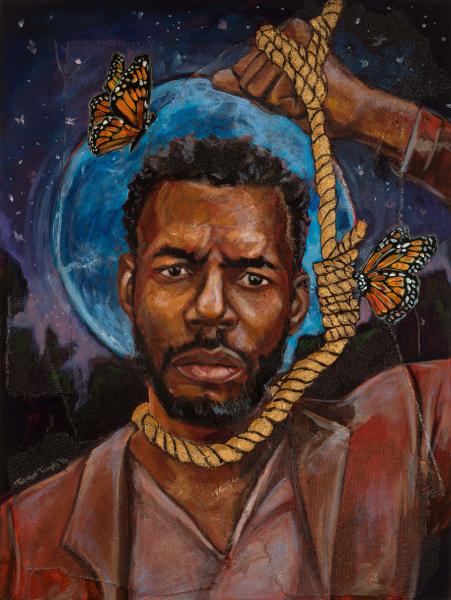
The most conspicuous wall in the exhibition space is the blank one where blue-tape outlines demarcate the spots where six paintings used to hang before a controversy led to their removal. From the series “Joy Cometh in the Morning,” these absent works are head-and-shoulder portraits of unnamed participants in the 1831 slave rebellion led by Nat Turner, which was inspired by his reading of scripture and his discernment of God’s voice. Each figure is noosed around the neck, harking to the method of their execution, but clenches the rope in a raised fist, staring straight ahead at the viewer with a look of defiance. While shadows of violence flare behind them, a butterfly alights on the knot of their rope, and a silent blue moon forms a halo around their head.

What Profit Is There in My Blood by Stephen Towns
Stephen Towns (American, 1980–), What Profit Is There in My Blood?, 2016. Acrylic, oil, metal leaf, Bristol board, canvas, and paper on panel, 24 × 18 in. Photo via the artist.

Just prior to the show’s opening, an African American employee at the gallery complained that these paintings made her work environment feel abusive and uncomfortable. Out of sensitivity, Towns decided to take down the paintings and instead present photos of them in a binder for optional viewing. An artist’s statement is displayed next to the empty frames, which says, in part,

The original intent of the work was to honor the countless black men and women that fought against slavery, with the knowledge that their very fight may end their lives. . . . Though I am saddened to see the work go, I value Goucher’s Black employees’ concern. The intent of my work is to examine the breadth and complexity of American history, both good and bad. It is not to fetishize Black pain, nor to diminish it.

The overwhelming response to this action among viewers at Tuesday’s reception was frustration: commending Towns’s empathy but questioning whether self-censorship was the right way to go. Both white and black attendees spoke about how one of the powers of art is precisely to make us uncomfortable. Art awakens us to reality, even if that reality is painful. Removing offensive work prevents people from having meaningful encounters with it. Towns expressed his mixed feelings about not wanting to trigger trauma but also wanting to shine a light on hard truths. He said he was intentional about not making the images graphic.

To paraphrase his comments, his aim is to comfort the afflicted and afflict the comfortable—and when his work has the reverse effect of afflicting the afflicted, he feels guilty.   Continue reading ““Stephen Towns: A Migration” exhibit”