Book Review: Accumulated Lessons in Displacement: Poems by Rachel E. Hicks

. . . each day a misery and a marvel, each person also.

—Rachel E. Hicks, from “Accumulated Lessons in Displacement”

A white American born in the foothills of the Himalayas to international school educators, Rachel E. Hicks is a second-generation third-culture kid (TCK) whose writing reflects decades of living as a global nomad, exploring themes of memory, connection, suffering, exile (both physical and spiritual), hospitality, and hope. She grew up in six countries—India, Pakistan, the United States, Jordan, the Democratic Republic of the Congo, and Hong Kong—and spent seven years as an adult in Chengdu, China, where she worked for the relief and development organization Food for the Hungry.

In 2013, she, her husband, and their two kids repatriated to the US, settling in Baltimore, where they live today. Hicks has lived in Baltimore longer than in any other city. But even with this rootedness, “the soil of each place in which I’ve lived still clings,” she says.
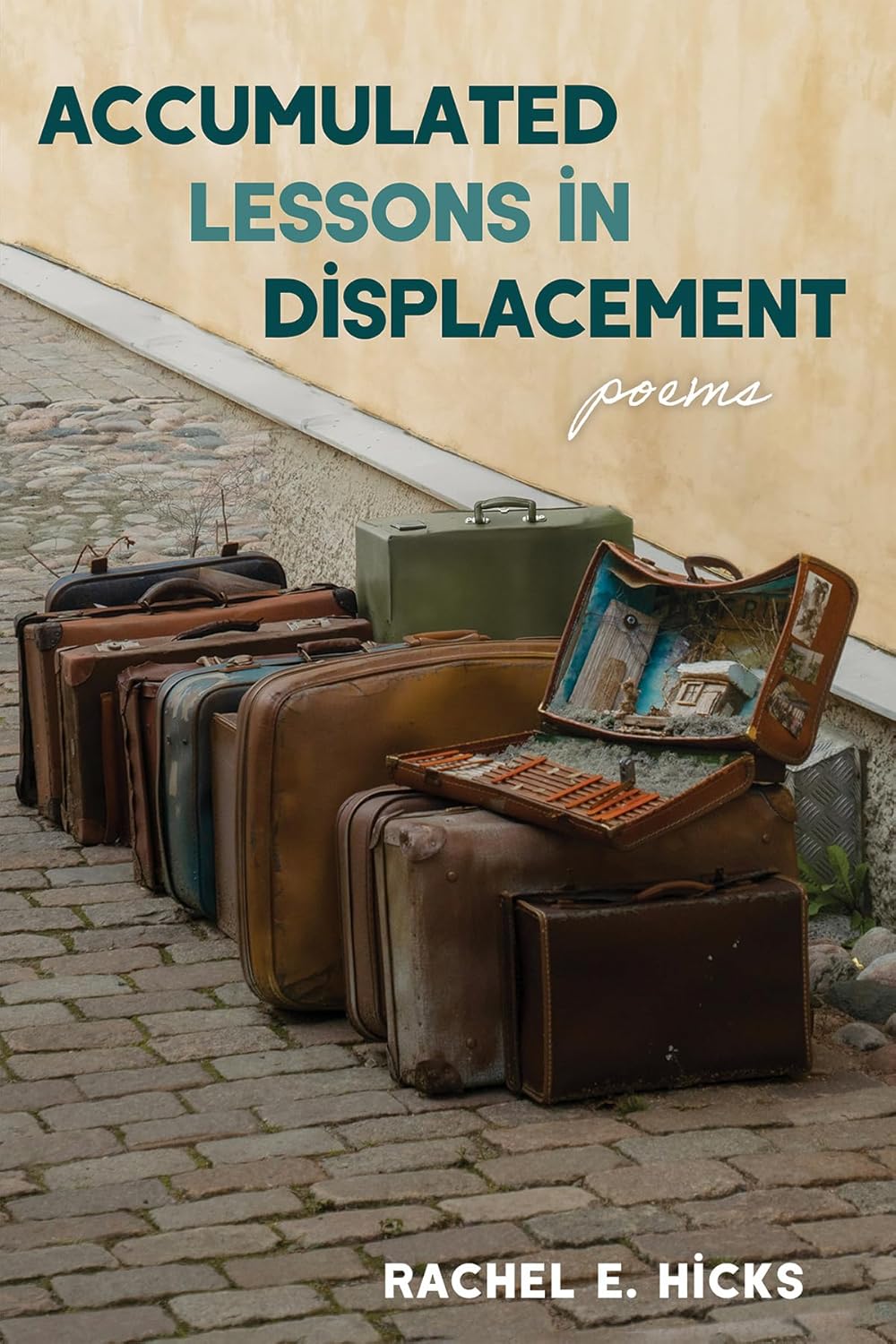
Accumulated Lessons in Displacement

In her debut poetry collection, Accumulated Lessons in Displacement (Wipf & Stock / Resource Publications, 2025), Hicks grapples with the experience of being a “perpetual pilgrim”—on her way to a particular place but also attuned to the significance of each moment along the way. “Pilgrims learn to walk a life of paradox: even though their hearts are set on their final destination, they walk through each day alive to its possibilities, people and lessons,” she wrote in a 2014 blog post.

What is “home”? How can we bear to leave home, whether forced to do so by war, famine, or natural disaster, or we choose to for opportunity or ministry? What do we do with feelings of alienation when we find ourselves in a culture not our own or in which we don’t fit well? How do we live cross-culturally? How do we make a home where we’re at? What are our responsibilities to place? Who is our neighbor?

“I believe that many—all?—of us live our lives with some sense of exile,” Hicks writes on her blog. “We experience it and are aware of it to varying degrees, but it’s there. So many of our quests, our longings, our purpose-seeking, and the stories we create and tell are about trying to find our way home. Home being that place—literal or figurative—in which we feel wholeness and true belonging.”

Accumulated Lessons is divided into two parts: “Bright Sadness, Bitter Joy” and “A Deeper Knowing.” The term “bright sadness”—a translation of the Greek word charmolypê—comes from the Eastern Orthodox tradition, and it describes the paradoxical state of mourning over sin while rejoicing in God’s grace. It can also describe the paradox of living a life of joy amid suffering.

I was trying to learn the word for joy

that settles awkwardly in grief’s nest, an oversized bird.
I didn’t want to scare it away.

So says the speaker in the book’s title poem, “Accumulated Lessons in Displacement.” Unfolding over eight sections, this persona poem draws on Hicks’s own experience of abrupt displacement from Kinshasa as a teenager, as well as the experiences of Bosnian refugee friends, and Syrian refugees she had only read about in the news.

It opens with a reflection on “home” in all its ordinariness—the yellow coffee cup, the dusty houseplant, the sunlit window seat—and laments that “no footpath exists leading back to these things,” which, the reader is led to presume, have been destroyed by armed conflict, or its residents blocked from returning by threat of death.

The poem contains several arresting images, like the green threads of a sweater on barbed wire tracing a path across miles. A boy who collects bullet casings to make a necklace for his sister. Charred diary pages dancing around a blown-out living room, “ma[king] a strange poem in my heart.”

Hicks wrestles with the savage violence humans are capable of:

It makes no sense that a soldier can press a button

and somewhere a baby ignites into flame.
And he goes home and brushes his teeth.

What we do to each other, to other created souls.
Always I carry this burden like a child on my hip.

Another powerful poem in the collection is “Visit to Sarajevo,” where Hicks describes visiting the Bosnian-Herzegovinan capital with her friend Dragan, who was forced to flee it as a young married adult with a child in the 1990s after the city was besieged by Serbian forces. Hicks had met Dragan and his family in 2000 through her husband, Jim, who worked alongside him at a refugee resettlement agency in Phoenix, Arizona, and the families became close. Meeting up years later in Dragan’s hometown, Dragan leads Hicks through the once-familiar streets “in a haze of pride, nostalgia, nightmare,” giving her a tour of sites both historically significant and deeply personal.

Hicks’s passport country too has its national traumas, one of which was precipitated by 9/11, when in 2001, terrorists flew planes into the World Trade Center in New York City, killing almost three thousand people. In “Disaster Chaplaincy Training,” she describes a course she took, taught by a Ground Zero worker, to become further equipped for her work in China, which was focused on disaster preparedness and response. In the course, she learned how to “loiter with intent” in zones of disaster, “acclimat[ing] to [suffering’s] pungency.” Make sure, said the instructor, to “let them see you cupping a small ball / of hope—toss it up, catch it.”

Nationwide crisis struck the US again when on April 12, 2015, a young Black man from Baltimore, Freddie Gray, died of a spinal cord injury while in police custody, allegedly due to police brutality—though none of the six involved officers was ultimately held responsible. Gray’s death led to civil unrest in Baltimore (which Hicks had recently made her home) and throughout the country, as citizens demanded recognition, in word and practice, that “Black lives matter.”

Hicks wrote “The Morning After Freddie Gray’s Funeral” while Baltimore was on lockdown. Fumbling for words, she tries to explain to her children what’s going on as she, too, tries to educate herself more deeply about the history of racism in America and the longstanding grievances of the Black community she lives in. In the poem, she harvests mint from her garden to brew a gallon of black mint tea to share with her neighbor—

             as what? An offering, apology?

A way to say I’m trying—learning
about all that fuels these fires still
smoldering this hushed morning?

The staining of the clear water as the tea steeps becomes a metaphor.

Accumulated Lessons in Displacement addresses global suffering, more localized suffering, as well as personal and family suffering.

One example of the latter has to do with Hicks’s daughter’s diagnosis, following an ankle sprain, with complex regional pain syndrome (CRPS), Ehlers-Danlos syndrome (EDS), and postural orthostatic tachycardia syndrome (POTS), chronic conditions that cause extreme nerve pain. “Bright Sadness” describes a return car ride from a fruitless medical visit, her daughter crying and gasping in agony in the back seat, when offhandedly, Hicks insists, “Turn your cries into opera!” This unexpected and ridiculous suggestion defuses, if for just a moment, the intense situation, resulting in “joy-laughing” amid plaintive contralto tones all the way home.

“Post-Miracle (I)” celebrates her daughter’s miraculous healing, holds the strange, tentative, empty-handed feeling of a fervent prayer request graciously granted. But then comes “Post-Miracle (II),” written when, after two months of her daughter being pain-free, the CRPS returned. Hicks wrestles with gratitude for the brief reprieve and anger at God’s “undoing” the miracle. She wonders about some of the healings Jesus performed in the Gospels, and whether they stuck.

“Post-Miracle (II)” is one of the few poems in the collection with end rhyme, each quatrain following an abba pattern. Perhaps the choice to work with a rhyme scheme for this particular subject represents, consciously or subconsciously, her attempt to make things rhyme again, to harmonize the reality of chronic pain with a good and loving God, to impose structure on the chaos.

Several of Hicks’s poems engage with biblical stories: the Suffering of Job, the Parable of the Prodigal Son, the Massacre of the Innocents, Zacchaeus encountering Jesus, the Walk to Emmaus. She performs poetic midrash, imaginatively interpreting and expanding the texts to connect with them on a deeper level.

Besides the biblical authors, some of her literary conversation partners in this collection are Frederick Buechner, Henri Nouwen, Simone Weil, Czesław Miłosz, Dostoevsky, G. K. Chesterton, Gregory of Nyssa, Paul Kingsnorth, and Karen Blixen.

Although there’s a heaviness to much of the material, it’s not overwhelming, as small graces are woven throughout: complimentary walnuts from a fruit shop owner on a winter Sunday; laughter over language barriers; refreshment from a water hose; the scent of turmeric and cardamom at a Punjab store in Baltimore, reminders of the poet’s birthplace; “the comfort of the priest’s thick thumb / upon my forehead, the signature of / Jesus,” on Ash Wednesday; dandelions and buttercups brushing ankles; a cairn at West Clear Creek; the monks at Great Lavra, Greece, making room for the dispossessed; bundles of sheep ascending limestone slopes at dawn in the Cotswolds; the delightful word cusp; her son’s euphoria upon gliding down a mountain on skis; the slow labor of opening a pomegranate and obtaining its ruby-red seeds for her daughter to eat.

The book is shot through with joy—a joy that coexists with suffering and that is sustained through faith.

“These are poems to live by—to help you stay human, love people, find joy in sorrow, pay attention to the world around you, open yourself to God, welcome mystery, and understand our times at a deeper level,” Hicks wrote in an email announcing the launch of the book. “You’ll journey all around the world and find it—in spite of its sorrow—full of beauty and worth loving.”

One of my favorite poems is “Just Before,” a perfect reading for the upcoming Advent season. It spans four cities of the world—places where people work, play, pray, and rest; places of economic disparity, of spiritual longing as well as mundane concerns—in each imagining the moment just before Jesus returns. In the midst of our threshing corn or lighting a lamp or settling a legal dispute or herding sheep, Jesus will come with a beauty that blossoms all the way out to the horizon, calling all nomads home.

“Just Before” by Rachel E. Hicks

When Jesus comes again
in all his glory, somewhere in
the Sichuan mountains tires will crackle
over corn spread out on the road—
easy threshing—while a small child
urinates in the gutter, absorbed
in watching the car shoot by.

As the first rent opens
a fingernail tear in the hazy sky,
a woman in the foothills above Rishikesh
will lay down her firewood burden
and light the clay Diwali lamp
in the chilling dusk,
circling her cupped hands in blessing.

In the pause before the clamor
of heaven’s trumpets,
the jurors’ waiting room in Baltimore’s
civic court will throb with the quiet
turning of pages, a buzzing phone
in the hand of a tired man, berating
himself for forgetting to bring coffee.

Just before we are aware of him,
Jesus will pause to survey the view;
two shepherd boys amidst boulders
in the Wadi Rum hills south of Amman
wipe sleep from their eyes and stand amazed
at the blood-red poppies at their feet
stretching to the eastern horizon.


Purchase Accumulated Lessons in Displacement here. (Update, 11/14/25: Wipf & Stock is offering a 50% discount through November 30, 2025; use code CONFSHIP at checkout. Media mail shipping is free.)

“Just Before” is reproduced with permission from Wipf and Stock Publishers, www.wipfandstock.com.
Roundup: Weighed-down sheep, sin and grace, Bermejo’s devil, and more

POEM: “Lost Sheep” by Margaret DeRitter: DeRitter writes about a lost Merino sheep in Australia who, because left unsheared for so long, was carrying over seventy-five pounds of wool on his back. He was found in 2021 and rescued by Edgar’s Mission Farm Sanctuary in Lancefield.

+++

SONGS:

>> “What Have We Become” by the Sweeplings: The Sweeplings are Cami Bradley and Whitney Dean, a singing-songwriting folk pop duo. From their album Rise and Fall (2015), “What Have We Become” laments how sin encroaches on our lives—we may welcome it in at first, but then it takes over, makes of our house a wasteland. This theme is embodied by a shadowy, thorny-veiled dancer in the music video.

>> “It Knows Me” by Avi Kaplan: Living outside Nashville, Tennessee, Avi Kaplan is best known for being the original vocal bass of the a cappella group Pentatonix, from 2011 to 2017. This song of self-probing is from his second solo EP, I’ll Get By (2020). It’s about the freedom that comes from reckoning with one’s inner darkness and accepting grace. The animation in the video is by Mertcan Mertbilek.

Kaplan, who is Jewish, wrote on Facebook,

“It Knows Me” is an extremely personal song to me. I believe that everyone has a darker side of them, and that you can choose to play into that, or you can choose to not. This song is about that battle between those two forces, and having a little grace for yourself when you do falter on your path.

>> “Not the Devil Song” by Marcus & Marketo: Marcus & Marketo (Marcus Clingaman and Marketo Michel) are a worship music duo from South Bend, Indiana, fusing the styles of gospel, classical, country, and soul. “Not the Devil Song,” which they wrote in 2019, is about the power Christians are given to tell Satan to back off! When he dangles temptations in front of you, whispers lies in your ear, sows seeds of doubt or fear or hopelessness, you can confidently retort, “Devil, no, you gotta let go; Jesus died to save my soul.”

+++

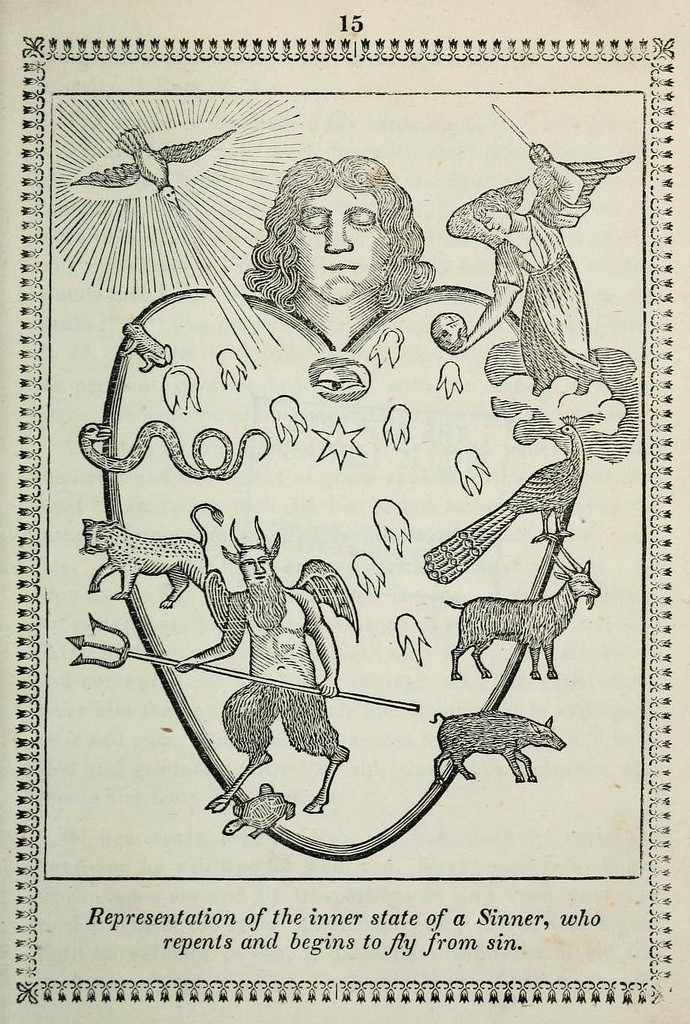
WOODCUT SERIES: Das Herz de Menschen (The Heart of Man): “The following illustrations—which, in a wonderful marriage of word and image, plot out the life of the Christian soul—form the central strain in The Heart of Man: Either a Temple of God, or a Habitation of Satan: Represented in Ten Emblematical Figures, Calculated to Awaken and Promote a Christian Disposition (1851), an English edition of a German book published in 1812 in Berlin by the ‘divine’ and philanthropist Johannes Gossner (1773-1858),” which was itself based on an older French text. The illustrations are not credited and are probably copies of ones that originated in France in the late seventeenth or early eighteenth century.

The Heart of Man

In his book The Forge of Vision (2015), visual studies scholar David Morgan contrasts this emblematic series with the related Cor Jesu amanti sacrum by Anton Wierix (which I wrote about here). Whereas the Wierix engravings from Antwerp are marked by sweetness, with the Christ child gently cleaning and setting up house in the human heart, the anonymous illustrations Gossner uses portray more of a psychomachia (battle for the soul), with armed angels seeking to oust Satan and his minions.

+++

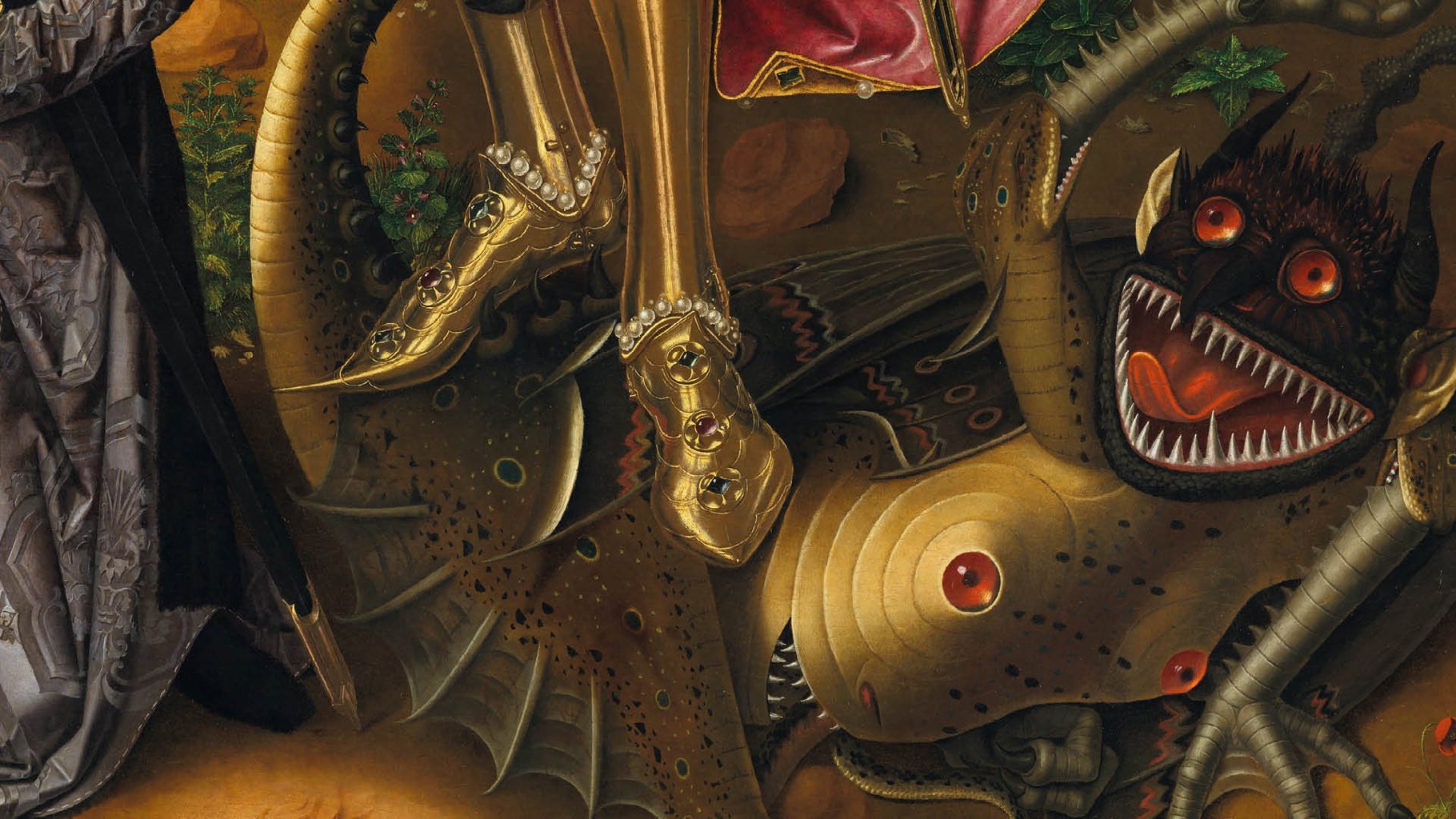
VIDEO: “How Bermejo paints good and evil in Saint Michael Triumphs over the Devil: In this nine-minute video, Daniel Sobrino Ralston, associate curator for Spanish paintings at the National Gallery in London, examines a late Gothic painting in the museum’s collection by the Spanish artist Bartolomé Bermejo, showing the archangel Michael slaying Satan. Based on Revelation 12:7–9, this subject gave artists the chance to flex their imaginations in portraying evil incarnate and its vanquishment. Possessing an impressive capacity for fantastical invention, Bermejo gives the devil snakes for arms, eyes for nipples, bird claws, moth-like wings, a spiky tail, and a cactus growing out of its head!

Bermejo, Bartolome_St. Michael (detail)
Bartolomé Bermejo (Spanish, ca. 1440–after 1495), Saint Michael Triumphs over the Devil (detail), 1468. Oil and gold on wood, 179.7 × 81.9 cm. National Gallery, London.

If this visual subject interests you, I recommend the book Angels and Demons in Art by Rosa Giorgi, from the J. Paul Getty Museum’s Guide to Imagery series.

Roundup: Les Mis, blood collages, Esau McCaulley on Lent, and more

I’ve received a few requests from followers to resume my monthly thirty-song playlists. I had previously thought I’d stick to publishing these during Ordinary Time, since I have longer, thematic playlists for the seasons of Advent, Christmas, Lent (our current place in the calendar), and Easter—which you can find on my Spotify profile. But I’m happy to oblige! Here’s a new playlist for March:

+++

ESSAY: “Victor Hugo’s Masterpiece of Impossibility” by Caitrin Keiper, Plough: A wonderful essay on how competing vows in the novel and musical Les Misérables reveal the paradox of grace. I’ve been captivated by this story of mercy, forgiveness, and transformation set in revolutionary France ever since I saw the 1998 film adaptation starring Liam Neeson in middle school. The faith-inspired actions of Bishop Myriel at the beginning set the life of the protagonist Jean Valjean, an escaped convict, on a trajectory that is beautiful to watch unfold, and the downfall of the law-obsessed Inspector Javert, who cannot bring himself to accept the grace offered him, is most tragic.

+++

PODCAST EPISODES:

>> Season 2, episode 2, of Gather Round, on the DPP’s Lent 2023 Living Prayer Periodical: On the in-house podcast of Grace Mosaic in Washington, DC, three of my four Daily Prayer Project colleagues and I walk listeners through the latest edition of our prayer periodical, which covers the six weeks of Lent. The conversation starts at 3:46. Rev. Joel Littlepage, curator of the liturgies and songs, highlights a litany to the Servant-Christ from Andhra Theological College in Hyderabad, India, and a song by Pastor Antonio Rivera González of Mexico (see below). Ashley Williams, who commissions or secures reproduction rights for the practice-based essays and curates the photographs throughout, shares some teasers for “Calling Out to God in Lament” by Nina Barnes and “Intractable Sin, Preemptory Prayer” by Alicia Akins.

Daily Prayer Project, Lent 2023
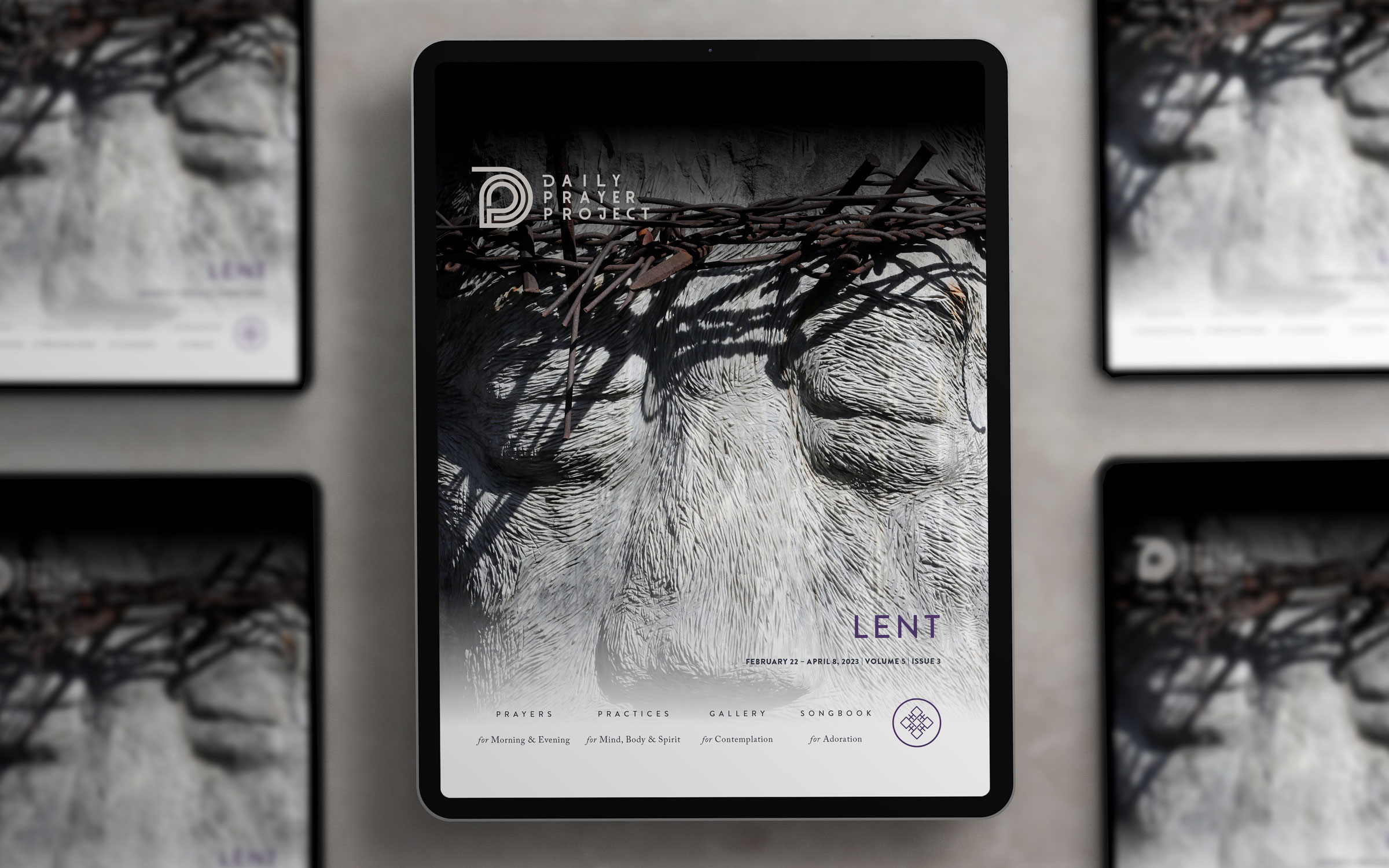
The Daily Prayer Project’s Lent 2023 booklet, featuring scripture, prayers, practical essays, art, and music from diverse contributors, is available in print and digital formats.

As curator of the art on the cover and in the Gallery section, I discuss the marble sculpture Condemned to Death by Chang Dong Ho (장동호) (see more by the artist), the mixed-media piece Gathering Fragments 1 by C. F. John, the photograph Untitled #10, Flushing, NY from the Stranger Fruit series by Jon Henry, and the painted woodcarving Qwi:qwelstom (Halkomelem, a Coast Salish language, for “Balance and Harmony”) by Don Froese.

At 32:44–35:06, our theological editor, Rev. Russ Whitfield, discusses a theological method that has informed our work at the DPP called triperspectivalism (or multiperspectivalism), which says that we can enrich our perspective, limited on its own, by looking at things from different angles, especially those revealed to us by other people and cultures. For a snippet of the Herman Bavinck quote, see here. What Russ says is SO GOOD! I believe our prayerbooks stand out from other similar projects in that they are deliberately cross-cultural—not because it’s trendy, but because there is so much beauty and wisdom we are missing by not availing ourselves of the many resources of the global church. Our content is also cross-historical.

There are subscription options for individuals (you receive a print edition and a digital download link) and groups (digital access, with bulk-printing options). You can also buy a single copy, but it’s cheaper to purchase a monthly subscription and then cancel after you receive your edition if you don’t wish to continue. We publish six editions a year, each following the same format but filled with new content for the given season.

>> “Lent: Season of Repentance, Renewal . . . and Rebellion” with Esau McCaulley, For the Life of the World: Here Rev. Dr. Esau McCaulley—associate professor of New Testament at Wheaton College, contributing opinion writer for the New York Times, and award-winning author of Reading While Black—talks about the Christian practice of Lent as a collective wisdom passed down through generations of Jesus followers, as well as a spiritual rebellion against mainstream American culture, which has its own established rhythms that shape how we spend our money, when we feast, and what we celebrate.

McCaulley spent the first twenty-one years of his life in the Black Baptist church and the past twenty in a high-liturgical tradition, both of which have been formative for him. One thing he appreciates about liturgy (both the yearly calendar and the elements within a worship service), he says, is how it helps him more fully inhabit the story of Christ. He construes Lent as a season of repentance and grace; he points out the justice practices of Lent; he walks through a Christian understanding of death, and the beautiful practice of stripping the altars on Maundy Thursday; and he’s emphatic about how Lent is a guided season of pursuing the grace to find, or perhaps return to, yourself as God has called you to be. These ideas are expanded upon in his new book, Lent: The Season of Repentance and Renewal, from IVP’s Fullness of Time series.

+++

SONGS:

>> “Divino compañero del camino” (O Lord, Divine Companion): Written in 1964 by Antonio Rivera of Mexico, this popular Spanish-language song is performed here by Karina Moreno and Joseph Espinoza. It’s based on Luke 24:28–32, from the postresurrection story of the walk to and supper at Emmaus, but its pilgrimage aspect—the idea of Jesus as a companion on our life journey—makes it appropriate for Lent. [HT: The Daily Prayer Project]

>> “Yeshu Ji Mere Paap Kshama Kar Do” (Lord Jesus, Forgive My Sins): A Hindi song of confession with words by the late Shri Jalal Masih and music by his granddaughter, Mercy Sharon Masih. Mercy sings it here with her father, Hanook Masih. For an English translation, click the “CC” button. [HT: Global Christian Worship]

+++

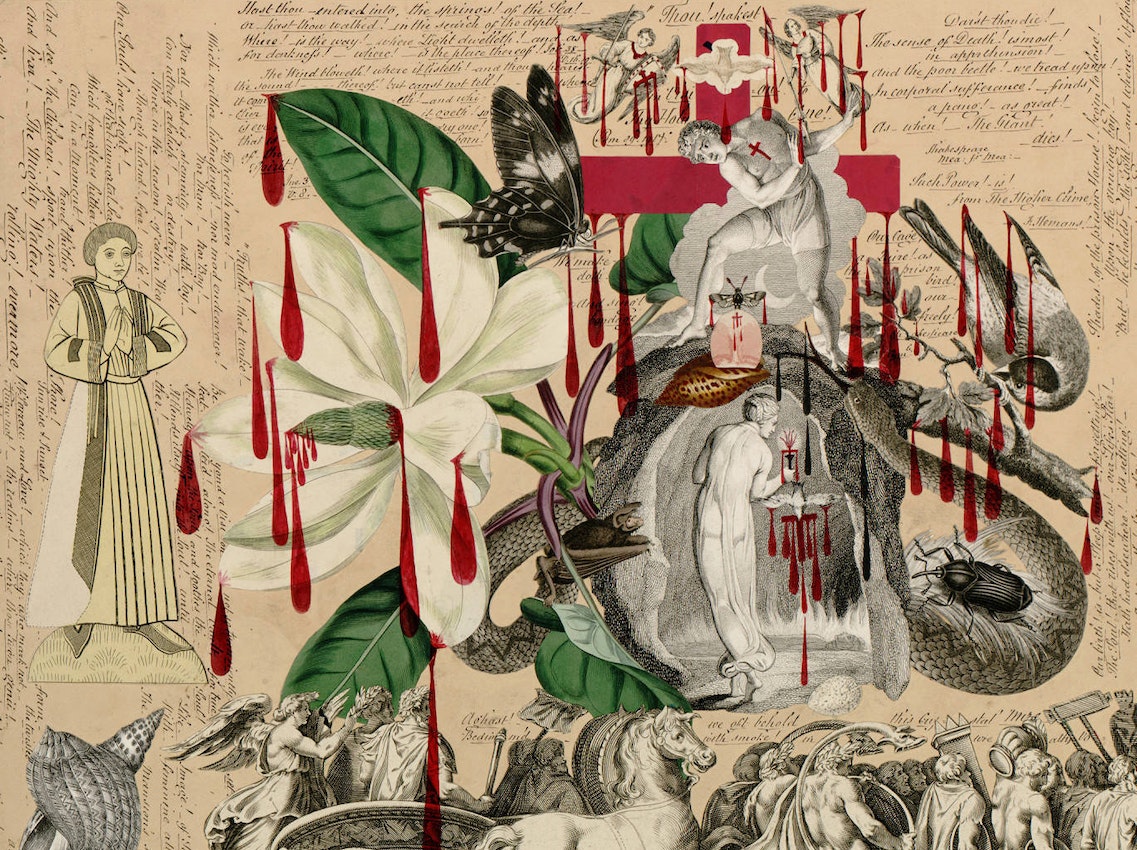
ARTICLE: “The Blood Collages of John Bingley Garland (ca. 1850–60),” Public Domain Review: Peruse the so-called Victorian Blood Book, an eccentricity made by the British politician and fishmonger John Bingley Garland as a wedding gift for his daughter Amy in 1854. It consists of forty-one collages whose sources are engravings by William Blake and various other religious artists, botanical and zoological illustrations, photographs of medieval tombs, and other images from nineteenth-century books, but with one distinguishing decorative addition by Garland’s hand: drops of blood in red India ink, presumably signifying the blood of Christ. The pages also bear extensive handwritten religious commentary.

Garland, John Bingley_Blood Book
Detail from a page of John Bingley Garland’s “Blood Book” (ca. 1850–60), featuring a cut-out from a reproduction of William Blake’s engraving The Soul exploring the recesses of the Grave.

The Blood Book transferred from the collection of novelist Evelyn Waugh to the Harry Ransom Center at the University of Texas at Austin upon Waugh’s death, and they identify it as “the single most curious object in the entire library.” Though modern eyes may see the collages as surreal or even grotesque, Garland’s descendants regarded them as nothing other than “a precious reminder of the love of family and Our Lord,” as they have written. The Harry Ransom Center has digitized the full book.

“The Avowal” by Denise Levertov

Rawles, Calida_Radiating My Sovereignty
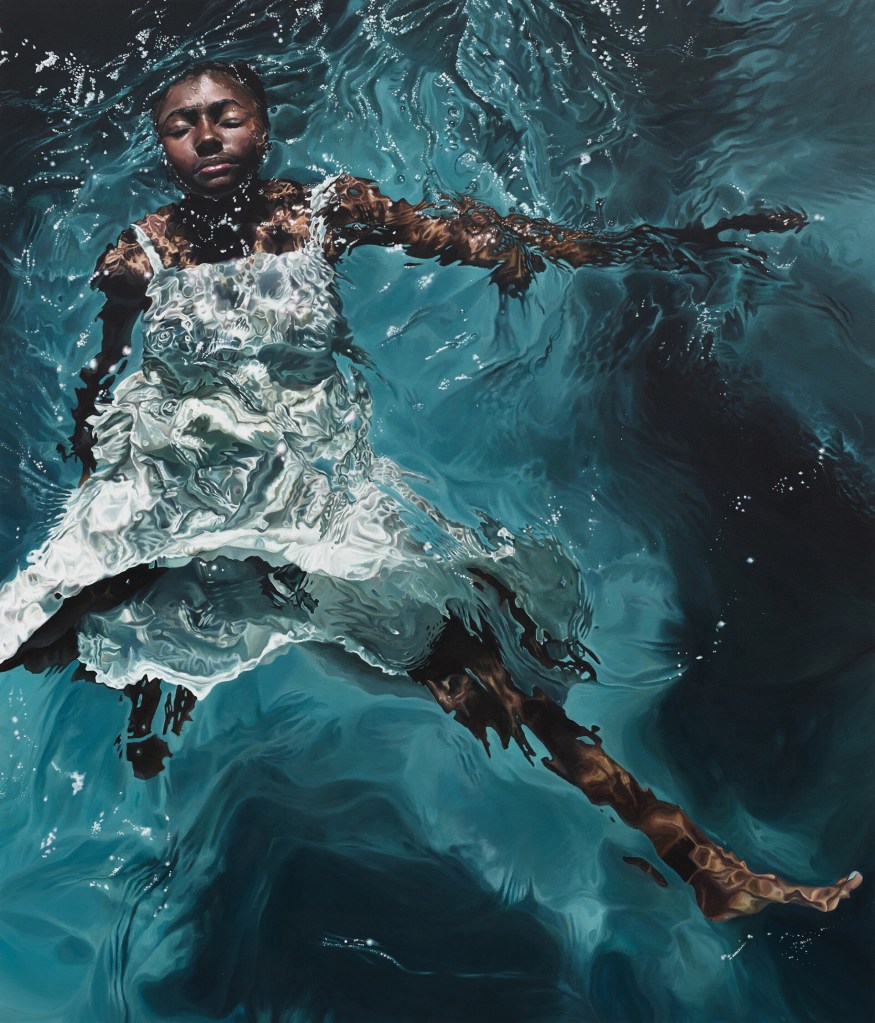
Calida Garcia Rawles (American, 1976–), Radiating My Sovereignty, 2019. Acrylic on canvas, 84 × 72 in.

For Carolyn Kizer and John Woodbridge,
Recalling Our Celebration
of George Herbert’s Birthday, 1983

As swimmers dare
to lie face to the sky
and water bears them,
as hawks rest upon air
and air sustains them,
so would I learn to attain
freefall, and float
into Creator Spirit’s deep embrace,
knowing no effort earns
that all-surrounding grace.

This poem is from Oblique Prayers, copyright © 1984 by Denise Levertov, and also appears in Levertov’s The Stream and the Sapphire: Selected Poems on Religious Themes. Used by permission of New Directions Publishing Corp.