
There are hundreds of creative works I could feature on the topic of Christ’s wounds. Here are just a few of note.
ARTICLE: “‘Your body is full of wounds’: references, social contexts and uses of the wounds of Christ in Late Medieval Europe” by Johanna Pollick, Emily Poore, Sophie Sexon, and Sara Stradal: In this three-part collaborative essay, I was most intrigued, in part because of its newness to me, by the first section, “The flowering wound: Christ’s heart in Princeton University, MS Taylor 17,” in which Dr. Johanna Pollick explores a small English illuminated devotional book, dating from around 1500, that portrays Christ’s wounds as wells. For help in interpreting these images, she turns to medieval literary traditions as well as to the Carthusian Miscellany.
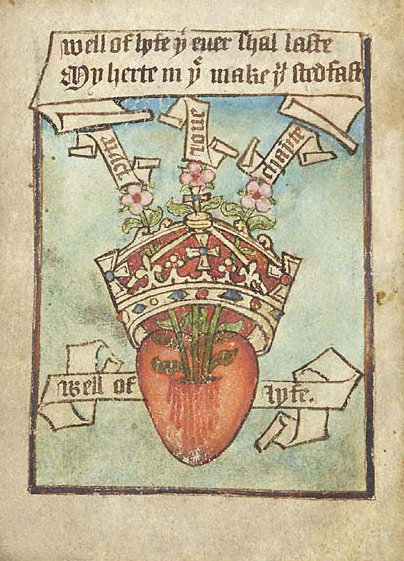
Dr. Grace Hamman writes about MS Taylor 17’s extraordinary “well of lyfe” page in Jesus through Medieval Eyes (and for InterVarsity’s The Well), which is what brought me to this essay. The hand-colored image shows flowers—labeled “pyte” (pity), “loue” (love), and “charyte” (charity)—springing forth from the wounded heart of Jesus. The verse prayer at the top reads, “Well of lyfe that ever shall laste / My herte in thee make it stedfast.”
The same theme shows up in another late fifteenth-century English lyric in MS Arundel 286 at the British Library, which appears in modern compilations under the title “The Wounds, as Wells of Life” or “The Wells of Jesus’ Wounds”:
Ihesus woundes so wide
Ben welles of lif to the goode,
Namely the stronde of his syde
That ran ful breme on the rode.
Yif thee list to drinke
To fle fro the fendes of helle,
Bowe thu doun to the brinke
And mekely taste of the welle.
Jesus’s wounds so wide
Are wells of life to the good,
Namely the stream from his side
That ran fiercely on the rood.
If thou list to drink,
To flee from the fiends of hell,
Bow thou down to the brink
And meekly taste of the well.

Trans. Victoria Emily Jones
And in a late fifteenth-century gold ring, also from England, engraved with a Man of Sorrows image and hieroglyphs of Christ’s five wounds, labeled “The well of pitty, the well of merci, the well of confort, the well of gracy, the well of everlastingh lyffe”:
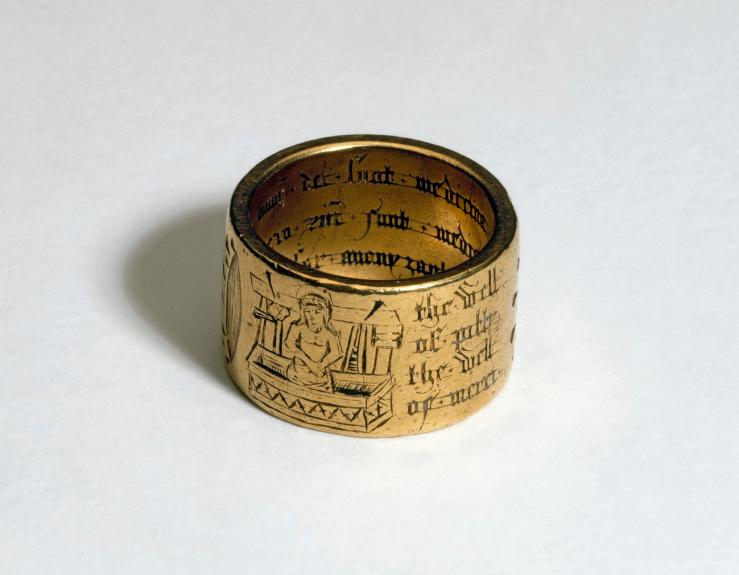
Finger ring with the Image of Pity and the Five Wounds of Christ, England, late 15th century. Gold, engraved, diameter 27.2 mm. British Museum, London, AF.897. 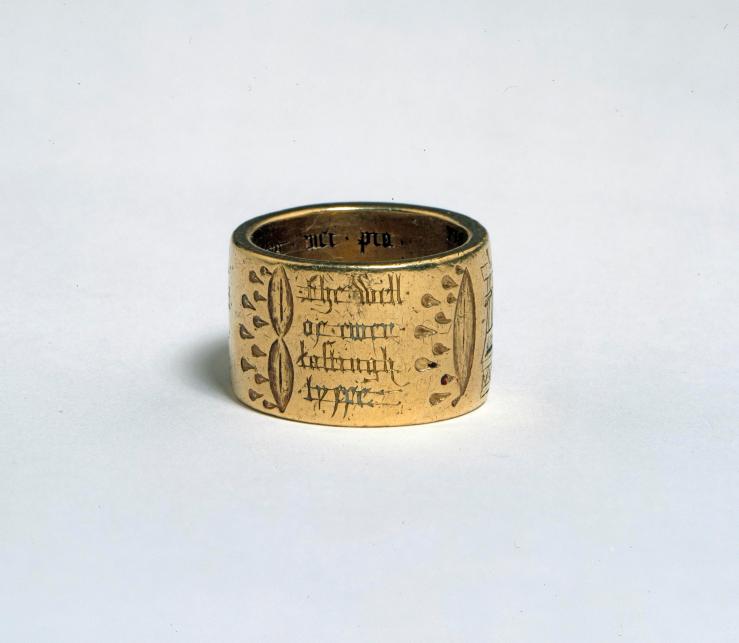
(Related posts: “Hidden in the Cleft”; “Upon the Bleeding Crucifix” by Richard Crashaw; By His Wounds)
+++
SONG: “Deep Were His Wounds” by William Johnson, 1953: This midcentury hymn is composed of three simple stanzas: The first half of each meditates on Jesus’s cruel death on the cross, whereas each second half (“But . . .”) celebrates the healing, freedom, and eternal life that death wrought.
>> Music by Leland B. Sateren, 1958: I like this tune, called MARLEE, but it’s difficult to sing congregationally. Here’s a soloist, Sarah Gulseth, singing it for her church’s 2011 Good Friday service, accompanied on organ by Luther Gulseth:
And here’s a Minnesota church choir singing it. Copyright for both the text and tune is held by Augsburg Fortress; you can purchase the sheet music here.
>> Music by Vito Aiuto, 2008: I was first introduced to “Deep Were His Wounds” through the Welcome Wagon’s debut album, Welcome to the Welcome Wagon, “a ramshackle singalong enterprise of a Presbyterian pastor (the Rev. Vito Aiuto) and his wife (Monique) wrestling out the influences of folk music, religion, popular culture, and church tradition.” Mood-wise, Aiuto’s tune wouldn’t work as well for Good Friday—even given the paradox of that day, it’s too bright, in my opinion, for that somber observance. But it’s great for throughout the year, especially for churches that favor a contemporary/folksy style of music.
+++
CANTATA CYCLE: “Membra Jesu Nostri” (The Limbs of Our Suffering Jesus) by Dieterich Buxtehude: Dieterich Buxtehude (ca. 1637–1707) was a Danish German organist and composer of the mid-Baroque period. For Good Friday 1680, he composed a cycle of seven concerto-aria cantatas. The texts of the aria sections are taken from the medieval Latin hymn “Salve mundi salutare” (Hail, the World’s Salvation) by the Cistercian abbot Arnulf of Leuven (ca. 1200–1250), whereas the concerto section texts are Old Testament quotations. The following video is a 2004 performance from Payerne, Switzerland; see the YouTube video description for further credits. The video includes English subtitles, but you can also read the lyrics (with translation) here.
The cycle begins by paying homage to Christ’s wounded feet (“Ad Pedes” = “To the Feet”), and then progresses upward to his knees, hands, side, breast, heart, and finally, face/head. Traditionally, Christ’s wounds are enumerated as five: a hole in each foot, a hole in each hand, and a hole through his side/heart (from the centurion’s spear). But Arnulf meditates on seven distinct body parts of Christ’s that were injured on Good Friday.
+++
ARTWORKS:
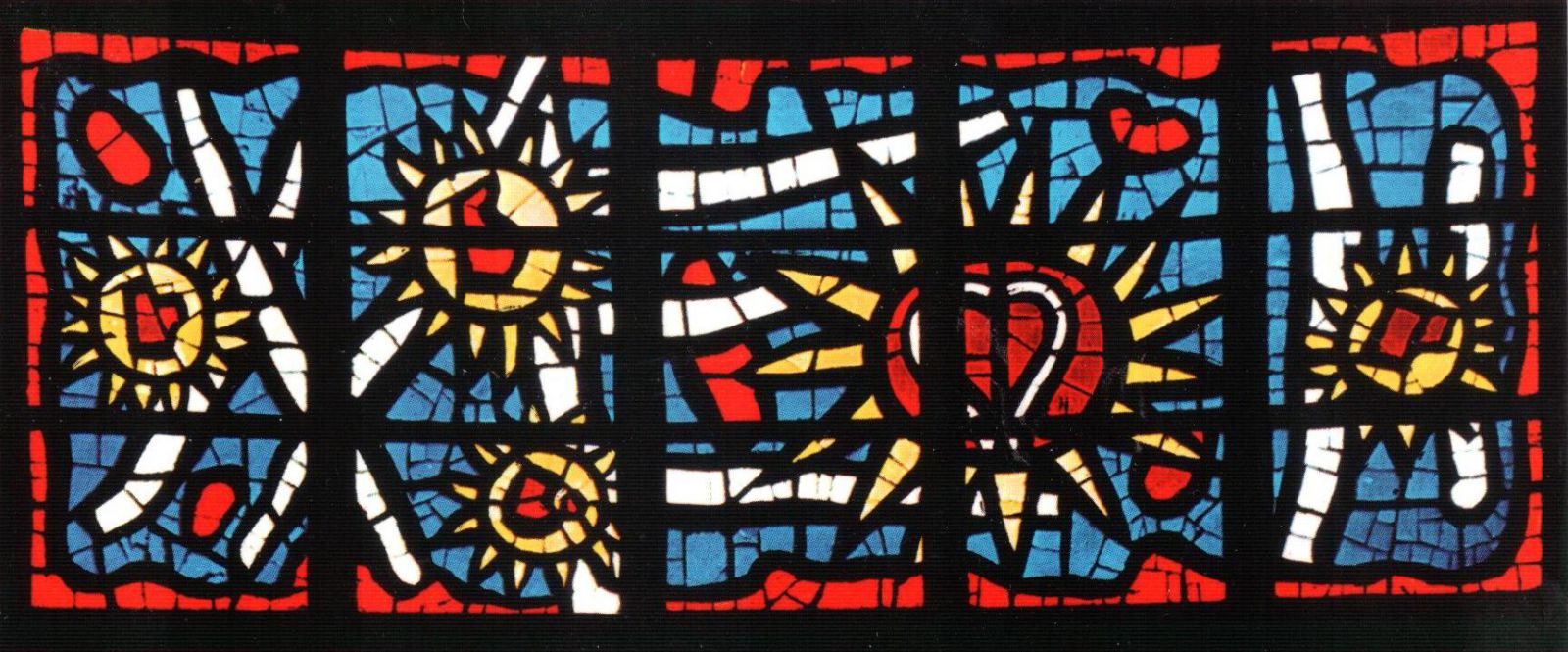
>> The Five Wounds of Christ by Fernand Léger | Commentary by Albert Hengelaar: This visual meditation is about the architecture and interior decoration of the Sacré-Coeur in Audincourt, France, a product of the Art Sacré movement, a Catholic art renaissance spearheaded by the French Dominican Order from 1919 to the 1950s. The centerpiece of the church, sited above the high altar, is a stained glass window depicting the five wounds of Christ shining like suns—one of seventeen windows the artist Fernand Léger designed to encircle the space in a strip.
>> The Great Wound, aka Go On, Wounded Healer by Jack Baumgartner | Commentary by Sam Kee: In this Substack post, Sam Kee unpacks a drawing by his friend Jack Baumgartner [previously], which shows that “there is life in His [Christ’s] wounds, and He pours His life into our wounds.” The drawing started with the roman numeral V, which stands for the five wounds of Christ. The circumference is one large wound that encompasses five smaller wounds, eye-like, each one weeping blood. Other symbols that Kee analyzes in the drawing are wheat, grapes, fig leaves, seashell, fire, heart, and womb. “Go on” is a refrain that Baumgartner uses often in his work, a mantra for persevering in the faith, for continuing on the path.
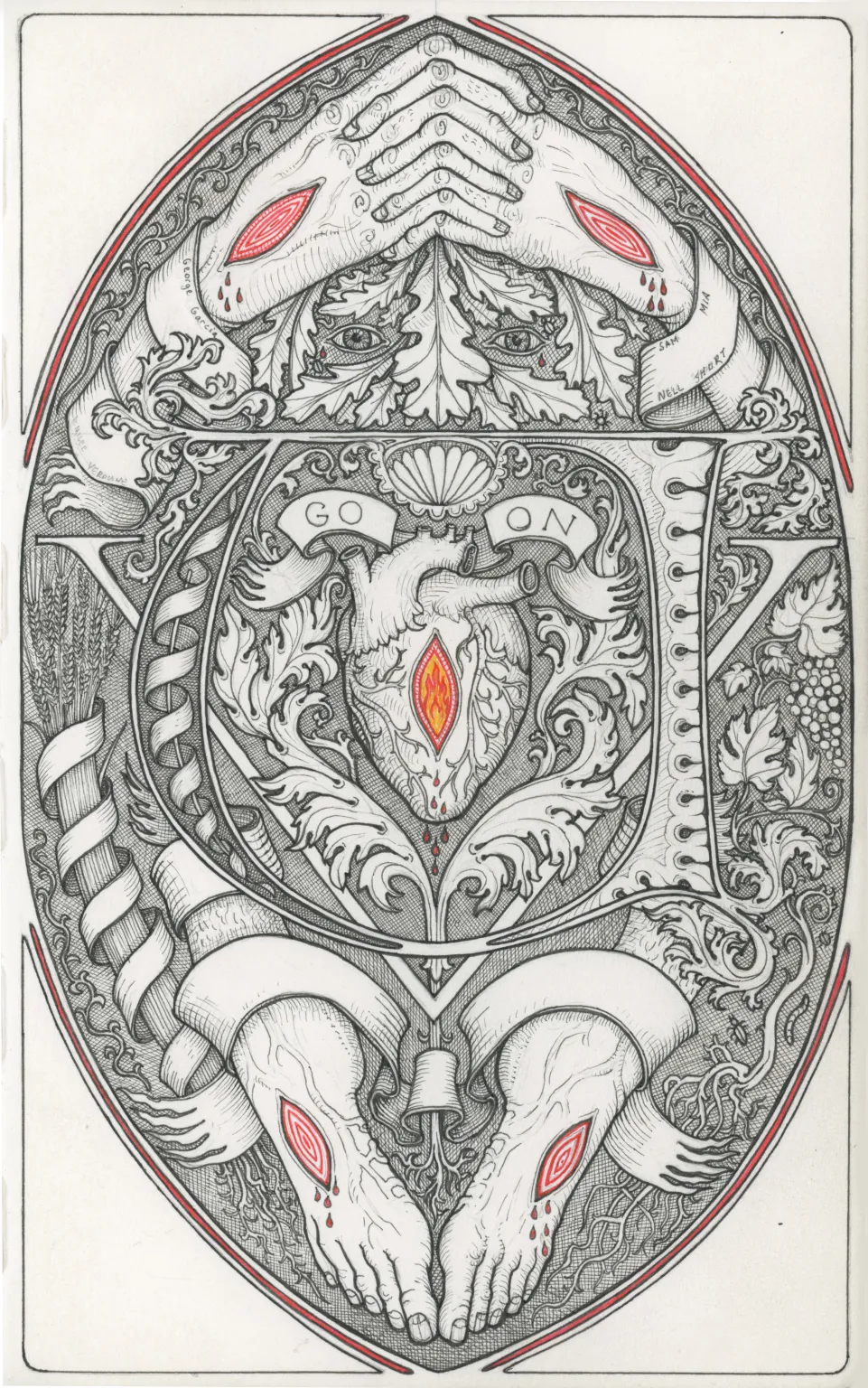
Kee concludes with an original ekphrastic poem.
You can purchase an archival reproduction of The Great Wound from Baumgartner’s online shop. I encourage you to explore his website as well. I admire how his work is somehow both mystical and earthy, rooted.








 Art & Theology
