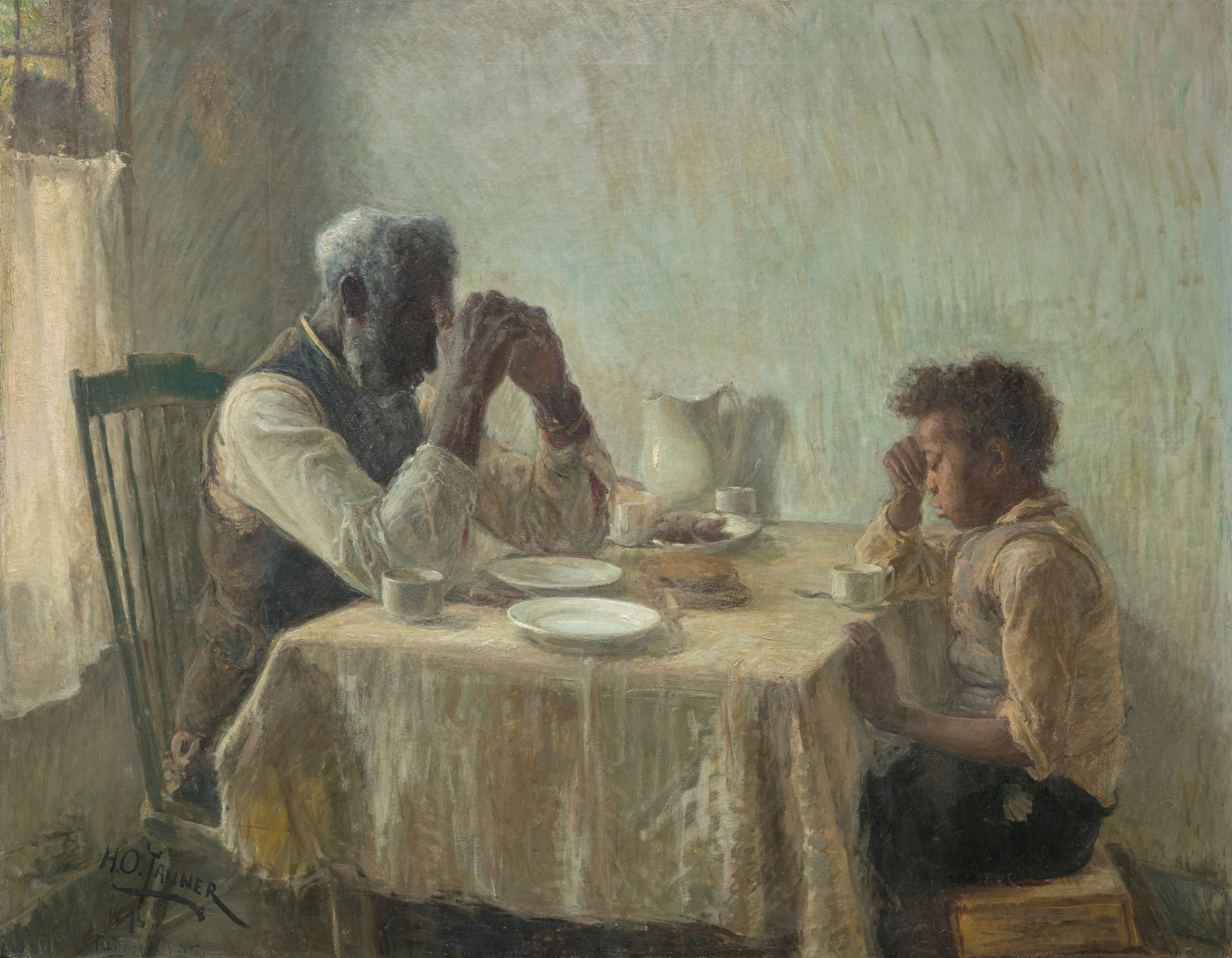
Henry Ossawa Tanner (American, 1859–1937), The Thankful Poor, 1894. Oil on canvas, 35 1/2 × 44 1/4 in. (90.2 × 112.4 cm). Collection of the Art Bridges Foundation, Bentonville, Arkansas.
Momma used to say
That when Jesus turned the
Loaves and fish
Into a picnic
For those hungry folks
In the wilderness
The God blessed victuals
Tasted like mouth watering
Mississippi catfish
Deep fried in the best store bought meal
Served with a healthy side helping
Of iron skillet cornbread—
Bread so fine that
No one asked for butter or honey
And nary a crumb hit the ground.
She grew up an orphan
In the Great Depression,
Where low cotton prices
And bad weather
Killed farms and families—
Times, she remembered, so hard
That sometimes even dinner
Was a miracle
And prayers offered
At the evening meal
Wafted in the air
Thick as coal oil smoke
In the fragrance of gratefulness.
This poem by Tom Darin Liskey was originally published June 16, 2019, on Kelly Belmonte’s All Nine blog. Used with permission of the author.
Tom Darin Liskey is a photographer and a writer of fiction, nonfiction, and poetry. A graduate of the University of Southern Mississippi, he spent nearly a decade working as a photojournalist in Venezuela, Argentina, and Brazil. He is the author of the short story collection This Side of the River (2022) and, with Kelly Belmonte, the poetry-photography collaboration Transit (2022), as well as a contributor to The Cultivating Project. He lives with his family in South Carolina.
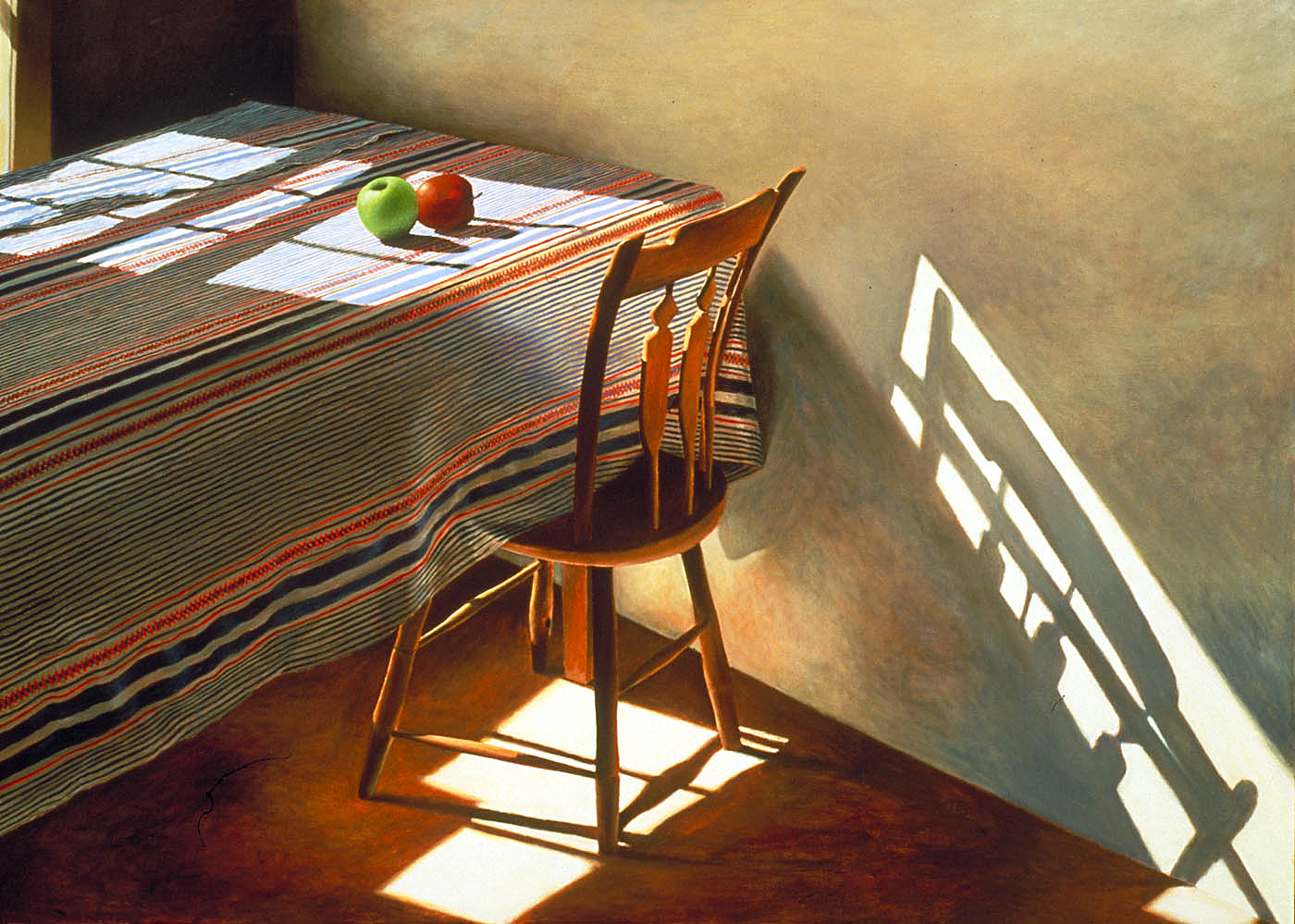
Leigh Palmer (American, 1943–), Striped Tablecloth with Two Apples, 1983. Oil on linen, 36 1/8 × 50 in. (91.8 × 127.1 cm). Smithsonian American Art Museum, Washington, DC.
It is a kind of love, is it not?
How the cup holds the tea,
How the chair stands sturdy and foursquare,
How the floor receives the bottoms of shoes
Or toes. How soles of feet know
Where they’re supposed to be.
I’ve been thinking about the patience
Of ordinary things, how clothes
Wait respectfully in closets
And soap dries quietly in the dish,
And towels drink the wet
From the skin of the back.
And the lovely repetition of stairs.
And what is more generous than a window?
This poem is from The Patience of Ordinary Things (Amherst Writers & Artists Press, 2003) and is compiled in Another River: New and Selected Poems (Amherst Writers & Artists Press, 2005).
Pat Schneider (1934–2020) was a poet, playwright, librettist, and leader of writing workshops who in 1981 founded the nonprofit organization Amherst Writers & Artists to help people discover their deepest stories through writing. The AWA grew out of a writing method Schneider developed, described in her book Writing Alone and with Others (Oxford University Press, 2003), which is used by an international network of workshop leaders. This is one of over a dozen books she’s published, which include six collections of poetry, a spiritual autobiography, and How the Light Gets In: Writing as a Spiritual Practice (Oxford University Press, 2013). She and her husband, Peter, a Methodist minister, devoted many years to community-based social justice ministry, fueled in part by Schneider’s having grown up in an impoverished single-parent home (and later orphanage). She had four children.
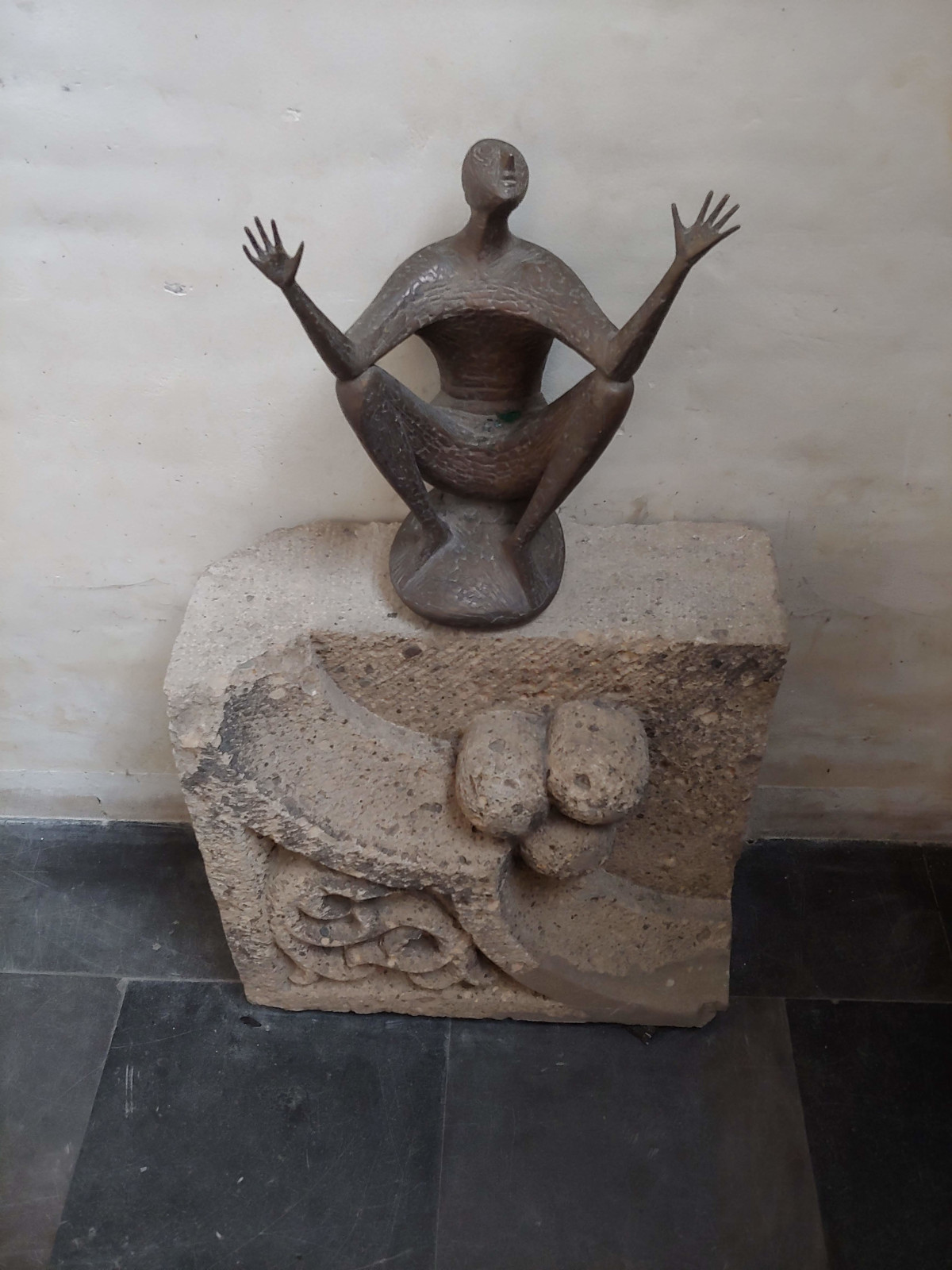
Unidentified sculpture at the Grote of Sint-Laurenskerk (Church of Saint Lawrence), Rotterdam, Netherlands. Photo: Victoria Emily Jones.
Would God I knew there were a God to thank
     When thanks rise in me, certain that my cries
Do not like blind men’s arrows pierce the skies
     Only to fall short of my quarry’s flank.
Why do I thirst, a desperate castaway
     Quaffing salt water, powerless to stop,
Sick lark locked in a cellar far from day,
     Lone climber of a peak that has no top?

To praise God is to bellow down a well
     From which rebounds one’s own dull booming voice,
          Yet the least leaf points to some One to thank.
The whorl embodied in the slightest shell,
     The firefly’s glimmer signify Rejoice!
          Though overhead, clouds cruise a sullen blank.
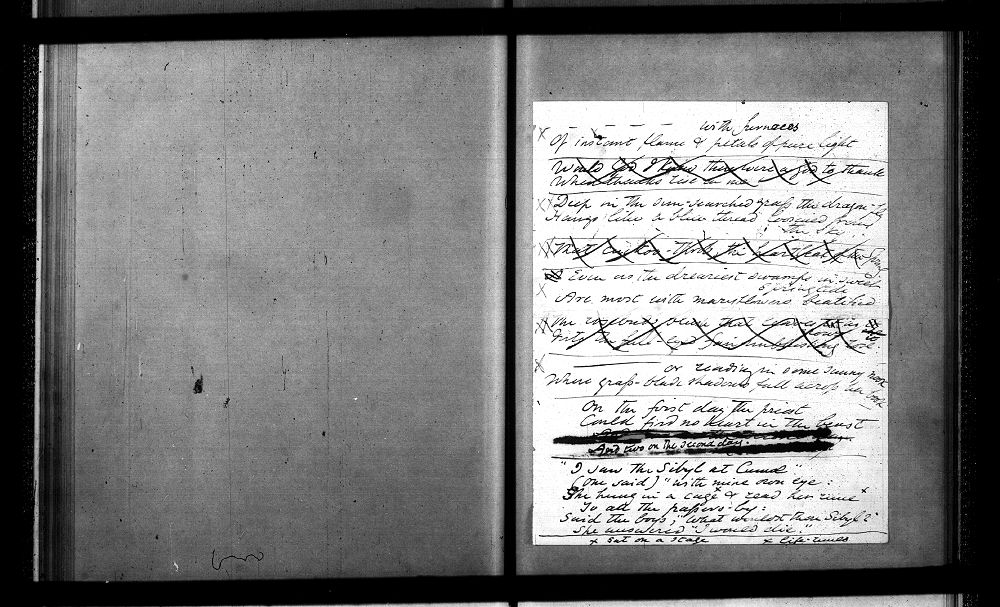
The first line and a half of this sonnet are a crossed-out fragment from one of the notebooks of the British poet and artist Dante Gabriel Rossetti (1828–1882), which he used to work out poetic ideas. This one never went anywhere. But Rossetti’s brother, William Michael Rossetti, saw something in it worthy of preservation; he salvaged it and other select scraps from his brother’s papers, publishing them posthumously in a “Versicles and Fragments” section of Rossetti’s collected works in 1901.
Page 16 of Sonnets and Fragments by Dante Gabriel Rossetti (Princeton/Troxell bound manuscript volume), 1848–81. The first deletion, by Rossetti’s hand, is “Would God I knew there were a god to thank / When thanks rise in me.” [object record]
The modern American poet X. J. Kennedy developed Rossetti’s fragment into a full poem that grapples with the silence of God and, despite such, the impulse to praise. The speaker is confounded by the contradiction that the world seems infused with God’s presence—the natural world points to a Creator—and yet God is unresponsive when the speaker initiates contact. The prayers he launches toward heaven like arrows appear not to reach their target. He’s experiencing spiritual aridity. He feels like a thirsty castaway whose only drink is salt water (why doesn’t God satiate as promised?); a bird trapped in a dark cellar; a mountain climber endlessly climbing, never catching sight of the vista.
The poem tugs back and forth between despondency and awe, between clench-fisted frustration and open-handed surrender. Each glorious tree leaf, the intricate design of conch shells, the whimsy of lightning bugs—these are gifts, but where’s the giver? Gratitude must be directed to someone, but whom does one thank for the wonders and small joys experienced in nature? Who or what is their source? Oh, how I wish I knew there were a God out there to thank, when thanks well up in me. The speaker wants to place his thanks somewhere, but when he places them in God, he receives no confirmation of receipt. There’s a disconnect between what nature testifies and what the speaker has suffered: the “sullen blank” of heaven.
Dante Gabriel Rossetti’s brother, William, wrote in 1895 that, unlike their devout sister Christina [previously], Dante was “a decided sceptic. He was never confirmed, professed no religious faith, and practised no regular religious observances; but he had sufficient sympathy with the abstract ideas and the venerable forms of Christianity to go occasionally to an Anglican church—very occasionally, and only as the inclination ruled him.” Starting in mid-adolescence, he rejected organized religion.
Kennedy, similarly, was raised in a religious household: his father was Catholic, his mother Methodist. And yet in his adulthood he has come to question and reject some of the tenets of orthodox Christianity. But still, he searches for God. “There is a clash in his poems between his skepticism or uneasy agnosticism and his unresolved longing for faith in God,” reads his bio on the Harvard Square Library website. Kennedy’s desire to believe but his inability to do so is expressed recurringly in his work—as in this poem, in which he, taking the baton from Rossetti, is very likely the speaker.
X. J. Kennedy (born 1929) is an American poet, translator, editor, and author of children’s literature and textbooks on English literature and poetry. Born Joseph Charles Kennedy in Dover, New Jersey, he adopted the nom de plume X. J. Kennedy in 1957 to avoid being mistaken for the better-known Joseph Kennedy, then US ambassador to England and father of future president John F. Kennedy. His award-winning poetry collections include Nude Descending a Staircase (1961) and Cross Ties (1985). He lives in Lexington, Massachusetts.
Cairn by James Brunt, Filey Beach, East Yorkshire, England, 2018
We alone can devalue gold
by not caring
if it falls or rises
in the marketplace.
Wherever there is gold
there is a chain, you know,
and if your chain
is gold
so much the worse
for you.

Feathers, shells
and sea-shaped stones
are all as rare.

This could be our revolution:
to love what is plentiful
as much as
what is scarce.
Alice Walker is an American novelist, short story writer, poet, and social activist. Born in 1944 in Eatonton, Georgia, the eighth and last child of sharecroppers, in 1982 she became the first African American woman to win the Pulitzer Prize for Fiction, which she was awarded for her novel The Color Purple. Over the span of her career, Walker has published numerous best-selling works of fiction, poetry collections, essays, and children’s books. She lives in Mendocino, California.
At first glance this poem may seem naive or flippant about economic realities. In the world we’ve created, money is a necessity. My country, the United States, has suffered two recessions in recent memory: in 2007–9, when the subprime mortgage crisis led to the collapse of the US housing bubble, and during the first two months of the COVID-19 pandemic in March and April 2020, when more than twenty-four million Americans lost their jobs. Lack of money can have disastrous effects.
But “We Alone” is not denigrating those who stress about not having a paycheck or not being able to afford basic provisions. Rather, it is critiquing a system that creates those conditions, a system in which money has been elevated to godlike status, and wealth is consolidated in the banking and corporate institutions headquartered on Wall Street, which engage in predatory activities that harm and debase. Capitalism is built on self-interest, profit, and acquisitiveness, and therefore it can easily breed greed, a voraciousness for more and more, which often comes at the expense of others.
Alice Walker has said elsewhere that “capitalism is a big problem, because with capitalism you’re just going to keep buying and selling things until there’s nothing else to buy and sell, which means gobbling up the planet.”[1] In her essay “All Praises to the Pause,” she writes,
Capitalism . . . cannot possibly sustain itself without gobbling up the world. That is what we see all around us. Women and children in Bangladesh, India, the Philippines, Haiti, Mexico, China and elsewhere in the world forced into starvation and slavery as they turn out the tennis balls and cheap sneakers for the affluent. Ancient trees leveled to make more housing while housing that could be saved and reused is torn down and communities heartlessly displaced. Mining of the earth for every saleable substance she has. Fouling of the waters that is her blood. Murdering innocents, whether people, animals or plants, in pursuit of oil.[2]
(Related reading: report from “Can Capitalism Be Ethical?,” a lecture by Dr. Rowan Williams, former archbishop of Canterbury, Murray Edwards College Cambridge, November 2, 2016)
My purpose here is not to argue for or against specific economic systems, nor is that the point of this poem. What Walker challenges in “We Alone” is the pervasive notion that people and things are worth only what the market says they are. Have you, too, bought in to that lie? Do you fail to value the things that are free and plentiful in life, like shells on the beach, or birdsong, or a refreshing rain? Ordinary gifts like that operate outside the laws of supply and demand and suggest the beautiful abundance of God’s economy.
On a few occasions the Bible uses the term “mammon” to refer to riches and their pernicious influence. Jesus preached against mammon in his Sermon on the Mount, famously warning the crowds, “You cannot serve both God and mammon” (Matt. 6:24). The church fathers personified mammon as an evil master who enslaves, and medieval Christian writers named it a demon. Walker, too, acknowledges how wealth can hold us captive, the word “chain” in her poem pulling double duty, referencing on the one hand a metal-link ornament holding a jewel or a watch, and on the other hand a shackle.
To not care about filling our coffers is a countercultural stance. To not be constantly checking the rise and fall of stock prices, or obsessing about our investment portfolio.
Those who overvalue material assets will miss out on the more satisfying riches that abound in the natural world, which don’t have to be worked for or taken from others to be enjoyed.
NOTES
1. Alice Walker, quoted in Fernanda Sayão, “Capitalism” (Rio de Janeiro: Animal Farm Research, 2012), 14.
2. Alice Walker, “All Praises to the Pause; The Universal Moment of Reflection,” commencement address, California Institute of Integral Studies, San Francisco, May 19, 2002, in We Are the Ones We Have Been Waiting For: Inner Light in a Time of Darkness (New York: The New Press, 2006), 77–78.
Mikael Owunna (Nigerian American, 1990–), Lébé and His Articulations, from the Infinite Essence series, 2019. Dye sublimation print, 60 × 40 in. (152.4 × 101.6 cm). Edition of 3 + 1AP. [for sale]
                                O Lord!
        Thou hast given me a body,
Wherein the glory of thy power shineth,
Wonderfully composed above the beasts,
Within distinguished into useful parts,
Beautified without with many ornaments.
        Limbs rarely poised,
                And made for heaven:
        Arteries filled
                With celestial spirits:
        Veins, wherein blood floweth,
                Refreshing all my flesh,
                                Like rivers.
        Sinews fraught with the mystery
            Of wonderful strength,
                Stability,
                Feeling.
        O blessed be thy glorious Name!
That thou hast made it
            A treasury of wonders,
                Fit for its several ages;
                    For dissections,
                    For sculptures in brass,
                    For draughts in anatomy,
        For the contemplation of the sages.
                Whole inward parts,
                        Enshrined in thy libraries,
        Are:
                The amazement of the learned,
                The admiration of kings and queens,
                The joy of angels,
                The organs of my soul,
                The wonder of cherubims.
        Those blinder parts of refined earth,
                        Beneath my skin,
            Are full of thy depths,
            For:
                        Many thousand uses,
                        Hidden operations,
                        Unsearchable offices.
        But for the diviner treasures wherewith thou hast endowed
            My brains,
            My heart,
            My tongue,
            Mine eyes,
            Mine ears,
            My hands,
O what praises are due unto thee,
        Who has made me
                    A living inhabitant
                            Of the great world,
                    And the centre of it!
        A sphere of sense,
                            And a mine of riches,
Which when bodies are dissected fly away.
        The spacious room
                    Which thou has hidden in mine eye;
        The chambers for sounds
                    Which thou has prepar’d in mine ear;
        The receptacles for smells
                    Concealed in my nose;
        The feeling of my hands;
                    The taste of my tongue.
        But above all, O Lord, the glory of speech,
whereby thy servant is enabled with praise to
celebrate thee.
                                    For
        All the beauties in heaven and earth,
        The melody of sounds,
        The sweet odours
                            Of thy dwelling-place.
        The delectable pleasures that gratify my sense,
                            That gratify the feeling of mankind.
        The light of history,
                            Admitted by the ear.
        The light of heaven,
                            Brought in by the eye.
        The volubility and liberty
                            Of my hands and members.
        Fitted by thee for all operations,
                            Which the fancy can imagine,
                            Or soul desire:
        From the framing of a needle’s eye,
                            To the building of a tower;
        From the squaring of trees,
                            To the polishing of kings’ crowns.
        For all the mysteries, engines, instruments, wherewith the world is filled, which we are able to frame and use to thy glory.
        For all the trades, variety of operations, cities, temples, streets, bridges, mariner’s compass, admirable pictures, sculpture, writing, printing, songs and music, wherewith the world is beautified and adorned.
        Much more for the regent Life,
            And power of perception,
                Which rules within.
        That secret depth of fathomless consideration
            That receives the information
                Of all our senses,
That makes our centre equal to the heavens,
    And comprehendeth in itself the magnitude of the world;
        The involved mysteries
                            Of our common sense;
        The inaccessible secret
                            Of perceptive fancy;
        The repository and treasury
                            Of things that are past;
        The presentation of things to come;
            Thy Name be glorified
                For evermore.
    For all the art which thou hast hidden
            In this little piece
                Of red clay,
    For the workmanship of thy hand,
        Who didst thyself form man
            Of the dust of the ground,
        And breathe into his nostrils
            The breath of life.
    For the high exaltation whereby thou hast glorified every body,
                Especially mine,
        As thou didst thy servant
                Adam’s in Eden.
    Thy works themselves speaking to me the same thing that was said unto him in the beginning,
                WE ARE ALL THINE.
Thomas Traherne (1636/37–1674) was a country priest from England whose devotional writings, both prose and verse, are remarkable for their spiritual intensity. He wrote rapturously about the goodness, love, and mercy of God and the glories of God’s creation. He is sometimes classed as a Metaphysical poet, though his poems read more like Walt Whitman, with their long catalogs and ebullient joy. Traherne is most celebrated for his Centuries of Meditations, a collection of theological reflections that wasn’t published until 1908.
I’ve compiled a playlist of songs of thanks to God for life, beauty, family, salvation, fruitful harvests, and countless other blessings, and for God’s very self. To make a list on this theme is difficult, as every praise song, of which there are millions, is essentially a song of thanksgiving. So many songs and other musical pieces, including those from outside the Judeo-Christian tradition, testify to experiences of goodness. Perhaps I’m being too literal, but I focus (though not exclusively) on songs that explicitly say “Thanks.” I also want to make clear that God deserves thanks not just for what he’s done but for who he is.
To save the playlist to your Spotify account, click the ellipsis and select “Add to Your Library.”
The list is bookended by the seventeenth-century Trinitarian doxology written by Thomas Ken (“Praise God from whom all blessings flow . . .”), which many churches sing weekly to the tune of OLD 100TH. While the first on the list is in English, the last is in Hawaiian.
Several of the songs are settings of the biblical psalms. The Abayudaya community of Jews in eastern Uganda, for example, sings the call-and-response Psalm 136 in Luganda; led by J. J. Keki, the congregation responds after each line with “His steadfast love endures forever!” Banjoist Béla Fleck [previously] and mandolinist Chris Thile use this melody from Abayudaya as the basis of their “Psalm 136” duet, which appears on Fleck’s new album, Bluegrass Heart.
There’s also Psalm 92 (“It is good to give thanks to the Lord . . .”) from Poor Bishop Hooper’s EveryPsalm project, Wendell Kimbrough’s Psalm 107, and a classical guitar rendition of Jewish singer-songwriter Debbie Friedman’s “Hodu” [previously], a setting of Psalm 118:1–4. Rebekah Osborn also sets Psalm 118, in English.
“We Thank You” is by Broken Walls, a musical group comprising followers of the Jesus Way who seek to build bridges between the church and the First Nations people of North America. Founded by Jonathan Maracle, a Mohawk from Tyendinaga Territory in Ontario, Canada, the band uses indigenous instruments and sounds to share the Creator’s love.
Across the Atlantic, the monks of Keur Moussa Abbey [previously] in Senegal sing “Nous Te Louons, Père Invisible” (“We Praise You, Invisible Father”), accompanied by balafon (a gourd-resonated xylophone). The French lyrics translate as follows:
Lord of immortality We praise you, invisible Father You are the source of life We praise you, invisible Father The source of all light We praise you, invisible Father You are the source of grace We praise you, invisible Father Friend of mankind, friend of the poor, you draw everything unto yourself through the coming of your beloved Son! We praise you, invisible Father
I’ve also included a dedicatory instrumental piece played on kora and oboe for the inauguration and consecration of the abbey.
Praise be to God, too, for natural wonders large and small. You’ll want to be sure to check out Alanna Boudreau’s setting of “Pied Beauty” by the poet-priest Gerard Manley Hopkins. (For you Hopkins lovers, Boudreau also set “My own heart let me more have pity on” and “God’s Grandeur,” the latter appearing on Spotify as “Wb / Bw.”) There are also classics like “This Is My Father’s World” and, retuned and retitled by Ben Thomas, “I Sing the Mighty Power of God” [previously].
“For the Beauty of the Earth,” which opens with gratitude for creation and then expands into other areas of thanks, is one of my all-time favorite hymns. Andrew Laparra’s straightforward rendition is so lovely, even though it does omit two of the verses—on the wonders of the human body (“. . . the mystic harmony linking sense and sound to sight”) and “the joy of human love . . .”
For the provision of food, there’s a delightful little song that Kim Gannon and Walter Kent wrote for the 1948 Disney short The Legend of Johnny Appleseed, the American nurseryman, conservationist, and folk hero. The song became popular in primary schools and children’s camps and at grace before meals, and in 2003 Mary Thienes Schünemann included an adaptation in the songbook and accompanying album This Is the Way We Wash-a-Day, which is what I’ve put on the list.
For another prayer appropriate for mealtime, see “Multilingual Grace” by Jaewoo Kim, Grace Funderburgh, Abraham Deng, and Josh Davis of Proskuneo Ministries [previously]. “Here in our community, we eat together a lot . . . and that means Koreans, Latinos, Americans, Burmese, and Sudanese and more coming together around the table,” Davis writes on the Proskuneo blog. “We wanted something we could sing to thank God together. And so we wrote this.” The chorus says “Thank you” in Arabic, Korean, Spanish, and Swahili:
Relishing simply being alive is a common theme that comes across especially in songs like “So Glad I’m Here” by Bessie Jones, covered by Dan Zanes [previously] and Elizabeth Mitchell [previously], and “It’s Such a Good Feeling” by the Mister Rogers(!), charmingly jazzified by Holly Yarbrough.
Michael and Lisa Gungor sing of the gift of their second daughter, Lucette, in their song “Light.” Lucie, as they call her, whose name means “light,” was born in 2014 with Down syndrome and heart complications. Seven years and multiple heart surgeries later, she continues to fill the Gungors’ lives, and others’, with brightness.
Gratitude in all circumstances is another theme that comes up, in such songs as “Hallelujah” by the Sons of Rainer, “Sing” by Jon Batiste, and the traditional hymn “How Can I Keep from Singing.” And India Arie’s gorgeous “Give Thanks,” which expresses an attitude of welcome and embrace for all that life brings. In the refrain “Give thanks for all that is,” “Give thanks” is substituted in repeats with the words “Selah” (an untranslatable Hebrew word from the Psalms that probably indicates a reflective pause in the music), “Hallelujah” (Hebrew for “Praise the Lord”), “Namaste” (Sanskrit for “I bow to you”), and “Ashé” (a multivalent concept in Yoruba religion that carries the meaning, in one sense, of “So be it,” similar to “Amen” in Christianity).
Recited daily upon waking up, “Modeh Ani” by Nefesh Mountain is a Jewish prayer of thanks that translates to “I give thanks before you, King living and eternal, for You have returned within me my soul with compassion; abundant is Your faithfulness!” It’s based on the belief that every morning, God renews every person as a new creation.
There are also gospel songs aplenty by artists including Shirley Ann Lee, Mahalia Jackson, Beyoncé [previously], Regina Belle, Roberta Martin, Janice Gaines (covering Andraé Crouch), and others from the Black church tradition.
Bob Marley’s “Thank You, Lord” from 1967 isn’t on Spotify, but an admirable cover by his fellow Jamaican reggae artist Max Romeo is. Sam Cooke’s recording of “I Thank God” by Jack Hoffman, Elliott Lewis, and Bebe Blake is also missing from the streaming service, but I love what the Avett Brothers do with the song, so I’ve featured them instead.
Our gratitude for God’s love and hospitality should overflow into our relationships with other people, animals, and the earth, and our trust in God’s goodness means we should receive with openness what comes from his hand, even if it’s not what we asked for. In the playlist’s penultimate song, “The Welcome,” David Benjamin Blower sings, “Just as Love has welcomed you, my friends / Welcome one another and all things.”
+++
This blog site and the thematic playlists that accompany it take an enormous amount of time to put together. If you have been blessed by either this year, please consider making a financial contribution to support me so that I can continue doing this work. And thank you, all, for engaging with and sharing the content!
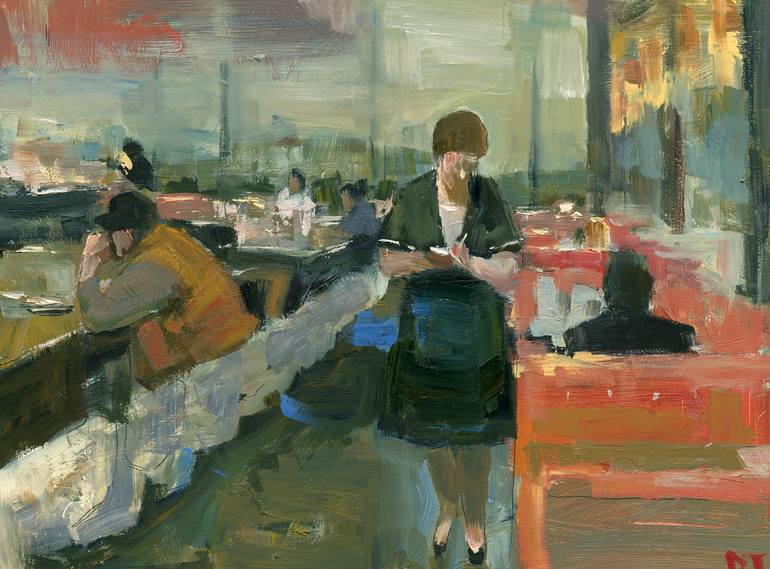
Darren Thompson (American, 1968–), Blonde with Sand, 2019. Oil on wood, 12 × 16 in. (A “blonde with sand” is coffee with cream and sugar.)
The waitress stands over me at 6:00 a.m. with pad and pen. She recites her litany with weary kindness; she says orange juice, coffee, two eggs over easy, says whole wheat toast, marmalade, each word a wafer I take from her hands and eat.
I stand before the white robed technician, my blouse draped around my hips. She gently cups my breasts in her hand, guides me between the cold steel wings of the machine. It will aim its radiant eye to uncover whatever mystery might be hidden there.
The beautician holds my head in her hands, tips it backward over the white chalice of the sink, sluices warm water through my hair again and again, smoothing the wings of my emptiness with her fingers until I am loosened and released.
This poem was originally published in Christianity and the Arts journal in 1999 and is reprinted here with the author’s permission.
+++
Taking its title from Psalm 91:11, “And He Shall Give His Angels Charge Over You” by Sharron Singleton expresses gratitude for those who work in the service sector, such as diner servers, mammography technologists, and hairstylists, who care for us through things like a hot cup of coffee, a diagnostic X-ray, or a relaxing shampoo—gifts that should not be taken for granted. The speaker of the poem, in fact, receives them as sacraments of sorts, describing the waitress’s recitation of menu offerings as “a wafer.” Similarly, the mammography tech wears a white robe, like the alb of a priest; she guides and illumines. And at the salon, the sink is like a chalice, a liturgical vessel, holder of the sacred—or a baptismal font; the speaker leaves washed and unburdened, light of spirit.
Singleton’s first full-length poetry collection, Our Hands a Hollow Bowl (Grayson Books, 2018), is an artful celebration of the sacramentality of nature and of everyday life—gardening, peeling potatoes, working, hiking, having sex, playing baseball, waiting in line, watching one’s son hold his son, selling a home full of memories. She also writes tenderly but without sentimentality about her mother and father, reflecting especially on her upbringing in rural Michigan, her mother’s slow death from cancer, and the pain of absence.
Singleton has recently completed the manuscript for her second full-length collection and is in the process of getting it published.
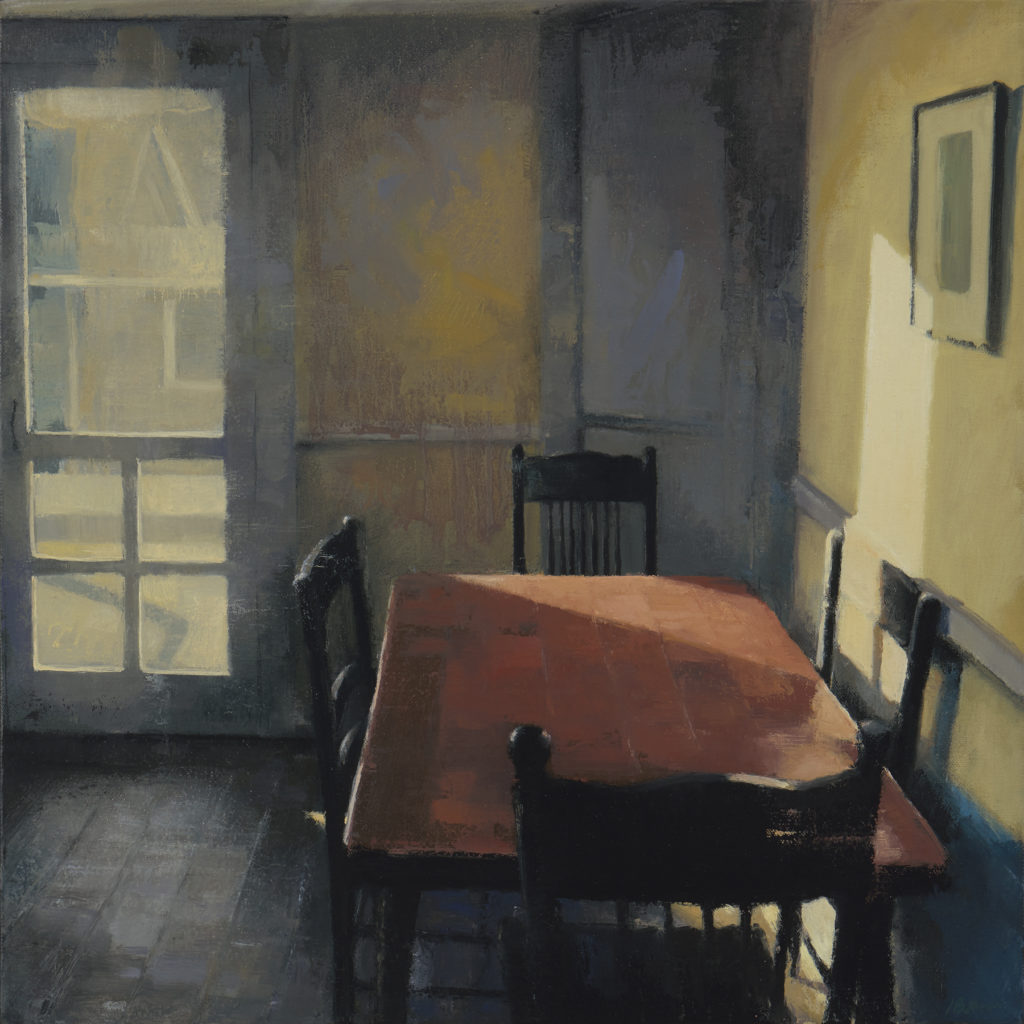
Jeff Bellerose (American, 1973–), Tranquil, 2018. Oil on canvas, 20 × 20 in. (50.8 × 50.8 cm).
1

Then shall all the trees of the wood sing for joy
      while each leaf thrusts into the universe of air
and the light green haze of April rises like smoke
      sweet in the nostril. Let the mind fill the hemisphere
of day while the sun beats a million white wings.
      Let each yellow and red bud in the dew
blaze forth with a hundred suns while night
      picks up her gauze and vanishes over the hills.
Let the rabbit’s eye shine while he drums the turf
      summoning his brethren;
the squirrels spiral down, their tails like clouds,
      to clatter among the woodsy rubble;
and the shrew shriek and hide herself under the root.

2

The cat stretches by the window and cries at the door;
      the dog yawns, then yelps at the rising sun
that will run all day till it drops in the west.
      The mattress creaks as the man rises to fix breakfast,
his back telling him he is—ah!—alive
      while the neighbor’s car snorts and gulps air
in an ascending whine.
      Children feel their way through cool porcelain bathrooms,
teenagers dream a world of shimmering electric presences
      and clothes rise from the dresser to glide across the skin,
the belt firmly encircles the waist
      and the tie mounts to prop the chin.

3

Yet, staring back from the bathroom mirror are
      the ghost of the office, the boss’s purposeful smile,
fog of the night’s dream, the nattering conscience,
      the gluttonous mortgage, the skin in love with gravity,
and the razor’s unkind cut—awareness of
      what is done and undone—the thousand engines of destruction
the cerebral cortex draws across its synapses
      toward the fragile sanctum of the present moment.
Let each ghost wither and vanish in sunlight,
      crisp to the nothing it is,
while a joyful procession dances along
      the myriad lightning pathways of the mind.

4

Tree and house are clear in this moment
      when light is given shape and each thing pauses,
itself—before the frame blurs, the attention fails
      and we fall into one or another distraction:
the horrors and banalities of the news, the half-typed letter,
      the mysteries of long division, the tumbled tower of blocks,
regret’s heavy shadow or the usual obsession.
      Lord, in the bright vehicle of this moment,
descend to us and spread your golden tent
      that we might keep sweet breakfast together, your beard dripping
honey as we ascend the dayspring of your eyes
      into an emptiness that is present, solid and real.
One of the reasons I love poetry is it brings me into more intimate contact with the world. It slows me down and asks me to give my attention to things that, in my constant, often self-inflicted busyness, I fail to notice. And it shepherds me into a deeper sense of gratitude and awe. It’s really easy for me to see the world’s ugliness—sin, suffering—and to be scared, angry, disgusted, horrified, or overwhelmed. My inclination is to see what’s wrong instead of what’s right. While poetry can perform many different functions, one of them is to attune us to the daily gifts and graces that come to us from, I believe, the hand of God.
In the spirit of Thanksgiving, here are ten contemporary poems of gratitude that can be read online. A popular tradition for this holiday is, when gathered with others round the feasting table, to take turns sharing what you’re thankful for. The three most typical answers for adults are: my family, my health, my job. These are perfectly fine answers. But poets can show us what it feels like to be blessed with family, for example, and can teach us how to offer praise even when our health is declining or we’re unemployed. Moreover, poets help us expand our repertoire of thanksgivings, naming things with specificity: “the incense of butter on toast” (Siegel), “the honey-colored toes of mice” (Singleton), “two daughters and one cloud, an old oak / and a great love” (Wiman), the moon that “shakes a dress of light onto my body” (Silver) and “shuffl[es] its soft, blind slippers over the floor” (Hirshfield).
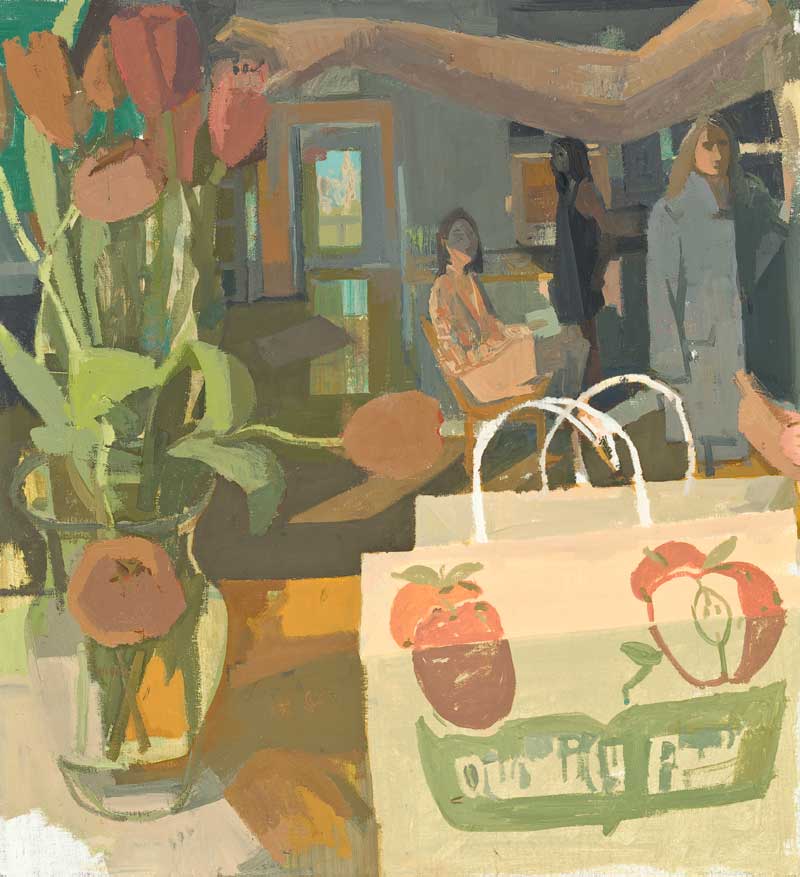
Susan Lichtman (American, 1952–), Orchard Bag and Bouquet, 2015. Oil on linen, 24 × 22 in.
I’ve listed the volume that each poem is published in—I’ve read all but the Browning one, and they’re all excellent. I hope this tiny sampling from the trove of contemporary poetry enlarges your thankfulness and inspires you to read more! Happy Thanksgiving, friends.
“When the sun returns”by Sarah Browning, in Killing Summer (2017): Jesus said to consider the birds. Browning does. “it is hallelujah time, / the swallows tracing an arc / of praise just off our balcony, / the mountains snow-sparkling / in gratitude . . .”
“A Song of Praises”by Robert Siegel (scroll to bottom of page), in Within This Tree of Bones(2013): In this very textural, sensory poem, a humdrum morning routine becomes a litany of more than two dozen in-the-moment gratitudes, for everything from warm washcloths to the snap of elastic to grapefruit flesh to a beautiful face at the breakfast table.
“I Praise Unsalted Butter”by Sharron Singleton, in Our Hands a Hollow Bowl (2018): Another litany of thanksgivings for the mundane, like pearl buttons, babies’ fingernail parings, freckles, delphinium’s cobalt, unseen dendrites, the word “rhubarb,” and so on. In spite of great evil (the poet references the famous “Napalm Girl” photograph), there is still much to wonder at.
“Fifty”by Christian Wiman, in Survival Is a Style (2020): “I never thought I’d live to the age of fifty, so my inclination these days is to praise,” says Wiman, who was diagnosed with a rare blood cancer in 2006 during his first year of marriage. “I wasn’t able to write about joy until I got sick. It wasn’t that sickness brought joy. It’s made me much more conscious of how much joy was in my life and gave me some impetus to articulate it.”
“Morning”by Yahia Lababidi, inBarely There: Short Poems (2013): This six-liner celebrates the newness and invitation of each day. (For a bonus poem by the same author, see “Breath.”)
“Psalm”by Marilyn Nelson, in The Fields of Praise (1997): Reflecting on the inherently dangerous act of driving, Nelson is thankful for (God’s) ongoing protection in the car. The poem ends with a classic line from the biblical book of Psalms.
“How Rarely I Have Stopped to Thank the Steady Effort”by Jane Hirshfield (scroll down to fourth poem), in The Beauty: Poems (2015): I would have never thought to be thankful for walls that stand up! But yes, the basic architecture of my little suburban home is a marvel—how it all holds together. In a pause in conversation, the speaker of this poem ponders all that’s going on in the silence: tree bark absorbing the scent of crow feathers, honey dissolving into tea, DNA replicating. The poem then turns into an expansive reflection on all the invisible phenomena of bodies and lives, of emotions and desires that ebb and flow as their building blocks get rearranged.
“A Handful of Berakhot” by Anya Krugovoy Silver, in The Ninety-Third Name of God (2010): Silver [previously] is one of the consummate poets of gratitude, particularly gratitude amid illness. She was pregnant with her first and only son, Noah, when she was diagnosed with inflammatory breast cancer in 2004. She died in 2018. Her body of work is characterized by a stubborn holding on to joy even as she wrestles honestly with God through many painful years of chemo and a mastectomy. Silver, a Christian, married a Jewish man, whose faith tradition inspired this poem. “In Judaism, a berakhah (pl. berakhot) is a formula of blessing or thanksgiving, recited in public or private, usually before the performance of a commandment, or the enjoyment of food or fragrance, and in praise on various occasions. The function of a berakhah is to acknowledge God as the source of all blessing” [source]. Silver’s nineteen custom berakhot are for such occasions as “buckling my son’s shoes,” “slipping my prosthetic breast into my bra,” “riding the ferris wheel,” and “going to the post office.”
“Gratitude”by Anna Kamieńska, in Astonishments: Selected Poems(2007): “I was full of thanks / like a Sunday alms-box,” Kamieńska writes in this rapturous poem, which bursts with love for everyone and everything.
Betye Saar (American, 1926–), Flight, 1963. Screenprint, 14 9/16 × 18 1/8 in. (37 × 46 cm). Museum of Modern Art, New York.
We walk in miracles as children scruff
through daisy fields, their dresses appliquéd
with shifting tide of blossom, welkin-stuff,
the Father’s white creative laughter made.
Common as spring, as bread, as sleep, as salt,
the daisies grow. Our Father made them reel
against us like the morning stars that vault
the greater home His love will yet reveal.
The petals push against the ankles, knees,
the thigh, the hands; gold pollen sifts within
the pores to rivulets of veins, to seas
of subtle life behind unsubtle skin.
O deeper and deeper than daisy fields, we drown
in miracles, in God, our Seed, our Crown.
“We Walk in Miracles” appears in After Silence: Selected Poems of Sister Maura Eichner, SSND (Notre Dame of Maryland University, 2011), published posthumously and copyrighted by the Atlantic-Midwest Province of the School Sisters of Notre Dame. Used with permission.




 Art & Theology