Easter, Day 8: Sent

Now the eleven disciples went to Galilee, to the mountain to which Jesus had directed them. When they saw him, they worshiped him, but they doubted. And Jesus came and said to them, “All authority in heaven and on earth has been given to me. Go therefore and make disciples of all nations, baptizing them in the name of the Father and of the Son and of the Holy Spirit and teaching them to obey everything that I have commanded you. And remember, I am with you always, to the end of the age.”

—Matthew 28:16–20

Jesus said to [his disciples] again, “Peace be with you. As the Father has sent me, so I send you.” When he had said this, he breathed on them and said to them, “Receive the Holy Spirit.”

—John 20:21–22

LOOK: The Great Commission by He Qi

He Qi_Great Commission
He Qi (Chinese, 1950–), The Great Commission, 2017. Oil on canvas. [purchase giclée print]

In this painting by the Chinese artist He Qi (pronounced huh chee), Jesus holds a staff in his right hand (he is the Good Shepherd) and with the other points to the world outside Jerusalem’s gates, to which he calls his disciples to carry his all-renewing gospel. A modern cityscape rises up behind the figures, indicating that this call extends to the present era.

In the foreground, a minister baptizes a kneeling woman in red, their forms intercut with a fishing boat. The boat is a reference to Peter and Andrew’s original vocation as fishers and to Jesus’s promise, should they choose to follow him, to make them “fishers of people” (Matt. 4:19)—that is, gatherers of folks into the wide net of (proto-)Christian community, proclaiming and living out the kingdom of God in the power of God’s Spirit.

The Holy Spirit is represented as a dove sweeping down from the heavens, caressing the edge of Jesus’s halo. He’s the wind in the sails of the woman at the right, who goes forth into the darkness bearing the light of God’s word—her cheeks aglow with it, her feet eager to publish it abroad.

Her predecessors in the task of preaching the good news of Christ’s resurrection are portrayed in the background—the three women who first discovered the empty tomb and who then proceeded to “go quickly and tell” (Matt. 28:7).

LISTEN: “As the Father Sent Me” by Alana Levandoski, on Behold, I Make All Things New (2018)

As the Father sent me
So I send you


This is the final “artful devotion” post of this Easter season—but Eastertide continues until June 8! Spiritual director Tamara Hill Murphy explains on her Substack:

Easter Sunday marks the beginning of a week in the liturgical calendar known as the Easter Octave, followed by a seven-week festival called Eastertide, also referred to as the Great Fifty Days.

Beginning with the Feast of the Resurrection and including the Feast of the Ascension, Eastertide lasts fifty days, paralleling the forty days Christ spent on earth after His resurrection, plus the ten days the disciples spent waiting for the promised Spirit of Jesus. Exclamatory worship and celebratory feasting characterize the prayers and practices of Eastertide, which include invitations for baptism, thanksgiving, savoring beauty, feasting, play, and caring for creation. It is a time of celebration for the new creation that Jesus inaugurates for all of us.

So keep celebrating! I will continue posting Easter content throughout the season, just at a lesser frequency.

On this eighth day of Easter and ever forward, may you be filled with the transforming knowledge, excitement, and power of Christ’s resurrection, and go out and share it with the world.

“Fishers of People” by Andrew Roycroft (poem)

Mynheer_Nicholas_The Calling
Nicholas Mynheer (British, 1958–), Jesus Appears on the Shore: The Calling, 2007. Oil on canvas, 31 × 25 cm. Final painting from the thirteen-piece Sarum Cycle on Christ’s passion. [read artist profile]

Just as day was breaking, Jesus stood on the shore;
yet the disciples did not know that it was Jesus.
(John 21:4)

Lap lulled by lifeless waters,
ill-cast nets bearing no weight,
the fishermen see against
charcoal dawn
the lone figure of the Lord—
come to draw them in again,
and launch them out.

This poem is No. XXXII from 33: Reflections on the Gospel of Saint John by Andrew Roycroft (Baltimore: Square Halo Books, 2022). Used by permission of the publisher.


Roycroft’s poems from the collection 33 are remarkable for their concision, especially this one based on John 21. There’s so much richness packed into these seven spare lines, about resurrection, restoration, plenitude, calling. The rabbi Jesus whom they had followed for three years and staked all their hopes in had died; he was executed by the state. Disappointed and forlorn, and some perhaps ashamed by their abandonment of him in his hour of deepest need, the disciples return to their livelihood as fishers. But their first night back at sea proves fruitless, yields no catch; the waters are dead, like their Lord. Or so they thought.

A voice from the shore yells out to them, telling them to cast their nets on the right side of the boat. Skeptically, they do, and the nets fill with such an abundance of fish that the men can barely heave them up. It’s then that they recognize the voice as that of their beloved Jesus. Peter cannot contain his joy and jumps into the sea, splashing his way to reunion with the one he had denied knowing just the previous week.

Jesus and friends then have a fish barbecue breakfast on the beach. He redeems Peter and removes his guilt by asking him three times, “Do you love me?,” giving him the chance to respond triply in the affirmative, counteracting the three no’s he had spoken the other night outside the house of Caiaphas. “Then feed my sheep,” Jesus says. Peter would go on to show his love for Jesus by doing just that, playing an instrumental role in the early church.

Luke places the episode of the miraculous catch of fish at the beginning of Jesus’s ministry, when Jesus calls his very first disciples (see Luke 5:1–11). That this episode bookends the Gospels speaks of second chances and the persistence of God’s promise to make fruitful his word. In both versions, the call is the same: “Follow me.” Through life and in death and out the other side.

At the end of the Gospel of John, Jesus calls his disciples back into ministry, to teaching and healing and spreading the good news of resurrection. The abundance teeming below the surface of the Sea of Galilee hints at the life and heft of the new movement Jesus was launching—the imminent multiplication of followers of the Way. Having reeled them in from their feelings of lostness and imbued them with fresh hope, Jesus casts his disciples back into the waters of the world, commissioning them to draw others into God’s kingdom of love and grace.


Andrew Roycroft is a poet and pastor from Northern Ireland who blogs at Thinking Pastorally. His poetry has featured in a variety of journals in the UK and Ireland, in Arts Council for Northern Ireland projects, on BBC Radio, and in the work of composer Anselm McDonnell, and he has received several commissions from New Irish Arts. 33: Reflections on the Gospel of Saint John (Square Halo, 2022) is his first poetry collection.

Pentecost art from Asia

Ten days after Jesus ascended into heaven (and fifty days after his resurrection), his Holy Spirit descended on the apostles, manifesting as “tongues of fire” (Acts 2:3). This miraculous gift enabled the apostles to speak in languages foreign to them but native to the many Jews from abroad who were gathered in Jerusalem for Shavuot (called “Pentecost” by Hellenized Jews), a festival of giving thanks for the harvest and for God’s provision of the Torah. For the first time the gospel of Jesus Christ was proclaimed to a global audience. Three thousand people came to faith that day, and the Christian church was born.

The Spirit is still at work in the dissemination of the good news today, breathing life into cultures all over the world and thereby building up an incredibly diverse body of Christ.

The arts are one expression of this diversity.

In the introduction to his groundbreaking book Each with His Own Brush: Contemporary Christian Art in Asia and Africa (New York: Friendship Press, 1938), Daniel Johnson Fleming writes,

As at Pentecost, Parthians, Medes and Elamites heard the message, “every man in his own tongue wherein he was born,” so we see Chinese and Japanese and Indians expressing Christianity’s universal language, each with his own brush. For when the spirit of God descends upon any people, new forms of beauty appear, new artistic gifts are revealed, adding another testimony to the universality of the Christian faith.

Since the publication of this book almost seventy years ago, Christianity has grown exponentially in Asia, as have indigenous artistic expressions of the faith. In 1975 Japanese theologian and arts advocate Masao Takenaka published the heavily illustrated book Christian Art in Asia, highlighting the robust variety being produced on the continent. Three years later the Asian Christian Art Association was founded to encourage the exchange of ideas between Asian artists and theologians. Their magazine, Image (not to be confused with the Seattle-based quarterly), has showcased local talents even further. Dozens more books have been published in English on individual Asian artists, countries, and the Asian Christian art movement in general. For the latter, see the beautifully designed The Christian Story: Five Asian Artists Today, plus The Bible Through Asian Eyes.

Below is a sampling of Asian art on the theme of Pentecost. Some works were made using traditional art forms or techniques—Chinese papercutting, Japanese flower arranging (ikebana) or stencil printing (kappazuri), Indian cloth dyeing (batik)—while other artists have chosen to work in oils and acrylics, collage, or glass. Some depict native people and settings—for example, Thai dancers wrapped in sabai, or a group sitting under a thatched roof in Indonesia—while others prefer ethnic and geographic ambiguity. There’s no single style that epitomizes the art of any country.

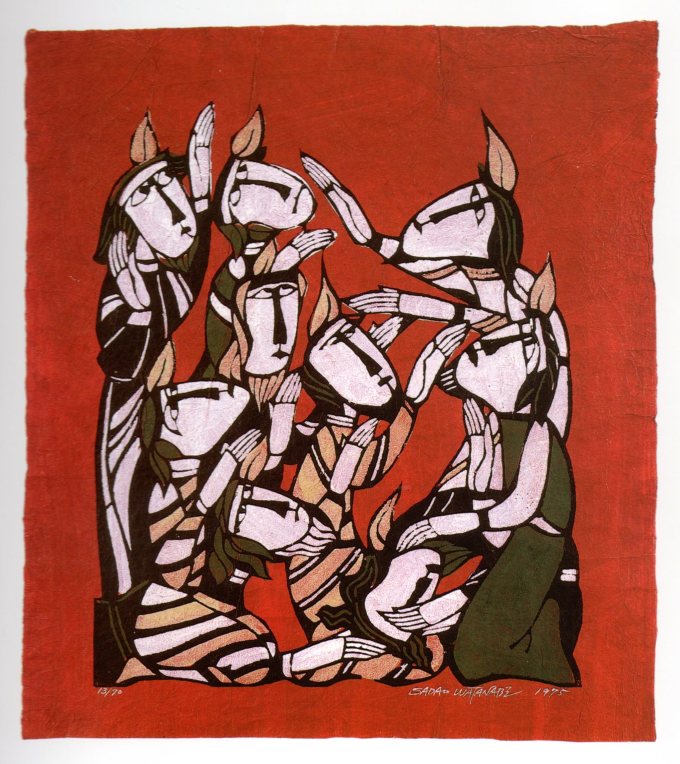
Pentecost by Sadao Watanabe
Sadao Watanabe (Japanese, 1913–1996), Pentecost, 1975. Hand-colored kappazuri-dyed stencil print on washi paper, 25.5 × 22.75 in. Source: Printing the Word: The Art of Watanabe Sadao (Philadelphia: American Bible Society, 2003)

Pentecost by Sadao Watanabe
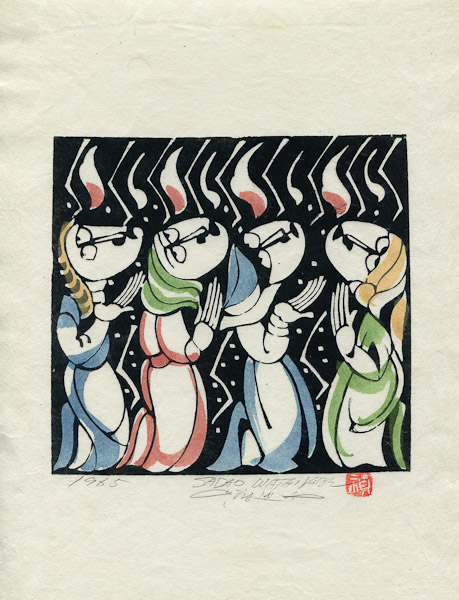
Sadao Watanabe (Japanese, 1913–1996), Pentecost, 1965. Hand-colored kappazuri-dyed stencil print on washi paper.

The Coming of the Holy Spirit by Soichi Watanabe
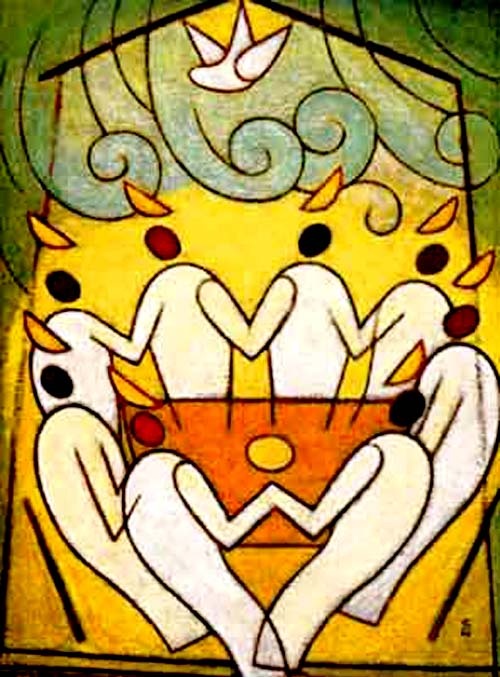
Soichi Watanabe (Japanese, 1949–), The Coming of the Holy Spirit, 1996. Oil on canvas, 18 × 13.25 in. Collection of the Overseas Ministries Study Center.

Pentecost by Tadao Tanaka
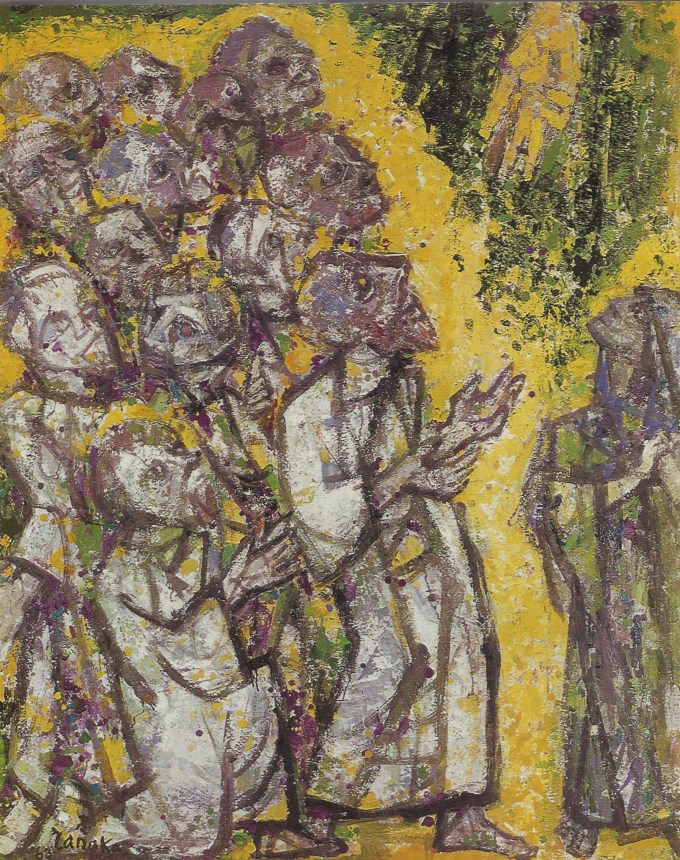
Tadao Tanaka (Japanese, 1903–1995), Pentecost, 1963. Oil on canvas. Source: Christian Art in Asia by Masao Takenaka (Tokyo: Kyo Bun Kwan, 1975)

Pentecost by Gako Ota
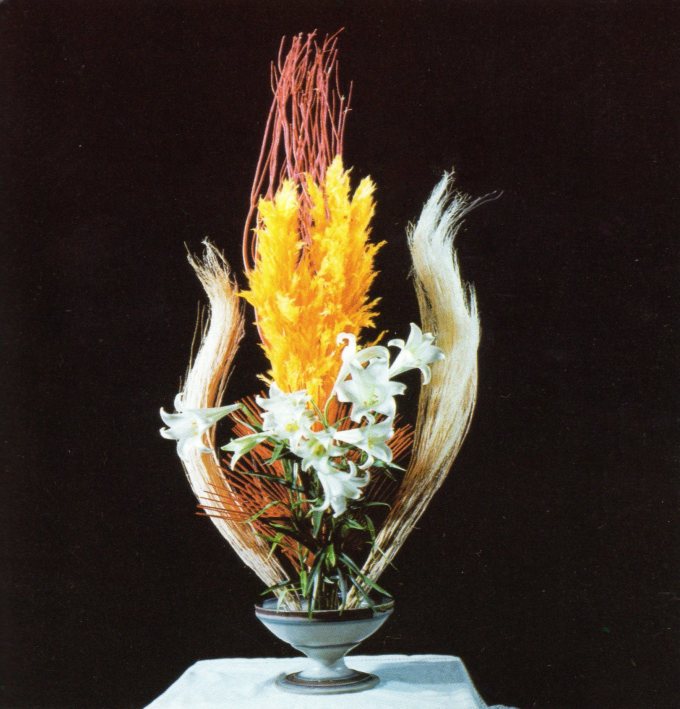
Gako Ota (Japanese, 1904–1972), Pentecost. Belvedere, pampas grass, paper bush, lilies, and rib of fan. Source: Consider the Flowers: Meditations in Ikebana, ed. Masao Takenaka (Tokyo: Kyo Bun Kwan, 1990)

Pentecost by Keiko Miura
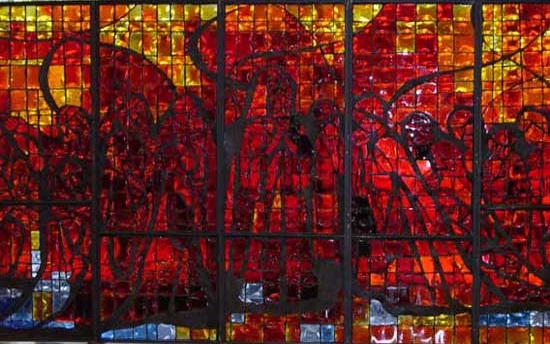
Keiko Miura (Japanese, 1935–), Pentecost, 2004. Stained glass window, All Pilgrims Christian Church, Seattle, Washington, USA.

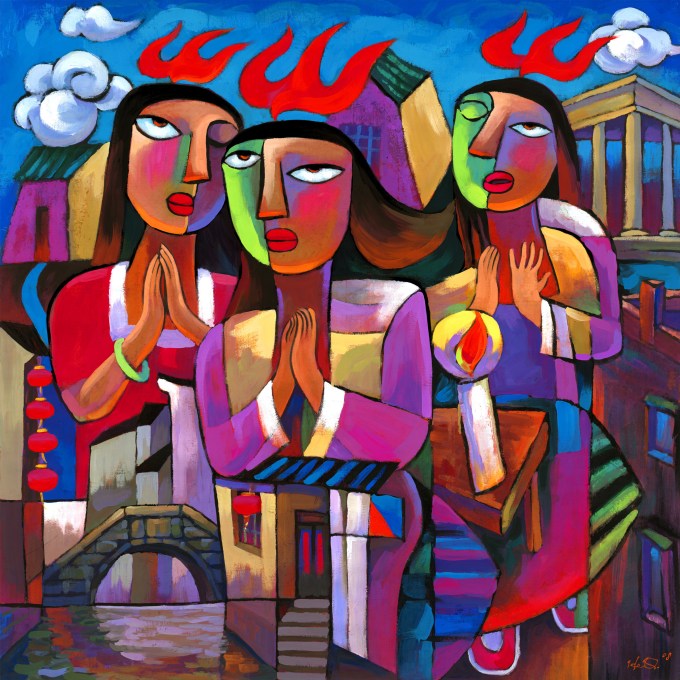
Holy Spirit Coming by He Qi
He Qi (Chinese, 1950–), Holy Spirit Coming, 1998. Oil on canvas.

Continue reading “Pentecost art from Asia”