Easter, Day 1: Welcome, Happy Morning!

LOOK: Harrowing of Hell by Kateryna Shadrina
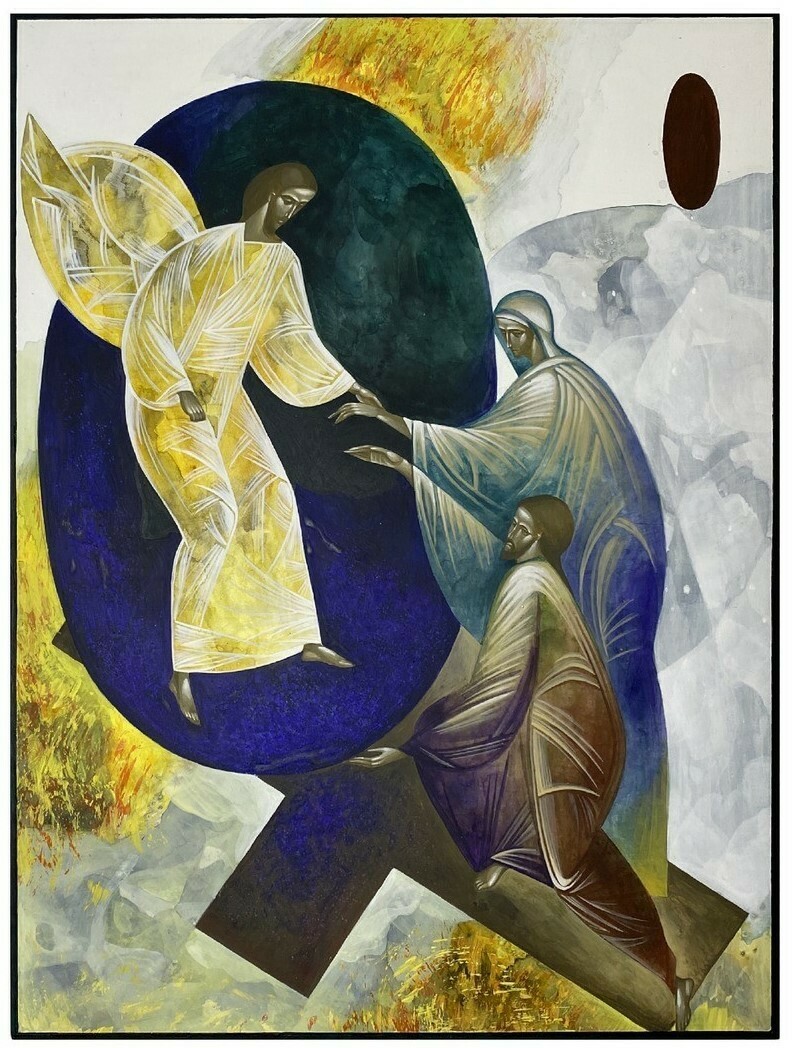
Shadrina, Kateryna_Harrowing of Hell
Kateryna Shadrina (Ukrainian, 1995–), Harrowing of Hell, 2021. Acrylic on gessoed wood, 40 × 30 cm.

This contemporary icon of the Resurrection shows Christ standing atop the gates of hell—which have fallen into the shape of a cross—redeeming Adam and Eve while flames whip all around. In the sudden rush of rescue, his cloak billows behind him. His mandorla—that is, the radiant oval that frames him—is traditionally gold, but here the artist has chosen a deep royal blue, symbolic of heaven, and jade green for healing, renewal, and prosperity. The black oval in the upper right may signify the mouth of the empty tomb, or the portal through which Christ will return with the newly liberated to the realms above.

LISTEN: “Welcome, Happy Morning!” | Original Latin words by Venantius Fortunatus, 6th century; English translation by John Ellerton, 19th century | Music: NOEL NOUVELET (traditional French tune), 15th century | Performed by the Green Carpet Players (musicians of Redeemer Church of Knoxville), feat. Tyler Anthony, on Rise, O Buried Lord, 2011

“Welcome, happy morning!”
age to age shall say:
hell today is vanquished,
heav’n is won today.
Lo! the dead is living,
God forevermore!
Him, their true Creator,
all his works adore.

“Welcome, happy morning!”
age to age shall say:
hell today is vanquished,
heav’n is won today.

Maker and Redeemer,
life and health of all,
thou, from heav’n beholding
human nature’s fall,
of the Father’s Godhead
true and only Son,
manhood to deliver,
manhood didst put on.

Thou, of life the author,
death didst undergo,
tread the path of darkness,
saving strength to show.
Come then, True and Faithful,
now fulfill thy word;
’tis thine own third morning:
rise, O buried Lord!

Loose the souls long prisoned,
bound with Satan’s chain;
thine that now are fallen
raise to life again;
show thy face in brightness,
bid the nations see;
bring again our daylight;
day returns with thee.

I like how this hymn—whose origins are in the sixth century!—integrates the Incarnation into the story of Easter, enfolding together Jesus’s birth, life, death, and resurrection as well as his second coming.

To deliver humanity from the thrall of sin and death, the second person of the Trinity put on human flesh. He lived faithfully and died a sacrificial death. And then this God-Man came back to life! Now all the created world praises his name. The hymn ends with a prayer to see resurrection life in our world and for Christ’s return. “True and Faithful” in the third stanza are epithets of Jesus, the white-horse rider, in Revelation 19:11.

The musicians of Redeemer Church of Knoxville have paired the early medieval text with the fifteenth-century French carol tune NOEL NOUVELET, which is more commonly used with “Sing We Now of Christmas” and “Now the Green Blade Riseth” but works equally well here. The group brings a raucous energy and sings at a quickened tempo, using xylophones, mandolins, and trumpets in their celebration of the Risen Christ.

This song and many others can be found on my Eastertide playlist.


During the Easter Octave (the first eight days of the fifty-day season of Easter), I will continue publishing short daily posts in this art-and-song format.

Easter Playlist

Easter Sunday is the most joyful day of the Christian year, kicking off a fifty-day season of feasting and celebration centered on the resurrection of Jesus Christ. While we celebrate the resurrection year-round (every Sunday is a “little Easter”), the liturgical calendar gives us this set-apart time to linger with and savor the mystery with particular focus and renewed fervor. Christ’s rising from the grave has far-reaching implications, which the church unpacks, most especially during Eastertide, through its liturgies, scripture readings, sermons—and music.

I compiled a Spotify playlist of songs and other musical pieces for this festal season—a mix of classical, gospel, choral, folk, and indie-pop, with some jazz and bluegrass. These selections span historical periods and geographic locales, ranging from early medieval hymns and liturgical refrains to newer releases, from Senegal, Tanzania, Chile, Tyendinaga Mohawk Territory (in Ontario), Serbia, Hungary, Germany, Ireland, France, the Middle East, and more.  

You’ll find plenty of classic texts and tunes, some retunes and new arrangements of the classics and other oldies, and some through-and-through originals. And lots of Alleluias!

Sung in Byzantine-rite churches, the Paschal troparion—“Christ is risen from the dead, trampling down death by death, and on those in the tombs bestowing life”—is represented here by a few different settings in a few different languages, including Georgian (“Krist’e Aghsdga”) and Greek (“Hristos Anesti”). Church of the Apostles does a version in English that works well with a contemporary worship band.

The medieval French melody known as NOEL NOUVELET is often paired with two different Easter hymn texts, both of which I’m very fond of: “Welcome, Happy Morning!” by Venantius Fortunatus, a sixth-century hymnographer in the Merovingian court and later bishop of Poitiers, and the early twentieth-century “Now the Green Blade Riseth” by J. M. C. Crum, which has this wonderfully poetic refrain: “Love is come again like wheat that springeth green.” Claire Holley [previously] recorded a subdued, guitar-picked rendition of the latter, and for the former, here’s Redeemer Knoxville’s [previously] super-fun arrangement, which includes mandolins, trumpets, and a raucous energy!

Christ’s death and resurrection initiated a new exodus, so to speak, so some of the songs, like “Carol of the Exodus” [previously] and “Mary, Don’t You Weep” [previously] use the language of Pharaoh’s armies (i.e., agents of death) being overthrown, and liberation.

Also included on the list is a Swahili praise song whose key phrase, “Yesu ni wangu, wa uzima wamilele,” translates to “Jesus is mine, he is (the God of) everlasting life.” Some English versions of the song translate it as “Jesus is mine, he’s alive and he’s eternal.”

Classical selections include the Sinfonia (instrumental opening) of Bach’s Easter Oratorio; “Dum transisset Sabbatum” (When the Sabbath Was Past), a Renaissance motet setting of Mark 16:1–2 by John Taverner; a movement from a piano sonata by modern Finnish composer Einojuhani Rautavaara inspired by the icon of the holy women at the tomb; and a movement from a violin sonata by Austrian Baroque composer Heinrich Ignaz Franz Biber.

The latter two are among the several allusive instrumental pieces on the list, which also include “Viriditas” on jazz guitar by Charlie Rauh (its title references Hildegard of Bingen’s concept of greening, freshness, new life) and “Phoenix” on oud by Egyptian Australian virtuoso Joseph Tawadros (the phoenix is a mythological bird that dies and rises again, which the medieval church embraced as a symbol of Christ).

Two gems I discovered while searching for Easter music are settings of Gerard Manley Hopkins’s poem “Easter”: one a Celtic-influenced choral setting by Steven C. Warner, the other an alt-rock version by Jon Green (JG Hymns):

A popular Easter song in Spanish-speaking churches throughout the world is “Resucitó” (He Is Risen) by Kiko Argüello:

There are a few songs here written for kids, like “Jesus Is Alive” by Rain for Roots and “Risen Today” by John Burland, but which I find enjoyable myself!

And there are a handful of songs by James Ward [previously], a gospel songwriter and pianist from New City Fellowship in Chattanooga, Tennessee—such as “Morning Sun,” which is included in the Trinity Hymnal:

For a closer, I chose “Love Divine, Victorious,” written by Karl Digerness and arranged by Minna Choi, musicians at City Church San Francisco [previously]. I love its blend of classical and folk-rock styles, with an orchestra interacting with a banjo and drum kit. (The album recording has a full orchestra and a choir; the video below is a pared-down version from last year, with string orchestra and two vocalists.) The song looks back in remembrance and forward in anticipation, quoting the traditional memorial acclamation “Christ has died, Christ is risen, Christ will come again.”

To listen to all 130-plus songs on Spotify, open the Art & Theology Eastertide Playlist link, then click on the More (…) icon and select “Save to Library.” Then the list will be easily accessible to you throughout the season and will reflect any new song additions I make.

Easter Playlist Cover

Playlist cover art: Edward Burra, Resurrection, ca. 1948–50

Holy Wednesday (Artful Devotion)

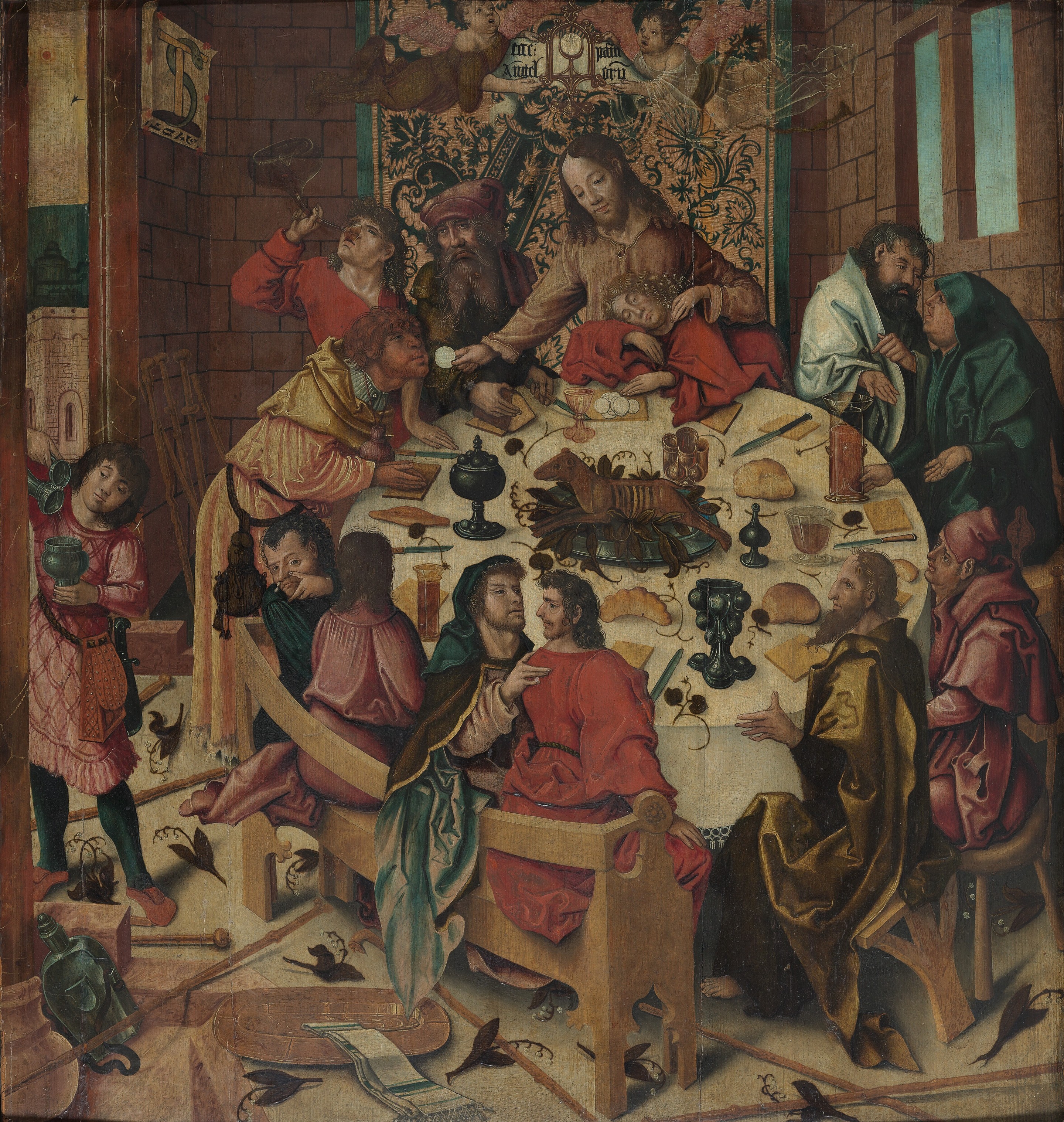
Ratgeb, Jorg_Last Supper (detail)
Attributed to Jörg Ratgeb (German, ca. 1480–1526), The Last Supper (detail), 1505–10. Oil on panel, 38 7/10 × 36 in. (98.5 × 91.5 cm). Boijmans van Beuningen Museum, Rotterdam, Netherlands.

Even my close friend in whom I trusted,
who ate my bread, has lifted his heel against me.
But you, O LORD, be gracious to me,
and raise me up . . .

—Psalm 41:9–10

“. . . the Scripture will be fulfilled, ‘He who ate my bread has lifted his heel against me.’ I am telling you this now, before it takes place, that when it does take place you may believe that I am he. . . .”

After saying these things, Jesus was troubled in his spirit, and testified, “Truly, truly, I say to you, one of you will betray me.” The disciples looked at one another, uncertain of whom he spoke.

One of his disciples, whom Jesus loved, was reclining at table at Jesus’ side, so Simon Peter motioned to him to ask Jesus of whom he was speaking. So that disciple, leaning back against Jesus, said to him, “Lord, who is it?”

Jesus answered, “It is he to whom I will give this morsel of bread when I have dipped it.” So when he had dipped the morsel, he gave it to Judas, the son of Simon Iscariot.

Then after he had taken the morsel, Satan entered into him. Jesus said to him, “What you are going to do, do quickly.” Now no one at the table knew why he said this to him. Some thought that, because Judas had the moneybag, Jesus was telling him, “Buy what we need for the feast,” or that he should give something to the poor.

So, after receiving the morsel of bread, he immediately went out. And it was night.

—John 13:18b–19, 21–30

+++

SONG: “Judas Song (Psalm 41​:​9​–10)” by Matt Grimsley (words adapted from the Trinity Psalter) | Performed by the Green Carpet Players, on Morning to Evening (2014)


ORCHESTRAL REPRISE: “Judas Song, Pt. 2: The Betrayer” by Amy Porter, based on a melody by Matt Grimsley | Performed by the Green Carpet Players, on Morning to Evening (2014)


The Green Carpet Players is the recording alias of the musicians of Redeemer Church of Knoxville. Since they released this second album in 2014, chief musician Matt Grimsley, who wrote “Judas Song,” has become the founding pastor of Resurrection Presbyterian Church in Madison, Wisconsin, and Amy Porter is now worship director at Church of the Redeemer in Maryville, Tennessee.

+++

Ratgeb, Jorg_Last Supper
Attributed to Jörg Ratgeb (German, ca. 1480–1526), The Last Supper, 1505–10. Oil on panel, 38 7/10 × 36 in. (98.5 × 91.5 cm). Boijmans van Beuningen Museum, Rotterdam, Netherlands.

In Jörg Ratgeb’s Last Supper, the disciples have laid aside their pilgrim’s staffs and have sat down to a Passover meal of roast lamb, bread, and wine. Jesus, having just announced that one of them would betray him, looks across the table at Judas, the group’s treasurer—who wears not one but two purses! Jesus tenderly and regretfully feeds Judas an unleavened wafer, indicating that he’s the one. The others seem not to notice—groups of two discuss among themselves who the traitor might be; one disciple guzzles down more wine from a tubed bottle, while another pours more from a jug; John’s asleep to Christ’s left, and to his right Peter stares blankly into space, knife in hand (foreshadowing his cutting off the ear of one of Jesus’s arresters later that night); and one crass disciple turns his head to shoot snot out his nose.

Jesus has just washed all their feet, as indicated by the water basin and towel in the foreground—a stunning act of humility. (We will visit that episode in tomorrow’s Gospel reading.) His supremest act of humility is but a day away. It’s alluded to by the poster at the left of a snake lifted up on a staff (see John 3:14–15), as well as by the monstrance (a receptacle for the consecrated Eucharistic host) that two angels raise above Jesus’s head, proclaiming his impending sacrifice.

The sweet, generative nature of this sacrifice is underscored by the lily-of-the-valley that’s strewn all over the floor and table, as the flower is connected with the advent of spring and the promise of new life.


This post belongs to the weekly series Artful Devotion. If you can’t view the music player in your email or RSS reader, try opening the post in your browser.

To view all the Revised Common Lectionary scripture readings for Wednesday of Holy Week, cycle A, click here.