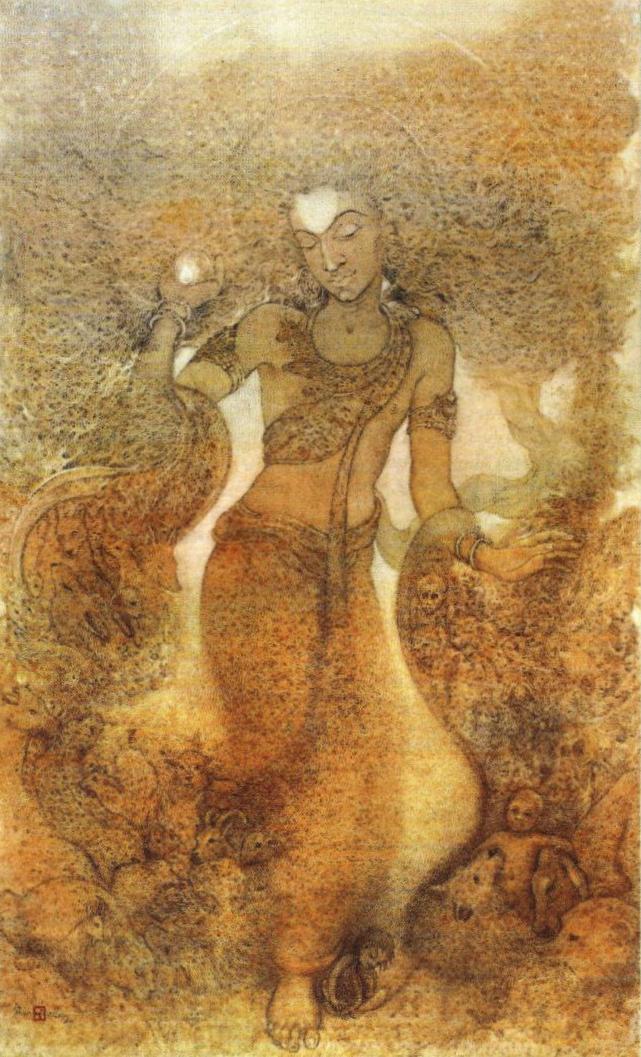
Frank Wesley (Indian, 1923–2002), The Promise of Peace, 1994. Watercolor, 50 × 30 cm.
Frank Wesley (1923–2002) [previously] is one of the twentieth century’s most celebrated Indian Christian artists. His watercolor The Promise of Peace appears on the cover of the March 1996 issue of Image: Christ and Art in Asia, the monthly magazine of the Asian Christian Art Association, which is where I sourced it from. Painted in warm brown earth tones and based on Isaiah 11:1–9, it shows an Indianized Jesus ushering in the peaceable kingdom of God. The ACAA provides the following commentary:
Christ is the shoot rising from the stump, and the Spirit of the Lord’s presence is shown in the white egg/flame/pearl in the upraised right hand and in the white heart shape centred on Jesus’ brow. A faint halo encircles his head, while a second halo sweeps from the right hand down to the left hand, under which the needy of the land shelter. The little child living at peace with many different animals is visible in the bottom right-hand corner, and the child playing unharmed with the viper is seated at the foot of Jesus. On the left-hand side of the painting a wide variety of creatures are playing happily together. The bracelet on Jesus’s left upper arm carries the symbol for Peter while that on the right upper arm signifies Paul. The symbols of the four gospel writers can be seen in the necklet.
LISTEN: “O Lord, May Your Kingdom Come” | Words by Greg Scheer, based on Isaiah 11:6–9, 2014 | Music by Eric Sarwar, based on the Raga Mishra Shivranjani, 2014 | Led by Eric Sarwar at the Calvin Symposium on Worship, 2019
Refrain: اے خدا تیری بادشاہی آئ (Transliteration: Aey Khuda, teri badshahi, aey) O Lord, may your kingdom come
Where the wolf and lamb Shall lie down as kin And a child shall lead them [Refrain]
Where the cow shall graze And its calves will play With the cubs of the lion [Refrain]
Where the babe in arms Shall fear no harm From the snake or the adder [Refrain]
May your kingdom come May your will be done On earth as in heaven [Refrain]
Born and raised in Pakistan, Rev. Dr. Eric Sarwar is a musician, global missiologist, and the pastor of Artesia City Church in Southern California, made up of Indian and Pakistani immigrants. He is also the founding president of the Tehillim School of Church Music and Worship in Karachi, which fosters the academic study of the ethnomusicology, missiology, and tradition of Christian worship in communities across Pakistan and the overseas diaspora. He plays the harmonium and is fluent in English, Hindi, Punjabi, and Urdu. He is the author of Psalms, Islam, and Shalom: A Common Heritage of Divine Songs for Muslim-Christian Friendship (Fortress Press, 2023) and is a frequent organizer of zabur (psalm) festivals.
In the video above, extracted from a Vespers service, Sarwar leads attendees of the 2019 Calvin Symposium on Worship in Grand Rapids, Michigan, in an anthem he wrote with Greg Scheer, joined on stage by other musicians from the symposium. The refrain is in Urdu and English.
This post is part of a daily Advent series from December 2 to 24, 2023 (with Christmas to follow through January 6, 2024). View all the posts here, and the accompanying Spotify playlist here. “O Lord, May Your Kingdom Come” is not on Spotify.
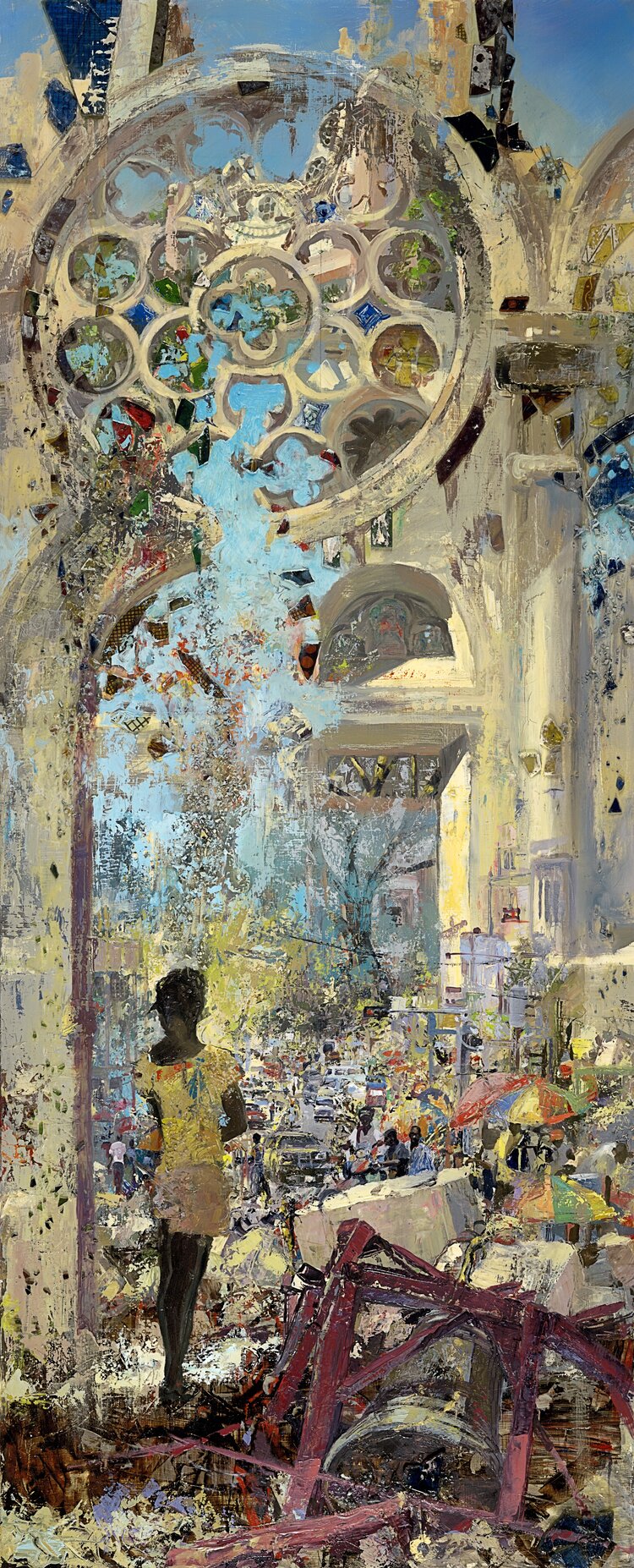
Bryn Gillette (American, 1980–), Cathedral, 2010–11, from the Beyond the Ruins series. Oil and glass shards on wooden door, 80 × 32 in. (203.2 × 81.3 cm). [available as a giclée print]
In 2000 while on a ministry trip to Jamaica, artist Bryn Gillette met Daniel Jean from Haiti, who was finishing up his Bible degree there while caring for five orphaned children. After Jean graduated he returned to Haiti and became a pastor and, over the next several years, continued taking in a growing number of children—ten, twenty-one, sixty-five!—from off the streets, giving them, through the help of his church community, food, shelter, medical care, education, love, and a sense of home.
While a large number of Haiti’s estimated 1.2 million orphans and vulnerable children (OVC) have lost parents to natural disaster, disease, gang violence, or political turmoil, most are what are called “social orphans,” meaning they have one or more living parents but that parent is unable to provide for them, usually because of poverty or drug addiction, and they are forced to fend for themselves. Some of these children are abandoned out of painful necessity; others, out of neglect. Jean was himself orphaned by poverty as a child, so he has an enormous amount of empathy for those in the same situation.
Having kept up a regular correspondence with Jean ever since their initial meeting, Gillette took his first trip to Haiti in 2008, to visit Jean and to meet the very large family he had built! Later that year he and his father, Mark Gillette, founded the nonprofit TeamOne:27 to support Jean’s work. Since then Jean’s family has grown to include more than two hundred kids in three “homes of blessing”—two in Port-au-Prince and one in Les Cayes, near where the magnitude 7.2 earthquake struck this August. The Gillettes describe Daniel Jean as a modern-day George Müller.
Bryn Gillette has since returned to Haiti seven more times and considers himself an “artistic ambassador” for the country. Cathedral is part of his twelve-piece Beyond the Ruins series of paintings, made in the aftermath of the catastrophic January 12, 2010, earthquake that struck just outside the capital of Port-au-Prince, killing tens of thousands of Haitians. Each painting was executed on a standard-size door, metaphoric of the aspiration that Haiti will emerge stronger on the other side of this tragedy—that it will pass “beyond the ruins.”
Gillette began painting Cathedral in July 2010, when he was first able to visit the ruins of the Cathédrale Notre-Dame de L’Assomption in Port-au-Prince. “At that time the property was gated and uncleared of the rubble and deceased,” he said.
Detail
He returned in summer 2011, at which point he was able to go inside the shell of the church.
I spent much of my time sorting through the small piles of remaining debris and collecting discarded “treasures” of the stained glass windows. It became a game to the local children, who sent me home with a pile of several pounds of glass. I vowed to myself to honor these sacred shards somehow in a work that would be a worthy tribute to these precious and grieving Haitians. I embedded shards and crushed fragments of the Cathedral’s glass into the painting itself, praying over Haiti with what I might describe as a weeping hope.
While he was there he saw a young girl lingering in the doorway, standing on the wreckage and staring out over the cityscape. In the painting, Gillette said, she represents on one level a personified Haiti, vulnerable and grieving and interceding for her people. Hear more from the artist on this painting in this 2019 video:
After eleven years, Notre-Dame Cathedral has still not been rebuilt, though donations have enabled the erection of a transitional 1,500-seat structure on the site, where Masses are celebrated. Its ruins, especially its shattered rose window, are now a distinguishing feature of the Port-au-Prince skyline.
Lament and hope are key elements of Gillette’s Beyond the Ruins series as a whole, as he elaborates:
During the years I worked on these images, the painting process distilled countless hours of conversation, travel, prayer, heartache, and hope into color and form. These door-size portals are our declarations of hope, our inner groaning for justice made visible, a plea for God’s Spirit to renew Haiti’s destiny. . . . It is my hope that this work be a catalyst for Kingdom scale conversations, dreams, prayers, relationships, and initiatives.
Cathedral speaks powerfully of one of the main themes of Advent: mourning the brokenness (of our bodies, spirits, families, cities, governments, earth, etc.) while awaiting the coming of a new day. And even as we wait, we work—we (re)build, we mend. We keep our hands to the plow. We sow weeping.
“I feel like I am often praying in imagery rather than words,” Gillette says. Though I am viewer, not maker, I often feel the same—that my consideration of a particular image is my prayer. I’m thankful to artists who are able to express these “prayers” so eloquently and who put them out into the world so that we, too, can lift them up to God.
LISTEN: “Jesucristo, esperanza del mundo” (Jesus Christ, Hope of the World) | Words by Silvio Meincke, 1982; trans. Pablo D. Sosa, 1988 | Music by João Carlos Gottinari and Edmundo Reinhardt, 1982; arr. Greg Scheer, 1994 | Performed by Calvin University’s Capella, 2021
A little beyond this our time The future announces with gladness No war, no disaster, no crime No more desolation, no sadness
Lord, may your kingdom come The joy of our world re-create And all our hope and our longings Transform in the fullness of life Aié, eiá, aié, aié, aié
A bud of your hope is sprouting The token of flowers in spring A world to arrive, no doubting With justice and joy that you bring
We hope to cast out all our hate We long for a world of pure beauty In which peace will never abate And justice will be, then, our duty
The seeds of your kingdom we bear Your future is drawing so near The earth with your help we prepare Until you, in fullness, appear
I’m aware that Spanish is not an official language of Haiti, but I’m always bringing art from different cultures into contact with one another, as I like to reveal points of connection across contexts. In addition to the obvious connections between today’s featured hymn and painting, consider the small but meaningful resonance between the line “A bud of your hope is sprouting” and artist Bryn Gillette’s description of the umbrellas on the Rue St Laurent opening like flowers.


 Art & Theology