
The Word, for our sake, became poverty clothed as the poor who live off the refuse heap.

The Word, for our sake, became agony in the shrunken breast of the woman grown old by the absence of her murdered husband.

The Word, for our sake, became a sob a thousand times stifled in the immovable mouth of the child who died from hunger.

The Word, for our sake, became rebellion before the lifeless body of Gaspar Sanchez Toma, “scientifically” murdered.

The Word, for our sake, became danger in the anguish of the mother who worries about her son growing into manhood.

The Word became an ever-present absence among the 70,000 families torn apart by death.

The Word, for our sake, became an inexorable accusation arising from the blazing craters which swallowed up their tortured bodies.

The word-knife cut us deeply in that place of shame: the painful reality of the poor.

The Word blew its spirit over the dried bones of the Mummified-Churches, guardians of silence.

The Word, that early-morning-bugle, awoke us from the lethargy which had robbed us of our Hope.

The Word became a path in the jungle, a decision on the farm, love in women, unity among workers,
and a Star for those few who can inspire dreams.

The Word became Light,
The Word became History,
The Word became Conflict,
The Word became Indomitable Spirit,
and sowed its seeds
upon the mountain,
near the river, and in the valley,

and those-of-good-will heard the angels sing.

Tired knees were strengthened,
trembling hands were stilled,
and the people who wandered in darkness
saw the light!

Then,

The Word became flesh in a nation-pregnant-with-freedom,
The Spirit strengthened the arms which forged Hope,
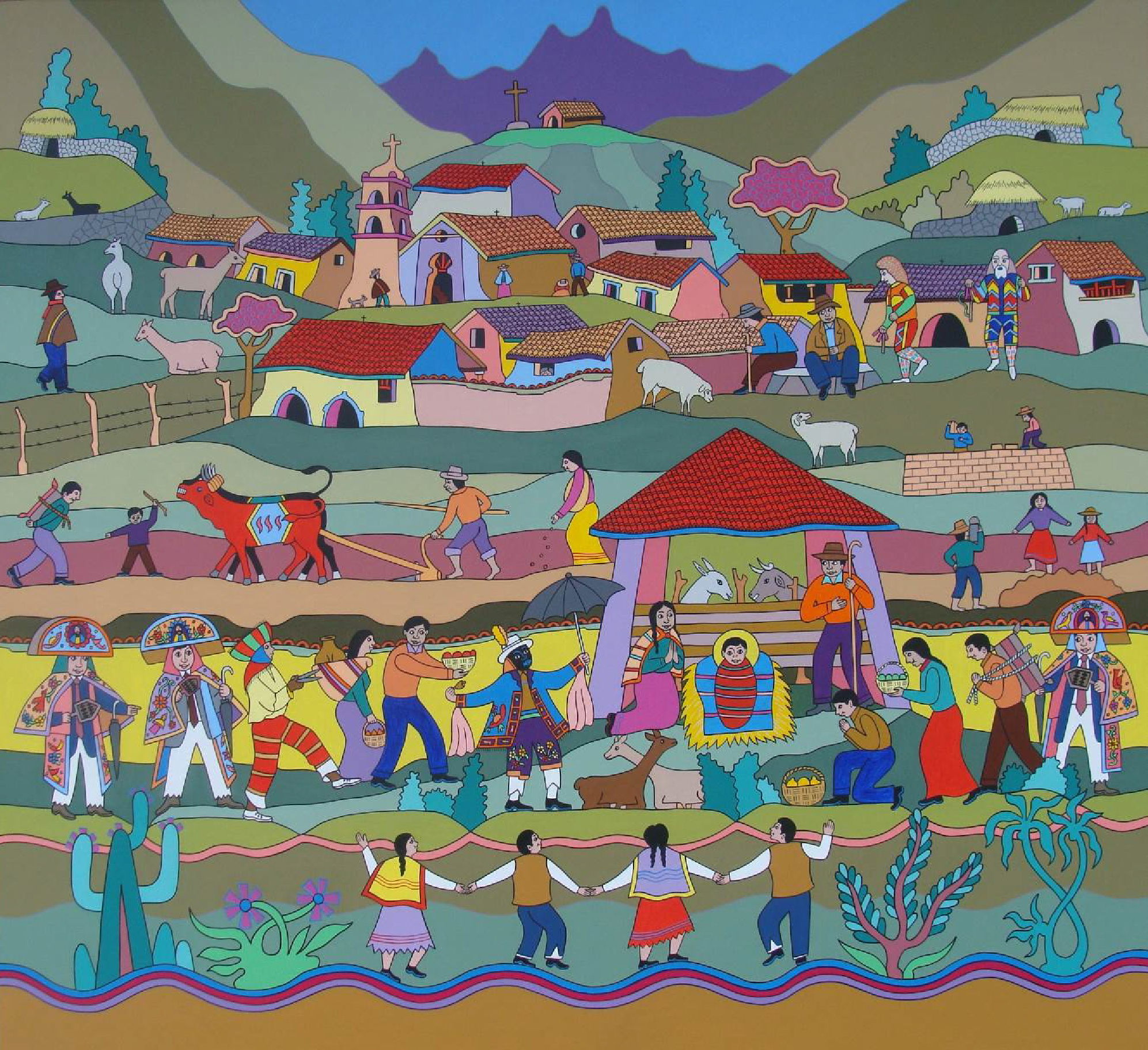
The Verb became flesh in the people who perceived a new day, and for our sake became life in Mary and Joseph who embrace Righteousness and bury the people’s ignominy.

The Word became the seed-of-justice
and we conceived peace.

The Word cried out to the world the truth about the struggle against the anti-man.

The Word made justice to rain
and peace came forth from the furrows in the land.

And we saw its glory in the eyes of the poor converted into true men and women.

Grace and Truth celebrated together
in the laughter of the children rescued by life.

And those-who-saw-the-star
opened up for us
the path we now follow.

Meanwhile,
Herod, slowly dying,
is eaten by worms.

The Word became judgment
and the anti-men ground their teeth.

The Word became forgiveness
and human hearts
learned to beat with love.

And the Word shall continue sowing futures
in the furrows of Hope.

And on the horizon,
the Word made light
invited us to relive a thousand dawns
toward the Kingdom that comes.

The Word will gather us round her table.
And they will come from the East and the West,
from the North and the South,
and dressed in incorruption
we-will-finally-be-happy.
Translated from the Spanish by Maria Elena Acevedo, René Calderón, Maria Elena Caracheo, Sister Caridad Inda, and Philip Wheaton in the bilingual Threatened with Resurrection / Amenazado de Resurreción: Prayers and Poems from an Exiled Guatemalan (The Brethren Press, 1982).
Julia Esquivel (1930–2019) was a Guatemalan poet, theologian, lay preacher, biblical studies teacher, social worker, and human rights activist. In 1953 she moved to Costa Rica to study at the Seminario Biblico Latinoamericano, returning to Guatemala to work at the Instituto Evangélico América Latina. After speaking out against the massacres, assassinations, torture, and forced disappearances being carried out by the Guatemalan military and police, she received death threats and survived two kidnapping attempts and thus went into forced exile in 1980, finding refuge in the monastic Communauté de Grandchamp in Switzerland. She studied at the Ecumenical Institute at Château de Bossey, run by the World Council of Churches. She returned to her home country in 1996 after the signing of the Peace Accords, helping document over two hundred thousand civilian deaths and disappearances for the Recovery of Historical Memory Project and working with women traumatized by violence. She is the author of several books, including the poetry collections Threatened with Resurrection (1982) and The Certainty of Spring (1993).
 Art & Theology