Art at the United Nations Headquarters in New York

Chagall’s Peace Window is one of the most significant works in the United Nations’ art collection. On my quick visit to New York City last month, where the UN is headquartered, I was hoping to see it, but I emailed ahead of time and found out it’s not currently available for viewing due to construction behind it. (You can “see” it but not really, because it’s not lit, and there’s a tall plastic barrier in front.) I was disappointed, but I decided to visit the UN anyway, to see what other art I might find.

The United Nations was founded in 1945 for the purpose of preventing a third world war. Comprising 193 member states, the organization is committed to maintaining international peace and security, developing friendly relations among nations, and promoting social progress, better living standards, and human rights. Their motto is “Peace, dignity, and equality on a healthy planet.”

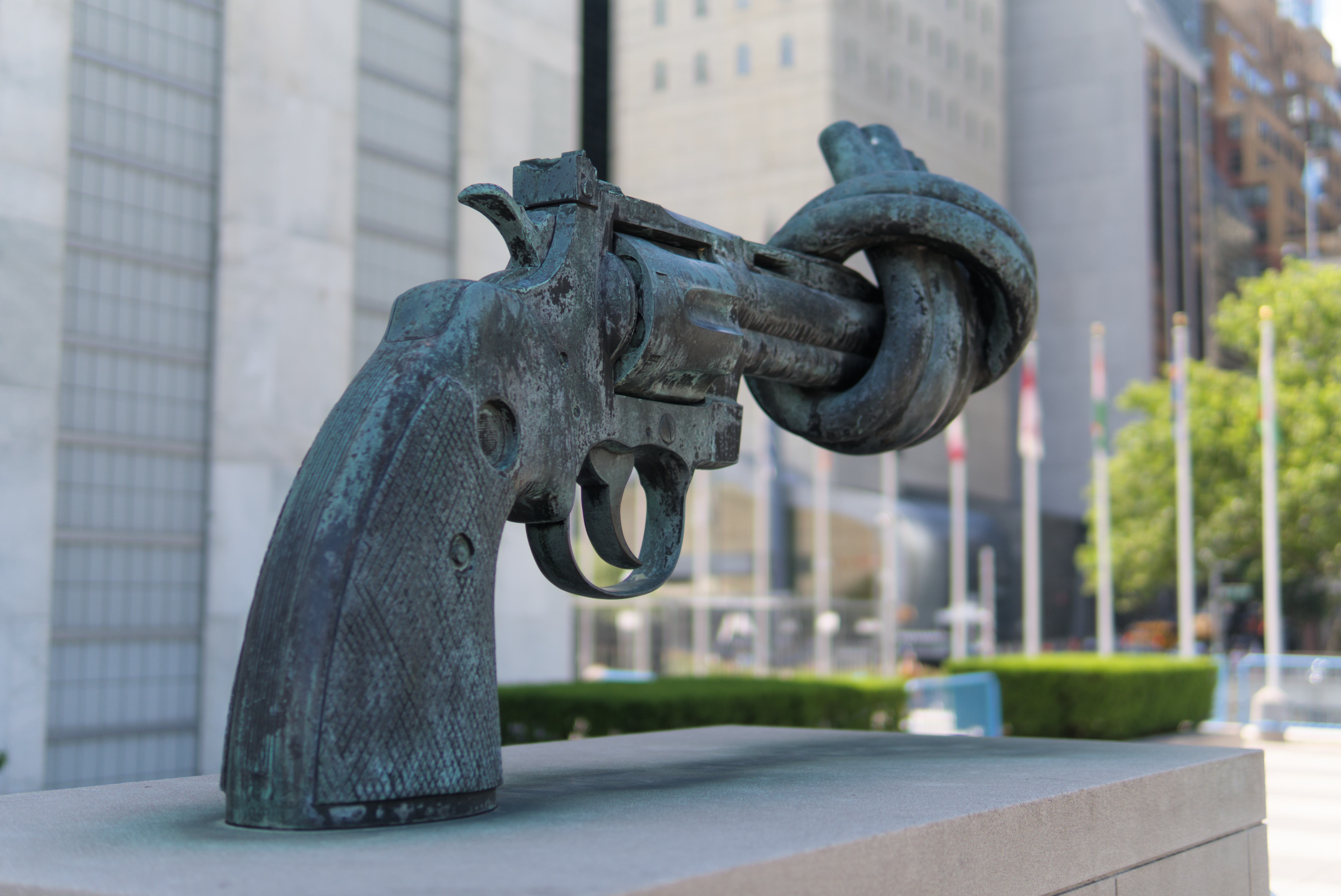
After presenting my ID, getting my photo taken, being stickered, and going through security, I was inside the campus and directed to the General Assembly Building. Outside the entrance to this building is the famous Non-Violence bronze, aka The Knotted Gun, by Carl Fredrik Reuterswärd of Sweden. The artist made the sculpture in 1980 after his friend John Lennon was murdered. He wanted to honor the singer-songwriter’s vision of a peaceful world.
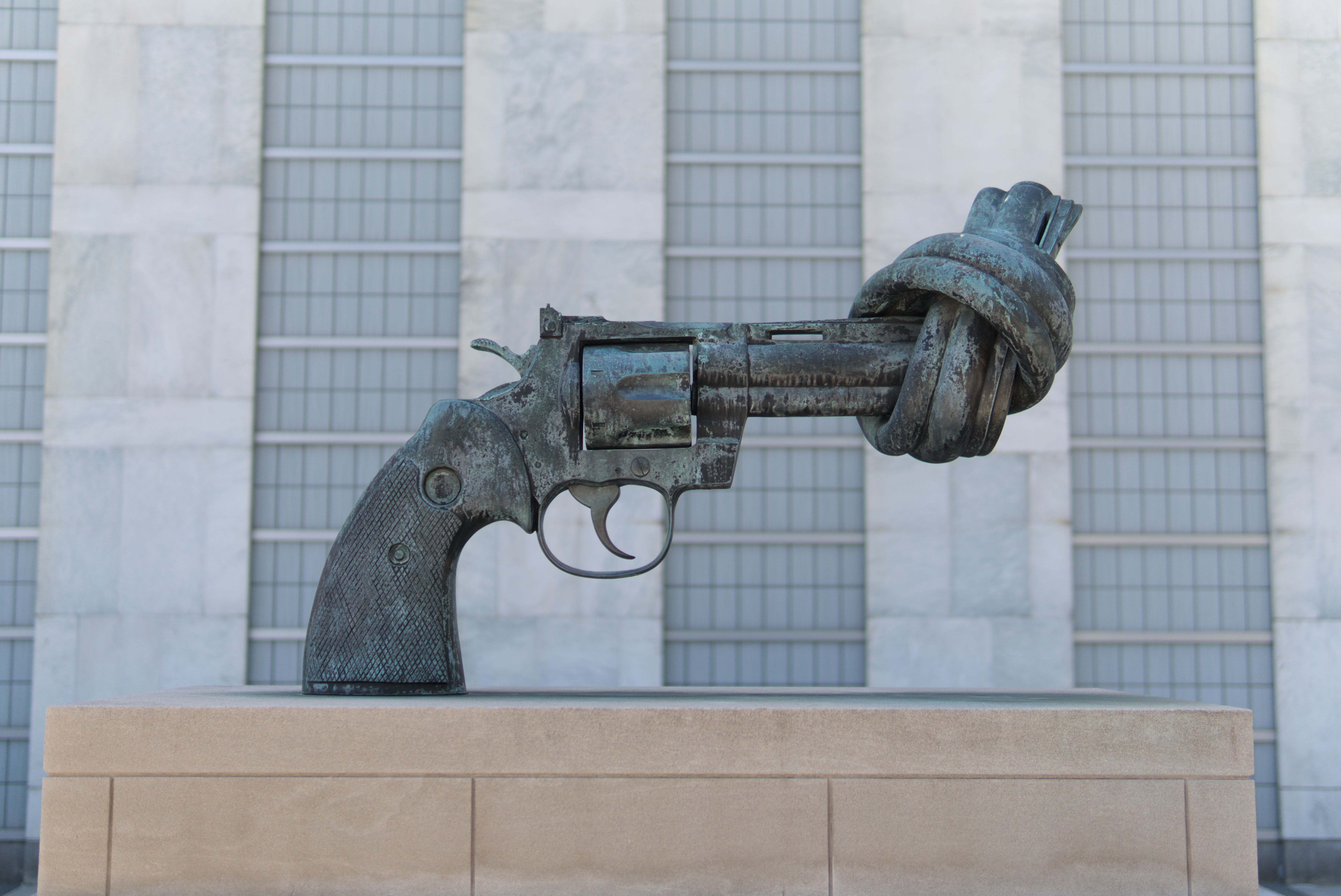
Reuterswärd, Carl Fredrik_Non-Violence
Carl Fredrik Reuterswärd (Swedish, 1934–2016), Non-Violence, 1984. Bronze, 79 × 44 × 50 in. United Nations Headquarters (outside the General Assembly building), New York. Gift from Luxembourg. Photo: Victoria Emily Jones. [object record]

Reuterswärd, Carl Fredrik_Non-Violence

The original cast was first placed at the Strawberry Fields memorial in New York City’s Central Park, across the street from the Dakota apartment building where Lennon and his wife, Yoko Ono, lived, and where he was shot. But Reuterswärd worried it would be stolen there. In 1988, the Government of Luxembourg bought the sculpture and donated it to the United Nations, who installed it inside the gate of their New York headquarters.

Non-Violence is an oversize replica of a Colt Python .357 Magnum revolver with the barrel tied in a knot and the muzzle pointing upward, rendering the weapon useless. In his statement from 1988, Reuterswärd said, “Humor is the finest instrument we have to bring people together. While making my peace-symbol, I thought of the importance of introducing a touch of humor, just to make my ‘weapon’ symbolically ridiculous and completely out of order.”

Reuterswärd ultimately made over thirty additional casts of Non-Violence, which are publicly installed in cities such as Beijing, Beirut, Cape Town, Lausanne, and Mexico City.

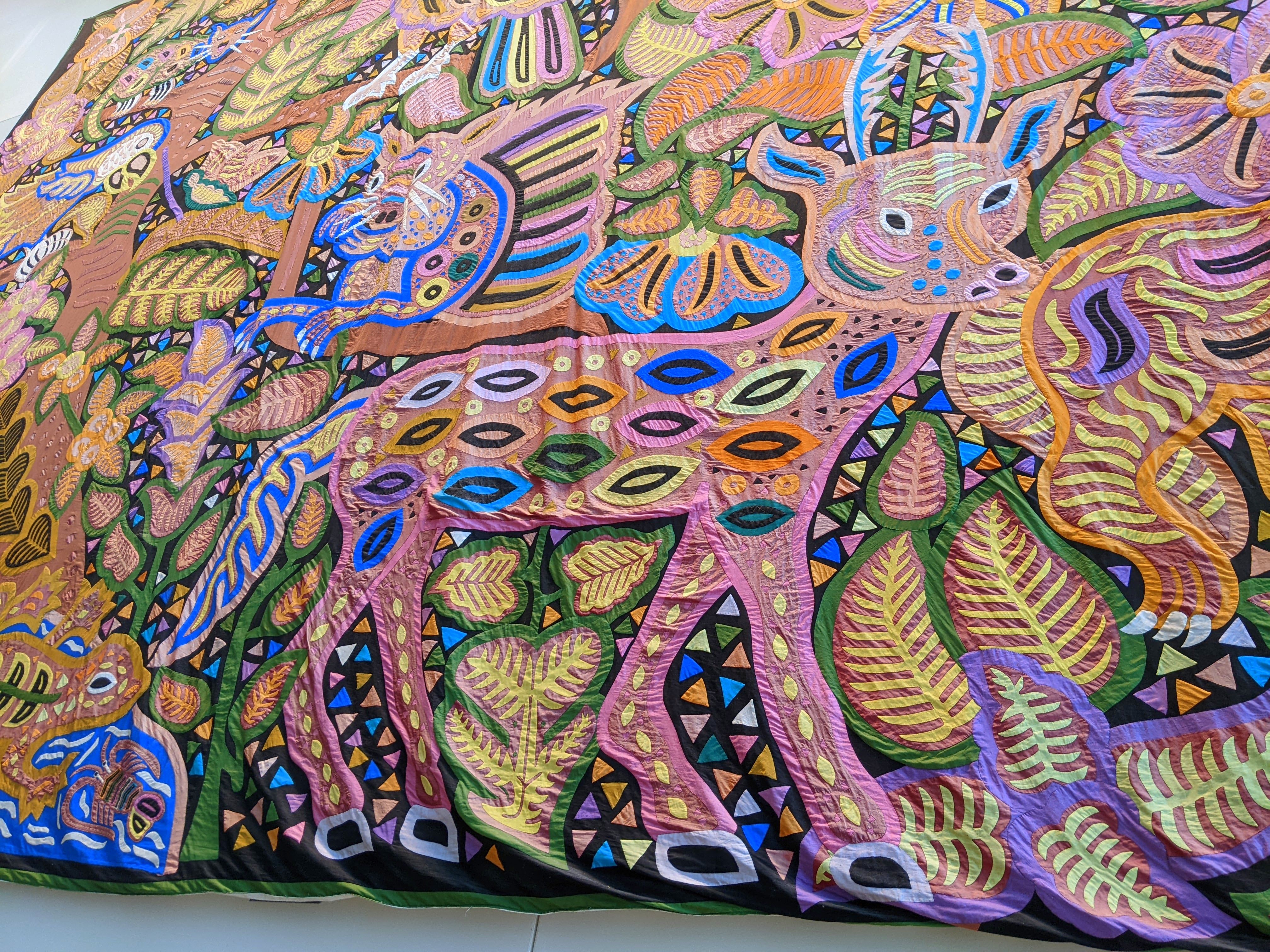
After spending some time with this iconic work, I entered the General Assembly lobby. What first caught my eye, on the right wall, was a monumental Mola Tapestry from Panama, made by unidentified Kuna women. (To learn about the art form, see my previous blog post from Lent 2022.)
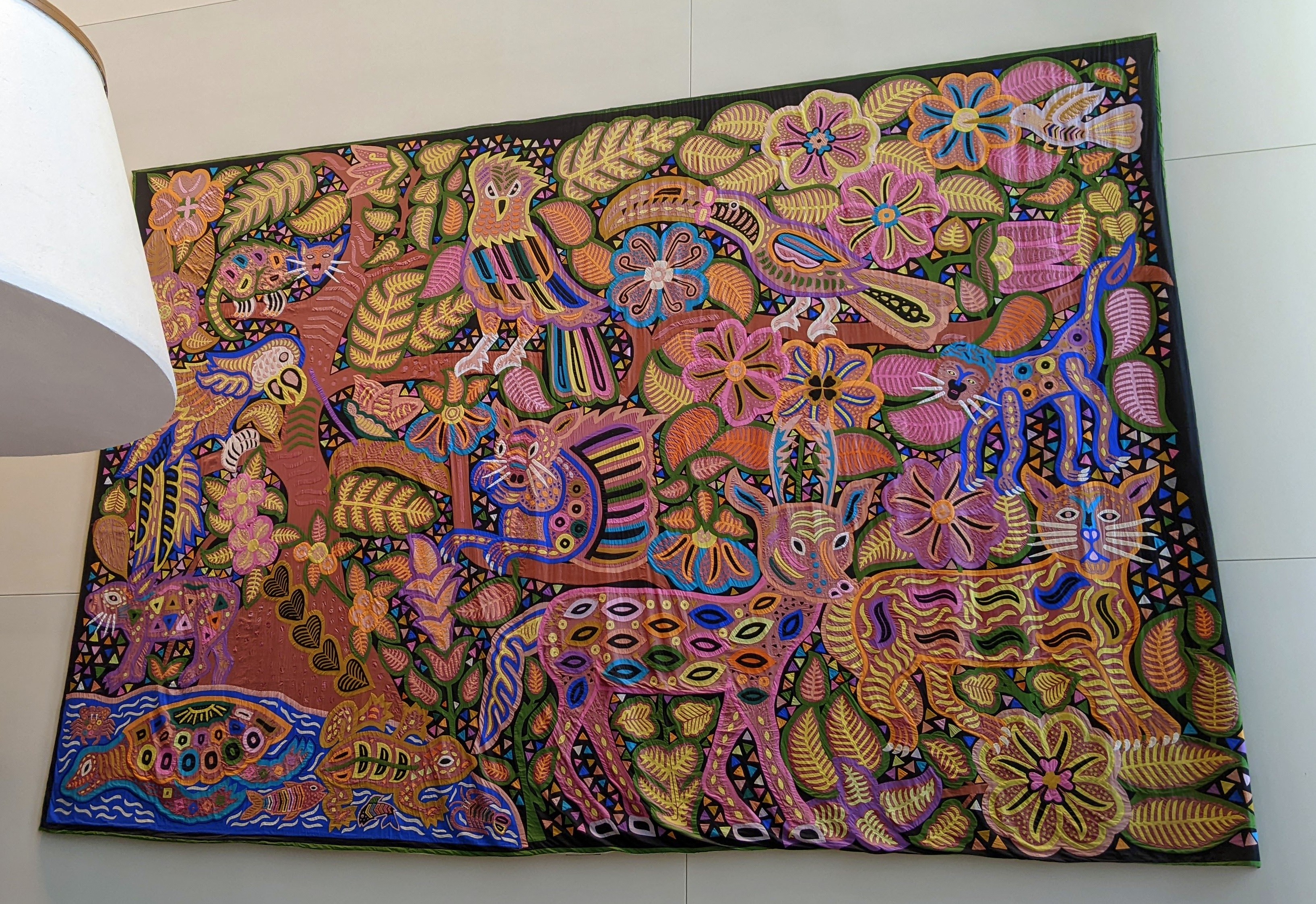
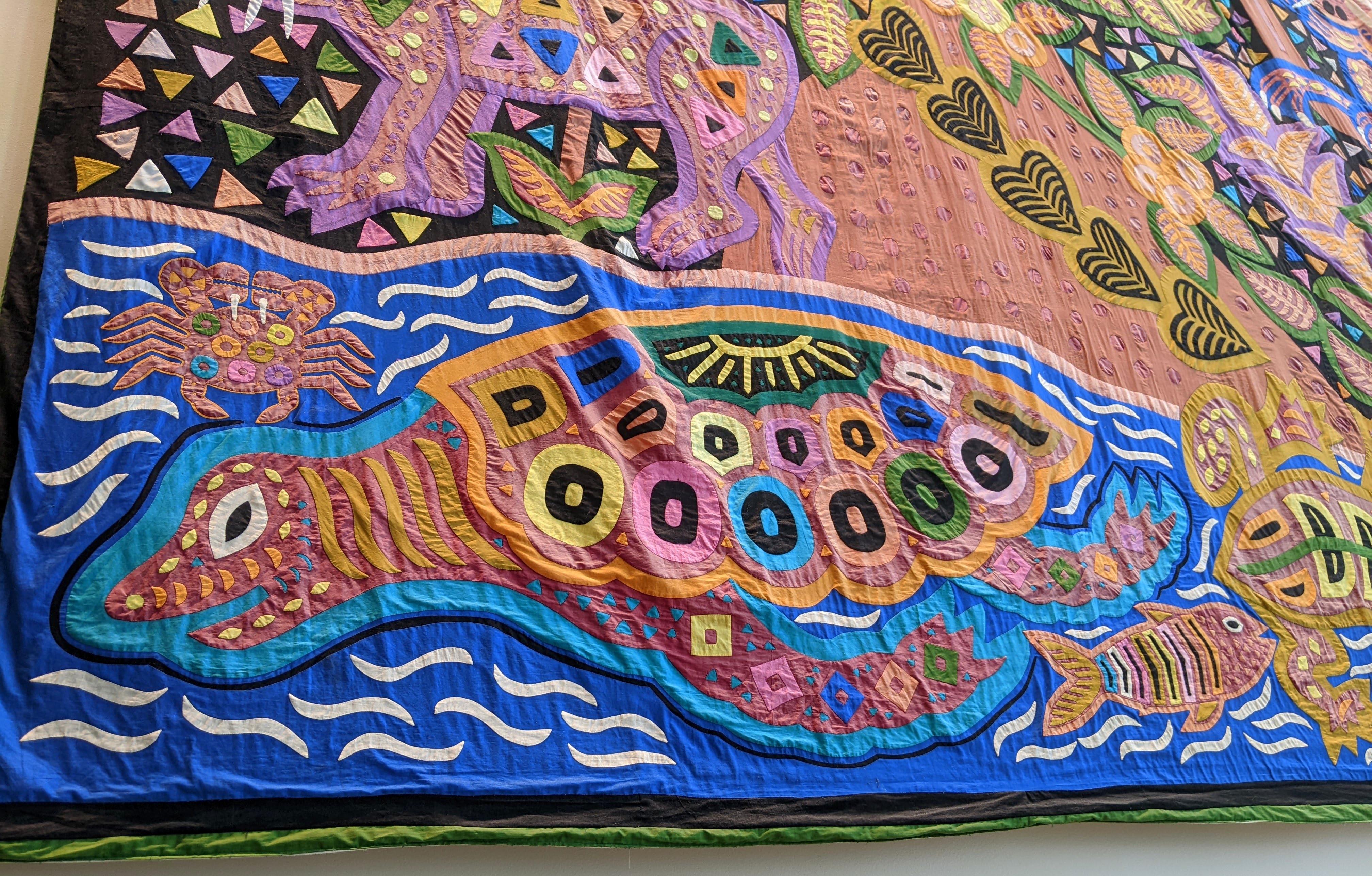
Mola Tapestry
Mola Tapestry by the Kuna people, 1993. Reverse appliqué tapestry, 190 × 284 in. General Assembly Building, United Nations Headquarters, New York. Gift from Panama. Photo: Victoria Emily Jones. [object record]

Molas are made using a reverse appliqué technique, in which several layers of multicolored cloth are sewn together and then parts of each layer are cut out to form the design. These textile panels are traditionally made on a smaller scale and sewn onto women’s blouses, but as outside interest in them grew, local artisans started making some to be displayed as wall hangings.

This one shows a colorful array of indigenous flora and fauna, including a toucan, owl, hummingbird, monkey, turtle, frog, squirrel, rabbit, deer, and wildcat.

On the opposite wall is a nearly thirty-foot-long painting titled La Fraternidad (Brotherhood) by Mexican artist Rufino Tamayo [previously], which shows a group of people gathered around a fire with interlaced arms. The fire may represent enlightenment, knowledge and power, or the Divine Presence.

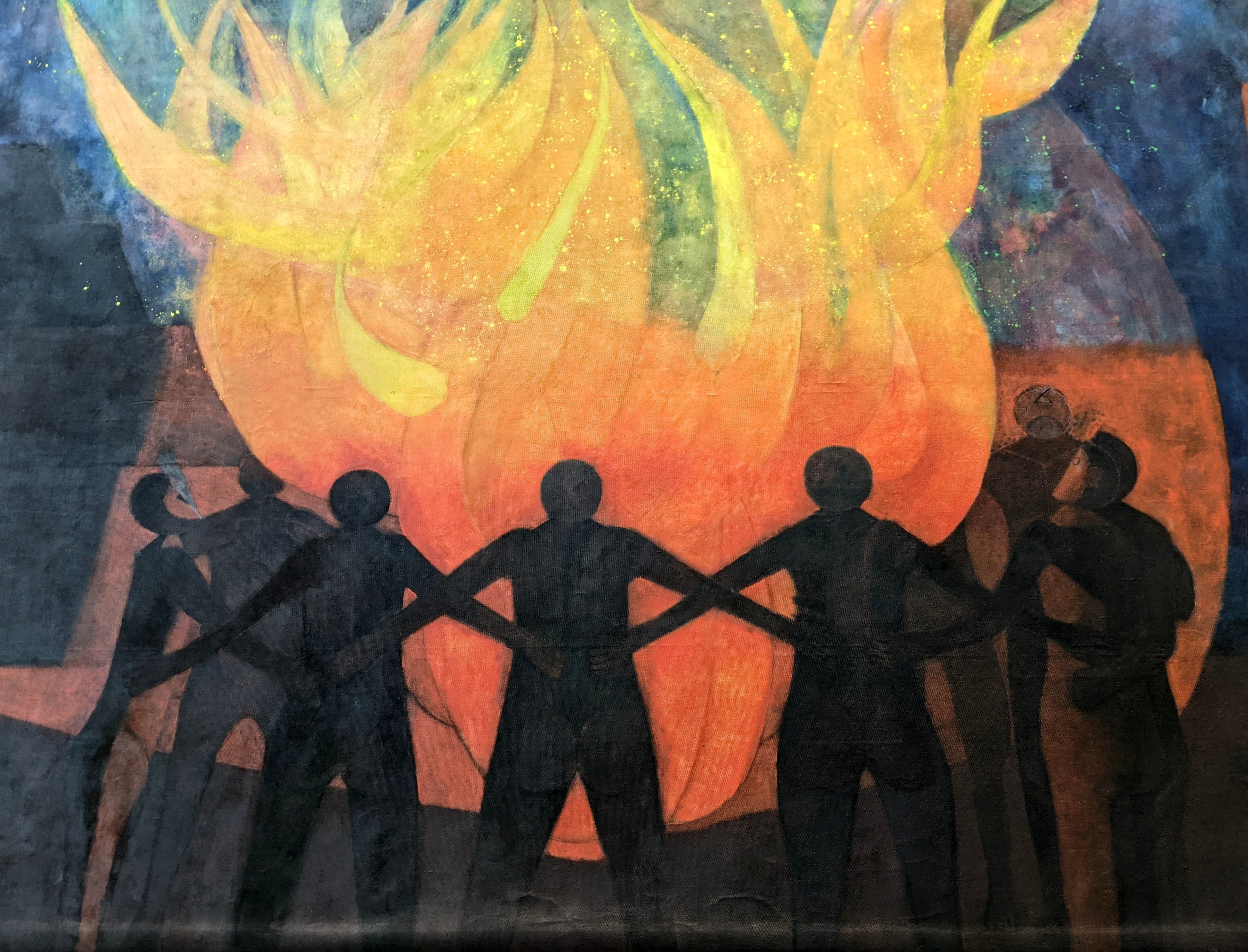
Rufino Tamayo (Mexican, 1899–1991), La Fraternidad (Brotherhood), 1968. Oil on canvas, 160 × 358 in. General Assembly Building, United Nations Headquarters, New York. Gift from Mexico, 1971. Photo: Victoria Emily Jones. [object record]

Tamayo, Rufino_La Fraternidad

At the left is an ancient Aztec or Mayan pyramid, whereas the structure at the right is modern. Tamayo said this shows the span of time, from the ancient era into the present and future.

From 2009 to 2014 the painting was on display at the Mexican state legislature, after which it was restored and returned to the UN.

Situated in front is a replica of an ancient Greek sculpture depicting Poseidon of Artemision, god of the sea, in an active stance. His right hand would have originally wielded a trident, representing his power. At first I thought it an odd choice for the UN to display an apparently militant figure, as Poseidon used his trident as a weapon to fight Trojans, Titans, and others, and indeed here he seems poised to deliver a death blow. But after some rudimentary research, I found that Poseidon also created life-giving springs with the strike of his trident (think Moses striking the rock with his staff), and used it to calm turbulent waters. These ameliorating acts align with the UN’s mission and make the Poseidon sculpture a fitting addition to their collection.  

Also in the lobby is a wool tapestry from Latvia. Titled Hope, it’s by the well-known Latvian textile artist Edīte Pauls-Vīgnere.

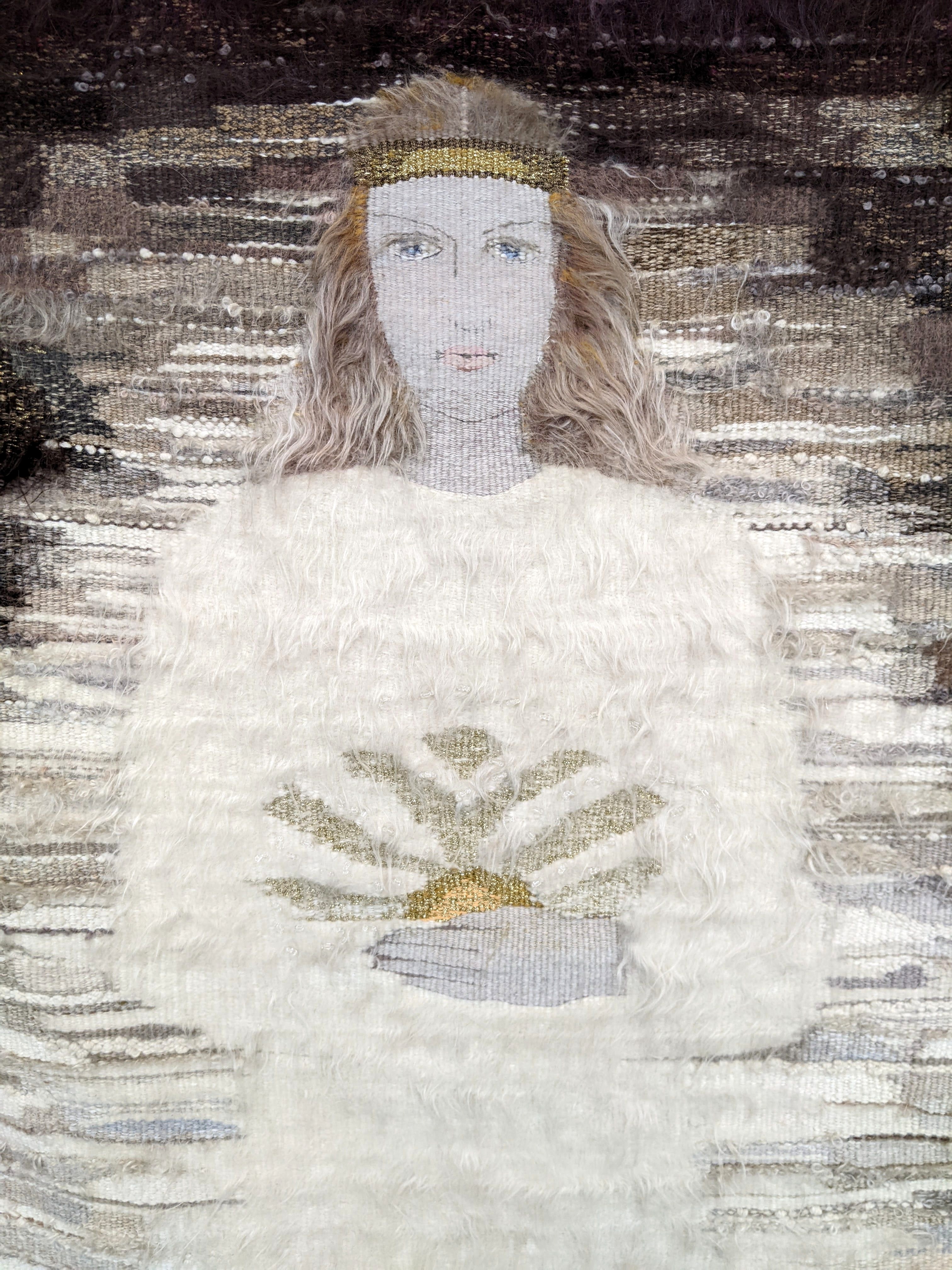
Pauls-Vīgnere, Edīte_Hope
Edīte Pauls-Vīgnere (Latvian, 1939–), Hope, 1994. Tapestry, 126 × 114 in. General Assembly Building, United Nations Headquarters, New York. Gift from Latvia. Photo: Victoria Emily Jones. [object record]

Pauls-Vīgnere, Edīte__Hope (detail)

The female figure in the foreground is, I’m assuming, a personification of hope, dressed in a white gown and golden headband and holding the sun. She stands in front of the Freedom Monument in Riga, which shows Lady Liberty holding three gilded stars, symbolizing the three constitutional districts of Latvia.


Deeper inside the lobby was a temporary exhibition, Interwoven: Refugee Murals Across Borders, organized jointly by UNHCR (the UN Refugee Agency) and Artolution. It opened on June 20, World Refugee Day, and will continue through July 19. The exhibition presents paintings by refugees and host communities in refugee camps, conflict zones, and crisis-affected communities across the world. These were created through a collaborative process in which the work circulated to different locations, with artists contributing additions at each stop. The end results show interwoven narratives of the diverse peoples forced to flee their homes. Themes include joy, lament, labor, empowerment, identity, and home.

Made by about a dozen refugee girls and women from four countries, Fabric of Women’s Resilience began in Uganda with a small group of South Sudanese, who prepared the traditional bark cloth from the bark of a mutuba tree. This substrate then traveled to Bangladesh, where Rohingya women painted a pregnant woman lying on a bed while a female doctor presses a stethoscope to her belly, and on the left, a mother bathing her child. The artists said they wanted to encourage mothers to seek access to prenatal healthcare and to practice good hygiene with their babies.
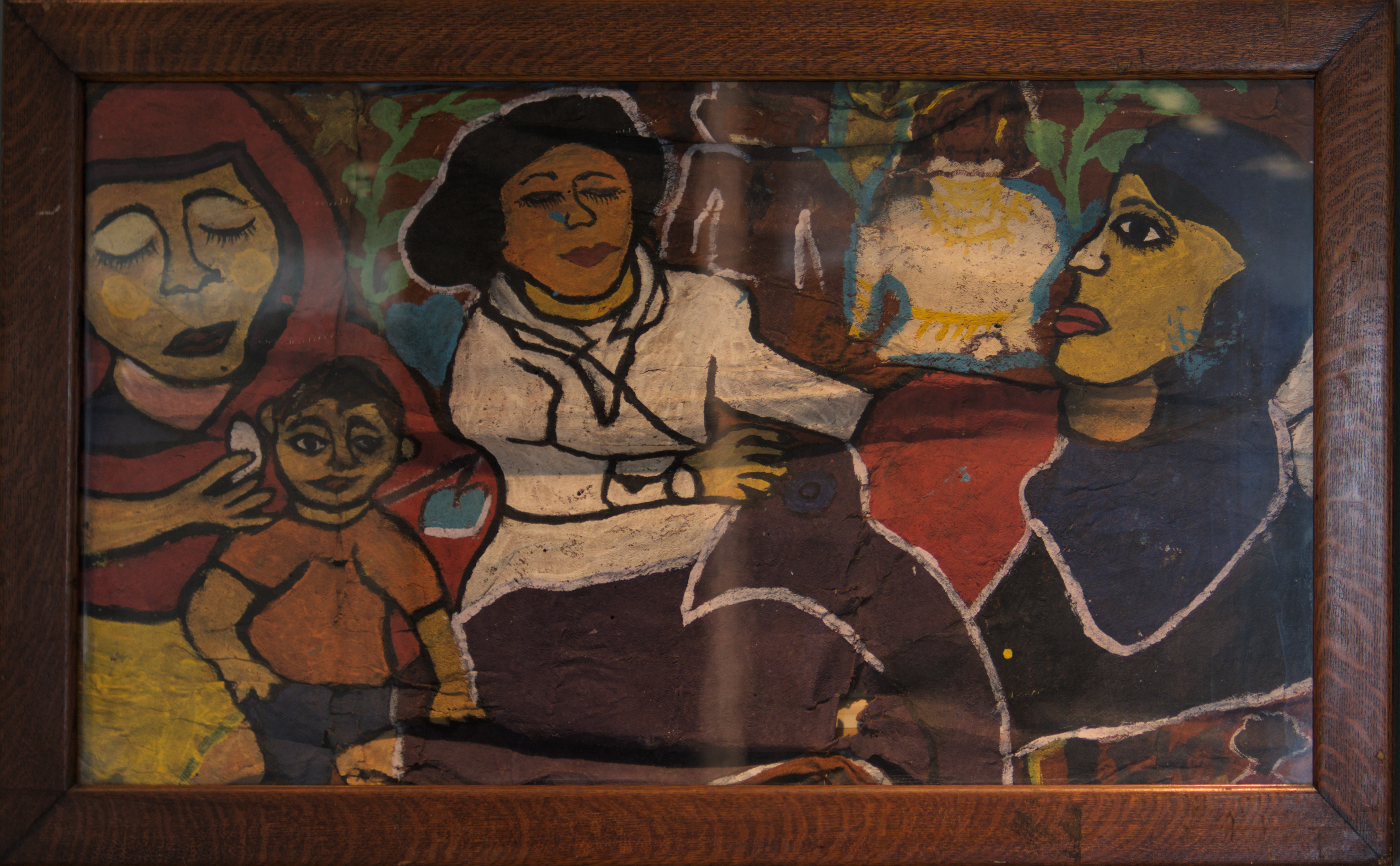
Fabric of Women's Resilience
Fabric of Women’s Resilience, a collaborative painting by approx. twelve Rohingya, Syrian, Afghan, and South Sudanese refugee women, 2018. Acrylic on bark cloth, 24 × 60 in. Photo: Victoria Emily Jones.

In Greece, the bark cloth traveled to Samos refugee camp, where one young Afghan woman, with the help of others, painted one of her traumatic childhood experiences: being married off at age twelve to an older man. This scene at the top is a bit crumpled in the frame, so it’s difficult to see, but the child bride is crying, and the man has a white beard.

The painting also went to Azraq refugee camp in Jordan, where Syrian women added a woman carrying a baby on her back while reading a book to show that women can be mothers and pursue an education. (This scene was at the extreme right but must have come off; view the full original painting on the exhibition webpage, fourth image down.) It ended its journey with a return to Uganda, where the South Sudanese women filled in the remaining spaces with plants, fish, and fruits.

Other artworks include The Creature of Home and Play in the Midst of Chaos, painted on food distribution bags and as a collaboration between South Sudanese and Rohingya refugees, both children and adults.

The Creature of Home, which traveled to BidiBidi Refugee Settlement in Uganda and Balukhali Refugee Camp in Bangladesh, depicts chickens, a soccer field, memories of home, and tools needed to take care of the land.
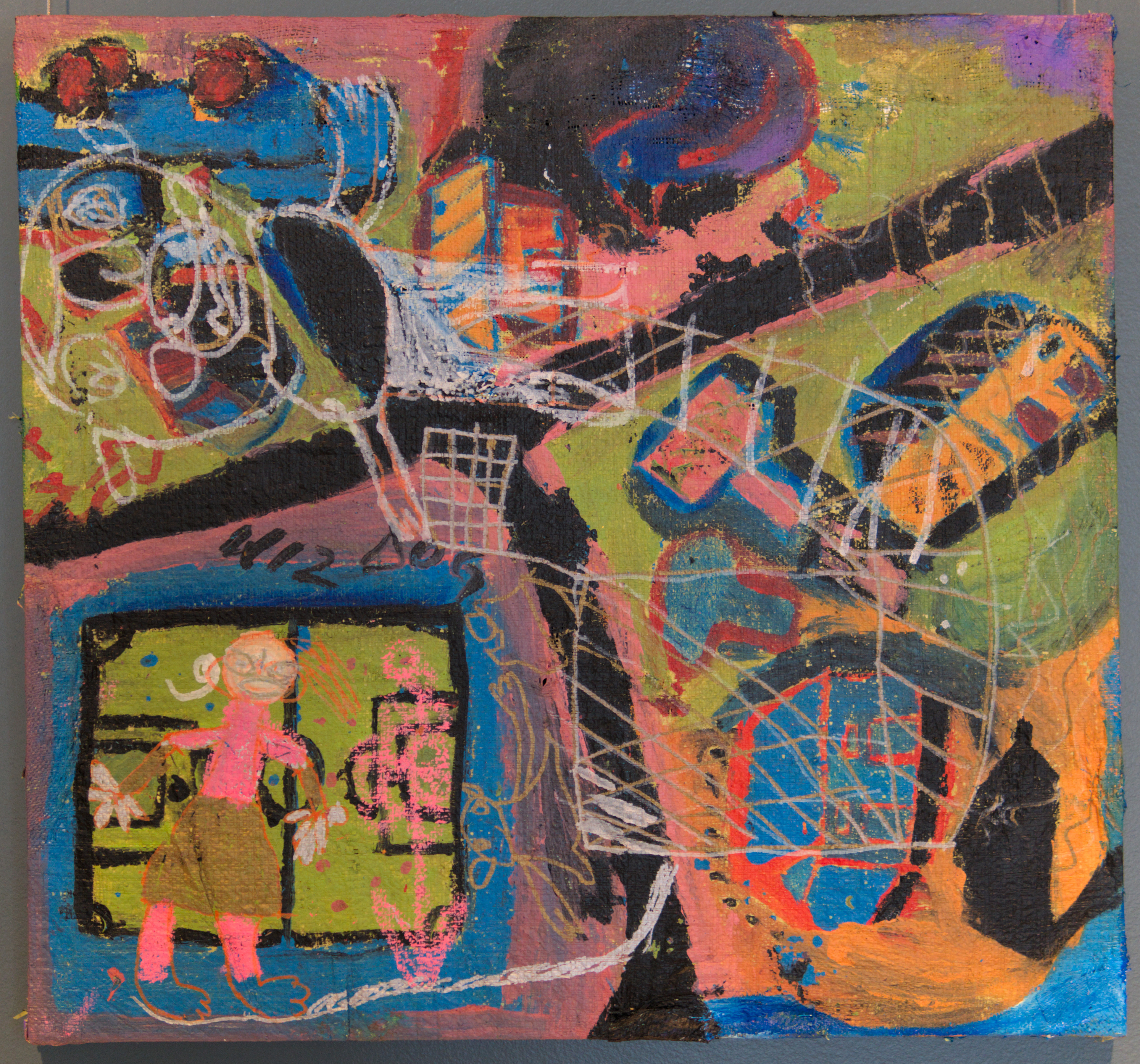
The Creature of Home
The Creature of Home, a collaborative painting by South Sudanese refugees at BidiBidi Refugee Settlement, Uganda, and Rohingya refugees at Balukhali Refugee Camp, Bangladesh. Photo: Victoria Emily Jones.

Play in the Midst of Chaos, which traveled to BidiBidi Refugee Settlement in Uganda and Bhasan Char Island in Bangladesh, captures a sense of joy with its vivid colors and depiction of sports. It also highlights the importance of planting trees and taking climate action.
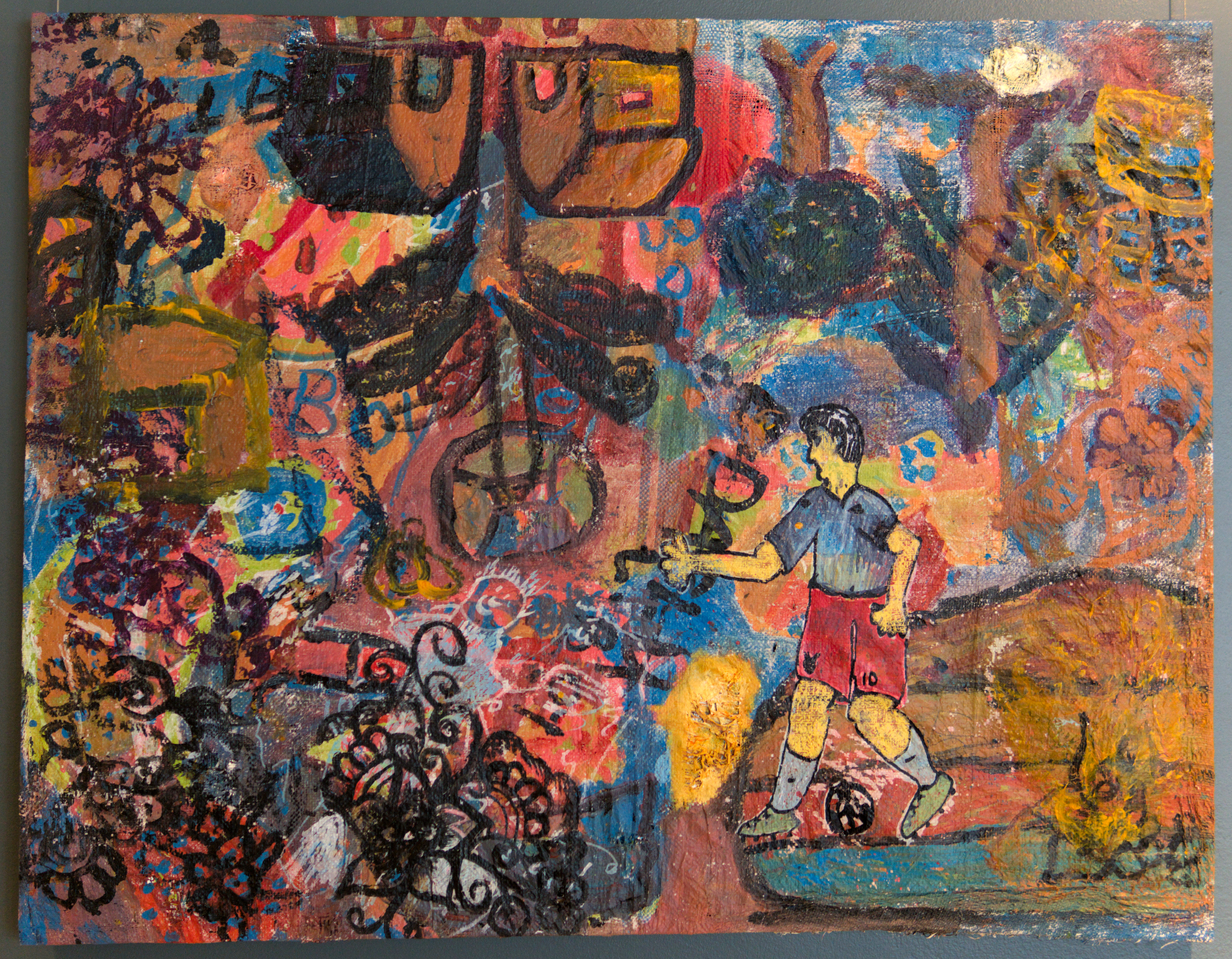
Play in the Midst of Chaos
Play in the Midst of Chaos, a collaborative painting by South Sudanese refugees at BidiBidi Refugee Settlement, Uganda, and Rohingya refugees at Bhasan Char Island, Bangladesh. Photo: Victoria Emily Jones.

Seeing the Interwoven exhibition sent me down an internet rabbit trail of learning more about the co-organizer, Artolution, and the work they’re doing, which then impelled me to learn more about the refugee communities in which they’re active. Follow them on Instagram, Facebook, or Twitter. I also commend to you the Founder Spirit podcast interview with Artolution cofounder and public artist, educator, and humanitarian Max Frieder.


All the above artworks can be seen for free without an appointment. (However, note that the temporary exhibitions change throughout the year.) But to access the sculptures in the garden, which is kept locked, your only option is to pay $26 for the guided, forty-five-minute Garden Tour.

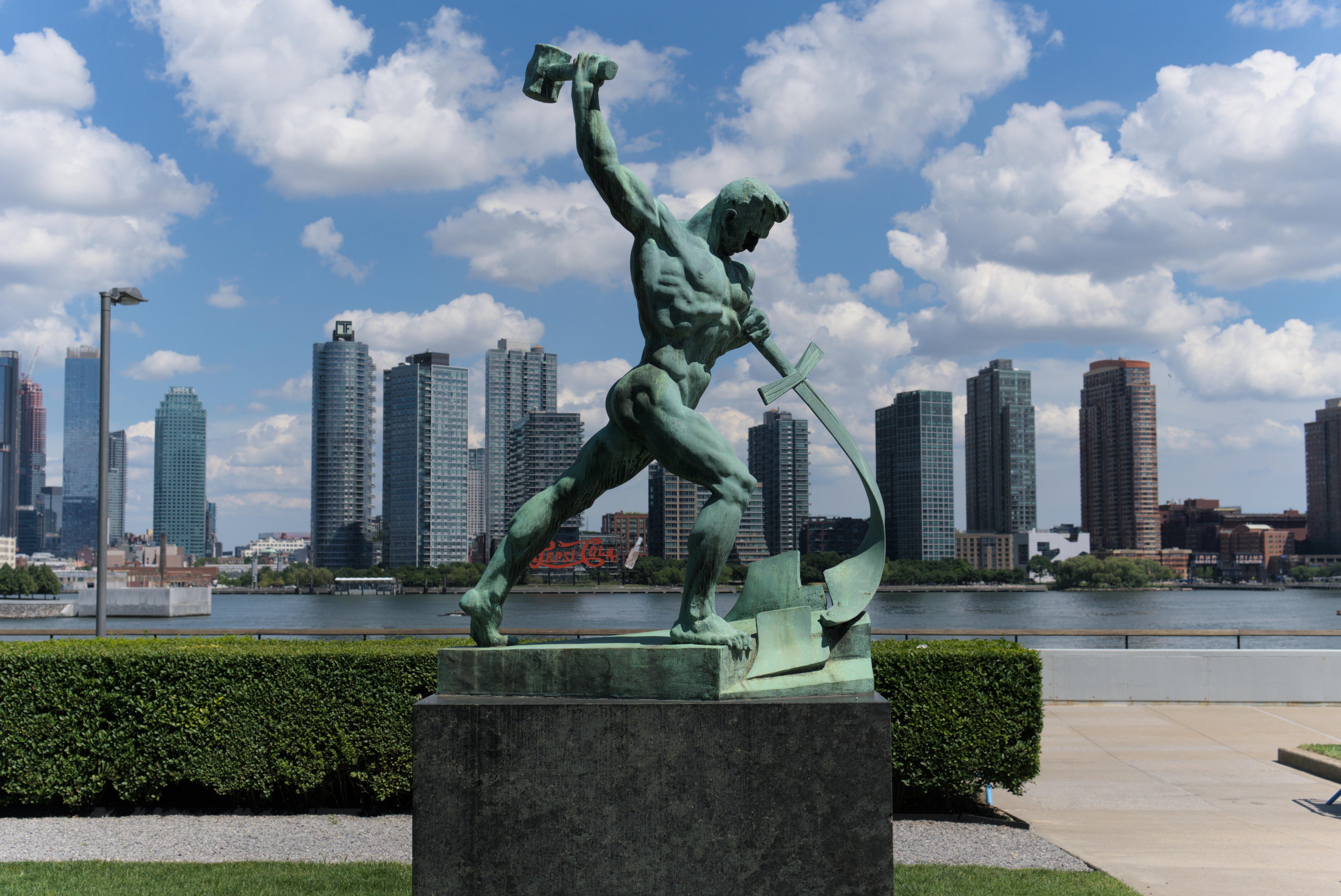
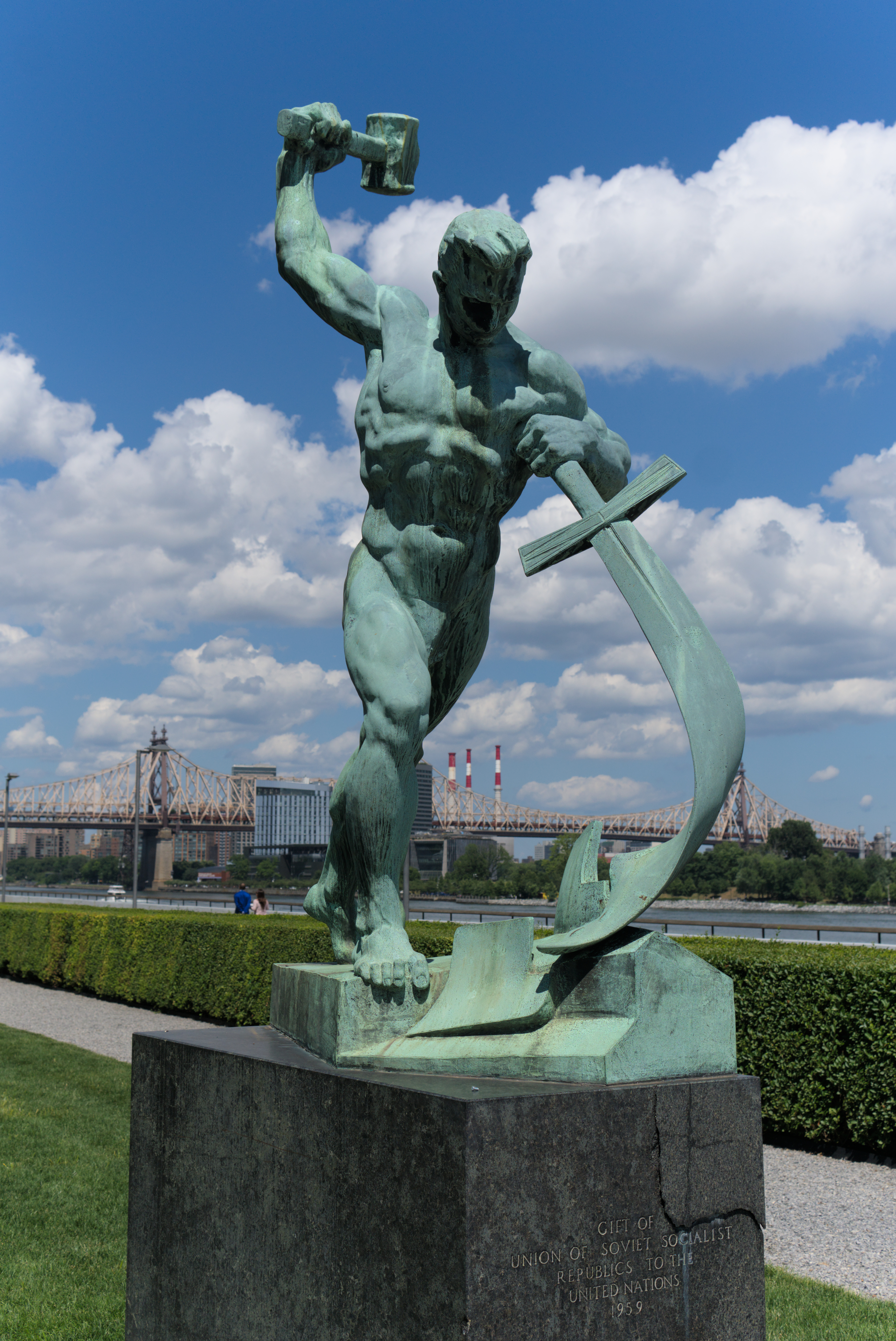
I had seen photos of the biblically inspired Let Us Beat Swords into Ploughshares and wanted to see it in person, so I paid up. It’s vaguely visible from the vantage of the free-access plaza outside the main entrance of the General Assembly Building.
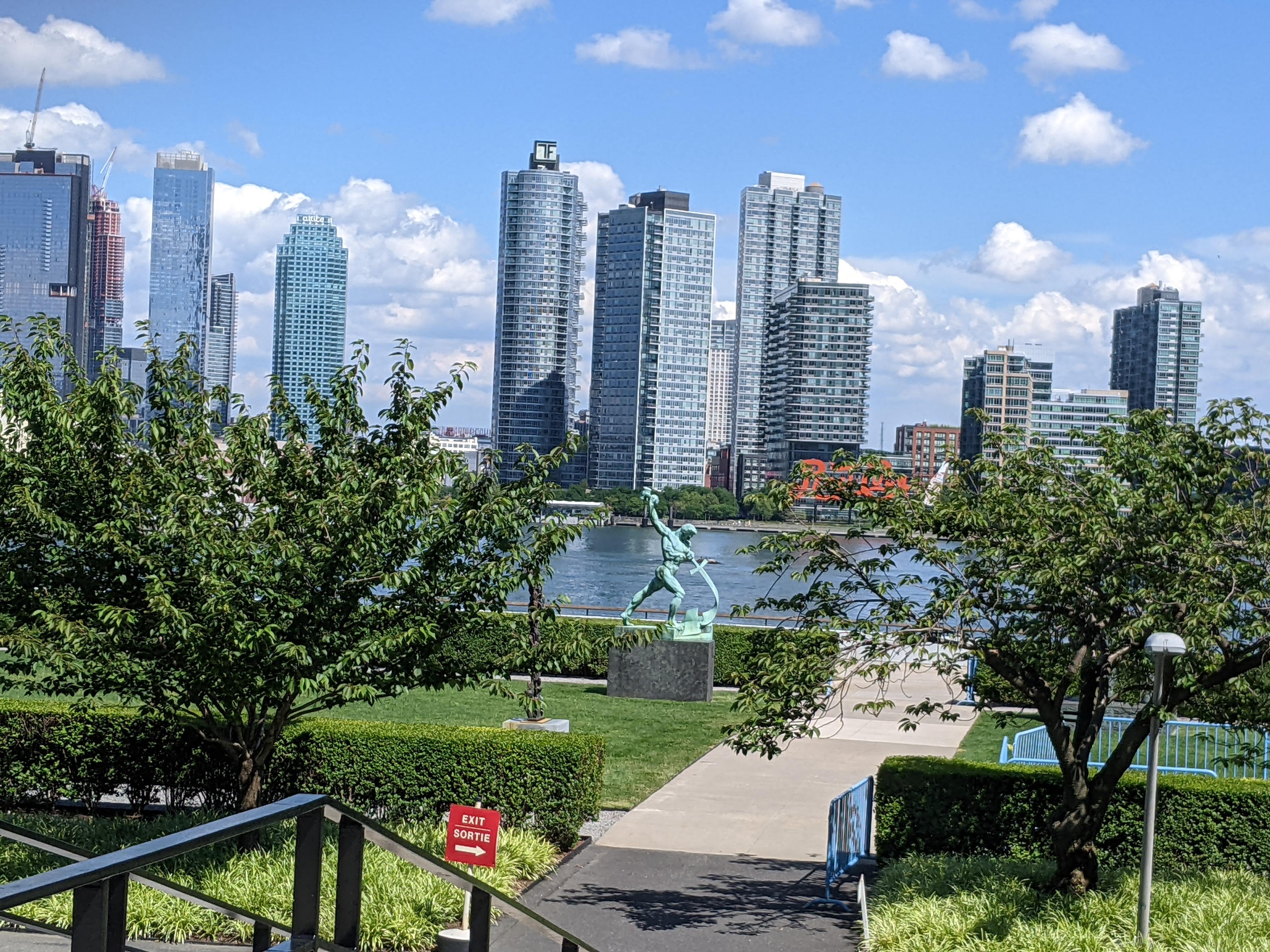
Swords into Plowshares

But let’s move in closer.

Vuchetich, Yevgeny_Let Us Beat Swords into Ploughshares
Yevgeny Vuchetich (Russian, 1908–1974), Let Us Beat Swords into Ploughshares, 1959. Cast bronze and granite pedestal, figure 111 × 76 × 35 in., pedestal 44 × 75 × 34 in. North Lawn, United Nations Headquarters, New York. Gift from the USSR. Photo: Victoria Emily Jones. [object record]

Swords into Plowshares

Gifted to the United Nations by the USSR in 1959, the bronze sculpture is by the Soviet artist Yevgeny (sometimes spelled “Evgeniy”) Vuchetich, who was of Russian, French, and Serbian heritage and lived most of his life in Russia. It shows a muscular man (modeled by Olympic wrestler Boris Gurevich) hammering a sword into a plow blade, used to cut furrows for planting crops. Representing the transformation of tools of death into tools of life, the imagery is taken from Isaiah 2:4 in the Hebrew Bible, in which the prophet proclaims that “in days to come,” people of all nations “shall beat their swords into plowshares and their spears into pruning hooks; nation shall not lift up sword against nation; neither shall they learn war any more.” The vision is that in the kingdom of God, instead of the land being littered with human blood and corpses, it will be cultivated and bring forth good food.

This scripture text is the basis of the African American spiritual “Down by the Riverside” [previously], whose refrain declares, “I ain’t gonna study war no more!” One of the commonly used verses is “I’m gonna beat my sword into a plow.” Here’s Michael Wright’s version:

And, from 1959, the Golden Gate Quartet’s, arranged by Orlandus Wilson:

Reflecting the song lyrics, Vuchetich’s sculpture is itself planted “down by the riverside”—the East River.

(Related posts: “A Blessing for Those Who Hate and Hurt”; “The Christmas Truce of 1914”; Benjamin Rush’s “Plan of a Peace-Office for the United States”)

Vuchetich was one of the major figures of Soviet government–backed monumental sculpture, making his name from depictions of military heroes. So I find it a little odd that he was commissioned to make this peace sculpture that subverts the very militarism his other sculptures celebrate. One of his most famous pieces is The Motherland Calls; located at the top of Mamayev Kurgan hill overlooking the city formerly known as Stalingrad, it shows a female personification of Russia lifting high a sword in one hand and calling the Soviet people to battle with the other.

Look, many artists will take what work they can get, regardless of whether a commission matches their own ideology. I don’t claim to know what Vuchetich’s personal views were about war, violence, and empire.

Regardless of its disjunction with the artist’s larger oeuvre—and the uncomfortable fact that the donor’s successor state and caretaker of the sculpture, the Russian Federation, is persisting in an illegal and immoral war against its neighbor Ukraine—I really appreciate the theological imagination that Let Us Beat Swords into Ploughshares embodies, entreating us to apply our strength to constructive, not destructive, acts.

Nearby in the garden, not pictured in this article, is a literalization of the “swords into plowshares” principle. A recent gift from the Government of Colombia, Kusikawsay (Quechua for “peaceful and happy life”) is made of steel armaments melted and cast into the shape of a canoe, sailing upward. A donor representative said the sculpture for them symbolizes the end of an over-fifty-year armed conflict in their country. The idea is that the grotesque paraphernalia of war is metamorphosed into a benign watercraft that, in how it’s positioned, symbolizes humanity’s traveling into a lofty future.

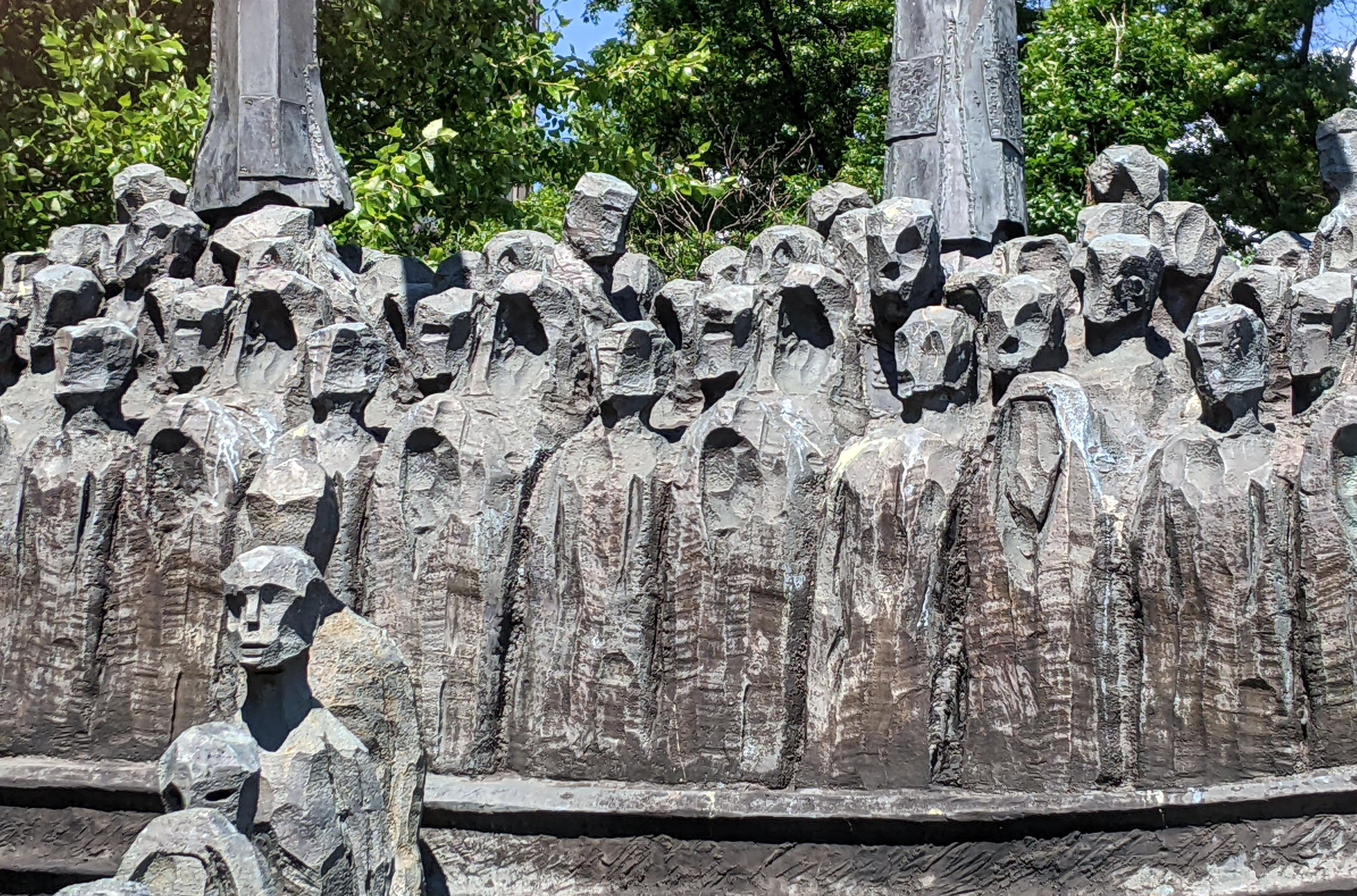
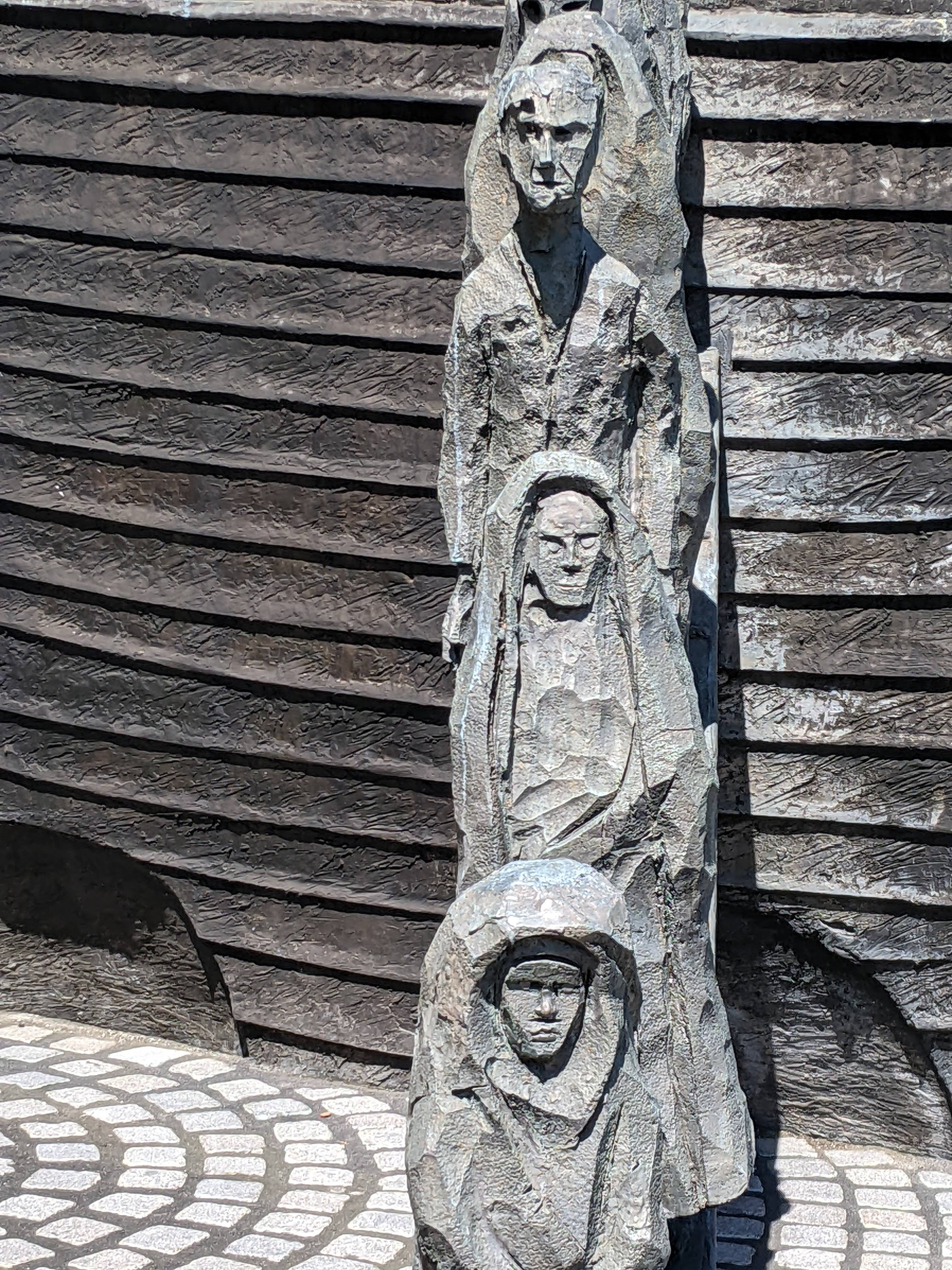
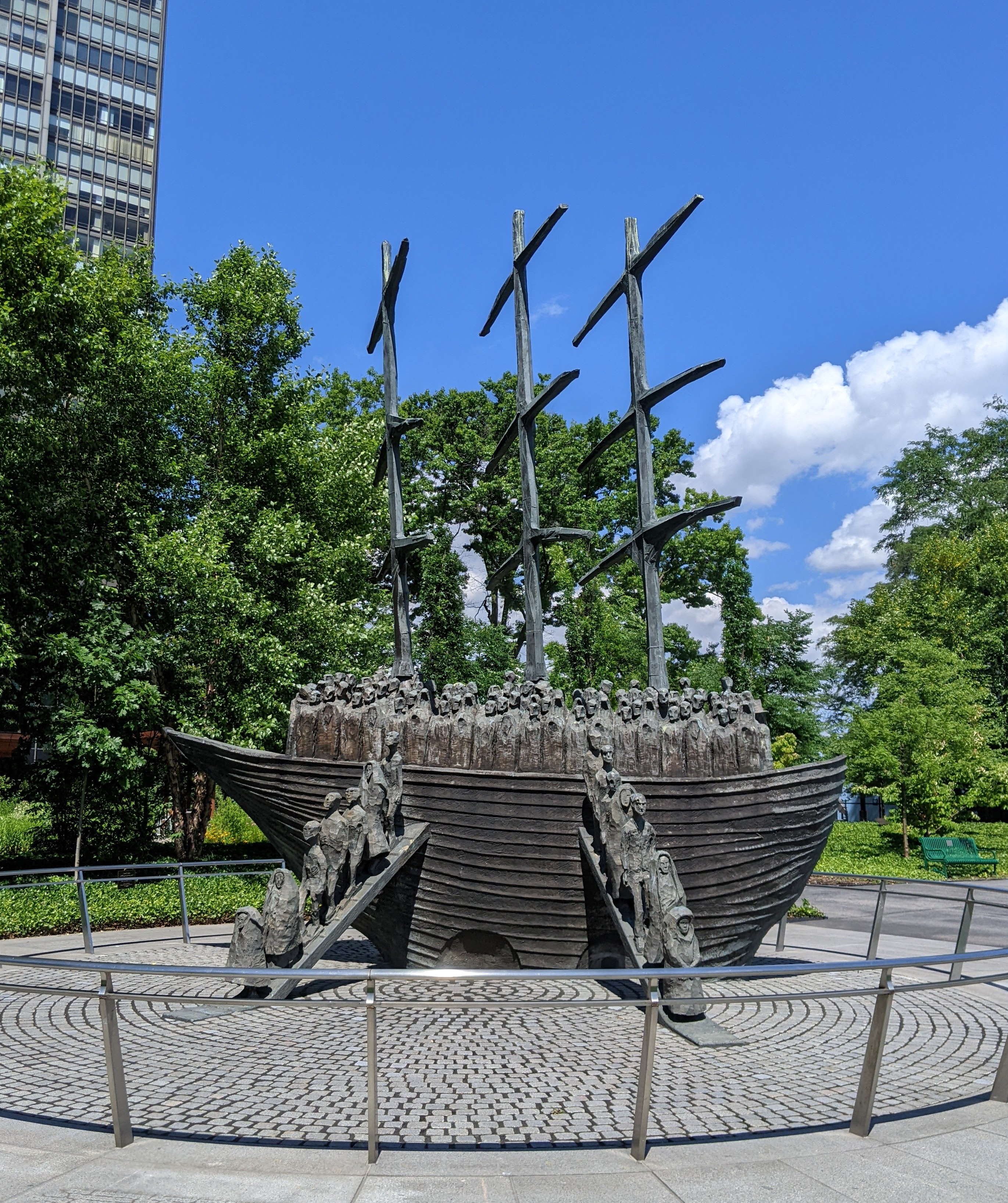
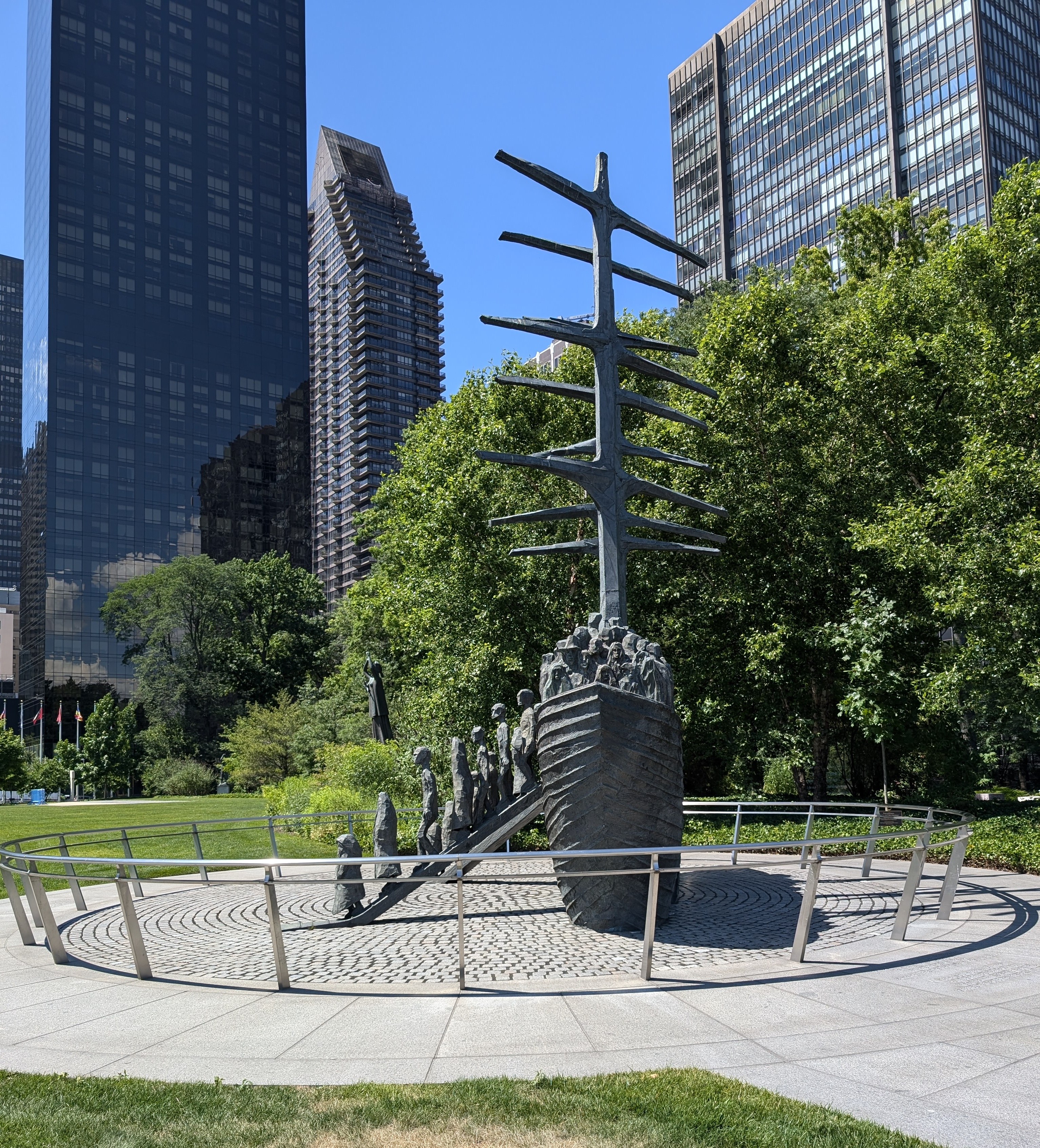
Another boat on the UNHQ’s North Lawn is Arrival by the Irish sculptor John Behan, which shows Irish immigrants disembarking into a new world. The sculpture was intended as a thank-you to the many nations that have received the Irish over the years, including Great Britain, the United States, Canada, Australia, Argentina, Chile, Mexico, New Zealand, and Brazil.
Behan, John_Arrival
John Behan (Irish, 1938–), Arrival, 2000. Bronze, stainless steel on granite pavers, 26 × 23 ft. North Lawn, United Nations Headquarters, New York. Gift from Ireland. Photo: Victoria Emily Jones. [object record]

Behan, John_Arrival

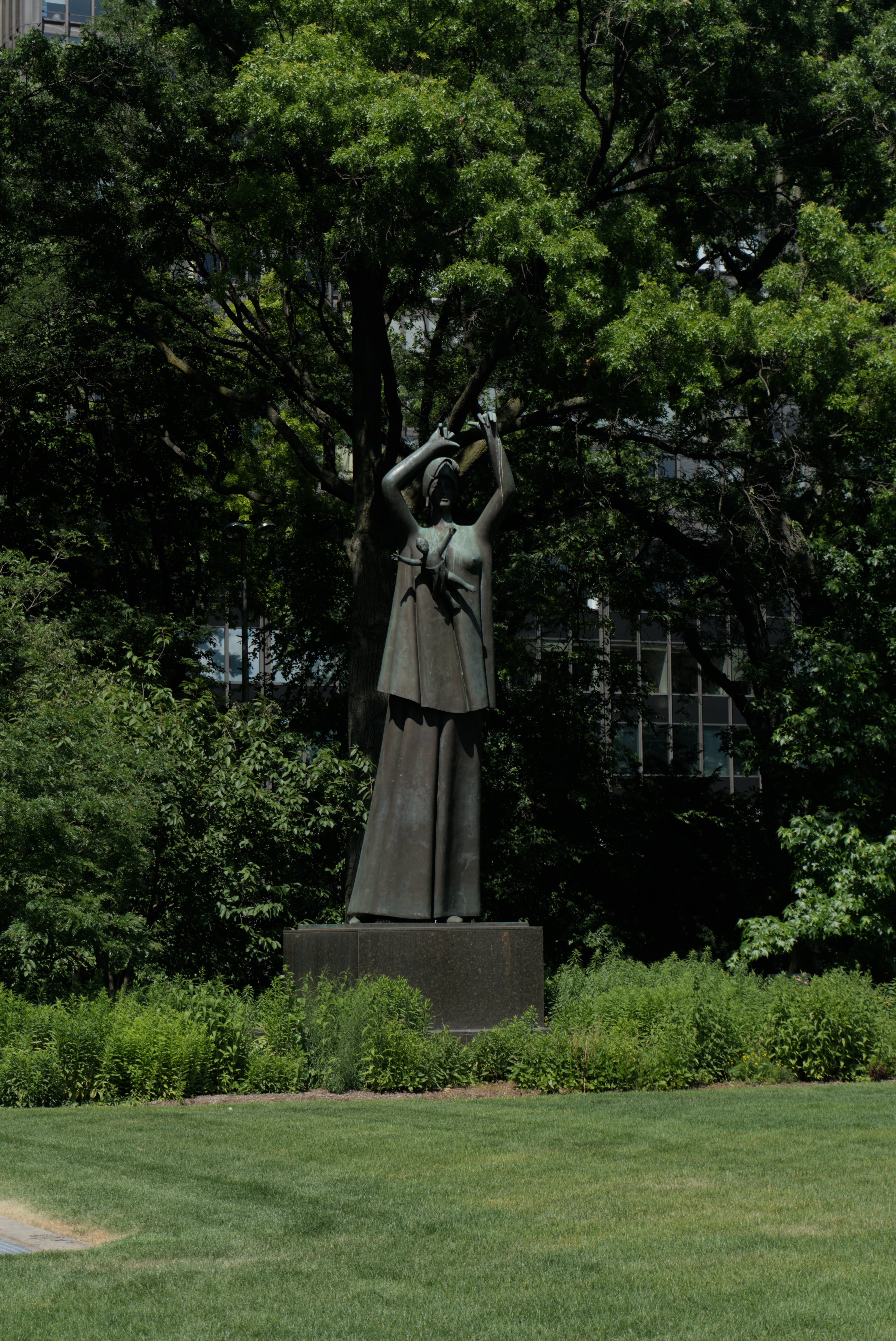
This piece wasn’t covered by the Garden Tour, nor was the colossal Mother and Child by the Italian artist Giacomo Manzù, which I spotted across the lawn and hurriedly snapped a distant photo of while scurrying to keep up with the group.
Manzù, Giacomo_Mother and Child
Giacomo Manzù (Italian, 1908–1991), Mother and Child, 1989. Bronze, 254 × 66 × 52 in. North Lawn, United Nations Headquarters, New York. Gift from Italy. Photo: Victoria Emily Jones. [object record]

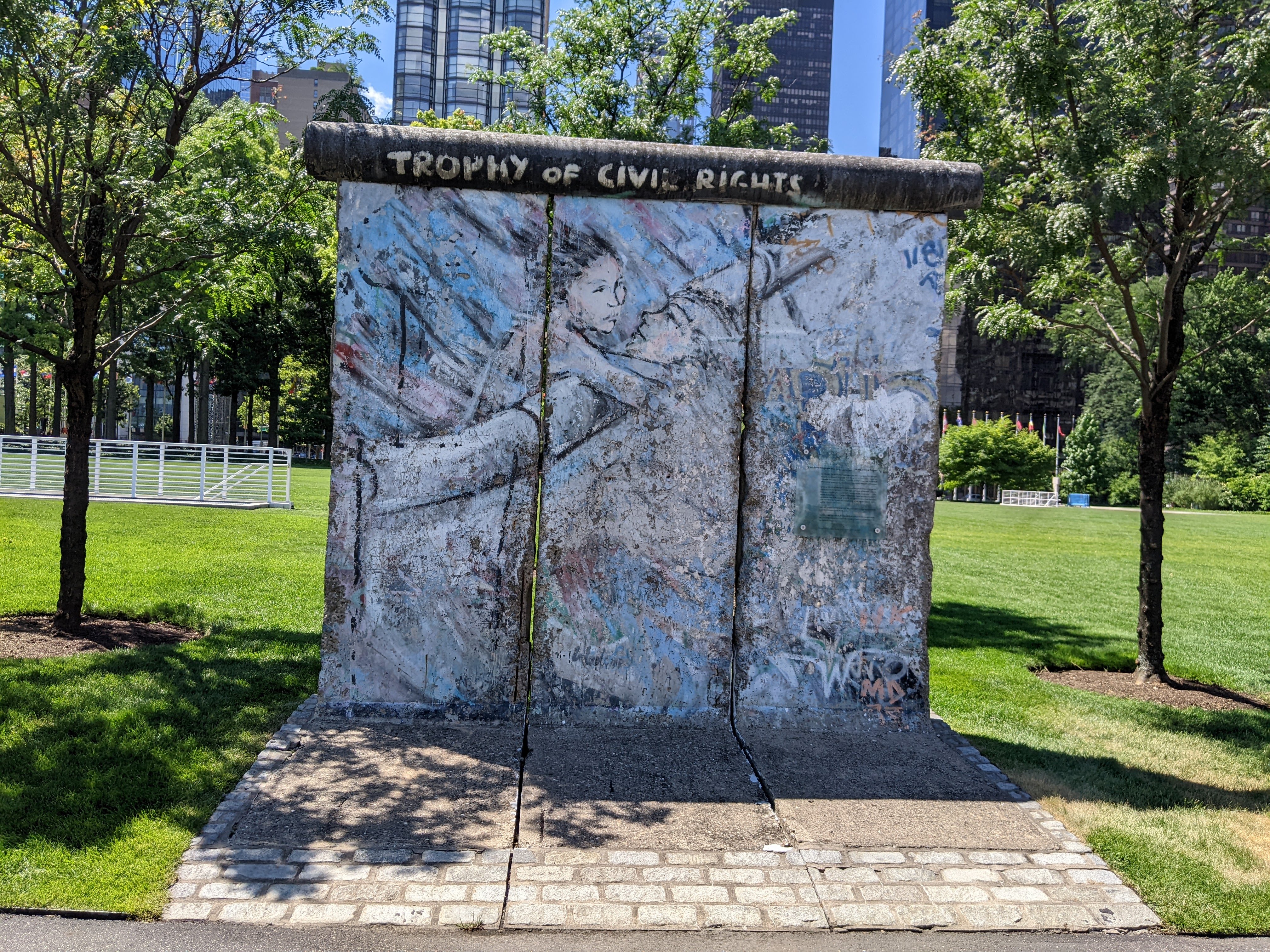
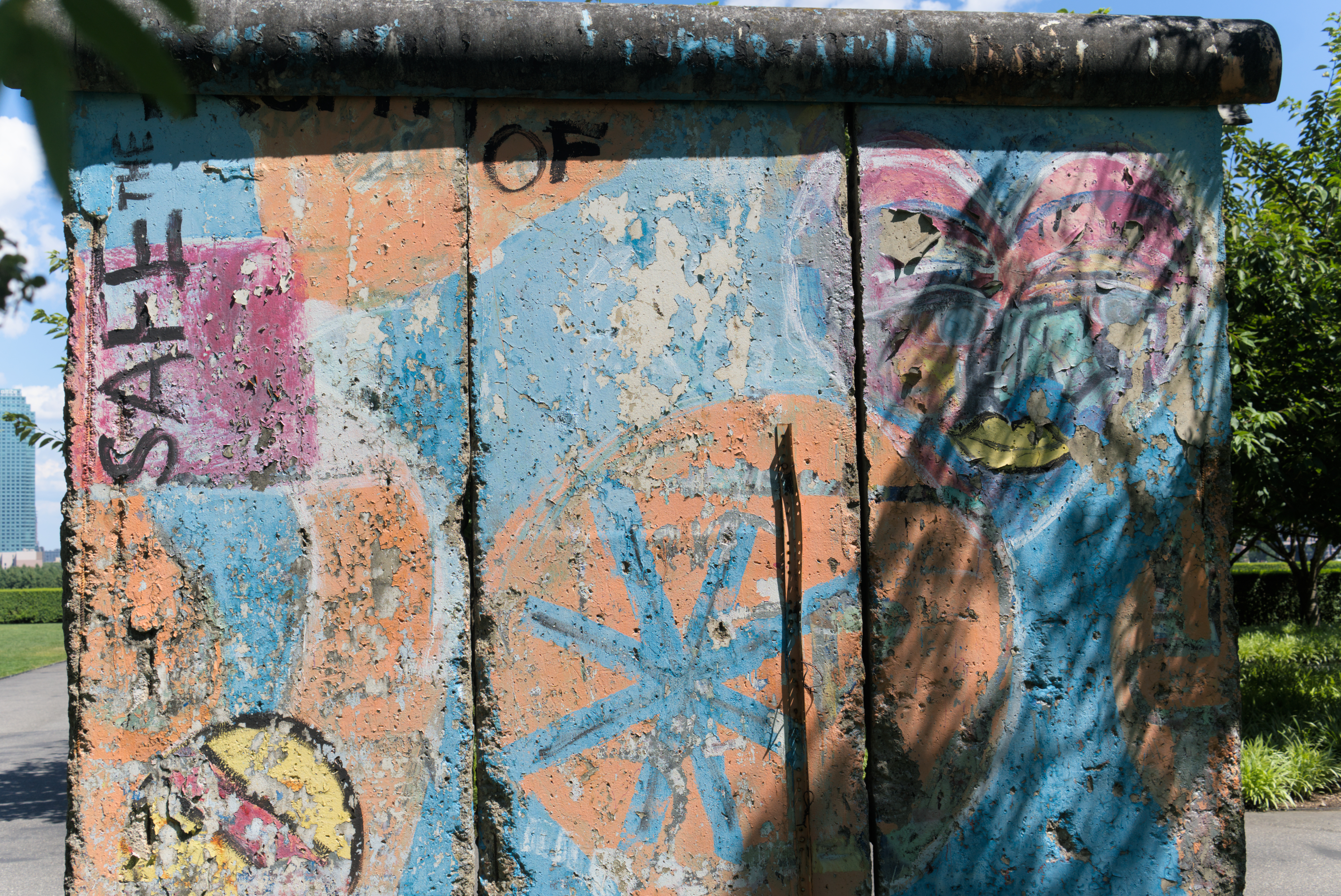
One of the pieces our guide did stop for and spend a good amount of time on was a fragment of the Berlin Wall gifted by Germany in 2002, after the wall came down in 1989. The ninety-six-mile-long barrier was erected in 1961 to divide the country into East (Communist) and West (Federal Republic), but a peaceful revolution in East Germany resulted in its fall and the country’s reunification as a federal republic, marking the end of the Cold War in Europe.
Alavi, Kani_Trophy of Civil Rights
Kani Alavi (Iranian German, 1955–), Trophy of Civil Rights (Berlin Wall Fragment), ca. 1998. Precast reinforced concrete wall sections with paint, overall 84 × 114 in. North Lawn, United Nations Headquarters, New York. Gift from Germany. Photo: Victoria Emily Jones. [object record]

The front of this three-slab wall fragment (that is, the side visible from the paved path) bears a mural by Kani Alavi, an Iranian artist who moved to West Berlin in 1980, living in an apartment overlooking the formidable “Checkpoint Charlie.” Throughout the 1980s, artists painted images on the west side of the wall as a form of political commentary and resistance. The east side, however, was unpainted during the Cold War because it was so heavily guarded; attempted art interventionists probably would have been shot.

After the border opened on November 9, 1989, and demolition of the wall began, Alavi was a key organizer of what’s known as the East Side Gallery, inviting artists from Germany and around the world to paint murals on the east side of the wall, across a segment that would be deliberately left standing as a memorial. “Alavi helped transform the most visible symbol of the Iron Curtain into an enduring monument to the power of freedom,” Ryan Prior wrote for CNN. This open-air gallery is one of Berlin’s most visited attractions, featuring the work of at least 118 artists from twenty-one countries.

Berlin Wall (detail)

Alavi painted Trophy of Civil Rights (I’m not sure whether that inscription was his or just a remnant from another artist, but it’s become the mural’s de facto title) on a section of remaining wall sometime around 1998. “It is a representation of two people hugging over the wall, a dramatic situation of people trying to get close to each other,” he told NPR through a translator. “It shows how the people were separated. It shows how a culture was divided by a wall. That’s what happened, and that’s what I showed.”

The other side of the wall is painted with miscellaneous graffiti by anonymous artists.
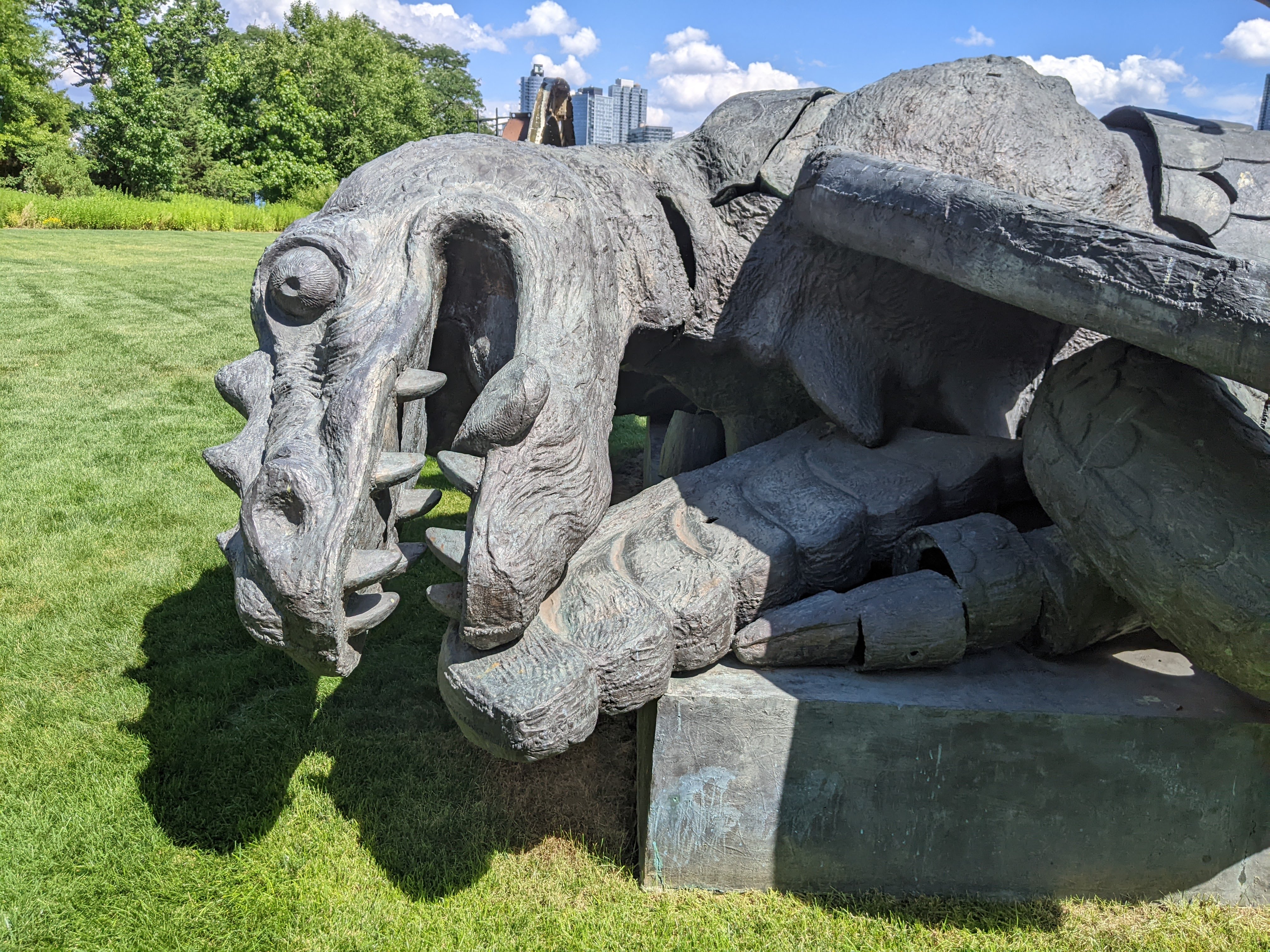
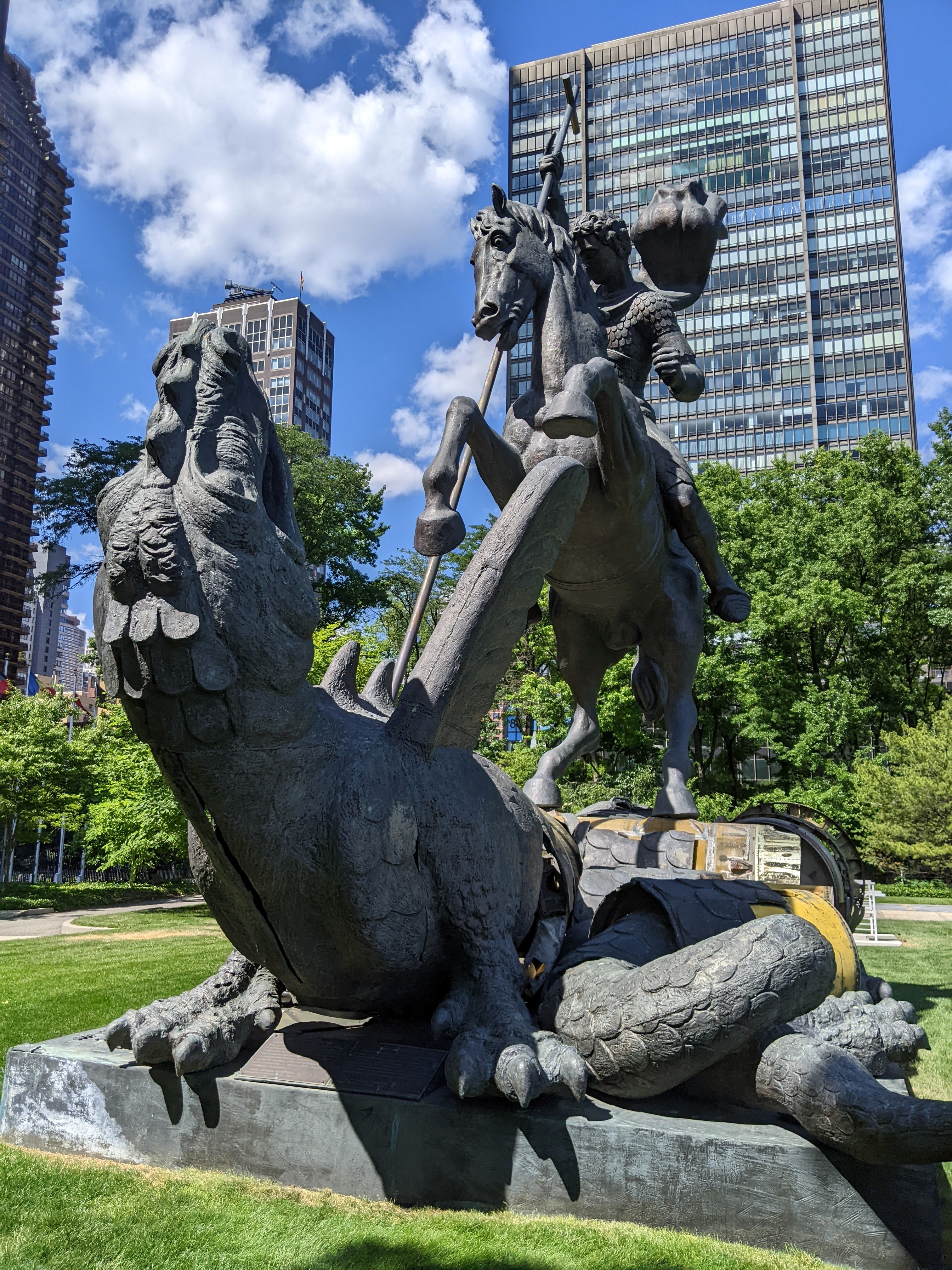
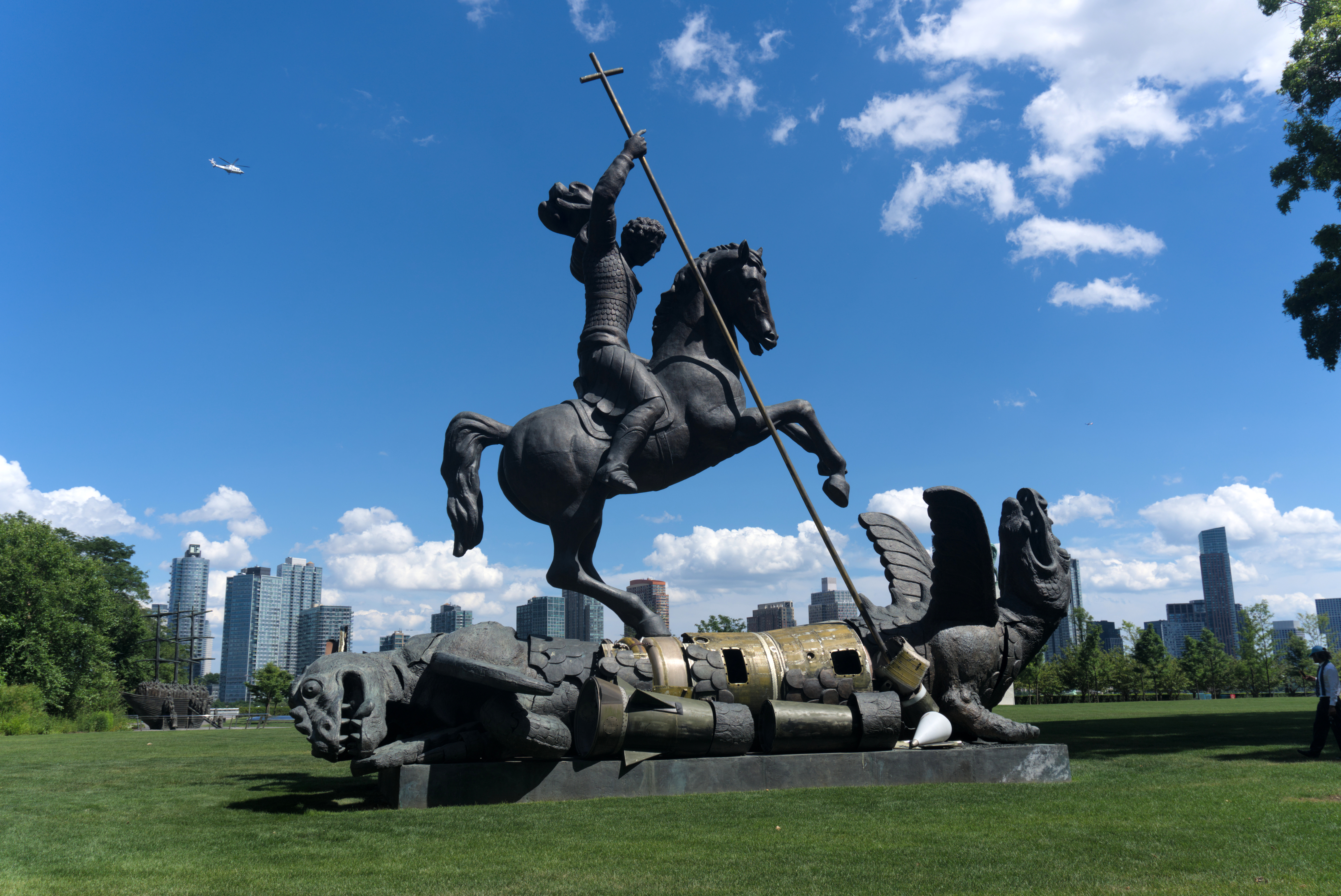
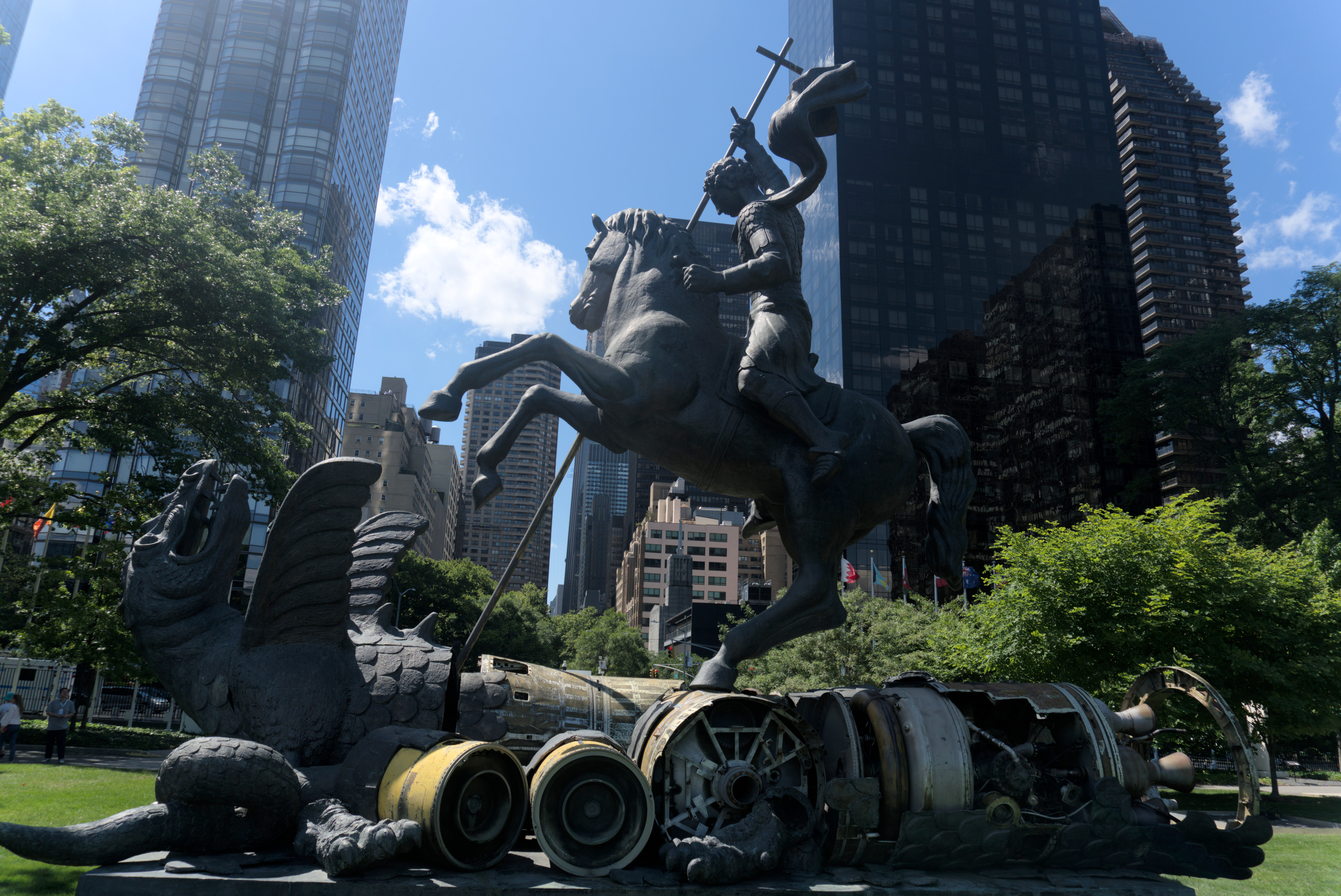
The largest sculpture on the North Lawn, standing at thirty-one feet tall and weighing forty tons, is Good Defeats Evil by the Georgian Russian sculptor Zurab Tsereteli. It depicts the Early Christian martyr-saint George, who was tortured and executed in 303 under the Diocletian persecution. Legends about him started developing in the sixth century and by the thirteenth century were widely circulated and embellished to include a tale of him slaying a dragon to save a Libyan princess whom the terrorized villagers had planned to sacrifice to it for appeasement.
Tsereteli, Zurab_Good Defeats Evil
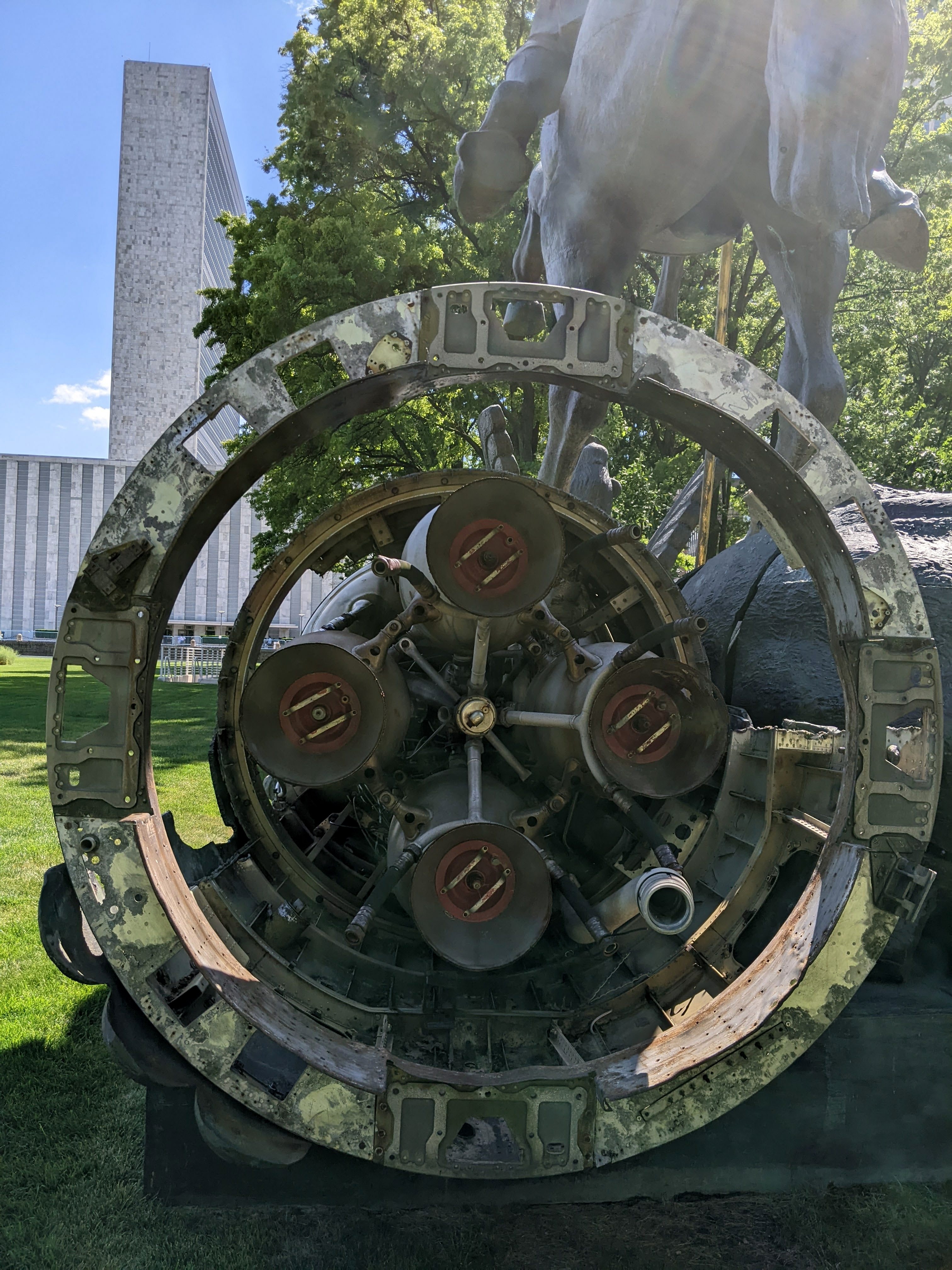
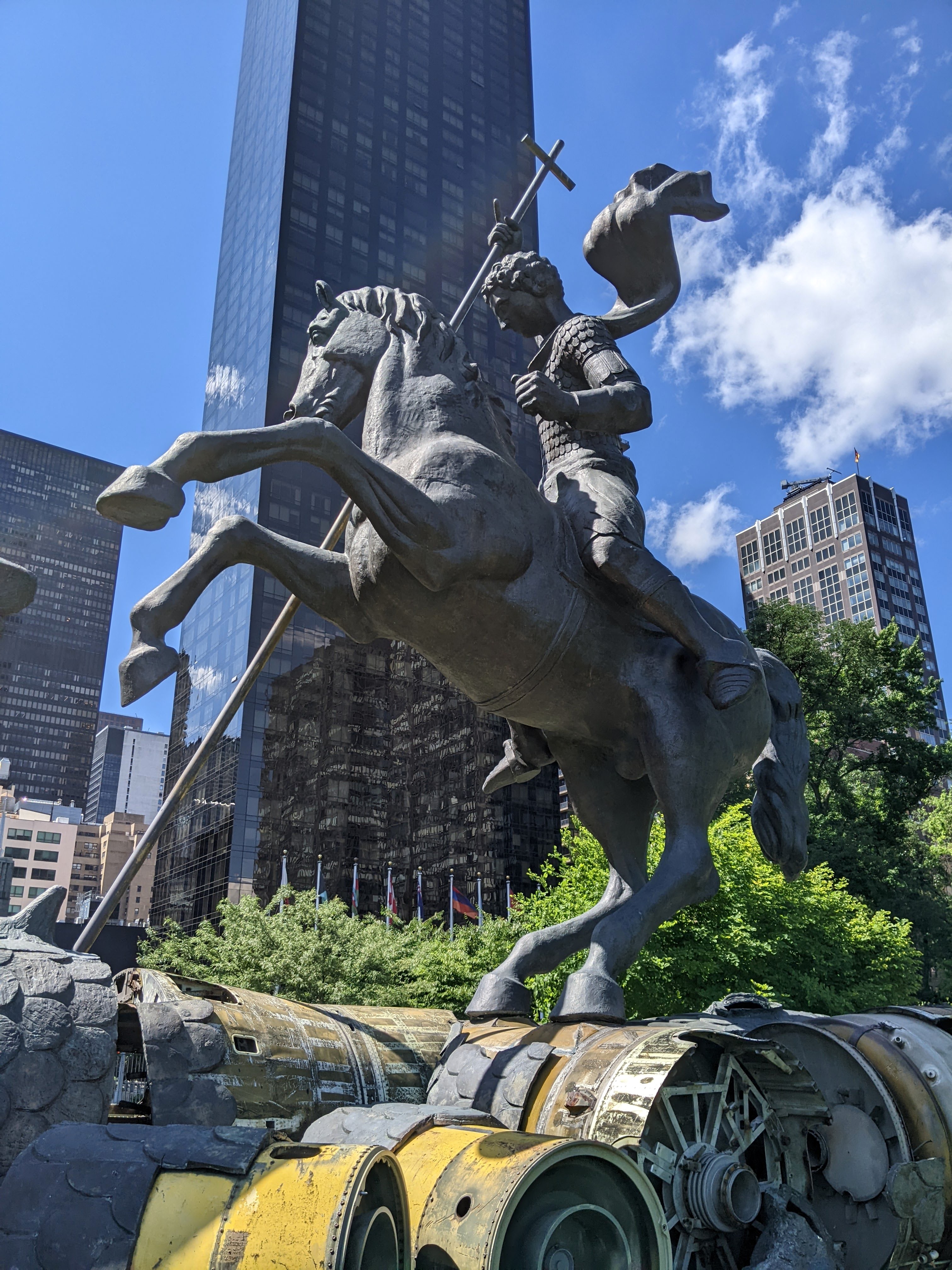
Zurab Tsereteli (Georgian Russian, 1934–), Good Defeats Evil, 1990. Cast bronze figure with dragon formed from sections of two destroyed nuclear missiles, 31 × 18 × 10 ft. North Lawn, United Nations Headquarters, New York. Gift from the USSR. Photo: Victoria Emily Jones. [object record]

Tsereteli, Zurab_Good Defeats Evil (back)
Tsereteli, Zurab_Good Defeats Evil (detail)

(Side note: Saint George is not to be confused with Saint Michael the Archangel from the book of Revelation, who in Christian iconography is usually shown on foot [but occasionally on horseback], also slaying a dragon. The easiest way to tell the two saints apart is that Michael has wings, whereas George does not.)

The most intriguing aspect of this sculpture is that the two-headed dragon is made up of sections of two destroyed nuclear missiles, making the piece a symbol of disarmament. According to the UN website, here

the dragon is not the mythological beast of early Christian tradition, but rather represents the vanquishing of nuclear war through the historic treaty between the Soviet Union and the United States [the Treaty on the Elimination of Intermediate-Range and Short-Range Nuclear Missiles, signed in 1987]. Created as a monument to peace, the sculpture is composed of parts of actual United States and Soviet missiles. Accordingly, the dragon is shown lying amid actual fragments of these weapons, the broken pieces of Soviet SS-20 and U.S. Pershing missiles.
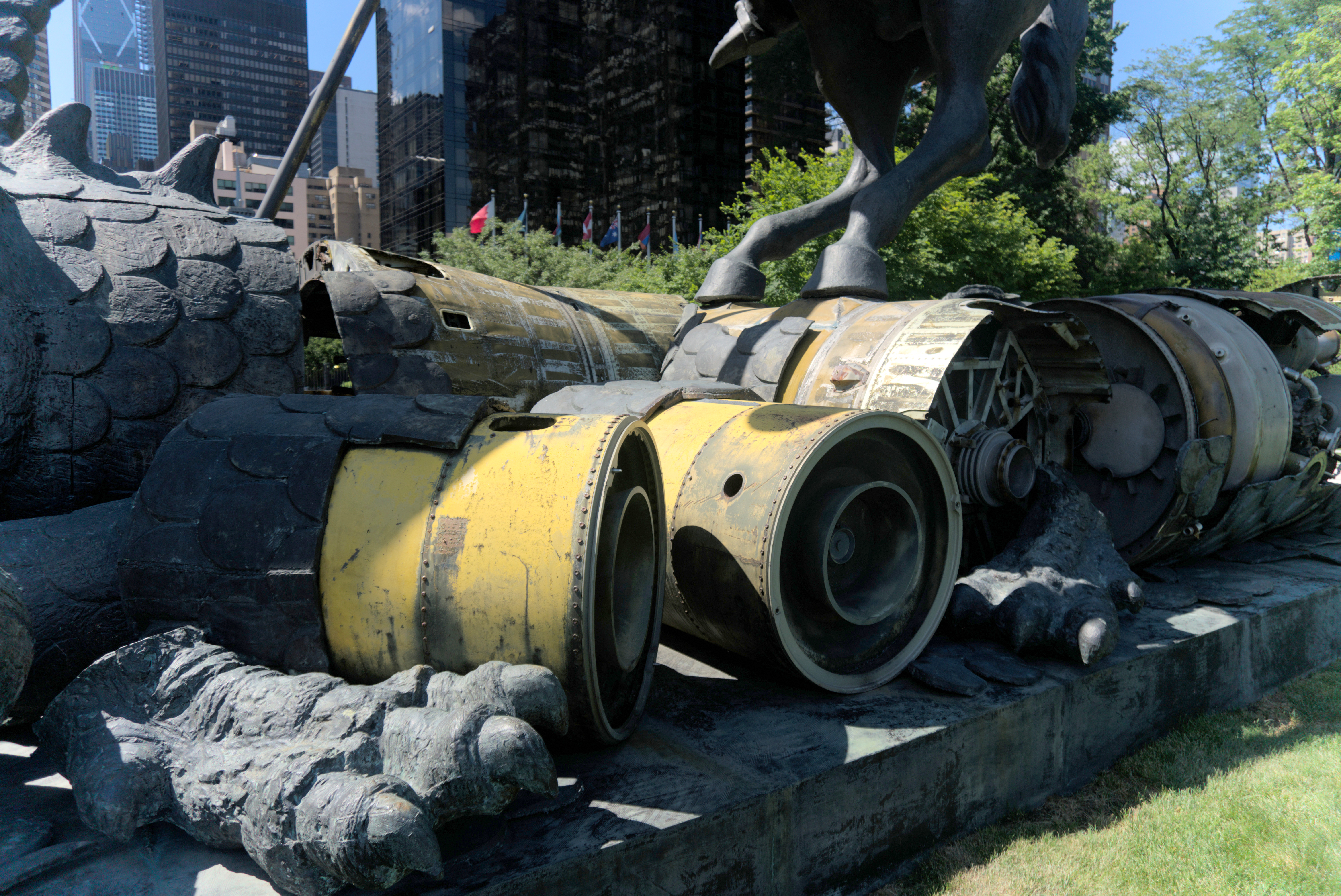
Tsereteli, Zurab_Good Defeats Evil (detail)

The dragon’s two heads thus represent the world’s two largest nuclear arsenals during the Cold War: those of the Soviet Union and the United States.

The last sculpture I’ll mention is Consciousness by the Mongolian artist Ochirbold Ayurzana. It consists of a rounded, high-luster steel alloy floor plate on which stands a human figure, made of twisted metal strings, examining the footprints they’ve left on the planet. What mark will we make, for good or ill? The sculpture is dedicated to the historic adoption of two global developmental milestone documents: the UN 2030 Agenda for Sustainable Development and the Paris Agreement on Climate Change.
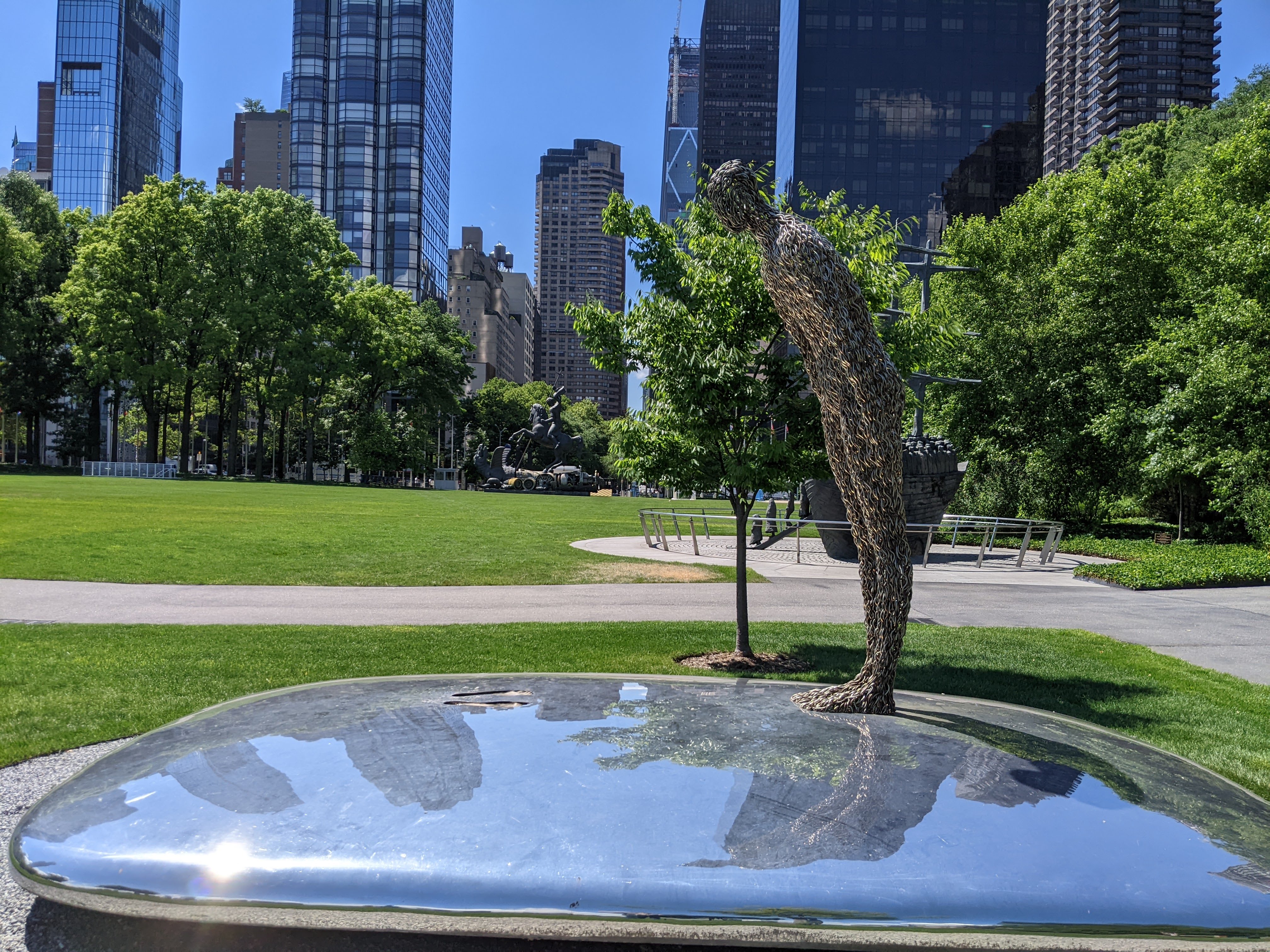
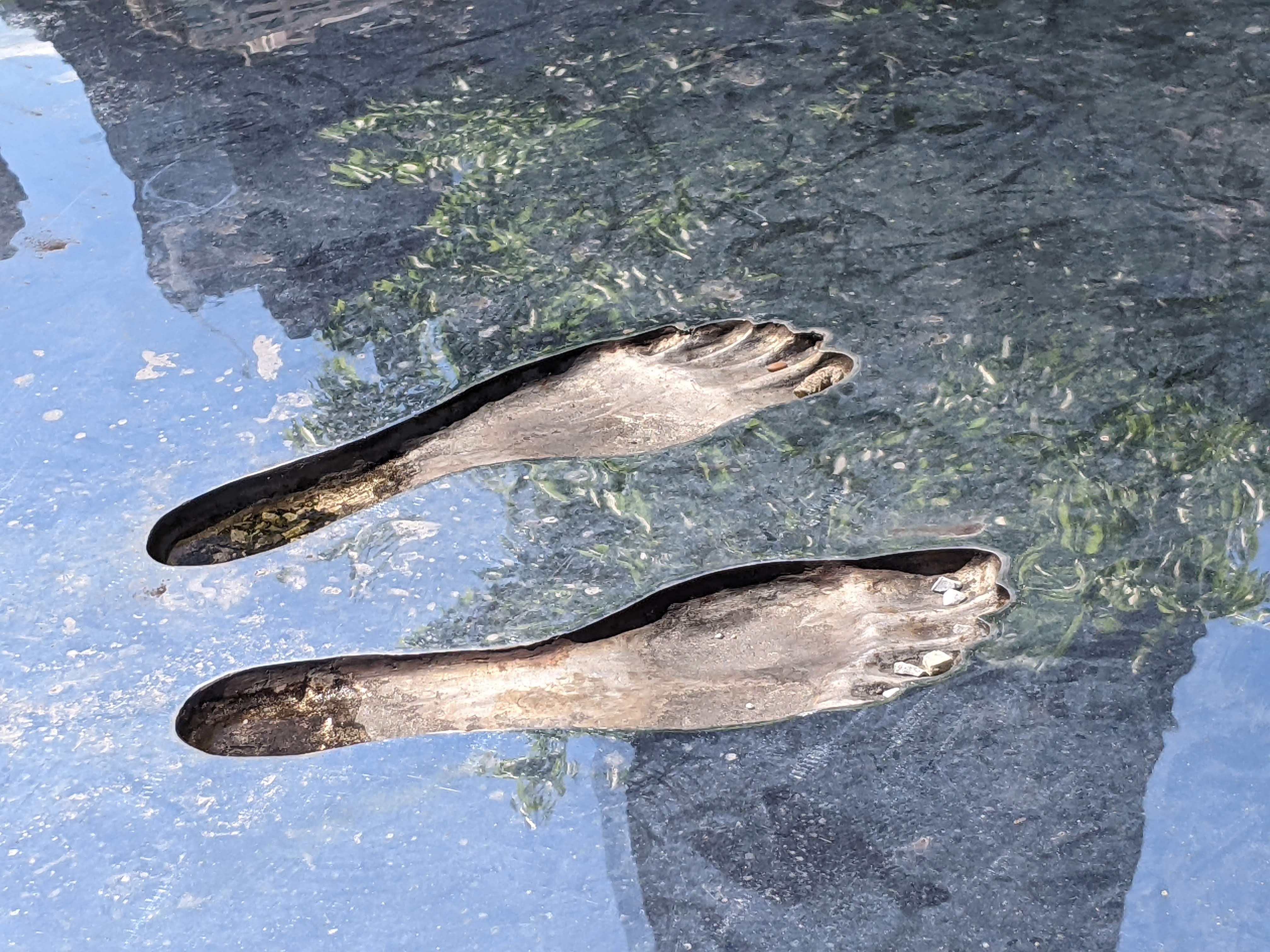
Ayurzana, Ochirbold_Consciousness
Ochirbold Ayurzana (Mongolian, 1976–), Consciousness, 2017. Steel, metal on pedestal, 110 × 196 × 125 in. North Lawn, United Nations Headquarters, New York. Gift from Mongolia. Photo: Victoria Emily Jones. [object record]


This is just a selection of the many artworks on view at the United Nations Headquarters in Manhattan. To view a full catalog, click here.

Garden Tours are offered every Wednesday at 2 p.m. from May through August, and Art Tours are offered every other Thursday at 1:15 p.m. year-round—or either one upon request. I’m grateful for their having accommodated me and my husband while we were in town!

I really wish the UN would allow visitors to move through the garden at their own speed, though, as the tour was so fast-paced that I hardly had time to take in a sculpture before we were made to move on to the next one. Approximately one to three minutes was apportioned for each work, which is hardly enough time to sit with the weight and history of some of these pieces. And I didn’t have time to change camera lenses for different types of shots. Because you have to be accompanied by a staff person, you are not allowed to linger behind when the group advances. Some leeway was given to me, but overall I felt rushed. Perhaps the pacing was anomalous because it was such a hot day—in the nineties—and the few shaded areas were prioritized.

Despite the swiftness, I really enjoyed the tour and experiencing and learning about the variety of sculptures and other art pieces from a variety of UN member countries, which celebrate peace, joy, and global unity and project a hopeful future.
Stained glass in West Side Chicago church reclaims an identity for Black youth

New Mount Pilgrim commemorates the Maafa, the Great Migration, and martyrs of urban violence and instills hope with trilogy of rose windows, which include an African Christ

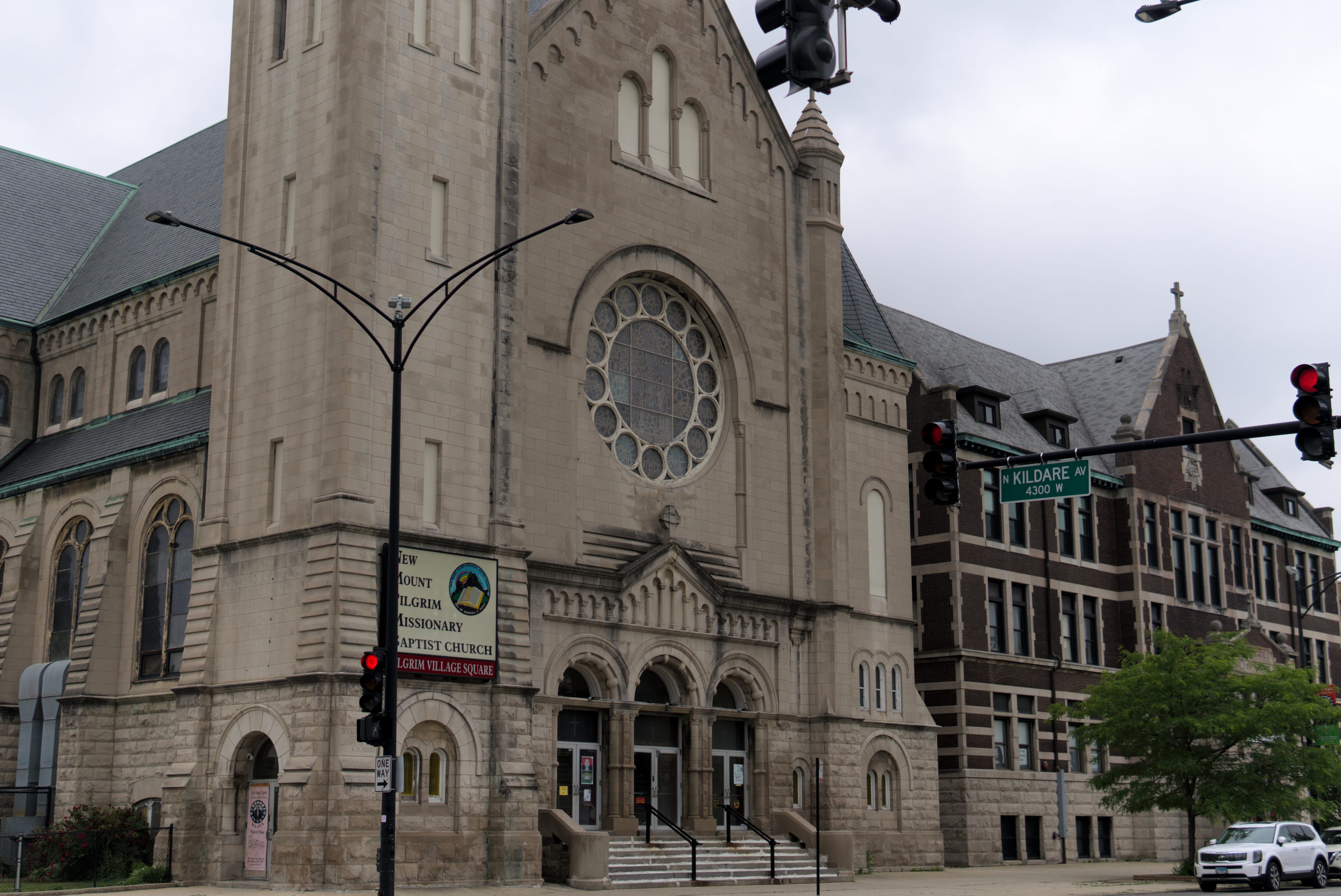
Designed by Charles L. Wallace and built in 1910–11, the French Romanesque–style church at 4301 West Washington Boulevard in Chicago’s West Garfield Park neighborhood was originally home to one of the largest Irish Catholic parishes in the city: St. Mel’s (named after Mél of Ardagh, a nephew of St. Patrick from the fifth century). They had the interior decorated with stained glass windows made by the studio of F. X. Zettler in Munich, portraying biblical figures and other saints—all as Caucasian, as was customary at the time and, frankly, still is. St. Mel’s, which merged with Holy Ghost Catholic Church in 1941 (whose parishioners were mainly of German descent), was a flourishing congregation. But in the late 1960s, white people began leaving the neighborhood as Black people moved in, and St. Mel’s membership waned until eventually the church closed its doors in 1988.

After the building had stood vacant for several years, in 1993, the Catholic Archdiocese of Chicago sold it to New Mount Pilgrim Missionary Baptist Church, a local Black congregation founded in 1950. The church leaders found that, due to lack of maintenance, the three large rose windows had structural issues that needed to be addressed. Rather than repairing the windows, they decided to replace them with new ones that better reflected the faith stories of their own parishioners—their history, heritage, and aspirations as a community. Rev. Dr. Marshall E. Hatch Sr., who had become the church’s pastor just a month after they moved into the new building and still serves in that role, developed the concepts for the windows with input from the congregation and started fundraising. All three were fabricated by Botti Studio of Architectural Arts in nearby Evanston, Illinois.

The Maafa Remembrance Window

The most striking and theologically profound of the three new windows, and the one I flew to Chicago to see last summer, is the Maafa Remembrance window on the wall to the left of the front altar. Because the church is oriented south rather than the traditional east, this is, directionally speaking, the East Rose Window; it purposefully faces the Atlantic Ocean. It was dedicated December 17, 2000, the church’s fiftieth anniversary year. It replaced an image of the Assumption of Mary (which you can view here); read more about the church building’s original windows on the website of art historian Rolf Achilles.

Maafa Remembrance Window
Maafa Remembrance, 2000, based on an illustration from The Middle Passage by Tom Feelings. Stained glass, diameter 25 feet. New Mount Pilgrim Missionary Baptist Church, West Garfield Park, Chicago. Photo: Victoria Emily Jones.

Original stained glass
Six of the twelve apostles are pictured in these stained glass windows inherited by New Mount Pilgrim from the building’s former owner, St. Mel’s Catholic Church. They appear beneath the newer Maafa Remembrance window, commissioned to counterbalance the preponderance of sacred white personages with sacred Black ones and to tell a narrative of liberation. Photo: Victoria Emily Jones.

Maafa (mah-AH-fah) is a Swahili word meaning “great disaster” or “great tragedy.” Since the late 1980s it has been used to refer to the transatlantic slave trade of the sixteenth through nineteenth centuries, during which an estimated 12.5 million African men, women, and children were kidnapped from their homes and forcibly brought to the Americas to work plantations without pay (by and large), building the wealth of their white enslavers. Some scholars prefer the term “African Holocaust” or “Black Holocaust” to describe this historic atrocity.

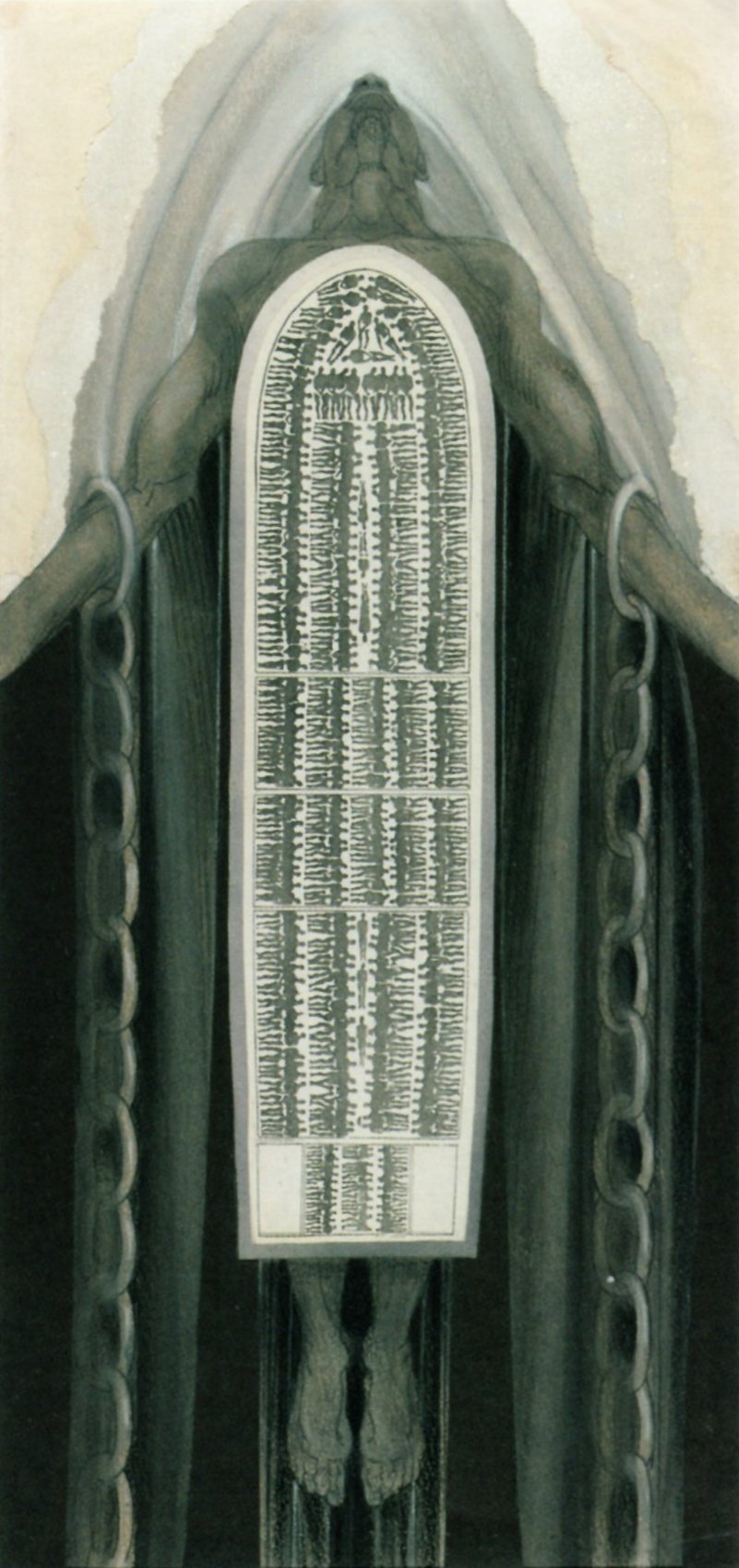
Based on an illustration by Tom Feelings from his extraordinary book The Middle Passage: White Ships / Black Cargo (Dial, 1995), the East Rose Window commemorates the Maafa through an evocation of the Middle Passage, the second leg of the triangular trade route. On this harrowing two- to three-month voyage across the Atlantic Ocean, which ships made many times over chattel slavery’s multicentury duration, at least two million enslaved Africans died of malnutrition, dehydration, disease, captor-inflicted violence, or suicide.


The closeness of the place, and the heat of the climate, added to the number in the ship, which was so crowded that each had scarcely room to turn himself, almost suffocated us. This produced copious perspirations, so that the air soon became unfit for respiration, from a variety of loathsome smells, and brought on a sickness among the slaves, of which many died, thus falling victims to the improvident avarice, as I may call it, of their purchasers. This wretched situation was again aggravated by the galling of the chains, now become insupportable; and the filth of the necessary tubs, into which the children often fell, and were almost suffocated. The shrieks of the women, and the groans of the dying, rendered the whole a scene of horror almost inconceivable.

—Olaudah Equiano, The Interesting Narrative of the Life of Olaudah Equiano, Or Gustavus Vassa, the African (London, 1789)


Slave ship icon
William Elford, “Stowage of the British slave ship ‘Brookes’ under the regulated Slave Trade Act of 1788,” 1788. Elford was the chairman of the Plymouth Committee of the Society for Effecting the Abolition of the Slave Trade in England, the body that commissioned these stowage plans in order to expose the horrors of human trafficking. He based the plans on the measurements and sailing records of an actual slave ship docked in Liverpool in early 1788.

Feelings, Tom_The Middle Passage
Tom Feelings (American, 1933–2003), illustration for The Middle Passage: White Ships / Black Cargo (Dial, 1995). Pen and ink, tempera on rice paper. Collection of the Beinecke Rare Book and Manuscript Library, Yale University. © The Estate of Tom Feelings. Used with permission.

Tom Feelings and Marshall Hatch
Newbery- and Caldecott-winning illustrator Tom Feelings shakes hands with Pastor Marshall Hatch in the offices of New Mount Pilgrim in December 2000 after the dedication of the Maafa Remembrance window, designed after an illustration from Feelings’s book The Middle Passage. Feelings said it was the first time his art had been used by a church.

In Feelings’s image, an African Christ figure stretches his chained arms out, as if on the cross. His body is constituted by the famous schematic representation of the crowded lower deck of the Brookes slave ship’s human cargo hold, first created in England in 1788 and widely disseminated throughout the nineteenth century. The perspective is such that we’re looking down on a body-as-slave-ship gliding through the waters—but it’s also a crucifixion. The Son of God carries the suffering of the sons and daughters of God, feeling it in his own body. He wears the slave ship like a giant wound that will forever mark him because it has marked his ecclesial body, the church.

The window functions, on one level, as a lament. Consider it in light of the following poem by Lucille Clifton, which draws out the cruel irony of the actual names some ostensibly Christian slave ship owners gave their vessels.

“slaveships” by Lucille Clifton

loaded like spoons
into the belly of Jesus
where we lay for weeks for months
in the sweat and stink
of our own breathing
Jesus
why do you not protect us
chained to the heart of the Angel
where the prayers we never tell
and hot and red
our bloody ankles
Jesus
Angel
can these be men
who vomit us out from ships
called Jesus    Angel    Grace Of God
onto a heathen country
Jesus
Angel
ever again
can this tongue speak
can these bones walk
Grace Of God
can this sin live

—from The Terrible Stories (1996), compiled in Blessing the Boats: Selected Poems, 1988–2000 and The Collected Poems of Lucille Clifton, 1965–2010; © The Estate of Lucille Clifton

The speaker of the poem, an enslaved African, addresses Jesus, questioning why he allows them to be so brutally treated—stolen from their homeland, marched to the coast in chains, claustrophobically packed in ship holds for maximum profitability, and spat out onto auction blocks in a barbarous country that appears to practice the devil’s ways more than God’s. How can God abide such sin? What kind of grace is it that transports them into oppression?

Christian Wiman brilliantly unpacks this poem, noting Clifton’s cunningly subtle tweak of a prophetic passage from Ezekiel that promises resurrection, both of individuals and of a nation. Underneath its acerbity, there’s a certain hopefulness to the poem—a hope that this sin will die, this suffering be transformed. In both Ezekiel’s vision of the valley of dry bones and Clifton’s poem, Wiman writes,

the Word comes streaming again through, and by means of, the word. In terms of the poem, Jesus (the man) is on board Jesus (the ship), but he is in the hold, just as, when the worship services took place above the captured slaves on the Gold Coast of Africa, God, if he was anywhere, was underneath it all, shackled and sweating and merged with human terror.

Emmanuel, God-with-us.

Clinging to this truth, the psalmist declares, “If I make my bed in hell, behold, thou [God] art there” (Psalm 139:8b). In his great compassion, God descends with us into the depths, and bears us up.

Photo: Victoria Emily Jones

The Maafa Remembrance window plays with the themes of descent and ascent. As Emmanuel, Jesus was below deck, in the miserable belly of the thousands of slave ships that traversed the Atlantic, suffering with those chained inside. Christ’s arms are draped with chains, notes Marshall Hatch Jr., the pastor’s son and cofounder and executive director of the MAAFA Redemption Project (more on that below), “but he’s rising. And at some point those chains will break. That’s the hopefulness that shines through.”

Thus, the window commemorates both tragedy and triumph. It honors those who died on the Middle Passage and through the institution of slavery more broadly while also honoring those who persevered all the way to freedom. Hatch Jr. says this Christ is “carrying within himself the memories of those who lost their lives on the journey to America. But also he’s carrying the legacy of those who survived. And we are that living legacy,” descendants of the Middle Passage.

The border around the window’s central image calls parishioners to “REMEMBRANCE.” They must remember their history, the Great Catastrophe their ancestors endured, and, having faced the truth, commit to ending slavery’s legacy of racism in America’s civic, social, and religious spheres and in their own psyches.

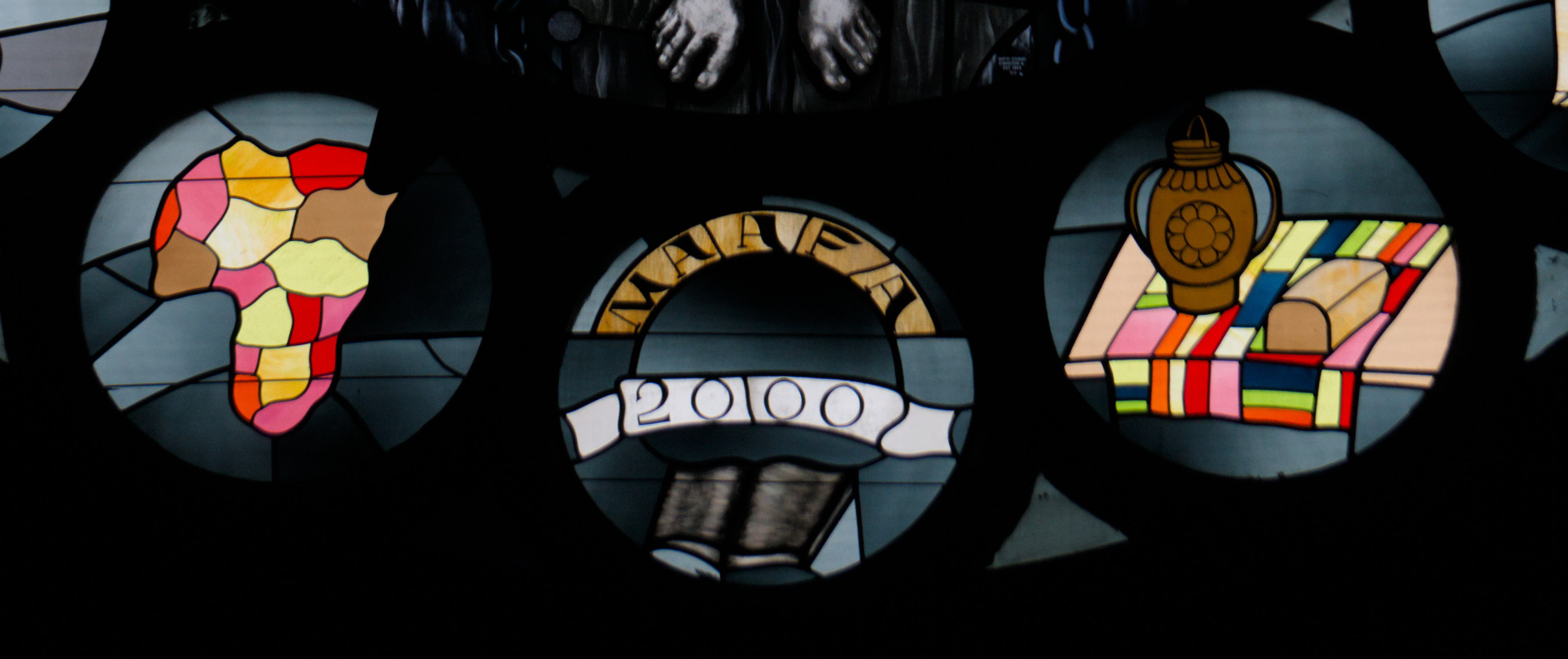
Two of the roundels in the bottom border show a map of Africa and a Communion table laid with kente cloth, a loaf of bread, and a flask of wine. The roundel between these two displays the open word of God, which guides Christians forward in our work of justice and reconciliation.  

Photo by Victoria Emily Jones

Art historian Cheryl Finley features New Mount Pilgrim’s Maafa Remembrance window in her book Committed to Memory: The Art of the Slave Ship Icon (Princeton University Press, 2022), which traces the origins of the Brookes schematic and its proliferation in mass culture and art. She identifies the window, twenty-five feet in diameter, as the largest example of the “slave ship icon” in the world and writes that, like the cross of Christ, the slave ship embodies both death and rebirth. It is “a site of death, of dying Africans, and of new life, of a people who would persevere in the face of slavery and unspeakable cruelty to become a free people who helped define the modern era” (6).

“The children will need to know that this symbol, this window, is a representation of not only the pain but also the possibilities of a great and mighty God,” Rev. Dr. Gregory Thomas told the Chicago Tribune in 2000. Thomas was a theology professor at Harvard Divinity School, where Hatch Sr. served a fellowship sabbatical semester in 1999 and first encountered Feelings’s Middle Passage book.

In the window, slavery is interpreted in light of the paradox of the cross. Theologian James H. Cone famously interpreted another, later icon of Black suffering—the lynching tree—in light of the same in his essential book The Cross and the Lynching Tree (Orbis, 2011). He opens the book by explaining why and how the cross has held such power for the Black church:

The cross is a paradoxical religious symbol because it inverts the world’s value system with the news that hope comes by way of defeat, that suffering and death do not have the last word, that the last shall be first and the first last.

That God could “make a way out of no way” in Jesus’ cross was truly absurd to the intellect, yet profoundly real in the soul of black folk. Enslaved blacks who first heard the gospel message seized on the power of the cross. Christ crucified manifested God’s loving and liberating presence in the contradictions of black life—that transcendent presence in the lives of black Christians that empowered them to believe that ultimately, in God’s eschatological future, they would not be defeated by the “troubles of this world,” no matter how great and painful their suffering. Believing this paradox, this absurd claim of faith, was only possible through God’s “amazing grace” and the gift of faith, grounded in humility and repentance. There was no place for the proud and the mighty, for people who think that God called them to rule over others. The cross was God’s critique of power—white power—with powerless love, snatching victory out of defeat. (2)

A powerful reclamation of Christian iconography, New Mount Pilgrim’s Maafa Remembrance window weds Black history and Christian theology to offer its predominantly African American congregation a communal symbol that honors what they’ve been through as a people and reminds them that they worship a risen Christ who breaks chains and brings life out of death.

The North Star / Great Migration Window

The East Rose Window covered in the previous section is narratively the first in the trilogy of newly commissioned windows, but the first of the three to be fabricated and installed, earlier in 2000, was the North Rose Window, called the North Star or Great Migration window. It commemorates those who traveled north on the Underground Railroad to escape slavery, and, a few generations later (from about 1910 to 1970), as part of a mass movement to escape Jim Crow oppression.

North Star Window
North Star / Great Migration, 2000. Stained glass, diameter 25 feet. New Mount Pilgrim Missionary Baptist Church, West Garfield Park, Chicago. Photo: Victoria Emily Jones.

The North Star window shows a Black family unit, the father, in purple robe, lifting his newborn up to the heavens in a gesture of gratitude and pride. The child is backlit by the North Star, a beacon to freedom. The scene recalls the famous naming ceremony in the 1977 Roots miniseries, based on the best-selling novel by Alex Haley, in which Omoro Kinte, a Mandinka man living in The Gambia, carries his firstborn son, Kunta Kinte, to the edge of the village, raises him into the starry night sky, and exclaims, “Behold, the only thing greater than yourself!” This declaration affirms the child’s inherent worth and directs him toward worship of his Creator God.

Later in the story, when Kunta has his first child, Kizzy, thousands of miles away in America, he enacts the same ritual with her.

During New Mount Pilgrim’s baby dedication ceremonies, the pastor raises the child in like manner while the parents vow to bring up the child in the nurture and admonition of the Lord and the congregation vows to support them in this task. This physical gesture of lifting up signifies surrender to God and hope that the next generation will carry the flame of faith out into the city of Chicago and the wider world. Because the North Star window is situated across from the pulpit, over the choir loft and organ, it is in full view of the dedicants.

Baby dedication
Baby dedication ceremony, New Mount Pilgrim Missionary Baptist Church. Photo courtesy of Partnering for Community Impact.

New Mount Pilgrim MB Church
View from the pulpit of New Mount Pilgrim, facing the North Star window and the main entrance to the church. Photo courtesy of the church.

The inscription below the family in the window reads, “Lift holy hands,” a phrase taken from 1 Timothy 2:8, and the roundels in the border spell out the name of the church. The three portraits at the bottom are of the church’s longest-serving pastors: (from right to left) Rev. J. H. Johnson, the church’s first elected pastor; Rev. James R. McCoy, who served from 1965 to 1993; and Rev. Dr. Marshall Hatch Sr., who has served since 1993. Hatch Sr.’s father and McCoy both participated in the Great Migration, having moved to Chicago from Aberdeen, Mississippi, and so did the majority of the church’s founding members.

The North Star window fills the space previously occupied by a window depicting Saint Cecilia, a Roman virgin martyr.

The Sankofa Peace Window

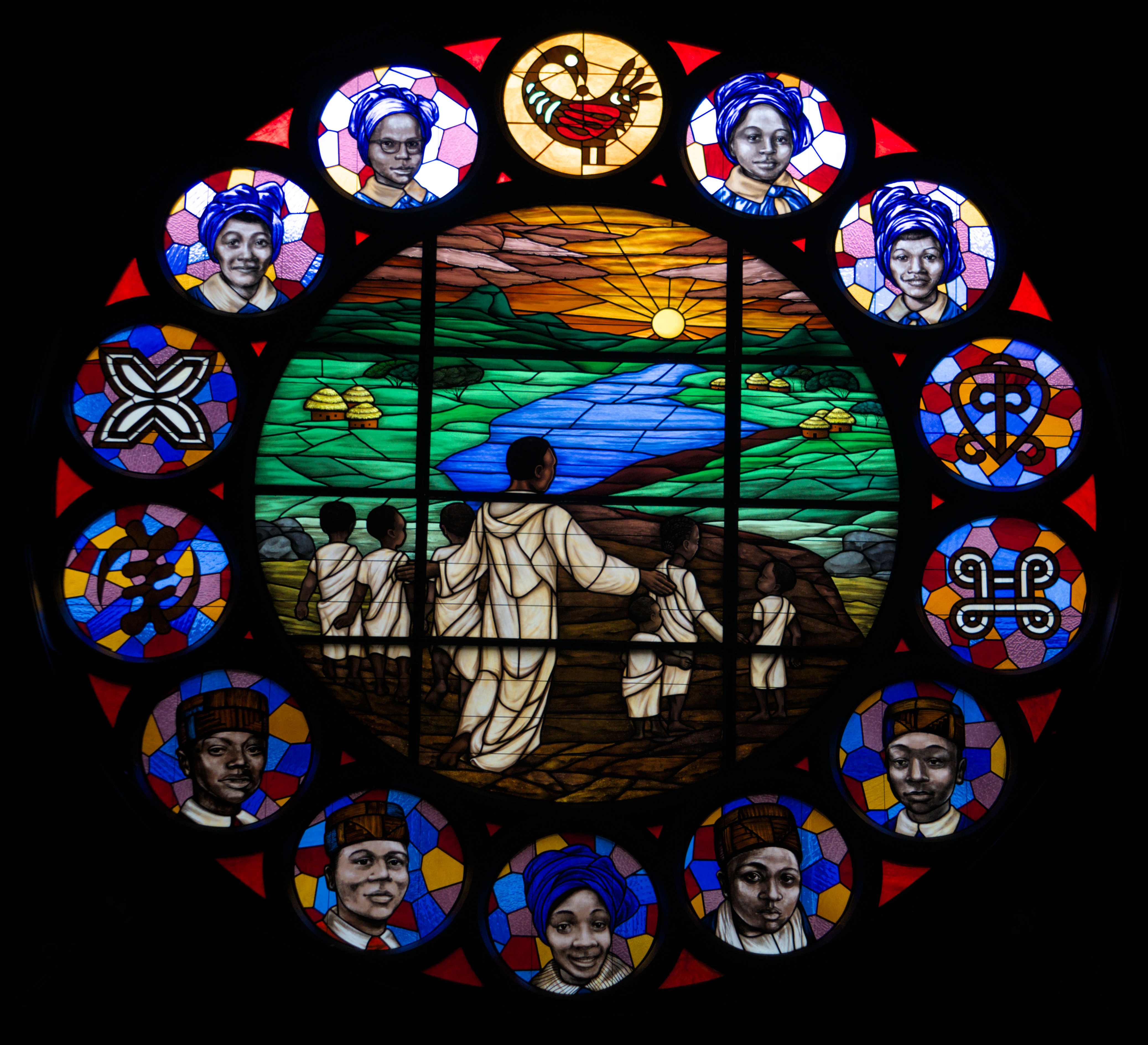
The West Rose Window, known as the Sankofa Peace window, was the final one to be installed, replacing the clear panes that were there for over two decades. (New Mount Pilgrim sold the original window depicting Mary and the Christ child blessing and accepting the rosary from a male and female saint, to raise funds for the new one.) The Sankofa Peace window was dedicated on February 24, 2019 (watch the service here and view photos here), the year that marked the four hundredth anniversary of race-based slavery in America.

Sankofa Peace Window
Sankofa Peace, 2019. Stained glass, diameter 25 feet. New Mount Pilgrim Missionary Baptist Church, West Garfield Park, Chicago. Photo: Victoria Emily Jones.

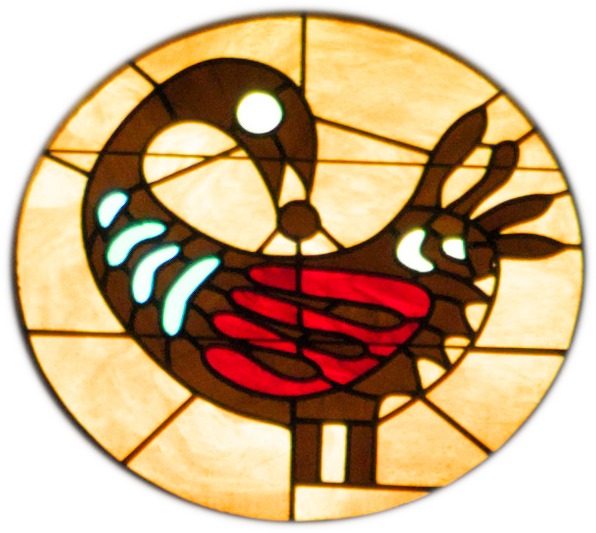
Sankofa is a Twi word from the Akan people of Ghana that means “go back and retrieve it,” a phrase that encourages learning from the past to inform the future. It comes from the proverb “Se wo were fi na wosan kofa a yenkyiri”—“It is not wrong to go back for that which you have forgotten,” to return to one’s roots to reclaim lost identity. The concept of Sankofa is traditionally symbolized by a mythical bird with its head turned backward while its feet face forward, carrying a precious egg in its mouth, which represents the knowledge of the past on which wisdom is based.
Sankofa bird

The Sankofa bird appears in the top center roundel of the window.

Hatch Jr., who preached at the window’s dedication service, discussed Sankofa as a spiritual discipline, highlighting how it can refer not only to returning to one’s cultural roots, but also to God, our Source. “Sankofa is the process of training my soul to reach back and remember the grace and the glory of God,” he says, which can fuel us for the forward journey. He quotes the famous gospel hymn that says, “My soul looks back in wonder how I got over.” We must regale one another with stories of where we’ve been and how far God has brought us, and remind ourselves and each other where we’re heading.

Besides the Sankofa bird, the other four adinkra symbols that New Mount Pilgrim chose to include in the window’s border are:

These are key guiding principles of the church, part of their missional purpose and identity. They seek liberation and peace for all, through the power of God, following the path of the Savior who is Love, who brings us back to who we most truly are.

One way the Sankofa Peace window looks backward while moving forward is through the memorialization of murdered Black American youth, from the civil-rights-era South and twenty-first-century Chicago. The portraits at the top depict the four girls who were killed by the Sixteenth Street Baptist Church bombing in Birmingham, Alabama, in 1963: Carole Robertson (age fourteen), Addie Mae Collins (fourteen), Denise McNair (fourteen), and Cynthia Wesley (eleven).

The five teens at the bottom, selected by members of New Mount Pilgrim’s youth leadership committee, were victims of Chicago violence from the previous decade or so. From left to right, they are:

  • Derrion Albert (1994–2009), age sixteen. On his way home from school, he got caught in the middle of a brawl between two rival factions of students and was beaten to death with a railroad tie. The crime was captured on cellphone video.
  • Laquan McDonald (1997–2014), age seventeen. He was shot sixteen times by a police officer while he was walking away.
  • Hadiya Pendleton (1997–2013), age fifteen. She was killed by a stray bullet while hanging out in a park with friends after her final honors exams.
  • Blair “Bizzy” Holt (1990–2007), age sixteen. He was fatally shot on a CTA bus while shielding his friend from gang gunfire.
  • Demetrius “Nunnie” Griffin Jr. (2000–2016), age fifteen. A lifelong member of New Mount Pilgrim, he was burned to death in a trash can in a West Side alley. His death was ruled a homicide, but his killer(s) have not been found. He had told his mother that a gang had been trying to recruit him.

All nine children are dressed in traditional African headwear. 

Even as the window laments these unjust deaths, it also provides a vision of restoration. The central scene shows Jesus as the Good Shepherd, leading his children to green pastures and still waters lined with thatched-roof homes—an Edenic place of peace and rest. One might view this as the afterlife (Hatch Sr. told me the children are “going back to the Father’s estate”); but it could also be seen as a picture of Christ leading us into a future on this side of the parousia, where all God’s children are safe and thrive on earth as it is in heaven.

Hatch Sr. told me the window is about recovering a village mentality right in the heart of the city, embracing values like hospitality, family, mutual support, elder respect, and the protection and uplift of children. Whereas the North Star window visualizes the literal lifting up of a child, the Sankofa Peace window calls parishioners to do it metaphorically, through the building of strong community and advocacy for policies that prevent violence and tragedy.

The MAAFA Redemption Project

As a tangible outworking of the communal values expressed in its three rose windows, in 2017 New Mount Pilgrim established a workforce, social, and spiritual development program for young Black men in West Garfield Park, which is still running strong. (It graduated its seventh cohort last month!) Called the MAAFA Redemption Project, it is predicated on the belief that redemption and transformation must begin with the individual, and then that personal transformation can effect family and community transformation. The program emphasizes the importance of, as its website says, “remembering the past in order to create a more just and verdant present and future.”

MAAFA Redemption Project
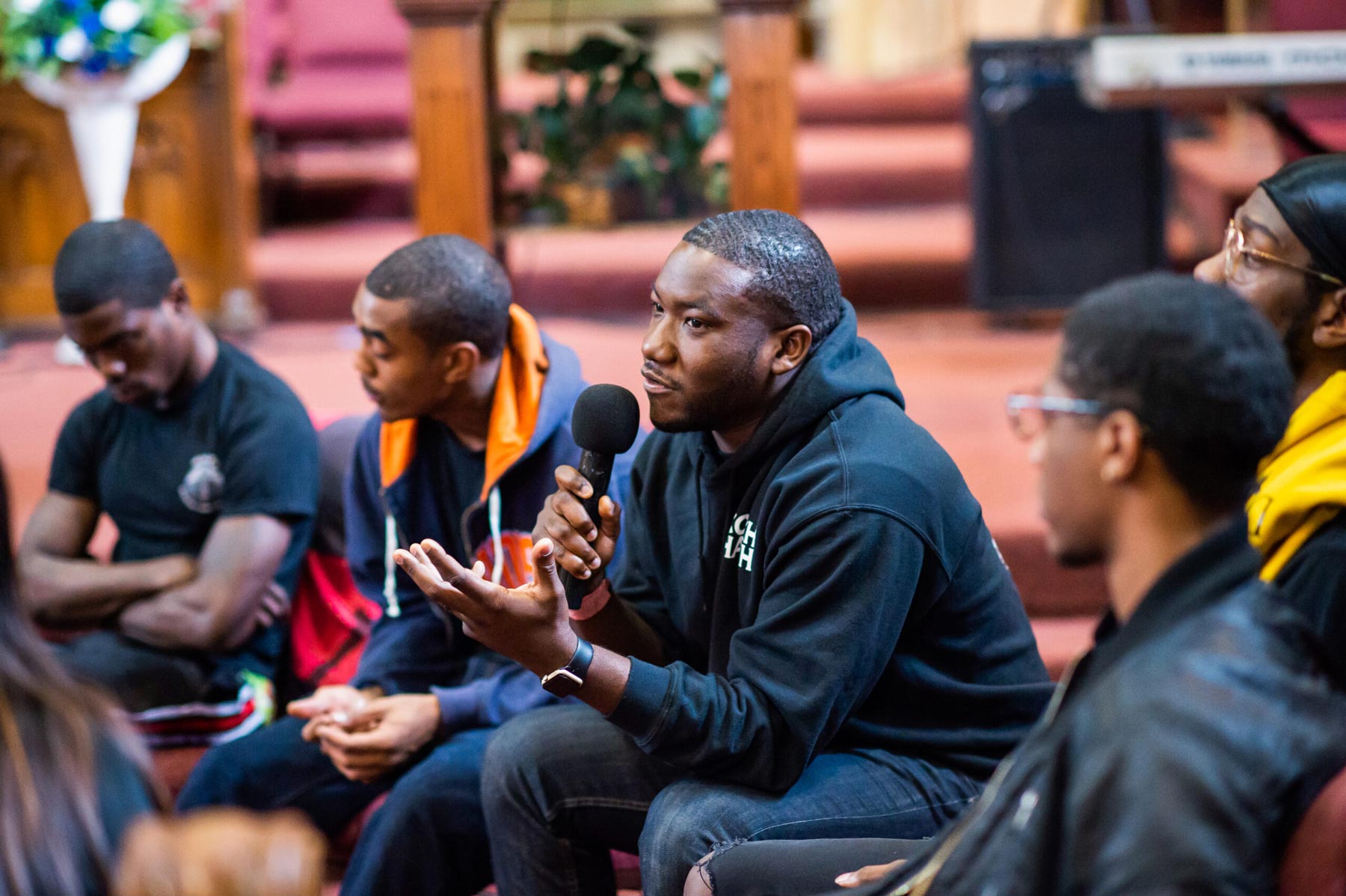
Marshall Hatch Jr., director of the MAAFA Redemption Project (a ministry of New Mount Pilgrim MB Church), speaks with a group of participants about their experiences as young Black men living in West Garfield Park.

Using a dual direct-service and community-building approach, the program provides housing, job training, educational opportunities, psychotherapy, counseling, and wrapround social services to the young men who enroll. These supports are supplemented with programming that focuses on the arts, cultural identity development, spiritual enrichment, transformative travel, civic empowerment, and life coaching and mentoring.

The square-mile neighborhood of West Garfield Park has the highest rate of gun violence in Chicago and is one of the most crime-dense populations in the nation. The MAAFA Redemption Project seeks to recruit men between the ages of eighteen and thirty who are a part of this gun culture or at risk of becoming so, recognizing that young people are a neighborhood’s greatest resource for change. The project affirms the dignity and promise of the neighborhood’s Black and Brown youth and aims to instill hope in them, empowering them in activism against gun violence and the conditions that create it.

“The young people who come to us are tired of the subculture that only produces death, despair, and falling into the trap of the criminal justice system,” says Marshall Hatch Jr., the cofounder and executive director of the MAAFA Redemption Project. “They want something different for themselves and their loved ones.”

He continues, “We want to create the space for young men to see themselves differently, to reimagine themselves as men and leaders, pillars of this neighborhood. And so our goal is to embrace the truths that they give us of their experience but also challenge them to overcome, just as their ancestors overcame; to develop the inner resources to persevere and to challenge the system so that their sons, their daughters, don’t have to fight the same fights.”

The video storytelling unit NBC Left Field ran a wonderful segment in November 2018 that features the work of MAAFA Redemption Project:

I also recommend the feature-length documentary All These Sons (2021), directed by the Oscar-nominated Bing Liu and Joshua Altman (Minding the Gap) and streaming for free on Tubi, Amazon, and other services. MAAFA Redemption Project is one of the two Chicago antiviolence programs profiled, the other being the South Side’s Inner-City Muslim Action Network (IMAN) run by Billy Moore.

Most recently, MAAFA Redemption Project has partnered with other groups to build and share ownership of the Sankofa Wellness Village, a series of interconnected capital projects and social enterprises sited along the Madison and Pulaski corridor in West Garfield Park. Winner of the Chicago Prize awarded by the Pritzker Traubert Foundation, the village will be a sprawling, $50 million campus that will bring critical health, financial, and recreational resources back into the disinvested neighborhood, including a wellness center, a credit union, an art center, a business incubator and entrepreneurial support center, and pop-up fresh food markets.

The Sankofa Wellness Village breaks ground later this summer and is expected to open in late 2025.

Having identified the arts as an unmet need and desire of West Garfield Park residents, MAAFA Redemption Project has taken the reins on what will be called the MAAFA Center for Arts and Activism. They are working to restore the old St. Barnabas Episcopal Church to provide a space where residents can engage in intergenerational art making, relationship building, community organizing, political education, and civic empowerment.

Maafa Center for Arts and Activism
Rendering of the future MAAFA Center for Arts and Activism in West Garfield Park, Chicago. Credit: Moody Nolan/Bureau Gemmel

“We’re part of a continuum of that liberation narrative of God,” Hatch Sr. says, referring to his church’s commitment to see their neighborhood flourish.

For another, well-reported article on the New Mount Pilgrim windows that includes many great photographs of them within the larger sanctuary and worship service context, see the Faith & Leadership article “Proclaiming the liberation narrative of God through church art” by Celeste Kennel-Shank.

Conclusion

When in the nineties they inherited a grand church full of Eurocentric stained glass and other decoration from the Irish Catholic community that worshipped there previously, New Mount Pilgrim Missionary Baptist Church had some decisions to make. How would they honor the history of that sacred space while also making room for their own histories? What adjustments would have to be made to accommodate their different ecclesial and theological tradition? They made a few changes to the sanctuary, but they left most of it intact. The most significant change is the three new rose windows they commissioned to replace the old ones that were buckling. Once the first two were installed, Pastor Marshall Hatch Sr. told me, the space really started to feel like home.

Hatch Sr. spoke to me about “the power of art to reclaim an identity” for youth involved in or susceptible to gang violence. For sure, many local youth have been inspired by the Maafa Remembrance image in particular, which MAAFA Redemption Project uses as its logo, and thus it’s been widely visible throughout the neighborhood. And yet while the “under thirty” demographic is a particular focus of the church’s outreach efforts, the identity-forming power of art holds true for folks of any age. When a West Garfield Park resident enters the New Mount Pilgrim sanctuary for whatever reason—prayer, worship, respite, connection, religious education, compulsion from a family member—they can hopefully see themselves reflected in the imagery of the rose windows, and, in conjunction with the church’s music and preaching ministries, experience healing and revival.

Their culture, their history, their stories are sacralized in stained glass and integrated into the larger story of redemption God is telling.

Perhaps, from viewing the windows, they feel a deep identification with Christ in his crucifixion, or a sense of God’s presence with them in their suffering; perhaps they are dazzled by the dignity and endurance of their ancestors, or are compelled by the freedom Christ offers; perhaps that was one of their friends whose face shines down from the wall, or the niece or nephew of a friend, and they are turned toward somber remembrance of the lost life and moved to concrete action to reduce the city’s violence; perhaps they’re emboldened by the reminder that Christ goes with them as they seek transformation, as they bring to bear the gospel in this present age, in their own lives and the life of their community.

Visit the Church

Address:
New Mount Pilgrim Missionary Baptist Church
4301 W. Washington Blvd.
Chicago, IL 60624
(To see the windows in the sanctuary, I made a weekday appointment ahead of time with office manager Rochelle Sykes by calling the church at 773-287-5051. She let me in through the side door.)

Closest CTA train stop:
Pulaski (Green Line) (twelve-minute walk)

Worship service:
Sundays, 10:00 a.m.

Further Reading

The Middle Passage: White Ships / Black Cargo by Tom Feelings (Dial, 1995). This is an important work that every American should own a copy of. It consists of fifty-four powerful grayscale drawings that tell the story of the transatlantic slave trade’s Middle Passage. There’s no written narrative, but there is a brief introduction by the historian John Henrik Clarke. The book caught the attention of Marshall Hatch Sr. while he was a scholar-in-residence at Harvard Divinity School in 1999 and led him to reach out to Feelings for permission to have a stained glass window made based on one of the illustrations.

Committed to Memory: The Art of the Slave Ship Icon by Cheryl Finley (Princeton University Press, 2022). Thank you to Marshall Hatch Sr. for recommending this book to me. Finley, an art historian, explores how an eighteenth-century engraving of a slave ship became a cultural icon of Black resistance, identity, and remembrance, its radical potential rediscovered in the twentieth century by Black artists, activists, writers, filmmakers, and curators who have used it as a medium to reassert their common identity and memorialize their ancestors. It’s heavily illustrated and an insightful read, academic in tone but very accessible.

Painting the Gospel: Black Public Art and Religion in Chicago by Kymberly N. Pinder (University of Illinois Press, 2016). This is where I first found out about the Maafa Remembrance window at New Mount Pilgrim. It’s one of sixty-some Black-affirming religious images from Chicago churches and their neighborhoods made between 1904 and 2015 that Pinder, an art historian, features, focusing on their intersection with the social, political, and theological climates of the times. Read my review here.

“Voices from Chicago’s Most Violent Neighborhood” by Andy Grimm, Chicago Sun-Times, 2023. The Sun-Times spent months last year talking to residents of West Garfield Park about why they’ve chosen to stay despite the rampant violence, and they’ve presented some of these stories in a well-designed, interactive web feature. One of the remarks that stands out to me is: “The most dangerous residents of the neighborhood are also the most endangered.”
A Blessing for Those Who Hate and Hurt

Pena Defillo, Fernando_The Offering
Fernando Peña Defilló (Dominican, 1928–2016), La ofrenda (The Offering), 1993. Oil and acrylic on canvas, 126 × 166 cm. Private collection. Source: Latin American Art in the Twentieth Century, ed. Edward J. Sullivan (Phaidon, 1996), p. 110.

May those whose hell it is
To hate and hurt
Be turned into lovers
Bringing flowers.

—Shantideva, eighth century

These lines are from chapter 10, stanza 9, of the Bodhicharyavatara (Way of the Bodhisattva), a Mahayana Buddhist text by the eighth-century Indian monk Shantideva. I first encountered this religious classic, originally written in Sanskrit, while working at Shambhala Publications. The excerpt above was adapted by author David Richo from a translation by the Padmakara Translation Group. Here’s 10.9 in full, as translated by PTG:

May the hail of lava, fiery stones, and weapons
Henceforth become a rain of blossom.
May those whose hell it is to fight and wound
Be turned to lovers offering their flowers. [source]

Other translations include those by Stephen Batchelor—

May the rains of lava, blazing stones, and weapons
From now on become a rain of flowers,
And may all battling with weapons
From now on be a playful exchange of flowers. [source]

—and Fedor Stracke:

May the rain of leafs, embers, and weapons
Become forthwith a rain of flowers.
May those cutting each other with knives
Forthwith throw flowers for fun. [source]

I am so struck by this short benediction that prays our hate be transformed into love, our hardness into softness, our cold, sterile weaponry into delicately petaled, fragrant blooms. Shantideva recognized that when we lash out in physical or verbal violence, we create a hell that’s all our own. We may intend to inflict suffering on another, but in doing so, we often wound ourselves—psychologically, spiritually. When we dehumanize others, we become less human.

Instead of hurling rocks, punches, bullets, or insults, what if we were to completely confound our enemies by offering them words or tokens of love? Love is the way of the bodhisattva, the “enlightened being.” It’s the way of Jesus—he who said, “Love your enemies; do good to those who hate you; bless those who curse you; pray for those who mistreat you” (Luke 6:27–28).

Loving people doesn’t mean we can’t be angry at them—but we cannot allow our anger to fester into bitterness and ill will or to explode in harmful outbursts. It should be a productive anger.

How might we use an ethic of love to direct our anger or somebody else’s toward a good end, to defuse a contentious situation? Not taking the easy way out by simply ignoring or retreating from a problem, but confronting our opponent in peaceful, creative, and potentially transformative ways?

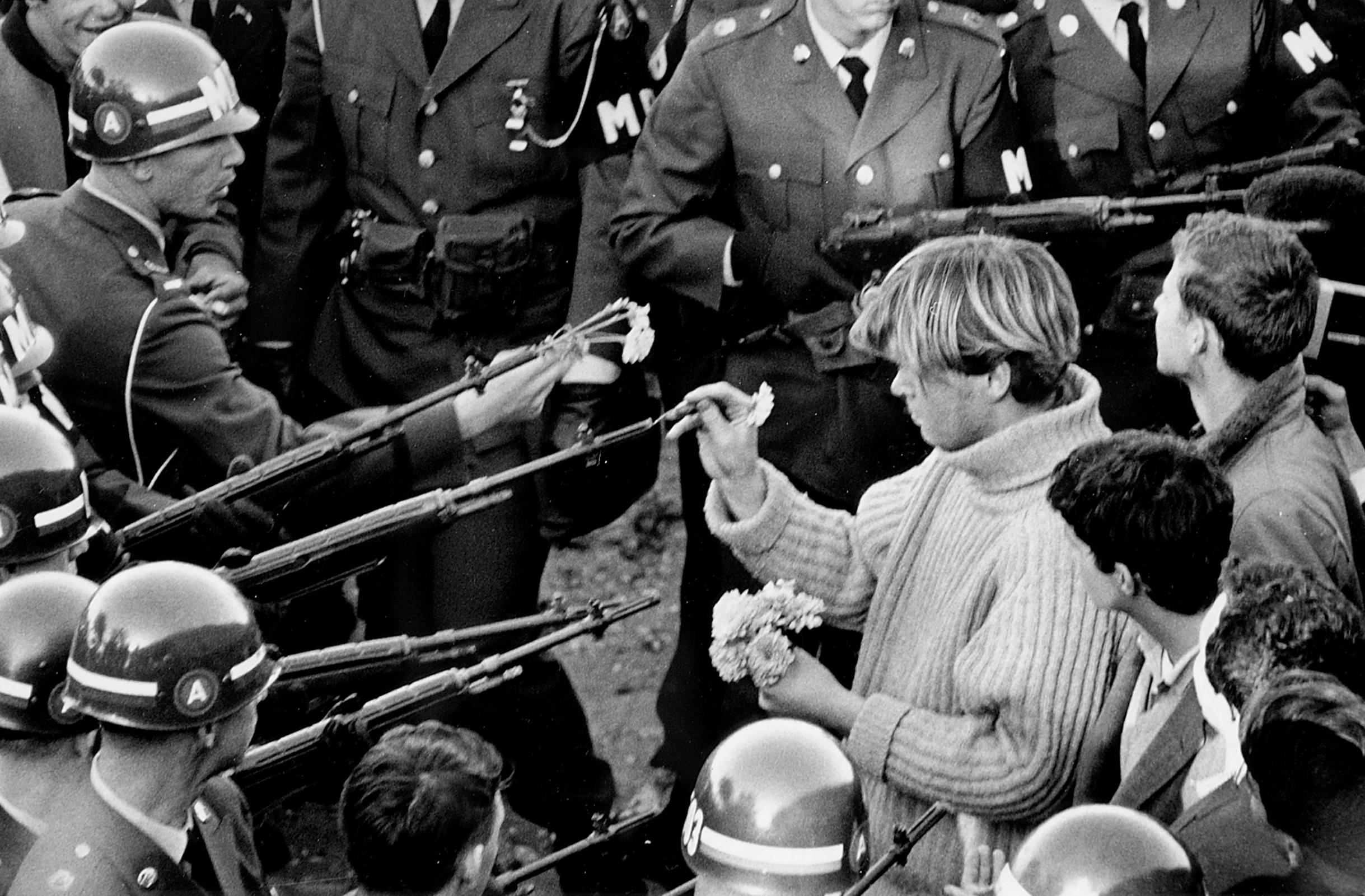
I’m reminded of the historic Pulitzer Prize–nominated photograph Flower Power, taken by Washington Star photojournalist Bernie Boston on October 21, 1967, when he was covering an antiwar march on the Pentagon. As the 503rd Military Police Battalion formed a semicircle around demonstrators to prevent them from climbing the Pentagon steps, Boston captured eighteen-year-old George Edgerly Harris III, aka Hibiscus, placing a carnation into the barrel of an M14 rifle held by one of the soldiers. What a powerful image!

Flower Power
Bernie Boston (American, 1933–2008), Flower Power, Arlington, Virginia, 1967

Two years earlier in his essay “How to Make a March/Spectacle,” Allen Ginsberg was the first to expound on the potency of flowers as a spectacle to simultaneously disarm opponents and influence thought. He said “masses of flowers” should be handed out on the front lines of protests to police, the press, and onlookers as a symbol of nonviolent advocacy. He also suggested candy bars and toys.

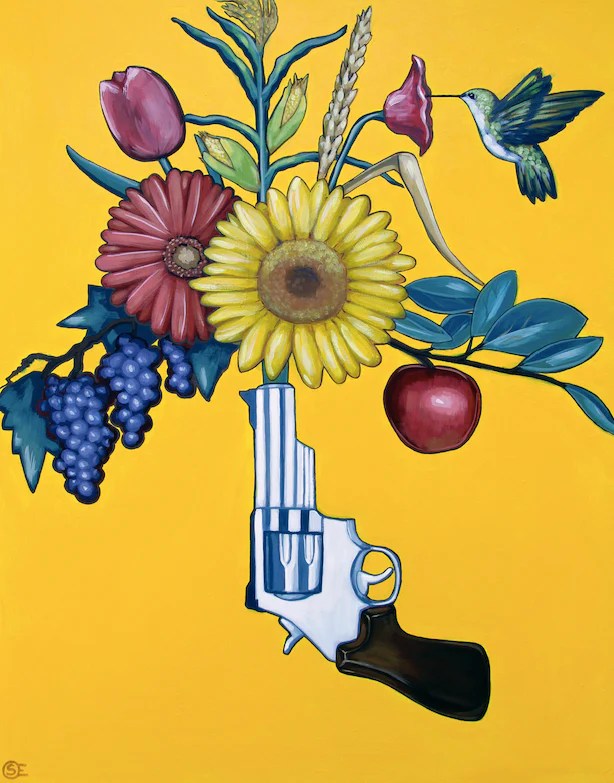
Artist Scott Erickson seems to have drawn on Boston’s Flower Power photograph in his visual interpretation of Isaiah 2:4, Swords into Plowshares, which shows a sprig of foliage growing out of the barrel of a pistol, oriented upward like a vase. Its deadly power mocked and reversed, the gun releases a benign projectile that attracts and nourishes rather than strikes fear.

Erickson, Scott_Swords into Plowshares
Scott Erickson (American, 1977–), Swords into Plowshares, 2016 [purchase a reproduction]

The evocative Bible verse on which this painting is based prophesies a day when all the nations “shall beat their swords into plowshares, and their spears into pruning hooks”—a poetic way of describing the cessation of violence, as tools of destruction are transformed into gardening tools.

Christian activist Shane Claiborne has been instrumental in helping me see the immense beauty of Isaiah’s visions of the eschaton—he has worked with RAWtools to decommission firearms and literally forge them into shovels, spades, and other life-giving implements!—along with the holy foolishness of the gospel and all that implies. Before becoming a leader of the new monasticism movement, Claiborne went to circus school, and he has often put that training to use on the streets of Philadelphia where he lives. In his first book, The Irresistible Revolution: Living as an Ordinary Radical (2006), he writes,

Whenever there is a fight on our block, my first instinct is to run inside and grab our torches and begin juggling them, to upstage the drama of violent conflicts in our neighborhood. Perhaps the kids will lose interest in the noise of a good fight and move toward the other end of the block to watch the circus. I truly believe we can overwhelm the darkness of this world by shining something brighter and more beautiful. (285)

He has also written about Jesus’s “triumphal” entry into Jerusalem as a theatrical parody of power: he rode in on a dinky donkey instead of a warhorse, showing a much different alternative to the military might of empires. (“Imagine the president riding a unicycle in the Fourth of July parade”! Jesus for President, p. 122) And then on the cross, Jesus made a spectacle of human violence. In exchange for taunts and blows, he gave forgiveness, a metaphorical bouquet.

Banksy_Rage, Flower Thrower
Banksy, Rage, Flower Thrower, 2005. Mural, Beit Sahour, Palestinian Territories. Photo: Eddie Gerald / Alamy Stock Photo.

The UK-based street artist Banksy draws on the association of flowers with love and peace and their playful ability to disrupt violence in his mural Rage, Flower Thrower, which debuted on the West Bank wall in Israel-Palestine. Nathan Mladin, a researcher for Theos think tank, wrote about this artwork for the Visual Commentary on Scripture’s Logics of Reversals exhibition:  

With a balaclava drawn over his face, the young protester is shown leaning back, as though braced to hurl a Molotov cocktail. But instead of a weapon, he wields a flower bouquet, the only coloured element in this otherwise monochrome work. We expect an act of aggression—all other elements of the mural suggest imminent violence—but instead we are offered a call to peace. . . . Theologically construed, the mural hints at the eschatological terminus of violence.

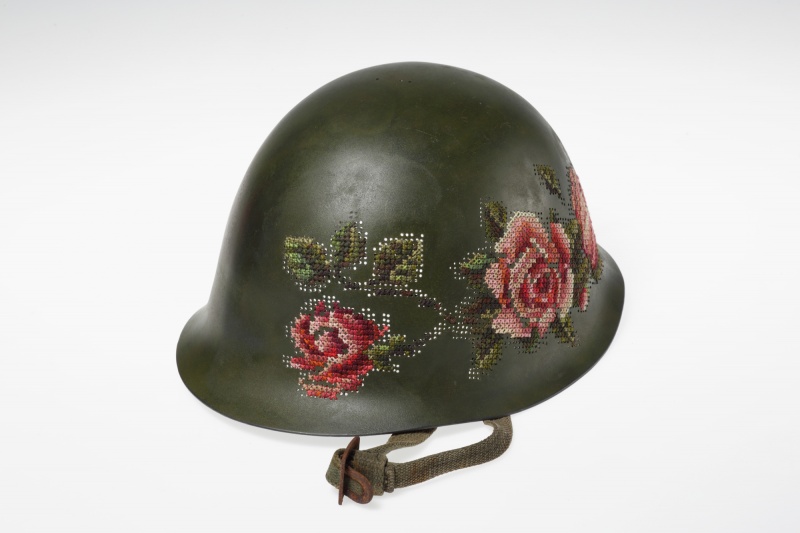
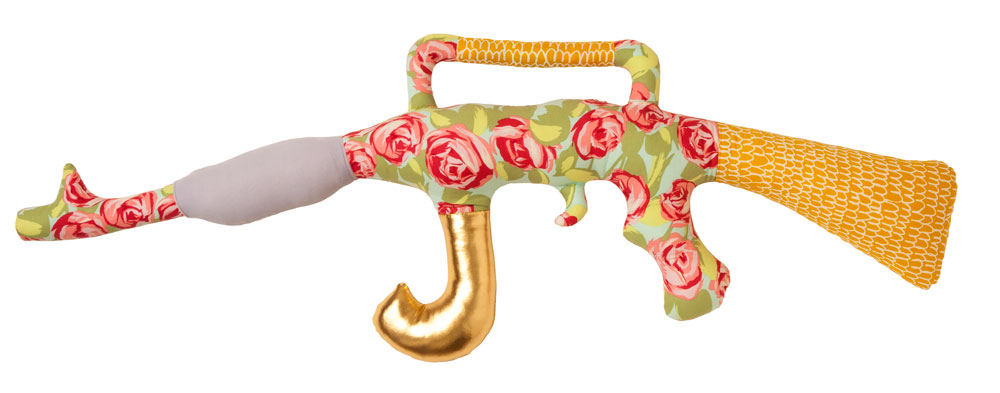
The absurd juxtaposition of flowers and violence is employed too by Lithuanian artist Severija Inčirauskaitė-Kriaunevičienė, who embroiders floral patterns onto antique soldiers’ helmets sourced from various countries, and Natalie Baxter of Lexington, Kentucky, whose Warm Gun series comprises over one hundred quilted stuffed guns, “droopy caricatures of assault weapons,” she says, “bringing ‘macho’ objects into a traditionally feminine sphere and questioning their potency.”

Incirauskaite-Kriauneviciene, Severija_Kill(ed) for Peace
Severija Inčirauskaitė-Kriaunevičienė (Lituanian, 1977–), from the series Kill(ed) for Peace, 2016. Antique soldier’s helmet, cotton, cross-stitch embroidery, drilling, and industrial needle punching, 30 × 22 × 21 cm. Private collection, Latvia.

Baxter, Natalie_Rose to the Occasion (Warm Gun)
Natalie Baxter (American, 1985–), Rose to the Occasion, from the Warm Gun series, 2016. Fabric and polyfill, 15 × 42 × 3 in.

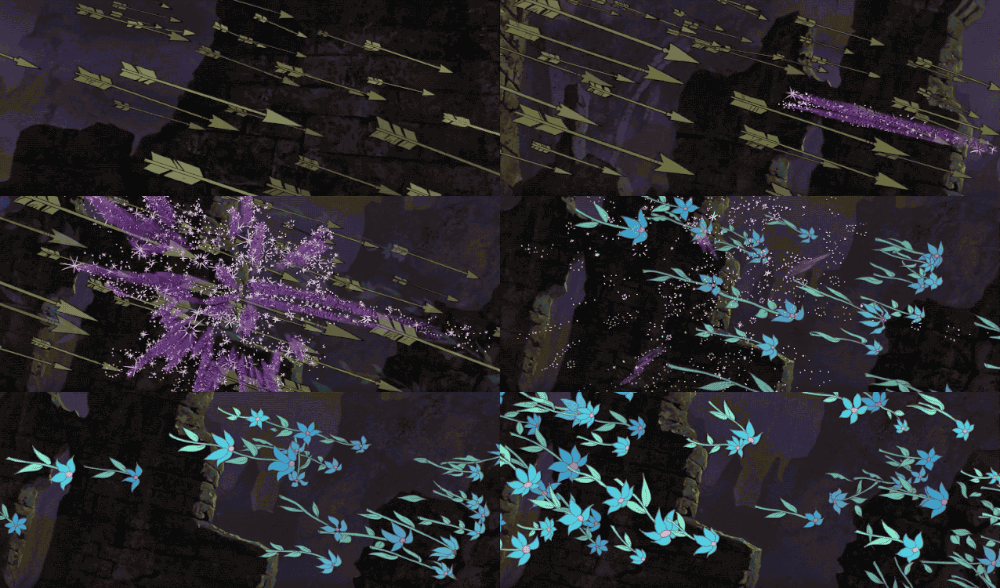
Another artistic example of overcoming brutality with gentleness can be found in the climactic battle sequence from Disney’s animated classic Sleeping Beauty (1959). As Prince Phillip escapes from Maleficent’s dungeon with the aid of the three good fairies, Maleficent’s goons shoot arrows at him—but Flora transforms them by magic into flowers, which fall innocuously about his booted feet. (The animation is by Dan McManus.)

Sleeping Beauty arrows

Flora’s other enchantments include turning launched boulders into soap bubbles and a curtain of boiling water, tipped from a cauldron over a doorway, into a rainbow. Each of these deflective maneuvers involves the transformation of something threatening into something whimsical. While they do not ultimately deter the villain from her murderous rampage, and alas, Phillip conquers evil with a sword (albeit the Sword of Truth—there’s metaphor at play here), Flora’s few creative interventions at the outset of the battle assert an attractive counterethic that we would do well to embrace.

I need the dreams of Isaiah and the prayers of Shantideva, I need the ridiculous street theater of Hibiscus and Shane Claiborne and the activist blacksmithing of RAWtools, I need Banksy’s murals in zones of conflict and other subversive art, I need fairy tales from writers and animation studios, to help me relinquish my hate and imagine wholesome new ways of engaging my enemies. Most of all, I need Christ’s vibrant, upending gospel embedded more deeply in my heart, and the Holy Spirit—renewer, transformer—to melt the disdain and loathing I feel for certain figures in the current US political landscape and reshape it into loving regard.

While I do not have an urge to enact physical violence on anyone, I often seethe and think unkindly thoughts toward those I deem morally odious. Sometimes I pray they get what’s coming to them. But then I am convicted by that un-Christlike posture. I crave the eyes and mind of Christ, who sees everyone as redeemable and worthy of love, bearers of the divine image, and who moves toward them with open arms instead of clenched fists.
“May those whose hell it is to hate and hurt be turned into lovers bringing flowers.”

I pray this, sincerely, for others (I have a few particular names in mind), and also for myself.

Amen.

Roundup: Prayers for a violent world, sad church songs, Climate Vigil Songs, and more

PRAYER COMPILATION: “Prayers for a Violent World” by W. David O. Taylor: “How exactly do we pray in the aftermath of violence? What words should we put on our lips? What can the whole people of God say ‘amen’ to and what might only one of us be able to say amen to in good conscience? These questions are, of course, far from easy to answer, but over the past couple of years I have attempted to give language to such matters and I have included here a number of those prayers, in the hope that they might prove useful, and perhaps comforting, to people who face the terrors and traumas of violent activities on a regular basis.” Included are prayers After a Mass Shooting, Against Bloodthirstiness, For Loving a Hurting Neighbor, For Enemies, For Bitter Lament, For Peace in a Time of War, For Those Who Weary of Doing Justice, and more.
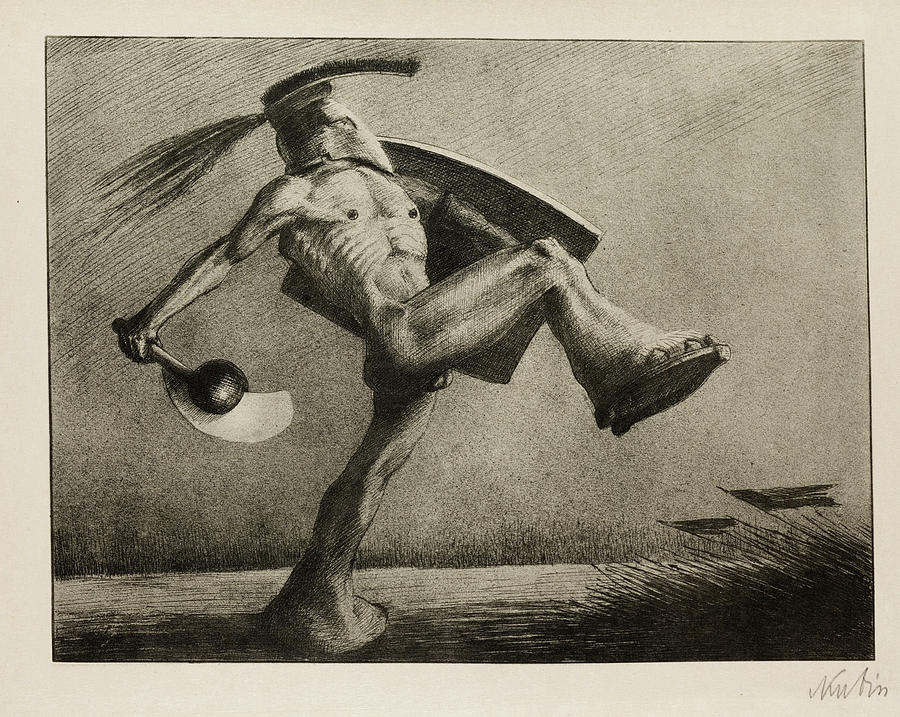
Kubin, Alfred_War
Alfred Kubin (Austrian, 1877–1959), War, 1903

Here’s Taylor’s Prayer of Allegiance to the Prince of Peace:

O Lord, you who deserve all our loyalties, we pledge allegiance this day to the Lamb of God and to the upside-down Kingdom for which he stands, one holy nation under God, the Servant King and the Prince of Peace, with liberty and justice for all without remainder. We pray this in the name of the Holy Trinity. Amen.

+++

NEW ALBUMS:

>> Sorrow’s Got a Hold on Me by Paul Zach: On May 20, singer-songwriter Paul Zach wrote on his Instagram, “My new album of thirteen sad church songs is out today! Many of these songs were written right after one of my weekly EMDR therapy sessions, as I have been working through the sorrow, trauma, and grief of the past few years. I’m learning to bring all of myself to God in prayer and songwriting, which includes my sorrow and anger. I’ve always heard that God shows up in a unique way in times of grief but that has not been my experience. These songs are an invitation for the ‘man of sorrows’ to join me in my grief.”
Below is a demo of the first verse of my favorite song on the album, “We Bring You All Our Sorrows,” followed by the album link from Spotify. It includes a newly revised version of one of my favorite songs by Zach, “When Your Kingdom Comes” [previously].
Zach often writes collaboratively (including as part of the Porter’s Gate! see below), and the cowriters on some of the songs here are Kate Bluett, Latifah Alattas (Page CXVI), Nick Chambers, Orlando Palmer (IAMSON), Jessica Fox, Alex Johnson, and Philip Zach. There are also a few guest vocalists.

>> Climate Vigil Songs by the Porter’s Gate: The Porter’s Gate is a collective of fifty-plus songwriters, musicians, scholars, pastors, and music industry professionals from a variety of Christian worship traditions and cultural backgrounds, making music for churches. This sixth album of theirs, made in partnership with the #ClimateVigil movement, is themed around environmental justice and creation care. Below are videos for “Brother Son (Giving Glory!)” and “Jubilee.”

Besides “Brother Sun,” my favorite tracks are “Satisfied,” a prayer that we would stop seeking to build our wealth (a motive that drives a lot of environmental injustices) and instead be grateful for God’s provision; “The Kingdom Is Coming,” a marchlike call-and-response song that rallies us to pray, wait, and work for an end to creation’s groaning; and “Water to Wine,” which wonders at the miraculous process of planting and growing grapes for harvest. There’s also “All Creatures Lament,” a minor-key arrangement of “All Creatures of Our God and King” with new lyrics that enjoin the animals to mourn habitat loss, air pollution, and other results of humans’ power abuses and irresponsible stewardship.

To learn more about the album, listen to this great interview with Porter’s Gate cofounder and producer Isaac Wardell; it’s from the RESOUNDworship Songwriting Podcast, hosted by Joel Payne. Wardell discusses the vision for Climate Vigil Songs, and especially the difficulty, with thematic albums, of avoiding the pitfalls of being too heavy-handed with the messaging on the one hand, and on the other, being so vague that people don’t see the connection. There’s also a need for tonal balance, and for songs that fill different functions.

We wanted to write for this album at least three different kinds of songs. One kind is essentially songs of lament—songs lamenting the state of creation because of human sin and the brokenness of the world. Secondly, we wanted to write hopeful, you might even call them eschatological, songs—songs that are joyful, that are about this is the world that God has made, this is God’s creative work, this is how God calls us into his creative work. . . . And lastly, we wanted to write mobilization songs—songs that have some kind of an ethical component of calling people to action in some way. . . . We want to make sure the record is not too much of a downer, like all lament songs; we want to make sure that it’s not too much of a happy-clappy “Isn’t creation beautiful!”; and we also don’t want to let it just delve into being a 100 percent political action record. . . . We want to balance those things.

Wardell also talks about the group’s collaborative songwriting approach (including all the theological and editorial work that’s put in), Te Fiti’s stolen (and later, restored) heart in Disney’s Moana, personified nature in the Psalms, creation as an experiencer of the fall and redemption, the role of provocation in church, and biblical imagery he wishes they could have included on the album but had to leave out for length.

+++

POEM + CHORAL SETTING: “when god decided to invent” by E. E. Cummings: “Here’s a brief powerhouse of a poem from E. E. Cummings, two stanzas that draw a sharp distinction between God’s inventive, joyful creativity on the one hand, and our too-frequent turn toward violence on the other. As the mass shootings in Buffalo, Uvalde, and elsewhere continue to reverberate, Cummings’ poem helps us feel and think about what’s at stake – and what the way forward looks like.”

SALT Project reproduces the poem, provides brief commentary, and links to a musical setting by Joshua Shank—a composition for SATB, soprano saxophone, and finger cymbals that premiered in 2005. Shank says the arc of his piece is creation-destruction-recreation. “This final chord is the creator taking control of the creation again.”

+++

RADIO EPISODE: “Belief in Poetry: John Donne”: John Donne (1572–1631) is one of my favorite poets, and looking back on the blog, I can’t believe I’ve not yet featured any of his poems! (I’ll have to rectify that . . .) In this BBC Radio 4 segment from March 13, poet and theologian Pádraig Ó Tuama considers Donne’s complex faith life through his poetry. He speaks with Julie Sanders, professor of English literature and drama at Newcastle University; Mark Oakley, writer and dean of St. John’s College, Cambridge; and Michael Symmons Roberts, poet and professor of poetry at Manchester Metropolitan University. Sir Simon Russell Beale reads the four featured Donne poems: “Death, be not proud” and “Batter my heart, three-person’d God” from his Holy Sonnets series, “Hymn to God, My God, in My Sickness,” and “A Hymn to God the Father.”

Here are two of the quotes that stood out to me:

  • “It’s easy to think of John Donne’s life falling neatly into two parts: the worldly man, and the spiritual seeker; the lover of women, and the lover of God; Catholic, then Protestant; before Anne, and after Anne; love poet, and religious poet. But life is rarely that clear. And rather, it’s the tension between these dynamics of him that gives birth to so much of his work.”—Pádraig Ó Tuama
  • “There’s an assumption that a poet working in this territory is sure of their ground and knows what they’re writing about. I don’t think that’s ever true, because why would you write the poems, if that were true? You’d just bathe in your certainty! The whole act of sitting down to write a poem is not to dress up something you already know in a way that makes it an enticing package for other people to be convinced by—and if you attempted that, it’s going to fall like the deadest thing on the page. Making a poem is an exploratory process. You don’t know where it’s going to end when you start it.”—Michael Symmons Roberts

Roundup: Juried exhibition call for entries, Malayalam worship song, and more

PLAYLIST: I can’t keep up with all the quality Christian (or, for artists who eschew that label, spiritually inflected?) music recordings that are out there—recent releases as well as back catalogs dating as far back as the thirties. There really is a breadth, and I sometimes get frustrated when I hear people claim otherwise. (Yes, there’s a lot of really crummy Christian music too . . . but that doesn’t mean the entire genre should be dismissed!) During this season of Ordinary Time I’m going to endeavor to release a monthly Spotify playlist consisting of a random assortment of thirty psalms, hymns, and spiritual songs, each by a different artist. Here’s June’s:

https://open.spotify.com/playlist/1exgudtuLRdwfrKj26AXr9?si=b24fd1f9006e47cd

+++

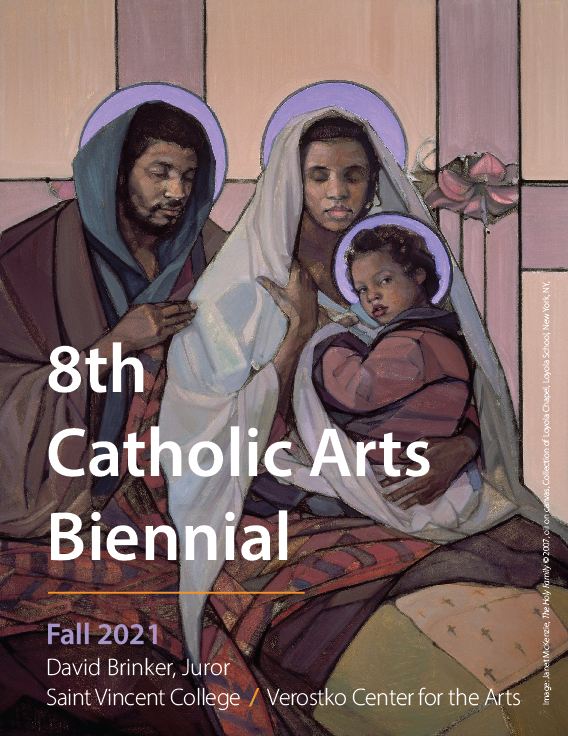
CALL TO ARTISTS: 8th Catholic Arts Biennial: Saint Vincent College in Latrobe, Pennsylvania, has issued a call for submissions for its eighth biannual juried exhibition of Christian-themed art. “This Biennial encourages submissions that expand representations of Christ, the Virgin Mary, biblical narratives, and the lives of the saints beyond Eurocentric presentations. Artwork made by women and persons of color is strongly encouraged. In addition to depictions of traditional Christian subjects, artists are urged to submit works that address social concerns from perspectives of faith pertinent to the contemporary moment. Works investigating the diversity of the human experience enlivened by Gospel values are also desired.”

8th Catholic Arts Biennial

Artists can be of any religious or denominational affiliation and can submit up to three works by the deadline of June 25. In addition to being exhibited September 6–October 29, 2021, at the Verostko Center for the Arts, the finalists will also be eligible for a top prize of $1,000, plus other cash prizes. The juror this year is David Brinker, director of the Museum of Contemporary Religious Art at Saint Louis University. (The painting on the promotional poster is The Holy Family by Janet McKenzie, a previous winner.)

+++

SONGS:

>> “Prarthana Kelkaname” (Hear Our Prayer): Jijo Hebron, a Christian worship leader from Kerala, India, and his wife Niveda Jijo released this YouTube recording on Sunday, in which they sing to God in the Malayalam language. The song’s English meaning is below. [HT: Global Christian Worship]

Hear our prayer and supplication, oh Lord
It is the promise in your Son’s name:
Whatever we ask, it will be granted.
There is no one to take care of my worries apart from you
Who stands as my father and mother

>> “Morning Prayer” by Langhorne Slim: From the album Strawberry Mansion, released this January.  

+++

ANIMATED SHORT: If Anything Happens I Love You: “In the aftermath of tragedy, two grieving parents journey through an emotional void as they mourn the loss of a child.” Written and directed by Will McCormack and Michael Govier and animated by Youngran Nho and team, this thirteen-minute film won Best Animated Short at the 2021 Oscars. It’s amazing how much I feel for these characters after such a short time of getting to know them. Streaming on Netflix.

+++

ARTICLE: “Art and Interfaith Conversation” by Andrew Smith: Birmingham, England, is a religiously diverse city, home not only to Christians but also to Muslims, Sikhs, Hindus, Buddhists, Jews, and others. The Church of England recognizes this rich presence and has on staff a director of interfaith relations for the bishop of Birmingham, Canon Dr. Andrew Smith. Smith is interested in how art and artifacts can be used to develop conversations between people of different faiths and to create new conversations, and here he discusses a Birmingham Conversations project he led along that vein: multifaith group tours at the Birmingham Museum and Art Gallery and St. Philip’s Cathedral. These he embarked on with a posture primarily of learning, not teaching. [HT: Still Life]

Smith served as a consultant for the museum’s faith gallery, which highlights religious objects from various traditions. He discusses the importance of honoring the integrity of each object’s spiritual significance, and some of the difficulties of creating a space that’s welcoming to people of all faiths when certain faiths regard certain imagery as problematic or even forbid it. He also shares some of the responses of non-Christian participants to specific works of Christian art, in both the museum and the cathedral. Some from the latter are recorded in the following video:

The Birmingham Conversations also commissioned two local artists, Jake Lever and Mandy Ross, to produce work informed by their visits over a yearlong period to different places of worship around Birmingham.

Lever, Jake_Dance
Jake Lever (British, 1963–), Dance, 2016. Ink and gouache on paper.

Roundup: A sign of the times; multifaith art exhibit; Hildegard of Bingen musical; and more

After nudges from several readers, I’ve decided to join Instagram! Follow me @art_and_theology. I’m still trying to settle on how I’d like to use the platform, but in the meantime, I’ve been sharing photos I’ve taken on visits to art museums and spaces that house sacred art. (And in case you don’t already know, Art & Theology is also on Facebook and Twitter.)

+++

DANCE: “Sign of the Times,” choreographed by Travis Wall: Premiering August 19, 2019, on Fox’s So You Think You Can Dance (season 16, episode 11), this contemporary dance piece is choreographer Travis Wall’s response to the gun violence epidemic in America. It’s a communal lament through movement, really—an expression of fear, sadness, pain, anger, frustration, and defiance. It is performed by this season’s “top ten”: Benjamin Castro, Gino Cosculluela, Eddie Hoyt, Madison Jordan, Anna Linstruth, Bailey Muñoz, Sophie Pittman, Mariah Russell, Ezra Sosa, and Stephanie Sosa.

+++

FEATURED POET: Marjorie Maddox: The latest installment of Abbey of the Arts’ Featured Poet series is, as usual, wonderful! I’ve read some of Maddox’s poems in magazines and anthologies but haven’t yet gotten my hands on one of her collections. This feature has incentivized me to request a copy of Transplant, Transport, Transubstantiation through my local library.

“The work of poetry,” Maddox writes, is “empathy and epiphany. The process of writing and reading allows us to better understand this world and the next. Poetry connects the local and universal, the mundane and the miraculous. It gives us those ears to hear and eyes to see that we might, then, head back into the turning world sustained, nourished, and willing to learn more. And will this not lead us to the Sacred? Yes, I say. Yes.”

+++

ESSAY: “Acts of Attention: On Poetry and Spirituality” by Robert Cording: I really enjoyed this essay from Image journal about the importance of attending to the world. “Attention is simply a loving look at what is,” writes Cording, a poet and birdwatcher. He discusses seeing not as a physiological act but as perceiving the fullness that exists in each moment. “Seeing is impossible without love or reverence,” he says. Along the way he engages with Marie Howe, Aristotle, Emerson and Thoreau, Tolstoy, Ruskin, Heidegger, Hopkins, Czesław Miłosz, and Marilynne Robinson. He also walks us through three poems: Robert Frost’s “Two Tramps in Mud Time,” Wallace Stevens’s “Man on the Dump,” and Seamus Heaney’s “The Pitchfork.” So much goodness here!

If you enjoyed this essay as much as I did, be sure to also check out “Cloud Shapes and Oak Trees,” also by Cording, from 2017.

+++

EXHIBITION: Abraham: Out of One, Many, curated by Rev. Paul-Gordon Chandler of Caravan: Caravan is an international nonprofit that uses the arts to build sustainable peace around the world. “Our peacebuilding work is based on the belief that the arts can serve as one of the most effective mediums to enhance understanding, bring about respect, enable sharing, and facilitate friendship between diverse peoples, cultures and faiths.”

Caravan’s current exhibition is built around Abraham, a key ancestral figure shared by the world’s three major monotheistic religions: Judaism, Christianity, and Islam. Caravan commissioned three Middle Eastern artists, one from each of these faith traditions, to each create five paintings on these subjects: Living as a Pilgrim, Welcoming the Stranger, Sacrificial Love, The Compassionate, and A Friend of God. The exhibition of resulting works opened May 3 at St. Paul’s Within the Walls in Rome. From there it has traveled to Paris and Edinburgh and, starting September 8, will be in the States, touring through 2021 with stops in Boston, Atlanta, Houston, Washington, DC, Chicago, and more (see schedule). There’s an excellent digital catalog available, which contains full-color reproductions and descriptions of all fifteen paintings.

Hussein, Sinan_Living as a Pilgrim
Sinan Hussein (Iraqi, 1977–), Living as a Pilgrim, 2019. Mixed media on canvas, 45 × 60 cm. Part of the “Abraham: Out of One, Many” exhibition organized by Caravan.

Sindy, Qais Al_Welcoming the Stranger
Qais Al Sindy (Iraqi, 1967–), Welcoming the Stranger, 2019. Oil and collage on canvas, 60 × 45 cm. Part of the “Abraham: Out of One, Many” exhibition organized by Caravan.

+++

MUSICAL: In the Green by Grace McLean: Lincoln Center Theater’s LCT3 produces shows by new playwrights, directors, and designers, and for this summer, they commissioned a musical about the twelfth-century German mystic Hildegard of Bingen. (It finished its run on August 4, so I’m late in publicizing it—sorry!) A Benedictine nun and later abbess, Hildegard was also a composer, poet, dramatist, theologian, botanist, and healer—a true polymath. In the Green focuses on her relationship with her mentor, Jutta, just six years her senior.

Here’s Grace McLean, the show’s lyricist, composer, playwright, and player of Jutta, performing “Eve” (which uses looping technology!), followed by a short conversation between her and one of the other cast members. [HT: Still Life]

Roundup: Obits; breast cancer saint; exhibitions; gospel jam

ARTIST DEATHS:

This August saw the homegoing of two beloved Christian art-makers.

>> “Making meaning out of suffering and loss is one of poetry’s most fundamental aims,” wrote poet Anya Silver, who passed away from inflammatory breast cancer on August 6 at age forty-nine. Since her diagnosis in 2004, she published four volumes of poetry that wrap up faith with deep, honest questioning of God. Many of her poems contain imagery related to cancer and its treatment and describe with unswerving candor what it’s like to live under the threat of imminent death. When she received a Guggenheim Fellowship this year, the foundation described her work as “engag[ing] with the trauma of chronic and terminal illness, and with religious faith and mystery, storytelling, memory, and the risks and rewards of being human.” One of her best-known poems is “Psalm 137 for Noah,” written for her only child, whom she gave birth to during her illness.

“I have a tremendous amount of joy in my life, and my joy exists with pain,” Silver said in an interview with Georgia Public Radio in January. “I don’t see those two things as completely separate. All of life is woven together, and separating the strands is impossible.” Read her obituary in the New York Times, and a sweet tribute by Elizabeth Palmer in the Christian Century.

Anya Silver

Anya Silver books

>> A giant of contemporary French sacred art, Jean-Marie Pirot, known professionally as Arcabas, died August 23 at age ninety-one. He is best known for his paintings, which feature biblical characters and scenes, but he also worked in sculpture, engraving, tapestry, mosaic, and cabinetry, as well as in the theater making scenery and costumes. His magnum opus is the interior decoration of Saint-Hugues-de-Chartreuse in the Isère region of France, which comprises over a hundred works by the artist created over a span of thirty-five years.

There has been much published about Arcabas in French (e.g.) but unfortunately very little in English—though for starters, I recommend this ArtWay article. A YouTube search of his name yields several video interviews and feature news segments—again, in French. I’ve embedded a recent video homage below, which shows you inside Saint-Hugues as well as his designs for the stained-glass windows inside the Basilica of the Sacred Heart in Grenoble, a project he was working on when he died. I’d love to help bring out some of these books, or even a brand-new catalogue raisonné, in English, so if any of you have connections to Arcabas’s French publishers or people close to him, or have experience translating from French to English, let me know!

Arcabas

+++

PAINTING: Saint Agatha’s Grief by Melissa Weinman: October is Breast Cancer Awareness Month, so what better time to get acquainted with Agatha of Sicily, patron saint of breast cancer patients. Agatha was a third-century Christian from a noble family whose martyrdom has been authenticated, although its details have not. According to legend, fifteen-year-old Agatha made a vow of virginity and rejected the amorous advances of the Roman prefect Quintianus. After consistently being spurned, Quintianus had her arrested for her faith (this was during the persecutions of Decius) and tortured. Among the tortures she underwent was the tearing off of her breasts with pincers. She died in prison, probably in the year 251.

St. Agatha's Grief by Melissa Weinman
Melissa Weinman (American), Saint Agatha’s Grief, 1996. Oil on canvas, 42 × 42 in.

In traditional portraiture, Agatha is shown holding her severed breasts on a platter (see, e.g., Francisco de Zurbarán). More recently, though, American artist Melissa Weinman painted a double portrait of Agatha as a modern-day woman in a white tank top enduring the tortuous experience of breast cancer. The two women stand back to back, the left figure having presumably just received the diagnosis, and the right figure bearing blood stains on the chest that indicate a mastectomy. There is an immediate sense of violation in the image, but also a sense that God’s glory is at work. While the one figure is cast in darkness, the other leans toward the light, suggesting hope and faith in the purposes of God, even in the groaning.

+++

RECENT EXHIBITION: “Creença”: This summer fifty artists from a variety of disciplines participated in a two-month residency at Konvent, a nineteenth-century convent (now an art center) in Cal Rosal, Catalonia, Spain. Organized by Void Projects, the residency culminated in a three-day pop-up exhibition from August 30 to September 2, titled “Creença” (Belief), which included not just visual art but live theater, talks, and music.

Jofre Oliveras and Stefan Krische installation
Site-specific installation by Jofre Oliveras and Stefan Krische, 2018, in Konvent, Cal Rosal, Catalonia, Spain.

+++

CURRENT EXHIBITION: “Wrestling the Angel: A Century of Artists Reckoning with Religion,” Bechtler Museum of Modern Art, Charlotte, North Carolina: Through October 28, the Bechtler is showing 219 pieces of religious-themed art spread out across its large fourth floor, including works by Dalí, Rouault, Chagall, Warhol, Manessier, Bearden, and other modern greats. I visited last weekend, and while I feel that the theme was treated too loosely and therefore the exhibition lacked the full impact it could have had, I thoroughly enjoyed individual portions, and I appreciate the Bechtler, and in particular curator Jen Edwards, for bringing together these diverse works that speak in some way to religion, spirituality, or morality.

This was the first time I’ve seen Rouault’s entire Miserere (“Have Mercy”) series—all fifty-eight aquatints!—in one space, and it was stunning. Its display alongside Charlotte artist Gina Gilmour’s Break Your Guns and Stacy Lynn Waddell’s Untitled (Mike Brown’s Battle at Normandy) reinforces the theme of lament for violence and suffering inherent in all three. In the same room the set of small bronze crucifixes by Elizabeth Turk, which in their original gallery installation in 2002–03 contained lit candles in the hollows of the heads, invite further reflection on death, subtly connecting (through strategic placement) Christ’s crucifixion with the “crucifixions” of those slain in the past century through acts of war, gun violence, and police brutality.

Wrestling the Angel installation view
Installation view: “Wrestling the Angel,” Bechtler Museum of Modern Art, Charlotte, North Carolina, 2018. Left: Prints from Georges Rouault’s Miserere series, 1927. Right: Break Your Guns by Gina Gilmour, 1980. Photo: Victoria Emily Jones.

Poppyfields (detail) by Elizabeth Turk
Elizabeth R. Turk (American, 1961–), untitled bronzes from Poppyfields, 2002–03. Installation view: “Wrestling the Angel,” Bechtler Museum of Modern Art, Charlotte, North Carolina, 2018. Photo: Victoria Emily Jones.

The Annunciation by Romare Bearden
Romare Bearden (American, 1911–1988), The Annunciation, ca. 1967. Collograph, 11 3/4 × 15 1/2 in. (29.6 × 39.4 cm). Courtesy of Jerald and Mary Melberg. Photo: Victoria Emily Jones.

For other reviews of this exhibition, see those by Andy Smith and Barbara Schreiber. And word to the wise: avoid the last day, because it’s a Carolina Panthers NFL home game, and the stadium is right across the street from the museum. (I wish I had thought to check the schedule before I made the cumbersome trek last Sunday!)

+++

JAM SESSION: I love this impromptu gospel music performance by Karen R. Harding (right), Steve Brock, and Sharon Walker. They sing “Give Up (And Let Jesus Take Over)” by Howard Goodman and “Can’t Nobody Do Me Like Jesus” by Andraé Crouch. [HT: Global Christian Worship]