Easter Mystery by Maurice Denis (painting)

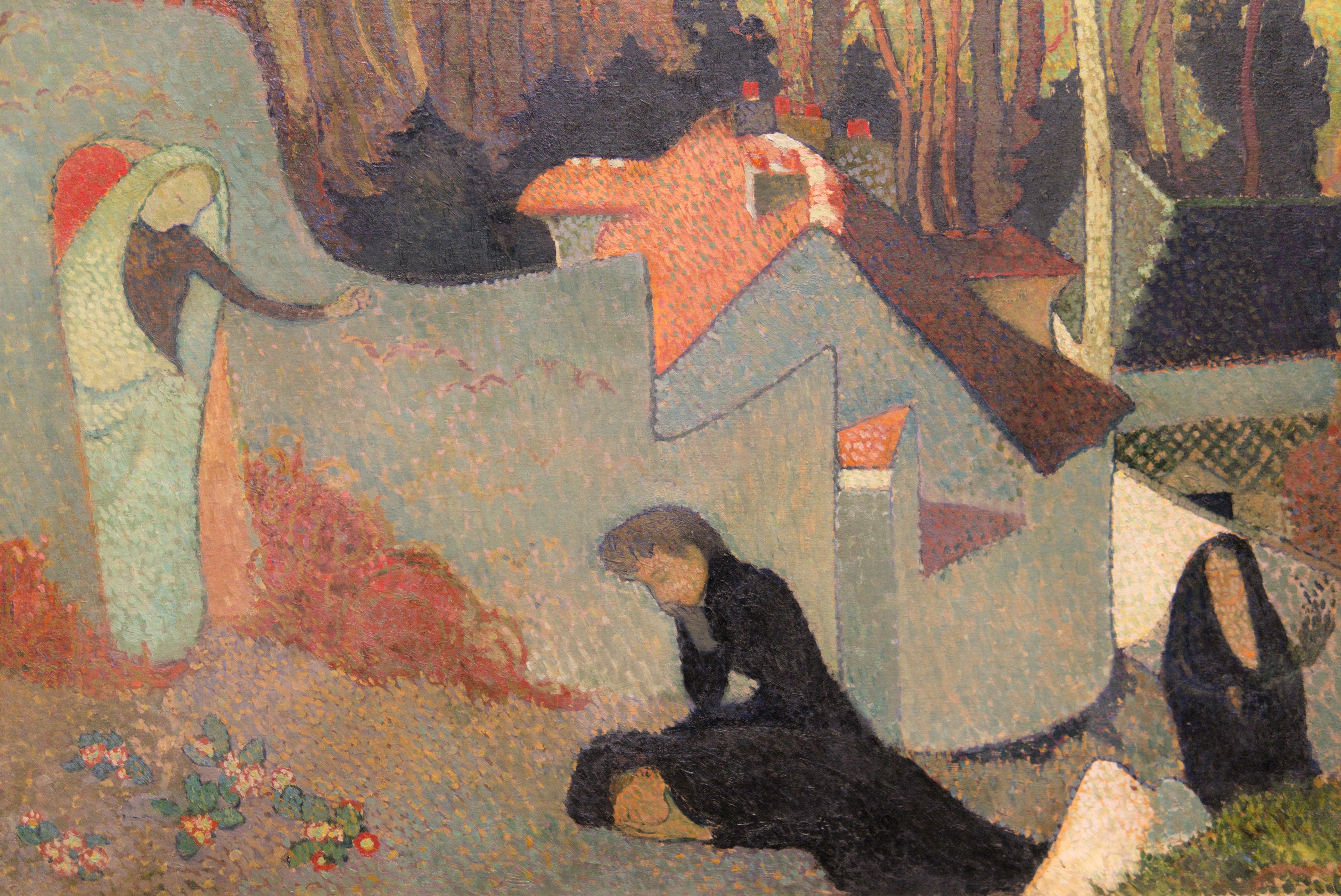
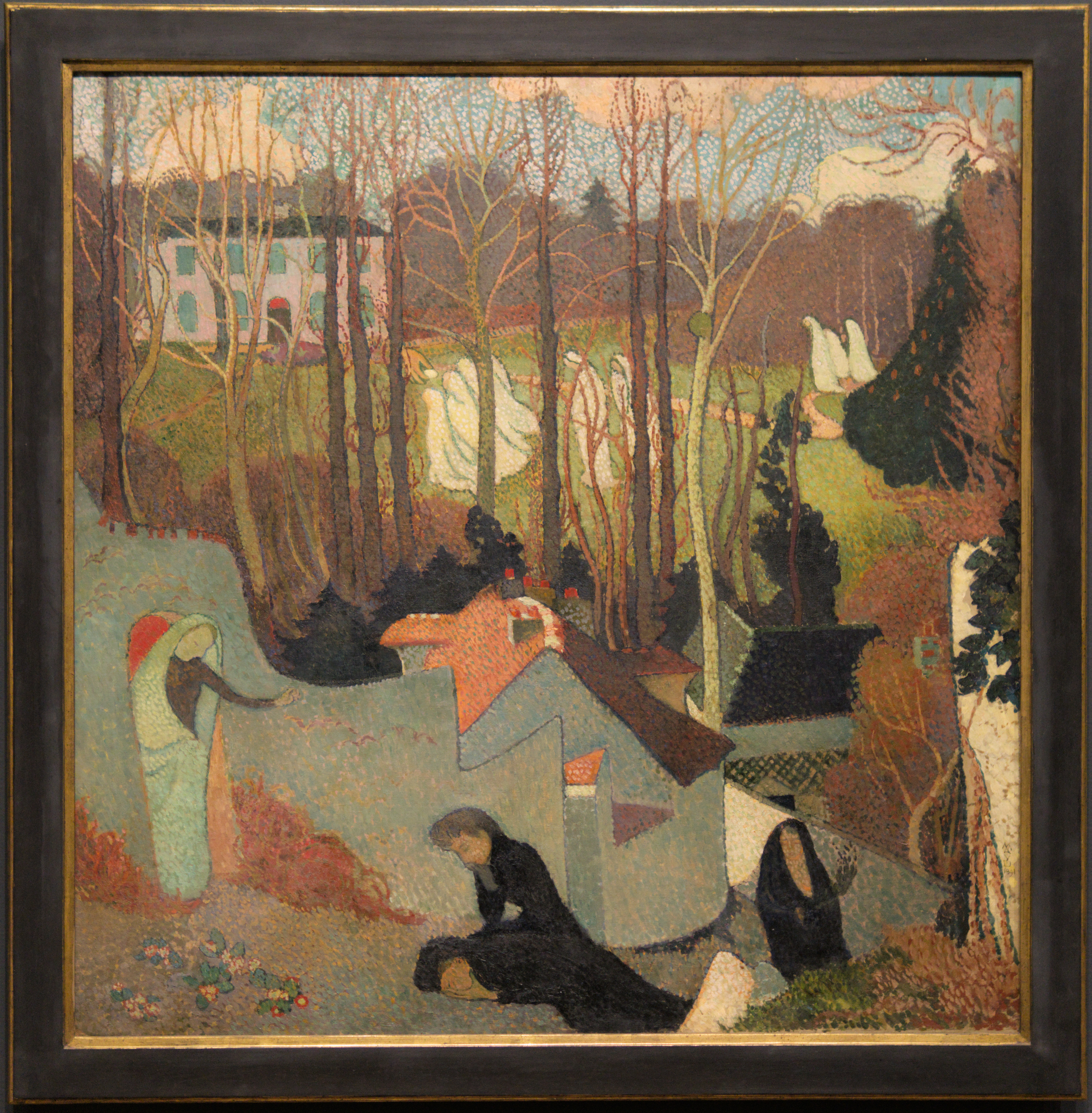
Last year when I was at the Art Institute of Chicago, I was transfixed by the pointillist painting Easter Mystery by the French artist Maurice Denis.
Denis, Maurice_Easter Mystery
Maurice Denis (French, 1870–1943), Easter Mystery (Mystère de Pâcques), 1891. Oil on canvas, 41 × 40 1/8 in. (104 × 102 cm). Art Institute of Chicago. Photo: Victoria Emily Jones. [object record]

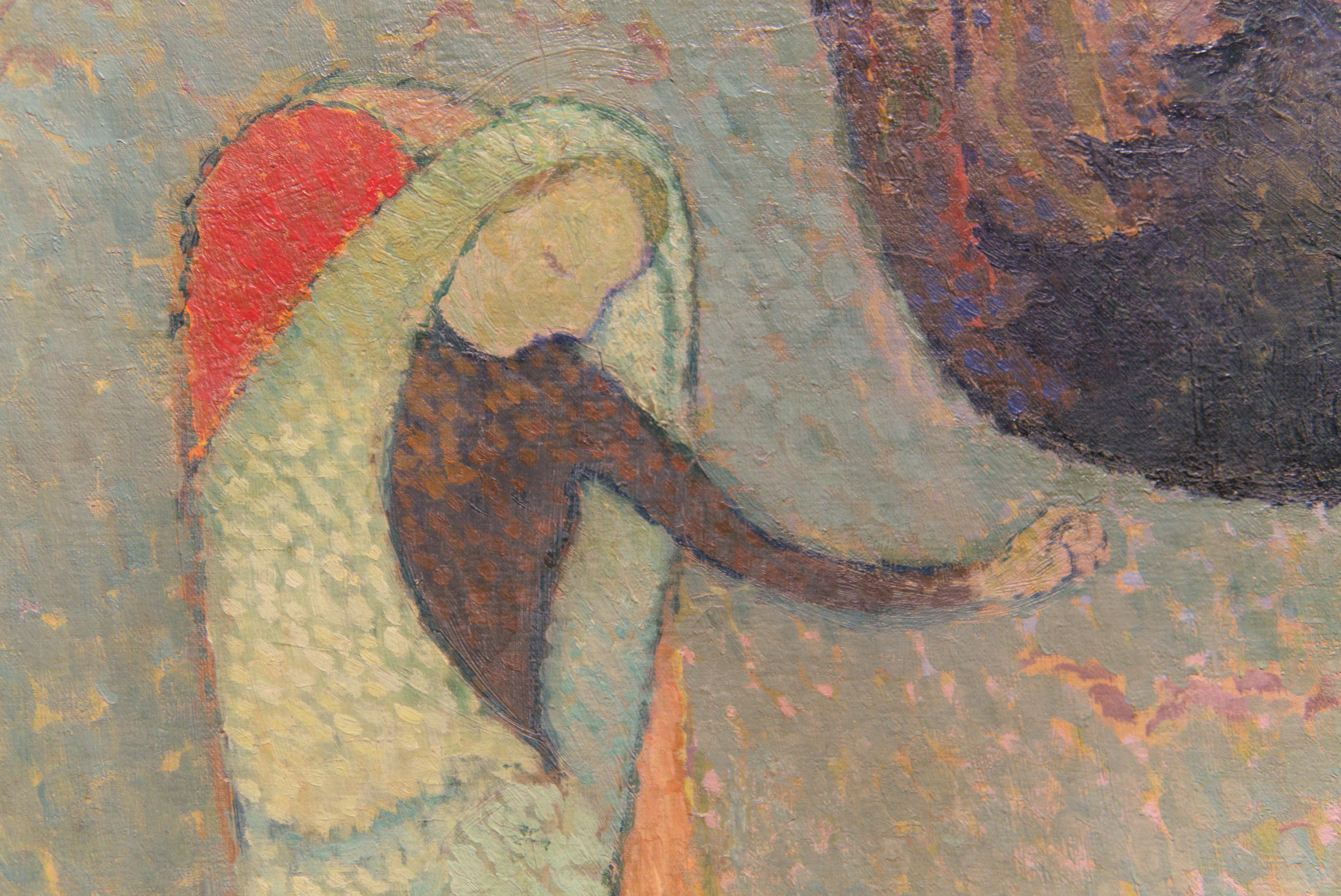
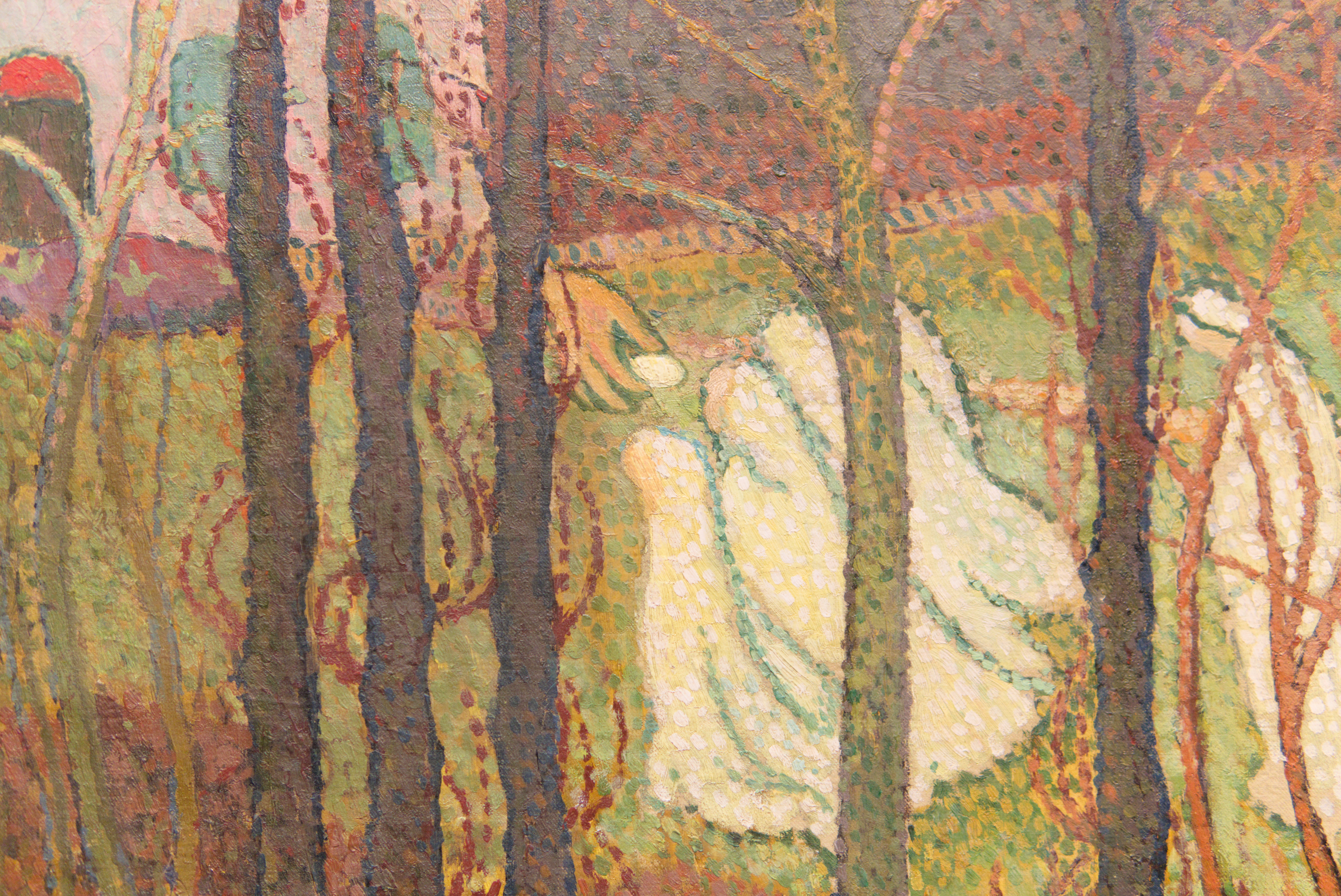
It shows three women dressed in mourning clothes arriving at Christ’s tomb (one ascending the hill, one kneeling, and one prostrate), only to find an angel at its entrance, announcing that Christ has risen. In the midground, visible through a veil of trees, the hand of God bends down to feed a group of white-clad women the body of Christ, a consecrated wafer that gives them eternal life.

Jesus’s teaching in John 6:48–58 is instructive here:

“I am the bread of life. Your ancestors ate the manna in the wilderness, and they died. This is the bread that comes down from heaven, so that one may eat of it and not die. I am the living bread that came down from heaven. Whoever eats of this bread will live forever, and the bread that I will give for the life of the world is my flesh.”

The Jews then disputed among themselves, saying, “How can this man give us his flesh to eat?”

So Jesus said to them, “Very truly, I tell you, unless you eat the flesh of the Son of Man and drink his blood, you have no life in you. Those who eat my flesh and drink my blood have eternal life, and I will raise them up on the last day, for my flesh is true food, and my blood is true drink. Those who eat my flesh and drink my blood abide in me and I in them. Just as the living Father sent me and I live because of the Father, so whoever eats me will live because of me. This is the bread that came down from heaven, not like that which the ancestors ate, and they died. But the one who eats this bread will live forever.”

The Art Institute audio guide (#841) provides the following commentary on the painting:

Maurice Denis belonged to a group of young French artists who called themselves the Nabis after the Hebrew word for prophets. The Nabis were interested in imbuing their subject matter with a sense of mystery and otherness. For Denis, a devout Catholic, an ordinary landscape could be loaded with manifestations of the divine. Denis sets this scene in the village of Saint-Germain-en-Laye, west of Paris, where he lived. The large house in the background would later become his home. In the foreground, an angel emerges from a cave, as if to announce Christ rising, to the mourning Virgin Mary and Mary Magdalene. Behind them are white-clad figures who hasten toward an astonishing sight, the hand of God himself, appearing miraculously from the trees to offer the Eucharist.

Denis strived for simple, flattened forms that sometimes verge on abstraction. He believed this process reflected spiritual purification, and he looked to the work of early Italian Renaissance art, and especially to the work of the painter monk Fra Angelico for inspiration. But he and the other Nabis were also deeply influenced by avant-garde French art. Here, Denis explores the effects of the pointillist technique of building up the picture surface with tiny dots of paint.

A 1994 exhibition catalog for Maurice Denis, 1870–1943 at the Musée des beaux-arts in Lyon expands on the artist’s technique in Easter Mystery. “By treating the surface with a kind of pointillist technique,” it reads, “he accentuates the gentleness of the curves, increases the light everywhere as in a mosaic, and endows the whole composition with an effect of airy lightness. . . . A spring landscape seems to be scattered with regularly spaced dabs of green paint, which work like a prism, breaking the light up into coloured particles. Denis used this method widely in order [in the words of Jean-Paul Bouillon] ‘to embody the truths of love and faith in perceptible form – making a surface quiver.’”

The quivering surface contributes to the mystical quality of the painting, in which mortality is taken up into immortality. By our partaking of the Eucharist, Christ assimilates us into his risen, living body, over which death has no dominion.
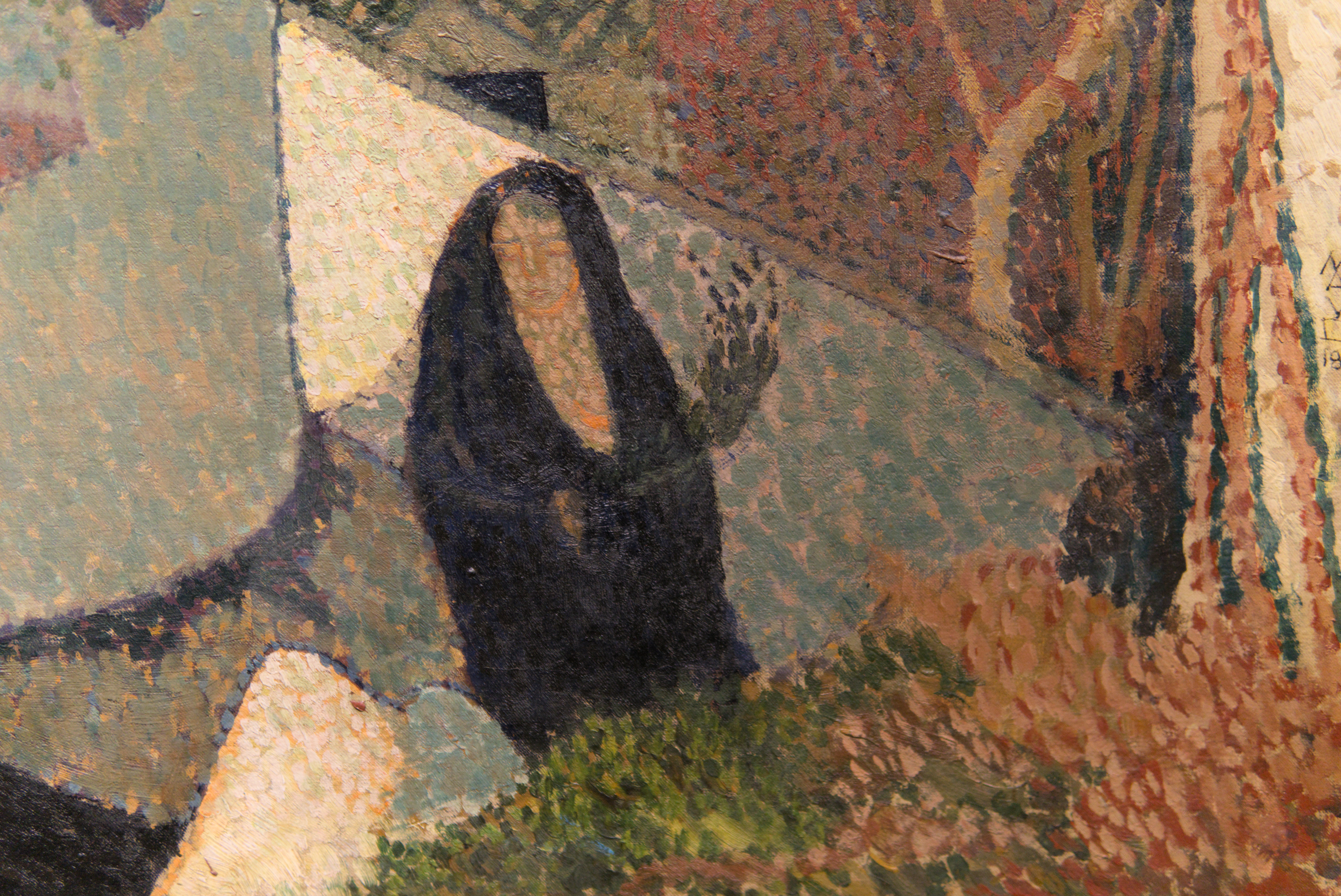
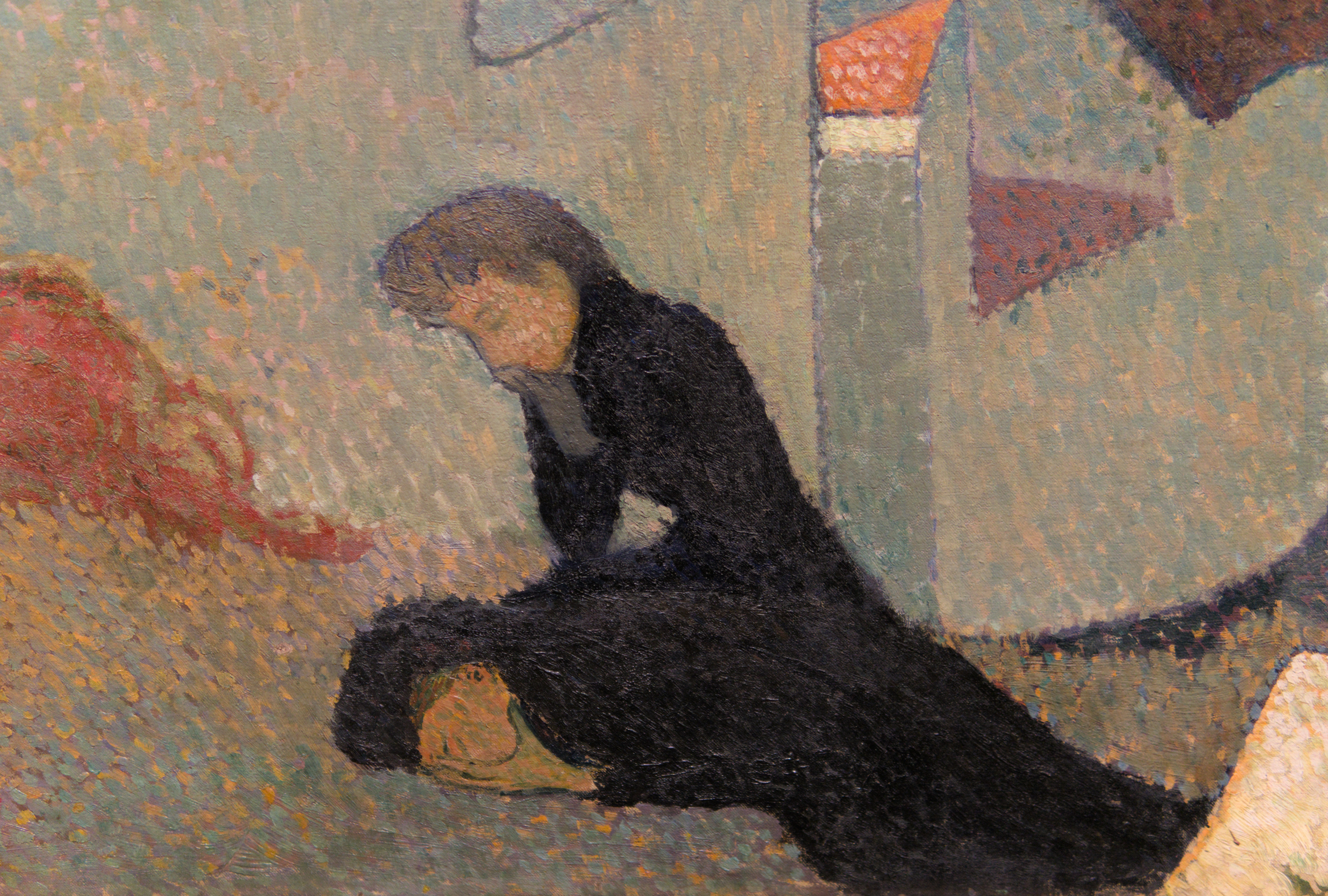
Photo by Victoria Emily Jones

This painting is in the public domain, and you are free to use my photos if you wish. To view them in full resolution, right-click and open in a new tab (if viewing on a computer) or pinch to zoom (if viewing on a phone).

God Raised Him Up (Artful Devotion)

Haugen Sorensen, Arne_Resurrection
Resurrection by Arne Haugen Sørensen (Danish, 1932–)

Peter, standing with the eleven, lifted up his voice and addressed them:

“. . . Men of Israel, hear these words: Jesus of Nazareth, a man attested to you by God with mighty works and wonders and signs that God did through him in your midst, as you yourselves know—this Jesus, delivered up according to the definite plan and foreknowledge of God, you crucified and killed by the hands of lawless men. God raised him up, loosing the pangs of death, because it was not possible for him to be held by it. For David says concerning him,

“‘I saw the LORD always before me,
for he is at my right hand that I may not be shaken;
therefore my heart was glad, and my tongue rejoiced;
my flesh also will dwell in hope.
For you will not abandon my soul to Hades,
or let your Holy One see corruption.
You have made known to me the paths of life;
you will make me full of gladness with your presence.’

“Brothers, I may say to you with confidence about the patriarch David that he both died and was buried, and his tomb is with us to this day. Being therefore a prophet, and knowing that God had sworn with an oath to him that he would set one of his descendants on his throne, he foresaw and spoke about the resurrection of the Christ, that he was not abandoned to Hades, nor did his flesh see corruption. This Jesus God raised up, and of that we all are witnesses . . .”

—Acts 2:22–32

+++

SONG: “Easter” by Bruce Cockburn, on Crowing Ignites (2019)

+++

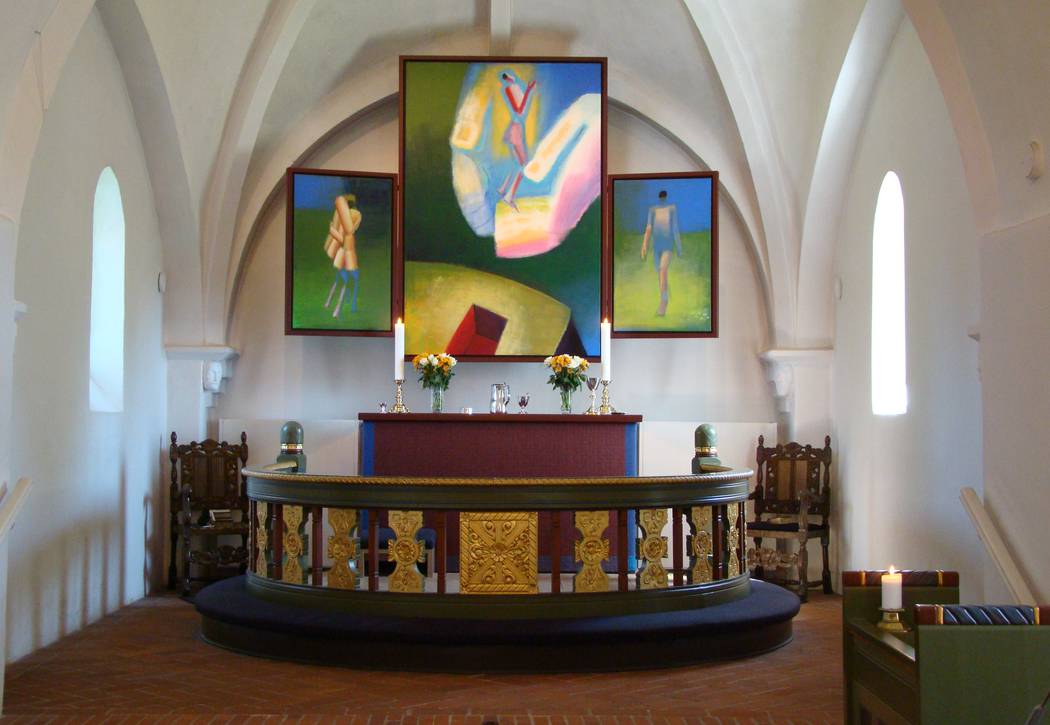
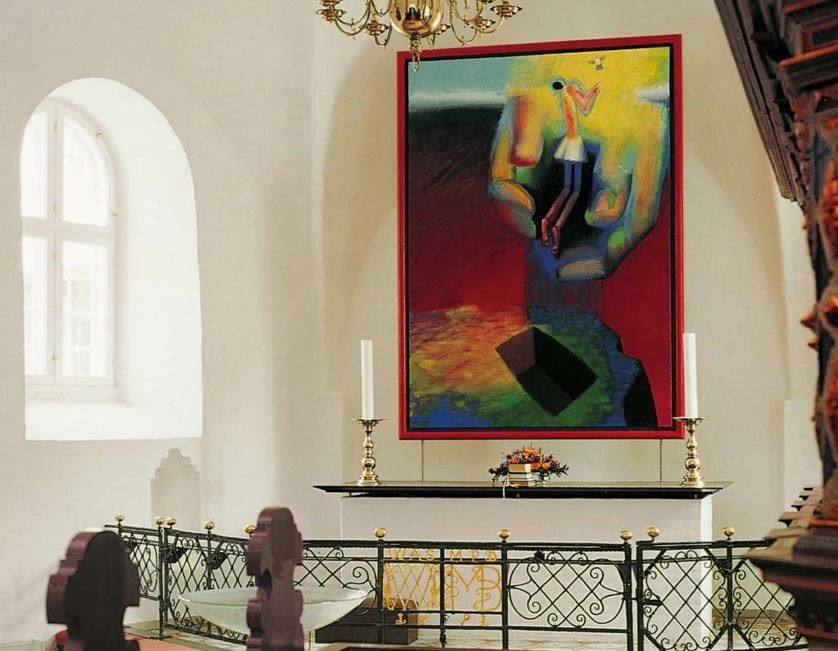
The tender hands of God lifting Christ out of the grave is one of Arne Haugen Sørensen’s favorite motifs—he’s painted it dozens of times, often as altarpieces for Danish churches.

Haugen Sorensen, Arne_Resurrection (Ringkobing)
Arne Haugen Sørensen (Danish, 1932–), Resurrection, 1996. Acrylic on canvas, 268 × 190 cm. Ringkøbing Church, Ringkøbing, Denmark.

Haugen Sorensen, Arne_Resurrection (Skelager)
Arne Haugen Sørensen (Danish, 1932–), Resurrection, 1997. Acrylic on canvas, 195 × 130 cm. Skelager Church, Aarhus, Denmark.

Haugen Sorensen, Arne_Resurrection (Bramming)
Arne Haugen Sørensen (Danish, 1932–), Resurrection (triptych), 2003. Acrylic on canvas. Sankt Ansgar Kirke, Bramming, Denmark.

Haugen Sorensen, Arne_Resurrection (Lillerod)
Arne Haugen Sørensen (Danish, 1932–), Resurrection, 2011, installed 2015. Acrylic on canvas, 162 × 130 cm. Lillerød Kirke, Lillerød, Denmark. Photo: Benny Grey Schuster.

Haugen Sorensen, Arne_Crucifixion and Resurrection (Fonnesbaek)
Arne Haugen Sørensen (Danish, 1932–), Crucifixion and Resurrection, 1996, installed 2002, Fonnesbæk Kirke, Ikast, Denmark. Photo: Benny Grey Schuster.

To view more of Haugen Sørensen’s work, visit www.arnehaugensorensen.com, and take this video tour of the Arne Haugen Sørensen Museum in Videbæk:


This post belongs to the weekly series Artful Devotion. If you can’t view the music player in your email or RSS reader, try opening the post in your browser.

To view all the Revised Common Lectionary scripture readings for the Second Sunday of Easter, cycle A, click here.

Love That Holds On Tight (Artful Devotion)

Fakaukau by Filipe Tohi
Filipe Tohi (Tongan, resident in New Zealand, 1959–), Fakaukau, 1996. Stone carving. Photo: Museum of New Zealand Te Papa Tongarewa, via Christ for All People, p. 87

I give them eternal life, and they will never perish, and no one will snatch them out of my hand. My Father, who has given them to me, is greater than all, and no one is able to snatch them out of the Father’s hand.

—John 10:28–29

+++

SONG: “O Love That Wilt Not Let Me Go” | Words by George Matheson, 1882 | Music by Albert L. Peace, 1884 | Performed by Madison Cunningham, on Monuments by Calvary Creative (2015)

+++

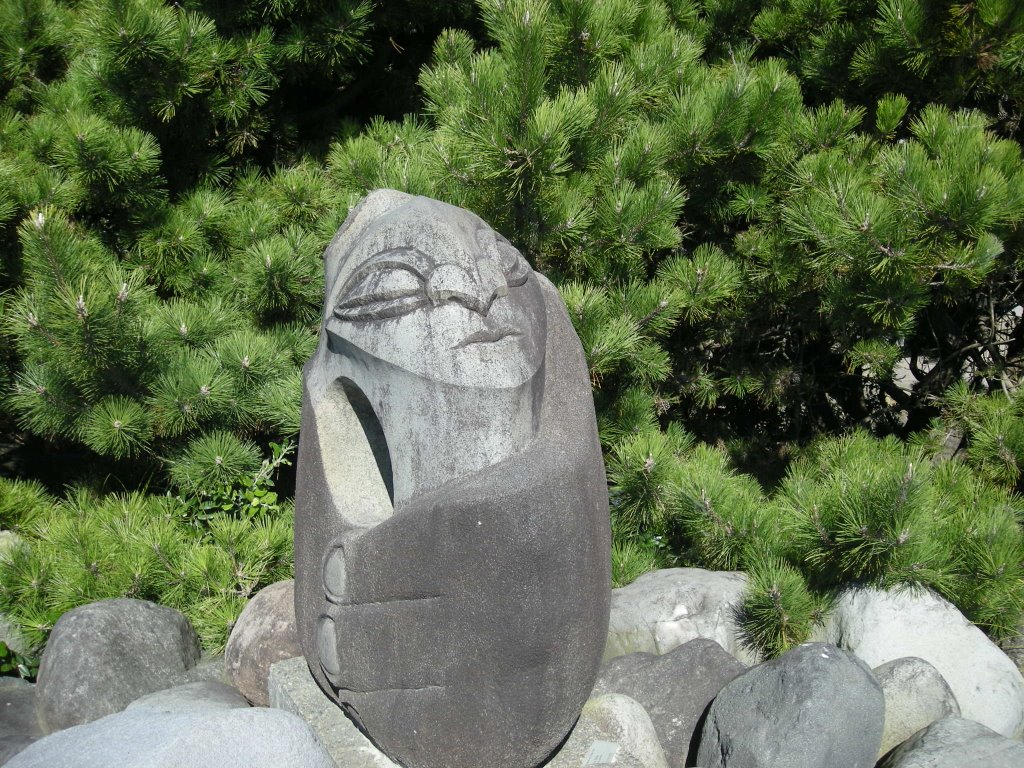
Fakaukau (“Thought”) is the title ascribed to this Tongan sculpture in the excellent book Christ for All People: Celebrating a World of Christian Art, published in 2001, which also places it in a private collection. However, photographs of a very similar—if not the same—sculpture by the same artist can be found online under the name Anchor Stone (see photos here and here), and it’s publicly accessible. Its shape is based on the anchor stone through which Tongan fishermen tie the rope of their boats. You can see the hand of God holding the fisher tenderly yet securely as the fisher rests in that grasp.

Anchor Stone by Filipe Tohi
Anchor Stone by Filipe Tohi, located along the Coastal Walkway in New Plymouth, Taranaki, North Island, New Zealand. Photo courtesy of New Plymouth District Council.

Anchor Stone is located along the New Plymouth Coastal Walkway, an eight-mile path that forms an expansive sea-edge promenade stretching from Pioneer Park at Port Taranaki all the way to the eastern side of Bell Block Beach in the Taranaki region of North Island, New Zealand. More precisely, the sculpture sits at the eastern end of a bridge that crosses the Huatoki Stream, near the Wind Wand. The walkway features several other sculptures by Filipe Tohi, as well as artworks by other Pacific Islanders.

Filipe Tohi was born in Nuku’alofa, Tonga, in 1959 and moved to Taranaki, New Zealand, in 1979, where he trained as a carver with a Maori cooperative. His early sculptures were mainly in stone and wood, but more recently he has achieved recognition for large contemporary sculptures in aluminum and steel that are inspired by lalava, traditional Tongan coconut sennit lashing (used to build roofs and canoes). Tohi studied and learned this ancient art form during a return visit to his homeland in 1987 and has been responsible for revitalizing and popularizing it. See more of his work at http://www.lalava.net/index.php/ct-menu-item-17#6.

Christianity took root in Tonga in the first half of the nineteenth century when the country’s king, George Tupou I, converted and the people followed suit. It has been Tonga’s main religion ever since.

+++

I first encountered the hymn “O Love That Wilt Not Let Me Go” a few years ago through a Calvary Collective album—I was extremely moved by Madison Cunningham’s understated arrangement and vocal performance, which captures so well the weary tone of the old text and tune. Cunningham adds a four-line chorus: “You will not let me go, so I will trust in thee. You won’t let go, so I will rest. You won’t let go, so I will trust in thee. O I will rest in thee.” Here is the full original text:

O Love that wilt not let me go,
I rest my weary soul in thee;
I give thee back the life I owe,
that in thine ocean depths its flow
may richer, fuller be.

O Light that follow’st all my way,
I yield my flick’ring torch to thee;
my heart restores its borrowed ray,
that in thy sunshine’s blaze its day
may brighter, fairer be.

O Joy that seekest me through pain,
I cannot close my heart to thee;
I trace the rainbow through the rain,
and feel the promise is not vain
that morn shall tearless be.

O Cross that liftest up my head,
I dare not ask to fly from thee;
I lay in dust life’s glory dead,
and from the ground there blossoms red,
life that shall endless be.

Upon hearing this, I immediately set about looking for a piano score—come to find that the hymn is in the hymnal I grew up with! And yet I don’t recall my congregation ever singing it.

In my estimation, “O Love” is one of the most sublime hymns ever written. It taps deeply into that feeling of “I’m tired, burnt out, spent,” meeting us there with gentle hope and joy. The first verse opens with a reminder of the tenacious hold God has on us and with a soul-invitation into the “ocean depths” of God’s being. What a contrast the hymn builds between our weakness and God’s strength. We flicker; God blazes. We bow our heads in exhaustion and lie down to die; God lifts us up and brings us into his full-flowering life. I know some churches have revived “O Love” using new tunes, but those, I feel, don’t hold a candle to Albert Peace’s original. The hymn often crops up in funeral programs and works beautifully in that context, but its relevance is by no means restricted to those at the end of life or those observing a recent passing.

For a brighter, more vigorous version of the hymn that utilizes the original tune, see Chelsea Moon’s Hymn Project, Volume 2, a collaboration with the Franz Brothers:

And here’s a great a cappella quartet arrangement by the Gaither Vocal Band:

Update, 10/19/20: Since I published this post, a video by 20schemes has been released, of Pete and Cara Bell from Hope Community Church Barlanark in Glasgow performing “O Love That Wilt Not Let Me Go” with the Peace tune I so admire. It’s a straightforward rendition with acoustic guitar, clear and beautiful singing, and lyrics onscreen, so if you’re looking to introduce the hymn to your church music team, this video would be a helpful start.


This post belongs to the weekly series Artful Devotion. If you can’t view the music player in your email or RSS reader, try opening the post in your browser.

To view all the Revised Common Lectionary scripture readings for the Fourth Sunday of Easter, cycle C, click here.