
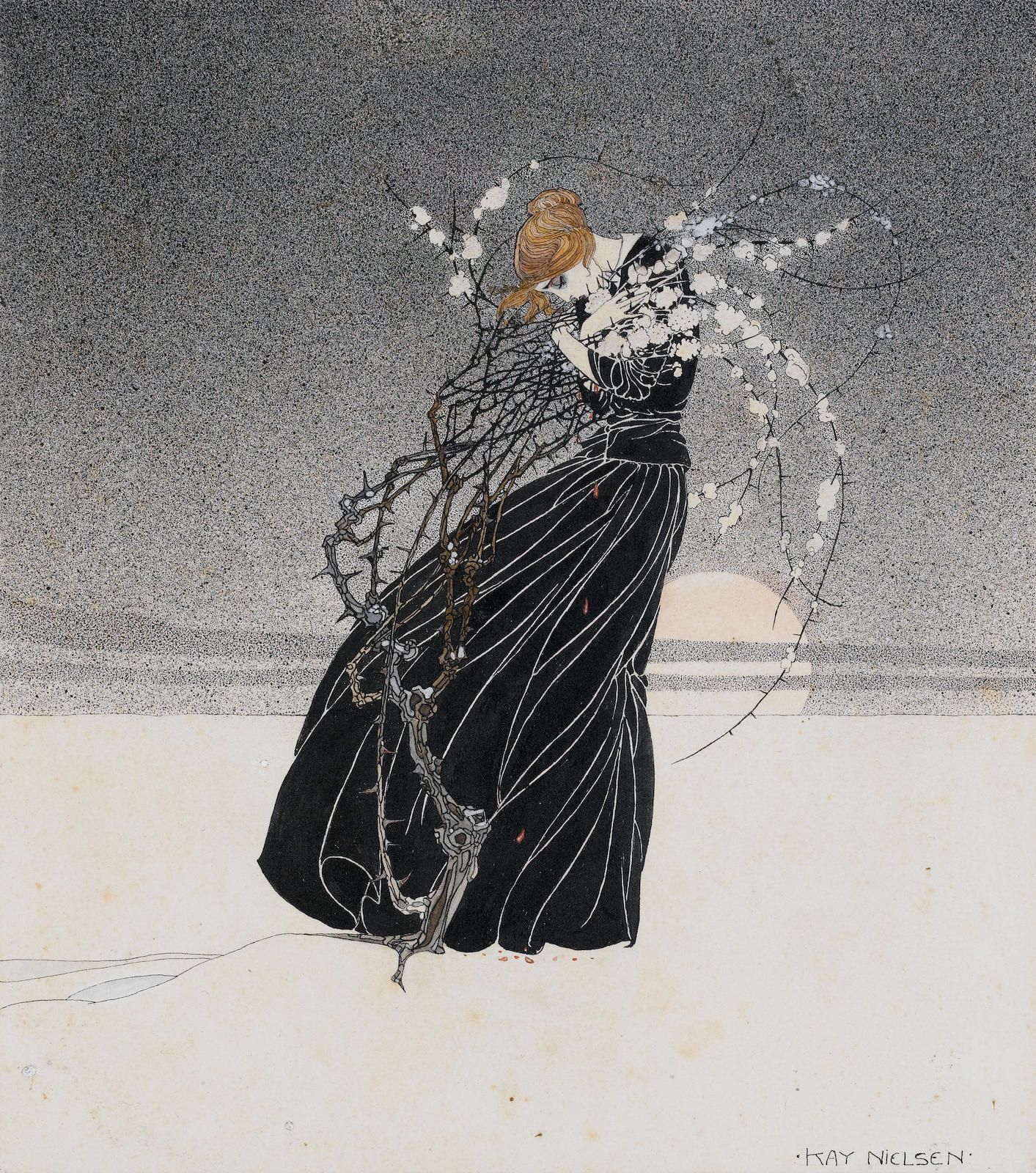
When I saw this watercolor drawing of a woman embracing a thorny shrub till she drips blood come up in my Instagram feed, I immediately thought of Christ’s passion.
The caption reveals that it’s an illustration by Kay Nielsen for Hans Christian Andersen’s “The Story of a Mother,” a fairy tale written in 1848 and published around 1910 that shows the beauty and intensity of a mother’s love for her child.
The story is about a woman whose young son is gravely ill. One evening, old man Death enters her house and takes the child. Utterly distraught, she runs out after him, seeking to save the boy from Death’s clutches. As she crosses the snowy landscape in search of her son, she is stopped by various beings who request things of her in exchange for help. Night asks her for lullabies. The blackthorn bush asks for warmth. The lake asks for her eyes, clear as pearls, so “she wept till her eyes dropped down to the bottom of the lake.” An old woman who keeps Death’s greenhouse asks for her long black hair. (Oddly, she’s a redhead in Nielsen’s drawing!) Here is the exchange with the blackthorn bush, as translated from the Danish by Jean Hersholt:
At the crossroad grew a blackthorn bush, without leaf or flower, for it was wintertime and its branches were glazed with ice.
“Did you see Death go by with my little child?”
“Yes,” said the blackthorn bush. “But I shall not tell you which way he went unless you warm me against your heart. I am freezing to death. I am stiff with ice.”
She pressed the blackthorn bush against her heart to warm it, and the thorns stabbed so deep into her flesh that great drops of red blood flowed. So warm was the mother’s heart that the blackthorn bush blossomed and put forth green leaves on that dark winter’s night. And it told her the way to go.
The mother fulfills all the demands she encounters in her quest and finally meets Death, who explains that he merely carries out God’s will, which she ought not to disrupt. She ultimately resigns herself in humility to divine providence and lets the child go.
I’m not suggesting that this fairy tale is an allegory of God’s love. That wouldn’t quite make sense, as God is invoked at the end as a character in the story—and, à la the book of Job, as one who sometimes wills death (“The LORD gives and takes away,” Job 1:21).
But the mother’s love in the story is reflective, I find, of the fierce love of God, who is willing to go to any extreme to save his children from Death. He became incarnate and embraced the way of the cross. He took unto himself the crown of thorns, the nails, the humiliation. He sacrificed not just parts of himself but his whole self.
In Nielsen’s illustration, I see a picture of Christ our mother who willingly endured pain to rescue us, the warmth of whose love reverses the curse and brings life.
 Art & Theology