Roundup: The body as sacred offering; rest as resistance; “Amazing Grace”

I’m late in notifying you about my June 2025 playlist (a random compilation of faith-inspired songs I’ve been enjoying lately), but be sure to check it out on Spotify.

See also my Juneteenth Playlist, which I’ve added six new songs to since originally releasing it two years ago, including a cover of Roberta Slavitt’s protest song “Freedom Is a Constant Struggle,” “Black Gold” by Esperanza Spalding, and “The Block” by Carlos Simon, a short orchestral work based on a six-panel collage by Romare Bearden celebrating Harlem street life.
Romare Bearden, The Block
Romare Bearden (American, 1911–1988), The Block, 1971. Cut-and-pasted printed, colored, and metallic papers, photostats, graphite, ink marker, gouache, watercolor, and ink on Masonite, 4 × 18 ft. (121.9 × 548.6 cm). Metropolitan Museum of Art, New York. Photo: Victoria Emily Jones.

+++

PODCAST EPISODE: “The Body as Sacred Offering: Ballet and Embodied Faith” with Silas Farley, For the Life of the World, April 30, 2025: An excellent interview! “Silas Farley, former New York City Ballet dancer and current Dean of the Colburn School’s Trudl Zipper Dance Institute, explores the profound connections between classical ballet, Christian worship, and embodied spirituality. From his early exposure to liturgical dance in a charismatic Lutheran church to his career as a professional dancer and choreographer, Farley illuminates how the physicality of ballet can express deep spiritual truths and serve as an act of worship.”

I was especially compelled by Farley’s discussion of turnout, the rotation of the leg at the hips—foundational to ballet technique. It gives the body an “exalted carriage” and allows for “a more complete revelation of the body,” he says, because you see more of the leg’s musculature that way. This physical positioning, he says, reflects the correlative “spiritual turnout” that’s also happening in dance, and that Christians are called to in life—a posture of openness and giving. He cites the theological concept of incurvatus in se, coined by Augustine and further developed by Martin Luther, which refers to how sin curves one in on oneself instead of turning one outward toward God and others.

Farley also discusses how liturgical dance is like and unlike more performative modes of dance (“liturgical dance . . . is a kind of embodied prayer . . . a movement that goes up to God out of the body”); how discipline and freedom go together; the body as instrument, and how dancers cultivate a hyperawareness of their bodies; the two basic design elements of ballet, the plié and the tendu, and their significance; his formation, from ages fourteen to twenty-six, under the teaching of Rev. Dr. Tim Keller at Redeemer Presbyterian Church; the Four Loves ballet he choreographed on commission for the Houston Ballet, based on a C. S. Lewis book (see promo video below, and his and composer Kyle Werner’s recent in-depth discussion about it for the C. S. Lewis Foundation); Songs from the Spirit, a ballet commissioned from him by the Metropolitan Museum of Art (see next roundup item); Jewels by George Balanchine, a three-act ballet featuring three distinct neoclassical styles; “Hear the Dance” episodes of City Ballet the Podcast, which he hosts; and book recommendations for kids and adults.

+++

SITE-SPECIFIC BALLET: Songs from the Spirit, choreographed by Silas Farley: Commissioned by MetLiveArts [previously], Songs from the Spirit by Silas Farley is a three-part ballet for seven dancers that interprets old and new Christian spirituals, having grown out of an offertory Farley gave at Redeemer Presbyterian Church based on the song “Guide My Feet, Lord.” Staged in the museum’s Assyrian Sculpture Court, the Astor Chinese Garden Court, and the glass-covered Charles Engelhard Court of the American Wing, the ballet progresses from “Lamentation” to “Contemplation” to “Celebration.” Here’s a full recording of the March 8, 2019, premiere:

For the project, Farley solicited new “songs (and spoken word poetry) from the spirit” from men who were currently or formerly incarcerated at San Quentin State Prison in California, whose creative talent he learned about through the Ear Hustle podcast. Recordings of these contributions form about half the score, while the other half consists of traditional spirituals sung live by soprano Kelly Griffin and tenor Robert May. My favorite section is probably “Deep River” at 26:54, a duet danced by Farley and Taylor Stanley, picturing a soul’s “crossing over” to the other side, supported by an angelic or divine presence, or perhaps one who’s gone before.  

In his artistic statement, Farley says he wanted to invite viewers “to accompany us [dancers] on this journey: from darkness to light, bondage to freedom, exile to home.”

I am struck by how a contemporary work that is, in Farley’s words, so “unequivocally Christ-focused and Christ-exalting” was welcomed, even made financially possible, by a prestigious secular institution. I find apt Farley’s response when asked by Macie Bridge from the Yale Center for Faith & Culture about his consideration of his audiences (see previous roundup item):

All the people coming to the performance are hungry in different ways. Some are longing for beauty. Some are longing for a prophetic image of a better world. Some are longing to see something reflected back to them from their own lives. And I’m just trusting that as I offer the artwork as an act hospitality, and as I offer the artwork as an act of adoration and worship back to God, that in his own beautiful, winsome, totally personalized way, he’ll meet each of the audience members in the way they need to be met.

+++

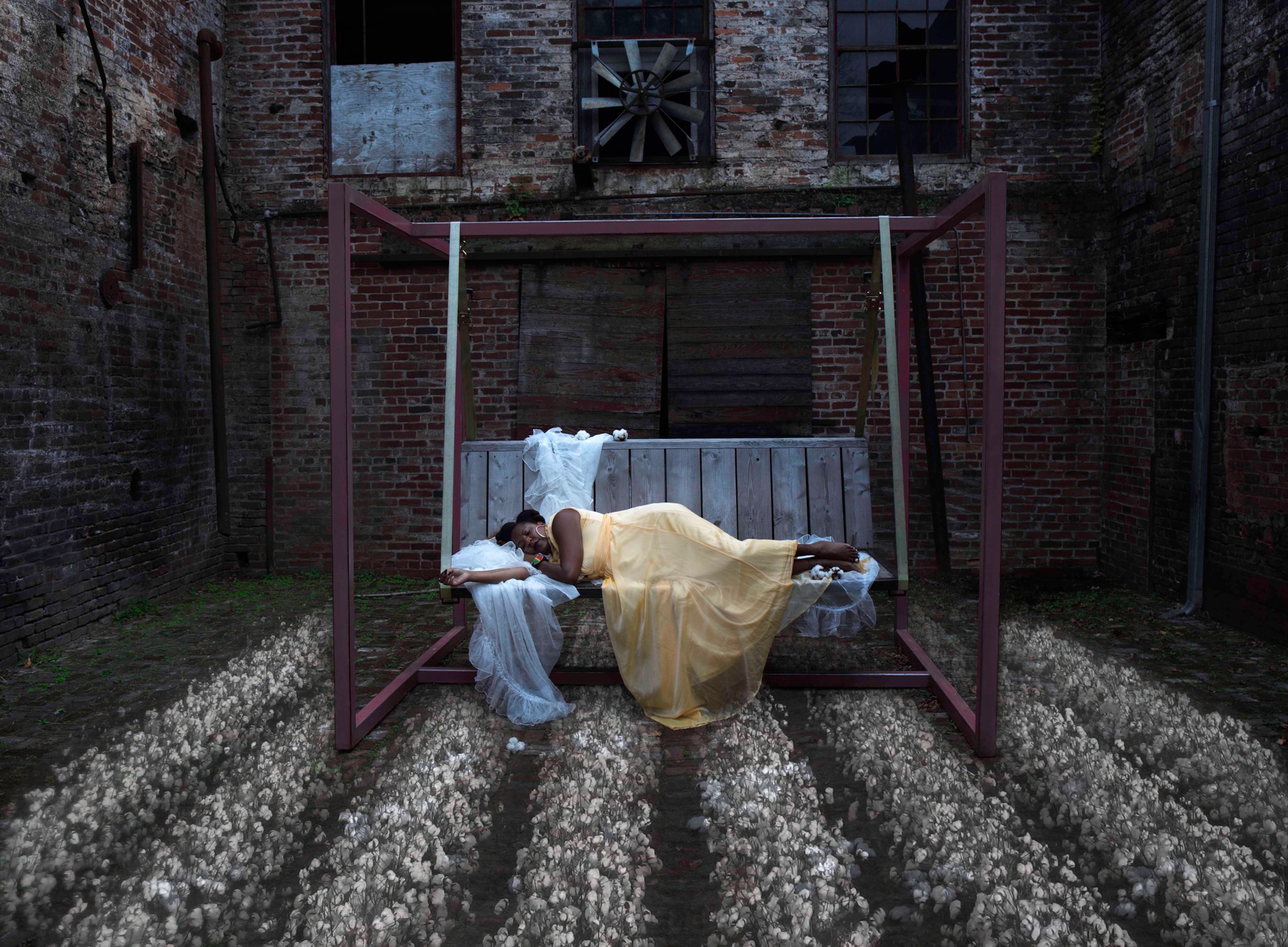
ARTWORK: Dreaming with the Ancestors by Charlie Watts and Tricia Hersey [HT: Visual Commentary on Scripture]: Tricia Hersey is a poet, performance artist, spiritual director, and community organizer living in Atlanta, Georgia. She is the founder of The Nap Ministry, an organization that promotes rest as a form of resistance against capitalism (which fuels contemporary grind culture) and white supremacy, and the author of the New York Times best-selling Rest Is Resistance: A Manifesto (2022) and We Will Rest! The Art of Escape (2024). She pursued graduate research in Black liberation theology, womanism, somatics, and cultural trauma, earning a master of divinity degree from Candler School of Theology at Emory University.
Watts, Charlie_Dreaming with the Ancestors
Charlie Watts and Tricia Hersey, Dreaming with the Ancestors, 2017. Archival digital print photograph, 76.2 × 101.6 cm.

The photograph Dreaming with the Ancestors, taken by Charlie Watts, portrays Hersey reclining on a wooden bench inside an open brick enclosure and above rows of cotton plants. Dressed in a soft yellow gown, she closes her eyes in rest, practicing what she calls “the art of escape”—from the incessant demand of productivity and overwork, from oppression of body and spirit, from noise that drowns out voices of wisdom.

In We Will Rest!, Hersey advises:

Every day, morning or night, or whenever you can steal away, find silence. Even if for only a few minutes. Look for quiet time, quiet breathing, quiet wind, quiet air. It is there. Even if it’s cultivated in your body by syncing with your own heart beating. Guilt and shame will be a formidable and likely opponent in your resistance. We expect guilt and shame to surface. Let them come. We rest through it. We commit to our subversive stunts of silence, truth, daydreaming, community care, naps, sleep, play, leisure, boundaries, and space. Be passionate about escape. (107)

+++

ALBUM: Grace Will Lead Me Home by Invisible Folk (2024) [HT: Jonathan Evens]: An Arts Council England grant awarded to singer-songwriter Jon Bickley in 2022 enabled him to conduct a research and songwriting project that culminated in the album Grace Will Lead Me Home, which engages with the hymn “Amazing Grace,” its author’s biography, and its legacy. Bickley partnered with the Cowper and Newton Museum in Olney and enlisted the collaboration of fellow folk musicians Angeline Morrison (The Sorrow Songs: Folk Songs of Black British Experience) and Cohen Braithwaite-Kilcoyne (creator of the “Black Singers and Folk Ballads” resource for secondary educators, and concertina player on Reg Meuross’s Stolen from God). Here’s the title track, written and sung by Morrison:

The album also includes a cover of Zoe Mulford’s “The President Sang Amazing Grace,” written in response to the racially motivated mass shooting at Mother Emanuel AME Church in Charleston, South Carolina, on June 17, 2015 (its ten-year anniversary is next Tuesday). In his eulogy at the funeral of one of the nine victims, Rev. Clementa Pinckney, President Barack Obama chose “the power of God’s grace” as his theme, and he closed by singing the first stanza of “Amazing Grace,” a moving gesture that Mulford’s song remembers.

Other songs on Grace Will Lead Me Home address John Newton’s love for his wife Polly, his impressment into naval service, and his friendship with William Cowper. There are also songs that grapple with the harm and suffering Newton inflicted on others through his involvement in the slave trade, and that wonder at his hymn’s being so mightily embraced not only by the Black church, many of whose members are descendants of enslaved Africans, but also by other traumatized communities, who insist amid all the wrongs and afflictions they’ve suffered that God is amazingly gracious.

It’s a myth that John Newton (1725–1807), who converted to Christianity in 1748 after surviving a turbulent sea voyage, immediately gave up his employment as a slave trader upon embracing Christ. In fact, he was soon after promoted from slave ship crew member to captain and sailed three more voyages to Africa as such, trafficking human beings for profit until 1754, when his ill health forced him to retire. But he continued to invest in slaving operations for another decade, until becoming a priest in the Church of England. It wasn’t until 1788, in the pamphlet Thoughts Upon the African Slave Trade, that he publicly denounced slavery and confessed his sin of having participated in that evil institution, and this was the start of his abolitionism.

+++

SONG: “Amazing Grace,” performed by the Good Shepherd Collective: This adaptation of “Amazing Grace” premiered at Good Shepherd New York’s digital worship service on June 1. Listen via the Instagram video below, or cued up on YouTube. The vocalists are, from right to left, Charles Jones on lead, Solomon Dorsey (also on bass), Jon Seale, Dee Wilson, and Aaron Wesley. James McAlister is on drums, Michael Gungor is on electric guitar, and Tyler Chester is on keys.

Contemporary Black artists at the Baltimore Museum of Art

This week I’ve been editing and captioning a backlog of photos from my camera, and I’ve come to a batch I took last August from Every Day: Selections from the Collection at the Baltimore Museum of Art, a reinstallation of the museum’s contemporary collection centered on the Black artistic imagination. I thought I’d share some of these photos here as a way to introduce you to some of today’s leading Black American artists.

+++

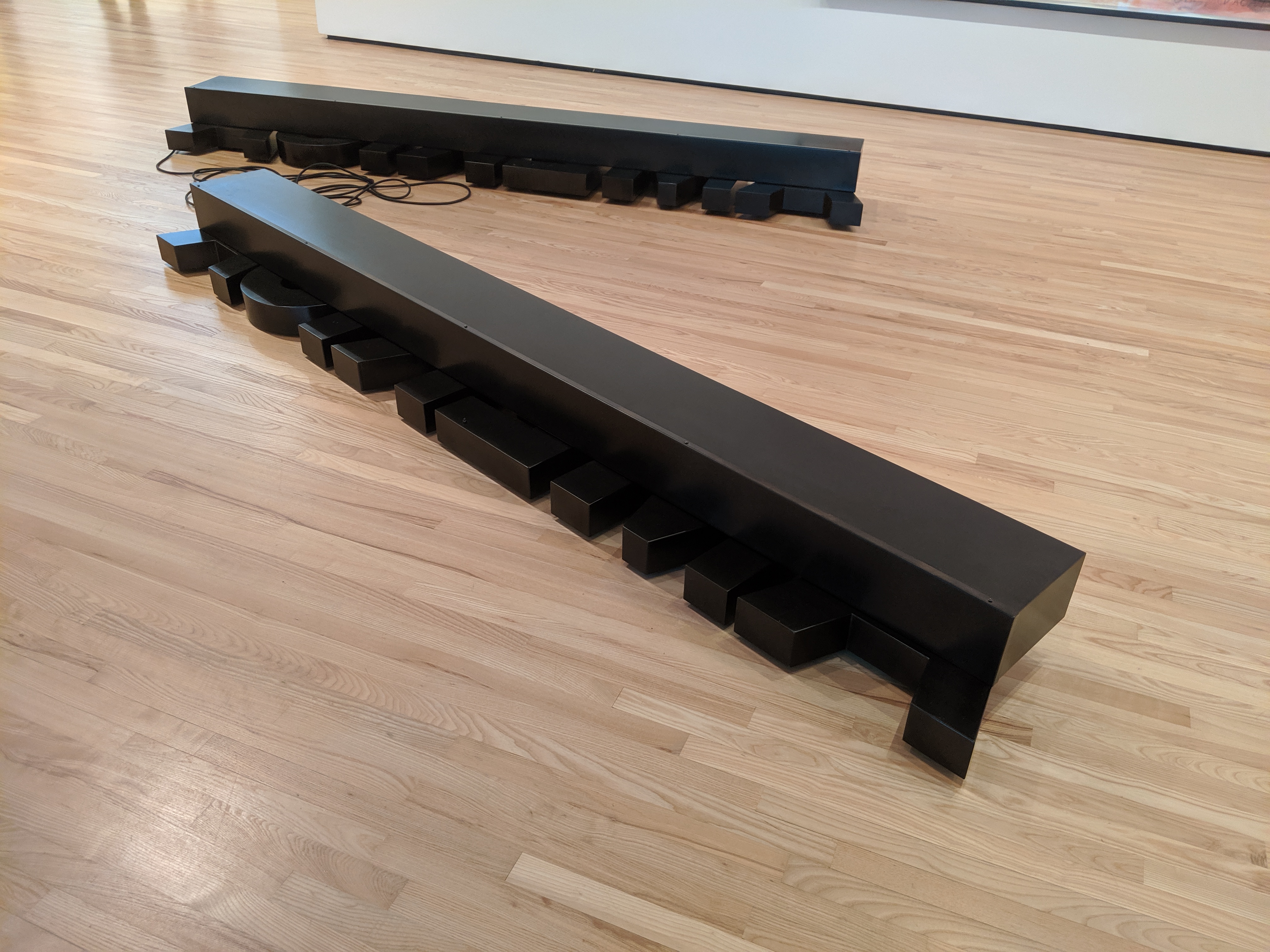
In the first gallery, an untitled neon sculpture by Glenn Ligon confronts the viewer, consisting of two black lightbox letter signs lying face-down on the floor, which each read, with some difficulty, “America.” They emit a flickering white light that pulsates at random. The piece is part of a series of variations on that word—a word, Ligon says, that means different things to different people.

Ligon, Glenn_America America
Foreground: Glenn Ligon (American, 1960–), Untitled (America America), 2015. Neon and blackened steel, 22 × 125 × 10 in. each. Baltimore Museum of Art, Maryland. Photo: Victoria Emily Jones.

He said his “double America” motif was inspired by the opening lines of Charles Dickens’s A Tale of Two Cities: “It was the best of times, it was the worst of times, it was the age of wisdom, it was the age of foolishness . . . it was the spring of hope, it was the winter of despair . . .” The wall text continues: “Dickens used a series of opposing statements to capture a moment in European history [1775–92] in which wealth coexisted with poverty, war with leisure and comfort, and aspirational ideals with harsh realities. Ligon sees similar extremes at work in the twenty-first century: ‘There is this sense that America, for all its dark deeds, is still this shining light.’”

In the age of MAGA I’m reminded of a poem by Langston Hughes published in July 1936, “Let America Be America Again,” in which he laments that as a country, we’ve never been what we’ve aspired to be: a place of liberty and justice for all. He loves America and the ideals on which it was founded but is forced to reckon with its failures, pointing out the hypocrisy of a nation that proclaims in its founding document that “all men are created equal” while segregating, disenfranchising, and brutalizing African Americans. (And the poem goes on to cite inequalities experienced by other groups too.) It’s very much in the spirit of Frederick Douglass’s speech less than a century earlier, “What to the Slave Is the Fourth of July?”

Ligon, Glenn_America America

You can read Hughes’s full poem at Poets.org, but here are the first six stanzas and then one:

Let America be America again.
Let it be the dream it used to be.
Let it be the pioneer on the plain
Seeking a home where he himself is free.

(America never was America to me.)

Let America be the dream the dreamers dreamed—
Let it be that great strong land of love
Where never kings connive nor tyrants scheme
That any man be crushed by one above.

(It never was America to me.)

O, let my land be a land where Liberty
Is crowned with no false patriotic wreath,
But opportunity is real, and life is free,
Equality is in the air we breathe.

(There’s never been equality for me,
Nor freedom in this “homeland of the free.”)

. . .

O, let America be America again—
The land that never has been yet—
And yet must be—the land where every man is free.

. . .

Hear Ligon discuss his art practice in the “A Closer Look” interview from the BMA, below, and zoom in on some of his artworks at Google Arts & Culture.

+++

Behind Ligon’s neon sculpture was a large gouache by Kara Walker titled Terrible Vacation. It was impossible to get a decent photo with the glare on the glass, so here is a professional photo of the painting, unframed, from Sikkema Jenkins & Co.

Walker, Kara_Terrible Vacation
Kara Walker (American, 1969–), Terrible Vacation, 2014. Gouache on paper, 72 1/2 × 159 1/2 in. Baltimore Museum of Art, Maryland.

Best known for her room-size tableaux of cut-paper silhouettes addressing the history of race in America, here she pays homage to J. M. W. Turner’s 1840 Slave Ship, the Romantic painter’s abolitionist response to the Zong massacre of 1781, in which the captain of a British slave ship en route to Jamaica threw 133 sick enslaved people overboard to collect insurance on them as property “lost at sea.” Human and elemental violence converge in Turner’s painting, as a ship sails through a stormy ocean filled with flailing human limbs in chains.

Walker’s painting after Turner brings this mass murder to the attention of a new public, and though it references the past of England in particular, America, as a fellow player in the transatlantic slave trade, is implicated too.

+++

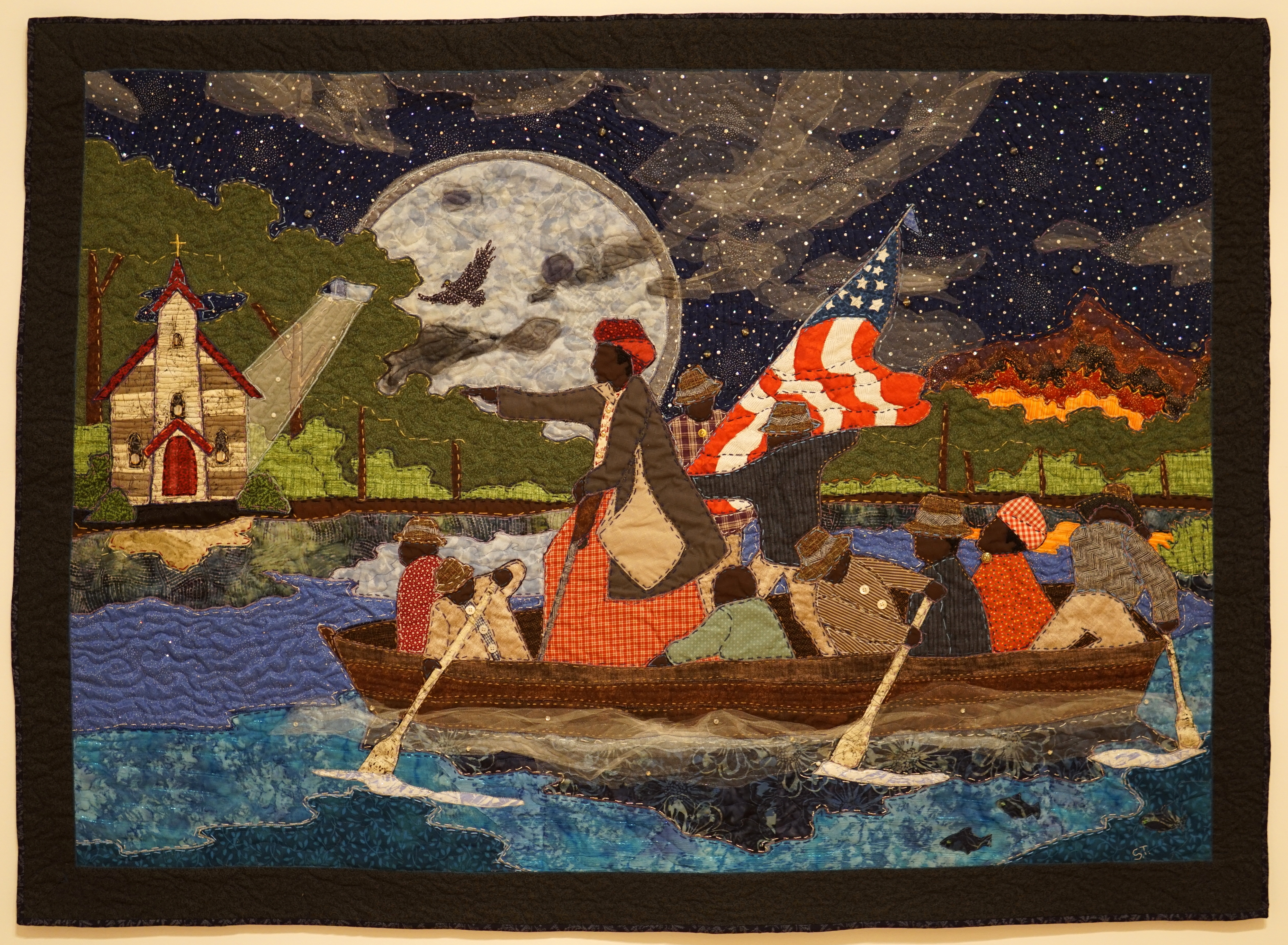
On the left wall was a story quilt by Baltimore artist Stephen Towns [previously], one is a series paying tribute to Harriet Tubman.

Towns, Stephen_We Shall Pass through the Combahee.JPG
Stephen Towns (American, 1980–), We Shall Pass through the Combahee, 2019. Natural and synthetic fabric, nylon tulle, polyester and cotton thread, metallic thread, crystal glass beads, and resin and metal buttons. Baltimore Museum of Art, Maryland. Photo: Victoria Emily Jones.

Titled We Shall Pass through the Combahee, it records the historic military operation, led by Harriet Tubman, known as the Raid on Combahee Ferry, which succeeded in freeing seven hundred-plus slaves. During the Civil War, on June 1–2, 1863, Tubman guided two of Lincoln’s gunboats, peopled with Union Army soldiers, along the Combahee in South Carolina to strategic points near the shore where slaves awaited rescue, avoiding rebel torpedoes along the way.

Towns modeled the scene after Emanuel Leutze’s famous 1851 painting Washington Crossing the Delaware, set during the Revolutionary War, but he recasts Tubman as the American hero, bravely leading her people and her nation to victory. The church in the background likely represents the historic Tabernacle Baptist Church in Beaufort, where the escapees gathered after the raid, further up the river, before being relocated to St. Helena Island. It is illuminated as if by divine light because Tubman always said it was God who gave her direction in making certain critical moves during her many rescue operations—as Underground Railroad conductor and as military leader.

Towns describes the piece, and his complicated relationship to history and patriotism:

To learn about another body of Towns’s work, A Path Between Two Continents, see this video by York College Galleries:

+++

New York–based Afro-Dominican artist Firelei Báez examines through her art the historical narratives of the Afro-Caribbean diaspora, focusing on the politics and cultural ambiguities of place, writes ArtDaily. May 19, 2017, 6:05 p.m. (an idiom playing out its history) at the Baltimore Museum of Art commemorates New Orleans’s removal of its monument to Confederate general Robert E. Lee, erected in 1884, from “Lee Circle.” “It’s a gesture that reacts in time both forward and backwards, almost like a prayer, in solidarity with the people who had to suffer through that space and the resistance moving forward,” Báez said.

Baez, Firelei_May 19, 2017
Firelei Báez (Dominican American, 1981–), May 19, 2017, 6:05 p.m. (an idiom playing out its history), 2018. Oil, oil stick, and graphite on canvas, 92 × 120 in. Baltimore Museum of Art, Maryland. Photo: Victoria Emily Jones.

Katie A. Pfohl, a curator at the New Orleans Museum of Art, writes about the series to which this piece belongs, which focuses on key chapters from New Orleans’s past:

In these new paintings, Báez overlays figures, symbolic imagery, and calligraphic gestures onto architectural surveys from the 1930s-era Historic American Buildings Survey, a project of the Works Progress Administration, of significant sites across New Orleans. Blurring the lines between past, present, and future, Báez paints new imagery upon these archival drawings, and in the process overwrites the often divisive history these older documents represent. Báez carries portraiture into a space where identity is rooted in history, but can likewise become untethered—and liberated—from it.

Another Báez piece in the BMA’s collection is Convex (recalibrating a blind spot), which consists of a diagram of the American Sugar Refinery in New Orleans overpainted with vibrant colors.

+++

Bey, Dawoud_Mathes Manafee and Cassandra Griffen
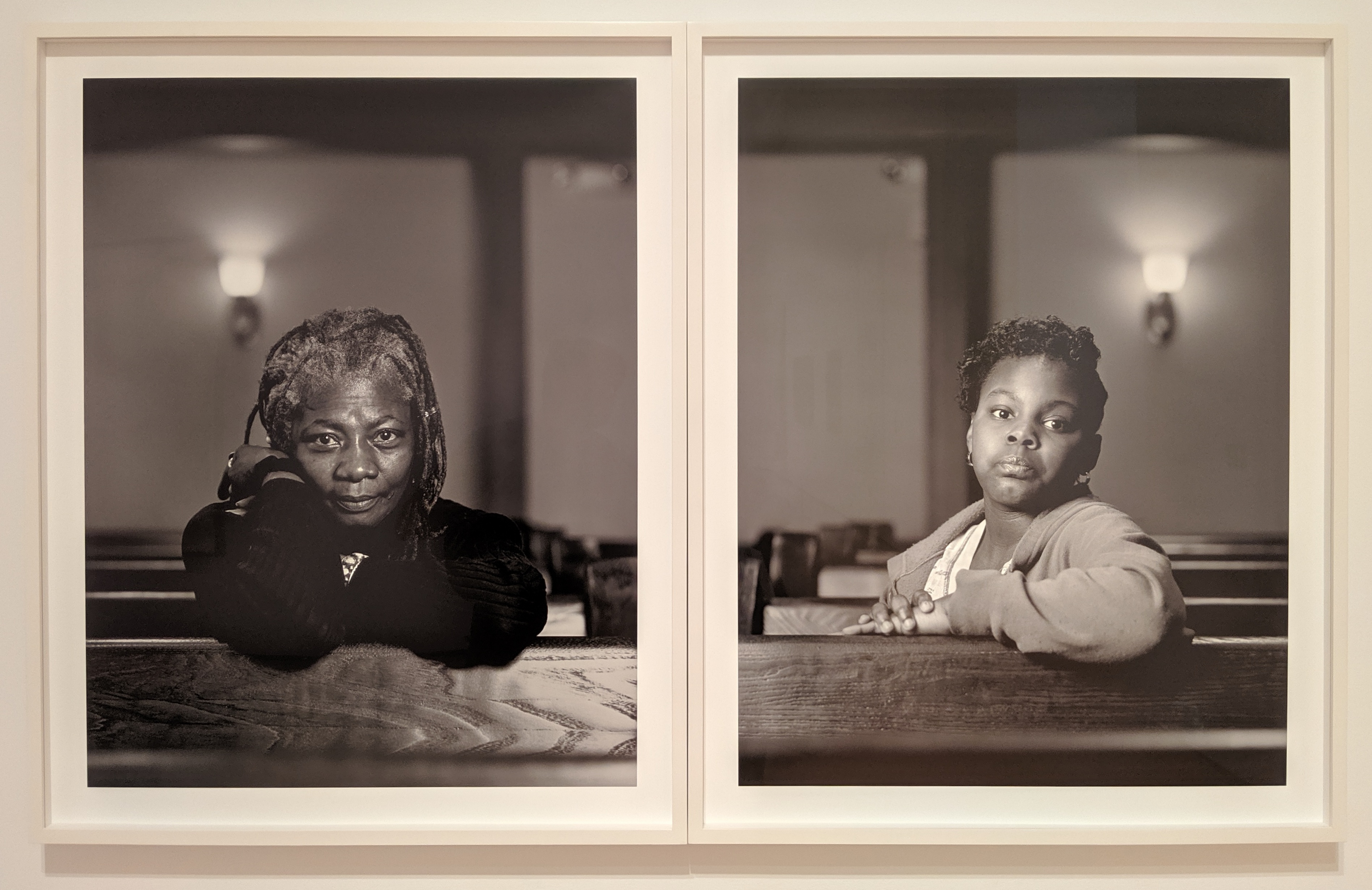
Dawoud Bey (American, 1953–), The Birmingham Project: Mathes Manafee and Cassandra Griffen, 2012. Inkjet prints, pigment-based, 40 × 32 in. each. Baltimore Museum of Art, Maryland. Photo: Victoria Emily Jones.

In the same gallery as the previous four pieces was a photograph diptych by Dawoud Bey, from his Birmingham Project series.

On September 15, 1963, four young black girls—Addie Mae Collins, Denise McNair, Carole Robertson, and Cynthia Wesley—were killed when white supremacists bombed the Sixteenth Street Baptist Church in Birmingham, Alabama. Fifty years later, Dawoud Bey worked with Birmingham residents to memorialize them, to pay “tribute to those who were in Birmingham at that difficult moment and those who have been born since.” He photographed adolescents the same ages as those who had died, and men and women in the fifties and sixties, the ages those young people would be had they lived.

+++

Simmons, Gary_Triple Burn
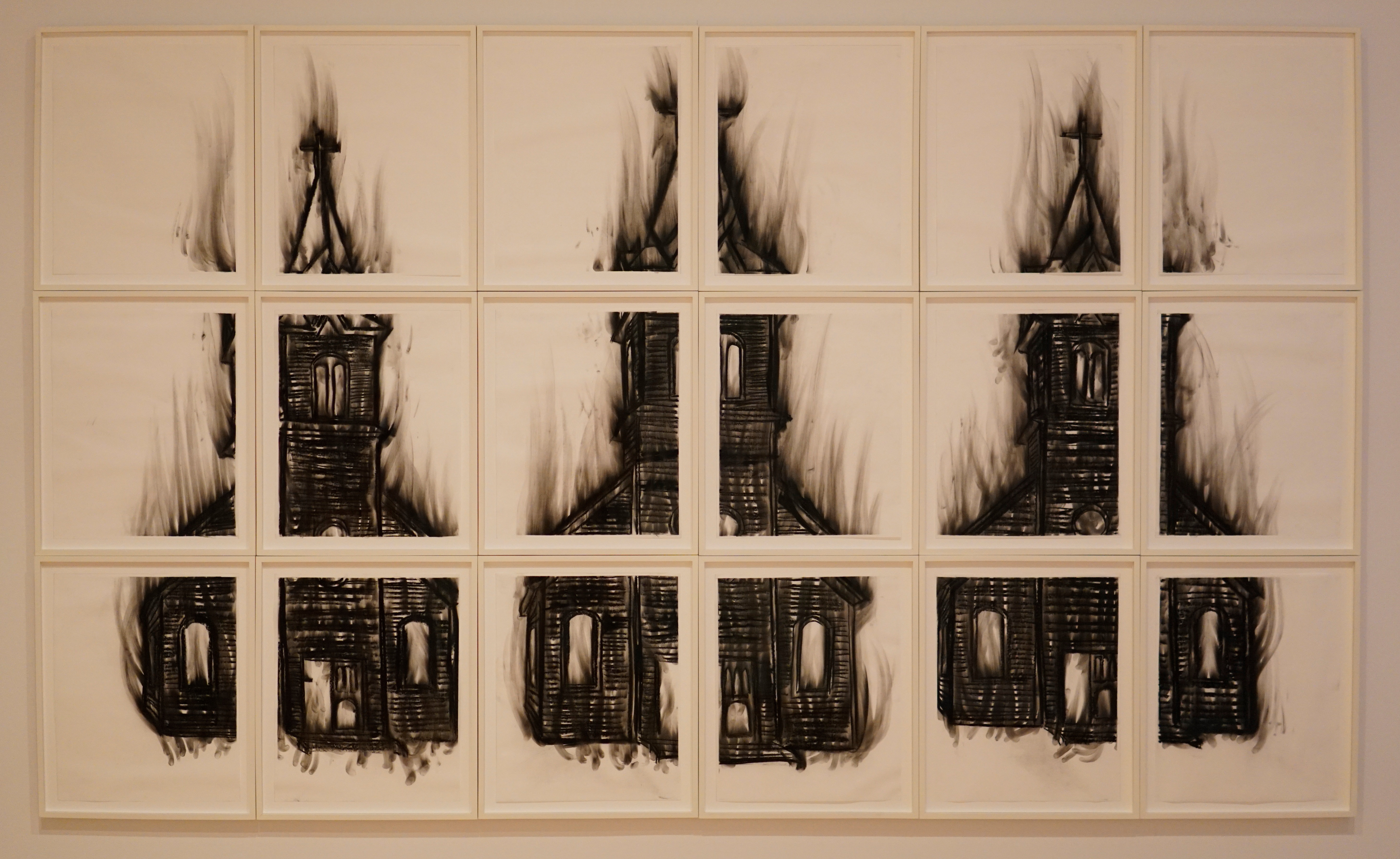
Gary Simmons (American, 1964–), Triple Burn, 2003. Charcoal with smudging on paper, 66 3/4 × 110 1/4 in. Baltimore Museum of Art, Maryland. Photo: Victoria Emily Jones.

Over and over again, white supremacists have sought to terrorize black communities by setting fire to black churches. The 1990s saw an increase in such terrorist acts and images circulated widely of burning churches, past and present. In this drawing, Gary Simmons blended his recollections of these images into a composite picture of a single church, repeated three times. He used his fingers to smudge trails of charcoal dust across the paper, creating ghostly impressions of flames of smoke. “I do this as a way of creating a feeling of something familiar but displaced,” the artist explains. “The image is intended to hang in one’s memory . . . the further one gets from an experience, the more it becomes abstracted.”

Ernest Shaw, a local artist and art educator, points out how the white frames around the paper create crosses, representing crossroads as well as Black spirituality:

+++

How long is a chain?
How long is a change?
How heavy is a chain?
How heavy is a change?

—Melvin Edwards, 1970

Edwards, Melvin_Scales of Injustice
Melvin Edwards (American, 1937–), Scales of Injustice, 2017/2019. Barbed wire, chain, and steel. Baltimore Museum of Art, Maryland. Photo: Victoria Emily Jones.

In Scales of Injustice, a steel platform resembling one half of a weighted scale holds a tangle of barbed wire. It is suspended over a length of chain sprawled out on the floor, and the whole scene, sited in a corner, is separated from the viewer by a barbed-wire barrier. This conceptual sculpture by Melvin Edwards is an adaptation of a site-responsive work he exhibited at the Whitney Museum in 1970, Corner for Ana, the title a reference to his young daughter and to the notion of “timeout.”

The materials—steel chain, barbed wire—evoke brutality and oppression. Perhaps it’s change, in a larger sense, that hangs in the balance, precarious and unsure.

Edwards, Melvin_Scales of Injustice (detail)

Edwards, Melvin_Scales of Injustice (detail)

Edwards said this re-creation was in response to the death of Pateh Sabally, a twenty-two-year-old Gambian refugee who drowned in the Grand Canal of Venice on January 21, 2017, as onlookers taunted and filmed his struggles and offered no help.

+++

Simpson, Lorna_Easy to Remember
Lorna Simpson (American, 1960–), Easy to Remember (still), 2001. 16 mm film transferred to DVD (black and white, sound); 2:35 min. Baltimore Museum of Art, Maryland.

For this video, Lorna Simpson recorded fifteen professional singers separately humming along to jazz saxophonist John Coltrane’s haunting interpretation of Rogers and Hart’s “It’s Easy to Remember.” Simpson then combined the recordings to create a choir of voices. This layered tune becomes the soundtrack for a grid of moving images, each focused tightly on one singer’s lips. The individuality of each participant emerges in variations among the mouths, a part of the body integrally linked to expression and physicality. The video demonstrates that even within a collective experience, including one of songs and the emotions they conjure, independent voices persist and disrupt.

+++

David Hammons grew up in Springfield (Illinois), studied art in Los Angeles, and then settled in New York City in 1974, where he still lives. Traveling is one of his many “basketball drawings,” which he made by bouncing a Spalding around the streets of Harlem and onto a nine-foot-tall sheet of paper, creating atmospheric gray pebbling that resembles clouds in the sky or light and shadow on the ground.

Hammons, David_Traveling
David Hammons (American, 1943–), Traveling, 2001–2. Harlem dirt on paper and suitcase, 109 5/16 × 41 3/4 × 9 1/2 in. Baltimore Museum of Art, Maryland. Photo: Victoria Emily Jones.

I love the love of place this piece promotes. “Harlem dirt” is listed as the primary material! Hammons is sanctifying the dust of his neighborhood (“the ephemeral stuff of black urban experience”) by bringing it into a high-art context, essentially saying, “My background, my experiences, are worthy.” Martin Herbert, writing for Frieze, discusses the multivalence of the title:

The title of this work, Traveling, evokes many things: the eponymous rule of basketball that says you can’t take the ball and run with it; Hammons’ own movement across the Atlantic and that of the grimy orange sphere across the room; the upward mobility of dirt-into-art, and its direct social analogue—the ‘coming up from the streets’ dream/boast of a million aspiring rappers and pro-court players in environments where, as hip-hopper Mos Def put it, ‘you can either get paid or get shot’.

The artwork juts out from the wall at a slight angle, and one discovers propped behind it a thin brown suitcase.

Hammons, David_Traveling (detail)

+++

Like Stephen Towns, Amy Sherald lives in Baltimore. She is known for her large-scale portrait paintings that use grisaille to portray skin tones as a way of “challenging the concept of color-as-race,” and was chosen to paint the official portrait of First Lady Michelle Obama.

Sherald, Amy_Planes, rockets, and the spaces in between
Amy Sherald (American, 1973–), Planes, rockets, and the spaces in between, 2018. Oil on canvas, 100 × 67 in. Baltimore Museum of Art, Maryland. Photo: Victoria Emily Jones.

About Planes, rockets, and the spaces in between, Sherald writes,

I wanted the environment to be in what would be perceived as an American landscape. These two figures are witnesses of a very American moment in history. . . . One key thing to note in all of my paintings is that the figures in the work will never be passive participants. Eye contact plays an extraordinary and crucial role in human connection. The figure gazing off at the rocket as she holds her friend’s hand solidifies the moment, as the second figure looks back to meet the gaze of the viewer.

Read more of Sherald’s commentary on this painting in Ursula magazine.

+++

I’ve appreciated how conscientious the Baltimore Museum of Art has been, in the past two years especially, in expanding its collection to better reflect the city it’s in. In 2018 it deaccessioned redundancies in its contemporary holdings to enable the purchase of new works by female artists and artists of color. Such acquisitions “enhance our ability to tell the uniquely varied and layered narratives that exist across the history of art and into the present,” said BMA director Christopher Bedford in a press release.

I also appreciate the video interviews with artists that the museum has been producing, which I hope to see more of.

https://artbma.org/
https://www.facebook.com/artbma
https://twitter.com/artbma
https://www.instagram.com/baltimoremuseumofart/