
This is the first of eight daily art-and-song posts, one for each day of the Easter Octave.
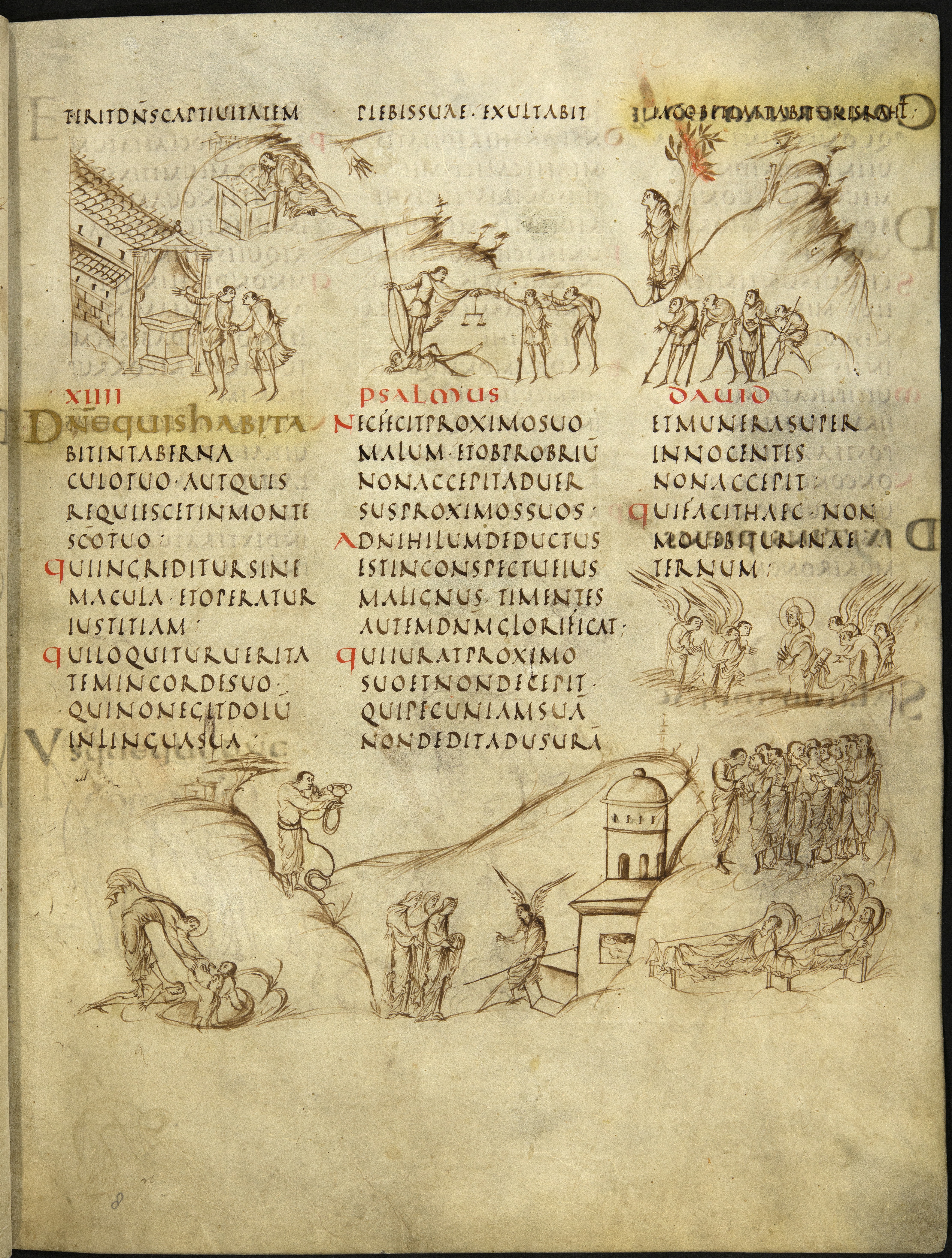
LOOK: Folio 8r (detail) from the Harley Psalter

Produced at Christ Church in Canterbury, England, in the eleventh century, the Harley Psalter is celebrated for its lively and delicate multicolored line drawings executed in green, blue, pale sepia, and red inks, which illustrate individual lines from the Psalms, sometimes interpreting them in light of the New Testament. The manuscript is closely based on the ninth-century Utrecht Psalter from France, with a very similar arrangement and many near-identical images.
Folio 8r illustrates Psalm 16 (Psalm 15 in the Vulgate), even though the text of that psalm appears on the following page. I’ll focus on the three drawings at the bottom left (pictured above).
On the far left, the risen Christ pulls Adam and Eve up out of the pit of hell, trampling Hades (death personified as a crumpled man). To the right, three women go to visit Jesus’s tomb early on Easter morning, only to find it empty, save for the abandoned graveclothes—which we can see through an opening in the lower story.
These two vignettes illustrate Psalm 16:10: “For thou wilt not leave my soul in hell; neither wilt thou suffer thine Holy One to see corruption” (KJV). In the New Testament, both Peter (Acts 2:24–28) and Paul (Acts 13:35) apply this verse to Jesus’s resurrection.
The Hebrew word translated into English as “hell” is Sheol, the realm of the dead. In the Apostles’ Creed, the church proclaims that Jesus “was crucified, died, and was buried; he descended into hell [or ‘to the dead,’ as some translations render it]. On the third day he rose again . . .” As have and will most all humans, Jesus went down into the grave—but God did not leave him there. Nor will he leave his holy ones in that shadowy netherworld of deceased souls. Paul writes that Jesus is the first fruits of the harvest of eternal life (1 Cor. 15:20), his resurrection a foretaste and guarantee of the resurrection of all believers. That’s why the church developed the image of the Harrowing of Hell, or Anastasis, showing Christ triumphantly retrieving our ancestors in the faith from the Pit.
Matthew records that at the moment of Jesus’s death, the earth quaked, opening tombs, “and many bodies of the saints who had fallen asleep were raised. After his resurrection they came out of the tombs and entered the holy city and appeared to many” (Matt. 27:52–53). What a strange phenomenon! That’s the harrowing.
The figure who appears in the Harley Psalter between the Harrowing of Hell and the Holy Women at the Tomb is the psalmist himself. He stands on a hillside holding a cup in his right hand and touching his lips with his left, harking to Psalm 16:4–5: “Their [idolaters’] drink offerings of blood I will not pour out or take their names upon my lips. The LORD is my chosen portion and my cup . . .”
To view all 112 drawings from the Harley Psalter in high resolution, visit https://commons.wikimedia.org/wiki/Category:Harley_Psalter_(11th_c.)_-_BL_Harley_603.
If you want to explore the manuscript’s predecessor, the Utrecht Psalter, the Universiteitsbibliotheek Utrecht (its owning institution) provides a full, annotated digital scan, in which every vignette is linked to the psalm verse it illustrates and accompanied by a description. It’s a wonderful resource! Here’s folio 8r, for example.
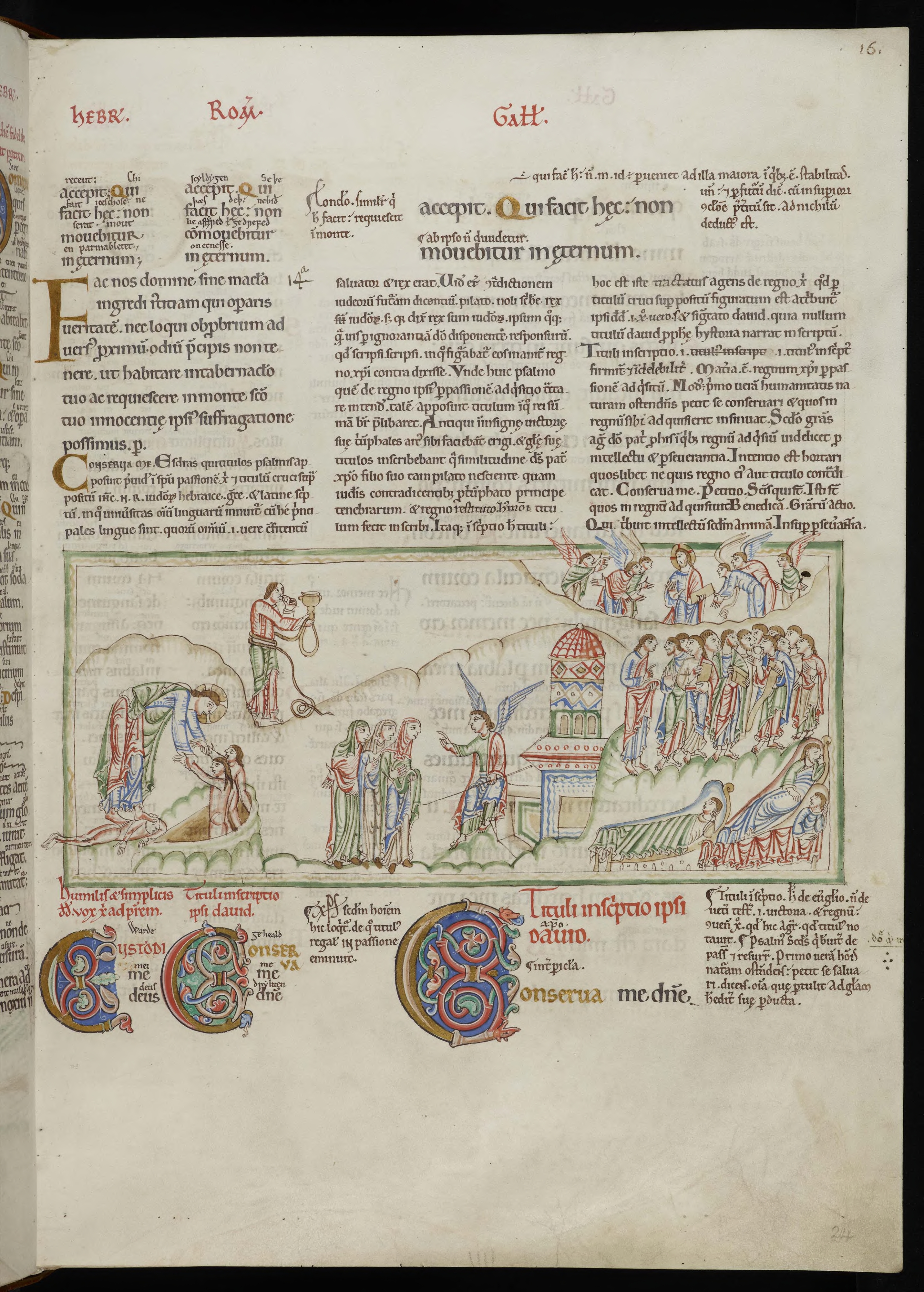
See also the Eadwine Psalter, another copy of the Utrecht Psalter, only slightly later than Harley. Folio 24r corresponds with folio 8r in Utrecht and Harley.
LISTEN: “Rise Up (Lauds)” by Dylan McKeeman, on Good Morning, Happy Easter, vol. 3, by the Morning and Night Collective, 2014
Rise up this morning
Jesus is risen!
Rise up this morning and praise
Rise up this morning
Jesus is risen!
Rise up this morning and praiseHe is risen indeed
He is risen for me
He is risen this blessed day
He is risen indeed
He has set us all free
He’s risen this blessed day
Dylan McKeeman wrote this song while serving as the director of music and arts at Reynolda EPC in Winston-Salem, North Carolina. He is currently the director of modern worship and production at First Presbyterian Church, also in Winston-Salem.
The subtitle “Lauds” (Latin for “praises”) refers to an early-morning canonical hour designated for prayer, corresponding with dawn.
The song opens with the low, bowed tones of an upright bass, and then a violin, banjo, and guitar enter, all improvising around an F2 chord. Vocalist Jess Silk provides an ethereal hum underneath, which, together with the instruments, evokes a mist lifting. After about the first minute, the song modulates up a whole step to G and a bright banjo tune kicks in along with the summons: “Rise up this morning, Jesus is risen!”
McKeeman is on lead vocals, banjo, and guitar.
 Art & Theology