If I, your Lord and Teacher, have washed your feet, you also ought to wash one another’s feet. For I have set you an example, that you also should do as I have done to you. . . .
I give you a new commandment, that you love one another. Just as I have loved you, you also should love one another. By this everyone will know that you are my disciples, if you have love for one another.
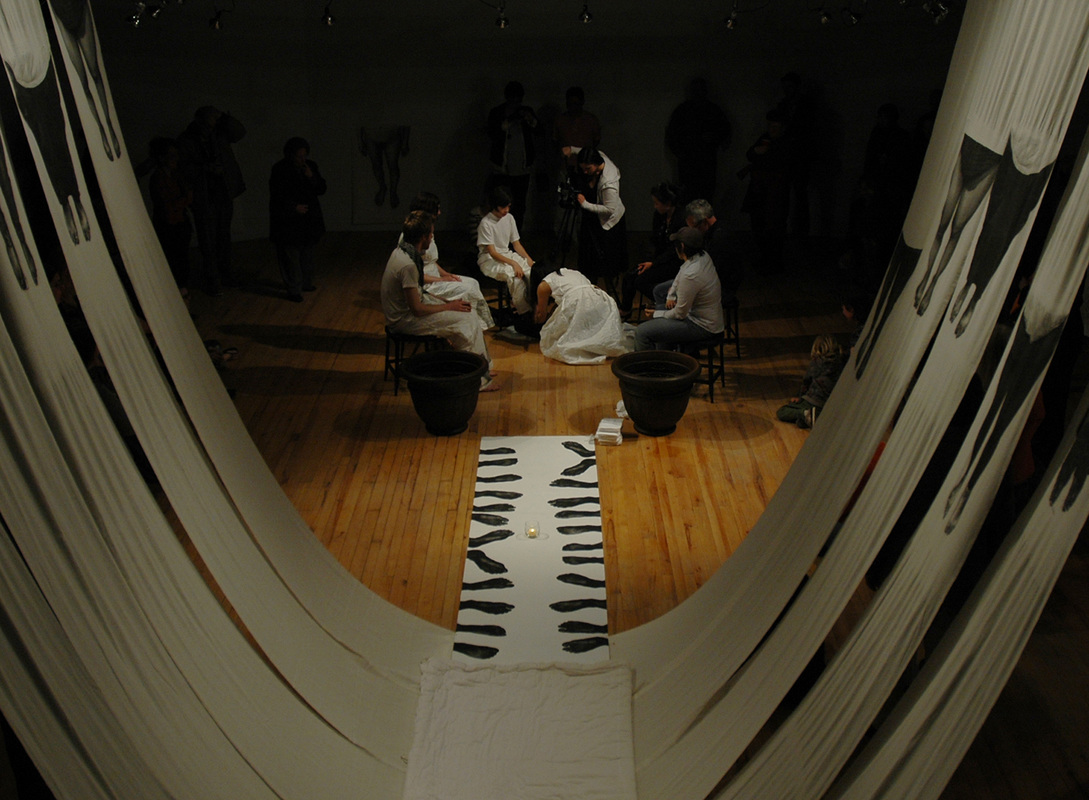
Hyeyoung Shin (Korean American, 1974–), We Are, 2010. Performance, graphite drawings on paper and paper garments, and lithographs on muslin. Big Orbit Gallery, Buffalo, New York.Foot-washing performance by Hyeyoung Shin at the opening of We Are, April 23, 2010, Big Orbit Gallery, Buffalo, New York.
Hyeyoung Shin is a South Korean–born, Kansas City–based artist whose work explores human vulnerability, humility, intimacy, empathy, interpersonal relationships, and belonging.
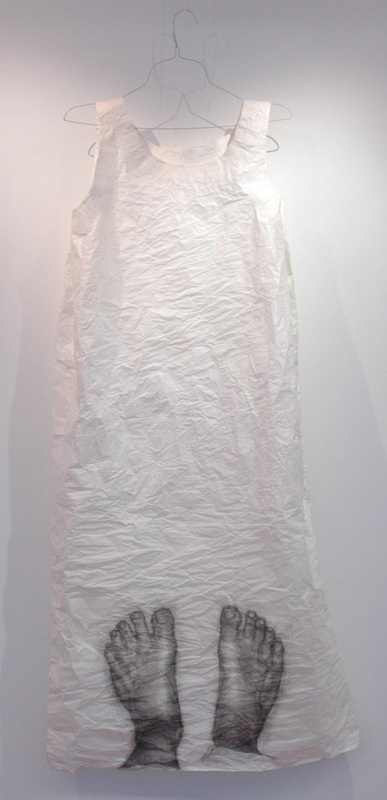
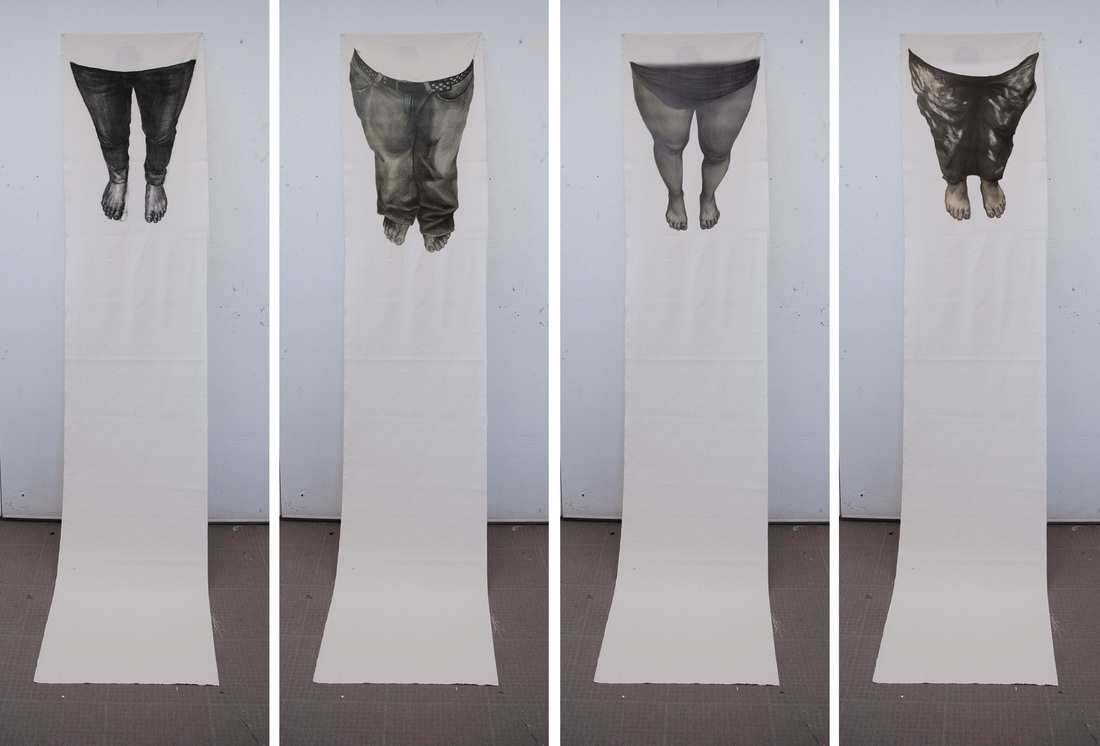
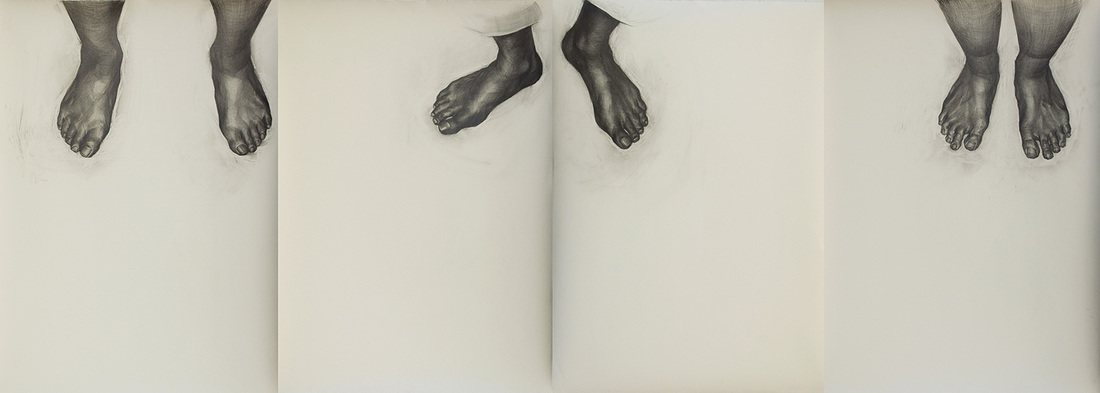
We Are is the name of a solo exhibition of hers from 2010 consisting of life-size drawings and lithographs of human feet and a foot-washing performance. Shin executed thirty-four graphite drawings on paper as well as on paper garments that she custom-made. The structural anchor of the installation was five muslin panels, each ten yards long, suspended from the ceiling and draped like a hammock. On the upper reaches of each were lithographs of two pairs of legs, and in the bed of the hammock lay a mat, a pillow, and a paper dress. Leading up to the hammock was a long sheet of paper with twelve sets of footprints arranged in two rows, evoking Jesus’s twelve disciples.
Graphite drawing on handmade paper garment with hanji, 2009Lithographs on muslin, approx. 288 × 30 in., 2009–10Graphite drawings on paper, 42 × 64 in., 2009
Shin enacted the foot washings herself. She said that “through the experiences, I began to learn again how to practice love akin to holding my mother’s feet” as she lay dying of a terminal illness. The physical proximity and tender touch at that gallery event opened up channels of empathy between the artist and participants.
LISTEN: “Reverie: This is my will,” arr. Anne-Marie O’Farrell, on Easter in Ireland: Music for the Paschal Season (2020)
Rev. Dr. Anne-Marie O’Farrell, a harpist, composer, and Church of Ireland minister from Dublin, wrote this reverie on the Maundy Thursday hymn “This Is My Will” for solo lever harp in 2019. (A reverie is an instrumental piece suggesting a dreamy or musing state.) The Jesuit priest James Quinn (1918–2010) of Scotland wrote the hymn text, reproduced below, in 1969, a paraphrase of John 15:11–17, pairing it with a traditional Irish suantraí (lullaby) melody. It is that melody—which in Ireland has come to be associated with Holy Week, thanks to Quinn—that O’Farrell has arranged here. Purchase sheet music for O’Farrell’s harp reverie, or an arrangement for SATB voices and solo.
This is my will, my one command, that love should dwell among you all. This is my will, that you should love as I have shown that I love you.
No greater love a man can have than that he die to save his friends. You are my friends if you obey all I command that you should do.
I call you now no longer slaves; no slave knows all his master does. I call you friends, for all I hear my Father say you hear from me.
You chose not me, but I chose you, that you should go and bear much fruit. I called you out that you in me should bear much fruit that will abide.
All that you ask my Father dear for my name’s sake you shall receive. This is my will, my one command, that love should dwell in each, in all.
Jesus speaks this discourse after washing his disciples’ feet the day before his death. The name traditionally accorded to Thursday of Holy Week—Maundy Thursday—comes from the Latin word mandatum, “command,” referencing this passage.
AVANT-GARDE CLASSICAL: Klang—Die 24 Stunden des Tages (Sound—The 24 Hours of the Day) is a cycle of chamber-music compositions by the avant-garde German composer Karlheinz Stockhausen, which he worked on from 2004 until his death in 2007. (The intention was for there to be twenty-four pieces, but the cycle was unfinished at twenty-one.) The first two pieces in the cycle, on the themes of Ascension and Pentecost, were commissioned for the interdisciplinary Pause festival at Milan Cathedral by artache, a Milan-based nonprofit committed to showcasing contemporary artworks in public places of worship. The artistic director of artache at the time was Don Luigi Garbini, a priest at the church of San Marco in Milan and cofounding director of the artache initiative the Laboratorio di Musica Contemporanea al Servizio della Liturgia (Laboratory for Contemporary Music in the Service of the Liturgy).
>> No. 81: “KLANG, 1st Hour: Himmelfahrt (Ascension)” by Karlheinz Stockhausen, for organ or synthesizer, soprano, and tenor, 2004–5: This thirty-seven-minute piece premiered at Milan Cathedral on Ascension Day, May 5, 2005. The two hands of the organist almost always play in different, independent tempos of a chromatic time scale, while the soloists sing words or phrases associated with “ascension,” particularly the Ascension of Christ. According to the composer, “Asking a performer to break the barrier of time by playing simultaneously in different tempi is like submitting a man to physical disruption, allowing him to go in spirit form towards another world” (source). For musical analysis by Ed Chang, see here. The performance below is from the North American premiere at the Schwartz Center for the Performing Arts at Emory University in Atlanta on October 11, 2005, featuring organist Randall Harlow, soprano Teresa Hopkin, and tenor John Bigham.
>> No. 82: “KLANG, 2nd Hour: Freude (Joy)” by Karlheinz Stockhausen, for two harps and voice, 2005: This forty-minute piece premiered at Milan Cathedral on July 6, 2006. The text is taken from the medieval Pentecost hymn “Veni Creator Spiritus” [previously], which the harpists sing in spurts, “in alternation or sometimes together . . . , while plucking, picking, caressing, stroking, pinching, rubbing, striping, striking, pinking, jubilating,” as Stockhausen put it. In program notes dated February 15, 2006, he writes, “There is something unique about the adventure to combine two harps which are normally tuned in diatonic scales and to synthesise them into one large chromatic harp. . . . Pentecost unites what has been separated. My work FREUDE too.” For musical analysis by Ed Chang, see here. The performance below is from the Stockhausen Memorial Concert in Kürten, Germany, on December 16, 2017, featuring Marianne Smit and Miriam Overlach.
NEW DOCTORAL COHORT:The Sacred Art of Reading: The Eugene Peterson Center for Christian Imagination at Western Theological Seminary in Holland, Michigan, is offering a new, mostly remote, three-year DMin track called “The Sacred Art of Reading,” which begins this October, taught by Professor Chris E.W. Green. The program is centered on the reading of scripture—the Old Testament narrative books (Year 1), Old Testament poetry and wisdom literature (Year 2), and the Gospels and Apocalypse (Year 3)—alongside a number of additional primary texts, whose titles you can view on the website; authors include, among others, Avivah Gottlieb Zornberg, Amy-Jill Levine, Daniel Berrigan, Robert Alter, Shusaku Endo, and of course Eugene Peterson! Participants get together in person for one week each semester (times six semesters) and are responsible for, in addition to the $17,280 tuition, travel and lodging costs. The application deadline is June 30, 2023. Applicants must hold an MDiv degree or its educational equivalent and have at least three years of ministry experience since completing the MDiv. Here’s a condensed program description:
The Sacred Art of Reading cohort will be dedicated to collaboration in “the forbidding discipline of spiritual reading,” confident that such an undertaking cultivates the loving attentiveness, prophetic discernment, and childlike openness to surprise that characterize what St. Paul calls the faith that works by love. . . . The cohort is designed to cultivate an alternative awareness, one shaped by the slow, painstaking work of collaborative interpretation. And to that end, the heart of the program is the reading of the Christian Scriptures. The aim will be both philosophical and devotional, critical and celebratory, mystical and pastoral. No one reading method will be stipulated, but students will be encouraged to find ways to honor the traditions of the communities in which they learned to argue, to muse, and to pray.
Besides Scripture, the cohort will engage a wide range of texts including poems, memoirs, essays, treatises, sermons, and stories old and new, familiar and strange, sacred and “worldly,” in part and in whole, not so much in order to “plunder the Egyptians” as to bear glad witness to the wonder that God is never left without a witness because all truth, truly received, trues.
This approach really wets my whistle! I don’t have a master’s degree, so I’m out, but I feel so energized by the reading list and wanted to share the opportunity with you all, as the program seems doable for those with full-time jobs. A virtual interest meeting is being held on June 1. Click here to view other doctor of ministry cohorts at Western.
+++
FUNDRAISING CAMPAIGN: The Soil and The Seed Project: I’ve mentioned this project several times on the blog before, as I’m a big fan. A ministry of VMMissions (Virginia Mennonite Missions), The Soil and The Seed Project releases original music, art, and liturgies throughout the Christian year, especially suitable for families with littles. They launched in December 2021 and since then have put out seven collections, with their latest and largest yet—Vol. 7 // Ordinary Time—dropping this week. (Request a free download through their website, or stream the music through your favorite service.) Coinciding with this release, they have also launched a campaign to raise $27,000 by June 18 to cover the costs of recording, mixing, pressing, printing, shipping, etc., for future collections. Learn more in the five-minute video below, which features the new songs “In the Little Moments,” “Teach Me, O LORD,” and “Because of Jesus.”
The Soil and The Seed Project offers all their content for free, including physical CDs (as stock permits), and are committed to keeping it that way—which is why they need the support of donors. Donate to their campaign, and you can opt to receive stickers, notecards, and/or a T-shirt as a thank-you. Also note: they’ll be giving a concert at 6:30 p.m. on Saturday, June 3, at the Brethren & Mennonite Heritage Center in Harrisonburg, Virginia.
+++
SONG: “Holy Spirit” by Victoria Williams: “Part front-porch soothsayer, part quirky bayou princess, and part eternal child, Victoria Williams writes songs of indescribable originality that embrace the earthly and the divine with wit, charm, and understated vision,” writes Josh Kun for Bomb magazine. The song “Holy Spirit” [read lyrics] is from her 1990 album Swing the Statue!. It opens with the familiar invocation from a Gullah spiritual: “Kum ba yah, my Lord” (which translates to “Come by here”). She seeks God’s presence and then, given a renewed sensitivity to it, identifies and celebrates its flow throughout her daily goings. She feels the Holy Spirit while building a raft with friends on the shores of Louisiana’s Lake Bistineau and riding a New York City subway beside a whistling stranger, as well as in graveyards and at bars and out under open night skies. The Spirit flows through all of life. I can’t find the song online anywhere other than in this YouTube fan video, which sets it to photos. [HT: Jonathan Evens]
+++
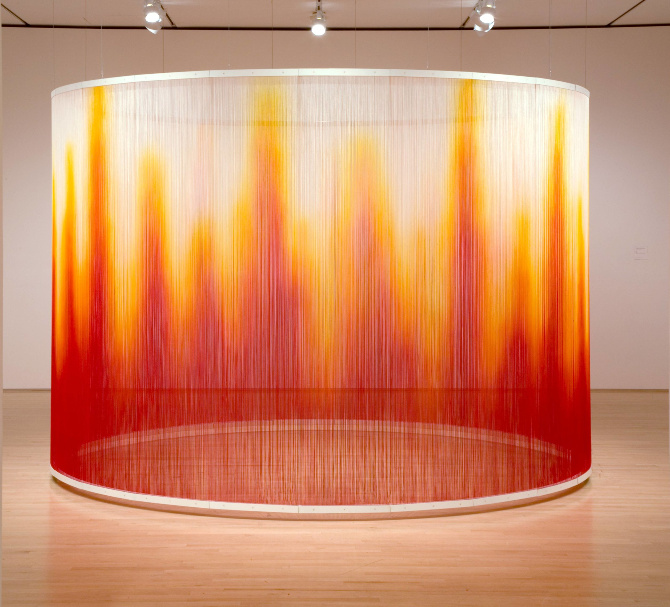
ARTWORK: Fire by Teresita Fernández: In the collection of SFMOMA, this ring of warm-colored silk yarn conveys something of the flickering quality of fire. At the link is a short video interview with the artist about the piece. Fernández says she is interested in the sensorial aspects of viewer engagement with art.
Teresita Fernández (American, 1968–), Fire, 2005. Silk yarn, steel armature, and epoxy, 243.8 × 365.8 cm. San Francisco Museum of Modern Art, California.
Fire was a highlight of the 2013 exhibition Beyond Belief: 100 Years of the Spiritual in Modern Art, jointly organized by SFMOMA and the Contemporary Jewish Museum. Here’s a video of the Lick Wilmerding High School Vocal Ensemble singing “Famine Song” by VIDA around the installation that year, a song inspired by the basket weavers of Sudan, who persist in their craft during times of hardship, their hands working natural fibers into beautiful, colorful vessels. “Weave, my mother; weave, my child; weave your baskets of rushes wild . . .”
P. Solomon Raj (Indian, 1921–), Pentecost, 1980s. Batik.
. . . Then, like a wildfire, the Holy Spirit spread through their ranks, and they started speaking in a number of different languages as the Spirit prompted them. . . .
—Acts 2:3–4, The Message
+++
MUSIC: “The Elements: Fire” by Hiromi Uehara and Edmar Castaneda, on Live in Montreal (2017)
“Fire” is a collaborative composition and performance by Japanese jazz pianist Hiromi and Colombian jazz harpist Edmar Castaneda. Their virtuosity is amazing! And they have such a fun synergy on stage together.
“I was born to play the harp,” says Castaneda. “It is a gift from God, and like every gift from God, it has a purpose. The purpose of my music is to worship Him and bring his presence and unconditional love to people.”
Thanks to Global Christian Worship for introducing me to these music artists and to this piece in particular.
+++
Dr. P. Solomon Raj is a Lutheran theologian and visual artist from Andhra Pradesh, India. He works mainly in batik (a wax-resist method of dyeing cloth) and woodcut. He is ninety-eight years old.
This post belongs to the weekly series Artful Devotion. If you can’t view the music player in your email or RSS reader, try opening the post in your browser.
To view all the Revised Common Lectionary scripture readings for Pentecost, cycle C, click here.



 Art & Theology