This month I traveled to parts of Germany and Belgium to experience some of the art of those countries, with a focus on medieval religious art. In Brussels, besides exploring the famous Oldmasters Museum (part of the Royal Museums of Fine Arts of Belgium), I visited the lesser-known Art and History Museum, whose collection includes not just western European art from prehistoric times through the nineteenth century, but also art from Asia (China, Korea, India, Pakistan, Afghanistan, Sri Lanka, Tibet, Nepal, Turkey, Iran, Cambodia, Thailand, Burma), Oceania, the pre-Columbian Americas, and ancient Egypt, Greece, and Rome.
I spent the most time with the medieval European art on the ground floor—wooden statuettes, ivory and alabaster carvings, stained glass, paintings, metalworks, and tapestries. With the Google Translate app open, I hovered my phone over the Dutch and French descriptive labels to read them in English.
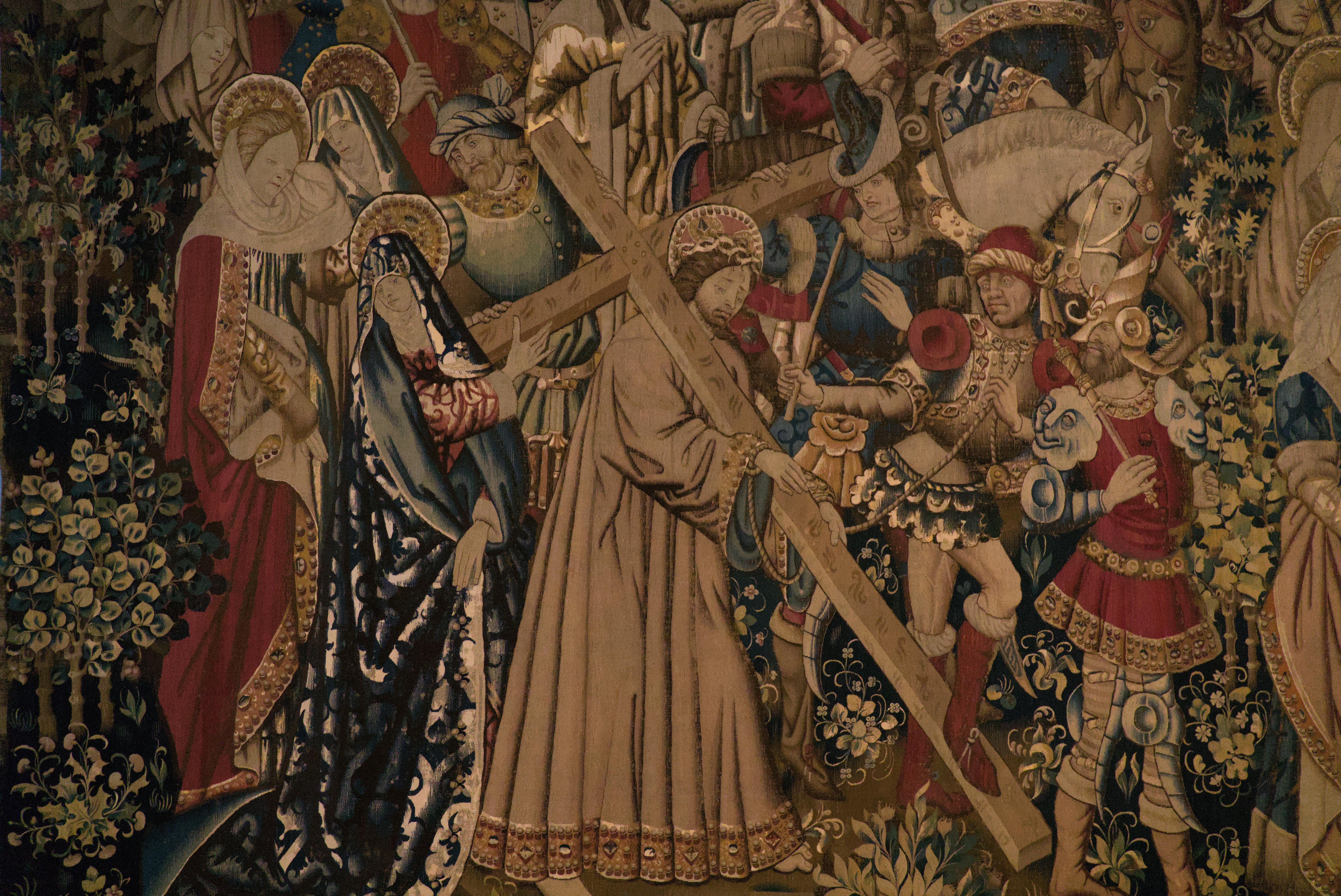
My favorite tapestry I saw, from fifteenth-century Tournai, portrays three scenes from the passion of Christ: Christ Carrying the Cross, the Crucifixion, and the Resurrection. The museum gallery it’s displayed in also houses a large medieval loom, which is what’s protruding at the bottom right corner of the following photo.
Scenes from the Passion, Tournai, ca. 1445–55. Tapestry of wool and silk, 424 × 911 cm. Art and History Museum, Brussels, Belgium, Inv. 3644. All photos by Victoria Emily Jones.
Tapestries made in the Flemish city of Tournai were among the most sought after in the fifteenth century. These large-scale wall hangings were bought by royalty, nobles, and high-ranking clergy to decorate their palaces. This one, nearly thirty feet long, is the second of a two-part hanging whose first part (portraying Christ’s Entry into Jerusalem, the Last Supper, and the Arrest of Christ) is in the collection of the Vatican.
Below are some detail shots.
First, Christ carries his cross. A soldier pulls him forward by a rope tied to his wrists, while tauntingly standing on the vertical wood beam and hitting him with a baton. On a less serious note, those are some spiffy face-shaped shoulder scales on the right.
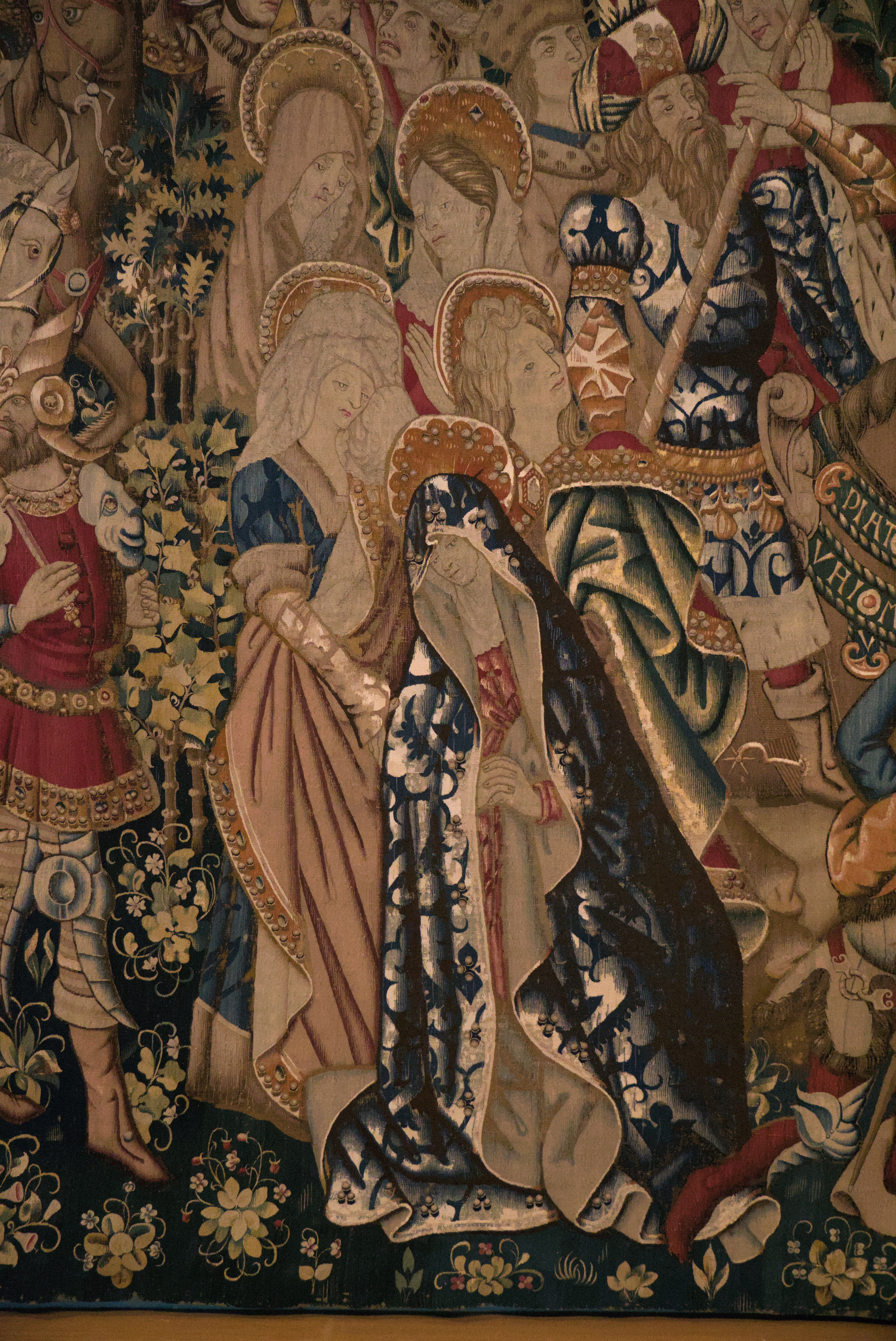
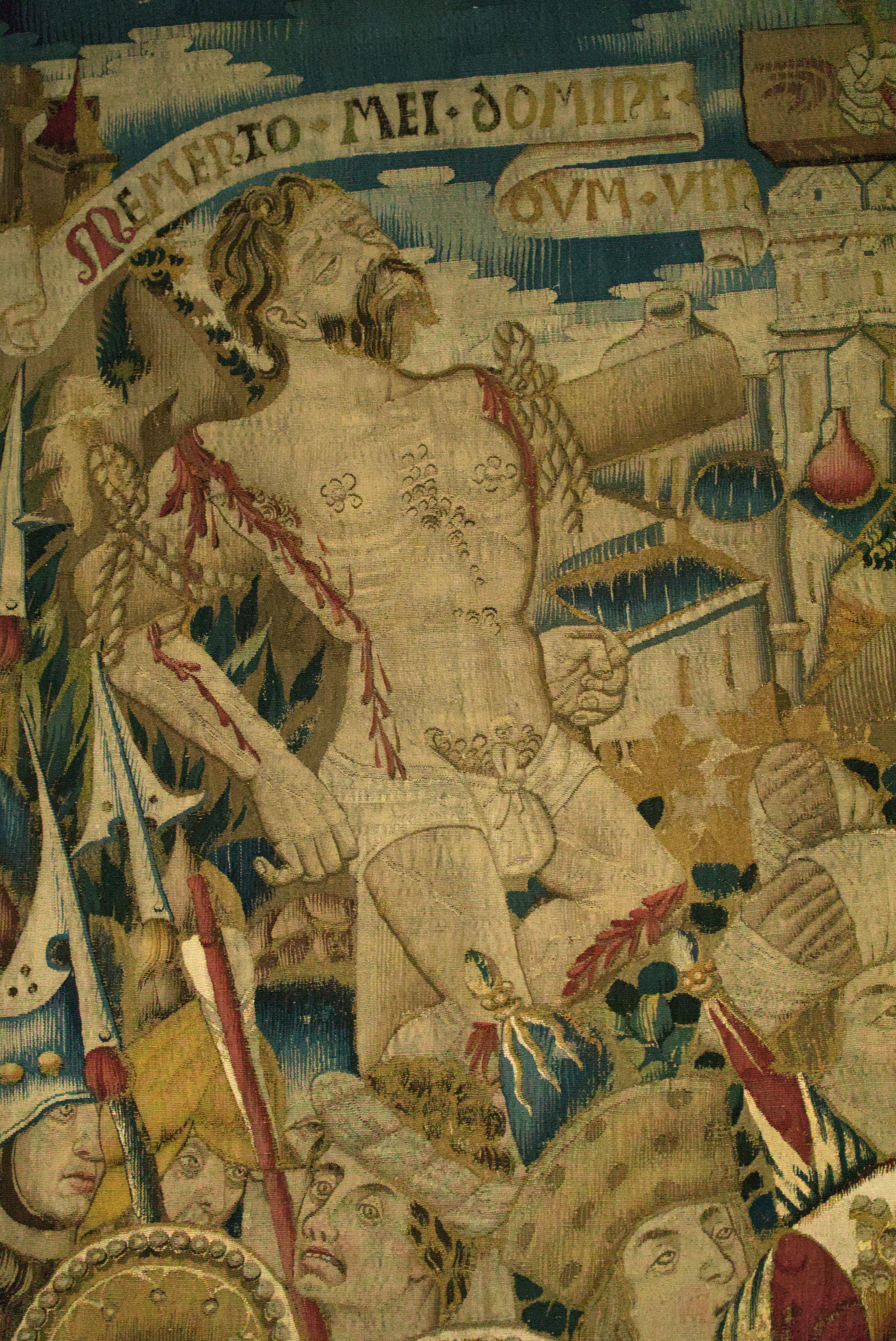
Christ crucified:
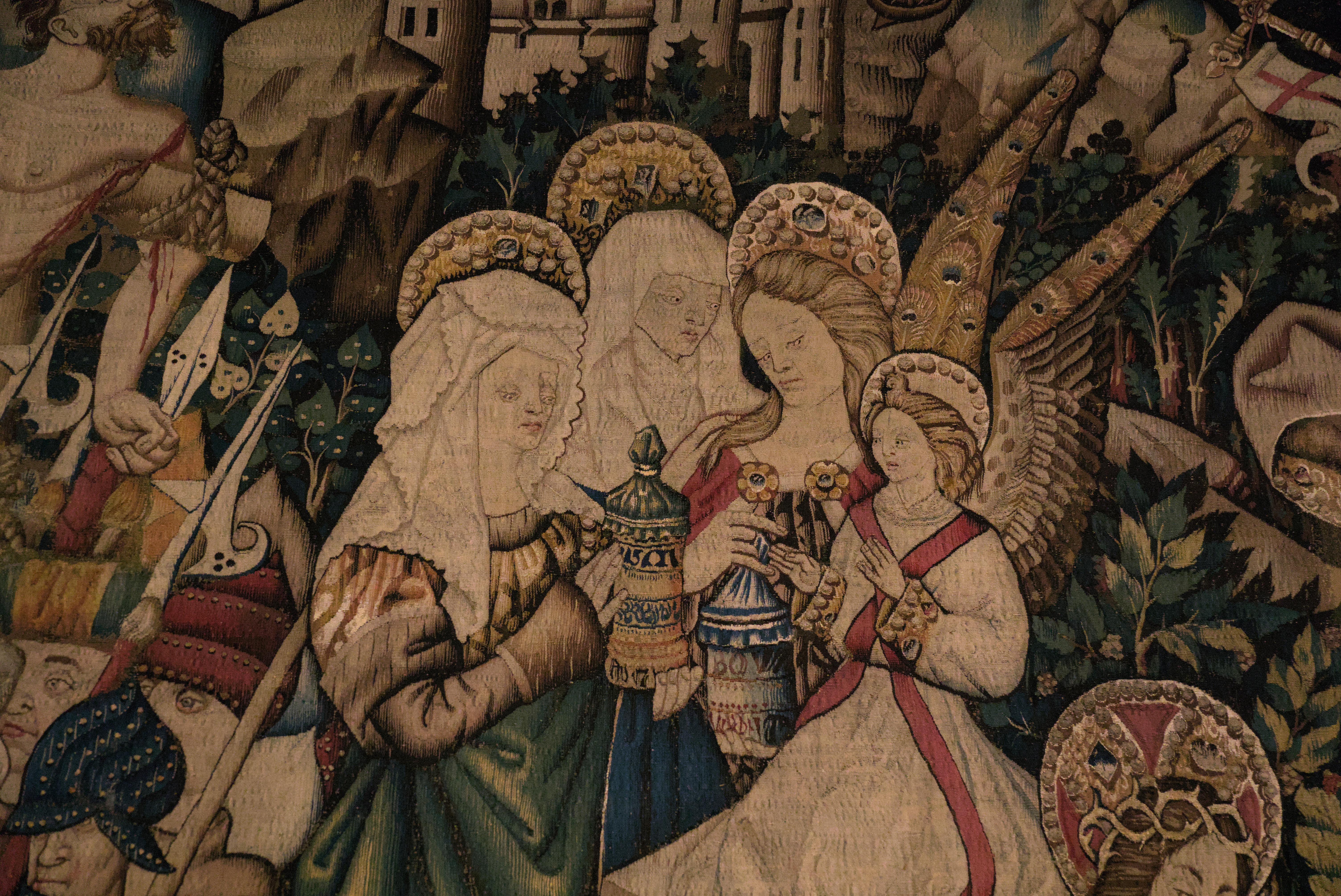
A group of four women mourn—the Virgin Mary up front in the blue mantle, backed by three other Marys—alongside a curly-haired apostle John in green.
On Christ’s right (the viewer’s left), the penitent thief, with his last breaths, says, Memento mei, Domine, dum ven[eris in regnum tuum] (Remember me, Lord, when you come into your kingdom) (Luke 23:42).
The pointing man below the cross to Christ’s left, our right, is the Roman centurion (officer in command of one hundred soldiers) who, when Jesus died, proclaimed, Vere filius Dei erat iste (Truly this man was the Son of God!) (Matt. 27:54; Mark 15:39; cf. Luke 23:47).
On the other side of the cross, a Roman spearman, to whom tradition gives the name Longinus, points to his eyes. That’s because according to a medieval legend, Longinus was blind, but when he pierced Jesus’s side to verify his death, some of the blood from the open wound fell into Longinus’s eyes and restored his sight, after which he confessed allegiance to Christ.
Despite these three stories—two biblical, one apocryphal—of Christian conversion at the cross, Christ’s death did not move all the hearts of those present. At the base of the cross, two men fight with knives over Christ’s garment, their greed and aggression a foil to Christ’s selflessness and gentleness, and an example of the sin he came to redeem us from.
And again, pacifist though I am, I can’t help but remark on the fine-looking armor in the crowd:
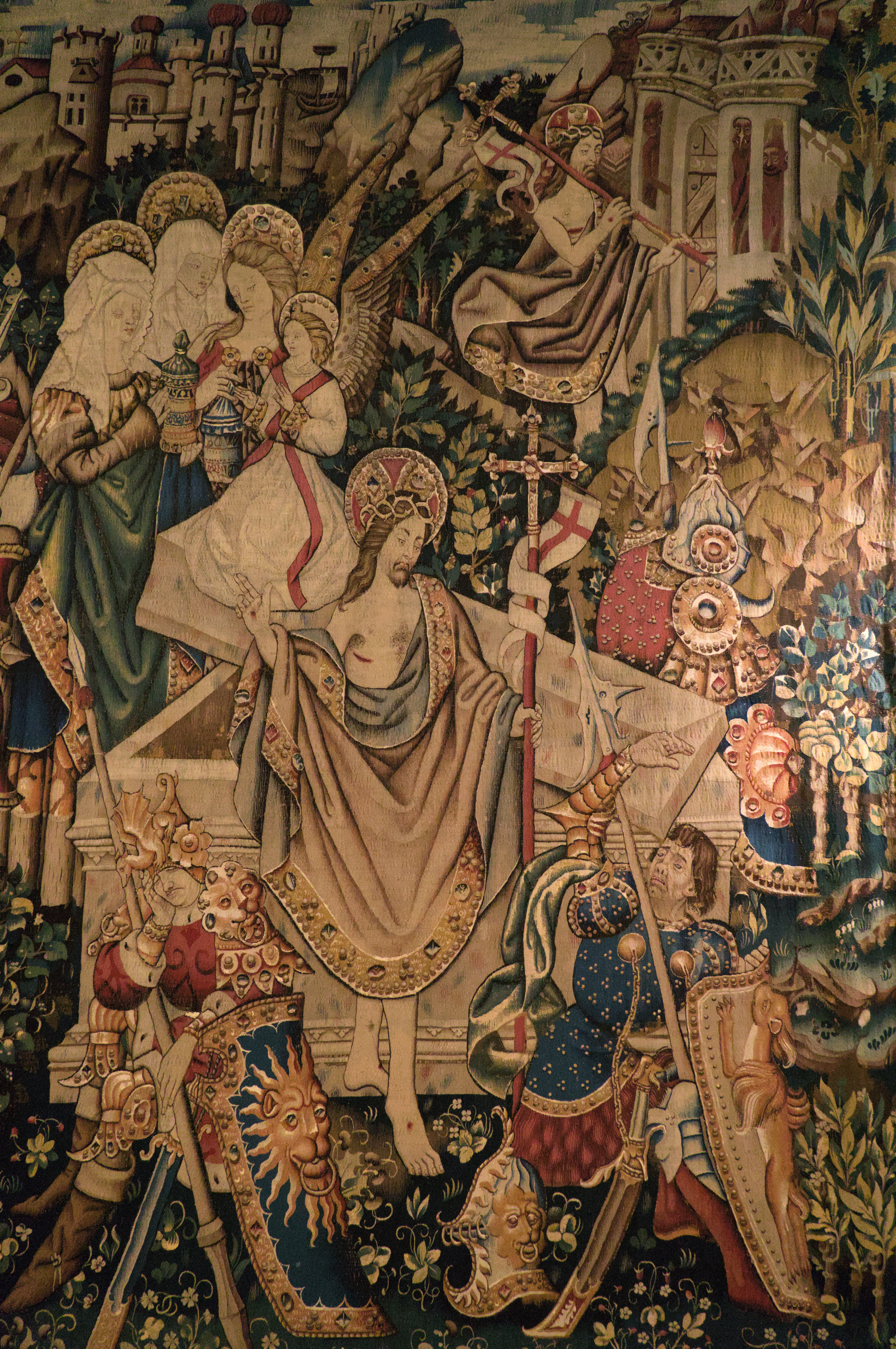
The right-most third of the tapestry portrays vignettes of the Resurrection.
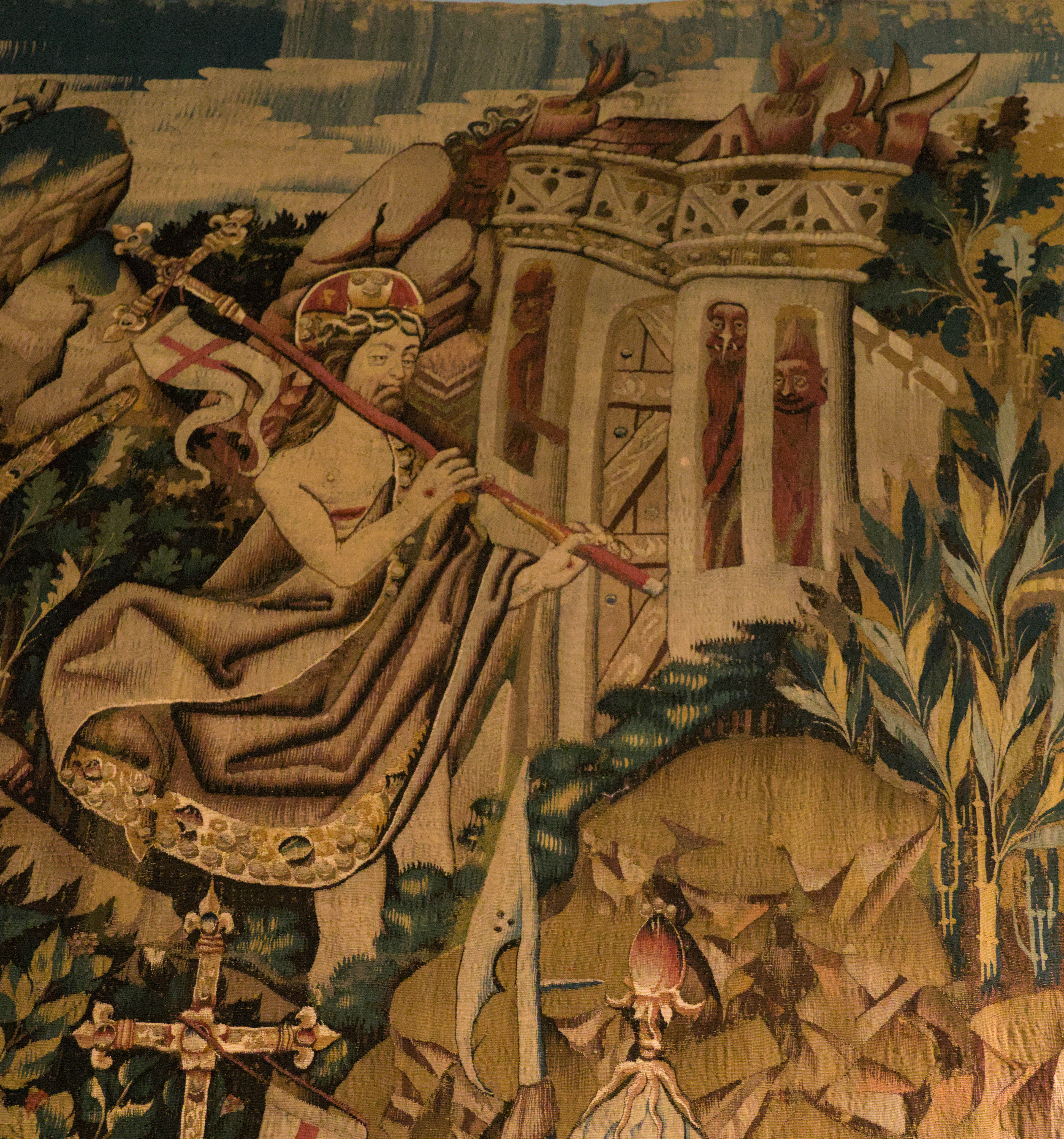
At the bottom, Christ emerges triumphant from his tomb, holding a banner in one hand and bestowing blessing with the other.
In the middle ground, the three Marys arrive at the empty tomb, ointments in hand, where they meet an angel who informs them that Christ has risen from the dead. Mary Magdalene is the one with her hair uncovered.
The risen Christ appears again at the top right, harrowing hell, a realm that is represented as a turreted fortress from whose windows fiery red demons glower and smirk. Christ has come to break down the doors and release the Old Testament saints being held captive—that is, those who died trusting in Yahweh and who were awaiting Christ’s redemption in the netherworld.
Let’s zoom in closer, shall we?
This is just one of the many artistic treasures, woven and otherwise, at Brussels’ Art and History Museum. I highly recommend a visit! I easily spent several hours there.
Based at the Faculty of Classics at the University of Oxford, the Manar al-Athar (“Guide to Archaeology”) digital archive provides high-resolution photographs of archaeological sites, buildings, and art from the Levant, North Africa, the Caucasus, and the Balkans, covering the time of Alexander the Great (ca. 300 BCE) through the Byzantine and early Islamic periods, with special emphasis on late antiquity. All the images are freely downloadable, made available for teaching, research, and academic publication under a Creative Commons Attribution-NonCommercial-ShareAlike 2.0 UK (CC BY-NC-SA 2.0) license.
Manar al-Athar was established in 2012 by Dr. Judith McKenzie (1957–2019) and since 2020 has been directed by Dr. Ine Jacobs. It is in continuous development. The photos are cataloged by geographical region and are labeled in both English and Arabic. They picture a range of historical structures—some intact, others in ruins; both interiors and exteriors, where applicable—including mausoleums, churches, mosques, khanqahs (Sufi lodges), hammams (public bathhouses), palace complexes, madrasas (colleges for Islamic instruction), forums, fountains, cisterns, aqueducts, civic buildings, theaters, markets, fortifications, and hostels.
Of primary interest to me is the Christian art from churches and tombs, from countries such as Egypt, Syria, Turkey, Armenia, Georgia, and Serbia, and Jewish art that pictures stories from the Hebrew Bible.
Unfortunately, the subjects of the artworks aren’t labeled and there’s no commentary or transcription/translation of inscriptions, nor are the buildings or artworks dated. Inevitably, many of the frescoes and mosaics have degraded with age, sometimes making the iconography difficult to read. There’s also no way to filter by religion; Christianity accounts for only a portion of the images, with others coming from Jewish, Islamic, or pagan traditions, and a number are from nonreligious contexts. I’d love to see a more robust tagging system and advanced searchability functions as the archive continues to evolve.
The archive is by no means comprehensive, but I hope it will encourage further scholarship and attract more digital image donations.
Below is a sampling of the hundreds of images you can find on the Manar al-Athar website.
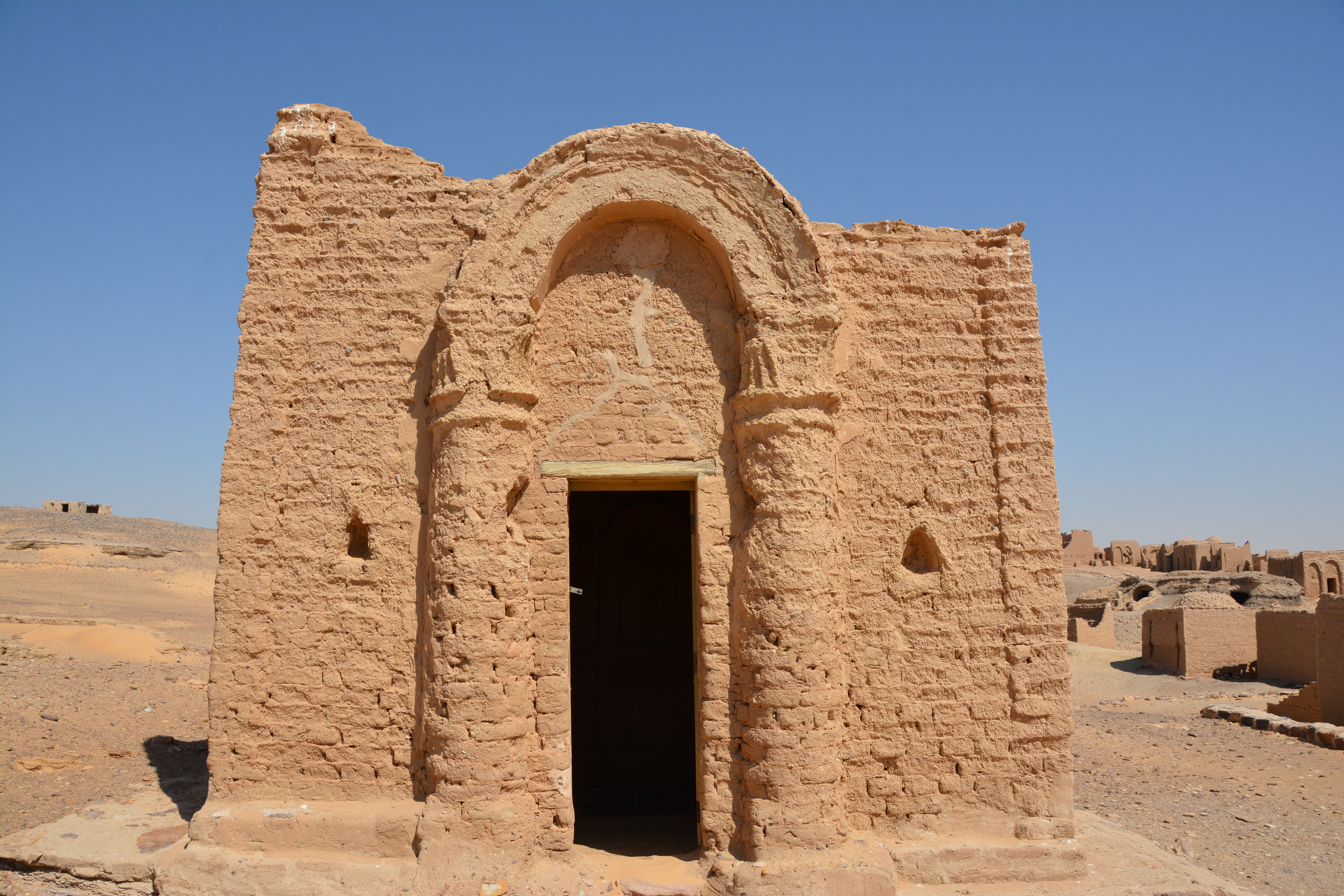
One of the earliest surviving and best-preserved Christian cemeteries in the world, used by Christians from the third to eighth centuries, is Bagawat Necropolis in the Kharga Oasis in Egypt’s Western Desert. The Chapel of Peace is one of 263 mud-brick funerary chapels in the cemetery, celebrated for the painting of biblical, early Christian, and allegorical figures inside its dome.
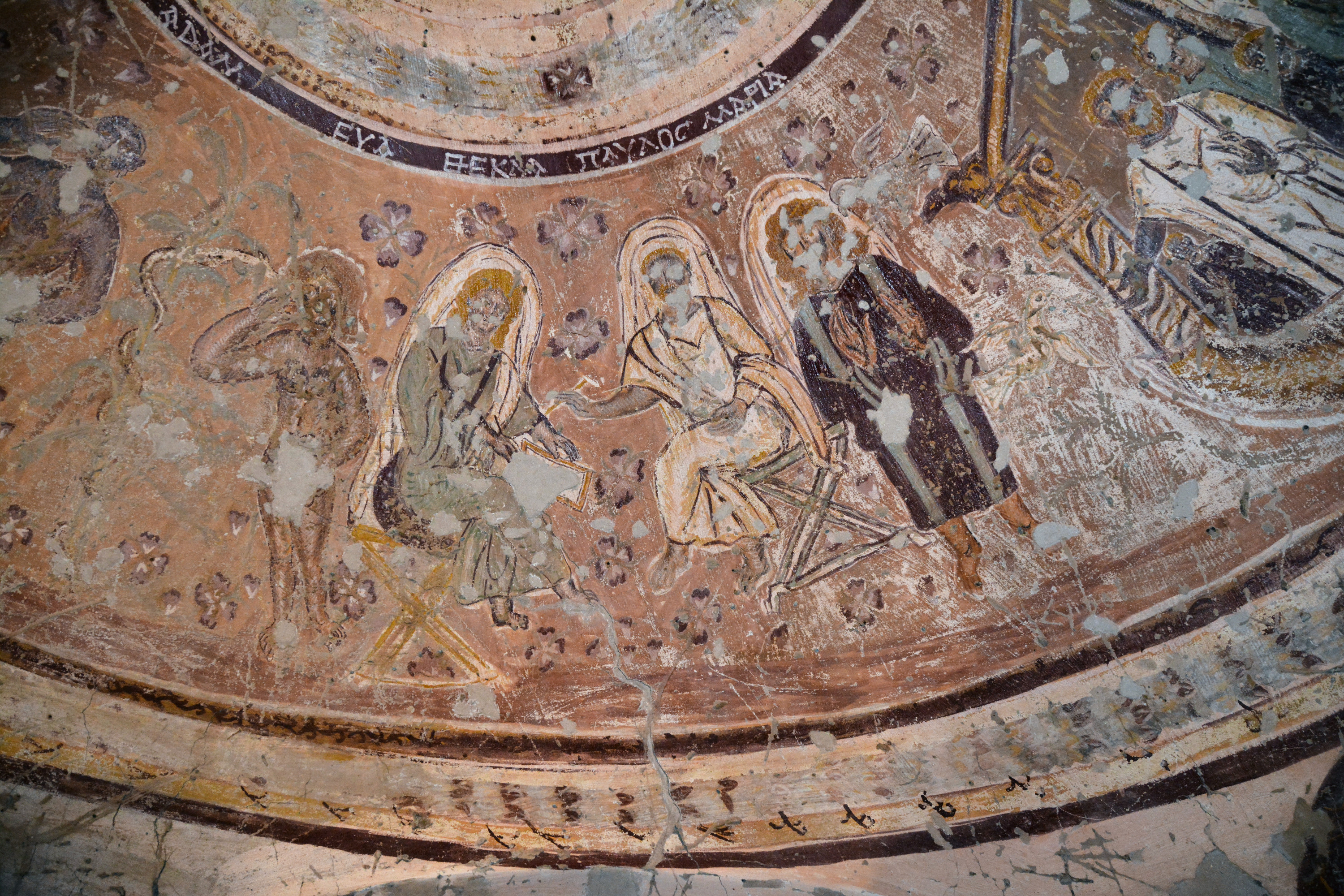
The Chapel of Peace, a monumental Christian tomb at Bagawat Necropolis, Kharga Oasis, Egypt, built 5th or 6th century. Photo: Mohamed Kenawi / Manar al-Athar.Dome fresco detail from the Chapel of Peace at Bagawat Necropolis in Kharga Oasis, Egypt, 5th or 6th century. Photo: Mohamed Kenawi / Manar al-Athar.
The detail pictured above shows the female saint Thecla (Θέκλα), a first-century Christian preacher and martyr, learning from the apostle Paul (Παῦλος), as described in the ancient apocryphal Acts of Paul and Thecla. They both sit on stools, Thecla holding open a book on her lap, pen in hand, while Paul points out a particular text.
In addition to Paul and Thecla, the dome fresco also depicts, clockwise from that pair: Adam and Eve; Abraham about to sacrifice his son Isaac, with Sarah stretching out her hand (it’s unclear whether this gesture signifies her surrender to God’s will or an attempt to stop her husband’s act); Peace, holding a scepter and an ankh; Daniel in the Lions’ Den; Justice, holding a cornucopia and balance scales; Prayer; Jacob; Noah’s Ark; and the Virgin Annunciate, the New Eve, who heard the word of God and obeyed it and thus brought forth life, unlike her ancestor, who listened to the lies of the Evil One and brought forth death (the snake and dove at the women’s respective ears emphasize this contrast). View a facsimile of the full dome here.
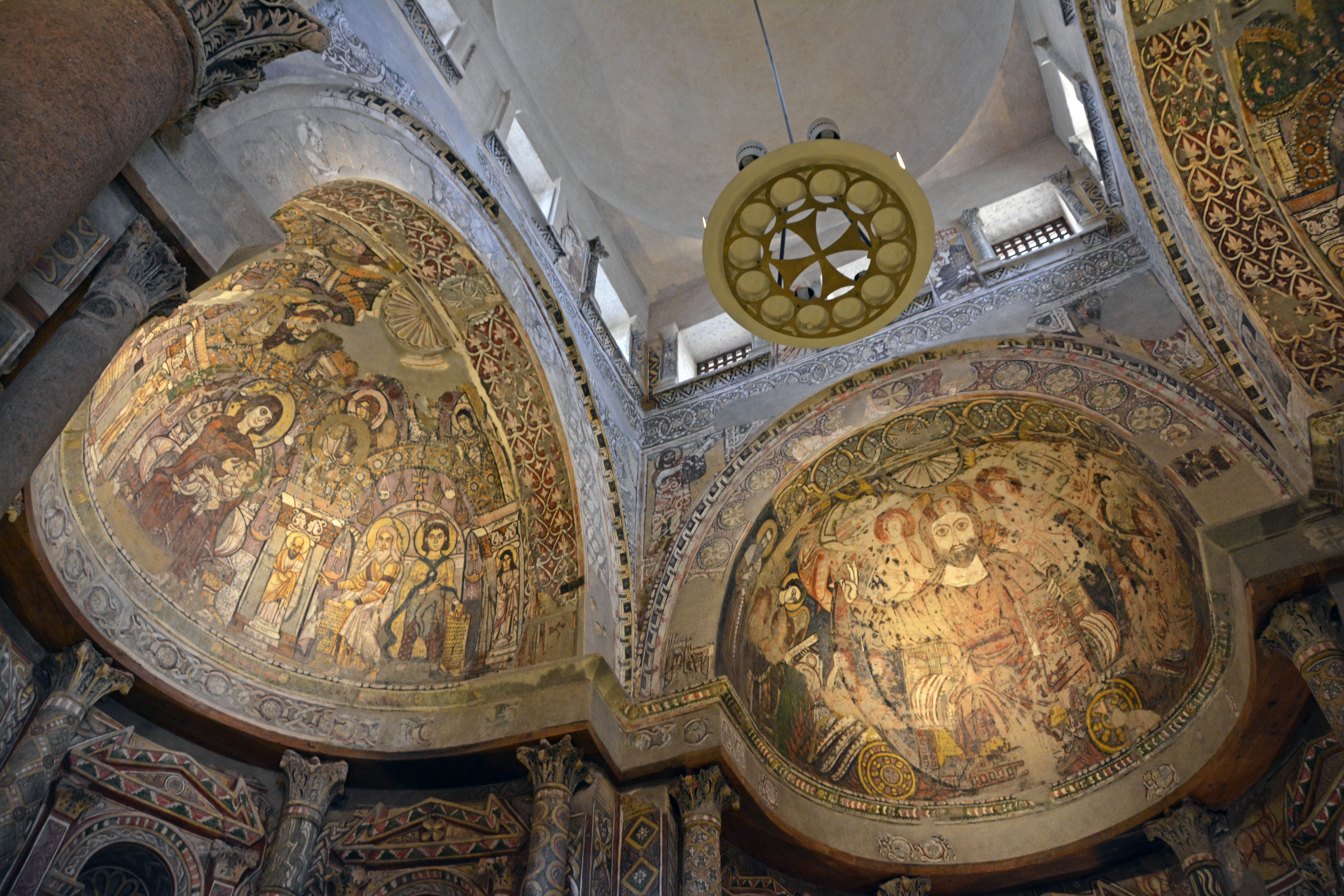
Also in the Egyptian folder are photos of one of Byzantine Egypt’s most glorious encaustic-painted sanctuaries, that of the Red Monastery Church, a triconch (three-apse) basilica that’s part of the (Coptic Orthodox) Monastery of Apa Bishuy near Sohag.
North apse (Virgin Galaktotrophousa, aka the Nursing Madonna) and east apse (Christ Pantocrator), painted 6th–7th or 8th century, Red Monastery Church, near Sohag, Egypt. Photo: Mohamed Kenawi / Manar al-Athar.
Here’s a video that presents a 3D reconstruction and fly-through of the basilica:
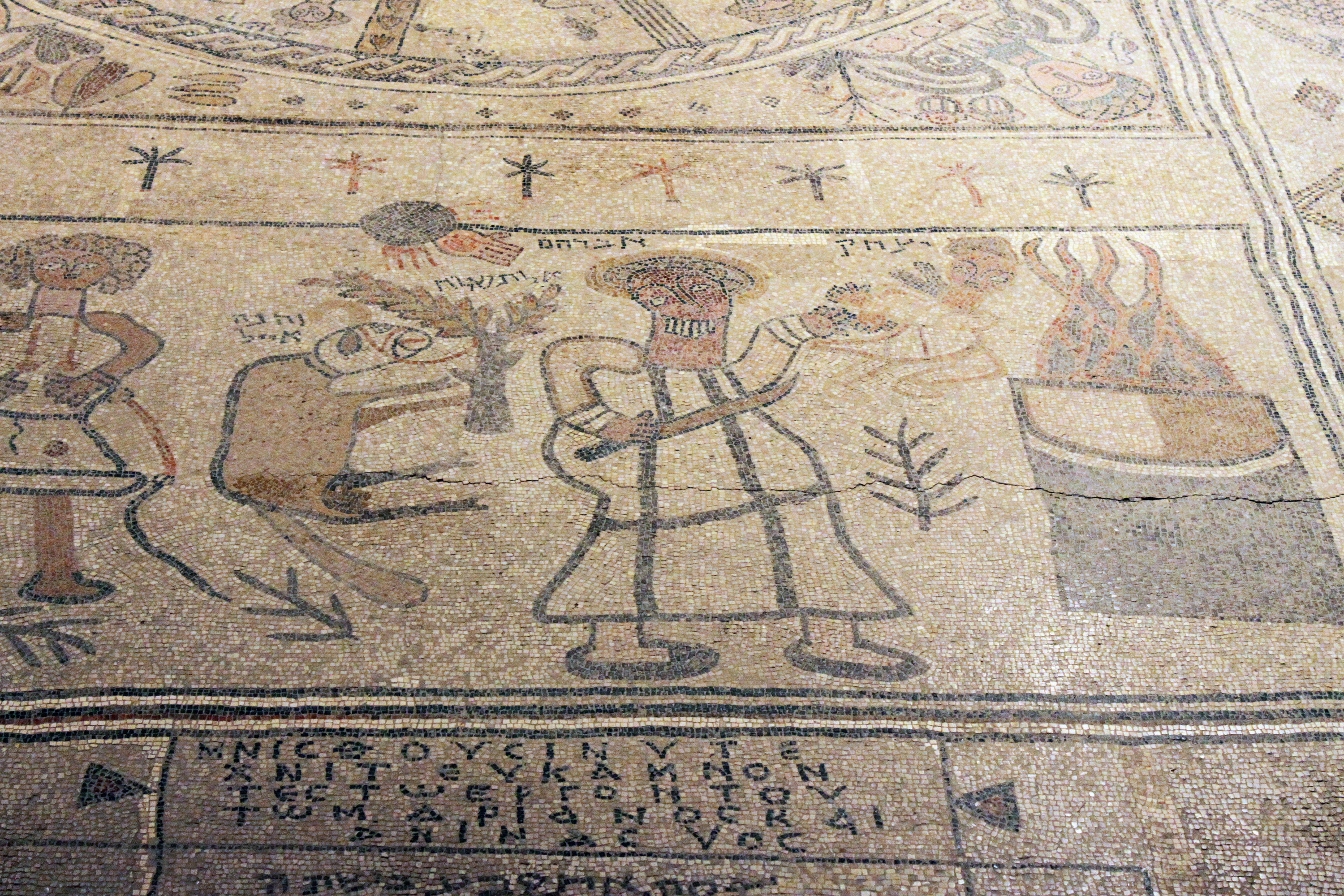
Moving northeast into Israel, we come to the sixth-century Bet Alpha (sometimes rendered as Beit Alfa) Synagogue, located in the Beit She’an Valley. The excavation of Jewish sacred sites like this one reveal that, contrary to what is popularly alleged, Judaism is not a strictly aniconic religion. Many Jewish communities have understood the prohibition against graven images in Exodus 20:3–6 and Leviticus 26:1 as a prohibition against idol worship, not figurative art (art that depicts people and animals) in general. Thus several ancient synagogues, not to mention Jewish manuscripts, portray episodes from the biblical narrative, such as the Akedah (Binding [of Isaac]), told in Genesis 22.
The Binding of Isaac, early 6th century. Mosaic pavement, Bet Alpha (Beit Alfa) Synagogue, Heftziba, Israel. Photo: Sean Leatherbury / Manar al-Athar.
Rendered in a primitive style, this scene is one of three from the mosaic pavement in the central hall of Bet Alpha. It shows Abraham, sword in hand, about to throw his son Isaac onto a fiery altar, when God, represented by a hand from the sky, intervenes, telling him to stop; it’s then that Abraham notices a ram tangled up in a nearby thicket, which he sacrifices instead. The Hebrew inscriptions read, from right to left, “Yitzhak” (Isaac), “Avraham” (Abraham), “al tishlakh” (Do not lay [your hand on the boy]), and “v’hineh ayil” (Here is a ram). Stylized palm trees line the top of the scene.
Here is video footage of the full floor mosaic in its space, showing wide views as well as details, including of the remarkable zodiac wheel in the center:
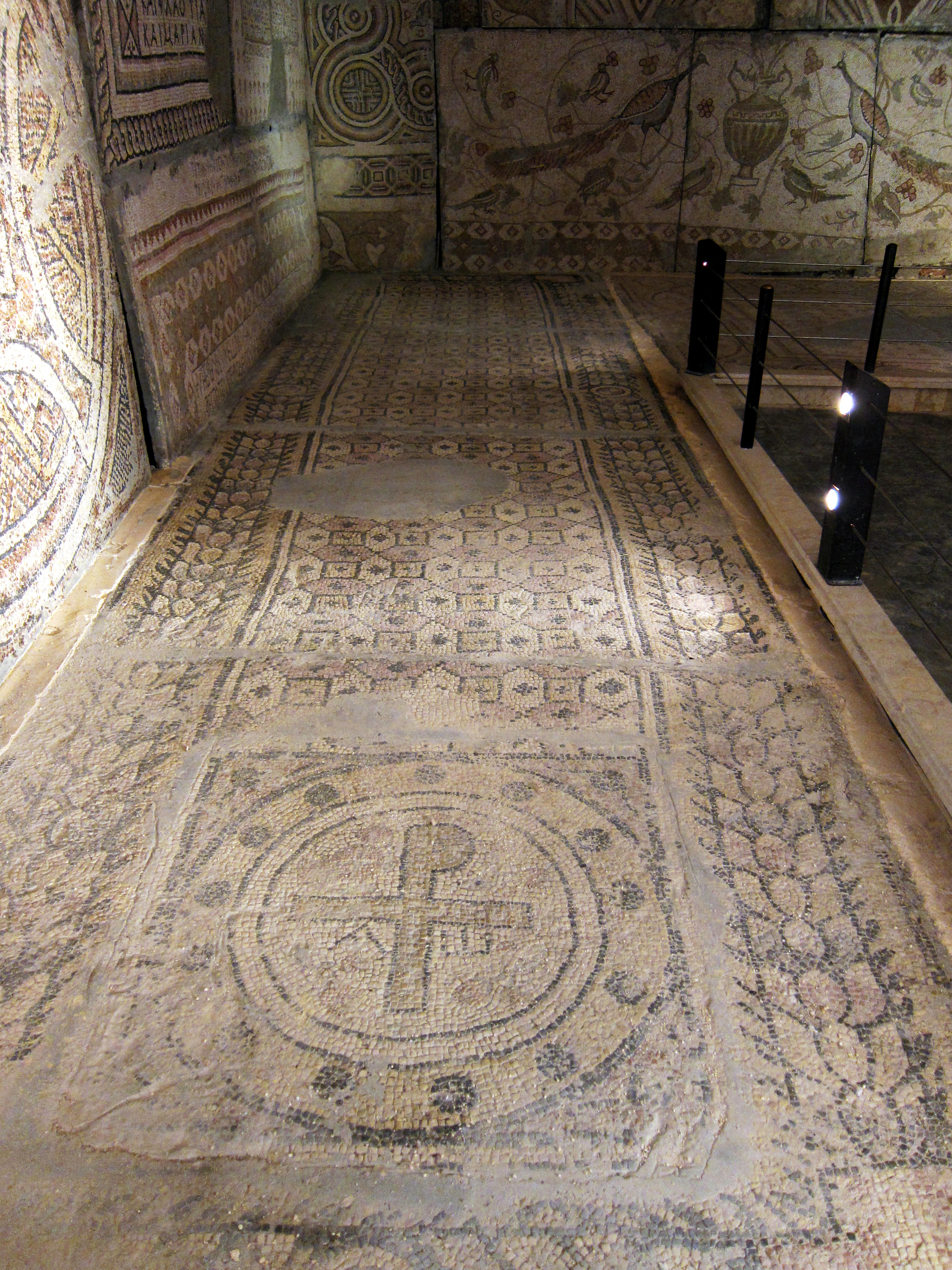
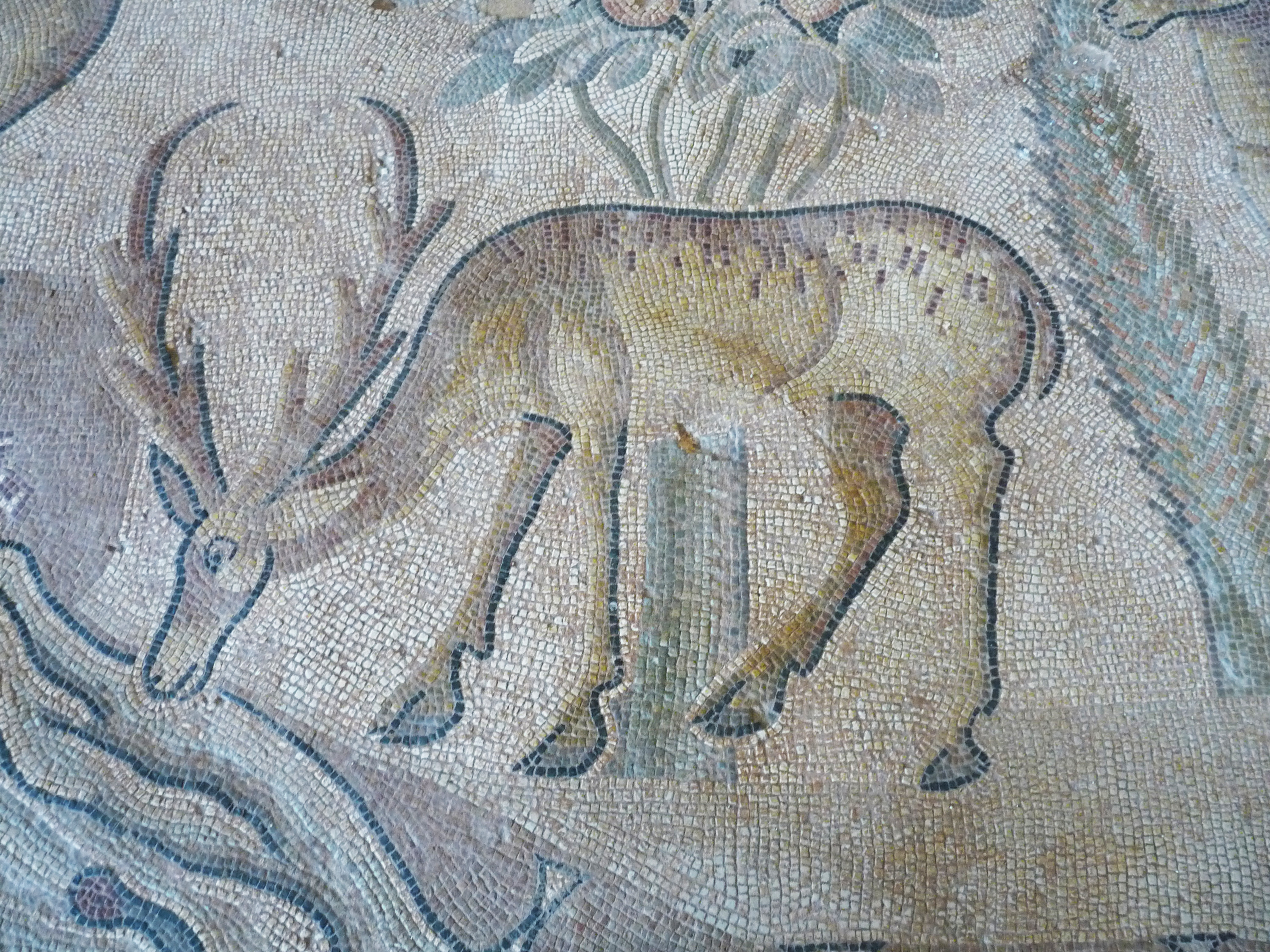
Mosaic was a common form of late antique decoration in places of worship. Here are two examples from Syria:
Mosaics from the ancient Tell Aar church, including a chi-rho monogram with an alpha and omega (foreground) and peacocks flanking an amphora (background), housed in the Maarat al-Numan Museum, Syria. Photo: Sean Leatherbury / Manar al-Athar.Deer drinking from a stream, 5th century. Mosaic, Church of the Martyrs, Taybat al-Imam, Syria. Photo: Jane Chick / Manar al-Athar.
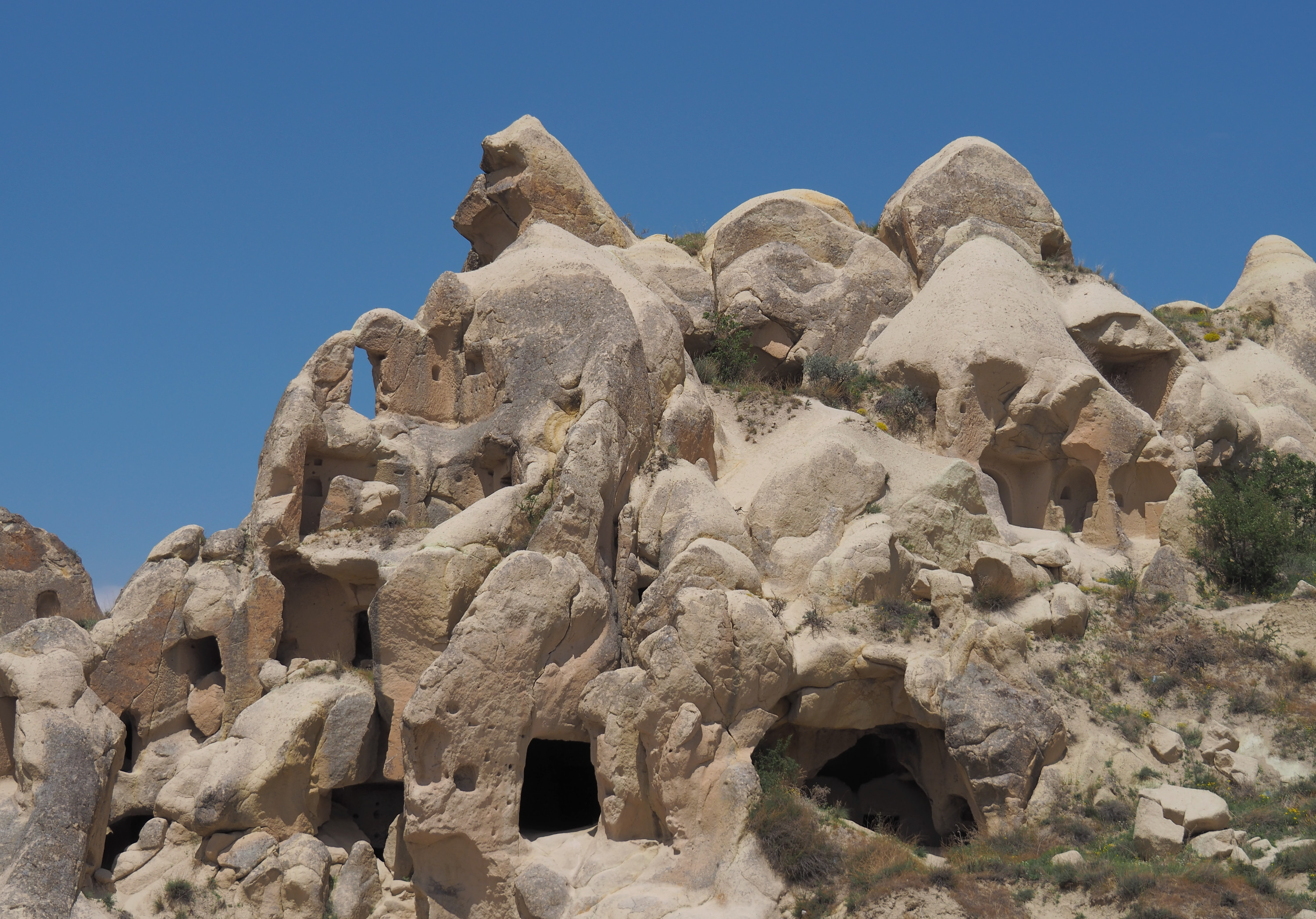
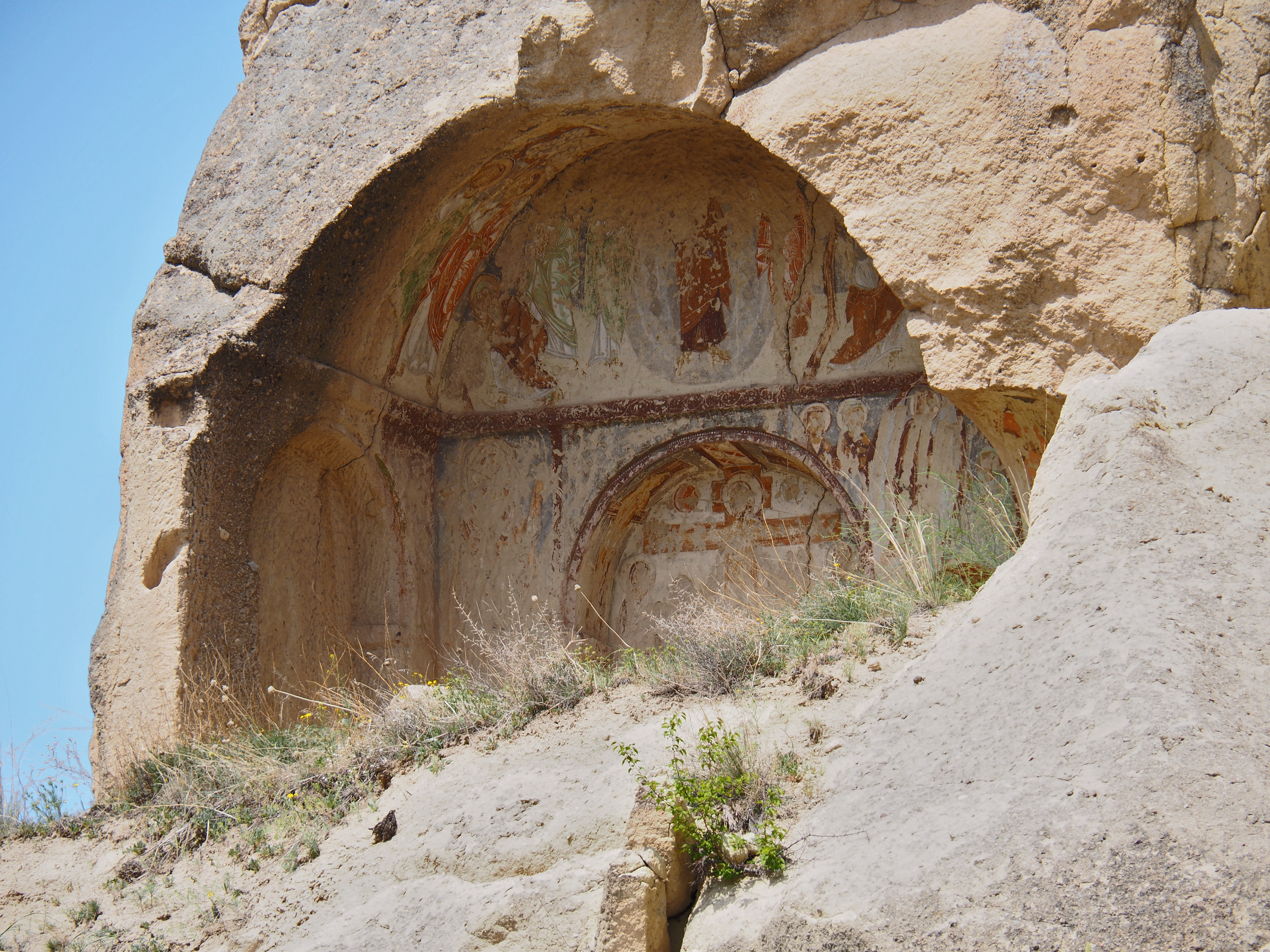
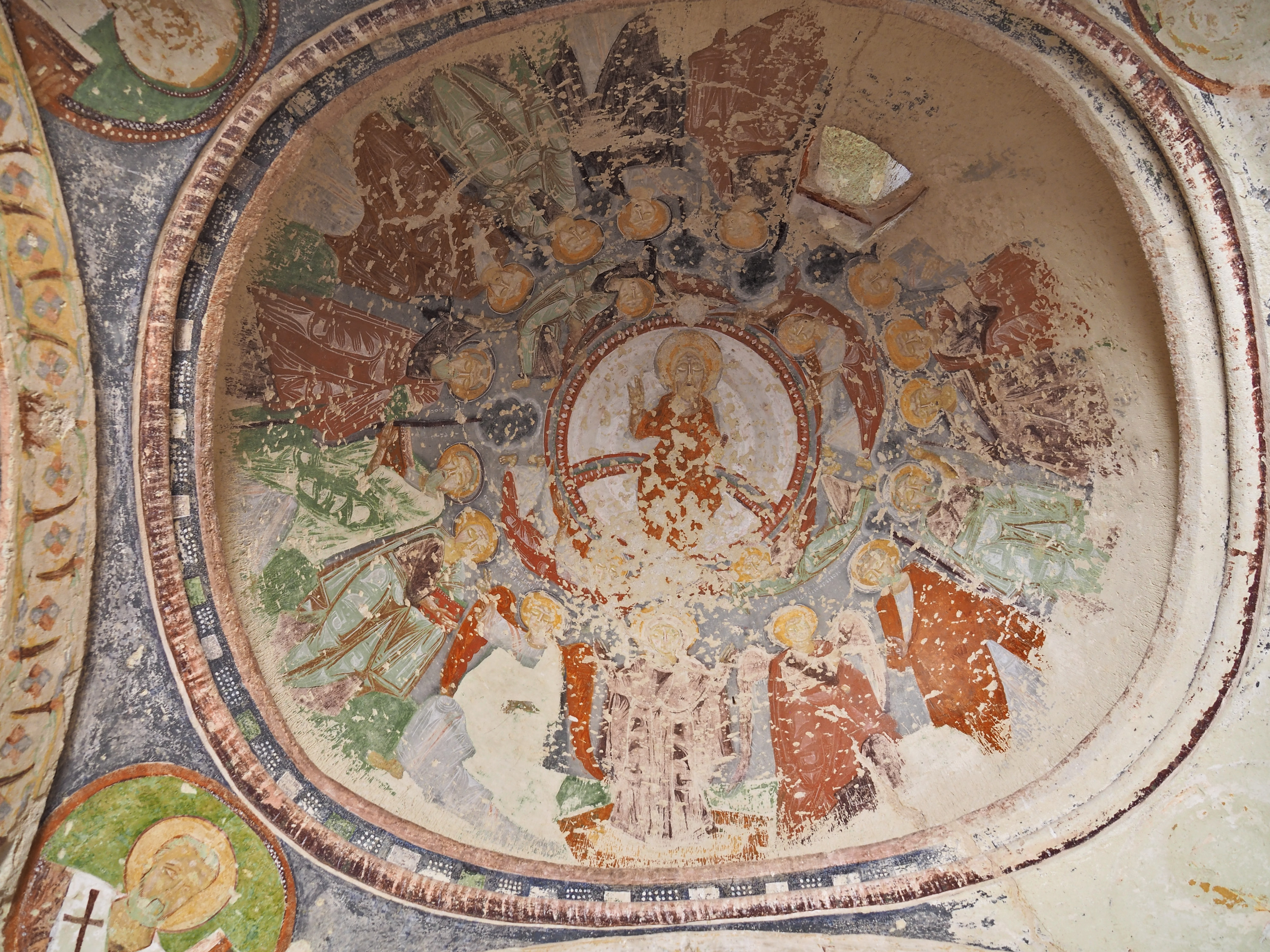
To the north of Syria in Turkey—cataloged by Manar al-Athar under “Anatolia,” the ancient name for the peninsula that comprises the majority of the country—there are the Cappadocian cave churches, hewn out of volcanic tufa. They began to be built in the fifth century, with a boom happening in the ninth through eleventh centuries, which is the period to which almost all the surviving paintings can be dated. There are over a thousand such churches, some very simple inside, and others elaborately painted. The architecture has been described as eccentric and enchanting. I like to imagine the monks, nuns, and other Christians who worshipped there all those centuries ago.
Middle Byzantine cave church, Göreme Open Air Museum, Cappadocia, Turkey. Photo: Marlena Whiting / Manar al-Athar.Frescoes depicting the Crucifixion and the Transfiguration, from a rock-cut chapel at the Göreme Open Air Museum, Cappadocia, Turkey. Photo: Marlena Whiting / Manar al-Athar.The Ascension of Christ, 10th century. Dome fresco, Church of the Evil Eye (El Nazar Kilise), Göreme, Cappadocia, Turkey. Photo: Marlena Whiting / Manar al-Athar.
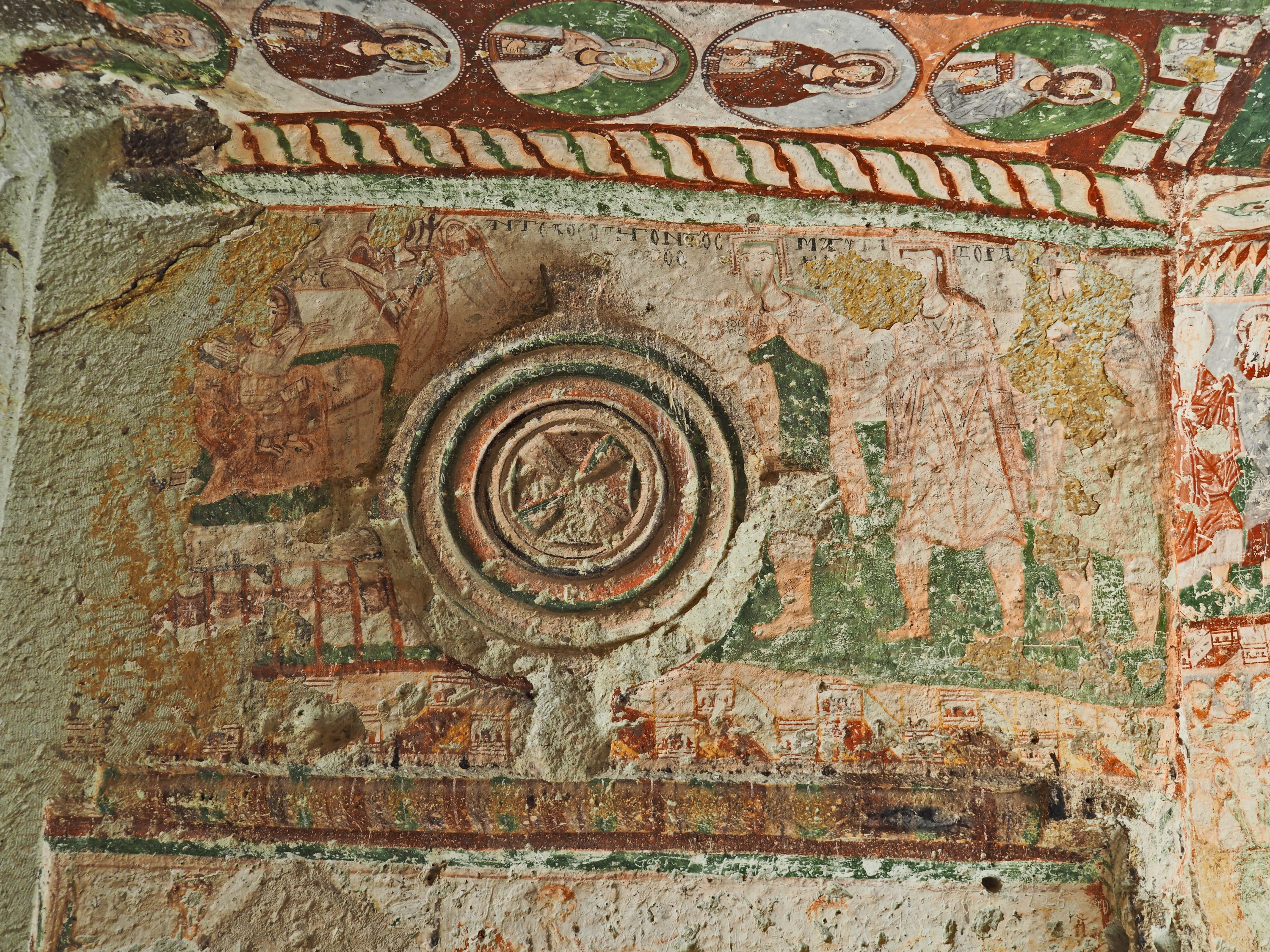
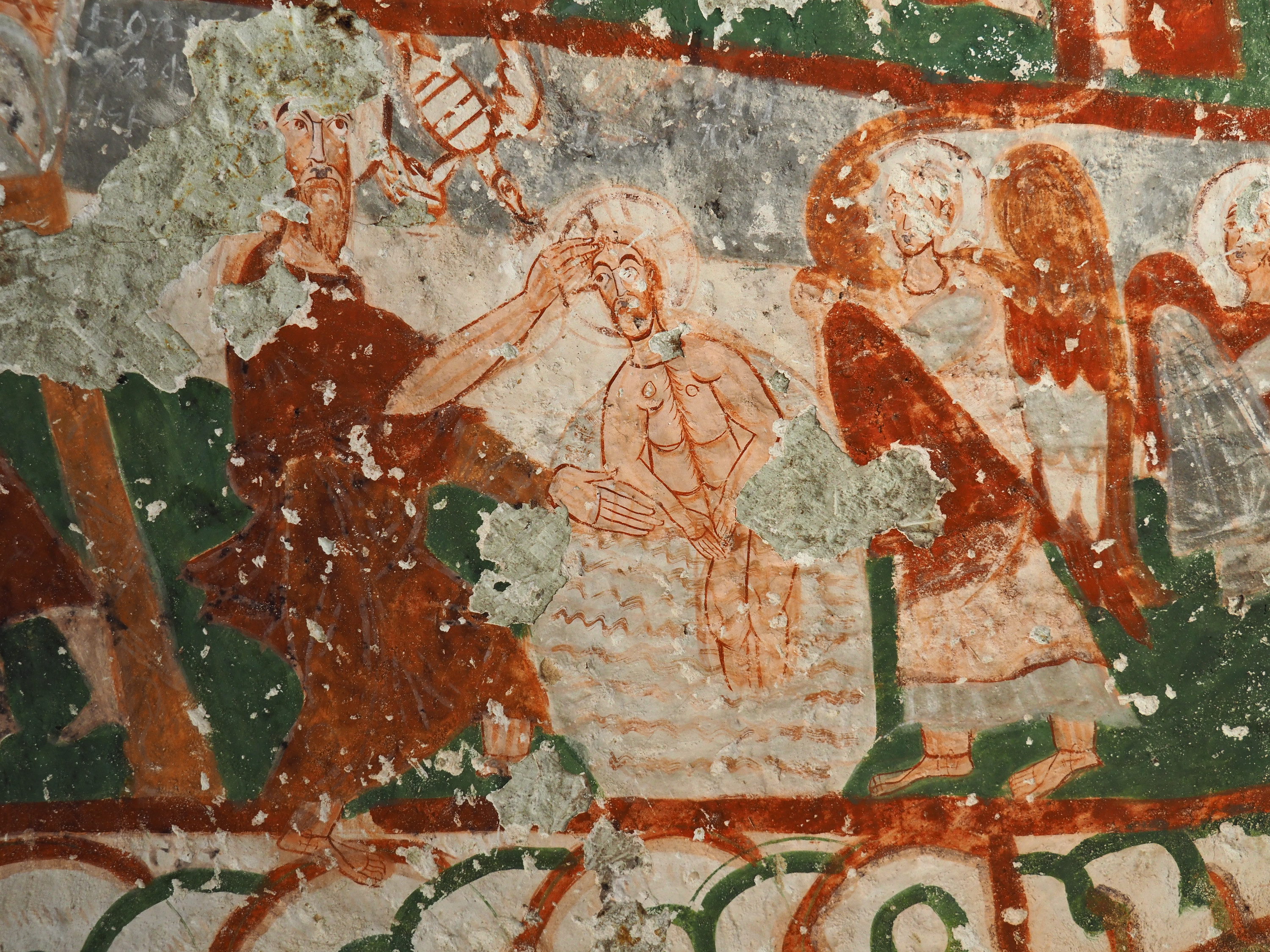
One of the cave churches in Cappadocia, part of an ancient monastic settlement, is Pancarlik Church, home to an impressive fresco cycle on the Life of Christ that’s painted mainly in rusty red and bean green.
Adoration of the Magi fresco and Greek cross relief carving, probably early 11th century. Pancarlik Church, Cappadocia, Turkey. Photo: Marlena Whiting / Manar al-Athar.The Baptism of Christ, probably early 11th century. Fresco, Pancarlik Church, Cappadocia, Turkey. Photo: Marlena Whiting / Manar al-Athar.
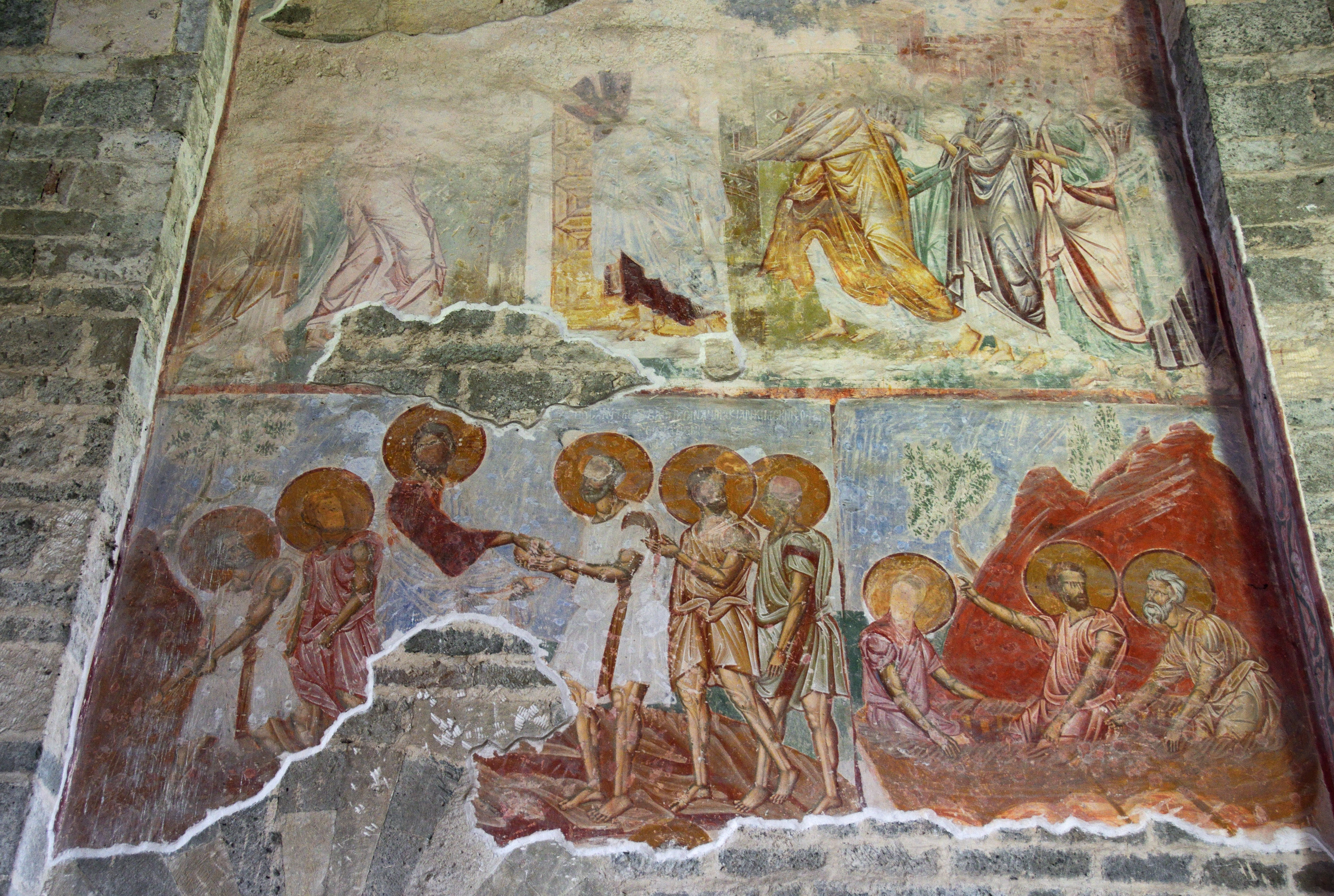
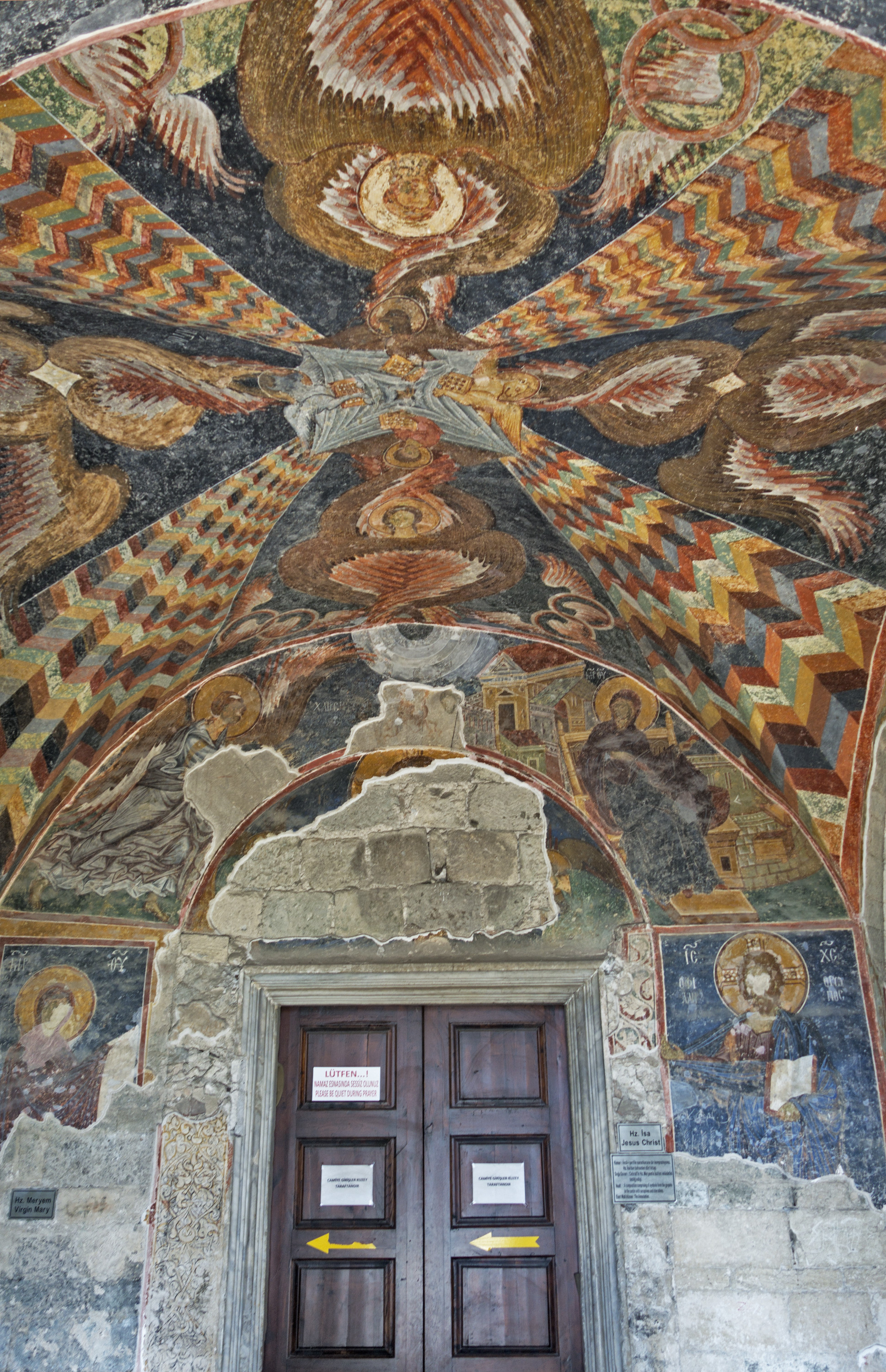
Beyond Cappadocia but also in Turkey is Hagia Sophia (Holy Wisdom) in Trabzon, not to be confused with the more famous Hagia Sophia in Istanbul, 650 miles away. Originally a Greek Orthodox church, it was converted into a mosque following the conquest of Trabzon (then called Trebizond) by Mehmed II in 1461. During prayer the frescoes in the nave, made by Christians who built and previously occupied the space, are covered by curtains to honor the Islamic prohibition against images—the veils are pulled aside during tourist hours—while the frescoes in the narthex remain uncovered at all times.
The Incredulity of St. Thomas (top) and The Risen Christ Appears on the Shore (bottom), late 13th century. Frescoes, Hagia Sophia (Aya Sofya Mosque), Trabzon, Turkey. Photo courtesy of Manar al-Athar.
One of the frescoes shows Christ appearing to his disciples after his resurrection on the shore of the Sea of Galilee. He hands a fish and a loaf of bread to Peter, who stands at the front of the group, so that they can all share a joyous breakfast together after the tragic, upending events of the previous week.
Frescoed narthex, late 13th century, Hagia Sophia (Aya Sofya Mosque), Trabzon, Turkey. Photo: Matthew Kinloch / Manar al-Athar.
Another fresco, on the vaulted ceiling of the narthex, shows the four living creatures of Revelation 4—long interpreted by Christian artists as symbols of the Four Evangelists—situated along the four sides of the canopy of the heavens, each holding a golden Gospel-book and surrounded by seraphim and blazes of rainbow light.
In the Caucasus region, Armenia has a long and rich tradition of Christian art, especially relief carving and painting, as the faith took root there early on in the fourth century.
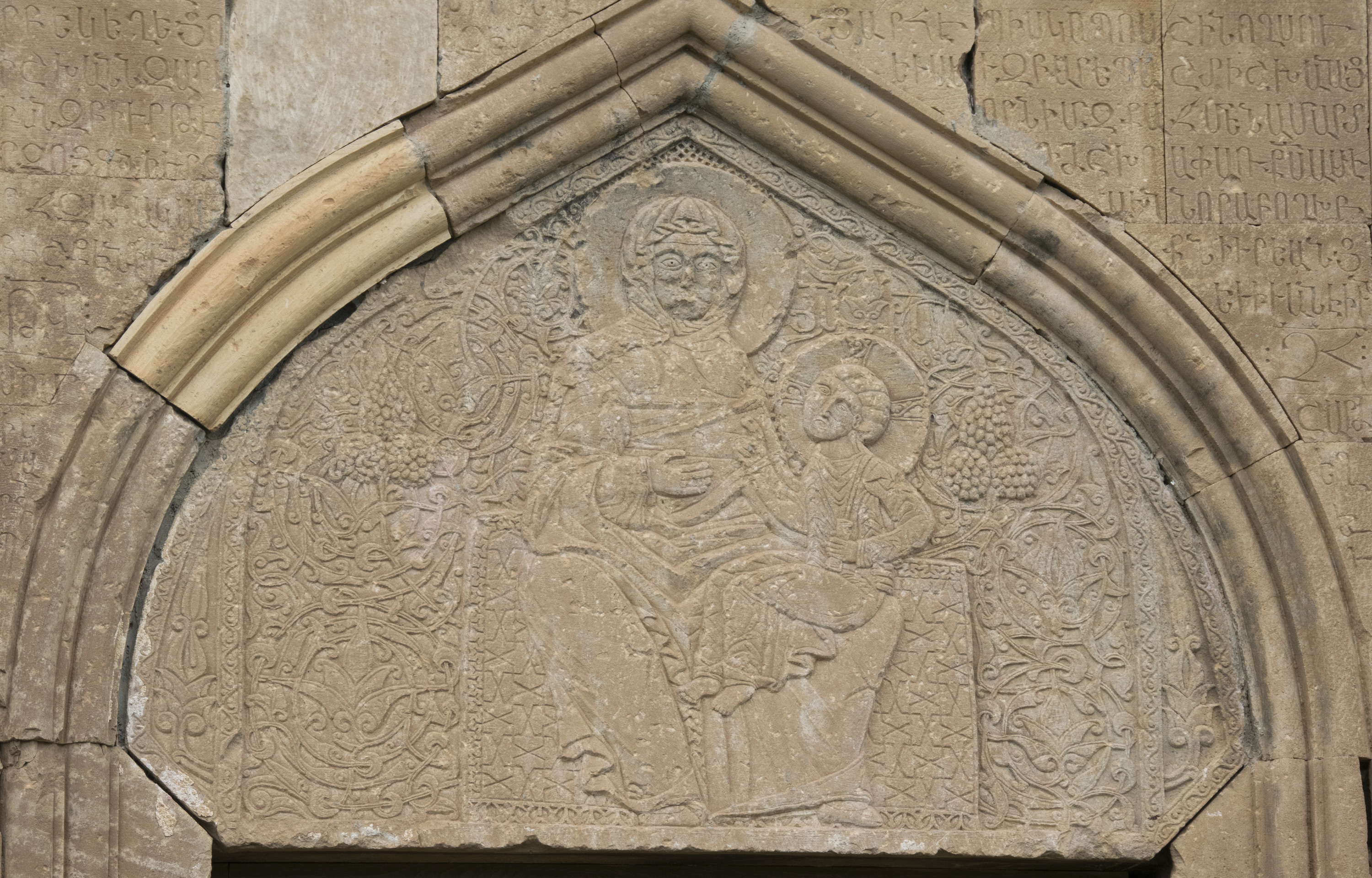
Momik Vardpet, Virgin and Child, ca. 1321. Carved tympanum, west portal, Church of St. Astvatsatsin (Holy Mother of God), Areni, Armenia. Photo courtesy of Manar al-Athar.
Overlooking the village of Areni on the eastern bank of the river Arpa is the Church of St. Astvatsatsin, which has a beautiful relief carving in the tympanum above the west portal by the Armenian architect, sculptor, and manuscript illuminator Momik Vardpet (died 1333). It depicts the Christ child seated on the lap of his mother, holding a scroll in one hand and raising the other in blessing. Decorative vines rise up behind and around the pair, suggesting verdancy.
The most distinctive Christian art form in Armenia is the khachkar, a carved memorial stele bearing a cross and often botanical motifs, and only occasionally a Christ figure. In the village of Sevanavank, at a different Church of St. Astvatsatsin, there’s a particularly striking khachkar that portrays the crucified Christ in the center, and below that, a scene of the Harrowing of Hell.
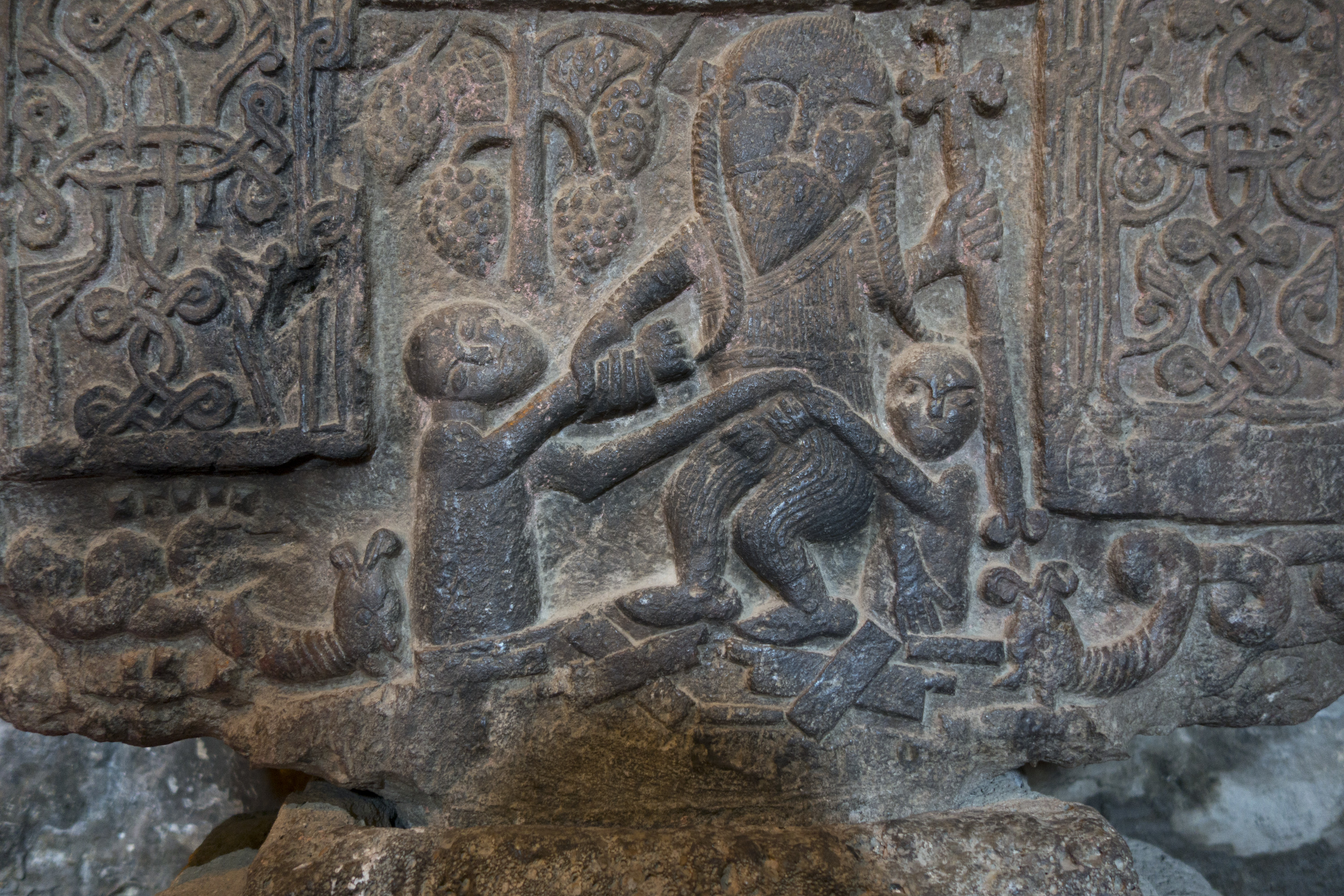
The Harrowing of Hell, detail of a khachkar from the Church of St. Astvatsatsin (Holy Mother of God) in Sevanavank, Armenia. Photo: Matthew Kinloch / Manar al-Athar. [view full khachkar]
Holding aloft his cross as a scepter, the risen Christ breaks down the gates of death and rescues Adam and Eve, representatives of redeemed humanity, while serpents hiss vainly at his heels. I’m struck by the uniqueness of Christ’s hair, which flows down in two long braided pigtails. Was this a common hairstyle for males in medieval Armenia? I have no idea.
The last artwork from Armenia that I’ll share is an icon of paradise from the Church of St. Astvatsatsin (yes, it’s a popular church name in that country!) at Akhtala Monastery.
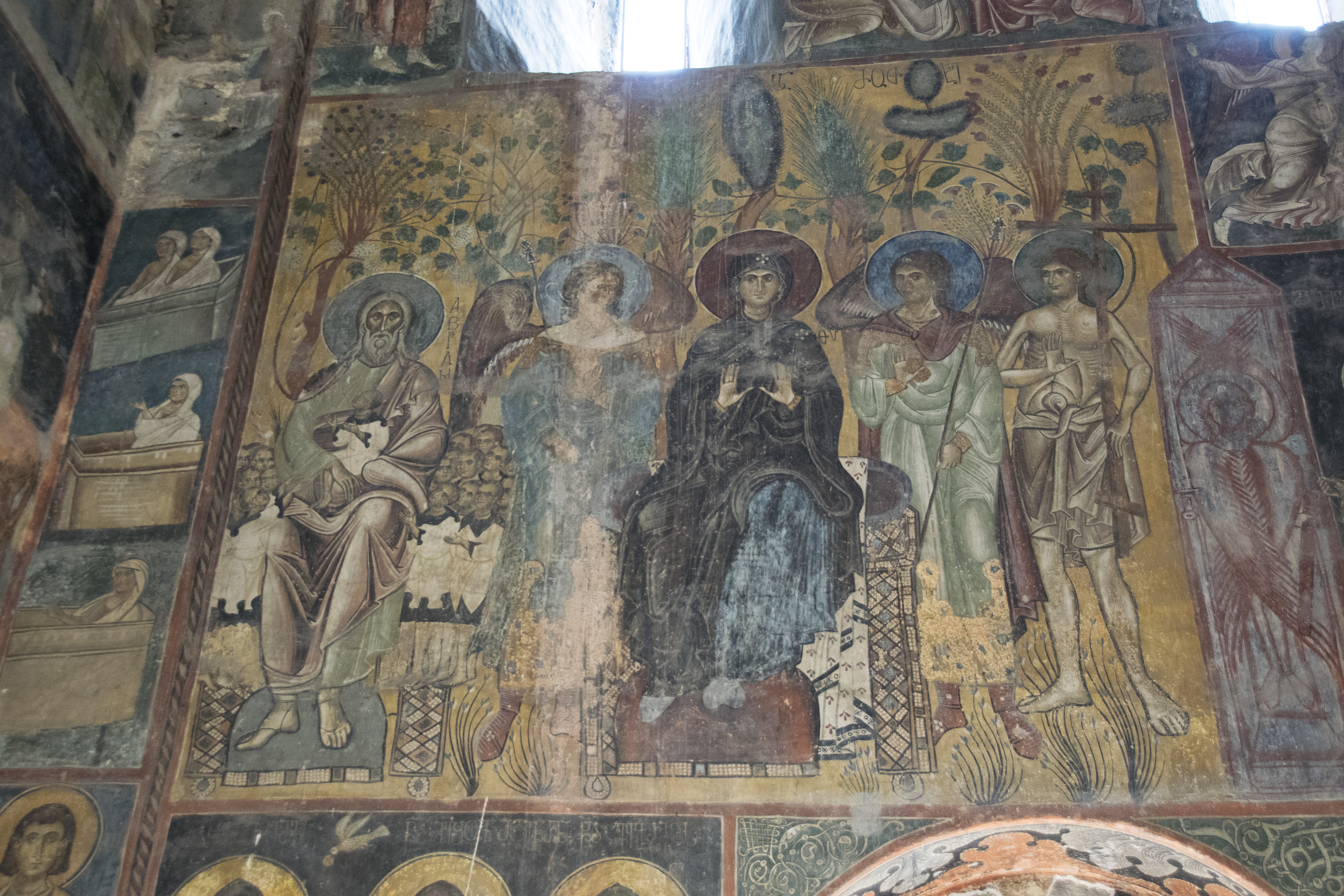
Paradise, 1205–16. Fresco, west wall, Church of St. Astvatsatsin (Holy Mother of God), Akhtala Monastery, Akhtala, Armenia. Photo courtesy of Manar al-Athar.
In the center is the Mother of God flanked by two angels. On the left is Abraham with a child, representing a blessed soul, sitting on his lap (Luke 10:22 describes how the righteous dead go to “Abraham’s bosom,” a place of repose). On the right is Dismas, the “good thief” who repented on the cross of his execution, and to whom Jesus promised paradise (Luke 23:39–43); he is venerated as a saint in the Catholic and Orthodox churches.
The image is part of a larger Last Judgment scene that covers the entire west wall. A few panels above, at the very top, Christ is enthroned on a rainbow.
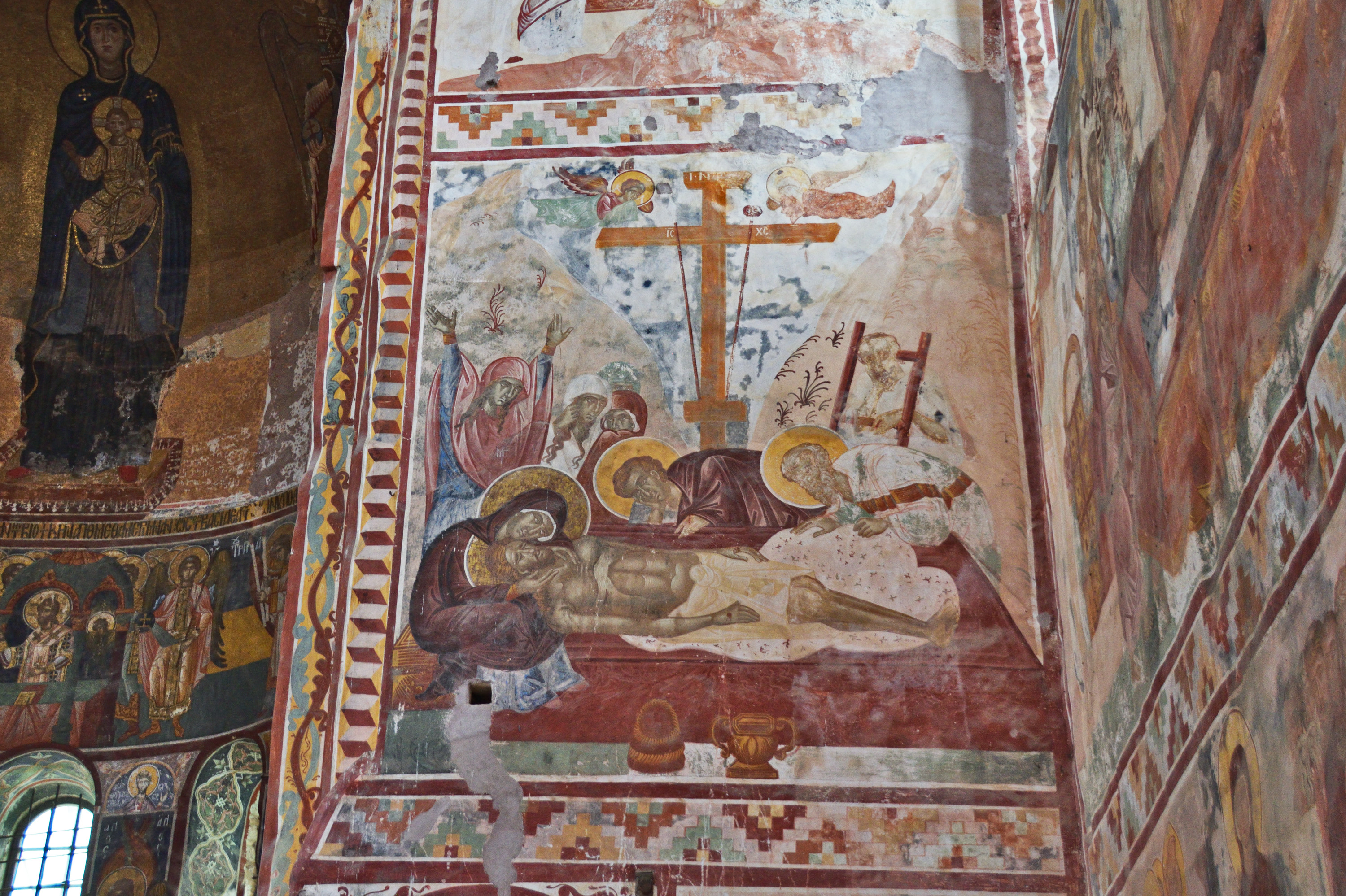
The neighboring country of Georgia has also cultivated a tradition of Christian icon painting. The main church of Gelati Monastery, founded in 1106, is richly decorated with painted murals dating from the twelfth through seventeenth centuries. One of them is the Lamentation over the Dead Christ: The Virgin Mary gently cradles the head of her son and Mary Magdalene throws her arms up in grief while the apostle John leans in close to mourn the loss and Joseph of Arimathea begins to wrap the body in a shroud.
Lamentation over the Dead Christ, fresco, Church of the Blessed Virgin, Gelati Monastery, near Kutaisi, Georgia. Photo courtesy of Manar al-Athar.
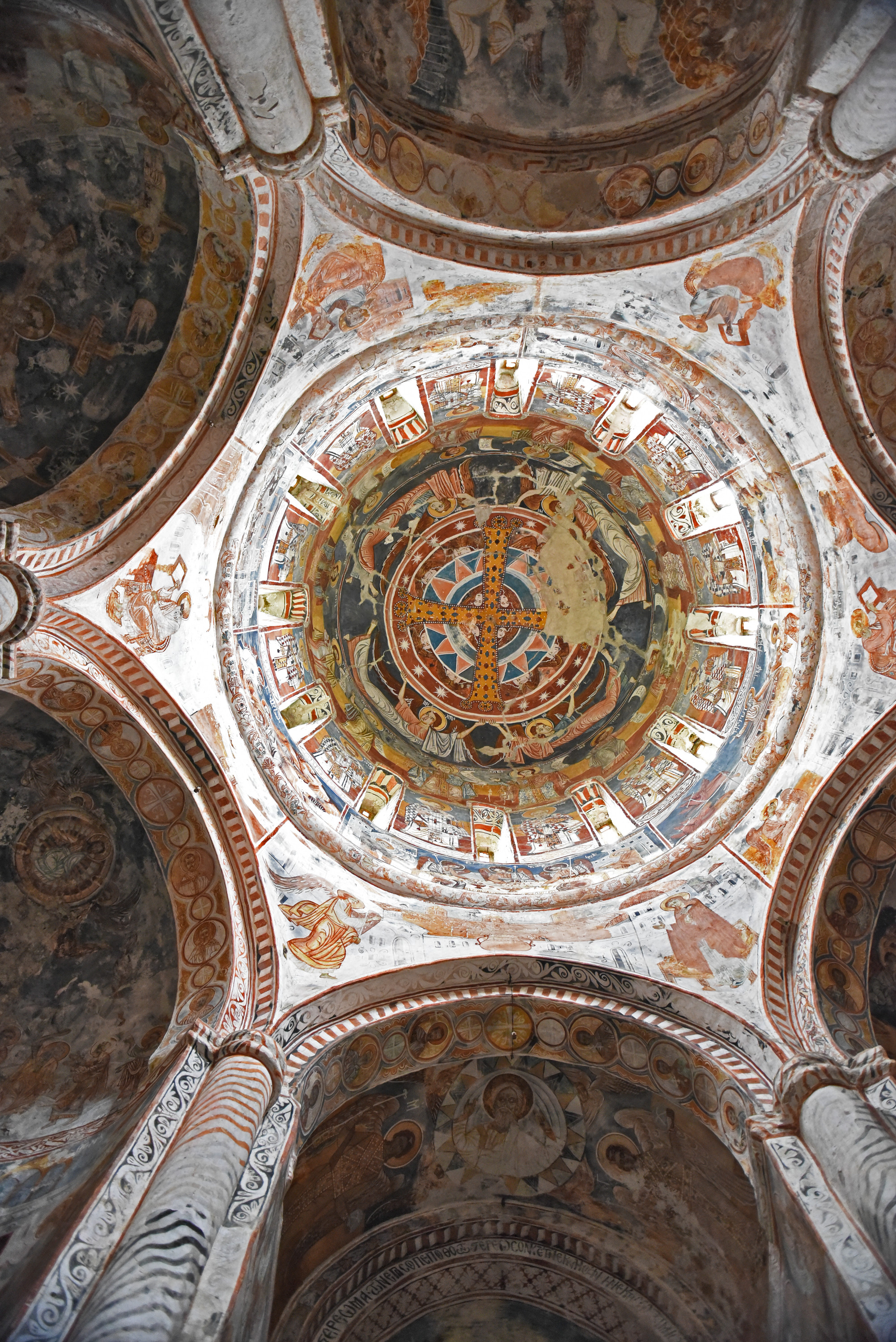
Another Georgian icon painting, from the central dome of the Church of St. Nicholas in Nikortsminda, shows angels bearing aloft a jeweled cross, surrounded by the twelve apostles.
Central dome, Church of St. Nicholas, Nikortsminda, Georgia. Photo: Ross Burns / Manar al-Athar.
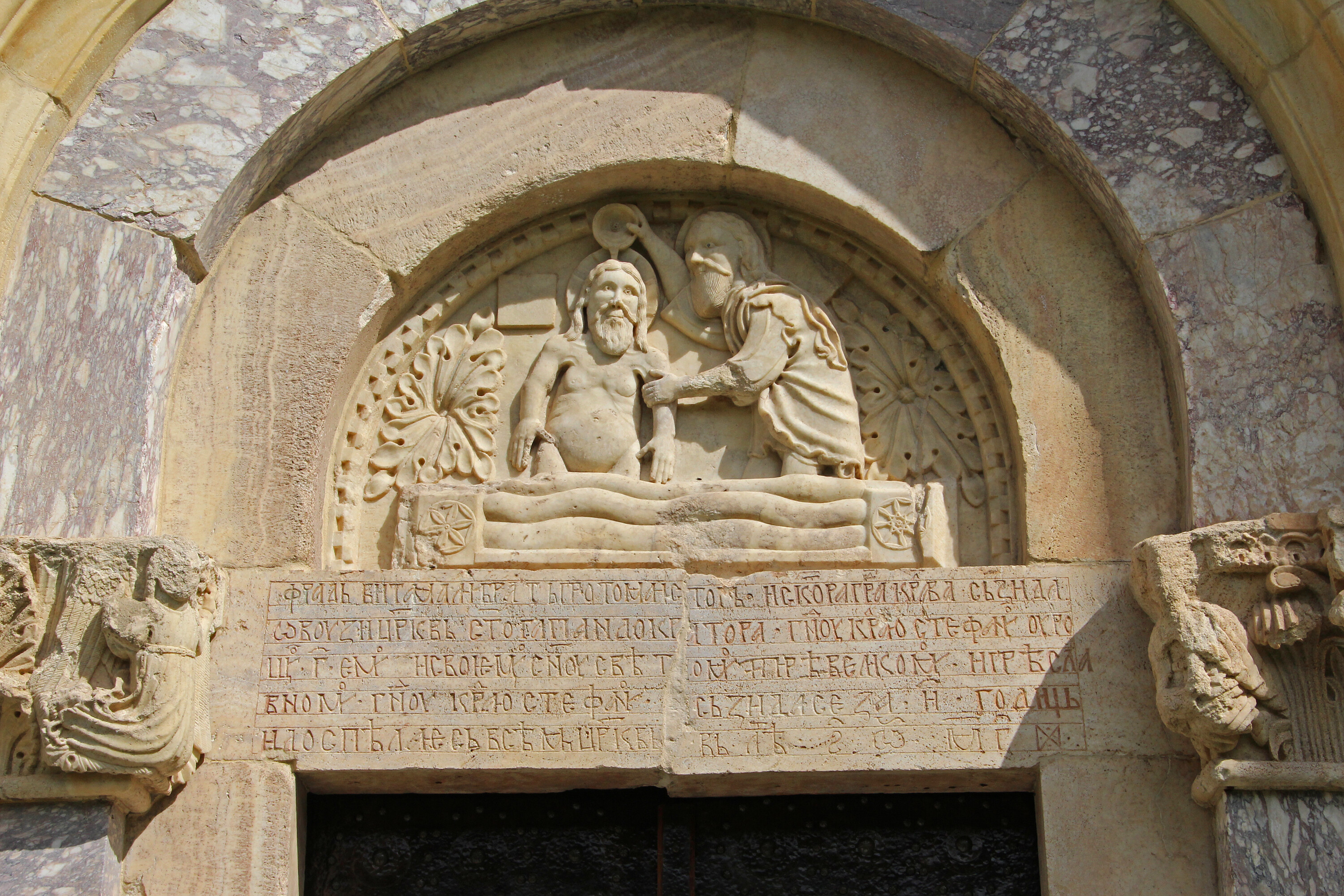
Lastly, from the Balkans, I want to point out Decani Monastery in Kosovo, a Serbian Orthodox monastery built in the fourteenth century in an architectural style that combines Byzantine and Romanesque influences. The tympana of its katholicon (main church) lean into the Romanesque. The one over the south entrance portrays John baptizing Jesus in the river Jordan, and the Serbian inscription below describes the monastery’s founding.
The Baptism of Christ, 1327–35. Carved tympanum, south portal, Christ Pantocrator Church, Decani Monastery, near Deçan, Kosovo. Photo: Mark Whittow / Manar al-Athar.
It’s important to note that this is one of a number of churches from the Manar al-Athar archive that are still active sites of Christian worship, where communities of believers are nurtured through word, image, and sacrament.
If you are interested in volunteering with Manar al-Athar—helping with image processing, labeling, fundraising, or web building—or if you have taken any photographs that may be of interest to the curatorial team, email manar@classics.ox.ac.uk.
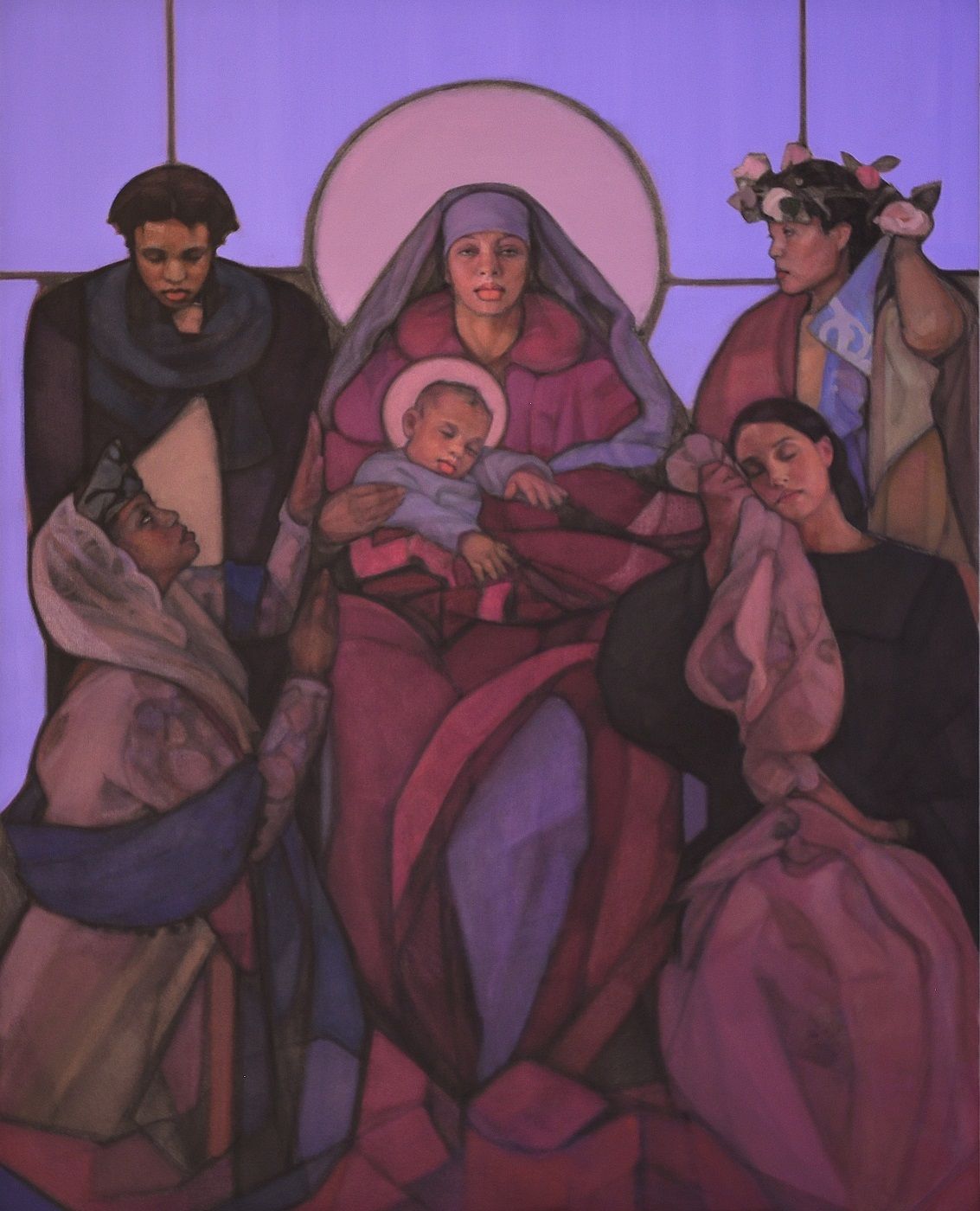
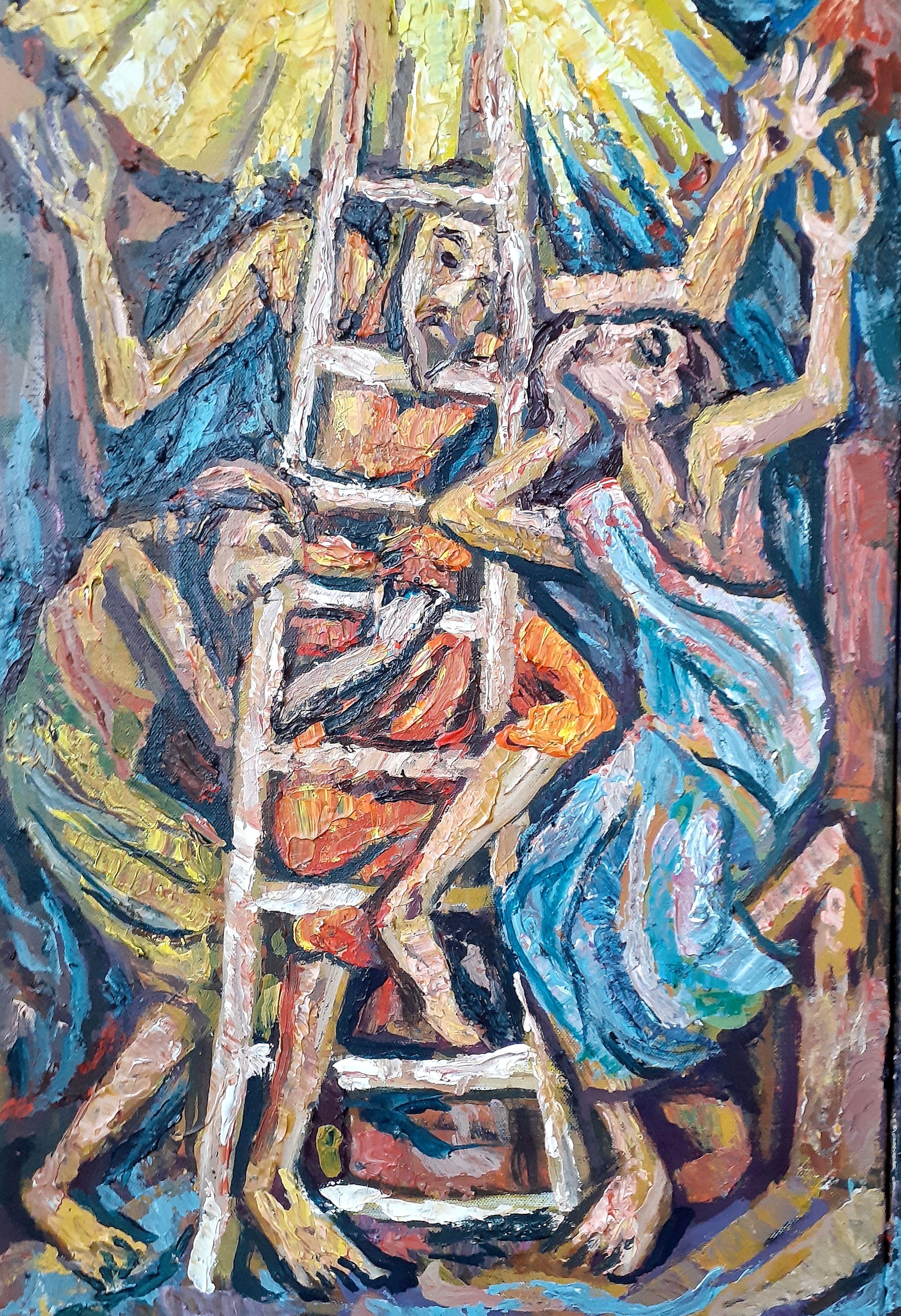
Janet McKenzie, The Divine Journey: Companions of Love and Hope, 2017. Oil on canvas, 48 × 36 in. Memorial Church, Harvard University, Cambridge, Massachusetts.Khrystyna Kvyk (Ukrainian, 1994–), The Descent into Hell, 2023. Acrylic on gessoed wood, 40 × 40 cm. Private collection.
+++
FREE ZOOM CONVERSATION: Social music with Dan Zanes, July 16, 2025, 8 p.m. ET: I met the Baltimore-based folk musicians Dan and Claudia Zanes [previously] two years ago at a local family concert they put on. Joyous, bighearted, faith-filled, community-focused, committed to social justice—I love who they are and what they’re about and all the rich music they share.
In a social mediapost on June 11, Dan posed the question, “Is there anyone out there who wants to become a music maker and help uplift their community?” Followed by a generous offer: “I can teach you how to play guitar and sing songs (and write songs if you want). No cost, this is a different approach. It will be through a series of Zoom lessons (unless you live down the street). Whether you’re a beginner or someone who’s been dabbling and wants to take it out of the house, I can get you to a confident place so you can play for and with people.” The caveat? You just have to promise to put in the practice and to share your music freely in your community! And to teach someone else what you’ve learned.
“There are so many ways to make positive social change,” Dan says, “and creating music in our communities is certainly one of them.” I believe he has already selected a set of students to take on, but having received so many messages of interest, he has also decided to host a Zoom conversation on social music this coming Wednesday evening. On July 9, he wrote on socialmedia:
Social music in chaotic times, people! Let’s talk about it. I’ve been hearing from many folks who want to be more useful in their communities and see music as the way.
Yes! Music can be healing, galvanizing, uplifting, energizing, and calming. Imagine if every community had many more music makers to play for the young folks, the elders, to lead singalongs and dance parties, to offer songs during times of loss and celebration. Of course it’s happening now, and still I believe there’s so much more that is possible.
If you’re interested in joining the meeting, send Dan an Instagram message @danzanes or a Facebook message @danandclaudiazanes and he’ll send you the link.
To give you a sense of Dan and Claudia’s vibes, here’s one of their original songs, which they debuted on their YouTube channel in 2020:
+++
ONLINE RETREAT: “Read for Your Life: Creating a Story-Formed Home” with Sarah Clarkson, August 5, 2025: Join author Sarah Clarkson [previously] for a daylong online retreat exploring children’s literature, childhood reading, and the development of imagination. “My goal,” she writes, “is to provide a vision for the beauty of the reading life, some good research, and a generous stack of practical booklists to help you begin to outfit and build a home library for the children in your life.” The cost is $35. The event begins at 9:30 a.m. UK time, but all live sessions will be recorded and offered on-demand afterward to registrants.
+++
PODCAST EPISODE: “The Green Man,”Gone Medieval, June 23, 2025: In this episode, Dr. Eleanor Janega talks with Imogen Corrigan, author of The Green Man: Myth and Reality (Amberley, 2025), about the enigmatic “green man” figure, or foliate head, which can be found in almost every pre-Reformation English cathedral and in many churches, decorating arches, corbels, roof bosses, choir stalls, and chancel screens. Corrigan claims that “the image has to be one of the most misunderstood, misinterpreted and misrepresented in the history of church carvings,” having nothing to do with pagan fertility rites. She suggests, rather, that the Green Man gestures toward the resurrection of, and resurrection in, Christ—to spiritual rebirth and eternal life.
Misericord from King’s Lynn Minster, England, ca. 1370s, depicting a Green Man disgorging oak leaves. Photo: Lucy Miller. (Click on image for great compilation!)
The two medievalists speak on location at St Mary’s at Minster-in-Thanet and St Nicholas-at-Wade in Kent. The conversation really starts to pick up at 19:47.
+++
This past month has seen the death of two rock ’n’ roll legends whose music, which played regularly on Oldies 100.7 WTRG, formed part of the soundtrack of my 1990s childhood: Brian Wilson (of the Beach Boys) and Sly Stone (of Sly and the Family Stone).
Much has been written about both trailblazers. I just want to mention two things:
1. Love and Mercy, the 2014 film directed by Bill Pohlad about Brian Wilson (played by Paul Dano and John Cusack), is excellent. Elliot Roberts makes the case that it’s the best music biopic ever made, and I’m inclined to agree; New York Times film critic Alissa Wilkinson also cites it as her favorite, at least within the rock genre. The story alternates between Wilson’s production of the Pet Sounds album in the mid-sixties and his psychological treatment under his abusive therapist and conservator Eugene Landy in the late 1980s, which coincided with his meeting Melinda Ledbetter, who would become his wife. The title is taken from one of Wilson’s solo songs from 1988. Here’s the film trailer:
2. Active from 1966 to 1983, Sly and the Family Stone was one of the very few multiracial, mixed-gender bands of the time, modeling integration when the notion was still fairly new in America. Perhaps you’ve heard their most famous hit, “Everyday People,” a call for unity across lines of difference (“There is a blue one who can’t accept the green one / For living with a fat one, tryna be a skinny one . . .”). Sly Stone was the front man—singer, songwriter, multi-instrumentalist, and producer. As is common among so many African American musicians, he got his musical start in church; from infancy, he was immersed in gospel music as a member of the Church of God in Christ, and his musical talent was nurtured there. I learned that in the fifties, he and three of his four siblings even formed a gospel group called the Stewart Four, locally releasing a single in August 1956. Here’s the B-side, “Walking in Jesus’ Name,” with a thirteen-year-old Sly singing lead:
HYMN TEXT: “Lights” by Kate Bluett: Kate Bluett [previously] is a Catholic poet and lyricist from North Texas who frequently participates in cross-denominational music collaborations. Her work has been published by Oregon Catholic Press and GIA Publications and recorded by the Porter’s Gate and Paul Zach, among others. I enjoy following her at https://katebluett.home.blog/, where she regularly shares new metrical verses she has written, tied to the liturgical calendar. Last Eastertide she published a text called “Lights,” which muses on candle flames, stars, and other light sources as reflections of the light of the risen Christ.
+++
AUDIO DRAMA: Anastasis: The Harrowing of Hades by Creative Orthodox:Creative Orthodox is the moniker of Michael Elgamal, a Coptic Orthodox artist and storyteller born in Egypt and living in Canada. Last May he released an audio drama, adapted from a graphic novel, about Christ’s epic descent into the underworld to reclaim the Old Testament righteous. This theatrical medium, which relies on voice acting, sound effects, and music to tell a story, was a very popular form of entertainment in the 1920s–40s before the advent of television but is much rarer today—which is a shame, because I find it really engaging! See the YouTube description for a full list of credits (script, score, actors, etc.).
Dionysius (Russian, ca. 1440–ca. 1508), Christ’s Descent into Hades, from Ferapontov Monastery, ca. 1495–1504. Tempera on wood, 31.2 × 10.5 cm. State Russian Museum, Saint Petersburg.
+++
SONGS:
>> “Christ Is Risen” (لمسيح قام) by Ribale Wehbé:Ribale Wehbé is a Lebanese singer specializing in Byzantine chant. Here she sings a traditional Easter chant in Arabic, arranged by Joseph Yazbeck.
>> “Hallelujah, Hosanna” (हाल्लेलुयाह होशन्ना) by One Tribe: Originally written in Tamil by pastors Dudley Thangaiah and Paul Thangaiah, “Hallelujah, Hosanna” is sung here in Hindi by the Indian Christian worship collective One Tribe. Turn on “CC” for closed captioning, and view the full credits in the YouTube video description. [HT: Global Christian Worship]
>> “He Did Rise” by Monroe Crossing: A bluegrass song about the women’s discovery of the empty tomb on Easter morning, written by Mark Anderson and performed here by his band, Monroe Crossing, at a music festival in Lexington, Kentucky, in 2009. Anderson is on the double bass. [HT: Global Christian Worship]
+++
SPOTIFY PLAYLIST: May 2025 (Art & Theology): An assortment of psalms, hymns, and spiritual songs, old and new. For my Easter-specific playlist from 2022 (with a smattering of new additions since, including a large batch from Cardiphonia at the bottom), see here.
The medieval manuscript known as the Eton Roundels is a brief typological picture sequence produced in the English Midlands (possibly Worcester) in the mid-thirteenth century. Typology is a mode of Christian biblical interpretation in which certain Old Testament figures, events, or objects are seen as foreshadowing New Testament figures or events, especially Christ. Art historian Avril Henry says the Eton Roundels came into being at about the same time as the Biblia pauperum, a tradition of picture Bibles forming the largest and best-known compendium of typological imagery and verses.
The Eton manuscript consists of twelve pages of pictures, each with a large roundel at the center picturing a New Testament event (the “antitype”) and four surrounding smaller roundels depicting the Old Testament (and occasionally classical) “types” and prophets. Each page also includes a half-roundel on the left and right inhabited by anonymous figures who probably simply represent onlookers. A crowned female Virtue is seated at the bottom of each page, under whom is written a biblical commandment whose relevance to the pictures is sometimes difficult to discern. These pages are bound together with an Apocalypse, but it’s unknown whether the two works were conceived together from the start; it’s only certain that they were combined by the late seventeenth century.
The maker, scriptorium or city of origin, original recipient (and whether religious or lay), and purpose of the Eton Roundels are also unknown. Presumably the manuscript’s function was meditational.
The artist didn’t invent any of the typological correspondences illustrated in the roundels; they were all already common currency.
Below are the two Resurrection-themed pages, with a breakdown of the illustrations, including translations of the Latin inscriptions. The translations are by Avril Henry and are from his book The Eton Roundels: Eton College, MS 177 (‘Figurae bibliorum’)—A colour facsimile with transcription, translation and commentary (Scolar Press, 1990). This book is an excellent resource for learning more about the manuscript and is the only place I’m aware of where you can view all twelve pages.
Thank you to Sally Jennings, Collections Administrator at Eton College Library, and Dr. Carlotta Barranu, Library Curator of Rare Books and Manuscripts at the time of my research, who provided me with photographs and translations prior to my gaining access to Henry’s book.
Folio VIII (5v)
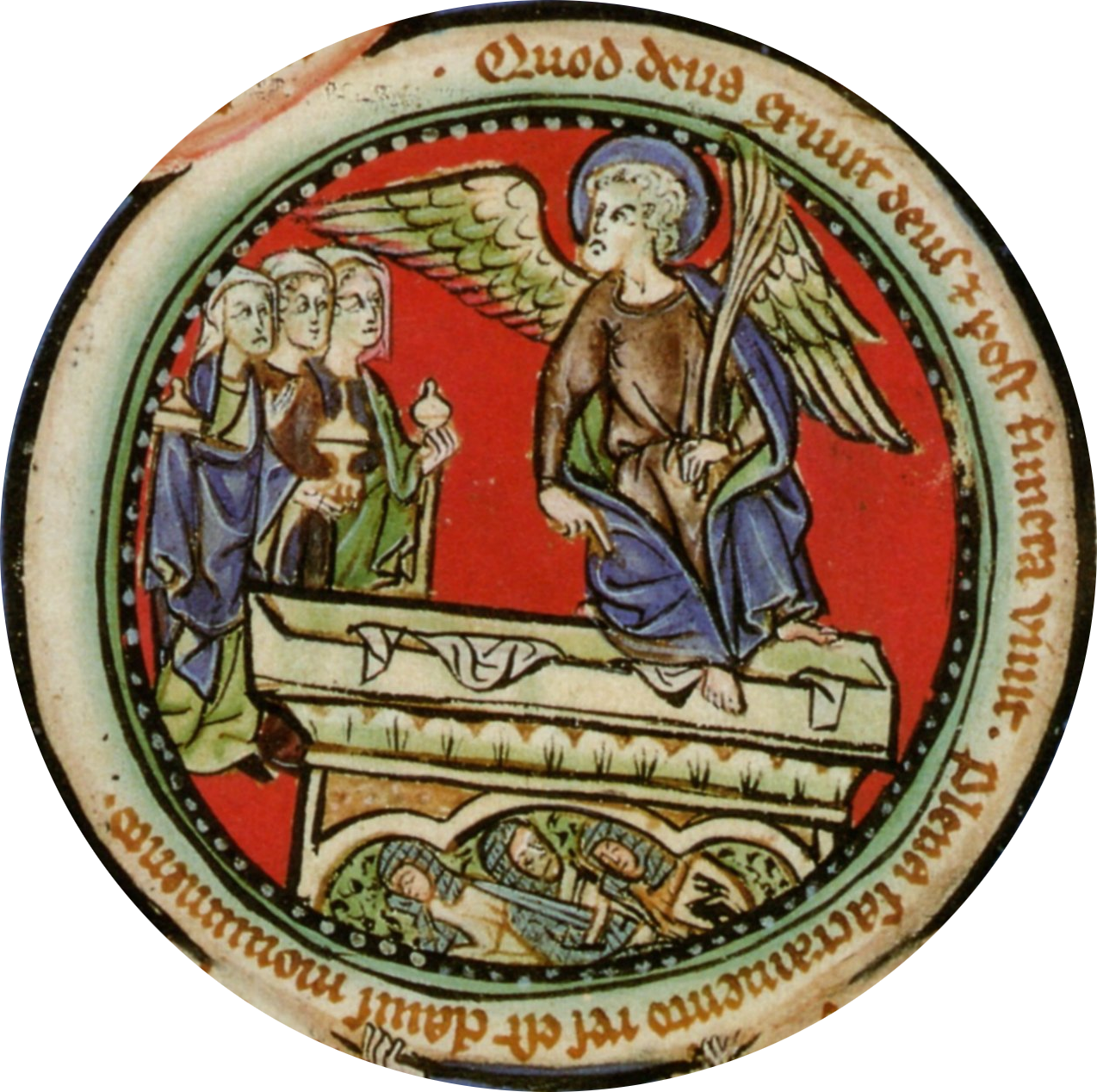
“Three Women at the Tomb,” etc., from the Eton Roundels manuscript, English Midlands, 1260–70. Eton College Library, MS 177, fol. VIII. Reproduced by permission of the Provost and Fellows of Eton College.
↑ Center:Three Women at the Tomb (Mark 16:1–8)
“Because God came forth and God lives after burial, the event filled with mystery is the key to the tomb.”
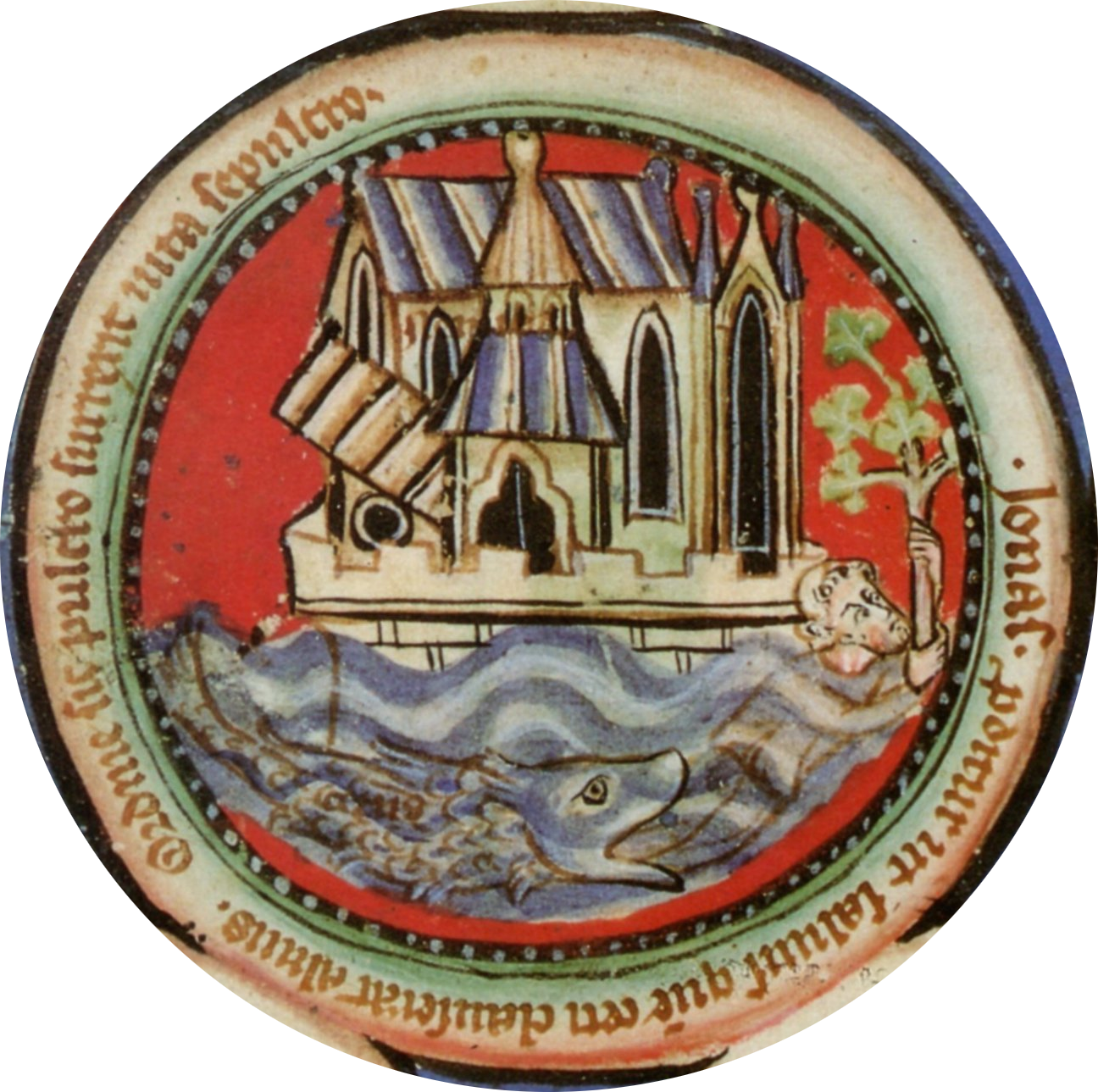
↑ Top left:Jonah Leaves the Fish (Jonah 2:11; cf. Matt. 12:38–41)
“Jonas. Just as he whom the belly of the sea-creature had enclosed is brought forth unharmed, at a glorious command life rose up from the tomb.”
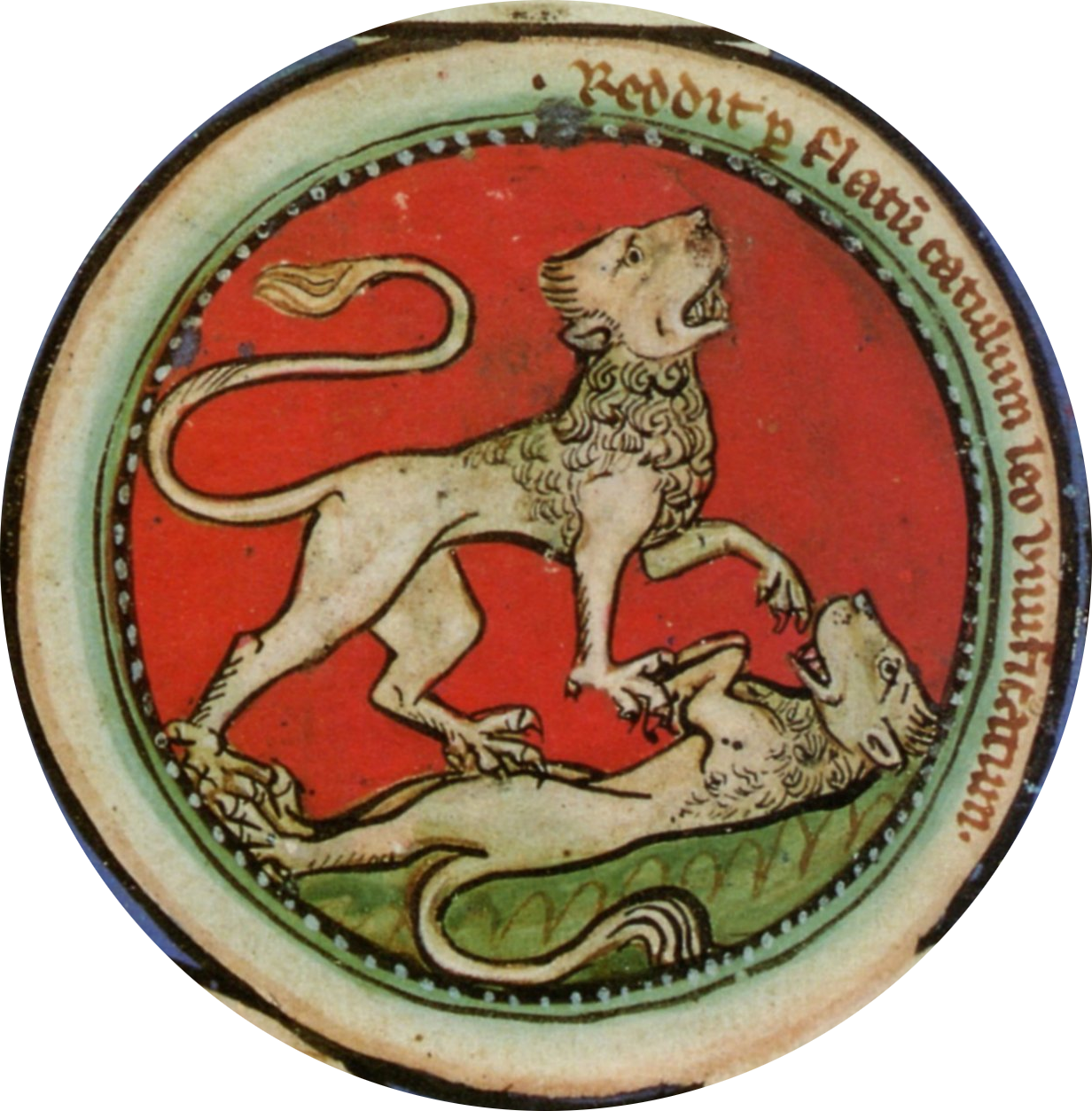
↑ Top right:A Lion Revivifies Its Young
“By [its] breath the lion brings its cub back to life.”
This statement refers to a piece of lore found in the third-century Physiologus and its descendants, the medieval bestiaries, according to which lion cubs are born dead but are brought back to life three days later by their father’s breath. This (fictitious) leonine behavior was seen to reflect the Father raising the Son from the tomb on Easter morning.
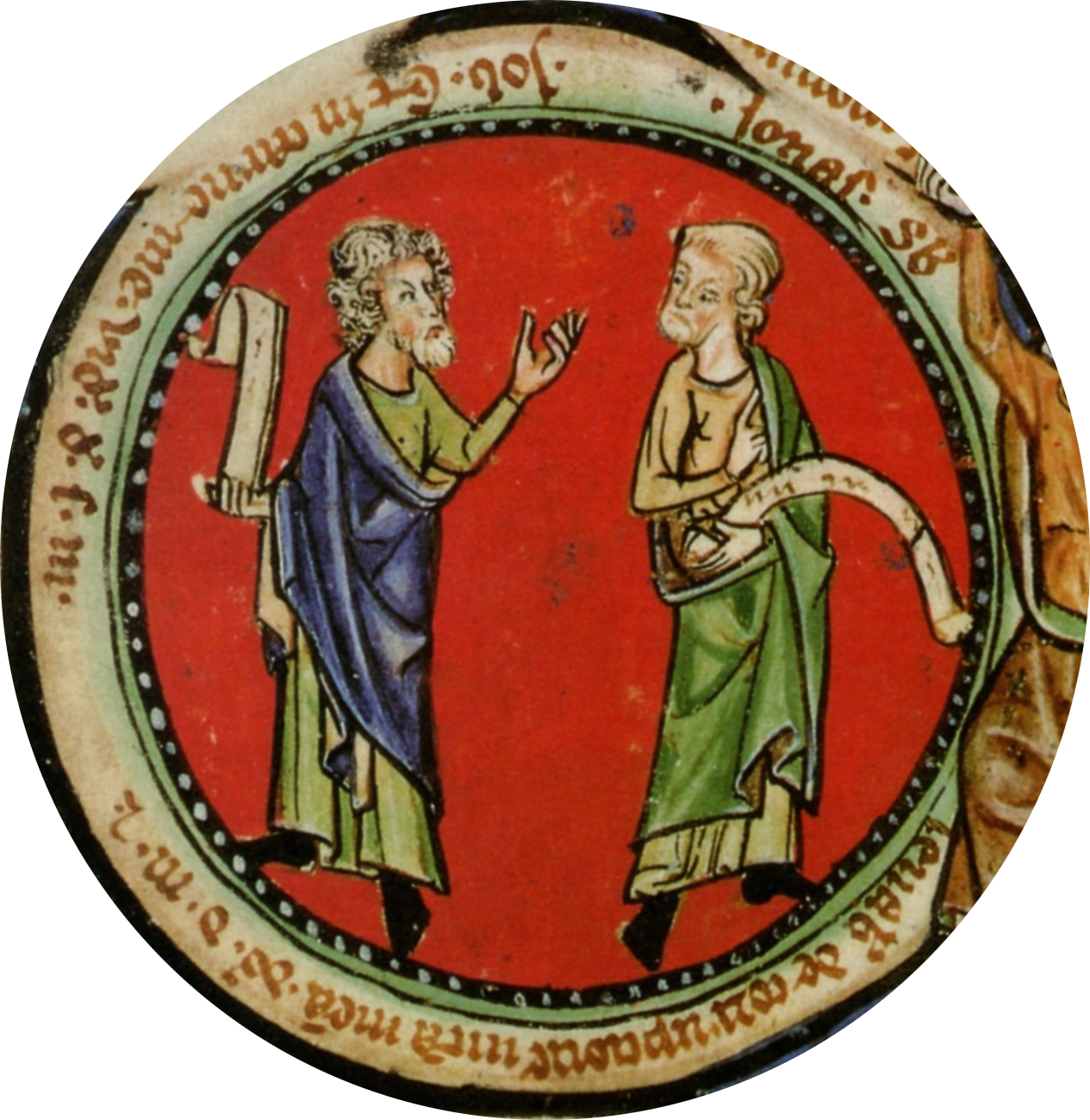
↑ Bottom left:Job and Jonah (Job 19:26; Jonah 2:7)
“Job: And in my flesh I shall see God my [savior]. Jonah: Thou shalt lift up my life from corruption, O Lord my God.”
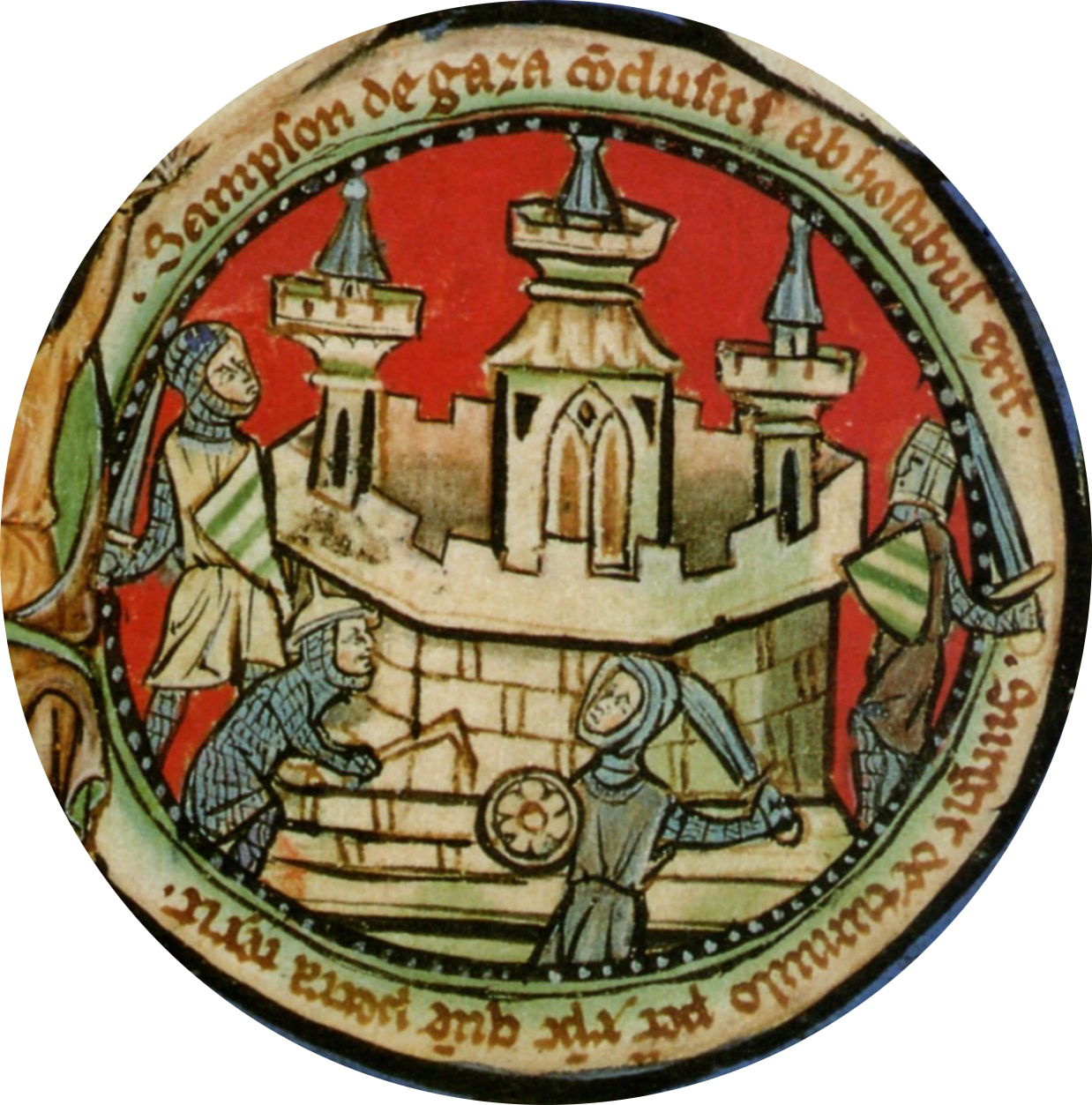
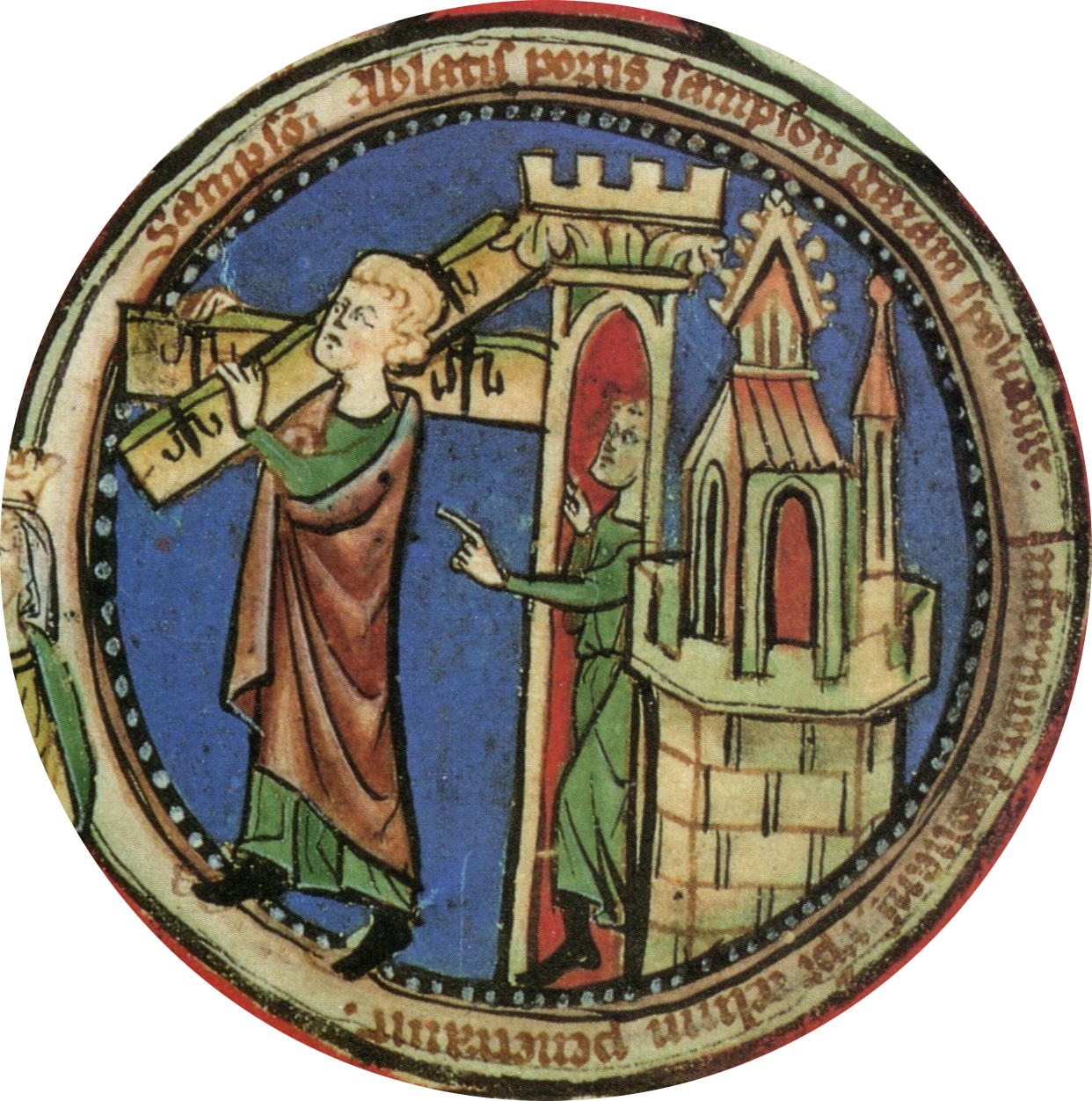
↑ Bottom right:Samson’s Escape from Gaza (Judg. 16:1–3)
“The imprisoned Samson escaped from Gaza and his enemies. Christ the stone, whom the stone covered, rose from the tomb.”
This roundel portrays Philistine soldiers of Gaza encircling the city gate to kill Samson the Israelite. But Samson escapes their watch unharmed, in a dramatic episode depicted on the following page (see below). The scene here is rarely depicted, whereas what follows in the narrative—Samson carrying the gates of Gaza—was a popular type of the Resurrection. Notice how the soldiers parallel the sleeping ones in the central scene, both groups bested by God’s power.
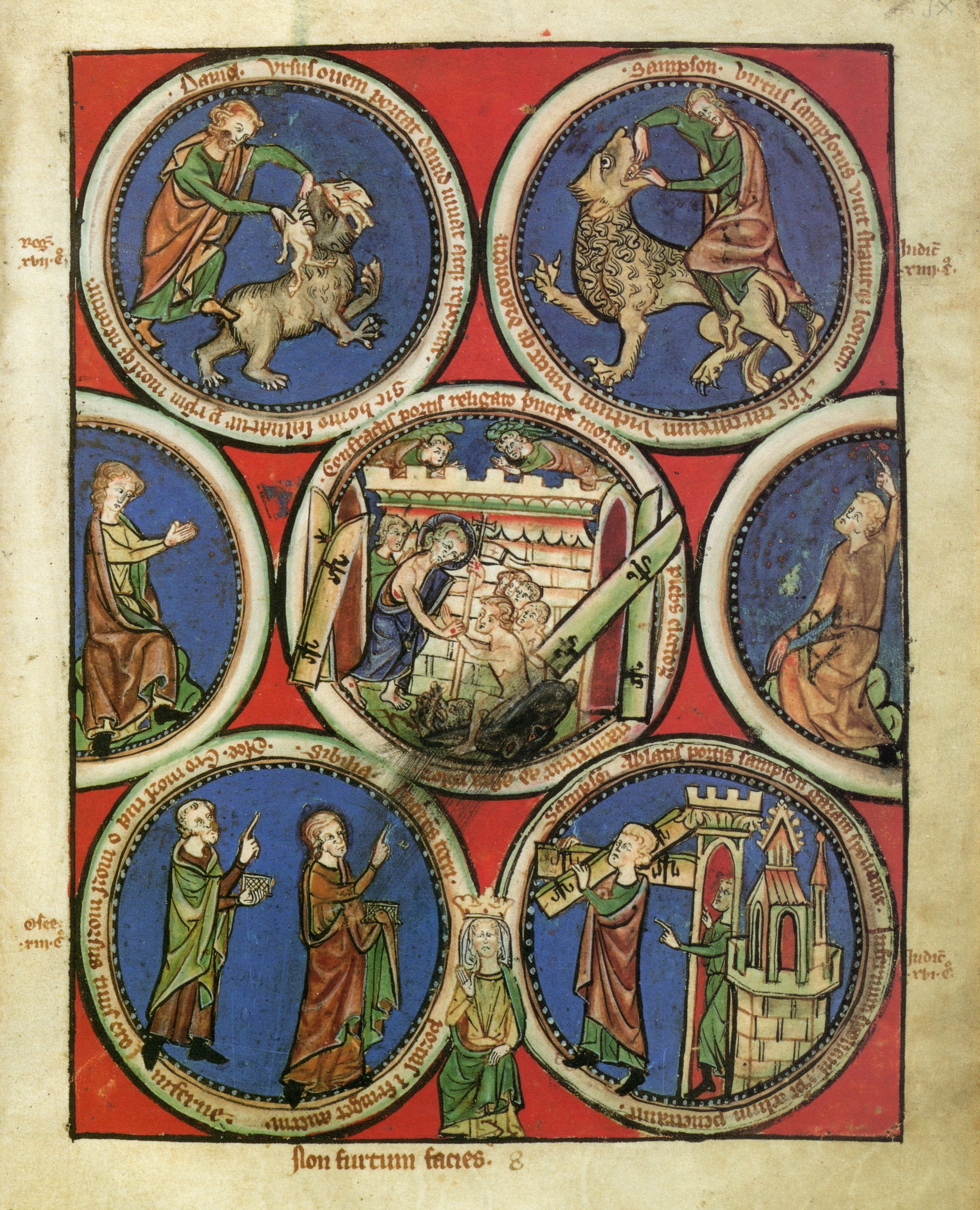
Folio IX (6r)
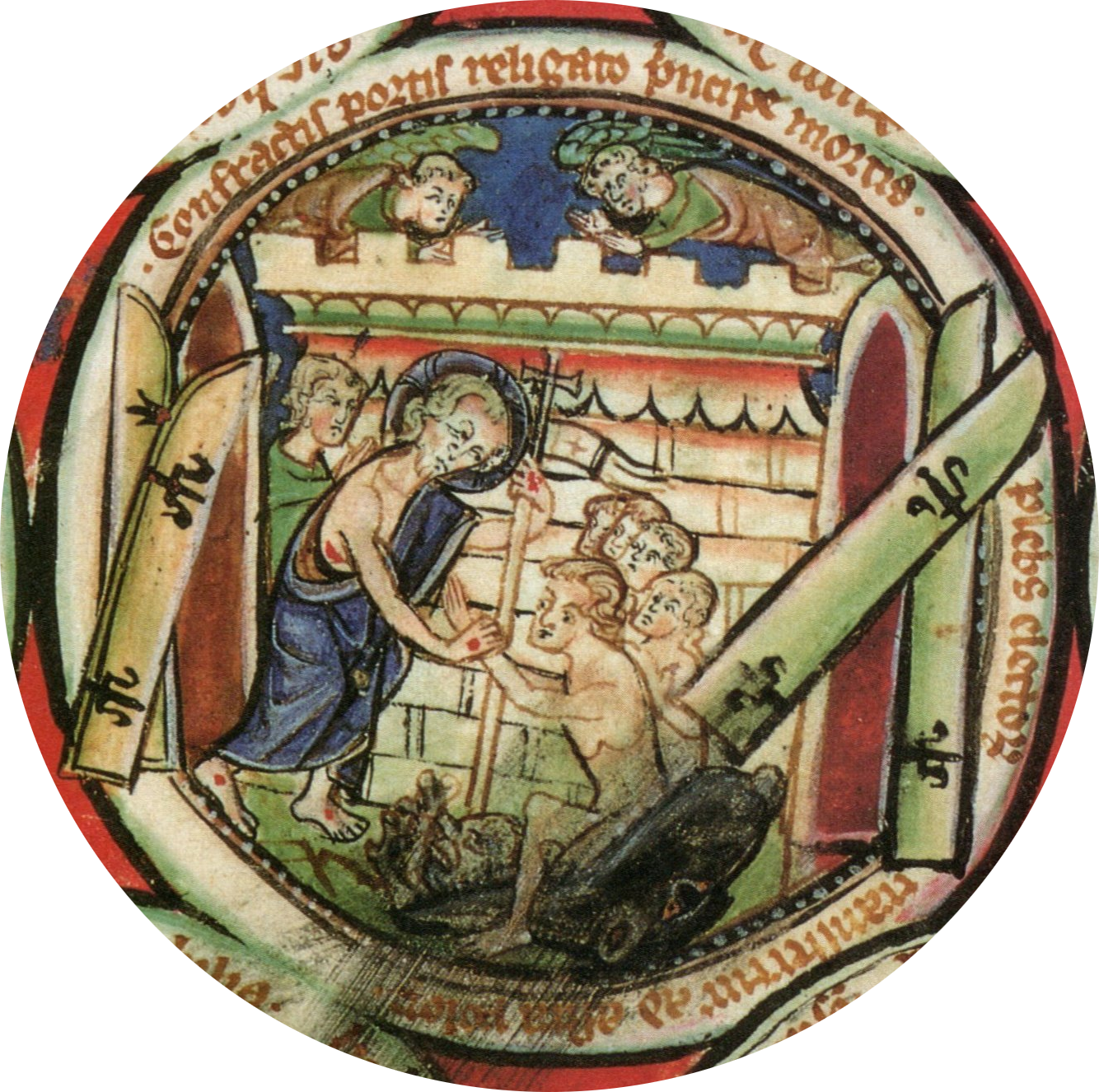
“Christ Opens Limbo,” etc., from the Eton Roundels manuscript, English Midlands, 1260–70. Eton College Library, MS 177, fol. IX. Reproduced by permission of the Provost and Fellows of Eton College.
“The gates having been broken and the prince of death bound, the body of the elect is carried to the stars in the heavens.”
Christ’s Descent into Limbo, or the Harrowing of Hell, is an episode inferred from a few enigmatic biblical verses and elaborated in the apocryphal Gospel of Nicodemus. In the Eastern Orthodox Church, it is the primary icon of the Resurrection: Christ breaking down the gates of hell to rescue his predeceased beloveds from death and Satan. Medieval artists in the West were also fond of picturing the Harrowing, often portraying the entrance to hell as a monstrous maw (called a “hellmouth”).
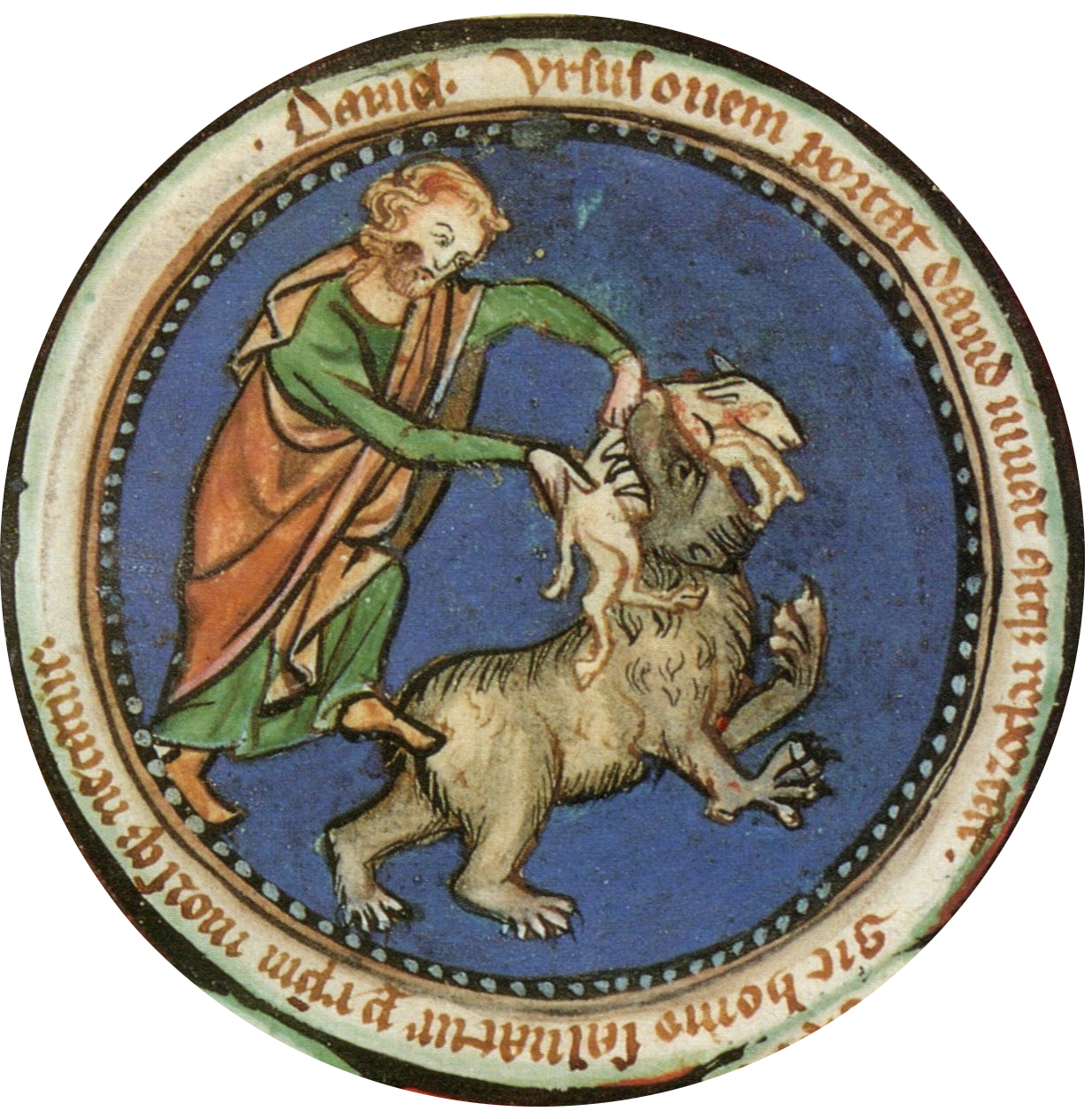
↑ Top left:David Saves the Lamb from the Bear (1 Sam. 17:34–37)
“David. The bear is carrying off a sheep. David assists [the sheep], and takes it back. In the same way, man is saved by Christ and death is slain.”
David, who was a shepherd before he was anointed king of Israel, figures Christ in how he fiercely protected the lambs in his care, intervening to save them whenever they were snatched away by a lion or bear; he’d pry open the beast’s jaws, free the lamb, and then strike the beast dead, he relays to Saul. In a similar manner, Christ pried open the jaws of hell to save his precious sheep.
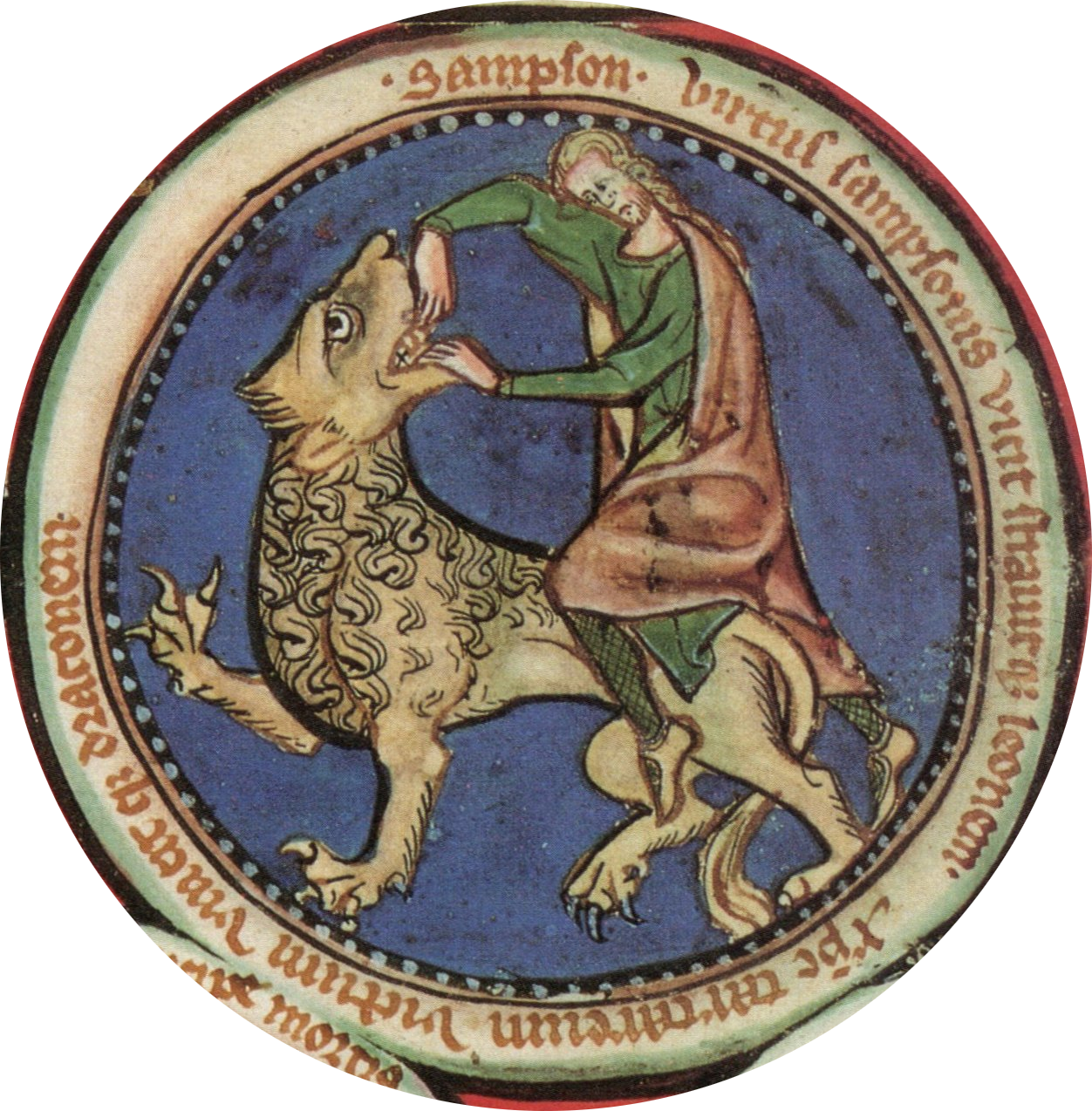
↑ Top right:Samson Kills the Lion (Judg. 14:5–8)
“Samson. The strength of Samson conquered the lion and tore [it] to pieces, and Christ conquers defeated hell together with the dragon.”
When Samson went down to the vineyards of Timnah to seek a wife, he encountered a fearsome lion, and “the spirit of the LORD rushed on him, and he tore the lion apart barehanded” (Judg. 14:6). This was Samson’s first display of divine empowerment.
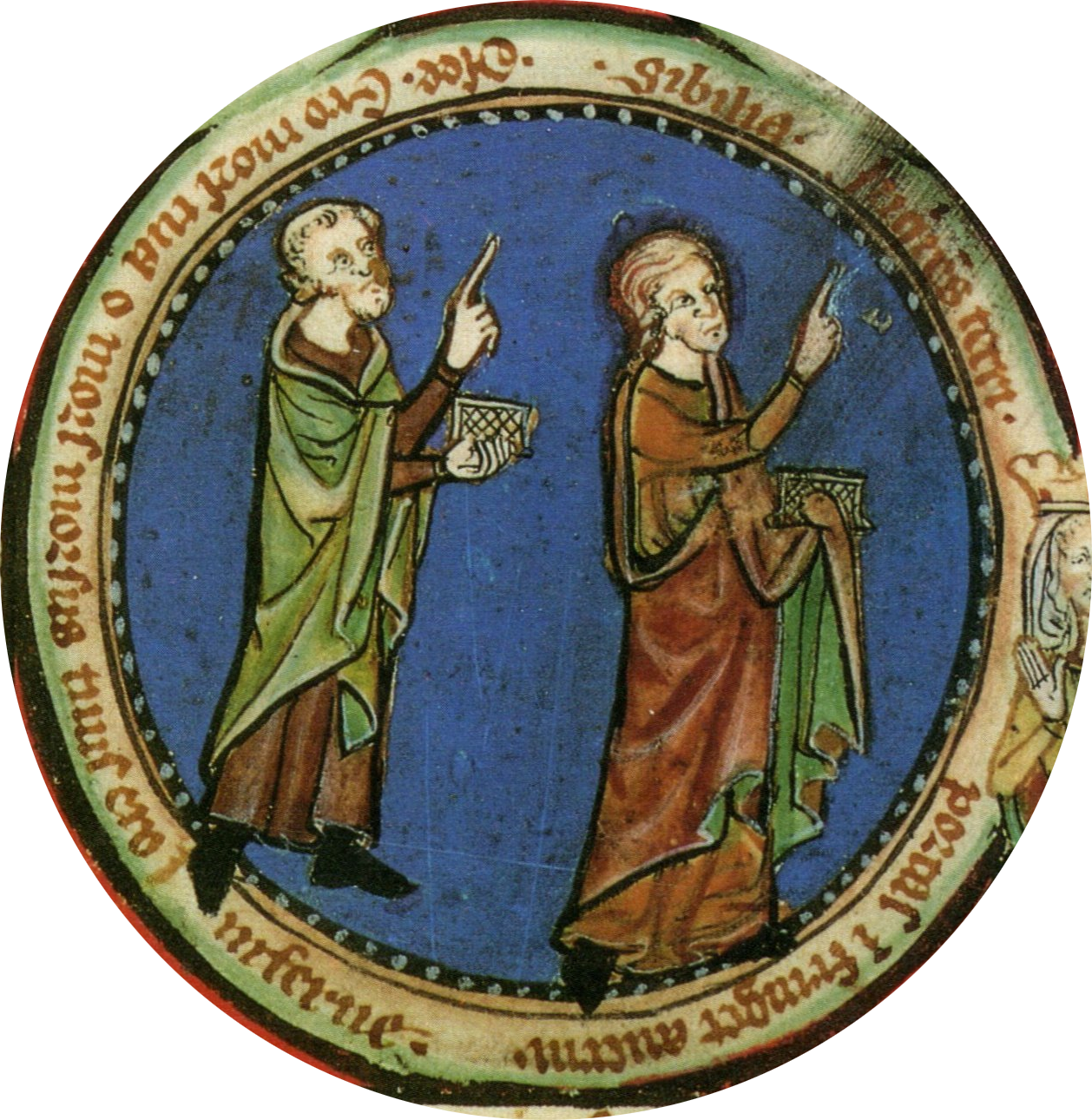
↑ Bottom left:Hosea and the Erythraean Sibyl (Hosea 13:14; Augustine, PL XLI 579)
“Hosea: O death, I will be your death; O hell, I will be your torment. Sibyl: The seeker will break the gates of the hideous underworld.”
The Sybilline Oracles is a collection of ancient Greek prophecies ascribed to the pagan sibyls (but many of which were actually written by Jews and Christians). Several of the church fathers cited them in defense of Christianity. The Erythraean Sibyl, for example, is said to have foretold the coming of Christ through an acrostic whose initial letters spell out “Ιησόύς Χριστός Θεου Ύίος Σωτηρ Σταύρος” (Jesus Christ, God’s Son, Savior, Cross). (See Eusebius’s Oration of Constantine, chap. 18.) She appears in the floor mosaic at Siena Cathedral, the stained glass at Beauvais Cathedral, Michelangelo’s Sistine Chapel, the Van Eycks’ Ghent Altarpiece, and a number of other medieval and Renaissance Christian artworks.
↑ Bottom right:Samson and the Gates of Gaza (Judg. 16:1–3)
“By carrying off the gates, Samson robbed Gaza. Robbing hell, Christ entered heaven.”
To break free of the Gazites, Samson tore the doors of the city gates off their hinges and carried them away, a demonstration of triumph. This feat prefigured Christ’s breaking out of his tomb. It can also be read, as on this Eton folio, as a prefigurement of Christ’s storming the gates of hell to release those held captive by the devil.
This is the first of eight daily art-and-song posts, one for each day of the Easter Octave.
LOOK: Folio 8r (detail) from the Harley Psalter
Detail from the Harley Psalter, Canterbury, first half of 11th century. London, British Library, Harley MS 603, fol. 8r.
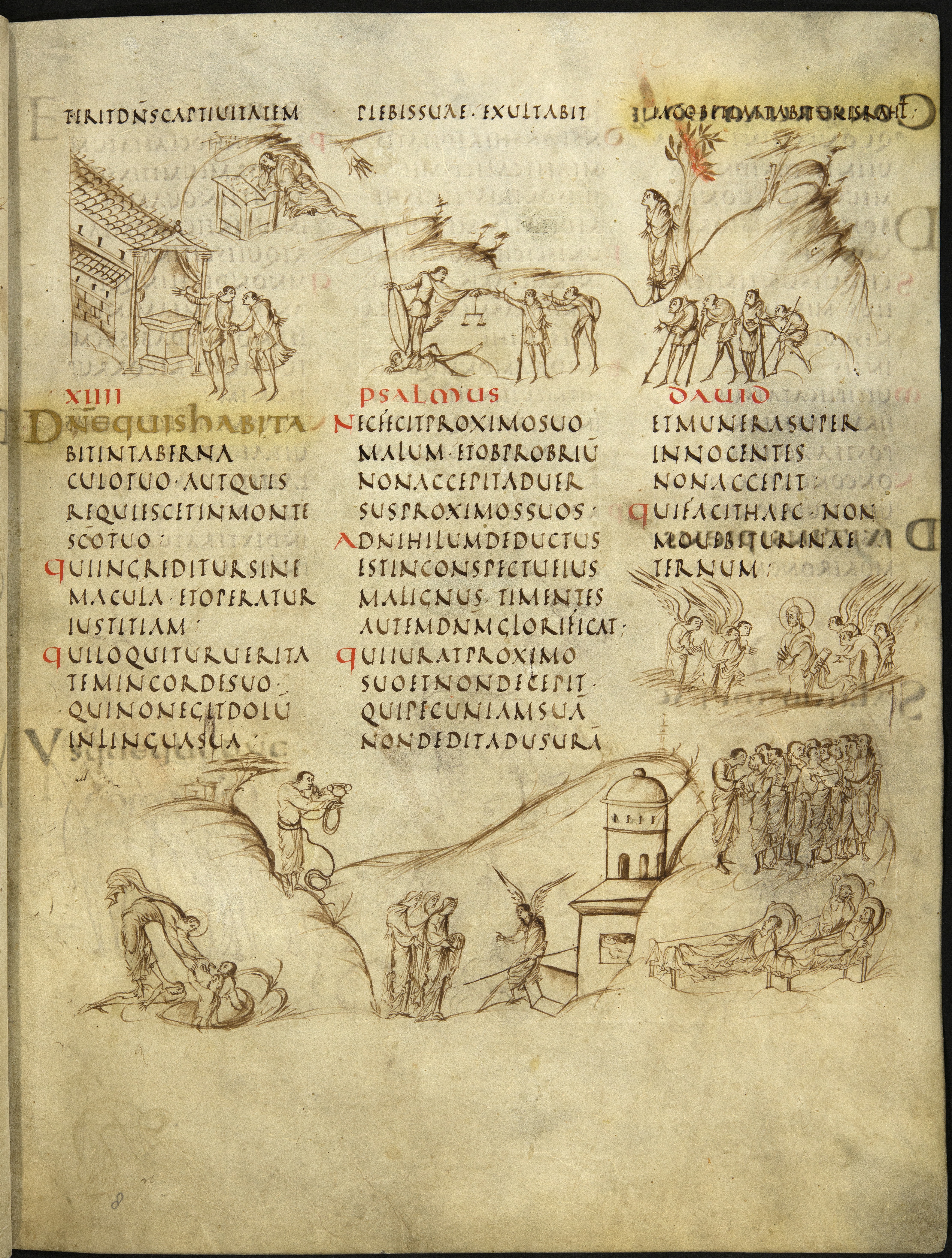
Produced at Christ Church in Canterbury, England, in the eleventh century, the Harley Psalter is celebrated for its lively and delicate multicolored line drawings executed in green, blue, pale sepia, and red inks, which illustrate individual lines from the Psalms, sometimes interpreting them in light of the New Testament. The manuscript is closely based on the ninth-century Utrecht Psalter from France, with a very similar arrangement and many near-identical images.
Folio 8r illustrates Psalm 16 (Psalm 15 in the Vulgate), even though the text of that psalm appears on the following page. I’ll focus on the three drawings at the bottom left (pictured above).
On the far left, the risen Christ pulls Adam and Eve up out of the pit of hell, trampling Hades (death personified as a crumpled man). To the right, three women go to visit Jesus’s tomb early on Easter morning, only to find it empty, save for the abandoned graveclothes—which we can see through an opening in the lower story.
These two vignettes illustrate Psalm 16:10: “For thou wilt not leave my soul in hell; neither wilt thou suffer thine Holy One to see corruption” (KJV). In the New Testament, both Peter (Acts 2:24–28) and Paul (Acts 13:35) apply this verse to Jesus’s resurrection.
The Hebrew word translated into English as “hell” is Sheol, the realm of the dead. In the Apostles’ Creed, the church proclaims that Jesus “was crucified, died, and was buried; he descended into hell [or ‘to the dead,’ as some translations render it]. On the third day he rose again . . .” As have and will most all humans, Jesus went down into the grave—but God did not leave him there. Nor will he leave his holy ones in that shadowy netherworld of deceased souls. Paul writes that Jesus is the first fruits of the harvest of eternal life (1 Cor. 15:20), his resurrection a foretaste and guarantee of the resurrection of all believers. That’s why the church developed the image of the Harrowing of Hell, or Anastasis, showing Christ triumphantly retrieving our ancestors in the faith from the Pit.
Matthew records that at the moment of Jesus’s death, the earth quaked, opening tombs, “and many bodies of the saints who had fallen asleep were raised. After his resurrection they came out of the tombs and entered the holy city and appeared to many” (Matt. 27:52–53). What a strange phenomenon! That’s the harrowing.
The figure who appears in the Harley Psalter between the Harrowing of Hell and the Holy Women at the Tomb is the psalmist himself. He stands on a hillside holding a cup in his right hand and touching his lips with his left, harking to Psalm 16:4–5: “Their [idolaters’] drink offerings of blood I will not pour out or take their names upon my lips. The LORD is my chosen portion and my cup . . .”
If you want to explore the manuscript’s predecessor, the Utrecht Psalter, the Universiteitsbibliotheek Utrecht (its owning institution) provides a full, annotated digital scan, in which every vignette is linked to the psalm verse it illustrates and accompanied by a description. It’s a wonderful resource! Here’s folio 8r, for example.
Psalm 15(16) from the Utrecht Psalter, Reims, France (Hautvilliers Abbey), ca. 820-30. Utrecht, Universiteitsbibliotheek, MS 32, fol. 8r.
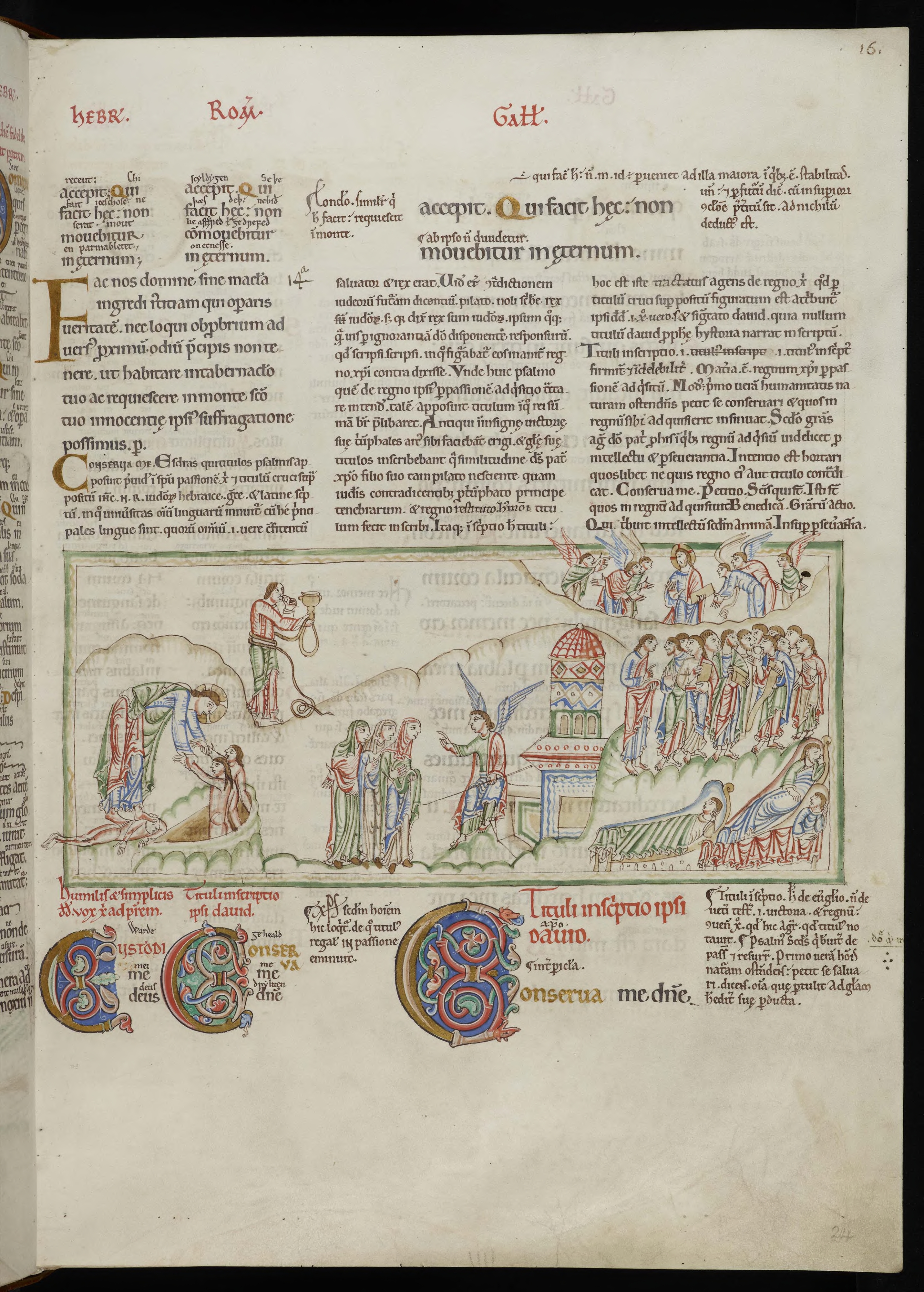
See also the Eadwine Psalter, another copy of the Utrecht Psalter, only slightly later than Harley. Folio 24r corresponds with folio 8r in Utrecht and Harley.
Psalm 15(16) from the Eadwine Psalter, Canterbury, ca. 1150. Cambridge, Trinity College, R.17.1, fol. 24r.
LISTEN:“Rise Up (Lauds)” by Dylan McKeeman, on Good Morning, Happy Easter, vol. 3, by the Morning and Night Collective, 2014
Rise up this morning Jesus is risen! Rise up this morning and praise Rise up this morning Jesus is risen! Rise up this morning and praise
He is risen indeed He is risen for me He is risen this blessed day He is risen indeed He has set us all free He’s risen this blessed day
Dylan McKeeman wrote this song while serving as the director of music and arts at Reynolda EPC in Winston-Salem, North Carolina. He is currently the director of modern worship and production at First Presbyterian Church, also in Winston-Salem.
The subtitle “Lauds” (Latin for “praises”) refers to an early-morning canonical hour designated for prayer, corresponding with dawn.
The song opens with the low, bowed tones of an upright bass, and then a violin, banjo, and guitar enter, all improvising around an F2 chord. Vocalist Jess Silk provides an ethereal hum underneath, which, together with the instruments, evokes a mist lifting. After about the first minute, the song modulates up a whole step to G and a bright banjo tune kicks in along with the summons: “Rise up this morning, Jesus is risen!”
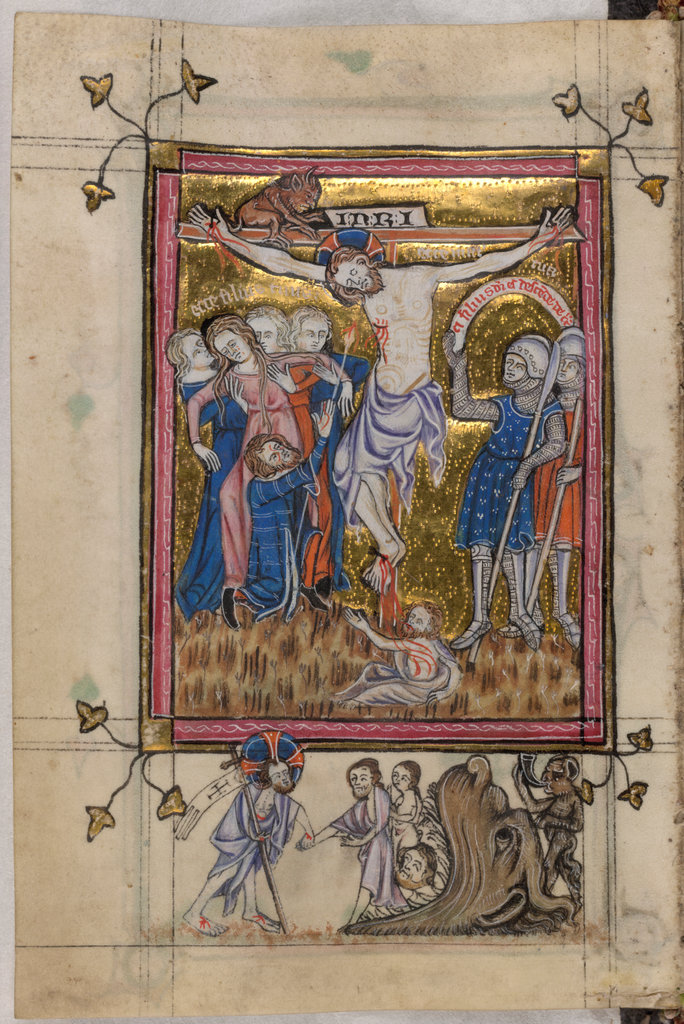
Crucifixion with bas-de-page scene of Christ leading figures from the mouth of Hell, from the Taymouth Hours, England, second quarter of 14th century. British Library, Yates Thompson 13, fol. 122v.
ORIGINAL MIDDLE ENGLISH:

Loue me brouthte,
& loue me wrouthte,
Man, to be þi fere.
Loue me fedde,
& loue me ledde,
& loue me lettet here.

Loue me slou,
& loue me drou,
& loue me leyde on bere.
Loue is my pes,
For loue i ches,
Man to byƷen dere.

Ne dred þe nouth,
I haue þe south,
Boþen day & nith,
To hauen þe,
Wel is me,
I haue þe wonnen in fith.
MODERN ENGLISH TRANSLATION:

Love me brought,
And love me wrought,
Man, to be thy fere. [companion]
Love me fed,
And love me led,
And love me fastens here.

Love me slew,
And love me drew,
And love me laid on bier.
Love’s my peace;
For love I chose
To buy back man so dear.

Now fear thee not;
I have thee sought
All the day and night.
To have thee
Is joy to me;
I won thee in the fight.

Trans. Victoria Emily Jones
This medieval passion lyric is from the Commonplace Book of John of Grimestone, compiled in Norfolk, England, in 1372 and owned by the National Library of Scotland in Edinburgh. It was transcribed by Carleton Brown in Religious Lyrics of the Fourteenth Century(Oxford: Clarendon Press, 1924), page 84.
Adv.MS.18.7.21, fol. 121r, with “Love Me Brought” poem highlighted. In this manuscript, the Franciscan friar John of Grimestone jotted down miscellaneous verses and quotes to use in his preaching.
In the poem, Christ addresses humankind from the cross, professing his great love for her. He was begotten in love by the Father, and it’s love that brought him to earth. Love nourished and guided him, and for love he stayed the difficult course, all the way to the end. Satan had stolen Christ’s beloved, and to win her back, Christ went into battle, to redeem her who was rightfully his. His decisive move: spreading out his arms across a wooden beam, so as to embrace the world, and submitting to being nailed there.
He died for love of his lady. Love is what drew him to and secured him to that cross, what kept him there when the physical and emotional agony begged he desist. And because of his persistence in seeking us, his courageous endurance as the enemy assailed, he attained ultimate victory. “Well is me!” (Blessed am I), he exclaims, “for you are mine and I am yours.” Let nothing stand between.
Katharine Blake, the founder and musical director of Mediæval Bæbes, wrote a setting of “Love Me Broughte,” in medieval style, for the group’s 1998 album Worldes Blysse. Sweet and vigorous, it features, besides voices, a zither, pipe, recorder, tambourine, and drums.
Did you enjoy this poem? For more like it, come on out on November 23 to “Christ Our Lover: Medieval Art and Poetry of Jesus the Bridegroom,” a lecture by Dr. Grace Hamman that I’ve organized for the Eliot Society in Annapolis. Learn some of the ways Christian preachers, poets, theologians, mystics, and artists in the late Middle Ages, both male and female, conceptualized Christ’s passionate love, drawing from the Song of Songs, courtly love poetry, and more—often in quite imaginative ways!
>> “He Is Lord (In Every People),” adapt. Gregory Kay: In this video from 2021, members of Spring Garden Church in Toronto take turns singing the popular twentieth-century worship song (of unknown authorship) “He Is Lord” in their native languages: English, Portuguese, Arabic, Korean, and Chinese. Greg Kay, one of the church’s copastors, added a fun refrain that highlights the global character of Christianity and the lordship of Christ over all creation, which everyone joins in on. Love this idea! [HT: Liturgy Fellowship]
>> Easter Medley performed by Infinity Song, feat. Victory Boyd:Infinity Song is a sibling band from New York City that was led for years by Victory Boyd, who is now focusing on her solo music career; its current members, represented in this video from 2021, are Abraham, Angel, Israel, and Thalia “Momo” Boyd. (Victory is singing lead.) The group combines the songs “In the Name of Jesus” by David Billingsley, “Jesus Is Alive” by Ron Kenoly [previously], and “Redeemer” by Nicole C. Mullen into an Easter medley at Fount Church in New York.
>> “Yessu Jee Utheya” (یسوع جی اُٹھیا) (Jesus Is Risen), performed by Tehmina Tariq:Tehmina Tariq is a prolific gospel singer from Islamabad, Pakistan. Here she performs a song in Urdu by Nadir Shamir Khan (words) and Michael Daniel (music). Press the “CC” button on the YouTube video player to follow along with the lyrics. For a more recent Easter song that Tariq recorded, see “Zinda Huwa Hai Masih” (The Messiah Is Risen). [HT: Global Christian Worship]
+++
MEDIEVAL MYSTERY PLAY: The Harrowing of Hell from the York cycle, produced by the YMPST (York Mystery Plays Supporters Trust): From the mid-fourteenth to mid-sixteenth century in England, during the feast of Corpus Christi in early summer, villagers used to enact stories from the Bible on moveable stages called pageant wagons, which would wheel through town making various stops for performance. Playing the roles of sacred personages were not professional actors but members of the trade guilds. Such plays were banned in Tudor times but since the mid-twentieth century have enjoyed a revival.
One of the few complete surviving English mystery play cycles, consisting of forty-eight individual verse dramas of about twenty minutes each, is the York Mystery Plays, named after the historic town where they originated. One of the plays, assigned to the town saddlers, is The Harrowing of Hell. The following video is a 2018 performance sponsored by the York Mystery Plays Supporters Trust, also available on DVD. You can follow along with the script at TEAMS Middle English Texts, though note that the players do adapt it lightly. Learn more at https://ympst.co.uk/.
A soul writhes in Hades, awaiting rescue by Christ, in the 2018 YMPST wagon play performance of The Harrowing of Hell
For a preview of the language, here’s Adam’s speech toward the end, after Christ binds Satan and casts him into a fiery pit (I love the alliterative phrase “mickle is thy might”!):
A, Jesu Lorde, mekill is thi myght That mekis thiselffe in this manere Us for to helpe as thou has hight Whanne both forfette, I and my feere. Here have we levyd withouten light Foure thousand and six hundreth yere; Now se I be this solempne sight Howe thy mercy hath made us clene.
Modern English translation:
Ah, Lord Jesus, mickle [great] is thy might That makest thyself in this manner To help us as thou hast said When both of us offended thee, I and my companion [Eve]. Here have we lived without light For four thousand six hundred years; Now see I by this solemn sight How thy mercy hath made us clean.
The YMPST performance incorporates modern elements in the music and costuming, including an electric guitar–driven rendition of the American gospel song “Ain’t No Grave” at the opening and closing.
+++
ART COMMENTARIES:
Below are discussions of two medieval English artworks of the Harrowing of Hell, one of my favorite religious subjects. In modern-day parlance, the word “hell” (an English translation of the Greek “Tartarus” or “Hades” or the Hebrew “Sheol”) typically connotes a place of eternal torment where the damned go, but in Christian theology it was long used more broadly to refer to the compartmentalized netherworld where both righteous and unrighteous souls go after death to await the general resurrection that will take place at Christ’s return.
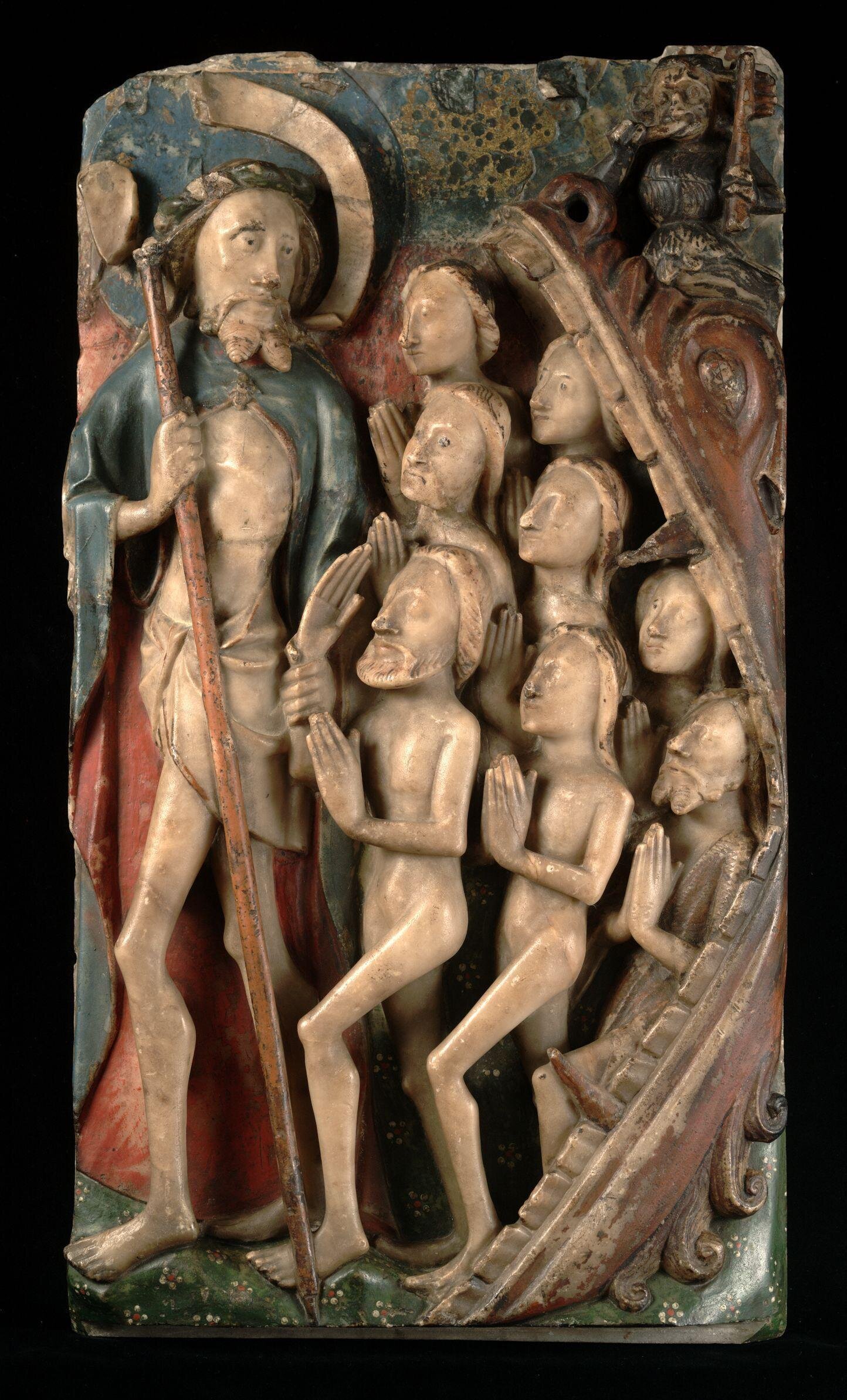
>> “The Harrowing of Hell” (Smarthistory video): Drs. Nancy Ross and Paul Binski discuss a fifteenth-century alabaster that’s in the collection of the Victoria and Albert Museum in London. What sticks out to me—the commentators mention it only briefly—is that Christ stands on a green, flowery lawn! The artist is probably alluding to the springtime, the new life, that Jesus’s resurrection ushered in: the redeemed exit the hellmouth, barefoot like their Lord, onto this lush grass. This detail reminds me a bit of Fra Angelico’s Noli me tangere fresco at San Marco in Florence.
The Harrowing of Hell, England, 15th century. Carved, painted, and gilt alabaster, 58 × 32 cm. Victoria and Albert Museum, London.
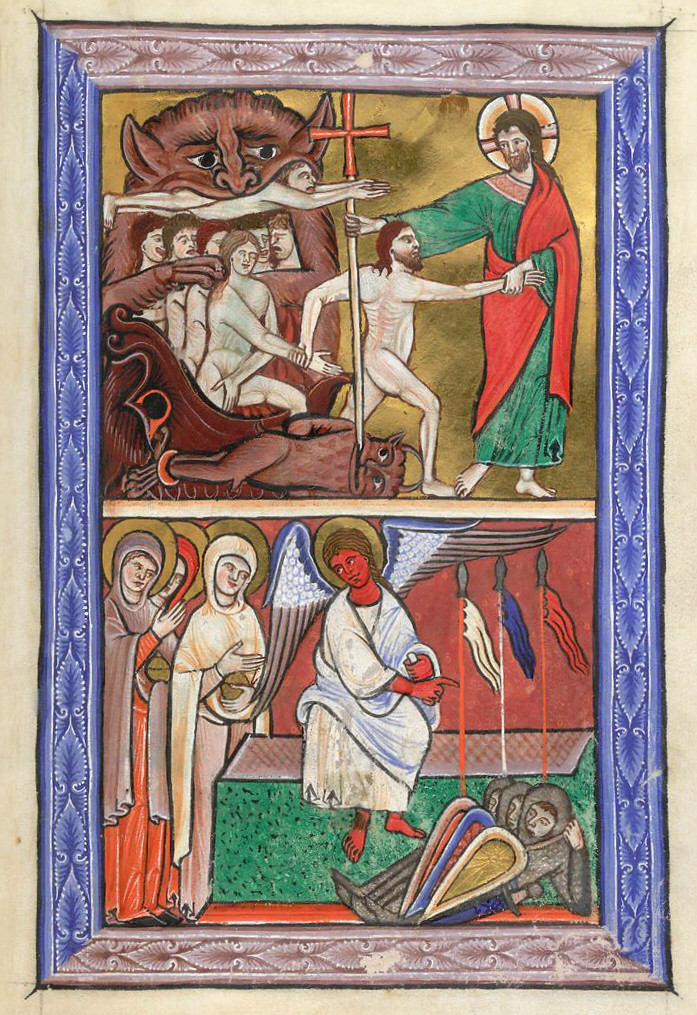
>> “Under the Earth” by Joanna Collicutt: The Visual Commentary on Scripture is a free online resource that provides material for teaching, preaching, researching, and reflecting on the Bible, art, and theology. For one of her three VCS-commissioned “visual commentaries” on Philippians 2:1–11, Rev. Dr. Joanna Collicut has selected an illumination of the Harrowing of Hell from a thirteenth-century psalter. The Christ Hymn that forms the meat of this passage celebrates Jesus’s descent and ascent, and in verse 10 it says that at his name, every knee will bow in heaven, on earth, and “under the earth.” This phrase had never stood out to me until now.
The Harrowing of Hell and The Holy Women at the Tomb, from an English psalter (BL Arundel 157, fol. 110), ca. 1220–40. Ink, tempera, and gold leaf on vellum, 29.5 × 20 cm. British Library, London.
Lift up your heads, O gates! and be lifted up, O ancient doors, that the King of glory may come in! Who is the King of glory? The LORD, strong and mighty, the LORD, mighty in battle. Lift up your heads, O gates! and be lifted up, O ancient doors, that the King of glory may come in! Who is this King of glory? The LORD of hosts, he is the King of glory. Selah
—Psalm 24:7–10
LOOK: Christ’s Descent into Hell from the Stuttgart Psalter [HT]
Christ’s Descent into Hell, from the Stuttgart Psalter, made at the scriptorium at St. Germain-des-Prés in Paris, ca. 820–30. Cod.bib.lat.fol.23, fol. 29v, Württembergische Landesbibliothek, Stuttgart, Germany. Click on image to see full page and explore further.
The above psalm passage is read at several times during the church year, depending on your tradition: during Advent, in relation to Christ’s coming into the world (see, e.g., here); on Palm Sunday, where the gates are those of Jerusalem; and on Ascension Day, when Christ (re)enters heaven. But in some illuminated psalters—such as the Stuttgart Psalter from ninth-century France—it is connected with Jesus’s descent into hell between his death and resurrection.
On the Psalm 24 page of the Stuttgart Psalter, the manuscript’s anonymous artist has depicted Christ storming the gates of hell, which are guarded by two winged, fire-spitting demons. Satan or Hades (Death) cowers in the bottom left corner, licked by flames and fearful of his imminent end. Encompassed in a green mandorla and accompanied by an angel, Christ breaches enemy territory, using a long slender cross to break down the doors behind which Satan has kept souls imprisoned. He is here to strike Death dead and gain back his beloveds in an awesome display of glory, power, and love.
LISTEN: “Lift Up Your Heads”| Text: Psalm 24:7–10 | Music by Joseph M. Martin and Jon Paige, 1996 | Performed by CMS College Choir Kottayam, dir. Vimal Kurian, 2015
Lift up your heads, you everlasting doors; open up and let the King of glory come in. Let the King of glory come in. (Repeat)
Who is the King of glory? Who is the King of glory? The Lord of hosts! He is the King of glory. The Lord of hosts! He is the King of glory.
Lift up your heads, you everlasting doors; open up and let the King of glory come in. Let the King of glory come in.
Alleluia, let us sing To the one eternal King; Alleluia evermore To the King and Lord of lords.
Who is the King of glory? Who is the King of glory? The Lord of hosts! He is the King of glory. The Lord of hosts! He is the King of glory.
Lift up your heads, you everlasting doors; open up and let the King of glory come in. Let the King of glory come in. (Repeat)
Jyoti Sahi (Indian, 1944–), Triptych of Salvation, 2021. Acrylic, oil, and ocher on canvas, 24 × 48 in. All photos courtesy of the artist.
Death trampled our Lord underfoot, but he in his turn treated death as a highroad for his own feet. He submitted to it, enduring it willingly, because by this means he would be able to destroy death in spite of itself. Death had its own way when our Lord went out from Jerusalem carrying his cross, but when by a loud cry from that cross he summoned the dead from the underworld, death was powerless to prevent it.
Death slew him by means of the body which he had assumed, but that same body proved to be the weapon with which he conquered death. In slaying our Lord, death itself was slain. It was able to kill natural human life, but was itself killed by the life that is above the nature of mortals.
Death could not devour our Lord unless he possessed a body, neither could hell swallow him up unless he bore our flesh; and so he came in search of a chariot in which to ride to the underworld. This chariot was the body which he received from the Virgin; in it he invaded death’s fortress, broke open its strong room, and scattered all its treasure.
At length he came upon Eve, the mother of all the living. She was that vineyard whose enclosure her own hands had enabled death to violate, so that she could taste its fruit; thus the mother of all the living became the source of death for every living creature. But in her stead Mary grew up, a new vine in place of the old. Christ, the new life, dwelt within her. When death, with its customary impudence, came foraging for her mortal fruit, it encountered its own destruction in the hidden life that fruit contained. All unsuspecting, it swallowed him up, and in doing so released life itself and set free a multitude.
He who was also the carpenter’s glorious son set up his cross above death’s all-consuming jaws, and led the human race into the dwelling place of life. Since a tree had brought about the downfall of humankind, it was upon a tree that humankind crossed over to the realm of life. Bitter was the branch that had once been grafted upon that ancient tree, but sweet the young shoot that has now been grafted in, the shoot in which we are meant to recognize the Lord whom no creature can resist.
We give glory to you, Lord, who raised up your cross to span the jaws of death like a bridge by which souls might pass from the region of the dead to the land of the living. . . .
We give glory to you who put on the body of a single mortal and made it the source of life for every other mortal.
You are incontestably alive! Your murderers sowed your living body in the earth as farmers sow grain, but it sprang up and yielded an abundant harvest of people raised from the dead.
Come then, my brothers and sisters, let us offer our Lord the great and all-embracing sacrifice of our love, pouring out our treasury of hymns and prayers before him who offered his cross in sacrifice to God for the enrichment of all.
—Ephrem the Syrian, sections 3–4 and 9 of the Eastertide sermon “On Our Lord,” trans. the International Commission on English in the Liturgy in TheLiturgy of the Hours, vol. 2 (New York: Catholic Book Publishing Co., 1976), 735–36
Ephrem the Syrian (ca. 306–373) was a prominent Christian theologian, hymnist, and teacher who is venerated as a saint and a doctor of the church. Born in Nisibis (in modern-day Turkey), he served as a deacon and later lived in Edessa, a center of Greek and Syriac theological and philosophical thought in Upper Mesopotamia. He spoke and wrote in Syriac, a dialect of Aramaic, and is the most significant of all the Syriac Christian fathers.
The three-paneled painting at the top of this post is by my friend Jyoti Sahi, one of the most theologically exploratory artists working today. I saw this triptych at an earlier stage of development when I visited his home in Silvepura Village, India, in 2019 and am so pleased by how it turned out. “It represents Christ ascending the cross (left), harrowing the underworld as the drummer (center), and rising like the sprout from the seed that is Mary, from whose womb he sprang forth (right),” Jyoti told me.
The central panel is based on iconography of the Anastasis, in which Jesus descends into Hades following his crucifixion to liberate those who have died. In such icons, Adam and Eve, who represent all of humanity, are “drawn up from the earth,” as Jyoti puts it. Jyoti portrays this rescue as a dance, with Jesus beating out the rhythms of redemption, as well as a time of planting and harvest (he wields a plow and a scythe). Jesus’s death tilled the soil, making conditions right for the dead to be raised to new life.
Jyoti has long been interested in the symbolism of the ladder and the seed, and both symbols are employed here. The ladder is an instrument of both descent and ascent, and the seed, as Christ himself taught, must “die”—be buried in the ground—before it yields life. In the right panel of the Triptych of Salvation, Jesus, having gone down into the earth, bursts forth from his casing, emerging as the tree of life, whose roots are watered by the river of life, which flows across all three panels. This tree is the cross transformed.
His arms raised again as they were on the cross but no longer pinned down, Jesus leads the dance of resurrection, and Adam and Eve and the others who have been delivered join in. They are the fruitful crop of Christ the Gardener.














 Art & Theology