Now the eleven disciples went to Galilee, to the mountain to which Jesus had directed them. When they saw him, they worshiped him, but they doubted. And Jesus came and said to them, “All authority in heaven and on earth has been given to me. Go therefore and make disciples of all nations, baptizing them in the name of the Father and of the Son and of the Holy Spirit and teaching them to obey everything that I have commanded you. And remember, I am with you always, to the end of the age.”
—Matthew 28:16–20
Jesus said to [his disciples] again, “Peace be with you. As the Father has sent me, so I send you.” When he had said this, he breathed on them and said to them, “Receive the Holy Spirit.”
—John 20:21–22
LOOK: The Great Commission by He Qi
He Qi (Chinese, 1950–), The Great Commission, 2017. Oil on canvas. [purchase giclée print]
In this painting by the Chinese artist He Qi (pronounced huh chee), Jesus holds a staff in his right hand (he is the Good Shepherd) and with the other points to the world outside Jerusalem’s gates, to which he calls his disciples to carry his all-renewing gospel. A modern cityscape rises up behind the figures, indicating that this call extends to the present era.
In the foreground, a minister baptizes a kneeling woman in red, their forms intercut with a fishing boat. The boat is a reference to Peter and Andrew’s original vocation as fishers and to Jesus’s promise, should they choose to follow him, to make them “fishers of people” (Matt. 4:19)—that is, gatherers of folks into the wide net of (proto-)Christian community, proclaiming and living out the kingdom of God in the power of God’s Spirit.
The Holy Spirit is represented as a dove sweeping down from the heavens, caressing the edge of Jesus’s halo. He’s the wind in the sails of the woman at the right, who goes forth into the darkness bearing the light of God’s word—her cheeks aglow with it, her feet eager to publish it abroad.
Her predecessors in the task of preaching the good news of Christ’s resurrection are portrayed in the background—the three women who first discovered the empty tomb and who then proceeded to “go quickly and tell” (Matt. 28:7).
LISTEN: “As the Father Sent Me” by Alana Levandoski, on Behold, I Make All Things New (2018)
Easter Sunday marks the beginning of a week in the liturgical calendar known as the Easter Octave, followed by a seven-week festival called Eastertide, also referred to as the Great Fifty Days.
Beginning with the Feast of the Resurrection and including the Feast of the Ascension, Eastertide lasts fifty days, paralleling the forty days Christ spent on earth after His resurrection, plus the ten days the disciples spent waiting for the promised Spirit of Jesus. Exclamatory worship and celebratory feasting characterize the prayers and practices of Eastertide, which include invitations for baptism, thanksgiving, savoring beauty, feasting, play, and caring for creation. It is a time of celebration for the new creation that Jesus inaugurates for all of us.
So keep celebrating! I will continue posting Easter content throughout the season, just at a lesser frequency.
On this eighth day of Easter and ever forward, may you be filled with the transforming knowledge, excitement, and power of Christ’s resurrection, and go out and share it with the world.
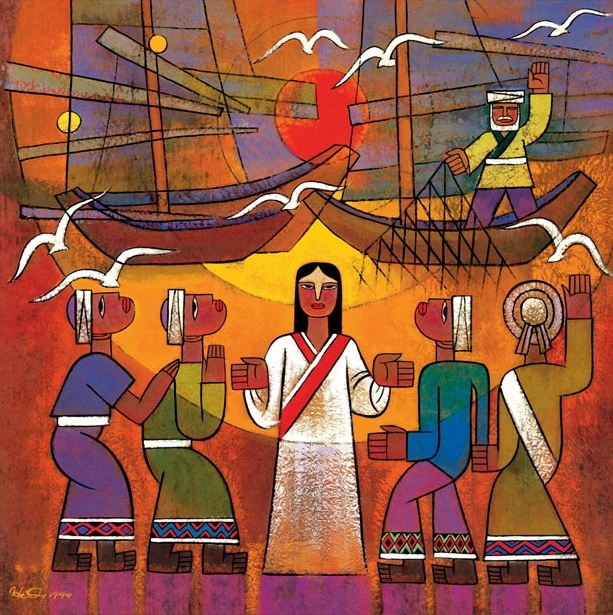
VISIO DIVINA SERIES: “During Asian Pacific American Heritage Month, C4SO [Diocese of Churches for the Sake of Others] celebrates artist He Qi, who reinterprets sacred art within an ancient Chinese art idiom. His work is a blend of Chinese folk art and traditional painting technique with the iconography of the Western Middle Ages and Modern Art. On each Sunday during May, we have licensed one of He’s paintings to illuminate one of the lectionary readings. We will provide prompts for you to do Visio Divina, or ‘sacred seeing,’ an ancient form of Christian prayer in which we allow our hearts and imaginations to enter into a sacred image to see what God might have to show us.” [HT: Global Christian Worship]
He Qi (Chinese, 1950–), Calling the Disciples, 1999. Oil on canvas.
For this past Lent the C4SO brought us the Stations of the Cross by Laura James, a self-taught painter of Antiguan heritage, combined with a liturgy by their scholar in residence, Rev. Dr. W. David O. Taylor. I appreciate their recognition of the value of visual art to the individual and corporate lives of their people.
+++
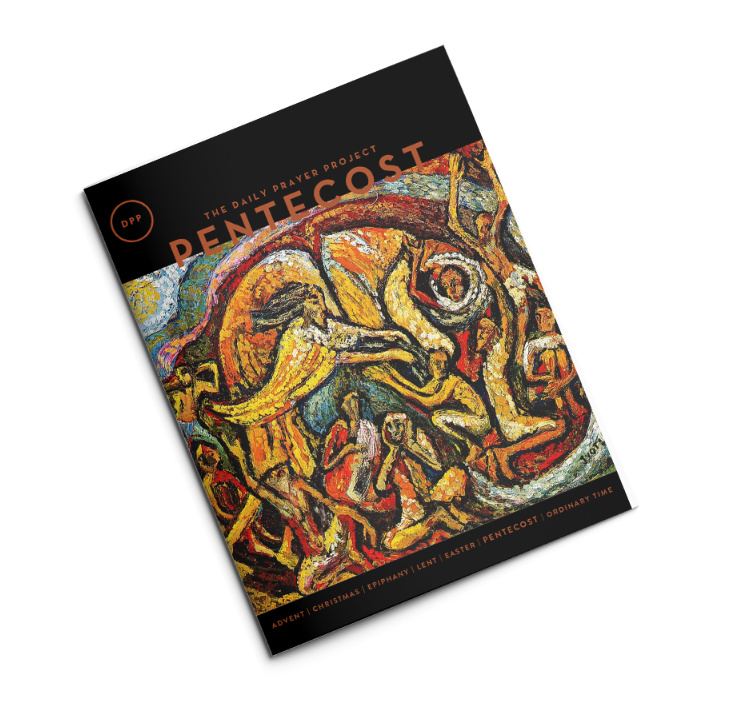
NEW DPP EDITION: Pentecost 2021: Pentecost is May 23, kicking off a new season of the church year—which means a new periodical from The Daily Prayer Project is hot off the presses! This is one of the publications I work for. “We celebrate and join in prayer with a vastly diverse church in this edition of the DPP. The Indian artist Jyoti Sahi’s dynamic painting Receive the Holy Spirit adorns the cover and leads us to a powerful remembrance of and meditation on that great outpouring of Pentecost. The church of the Caribbean gifts us with their song of Pentecost: ‘Fire, fire, fire! Fire fall on me!’ The Christian Council of Nigeria leads us in prayer and asks God to ‘grant us a vision of our land that is as beautiful as it could be . . . [and the] grace to put this vision into practice.’ The Korean songwriter Geon-yong Lee offers up a lament for the fractures of the church and invites us to truly long and work for unity: ‘Come, hope of unity; make us one body. Come, O Lord Jesus; reconcile all nations.’ . . .”
The two other featured artworks in this edition, which will be added to our online gallery May 23, are an abstract ink drawing by Takahiko Hayashi, evocative of the Spirit’s vitality, and a piece by Yuanming Cao that celebrates the steadfastness of the church in China using as its medium the everyday devotional materials of rural Christians in the Suzhou region.
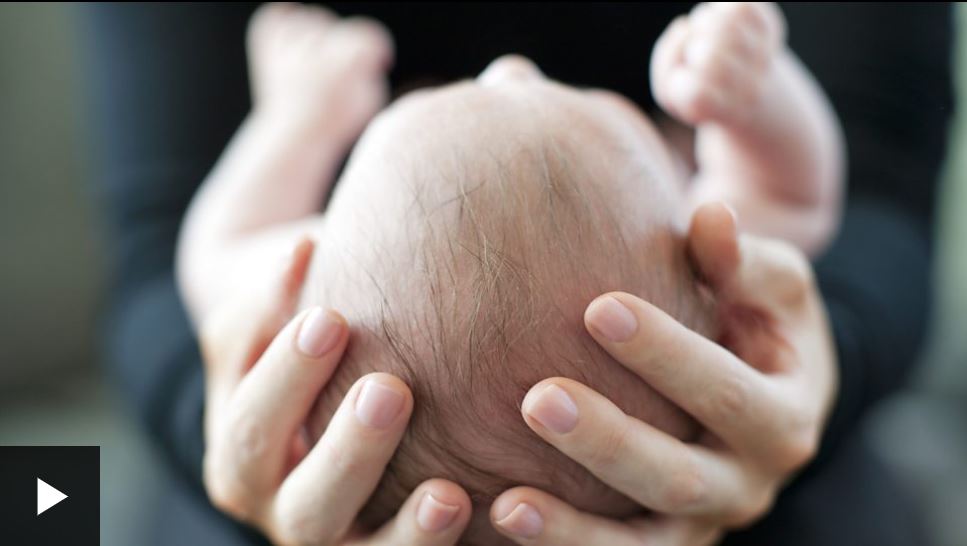
VIDEO: “What happens to humans when we can’t touch?”: “Touch is how we first communicate as babies. And it’s fundamental to human wellbeing. So what happens when we can’t touch?” This recent BBC Radio 4 video by Daniel Nils Roberts discusses the importance of touch to human development, connection, and health. Roberts talks to scientists—and a cuddle therapist!—about why touch makes us feel good, and the skyrocketing of “touch hunger” since the onset of COVID-19. While I have been deprived of physical contact with friends for the past year and I sorely miss it (I hadn’t realized how much hugs, shoulder pats, etc., mean to me), I live with my husband and have been able to receive touch from him; I can’t imagine what it would be like for those who have been completely without touch during this time of restrictiveness. [HT: Joy Clarkson]
+++
NEW BOOK: Enjoying the Bible: Literary Approaches to Loving the Scriptures by Matthew Mullins: Released in January by Baker Academic. “Many Christians view the Bible as an instruction manual. While the Bible does provide instruction, it can also captivate, comfort, delight, shock, and inspire. In short, it elicits emotion—just like poetry. By learning to read and love poetry, says literature professor Matthew Mullins, readers can increase their understanding of the biblical text and learn to love God’s Word more.”
I found out about this book through the interview by Jessica Hooten Wilson in the current issue of Christianity Today, “Reading God’s Word like a Poem, Not an Instruction Manual” [HT: ImageUpdate]. In the interview Mullins says he hopes the book reaches those Christians who tend to privilege information and instruction in their scripture reading above enjoyment—people who go to the Bible only for facts about God or practical guidance, not an encounter. Mullins shows how the Bible wants to shape not only our intellectual understanding but also our desires and emotions, and that many scripture passages are not reducible to a simple message or takeaway. Those who read and enjoy poetry inherently grasp this about the Bible. Here’s a short lecture Mullins gave on the topic in 2018, “You Can’t Understand the Bible If You Don’t Love Poetry”:
+++
ONLINE POETRY RETREAT: Send My Roots Rain, Saturday May 15, 10 a.m.–3 p.m. UK time: Brought to you by the Church Times and Sarum College, this event will feature readings and/or presentations by Pádraig Ó Tuama, Malcolm Guite, Helen Wilcox, Mark Oakley, and others. The cost is £15 (about USD$20). [HT: Arts and the Sacred at King’s (ASK) weekly e-bulletin; email Chloë Reddaway to subscribe]
+++
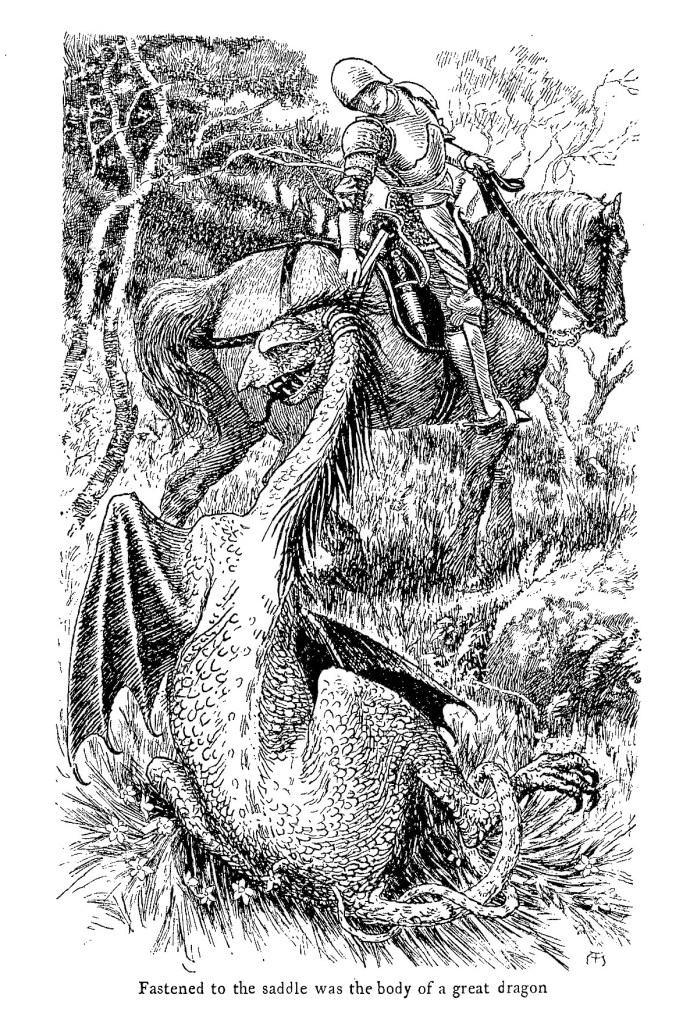
SUMMER READING GROUP: Phantastes by George MacDonald, led by Kirstin Jeffery Johnson: The Rabbit Room is sponsoring an online book club this summer centered on Phantastes by George MacDonald, a fantasy novel whose young hero Anodos wakes up in Fairy Land one day and is forced to reassess his assumptions about himself and others. Fantasy is not a genre I naturally gravitate to, but I keep hearing about this novel from different sources—how perplexing yet alluring it is—so I’m going to give it a try! I’m especially thrilled that the discussions will be led by MacDonald scholar Kirstin Jeffrey Johnson. Oh, and fun fact: this is the book that C. S. Lewis said most shaped his vocational attitude and philosophy of life.
“The ‘live’ version of this book group, including the online forum, opens May 25 [with chapters 1–4] and will include Zoom chats every Tuesday night at 7:00 p.m. CST for five weeks. However, you are welcome to join at any time, even after the live chats have ended. The discussions will be archived, and the forum will be open indefinitely for new registrants to continue reading and discussing the book.” You can purchase a copy of the book through the Rabbit Room Store, or there’s this annotated edition I bought, edited by John Pennington and Roderick McGillis. (It has a beautiful cover, but the annotations seem geared more toward middle-grade readers.)
Illustration by Arthur Hughes, from chapter 23 of the third edition of Phantastes by George MacDonald, published by Arthur C. Fifield in 1905
As a bonus, listen to “Giving as the Angels Give,” a two-part session from Hutchmoot 2019 that explores “some of the ways in which, as an author, teacher, and community-builder, MacDonald intentionally manifested hospitality.” Part 1 is a personal on-ramp to the topic by Jennifer Trafton (“I can’t think of any other writer who makes me feel the intimacy of God’s welcome more than MacDonald does,” she says), and part 2, which focuses more on MacDonald’s biography, is by Kirstin Jeffrey Johnson.
Note to reader: “HT” stands for “hat tip”; it’s an acknowledgment of where or from whom I first found mention of the content I link to—that is, if I did not discover it directly from the source itself. I include these tags, along with strategic hyperlinks on the names of people and institutions, because, other than simply being courteous, I want to aid you in building your own “Christianity and the arts” network. One of the primary questions I get from people is “Who should I follow?” or “Where did you find about . . . ?” Soon I will compile a list, on its own tab, of like-minded content curators/providers that inspire me, but regular readers of the blog will, I’m sure, have already picked up on who a lot of those are. And I’m learning of new ones all the time!
Ten days after Jesus ascended into heaven (and fifty days after his resurrection), his Holy Spirit descended on the apostles, manifesting as “tongues of fire” (Acts 2:3). This miraculous gift enabled the apostles to speak in languages foreign to them but native to the many Jews from abroad who were gathered in Jerusalem for Shavuot (called “Pentecost” by Hellenized Jews), a festival of giving thanks for the harvest and for God’s provision of the Torah. For the first time the gospel of Jesus Christ was proclaimed to a global audience. Three thousand people came to faith that day, and the Christian church was born.
The Spirit is still at work in the dissemination of the good news today, breathing life into cultures all over the world and thereby building up an incredibly diverse body of Christ.
As at Pentecost, Parthians, Medes and Elamites heard the message, “every man in his own tongue wherein he was born,” so we see Chinese and Japanese and Indians expressing Christianity’s universal language, each with his own brush. For when the spirit of God descends upon any people, new forms of beauty appear, new artistic gifts are revealed, adding another testimony to the universality of the Christian faith.
Since the publication of this book almost seventy years ago, Christianity has grown exponentially in Asia, as have indigenous artistic expressions of the faith. In 1975 Japanese theologian and arts advocate Masao Takenaka published the heavily illustrated book Christian Art in Asia, highlighting the robust variety being produced on the continent. Three years later the Asian Christian Art Association was founded to encourage the exchange of ideas between Asian artists and theologians. Their magazine, Image (not to be confused with the Seattle-based quarterly), has showcased local talents even further. Dozens more books have been published in English on individual Asian artists, countries, and the Asian Christian art movement in general. For the latter, see the beautifully designed The Christian Story: Five Asian Artists Today, plus The Bible Through Asian Eyes.
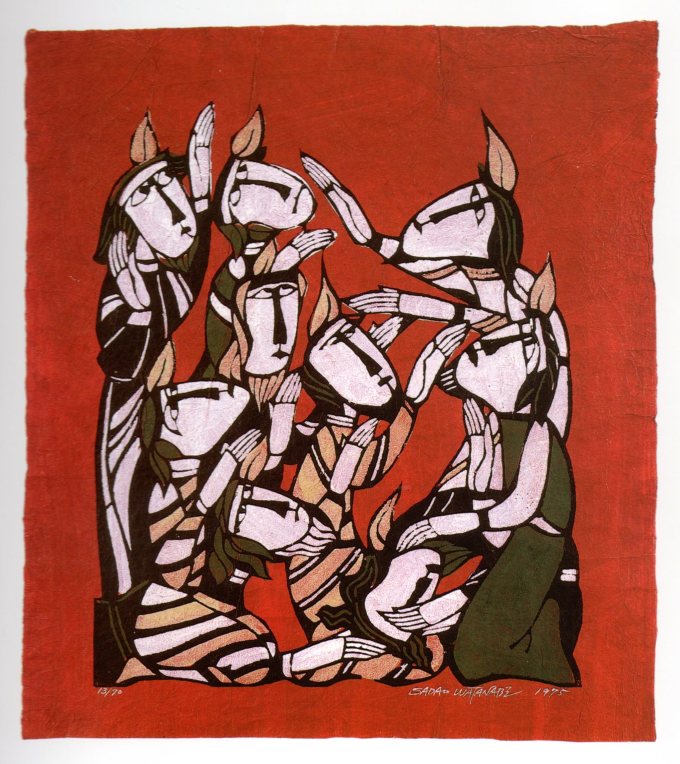
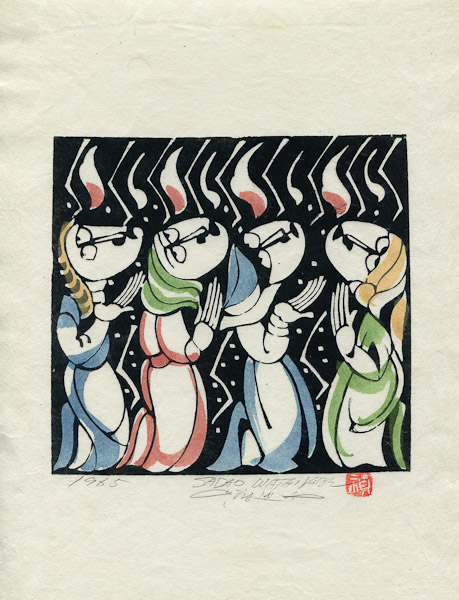
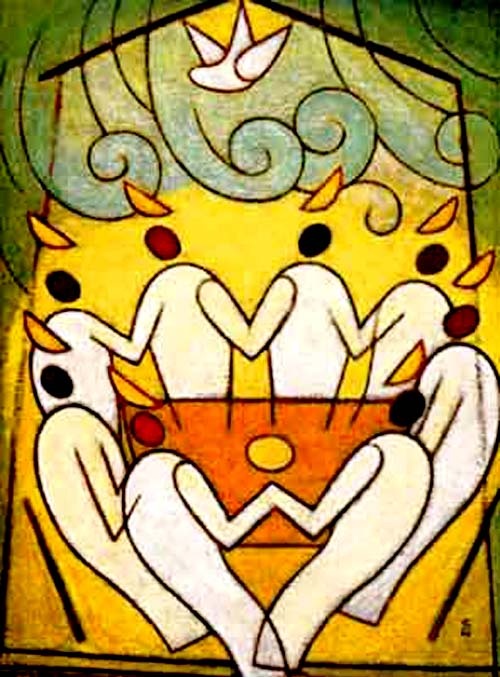
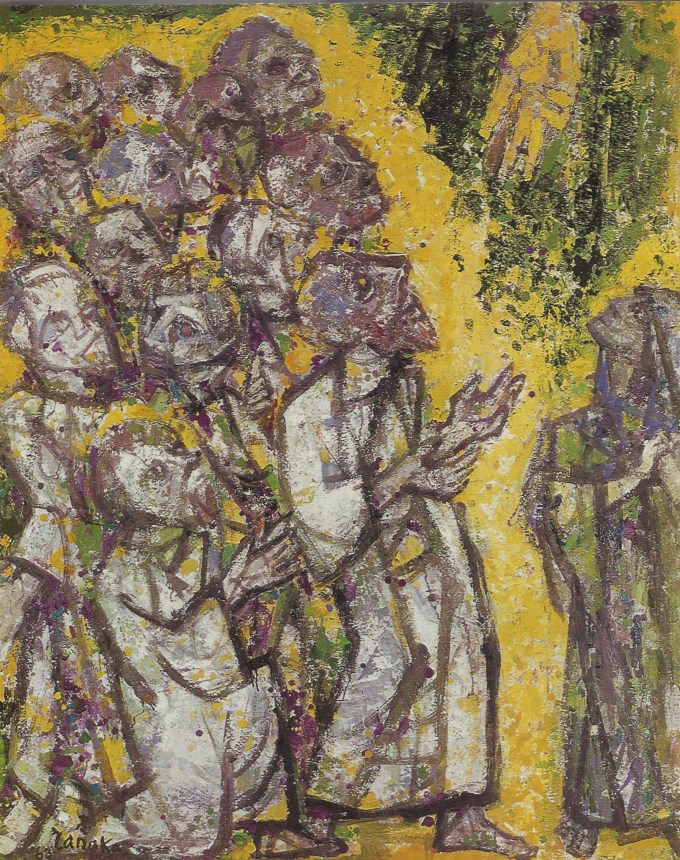
Below is a sampling of Asian art on the theme of Pentecost. Some works were made using traditional art forms or techniques—Chinese papercutting, Japanese flower arranging (ikebana) or stencil printing (kappazuri), Indian cloth dyeing (batik)—while other artists have chosen to work in oils and acrylics, collage, or glass. Some depict native people and settings—for example, Thai dancers wrapped in sabai, or a group sitting under a thatched roof in Indonesia—while others prefer ethnic and geographic ambiguity. There’s no single style that epitomizes the art of any country.
Sadao Watanabe (Japanese, 1913–1996), Pentecost, 1975. Hand-colored kappazuri-dyed stencil print on washi paper, 25.5 × 22.75 in. Source: Printing the Word: The Art of Watanabe Sadao (Philadelphia: American Bible Society, 2003)
Soichi Watanabe (Japanese, 1949–), The Coming of the Holy Spirit, 1996. Oil on canvas, 18 × 13.25 in. Collection of the Overseas Ministries Study Center.
Tadao Tanaka (Japanese, 1903–1995), Pentecost, 1963. Oil on canvas. Source: Christian Art in Asia by Masao Takenaka (Tokyo: Kyo Bun Kwan, 1975)
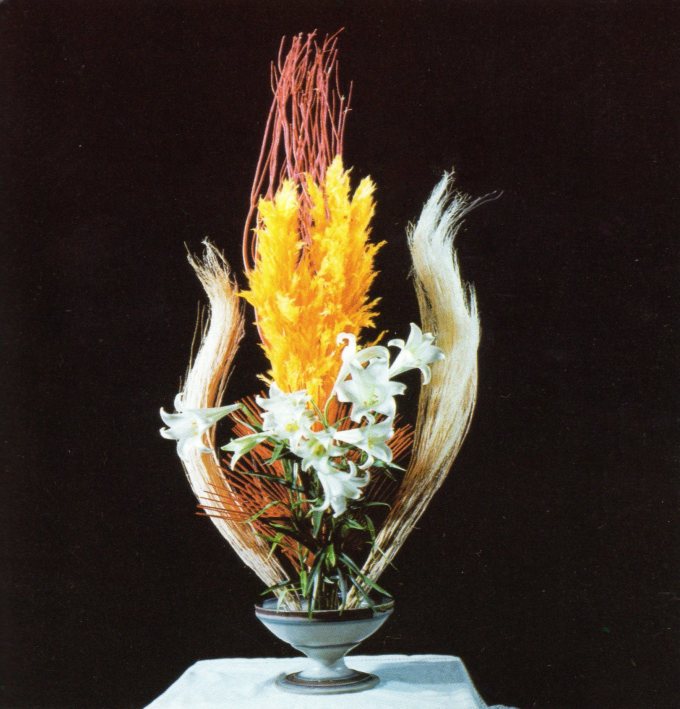
Gako Ota (Japanese, 1904–1972), Pentecost. Belvedere, pampas grass, paper bush, lilies, and rib of fan. Source: Consider the Flowers: Meditations in Ikebana, ed. Masao Takenaka (Tokyo: Kyo Bun Kwan, 1990)
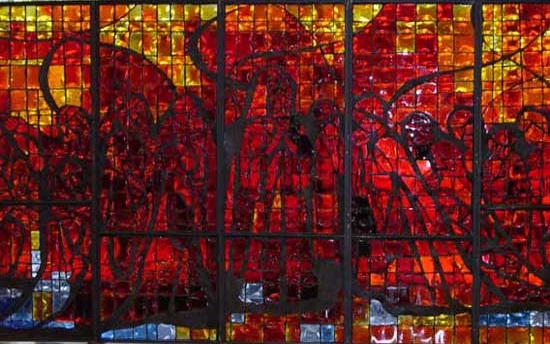
Keiko Miura (Japanese, 1935–), Pentecost, 2004. Stained glass window, All Pilgrims Christian Church, Seattle, Washington, USA.
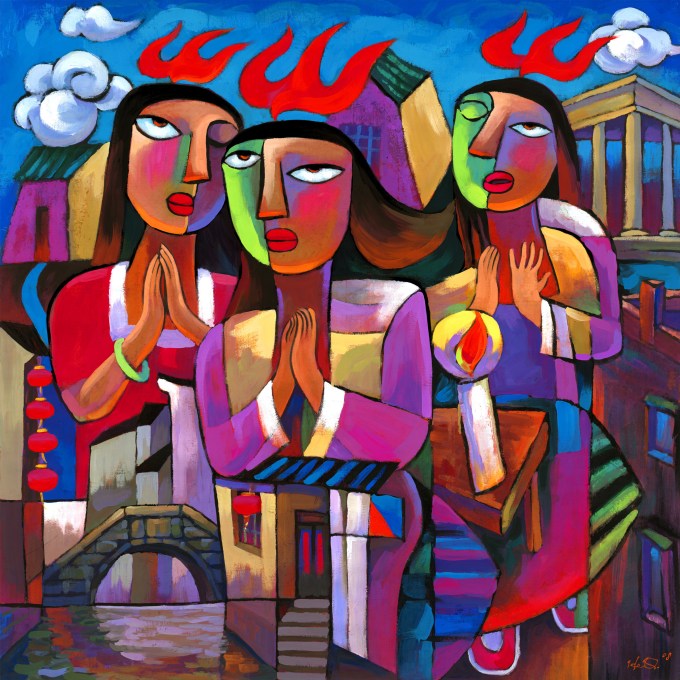
He Qi (Chinese, 1950–), Holy Spirit Coming, 1998. Oil on canvas.


 Art & Theology