LOOK: The Wise and Foolish Virgins, Norwegian tapestry
The Wise and Foolish Virgins, Norway, 17th century. Wool, bast fiber, 83 1/2 × 61 in. (212.1 × 154.9 cm). Minneapolis Institute of Art, Minneapolis, Minnesota.
The golden age of Norwegian tapestry (billedvev) spans roughly 1550 to 1800. Of all the woven subjects during this period, the Wise and Foolish Virgins was the most popular. The art historian Thor B. Kielland registered a total of seventy-five such tapestries from the seventeenth century alone. Draped over a bed, they would have provided warmth, decoration, and moral instruction. I love their aesthetic!
Jesus’s parable of the wise and foolish virgins comes from Matthew 25. Ten young women are members of a bridal party, and they’re awaiting the arrival of the bridegroom so that the celebration can start. In the tapestry pictured here, the top figures represent the wise virgins, whose oil-filled lamps indicate their readiness to accompany the bridegroom to the wedding feast. Those in the lower register, however, foolishly allowed their lamps to burn out; they weep into their handkerchiefs because the feasting started when they were out replenishing their oil supply, and now they’re too late.
That’s Christ the bridegroom in the upper right.
If I’m honest, this parable is uncomfortable for me. I don’t like that the neglectful women are locked out of the party. I don’t want anyone who wants in to be turned away. I want the bridegroom to show them grace, as the landowner did the day laborers who worked the vineyard for only one hour, giving them the same wage as those who worked for nine. But the parable of the virgins, with its stark sense of finality, is one of Christ’s teachings, so I want to grapple with it, not simply ignore it to suit my own proclivities.
I learned much about the existing body of Ten Virgins tapestries from rural Norway from Laura Berlage’s webinar “Dressing the Wise and Foolish Virgins: What Tapestry Can Teach Us About Women, Dress, and Culture in 16th and 17th Century Norway,” presented on July 17, 2023. She says the tapestries were made by women (unlike those produced by the guilds in Flanders and Paris), for women (they were used as bridal coverlets and included in dowries). They preached preparedness for young wives. “Good comes to those who are prepared,” Berlage elaborates; “you can’t get to heaven by borrowing someone else’s spiritual work.”
Regarding the headwear, Berlage clarifies: “The crowns the virgins wear are not because they’re princesses. There is a special tradition in Norway of wearing a crown at your wedding, which is an ancient nod to the Norse goddess Freja (later said to be an emblem of the Virgin Mary).”
Over time, Berlage says, the original meaning of the parable got lost, such that weavers no longer differentiated between the two sets of virgins, for example. She calls this phenomenon “image decay” and compares it to the telephone game.
For a shorter, less academic lesson on the ten virgins in Norwegian tapestry, see the six-minute video “Woven Wise and Foolish Virgins” by Robbie LaFleur:
LISTEN: “Himmelriket Liknas Vid Tio Jungfrur” (The Kingdom of Heaven Is Like Unto Ten Virgins) | Words from Then Swenska Psalmboken (The Swedish Hymnbook), 1697 | Traditional melody from Mockfjärd, collected by Nils Andersson in 1907 from Anders Frisell | Performed by Margareta Jonth on the album Religious Folk-Songs from Dalecarlia, 1977, reissued 1994
Himnelriket liknas vid tio jungfrur
som voro av olika kynne.
Fem månde oss visa vår tröga natur
Vårt sömnig och syndiga sinne.
Gud nåde oss syndare arma.

Vår brudgum drog bort uti främmande land
Och månde de jungfrur befalla
Sig möta med ljus och lampor i hand
Enär som han ville dem kalla.
De fävitske dröjde för länge.

De ropa: O Herre, o Herre låt opp,
Låt oss icke bliva utslutna!
Men ute var nåden, all väntan, allt hopp
Ty bliva de arma förskjutna
Till helvetets jämmer och pina.

Så låter oss vaka och hava det nit
Att tron och vår kärlek må brinna.
Vi måge här följa vår brudgum med flit
Och eviga salighet finna.
Det himmelska bröllopet. Amen.
The kingdom of heaven is like unto ten virgins Who were of different character. Five showed us our slothful nature, Our sleepy and sinful selves. God have mercy on us poor sinners.
Our bridegroom traveled in foreign lands And ordered the virgins To meet him with lighted lamp in hand Whenever he called them. The foolish ones waited too long.
They cry, “O Lord, O Lord, open up, Let us not be locked out!” But it was too late for mercy, for waiting, for hope, For the poor souls were cast Into hell’s wailing and torment.
So let us watch and show zeal That faith and our love may burn. Let us follow our bridegroom diligently And find eternal bliss, The heavenly wedding. Amen.
This a continuation of yesterday’s article.In part 1 I shared three room highlights from my visit to Kolumba museum in Cologne, Germany, run by the city’s Catholic archdiocese; in this final part I will do the same for KMSKA in Antwerp, Belgium, whose Old Masters galleries received a “contemporary injection” in an exhibition that wrapped this week.All photos are my own.
[Content warning: This article contains female nudity: a controversial Renaissance painting of the Virgin Mary, and three photographs of women who have just given birth.]
KMSKA, Antwerp
The Royal Museum of Fine Arts Antwerp, or KMSKA for short, is a world-famous museum whose collection spans seven centuries, from the Flemish Primitives to the Expressionists.
When I was there last month, the featured exhibition was Collected with Vision: Private Collections in Dialogue with the Old Masters, which ran from April 4 to October 12, 2025. Organized in conjunction with Geukens & De Vil Projects, it interwove postwar and contemporary works by internationally renowned artists from Belgian private collections with the existing museum collection, “expanding the transhistorical approach already in place. The exhibition offers a reflection on the history of art collecting and asks probing questions about social issues such as gender, power and identity. The role of museums and collectors is the focal point. Do the interventions create a harmonious dialogue with 700 years of art history, or do they give rise to challenging contrasts?” Featured artists included Cindy Sherman, Olafur Eliasson, David Claerbout, Francis Alys, Christian Boltanksi, Tracey Emin, Marlene Dumas, Luc Tuymans, and Louise Bourgeois.
The galleries of the exhibition were organized by theme: Holy, Impotence, Horizon, Image, Entertainment, Profusion, Lessons for Life, Fame, The Salon, Heroes, Evil, The Madonna, Suffering, Redemption, Prayer, Heavens, and Power.
I’ll spotlight what I consider the most successful and intriguing pairings.
First, the “Madonna” room, anchored by the famous Madonna Surrounded by Seraphim and Cherubim by the late medieval French court painter Jean Fouquet. It’s the right wing of a diptych that originally hung above an altar at the Collegiate Church of Notre-Dame in Melun.
Jean Fouquet (French, 1410/30–1477/81), Madonna Surrounded by Seraphim and Cherubim, ca. 1450. Oil on panel, 92 × 83.5 cm. Koninklijk Museum voor Schone Kunsten Antwerpen (KMSKA, Royal Museum of Fine Arts Antwerp).
The painting is historically significant—I first encountered it in a college art history course. Commissioned by Etienne Chevalier, treasurer to King Charles VII of France, it portrays the Virgin Mary as the Queen of Heaven, baring her breast ostensibly to nourish the Christ child with her milk. She was probably modeled after Agnès Sorel, the king’s recently deceased mistress and mother of three of his daughters, considered the ideal of feminine beauty at that time in western Europe: pale-skinned, with a high forehead, and fashionable in her ermine cloak.
Though I can appreciate the technical excellence of this painting and the intense reds and blues of the angels, I don’t really like it. Mary seems cold, not very maternal. There’s also an eroticization of her body—not because her breast is exposed, which was common in Marian art, but because it seems to be on display for the viewer; her son’s not interested in feeding—that’s wholly inappropriate for the subject. Why you’d want to memorialize your boss’s sex partner in such a way is beyond me. I’m no prude, but I much prefer Jan van Eyck’s Madonna at the Fountain, on display in the same room:
Jan van Eyck (Flemish, 1390/99–1441), Madonna at the Fountain, 1439. Oil on panel, 19 × 12 cm. Koninklijk Museum voor Schone Kunsten Antwerpen (KMSKA, Royal Museum of Fine Arts Antwerp).
This small painting originally hung not in a church but in someone’s house. Though there’s still an air of formality, it has all the tenderness and connection that the other one lacks. Mother and son embrace in a garden of roses, irises, and lilies of the valley, he reaching round her neck and holding a string of prayer beads, she gazing adoringly at him. They stand beside a fountain, recalling Jesus’s discussion in John 4 about the “living water” he gives to those who thirst. The original wood frame bears the artist’s motto: “As well as I can.”
The deeply engrained portrait of motherhood embodied by the Virgin Mary is juxtaposed most potently with a series of three black-and-white portraits of new mothers by the Dutch photographer Rineke Dijkstra.
Gallery 2.17 (“The Madonna”) from the KMSKA exhibition Collected with Vision: Private Collections in Dialogue with the Old Masters
The accompanying text read:
Jean Fouquet portrays motherhood as something sacred. Mary as a symbol of purity and devotion is richly dressed in cool colours. Rineke Dijkstra homes in on the vulnerable reality. Her mothers are scantily clad and marked by childbirth. Both works are innovative: Fouquet may have painted his Mary for the first time from a real person, and in its day the painting was regarded as ‘modern’. Dijkstra shows motherhood in all its rawness, a taboo usually withheld from view.
Julie wears hospital pads and mesh underwear, which women often do for several weeks after giving birth to manage postpartum bleeding and urinary incontinence. As for Tecla, blood is running down her leg. And Saskia bears a scar from her cesarean section. A linea nigra (dark line) zips down the abdomen of all three, a temporary pigmentation increase caused by increased hormone levels. I love this triptych that shows motherhood’s glorious, messy, alterative impact on the body—the real physicality of the vocation of bearing children into the world.
I wish there were more imagery of Mary like this, as it would, I think, deepen the wonder of the Incarnation and enhance women’s ability to identify with Mary and thus further enliven her story.
Also in the Madonna gallery was a unique “light poetry” installation by Nick Mattan and Angelo Tijssens—one of seventeen spread throughout the second floor, collectively titled Licht dat naar ons tast (Light that reaches for us). KMSKA had commissioned this couple to bring to life the short verses the museum’s late writer-in-residence Bernard Dewulf had written in response to the galleries’ stated themes.
“Inspired by the museum’s many reading and praying figures, as well as James Ensor’s expressive hand sketches, [Mattan and Tijssens] sought a subtle way to make [Dewulf’s] words tangible,” the museum writes. Their solution was to project them onto the gallery floors from brass cylinders suspended from the ceiling. The words shine like faint specks of light, becoming legible only when a visitor holds their hands, a sweater, or something else up to the light.
Here my husband “holds” a poem written in the voice of Mary:
Nick Mattan (Belgian, 1987–) and Angelo Tijssens (Belgian, 1986–), Licht dat naar ons tast (Light that reaches for us), 2023, featuring seventeen poems by Bernard Dewulf. Commissioned by and permanently installed at the Koninklijk Museum voor Schone Kunsten Antwerpen (KMSKA, Royal Museum of Fine Arts Antwerp).
“Madonna” by Bernard Dewulf
Virgin, mother, wife – I have two breasts that stand for my three souls. I show you one of them, and whose it is is yours to choose.
Translated from the original Dutch by David Colmer
Kind of cheeky! Dewulf speaks of Mary’s three identities and lets us decide if the breast she bares in Fouquet’s painting represents her naked innocence, her nurturing impulse, or her desire to please her husband. (Traditionally in art, it has always stood for the second.)
The next gallery I entered was themed “Suffering.”
Gallery 2.19 (“Suffering”) from the KMSKA exhibition Collected with Vision: Private Collections in Dialogue with the Old Masters
As one would expect, it’s inhabited by several Old Master paintings of Christ’s passion, most notably a triptych by the Flemish Baroque artist Peter Paul Rubens.
Peter Paul Rubens (Flemish, 1577–1640), Epitaph of Jan Michielsen and His Wife Maria Maes (aka Christ on the Straw, Madonna, and Saint John), 1618. Oil on panel, 138 × 178 cm. Koninklijk Museum voor Schone Kunsten Antwerpen (KMSKA, Royal Museum of Fine Arts Antwerp).
The central panel shows the dead Christ being laid out on a marble slab and wrapped in a shroud by Joseph of Arimathea, while his mother and Mary Magdalene (and the apostle John in the background) mourn him. The left wing shows Mary supporting the pudgy little baby Jesus as he takes some of his first steps, while the right wing shows John, whose symbol is the eagle, writing his Gospel that will place Jesus’s death in the context of the larger story of his life of ministry and his resurrection.
This painting, along with Anthony van Dyck’s Lamentation over the Dead Christ and The Holy Trinity by a follower of Rubens’s (which shows God the Father cradling the dead body of God the Son in an image type sometimes referred to as the Mystic Pietà), are juxtaposed with three photographs by Nan Goldin that show the impact of AIDS on her friend, the Parisian gallery owner Gilles Dusein, and his partner, the artist Gotscho.
Nan Goldin (American, 1953–), Gilles in Hospital, Gilles’ Arm, and Gotscho Kissing Gilles, 1993. C-prints. Private collection.
Dusein’s emaciated arm, resting weakly on a hospital sheet, recalls the limp arm of Christ in paintings of the Deposition and Entombment; and Gotscho’s kiss, the love and grief of Jesus’s mother and friends as they watched their loved one suffer and succumb to death.
By displaying these disparate artworks from vastly different contexts across from each other, we are encouraged to draw connections between the suffering of Christ and that of the LGBTQ+ community. While Christians in Rubens’s day would sit before images of Jesus in pain or sorrow or having died a torturous and untimely death, and deepen their empathy and love, so too might we do well to sit prayerfully, humbly, empathetically, with contemporary images of suffering, seeking to enter the stories they tell.
Antonello da Messina (Italian, 1430–1479), Calvary, 1475. Oil on panel, 52.5 × 42.5 cm. Koninklijk Museum voor Schone Kunsten Antwerpen (KMSKA, Royal Museum of Fine Arts Antwerp).
Compare these figures to contemporary Belgian artist Berlinde de Bruyckere’s Schmerzensmann (Man of Sorrows), on loan from the collection of David and Indré Roberts (see wide-view photo above). The piece consists of a wax and resin mold of a contorted human form, its skin stretched and broken, its legs wrapped around a tall rusty pole.
“Man of Sorrows” is also the title of an Early Netherlandish painting by Albrecht Bouts and a modern painting by James Ensor, which KMSKA displays side-by-side.
Albrecht Bouts (Flemish, 1451/55–1549), Man of Sorrows, 1500–1525. Oil on panel, diameter 29 cm. Koninklijk Museum voor Schone Kunsten Antwerpen (KMSKA, Royal Museum of Fine Arts Antwerp).
The earlier one is an incredibly moving image of pathos. Christ wears a thick, twisted, mock crown whose thorns dig holes into his forehead and draw blood. His eyes are red with tears and sunken in, and his lips are turning blue with the pallor of death. I find it quite beautiful, insofar as an image of suffering can be beautiful. (That’s a topic for another day.)
James Ensor (Belgian, 1860–1949), Man of Sorrows, 1891. Oil on panel, 20 × 15.5 cm. Koninklijk Museum voor Schone Kunsten Antwerpen (KMSKA, Royal Museum of Fine Arts Antwerp).
The Ensor painting, on the other hand, is decidedly not beautiful. In fact, I think it’s the ugliest image of Christ I’ve ever seen, with his crumpled face, scraggly hair, and bared teeth. There’s something very unsettling about his expression, and no wonder, as the curatorial text informs that Ensor drew inspiration from the masks of demon characters in Japanese theater. “His [Ensor’s] Jesus screams with rage about the injustice inflicted on him,” the label says. Is that what that expression is? To me he looks sinister. Like he’s growling at us. And I dislike his dinky crown that he wears like a headband; give me Bouts’s gnarly one instead.
I’m in favor of Christ images that show the rage he must have felt, but I don’t think Ensor is successful if that was his aim. To name a few modern artists who were: Guido Rocha (Tortured Christ, 1975) and David Mach (Die Harder, 2011), both of whom capture Jesus’s cry of dereliction on the cross.
The final themed gallery I’ll call out is “Heavens.”
Gallery 2.22 (“Heavens”) from the KMSKA exhibition Collected with Vision: Private Collections in Dialogue with the Old Masters
The dominant Old Master work is a set of three panels from the upper tier of a colossal altarpiece that Hans Memling painted for the church at the Benedictine Abbey of Santa Maria la Real in Najera in northern Spain. All the other panels are lost.
The museum titles the central panel God the Father with Singing Angels—but I think the figure is more properly God the Son, Jesus Christ, portrayed as Salvator Mundi (Savior of the World). In his left hand he holds a cross-surmounted crystal globe, signifying his dominion over the earth, and with the other hand he gestures blessing. He wears a tiara and a red cope decorated with gold-thread embroidery, pearls, and precious stones, and his collar bears the words Agyos Otheos (Holy God).
Hans Memling (German Flemish, ca. 1430–1494), God the Father with Singing Angels, 1483–94. Oil on panel, 164 × 212 cm. Koninklijk Museum voor Schone Kunsten Antwerpen (KMSKA, Royal Museum of Fine Arts Antwerp).
Surrounding him is a musical band of angels, singing his praises from songbooks and, in the flanking panels, playing a variety of wind and string instruments: (from left to right) a psaltery, a tromba marina, a lute, a trumpet, a shawm, a straight trumpet, a looped trumpet, a portative organ, a harp, and a fiddle.
Hans Memling (German Flemish, ca. 1430–1494), Music-Making Angels (left), 1483–94. Oil on panel, 165 × 230 cm. Koninklijk Museum voor Schone Kunsten Antwerpen (KMSKA, Royal Museum of Fine Arts Antwerp).Hans Memling (German Flemish, ca. 1430–1494), Music-Making Angels (right), 1483–94. Oil on panel, 165 × 230 cm. Koninklijk Museum voor Schone Kunsten Antwerpen (KMSKA, Royal Museum of Fine Arts Antwerp).
This ensemble probably evokes for you a particular sound—something like Tallis or Palestrina—soaring polyphonic vocals, a gentle yet majestic accompaniment. But instead, a different soundtrack played, audibly, in the room: songs from the 1967 debut album of the American rock band the Velvet Underground, several of which use religious language to describe the experience of doing drugs. “Heroin” opens like this:
I don’t know just where I’m going But I’m gonna try for the kingdom, if I can ’Cause it makes me feel like I’m a man When I put a spike into my vein
And I’ll tell you things aren’t quite the same When I’m rushing on my run And I feel just like Jesus’ son
This aural element was complemented, on the gallery wall, by the guitar of Lou Reed, the band’s lead singer and songwriter. It’s signed by Andy Warhol, who produced and championed the Velvet Underground & Nico album and made its banana cover art, replicated on the instrument.
Lou Reed’s “Banana Guitar,” from a private collection
Adding to the mix, in the corner of the room was an installation by the Copenhagen-born and -based artist Olafur Eliasson, called Lighthouse Lamp. “Affixed to a tripod, a lamp situated within a Fresnel lens—a compact lens which was developed for lighthouses—emits a band of white light in 360 degrees,” the artist’s website explains. In this space, the beam takes on a triangular shape.
Olafur Eliasson (Icelandic Danish, 1967–), Lighthouse Lamp, 2004. Mixed media. Collection of Filiep and Mimi Libeert.
There was also an altarpiece of The Last Judgment and the Seven Acts of Mercy by Bernard van Orley, which references Jesus’s teaching in Matthew 25 about one’s entry into heaven being contingent on whether, in this life, you feed the hungry, give shelter to the homeless, visit the prisoner, and so on.
The “Heavens” gallery begs the question: How does one define “heaven”? Is it a physical place? A state of mind? An encounter? I think of related words like bliss, beatitude, communion, the sublime.
The celestial scene painted by Memling—and remember, it’s only partial, as the rest is missing—is beautifully rendered, but it also encapsulates what has become the popular cliché of heaven: angels on clouds, strumming harps, and a regal God swaying his scepter. Music-making, angelic beings, and the reign of God are all certainly a part of how the Bible describes heaven. But it’s also so much more. It’s a garden and a city. It’s healing and restoration. It’s the righting of wrongs. It’s all things made new. It’s jubilee. It’s a wedding—deep and lasting union between God and humanity. It’s an eternal interlocking of God’s space and ours (earth). It’s a global, transhistorical community of faith, gathered together around Christ their head, worshipping him in diverse languages, musical styles, dances, and other cultural expressions. It’s the culmination of the greatest story ever told.
Today, Memling’s vision of heaven probably fails to captivate most people, even Christians. So it’s an interesting experiment to compare it to how others conceive of the concept.
Eliasson’s Lighthouse Lamp wasn’t a commission on or explicit treatment of the theme, but the curator saw fit to place it beside Memling, because heaven is often conceived of as a light-filled space, and light can evoke the divine. For this reason, Memling painted his background gold. What’s more, the three-sidedness of Eliasson’s light beam may, for some, evoke the Trinity, the classical Christian doctrine of Father, Son, and Holy Ghost that Memling alludes to with the three precious stones on the fibula of Christ’s mantle.
Still, other folks experience what could be termed “heavenly” transcendence through the use of mind-altering substances, as did the members of the Velvet Underground, whose drug trips gave birth to their experimental music—which, in turn, has taken others to a transcendent place.
Whether in special exhibitions or displays of their permanent collections, I want to see more of this in museums: bringing old and new artworks into conversation with one another around universal themes, in the same room. (In some museums, the labels sometimes cross-reference works in other galleries, but that’s not the same.) Although there are benefits to the traditional approach of laying out art chronologically to give you discrete pictures of different historical eras and allow you to progress by time period, a thematic approach that compiles works from across time also has its benefits.
I’ve found cross-temporal art displays to be especially vitalizing, because instead of trying to tell history, they more naturally invite personal reflection and tend to be less academic in tone. Such an approach makes the art accessible to a larger number of people, especially those who don’t frequent museums. It helps us see the relevance of the Old Masters (or whatever the museum’s collection focus) for today—how the subjects they depicted often address topics or questions we still ask or wonder about or that reflect aspects of the common human experience, such as joy, suffering, family, death, betrayal, or festivity. Creating relationships between works made centuries apart, highlighting similarities and differences, can give us a broader perspective.
And for this museumgoer (pointing at myself) who is attracted to medieval and early Renaissance art and sometimes bypasses the contemporary galleries, the integrative approach is more engaging. Giving contemporary works a point of connection with the works I’m already inclined to like helps me enter into them more easily and fruitfully, and I’m more likely to spend time with them than if they were segregated.
New and old don’t have to be equally represented—Kolumba skews heavily contemporary, whereas KMSKA lets its strengths shine with the Old Masters, and yet the occasional unexpected intervention from years past or future always caused me to pause and be curious. Over the last several years I’ve been noticing other museums engaging in similar playful exchange—plopping a contemporary work into the medieval section, or vice versa, in a way that provides some kind of illumination.
This was my first and only visit to KMSKA, and as I understand, there’s not the same degree of intermixing of old and new year-round; this was a special exhibition that brought in contemporary works from outside, as the institution itself owns very few. But they did do something similar last year with the exhibition What’s the Story?, and the dangling light poems by Bernard Dewulf are a permanent fixture in the Old Masters galleries.
Have you been to a museum where works from different time periods were displayed side-by-side to create a discourse, and if so, did that choice enhance your engagement, insight, or appreciation? I’d love to hear what other museums are doing this!
This article took me some forty hours to write and to select and edit photos for. If you appreciate learning about my museum experiences and having access to high-resolution, downloadable art images, would you please consider adding to my “tip jar” (PayPal), or sponsoring a book from my Amazon wish list? Thank you!
New Mount Pilgrim commemorates the Maafa, the Great Migration, and martyrs of urban violence and instills hope with trilogy of rose windows, which include an African Christ
Designed by Charles L. Wallace and built in 1910–11, the French Romanesque–style church at 4301 West Washington Boulevard in Chicago’s West Garfield Park neighborhood was originally home to one of the largest Irish Catholic parishes in the city: St. Mel’s (named after Mél of Ardagh, a nephew of St. Patrick from the fifth century). They had the interior decorated with stained glass windows made by the studio of F. X. Zettler in Munich, portraying biblical figures and other saints—all as Caucasian, as was customary at the time and, frankly, still is. St. Mel’s, which merged with Holy Ghost Catholic Church in 1941 (whose parishioners were mainly of German descent), was a flourishing congregation. But in the late 1960s, white people began leaving the neighborhood as Black people moved in, and St. Mel’s membership waned until eventually the church closed its doors in 1988.
After the building had stood vacant for several years, in 1993, the Catholic Archdiocese of Chicago sold it to New Mount Pilgrim Missionary Baptist Church, a local Black congregation founded in 1950. The church leaders found that, due to lack of maintenance, the three large rose windows had structural issues that needed to be addressed. Rather than repairing the windows, they decided to replace them with new ones that better reflected the faith stories of their own parishioners—their history, heritage, and aspirations as a community. Rev. Dr. Marshall E. Hatch Sr., who had become the church’s pastor just a month after they moved into the new building and still serves in that role, developed the concepts for the windows with input from the congregation and started fundraising. All three were fabricated by Botti Studio of Architectural Arts in nearby Evanston, Illinois.
The Maafa Remembrance Window
The most striking and theologically profound of the three new windows, and the one I flew to Chicago to see last summer, is the Maafa Remembrance window on the wall to the left of the front altar. Because the church is oriented south rather than the traditional east, this is, directionally speaking, the East Rose Window; it purposefully faces the Atlantic Ocean. It was dedicated December 17, 2000, the church’s fiftieth anniversary year. It replaced an image of the Assumption of Mary (which you can view here); read more about the church building’s original windows on the website of art historian Rolf Achilles.
Maafa Remembrance, 2000, based on an illustration from The Middle Passage by Tom Feelings. Stained glass, diameter 25 feet. New Mount Pilgrim Missionary Baptist Church, West Garfield Park, Chicago. Photo: Victoria Emily Jones.Six of the twelve apostles are pictured in these stained glass windows inherited by New Mount Pilgrim from the building’s former owner, St. Mel’s Catholic Church. They appear beneath the newer Maafa Remembrance window, commissioned to counterbalance the preponderance of sacred white personages with sacred Black ones and to tell a narrative of liberation. Photo: Victoria Emily Jones.
Maafa (mah-AH-fah) is a Swahili word meaning “great disaster” or “great tragedy.” Since the late 1980s it has been used to refer to the transatlantic slave trade of the sixteenth through nineteenth centuries, during which an estimated 12.5 million African men, women, and children were kidnapped from their homes and forcibly brought to the Americas to work plantations without pay (by and large), building the wealth of their white enslavers. Some scholars prefer the term “African Holocaust” or “Black Holocaust” to describe this historic atrocity.
Based on an illustration by Tom Feelings from his extraordinary book The Middle Passage: White Ships / Black Cargo (Dial, 1995), the East Rose Window commemorates the Maafa through an evocation of the Middle Passage, the second leg of the triangular trade route. On this harrowing two- to three-month voyage across the Atlantic Ocean, which ships made many times over chattel slavery’s multicentury duration, at least two million enslaved Africans died of malnutrition, dehydration, disease, captor-inflicted violence, or suicide.
The closeness of the place, and the heat of the climate, added to the number in the ship, which was so crowded that each had scarcely room to turn himself, almost suffocated us. This produced copious perspirations, so that the air soon became unfit for respiration, from a variety of loathsome smells, and brought on a sickness among the slaves, of which many died, thus falling victims to the improvident avarice, as I may call it, of their purchasers. This wretched situation was again aggravated by the galling of the chains, now become insupportable; and the filth of the necessary tubs, into which the children often fell, and were almost suffocated. The shrieks of the women, and the groans of the dying, rendered the whole a scene of horror almost inconceivable.
In Feelings’s image, an African Christ figure stretches his chained arms out, as if on the cross. His body is constituted by the famous schematic representation of the crowded lower deck of the Brookes slave ship’s human cargo hold, first created in England in 1788 and widely disseminated throughout the nineteenth century. The perspective is such that we’re looking down on a body-as-slave-ship gliding through the waters—but it’s also a crucifixion. The Son of God carries the suffering of the sons and daughters of God, feeling it in his own body. He wears the slave ship like a giant wound that will forever mark him because it has marked his ecclesial body, the church.
The window functions, on one level, as a lament. Consider it in light of the following poem by Lucille Clifton, which draws out the cruel irony of the actual names some ostensibly Christian slave ship owners gave their vessels.
“slaveships” by Lucille Clifton
loaded like spoons into the belly of Jesus where we lay for weeks for months in the sweat and stink of our own breathing Jesus why do you not protect us chained to the heart of the Angel where the prayers we never tell and hot and red our bloody ankles Jesus Angel can these be men who vomit us out from ships called Jesus Angel Grace Of God onto a heathen country Jesus Angel ever again can this tongue speak can these bones walk Grace Of God can this sin live
The speaker of the poem, an enslaved African, addresses Jesus, questioning why he allows them to be so brutally treated—stolen from their homeland, marched to the coast in chains, claustrophobically packed in ship holds for maximum profitability, and spat out onto auction blocks in a barbarous country that appears to practice the devil’s ways more than God’s. How can God abide such sin? What kind of grace is it that transports them into oppression?
Christian Wiman brilliantly unpacks this poem, noting Clifton’s cunningly subtle tweak of a prophetic passage from Ezekiel that promises resurrection, both of individuals and of a nation. Underneath its acerbity, there’s a certain hopefulness to the poem—a hope that this sin will die, this suffering be transformed. In both Ezekiel’s vision of the valley of dry bones and Clifton’s poem, Wiman writes,
the Word comes streaming again through, and by means of, the word. In terms of the poem, Jesus (the man) is on board Jesus (the ship), but he is in the hold, just as, when the worship services took place above the captured slaves on the Gold Coast of Africa, God, if he was anywhere, was underneath it all, shackled and sweating and merged with human terror.
Emmanuel, God-with-us.
Clinging to this truth, the psalmist declares, “If I make my bed in hell, behold, thou [God] art there” (Psalm 139:8b). In his great compassion, God descends with us into the depths, and bears us up.
The Maafa Remembrance window plays with the themes of descent and ascent. As Emmanuel, Jesus was below deck, in the miserable belly of the thousands of slave ships that traversed the Atlantic, suffering with those chained inside. Christ’s arms are draped with chains, notes Marshall Hatch Jr., the pastor’s son and cofounder and executive director of the MAAFA Redemption Project (more on that below), “but he’s rising. And at some point those chains will break. That’s the hopefulness that shines through.”
Thus, the window commemorates both tragedy and triumph. It honors those who died on the Middle Passage and through the institution of slavery more broadly while also honoring those who persevered all the way to freedom. Hatch Jr. says this Christ is “carrying within himself the memories of those who lost their lives on the journey to America. But also he’s carrying the legacy of those who survived. And we are that living legacy,” descendants of the Middle Passage.
The border around the window’s central image calls parishioners to “REMEMBRANCE.” They must remember their history, the Great Catastrophe their ancestors endured, and, having faced the truth, commit to ending slavery’s legacy of racism in America’s civic, social, and religious spheres and in their own psyches.
Two of the roundels in the bottom border show a map of Africa and a Communion table laid with kente cloth, a loaf of bread, and a flask of wine. The roundel between these two displays the open word of God, which guides Christians forward in our work of justice and reconciliation.
Art historian Cheryl Finley features New Mount Pilgrim’s Maafa Remembrance window in her book Committed to Memory: The Art of the Slave Ship Icon (Princeton University Press, 2022), which traces the origins of the Brookes schematic and its proliferation in mass culture and art. She identifies the window, twenty-five feet in diameter, as the largest example of the “slave ship icon” in the world and writes that, like the cross of Christ, the slave ship embodies both death and rebirth. It is “a site of death, of dying Africans, and of new life, of a people who would persevere in the face of slavery and unspeakable cruelty to become a free people who helped define the modern era” (6).
“The children will need to know that this symbol, this window, is a representation of not only the pain but also the possibilities of a great and mighty God,” Rev. Dr. Gregory Thomas told the Chicago Tribune in 2000. Thomas was a theology professor at Harvard Divinity School, where Hatch Sr. served a fellowship sabbatical semester in 1999 and first encountered Feelings’s Middle Passage book.
In the window, slavery is interpreted in light of the paradox of the cross. Theologian James H. Cone famously interpreted another, later icon of Black suffering—the lynching tree—in light of the same in his essential book The Cross and the Lynching Tree (Orbis, 2011). He opens the book by explaining why and how the cross has held such power for the Black church:
The cross is a paradoxical religious symbol because it inverts the world’s value system with the news that hope comes by way of defeat, that suffering and death do not have the last word, that the last shall be first and the first last.
That God could “make a way out of no way” in Jesus’ cross was truly absurd to the intellect, yet profoundly real in the soul of black folk. Enslaved blacks who first heard the gospel message seized on the power of the cross. Christ crucified manifested God’s loving and liberating presence in the contradictions of black life—that transcendent presence in the lives of black Christians that empowered them to believe that ultimately, in God’s eschatological future, they would not be defeated by the “troubles of this world,” no matter how great and painful their suffering. Believing this paradox, this absurd claim of faith, was only possible through God’s “amazing grace” and the gift of faith, grounded in humility and repentance. There was no place for the proud and the mighty, for people who think that God called them to rule over others. The cross was God’s critique of power—white power—with powerless love, snatching victory out of defeat. (2)
A powerful reclamation of Christian iconography, New Mount Pilgrim’s Maafa Remembrance window weds Black history and Christian theology to offer its predominantly African American congregation a communal symbol that honors what they’ve been through as a people and reminds them that they worship a risen Christ who breaks chains and brings life out of death.
The North Star / Great Migration Window
The East Rose Window covered in the previous section is narratively the first in the trilogy of newly commissioned windows, but the first of the three to be fabricated and installed, earlier in 2000, was the North Rose Window, called the North Star or Great Migration window. It commemorates those who traveled north on the Underground Railroad to escape slavery, and, a few generations later (from about 1910 to 1970), as part of a mass movement to escape Jim Crow oppression.
North Star / Great Migration, 2000. Stained glass, diameter 25 feet. New Mount Pilgrim Missionary Baptist Church, West Garfield Park, Chicago. Photo: Victoria Emily Jones.
The North Star window shows a Black family unit, the father, in purple robe, lifting his newborn up to the heavens in a gesture of gratitude and pride. The child is backlit by the North Star, a beacon to freedom. The scene recalls the famous naming ceremony in the 1977 Roots miniseries, based on the best-selling novel by Alex Haley, in which Omoro Kinte, a Mandinka man living in The Gambia, carries his firstborn son, Kunta Kinte, to the edge of the village, raises him into the starry night sky, and exclaims, “Behold, the only thing greater than yourself!” This declaration affirms the child’s inherent worth and directs him toward worship of his Creator God.
During New Mount Pilgrim’s baby dedication ceremonies, the pastor raises the child in like manner while the parents vow to bring up the child in the nurture and admonition of the Lord and the congregation vows to support them in this task. This physical gesture of lifting up signifies surrender to God and hope that the next generation will carry the flame of faith out into the city of Chicago and the wider world. Because the North Star window is situated across from the pulpit, over the choir loft and organ, it is in full view of the dedicants.
Baby dedication ceremony, New Mount Pilgrim Missionary Baptist Church. Photo courtesy of Partnering for Community Impact.View from the pulpit of New Mount Pilgrim, facing the North Star window and the main entrance to the church. Photo courtesy of the church.
The inscription below the family in the window reads, “Lift holy hands,” a phrase taken from 1 Timothy 2:8, and the roundels in the border spell out the name of the church. The three portraits at the bottom are of the church’s longest-serving pastors: (from right to left) Rev. J. H. Johnson, the church’s first elected pastor; Rev. James R. McCoy, who served from 1965 to 1993; and Rev. Dr. Marshall Hatch Sr., who has served since 1993. Hatch Sr.’s father and McCoy both participated in the Great Migration, having moved to Chicago from Aberdeen, Mississippi, and so did the majority of the church’s founding members.
The North Star window fills the space previously occupied by a window depicting Saint Cecilia, a Roman virgin martyr.
The Sankofa Peace Window
The West Rose Window, known as the Sankofa Peace window, was the final one to be installed, replacing the clear panes that were there for over two decades. (New Mount Pilgrim sold the original window depicting Mary and the Christ child blessing and accepting the rosary from a male and female saint, to raise funds for the new one.) The Sankofa Peace window was dedicated on February 24, 2019 (watch the service here and view photos here), the year that marked the four hundredth anniversary of race-based slavery in America.
Sankofa Peace, 2019. Stained glass, diameter 25 feet. New Mount Pilgrim Missionary Baptist Church, West Garfield Park, Chicago. Photo: Victoria Emily Jones.
Sankofa is a Twi word from the Akan people of Ghana that means “go back and retrieve it,” a phrase that encourages learning from the past to inform the future. It comes from the proverb “Se wo were fi na wosan kofa a yenkyiri”—“It is not wrong to go back for that which you have forgotten,” to return to one’s roots to reclaim lost identity. The concept of Sankofa is traditionally symbolized by a mythical bird with its head turned backward while its feet face forward, carrying a precious egg in its mouth, which represents the knowledge of the past on which wisdom is based.
The Sankofa bird appears in the top center roundel of the window.
Hatch Jr., who preached at the window’s dedication service, discussed Sankofa as a spiritual discipline, highlighting how it can refer not only to returning to one’s cultural roots, but also to God, our Source. “Sankofa is the process of training my soul to reach back and remember the grace and the glory of God,” he says, which can fuel us for the forward journey. He quotes the famous gospel hymn that says, “My soul looks back in wonder how I got over.” We must regale one another with stories of where we’ve been and how far God has brought us, and remind ourselves and each other where we’re heading.
Besides the Sankofa bird, the other four adinkra symbols that New Mount Pilgrim chose to include in the window’s border are:
These are key guiding principles of the church, part of their missional purpose and identity. They seek liberation and peace for all, through the power of God, following the path of the Savior who is Love, who brings us back to who we most truly are.
One way the Sankofa Peace window looks backward while moving forward is through the memorialization of murdered Black American youth, from the civil-rights-era South and twenty-first-century Chicago. The portraits at the top depict the four girls who were killed by the Sixteenth Street Baptist Church bombing in Birmingham, Alabama, in 1963: Carole Robertson (age fourteen), Addie Mae Collins (fourteen), Denise McNair (fourteen), and Cynthia Wesley (eleven).
The five teens at the bottom, selected by members of New Mount Pilgrim’s youth leadership committee, were victims of Chicago violence from the previous decade or so. From left to right, they are:
Derrion Albert(1994–2009), age sixteen. On his way home from school, he got caught in the middle of a brawl between two rival factions of students and was beaten to death with a railroad tie. The crime was captured on cellphone video.
Laquan McDonald (1997–2014), age seventeen. He was shot sixteen times by a police officer while he was walking away.
Hadiya Pendleton (1997–2013), age fifteen. She was killed by a stray bullet while hanging out in a park with friends after her final honors exams.
Blair “Bizzy” Holt (1990–2007), age sixteen. He was fatally shot on a CTA bus while shielding his friend from gang gunfire.
Demetrius “Nunnie” Griffin Jr. (2000–2016), age fifteen. A lifelong member of New Mount Pilgrim, he was burned to death in a trash can in a West Side alley. His death was ruled a homicide, but his killer(s) have not been found. He had told his mother that a gang had been trying to recruit him.
All nine children are dressed in traditional African headwear.
Even as the window laments these unjust deaths, it also provides a vision of restoration. The central scene shows Jesus as the Good Shepherd, leading his children to green pastures and still waters lined with thatched-roof homes—an Edenic place of peace and rest. One might view this as the afterlife (Hatch Sr. told me the children are “going back to the Father’s estate”); but it could also be seen as a picture of Christ leading us into a future on this side of the parousia, where all God’s children are safe and thrive on earth as it is in heaven.
Hatch Sr. told me the window is about recovering a village mentality right in the heart of the city, embracing values like hospitality, family, mutual support, elder respect, and the protection and uplift of children. Whereas the North Star window visualizes the literal lifting up of a child, the Sankofa Peace window calls parishioners to do it metaphorically, through the building of strong community and advocacy for policies that prevent violence and tragedy.
The MAAFA Redemption Project
As a tangible outworking of the communal values expressed in its three rose windows, in 2017 New Mount Pilgrim established a workforce, social, and spiritual development program for young Black men in West Garfield Park, which is still running strong. (It graduated its seventh cohort last month!) Called the MAAFA Redemption Project, it is predicated on the belief that redemption and transformation must begin with the individual, and then that personal transformation can effect family and community transformation. The program emphasizes the importance of, as its website says, “remembering the past in order to create a more just and verdant present and future.”
Marshall Hatch Jr., director of the MAAFA Redemption Project (a ministry of New Mount Pilgrim MB Church), speaks with a group of participants about their experiences as young Black men living in West Garfield Park.
Using a dual direct-service and community-building approach, the program provides housing, job training, educational opportunities, psychotherapy, counseling, and wrapround social services to the young men who enroll. These supports are supplemented with programming that focuses on the arts, cultural identity development, spiritual enrichment, transformative travel, civic empowerment, and life coaching and mentoring.
The square-mile neighborhood of West Garfield Park has the highest rate of gun violence in Chicago and is one of the most crime-dense populations in the nation. The MAAFA Redemption Project seeks to recruit men between the ages of eighteen and thirty who are a part of this gun culture or at risk of becoming so, recognizing that young people are a neighborhood’s greatest resource for change. The project affirms the dignity and promise of the neighborhood’s Black and Brown youth and aims to instill hope in them, empowering them in activism against gun violence and the conditions that create it.
“The young people who come to us are tired of the subculture that only produces death, despair, and falling into the trap of the criminal justice system,” says Marshall Hatch Jr., the cofounder and executive director of the MAAFA Redemption Project. “They want something different for themselves and their loved ones.”
He continues, “We want to create the space for young men to see themselves differently, to reimagine themselves as men and leaders, pillars of this neighborhood. And so our goal is to embrace the truths that they give us of their experience but also challenge them to overcome, just as their ancestors overcame; to develop the inner resources to persevere and to challenge the system so that their sons, their daughters, don’t have to fight the same fights.”
The video storytelling unit NBC Left Field ran a wonderful segment in November 2018 that features the work of MAAFA Redemption Project:
I also recommend the feature-length documentary All These Sons (2021), directed by the Oscar-nominated Bing Liu and Joshua Altman (Minding the Gap) and streaming for free on Tubi, Amazon, and other services. MAAFA Redemption Project is one of the two Chicago antiviolence programs profiled, the other being the South Side’s Inner-City Muslim Action Network (IMAN) run by Billy Moore.
Most recently, MAAFA Redemption Project has partnered with other groups to build and share ownership of the Sankofa Wellness Village, a series of interconnected capital projects and social enterprises sited along the Madison and Pulaski corridor in West Garfield Park. Winner of the Chicago Prize awarded by the Pritzker Traubert Foundation, the village will be a sprawling, $50 million campus that will bring critical health, financial, and recreational resources back into the disinvested neighborhood, including a wellness center, a credit union, an art center, a business incubator and entrepreneurial support center, and pop-up fresh food markets.
The Sankofa Wellness Village breaks ground later this summer and is expected to open in late 2025.
Having identified the arts as an unmet need and desire of West Garfield Park residents, MAAFA Redemption Project has taken the reins on what will be called the MAAFA Center for Arts and Activism. They are working to restore the old St. Barnabas Episcopal Church to provide a space where residents can engage in intergenerational art making, relationship building, community organizing, political education, and civic empowerment.
Rendering of the future MAAFA Center for Arts and Activism in West Garfield Park, Chicago. Credit: Moody Nolan/Bureau Gemmel
“We’re part of a continuum of that liberation narrative of God,” Hatch Sr. says, referring to his church’s commitment to see their neighborhood flourish.
When in the nineties they inherited a grand church full of Eurocentric stained glass and other decoration from the Irish Catholic community that worshipped there previously, New Mount Pilgrim Missionary Baptist Church had some decisions to make. How would they honor the history of that sacred space while also making room for their own histories? What adjustments would have to be made to accommodate their different ecclesial and theological tradition? They made a few changes to the sanctuary, but they left most of it intact. The most significant change is the three new rose windows they commissioned to replace the old ones that were buckling. Once the first two were installed, Pastor Marshall Hatch Sr. told me, the space really started to feel like home.
Hatch Sr. spoke to me about “the power of art to reclaim an identity” for youth involved in or susceptible to gang violence. For sure, many local youth have been inspired by the Maafa Remembrance image in particular, which MAAFA Redemption Project uses as its logo, and thus it’s been widely visible throughout the neighborhood. And yet while the “under thirty” demographic is a particular focus of the church’s outreach efforts, the identity-forming power of art holds true for folks of any age. When a West Garfield Park resident enters the New Mount Pilgrim sanctuary for whatever reason—prayer, worship, respite, connection, religious education, compulsion from a family member—they can hopefully see themselves reflected in the imagery of the rose windows, and, in conjunction with the church’s music and preaching ministries, experience healing and revival.
Their culture, their history, their stories are sacralized in stained glass and integrated into the larger story of redemption God is telling.
Perhaps, from viewing the windows, they feel a deep identification with Christ in his crucifixion, or a sense of God’s presence with them in their suffering; perhaps they are dazzled by the dignity and endurance of their ancestors, or are compelled by the freedom Christ offers; perhaps that was one of their friends whose face shines down from the wall, or the niece or nephew of a friend, and they are turned toward somber remembrance of the lost life and moved to concrete action to reduce the city’s violence; perhaps they’re emboldened by the reminder that Christ goes with them as they seek transformation, as they bring to bear the gospel in this present age, in their own lives and the life of their community.
Visit the Church
Address: New Mount Pilgrim Missionary Baptist Church 4301 W. Washington Blvd. Chicago, IL 60624 (To see the windows in the sanctuary, I made a weekday appointment ahead of time with office manager Rochelle Sykes by calling the church at 773-287-5051. She let me in through the side door.)
The Middle Passage: White Ships / Black Cargo by Tom Feelings (Dial, 1995). This is an important work that every American should own a copy of. It consists of fifty-four powerful grayscale drawings that tell the story of the transatlantic slave trade’s Middle Passage. There’s no written narrative, but there is a brief introduction by the historian John Henrik Clarke. The book caught the attention of Marshall Hatch Sr. while he was a scholar-in-residence at Harvard Divinity School in 1999 and led him to reach out to Feelings for permission to have a stained glass window made based on one of the illustrations.
Committed to Memory: The Art of the Slave Ship Icon by Cheryl Finley (Princeton University Press, 2022). Thank you to Marshall Hatch Sr. for recommending this book to me. Finley, an art historian, explores how an eighteenth-century engraving of a slave ship became a cultural icon of Black resistance, identity, and remembrance, its radical potential rediscovered in the twentieth century by Black artists, activists, writers, filmmakers, and curators who have used it as a medium to reassert their common identity and memorialize their ancestors. It’s heavily illustrated and an insightful read, academic in tone but very accessible.
Painting the Gospel: Black Public Art and Religion in Chicagoby Kymberly N. Pinder (University of Illinois Press, 2016). This is where I first found out about the Maafa Remembrance window at New Mount Pilgrim. It’s one of sixty-some Black-affirming religious images from Chicago churches and their neighborhoods made between 1904 and 2015 that Pinder, an art historian, features, focusing on their intersection with the social, political, and theological climates of the times. Read my review here.
“Voices from Chicago’s Most Violent Neighborhood” by Andy Grimm, Chicago Sun-Times, 2023. The Sun-Times spent months last year talking to residents of West Garfield Park about why they’ve chosen to stay despite the rampant violence, and they’ve presented some of these stories in a well-designed, interactive web feature. One of the remarks that stands out to me is: “The most dangerous residents of the neighborhood are also the most endangered.”
Digital concept for outdoor fountain by Chad Knight, 2017 [purchase]
FIRST VOICE.

I thirst, but earth cannot allay
The fever coursing through my veins.
The healing stream is far away—
It flows through Salem’s lovely plains.

The murmurs of its crystal flow
Break ever o’er this world of strife;
My heart is weary, let me go,
To bathe it in the stream of life;

For many worn and weary hearts
Have bathed in this pure healing stream,
And felt their griefs and cares depart,
E’en like some sad forgotten dream.

SECOND VOICE.

“The Word is nigh thee, even in thy heart.”

Say not, within thy weary heart,
Who shall ascend above,
To bring unto thy fever’d lips
The fount of joy and love.

Nor do thou seek to vainly delve
Where death’s pale angels tread,
To hear the murmur of its flow
Around the silent dead.

Within, in thee’s one living fount,
Fed from the springs above;
There quench thy thirst till thou shalt bathe
In God’s own sea of love.
This poem was originally published in Sketches of Southern Life (1872) (revised and expanded from an earlier version in Forest Leaves [1845]) and is in the public domain.
Tired and disheartened, the speaker in the first half of “I Thirst” by Frances Ellen Watkins Harper longs to be with God in the New Jerusalem (Salem for short). She thirsts for another world, away from the brokenness and suffering endured on earth. She can faintly hear the rush of living waters somewhere above and beyond her, and she wants desperately to plunge in. Essentially, she wishes to die, to enter the eternal presence of the Lord, where true life is.
But then a wise voice gently reprimands her escapist attitude, reminding her that God is with her in the Spirit right now, pouring his life into her, even residing within her. She has intimate access to the Divine. While full beatitude still lies on the horizon, in the meantime, we can quench our thirst for that “something more” by communing with God interiorly, through prayer and the word, and in corporate worship with our fellow pilgrims on the way. We receive a foretaste of the heavenly feast at the Lord’s Table, and throughout the week God nourishes us again and again so that, overflowing with the Holy Spirit, we may nourish others, pointing them to the Source.
This second half of the poem is based on Romans 10:6–8: “The righteousness which is of faith speaketh on this wise: ‘Say not in thine heart, “Who shall ascend into heaven?” (That is, to bring Christ down from above.) Or, “Who shall descend into the deep?” (That is, to bring up Christ again from the dead.)’ But what saith it? ‘The word is nigh thee, even in thy mouth, and in thy heart: that is, the word of faith . . .’” (KJV). There’s an echo of Jesus’s words to his disciples that “neither shall they say, ‘Lo here!’ or, ‘lo there!’ for, behold, the kingdom of God is within you” (Luke 17:21). There’s also an implicit connection to John 4:13–14 and 7:38, which says that springs of living water—that is, Spirit-powered life—flow forth from the hearts of believers unto eternity.
Frances Ellen Watkins Harper (1825–1911) was a best-selling poet, fiction writer, essayist, traveling lecturer, and prominent political activist who advocated for abolitionism, temperance, and women’s suffrage. Born to free African American parents in Baltimore, Maryland (a slave state), she was orphaned at age three and subsequently raised by her maternal uncle, William Watkins, an AME minister and educator. In her twenties she moved to Philadelphia, and a letter she wrote to a friend in April 1858 describes how, against orders, she refused to give up her seat on a city trolley to a white person. At the forefront of nineteenth-century Black political thought and action, Harper founded, supported, and held high office in several national progressive organizations, including the National Association of Colored Women. She was also at the forefront of the early African American literary tradition, publishing ten volumes of poetry during her lifetime, which sold in the tens of thousands—in addition to her short stories and novels.
“They will hunger no more and thirst no more; the sun will not strike them, nor any scorching heat, for the Lamb at the center of the throne will be their shepherd, and he will guide them to springs of the water of life, and God will wipe away every tear from their eyes.”
—Revelation 7:16–17
Then the angel showed me the river of the water of life, bright as crystal, flowing from the throne of God and of the Lamb through the middle of the street of the city. On either side of the river is the tree of life with its twelve kinds of fruit, producing its fruit each month, and the leaves of the tree are for the healing of the nations. Nothing accursed will be found there any more. But the throne of God and of the Lamb will be in it, and his servants will worship him; they will see his face, and his name will be on their foreheads. And there will be no more night; they need no light of lamp or sun, for the Lord God will be their light, and they will reign forever and ever.
And he said to me, “These words are trustworthy and true, for the Lord, the God of the spirits of the prophets, has sent his angel to show his servants what must soon take place.”
“See, I am coming soon! Blessed is the one who keeps the words of the prophecy of this book.”
—Revelation 22:1–7
LOOK: The Supper of the Lamb by Wayne Forte
Wayne Forte (Filipino American, 1950–), The Supper of the Lamb, 2004. Oil on canvas, 60 × 48 in.
In this eschatological painting by Wayne Forte, the slain and risen Lamb reopens Eden, welcoming us all to the feast. He holds a palm branch, symbol of the martyr’s victory, and stands atop a table set with bread, wine, and the fruits of the tree of life. A river issues forth, further underscoring that this is a place of refreshment.
In the foreground, the iron grillwork of the gate depicts key events from salvation history: the Fall and Expulsion, Noah’s Ark, the Sacrifice of Isaac, the Exodus, the Nativity, the Crucifixion, and the Resurrection. Originating in the early Christian era, the IHS monogram at the top denotes the first three letters of the Greek name of Jesus, ΙΗΣΟΥΣ: iota, eta, sigma. Later it came to be mistakenly (but appropriately!) interpreted as an acronym for the Latin Jesus Hominum Salvator, “Jesus, Savior of Humanity.”
LISTEN: “Behold, Behold” by Caroline Cobb, performed with Sean Carter on AHome and a Hunger: Songs of Kingdom Hope (2017)
I see a city coming down Like a bride in whitest gown Purely dressed I see the pilgrims coming home All creation finds shalom The promised rest The Lamb of God will be her light The sun will have no need to shine
Refrain: Behold, behold God makes his home with us He’ll take his throne, forever glorious Behold, behold God makes his home with us He’ll take his throne, forever glorious The curse will be undone O come, Lord Jesus, come
The Lord will banish every sin All that’s broken he will mend And make new And we will see him face to face As he wipes our tears away And death is through And all the ransomed and redeemed From every tongue and tribe will sing
[Refrain]
At last the darkness will surrender to the light But we, unveiled in glory, will forever shine At last the powers of hell will drown in lakes of fire But we will freely drink the crystal streams of life
Come, thirsty, taste and see Come, hungry, to the feast Come, weary, find your peace The Bride and Spirit sing Come! Come!
[Refrain]
Based on Revelation 21–22, “Behold, Behold” is the last song on Caroline Cobb’s album A Home and a Hunger, which traces kingdom hope from Genesis to Revelation, each song focusing on a different biblical book.
This post is part of a daily Advent series from December 2 to 24, 2023 (with Christmas to follow through January 6, 2024). View all the posts here, and the accompanying Spotify playlist here.
Jacques Richard Sassandra (French, 1932–), Le buisson ardent (The Burning Bush), late 1980s. Oil on canvas, 110 × 272 cm. Collection of the artist.
Last year when I was corresponding with the artist Sassandra about the New Jerusalem collage from his Apocalypse series, he sent me some photos of this painted triptych on the same subject. It’s called The Burning Bush. When open, it’s about nine feet across, and it shows Christ as the Good Shepherd standing in the river of life, which waters the roots of the tree of life, whose leafy branches extend all around. This is a depiction of the new heaven and new earth described in the book of Revelation, with angels posted at its twelve gates. (See Advent, Day 15.)
The image references other biblical passages as well. The lion and the lamb lying down together in peace—the lion having given up its carnivorous diet to eat straw instead of fellow creatures—is an allusion to the messianic kingdom prophesied in Isaiah 11. And the French inscription on the arch above Jesus and the bottom gatepost is the text of John 10:9: Je suis la porte. Si quelqu’un entre par moi il sera sauvé. (“I am the gate. If anyone enters by me, he will be saved.”) Jesus is the doorway through which we enter this glorious future.
Sassandra, Le buisson ardent (central panel)
It’s worth quoting the John passage in full, which rings loudly with the theme of sacrifice:
So again Jesus said to them, “Very truly, I tell you, I am the gate for the sheep. All who came before me are thieves and bandits, but the sheep did not listen to them. I am the gate. Whoever enters by me will be saved and will come in and go out and find pasture. The thief comes only to steal and kill and destroy. I came that they may have life and have it abundantly.
“I am the good shepherd. The good shepherd lays down his life for the sheep. The hired hand, who is not the shepherd and does not own the sheep, sees the wolf coming and leaves the sheep and runs away, and the wolf snatches them and scatters them. The hired hand runs away because a hired hand does not care for the sheep. I am the good shepherd. I know my own, and my own know me, just as the Father knows me, and I know the Father. And I lay down my life for the sheep. I have other sheep that do not belong to this fold. I must bring them also, and they will listen to my voice. So there will be one flock, one shepherd. For this reason the Father loves me, because I lay down my life in order to take it up again. No one takes it from me, but I lay it down of my own accord. I have power to lay it down, and I have power to take it up again. I have received this command from my Father.”
Two of the seven I AM statements that Jesus speaks in the Gospel of John are present here: “I AM the gate of the sheepfold,” “I AM the good shepherd.” The others are “I AM the bread of life,” “I AM the light of the world,” “I AM the resurrection and the life,” “I AM the way, the truth, and the life,” and “I AM the true vine.” Biblical scholars say that with these statements, Jesus was ascribing to himself the divine, if somewhat cryptic name that God disclosed to Moses in Exodus 3:14–15: I AM THAT I AM.
Sassandra, Le buisson ardent (closed)
Sassandra makes that connection in this triptych. When the wings are closed, the outer scene shows Moses before the burning bush, his shoes reverently removed, his arms raised in worship before the fiery Voice that calls him. Inscribed along the sides of these two exterior panels is Saint, saint, saint est le seigneur de l’univers! Toute la terre est pleine de sa gloire! (“Holy, holy, holy is the Lord of the universe! All the earth is full of his glory!”) (Isa. 6:3).
The artwork thus links Yahweh’s revelation to Moses as the great I AM with Christ’s apocalyptic appearing at the end of time. The wispy leaves on the tree of life on the interior panels appear as little flames, and Christ stands among them, the full revelation of God, who beckons us.
“Adonai” is one of the seven traditional O Antiphons, titles for Christ taken from the Old Testament and turned into short Advent refrains. It’s a Hebrew word that translates to “my Lord,” and it was used by the ancient Israelites to refer to God, as they regarded the divine name, I AM, as too sacred to be uttered. The “O Adonai” antiphon of Christian tradition recognizes that the God who spoke to Moses in the burning bush is the same God who speaks through Christ, and it entreats God to come deliver us from bondage, as he did the Israelites from Egypt:
O Adonai and ruler of the house of Israel, who appeared to Moses in the burning bush and gave him the Law on Sinai: come with an outstretched arm and redeem us.
Sassandra’s Burning Bush shows that deliverance—a landscape of liberation, where Christ, having given himself, holds us at rest in his arms and we are refreshed unceasingly by living water, and all creation sings God’s glory.
LISTEN: “All Glory Be to Christ” | Words by Dustin Kensrue, 2012 | Scottish folk melody, probably 17th century | Arranged and performed by The Petersens on Christmas with the Petersens, 2020
Should nothing of our efforts stand No legacy survive Unless the Lord does raise the house In vain its builders strive [Ps. 127:1] To you who boast tomorrow’s gain Tell me, what is your life? A mist that vanishes at dawn [James 4:13–14] All glory be to Christ!
Refrain: All glory be to Christ our king! All glory be to Christ! His rule and reign we’ll ever sing, All glory be to Christ!
His will be done, his kingdom come On earth as is above Who is himself our daily bread [Matt. 6:10–11] Praise him, the Lord of love Let living water satisfy The thirsty without price [Isa. 55:1; John 4:10; 7:37; Rev. 21:6] We’ll take a cup of kindness yet All glory be to Christ! [Refrain]
When on the day the great I Am [Exod. 3:14] The faithful and the true [Rev. 19:11] The Lamb who was for sinners slain [Rev. 5:6] Is making all things new [Rev. 21:5] Behold our God shall live with us And be our steadfast light [Rev. 22:5] And we shall e’er his people be All glory be to Christ! [Refrain]
This traditional folk melody from Scotland is one of the most recognizable in the world. It is most associated with Robert Burns’s Scots poem “Auld Lang Syne,” a staple of New Year’s Eve parties. As the old year passes, it’s common to pause and consider what passes away with it and what will last, and to cast a renewed vision for the new year.
In December 2011 the American singer-songwriter Dustin Kensrue [previously] was inspired to write new lyrics for the tune AULD LANG SYNE. “The idea is that—especially at the beginning of the new year—we would dedicate all our efforts to bringing glory to Jesus Christ,” he said, “to acknowledge that anything else would be of no value, and to celebrate our redemption in him.” Kensrue’s lyrics are full of biblical allusions, whose chapter-verse references I’ve cited in brackets above.
Kings Kaleidoscope recorded “All Glory Be to Christ,” sung by Chad Gardner, on their Christmas EP Joy Has Dawned (2012). The music video was filmed on a carousel at a fair, a metaphor for the passage of time. The years go round and round as our world revolves around the sun. When the ride stops, will we have ridden wisely and well?
Rather than feature the original recording, I’ve chosen to feature a more recent version by The Petersens, a family bluegrass band from Branson, Missouri, because I absolutely love how they have reharmonized it, including starting it in a minor key. Ellen Petersen Haygood sings lead, and harmonizing vocals are supplied by her siblings Matt Petersen and Katie Petersen and her mom, Karen Petersen.
Then I saw a new heaven and a new earth, for the first heaven and the first earth had passed away, and the sea was no more. And I saw the holy city, the new Jerusalem, coming down out of heaven from God . . .
It has a great, high wall with twelve gates, and at the gates twelve angels, . . . and the twelve gates are twelve pearls. . . .
I saw no temple in the city, for its temple is the Lord God the Almighty and the Lamb. And the city has no need of sun or moon to shine on it, for the glory of God is its light, and its lamp is the Lamb. The nations will walk by its light, and the kings of the earth will bring their glory into it. Its gates will never be shut by day—and there will be no night there. . . .
Then the angel showed me the river of the water of life, bright as crystal, flowing from the throne of God and of the Lamb through the middle of the street of the city. On either side of the river is the tree of life with its twelve kinds of fruit, producing its fruit each month, and the leaves of the tree are for the healing of the nations. Nothing accursed will be found there any more. But the throne of God and of the Lamb will be in it, and his servants will worship him; they will see his face, and his name will be on their foreheads. And there will be no more night; they need no light of lamp or sun, for the Lord God will be their light, and they will reign forever and ever.
—Revelation 21:1–2, 12, 21–25; 22:1–5
LOOK: The New Heaven by Leroy Almon
Leroy Almon (American, 1938–1997), The New Heaven, 1984. Carved wood, light bulbs, artificial pearls, glue, glitter, plastic letters, paint, 36 × 28 in. (91.4 × 71.1 cm). Toledo Museum of Art, Ohio. [object record]
This mixed-media depiction of heaven by African American folk artist Leroy Almon draws on imagery from the book of Revelation, showing centrally a crystal-bright river, the water of life, flowing forth from the mouth of God (Rev. 22:1–2). It courses through the paradisal scene, past the tree with its twelve fruits and healing leaves, and is pumped into twelve fountains, from which Black and white people drink together. Across lines of race, the new-city dwellers unite in worship, fellowship, and play. Notice the group of children with the ball in the bottom register!
For a framing device, Almon has used two wooden doors that bow out, as if the scene in all its fullness cannot be contained; as if the borders of the new city must bend to embrace the multitudes and their joy. The shape communicates an expansiveness that is the heart of God.
God is shown as majestic, mountain-like, and yet bearing a tender expression. The plastic beads on his forehead are printed with letters that read, “THE NEW HEAVEN,” and his eyes (not lit in this photo) are battery-powered light bulbs! He is, as John the Revelator tells us, the unending light dispelling all darkness.
Almon was born in 1938, so for about the first three decades of his life, he lived in a country where racial segregation was enforced legally in many states and socially in others. By and large, Blacks and whites were made to live in separate neighborhoods, attend separate schools, swim in separate pools, eat at separate restaurants, drink from separate water fountains, pass through separate public building entrances, wait in separate waiting rooms, sit in separate sections of the bus and the theater and even (woe is us) the church, and so on. Even after the passage of the Civil Rights Act in 1964, mandating desegregation, racial prejudices and hostilities continued to persist, as they do today. And because sinful human beings create and run systems (criminal legal, economic, educational, medical, etc.), it’s no surprise that the sin of racism can be found there as well.
Almon longed to see racial justice and (re)conciliation, and he knew Jesus has the power to make it happen. Almon’s preaching ministry went hand-in-hand with his art making. Through both, he shared the good news that Jesus, through his life, death, and resurrection, calls us to a new way of being in the world, which involves repentance of sin and turning to the divine light of love that knows no bounds. His New Heaven envisions a world saved and transformed by Christ’s love, where power is shared equally, forgiveness sought and granted, and friendship is the order of the day, as is a shared rejoicing in the greatness of God. In The New Heaven, Black and white praise Jesus side-by-side, eat at the tree of life together, and put their lips to the same bubbling fount of living water.
And not only are relationships healed and humanity restored to its original harmony in the new heaven, but also personal sorrows and hardships are no more. Physically, mentally, emotionally, spiritually, socially, we flourish in the light of God that never dims.
LISTEN: “Great Rejoicing” by Thad Cockrell, on To Be Loved (2009) | Performed by Rain for Roots, feat. Sandra McCracken and Skye Peterson, on Waiting Songs (2015)
There’s gonna be a great rejoicing (2×)
The troubles of this world Will wither up and die That river of tears made by the lonely Someday will be dry There’s gonna be a great rejoicing
There’s gonna be a great joy river (2×)
Questions of this world Someday will be known Who’s robbing you of peace And who’s the giver
There’s gonna be a great joy river
Someday you will find me Guarded in His fortress Open heart and wings That never touch the ground Someday we will gather In a grand reunion Debts of this old world Are nowhere to be found Nowhere to be found
There’s gonna be a great rejoicing (5×)
We are now halfway through Advent! Many of the songs featured in this Advent series, including today’s, appear on my Advent Playlist. I also have a companion Christmastide Playlist, which has been revised and expanded since last year to include some choral selections.
Before I launch into the Advent content, I want to alert newcomers to, and remind old-timers of, my Thanksgiving Playlist on Spotify (introduced here), which is revised and expanded since last year. You can get an overview at this blog post. From Destiny’s Child to Yo-Yo Ma, Meister Eckhart to Mister Rogers, there’s a little something for everyone, I hope. And exemplifying the global nature of Christianity, there are songs in Hebrew, Luganda, Zulu, Swahili, Yoruba, Spanish, French, Hawaiian, Arabic, Korean, and Tamil.
+++
ESSAY: “All Creation Waits” by Gayle Boss: In the northern hemisphere, Advent is accompanied by a deepening of the dark and cold. In her bestselling and wholly unique Advent devotional, All Creation Waits, Gayle Boss provides twenty-five reflections that detail how wildlife—turtles, loons, black bears, and so on—adapts to these changing conditions. Animals know that the darkness is a door to a new beginning, and we would do well to embrace this wisdom. In the book, each day’s reading is paired with a woodcut illustration by David G. Klein.
The year of the book’s 2016 release, On Being published the introduction on its blog, where Boss answers, “Why animals for Advent?” and describes some of the inspiration behind and framing of the book. This year Paraclete Press released a hardcover gift edition with a new introduction and afterword.
Woodcut by David G. Klein, 2016. In All Creation Waits, Gayle Boss tells a story of how one year, a week into Advent, she found a manger in the woods, which local children had filled with hay for the animals, then shelled corn.
+++
SONG: “O Come, O Come, Emmanuel”: There are hundreds of arrangements and recordings of this most beloved Advent hymn. Last year I featured two that I particularly like, and I think I’ll start a trend on the blog by doing the same at the beginning of each Advent—sharing two new renditions of the song.
>> Anna Hawkins.Anna Hawkins is a singer-songwriter of Irish heritage living in New Zealand. In her version of “O Come, O Come, Emmanuel” from her album Divine (2015), she sings the first verse in Hebrew, honoring the lyrics’ rootedness in the Hebrew scriptures. The music video was shot in Israel (cinematography by Michael Hilsden from Aspiring Productions). [HT: Global Christian Worship]
חזור חזור עמנואל ופדה אסירי ישראל שבגולה נאנחים עד כי תבוא בן- האלוהים ,שמחו! שמחו! עמנואל יבוא לכם בני ישראל
Chazor, chazor Immanu-El Ufde asirei Israel Shebagola ne’enachim Ad ki tavo Ben Elohim Simchu, Simchu, Immanu-El Yavo lachem bnei-Israel
[English translation:] O come, O come, Emmanuel And ransom captive Israel That mourns in lonely exile here Until the Son of God appear Rejoice! Rejoice! Emmanuel Shall come to thee, O Israel
>> CeCe Winans, arr. Alvin Love III.CeCe Winans is a gospel legend. On Something’s Happening! A Christmas Album (2018), she collaborated with her son, Alvin Love III, who wrote the lush orchestral arrangements and produced the record. “O Come, O Come, Emmanuel” opens with a celesta, which sounds like a music box or twinkling stars and has long been associated with the supernatural. The accompaniment is played by the Zagreb Philharmonic Orchestra, conducted by Tim Akers.
+++
VISUAL MEDITATION: “I Corinthians 7:29-31: God Only Knows” by Lynn Miller: Rev. Dr. Lynn Miller is an author, ecclesiastical artist, workshop leader, and Presbyterian minister who holds a BFA in graphic design, an MA in art history, an MFA in creative writing, an MDiv, and a DMin. From 2014 to 2021 she ran the blog Art&Faith Matters, curating a diversity of images based on the liturgical calendar. In this post she guides us in looking at the surrealist painting At the Appointed Time by Kay Sage, which features a mysterious, draped figure or object and lines receding toward the horizon. “What do you see in the painting? What do you think about what you see? What do you wonder about this painting?” She posits a number of possible interpretations.
Kay Sage (American, 1898–1963), At the Appointed Time, 1942. Oil on canvas, 81.3 × 99.1 cm. Newark Museum of Art, Newark, New Jersey.
+++
PODCAST SERIES: “Whispered Light: Advent Reflections on Death, Judgement, Heaven and Hell” by Matt Simpkins: In this four-episode podcast series from December 2020, Rev. Matt Simpkins, an Anglican priest and musician from Essex, explores the four themes traditionally contemplated by Christians during Advent—death, judgment, heaven, and hell—through four old American folk songs. He performs the songs, giving their history and using them as a launchpad for spiritual and theological reflection, which also integrates discussion of the Psalms. He addresses misconceptions about these “last things,” tracing the thread of hope and redemption that runs through them all. Just twenty to thirty minutes each, the episodes are available on your favorite podcast app and on YouTube (links below).
Episode 1: “O Death” (aka “A Dialogue with Death”)
I’ve been working my way through Emily Dickinson’s complete poems and falling in love with her all over again.
Dickinson wrote a lot about death, eternity, immortality, the afterlife. Most people are familiar with “This World is not Conclusion,”“Because I could not stop for Death –,” and “I heard a Fly buzz – when I died –,” to name a few—all mainstays of middle school English curricula in the US. Below I’ve selected three of her lesser-known poems about heaven, which she describes as: Being truly known. Full sight. Day. The quenching of a deep thirst that nothing on earth can satisfy. Permanence.
I’ve reproduced them as they appear in Emily Dickinson’s Poems: As She Preserved Them, edited by Cristanne Miller (The Belknap Press of Harvard University Press, 2016). Dickinson did not title her poems, so scholars refer to them by their first line.
Seonna Hong (American, 1973–), World Without End, 2015. Acrylic and oil pastel on canvas, 48 × 60 in. (121.9 × 152.4 cm). [artist’s website]
At last – to be identified – At last – the Lamps upon your side – The rest of life – to see –
Past Midnight – past the Morning Star – Past Sunrise – Ah, what leagues there were – Between Our feet – and Day!
Late 1862 (revised from the 1860 version)
We thirst at first – ’tis Nature’s Act – And later – when we die – A little Water supplicate – Of fingers going by –
It intimates the finer want – Whose adequate supply Is that Great Water in the West – Termed Immortality –
Second half of 1863
It is an honorable Thought And makes One lift One’s Hat As One met sudden Gentlefolk Upon a daily Street
That We’ve immortal Place Though Pyramids decay And Kingdoms, like the Orchard Flit Russetly away
EXHIBITION: Here After, Bridge Projects, Los Angeles, May 7–July 30, 2022: This latest offering from the spirituality-forward art gallery Bridge Projects looks amazing! I appreciate their commitment to featuring religiously and ethnically diverse artists, as well as a range of styles and media.
Andrea Büttner, Dancing Nuns, 2007; Tuan Andrew Nguyen, video still from The Boat People, 2020; Belu-Simion Fainaru, Monument for Nothingness, 2012–22; Bonita Helmer, The Four Worlds (Tiferet), 2002–5; Afruz Amighi, Guardian, 2021; Mercedes Dorame, Orion’s Belt—Paahe’ Sheshiiyot—a map for moving between worlds, 2018
The group exhibition features thirty-seven artists who explore the idea of paradise—both how it has been pursued on earth across history, and how it is imagined after life. From Pure Land Buddhism’s chant “Namu Amida Butsu” (“I take refuge in Amida Buddha”) to Christianity’s prayer for the Kingdom to be “on earth as it is in heaven,” the concepts of paradise are as diverse as those who hope for it.
In Here After, works like William Kurelek’s Farm Boy’s Dream of Heaven (1963) envision an eschatological beyond in figurative form, while works by Bonita Helmer and Zarah Hussain do so in more abstract terms. Andrea Büttner and Claire Curneen’s works point to a vulnerable, sensual bodiliness, embedded in the surface of the world where all things come to pass. There is a land beyond the river by Gyun Hur and Tuan Andrew Nguyen’s The Boat People make space for remembrance of those who have passed, while Afruz Amighi, Mercedes Dorame, and Charwei Tsai position the viewer between worlds, feet firmly planted on the ground yet gazing at the glory and wonder of the beyond. In his installation Skywall, David Wallace Haskins plunges into the boundless sky and its immaterial light, letting all the expansive beauty grip the viewer. Kate Ingold intones the rhythmic mantras of what the divine is not with minute stitches, employing almost impossible patience to painstakingly outline absence. Kris Martin lodges small contradictions in the mind, which, in time, grow to be distracting puzzles—the candle in a sealed box, whose existence cannot be proven with the senses. And Tatsuo Miyajima uses digital counters to display the uncountable, unending dimension of existence.
+++
SONGS:
>> “O Jesus, Crowned with All Renown,” performed by Jon and Amanda McGill: The Monday to Wednesday preceding Ascension Day is known as Rogationtide, a short liturgical period (observed by most Anglicans, Episcopalians, Catholics, and others) in which we pray that God blesses the crops so that they yield a good harvest. It falls on May 23–25 this year. The hymn “O Jesus, Crowned with All Renown” is especially associated with the Rogation Days. It was written in 1860 by Edward White Benson, archbishop of Canterbury, and is typically paired with the tune KINGSFOLD.
O Jesus, crowned with all renown, Since thou the earth hast trod, Thou reignest, and by thee come down Henceforth the gifts of God. Thine is the health and thine the wealth That in our halls abound, And thine the beauty and the joy With which the years are crowned.
Lord, in their change, let frost and heat And winds and dews be giv’n; All fostering power, all influence sweet, Breathe from the bounteous heav’n. Attemper fair with gentle air The sunshine and the rain, That kindly earth with timely birth May yield her fruits again.
That we may feed the poor aright, And gathering round thy throne, Here, in the holy angels’ sight, Repay thee of thine own: That we may praise thee all our days, And with the Father’s name, And with the Holy Spirit’s gifts, The Savior’s love proclaim.
“Rogation” is derived from the Latin verb rogare, which means “to ask.” In the liturgies of Rogation Days, we ask the Lord to bless the fields, the crops, and the hands of farmers who produce our food. Worship on Rogation Days teaches us that we depend upon God’s favor over his land. We ask him for goodness over not just an abstract idea of our “land” but the very real earth beneath our feet in our backyards, our neighborhoods, and whatever part of the earth our feet hit the ground. As we’ve become a post-industrial society, the prayers for Rogation Days have expanded to include not only prayers for farmers and fishermen, but also for commerce and industry, and for all of us as stewards of creation.
>> “The Twelve: An Anthem for the Feast of Any Apostle,” words by W. H. Auden and music by William Walton: In 1965 the dean of the choir school at Christ Church, Oxford—Dr. Cuthbert Simpson—approached poet W. H. Auden and composer William Walton to write a choral anthem for use on apostolic feast days. “The Twelve” is the result. In this video filmed at Keble College, Oxford, in July 2021, it is performed by the vocal ensembles VOCES8 and Apollo5 (both directed by Barnaby Smith), with Peter Holder on organ. Learn more about the background and structure of the anthem here.
This performance appears on Renewal?, a concept album released February 25 that combines new works by Paul Smith (cofounder of VOCES8) and Donna McKevitt with works by three influential modern composers: William Walton, John Cage, and William Henry Harris. “Multifaceted texts by Lal Ded, Edmund Spenser, W. H. Auden, Lord Byron, Pablo Neruda, Maya Angelou, and Edna St. Vincent Millay offer space to consider our world, past and present, and meditate on a response to build a better future.”
You can read the full text of “The Twelve” in the YouTube video description. It begins,
Without arms or charm of culture, Persons of no importance From an unimportant Province, They did as the Spirit bid, Went forth into a joyless world Of swords and rhetoric To bring it joy.
+++
VISUAL MEDITATIONS:
Ascension Day occurs every year on the Thursday that falls forty days after Easter (see Acts 1:1–3). This year it is May 26. Here are two Ascension-themed visual meditations from ArtWay.eu.
>> On the Reidersche Tafel, by Nigel Halliday: This ivory bas-relief, which was probably originally embedded in a book cover, is the earliest known representation of the Ascension. It shows Jesus striding up a mountain, being pulled up into heaven by the hand of God the Father. (Mark and Luke use the passive voice to describe the Ascension: “he was taken up into heaven.”) He is dressed in a toga and holding a scroll. Learn more from Nigel Halliday at the above link, or visit this Instagram post I made two years ago.
The Women at Christ’s Tomb and the Ascension, Milan or Rome, ca. 400. Ivory plaque, 18.7 × 11.5 cm. Bayerisches Nationalmuseum (Bavarian National Museum), Munich, Germany.
>> On Ngambuny Ascends by Shirley Purdie, by Rod Pattenden: Ngambuny is the Gija name for Jesus. Aboriginal Australian artist Shirley Purdie sets his ascension within the indigenous landscape of the Bungle Bungle Range, using her characteristic style of dotted outlines. “Purdie draws on her cultural tradition to locate the presence of God within the skin of her land,” writes the Rev. Dr. Rod Pattenden. “Her work is literally painted with the earth, as she collects ochres from the land she is responsible for and mixes it with glue to attach to her warm hued canvases.” Pattenden offers a fascinating reading of Purdie’s Ngambuny Ascends, discussing the use of black ocher, God as Creator Spirit alive in the earth, and more.
Shirley Purdie (Gija, 1948–), Ngambuny Ascends, 2013. Natural ocher on canvas, 60 × 80 cm. Private collection. The artist is represented by the Warmun Art Centre in Warmum, WA, Australia.


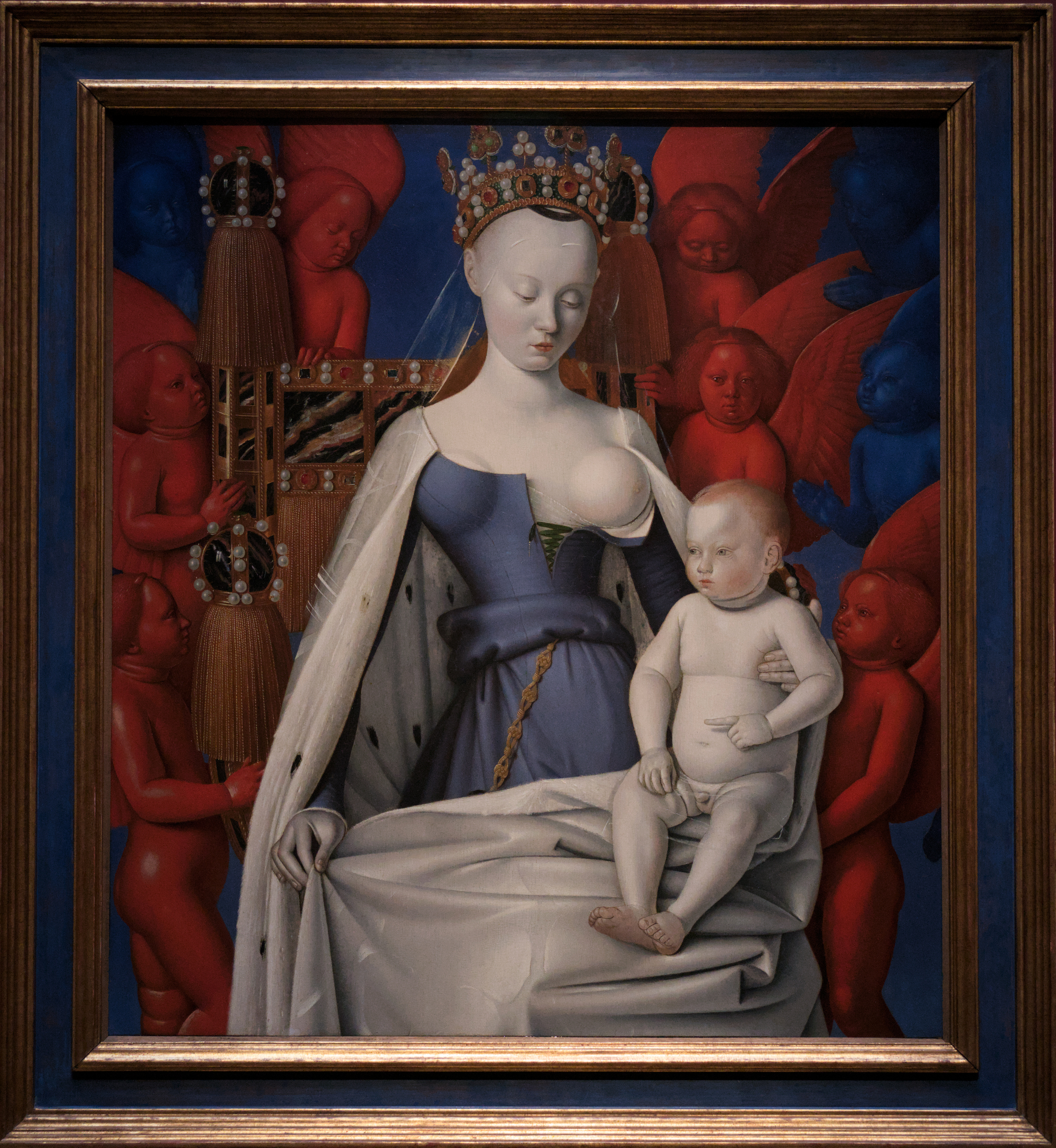
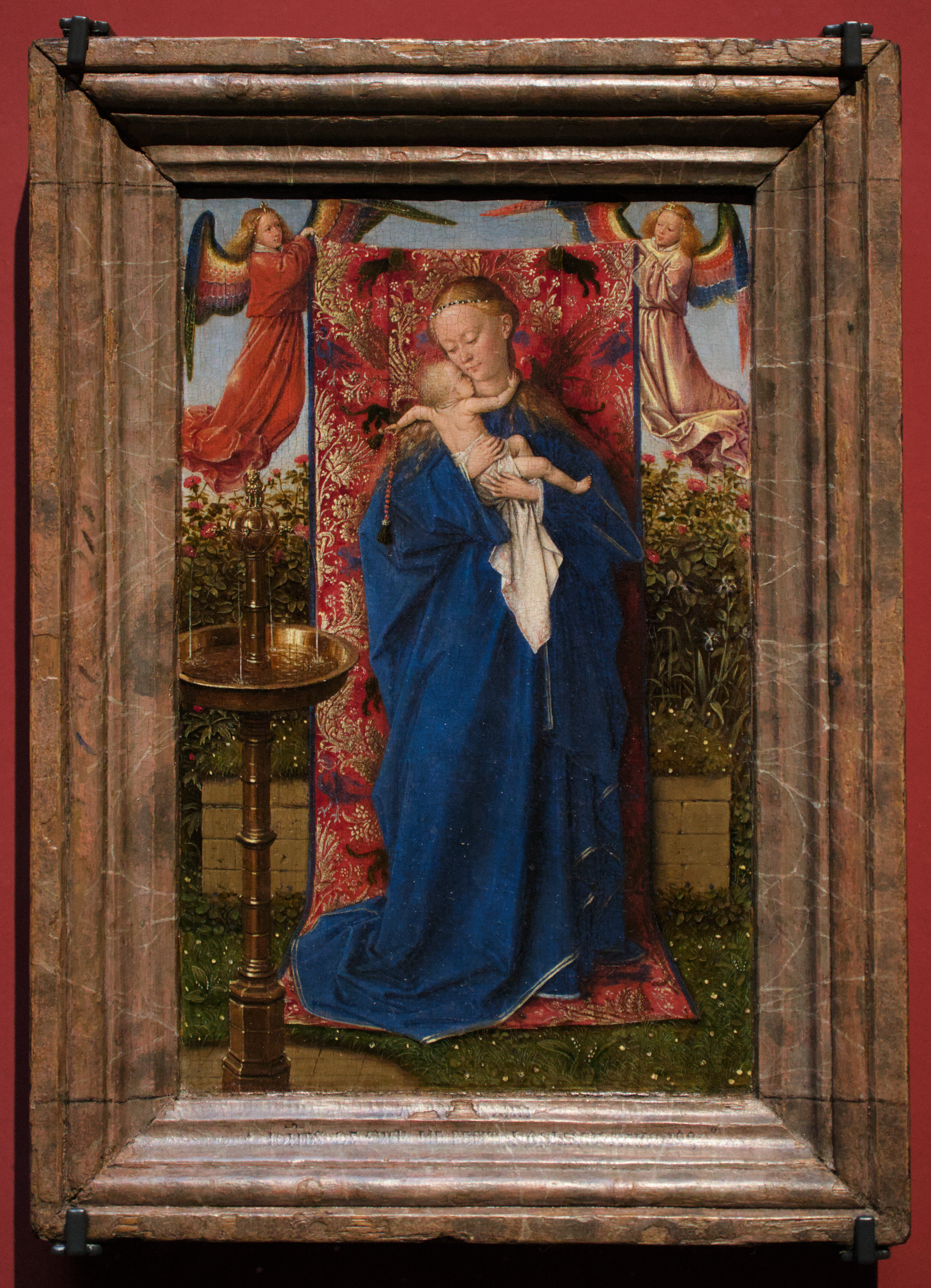
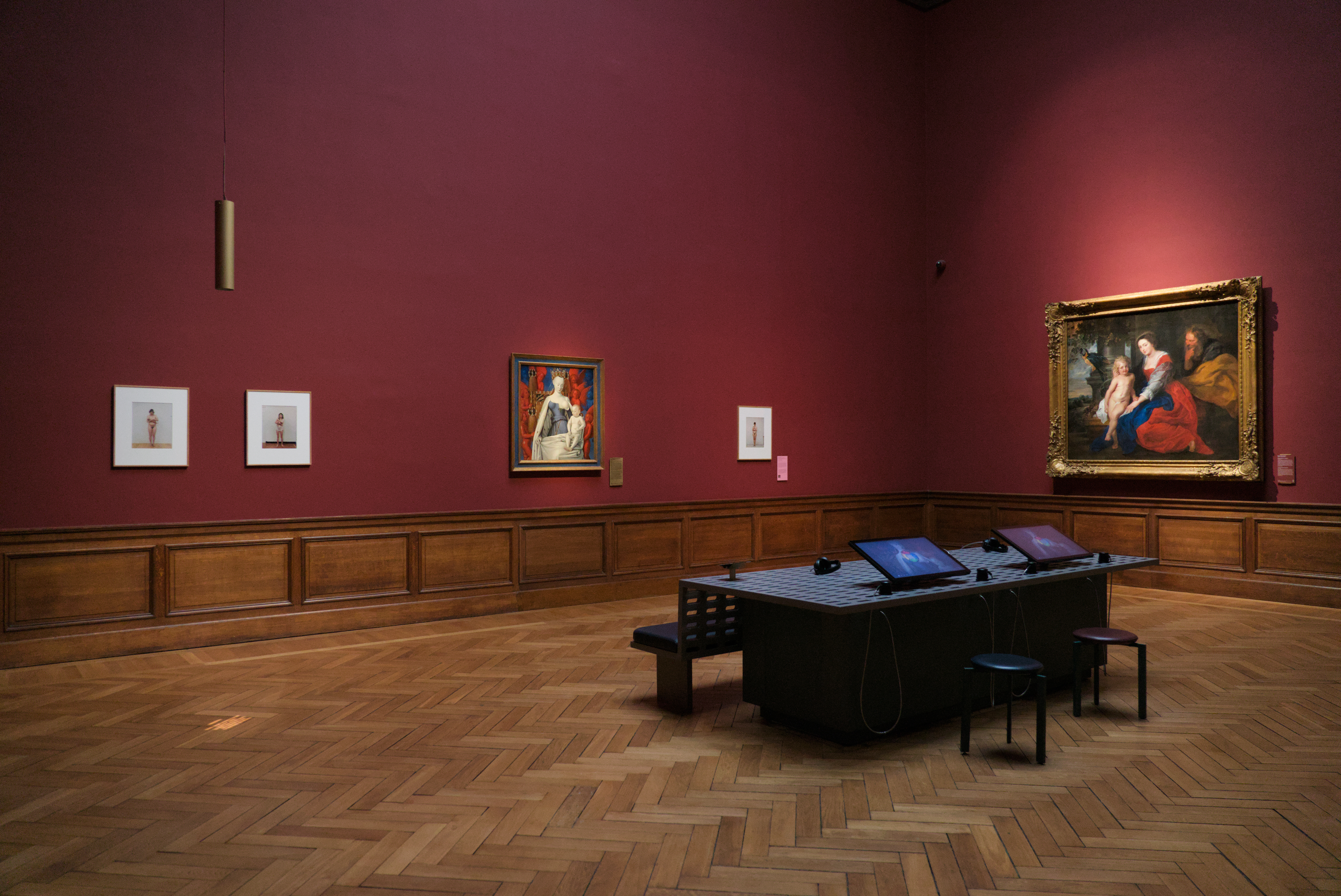
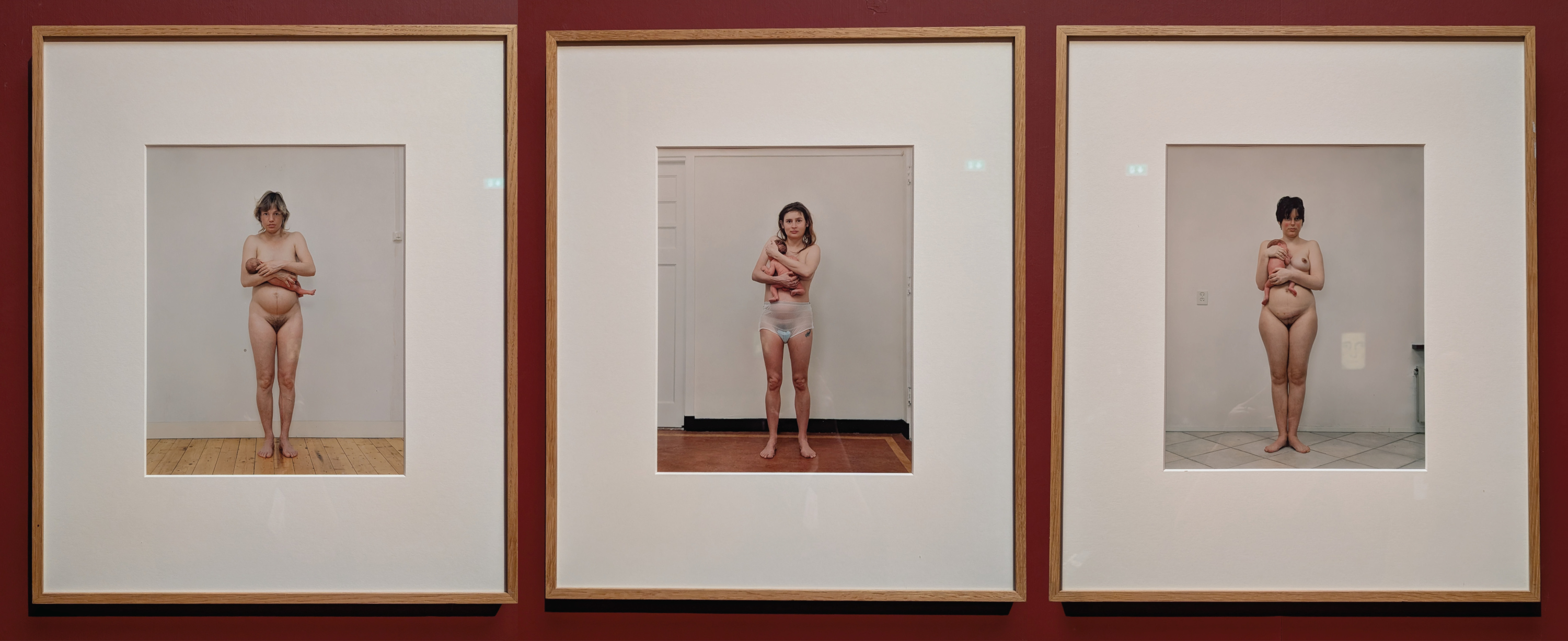
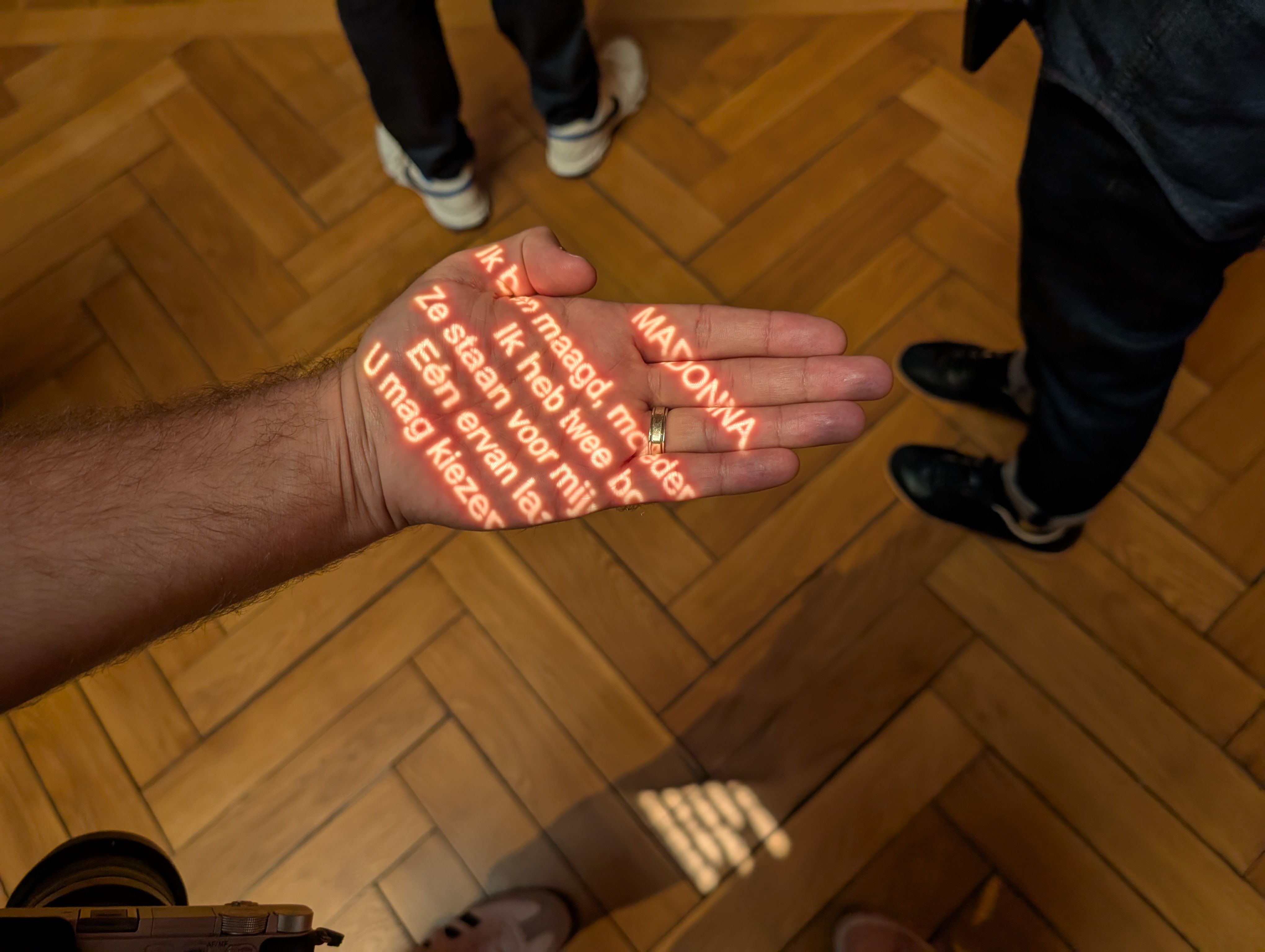
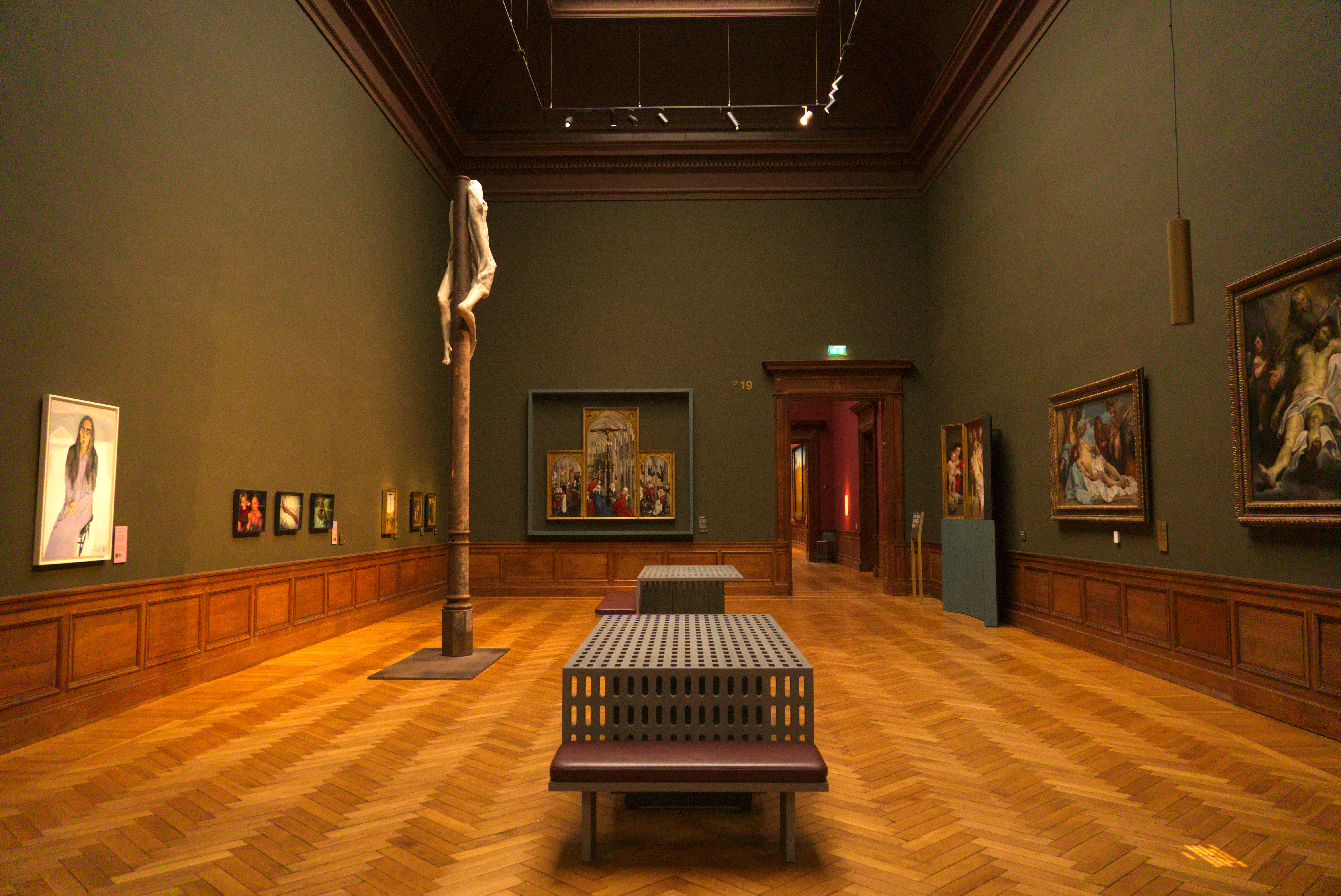
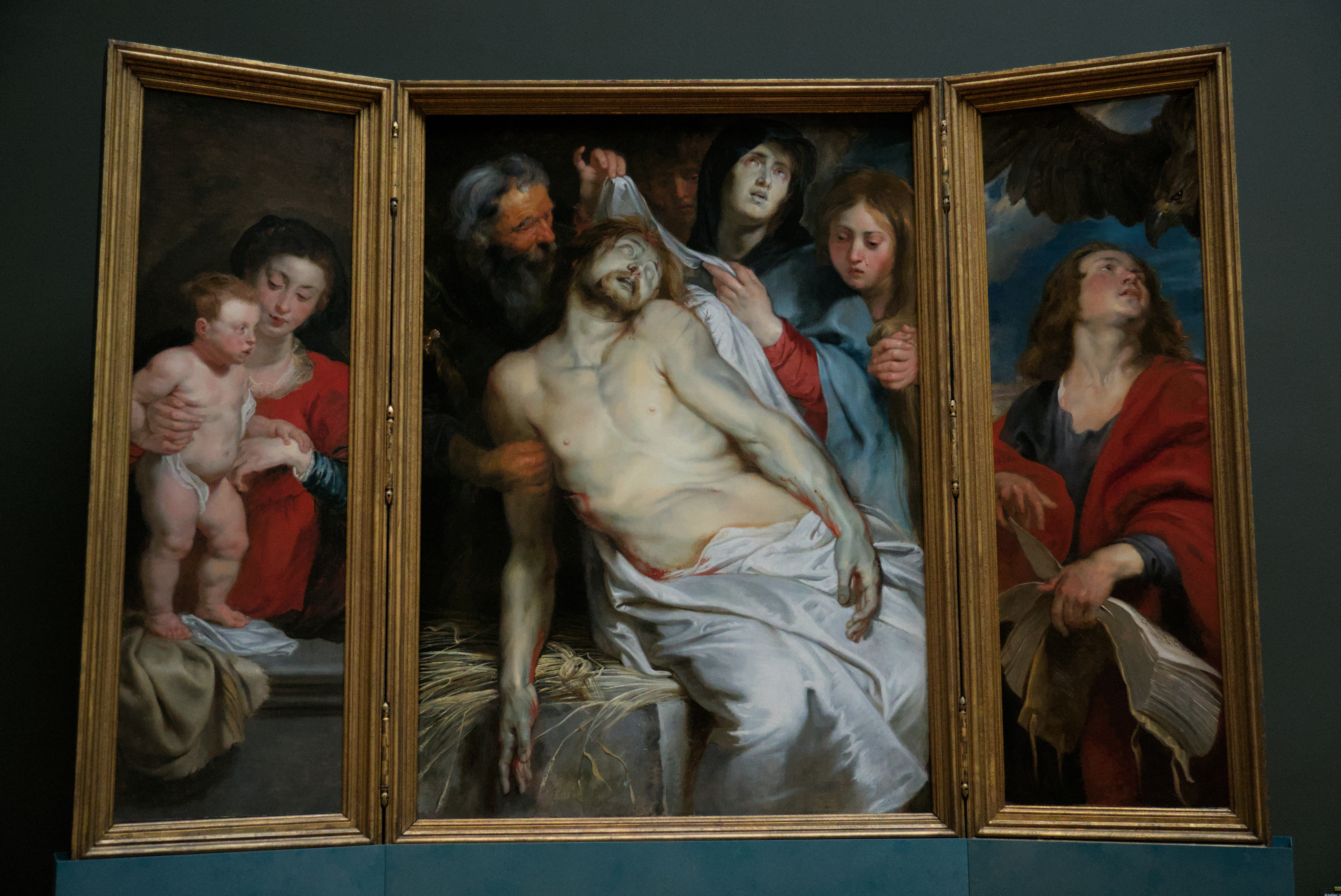
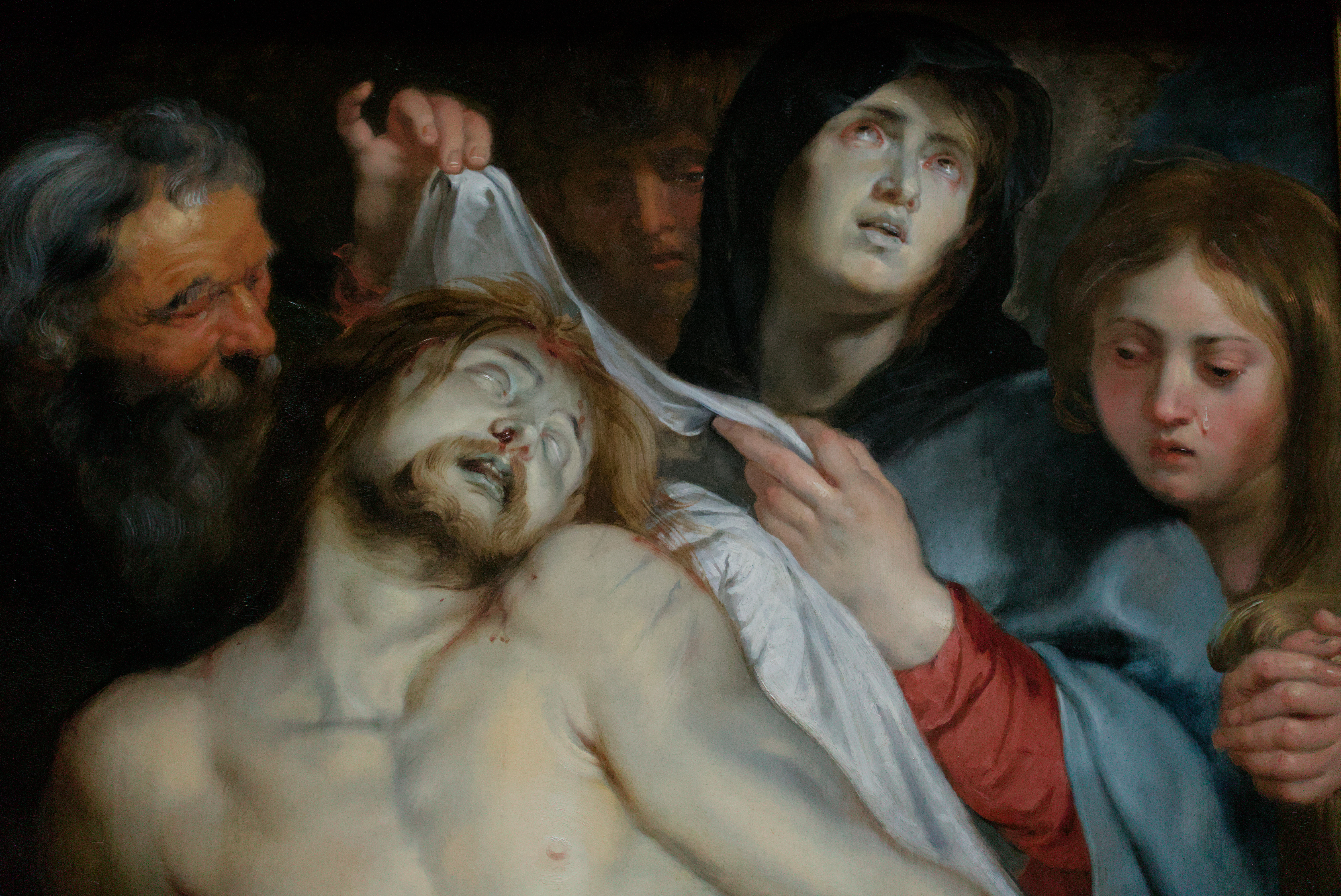
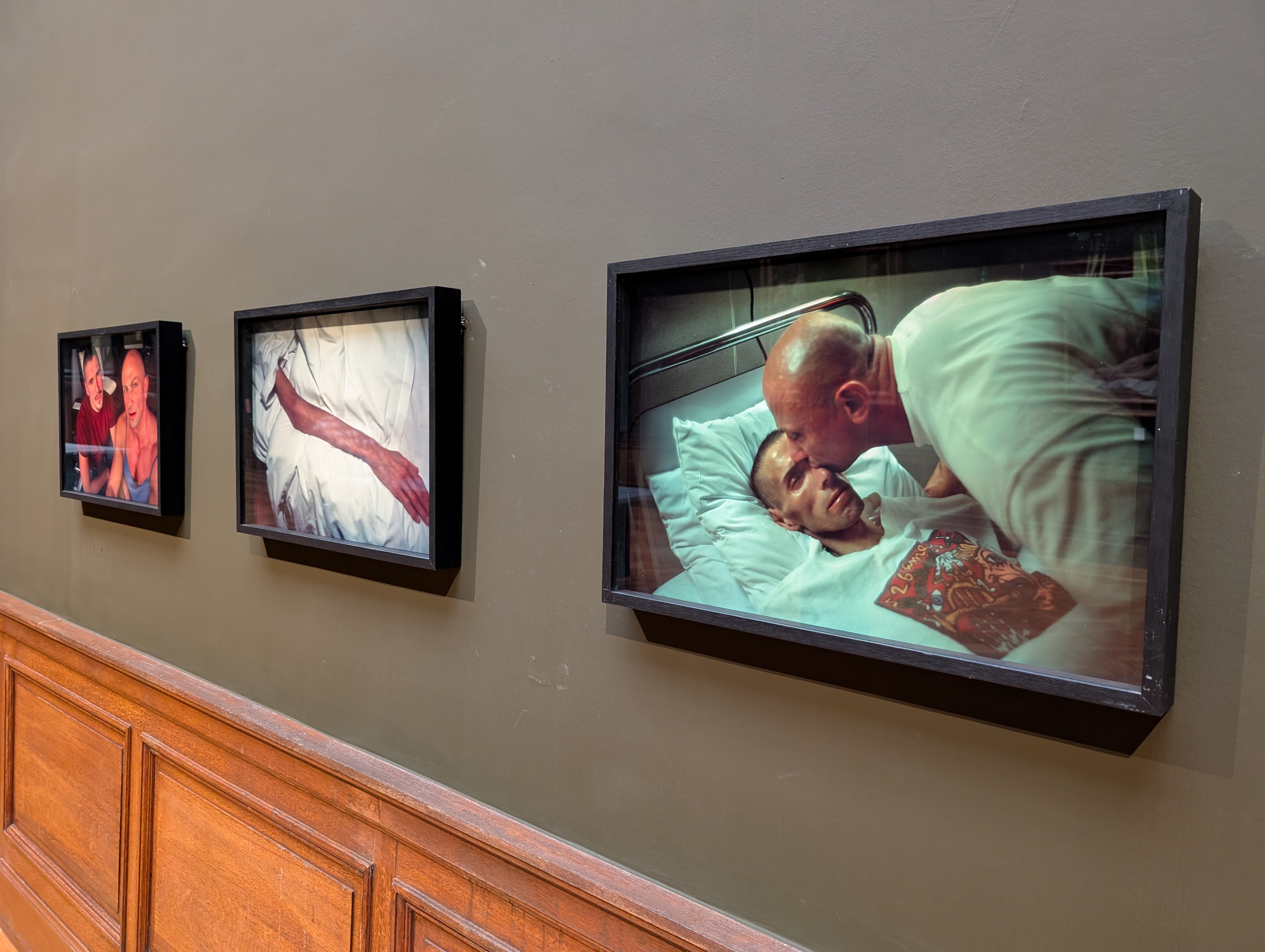
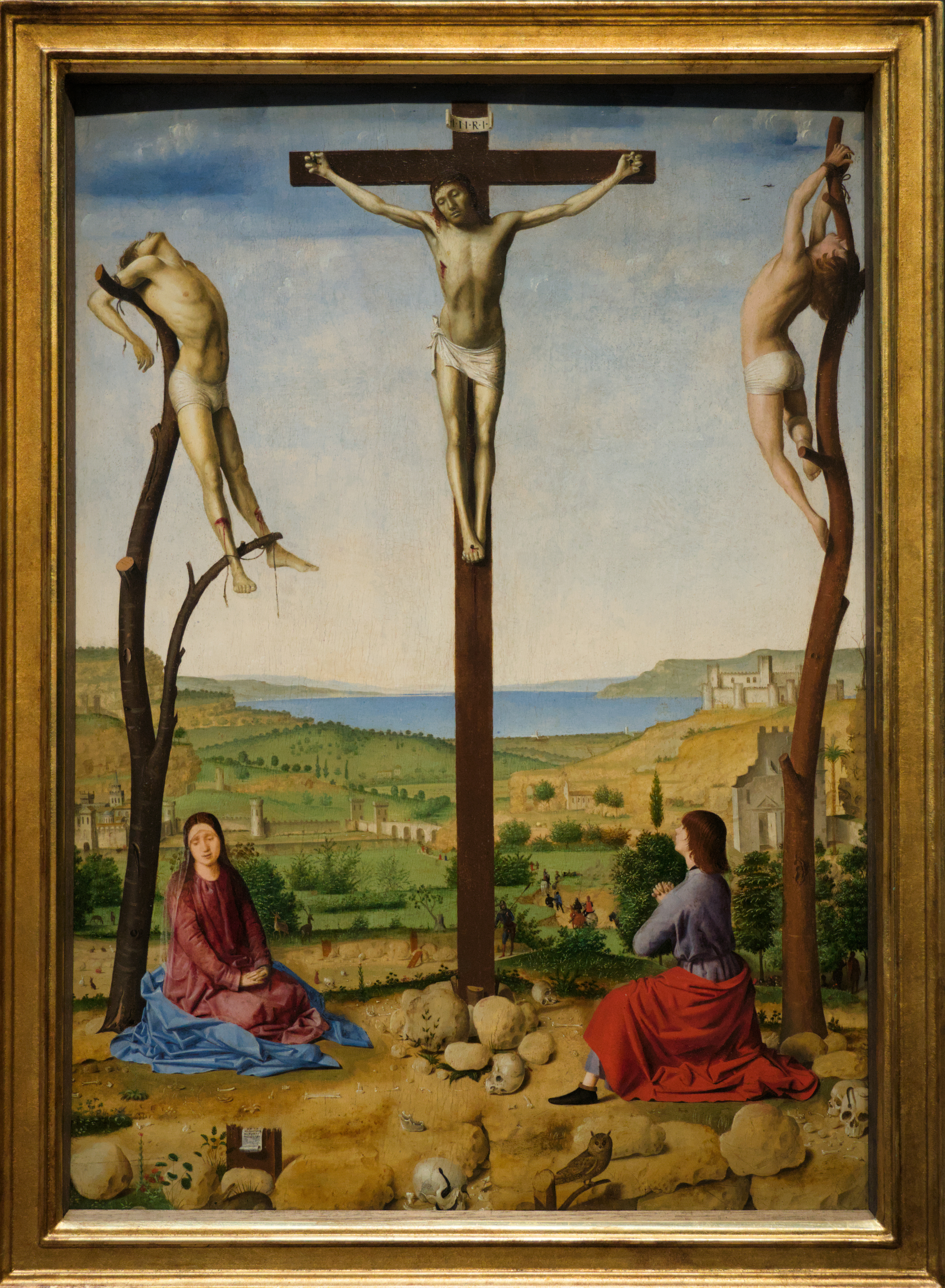
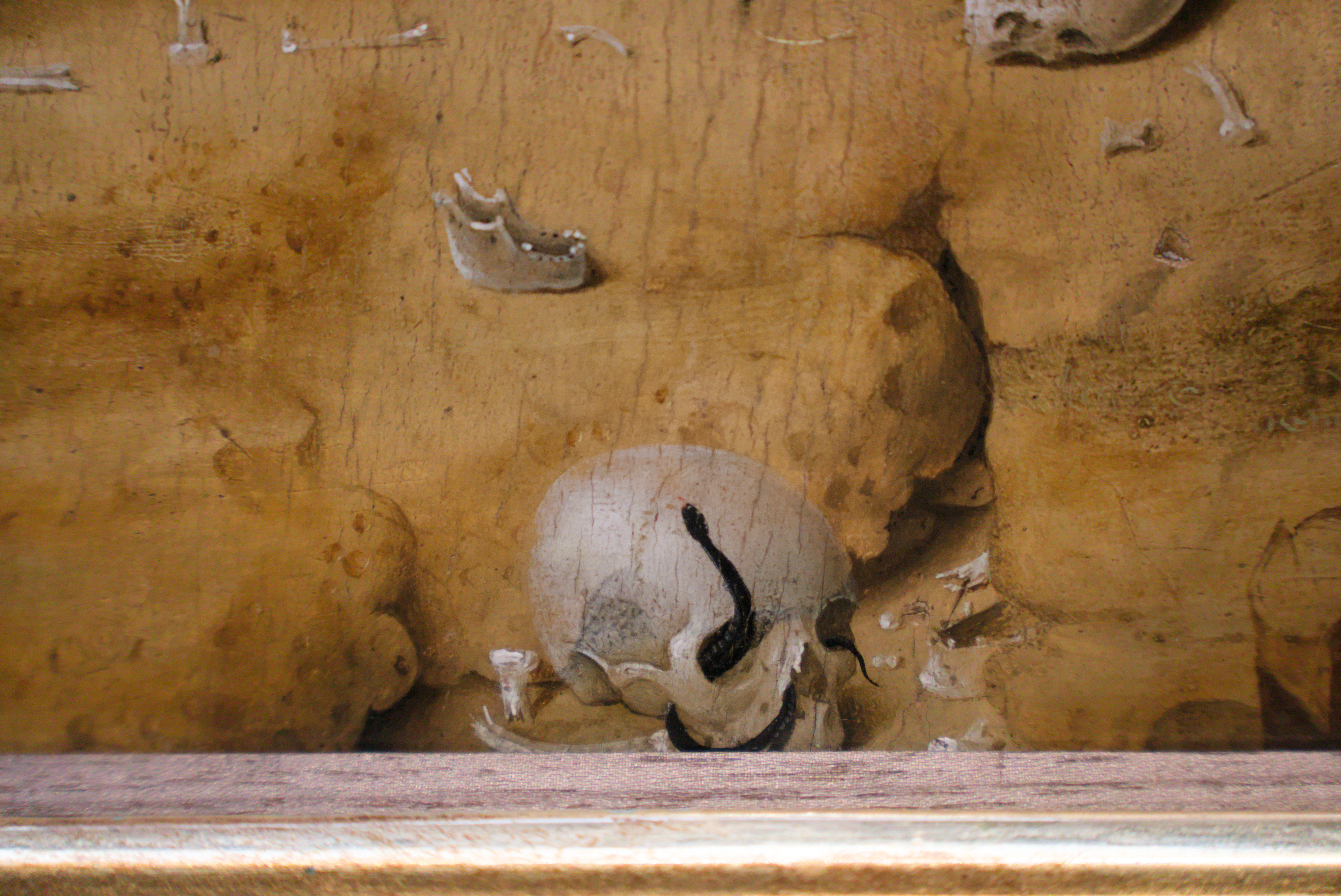
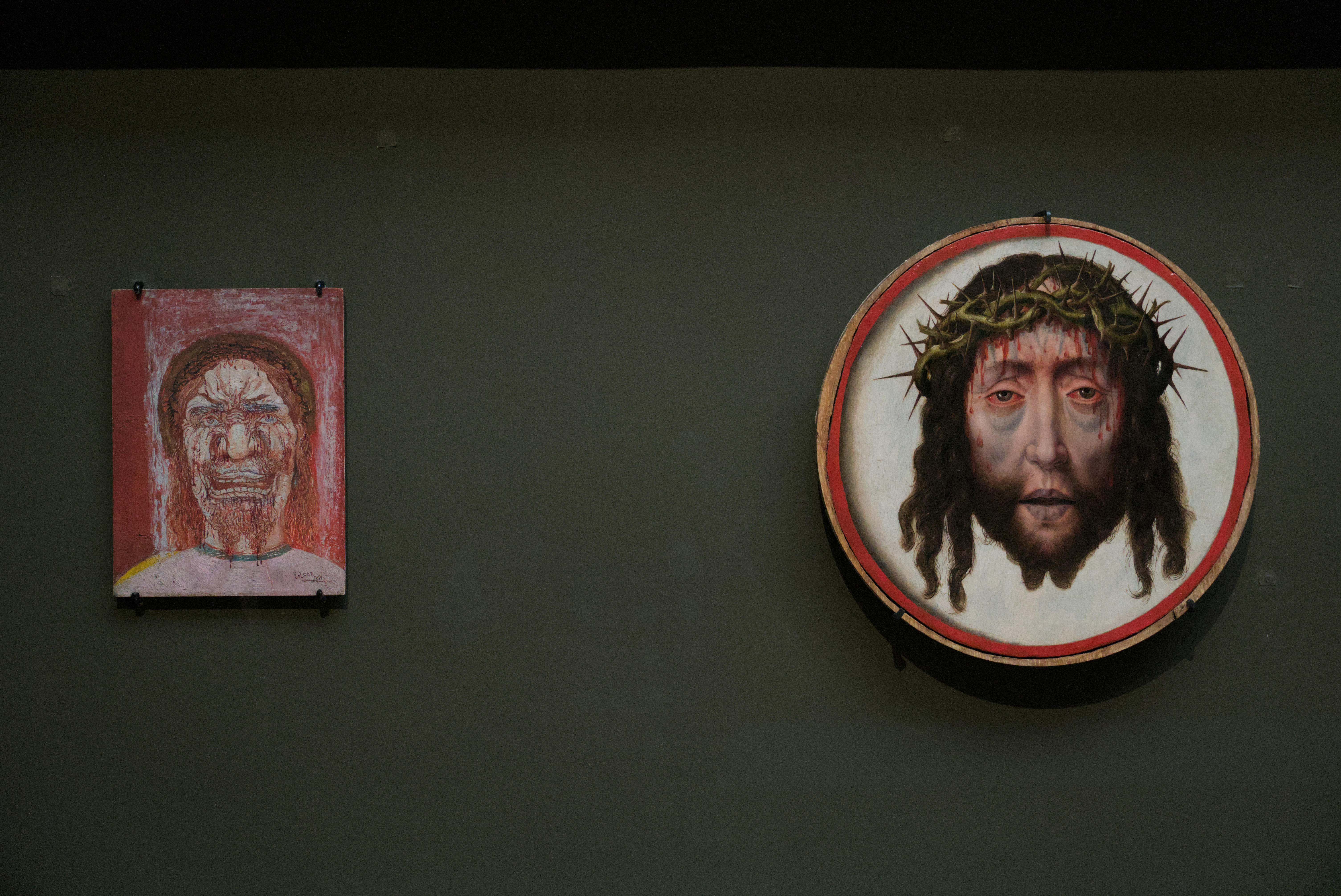
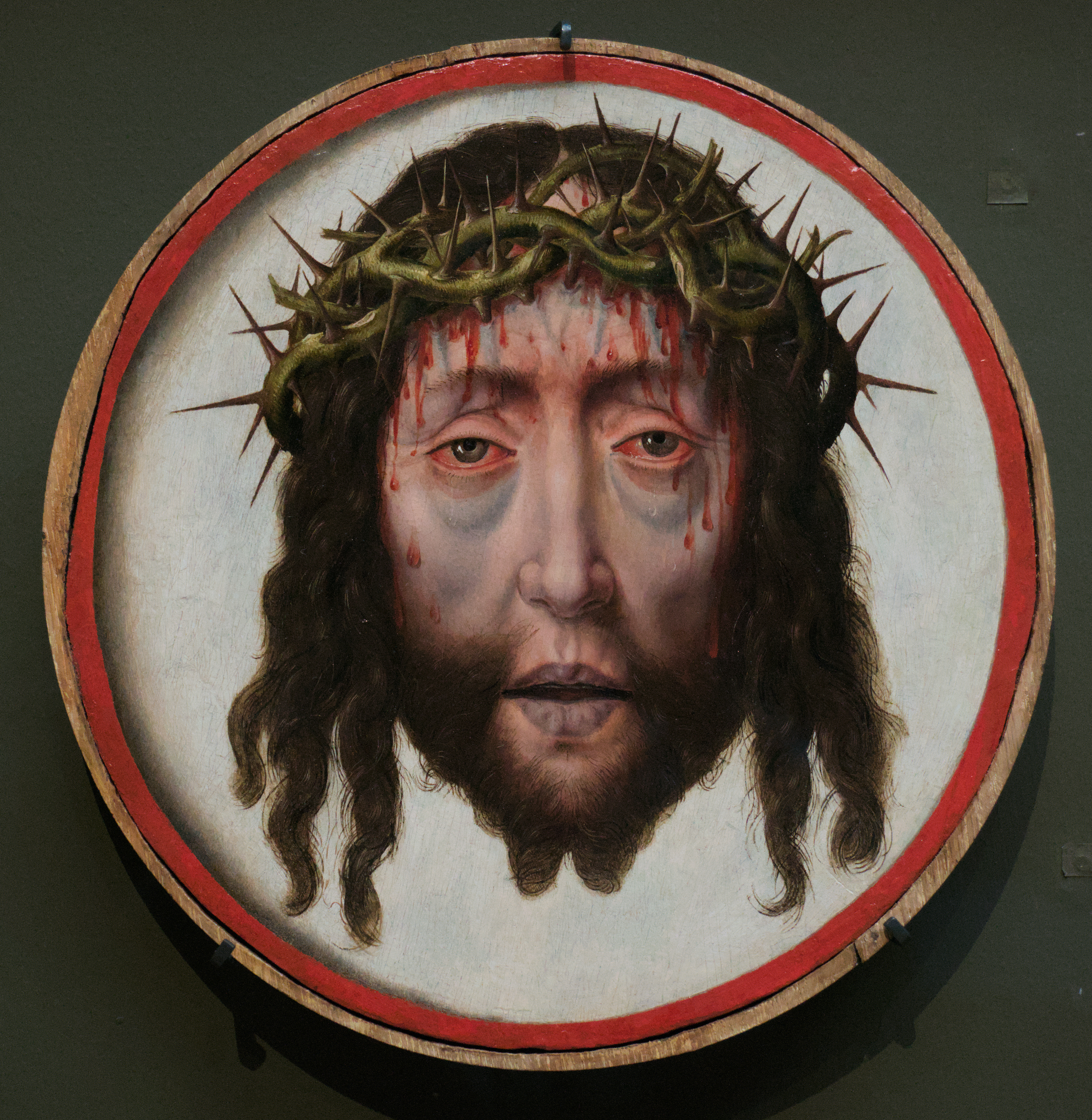
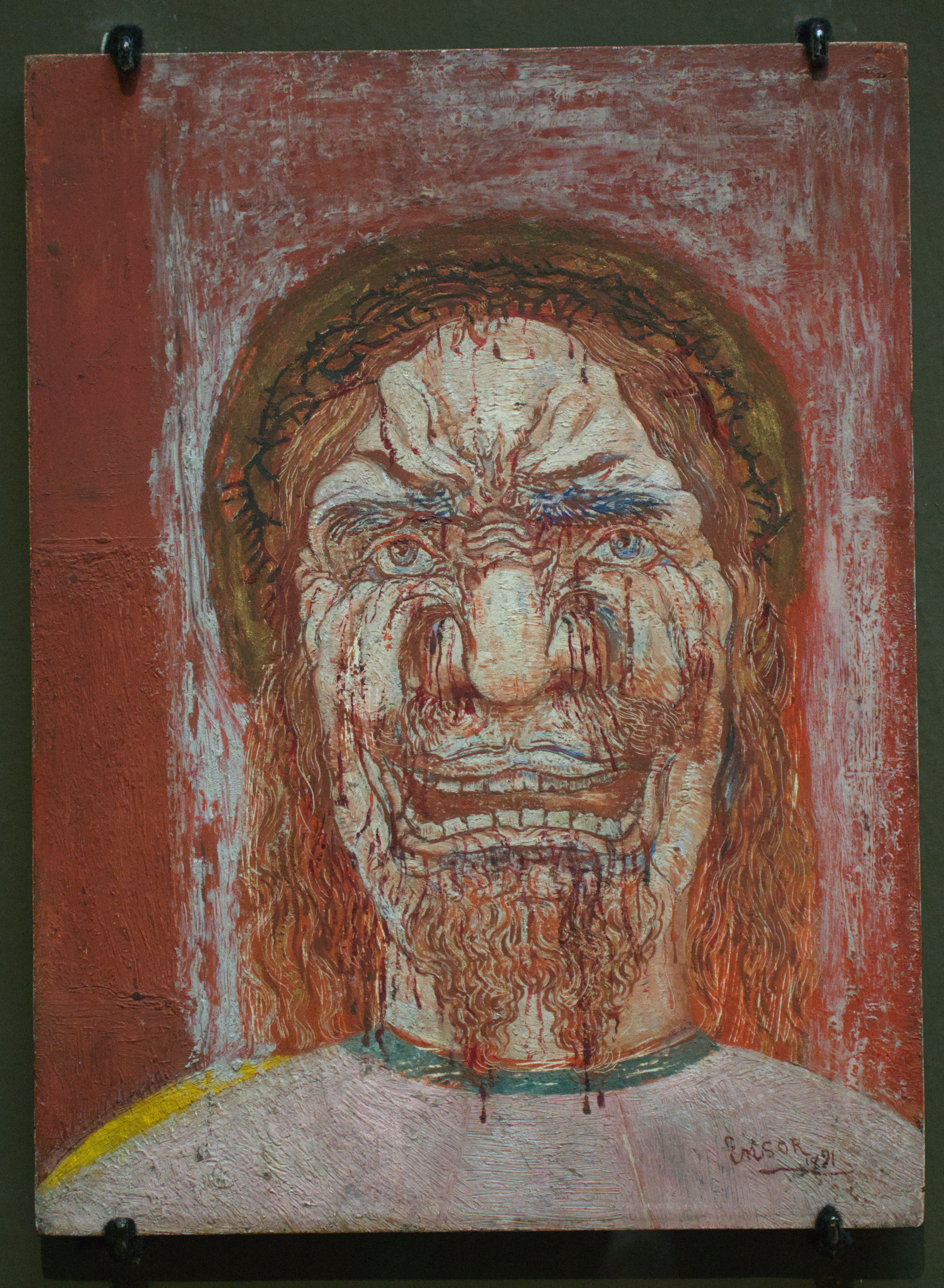
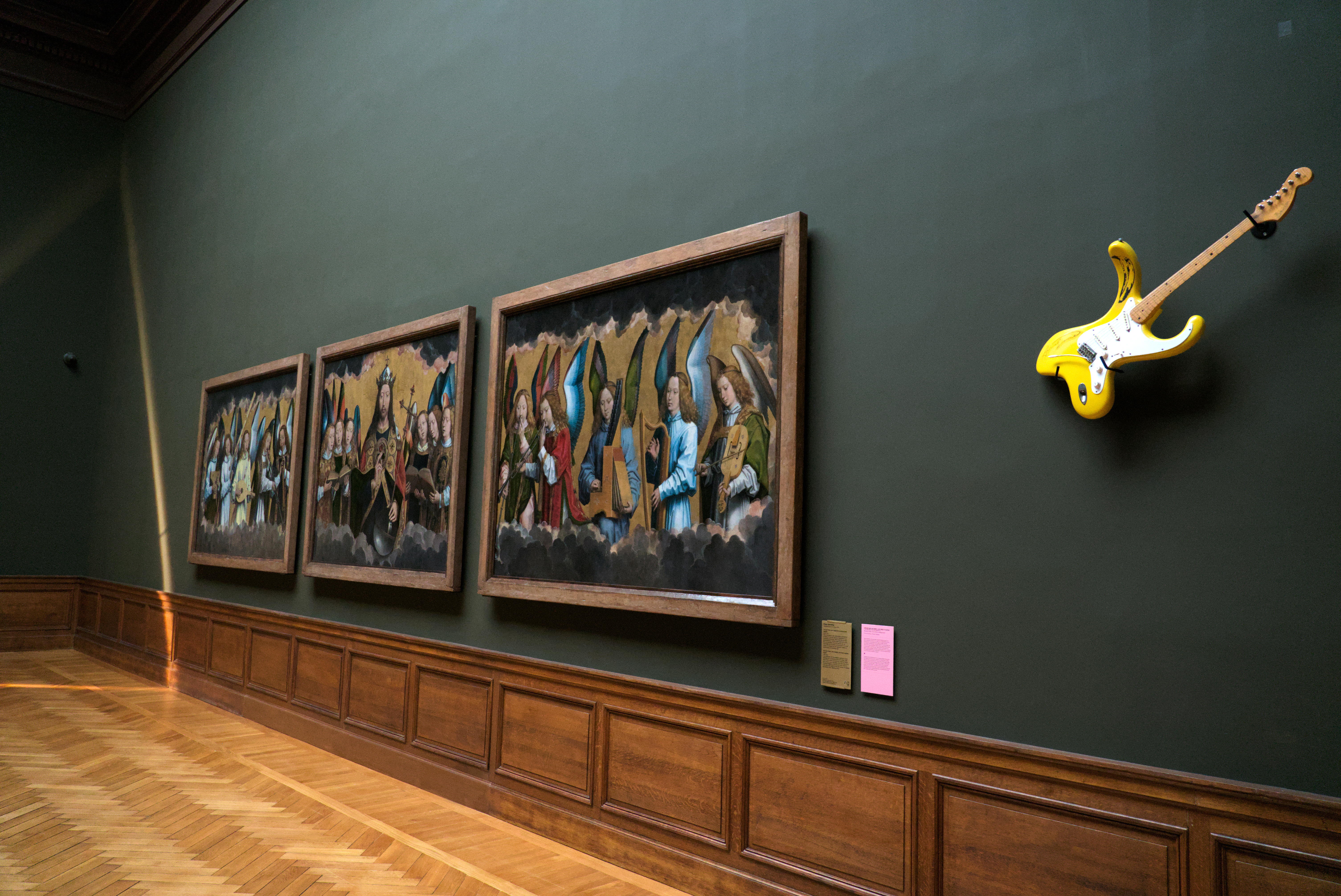
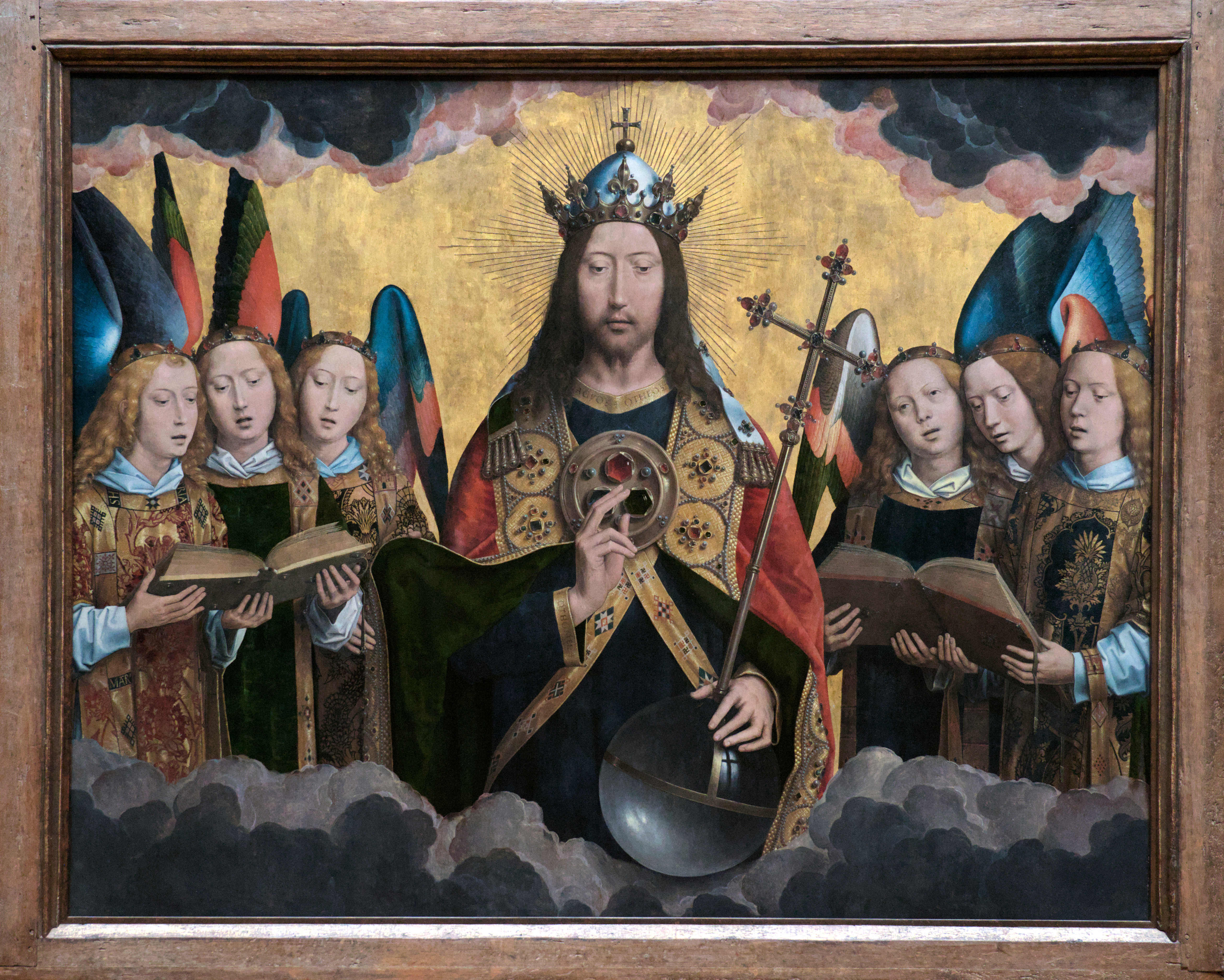
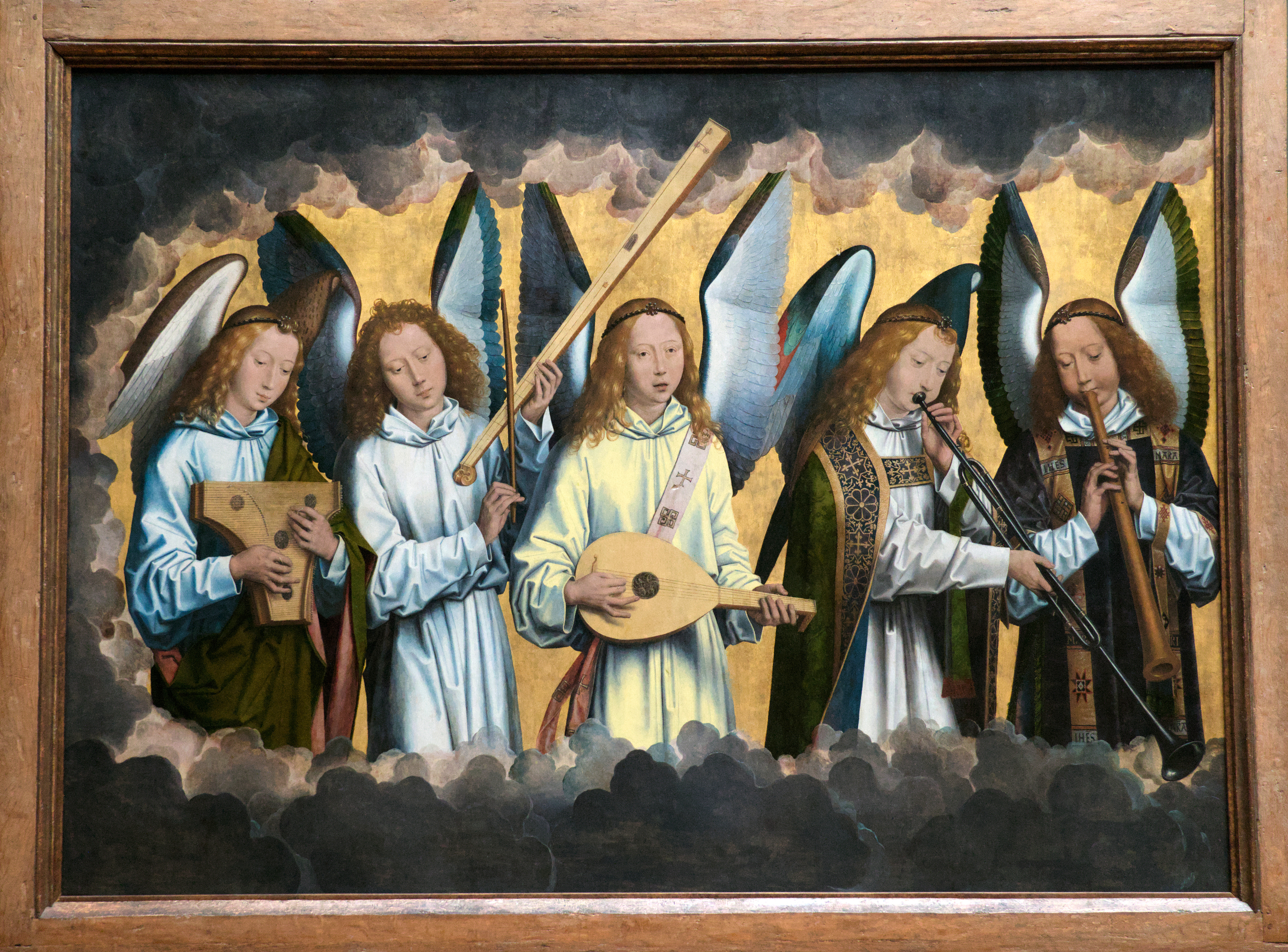
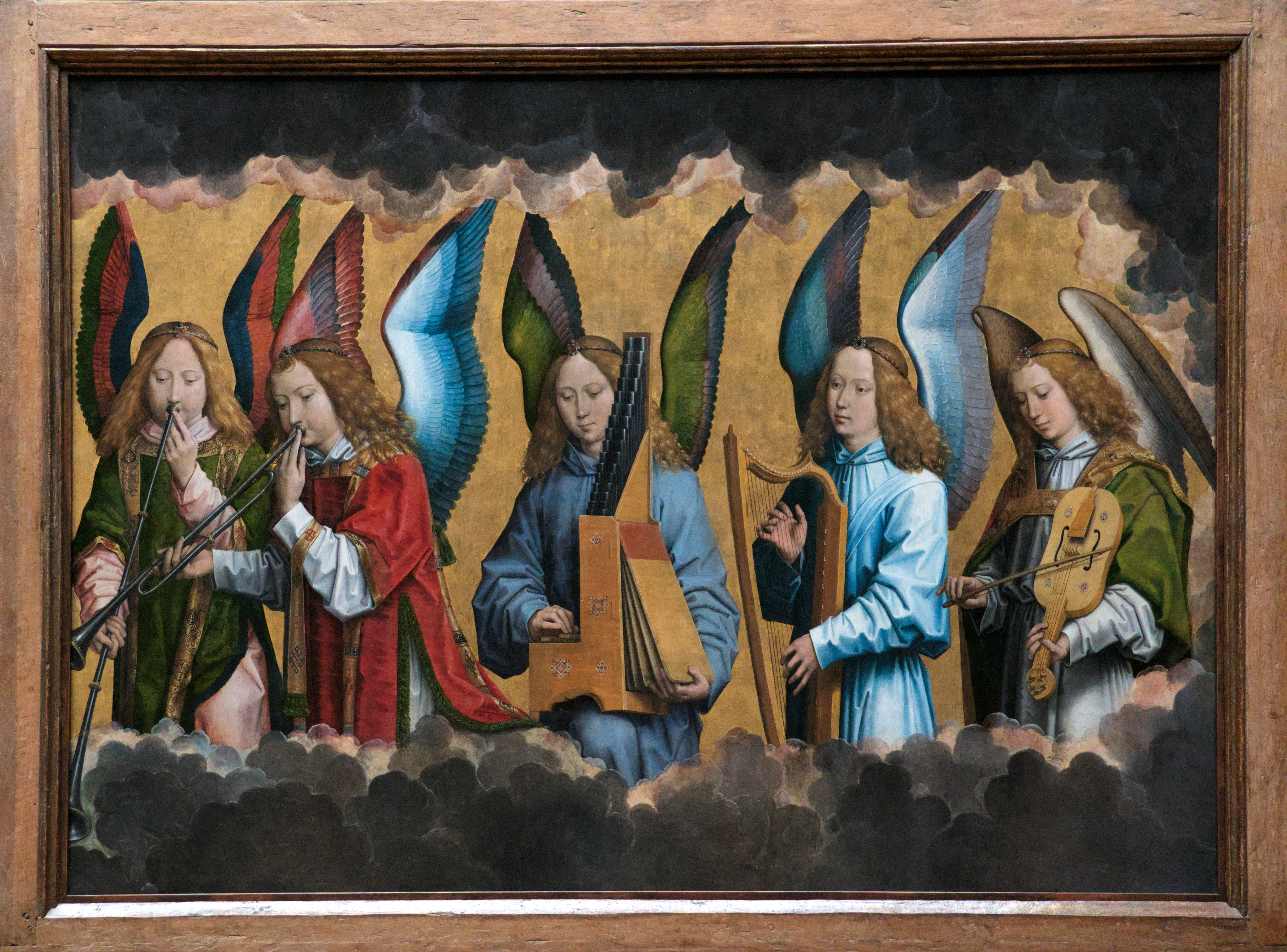
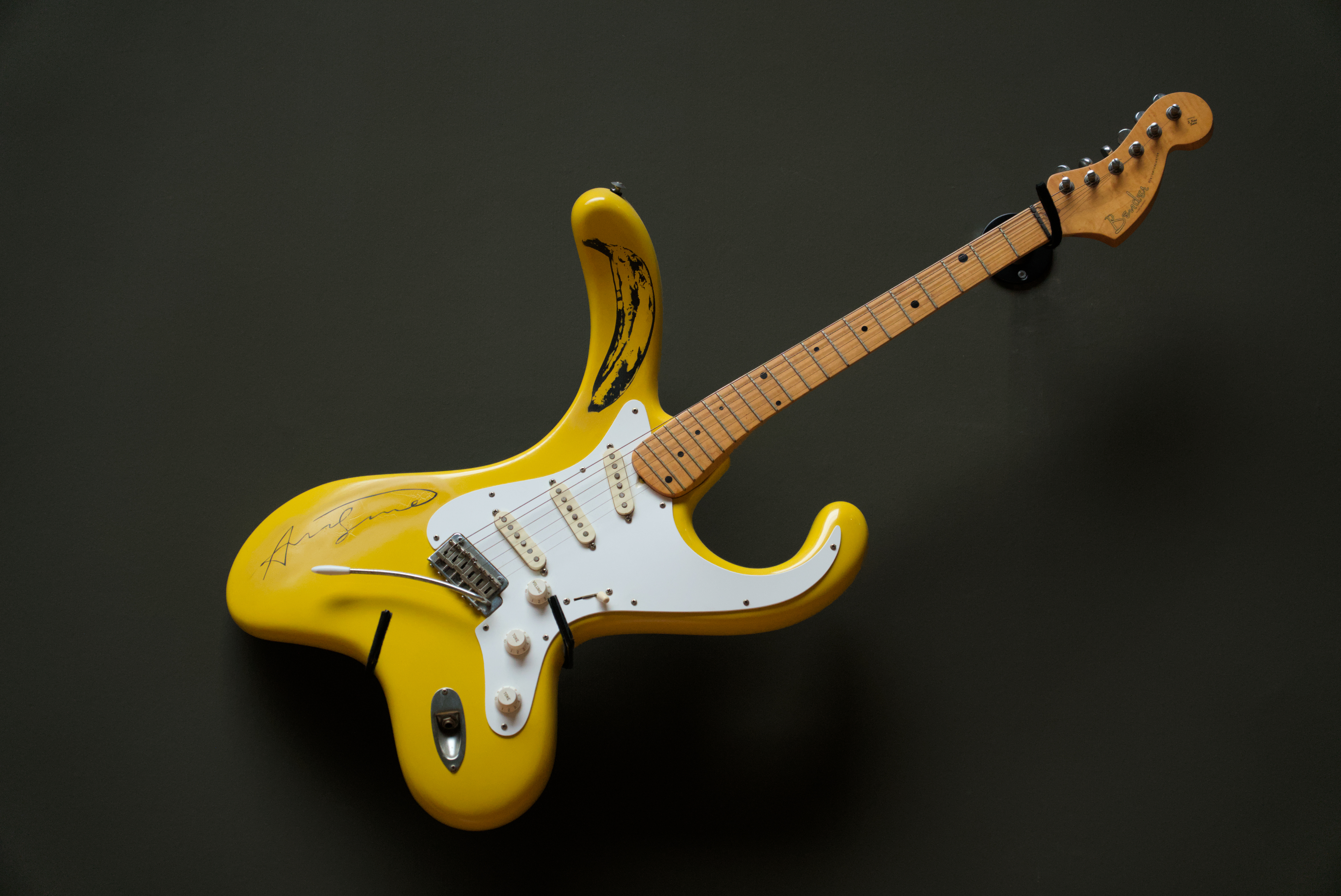
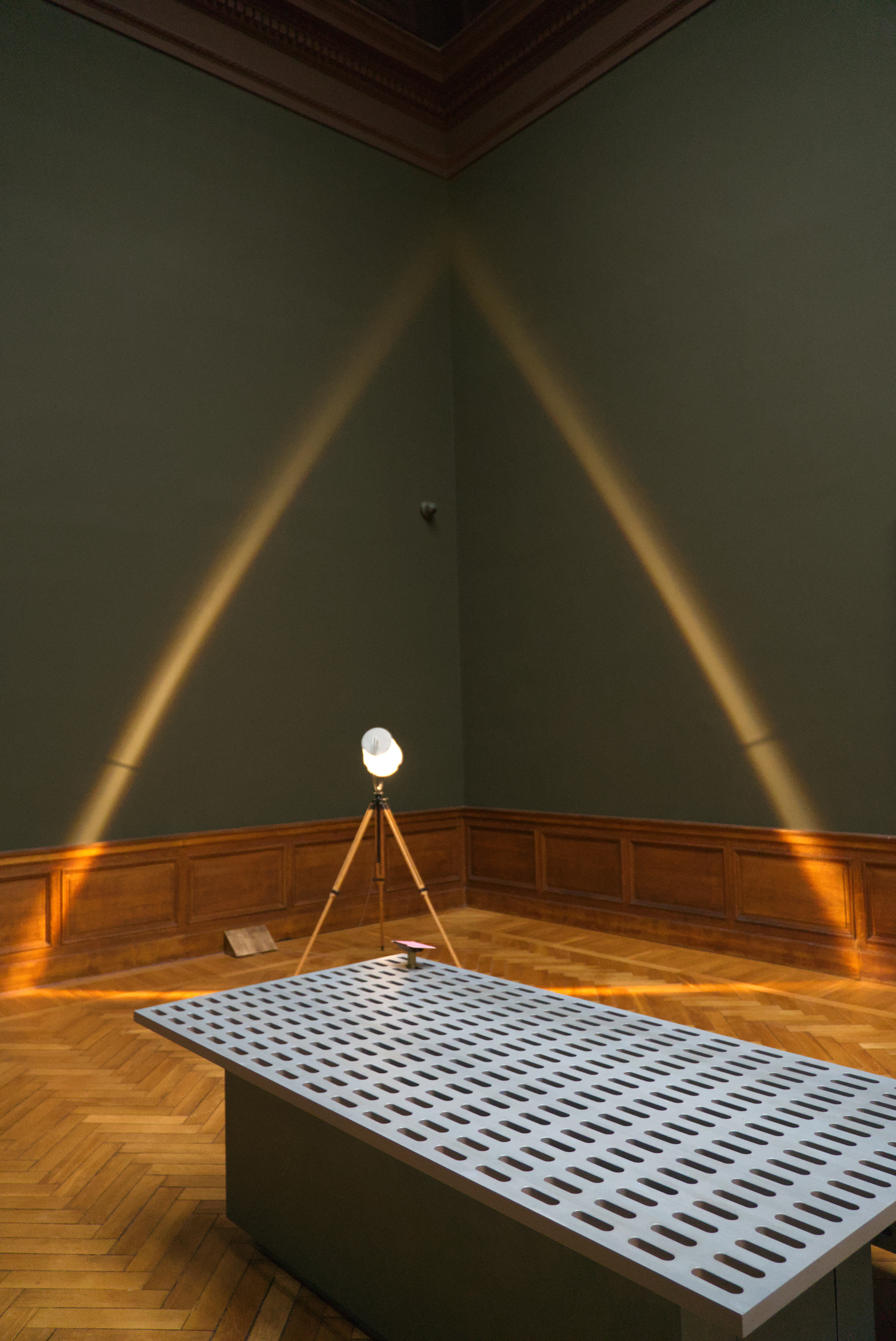
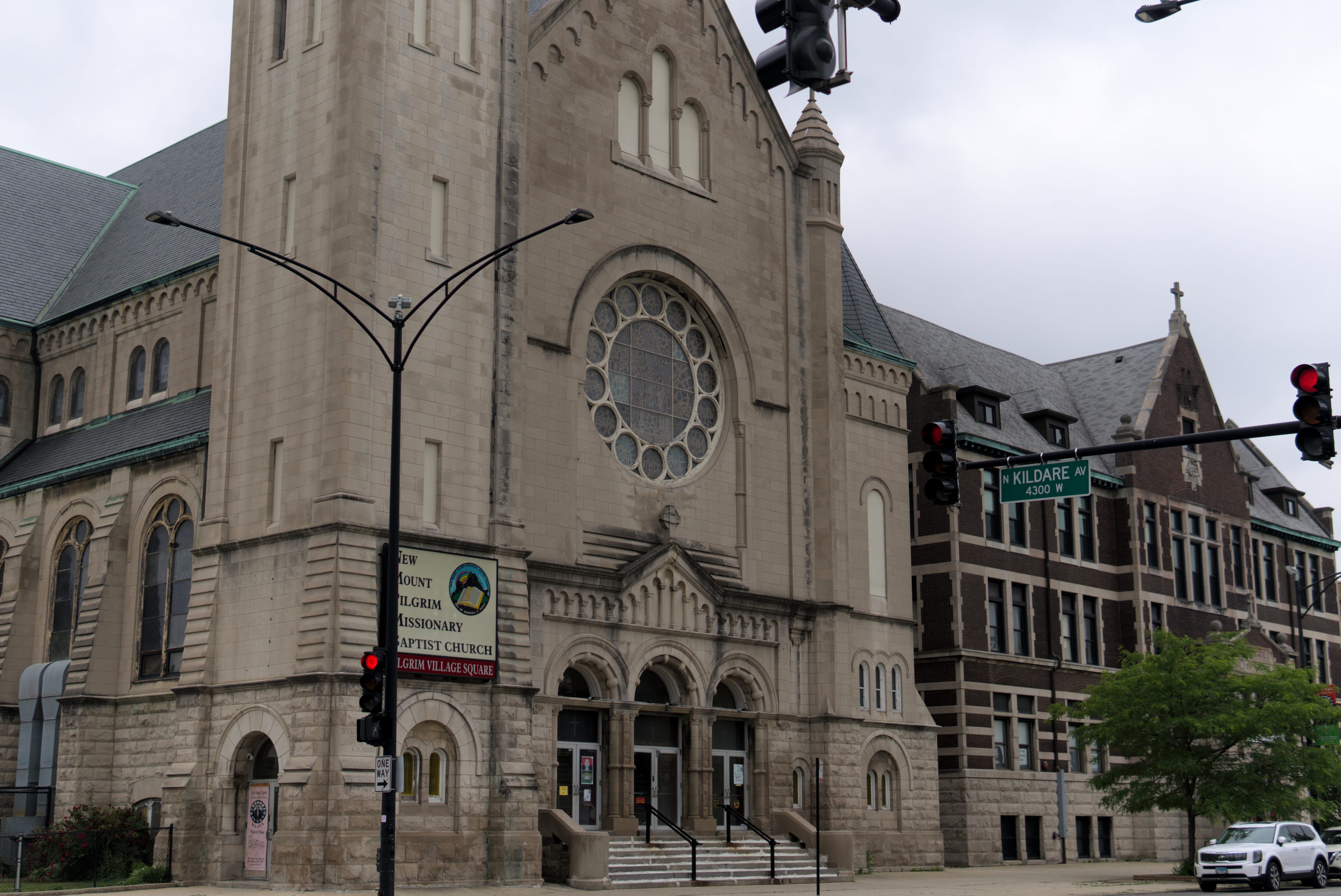


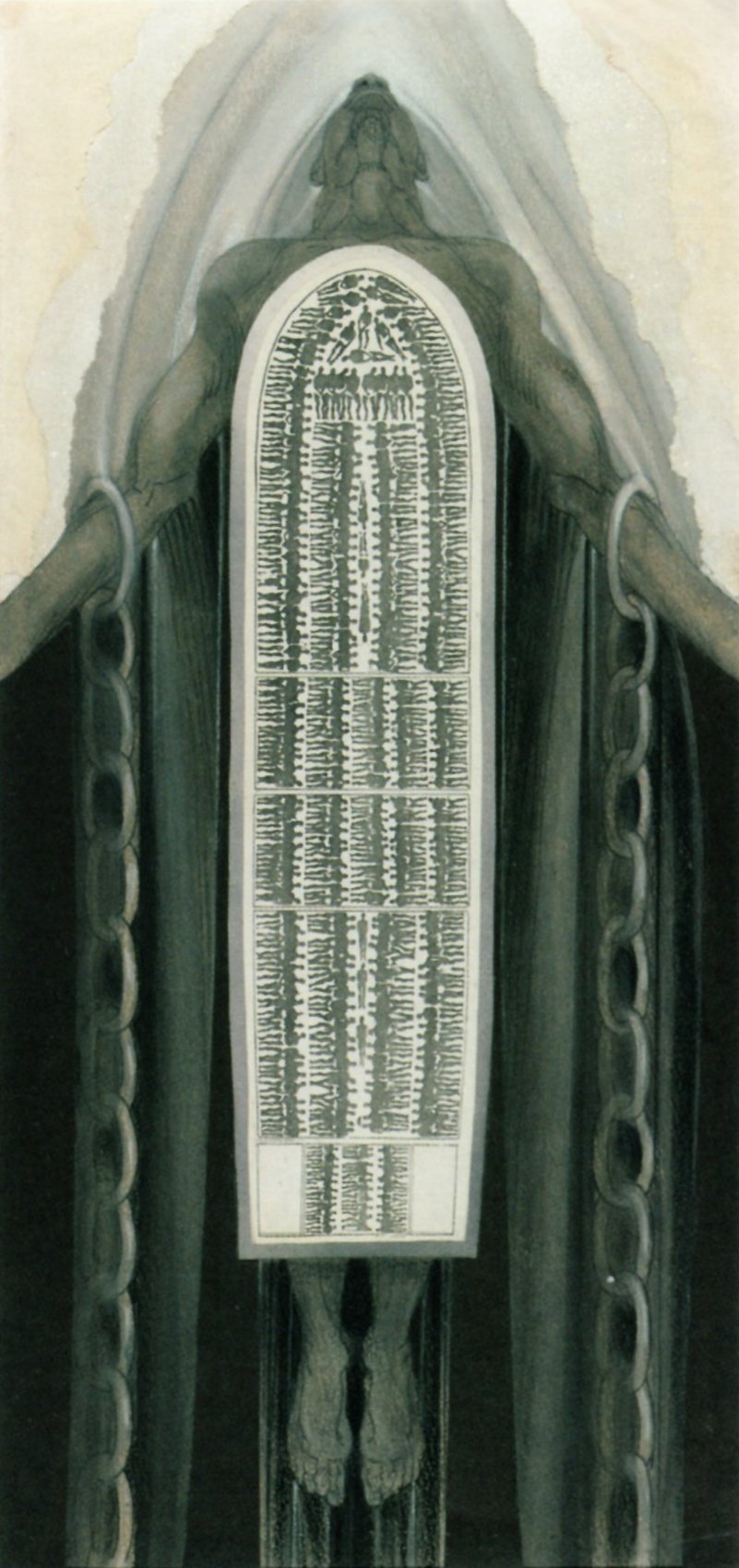


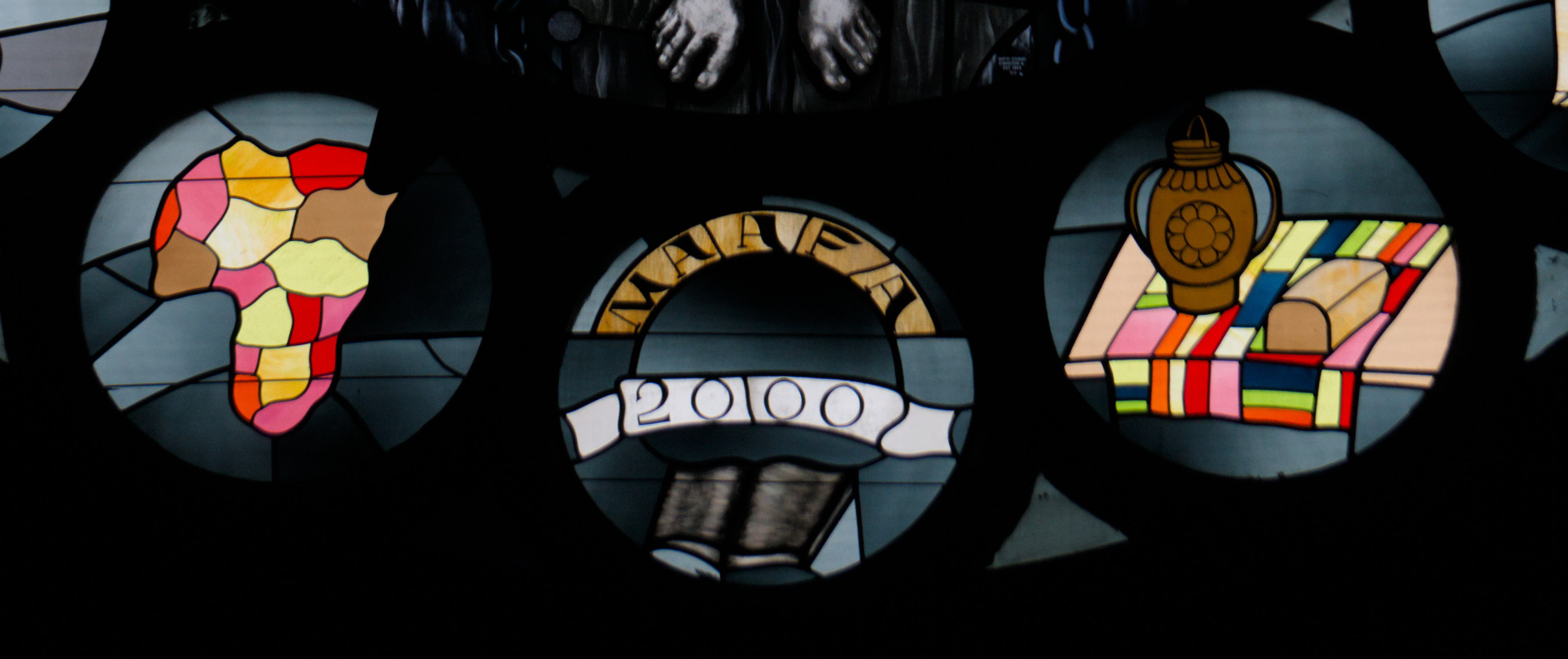


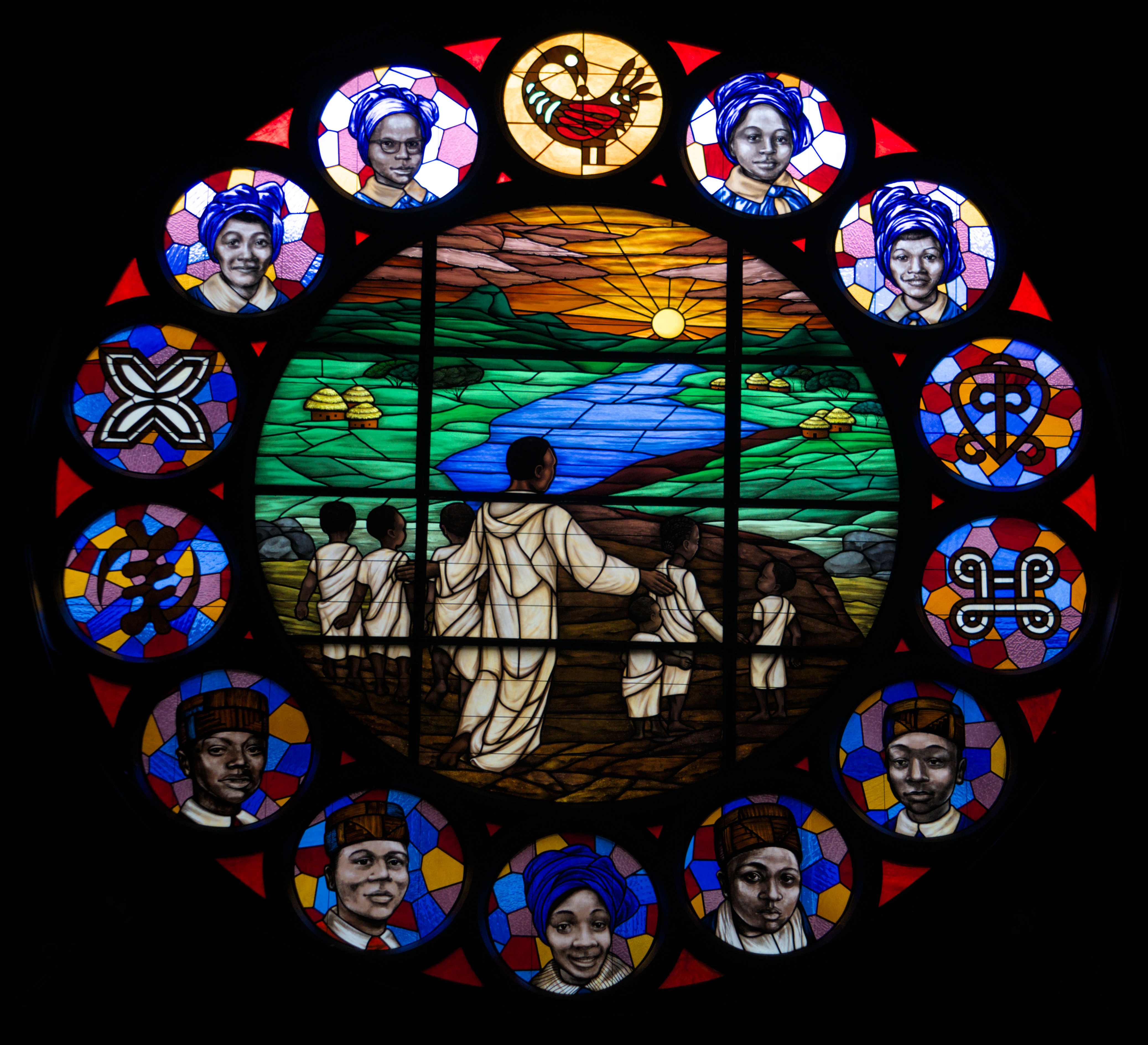



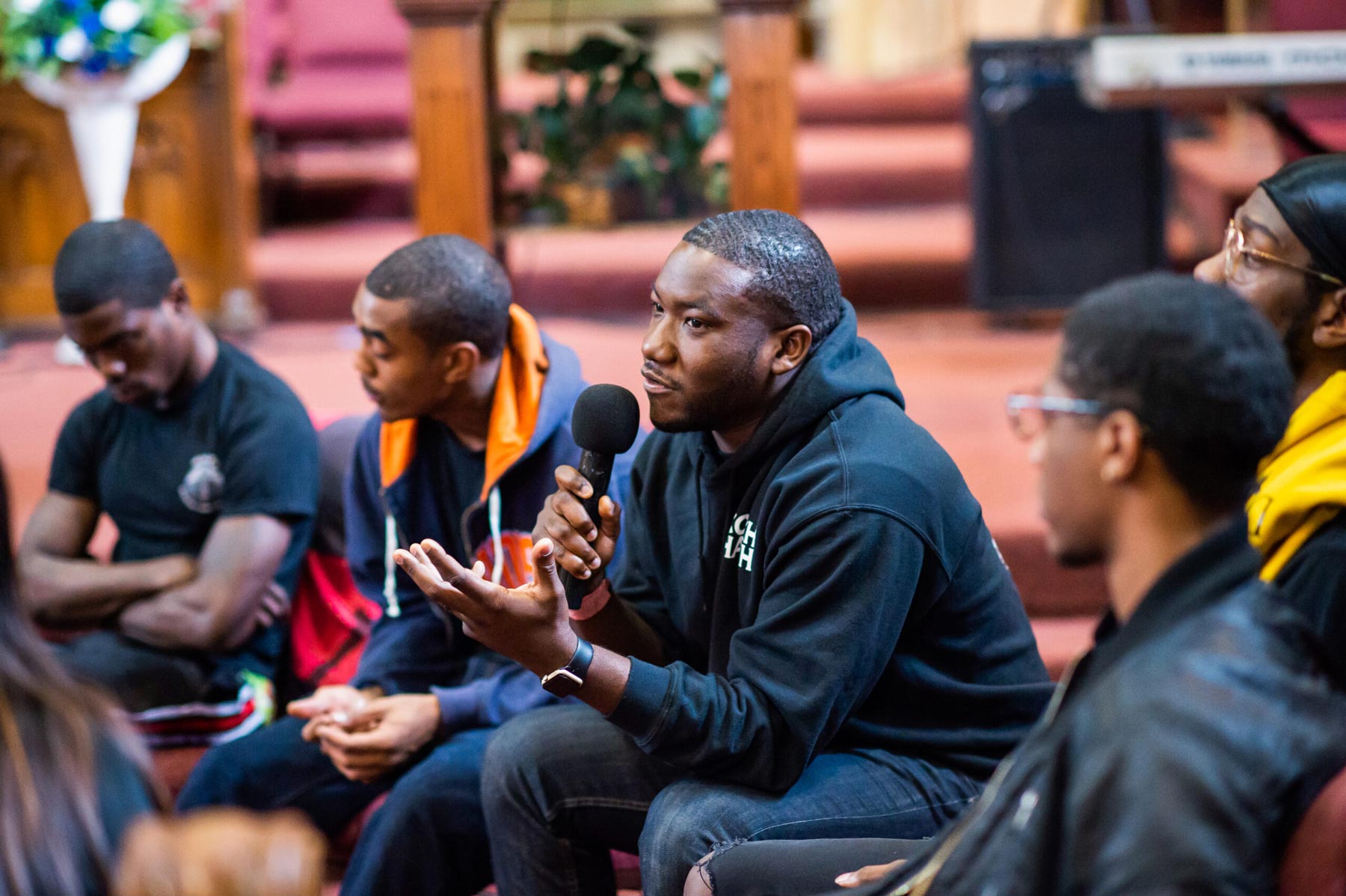




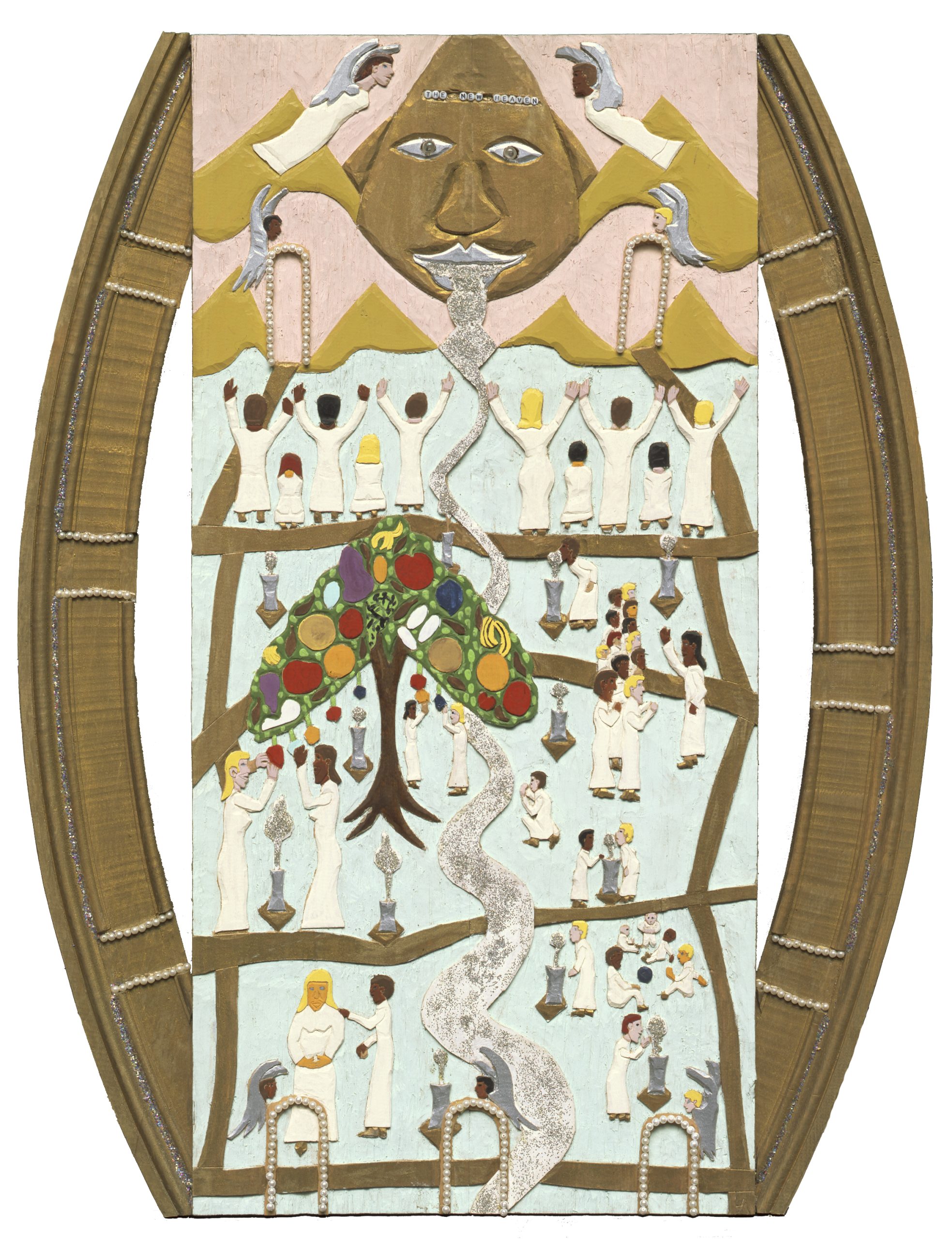
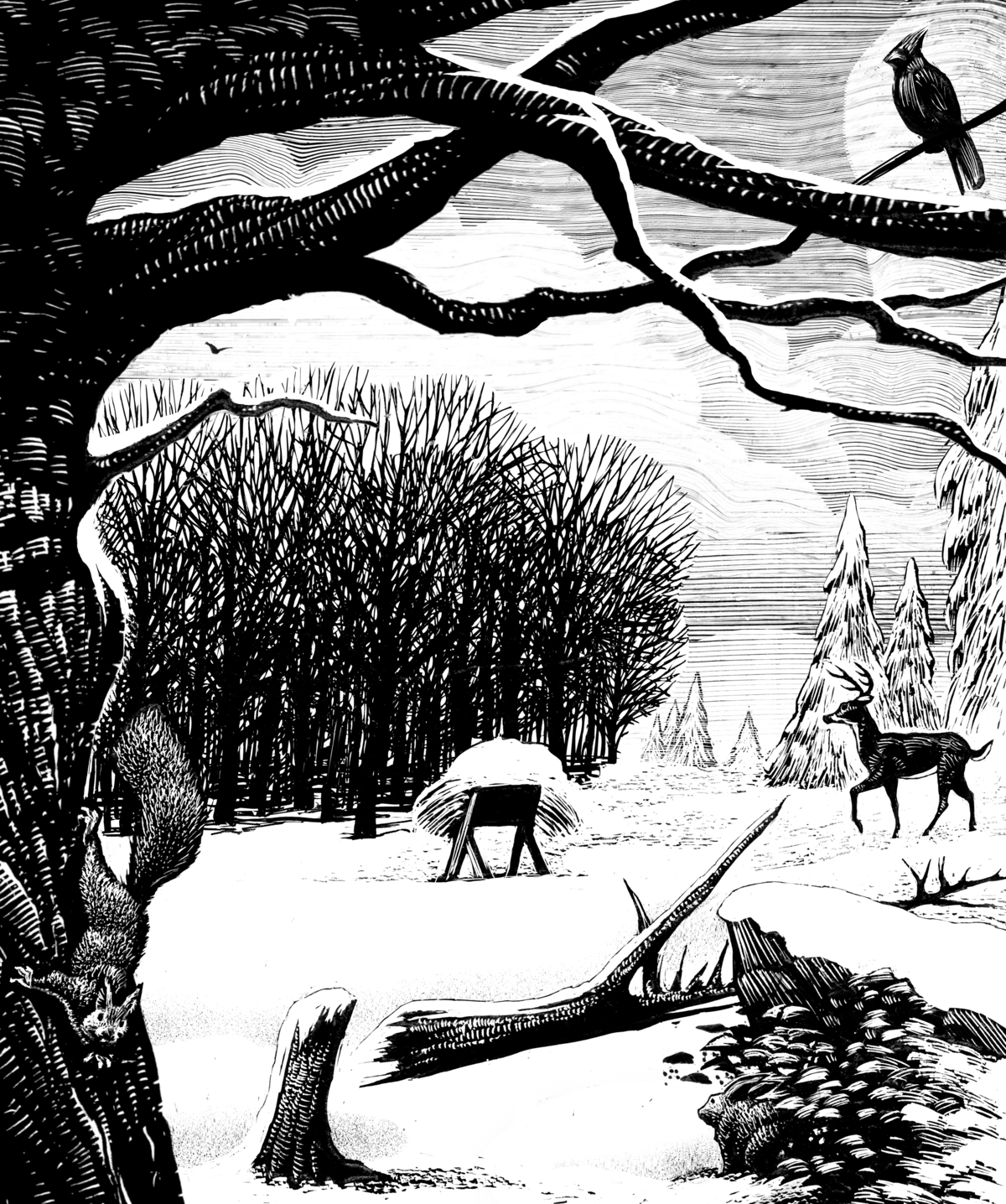


 Art & Theology