
Easter, Day 1: “Now in glory he doth rise!”

The high point of the church year, Easter is a fifty-day festal season, beginning today, that celebrates the Resurrection of Christ with concentrated vigor! The first eight days of Easter are called the Easter Octave. During this octave I will be publishing daily art-and-song posts, as I did for Holy Week, in the hopes that these works of beauty will help you to bask, wonder, and rejoice in the world-changing truth that Christ is risen.

LOOK: Alleluia by Helen Siegl

Siegl, Helen_Resurrection
Helen Siegl (Austrian/American, 1924–2009), Alleluia, 1975. Color woodcut, 20.5 × 12 cm.

Jesus flipped the script on death! On the bottom of this woodcut, Jesus hangs dead on a tree. The sun and moon have gone black. In the center of the composition, a large crown of thorns encircles instruments of the passion: the titulus, the rooster, the three nails, the spear, the sponge-tipped reed, the scourge, the bread and the wine. But Jesus emerges victorious from the whole ordeal. The serpentine creature that bares its teeth could be read as the serpent from Genesis, whom God prophesied would have his head crushed by the offspring of Eve (Gen. 3:15), or as the sea monster from the book of Jonah as an allegory of the tomb in which Jesus spent three days before emerging anew (Matt. 12:38–41). Sun, stars, planets—the cosmos rejoices. Its Savior has risen.

LISTEN: “Praise the Savior, Now and Ever” | Original Latin words by Venantius Fortunatus, 569 CE; adapted into Swedish by Johan Olaf Wallin, 1819; translated into English by Augustus Nelson, 1925 | Music: American shape-note tune (HOLY MANNA), attributed to William Moore, 1829 | Performed by the musicians of Redeemer Presbyterian Church, Indianapolis, 2007

Praise the Savior, now and ever;
Praise him, all beneath the skies!
Prostrate lying, suff’ring, dying
On the cross, a sacrifice.
Vict’ry gaining, life obtaining,
Now in glory he doth rise.

Man’s work faileth, Christ’s availeth;
He is all our righteousness.
He, our Savior, has forever
Set us free from dire distress.
Through his merit we inherit
Light and peace and happiness.

Sin’s bond severed, we’re delivered;
Christ has bruised the serpent’s head.
Death no longer is the stronger,
Hell itself is captive led.
Christ has risen from death’s prison;
O’er the tomb he light has shed.

For his favor, praise forever
Unto God the Father sing;
Praise the Savior, praise him ever,
Son of God, our Lord and King.
Praise the Spirit; through Christ’s merit
He doth us salvation bring!

This song has its roots in one of the oldest Easter hymns, “Pange, lingua, gloriosi proelium certaminis” (Sing, My Tongue, the Glorious Battle)—from the sixth century. It’s been copiously translated and adapted over the years. This version comes from Redeemer Indy, a Presbyterian church in Indianapolis. While working as a worship director there in the 2000s, Bruce Benedict found the English text in the Trinity Hymnal and paired it with the shape-note tune HOLY MANNA to give it an “Easter jamboree vibe,” arranging it for bluegrass instruments.

The Psalter Hymnal Handbook notes, “The text sets forth the gospel of Easter: Christ who died has risen in victory (st. 1), has set us free from sin (st. 2), and has conquered death and hell itself (st. 3); to that confession we respond with our praise—a doxology to the Trinity (st. 4).” 

This song is on the Art & Theology Eastertide Playlist.
Christmas, Day 12

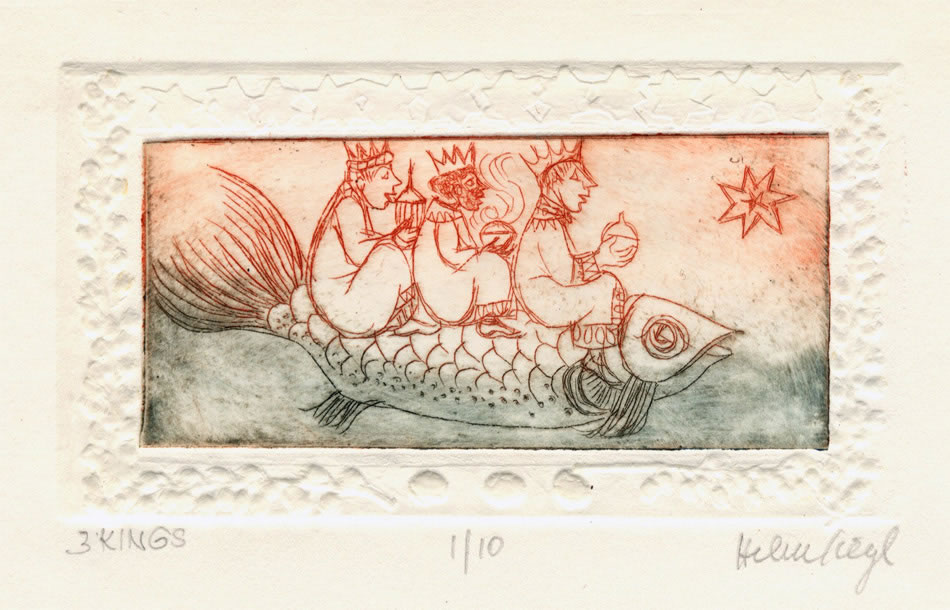
LOOK: 3 Kings by Helen Siegl

Siegl, Helen_Three Kings
Helen Siegl (Austrian American, 1924–2009), 3 Kings, n.d. Etching and collagraph, 3 × 5 in. (7.6 × 12.7 cm).

Ah, such whimsy!

LISTEN: “We Three Cool Kings” | Words and music by John H. Hopkins, 1857 | Arranged by Eugene Gwozdz, 2015 | Sung by Alan H. Green, Mykal Kilgore, Dennis Stowe, Nili Bassman, Josh Davis, Kevin Smith Kirkwood, Linda Mugleston, Brian O’Brien, Mary Michael Patterson, Mike Schwitter, and Rashidra Scoti on Broadway’s Carols for a Cure, vol. 17, 2015

We three kings of Orient are;
bearing gifts, we traverse afar,
field and fountain, moor and mountain,
following yonder star.

O star of wonder, star of light,
star with royal beauty bright,
westward leading, still proceeding,
guide us to thy perfect light.

Born a king on Bethlehem’s plain,
gold I bring to crown him again,
King forever, ceasing never,
over us all to reign.

Frankincense to offer have I;
incense owns a Deity nigh;
prayer and praising, voices raising,
worshipping God most high.

Myrrh is mine; its bitter perfume
breathes a life of gathering gloom;
sorrowing, sighing, bleeding, dying,
sealed in the stone-cold tomb.

Glorious now behold him arise,
King and God and Sacrifice:
Alleluia, Alleluia,
sounds through the earth and skies.

This jazzified version of the Christmas classic “We Three Kings” is performed by the Broadway cast of At This Performance… Written in the voices of the magi (whose traditional names are Caspar, Melchior, and Balthazar), it propounds the symbolic significance of the three gifts they give to the Christ child. I love how the arranger has layered those middle three verses!

Launched in 1999, Carols for a Cure is an annual collection of seasonal songs sung by members of the Broadway and Off-Broadway theater community to raise money for the charity Broadway Cares / Equity Fights AIDS. Its latest volume, number 21, was released in 2019.

My Father’s House (Artful Devotion)

Siegl, Helen_Rejoice and Be Glad
Helen Siegl (Austrian, 1924–2009), Rejoice & Be Glad, 1974. Color woodcut, 30 × 30 cm. Edition of 50. Sacred Art Pilgrim Collection.

“Let not your hearts be troubled. Believe in God; believe also in me. In my Father’s house are many rooms. If it were not so, would I have told you that I go to prepare a place for you? And if I go and prepare a place for you, I will come again and will take you to myself, that where I am you may be also.”

—John 14:1–3

+++

SONG: “Come and Go with Me to My Father’s House” | Traditional African American | Performed under the musical direction of Dr. Markanthony Henry (on piano), with soloist Caterina Finocchi, at Iglesia Presbiteriana San Andrés (Saint Andrew’s Presbyterian Church) in Buenos Aires, Argentina, October 28, 2012

[Related posts: “‘As the bridegroom rejoices over his bride . . .’ (Artful Devotion)”; “Let Jesus Lead You (Artful Devotion)”]

+++

Art collector John A. Kohan has a wonderful biographical write-up about Helen Siegl on his website, Sacred Art Pilgrim—not to mention a select compilation of her art.

A devout Catholic all her life, Siegl was born in Vienna and was a teenager at the time of the Anschluss (the annexation of Austria to Nazi Germany). After the traumatic years of World War II and during the Soviet occupation of her home country, she emigrated to Canada in 1952. She got married and settled in Philadelphia, where her husband served as conservator of paintings at the Philadelphia Museum of Art. She raised eight children with him while also working as a printmaker—mostly woodcuts and linocuts. Her style blends elements of folk art and German expressionism, and her themes were often biblical.


This post belongs to the weekly series Artful Devotion. If you can’t view the music player in your email or RSS reader, try opening the post in your browser.

To view all the Revised Common Lectionary scripture readings for the Fifth Sunday of Easter, cycle A, click here.