“Easter Song” by Sedulius Scottus, trans. Helen Waddell

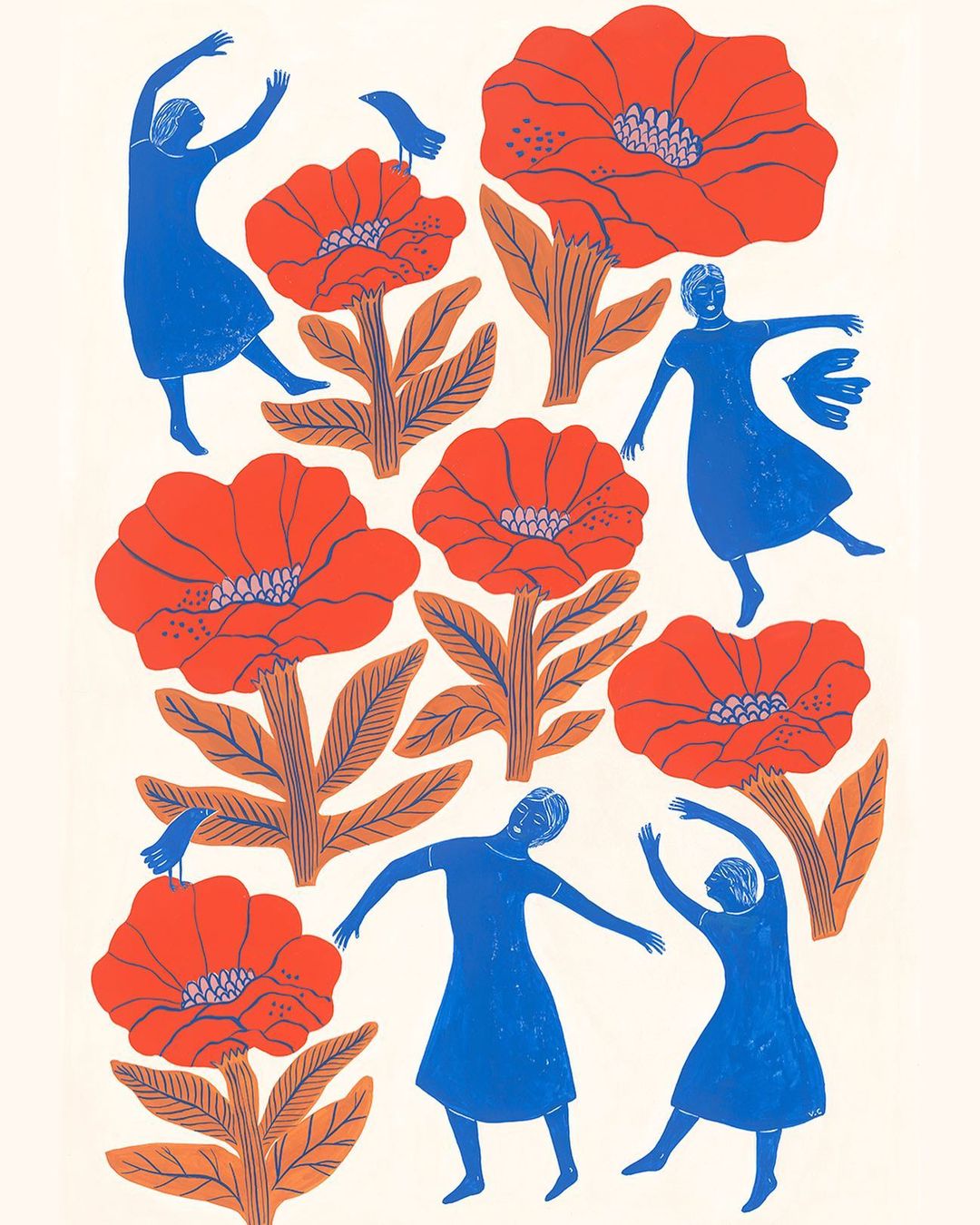
Illustration by Virginie Cognet
Virginie Cognet, Danse, 2023. Gouache on satin-finish watercolor paper, 70 × 50 cm.

Last night did Christ the Sun rise from the dark,
The mystic harvest of the fields of God,
And now the little wandering tribes of bees
Are brawling in the scarlet flowers abroad.
The winds are soft with birdsong; all night long
Darkling the nightingale her descant told,
And now inside church doors the happy folk
The Alleluia chant a hundredfold.
O Father of thy folk, be thine by right
The Easter joy, the threshold of the light.

This English translation of Sedulius Scottus’s “Carmen paschale” originally appeared in Mediaeval Latin Lyrics by Helen Waddell (Henry Holt, 1929) and is in the public domain.

Sedulius Scottus (fl. 840–860) was an early medieval Irish monk, poet, teacher, and biblical commentator. (He is not to be confused with the fifth-century poet Caelius Sedulius, who also wrote a [much longer] Carmen paschale, consisting of five books.) Driven out of his monastery by Viking invaders, Sedulius settled in the city of Liège under the protection of Bishop Hartgar. While living in exile on the Continent, he established himself as a leading literary figure of the Carolingian Renaissance. One of his most important works is De Rectoribus Christianis (On Christian Rulers), an instructional treatise on governing and a noteworthy contribution to Christian ethics. Sedulius was at least trilingual, proficient in Irish, Greek, and Latin. Eighty-three of his poems survive, composed in a variety of classical meters and ranging from mock heroic epics and philosophical puzzles to hymns of praise and drinking songs.

Helen Waddell (1889–1965) was a medieval literature scholar, historical novelist, playwright, and translator (from medieval French and Latin to English) who was awarded the Benson Medal of the Royal Society of Literature. She was born in Tokyo to an Irish Presbyterian missionary family, spending the first eleven years of her life in Japan. She was later educated in Belfast, Oxford, and Paris and became part of a circle of friends in London that included W. B. Yeats, Virginia Woolf, and Siegfried Sassoon. In addition to writing, she worked as a literary adviser and reader for the esteemed publisher Constable. She is the subject of an award-winning biography by Dame Felicitas Corrigan, published in 1986.

Holy Week: Jesus Takes Up His Cross

. . . carrying the cross by himself he went out to what is called the Place of the Skull, which in Hebrew is called Golgotha. There they crucified him . . .

—John 19:17–18

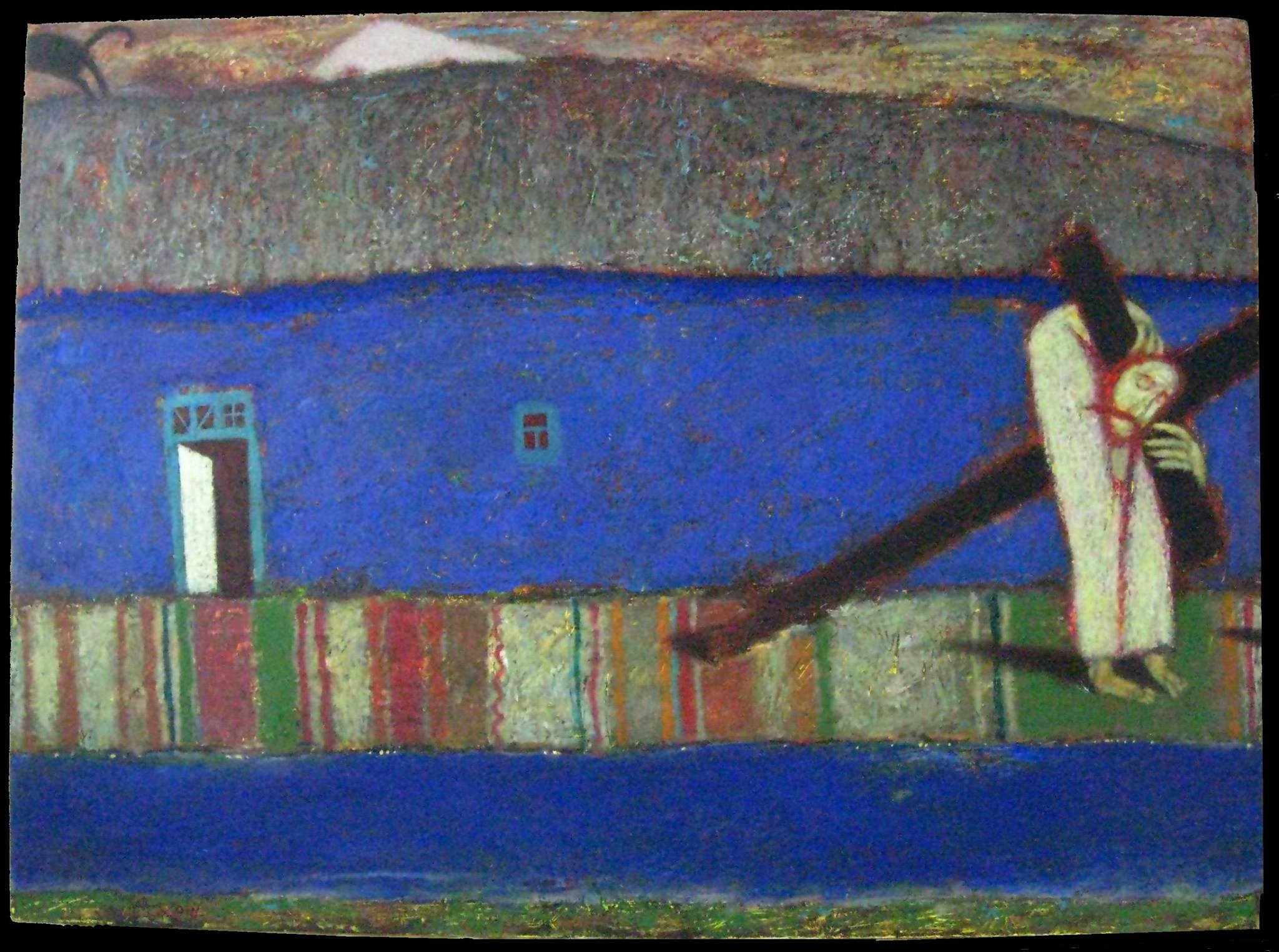
LOOK: White Mountain by Ihor Paneyko

Paneyko, Ihor_White Mountain
Ihor Paneyko (Игоря Панейка) (Ukrainian, 1957–), White Mountain, 2011. Egg tempera on gessoed board.

LISTEN: “Solus ad victimam” (Alone to Sacrifice Thou Goest, Lord) | Original Latin words by Peter Abelard, second quarter of 12th century; English translation by Helen Waddell, 1929 | Music by Kenneth Leighton, 1973 | Performed by St. Olaf Cantorei, dir. John Ferguson, on Hidden in Humbleness: Meditations for Holy Week and Easter, 2010

Alone to sacrifice thou goest, Lord,
Giving thyself to Death, whom thou hast slain.
For us, thy wretched folk, is [there] any word,
Who know that for our sins this is thy pain?

For they are ours, O Lord, our deeds, our deeds.
Why must thou suffer torture for our sin?
Let our hearts suffer for thy passion, Lord,
That very suffering may thy mercy win.

This is that night of tears, the three days’ space,
Sorrow abiding of the eventide,
Until the day break with the risen Christ,
And hearts that sorrowed shall be satisfied.

So may our hearts share in thine anguish, Lord,
That they may sharers of thy glory be.
Heavy with weeping may the three days pass,
To win the laughter of thine Easter Day.

“In Parasceve Domini: III. Nocturno,” whose first line is “Solus ad victimam procedis, Domine,” is a Latin hymn by the French scholastic philosopher, theologian, and poet Peter Abelard (1079–1142). It appears in his collection Hymnarius Paraclitensis—a major contribution to medieval Latin hymnody—and was sung in the night office (Nocturns) of prayers on Good Friday.

Today it is best known through its modern choral setting of the English by British composer and pianist Kenneth Leighton (1929–1988). Dr. David Ouzts, the minister of music and liturgy at Church of the Holy Communion in Memphis, says this is “one of the most effective musical settings of any anthem of the 1,000-plus octavos in our parish music library.” He continues:

This anthem is one of those with harmonies and sonorities that may not sound correct when they are. Worshipers will hear the sparseness of the choir singing in simple same-note octaves, and in the next moment, dissonances between the choral voices will appear.

Though this 12th century text is most certainly a Passiontide text, my favorite aspect is that it foreshadows Easter and the Resurrection.

The wordplay of the music that accompanies “laughter” in the text is notable. The choral voices are high in their tessituras, and the full choir ends literally on a high note, after which the organ accompaniment steals the show with great dissonant chords, only to land on a huge, bright E Major chord.

The hymn invites us to follow Christ to Golgotha, beholding his suffering so that we might be moved to contrition and, clinging to God’s mercy, rise to newness of life—or, as the wonderful last line puts it, “win the laughter of [Christ’s] Easter Day.” The fourth stanza alludes to Romans 8:17, where the apostle Paul writes that we are “heirs of God and joint heirs with Christ, if we in fact suffer with him so that we may also be glorified with him.” Paul speaks elsewhere of believers being “crucified with Christ” (Gal. 2:20)—see my visual commentaries on this passage—and “baptized into his death” (Rom. 6:3) as well as being raised with him.

Jesus may have gone “alone to sacrifice”—but the fruits of that sacrifice abound to all who would eat. Praise be to God.

As we enter the Paschal Triduum, let us weep for our sins and for the innocent Lamb who was slain to atone for them. Let us also look with hope toward daybreak.