LOOK: The Wise and Foolish Virgins, Norwegian tapestry
The Wise and Foolish Virgins, Norway, 17th century. Wool, bast fiber, 83 1/2 × 61 in. (212.1 × 154.9 cm). Minneapolis Institute of Art, Minneapolis, Minnesota.
The golden age of Norwegian tapestry (billedvev) spans roughly 1550 to 1800. Of all the woven subjects during this period, the Wise and Foolish Virgins was the most popular. The art historian Thor B. Kielland registered a total of seventy-five such tapestries from the seventeenth century alone. Draped over a bed, they would have provided warmth, decoration, and moral instruction. I love their aesthetic!
Jesus’s parable of the wise and foolish virgins comes from Matthew 25. Ten young women are members of a bridal party, and they’re awaiting the arrival of the bridegroom so that the celebration can start. In the tapestry pictured here, the top figures represent the wise virgins, whose oil-filled lamps indicate their readiness to accompany the bridegroom to the wedding feast. Those in the lower register, however, foolishly allowed their lamps to burn out; they weep into their handkerchiefs because the feasting started when they were out replenishing their oil supply, and now they’re too late.
That’s Christ the bridegroom in the upper right.
If I’m honest, this parable is uncomfortable for me. I don’t like that the neglectful women are locked out of the party. I don’t want anyone who wants in to be turned away. I want the bridegroom to show them grace, as the landowner did the day laborers who worked the vineyard for only one hour, giving them the same wage as those who worked for nine. But the parable of the virgins, with its stark sense of finality, is one of Christ’s teachings, so I want to grapple with it, not simply ignore it to suit my own proclivities.
I learned much about the existing body of Ten Virgins tapestries from rural Norway from Laura Berlage’s webinar “Dressing the Wise and Foolish Virgins: What Tapestry Can Teach Us About Women, Dress, and Culture in 16th and 17th Century Norway,” presented on July 17, 2023. She says the tapestries were made by women (unlike those produced by the guilds in Flanders and Paris), for women (they were used as bridal coverlets and included in dowries). They preached preparedness for young wives. “Good comes to those who are prepared,” Berlage elaborates; “you can’t get to heaven by borrowing someone else’s spiritual work.”
Regarding the headwear, Berlage clarifies: “The crowns the virgins wear are not because they’re princesses. There is a special tradition in Norway of wearing a crown at your wedding, which is an ancient nod to the Norse goddess Freja (later said to be an emblem of the Virgin Mary).”
Over time, Berlage says, the original meaning of the parable got lost, such that weavers no longer differentiated between the two sets of virgins, for example. She calls this phenomenon “image decay” and compares it to the telephone game.
For a shorter, less academic lesson on the ten virgins in Norwegian tapestry, see the six-minute video “Woven Wise and Foolish Virgins” by Robbie LaFleur:
LISTEN: “Himmelriket Liknas Vid Tio Jungfrur” (The Kingdom of Heaven Is Like Unto Ten Virgins) | Words from Then Swenska Psalmboken (The Swedish Hymnbook), 1697 | Traditional melody from Mockfjärd, collected by Nils Andersson in 1907 from Anders Frisell | Performed by Margareta Jonth on the album Religious Folk-Songs from Dalecarlia, 1977, reissued 1994
Himnelriket liknas vid tio jungfrur
som voro av olika kynne.
Fem månde oss visa vår tröga natur
Vårt sömnig och syndiga sinne.
Gud nåde oss syndare arma.

Vår brudgum drog bort uti främmande land
Och månde de jungfrur befalla
Sig möta med ljus och lampor i hand
Enär som han ville dem kalla.
De fävitske dröjde för länge.

De ropa: O Herre, o Herre låt opp,
Låt oss icke bliva utslutna!
Men ute var nåden, all väntan, allt hopp
Ty bliva de arma förskjutna
Till helvetets jämmer och pina.

Så låter oss vaka och hava det nit
Att tron och vår kärlek må brinna.
Vi måge här följa vår brudgum med flit
Och eviga salighet finna.
Det himmelska bröllopet. Amen.
The kingdom of heaven is like unto ten virgins Who were of different character. Five showed us our slothful nature, Our sleepy and sinful selves. God have mercy on us poor sinners.
Our bridegroom traveled in foreign lands And ordered the virgins To meet him with lighted lamp in hand Whenever he called them. The foolish ones waited too long.
They cry, “O Lord, O Lord, open up, Let us not be locked out!” But it was too late for mercy, for waiting, for hope, For the poor souls were cast Into hell’s wailing and torment.
So let us watch and show zeal That faith and our love may burn. Let us follow our bridegroom diligently And find eternal bliss, The heavenly wedding. Amen.
To him who loves us and freed us from our sins by his blood and made us a kingdom, priests serving his God and Father, to him be glory and dominion forever and ever. Amen.
Look! He is coming with the clouds; every eye will see him, even those who pierced him, and all the tribes of the earth will wail on account of him.
So it is to be. Amen.
—Revelation 1:5b–7
LOOK: The Last Judgment by Jan van Eyck
Jan van Eyck (Netherlandish, ca. 1390–1441), The Last Judgment, ca. 1436–38. Oil on canvas, transferred from wood, 22 1/4 × 7 2/3 in. (56.5 × 19.7 cm). Metropolitan Museum of Art, New York.
What is your reaction to this image? Terror? Awe? Gratitude? Disgust? Intrigue? Indifference?
I’m often repulsed by how the Last Judgment was interpreted by medieval and Renaissance artists, with graphic displays of torture intending to compel people to righteous living through fear. To be sure, the subject has made for some truly remarkable paintings, full of fantastical grotesqueries and masterfully executed—like this one—but I worry that the scare tactics such paintings use are not helpful and are even harmful.
Nonetheless, the Last Judgment is an unavoidable topic in scripture. The Bible refers several times to God as judge and describes a final accounting of sin upon Christ’s return, resulting in reward for the righteous and punishment for the unrighteous. It’s also in our creeds: “He [Jesus Christ] will come again to judge the living and the dead” (see 2 Tim. 4:1; 1 Pet. 4:5). Those who seek to be faithful to scripture must reckon with the idea of the Last Judgment. Advent, which is penitential in character, has historically been a period for the church to do that. As the Episcopal priest and author Fleming Rutledge points out in her published collection of Advent sermons, judgment is one of the four traditional themes of the season—the other three being death, heaven, and hell.
The early Northern Renaissance master Jan van Eyck’s Last Judgment from ca. 1436–38 is one of history’s most famous and most gruesome. “The diabolical inventions of Bosch and Brueghel,” writes art historian Bryson Burroughs, “are children’s boggy lands compared to the horrors of the hell [van Eyck] has imagined.”
The midground portrays the resurrection of the dead, who rise up out of their graves on land or at sea to be judged by Christ. One of the inscriptions on the frame is Revelation 20:13: “And the sea gave up the dead which were in it; and death and hell delivered up the dead which were in them: and they were judged every man according to their works.”
In the center Saint Michael the Archangel, dressed in his jewel-studded armor and with sword unsheathed, stands atop the giant batlike wings of Death personified, which are inscribed with the words CHAOS MAGNVM (“great chaos”) and UMBRA MORTIS (“shadow of death”). Death is a skeletal figure who excretes the damned through his bowels into hell’s dark slime, where bestial demons tear at, choke, devour, crush, and impale them. One man’s legs are being ripped apart at the anus.
Even kings and clergymen are part of the tragic death-heap—see the bishop’s miter, the cardinal’s galero, the royal crown. Not all who say, “Lord, Lord,” will enter heaven (Matt. 7:21); even the most outwardly pious will have their sins exposed on the last day, and those who prove to be hypocrites, who have harmed others and shamed God without repentance, will be thrown into the pit.
Shooting down like arrows into this pit is the double inscription ITE VOS MALEDICTI IN IGNEM ETERNAM (“Go, ye cursed, into everlasting fire”), taken from Matthew 25:41. And Deuteronomy 32:23–24, a warning from God via Moses to the people of God in their disobedience, is one of the inscriptions on the frame:
I will heap mischiefs upon them; I will spend mine arrows upon them. They shall be burnt with hunger, and devoured with burning heat, and with bitter destruction: I will also send the teeth of beasts upon them, with the poison of serpents of the dust.
Perhaps your chest is tightening right now, your stomach churning. How does this picture cohere with the God of love and mercy?
Look up.
See Jesus Christ, the Son of Man, coming in glory. See his glowing stigmata, beacons of love and mercy. He is dressed in a long, red, open mantle and is barefoot, revealing all five wounds. All around him, angels bear the instruments of his passion: the cross, the three nails, the crown of thorns, the lance, the sponge-tipped reed. See him flanked by all the ranks of the redeemed, including, on a larger scale, the Virgin Mary and John the Baptist, the first two witnesses of Jesus’s divinity.
VENITE BENEDICTI PATRIS MEI, read the inscriptions fanning out from Christ’s elbows: “Come, ye blessed of my Father” (Matt. 25:34). This good word is taken from Jesus’s parable of the sheep and the goats, in which he teaches that those who feed the hungry, clothe the naked, shelter the immigrant, care for the sick, and visit the imprisoned will be honored by God on the last day.
Another benediction is inscribed on the picture’s frame:
And I heard a loud voice from the throne saying,
“See, the home of God is among mortals. He will dwell with them; they will be his peoples, and God himself will be with them and be their God; he will wipe every tear from their eyes. Death will be no more; mourning and crying and pain will be no more, for the first things have passed away.” (Rev. 21:3–4 NRSV)
Van Eyck’s Last Judgment does not stand alone. For centuries it has been configured as a diptych (two-paneled artwork) with a Crucifixion on the left and is thus intended to be read in light of God’s supreme act of vulnerable love and self-giving:
Jan van Eyck (Netherlandish, ca. 1390–1441), The Crucifixion; The Last Judgment (with recently conserved frame), ca. 1436–38. Oil on canvas, transferred from wood, each panel 22 1/4 × 7 2/3 in. (56.5 × 19.7 cm). Metropolitan Museum of Art, New York.
Originally these two paintings very likely served as the wings of a triptych with a painted or sculpted centerpiece, or as the doors to a tabernacle or reliquary shrine. In 2019 the Metropolitan Museum of Art had the frames restored from their modern brass color to their original red.
So, what are we to make of this image today? Is there value in meditating on it?
I’ve presented it here, so I think it’s definitely worth knowing about. It’s a stunning art object that gives us a glimpse into the religious imagination of late medieval Christians. But I would also advise caution, especially to those who have been traumatized by hell teachings in the past. While Christians are called to cultivate a holy fear of God, a soberness around the weight of our sin and the power of God’s justice, this fear is not supposed to be the kind of fear that induces anxiety or paralyzes. That kind of fear will never lead us to love God.
We are never meant to think on hell apart from the grace Christ extends to us with his pierced and outstretched hands, which plead our case before God. Van Eyck holds both together in this painting, but the more visually immersive bottom half seems to indulge some pretty sick fantasies that could well generate an unhealthy fear of God if one were to stay stuck there, not to mention create the false impression that God is monstrously vindictive.
There is debate within Christianity, and has been since the patristic era, whether Jesus’s justice is merely punitive or ultimately restorative—that is, whether hell is a place of eternal conscious torment or a place where one is purged of evil and that will in the end be emptied. (There is biblical support for both views, which I won’t get into here.) There is also disagreement as to whether the Bible’s language about hell, such as its being a place of “fire” and “brimstone” (sulfur) (e.g., Rev. 21:8), is meant to be taken literally or figuratively.
Whatever the duration, physical nature, and ultimate purpose of hell, I want to emphasize that biblical passages about the Last Judgment ought not drive us to despair; they should drive us into the arms of Christ, who receives into his presence all those who trust in his merits and turn from their wickedness. The wounds that Christ so prominently displays in van Eyck’s painting are tokens of divine forgiveness as well as a model of the kind of selfless love we are to follow, a love vulnerable enough to receive injury but never to inflict it. Those who tumble into the depths of the underworld to be ravaged by externalizations of their own destructive evils have rejected the call to “do justice, love mercy, and walk humbly with [their] God” (Mic. 6:8). Many of them are ones who on earth bore much power but used it to abuse others or were neglectful.
For more on the characterization of Jesus as judge in the art and theology of the Middle Ages (whose influence was felt in the Renaissance and later eras), see chapter 2, “The Judge,” of Jesus through Medieval Eyes by Grace Hamman. “The promise of answering unanswered evil, acknowledging the recognized and unrecognized wrongs of the mortal world—everlasting justice and compassion—is ultimately what Christ the Judge signifies. It’s a promise, a prophecy, and a call for action now,” Hamman writes (28). She discusses how neighborliness and fear of God are twinned: “Am I seeing the immortal being, the image of God, Jesus himself, in every person I encounter?” medieval imagery prompted viewers to ask (37). “Jesus the Judge reminds us of our divine community and invites a fear that guides us to love our neighbor as we love ourselves. . . . Fear of Jesus the Judge becomes a gift for our practice of justice, in the radiant light of his justice. Such a fear softens flinty hearts” (21, 36). In the chapter Hamman does also acknowledge the complications and misuses of fear in the medieval church and its legacy today.
I urge you to consider the van Eyck diptych in light of the retuned hymn below as you meditate on Christ’s return and his role as judge.
LISTEN: “Lo! He Comes with Clouds Descending” | Words by Charles Wesley, 1758 | Music by Thomas Vito Aiuto, 2012 | Performed by the Welcome Wagon on Precious Remedies Against Satan’s Devices, 2012
Lo! he comes with clouds descending, once for favored sinners slain; thousand, thousand saints attending swell the triumph of his train.
Ev’ry eye shall now behold him, robed in dreadful majesty; those who set at naught and sold him, pierced, and nailed him to the tree, deeply wailing, deeply wailing, shall the true Messiah see.
Ev’ry island, sea, and mountain, heav’n and earth, shall flee away; all who hate him must, confounded, hear the trump proclaim the day: Come to judgment, come to judgment! Come to judgment, come away! Alleluia, alleluia! God appears on earth to reign.
The dear tokens of his passion Still his dazzling body bears, Cause of endless exultation To his ransomed worshippers. With what rapture, with what rapture Gaze we on those glorious scars! Alleluia, alleluia! God appears on earth to reign.
Yea, amen! Let all adore thee, high on thine eternal throne; Savior, take the pow’r and glory, claim the kingdom for thine own. O come quickly, O come quickly; everlasting God, come down. O come quickly, O come quickly; everlasting God, come down. O come quickly, O come quickly; everlasting God, come down.
I’m struck by the bright, celebratory, homey tone of the new tune Rev. Vito Aiuto gave this old Wesley hymn about Christ’s second coming. One might expect, with its verses about judgment, to have a dark or foreboding tone. But for those who are in Christ, his return, and even the day of judgment, will be an occasion of rejoicing!
Note that “dreadful” here is used in the archaic sense of inspiring awe or reverence.
This post is part of a daily Advent series from December 2 to 24, 2023 (with Christmas to follow through January 6, 2024). View all the posts here, and the accompanying Spotify playlist here.
Before I launch into the Advent content, I want to alert newcomers to, and remind old-timers of, my Thanksgiving Playlist on Spotify (introduced here), which is revised and expanded since last year. You can get an overview at this blog post. From Destiny’s Child to Yo-Yo Ma, Meister Eckhart to Mister Rogers, there’s a little something for everyone, I hope. And exemplifying the global nature of Christianity, there are songs in Hebrew, Luganda, Zulu, Swahili, Yoruba, Spanish, French, Hawaiian, Arabic, Korean, and Tamil.
+++
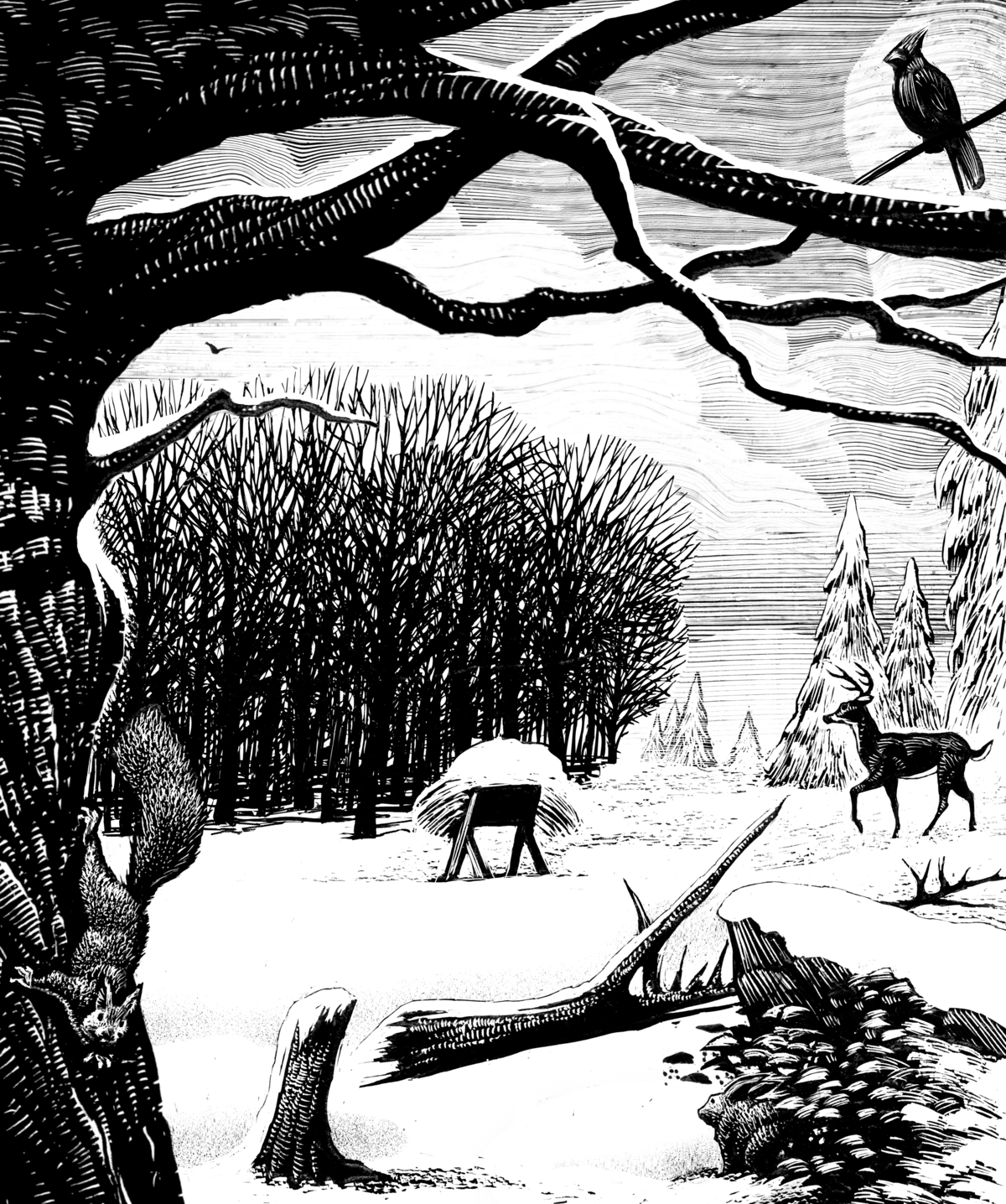
ESSAY: “All Creation Waits” by Gayle Boss: In the northern hemisphere, Advent is accompanied by a deepening of the dark and cold. In her bestselling and wholly unique Advent devotional, All Creation Waits, Gayle Boss provides twenty-five reflections that detail how wildlife—turtles, loons, black bears, and so on—adapts to these changing conditions. Animals know that the darkness is a door to a new beginning, and we would do well to embrace this wisdom. In the book, each day’s reading is paired with a woodcut illustration by David G. Klein.
The year of the book’s 2016 release, On Being published the introduction on its blog, where Boss answers, “Why animals for Advent?” and describes some of the inspiration behind and framing of the book. This year Paraclete Press released a hardcover gift edition with a new introduction and afterword.
Woodcut by David G. Klein, 2016. In All Creation Waits, Gayle Boss tells a story of how one year, a week into Advent, she found a manger in the woods, which local children had filled with hay for the animals, then shelled corn.
+++
SONG: “O Come, O Come, Emmanuel”: There are hundreds of arrangements and recordings of this most beloved Advent hymn. Last year I featured two that I particularly like, and I think I’ll start a trend on the blog by doing the same at the beginning of each Advent—sharing two new renditions of the song.
>> Anna Hawkins.Anna Hawkins is a singer-songwriter of Irish heritage living in New Zealand. In her version of “O Come, O Come, Emmanuel” from her album Divine (2015), she sings the first verse in Hebrew, honoring the lyrics’ rootedness in the Hebrew scriptures. The music video was shot in Israel (cinematography by Michael Hilsden from Aspiring Productions). [HT: Global Christian Worship]
חזור חזור עמנואל ופדה אסירי ישראל שבגולה נאנחים עד כי תבוא בן- האלוהים ,שמחו! שמחו! עמנואל יבוא לכם בני ישראל
Chazor, chazor Immanu-El Ufde asirei Israel Shebagola ne’enachim Ad ki tavo Ben Elohim Simchu, Simchu, Immanu-El Yavo lachem bnei-Israel
[English translation:] O come, O come, Emmanuel And ransom captive Israel That mourns in lonely exile here Until the Son of God appear Rejoice! Rejoice! Emmanuel Shall come to thee, O Israel
>> CeCe Winans, arr. Alvin Love III.CeCe Winans is a gospel legend. On Something’s Happening! A Christmas Album (2018), she collaborated with her son, Alvin Love III, who wrote the lush orchestral arrangements and produced the record. “O Come, O Come, Emmanuel” opens with a celesta, which sounds like a music box or twinkling stars and has long been associated with the supernatural. The accompaniment is played by the Zagreb Philharmonic Orchestra, conducted by Tim Akers.
+++
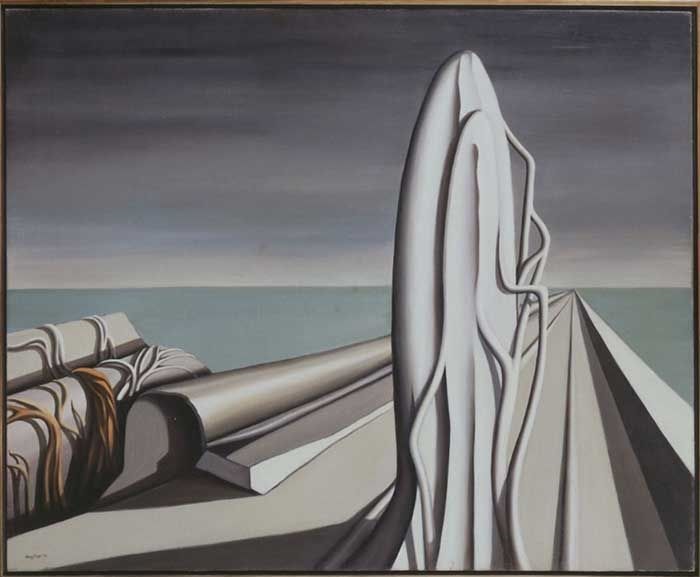
VISUAL MEDITATION: “I Corinthians 7:29-31: God Only Knows” by Lynn Miller: Rev. Dr. Lynn Miller is an author, ecclesiastical artist, workshop leader, and Presbyterian minister who holds a BFA in graphic design, an MA in art history, an MFA in creative writing, an MDiv, and a DMin. From 2014 to 2021 she ran the blog Art&Faith Matters, curating a diversity of images based on the liturgical calendar. In this post she guides us in looking at the surrealist painting At the Appointed Time by Kay Sage, which features a mysterious, draped figure or object and lines receding toward the horizon. “What do you see in the painting? What do you think about what you see? What do you wonder about this painting?” She posits a number of possible interpretations.
Kay Sage (American, 1898–1963), At the Appointed Time, 1942. Oil on canvas, 81.3 × 99.1 cm. Newark Museum of Art, Newark, New Jersey.
+++
PODCAST SERIES: “Whispered Light: Advent Reflections on Death, Judgement, Heaven and Hell” by Matt Simpkins: In this four-episode podcast series from December 2020, Rev. Matt Simpkins, an Anglican priest and musician from Essex, explores the four themes traditionally contemplated by Christians during Advent—death, judgment, heaven, and hell—through four old American folk songs. He performs the songs, giving their history and using them as a launchpad for spiritual and theological reflection, which also integrates discussion of the Psalms. He addresses misconceptions about these “last things,” tracing the thread of hope and redemption that runs through them all. Just twenty to thirty minutes each, the episodes are available on your favorite podcast app and on YouTube (links below).
Episode 1: “O Death” (aka “A Dialogue with Death”)



 Art & Theology