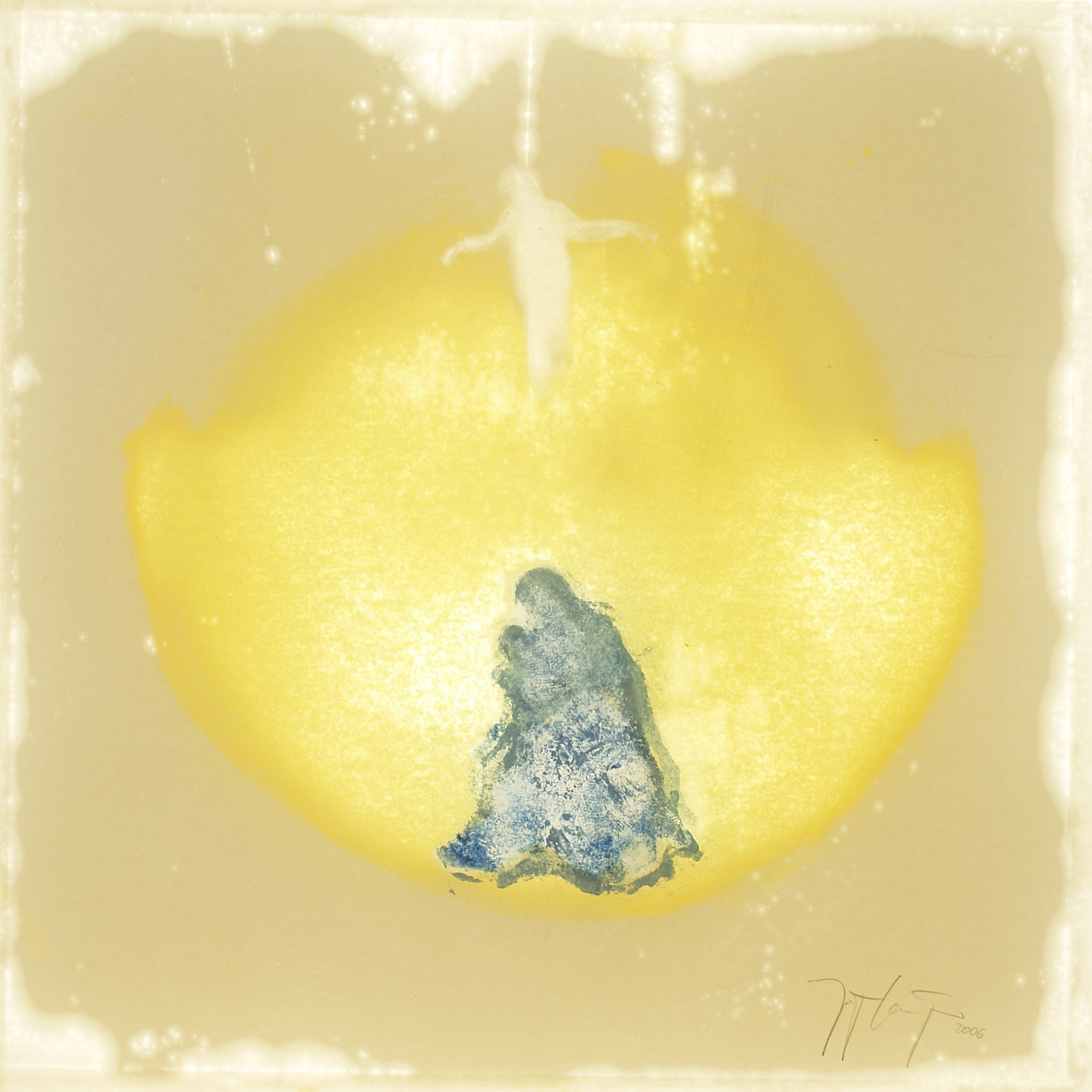
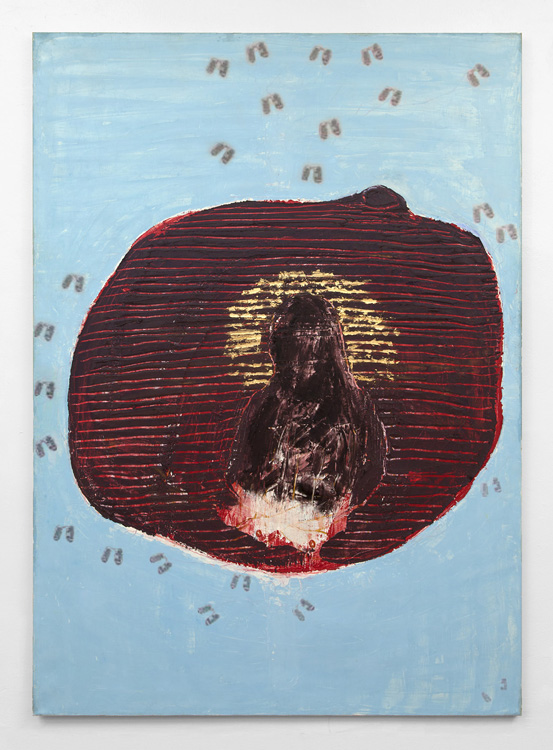
Jörg Länger (German, 1964–), Chr. Geb., 2006. Linocut, wax, oil, and graphite pencil on paper, 33 × 33 cm, cast with resin between two Optiwhite sheets of glass, 38 × 38 cm.
The contemporary German artist Jörg Länger creates extraordinary mixed-media works, many of which are in dialogue with Christian art history. In addition to earning an advanced degree in art, Länger has also done university coursework in theology and philosophy, so it’s no wonder his pieces demonstrate a keen theological awareness and spiritual sensibility.
After some fifteen years of working in photography, installation art, performance art, and conceptual art, in 1998 Länger shifted gears to focus on drawing, painting, and printmaking. He developed a series, still ongoing, that he calls “Protagonisten aus 23.000 Jahren Kulturgeschichte” (Protagonists from 23,000 Years of Cultural History), in which he takes figures from prehistoric petroglyphs and bas-reliefs, ancient Greek vases, medieval manuscripts, European Renaissance paintings, and contemporary art, simplifies them, and puts them into a new pictorial context. He copies the figure’s outline onto a linoleum block, inks and prints it to produce a sort of silhouette, and builds out from there using oil paint, pastels, wax, and/or gold leaf, while still retaining a minimalist aesthetic.
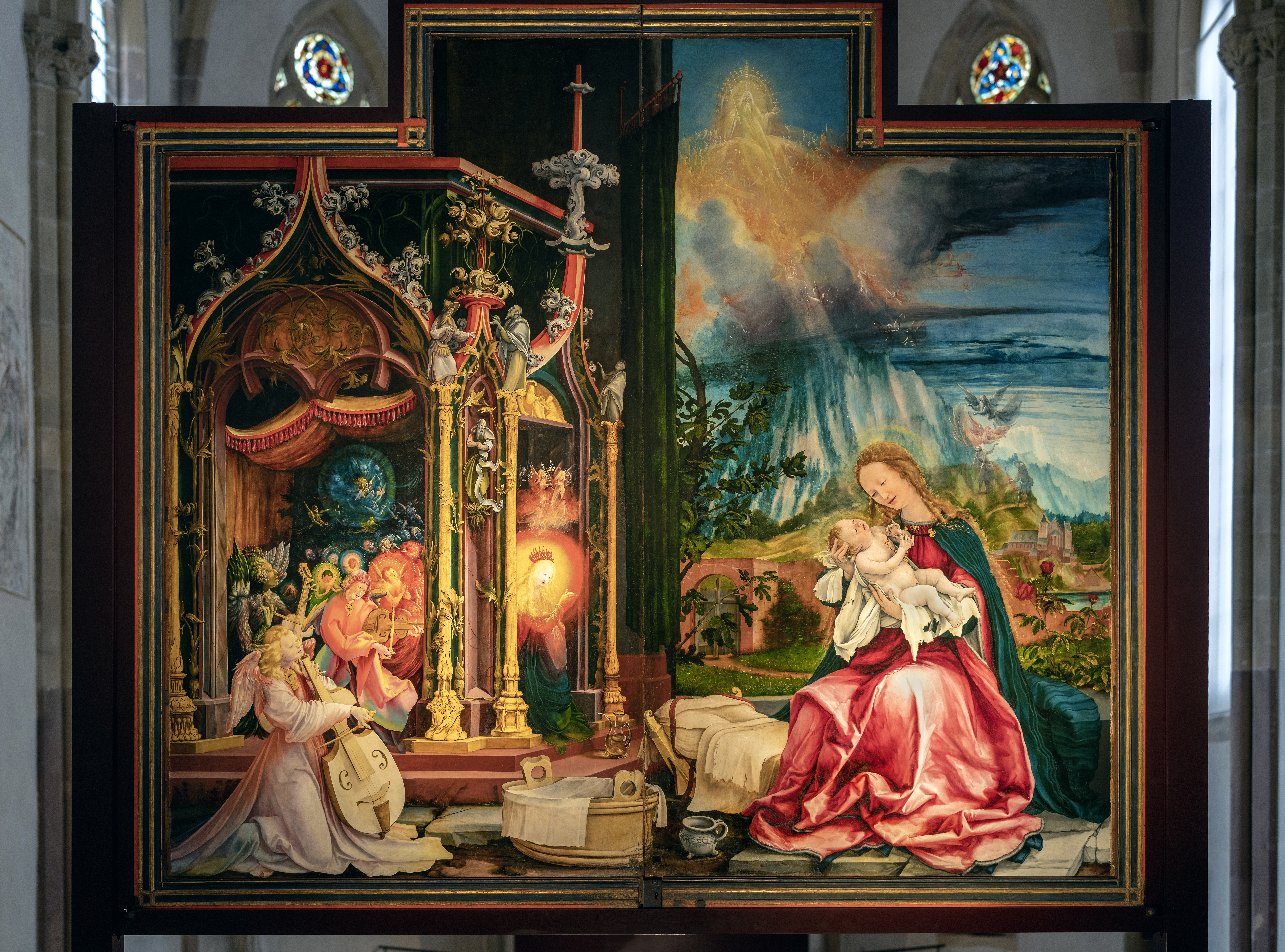
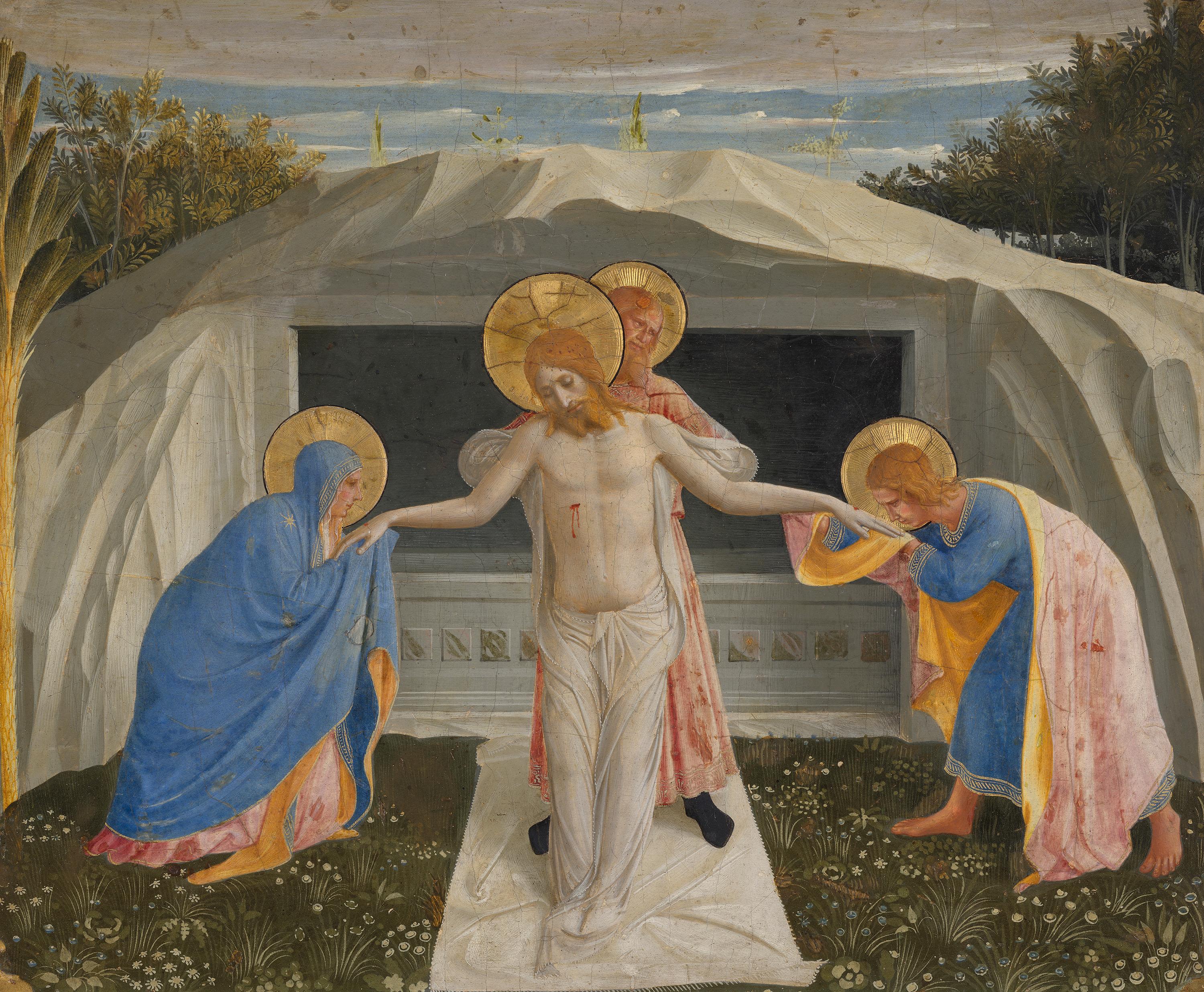
In his 2006 piece Chr. Geb. (short for Geburt Christi, “Birth of Christ”), the silhouetted figures are taken from Matthias Grünewald’s Isenheim Altarpiece and Fra Angelico’s Entombment of Christ.
Matthais Grünewald (German, ca. 1475/80–1528), The Nativity, central panel (first open view) of the Isenheim Altarpiece, 1515. Oil on wood, 269 × 307 cm. Unterlinden Museum, Colmar, France. Photo: Steven Zucker.Fra Angelico (Italian, ca. 1400–1455), Entombment of Christ, 1438–40. Tempera on wood, 37.9 × 46.6 cm. Alte Pinakothek, Munich.
With the shadowy blue central pair of Mother and Child, the ghostly impression of Christ’s crucified body (being dragged into a tomb in the scene it’s excised from), the expanding puddle of gold that holds together both birth and death, and the light that presses in from the edges, the work has a mystical feel. It shows the Eternal One entering time, born of a woman, to live and die and rise and so bring humanity back to God and back to their truest selves.
LISTEN: “O Vis Aeternitatis” by Hildegard of Bingen, ca. 1140–60 | Performed by Azam Ali, 2020
V. O vis aeternitatis
que omnia ordinasti in corde tuo,
per Verbum tuum omnia creata sunt
sicut voluisti,
et ipsum Verbum tuum
induit carnem
in formatione illa
que educta est de Adam.

R. Et sic indumenta ipsius
a maximo dolore
abstersa sunt.

V. O quam magna est benignitas Salvatoris,
qui omnia liberavit
per incarnationem suam,
quam divinitas exspiravit
sine vinculo peccati.

R. Et sic indumenta ipsius
a maximo dolore
abstersa sunt.

V. Gloria Patri et Filio
et Spiritui sancto.

R. Et sic indumenta ipsius
a maximo dolore
abstersa sunt.
V. O power within Eternity: All things you held in order in your heart, and through your Word were all created according to your will. And then your very Word was clothed within that form of flesh from Adam born.
R. And so his garments were washed and cleansed from greatest suffering.
V. How great the Savior’s goodness is! For he has freed all things by his own Incarnation, which divinity breathed forth unchained by any sin.
R. And so his garments were washed and cleansed by greatest suffering.
V. Glory be to the Father and to the Son and to the Holy Spirit.
R. And so his garments were washed and cleansed by greatest suffering.
Hildegard of Bingen [previously] was a twelfth-century German nun and polymath who wrote works on theology, medicine, and natural history; hymns, antiphons, and a drama for the liturgy (all with original music); and one of the largest bodies of letters to survive from the Middle Ages. In 1136 she was unanimously elected to lead her Benedictine community as abbess, which she did until her death in 1179.
“O vis aeternitatis” is the first entry in Hildegard’s Symphonia armonie celestium revelationum (Symphony of the Harmony of Celestial Revelations), a compilation of her liturgical songs that she made during her lifetime. It is labeled a “Responsory to the Creator.” “The responsory, one of several compositional forms Hildegard used,” explains medievalist Nathaniel M. Campbell, “is a series of solo verses [marked V] alternating with choral responses [marked R] sung at the first office of the day, vigils (matins), in the monastic liturgy.” It’s basically a call-and-response song.
This responsory, Campbell continues, “contemplate[s] the Incarnation . . . as the pivotal moment in which creation reached its perfect and predestined trajectory.” He notes how the refrain meditates on the cleansing of Adam’s flesh both from suffering and by (Christ’s) suffering. God put on our humanity and redeemed it.
Here’s how the medievalist Barbara Newman translates the responsory on page 99 of the critical edition of the Symphonia published by Cornell University Press:
Strength of the everlasting! In your heart you invented order. Then you spoke the word and all that you ordered was, just as you wished.
And your word put on vestments woven of flesh cut from a woman born of Adam to bleach the agony out of his clothes.
The Savior is grand and kind! From the breath of God he took flesh unfettered (for sin was not in it) to set everything free and bleach the agony out of his clothes.
Glorify the Father, the Spirit, and the Son.
He bleached the agony out of his clothes.
In the video above, “O vis aeternitatis” is performed by Azam Ali, an internationally acclaimed singer, producer, and composer who was born in Iran and raised in India and is now based in Los Angeles. She writes in the video’s YouTube description that Hildegard is part of the canon of universal spirituality and mysticism and that she is attracted to her cosmology, especially her articulation of the ancient philosophical concept of “the music of the spheres.”
In addition to her solo work, Ali is part of the musical group Niyaz, who blend medieval Sufi poetry and ancient Middle Eastern folk songs with modern electronic and trance music.
PODCAST: Poetry for All, hosted by Joanne Diaz and Abram Van Engen:Poetry for All “is for those who already love poetry and for those who know very little about it. In this podcast, we read a poem, discuss it, see what makes it tick, learn how it works, grow from it, and then read it one more time.” I’ve consistently enjoyed this podcast since its launch in 2020, having learned about it through cohost Abram Van Engen [previously], an academic who often writes and speaks about poetry for general Christian audiences. Here are some of my favorite episodes of the ninety-seven that have been released to date:
Three haiku by Kobayashi Issa, translated from the Japanese by Robert Hass: The first: “The snow is melting / and the village is flooded / with children.” Learn the characteristics of what Joanne Diaz calls “the perfect poetic form.”
“spring song” by Lucille Clifton: One of my favorite poems by one of my favorite poets. “This joyful poem caps a sequence of sixteen poems called ‘some jesus,’ which walks through biblical characters (beginning with Adam and Eve) and ends on four poems for Holy Week and Easter. [Clifton] wrote other poems on the Bible as well, including ‘john’ and ‘my dream about the second coming,’ which reimagine a way into biblical characters to make their stories fresh.”
“Elegy for My Mother’s Mind” by Laura Van Prooyen: This episode is unique in that it has the poet herself on to read and discuss the poem, which in this case navigates the complexities of memory, loss, and familial relationships.
“View but This Tulip” by Hester Pulter: Ashamedly, I had never heard of this seventeenth-century female poet before listening to this episode, so I’m grateful to guest Wendy Wall, cocreator of the award-winning Pulter Project website, for introducing me to her! “In this episode we discuss [Pulter’s] work with emblems, her scientific chemistry experiment with flowers, and her wonderment (both worried and confident, doubtful and awestruck) about the resurrection of the body and its reunification with the soul after death.”
“From Blossoms” by Li-Young Lee: A much-anthologized poem ostensibly about eating summer peaches, but more deeply, it’s about joy. “One of the things that draws me to this poem,” says Van Engen, “is that joy is actually very hard to write about . . . without it sounding naive or sentimental or withdrawn or unaware.”
“Primary Care” by Rafael Campo: Dr. Rafael Campo is both a poet and a practicing physician. Here he uses blank verse to explore the experience of illness and suffering.
+++
POEMS:
>> “For V. the Bag Lady, Great in the Kingdom of Heaven,” “Damascus Road,” “The Sower,” and “Crosses” by Paul J. Pastor: The Rabbit Room received permission to reproduce four poems from Paul J. Pastor’s [previously] new poetry collection, The Locust Years, which “explores a world of mystery and sorrow, desolation and love. Rooted in the Pacific Northwest, these poems offer readers an invitation to walk along a path pebbled with profound joy and deep loss.” I’ll be sharing another on the blog next week, courtesy of Wiseblood Books.
>>“Undone”by Michael Stalcup: The rise of blogging in the aughts and its descendant, Substacking, in the last few years has meant that poets and other writers can share their work directly with their reading publics and give them insight into their creative process if they wish. On his Substack, the Thai American poet Michael Stalcup [previously] recently shared one of his new poems that’s based on the story of the woman caught in adultery in John 8:1–11. He explains how the poem’s form, a blend of the Petrarchan sonnet and the chiasmus, contributes to its meaning.
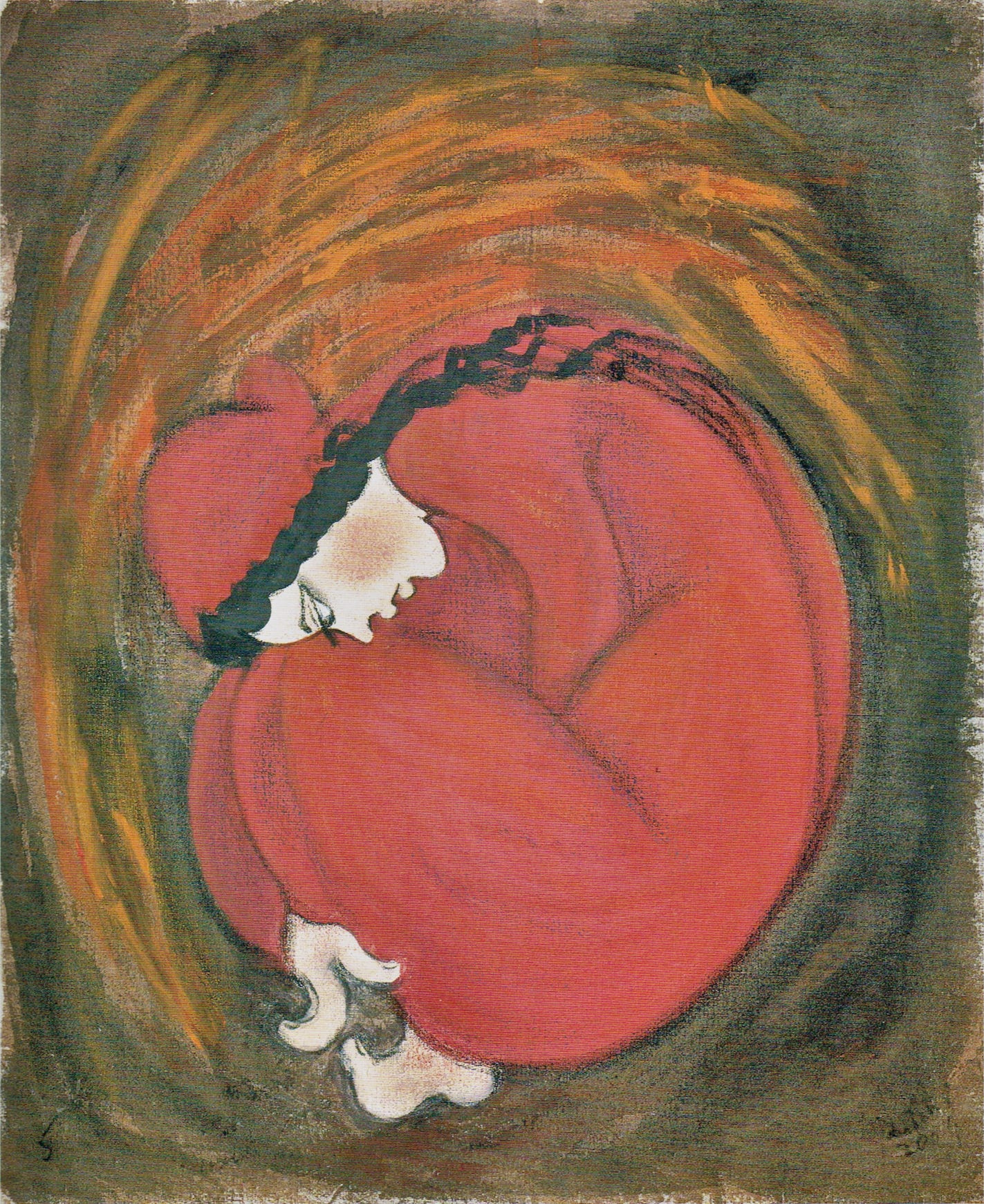
Nalini Jayasuriya (Sri Lankan, 1927–2014), Go, Sin No More, 2004. Mixed media on cloth, 23 × 19 in. Published in The Christian Story: Five Asian Artists Today, ed. Patricia C. Pongracz, Volker Küster, and John W. Cook (Museum of Biblical Art, 2007), p. 119.
Blessed be the paps which Thou hast sucked. —Luke 11:27
Suppose he had been Tabled at thy Teats, Thy hunger feels not what he eats: He’ll have his Teat ere long (a bloody one). The Mother then must suck the Son.
Scholar Kimberly Johnson [previously] unpacks these four lines about the body of Christ, who as an infant drank milk from his mother’s breast, and whose sacrificial death opened up his own breast whence flows the blood that nourishes us all. Johnson teases out the overlap of physical and spiritual in the poem, highlighting the maternal sharing of one’s own substance that links both couplets. At the eucharistic table, we are bidden to come and eat; or, in the stark metaphorical language of Crashaw, come and suck Christ’s bloody teat.
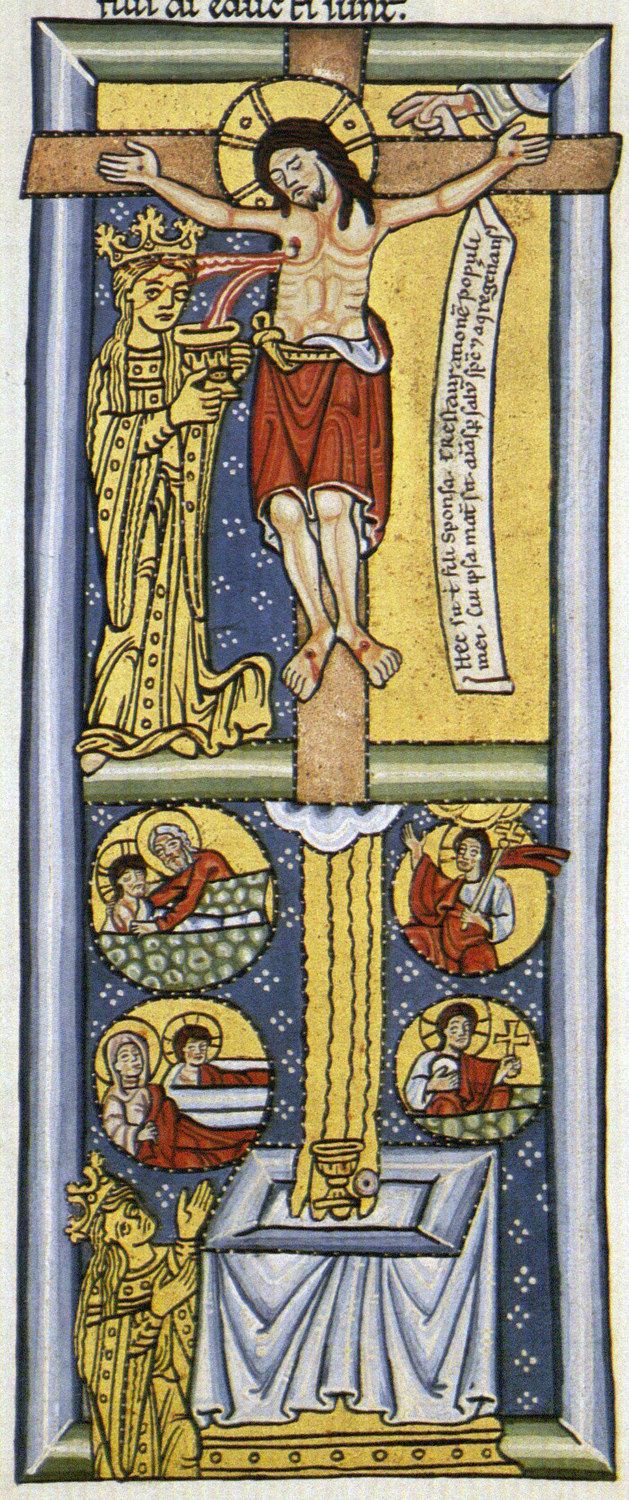
I plan to write an essay sometime about Christ as a nursing mother, as I’ve seen the image pop up in medieval writings and some visual art, including from Kongo and Ethiopia. In the meantime, here’s an illumination of the sixth vision in part 2 of Hildegard of Bingen’s Scivias (Know the Ways), painted under the supervision of Hildy herself. It shows the crucified Christ feeding Ecclesia (his bride, the church) with blood from his breast.
“The Crucifixion and the Eucharist,” from Scivias (Know the Ways) II.6, Rupertsberg Abbey, Germany, before 1179. Rupertsberg Codex, fol. 86r, Hildegard Abbey, Eibingen, Germany. The original manuscript from Hildegard’s lifetime was lost in 1945, but a faithful copy was made in 1927–33, which is the source of the color reproductions now available.
+++
ESSAY: “Only One Heart: The Poetry of Franz Wright as Emblem of God’s Grace” by Bonnie Rubrecht, Curator: “Are You / just a word? // Are we beheld, or am I all alone?” These three lines typify the poetry of Franz Wright (1953–2015), the Pulitzer Prize–winning author of Walking to Martha’s Vineyard, God’s Silence, and other collections. “Wright’s work is often described as confessional, colored by irony and humor. His irreverence, juxtaposed with honesty and humility, make his poetic voice unique in addressing God. Writers and poets often traffic in spiritual themes, but few modern poets echo the prophetic Old Testament tradition of crying out, approaching God with the concision and raw emotion that Wright does. He excels in voicing the concerns and ruminations of the human experience of suffering, while simultaneously shifting towards his own embodiment of grace.”
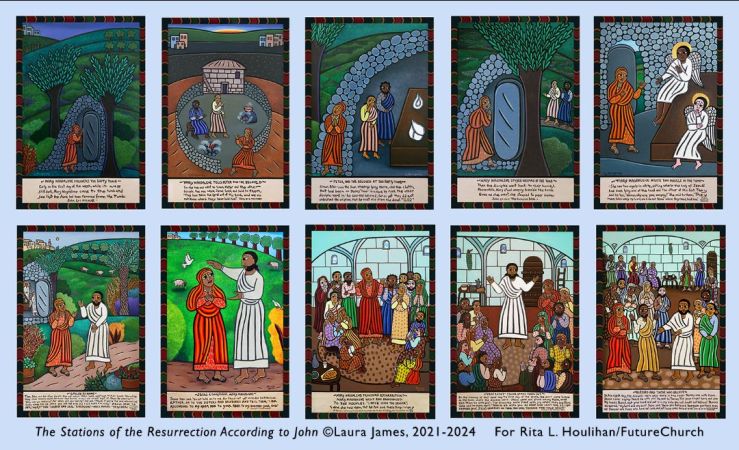
VIRTUAL ARTIST’S TALK: “The Stations of the Resurrection according to John” with Laura James, July 30, 2024, 7:00–8:15 p.m. ET: Next Tuesday, Bronx-based artist Laura James will discuss her latest painting series, The Stations of the Resurrection according to John, in a live online conversation with patron Rita L. Houlihan. Register at the link above.
The series began in 2021 with four paintings—Called by Name, Jesus Commissions Mary Magdalene, Mary Magdalene Proclaims Resurrection, and Pentecost: Jesus Sends Them Out, collectively the Mary Magdalene and the Risen Jesus series (which you can purchase as a set of cards)—and then expanded to include the full resurrection narrative from John 20. View details of all ten paintings for the first time, and hear from the artist about the artistic choices she made.
The daughter of immigrants from Antigua in the Caribbean, Laura James is especially celebrated for her vibrant paintings that depict biblical figures, including Jesus, as dark-skinned, influenced in part by the long tradition of Ethiopian Christian art. Rita Houlihan, who commissioned the Stations of the Resurrection series from James, is a founding member of FutureChurch’s Catholic Women Preach and Reclaim Magdalene projects and a longtime advocate for the restoration of historical memory regarding early Christian women leaders, especially Mary Magdalene.
VIRTUAL BOOK LAUNCH: Refractions, 15th anniversary edition, by Makoto Fujimura, August 6, 2024, 3:00 p.m. ET: Artist, speaker, writer, and IAMCultureCare founder Makoto Fujimura is one of the most prominent voices in the “art and faith” conversation in the US. On Tuesday, August 6, he’s hosting a Zoom event to celebrate the release of the fifteenth anniversary edition of his essay collection Refractions: A Journey of Faith, Art, and Culture, which is updated and expanded. He will read new selections from the book and host a time of Q&A and sharing. Register for the event at the above link, and you will receive a 30% discount on copies of the book preordered before the end of July.
+++
ART TRAIL: Vessel, miscellaneous locations along the Welsh-English border, August 8*–October 31, 2024: An exciting new art trail has been curated by Jacquiline Creswell [previously] for the group Art and Christianity. From the press release: “Vessel is a curated art trail in remote rural churches near the Black Mountains between Usk and Hay-on-Wye [in the border country between South Wales and England]. Seven artworks by seven [contemporary] artists will be shown in seven churches, six of which are maintained by the Friends of Friendless Churches who keep them open all year round. The theme of ‘vessel’ references bodies, boats, secretions and receptacles; each of the artworks will be sited in a particular relationship to the church and its material culture.”
*Lou Baker’s installation at Dore Abbey opens August 21.
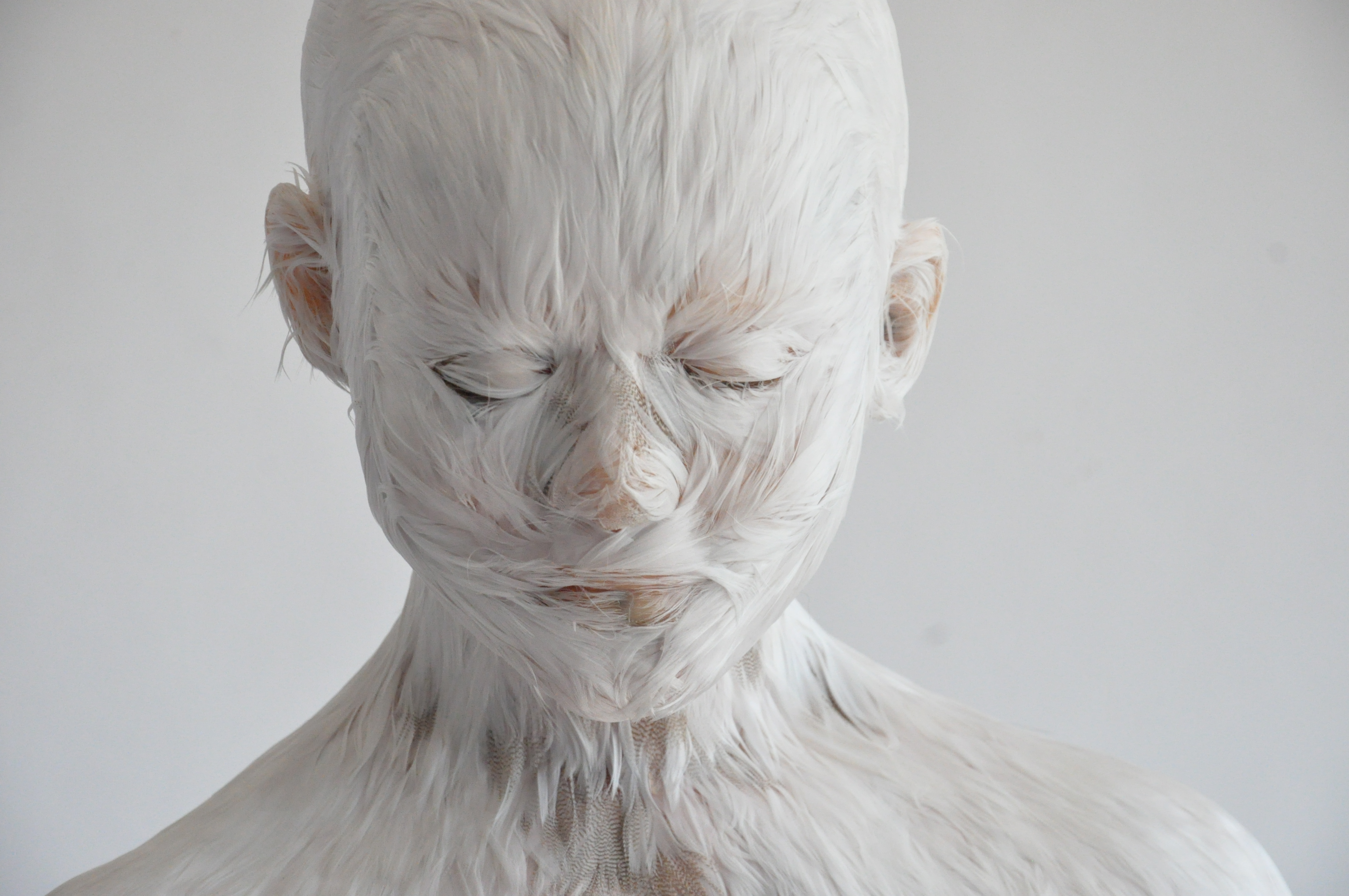
Lucy Glendinning (British, 1964–), White Hart (detail), 2018. Wax, Jesmonite, timber, duck feathers, 175 × 73 × 58 cm. Photo courtesy of Art and Christianity. [artist’s website]
Here is the list of venues, artists, and artworks:
St Michael and All Angels’, Gwernesney, Monmouthshire, Wales: Grace Vessel by Jane Sheppard
St Cadoc, Llangattock Vibon Avel, Monmouthshire, Wales: Wiela by Barbara Beyer
St Mary the Virgin, Llanfair Kilgeddin, Monmouthshire, Wales: Centre by Steinunn Thórainsdóttir
St Jerome, Llangwm Uchaf, Monmouthshire, Wales: White Hart by Lucy Glendinning
St David, Llangeview, Monmouthshire, Wales: Compendium by Andrew Bick
Dore Abbey, Herefordshire, England: Life/Blood by Lou Baker
Castle Chapel, Urishay, Herefordshire, England: Simmer Down I by Robert George
Art + Christianity is offering a weekend retreat September 13–15, based in Abergavenny, that will include a guided minibus tour (led by the curator) to all seven sites, a lecture by Fr. Jarel Robinson-Brown titled “Living Stones: Buildings, Bodies and Spirit,” a presentation and panel discussion on curating and organizing art in rural churches and chapels, and a performance by Holly Slingsby, Felled, Yet Unfurling, that draws on the iconography of the Tree of Jesse. (St Mary’s Priory in Abergavenny houses an extraordinary fifteenth-century oak carving of the Old Testament figure of Jesse that once formed the base of an elaborate sculpture depicting Jesus’s ancestry; to contextualize this artwork, in 2016 a Jesse Tree Window designed by Helen Whittaker was installed in the church’s Lewis Chapel.) Ticket pricing starts at £35 and does not include accommodations.
“As religious affiliation declines, can art provide fresh ways of exploring the questions posed by theology?” Borysewicz asks. “Might art—its creation as well as reception—lead to the discovery of new spiritual information? What do faith traditions lose when they overemphasize the written word and neglect the role of images?
“Historically, faith traditions have focused on both the written word and images as sources of knowledge and meaning. Some would claim that words have taken undue precedence as theologies have developed, while images seem to have been left behind. Has this shift in focus left us wanting?”
Alfonse Borysewicz (American, 1957–), Pomegranate, 2010–11. Oil and wax on linen, 70 × 50 in. The artist said, “When I see a pomegranate at the market, I see it as a visible sign of the resurrection of Christ; or a hive, the community of Christ.”
+++
SONGS:
>> “Kasih Tuhan” (God’s Love) by Abraham Boas Yarona, performed by Prison Akustik: This video shows, from what I can gather, a group of inmates from Lapas Abepura (Abepura Prison) in Papua, Indonesia, playing and singing an Indonesian Christian song together. It’s one of many lagu rohani (spiritual songs) uploaded to the Prison Akustik YouTube channel (the group is also active on Instagram and TikTok).
>> “Del amor divino, ¿quién me apartará?” (Who Can Separate Me from the Love of God?) by Enrique Turrall and José Daniel Verstraeten, performed by Coro del Seminario Internacional Teológico Bautista: Based on Romans 8:31–39, the lyrics of “Del amor divino” are by Enrique Turrall (1867–1953) of Spain, and the music is by José Daniel Verstraeten (b. 1935). The song was performed in 2018 by a vocal and instrumental ensemble from Seminario Internacional Teológico Bautista (International Baptist Theological Seminary) in Buenos Aires [previously], under the direction of Constanza Bongarrá.The instrumentalists are Jimena Garabaya (guitar), Marcelo Villanueva (charango), and Samy Mielgo (bombo). [HT: Daily Prayer Project]
>> “Caritas abundat in omnia” (Love Aboundeth in All Things) with “O virtus Sapientie” (O Virtue of Wisdom) by Hildegard of Bingen, sung by St. Stanislav Girls’ Choir of the Diocesan Classical Gymnasium, feat. Julija Skobe: Combining two Latin antiphons by the medieval German polymath Hildegard of Bingen [previously], who wrote both the words and music, this song is performed a cappella inside St. Joseph’s Church in Ljubljana, Slovenia, by a student choir with some forty singers between the ages of sixteen and nineteen, directed by Helena Fojkar Zupančič. Mesmerizing! Turn on closed captioning for English subtitles, or see here and here.
Last summer my husband and I drove up to Chadds Ford, Pennsylvania, to see the Joseph Stella: Visionary Nature exhibition at the Brandywine Museum of Art, which ran June 17–September 24, 2023. (Before that it was shown at the Norton Museum of Art in West Palm Beach, Florida, and the High Museum of Art in Atlanta.) It was lovely! There’s an accompanying catalog still available.
Joseph Stella (1877–1946) was born in the mountain village of Muro Locano in southern Italy, near Naples, and immigrated to New York at age eighteen, becoming a US citizen in 1923. He traveled much throughout his life—between his native country and his adopted country, but also for extended stays in Morocco, Chad, Algeria, France, and Barbados. In Paris in 1911–12 he met many of the leading artists of the European avant-garde, including Matisse, Picasso, and Modigliani, and was exposed to the full range of developments in modern art—postimpressionism, Symbolism, fauvism, cubism, surrealism, futurism, dadaism.
Though Stella absorbed some of these influences, he never aligned with a single group or movement. Art historian Abram Lerner says Stella is difficult to pin down, describing him as “a multiple stylist of unusual scope and energy,” both a modernist and a traditionalist. [1] In terms of content, his oeuvre is divided fairly evenly between urban industrial subjects—his most famous paintings are probably those from his series on the Brooklyn Bridge—and joyful and abundant nature.
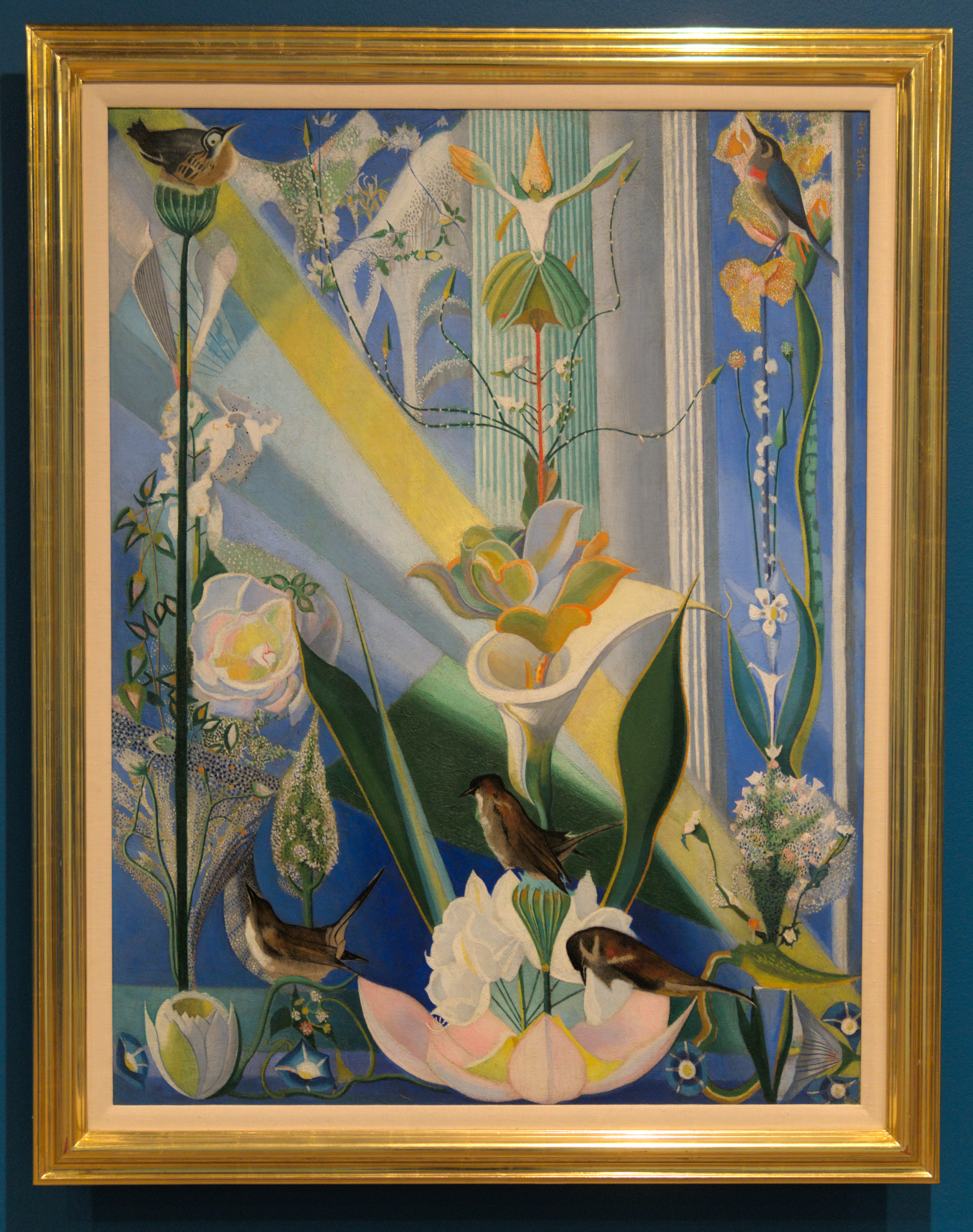
Joseph Stella: Visionary Nature, curated by Stephanie Heydt and Audrey Lewis, spotlights the latter. Many of Stella’s paintings feature birds and foliage hieratically positioned around a central axis, such as Dance of Spring (Song of the Birds).
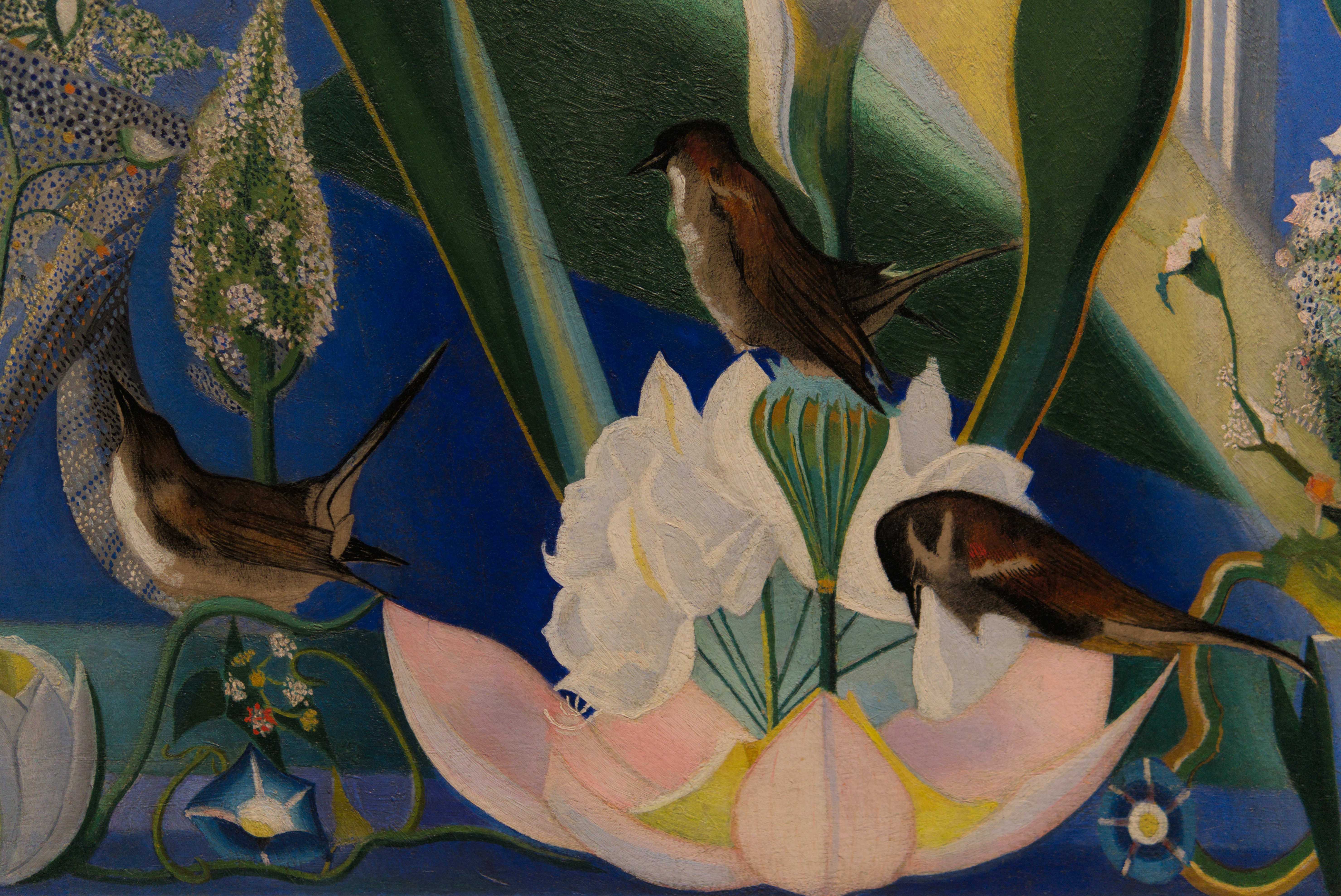
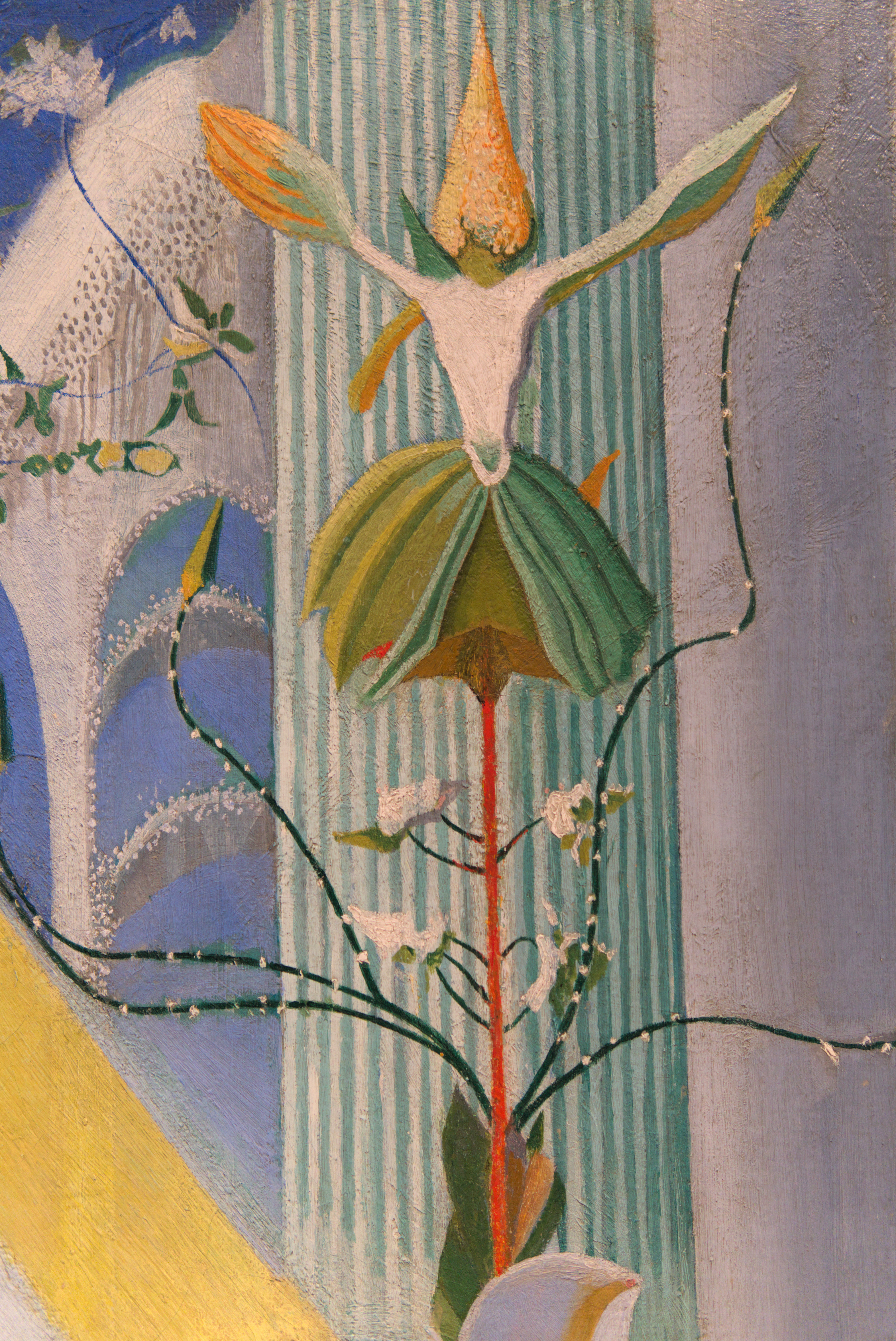
Joseph Stella (Italian American, 1877–1946), Dance of Spring (Song of the Birds), 1924. Oil on canvas, 42 3/8 × 32 3/8 in. (107.6 × 82.2 cm). Kemper Museum of Contemporary Art, Kansas City, Missouri. Photo: Victoria Emily Jones. [object record]Dance of Spring (Song of the Birds) (detail)Dance of Spring (Song of the Birds) (detail)
“Here,” reads the wall text,
Stella assembles a classical temple of flora and fauna—in his own words, culled “from the elysian lyricism of the Italian spring.” Flowers rise from a pink lotus at the base of a central column, culminating in the curious combination of lupine and a longhorn steer’s head flower, a floral form that resembles a bull’s skull. Below perch three sparrows, the national bird of Italy and a favorite of Stella’s.
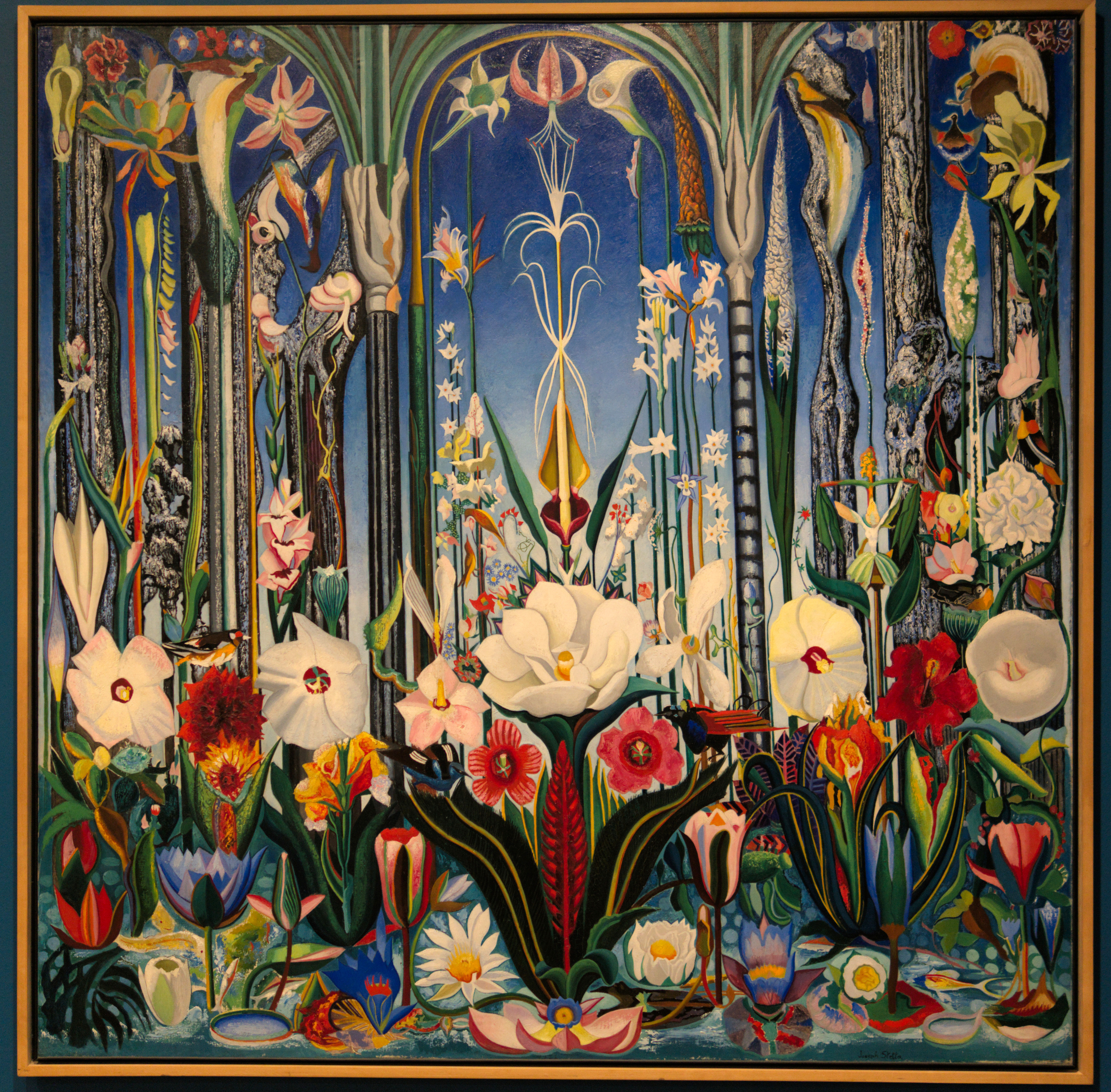
At over six square feet, Stella’s Flowers, Italy is an even more epic floral composition, a symphony of vitality and color.
Joseph Stella (Italian American, 1877–1946), Flowers, Italy, 1931. Oil on canvas, 74 3/4 × 74 3/4 in. (189.9 × 189.9 cm). Phoenix Art Museum, Arizona. Photo: Victoria Emily Jones.
From the wall text:
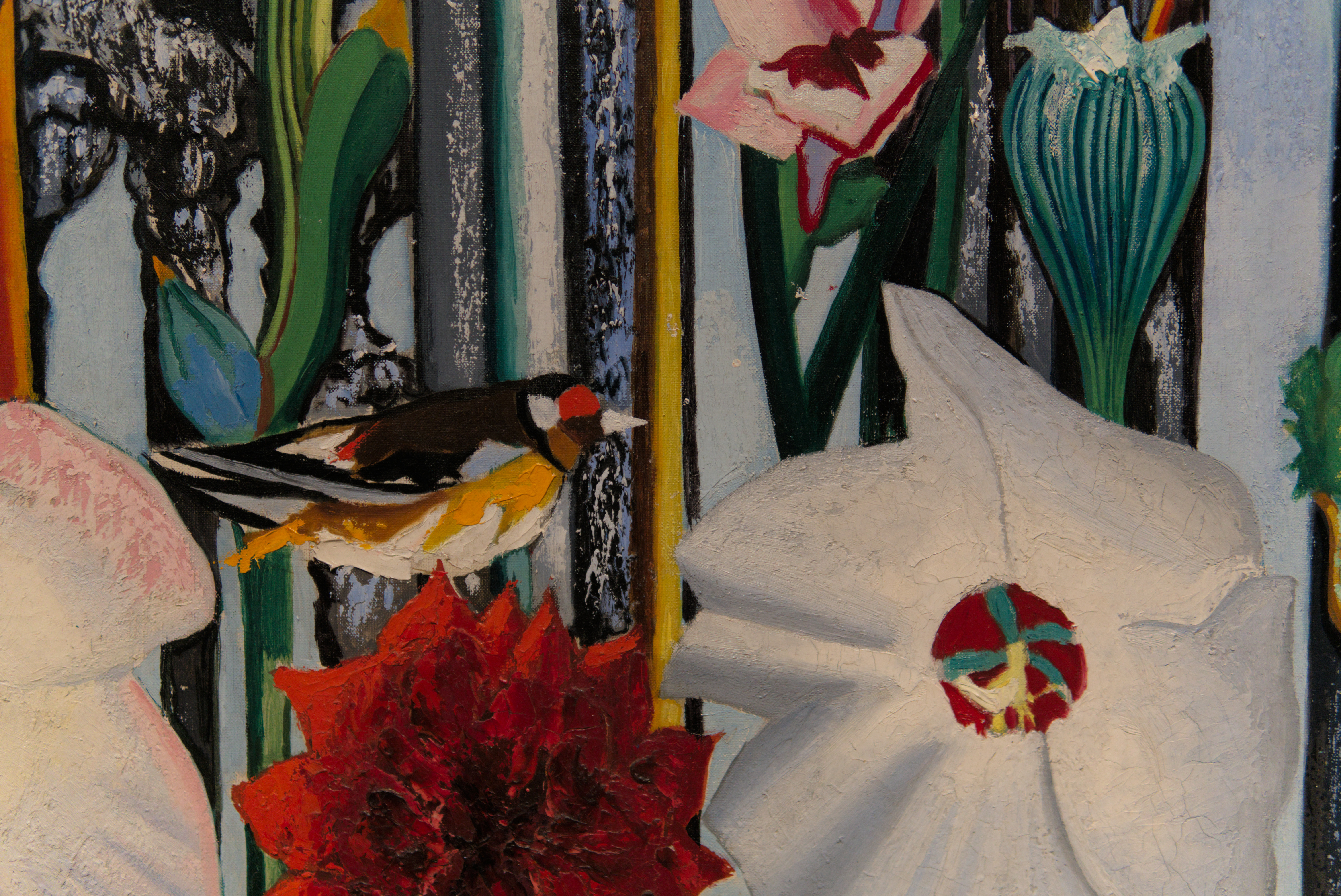
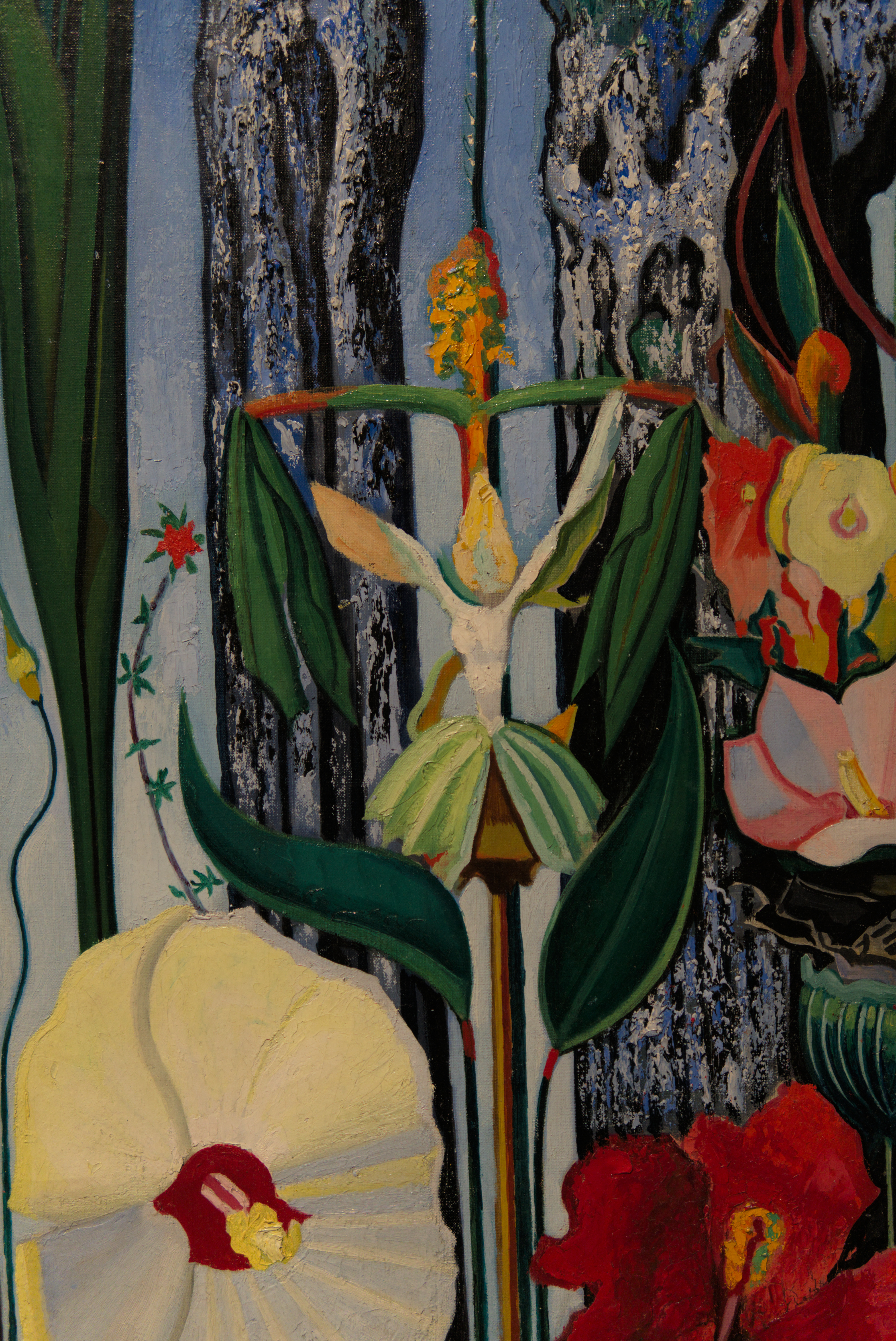
Order and symmetry are in constant tension with the spontaneity of organic ornamentation. The canvas overflows with colorful depictions of flowers and birds within a setting evoking Gothic architecture: pillars of gnarled tree trunks extend outward from the center, as if aisles of a cathedral. Lupine, gladiolas, and birds-of-paradise fill the vertical spaces with a spectrum of colors simulating stained glass windows. Like a congregation in the pews, a host of smaller flowers and plants are gathered below.
Flowers, Italy (detail)Flowers, Italy (detail)
Despite the title, the flowers depicted are not all native to Italy; Stella culled them from his world travels, and some are his own mystical inventions.
Stella sought to portray the voluptuousness and spirituality of his Italian homeland. He was raised in the Catholic faith, and although he didn’t practice as an adult, he remained proud of that heritage. Devotion to the Virgin Mary was a prominent aspect of his religious experience growing up, and in the 1920s he began painting a series of Madonnas, three of which were part of this exhibition.
Art historian Barbara Haskell identifies some of the artistic influences on these paintings:
The garlands of fruits and flowers that surrounded his Madonnas and their embroidered garments of lacy floral patterns recalled the work of the fifteenth-century Venetian Carlo Crivelli, while their impassive countenances, downcast eyes, and long, slim hands folded under translucent cloaks owed a debt to the Dugento masters Cimabue and Duccio. Yet Stella’s paintings were equally influenced by the flat, naive, and colorful images of the Madonna that proliferated in the popular devotional images and folk art of Southern Italy . . . in prayer sheets and books, scapulars, and ex-votos as well as in the profusion of silk and plastic flowers on altars and religious images. [2]
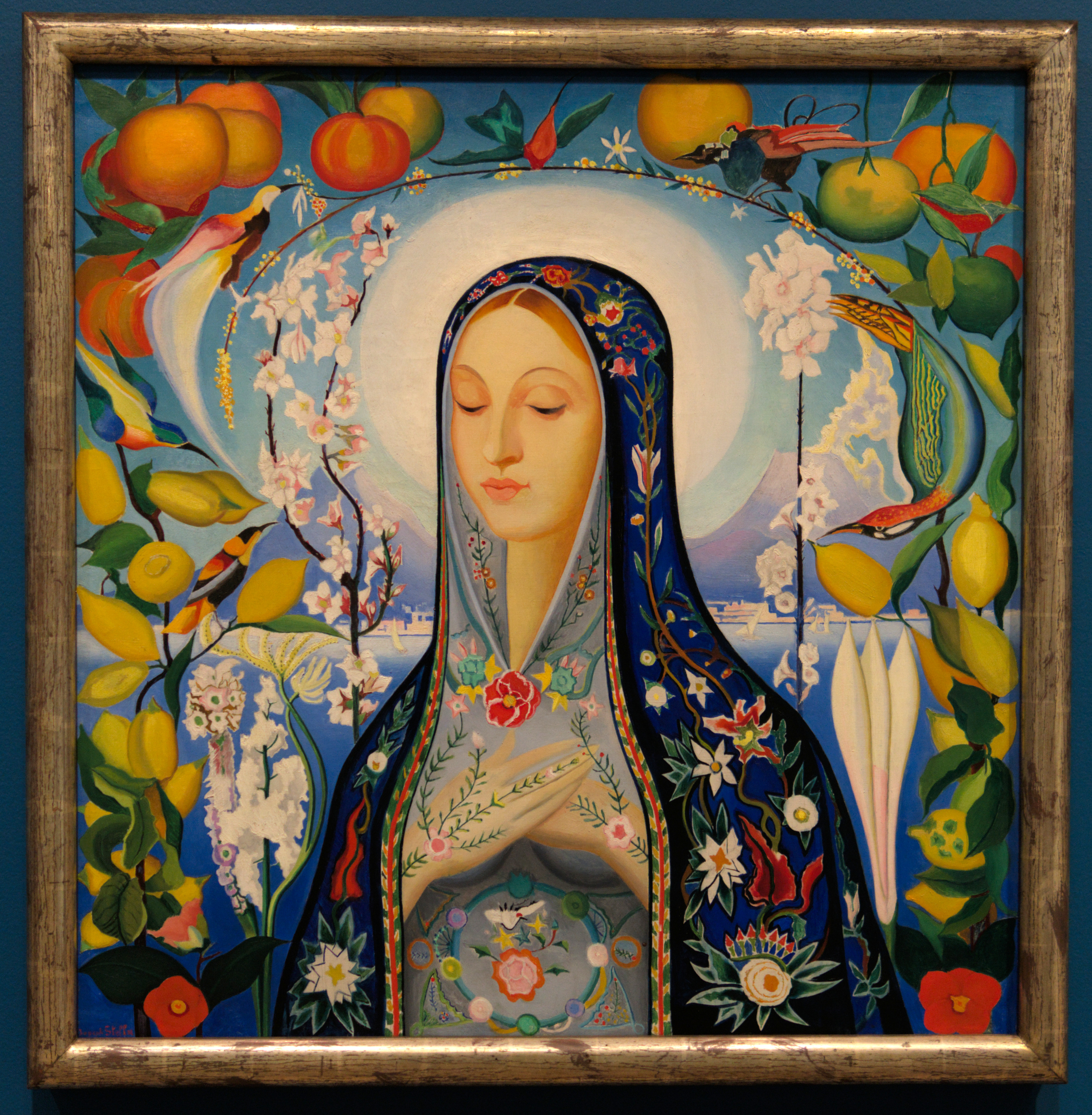
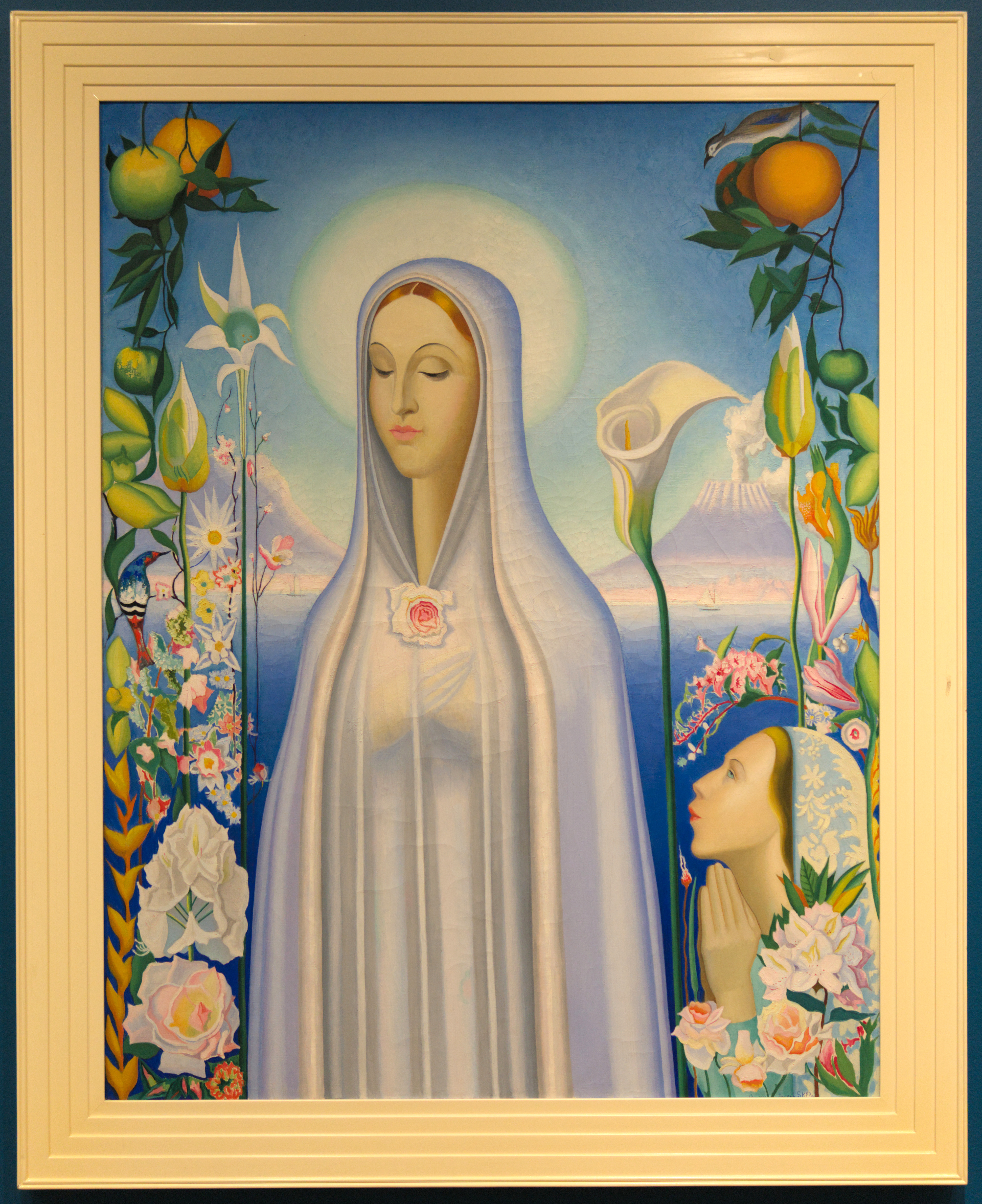
Joseph Stella (Italian American, 1877–1946), The Virgin, 1926. Oil on canvas, 39 11/16 × 38 3/4 in. (100.8 × 98.4 cm). Brooklyn Museum, New York. Photo: Victoria Emily Jones. [object record]
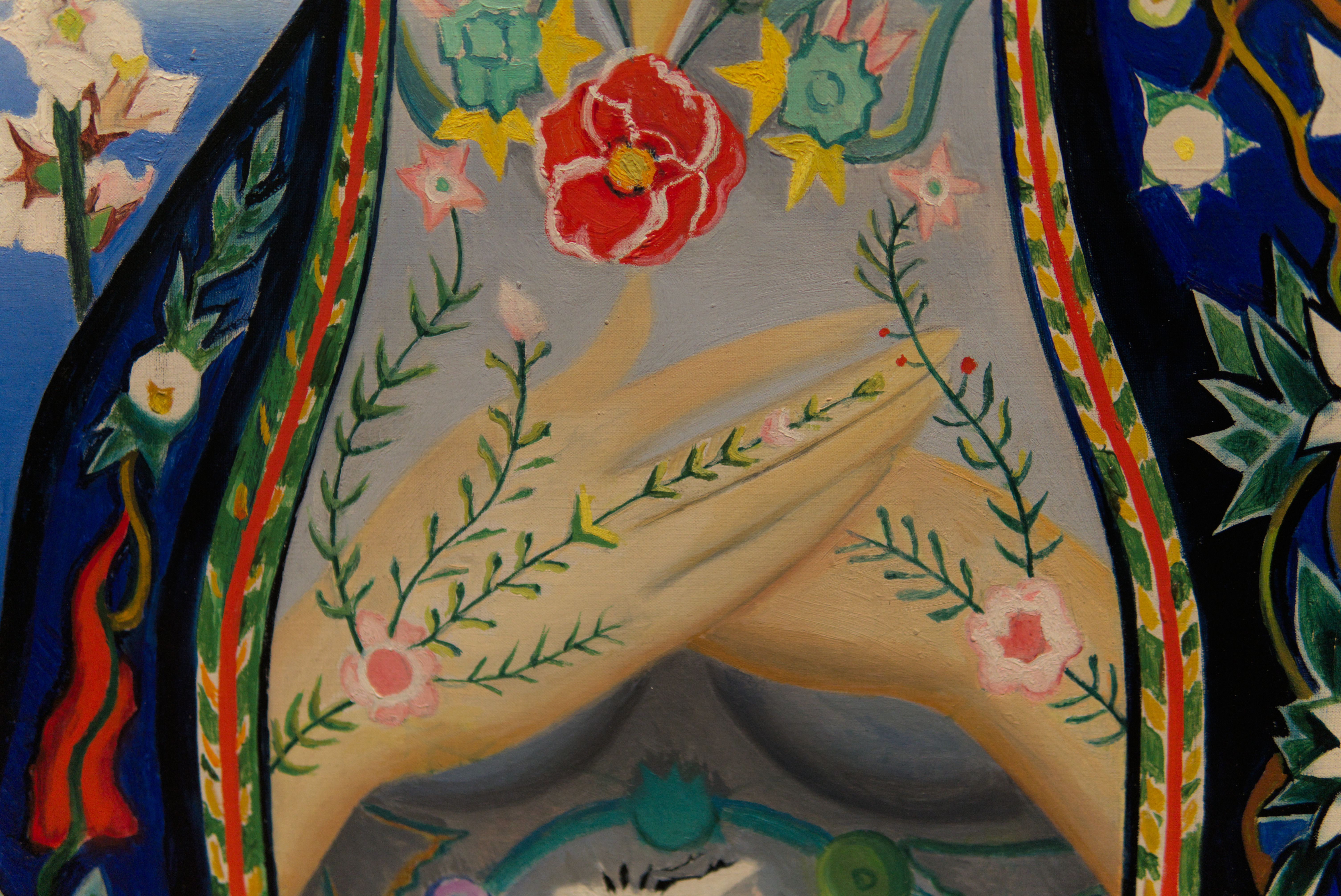
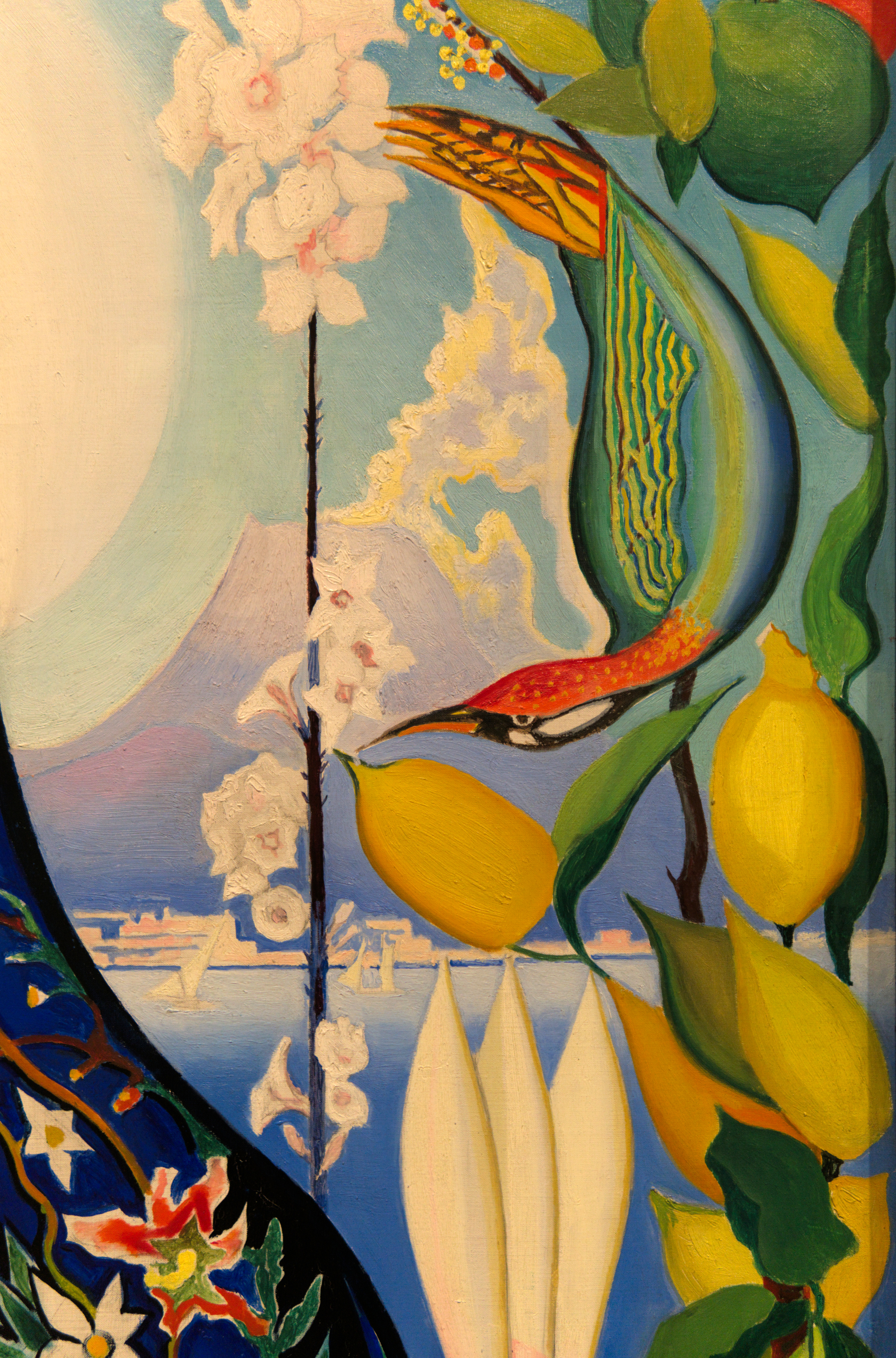
His 1926 Virgin from Brooklyn Museum is my favorite. It shows Mary enshrined among the fruits and flowers of the Mediterranean, with tendrils sweeping up and down her mantle and robe, adorning her neck like a necklace, sprouting out of her prayerful hands, and encircling the womb where she gestated Jesus. The Joseph Stella: Visionary Nature curators provided the following commentary in the wall text:
Eyes downcast and hands folded in a traditional Christian gesture of spiritual humility, Stella’s Madonna is set against the distinctive topography of Naples. Visible in the background is Mount Vesuvius, the smoldering volcano that erupted in AD 79 and a landmark of Southern Italy. The halo-like orb surrounding the Virgin’s head, seemingly nestled into the profiles of the mountains, transforms the modern Naples into a site of religiosity. Stella described “the Virgin praying [. . .] protected, on both sides, by almond blossoms, crowned above by the wreath of the deep and clear gold of the orange and lemon trees.”
Stella captures the wild beauty, the fecundity, the blossoming of Mary when the Holy Spirit plants his seed in her and she conceives God’s Word. Her acceptance of the divine call that the angel Gabriel relays to her produces life that redounds to all of humanity and indeed to the whole world. It’s why Mary’s cousin Elizabeth exclaims to her, “Blessed are you among women, and blessed is the fruit of your womb!” (Luke 1:42).
The Virgin (detail)The Virgin (detail)
There’s a long tradition in Christianity of describing Mary’s conception of Jesus as a flowering and of honoring her with flowers. I’m reminded especially of the twelfth-century mystic Hildegard of Bingen’s many hymns and antiphons that celebrate Mary in such terms.
Yes your flesh held joy like the grass when the dew falls, when heaven freshens its green: O mother of gladness, verdure of spring. [3]
Pierced by the light of God, Mary Virgin, drenched in the speech of God, your body bloomed, swelling with the breath of God. [4]
You glowing, most green, verdant sprout,
in the movement of the spirit, in the midst of wise and holy seekers, you bud forth into light.
Your time to blossom has come.
Balsam scented, in you the beautiful flower blossomed. [5]
The Brooklyn Virgin could be read as an Annunciation image, the Incarnation taking place inside this young woman who said yes to God. The sailboats on the sea, their movement reliant on the wind, may allude to the Holy Spirit who blew onto the scene in a major way in Luke 1 to move salvation history forward.
Joseph Stella (Italian American, 1877–1946), The Virgin (Virgin of the Rose and Lily), 1926. Oil on canvas, 57 1/2 × 44 3/4 in. (146.1 × 113.7 cm). Private collection, courtesy of Collisart, LLC, New York. Photo: Victoria Emily Jones. [object record]
The reference to outdoor religious processions with painted wooden Madonnas in southern Italy is more pronounced in Stella’s Purissima, in which the Mary figure, nearly life-size, is very stiff, statuesque. Co-curator Stephanie Heydt from the High Museum of Art introduces the work in this three-and-a-half-minute video:
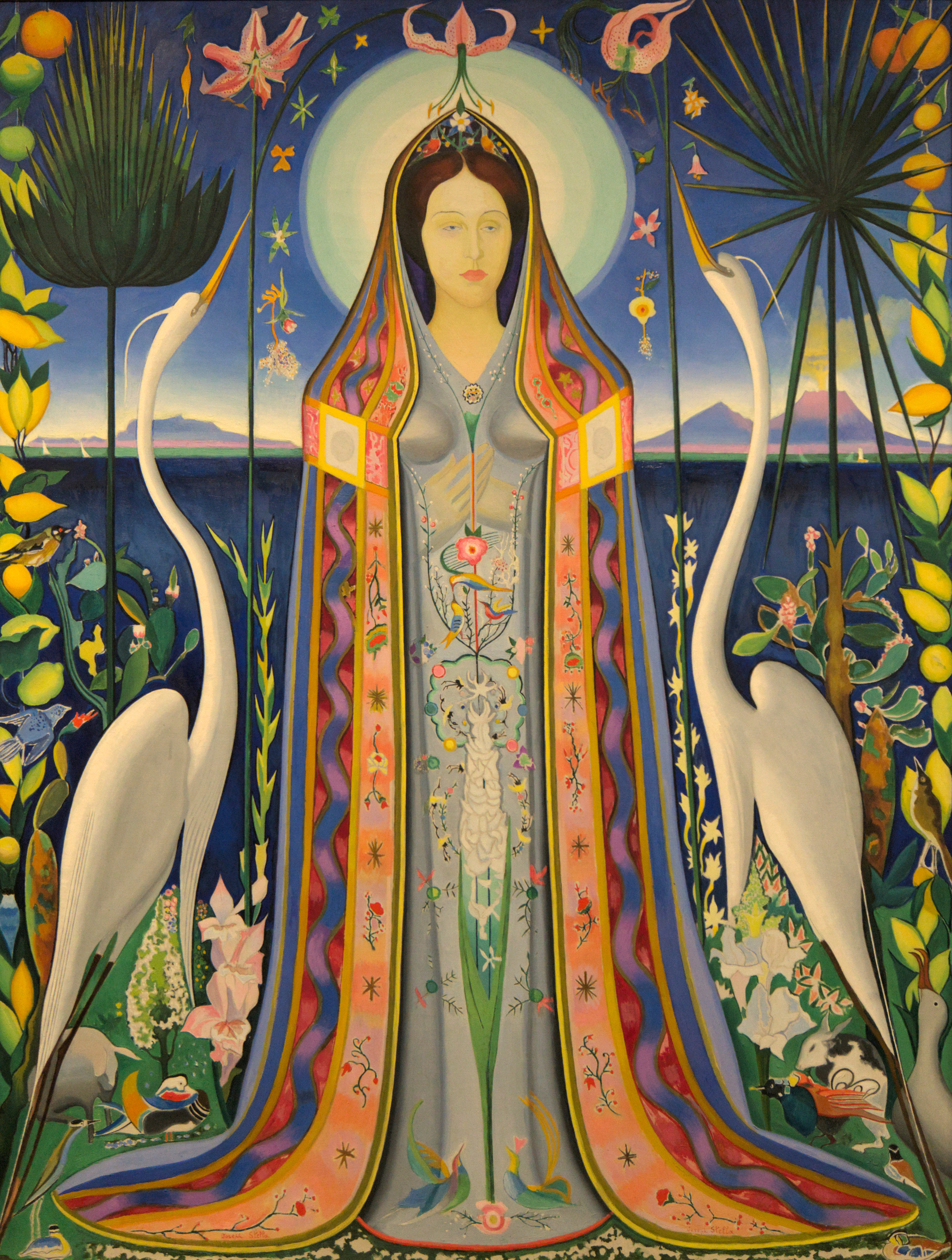
Joseph Stella (Italian American, 1877–1946), Purissima, 1927. Oil on canvas, 76 × 57 in. (193 × 144.8 cm). High Museum of Art, Atlanta, Georgia. Photo: Victoria Emily Jones. [object record]
“Mater Purissima” (Purest Mother), or “Virgo Purissima” (Purest Virgin), is one of Mary’s titles in Catholicism. The artist gave the following description of the painting:
Clear morning chanting of Spring.
BLUE intense cobalt of the sky—deep ultramarine of the Neapolitan sea, calm and clear as crystal—and alternating with zones of lighter blue, the mantle multicolored (an enormous lily blossom turned upside down).
SILVER quicksilver of spring water, quilted with the rose, green, and yellow of the gown—greenish silver, very bright—mystic DAWN-white—of the Halo.
WHITE as snow for the two herons, whose gleaming white necks enclose, like a sacred shrine, the prayer of the VIRGIN.
YELLOW very light—for the edges of the mantle—to bring it out clearly with diamond purity, and reveal the hard firm modeling of the virginal breast. The lines of the mantle fall straight over the long hieratic folds of the gown, forming a frame—and the full, resonant yellow of unpeeled lemons at both sides of the painting like echoing notes of the propitious shrill laughter of SPRING.
VIOLET mixed with ultramarine for the zigzag motif in the panel along the edge of the mantle, and bright, fiery violet at the top of Vesuvius, near the white fountainhead of incense—light violet tinged with rose, for the distant Smile of Divine Capri.
GREEN soft, tender, like the new grass—intense green for the short pointed leaves that enclose the lemons—and a dark green, both sour and sweet, for the palms that fan out at the sides like mystic garlands.
PINK strong—rising to the flaming, pure vermilion borders—of the Rose, brilliant as a jewel, in contrast to the waxy pallor of the hands clasped in prayer—and infinitely subtle, delicately modulated rose for the small flowers that with the others of various colors weave of dreams and promises and splendid bridal gown of the “Purissima.” [6]
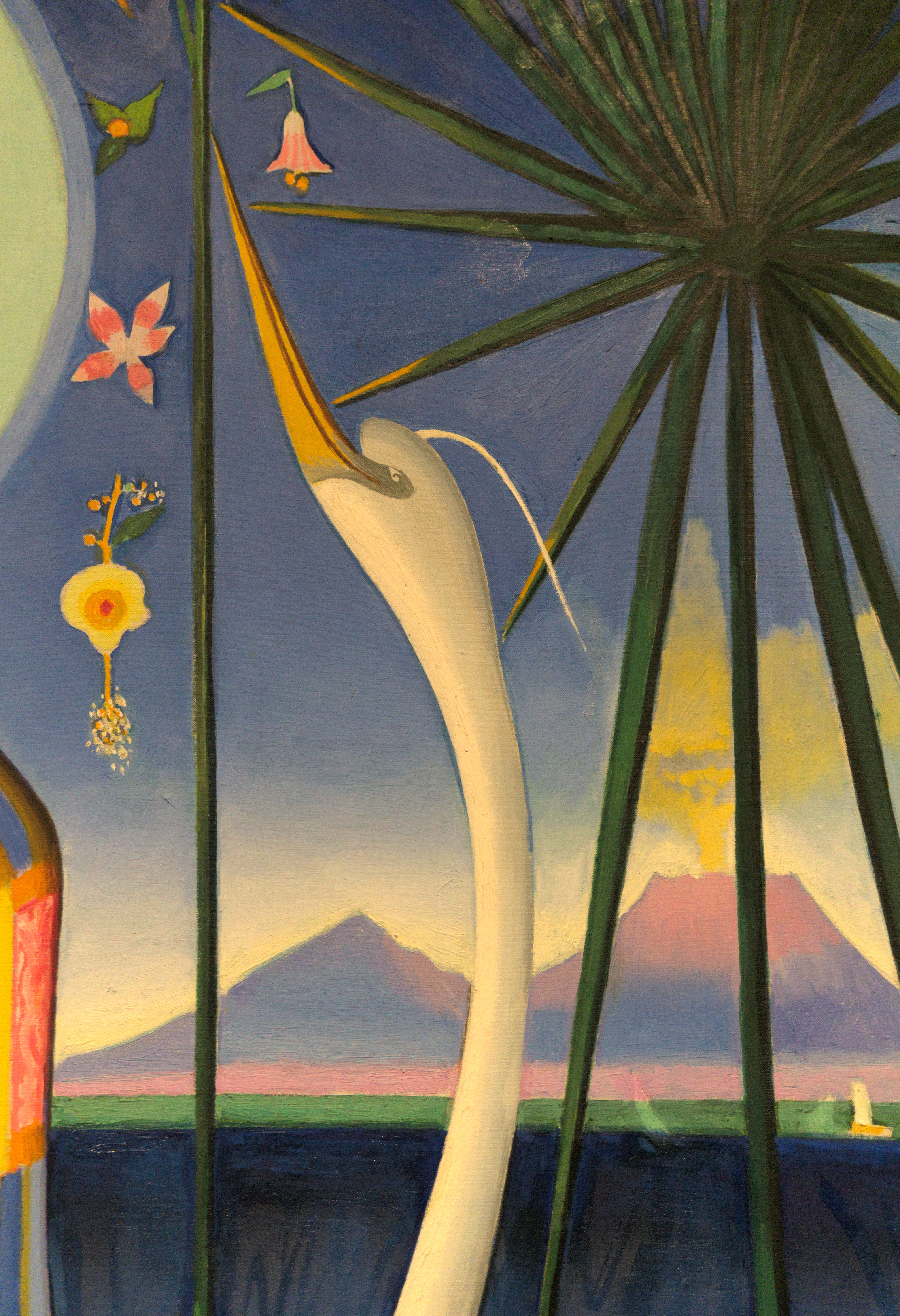
Like his Brooklyn Virgin, this painting is also set in the Bay of Naples, with Mount Vesuvius gently erupting in the right background, and the island of Capri rising up out of the sea on the left.
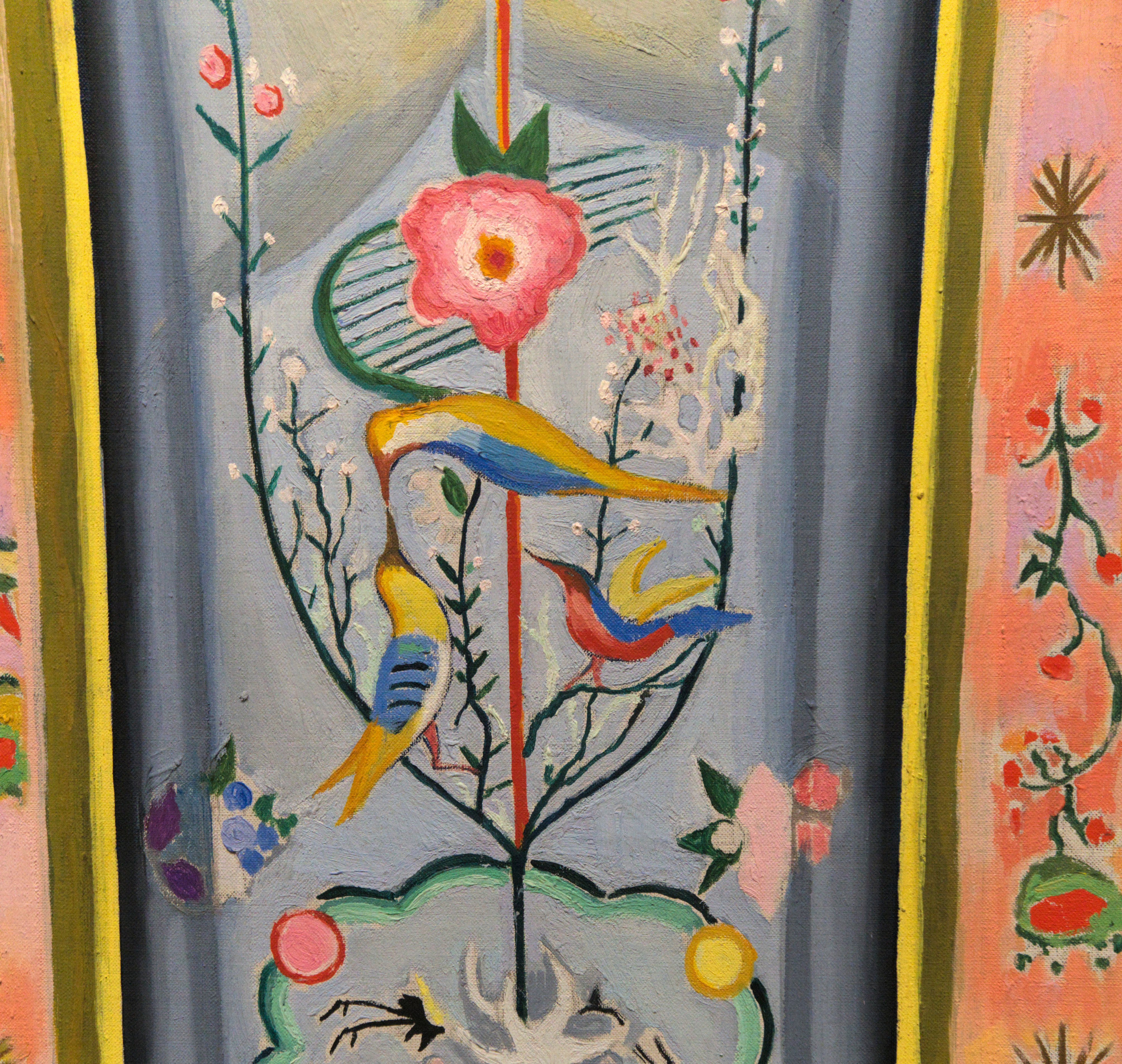
Purissima (detail)Purissima (detail)
Three pink lilies create a frame around the Purissima, their long stalks rising up on either side of her, with one flower bending down to crown her head with its filaments and anthers. She is attended not by angels but by herons, along with other critters at her feet. This is a Madonna both earthy and supernal.
Here are a few more photos from the exhibition:
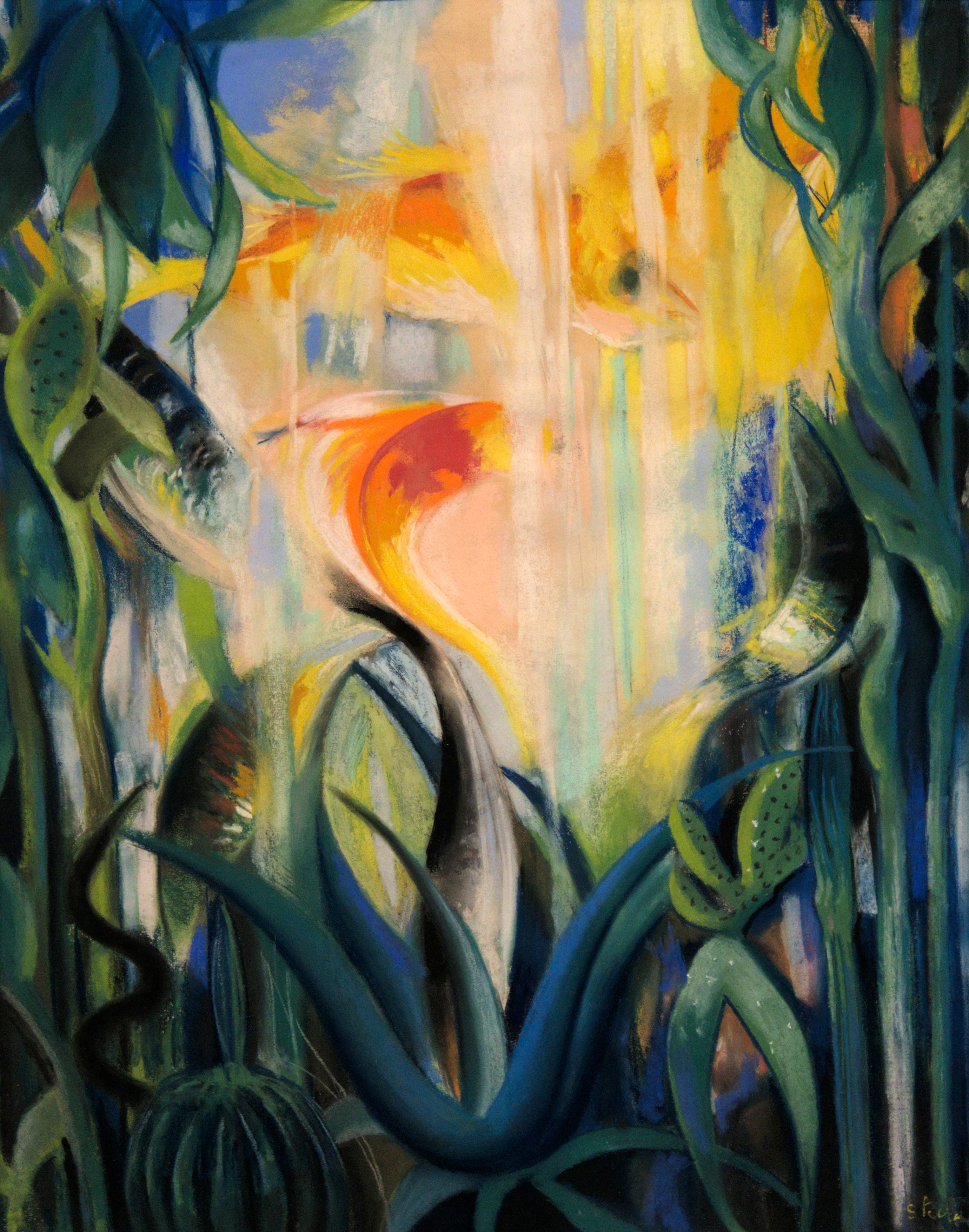
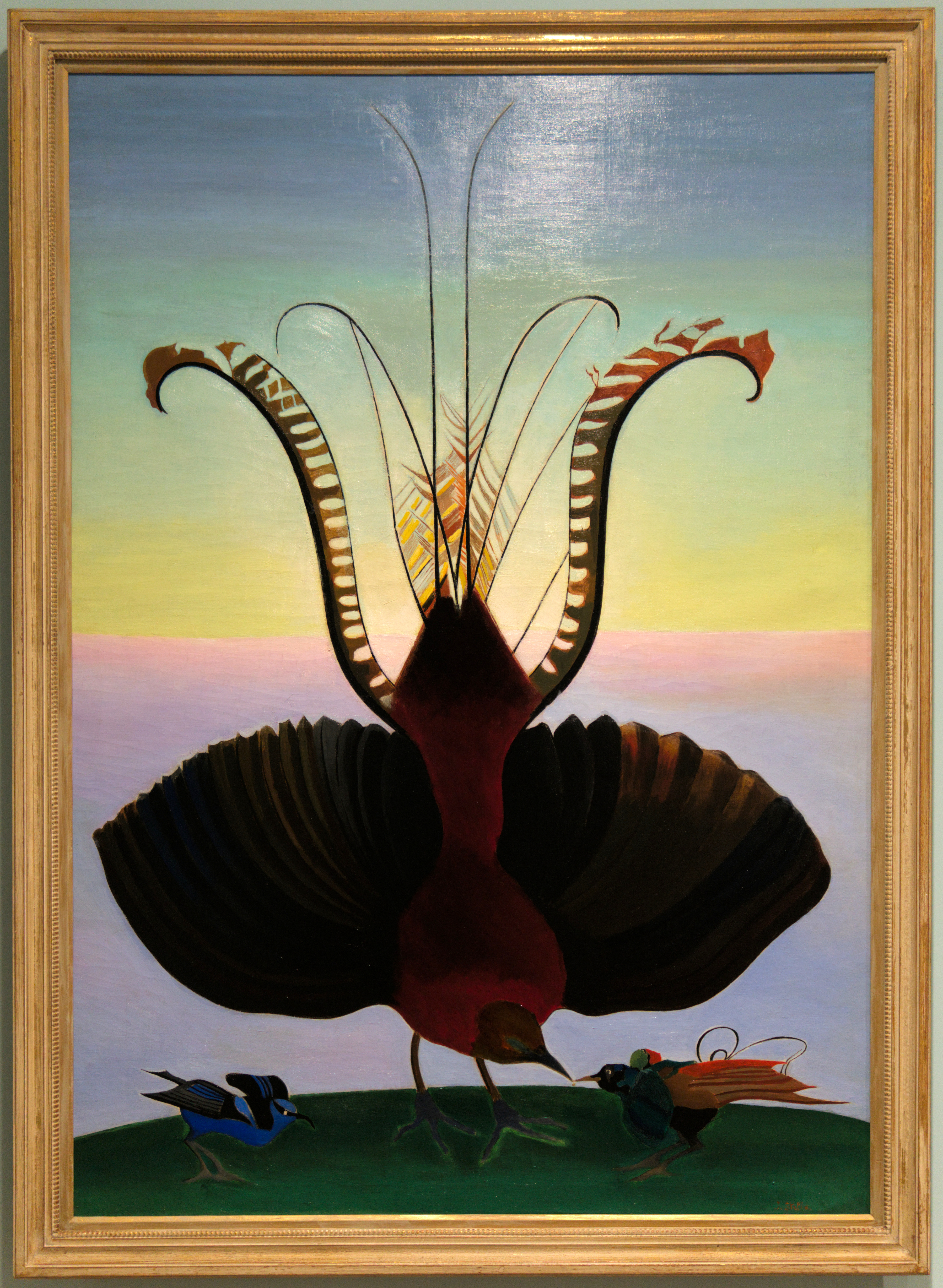
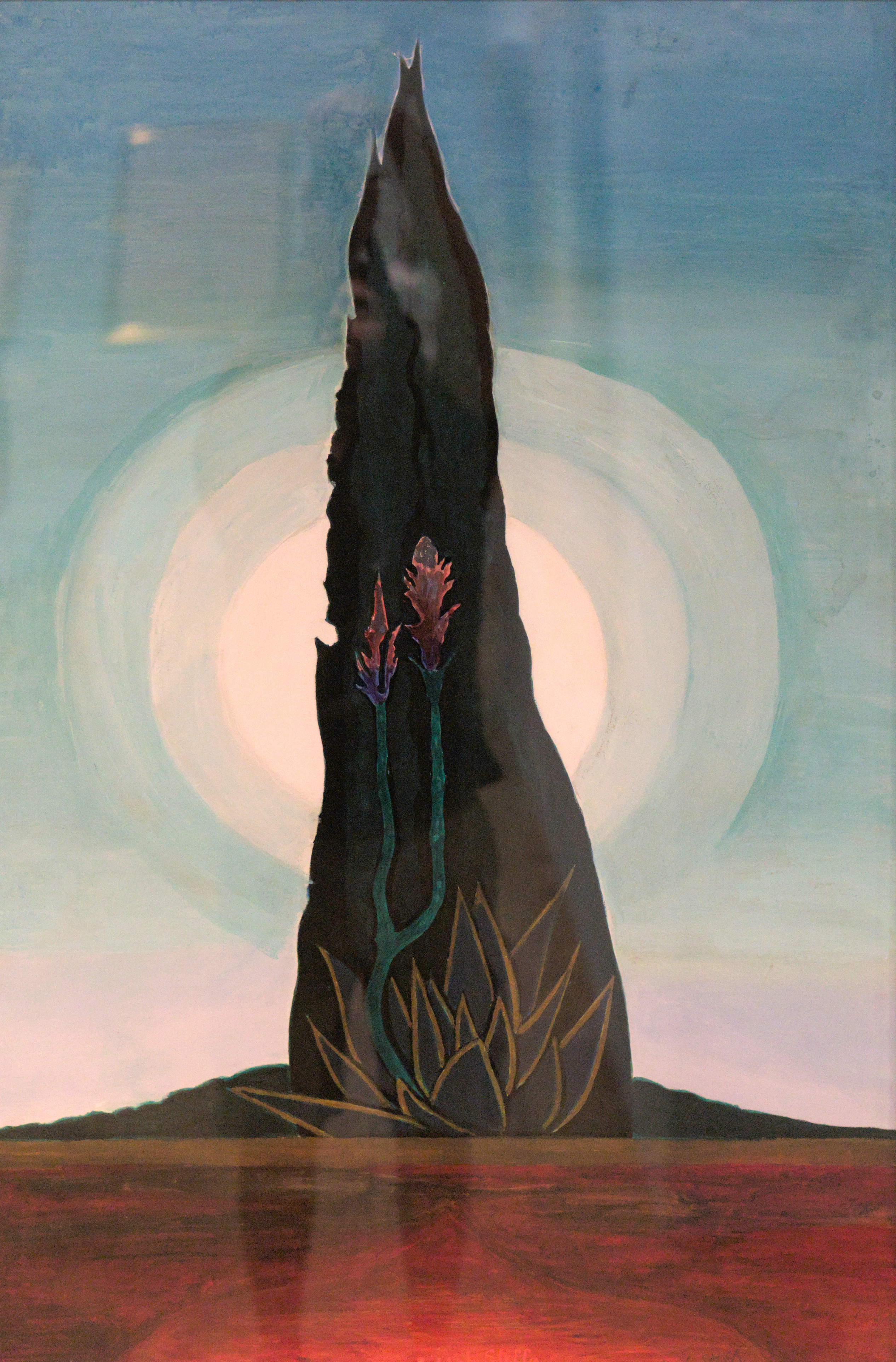
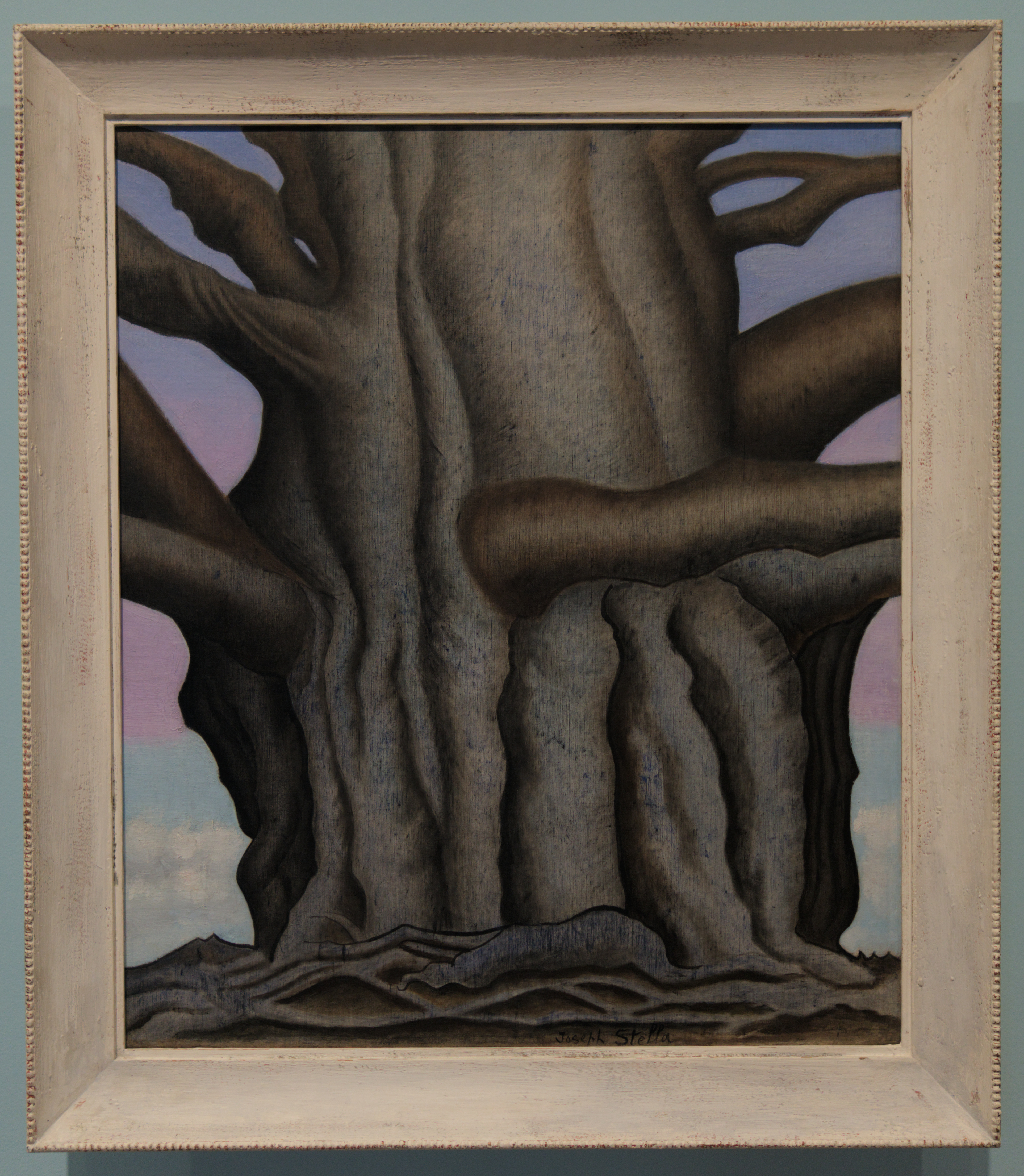
Joseph Stella (Italian American, 1877–1946), Aquatic Life (Goldfish), ca. 1919–22. Pastel on paper. American University Museum, Washington, DC. Photo: Victoria Emily Jones.Joseph Stella (Italian American, 1877–1946), Lyre Bird, ca. 1925. Oil on canvas, 54 × 30 1/8 in. (137.2 × 76.5 cm). Addison Gallery of American Art, Phillips Academy, Andover, Massachusetts. Photo: Victoria Emily Jones.Joseph Stella (Italian American, 1877–1946), Tree, Cactus, Moon, ca. 1928. Gouache on paper, 41 × 27 in. (104.1 × 68.6 cm). Reynolda House Museum of American Art, Winston Salem, North Carolina. Photo: Eric James Jones. [object record]Joseph Stella (Italian American, 1877–1946), Banyan Tree, ca. 1938. Oil on canvas, 36 1/2 × 31 1/2 in. (92.7 × 78.7 cm). Myron Kunin Collection of American Art, Minneapolis, Minnesota. Photo: Victoria Emily Jones.
1. Abram Lerner, foreword to Judith Zilczer, Joseph Stella: The Hirshhorn Museum and Sculpture Garden Collection (Washington, DC: Smithsonian Institution Press, 1983), 6.
2. Barbara Haskell, Joseph Stella (New York: Whitney Museum of American Art / Harry N. Abrams, 1994), 151.
3. From Hildegard of Bingen, “Hymn to the Virgin,” trans. Barbara Newman, in Symphonia: A Critical Edition of the “Symphonia armonie celestium revelationum” (Ithaca, NY: Cornell University Press, 1988, 1998), 123.
4. From Hildegard of Bingen, “Antiphon for the Virgin,” in Symphonia, 137.
5. FromHildegard of Bingen,“A Song to Mary,”rendered by Gabriele Uhlein, in Meditations with Hildegard of Bingen (Rochester, VT: Bear & Co., 1983), 119.
6. English translation from Irma B. Jaffe, Joseph Stella (Cambridge: Harvard University Press, 1970), 99–100. For the original Italian, see appendix 1, #29.
This book is the first time Hildegard’s writings appeared in English. In selecting, translating, and adapting the material for it, Uhlein worked from the German critical editions of De Operatione Dei (1965), Liber Vitae Meritorum (1972), and Hildegard’s letters (Briefweschel) (1965) and songs (Lieder) (1969), all published by Otto Müller Verlag in Salzburg.
For the original Latin of the above hymn and a more straightforward translation by Nathaniel M. Campbell, see here. This link also includes a musical performance of the Latin (Hildegard wrote her own lyrics and music!).
Hildegard of Bingen, OSB, (ca. 1098–1179) was a German Benedictine abbess, theologian, preacher, poet, composer, playwright, and medical writer and practitioner. She founded the monasteries of Rupertsberg and Eibingen and was named a “doctor of the church” by Pope Benedict XVI in recognition of “her holiness of life and the originality of her teaching.” Hildegard’s most significant works are her three volumes of visionary theology: Scivias (Know the Ways) (for which she also supervised miniature illuminations), the Liber Vitae Meritorum (Book of Life’s Merits), and the Liber Divinorum Operum (Book of Divine Works). But she is also well known for her liturgical hymns and antiphons, as well as the many letters she wrote to popes, emperors, abbots, abbesses, fellow mystics, and layfolk, dispensing wisdom and advice.
Gabriele Uhlein, OSF, (born 1952) is a retreat guide, workshop leader, and artist dedicated to the recovery of the Christian mystical tradition and the honoring of intuition and creativity in spiritual deepening. Born in Klingenberg, Germany, she emigrated to the US at age two. She has a PhD in process theology and Jungian-oriented psychology from Chicago Theological Seminary and is a member of the core staff at the Christine Center, a natural sanctuary in Willard, Wisconsin, rooted in the Franciscan principles of contemplation, hospitality, compassion, simplicity, transformation, and care for the earth.
Celebrated fifty days after Easter, Pentecost is one of the great feasts of the Christian year. It commemorates the descent of the Holy Spirit on Jesus’s apostles when they were gathered in Jerusalem for the Feast of Weeks ten days after Jesus ascended to heaven, marking the birth of the church. Acts 2 describes the Spirit’s coming as accompanied by a “rushing mighty wind” and “tongues of fire”—quite the dramatic entry! The Spirit filled the apostles with the miraculous ability to preach in speech that was comprehensible to all the many Jewish pilgrims, from various language groups, who were gathered in the city, resulting in the conversion that day of three thousand to the Jesus Way.
I’ve compiled a Spotify playlist of one hundred-plus Pentecost songs that celebrate God’s Spirit poured out over the face of the earth, bringing life and power. The indie folk genre is heavily represented, but there’s also an Appalachian fiddle tune, a Renaissance motet, a Native American dance song, a Russian Orthodox kontakion, Sacred Harp hymns, modern classical, Pentecostal gospel, blues, jazz, pop, lo-fi, and more. I hope to capture something of the Spirit’s dynamism with these selections.
The Holy Spirit ministers in a handful of ways. He renews, purifies, transforms. He gifts and empowers. He guides and illumines and comforts. He dwells within, a constant friendly presence. He intercedes for us with wordless groans. He unites believers across lines of difference, making us one. He enables us to bear fruit—love, joy, peace, etc.—for God’s glory and the world’s good.
So many songs centered on the Holy Spirit have an individualistic focus and a gentle, subdued tone. The Spirit does of course minister to the individual, and can be gentle and soothing (Jesus refers to him as the Comforter, after all!), and we often invoke him in our weariness. But the Spirit is also wild and uncontainable. And the life he brings is not merely of an inward spiritual kind; his impact manifests itself in tangible deeds out in the community, as those whom he fills go forth to serve their neighbors after the example of Christ.
Urban Doxology’s “Spirit, Send Your Fire” is a good example of a Holy Spirit song with an outward, communal focus, and it’s full of anticipatory excitement:
In terms of energy, consider the vigor with which Bach ornaments the final line of the Gloria, “Cum Sancto Spiritu in gloria Dei Patris” ([You, Jesus Christ, alone are the Most High] with the Holy Ghost in the glory of God the Father), in his B minor Mass. And for wildness: the loud clashing of the piano chords in Daniel Glover’s “The Descent of the Holy Spirit”from Misteria, evoking a sense of the disorientation that must have been felt on that historic day when the Spirit came suddenly sweeping in and the apostles started speaking multiple languages at once. (Some observers thought they were drunk!)
“Let the Waters” is another high-octane Pentecost song—this one in a rock style—which Michael Gungor wrote in 2014 when he was part of the Liturgists. In 2020 he revisited it with the Good Shepherd Collective, adding as a tag the African American spiritual “Wade in the Water” [previously]. In this context the spiritual references both the Spirit’s tendency to disrupt and the ancient Jewish folk belief that an angel would periodically come down to stir the waters of a certain pool in Bethesda, activating its healing properties (see John 5:4). The GSC released this new arrangement later in 2020 under the title “Pentecost,” featuring on vocals Gungor, Liz Vice, and Charles Jones.
Let the waters cool ya Let the Spirit move ya Feel the fire on your lips and sing your hallelujah Sing your hallelujah
O my soul, sing hallelujah
Wade in the water Wade in the water, children Wade in the water God’s gonna trouble the water
Led by Betty Pamptopee of Isabella Reservation, Michigan, “Methodist Hymn” is the first verse of “O for a Thousand Tongues to Sing” in Ojibwe (but to the tune of “Alas, and Did My Savior Bleed”). Even though “tongues” in the song’s titular first line is probably referring not to languages but to the individual’s desire to maximize God’s praise—as in “Oh, that I had more tongues to praise you with!”—I love the implications for Pentecost, when the gospel went out in many tongues, the beginning of the “proclaim[ing] and spread[ing] through all the earth abroad / the honors of [Jesus’s] name.” I think there’s massive potential for a multilingual choral arrangement of this hymn. (I’m thinking, for example, of Laurel MacDonald’s “Qui habitat,” featured here.)
Several of the songs on the playlist highlight the Spirit’s creativity, such as verse 1 of “Come, Holy Spirit” (alt title: “Holy Spirit, Groaning”) by David Benjamin Blower. Genesis 1 says that in the beginning, the Spirit hovered over the waters of chaos—implying that he was active in creation. And he is still a creative force, bringing forth new life.
Hildegard of Bingen [previously], a twelfth-century nun and polymath from Germany, wrote several beautiful Latin antiphons to the Holy Spirit, both words and music, which together convey a sense of mystery and awe. One of them is “Spiritus sanctus vivificans,” from her Symphony of the Harmony of Celestial Revelations, sung here by soprano Anna Sandström:
Here are two English translations; I can’t decide which I like best, so I proffer them both:
Holy Spirit,
giving life to all life,
moving all creatures,
root of all things,
washing them clean,
wiping out their mistakes,
healing their wounds,
you are our true life,
luminous, wonderful,
awakening the heart
from its ancient sleep.

Trans. Stephen Mitchell
The Spirit of God
is a life that bestows life,
root of the world-tree
and wind in its boughs.

Scrubbing out sins,
she rubs oil into wounds.

She is glistening life
alluring all praise,
all-awakening,
all-resurrecting.

Trans. Barbara Newman
Most songs take the form of calling on the Spirit to descend once more with the breath or fire of revival, such as many of the old hymns: by Ambrose (retuned by Bradford Loomis and Beth Whitney), Rabanus Maurus, Bianco da Siena (retuned by Seth Thomas Crissman, and another version by Luke Brodine), Martin Luther (retuned by Paula Best and Tara Ward), Heinrich Held (retuned by Joshua Bennetch), Isaac Watts (retuned by Jon Green), Joseph Hart (retuned by Stephen Gordon), Charles Wesley (retuned by Jered McKenna), Benjamin Beddome, and Samuel Longfellow (retuned by Seth Thomas Crissman, and another version by Greg Yoder, both of The Soil and The Seed Project).
For example, we might ask the Spirit to increase our love for God and others. In Watts’s “Come, Holy Spirit, heav’nly dove,” we beseech him to come “with all Thy quick’ning pow’rs; come, shed abroad a Savior’s love, and that shall kindle ours.” Or elsewhere, similarly, to “light up our mortal frame” with love, “till others catch the living flame” (Ambrose). The Spirit also kindles belief and trust. “Revive our drooping faith,” prays Hart.
Further, the Spirit knits together diverse peoples into a brand-new family whose head is Christ. Fr. Peter Raymond Scholtes, a Catholic priest living on the south side of Chicago, penned the post–Vatican II hymn “One in the Spirit” (aka “They’ll Know We Are Christians by Our Love”) against the backdrop of the civil rights movement. It proclaims that Christians are united by their share in, as the apostle Paul puts it, “one body and one Spirit . . . one hope . . . one Lord, one faith, one baptism, one God and Father of all . . .” (Eph. 4:2–5), and prays “that all unity [across all humankind] will one day be restored.” It also emphasizes the importance of the church’s public witness through acts of love. As Jesus says in John 13:35, “By this everyone will know that you are my disciples, if you have love for one another.” Love is the primary fruit of the Spirit that Paul lists in Galatians 5:22–23. Here’s a jazz arrangement of the hymn performed by Ruth Naomi Floyd:
Unity is also the theme of one of four featured hymns from the Orthodox liturgy for Pentecost, the text of which translates to: “When the Most High descended and confused tongues [at the Tower of Babel], he scattered the people; but when he distributed the tongues of fire, he called all to unity. Therefore, with one voice, let us praise the most Holy Spirit.” Pentecost is often referred to as a reverse Babel.
There are several musical settings of scripture on the playlist, including:
“O Children of Zion” by Seth Thomas Crissman (The Soil and The Seed Project), a setting of Joel 2:23a, 28: “O children of Zion, be glad and rejoice in the LORD your God. . . . I will pour out my spirit on all flesh; your sons and your daughters shall prophesy, your old men shall dream dreams, and your young men shall see visions.”
“If Ye Love Me” by Thomas Tallis, a setting of John 14:15–17: Jesus says, “If you love me, you will keep my commandments. And I will ask the Father, and he will give you another Advocate [/Helper/Comforter; Gr. parakletos, Paraclete], to be with you forever. This is the Spirit of truth, whom the world cannot receive because it neither sees him nor knows him. You know him because he abides with you, and he will be in you.”
“The Spirit of Life” by Cody Curtis (Psallos), a setting of Romans 8:1–17, about living not according to the flesh but according to the Spirit, who is “life and peace” and who abides in us, enabling us to resist sin and bearing witness that we are children of God and therefore join heirs with Christ
“God Is Love” by Ri-An, a setting of 1 John 4:7–21, about how we abide in God, and God in us, through the Spirit, who is love
There are also a few songs that reference the story of Ezekiel in the valley of dry bones [previously], in which God brings his prophet to a desolate landscape littered with human bones. But then: “Thus says the Lord GOD to these bones: I will cause breath to enter you, and you shall live. . . . Come from the four winds, O breath, and breathe upon these slain, that they may live” (Ezek. 37:5, 9). And the bones reassembled, took on flesh, and became animated once again—a picture of the regenerative power of God’s Spirit. (The Hebrew word for “spirit” is ruach, which can also be translated “breath”; same with the Greek pneuma.) Here’s Caroline Cobb’s “Dry Bones”:
I hope the Art & Theology Pentecost Playlist helps you to more fully exult in the myriad workings of the Spirit, who came in a blaze some two thousand years ago and burns still, all over the globe, where Christ’s kingdom has taken root.
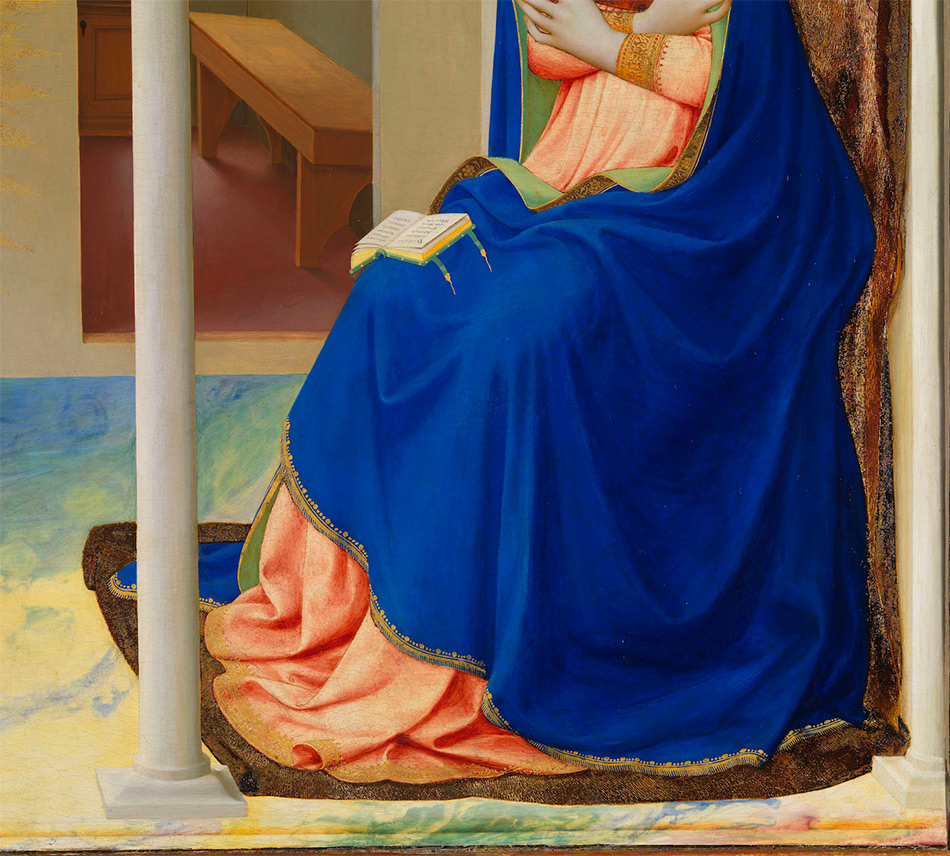
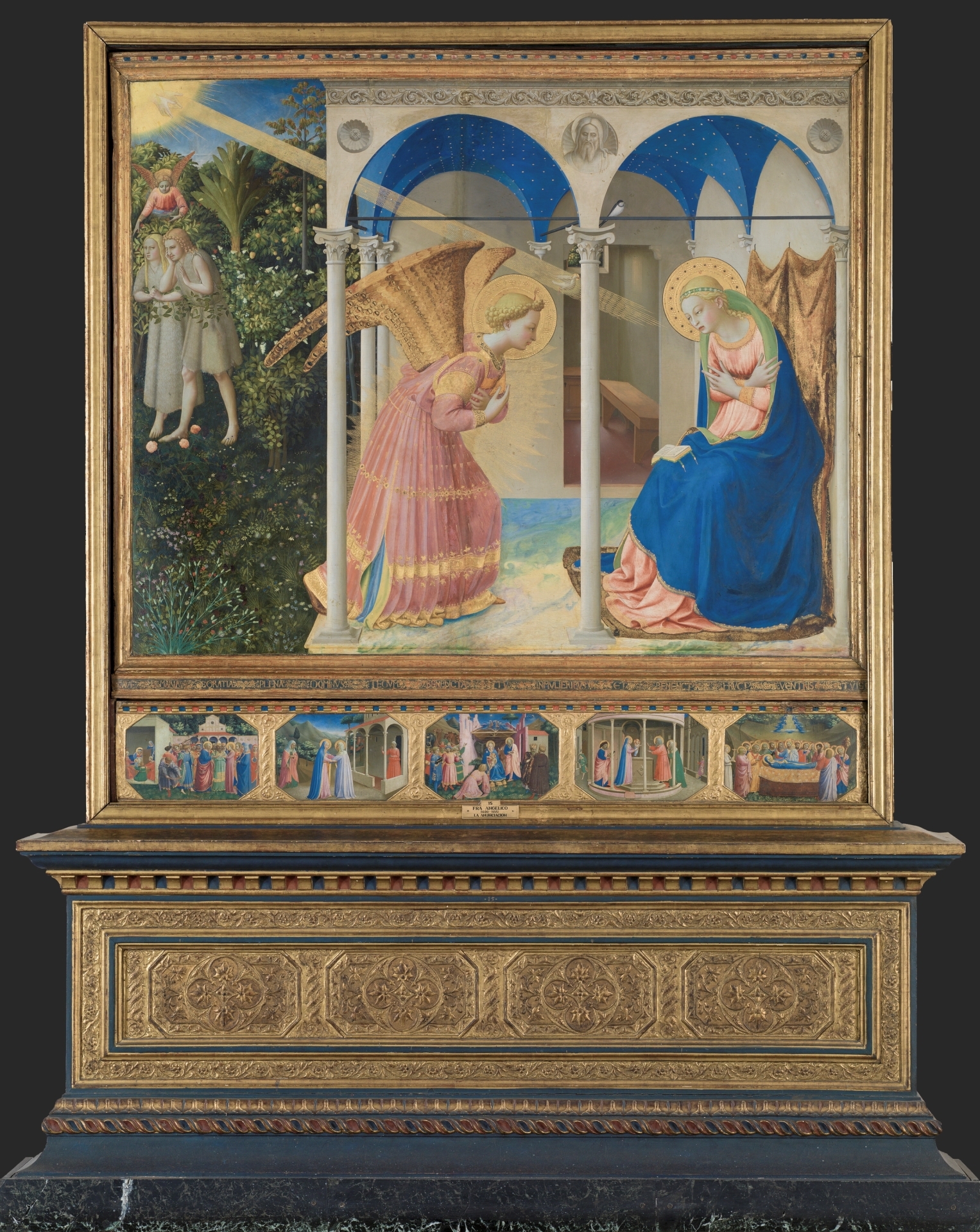
Fra Angelico (Italian, ca. 1395–1455), The Annunciation, ca. 1426. Tempera and gold on wood panel, 162.3 × 191.5 cm. Museo del Prado, Madrid.
The Annunciation was a favorite subject of the Early Renaissance artist Fra Angelico [previously], and he painted it multiple times throughout his career. Once was for an altarpiece for the convent of San Domenico in Fiesole, near Florence, now in the Prado Museum in Madrid.
In this version Mary sits on a draped chair under the portico of a domestic space, reading the scriptures, when suddenly this otherworldly being, dressed in rose and radiating, approaches. It’s the archangel Gabriel. His foot crosses the threshold of paradise into Mary’s space—the divine stepping into the human realm. Will you do it? he asks. Be mother to God?
Mary’s initial fear and perplexity eventually give way to glad acceptance. The artist compresses the episode—the arrival, the ask, the cogitation, the answer—into this singular freeze frame. When Mary says yes to God’s plan to become flesh of her flesh and so work out the salvation of the world, God releases his Spirit, who rides a stream of light from the heavens into her womb. At this miraculous moment, Jesus is conceived.
Gabriel crosses his hands over his chest in humble reverence, a gesture mirrored by Mary. Both are still before the profound mystery of the Incarnation.
Fra Angelico used ultramarine—the finest and most expensive of all pigments, made from lapis lazuli, a semiprecious stone imported to Europe from the Middle East—to paint Mary’s mantle as well as the star-studded ceiling above her. Blue represents heaven, and here Mary is clothed with it and overshadowed by it.
The male figure in the carved roundel above the central column is, I’d say (based on the unambiguous Montecarlo Altarpiece), the prophet Isaiah, who wrote centuries before the event that “the Lord himself shall give you a sign; behold, a virgin shall conceive, and bear a son, and shall call his name Immanuel” (Isa. 7:14).
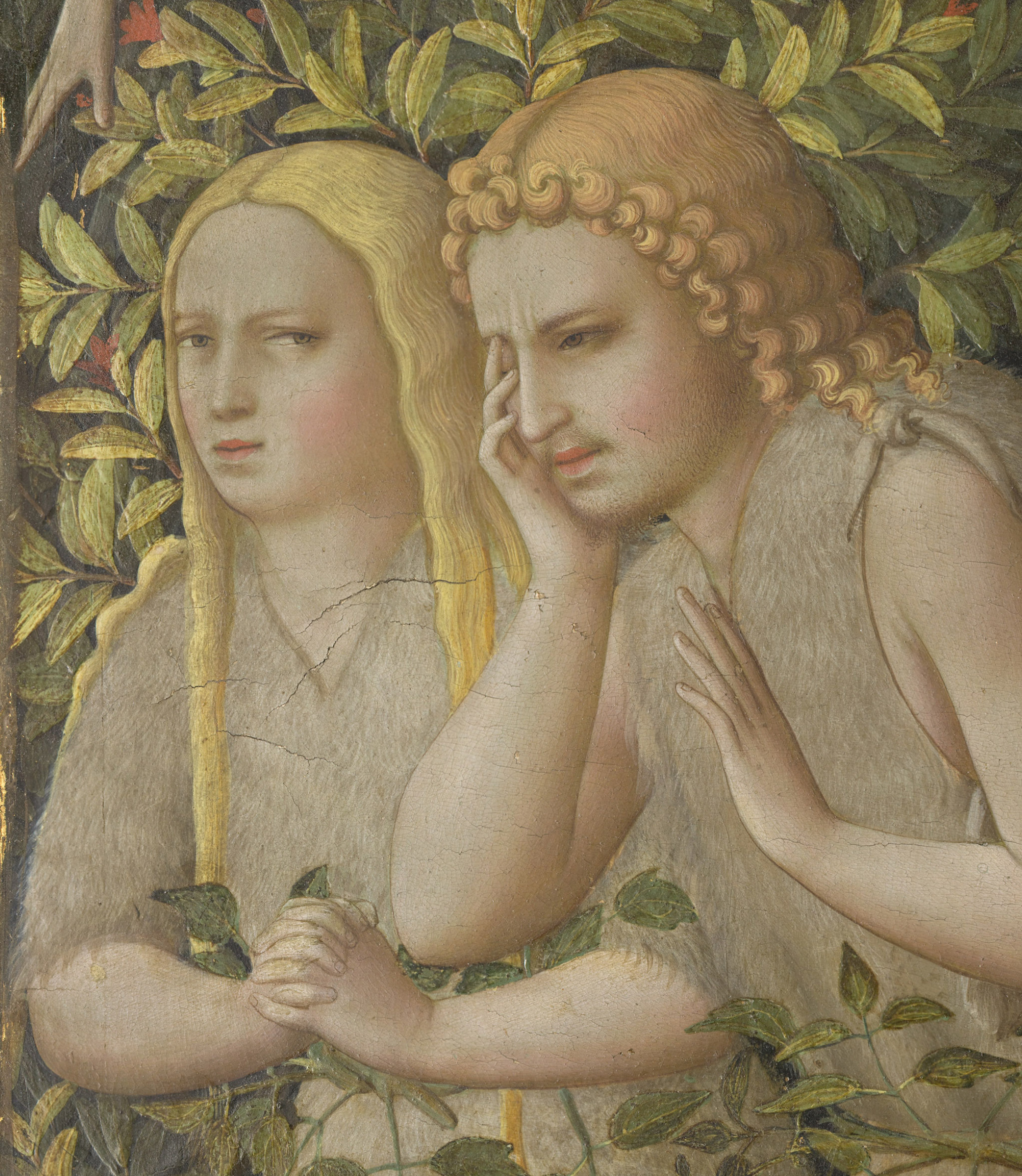
But Fra Angelico goes even further back than the Old Testament prophets. On the left side of the panel he shows our foreparents, Adam and Eve, being cast out of paradise, having broken God’s trust. They blush in shame—they wince, they cover their face. By including this catalyzing event from salvation history in his painting of the Annunciation, the artist is telling a larger narrative. In particular, he is drawing connections, mainly contrastive, between Adam and Eve and Christ and Mary.
In his epistles, the apostle Paul talks about Christ as the Second Adam, or the New/Last Adam (Rom. 5:12–21; 1 Cor. 15:22–23, 45), who came to restore what was lost with the first Adam. Whereas Adam disobeyed God and caused sin to enter the world, Christ lived a life of perfect obedience to the Father, thereby redeeming humanity. The early church fathers, starting with Justin Martyr, Irenaeus, and Tertullian in the second century, extended this corollary with another: Mary as the Second Eve. Whereas Eve rejected God’s will, Mary embraced it, and her obedient yes, like Eve’s disobedient no, had repercussions for all of humanity. As the arts lecturer John Skillen puts it, our undoing in the Expulsion is undone by the Annunciation.
We see on the left an angel driving humanity out of Eden, but on the right, another angel welcomes humanity back in. And in a glorious reversal of the order of first creation, where Eve was created from Adam, here the Second Adam is created from the Second Eve, knit together from her DNA.
In the first issue of her Medievalish newsletter from last December, Dr. Grace Hamman discusses Fra Angelico’s Prado Annunciation in terms of chronos (ordinary time measured in seconds and hours) and kairos (moments outside of time). “Fra Angelico recognizes something that is easy to forget: because God is outside of time, not bound by chronology like us creatures, this painting offers a ‘God’s-eye view’ of salvation history,” she writes, portraying a simultaneity of “falls” that the fourteenth-century contemplative writer Julian of Norwich expounds on:
When Adam fell, God’s Son fell; because of the true union which was made in heaven, God’s Son could not be separated from Adam, for by Adam I understand all mankind. Adam fell from life to death, into the valley of this wretched world, and after that into hell. God’s Son fell with Adam, into the valley of the womb of the maiden who was the fairest daughter of Adam, and that was to excuse Adam from blame in heaven and on earth; and powerfully he brought him out of hell. (Revelations of Divine Love, chap. 51)
“There was never a moment,” Hamman continues, “even in the expulsion from Eden, that Emmanuel was not with us, if one is given the eyes of kairos.”
And the Annunciation is only the main panel. Along the predella (base) are depicted the Marriage of the Virgin, the Visitation, the Nativity, the Presentation of Christ in the Temple, and the Dormition (the “falling asleep,” or death, of Mary).
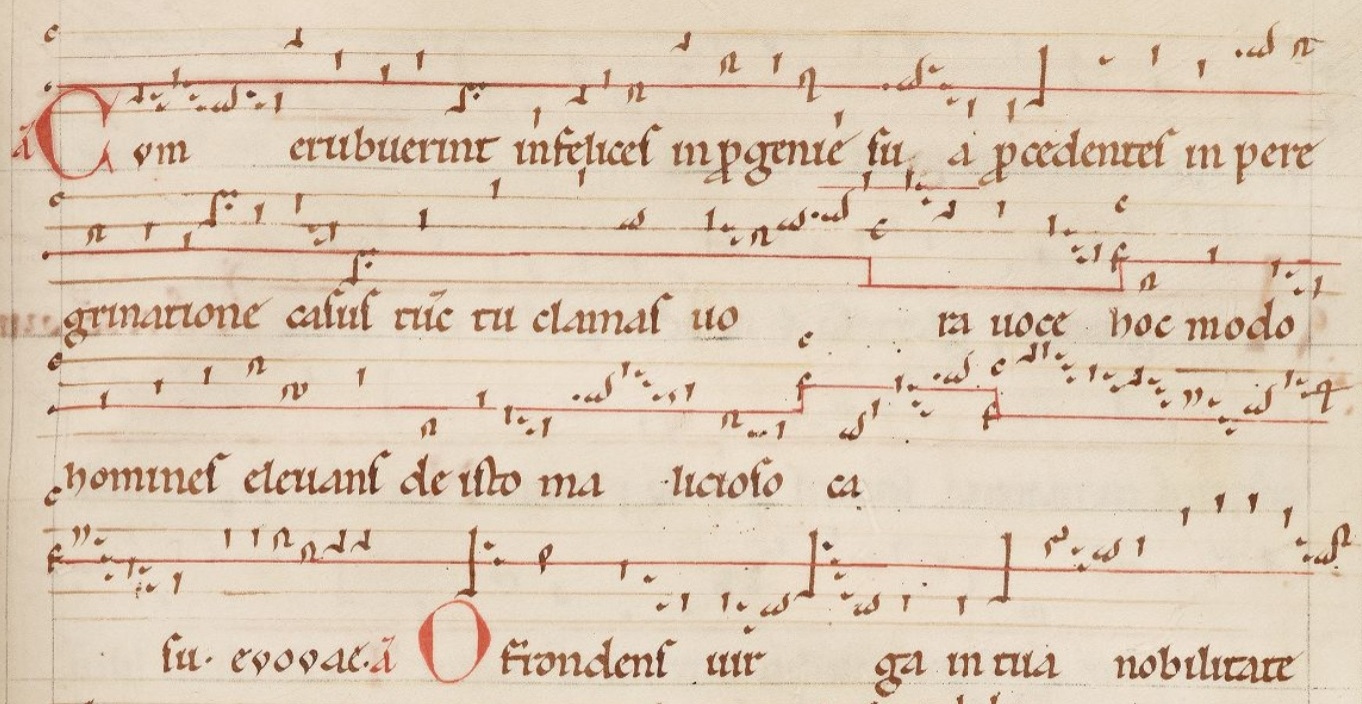
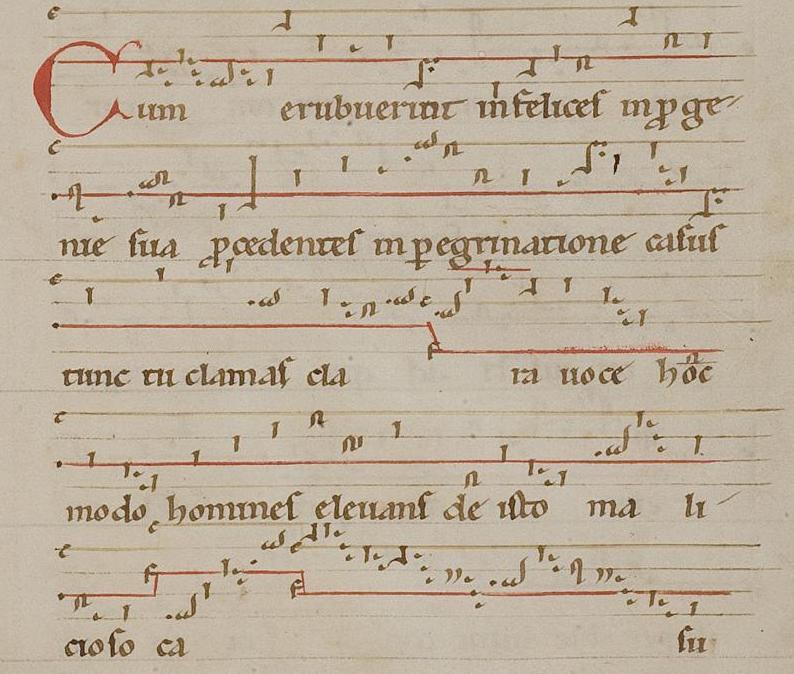
LISTEN: “Cum erubuerint infelices” (While Downcast Parents Blushed) by Hildegard of Bingen, ca. 1175 | Performed by La Reverdie on Sponsa Regis: La victoire de la Vierge dans l’œuvre d’Hildegard, 2003
Cum erubuerint infelices
in progenie sua,
procedentes in peregrinatione casus,
tunc tu clamas clara voce,
hoc modo homines elevans
de isto malicioso
casu.
While downcast parents blushed,
ashamed to see their offspring
wand’ring off into the fallen exile’s pilgrimage,
you cried aloud with crystal voice,
to lift up humankind
from that malicious
fall.

Trans. Nathaniel M. Campbell [source]
The Benedictine abbess Hildegard of Bingen (1098–1179) was a visionary theologian, poet, composer, singer, artist, gardener, and physician. She wrote on scientific and medical subjects in addition to theology, which she conveyed not only through prose but also through poetry, music, dramas, and illuminations. She was quite the medieval polymath!
I first learned about Hildegard in a Western music history survey course in college, in a unit centered on her Ordo Virtutum (Play of the Virtues). I couldn’t believe I had never heard about this amazing sister in the faith before. In 2012 she was formally canonized by the Roman Catholic Church—a long time coming!—and Pope Benedict XVI even named her a “doctor of the church,” a title given to saints who have made a significant contribution to theology or doctrine.
The corpus of surviving musical compositions by Hildegard is larger than that of any other medieval composer. More than half of these are antiphons, short free verses sung before and after each set of psalms during monastic prayer.
“Cum erubuerint” is one such antiphon. Hildegard would have sung it with her sisters at her monastery on the Rupertsberg and later the abbey at Eibingen as part of the Divine Office.
The song addresses the Virgin Mary, whose yes to Gabriel set into motion the Incarnation and thus humanity’s deliverance from spiritual exile.
As are many of Hildegard’s compositions, “Cum erubuerint” is highly melismatic—that is, it features long melodic phrases sung to one syllable. For example, I counted thirteen notes on the first syllable, “Cum”! The highest pitch occurs on clara (“clear”), referring to the definitive quality of Mary’s consent, bright and luminous, to this new thing that God is doing. An agent of God’s grace, Mary speaks a word that cuts through the mists of confusion through which we’ve been wandering, lost, uplifting us from the fall (casu), whose depths are underscored by that word’s being pitched the lowest. In her fiat, Mary is essentially saying, “Let there be light.”
Symphonia armonie celestium revelationum (Symphony of the Harmony of Celestial Revelations) is the title Hildegard gave to her collection of musical compositions, which are preserved in two manuscripts:
Dendermonde (D), Belgium, Sint-Pieters-en-Paulusabdij, Cod. 9 (ca. 1175). This one is considered by scholars to be the more authoritative. It was prepared under Hildegard’s supervision as a gift for the monks of Villers and contains fifty-seven songs.
Riesenkodex (R), Wiesbaden, Hessische Landesbibliothek, Hs. 2 (ca. 1180–85). This revised and enlarged edition, which includes seventy-five songs, was produced at the Rupertsberg scriptorium not long after Hildegard’s death.
Hildegard’s creations, compared with a contemporary hymn by Abelard or a sequence by Adam of St. Victor, will sound either primitive or unnervingly avant-garde. In a sense they are both. As a Benedictine, she was acquainted with a large repertoire of chant, but she lacked formal training and made no attempt to imitate the mainstream poetic and musical achievements of her day. Various scholars have hypothesized that she was influenced by German folksong, yet her compositions lack the two essential traits of a popular tune: it must be easy to remember and easy to sing. The difficult music of the Symphonia is sui generis. In [Sr. Maria Immaculata] Ritscher’s words, it is ‘gregorianizing but not Gregorian’ and impossible to classify in terms of any known contemporary movement. (27–28)
And regarding Hildegard’s lyrical texts:
Until the advent of modern vers libre, scholars were reluctant even to dignify Hildegard’s songs with the title of poetry. In style they are much closer to Kunstprosa, a highly wrought figurative language that resembles poetry in its density and musicality, yet with no semblance of meter or regular form. (32–33)
The above performance of “Cum erubuerint” is by La Reverdie, a medieval and Renaissance vocal ensemble that started in 1986 with two pairs of sisters from Italy.
But in addition, here are a few instrumental versions I particularly like:
>> Tina Chancey of the early music ensemble Hesperus plays the melody on kemenche, a bowed instrument from the Black Sea region of Turkey:
The song also appears, under the title “From This Wicked Fall,” on the Billboard-topping Vision: The Music of Hildegard Von Bingen (1994), a classical-electronic crossover album of seventeen of Hildegard’s works arranged by Richard Souther. In Souther’s version, nonlexical vocables (sung by soprano Emily Van Evera and mezzo-soprano Sister Germaine Fritz, OSB) replace the Latin text.
After nudges from several readers, I’ve decided to join Instagram! Follow me @art_and_theology. I’m still trying to settle on how I’d like to use the platform, but in the meantime, I’ve been sharing photos I’ve taken on visits to art museums and spaces that house sacred art. (And in case you don’t already know, Art & Theology is also on Facebook and Twitter.)
+++
DANCE: “Sign of the Times,” choreographed by Travis Wall: Premiering August 19, 2019, on Fox’s So You Think You Can Dance (season 16, episode 11), this contemporary dance piece is choreographer Travis Wall’s response to the gun violence epidemic in America. It’s a communal lament through movement, really—an expression of fear, sadness, pain, anger, frustration, and defiance. It is performed by this season’s “top ten”: Benjamin Castro, Gino Cosculluela, Eddie Hoyt, Madison Jordan, Anna Linstruth, Bailey Muñoz, Sophie Pittman, Mariah Russell, Ezra Sosa, and Stephanie Sosa.
+++
FEATURED POET: Marjorie Maddox: The latest installment of Abbey of the Arts’ Featured Poet series is, as usual, wonderful! I’ve read some of Maddox’s poems in magazines and anthologies but haven’t yet gotten my hands on one of her collections. This feature has incentivized me to request a copy of Transplant, Transport, Transubstantiation through my local library.
“The work of poetry,” Maddox writes, is “empathy and epiphany. The process of writing and reading allows us to better understand this world and the next. Poetry connects the local and universal, the mundane and the miraculous. It gives us those ears to hear and eyes to see that we might, then, head back into the turning world sustained, nourished, and willing to learn more. And will this not lead us to the Sacred? Yes, I say. Yes.”
+++
ESSAY: “Acts of Attention: On Poetry and Spirituality” by Robert Cording: I really enjoyed this essay from Image journal about the importance of attending to the world. “Attention is simply a loving look at what is,” writes Cording, a poet and birdwatcher. He discusses seeing not as a physiological act but as perceiving the fullness that exists in each moment. “Seeing is impossible without love or reverence,” he says. Along the way he engages with Marie Howe, Aristotle, Emerson and Thoreau, Tolstoy, Ruskin, Heidegger, Hopkins, Czesław Miłosz, and Marilynne Robinson. He also walks us through three poems: Robert Frost’s “Two Tramps in Mud Time,” Wallace Stevens’s “Man on the Dump,” and Seamus Heaney’s “The Pitchfork.” So much goodness here!
If you enjoyed this essay as much as I did, be sure to also check out “Cloud Shapes and Oak Trees,” also by Cording, from 2017.
+++
EXHIBITION: Abraham: Out of One, Many, curated by Rev. Paul-Gordon Chandler of Caravan: Caravan is an international nonprofit that uses the arts to build sustainable peace around the world. “Our peacebuilding work is based on the belief that the arts can serve as one of the most effective mediums to enhance understanding, bring about respect, enable sharing, and facilitate friendship between diverse peoples, cultures and faiths.”
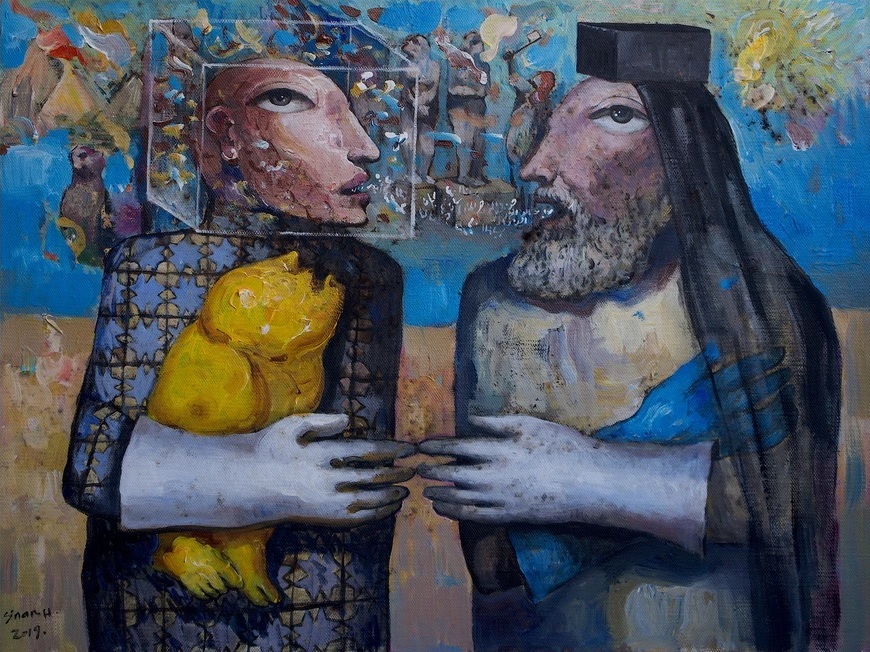
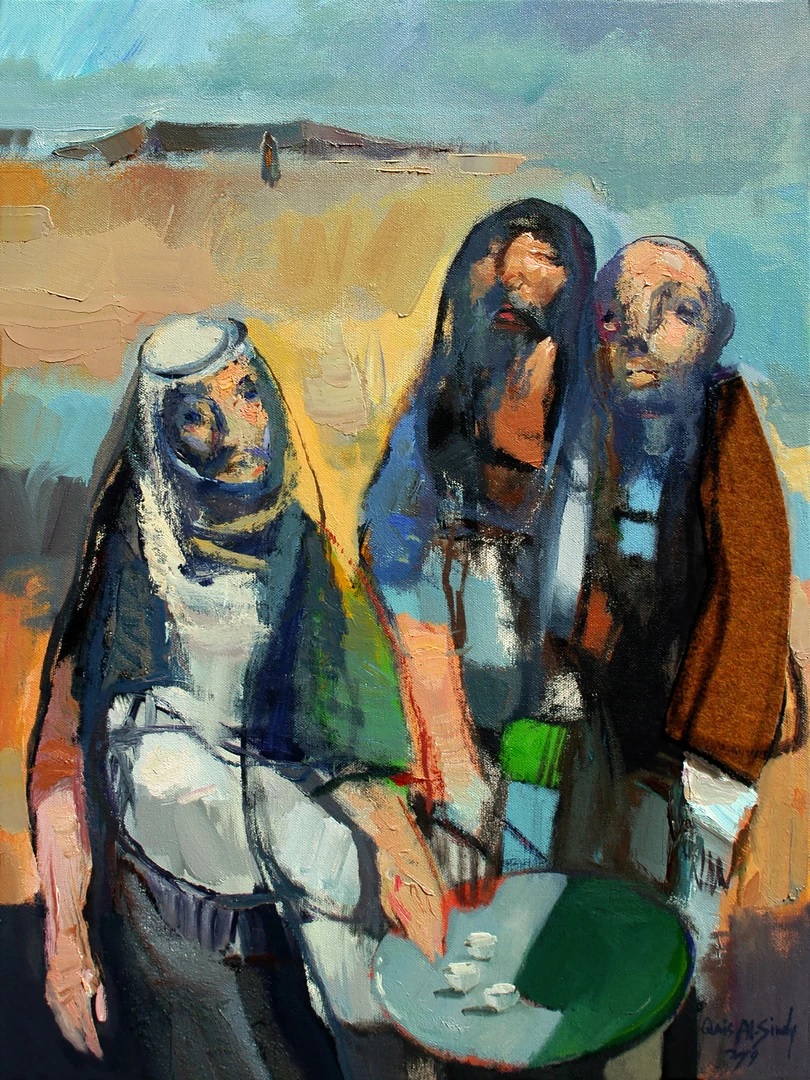
Caravan’s current exhibition is built around Abraham, a key ancestral figure shared by the world’s three major monotheistic religions: Judaism, Christianity, and Islam. Caravan commissioned three Middle Eastern artists, one from each of these faith traditions, to each create five paintings on these subjects: Living as a Pilgrim, Welcoming the Stranger, Sacrificial Love, The Compassionate, and A Friend of God. The exhibition of resulting works opened May 3 at St. Paul’s Within the Walls in Rome. From there it has traveled to Paris and Edinburgh and, starting September 8, will be in the States, touring through 2021 with stops in Boston, Atlanta, Houston, Washington, DC, Chicago, and more (see schedule). There’s an excellent digital catalog available, which contains full-color reproductions and descriptions of all fifteen paintings.
Sinan Hussein (Iraqi, 1977–), Living as a Pilgrim, 2019. Mixed media on canvas, 45 × 60 cm. Part of the “Abraham: Out of One, Many” exhibition organized by Caravan.
Qais Al Sindy (Iraqi, 1967–), Welcoming the Stranger, 2019. Oil and collage on canvas, 60 × 45 cm. Part of the “Abraham: Out of One, Many” exhibition organized by Caravan.
+++
MUSICAL: In the Green by Grace McLean:Lincoln Center Theater’s LCT3 produces shows by new playwrights, directors, and designers, and for this summer, they commissioned a musical about the twelfth-century German mystic Hildegard of Bingen. (It finished its run on August 4, so I’m late in publicizing it—sorry!) A Benedictine nun and later abbess, Hildegard was also a composer, poet, dramatist, theologian, botanist, and healer—a true polymath. In the Green focuses on her relationship with her mentor, Jutta, just six years her senior.
Here’s Grace McLean, the show’s lyricist, composer, playwright, and player of Jutta, performing “Eve” (which uses looping technology!), followed by a short conversation between her and one of the other cast members. [HT: Still Life]



 Art & Theology